
Amador County
State of California
Amador County is a county authority in the State of California, covering 14 regions, serving 40,474 residents. 1,321 residential solar installs are on record here. This page is the permit route for that jurisdiction: the fifteen steps from working out who has a say over an address through to permission to operate, the documents this authority publishes, and 62 answers taken from those documents and dated.
Permitting 5 steps · 28 questions
Whether a permit is needed — Yes. Q3 Electrical and building permits — Combined — the county's own 'Building Application' (Part I, plus Part II Contractor-Only or Part II Owner-Builder-Only) is a single application form; Q4 Plan review — Building Permit Portal (online applications): 'Applications may take up to 2 days to 4 weeks before you receive feedback, Q18 Where you file — eProcess360 — branded on the county's site as the 'Building Permit Portal', hosted at amador.co.ca.eprocess360.com. Q20
- Permit required
- Yes.88% source
- Plan review turnaround
- Building Permit Portal (online applications): 'Applications may take up to 2 days to 4 weeks before you receive feedback, depending on the scope of work' — not solar-specific.65% source
- Key document
- submittal guide + forms list cited by 6 open the document
-
Confirm who has a say over your address
A city address is usually permitted by the city, not the county — but not always, and some authorities keep building and hand electrical to someone else. Getting this wrong costs the whole submittal, because every requirement below belongs to whoever actually holds jurisdiction. Check the overlays in the same pass: an HOA, a historic district, a windstorm certification or a system-size cap can reshape the design, and all of them are cheaper to find now than after the array is laid out.
- Is this authority the AHJ for residential solar at this address? Yes, for unincorporated Amador County only — not for the five incorporated cities (Jackson, Sutter Creek, Ione, Plymouth, Amador City), which are separate AHJs. 85% · department page
- What does this authority permit itself, and what does it delegate? Both — the county's own Building Department issues and reviews both building and electrical permits in-house for unincorporated-area residential solar; no separate electrical-only permitting body or contracted plan-check firm was found. 78% · department page + forms list
- Is a permit required for a residential rooftop PV system? Yes. 88% · department handout (+ codified ordinance)
- Is there a separate electrical permit, or is it combined? Combined — the county's own 'Building Application' (Part I, plus Part II Contractor-Only or Part II Owner-Builder-Only) is a single application form; the residential submittal checklist lists 'Electrical, Plumbing, Mechanical Plan' as one line within one plan set rather than routing electrical as a separately filed permit. 58% · submittal guide + forms list
- Is a wind or windstorm certification required? No — California does not use a Texas-DOI/TDI-style separate wind-certification program; wind loads are addressed through the adopted 2025 CBC's structural provisions (ASCE 7-based design). 55% · codified ordinance (general inference)
- Is a Specific Use Permit or Council approval ever required? No — unlike Amador's zoning code, which requires a Use Permit for 'Small wind energy systems' (§19.48.170) on parcels ≥10 acres, there is no equivalent named Use Permit trigger for solar anywhere in Title 19. Roof-mount and ground-mount PV appear to fall under the general 'Accessory buildings' allowance (§19.28.010(C)), which is a by-right use subject only to the ordinary accessory-building setback/height rules in Chapter 19.48, not a discretionary permit. 72% · codified ordinance
-
Check who is allowed to apply
Several authorities require the electrical permit to be pulled by a licensed electrician, or require the contractor to be registered with them BEFORE applying. Registration is not same-day. This is second on the list rather than fourth because it is the step most likely to stop the job before the drawings matter.
- Who is allowed to pull the electrical permit? Either — the county's own Forms & Brochures page publishes both a 'Part II Contractor Only' and a 'Part II Owner Builder Only' fillable application form. 65% · forms list
- Must the contractor be registered with this authority before applying? No county business-license or contractor-registration requirement was found that gates issuance of a building/electrical permit. 68% · codified ordinance (absence)
- Is a homeowner permitted to self-install and self-permit? Yes — the county publishes a dedicated 'Part II Owner Builder Only' application form, indicating homeowner self-permitting is an accepted path (standard CA owner-builder rule); not stated as a solar-specific carve-out. 60% · forms list
-
Build the submittal package
Almost everywhere wants a site plan, a one-line or three-line electrical diagram, equipment cut sheets with listings, and a structural attachment detail. Build it against the published checklist rather than the last jurisdiction you worked in — the checklist is what the reviewer marks against.
- What documents make up a complete submittal? Per the county's general 'General Information for Residential Building Permits' checklist (not solar-specific): Title Sheet, Site Plan, Code Analysis, Foundation Plan, Floor Plan, Exterior Elevations, Framing Plan/details/cross-section, Electrical/Plumbing/Mechanical Plan, Fire Sprinkler Plan (if applicable), one set of registered Energy Calculations, wet-stamped truss calcs/engineering if required. 55% · submittal guide
- How many copies, and in what format? One legible and complete set of plans (per the general residential checklist); the county's forms page and Building Permit Portal notice both indicate plans may also be uploaded digitally as multiple files through eProcess360. 55% · submittal guide
- Is a site plan required, and what must it show? Yes. The general residential 'GENERAL SITE PLAN' requirement (not solar-specific) calls for: project location/address/APN, square footage of occupancy areas, energy-compliance climate-zone info, insulation R-values, owner and drafter contact info, north arrow and property size, property lines/easements, existing and finish contours/grading, locations of existing/proposed structures, wells, septic, water tanks, LPG tanks with dimensions to each other and property lines, and adjacent streets/driveways/watercourses. 62% · submittal guide
- Is a one-line / three-line diagram required? Not stated in solar-specific terms. The general residential checklist requires an 'Electrical, Plumbing, Mechanical Plan' as part of the submittal, which would need to show the PV circuit ahead of the service, but no document uses the term 'one-line' or 'three-line diagram.' 55% · submittal guide
- Is a structural PE stamp required, and at what threshold? No solar-specific threshold published. The general rule (per the county's residential guide) is that structural calculations stamped by a licensed design professional are required when construction 'deviates from conventional framing requirements... found in Chapter 23' of the Building Code Tables of Limitation; the solar-specific checklist that would normally state a PV mounting threshold does not exist for Amador. 52% · submittal guide
-
Apply and pay
Most authorities now take the whole application through a portal, and several states cap or constrain what a residential solar permit may cost. Check whether plan check is billed separately before you quote the job.
- Which permit portal does this authority use? eProcess360 — branded on the county's site as the 'Building Permit Portal', hosted at amador.co.ca.eprocess360.com. 90% · portal landing page
- Can the whole application be completed online? Yes — the Building Department's own page states applications are 'accepted and permits are issued in person or online', and the Building Permit Portal page describes applying digitally, uploading documents, and paying online by credit card end-to-end; in-person submittal remains available as an alternative rather than the online path being partial. 75% · department page
- How is the fee calculated? Not confirmed specifically for solar. The only fee schedule found ('Single Family Dwelling – Estimated Fees') prices general residential building permits by square footage of living space (a valuation proxy), suggesting the county's general permit-fee methodology is Valuation-based per the adopted CBC fee table, but no solar-specific fee line exists to confirm this applies the same way to a PV-only permit. 45% · fee schedule (inference)
-
Plan review — and start the utility in parallel
Interconnection is a separate process from the permit and usually the longer pole. Where the utility does not depend on the permit being issued, running both at once is the single biggest saving available on a residential job.
- What is the stated plan-review turnaround? Building Permit Portal (online applications): 'Applications may take up to 2 days to 4 weeks before you receive feedback, depending on the scope of work' — not solar-specific. A separate FAQ answer gives 10 working days for a Grading Permit specifically (not applicable to a rooftop PV job). 65% · department page
- How long is an issued permit valid before it expires? 180 days — a building permit becomes invalid/subject to expiration if the permit holder does not call for and pass a required inspection within 180 days of issuance or of the prior passed inspection. 92% · codified ordinance
- Which utility handles interconnection here? PG&E (Pacific Gas & Electric). 78% · county department page
- Where does the utility sit in the sequence? After permit. Amador County Code §15.04.080 (Utility company connections) makes it unlawful for 'any person or utility company to supply electric power to any building or structure for which a building permit is required... prior to the final inspection and approval thereof by the building department.' PG&E's own Electric Rule 21 (§D.13.b, Advice 7692-E) separately requires 'evidence of Applicant's final electric inspection clearance from the Governmental Authority having jurisdiction' before it will normally process a NEM/NBT Interconnection Request (Permission to Operate). 88% · codified ordinance + utility tariff
28 questions answered against Amador County’s own published documents
Q1 Is this authority the AHJ for residential solar at this address? Core Jurisdiction & scope
Yes, for unincorporated Amador County only — not for the five incorporated cities (Jackson, Sutter Creek, Ione, Plymouth, Amador City), which are separate AHJs.
Why the confidence is not higherBuilding Department's own current page states it processes permits 'for construction in the unincorporated area of Amador County.' Retrieved via Wayback (2026-02-18 capture) because amadorcounty.gov itself resets every connection this session. (Note: amadorcounty.gov could not be reached directly this session — every connection to it, including via headless Chrome, was reset at the TLS layer; a plain HTTP request was intercepted and redirected to an AT&T 'network protected – malware' notice, and a third-party fetch proxy separately reported blocking our IP for 'bad network reputation (AS7018)', AT&T's own ASN. This is a network-level block on this session's connection, not a site or WAF issue. Content was retrieved via Wayback Machine captures of the live pages instead; each is cited with its capture timestamp.)
department page checked 2026-08-30 https://www.amadorcounty.gov/departments/building
Q2 What does this authority permit itself, and what does it delegate? Core Jurisdiction & scope
Both — the county's own Building Department issues and reviews both building and electrical permits in-house for unincorporated-area residential solar; no separate electrical-only permitting body or contracted plan-check firm was found.
Why the confidence is not higherInferred from the Building Department's own pages and forms all being issued under one department letterhead/phone/email (Building@amadorcounty.gov, (209) 223-6422), with a single 'Building Application' form (Part I + Part II) rather than a split building/electrical application, and no third-party plan-check firm named anywhere reviewed.
department page + forms list checked 2026-08-30 https://www.amadorcounty.gov/departments/building/forms-brochures
Q3 Is a permit required for a residential rooftop PV system? Core Jurisdiction & scope
Yes.
Why the confidence is not higherThe county's own 'Work Exempt from Permit' handout (citing CRC §R105.2) lists specific narrow exemptions (small accessory structures, fences, retaining walls ≤4ft, small water tanks, sidewalks/driveways, small decks; and for electrical: temporary decorative lighting, receptacle reinstallation, breaker replacement, <25V/<50W wiring, minor repairs) — solar/PV is not among them, so a permit is required. Corroborated by Chapter 15.04.010's blanket requirement that construction/electrical work not specifically exempted needs a permit.
department handout (+ codified ordinance) checked 2026-08-30 https://www.amadorcounty.gov/home/showpublisheddocument/32623/638267481664730000
Q4 Is there a separate electrical permit, or is it combined? Core Jurisdiction & scope
Combined — the county's own 'Building Application' (Part I, plus Part II Contractor-Only or Part II Owner-Builder-Only) is a single application form; the residential submittal checklist lists 'Electrical, Plumbing, Mechanical Plan' as one line within one plan set rather than routing electrical as a separately filed permit.
Why the confidence is not higherNo document names a distinct standalone 'Electrical Permit' application type for PV; §15.04.075/.080 (Temporary power permits / Utility company connections) also treat 'the building permit' as the single instrument controlling when a utility may energize a structure. Not stated as an explicit yes/no anywhere for solar specifically.
submittal guide + forms list checked 2026-08-30 https://www.amadorcounty.gov/home/showpublisheddocument/211/638120618838970000
Q5 Who is allowed to pull the electrical permit? Core Who may apply
Either — the county's own Forms & Brochures page publishes both a 'Part II Contractor Only' and a 'Part II Owner Builder Only' fillable application form.
Why the confidence is not higherNot stated specifically for solar; inferred from the existence of both named application-form variants, combined with standard CA CSLB owner-builder rights (no Amador-specific carve-out for solar found).
forms list checked 2026-08-30 https://www.amadorcounty.gov/departments/building/forms-brochures
Q6 Must the contractor be registered with this authority before applying? Core Who may apply
No county business-license or contractor-registration requirement was found that gates issuance of a building/electrical permit.
Why the confidence is not higherAmador County Code Title 5 (Business Licenses and Regulations) contains only four chapters — Junk Dealers (5.04), Public Gatherings (5.08), Community Antenna Television System/cable franchise (5.12), and Film Permits (5.16) — no general contractor or business-license chapter comparable to Calaveras' §5.04.010. Positive control ('permit') hits 20 times in the extracted Title 5 text; fabricated control ('zzqqx') returns zero hits, confirming the extraction was working, so this is a genuine, checked absence rather than a search failure. Did not exhaustively search every other County Code title for a stand-alone contractor-registration requirement outside Title 5.
codified ordinance (absence) checked 2026-08-30 https://ecode360.com/46587226
Q7 Is a homeowner permitted to self-install and self-permit? Who may apply
Yes — the county publishes a dedicated 'Part II Owner Builder Only' application form, indicating homeowner self-permitting is an accepted path (standard CA owner-builder rule); not stated as a solar-specific carve-out.
Why the confidence is not higherInferred from the named form's existence on the Forms & Brochures page; no solar-specific homeowner-installer statement was found in any document reviewed.
forms list checked 2026-08-30 https://www.amadorcounty.gov/departments/building/forms-brochures
Q8 What documents make up a complete submittal? Core Submittal package
Per the county's general 'General Information for Residential Building Permits' checklist (not solar-specific): Title Sheet, Site Plan, Code Analysis, Foundation Plan, Floor Plan, Exterior Elevations, Framing Plan/details/cross-section, Electrical/Plumbing/Mechanical Plan, Fire Sprinkler Plan (if applicable), one set of registered Energy Calculations, wet-stamped truss calcs/engineering if required.
Why the confidence is not higherThis is the county's only published residential submittal checklist; it is generic to all residential construction (dated 2/15/2023, referencing the then-current 2022 CBC cycle) and does not itemize PV-specific items (module spec sheet, disconnect location, rapid-shutdown labeling, etc.). Amador's Building Department Forms & Brochures page was checked in full and has no dedicated solar/PV submittal checklist comparable to Calaveras' 'Roof and Ground Solar Checklist' — a genuine, checked absence, not an oversight on my part.
submittal guide checked 2026-08-30 https://www.amadorcounty.gov/home/showpublisheddocument/211/638120618838970000
Q9 How many copies, and in what format? Submittal package
One legible and complete set of plans (per the general residential checklist); the county's forms page and Building Permit Portal notice both indicate plans may also be uploaded digitally as multiple files through eProcess360.
Why the confidence is not higherThe 'General Information' document specifies 'one legible and complete set of plans' for counter submittal; it is not solar-specific and predates the current online-portal-first posture described on the Building Permit Portal page (2025).
submittal guide checked 2026-08-30 https://www.amadorcounty.gov/home/showpublisheddocument/211/638120618838970000
Q10 Is a site plan required, and what must it show? Core Submittal package
Yes. The general residential 'GENERAL SITE PLAN' requirement (not solar-specific) calls for: project location/address/APN, square footage of occupancy areas, energy-compliance climate-zone info, insulation R-values, owner and drafter contact info, north arrow and property size, property lines/easements, existing and finish contours/grading, locations of existing/proposed structures, wells, septic, water tanks, LPG tanks with dimensions to each other and property lines, and adjacent streets/driveways/watercourses.
Why the confidence is not higherDirect quote from the county's general residential submittal guide; this is the county's only published site-plan content standard and is not solar-specific, so a rooftop-only PV job may need less than this full list in practice.
submittal guide checked 2026-08-30 https://www.amadorcounty.gov/home/showpublisheddocument/211/638120618838970000
Q11 Is a one-line / three-line diagram required? Core Drawings & calculations
Not stated in solar-specific terms. The general residential checklist requires an 'Electrical, Plumbing, Mechanical Plan' as part of the submittal, which would need to show the PV circuit ahead of the service, but no document uses the term 'one-line' or 'three-line diagram.'
Why the confidence is not higherInferred from the general checklist's generic 'Electrical...Plan' line item; no solar-specific diagram requirement document exists to confirm the level of detail expected.
submittal guide checked 2026-08-30 https://www.amadorcounty.gov/home/showpublisheddocument/211/638120618838970000
Q12 Are string and conductor calculations required? Drawings & calculations
Nothing published by this authority.
Where we lookedAmador's general residential submittal checklist (General Information for Residential Building Permits) and the Forms & Brochures page were checked in full for a distinct string-sizing/conductor-calculation submittal item; none is named. No solar-specific submittal checklist exists to check against directly.
https://www.amadorcounty.gov/home/showpublisheddocument/211/638120618838970000
Q13 Is a structural PE stamp required, and at what threshold? Core Engineering & stamps
No solar-specific threshold published. The general rule (per the county's residential guide) is that structural calculations stamped by a licensed design professional are required when construction 'deviates from conventional framing requirements... found in Chapter 23' of the Building Code Tables of Limitation; the solar-specific checklist that would normally state a PV mounting threshold does not exist for Amador.
Why the confidence is not higherNo PV-specific stamp threshold found in any Amador document reviewed (General Information guide, Forms & Brochures list, Title 15.04); this is the general framing-deviation rule applied by inference.
submittal guide checked 2026-08-30 https://www.amadorcounty.gov/home/showpublisheddocument/211/638120618838970000
Q14 Is an electrical PE stamp required, and at what threshold? Engineering & stamps
Nothing published by this authority.
Where we lookedChecked the general residential submittal guide and the Forms & Brochures list for any electrical PE-stamp requirement at any threshold for residential PV; none found. No solar-specific document exists to check against.
https://www.amadorcounty.gov/home/showpublisheddocument/211/638120618838970000
Q15 What does a residential solar permit cost? Core Fees
Nothing published by this authority.
Where we lookedChecked the county's only two published fee documents — the 'Single Family Dwelling – Estimated Fees' schedule (revised 8/14/2025, OCR'd from an image-only PDF) and the general 'Estimated Fees' categories — for a solar/PV line item. Neither lists one; the SFD fee schedule is a square-footage-based table for whole dwellings, septic, well, grading, and encroachment, with no PV/solar row. Amador's Building Department Forms & Brochures page has no separate consolidated fee schedule document distinct from this one.
https://www.amadorcounty.gov/home/showpublisheddocument/55670/638908398028370000
Q16 How is the fee calculated? Core Fees
Not confirmed specifically for solar. The only fee schedule found ('Single Family Dwelling – Estimated Fees') prices general residential building permits by square footage of living space (a valuation proxy), suggesting the county's general permit-fee methodology is Valuation-based per the adopted CBC fee table, but no solar-specific fee line exists to confirm this applies the same way to a PV-only permit.
Why the confidence is not higherInference from the general residential fee schedule's structure; not a solar-specific statement, and confidence is kept low because of that gap.
fee schedule (inference) checked 2026-08-30 https://www.amadorcounty.gov/home/showpublisheddocument/55670/638908398028370000
Q17 Is there a separate plan-check fee? Fees
Nothing published by this authority.
Where we lookedChecked the 'Single Family Dwelling – Estimated Fees' schedule and the general residential submittal guide for a separately named plan-check fee applicable to solar; neither document breaks one out (the SFD schedule's 'Building Permit Fee' note says 'Estimate Includes Plan Review', implying a bundled rather than separate fee for standard residential work, but this is not stated for a PV-only permit).
https://www.amadorcounty.gov/home/showpublisheddocument/55670/638908398028370000
Q18 What is the stated plan-review turnaround? Core Timeline & validity
Building Permit Portal (online applications): 'Applications may take up to 2 days to 4 weeks before you receive feedback, depending on the scope of work' — not solar-specific. A separate FAQ answer gives 10 working days for a Grading Permit specifically (not applicable to a rooftop PV job).
Why the confidence is not higherDirect quote from the Building Permit Portal page; range is wide and explicitly scope-dependent, and is not a solar-specific SLA the way some other CA counties publish a small-project turnaround tier.
department page checked 2026-08-30 https://www.amadorcounty.gov/departments/building/building-permit-portal
Q19 How long is an issued permit valid before it expires? Timeline & validity
180 days — a building permit becomes invalid/subject to expiration if the permit holder does not call for and pass a required inspection within 180 days of issuance or of the prior passed inspection.
Why the confidence is not higherDirect quote from Amador County Code §15.04.045 (Expiration of building permit), current text under Ord. 1868 (12/16/2025), corroborated word-for-word by the county's own how-do-i FAQ ('If a building permit has expired (more than 180 days have past since the last inspection)...').
codified ordinance checked 2026-08-30 https://ecode360.com/46590241
Q20 Which permit portal does this authority use? Core Portal & process
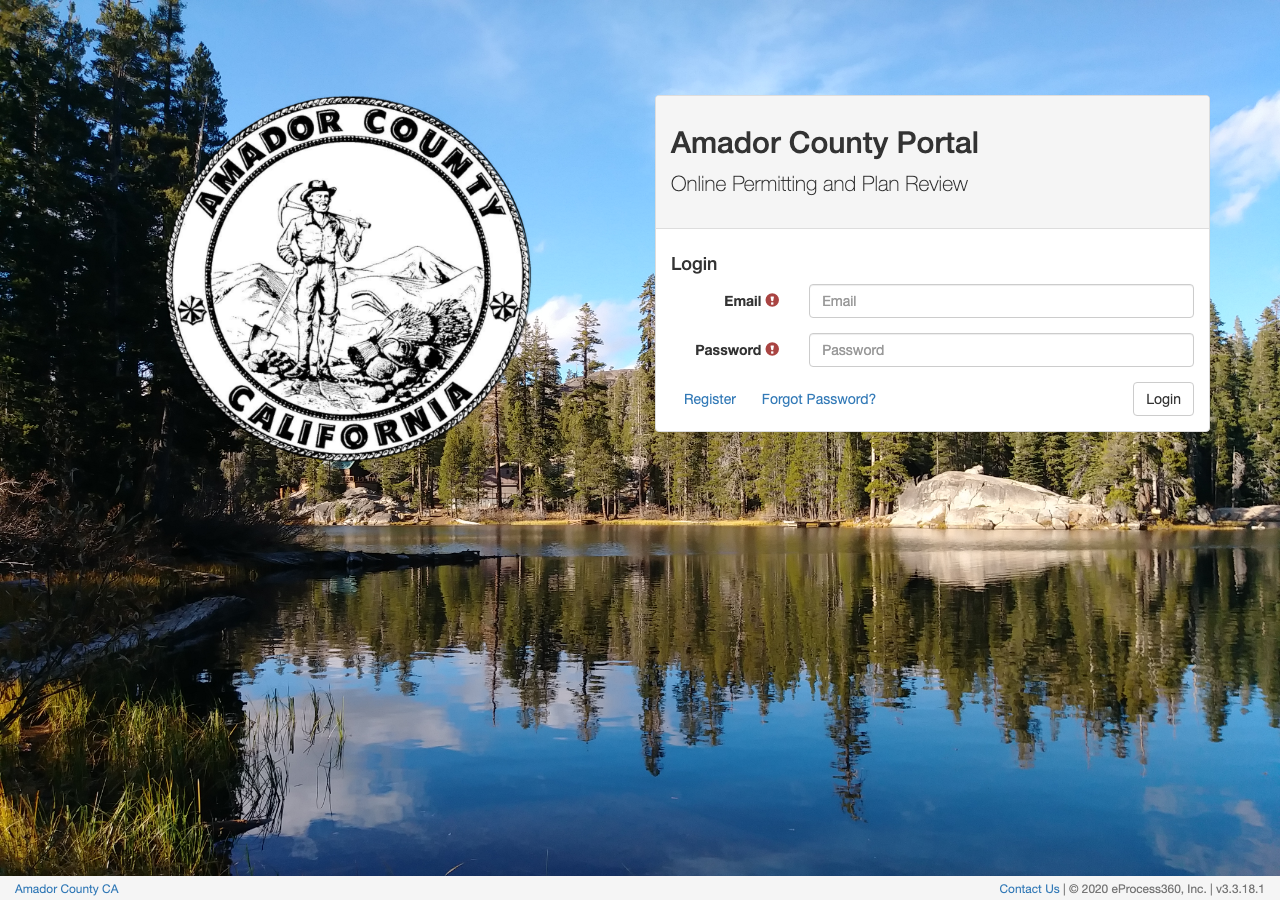
eProcess360 — branded on the county's site as the 'Building Permit Portal', hosted at amador.co.ca.eprocess360.com.
Why the confidence is not higherLinked directly from the Building Department's main page and its dedicated Building Permit Portal page; the portal itself loads live and identifies as 'Amador County Portal – Online Permitting and Plan Review'.
portal landing page checked 2026-08-30 https://amador.co.ca.eprocess360.com/
Q21 Can the whole application be completed online? Core Portal & process
Yes — the Building Department's own page states applications are 'accepted and permits are issued in person or online', and the Building Permit Portal page describes applying digitally, uploading documents, and paying online by credit card end-to-end; in-person submittal remains available as an alternative rather than the online path being partial.
Why the confidence is not higherCombination of the Building Department main page and the Building Permit Portal page; did not test the live apply-and-pay workflow end-to-end this session (would require creating a portal account).
department page checked 2026-08-30 https://www.amadorcounty.gov/departments/building/building-permit-portal
Q22 Which utility handles interconnection here? Core Utility interconnection
PG&E (Pacific Gas & Electric).
Why the confidence is not higherNot from PowerToChoose. The county's own Planning Department 'Amador County Energy Action Plan' page links exclusively to PG&E programs for every renewable-energy and rebate resource on the page (PG&E Home Money Saver, Energy House Calls presented by PG&E, PG&E Solar and Renewables, PG&E Financing Options for Solar, PG&E's 25 Money Saving Tips booklet) and refers to 'a net metering agreement with the local utility' in the same breath as those PG&E links — no other utility is named anywhere on the page.
county department page checked 2026-08-30 https://www.amadorcounty.gov/departments/planning/amador-county-energy-action-plan
Q23 Where does the utility sit in the sequence? Core Utility interconnection
After permit. Amador County Code §15.04.080 (Utility company connections) makes it unlawful for 'any person or utility company to supply electric power to any building or structure for which a building permit is required... prior to the final inspection and approval thereof by the building department.' PG&E's own Electric Rule 21 (§D.13.b, Advice 7692-E) separately requires 'evidence of Applicant's final electric inspection clearance from the Governmental Authority having jurisdiction' before it will normally process a NEM/NBT Interconnection Request (Permission to Operate).
Why the confidence is not higherBoth sources read and quoted directly by me this session (not inherited): the county ordinance text via eCode360, and PG&E's tariff PDF (CreationDate 25 Jun 2026, Advice 7692-E, effective 29 Aug 2025) via pdftotext of the full 290-page document.
codified ordinance + utility tariff checked 2026-08-30 https://ecode360.com/46590241
Q24 Is a HOA or architectural approval required first? Overlays & special cases
Nothing published by this authority.
Where we lookedAmador's zoning code (Title 19) was checked chapter-by-chapter (19.04 through 19.88) for a design-review or HOA-approval trigger specific to solar; none exists. Chapter 19.48 (General Provisions and Exceptions) and 19.28 (Additional Uses) were read in full — no HOA/architectural-approval clause for solar. California's Solar Rights Act (Civil Code §714/§4600) would preempt a private HOA's ability to disapprove solar regardless, but that is state law, not an Amador-specific document.
Q25 Is there a historic-district review? Overlays & special cases
Nothing published by this authority.
Where we lookedChapters 19.28 (Additional Uses) and 19.48 (General Provisions and Exceptions) were read in full for a historic-district or design-review trigger applicable to solar; none found. Did not read every other Title 19 chapter (e.g. a possible standalone Design Review chapter was not located in the TOC of Title 19 as fetched), so this is a partial rather than exhaustive check.
Q26 Is a wind or windstorm certification required? Overlays & special cases
No — California does not use a Texas-DOI/TDI-style separate wind-certification program; wind loads are addressed through the adopted 2025 CBC's structural provisions (ASCE 7-based design).
Why the confidence is not higherGeneral California-practice inference, not an Amador-specific document confirming the absence; matches the structure of other CA counties reviewed in this survey.
codified ordinance (general inference) checked 2026-08-30 https://ecode360.com/46590241
Q27 Is a Specific Use Permit or Council approval ever required? Overlays & special cases
No — unlike Amador's zoning code, which requires a Use Permit for 'Small wind energy systems' (§19.48.170) on parcels ≥10 acres, there is no equivalent named Use Permit trigger for solar anywhere in Title 19. Roof-mount and ground-mount PV appear to fall under the general 'Accessory buildings' allowance (§19.28.010(C)), which is a by-right use subject only to the ordinary accessory-building setback/height rules in Chapter 19.48, not a discretionary permit.
Why the confidence is not higherDirect textual contrast: §19.48.170 (Small Wind Energy Systems) is a fully built-out use-permit section (purpose, definitions, use-permit requirement, development standards, abandonment/performance-security provisions); no comparable 'Solar Energy Systems' section exists anywhere in Title 19's table of contents, which was read in full. Note: §19.28.010(C) cites 'Section 19.48.115' for accessory-building standards, but no §19.48.115 exists in the current (2026-04-14) Chapter 19.48 table of contents — a stale/broken cross-reference in the current code, flagged rather than resolved.
codified ordinance checked 2026-08-30 https://ecode360.com/46591955
Q28 Is there a system-size cap on residential generation? Overlays & special cases
Nothing published by this authority.
Where we lookedTitle 19 was checked (Chapters 19.28 and 19.48 in full, plus the TOC of all Title 19 chapters) for a kW or generation-size cap on residential solar; none found. The only numeric cap found for structures generally is the base-district height limit applied to accessory buildings via §19.48.090, which is not solar-specific.
Lines marked with a percentage were read off this authority’s own published documents. Unmarked guidance is general good practice, not this jurisdiction’s rule — always confirm against the authority before you submit.
Install 5 steps · 20 questions
-
Build to the code editions actually in force here
The NEC edition a jurisdiction enforces is often a cycle behind the newest one published, and local amendments sit on top of it. Rapid shutdown, conductor sizing and labelling all change between editions, so the edition in force is the first thing to establish, not the last.
- Which NEC edition is in force? 2025 California Electrical Code (Title 24, Part 3), which the county's own ordinance text describes as 'based on the 2024 Edition National Electric Code' — flagged as an anomaly: there is no 2024 edition of the NEC (NFPA 70 is issued on a 2017/2020/2023/2026 cycle), so this is very likely an uncorrected drafting error in the ordinance meant to say 2023 NEC (the standard basis for the 2025 CEC statewide). Recorded as written, not silently corrected. 80% · codified ordinance
- Which building code edition is in force? 2025 California Building Code (Title 24, Part 2), adopted along with the full matched 2025 code cycle (CRC, CEC, CMC, CPC, Energy Code, Historical Building Code, Fire Code, Existing Building Code, Green Building Standards Code, Referenced Standards Code, plus the 2024 International Property Maintenance Code) by Ordinance 1868, effective 12/16/2025. 96% · codified ordinance
- Which fire code edition is in force? 2025 California Fire Code (Title 24, Part 9), adopted in the same ordinance (1868, 12/16/2025) as the rest of the 2025 code cycle. 96% · codified ordinance
- Are there local amendments to any of the above? Yes. Chapter 15.04 carries multiple local amendments: Board of Appeals composition (§.020); an added automatic-sprinkler trigger at 5,000 sq ft fire area for all R-3 occupancies (§.025); a Sierra-elevation snow-load table from 20 PSF (0–1,000 ft) up to 270 PSF (7,001–8,000 ft) added to CBC §1608A (§.030); deletion of the standard annual-permit sections 105.1.1/.1.2 (§.035); an added agricultural-building permit exemption with detailed conditions (§.040); a 180-day-inactivity expiration rule added to CBC §105.5 (§.045); investigation-fee and refund amendments (§.050/.055); grading exemptions up to 500 cubic yards with conditions (§.060); a high-elevation LPG gas-leak-detector requirement (§.070); and local temporary-power-permit/utility-connection/liability provisions (§.075/.080/.090). 92% · codified ordinance
- What is the installation judged against? The adopted 2025 CEC (whose stated National Electrical Code basis is written as '2024' in the ordinance — see q29 flag), together with the general Article 690/705/706 framework it carries forward, plus PG&E Electric Rule 21's interconnection design/operating requirements (visible disconnect, marking) for anything that connects to the grid. 70% · codified ordinance + utility tariff
-
Fire access, setbacks and pathways
Ridge setbacks and roof access pathways are fire-service requirements and they constrain the array layout. They are the most common cause of a redesign after the fire department comments on a plan set.
- What ridge setback and access pathways are required? No Amador-specific ridge-setback or roof-pathway rule was found; this would be governed by the adopted 2025 California Fire Code's own standard photovoltaic pathway/setback provisions (Chapter 6, based on the 2024 IFC per the Title 24 Part 9 adoption pattern), with no local amendment on top. Amador's own Chapter 15.30 (Fire and Life Safety) covers driveway width/grade/turnaround and defensible-space setbacks for NEW construction in the State Responsibility Area (SRA) generally — not roof-mounted PV pathways — and by its own §15.30.030 scope clause applies only to new construction/new parcels approved after 1/1/1991, exempting 'existing structures', so a PV retrofit on an existing house would not trigger this chapter at all. 65% · codified ordinance
-
Rapid shutdown
Which rapid-shutdown rule applies follows directly from the NEC edition in force, and the initiation device has to be at a location the fire service can reach and identify. This is inspected, and it is labelled.
- Is rapid shutdown required, and to which NEC edition? Required, under the currently adopted 2025 CEC (Title 24 Part 3) Article 690.12 — the county's full, unamended adoption of the CEC by reference carries this forward, with no local deletion or exception found anywhere in Chapter 15.04. 75% · codified ordinance
-
Labels and placards
The NEC sets a baseline for permanent markings at the service equipment and the disconnecting means. On top of that, an authority may specify its own wording, and the utility may specify more again. Where any of them writes its own text, a generic off-the-shelf label set will not pass — this is the detail most often fixed on a return visit.
- Which placards does this authority require at the service equipment? Two things, neither Amador-specific: (1) a general county Building Permit placard/card requirement is implied by the code (§§105 administration provisions carried forward from the adopted CBC), though the department's page notes 'Inspection cards will no longer be issued. All inspections will be recorded in the portal' — so a physical card/placard may no longer be used at all for scheduling; (2) at the service equipment itself, the standard CEC Article 690 Part VI / §705.10(B)(2) warning/marking labels apply because the county adopts the CEC by reference, without a locally customized placard template. 55% · department page (+ code adoption, inferred)
- Does the UTILITY specify placards beyond the AHJ's? Yes — PG&E's Electric Rule 21 (§H.1.d, 'Visible Disconnect Required') independently requires a ganged, manually-operated isolating switch near the Point of Interconnection with markings/signage clearly indicating open/closed positions, shown on the submitted single-line diagram with its type/location pre-approved by PG&E, and — if not adjacent to the Point of Common Coupling — 'permanent signage must be installed at a Distribution Provider approved location.' 85% · utility tariff
- Where must the labels be placed? At the service equipment / point of interconnection and on the visible AC disconnect, per PG&E Rule 21's disconnect-marking requirement (see q42); Amador's own code adds no additional Amador-specific label-placement rule on top of the standard CEC Article 690/705 marking locations it adopts by reference. 60% · utility tariff
-
Disconnect, storage and listed equipment
Where the AC disconnect must sit relative to the meter is usually the utility's rule, not the building department's. Battery storage frequently carries its own permit, its own inspection and its own fire conditions.
- Where must the AC disconnect be, relative to the meter? Not specified with a dimension by Amador. PG&E's Electric Rule 21 requires the visible manual disconnect to be near the Point of Interconnection, reachable without obstacles or special keys, capable of being locked open, and shown/approved on the submitted single-line diagram — but the public tariff does not give a specific 'X inches from the meter' figure. That level of physical-placement detail would sit in PG&E's gated Distributed Generation interconnection handbook (TD-2306M), not reached this session. 60% · utility tariff
- Are batteries permitted, and under what conditions? Likely permitted, governed by the adopted 2025 CFC/CEC generically (Article 706 and CFC energy-storage provisions carried forward by reference); no Amador-specific battery/ESS ordinance (quantity limits, standoff distances, etc.) was found anywhere in Title 15. 58% · codified ordinance (absence)
- Is a ground mount treated as a structure? Likely yes, by the same general framework that governs any detached accessory structure — Amador's zoning code treats 'Accessory buildings' as a designated allowed use (§19.28.010(C)) subject to the ordinary detached-accessory-building setback rules (§19.48.110: 6 ft from main building and most property lines) and height rules (§19.48.090); the General Information residential guide separately requires a 'Foundation Plan' for structures generally. No document states in so many words that a ground-mounted solar array specifically 'is a structure.' 62% · codified ordinance (inference)
20 questions answered against Amador County’s own published documents
Q29 Which NEC edition is in force? Core Code editions in force
2025 California Electrical Code (Title 24, Part 3), which the county's own ordinance text describes as 'based on the 2024 Edition National Electric Code' — flagged as an anomaly: there is no 2024 edition of the NEC (NFPA 70 is issued on a 2017/2020/2023/2026 cycle), so this is very likely an uncorrected drafting error in the ordinance meant to say 2023 NEC (the standard basis for the 2025 CEC statewide). Recorded as written, not silently corrected.
Why the confidence is not higherDirect quote from Amador County Code §15.04.010(D), current text under Ord. 1868 (12/16/2025), read via eCode360 (code current through 2026-04-14).
codified ordinance checked 2026-08-30 https://ecode360.com/46590241
Q30 Which building code edition is in force? Core Code editions in force
2025 California Building Code (Title 24, Part 2), adopted along with the full matched 2025 code cycle (CRC, CEC, CMC, CPC, Energy Code, Historical Building Code, Fire Code, Existing Building Code, Green Building Standards Code, Referenced Standards Code, plus the 2024 International Property Maintenance Code) by Ordinance 1868, effective 12/16/2025.
Why the confidence is not higherDirect read of the current codified adoption section §15.04.010, listing all 2025-edition parts by letter (A through M).
codified ordinance checked 2026-08-30 https://ecode360.com/46590241
Q31 Which fire code edition is in force? Code editions in force
2025 California Fire Code (Title 24, Part 9), adopted in the same ordinance (1868, 12/16/2025) as the rest of the 2025 code cycle.
Why the confidence is not higherSame source as q29/q30, item I.
codified ordinance checked 2026-08-30 https://ecode360.com/46590241
Q32 Are there local amendments to any of the above? Core Code editions in force
Yes. Chapter 15.04 carries multiple local amendments: Board of Appeals composition (§.020); an added automatic-sprinkler trigger at 5,000 sq ft fire area for all R-3 occupancies (§.025); a Sierra-elevation snow-load table from 20 PSF (0–1,000 ft) up to 270 PSF (7,001–8,000 ft) added to CBC §1608A (§.030); deletion of the standard annual-permit sections 105.1.1/.1.2 (§.035); an added agricultural-building permit exemption with detailed conditions (§.040); a 180-day-inactivity expiration rule added to CBC §105.5 (§.045); investigation-fee and refund amendments (§.050/.055); grading exemptions up to 500 cubic yards with conditions (§.060); a high-elevation LPG gas-leak-detector requirement (§.070); and local temporary-power-permit/utility-connection/liability provisions (§.075/.080/.090).
Why the confidence is not higherDirect read of the full current §15.04 chapter text (Ord. 1868, 12/16/2025).
codified ordinance checked 2026-08-30 https://ecode360.com/46590241
Q33 What is the installation judged against? Core Electrical
The adopted 2025 CEC (whose stated National Electrical Code basis is written as '2024' in the ordinance — see q29 flag), together with the general Article 690/705/706 framework it carries forward, plus PG&E Electric Rule 21's interconnection design/operating requirements (visible disconnect, marking) for anything that connects to the grid.
Why the confidence is not higherCombines the adoption ordinance (§15.04.010) with PG&E's own current tariff; Amador publishes no solar-specific self-certification or inspection checklist (unlike Calaveras) that would show which CEC articles field inspectors actually check, so the practical-enforcement half of this answer is inferred rather than directly documented.
codified ordinance + utility tariff checked 2026-08-30 https://ecode360.com/46590241
Q34 Is there a local rule on service upgrades or busbar sizing? Electrical
Nothing published by this authority.
Where we lookedChapter 15.04 (all sections .010 through .090) was read in full for a local service-upgrade or busbar-sizing amendment (e.g. a 120%-rule ordinance or main-breaker amendment); none exists. Positive control ('permit') hits 20+ times in the extracted chapter text; fabricated control ('zzqqx') returns zero hits, confirming extraction was working, so this is a genuine absence.
Q35 Is a specific mounting system or attachment spacing required? Structural & mounting
Nothing published by this authority.
Where we lookedChapter 15.04 and Chapter 15.30 (Fire and Life Safety) were both read in full for a county-specific PV mounting/attachment-spacing standard; neither contains one. No solar-specific self-certification form (of the kind Calaveras publishes) exists for Amador to check for a manufacturer-spec-only clause.
Q36 What ridge setback and access pathways are required? Core Fire pathways & setbacks
No Amador-specific ridge-setback or roof-pathway rule was found; this would be governed by the adopted 2025 California Fire Code's own standard photovoltaic pathway/setback provisions (Chapter 6, based on the 2024 IFC per the Title 24 Part 9 adoption pattern), with no local amendment on top. Amador's own Chapter 15.30 (Fire and Life Safety) covers driveway width/grade/turnaround and defensible-space setbacks for NEW construction in the State Responsibility Area (SRA) generally — not roof-mounted PV pathways — and by its own §15.30.030 scope clause applies only to new construction/new parcels approved after 1/1/1991, exempting 'existing structures', so a PV retrofit on an existing house would not trigger this chapter at all.
Why the confidence is not higherChapter 15.30 was read in full (all ~50 sections); §15.30.030 (Scope) was quoted directly for the new-construction/SRA limitation. No solar-specific fire-code amendment exists in Amador's current code to confirm or contradict the standard adopted CFC pathway provisions.
codified ordinance checked 2026-08-30 https://ecode360.com/46590625
Q37 Is rapid shutdown required, and to which NEC edition? Core Rapid shutdown
Required, under the currently adopted 2025 CEC (Title 24 Part 3) Article 690.12 — the county's full, unamended adoption of the CEC by reference carries this forward, with no local deletion or exception found anywhere in Chapter 15.04.
Why the confidence is not higherCode-edition adoption is high-confidence and current (Ord. 1868, 12/16/2025); however Amador publishes no solar-specific inspection checklist or self-certification form (unlike Calaveras' E-Inspect form) that would show whether county inspectors specifically cite §690.12 in practice, so the practical-enforcement half of this answer is inferred from the code adoption alone, not from an inspection document.
codified ordinance checked 2026-08-30 https://ecode360.com/46590241
Q38 Which placards does this authority require at the service equipment? Core Labels Signage & labelling
Two things, neither Amador-specific: (1) a general county Building Permit placard/card requirement is implied by the code (§§105 administration provisions carried forward from the adopted CBC), though the department's page notes 'Inspection cards will no longer be issued. All inspections will be recorded in the portal' — so a physical card/placard may no longer be used at all for scheduling; (2) at the service equipment itself, the standard CEC Article 690 Part VI / §705.10(B)(2) warning/marking labels apply because the county adopts the CEC by reference, without a locally customized placard template.
Why the confidence is not higherItem (1) is a direct quote from the Building Department's main page about the shift away from paper inspection cards; item (2) is inferred from the code adoption, since no Amador document supplies its own placard template (checked Forms & Brochures and General Info documents).
department page (+ code adoption, inferred) checked 2026-08-30 https://www.amadorcounty.gov/departments/building
Q39 Does the authority specify placard wording of its own? Core Labels Signage & labelling
Nothing published by this authority.
Where we lookedChecked the Forms & Brochures list, the General Information for Residential Building Permits guide, and Chapter 15.04 in full for any Amador-authored placard wording template; none found. No solar-specific document exists to check against directly.
https://www.amadorcounty.gov/departments/building/forms-brochures
Q40 Does it specify letter height, colour or material? Core Labels Signage & labelling
Nothing published by this authority.
Where we lookedSame documents checked as q39 for letter height, colour, or material specification; none found.
https://www.amadorcounty.gov/departments/building/forms-brochures
Q41 Is a site plan / facility map placard required, and what must it show? Core Labels Signage & labelling
Nothing published by this authority.
Where we lookedChecked the General Information residential site-plan requirements and the Forms & Brochures list for a separate facility-map/directory placard requirement distinct from the ordinary site plan; none found.
https://www.amadorcounty.gov/home/showpublisheddocument/211/638120618838970000
Q42 Does the UTILITY specify placards beyond the AHJ's? Core Labels Signage & labelling
Yes — PG&E's Electric Rule 21 (§H.1.d, 'Visible Disconnect Required') independently requires a ganged, manually-operated isolating switch near the Point of Interconnection with markings/signage clearly indicating open/closed positions, shown on the submitted single-line diagram with its type/location pre-approved by PG&E, and — if not adjacent to the Point of Common Coupling — 'permanent signage must be installed at a Distribution Provider approved location.'
Why the confidence is not higherDirect quote extracted myself via pdftotext from PG&E's own current CPUC tariff (Advice 7692-E, effective 29 Aug 2025, PDF CreationDate 25 Jun 2026) — not inherited from another agent's read, and re-verified this session. This is a statewide PG&E requirement, correctly attributed to the utility rather than the county.
utility tariff checked 2026-08-30 https://www.pge.com/tariffs/assets/pdf/tariffbook/ELEC_RULES_21.pdf
Q43 Where must the labels be placed? Core Labels Signage & labelling
At the service equipment / point of interconnection and on the visible AC disconnect, per PG&E Rule 21's disconnect-marking requirement (see q42); Amador's own code adds no additional Amador-specific label-placement rule on top of the standard CEC Article 690/705 marking locations it adopts by reference.
Why the confidence is not higherCombines PG&E Rule 21 (verified directly) with the absence of any Amador-specific placement document (checked Forms & Brochures, General Info guide, Chapter 15.04).
utility tariff checked 2026-08-30 https://www.pge.com/tariffs/assets/pdf/tariffbook/ELEC_RULES_21.pdf
Q44 Must equipment be on a specific approved list? Equipment listing
Nothing published by this authority.
Where we lookedChecked the General Information guide, Forms & Brochures list, and Chapter 15.04 for a county-maintained approved-equipment list for solar; none found — only the standard CEC/UL listing requirement applies via code adoption.
https://www.amadorcounty.gov/home/showpublisheddocument/211/638120618838970000
Q45 Are batteries permitted, and under what conditions? Core Battery / ESS
Likely permitted, governed by the adopted 2025 CFC/CEC generically (Article 706 and CFC energy-storage provisions carried forward by reference); no Amador-specific battery/ESS ordinance (quantity limits, standoff distances, etc.) was found anywhere in Title 15.
Why the confidence is not higherAbsence proven by reading Chapter 15.04 (adoption/amendments) and Chapter 15.30 (Fire and Life Safety) in full — neither contains a 'battery' or 'energy storage' heading; positive control ('driveway', 'permit') and fabricated control ('zzqqx') both run against the same extracted text confirm this is a genuine absence rather than a search failure. No Amador-specific self-certification form exists (unlike Calaveras) to confirm what conditions are actually checked in practice.
codified ordinance (absence) checked 2026-08-30 https://ecode360.com/46590625
Q46 Is there a separate ESS permit or inspection? Battery / ESS
Nothing published by this authority.
Where we lookedChecked the two fee documents found (Single Family Dwelling – Estimated Fees; General Information guide) for a separate ESS/battery permit or fee line; neither has one.
https://www.amadorcounty.gov/home/showpublisheddocument/55670/638908398028370000
Q47 Is a ground mount treated as a structure? Core Ground mount
Likely yes, by the same general framework that governs any detached accessory structure — Amador's zoning code treats 'Accessory buildings' as a designated allowed use (§19.28.010(C)) subject to the ordinary detached-accessory-building setback rules (§19.48.110: 6 ft from main building and most property lines) and height rules (§19.48.090); the General Information residential guide separately requires a 'Foundation Plan' for structures generally. No document states in so many words that a ground-mounted solar array specifically 'is a structure.'
Why the confidence is not higherCombination of the zoning code's general accessory-building framework and the general residential submittal guide's foundation-plan requirement; neither document is solar-specific, so this is an inference by analogy rather than a direct statement.
codified ordinance (inference) checked 2026-08-30 https://ecode360.com/46592089
Q48 Where must the AC disconnect be, relative to the meter? Core Utility equipment
Not specified with a dimension by Amador. PG&E's Electric Rule 21 requires the visible manual disconnect to be near the Point of Interconnection, reachable without obstacles or special keys, capable of being locked open, and shown/approved on the submitted single-line diagram — but the public tariff does not give a specific 'X inches from the meter' figure. That level of physical-placement detail would sit in PG&E's gated Distributed Generation interconnection handbook (TD-2306M), not reached this session.
Why the confidence is not higherRule 21 (verified directly this session) answers the functional requirements but not an exact physical dimension; the more detailed document was not attempted this session, consistent with it being described elsewhere as access-gated to PG&E Job Owners.
utility tariff checked 2026-08-30 https://www.pge.com/tariffs/assets/pdf/tariffbook/ELEC_RULES_21.pdf
Lines marked with a percentage were read off this authority’s own published documents. Unmarked guidance is general good practice, not this jurisdiction’s rule — always confirm against the authority before you submit.
Inspection 5 steps · 14 questions
-
Book it
Booking is a portal, a phone call or an email depending on the authority, and the notice required is rarely zero. Book before the work is finished rather than after — the lead time, not the work, is usually what sets the date.
- How is an inspection booked? Portal or Phone — the Building Department's own page states 'Inspections must be requested via the Hotline: (209) 223-6423' and separately notes 'Inspection cards will no longer be issued. All inspections will be recorded in the portal,' indicating the eProcess360 portal is now the system of record for inspection status alongside phone-in scheduling. 82% · department page
-
Know who turns up
Some authorities inspect their own solar work; some delegate it, and a few do not inspect the PV equipment itself at all. Who is coming determines what they will look at.
- Does this AHJ perform its own final solar inspection? Yes — the county Building Department performs its own field inspections (via its own Inspection Hotline and inspectors); no self-certification/E-Inspect-style delegation program (of the kind Calaveras runs) was found anywhere on Amador's Building Department pages or Forms & Brochures list. 78% · department page
- If delegated, to whom? N/A — not delegated; the county performs its own final inspections (see q52). 70% · department page
-
Work the stages in order
A rough-in or mid-roof inspection, where one is required, has to happen before the work it covers is closed up. Missing a stage means opening something back up, and it is the most expensive kind of correction.
Nothing recorded for Amador County on this step yet — 2 questions checked and found unpublished. The guidance above is general.
-
Have the paperwork on site
The approved plan set, the permit, and the equipment listings should be on site and reachable. Inspectors routinely verify that installed equipment matches what was approved, and that the labels are the ones the plan set promised.
- Is there a published inspection checklist? No — Amador's Building Department does not publish a dedicated inspection checklist (solar-specific or general) comparable to Calaveras' Picture Instructions / E-Inspect Solar Checklist. 60% · forms list (absence)
-
Sign-off, and permission to operate
Passing gives you a final or an equivalent sign-off. That is not the same as permission to operate: PTO comes from the utility, and who tells the utility the inspection passed varies. A system left switched off for weeks is usually waiting on this handover.
- What is issued on pass? Likely 'Final' — inferred from the portal-centric process description (permits and their inspection status are tracked/closed out in eProcess360) — no Amador document uses the words 'Certificate of Occupancy', 'green tag', or 'Final' by name for a solar permit specifically. 45% · department page (inference)
- Who notifies the utility for PTO? Installer/Applicant — under PG&E Rule 21, the Producer (applicant/installer) submits the NEM/NBT Interconnection Request together with evidence of the AHJ's final inspection clearance; PG&E does not proactively pull this from the county. 82% · utility tariff
- How are corrections issued and cleared? Via plan resubmittal: the General Information guide states 'Any change to the scope of work/plans must be approved prior to calling for inspections. The approved set of plans must be resubmitted to the Building Department along with the revisions clouded for approval... A plan review fee based on the current hourly rate is due for each change.' The countywide FAQ separately notes that field corrections found at inspection must be brought up to the minimum code even if an error slipped through plan approval. 65% · submittal guide + FAQ
14 questions answered against Amador County’s own published documents
Q49 How is an inspection booked? Core Booking & scheduling
Portal or Phone — the Building Department's own page states 'Inspections must be requested via the Hotline: (209) 223-6423' and separately notes 'Inspection cards will no longer be issued. All inspections will be recorded in the portal,' indicating the eProcess360 portal is now the system of record for inspection status alongside phone-in scheduling.
Why the confidence is not higherDirect quotes from the Building Department main page and the Building Permit Portal page, both current (2025/2026 notices).
department page checked 2026-08-30 https://www.amadorcounty.gov/departments/building
Q50 How much notice is required? Core Booking & scheduling
Nothing published by this authority.
Where we lookedChecked the Building Department main page, the Building Permit Portal page, and the department FAQ page for a stated minimum-notice period (e.g. 'next business day' or '24 hours') for booking an inspection; none of the three states one for Amador (contrast with Calaveras, which publishes an explicit same-day cutoff).
Q51 Are same-day or AM/PM windows offered? Booking & scheduling
Nothing published by this authority.
Where we lookedSame three pages checked as q50 for AM/PM or same-day inspection window language; none found.
Q52 Does this AHJ perform its own final solar inspection? Core Who inspects
Yes — the county Building Department performs its own field inspections (via its own Inspection Hotline and inspectors); no self-certification/E-Inspect-style delegation program (of the kind Calaveras runs) was found anywhere on Amador's Building Department pages or Forms & Brochures list.
Why the confidence is not higherPositive statement from the department's own pages (Hotline-based inspection scheduling, no portal-only self-cert option mentioned); absence of any 'E-Inspect', 'self-certification', or photo-based-compliance program checked across the Building main page, FAQ page, Forms & Brochures page, and Building Permit Portal page — all read in full, none mention such a program.
department page checked 2026-08-30 https://www.amadorcounty.gov/departments/building
Q53 If delegated, to whom? Core Who inspects
N/A — not delegated; the county performs its own final inspections (see q52).
Why the confidence is not higherSame basis as q52.
department page checked 2026-08-30 https://www.amadorcounty.gov/departments/building
Q54 Which inspections are required, and in what order? Core Stages & sequence
Nothing published by this authority.
Where we lookedChecked the Building Department's main page, FAQ page, and Forms & Brochures list for a published inspection-stage sequence (e.g. rough electrical, mid-roof, final) specific to solar; none exists. No solar-specific inspection document was found for Amador to source a sequence from.
Q55 Is a rough-in or mid-roof inspection required? Stages & sequence
Nothing published by this authority.
Where we lookedSame documents checked as q54; no rough-in/mid-roof inspection requirement is named anywhere for Amador, solar-specific or otherwise.
Q56 Does the inspector verify labels and listings? Core What is checked
Nothing published by this authority.
Where we lookedChecked for a published inspection checklist (see q57 — none exists) that would state whether the inspector verifies labels/listings; without such a document, no page states this explicitly for Amador.
Q57 Is there a published inspection checklist? Core What is checked
No — Amador's Building Department does not publish a dedicated inspection checklist (solar-specific or general) comparable to Calaveras' Picture Instructions / E-Inspect Solar Checklist.
Why the confidence is not higherThe Building Department's main page, FAQ page, Forms & Brochures page, and Building Permit Portal page were all read in full; none links or describes an inspection checklist document. This is a genuine, checked absence across every Building Department page found, not an unresearched gap.
forms list (absence) checked 2026-08-30 https://www.amadorcounty.gov/departments/building/forms-brochures
Q58 What must be on site at inspection? Core Documents on site
Nothing published by this authority.
Where we lookedChecked the Building Department's main page, FAQ page, and Forms & Brochures list for a stated list of what must be on site at inspection (plans, permit card, etc.); none found specific to Amador or to solar. The department's note that 'Inspection cards will no longer be issued' suggests a printed card is no longer part of the answer, but no replacement 'must have on site' list was published.
Q59 Is there a re-inspection fee? Corrections & re-inspection
Nothing published by this authority.
Where we lookedChecked the 'Single Family Dwelling – Estimated Fees' schedule for a re-inspection fee line; none exists. No other Amador fee document was found to check.
https://www.amadorcounty.gov/home/showpublisheddocument/55670/638908398028370000
Q60 How are corrections issued and cleared? Corrections & re-inspection
Via plan resubmittal: the General Information guide states 'Any change to the scope of work/plans must be approved prior to calling for inspections. The approved set of plans must be resubmitted to the Building Department along with the revisions clouded for approval... A plan review fee based on the current hourly rate is due for each change.' The countywide FAQ separately notes that field corrections found at inspection must be brought up to the minimum code even if an error slipped through plan approval.
Why the confidence is not higherCombines a direct quote from the General Information guide (generic, not solar-specific) with the countywide FAQ's plan-approval-does-not-waive-code-minimum answer; no single Amador document lays out a full corrections-and-clearance workflow end-to-end.
submittal guide + FAQ checked 2026-08-30 https://www.amadorcounty.gov/home/showpublisheddocument/211/638120618838970000
Q61 What is issued on pass? Core Final sign-off & PTO
Likely 'Final' — inferred from the portal-centric process description (permits and their inspection status are tracked/closed out in eProcess360) — no Amador document uses the words 'Certificate of Occupancy', 'green tag', or 'Final' by name for a solar permit specifically.
Why the confidence is not higherNo document states what is issued on a passing final inspection for a residential solar retrofit; this is an inference from the general portal-based permit-closeout model described on the Building Permit Portal page, not a direct statement.
department page (inference) checked 2026-08-30 https://www.amadorcounty.gov/departments/building/building-permit-portal
Q62 Who notifies the utility for PTO? Core Final sign-off & PTO
Installer/Applicant — under PG&E Rule 21, the Producer (applicant/installer) submits the NEM/NBT Interconnection Request together with evidence of the AHJ's final inspection clearance; PG&E does not proactively pull this from the county.
Why the confidence is not higherDirect reading of PG&E Rule 21 §D.13.b's process description (verified myself this session, not inherited); this is a utility-level answer, correctly attributed to PG&E rather than Amador County.
utility tariff checked 2026-08-30 https://www.pge.com/tariffs/assets/pdf/tariffbook/ELEC_RULES_21.pdf
Lines marked with a percentage were read off this authority’s own published documents. Unmarked guidance is general good practice, not this jurisdiction’s rule — always confirm against the authority before you submit.
Jurisdiction & key facts
The standing 62-question set, answered for Amador County against this authority’s own published documents. Every answer carries the confidence it was recorded at and the document it came from. Where nothing is published we say so and show where we looked — a blank here is a finding, not a gap.
Amador County is the authority having jurisdiction 80% confidence
- Holds
- Building AND Electrical, for UNINCORPORATED Amador County only. Amador has five incorporated cities — Jackson, Sutter Creek, Ione, Plymouth, Amador City — each a separate legal jurisdiction outside county authority.
- Overridden by
- PG&E Electric Rule 21 (§D.13.b) requires 'evidence of Applicant's final electric inspection clearance from the Governmental Authority having jurisdiction over the Generating Facility' before PG&E will process Permission to Operate — i.e. the county's own final inspection must clear before PG&E energizes/approves interconnection. Also, Amador County Code §15.04.080 independently makes it 'unlawful for any person or utility company to supply electric power' before the Building Department's final inspection and approval.
- Why not higher
- The Building Department's own current page states plainly: 'The Building Department processes building permit applications for construction in the unincorporated area of Amador County, reviews plans, issues building permits, and performs inspections' (fetched via Wayback capture of the live page, 2026-02-18, since amadorcounty.gov itself could not be reached this session — see network note). Jackson (cityofjackson.org/168/Forms-Applications-Permits) and Plymouth (cityofplymouth.org/building/) were confirmed live this session to run their own separate building/permit pages. Sutter Creek's site (suttercreek.org) and Ione's (cityofione.com, which currently renders as an unbuilt GoDaddy template) could not be confirmed to the same standard this session — flagged rather than assumed. Unlike Calaveras County, Amador's own codified Chapter 15.04 (Adoption of California Building and Related Codes) does not contain a matching verbatim carve-out sentence naming the incorporated cities; §15.04.010 just says code applies 'within the county' with no city exclusion spelled out in the section text itself, so the scope statement here rests on the department's own plain-English page plus the separate incorporation of the five cities, not on an identical codified sentence to Calaveras' §15.04.040(C)(1). (Note: amadorcounty.gov could not be reached directly this session — every connection to it, including via headless Chrome, was reset at the TLS layer; a plain HTTP request was intercepted and redirected to an AT&T 'network protected – malware' notice, and a third-party fetch proxy separately reported blocking our IP for 'bad network reputation (AS7018)', AT&T's own ASN. This is a network-level block on this session's connection, not a site or WAF issue. Content was retrieved via Wayback Machine captures of the live pages instead; each is cited with its capture timestamp.)
- Permit required
- Yes.88%
- Plan review
- Building Permit Portal (online applications): 'Applications may take up to 2 days to 4 weeks before you receive feedback, depending on the scope of work' — not solar-specific.65%
- Portal
- eProcess360 — branded on the county's site as the 'Building Permit Portal', hosted at amador.co.ca.eprocess360.com.90%
- Electrical code
- 2025 California Electrical Code (Title 24, Part 3), which the county's own ordinance text describes as 'based on the 2024 Edition National Electric Code' — flagged as an anomaly: there is…80%
- Booking an inspection
- Portal or Phone — the Building Department's own page states 'Inspections must be requested via the Hotline: (209) 223-6423' and separately notes 'Inspection cards will no longer be issued.82%
Labels & placards for this authority
Wording None%
Size, colour & material None%
Where they go 60%
At the service equipment / point of interconnection and on the visible AC disconnect, per PG&E Rule 21's disconnect-marking requirement (see q42); Amador's own code adds no additional Amador-specific label-placement rule on top of the standard CEC Article 690/705 marking locations it adopts by reference.
What the utility wants on top 85%
Yes — PG&E's Electric Rule 21 (§H.1.d, 'Visible Disconnect Required') independently requires a ganged, manually-operated isolating switch near the Point of Interconnection with markings/signage clearly indicating open/closed positions, shown on the submitted single-line diagram with its type/location pre-approved by PG&E, and — if not adjacent to the Point of Common Coupling — 'permanent signage must be installed at a Distribution Provider approved location.'
Each figure above is sourced and dated in the full answer set below (questions 38–43). Where an authority’s own published sheet is older than the code it has adopted, the answer says so.
Their website
Average approval time — application to PTO
From the CPUC interconnection record. Bars show the average days taken each year; a year with no recorded projects is left blank rather than drawn as zero.