
City and County of San Francisco
State of California
City and County of San Francisco is a county authority in the State of California. This page is the permit route for that jurisdiction: the fifteen steps from working out who has a say over an address through to permission to operate, the documents this authority publishes, and 62 answers taken from those documents and dated.
Permitting 5 steps · 28 questions
Whether a permit is needed — Yes Q3 Electrical and building permits — Either Q4 Where you file — Three linked systems: SolarAPP+ (solarapp.nrel.gov) for instant online permits; DBI's own Electrical Permitting and Inspection Scheduling portal… Q20
- Permit required
- Yes95% source
- What it costs
- $320 for a system rated 10kW or less; $259 for each additional 10kW (up to 2 inspections)90% source
- Key document
- portal landing page cited by 13 open the document
-
Confirm who has a say over your address
A city address is usually permitted by the city, not the county — but not always, and some authorities keep building and hand electrical to someone else. Getting this wrong costs the whole submittal, because every requirement below belongs to whoever actually holds jurisdiction. Check the overlays in the same pass: an HOA, a historic district, a windstorm certification or a system-size cap can reshape the design, and all of them are cheaper to find now than after the array is laid out.
- Is this authority the AHJ for residential solar at this address? Yes 95% · department page
- What does this authority permit itself, and what does it delegate? Both 90% · department page
- Is a permit required for a residential rooftop PV system? Yes 95% · department page
- Is there a separate electrical permit, or is it combined? Either 85% · department page
- Is a HOA or architectural approval required first? No 70% · department page
- Is there a historic-district review? Yes, for designated landmarks, Article 10/11 historic districts (contributory resources), and properties on/eligible for the National or State Register — SF Planning Department review (and, where triggered, Historic Preservation Commission referral under Planning Code §1005) is required before DBI will issue any solar permit on such a property, regardless of system size. 65% · secondary source (search synthesis of Planning Code Art. 10/11)
- Is a wind or windstorm certification required? No 55% · published checklist
- Is a Specific Use Permit or Council approval ever required? No — residential rooftop PV is processed administratively (electrical/solar permit); a Conditional Use/Specific Use Permit or Board of Supervisors approval is not part of the standard pathway. Exception: properties requiring Historic Preservation Commission referral (Q25) go through a Commission-level hearing, which is the closest analog. 65% · department page
- Is there a system-size cap on residential generation? No system-size cap found on residential generation itself. SolarAPP+ eligibility is capped at 4kWdc, but that is a pathway-eligibility limit — larger systems simply route through the 'Solar Permit' or 'PV Plans' tracks instead of SolarAPP+, which carry no stated kW ceiling. CA AB 1132's 15kW figure is a fee-tier break, not an installation-size cap. 55% · department page
-
Check who is allowed to apply
Several authorities require the electrical permit to be pulled by a licensed electrician, or require the contractor to be registered with them BEFORE applying. Registration is not same-day. This is second on the list rather than fourth because it is the step most likely to stop the job before the drawings matter.
- Who is allowed to pull the electrical permit? Licensed electrician 90% · department page
- Must the contractor be registered with this authority before applying? Yes 95% · department page
- Is a homeowner permitted to self-install and self-permit? Yes 75% · department page
-
Build the submittal package
Almost everywhere wants a site plan, a one-line or three-line electrical diagram, equipment cut sheets with listings, and a structural attachment detail. Build it against the published checklist rather than the last jurisdiction you worked in — the checklist is what the reviewer marks against.
- What documents make up a complete submittal? Roof plan (with fire setbacks, roof type, orientation, module/inverter/disconnect locations), at least one elevation view, a detail view of the attachment method, an electrical wiring (one-line or multi-line) diagram with wire/conduit sizes and ampacity calcs, manufacturer data sheets (current PDFs only) for major components, updated warning-label/signage sheets, and — for non-R3, ground-mounted, or ballasted projects — PE/architect-stamped structural drawings and calculations. 92% · published checklist
- How many copies, and in what format? 1 unlocked PDF file, all pages formatted for 11x17 printing, 10-point type minimum, submitted digitally (by email for PV Plans, via web portal upload for Solar Permit); DBI will scan any paper submittals. 90% · published checklist
- Is a site plan required, and what must it show? Yes — a roof plan showing roof perimeter with fire setbacks (with calculations/sprinkler notes if setback is 18"), roof type/ridges/hips/valleys/parapets, vents/skylights, property orientation, adjacent street (corner lots), and the location of modules, junction/combiner boxes, disconnects, inverters, service, and subpanels. 90% · published checklist
- Is a one-line / three-line diagram required? Yes 90% · published checklist
- Are string and conductor calculations required? Yes 88% · published checklist
- Is a structural PE stamp required, and at what threshold? Required for non-R3 occupancies, ground-mounted systems, and ballasted (non-penetrating) systems; NOT required for a standard rooftop-attached PV system on a single-family/duplex/townhouse (R-3) using an approved, listed racking system. When required, calculations and drawings must be stamped/signed by a CA-licensed civil or structural engineer. 88% · published checklist
- Is an electrical PE stamp required, and at what threshold? Not stated as a separate requirement 55% · published checklist
-
Apply and pay
Most authorities now take the whole application through a portal, and several states cap or constrain what a residential solar permit may cost. Check whether plan check is billed separately before you quote the job.
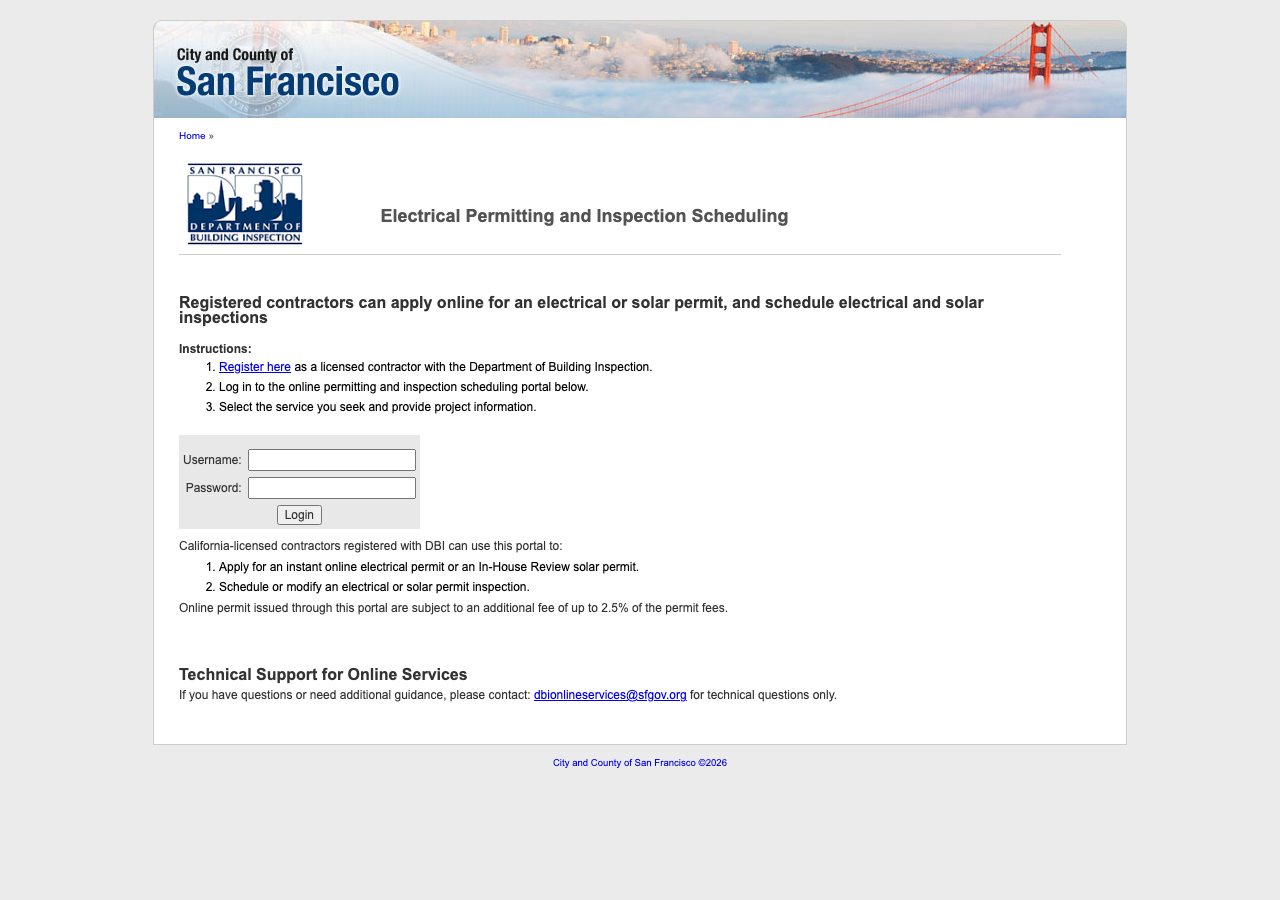
- Which permit portal does this authority use? Three linked systems: SolarAPP+ (solarapp.nrel.gov) for instant online permits; DBI's own Electrical Permitting and Inspection Scheduling portal (dbiweb02.sfgov.org/dbi_electrical) for solar/electrical permit issuance and inspection scheduling by registered contractors; and a DBI 'SolarPDFGenerate' web tool plus email to DBI.pvplans@sfgov.org for the PV Plans (multi-family/commercial) track. 88% · portal landing page
- Can the whole application be completed online? Yes, for SolarAPP+ (instant) and the online 'Solar Permit' track for single-family/duplex/townhouse; No for PV Plans (multi-family/commercial), which requires an in-person Permit Center visit to pay fees and collect the permit/job card. 85% · department page
- What does a residential solar permit cost? $320 for a system rated 10kW or less; $259 for each additional 10kW (up to 2 inspections) 90% · fee schedule
- How is the fee calculated? Tiered 88% · fee schedule
- Is there a separate plan-check fee? Yes for the online 'Solar Permit' track (fees paid when filed, and again when issued — the filing payment functions as the plan-check fee); No for PV Plans and SolarAPP+ tracks, which are paid only on issuance. 75% · department page
-
Plan review — and start the utility in parallel
Interconnection is a separate process from the permit and usually the longer pole. Where the utility does not depend on the permit being issued, running both at once is the single biggest saving available on a residential job.
- Which utility handles interconnection here? PG&E (Pacific Gas & Electric) 82% · utility territory map
- Where does the utility sit in the sequence? After permit 75% · department page
28 questions answered against City and County of San Francisco’s own published documents
Q1 Is this authority the AHJ for residential solar at this address? Core Jurisdiction & scope
Yes
Why the confidence is not higherSF.gov's own step-by-step page states DBI issues the permit for residential PV; SF is a consolidated city-county so there is no separate county AHJ to check against.
department page checked 2026-08-30 https://www.sf.gov/step-by-step--get-permit-solar-photovoltaic-system
Q2 What does this authority permit itself, and what does it delegate? Core Jurisdiction & scope
Both
Why the confidence is not higherDBI issues both building permits (for new-construction PV addenda) and electrical permits (for the PV system itself, all retrofit cases). Nothing is delegated to another jurisdiction, but SFFD holds independent, non-delegated fire-safety review/inspection authority alongside DBI — a genuine third party in the process, not DBI's delegate.
department page checked 2026-08-30 https://www.sf.gov/step-by-step--get-permit-solar-photovoltaic-system
Q3 Is a permit required for a residential rooftop PV system? Core Jurisdiction & scope
Yes
Why the confidence is not higherEvery pathway described (SolarAPP+, Solar Permit, PV Plans) requires at minimum a DBI electrical permit.
department page checked 2026-08-30 https://www.sf.gov/step-by-step--get-permit-solar-photovoltaic-system
Q4 Is there a separate electrical permit, or is it combined? Core Jurisdiction & scope
Either
Why the confidence is not higherFor new construction, PV is submitted as a building-permit addendum and a separate electrical permit is required afterward. For the far more common retrofit case, only an electrical permit is needed (no separate building permit) unless the project is ground-mounted, ballasted, or non-R3, which triggers structural/building review.
department page checked 2026-08-30 https://www.sf.gov/step-by-step--get-permit-solar-photovoltaic-system
Q5 Who is allowed to pull the electrical permit? Core Who may apply
Licensed electrician
Why the confidence is not higherOnly CA-licensed A, C-10, or C-46 (C-46 without battery storage) contractors may pull the solar/electrical permit; B contractors only for new construction/substantial remodel. A narrow owner-builder exception exists (see Q7) but is not the general rule.
department page checked 2026-08-30 https://www.sf.gov/step-by-step--get-permit-solar-photovoltaic-system
Q6 Must the contractor be registered with this authority before applying? Core Who may apply
Yes
Why the confidence is not higherPage states plainly: 'Contractors applying online for a solar permit, a PV Plans electrical permit, or for an electrical permit through SolarAPP+ must first register with DBI.'
department page checked 2026-08-30 https://www.sf.gov/step-by-step--get-permit-solar-photovoltaic-system
Q7 Is a homeowner permitted to self-install and self-permit? Who may apply
Yes
Why the confidence is not higherDBI's general electrical-permit page states 'Only owner-installers of stand-alone single family dwellings may apply for an electrical permit to do the work themselves,' subject to demonstrating competence and in-person approval by the Electrical Inspection Division — this is DBI's general electrical-permit policy (not solar-specific), but solar is pulled as an electrical permit so it applies. Confidence is not higher because no solar-specific confirmation of owner-builder eligibility was found.
department page checked 2026-08-30 https://www.sf.gov/apply-electrical-permit
Q8 What documents make up a complete submittal? Core Submittal package
Roof plan (with fire setbacks, roof type, orientation, module/inverter/disconnect locations), at least one elevation view, a detail view of the attachment method, an electrical wiring (one-line or multi-line) diagram with wire/conduit sizes and ampacity calcs, manufacturer data sheets (current PDFs only) for major components, updated warning-label/signage sheets, and — for non-R3, ground-mounted, or ballasted projects — PE/architect-stamped structural drawings and calculations.
Why the confidence is not higherDBI's own 'Prepare plans' page lists these as the required plan contents; it is current (no revision date shown but is the live, linked page from the active permit workflow).
published checklist checked 2026-08-30 https://www.sf.gov/information--prepare-plans-your-solar-panel-or-photovoltaic-pv-system
Q9 How many copies, and in what format? Submittal package
1 unlocked PDF file, all pages formatted for 11x17 printing, 10-point type minimum, submitted digitally (by email for PV Plans, via web portal upload for Solar Permit); DBI will scan any paper submittals.
Why the confidence is not higherStated verbatim on the plan-formatting page.
published checklist checked 2026-08-30 https://www.sf.gov/information--prepare-plans-your-solar-panel-or-photovoltaic-pv-system
Q10 Is a site plan required, and what must it show? Core Submittal package
Yes — a roof plan showing roof perimeter with fire setbacks (with calculations/sprinkler notes if setback is 18"), roof type/ridges/hips/valleys/parapets, vents/skylights, property orientation, adjacent street (corner lots), and the location of modules, junction/combiner boxes, disconnects, inverters, service, and subpanels.
Why the confidence is not higherDirectly listed under 'Roof plan' on DBI's plan-preparation page.
published checklist checked 2026-08-30 https://www.sf.gov/information--prepare-plans-your-solar-panel-or-photovoltaic-pv-system
Q11 Is a one-line / three-line diagram required? Core Drawings & calculations
Yes
Why the confidence is not higherPage requires an 'electrical wiring diagram (single or multiple line)' showing modules, inverters, switches, panels, wire types/sizes, conduit, and ampacity calcs.
published checklist checked 2026-08-30 https://www.sf.gov/information--prepare-plans-your-solar-panel-or-photovoltaic-pv-system
Q12 Are string and conductor calculations required? Drawings & calculations
Yes
Why the confidence is not higherSame wiring-diagram requirement explicitly lists wire types/sizes and 'ampacity calculations.'
published checklist checked 2026-08-30 https://www.sf.gov/information--prepare-plans-your-solar-panel-or-photovoltaic-pv-system
Q13 Is a structural PE stamp required, and at what threshold? Core Engineering & stamps
Required for non-R3 occupancies, ground-mounted systems, and ballasted (non-penetrating) systems; NOT required for a standard rooftop-attached PV system on a single-family/duplex/townhouse (R-3) using an approved, listed racking system. When required, calculations and drawings must be stamped/signed by a CA-licensed civil or structural engineer.
Why the confidence is not higherStated plainly: 'Non-R-3, ground mounted, and ballasted projects require structural review by an architect or engineer' — with the implication that ordinary R-3 rooftop-attached jobs on approved racking do not.
published checklist checked 2026-08-30 https://www.sf.gov/information--prepare-plans-your-solar-panel-or-photovoltaic-pv-system
Q14 Is an electrical PE stamp required, and at what threshold? Engineering & stamps
Not stated as a separate requirement
Why the confidence is not higherNeither the step-by-step page nor the plan-preparation checklist lists a distinct electrical PE stamp threshold (only the structural PE/architect stamp trigger described in Q13). Looked in both DBI solar pages; no electrical-specific stamp requirement found, so this is a probable absence rather than a confirmed one at the low end of usable confidence.
published checklist checked 2026-08-30 https://www.sf.gov/information--prepare-plans-your-solar-panel-or-photovoltaic-pv-system
Q15 What does a residential solar permit cost? Core Fees
$320 for a system rated 10kW or less; $259 for each additional 10kW (up to 2 inspections)
Why the confidence is not higherCurrent DBI Table 1A-E Electrical Permit fee schedule, effective for permits issued on/after 12 Jul 2026 (checked via linked document from the live sf.gov fee-schedule resource page, PDF extracted directly with pdftotext). Note: for a system just over 10kW this two-tier sum can exceed the CA AB 1132 statewide fee cap of $450 for systems ≤15kW; DBI's page does not reconcile this, so the effective ceiling for such systems may in practice be the state cap.
fee schedule checked 2026-08-30 https://api.sf.gov/documents/44102/Table_1A-E_-_Electrical_Permit_Issuance_and_Inspection_2026.pdf
Q16 How is the fee calculated? Core Fees
Tiered
Why the confidence is not higherFee schedule breaks Solar Photovoltaic Systems into a flat charge for '10 KW rating or less' and a stepped additional charge 'per additional 10 KW,' i.e., a kW-tiered structure rather than pure per-kW or flat.
fee schedule checked 2026-08-30 https://api.sf.gov/documents/44102/Table_1A-E_-_Electrical_Permit_Issuance_and_Inspection_2026.pdf
Q17 Is there a separate plan-check fee? Fees
Yes for the online 'Solar Permit' track (fees paid when filed, and again when issued — the filing payment functions as the plan-check fee); No for PV Plans and SolarAPP+ tracks, which are paid only on issuance.
Why the confidence is not higherStep-by-step page: 'Solar permit fees are paid when the application is filed and again when the permit is issued' vs. 'PV Plan permit fees are paid upon issuance' and 'SolarAPP+ electrical permit fees are paid when the permit is issued.' No line item is separately labeled 'plan check fee,' so this is an inference from the two-payment structure.
department page checked 2026-08-30 https://www.sf.gov/step-by-step--get-permit-solar-photovoltaic-system
Q18 What is the stated plan-review turnaround? Core Timeline & validity
Nothing published by this authority.
Where we lookedsf.gov step-by-step solar permit page, DBI permit-services page, DBI electrical permit application page — no stated plan-review turnaround in business days
https://www.sf.gov/step-by-step--get-permit-solar-photovoltaic-system
Q19 How long is an issued permit valid before it expires? Timeline & validity
Nothing published by this authority.
Where we lookedsf.gov step-by-step solar page, DBI permit-services page, DBI information-sheets/administrative-bulletin index (AB-004, AB-005, AB-093) — no permit-validity/expiration figure specific to solar/electrical permits found
Q20 Which permit portal does this authority use? Core Portal & process
Three linked systems: SolarAPP+ (solarapp.nrel.gov) for instant online permits; DBI's own Electrical Permitting and Inspection Scheduling portal (dbiweb02.sfgov.org/dbi_electrical) for solar/electrical permit issuance and inspection scheduling by registered contractors; and a DBI 'SolarPDFGenerate' web tool plus email to DBI.pvplans@sfgov.org for the PV Plans (multi-family/commercial) track.
Why the confidence is not higherAll three URLs are linked directly from the current step-by-step page.
portal landing page checked 2026-08-30 https://www.sf.gov/step-by-step--get-permit-solar-photovoltaic-system
Q21 Can the whole application be completed online? Core Portal & process
Yes, for SolarAPP+ (instant) and the online 'Solar Permit' track for single-family/duplex/townhouse; No for PV Plans (multi-family/commercial), which requires an in-person Permit Center visit to pay fees and collect the permit/job card.
Why the confidence is not higherExplicit on the step-by-step page: PV Plans applicants 'can come to the Permit Center... You must come in person — phone and electronic payments are not accepted for PV Plans permit fees.'
department page checked 2026-08-30 https://www.sf.gov/step-by-step--get-permit-solar-photovoltaic-system
Q22 Which utility handles interconnection here? Core Utility interconnection
PG&E (Pacific Gas & Electric)
Why the confidence is not higherPG&E is the sole distribution/interconnection utility for private residential ratepayers within San Francisco (Hetch Hetchy Power, SFPUC's public power arm, serves municipal accounts and some direct-access customers, not typical residential solar homeowners; CleanPowerSF is a generation-only CCA riding PG&E's wires). Not stated explicitly by name on the DBI solar page itself (which just says 'your utility provider'), so sourced to PG&E's own territory description and CPUC/city filings.
utility territory map checked 2026-08-30 https://www.pge.com/tariffs/assets/pdf/tariffbook/ELEC_MAPS_Service%20Area%20Map.pdf
Q23 Where does the utility sit in the sequence? Core Utility interconnection
After permit
Why the confidence is not higherDBI's page instructs: 'Once your installation is approved, take your proof of inspection to your utility provider to have your solar panel connected to the grid' — i.e., the physical connection/PTO step follows city permit issuance AND final inspection. The NEM interconnection application itself can be filed with PG&E in parallel, but SF's own sequence description ties the energization step to the post-inspection stage.
department page checked 2026-08-30 https://www.sf.gov/step-by-step--get-permit-solar-photovoltaic-system
Q24 Is a HOA or architectural approval required first? Overlays & special cases
No
Why the confidence is not higherNo HOA/architectural-approval step appears anywhere in DBI's or SFFD's residential solar permit workflow; California Civil Code §714 (Solar Rights Act) also limits HOA power to block solar. This is an absence inferred from the complete step-by-step process containing no such requirement, not an explicit 'no HOA review' statement.
department page checked 2026-08-30 https://www.sf.gov/step-by-step--get-permit-solar-photovoltaic-system
Q25 Is there a historic-district review? Overlays & special cases
Yes, for designated landmarks, Article 10/11 historic districts (contributory resources), and properties on/eligible for the National or State Register — SF Planning Department review (and, where triggered, Historic Preservation Commission referral under Planning Code §1005) is required before DBI will issue any solar permit on such a property, regardless of system size.
Why the confidence is not higherSourced via search-engine synthesis of SF Planning Code Articles 10 and 11 and HPC referral practice; direct fetch of the amlegal Planning Code text was blocked by a Cloudflare bot-challenge (403) so this could not be verified against the primary statute text directly in this run.
secondary source (search synthesis of Planning Code Art. 10/11) checked 2026-08-30 https://codelibrary.amlegal.com/codes/san_francisco/latest/sf_planning/0-0-0-27871
Q26 Is a wind or windstorm certification required? Overlays & special cases
No
Why the confidence is not higherNo windstorm/wind-zone certification scheme exists in California building practice comparable to Texas TDI; SF's own structural-review checklist requires wind/seismic-adequate structural calculations as part of ordinary PE review, not a separate 'windstorm certification.' Inferred from the absence of any such requirement in the structural-review checklist rather than an explicit statement.
published checklist checked 2026-08-30 https://www.sf.gov/information--prepare-plans-your-solar-panel-or-photovoltaic-pv-system
Q27 Is a Specific Use Permit or Council approval ever required? Overlays & special cases
No — residential rooftop PV is processed administratively (electrical/solar permit); a Conditional Use/Specific Use Permit or Board of Supervisors approval is not part of the standard pathway. Exception: properties requiring Historic Preservation Commission referral (Q25) go through a Commission-level hearing, which is the closest analog.
Why the confidence is not higherInferred from the complete step-by-step process containing no CU/legislative approval step for ordinary residential PV; the HPC exception is documented separately (Q25).
department page checked 2026-08-30 https://www.sf.gov/step-by-step--get-permit-solar-photovoltaic-system
Q28 Is there a system-size cap on residential generation? Overlays & special cases
No system-size cap found on residential generation itself. SolarAPP+ eligibility is capped at 4kWdc, but that is a pathway-eligibility limit — larger systems simply route through the 'Solar Permit' or 'PV Plans' tracks instead of SolarAPP+, which carry no stated kW ceiling. CA AB 1132's 15kW figure is a fee-tier break, not an installation-size cap.
Why the confidence is not higherLooked in the step-by-step page (states SolarAPP+ eligibility criteria including the 4kWdc limit) and the fee schedule (kW-tiered fee, no cap on tiers); found no separate ordinance capping residential system size. Recorded as a probable absence rather than a confirmed one because a citywide zoning cap could not be fully ruled out (amlegal Planning Code text was Cloudflare-blocked).
department page checked 2026-08-30 https://www.sf.gov/step-by-step--get-permit-solar-photovoltaic-system
Lines marked with a percentage were read off this authority’s own published documents. Unmarked guidance is general good practice, not this jurisdiction’s rule — always confirm against the authority before you submit.
Install 5 steps · 20 questions
-
Build to the code editions actually in force here
The NEC edition a jurisdiction enforces is often a cycle behind the newest one published, and local amendments sit on top of it. Rapid shutdown, conductor sizing and labelling all change between editions, so the edition in force is the first thing to establish, not the last.
- Which NEC edition is in force? 2023 90% · adopting regulation
- Which building code edition is in force? 2025 San Francisco Building Code, based on the 2025 California Building Code, operative 1 Jan 2026 88% · adopting ordinance
- Which fire code edition is in force? 2025 San Francisco Fire Code, based on the 2025 California Fire Code, operative 1 Jan 2026 85% · adopting ordinance
- Are there local amendments to any of the above? Yes 92% · adopting ordinance
- What is the installation judged against? The 2025 California Electrical Code (NEC 2023 base) as locally amended by San Francisco, plus SFFD fire-safety review under the 2025 California Fire Code as locally amended, plus DBI structural review under the 2025 California Building Code for non-R3/ground-mount/ballasted systems. 85% · ordinance + checklist
-
Fire access, setbacks and pathways
Ridge setbacks and roof access pathways are fire-service requirements and they constrain the array layout. They are the most common cause of a redesign after the fire department comments on a plan set.
- What ridge setback and access pathways are required? Roof plans must show fire setbacks, with calculations and sprinkler-provision notes specifically required when the setback is 18 inches (implying 18in is a governing threshold under the state fire code SF has adopted). An older (2019, marked DRAFT even then) SFFD guidance document described 3-foot-wide access pathways from eave to ridge (one pathway for hip roofs, two for single-ridge roofs, modules kept 1.5ft clear of hips/valleys), matching the standard California Fire Code residential PV pathway spec. 55% · published checklist (current) + archived draft (dated)
-
Rapid shutdown
Which rapid-shutdown rule applies follows directly from the NEC edition in force, and the initiation device has to be at a location the fire service can reach and identify. This is inspected, and it is labelled.
- Is rapid shutdown required, and to which NEC edition? Yes, rapid shutdown is required per NEC 690.12 as incorporated into the 2025 California Electrical Code (NEC 2023 base), effective 1 Jan 2026. The extracted SF local-amendments PDF shows no SF-specific rewrite of Article 690's rapid-shutdown provisions — SF appears to enforce the state-adopted NEC 2023 rapid-shutdown rule unmodified. 78% · adopting regulation
-
Labels and placards
The NEC sets a baseline for permanent markings at the service equipment and the disconnecting means. On top of that, an authority may specify its own wording, and the utility may specify more again. Where any of them writes its own text, a generic off-the-shelf label set will not pass — this is the detail most often fixed on a return visit.
- Which placards does this authority require at the service equipment? Not specifically enumerated by DBI beyond a general requirement for 'updated warning label and signage for service personnel and emergency responders' on the plan set; specific placard types (rapid-shutdown label, AC/DC disconnect labels, main service placard) are governed by the base NEC 690/705 labeling requirements adopted via the 2025 SFEC rather than a separately published SF placard list. 45% · published checklist
- Does the authority specify placard wording of its own? No 40% · published checklist
- Is a site plan / facility map placard required, and what must it show? Yes — the required roof plan functions as the facility map: it must show roof perimeter/fire setbacks, roof type and features (ridges, hips, valleys, parapets, vents, skylights), property orientation, adjacent street for corner lots, and the location of every module, junction/combiner box, disconnect, inverter, service equipment, and subpanel. 85% · published checklist
- Where must the labels be placed? At the main service/utility meter and disconnect location, and at points along the conduit run/junction boxes per the roof plan's conduit-routing requirement — SF does not publish a location diagram beyond what NEC 690/705 already mandates (at the PV disconnect, at the service disconnect, and at the utility meter). 45% · published checklist
-
Disconnect, storage and listed equipment
Where the AC disconnect must sit relative to the meter is usually the utility's rule, not the building department's. Battery storage frequently carries its own permit, its own inspection and its own fire conditions.
- Must equipment be on a specific approved list? Yes 85% · published checklist
- Are batteries permitted, and under what conditions? Yes, batteries/ESS are permitted in R-3 occupancies under the 2022 CFC Supplement §1207.11 (effective 1 Jul 2024, still in force under the 2025 SFFC per SFFD's own bulletin text): individual ESS units ≤20kWh, aggregate on-property rating ≤600kWh, with specified separation/impact-protection (e.g., 5/8in Type X gypsum board) depending on installation location. A DBI/Electrical permit with SFFD review is required for any ESS unit exceeding 1kWh; the plan-submittal requirement is waived when using SolarAPP+. 65% · fire department bulletin (draft watermark)
- Is there a separate ESS permit or inspection? No — ESS review/inspection is folded into the same DBI Permit or Electrical Permit as the PV system, with SFFD review/approval as a required component of that same permit, rather than a wholly separate ESS-only permit. 65% · fire department bulletin (draft watermark)
- Is there a local rule on service upgrades or busbar sizing? No local busbar/service-upgrade rule specific to solar found beyond the base 2025 CEC (which itself carries the state 120%-rule busbar provisions); the SFEC amendments document I extracted directly does not add a San Francisco-specific service-upgrade or busbar-sizing rule for PV. 55% · adopting regulation
- Is a specific mounting system or attachment spacing required? No specific spacing/attachment-system mandate beyond requiring an approved, listed racking system with manufacturer documentation of maximum weight, attachment method, and product-evaluation/structural design data; a basic uplift calculation is specifically required for reverse-tilt (north-slope) arrays. 80% · published checklist
20 questions answered against City and County of San Francisco’s own published documents
Q29 Which NEC edition is in force? Core Code editions in force
2023
Why the confidence is not higherThe 2025 San Francisco Electrical Code, based on the 2025 California Electrical Code (itself based on NEC 2023 with CA amendments), is operative 1 Jan 2026 — confirmed current as of this Aug 2026 check via amlegal's code index and the SF Electrical Code amendments PDF (extracted directly, dated Aug 2025, positive control 'electrical' = 69 hits, fabricated control 'zzqqx' = 0 hits).
adopting regulation checked 2026-08-30 https://media.api.sf.gov/documents/2025-08-08_SFEC_amendments.pdf
Q30 Which building code edition is in force? Core Code editions in force
2025 San Francisco Building Code, based on the 2025 California Building Code, operative 1 Jan 2026
Why the confidence is not higherConfirmed via multiple current sources (Board of Supervisors ordinance o0230-25/o0231-25, amlegal code index 'BUILDING CODE 2025 Edition') describing the statewide 2025 code-cycle adoption effective/operative 1 Jan 2026.
adopting ordinance checked 2026-08-30 https://codelibrary.amlegal.com/codes/san_francisco/latest/sf_building/0-0-0-84694
Q31 Which fire code edition is in force? Code editions in force
2025 San Francisco Fire Code, based on the 2025 California Fire Code, operative 1 Jan 2026
Why the confidence is not higherSF Fire Department's own administrative-bulletin index states the 2025 SFFC is 'effective as of January 1, 2026' and lists the full 2025 SFFC document.
adopting ordinance checked 2026-08-30 https://sf-fire.org/media/3919/download?inline=
Q32 Are there local amendments to any of the above? Core Code editions in force
Yes
Why the confidence is not higherThe 2025 SF Electrical Code amendments document (extracted and read directly, not summarized) shows numerous local revisions to base NEC/CEC sections (e.g., §300.3(C), §300.4(I), §300.37). SF Building, Fire, and Green Building Codes are likewise all 'based on' the state codes 'as amended by San Francisco.'
adopting ordinance checked 2026-08-30 https://media.api.sf.gov/documents/2025-08-08_SFEC_amendments.pdf
Q33 What is the installation judged against? Core Electrical
The 2025 California Electrical Code (NEC 2023 base) as locally amended by San Francisco, plus SFFD fire-safety review under the 2025 California Fire Code as locally amended, plus DBI structural review under the 2025 California Building Code for non-R3/ground-mount/ballasted systems.
Why the confidence is not higherSynthesis of the code-adoption sources above and the DBI plan-checklist requirements.
ordinance + checklist checked 2026-08-30 https://www.sf.gov/information--prepare-plans-your-solar-panel-or-photovoltaic-pv-system
Q34 Is there a local rule on service upgrades or busbar sizing? Electrical
No local busbar/service-upgrade rule specific to solar found beyond the base 2025 CEC (which itself carries the state 120%-rule busbar provisions); the SFEC amendments document I extracted directly does not add a San Francisco-specific service-upgrade or busbar-sizing rule for PV.
Why the confidence is not higherChecked the full extracted text of the 2025 SFEC amendments PDF for busbar/service-upgrade language; found none specific to solar interconnection (searched for '705', 'busbar', 'service' terms in the extracted text).
adopting regulation checked 2026-08-30 https://media.api.sf.gov/documents/2025-08-08_SFEC_amendments.pdf
Q35 Is a specific mounting system or attachment spacing required? Structural & mounting
No specific spacing/attachment-system mandate beyond requiring an approved, listed racking system with manufacturer documentation of maximum weight, attachment method, and product-evaluation/structural design data; a basic uplift calculation is specifically required for reverse-tilt (north-slope) arrays.
Why the confidence is not higherDirectly stated on the plan-preparation checklist under 'Method of attachment.'
published checklist checked 2026-08-30 https://www.sf.gov/information--prepare-plans-your-solar-panel-or-photovoltaic-pv-system
Q36 What ridge setback and access pathways are required? Core Fire pathways & setbacks
Roof plans must show fire setbacks, with calculations and sprinkler-provision notes specifically required when the setback is 18 inches (implying 18in is a governing threshold under the state fire code SF has adopted). An older (2019, marked DRAFT even then) SFFD guidance document described 3-foot-wide access pathways from eave to ridge (one pathway for hip roofs, two for single-ridge roofs, modules kept 1.5ft clear of hips/valleys), matching the standard California Fire Code residential PV pathway spec.
Why the confidence is not higherThe current DBI plan-checklist page (2026-08-30, sf.gov) confirms the 18in setback trigger but gives no further numeric detail; the 3-foot pathway figures come from a 2019 Wayback Machine capture of a document that was itself marked 'DRAFT,' and I could not reach the live sf-fire.org page (403 Forbidden even with a browser user-agent) to confirm it is still current. Treat the pathway-width figures as likely-correct (they match the statewide CFC standard) but not independently reconfirmed against a current SFFD document in this run.
published checklist (current) + archived draft (dated) checked 2026-08-30 https://www.sf.gov/information--prepare-plans-your-solar-panel-or-photovoltaic-pv-system
Q37 Is rapid shutdown required, and to which NEC edition? Core Rapid shutdown
Yes, rapid shutdown is required per NEC 690.12 as incorporated into the 2025 California Electrical Code (NEC 2023 base), effective 1 Jan 2026. The extracted SF local-amendments PDF shows no SF-specific rewrite of Article 690's rapid-shutdown provisions — SF appears to enforce the state-adopted NEC 2023 rapid-shutdown rule unmodified.
Why the confidence is not higherConfirmed the code edition (Q29) and searched the full extracted SFEC amendments text for Article 690/rapid-shutdown amendments; found only an unrelated cross-reference to 690.31(B) (conductor identification), no rapid-shutdown-specific local rewrite.
adopting regulation checked 2026-08-30 https://media.api.sf.gov/documents/2025-08-08_SFEC_amendments.pdf
Q38 Which placards does this authority require at the service equipment? Core Labels Signage & labelling
Not specifically enumerated by DBI beyond a general requirement for 'updated warning label and signage for service personnel and emergency responders' on the plan set; specific placard types (rapid-shutdown label, AC/DC disconnect labels, main service placard) are governed by the base NEC 690/705 labeling requirements adopted via the 2025 SFEC rather than a separately published SF placard list.
Why the confidence is not higherLooked in DBI's plan-preparation checklist (only generic 'warning labels' line item) and the extracted SFEC amendments PDF (no separate placard-specification article found); recorded as a probable absence of an SF-specific placard list distinct from the adopted NEC.
published checklist checked 2026-08-30 https://www.sf.gov/information--prepare-plans-your-solar-panel-or-photovoltaic-pv-system
Q39 Does the authority specify placard wording of its own? Core Labels Signage & labelling
No
Why the confidence is not higherNo SF-specific placard wording was found in DBI's checklist or in the extracted 2025 SFEC amendments; the checklist simply asks for 'updated warning label and signage,' which reads as a requirement to include NEC-standard labels rather than City-authored wording. Recorded at reduced confidence because SFFD's AB 5.12 bulletin (battery-specific, separately sourced) does specify some wording for ESS installations, so a blanket 'No' may not hold for every placard type.
published checklist checked 2026-08-30 https://www.sf.gov/information--prepare-plans-your-solar-panel-or-photovoltaic-pv-system
Q40 Does it specify letter height, colour or material? Core Labels Signage & labelling
Nothing published by this authority.
Where we lookedDBI plan-preparation checklist page; full extracted text of the 2025 SFEC local-amendments PDF (searched for placard/letter-height/color terms) — no SF-authored letter-height, colour, or material spec found
https://media.api.sf.gov/documents/2025-08-08_SFEC_amendments.pdf
Q41 Is a site plan / facility map placard required, and what must it show? Core Labels Signage & labelling
Yes — the required roof plan functions as the facility map: it must show roof perimeter/fire setbacks, roof type and features (ridges, hips, valleys, parapets, vents, skylights), property orientation, adjacent street for corner lots, and the location of every module, junction/combiner box, disconnect, inverter, service equipment, and subpanel.
Why the confidence is not higherDirectly listed under 'Roof plan' requirements on DBI's plan-preparation page.
published checklist checked 2026-08-30 https://www.sf.gov/information--prepare-plans-your-solar-panel-or-photovoltaic-pv-system
Q42 Does the UTILITY specify placards beyond the AHJ's? Core Labels Signage & labelling
Nothing published by this authority.
Where we lookedNot fetched this run — PG&E's Rule 21 / DG interconnection handbook was not retrieved; only PG&E's general NEM program page and territory map were checked
Q43 Where must the labels be placed? Core Labels Signage & labelling
At the main service/utility meter and disconnect location, and at points along the conduit run/junction boxes per the roof plan's conduit-routing requirement — SF does not publish a location diagram beyond what NEC 690/705 already mandates (at the PV disconnect, at the service disconnect, and at the utility meter).
Why the confidence is not higherInferred from the roof-plan conduit-routing requirement and standard NEC 690.56/705.10 placement rules incorporated via the adopted 2025 CEC; no SF-specific placement diagram was found in the extracted SFEC amendments.
published checklist checked 2026-08-30 https://www.sf.gov/information--prepare-plans-your-solar-panel-or-photovoltaic-pv-system
Q44 Must equipment be on a specific approved list? Equipment listing
Yes
Why the confidence is not higherDBI's checklist requires 'current PDF downloads from manufacturer websites' for data sheets and states 'if the listing is not shown in the cutsheet, we may ask for supporting documents' — i.e., equipment must show a recognized listing (UL/CEC-approved) in its documentation.
published checklist checked 2026-08-30 https://www.sf.gov/information--prepare-plans-your-solar-panel-or-photovoltaic-pv-system
Q45 Are batteries permitted, and under what conditions? Core Battery / ESS
Yes, batteries/ESS are permitted in R-3 occupancies under the 2022 CFC Supplement §1207.11 (effective 1 Jul 2024, still in force under the 2025 SFFC per SFFD's own bulletin text): individual ESS units ≤20kWh, aggregate on-property rating ≤600kWh, with specified separation/impact-protection (e.g., 5/8in Type X gypsum board) depending on installation location. A DBI/Electrical permit with SFFD review is required for any ESS unit exceeding 1kWh; the plan-submittal requirement is waived when using SolarAPP+.
Why the confidence is not higherSourced to SFFD's own Administrative Bulletin 5.12 PDF (extracted directly with pdftotext, watermarked 'DRAFT'). A Feb-2025 news report (CitizenPortal) states the SF Fire Commission put AB 5.12 itself 'on hold' for further stakeholder review after industry objections, so the bulletin's own adoption status is ambiguous; however, the underlying numeric limits (20kWh/600kWh, 7/1/2024) come from the state-adopted CFC Supplement §1207.11, which is in force regardless of AB 5.12's bulletin status. Confidence reflects that ambiguity.
fire department bulletin (draft watermark) checked 2026-08-30 https://sf-fire.org/sites/default/files/2025-03/5.12%20Energy%20Storage%20Systems%20In%20R-3%20Occupancies%20Final%20(3_10_2025).pdf
Q46 Is there a separate ESS permit or inspection? Battery / ESS
No — ESS review/inspection is folded into the same DBI Permit or Electrical Permit as the PV system, with SFFD review/approval as a required component of that same permit, rather than a wholly separate ESS-only permit.
Why the confidence is not higherAB 5.12 bulletin text: 'For R-3 occupancies, a DBI Permit (or an Electrical Permit) with SFFD review and approval, is required for the installation of ESS unit(s) exceeding 1kWh. The installation of gypsum board, impact protection, and/or rated enclosure can be reviewed and approved on the same permit.'
fire department bulletin (draft watermark) checked 2026-08-30 https://sf-fire.org/sites/default/files/2025-03/5.12%20Energy%20Storage%20Systems%20In%20R-3%20Occupancies%20Final%20(3_10_2025).pdf
Q47 Is a ground mount treated as a structure? Core Ground mount
Nothing published by this authority.
Where we lookedamlegal SF Planning Code section 'Solar Panels (Energy Systems)' (sf_planning/0-0-0-34093) — blocked by Cloudflare bot-challenge (403) on both WebFetch and browser-UA curl; no SF-hosted mirror found
https://codelibrary.amlegal.com/codes/san_francisco/latest/sf_planning/0-0-0-34093
Q48 Where must the AC disconnect be, relative to the meter? Core Utility equipment
Nothing published by this authority.
Where we lookedsf.gov step-by-step solar page, DBI plan-preparation checklist, extracted 2025 SFEC amendments PDF — no SF-specific AC-disconnect-to-meter placement rule beyond the base adopted NEC; PG&E interconnection handbook not fetched this run
https://www.sf.gov/information--prepare-plans-your-solar-panel-or-photovoltaic-pv-system
Lines marked with a percentage were read off this authority’s own published documents. Unmarked guidance is general good practice, not this jurisdiction’s rule — always confirm against the authority before you submit.
Inspection 5 steps · 14 questions
-
Book it
Booking is a portal, a phone call or an email depending on the authority, and the notice required is rarely zero. Book before the work is finished rather than after — the lead time, not the work, is usually what sets the date.
- How is an inspection booked? Portal 80% · department page
-
Know who turns up
Some authorities inspect their own solar work; some delegate it, and a few do not inspect the PV equipment itself at all. Who is coming determines what they will look at.
- Does this AHJ perform its own final solar inspection? Yes 90% · department page
- If delegated, to whom? N/A — not delegated. (A separate, independent, non-delegated SFFD inspection is also mandatory for every project, in addition to — not instead of — the DBI electrical inspection.) 90% · department page
-
Work the stages in order
A rough-in or mid-roof inspection, where one is required, has to happen before the work it covers is closed up. Missing a stage means opening something back up, and it is the most expensive kind of correction.
- Which inspections are required, and in what order? 1) SFFD field inspection first (call 415-558-3300, provide permit number/scope/contractor info, plus SolarAPP+ ID and checklist if applicable); 2) once SFFD approves, schedule the DBI electrical inspection (628-652-3400 or online portal for registered contractors); 3) once DBI approves, take proof of inspection to PG&E for grid connection/PTO. 85% · department page
-
Have the paperwork on site
The approved plan set, the permit, and the equipment listings should be on site and reachable. Inspectors routinely verify that installed equipment matches what was approved, and that the labels are the ones the plan set promised.
- Is there a published inspection checklist? Yes for SolarAPP+ jobs (the SolarAPP+ 'Inspection Checklist' is generated as part of the Approval ID package and must be presented at both the SFFD and DBI inspections); not confirmed for the Solar Permit/PV Plans tracks, which do not appear to have a separately published DBI/SFFD inspection checklist document. 70% · department page
- What must be on site at inspection? Approved plans on site; OSHA-compliant roof access; for the Fire Department inspection: the DBI electrical or solar permit number, scope of work as stated on the permit, and contractor contact information (plus, for SolarAPP+ jobs, the SolarAPP+ approval ID, printed checklist, and specification sheet); for the DBI electrical inspection: the permit number and contractor license number. 90% · department page
- Does the inspector verify labels and listings? Likely yes, but not confirmed by an explicit statement 50% · department page
-
Sign-off, and permission to operate
Passing gives you a final or an equivalent sign-off. That is not the same as permission to operate: PTO comes from the utility, and who tells the utility the inspection passed varies. A system left switched off for weeks is usually waiting on this handover.
- What is issued on pass? Final 55% · department page
- Who notifies the utility for PTO? Installer 88% · department page
- Is there a re-inspection fee? $259 per half hour (general DBI 'Re-inspection or additional inspection per Section 108A.8' rate); the step-by-step page separately notes 'Additional fees will be assessed if more than two [Fire Department] inspections are required' without stating the SFFD re-inspection amount. 70% · fee schedule
- How are corrections issued and cleared? For the Solar Permit/PV Plans tracks, corrections are emailed to the applicant (or posted in a shared Bluebeam session for Bluebeam account holders); the applicant revises and resubmits by email or in the Bluebeam session until all comments are addressed, then the application is approved. At field inspection, the inspector either approves the installation or issues 'corrective actions' to be cleared before re-inspection. 80% · department page
14 questions answered against City and County of San Francisco’s own published documents
Q49 How is an inspection booked? Core Booking & scheduling
Portal
Why the confidence is not higherRegistered contractors book DBI electrical/solar inspections online via the DBI Electrical Permitting and Inspection Scheduling portal; the general public (non-contractors) uses phone (628-652-3401 for building/plumbing/mechanical/electrical). SFFD's mandatory field inspection for every solar job, however, is booked by phone only (415-558-3300), not online — so the answer is genuinely mixed by inspecting department; Portal is recorded as primary because it is DBI's own preferred/first-listed channel.
department page checked 2026-08-30 https://dbiweb02.sfgov.org/dbi_electrical/
Q50 How much notice is required? Core Booking & scheduling
Nothing published by this authority.
Where we lookedsf.gov/schedule-and-pay-your-inspection and DBI electrical portal landing page — no stated advance-notice period for booking an inspection
Q51 Are same-day or AM/PM windows offered? Booking & scheduling
Nothing published by this authority.
Where we lookedsf.gov/schedule-and-pay-your-inspection and DBI electrical portal landing page — no AM/PM or specific-window scheduling language found
Q52 Does this AHJ perform its own final solar inspection? Core Who inspects
Yes
Why the confidence is not higherDBI's own electrical inspector performs the final electrical inspection for every solar PV job; this is not delegated to a third party.
department page checked 2026-08-30 https://www.sf.gov/step-by-step--get-permit-solar-photovoltaic-system
Q53 If delegated, to whom? Core Who inspects
N/A — not delegated. (A separate, independent, non-delegated SFFD inspection is also mandatory for every project, in addition to — not instead of — the DBI electrical inspection.)
Why the confidence is not higherStep-by-step page: 'you will need to get your solar PV system inspected by a SF Fire Department inspector AND a DBI electrical inspector prior to PG&E connecting it to the electrical grid' — both inspections are required from named City authorities, not a delegate.
department page checked 2026-08-30 https://www.sf.gov/step-by-step--get-permit-solar-photovoltaic-system
Q54 Which inspections are required, and in what order? Core Stages & sequence
1) SFFD field inspection first (call 415-558-3300, provide permit number/scope/contractor info, plus SolarAPP+ ID and checklist if applicable); 2) once SFFD approves, schedule the DBI electrical inspection (628-652-3400 or online portal for registered contractors); 3) once DBI approves, take proof of inspection to PG&E for grid connection/PTO.
Why the confidence is not higherThis exact sequence ('Once the Fire Department has approved your installation, schedule a DBI electrical inspection...') is stated on the step-by-step page.
department page checked 2026-08-30 https://www.sf.gov/step-by-step--get-permit-solar-photovoltaic-system
Q55 Is a rough-in or mid-roof inspection required? Stages & sequence
Nothing published by this authority.
Where we lookedsf.gov step-by-step solar page inspection section — only a two-stage SFFD-then-DBI-electrical sequence is described; no separately named rough-in/mid-roof inspection found
https://www.sf.gov/step-by-step--get-permit-solar-photovoltaic-system
Q56 Does the inspector verify labels and listings? Core What is checked
Likely yes, but not confirmed by an explicit statement
Why the confidence is not higherStandard NEC-based electrical final inspections verify labeling/listing as a matter of code compliance, and DBI's checklist requires listed/labeled equipment on the plans (Q44), but no DBI/SFFD document explicitly states 'the inspector verifies labels and listings' as a checked item. Recorded at reduced confidence as an inference rather than a documented practice statement.
department page checked 2026-08-30 https://www.sf.gov/step-by-step--get-permit-solar-photovoltaic-system
Q57 Is there a published inspection checklist? Core What is checked
Yes for SolarAPP+ jobs (the SolarAPP+ 'Inspection Checklist' is generated as part of the Approval ID package and must be presented at both the SFFD and DBI inspections); not confirmed for the Solar Permit/PV Plans tracks, which do not appear to have a separately published DBI/SFFD inspection checklist document.
Why the confidence is not higherStep-by-step page explicitly names the 'SolarAPP+ printed checklist' as required at inspection; no equivalent checklist document was found linked for the other two pathways.
department page checked 2026-08-30 https://www.sf.gov/step-by-step--get-permit-solar-photovoltaic-system
Q58 What must be on site at inspection? Core Documents on site
Approved plans on site; OSHA-compliant roof access; for the Fire Department inspection: the DBI electrical or solar permit number, scope of work as stated on the permit, and contractor contact information (plus, for SolarAPP+ jobs, the SolarAPP+ approval ID, printed checklist, and specification sheet); for the DBI electrical inspection: the permit number and contractor license number.
Why the confidence is not higherListed verbatim under 'Get your system inspected' on the step-by-step page.
department page checked 2026-08-30 https://www.sf.gov/step-by-step--get-permit-solar-photovoltaic-system
Q59 Is there a re-inspection fee? Corrections & re-inspection
$259 per half hour (general DBI 'Re-inspection or additional inspection per Section 108A.8' rate); the step-by-step page separately notes 'Additional fees will be assessed if more than two [Fire Department] inspections are required' without stating the SFFD re-inspection amount.
Why the confidence is not higherThe $259/half-hour figure is DBI's general electrical re-inspection rate stated in the current Table 1A-E fee schedule (extracted directly); it is not solar-labeled specifically, so applied here by inference that solar electrical re-inspections fall under the same general electrical fee table. SFFD's own re-inspection amount was not found.
fee schedule checked 2026-08-30 https://api.sf.gov/documents/44102/Table_1A-E_-_Electrical_Permit_Issuance_and_Inspection_2026.pdf
Q60 How are corrections issued and cleared? Corrections & re-inspection
For the Solar Permit/PV Plans tracks, corrections are emailed to the applicant (or posted in a shared Bluebeam session for Bluebeam account holders); the applicant revises and resubmits by email or in the Bluebeam session until all comments are addressed, then the application is approved. At field inspection, the inspector either approves the installation or issues 'corrective actions' to be cleared before re-inspection.
Why the confidence is not higherBoth the plan-review comment cycle and the field-inspection correction process are described on the step-by-step page.
department page checked 2026-08-30 https://www.sf.gov/step-by-step--get-permit-solar-photovoltaic-system
Q61 What is issued on pass? Core Final sign-off & PTO
Final
Why the confidence is not higherThe page describes the inspector approving the installation (or issuing corrections) with no mention of a Certificate of Occupancy or 'green tag' terminology for a PV-only job; this reads as a final inspection sign-off on the job card rather than a CO, but DBI does not use the word 'Final' explicitly either, so this is an inference from process description.
department page checked 2026-08-30 https://www.sf.gov/step-by-step--get-permit-solar-photovoltaic-system
Q62 Who notifies the utility for PTO? Core Final sign-off & PTO
Installer
Why the confidence is not higherStep-by-step page: 'Once your installation is approved, take your proof of inspection to your utility provider to have your solar panel connected to the grid' — the permit holder/installer is the one who carries proof of inspection to PG&E, not the City.
department page checked 2026-08-30 https://www.sf.gov/step-by-step--get-permit-solar-photovoltaic-system
Lines marked with a percentage were read off this authority’s own published documents. Unmarked guidance is general good practice, not this jurisdiction’s rule — always confirm against the authority before you submit.
Jurisdiction & key facts
The standing 62-question set, answered for City and County of San Francisco against this authority’s own published documents. Every answer carries the confidence it was recorded at and the document it came from. Where nothing is published we say so and show where we looked — a blank here is a finding, not a gap.
City and County of San Francisco is the authority having jurisdiction 95% confidence
- Holds
- Both (Building and Electrical), with concurrent Fire Department review/inspection
- Overridden by
- State law shapes the details: CA AB 1132 (Gov. Code, extended fee-cap statute) caps residential PV permit fees at $450 for systems ≤15kW; SolarAPP+ eligibility/criteria are set by NREL/DOE and referenced, not authored, by SF; state Civil Code §714 (Solar Rights Act) limits any HOA restriction. PG&E, not the City, controls interconnection/PTO timing as a separate track.
- Why not higher
- San Francisco is a consolidated city-county with its own Department of Building Inspection (DBI), which issues both building and electrical permits for residential rooftop PV directly (not delegated to any county — there is no county here to delegate to). The San Francisco Fire Department (SFFD) is a co-equal, non-delegated authority: SFFD plan review is required for multi-family/non-R3 occupancies, and SFFD field inspection is mandatory for every solar PV installation regardless of pathway before PG&E will energize. This is a correction-worthy nuance: DBI is not the sole AHJ end-to-end — SFFD holds independent, non-waivable authority over the fire-safety inspection step for all residential solar, including single-family SolarAPP+ jobs.
https://www.sf.gov/step-by-step--get-permit-solar-photovoltaic-system
- Permit required
- Yes95%
- Permit cost
- $320 for a system rated 10kW or less; $259 for each additional 10kW (up to 2 inspections)90%
- Portal
- Three linked systems: SolarAPP+ (solarapp.nrel.gov) for instant online permits; DBI's own Electrical Permitting and Inspection Scheduling portal (dbiweb02.sfgov.org/dbi_electrical) for…88%
- Electrical code
- 202390%
- Own placard wording
- No40%
- Booking an inspection
- Portal80%
Labels & placards for this authority
Wording 40%
No
Size, colour & material None%
Where they go 45%
At the main service/utility meter and disconnect location, and at points along the conduit run/junction boxes per the roof plan's conduit-routing requirement — SF does not publish a location diagram beyond what NEC 690/705 already mandates (at the PV disconnect, at the service disconnect, and at the utility meter).
What the utility wants on top None%
Each figure above is sourced and dated in the full answer set below (questions 38–43). Where an authority’s own published sheet is older than the code it has adopted, the answer says so.
Their website

Average approval time — application to PTO
From the CPUC interconnection record. Bars show the average days taken each year; a year with no recorded projects is left blank rather than drawn as zero.