
City of Aliso Viejo
Orange County
City of Aliso Viejo is a city authority in the State of California, serving 52,176 residents. 1,547 residential solar installs are on record here. This page is the permit route for that jurisdiction: the fifteen steps from working out who has a say over an address through to permission to operate, the documents this authority publishes, and 62 answers taken from those documents and dated.
Permitting 5 steps · 28 questions
Whether a permit is needed — Yes Q3 Electrical and building permits — Combined Q4 Plan review — SolarAPP+-eligible systems get instant/automated approval; for the standard (non-instant) plan-review route, Q18 Where you file — Tyler Technologies EnerGov 'Customer Self-Service (CSS) Portal' at alisoviejoca-energovpub.tylerhost.net Q20
- Permit required
- Yes95% source
- What it costs
- Valuation-based, no flat fee — e.g. a $20,000 system valuation totals $903.33 in combined plan-check + permit + issuance fees on the FY2026-27 Building Fee Schedule,75% source
- Plan review turnaround
- SolarAPP+-eligible systems get instant/automated approval; for the standard (non-instant) plan-review route, no turnaround time is published anywhere on the Building & Safety, Solar Permits,55% source
- Key document
- department handout (PDF) + platform eligibility policy cited by 10 open the document
-
Confirm who has a say over your address
A city address is usually permitted by the city, not the county — but not always, and some authorities keep building and hand electrical to someone else. Getting this wrong costs the whole submittal, because every requirement below belongs to whoever actually holds jurisdiction. Check the overlays in the same pass: an HOA, a historic district, a windstorm certification or a system-size cap can reshape the design, and all of them are cheaper to find now than after the array is laid out.
- Is this authority the AHJ for residential solar at this address? Yes 90% · department page
- What does this authority permit itself, and what does it delegate? Both (Building & Electrical) — held in-house by City staff, not contracted out; fire plan review/inspection for certain triggers (garage-installed ESS, general fire clearance before final) is delegated to Orange County Fire Authority (OCFA), a JPA of which Aliso Viejo is a confirmed member city. 85% · department page
- Is a permit required for a residential rooftop PV system? Yes 95% · department page
- Is there a separate electrical permit, or is it combined? Combined 80% · department handout (PDF)
- Is a HOA or architectural approval required first? No — HOA approval is explicitly waived as a condition of permit issuance, though the homeowner must still comply with recorded CC&Rs. 85% · department handout (PDF)
- Is there a historic-district review? No evidence of a historic-district review requirement. 60% · site search (absence)
- Is a wind or windstorm certification required? No — California has no TDI-style windstorm certification program; structural wind loading is handled through standard CBC design parameters (city-published Wind Exposure C, 110 mph design wind speed), not a separate certification. 65% · site search (absence) + department page
- Is a Specific Use Permit or Council approval ever required? No, for systems eligible for AB 2188 ministerial/expedited review (the guideline states these receive expedited plan review with HOA approval waived, implying no discretionary Council/SUP step); not stated one way or the other for larger or non-conforming systems. 55% · department handout (PDF)
- Is there a system-size cap on residential generation? No hard city-imposed cap on permit issuance; the Solar Guidelines flag <10 kW as the AB 2188 threshold for expedited review (not a ceiling), and the SolarAPP+ Instant Permit pathway itself is limited to the national SolarAPP+/SB 379 (Gov. Code §65850.52) ceiling of 38.4 kW AC for eligible systems. 65% · department handout (PDF) + platform eligibility policy
-
Check who is allowed to apply
Several authorities require the electrical permit to be pulled by a licensed electrician, or require the contractor to be registered with them BEFORE applying. Registration is not same-day. This is second on the list rather than fourth because it is the step most likely to stop the job before the drawings matter.
- Who is allowed to pull the electrical permit? Either 70% · permit application (PDF)
- Must the contractor be registered with this authority before applying? No 55% · department page
- Is a homeowner permitted to self-install and self-permit? Yes 70% · department handout (PDF)
-
Build the submittal package
Almost everywhere wants a site plan, a one-line or three-line electrical diagram, equipment cut sheets with listings, and a structural attachment detail. Build it against the published checklist rather than the last jurisdiction you worked in — the checklist is what the reviewer marks against.
- What documents make up a complete submittal? Per the Solar Photovoltaic Submittal Guidelines (rev. stamped 3/11/26): permit application, dimensioned site plan (lot, structures, property lines, panel/main-panel locations), single-line diagram (array config, wiring, combiner/junction box, conduit runs, grounding, disconnects, inverter, bus-bar rating/main breaker, conductor sizing calcs), inverter manufacturer spec sheet, module manufacturer spec sheet, array electrical parameters (series/parallel count, voltage, current), wiring/overcurrent protection info, roof structural info for rooftop systems (weight, framing, mounting hardware spec, dead/lateral/wind-uplift calcs), and the required PV warning signage list. 90% · published checklist (PDF)
- How many copies, and in what format? Electronic (PDF) submittal via the Customer Self-Service (CSS) Portal for SolarAPP+/standard permits, or by email to building@avcity.org, or in person at the counter; no specific number of paper copies is stated in the guideline. 65% · department handout (PDF)
- Is a site plan required, and what must it show? Yes — must show lot size, street, alley, easements, parking, location/size/use of all structures, property lines and lot dimensions/distances, plus size and location of the main service panel, solar panels, and all related equipment. 90% · published checklist (PDF)
- Is a one-line / three-line diagram required? Yes 90% · published checklist (PDF)
- Are string and conductor calculations required? Yes 90% · published checklist (PDF)
- Is a structural PE stamp required, and at what threshold? Engineering calculations for dead load, lateral resistance and wind-uplift are required for any rooftop PV mounting (per the Solar Guidelines), and the general Residential Submittal Checklist separately states any component 'that changes or affects any engineered building, including...structural or seismic components' must be wet-stamped, signed and dated by a licensed architect or engineer — but no PV-specific weight/kW exemption threshold is published. 60% · published checklist (PDF)
-
Apply and pay
Most authorities now take the whole application through a portal, and several states cap or constrain what a residential solar permit may cost. Check whether plan check is billed separately before you quote the job.
- Which permit portal does this authority use? Tyler Technologies EnerGov 'Customer Self-Service (CSS) Portal' at alisoviejoca-energovpub.tylerhost.net 95% · portal landing page
- Can the whole application be completed online? Yes for the SolarAPP+ Instant Solar Permit pathway (submit project, upload documents, and pay fees online in the CSS Portal). However a separate city handout, 'Solar Photovoltaic Submittal Guidelines,' states permits are 'issued in person from 7:30 am – 12:00 pm... accepted method of payment is cash or check' — that document conflicts with the SolarAPP+ process and reads as an older template that was not fully updated when SolarAPP+ was adopted. 60% · department page + conflicting handout (PDF)
- What does a residential solar permit cost? Valuation-based, no flat fee — e.g. a $20,000 system valuation totals $903.33 in combined plan-check + permit + issuance fees on the FY2026-27 Building Fee Schedule, before the 25% Green Building Program fee reduction that applies to qualifying residential solar PV (net ≈ $680 for that example) under AVMC Ch. 15.68. 75% · fee schedule (PDF)
- How is the fee calculated? Valuation 90% · fee schedule (PDF)
- Is there a separate plan-check fee? Yes 95% · fee schedule (PDF)
-
Plan review — and start the utility in parallel
Interconnection is a separate process from the permit and usually the longer pole. Where the utility does not depend on the permit being issued, running both at once is the single biggest saving available on a residential job.
- What is the stated plan-review turnaround? SolarAPP+-eligible systems get instant/automated approval; for the standard (non-instant) plan-review route, no turnaround time is published anywhere on the Building & Safety, Solar Permits, or Applications & Handouts pages. 55% · department page
- How long is an issued permit valid before it expires? Not published by the city (checked Building-Safety, Solar Permits, Solar Guidelines, and the Building/Grading Permit application — none state an expiration period). The statewide-adopted 2025 CBC/CRC default of 180 days applies absent a local amendment, but no city-specific amendment to that default was found. 50% · department page (absence) + inference from adopted code
- Which utility handles interconnection here? Split by address: Southern California Edison (SCE) serves residents and businesses WEST of Alicia Parkway; San Diego Gas & Electric (SDG&E) serves residents and businesses EAST of Alicia Parkway. Not a single utility for the whole city — do not assume SCE citywide. 80% · city resource directory
- Where does the utility sit in the sequence? No dependency for permit issuance — California's ministerial/SolarAPP+ process does not require prior utility sign-off to obtain a building permit; utility interconnection and PTO occur after final inspection as a separate step. 55% · inference from department page
28 questions answered against City of Aliso Viejo’s own published documents
Q1 Is this authority the AHJ for residential solar at this address? Core Jurisdiction & scope
Yes
Why the confidence is not higherCity's own Building & Safety page names an in-house Building Official (Justin Berry) and publishes a dedicated Solar Permits page and Solar PV Submittal Guidelines; OCFA's own member-cities page lists 'City of Aliso Viejo' by name for fire jurisdiction.
department page checked 2026-08-30 https://www.avcity.org/154/Building-Safety
Q2 What does this authority permit itself, and what does it delegate? Core Jurisdiction & scope
Both (Building & Electrical) — held in-house by City staff, not contracted out; fire plan review/inspection for certain triggers (garage-installed ESS, general fire clearance before final) is delegated to Orange County Fire Authority (OCFA), a JPA of which Aliso Viejo is a confirmed member city.
Why the confidence is not higherBuilding-Safety page names Justin Berry as 'Building Official' (city staff, no contractor named — unlike Camarillo/Dublin leads in the brief); OCFA's own member-cities page lists Aliso Viejo by name; FAQ lists OCFA as an outside-agency final-inspection clearance.
department page checked 2026-08-30 https://www.avcity.org/154/Building-Safety
Q3 Is a permit required for a residential rooftop PV system? Core Jurisdiction & scope
Yes
Why the confidence is not higherSolar Permits page and Solar Photovoltaic Submittal Guidelines both describe a mandatory permit process (SolarAPP+ Instant Solar Permit or standard plan review).
department page checked 2026-08-30 https://www.avcity.org/400/Solar-Permits
Q4 Is there a separate electrical permit, or is it combined? Core Jurisdiction & scope
Combined
Why the confidence is not higherSolar PV Submittal Guidelines direct applicants to call for a single 'final Building and Electrical inspection' for the project; SolarAPP+ issues one Instant Solar Permit covering the whole system rather than separate building/electrical permits.
department handout (PDF) checked 2026-08-30 https://www.avcity.org/DocumentCenter/View/240
Q5 Who is allowed to pull the electrical permit? Core Who may apply
Either
Why the confidence is not higherThe SolarAPP+ Instant Solar Permit pathway is contractor-only ('only for use by contractors registered with SolarAPP+'), but the standard Building/Grading Permit application on the city's own site includes an Owner-Builder Declaration (2b) alongside the Licensed Contractor Declaration (2a), so a homeowner may still pull the permit via the non-instant route.
permit application (PDF) checked 2026-08-30 https://www.avcity.org/DocumentCenter/View/251
Q6 Must the contractor be registered with this authority before applying? Core Who may apply
No
Why the confidence is not higherNo city-specific contractor pre-registration requirement was found on the Building & Safety, Solar Permits, or Applications & Handouts pages beyond providing a CSLB license number on the permit application. Note: the SolarAPP+ platform itself requires contractors to register with SolarAPP+ (a national NREL system), which is a platform registration, not city registration.
department page checked 2026-08-30 https://www.avcity.org/400/Solar-Permits
Q7 Is a homeowner permitted to self-install and self-permit? Who may apply
Yes
Why the confidence is not higherThe city's standard Building/Grading Permit Application includes an Owner-Builder Declaration and links to a required 'Owner-Builder Responsibility' form, which is the standard CA mechanism for self-install/self-permit. The SolarAPP+ Instant Solar Permit pathway specifically is contractor-only, so self-install must go through the standard (non-instant) route.
department handout (PDF) checked 2026-08-30 https://www.avcity.org/DocumentCenter/View/249
Q8 What documents make up a complete submittal? Core Submittal package
Per the Solar Photovoltaic Submittal Guidelines (rev. stamped 3/11/26): permit application, dimensioned site plan (lot, structures, property lines, panel/main-panel locations), single-line diagram (array config, wiring, combiner/junction box, conduit runs, grounding, disconnects, inverter, bus-bar rating/main breaker, conductor sizing calcs), inverter manufacturer spec sheet, module manufacturer spec sheet, array electrical parameters (series/parallel count, voltage, current), wiring/overcurrent protection info, roof structural info for rooftop systems (weight, framing, mounting hardware spec, dead/lateral/wind-uplift calcs), and the required PV warning signage list.
Why the confidence is not higherExtracted directly from the city's own current PDF checklist (pdftotext, not a summary).
published checklist (PDF) checked 2026-08-30 https://www.avcity.org/DocumentCenter/View/240
Q9 How many copies, and in what format? Submittal package
Electronic (PDF) submittal via the Customer Self-Service (CSS) Portal for SolarAPP+/standard permits, or by email to building@avcity.org, or in person at the counter; no specific number of paper copies is stated in the guideline.
Why the confidence is not higherGuideline states electronic email or in-person submittal but never states a copy count — a genuine absence in a document I read in full.
department handout (PDF) checked 2026-08-30 https://www.avcity.org/DocumentCenter/View/240
Q10 Is a site plan required, and what must it show? Core Submittal package
Yes — must show lot size, street, alley, easements, parking, location/size/use of all structures, property lines and lot dimensions/distances, plus size and location of the main service panel, solar panels, and all related equipment.
Why the confidence is not higherVerbatim from the city's Solar Photovoltaic Submittal Guidelines site-plan checklist item.
published checklist (PDF) checked 2026-08-30 https://www.avcity.org/DocumentCenter/View/240
Q11 Is a one-line / three-line diagram required? Core Drawings & calculations
Yes
Why the confidence is not higherGuideline requires 'a minimum of a single line diagram' with 13 enumerated elements.
published checklist (PDF) checked 2026-08-30 https://www.avcity.org/DocumentCenter/View/240
Q12 Are string and conductor calculations required? Drawings & calculations
Yes
Why the confidence is not higherGuideline item 13 under line diagrams: 'Show calculations to justify conductor sizes being used.'
published checklist (PDF) checked 2026-08-30 https://www.avcity.org/DocumentCenter/View/240
Q13 Is a structural PE stamp required, and at what threshold? Core Engineering & stamps
Engineering calculations for dead load, lateral resistance and wind-uplift are required for any rooftop PV mounting (per the Solar Guidelines), and the general Residential Submittal Checklist separately states any component 'that changes or affects any engineered building, including...structural or seismic components' must be wet-stamped, signed and dated by a licensed architect or engineer — but no PV-specific weight/kW exemption threshold is published.
Why the confidence is not higherTwo of the city's own documents establish the requirement but neither states a numeric exemption threshold, so this is an inference across two sources rather than a single explicit statement.
published checklist (PDF) checked 2026-08-30 https://www.avcity.org/DocumentCenter/View/240
Q14 Is an electrical PE stamp required, and at what threshold? Engineering & stamps
Nothing published by this authority.
Where we lookedSolar Photovoltaic Submittal Guidelines (PDF), Residential Submittal Checklist (PDF), Building/Grading Permit Application (PDF) — none state an electrical PE-stamp threshold distinct from the general structural PE requirement.
Q15 What does a residential solar permit cost? Core Fees
Valuation-based, no flat fee — e.g. a $20,000 system valuation totals $903.33 in combined plan-check + permit + issuance fees on the FY2026-27 Building Fee Schedule, before the 25% Green Building Program fee reduction that applies to qualifying residential solar PV (net ≈ $680 for that example) under AVMC Ch. 15.68.
Why the confidence is not higherFee-schedule PDF (revision-stamped, modified 2 Jul 2026) gives the valuation table and the 25% waiver text explicitly; the dollar example is my calculation applying the table, and the precise scope of what the 25% discount is taken against (permit fee only, vs. the whole total) is not spelled out.
fee schedule (PDF) checked 2026-08-30 https://avcity.org/DocumentCenter/View/2423/Building-Permit-Fees
Q16 How is the fee calculated? Core Fees
Valuation
Why the confidence is not higherCity uses a tiered Total-Valuation table for building permit/plan-check/issuance fees, with system cost as the valuation input, then a 25% Green Building Program reduction for qualifying solar PV.
fee schedule (PDF) checked 2026-08-30 https://avcity.org/DocumentCenter/View/2423/Building-Permit-Fees
Q17 Is there a separate plan-check fee? Fees
Yes
Why the confidence is not higherThe valuation table lists 'Plan Check Fee' as a distinct column/line from 'Permit Fee' and 'Permit Issuance' at every valuation tier.
fee schedule (PDF) checked 2026-08-30 https://avcity.org/DocumentCenter/View/2423/Building-Permit-Fees
Q18 What is the stated plan-review turnaround? Core Timeline & validity
SolarAPP+-eligible systems get instant/automated approval; for the standard (non-instant) plan-review route, no turnaround time is published anywhere on the Building & Safety, Solar Permits, or Applications & Handouts pages.
Why the confidence is not higherInstant path is confirmed by the city's own SolarAPP+ page; absence of a published standard turnaround was checked across all three relevant city pages before recording.
department page checked 2026-08-30 https://www.avcity.org/400/Solar-Permits
Q19 How long is an issued permit valid before it expires? Timeline & validity
Not published by the city (checked Building-Safety, Solar Permits, Solar Guidelines, and the Building/Grading Permit application — none state an expiration period). The statewide-adopted 2025 CBC/CRC default of 180 days applies absent a local amendment, but no city-specific amendment to that default was found.
Why the confidence is not higherGenuine absence proven by reading the relevant documents; the 180-day figure is an inference from the statewide-adopted code, not a city-published number.
department page (absence) + inference from adopted code checked 2026-08-30 https://www.avcity.org/154/Building-Safety
Q20 Which permit portal does this authority use? Core Portal & process
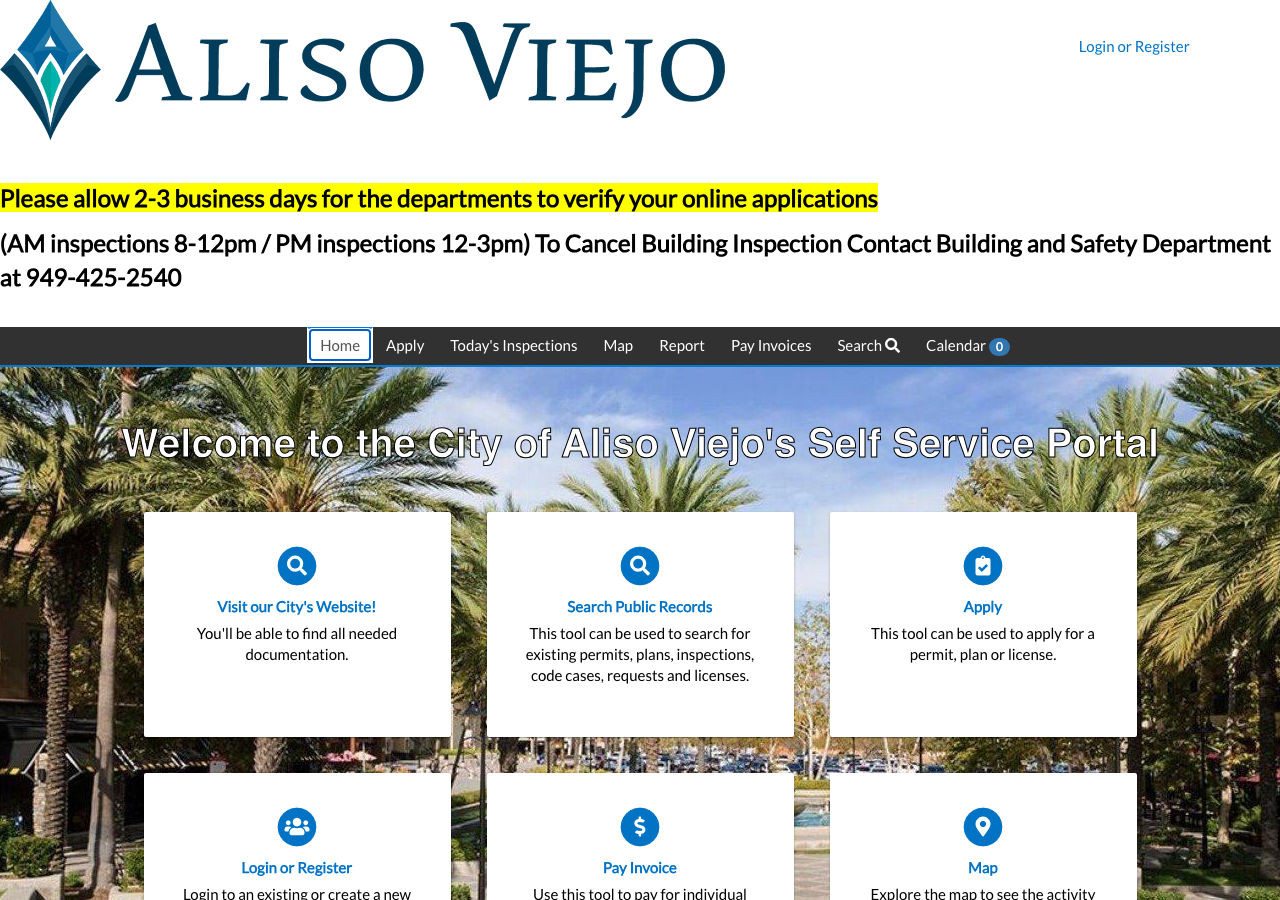
Tyler Technologies EnerGov 'Customer Self-Service (CSS) Portal' at alisoviejoca-energovpub.tylerhost.net
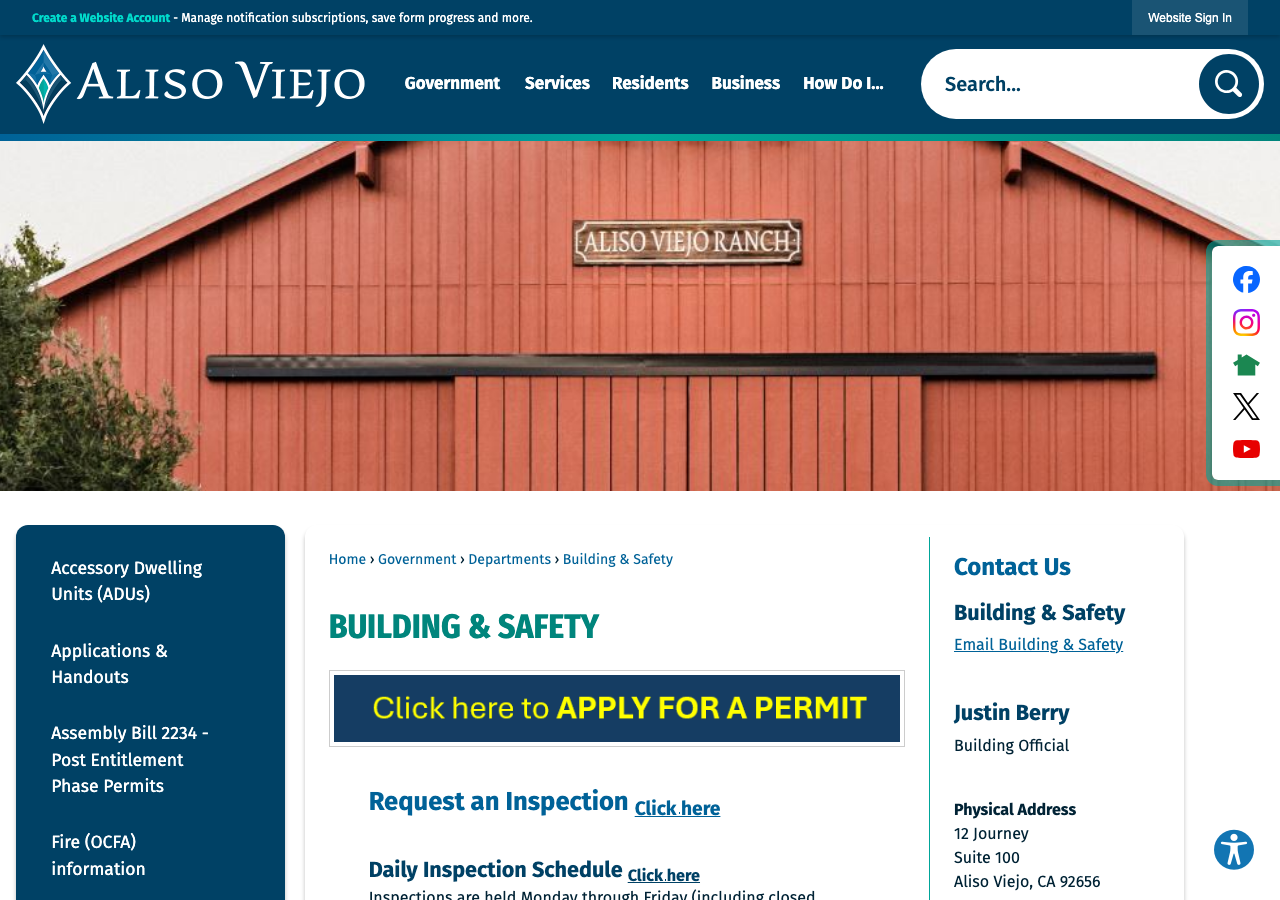
Why the confidence is not higherLinked directly from Solar Permits, Building-Safety and Applications pages as 'Apply for a Permit' / 'Request an Inspection'.
portal landing page checked 2026-08-30 https://alisoviejoca-energovpub.tylerhost.net/apps/SelfService#/home
Q21 Can the whole application be completed online? Core Portal & process
Yes for the SolarAPP+ Instant Solar Permit pathway (submit project, upload documents, and pay fees online in the CSS Portal). However a separate city handout, 'Solar Photovoltaic Submittal Guidelines,' states permits are 'issued in person from 7:30 am – 12:00 pm... accepted method of payment is cash or check' — that document conflicts with the SolarAPP+ process and reads as an older template that was not fully updated when SolarAPP+ was adopted.
Why the confidence is not higherTwo current city documents give contradictory answers on this point; flagged rather than picking one silently.
department page + conflicting handout (PDF) checked 2026-08-30 https://www.avcity.org/400/Solar-Permits
Q22 Which utility handles interconnection here? Core Utility interconnection
Split by address: Southern California Edison (SCE) serves residents and businesses WEST of Alicia Parkway; San Diego Gas & Electric (SDG&E) serves residents and businesses EAST of Alicia Parkway. Not a single utility for the whole city — do not assume SCE citywide.
Why the confidence is not higherDirectly from the city's own Business Directory entries (not PowerToChoose), which name the dividing line explicitly for both utilities; entries are dated 2019 in the CMS history but utility service-territory boundaries in this area are stable over decades. The Building & Safety 'Outside Permitting Agencies' list only names SCE, which appears to be an incomplete/west-side-biased list rather than evidence the whole city is SCE.
city resource directory checked 2026-08-30 https://www.avcity.org/businessdirectoryii.aspx?bid=77
Q23 Where does the utility sit in the sequence? Core Utility interconnection
No dependency for permit issuance — California's ministerial/SolarAPP+ process does not require prior utility sign-off to obtain a building permit; utility interconnection and PTO occur after final inspection as a separate step.
Why the confidence is not higherInferred from the standard AB 2188/SolarAPP+ ministerial-permitting design rather than a city document that states the sequence explicitly.
inference from department page checked 2026-08-30 https://www.avcity.org/400/Solar-Permits
Q24 Is a HOA or architectural approval required first? Overlays & special cases
No — HOA approval is explicitly waived as a condition of permit issuance, though the homeowner must still comply with recorded CC&Rs.
Why the confidence is not higherCity's own Solar Photovoltaic Submittal Guidelines states this in the 'REVIEW' section verbatim, consistent with the Solar Rights Act (Civil Code §714/§4600) which preempts HOA solar restrictions statewide.
department handout (PDF) checked 2026-08-30 https://www.avcity.org/DocumentCenter/View/240
Q25 Is there a historic-district review? Overlays & special cases
No evidence of a historic-district review requirement.
Why the confidence is not higherSite search for 'historic' (positive control 'solar'/'electrical' both returned many relevant hits; fabricated control 'zzqqx' returned zero, confirming the search index works) surfaced only 'Historic Barn' photos, the AV Ranch historic-structures page, and a CEQA tribal-cultural-resources assessment — no zoning historic-overlay district. Aliso Viejo incorporated only in 2001, making a historic-district ordinance unlikely, but I did not get past codepublishing.com's 403 to read Title 15 (Zoning) directly, so this is a search-based absence rather than a code-text absence.
site search (absence) checked 2026-08-30 https://www.avcity.org/Search/Results?searchPhrase=historic
Q26 Is a wind or windstorm certification required? Overlays & special cases
No — California has no TDI-style windstorm certification program; structural wind loading is handled through standard CBC design parameters (city-published Wind Exposure C, 110 mph design wind speed), not a separate certification.
Why the confidence is not higherSite search for 'windstorm' returned only a 'did you mean windsor' suggestion and one Local Hazard Mitigation Plan hit, no certification program; wind design parameters found on the Building-Safety page.
site search (absence) + department page checked 2026-08-30 https://www.avcity.org/Search/Results?searchPhrase=windstorm
Q27 Is a Specific Use Permit or Council approval ever required? Overlays & special cases
No, for systems eligible for AB 2188 ministerial/expedited review (the guideline states these receive expedited plan review with HOA approval waived, implying no discretionary Council/SUP step); not stated one way or the other for larger or non-conforming systems.
Why the confidence is not higherInferred from the ministerial-review framing of the Solar Guidelines; no explicit statement was found addressing non-conforming or oversized systems.
department handout (PDF) checked 2026-08-30 https://www.avcity.org/DocumentCenter/View/240
Q28 Is there a system-size cap on residential generation? Overlays & special cases
No hard city-imposed cap on permit issuance; the Solar Guidelines flag <10 kW as the AB 2188 threshold for expedited review (not a ceiling), and the SolarAPP+ Instant Permit pathway itself is limited to the national SolarAPP+/SB 379 (Gov. Code §65850.52) ceiling of 38.4 kW AC for eligible systems.
Why the confidence is not higher10 kW figure from the city's own guideline; 38.4 kW ceiling from SolarAPP+'s own published eligibility criteria, which the city has adopted wholesale as its instant-permit pathway.
department handout (PDF) + platform eligibility policy checked 2026-08-30 https://www.avcity.org/DocumentCenter/View/240
Lines marked with a percentage were read off this authority’s own published documents. Unmarked guidance is general good practice, not this jurisdiction’s rule — always confirm against the authority before you submit.
Install 5 steps · 20 questions
-
Build to the code editions actually in force here
The NEC edition a jurisdiction enforces is often a cycle behind the newest one published, and local amendments sit on top of it. Rapid shutdown, conductor sizing and labelling all change between editions, so the edition in force is the first thing to establish, not the last.
- Which NEC edition is in force? 2023 NEC, adopted as the 2025 California Electrical Code effective 1 Jan 2026 85% · adopting ordinance
- Which building code edition is in force? 2025 California Building Code (Vols. 1 & 2) and 2025 California Residential Code, both with amendments 95% · adopting ordinance
- Which fire code edition is in force? 2025 California Fire Code, with amendments 90% · adopting ordinance
- Are there local amendments to any of the above? Yes 85% · adopting ordinance
- What is the installation judged against? "The plans shall conform to all applicable California Building, Electrical, and Fire codes as amended and adopted by the City of Aliso Viejo." 85% · department handout (PDF)
-
Fire access, setbacks and pathways
Ridge setbacks and roof access pathways are fire-service requirements and they constrain the array layout. They are the most common cause of a redesign after the fire department comments on a plan set.
Nothing recorded for City of Aliso Viejo on this step yet — 1 question checked and found unpublished. The guidance above is general.
-
Rapid shutdown
Which rapid-shutdown rule applies follows directly from the NEC edition in force, and the initiation device has to be at a location the fire service can reach and identify. This is inspected, and it is labelled.
Nothing recorded for City of Aliso Viejo on this step yet — 1 question checked and found unpublished. The guidance above is general.
-
Labels and placards
The NEC sets a baseline for permanent markings at the service equipment and the disconnecting means. On top of that, an authority may specify its own wording, and the utility may specify more again. Where any of them writes its own text, a generic off-the-shelf label set will not pass — this is the detail most often fixed on a return visit.
- Which placards does this authority require at the service equipment? Per the city's Solar Photovoltaic Submittal Guidelines: signage at (1) DC combiner/junction box, (2) DC disconnect, (3) inverter, (4) AC disconnect, (5) meter, and (6) a permanent directory/plaque for disconnect locations if not co-located. 55% · department handout (PDF) — flagged as likely stale
- Does the authority specify placard wording of its own? Yes 70% · department handout (PDF)
- Is a site plan / facility map placard required, and what must it show? Yes — a permanent directory or plaque is required 'providing the location of service disconnecting means and photovoltaic system disconnecting means, if not located at the same location,' satisfying NEC 705.10; the guideline does not separately require a full facility/site map placard beyond the plan-submittal site plan itself. 70% · department handout (PDF)
-
Disconnect, storage and listed equipment
Where the AC disconnect must sit relative to the meter is usually the utility's rule, not the building department's. Battery storage frequently carries its own permit, its own inspection and its own fire conditions.
- Must equipment be on a specific approved list? No city-maintained approved-equipment list was found; standard UL-listing requirements apply via the adopted electrical/building codes rather than a separate city list. 50% · department page (absence)
- Are batteries permitted, and under what conditions? Yes — the SolarAPP+ Instant Solar Permit explicitly covers 'roof-mounted solar photovoltaic panel installations with or without an energy storage system.' A garage-installed ESS specifically requires an OCFA-approved plan 'AT THE TIME OF INSPECTION.' Under the SolarAPP+ national eligibility rules the city has adopted, individual batteries are capped at ≤20 kWh and aggregate ESS capacity at ≤80 kWh (location-dependent) to remain eligible for the instant pathway. 75% · department page
- Is there a separate ESS permit or inspection? Yes for battery/ESS specifically — OCFA requires an approved plan for garage-installed ESS at time of inspection, and OCFA's own current fee schedule carries a distinct 'Battery Systems, stationary storage and cell sites' line (PR375 plan review $963 / PR375i inspection-only $233), separate from the residential PV line (PR362 $223 / PR362i $175). 70% · fee schedule (PDF)
- Is there a local rule on service upgrades or busbar sizing? No distinct local numeric amendment found beyond a restatement of NEC 705.12: the guideline notes 'center-fed panels may not exceed the bus bar rating' as a submittal item, not a local amendment. 55% · department handout (PDF)
- Is a specific mounting system or attachment spacing required? No universal spacing table specified; the guideline requires submittal of the mounting-hardware manufacturer's specifications plus engineering calculations for dead load, lateral resistance and wind uplift, evaluated per-project rather than against a fixed local spacing standard. 55% · published checklist (PDF)
20 questions answered against City of Aliso Viejo’s own published documents
Q29 Which NEC edition is in force? Core Code editions in force
2023 NEC, adopted as the 2025 California Electrical Code effective 1 Jan 2026
Why the confidence is not higherCity's Building-Safety page and adopting Ordinance No. 2025-246 (passed 20 Aug 2025) both list the '2025 CA Electrical Code' among adopted model codes; the 2025 CEC's base edition is the 2023 NEC per DGS/NFPA, matching the current statewide cycle (not a '2025 NEC', which does not exist).
adopting ordinance checked 2026-08-30 https://www.avcity.org/documentcenter/view/4348
Q30 Which building code edition is in force? Core Code editions in force
2025 California Building Code (Vols. 1 & 2) and 2025 California Residential Code, both with amendments
Why the confidence is not higherOrdinance No. 2025-246, adopted 20 Aug 2025, codified into AVMC Ch. 13.02/13.04.
adopting ordinance checked 2026-08-30 https://www.avcity.org/documentcenter/view/4348
Q31 Which fire code edition is in force? Code editions in force
2025 California Fire Code, with amendments
Why the confidence is not higherNamed explicitly in Ordinance No. 2025-246's list of 13 model codes adopted by reference.
adopting ordinance checked 2026-08-30 https://www.avcity.org/documentcenter/view/4348
Q32 Are there local amendments to any of the above? Core Code editions in force
Yes
Why the confidence is not higherOrdinance 2025-246 itself states it adopts the model codes 'with amendments...tailored to the safety needs of the City of Aliso Viejo' for Building, Residential, WUI and Fire codes specifically; the fee schedule's Green Building 25% solar waiver (AVMC Ch. 15.68) is a further local amendment.
adopting ordinance checked 2026-08-30 https://www.avcity.org/documentcenter/view/4348
Q33 What is the installation judged against? Core Electrical
"The plans shall conform to all applicable California Building, Electrical, and Fire codes as amended and adopted by the City of Aliso Viejo."
Why the confidence is not higherVerbatim from the city's own Solar Photovoltaic Submittal Guidelines.
department handout (PDF) checked 2026-08-30 https://www.avcity.org/DocumentCenter/View/240
Q34 Is there a local rule on service upgrades or busbar sizing? Electrical
No distinct local numeric amendment found beyond a restatement of NEC 705.12: the guideline notes 'center-fed panels may not exceed the bus bar rating' as a submittal item, not a local amendment.
Why the confidence is not higherRead the full guideline text; this appears to restate the NEC's own supply-side/load-side connection rule rather than impose a stricter local one.
department handout (PDF) checked 2026-08-30 https://www.avcity.org/DocumentCenter/View/240
Q35 Is a specific mounting system or attachment spacing required? Structural & mounting
No universal spacing table specified; the guideline requires submittal of the mounting-hardware manufacturer's specifications plus engineering calculations for dead load, lateral resistance and wind uplift, evaluated per-project rather than against a fixed local spacing standard.
Why the confidence is not higherFull text of the 'ROOF INFORMATION' checklist section read directly; no numeric spacing table appears.
published checklist (PDF) checked 2026-08-30 https://www.avcity.org/DocumentCenter/View/240
Q36 What ridge setback and access pathways are required? Core Fire pathways & setbacks
Nothing published by this authority.
Where we lookedSolar Photovoltaic Submittal Guidelines (PDF, full text read) and OCFA's own site — OCFA has no lettered PV/ESS guideline (ocfa.org/_uploads/pdf/PhotovoltaicGuideline.pdf returns 404) and the city guideline never mentions ridge setback or roof access pathways at all.
Q37 Is rapid shutdown required, and to which NEC edition? Core Rapid shutdown
Nothing published by this authority.
Where we lookedCity's Solar Photovoltaic Submittal Guidelines (full text read via pdftotext) never mentions 'rapid shutdown' or NEC 690.12 anywhere; site search for both terms on avcity.org returned no relevant hits (positive control 'electrical' and fabricated control 'zzqqx' both behaved correctly, confirming the search index works). Rapid shutdown is nonetheless mandatory under the state-adopted 2023-NEC-based 2025 CEC regardless of local documentation; the city has just never published local guidance reflecting it — its one PV handout instead cites the obsolete 2014-NEC TIA 14-9/14-10/14-11/14-12 rapid-shutdown scheme as 'NOT adopted.'
Q38 Which placards does this authority require at the service equipment? Core Labels Signage & labelling
Per the city's Solar Photovoltaic Submittal Guidelines: signage at (1) DC combiner/junction box, (2) DC disconnect, (3) inverter, (4) AC disconnect, (5) meter, and (6) a permanent directory/plaque for disconnect locations if not co-located.
Why the confidence is not higherThis is the city's own listed placard set, but the same document never mentions NEC 690.12 rapid shutdown at all and instead references NFPA TIA 14-9 through 14-12 (2014 NEC interim amendments) as 'NOT adopted' — a pre-2019 rapid-shutdown framing. This strongly suggests the handout is a stale/unedited template despite its 3/11/26 revision stamp, so treat this placard list as incomplete against the current 2023-NEC-based 2025 CEC (which requires a rapid-shutdown label at the PV disconnect under 690.12(B)(2)).
department handout (PDF) — flagged as likely stale checked 2026-08-30 https://www.avcity.org/DocumentCenter/View/240
Q39 Does the authority specify placard wording of its own? Core Labels Signage & labelling
Yes
Why the confidence is not higherThe guideline gives verbatim required wording for each of the six placard locations, but see q38 — the wording set is missing a current NEC 690.12 rapid-shutdown label, so 'its own wording' exists but may not be complete against current code.
department handout (PDF) checked 2026-08-30 https://www.avcity.org/DocumentCenter/View/240
Q40 Does it specify letter height, colour or material? Core Labels Signage & labelling
Nothing published by this authority.
Where we lookedSolar Photovoltaic Submittal Guidelines 'REQUIRED PHOTOVOLTAIC SIGNS' section (full text read) — gives verbatim wording for six placards but never states letter height, colour, or material for any of them.
Q41 Is a site plan / facility map placard required, and what must it show? Core Labels Signage & labelling
Yes — a permanent directory or plaque is required 'providing the location of service disconnecting means and photovoltaic system disconnecting means, if not located at the same location,' satisfying NEC 705.10; the guideline does not separately require a full facility/site map placard beyond the plan-submittal site plan itself.
Why the confidence is not higherVerbatim from the guideline's signage item 6; the plan-submittal site plan (item under 'SITE PLAN') is what shows equipment layout, not a separate as-built facility map placard.
department handout (PDF) checked 2026-08-30 https://www.avcity.org/DocumentCenter/View/240
Q42 Does the UTILITY specify placards beyond the AHJ's? Core Labels Signage & labelling
Nothing published by this authority.
Where we lookedSCE's own interconnection/DG documentation — on.sce.com/interconnectionhandbook 302-redirects to the SCE homepage with no working target found; did not attempt a Wayback capture within this run's time budget.
Q43 Where must the labels be placed? Core Labels Signage & labelling
Nothing published by this authority.
Where we lookedSolar Photovoltaic Submittal Guidelines names sign locations (DC combiner/junction box, DC disconnect, inverter, AC disconnect, meter, and a directory/plaque) but gives no mounting height or visibility specification beyond 'accessible location' for one of the six signs.
Q44 Must equipment be on a specific approved list? Equipment listing
No city-maintained approved-equipment list was found; standard UL-listing requirements apply via the adopted electrical/building codes rather than a separate city list.
Why the confidence is not higherChecked Solar Permits, Solar Guidelines and Applications & Handouts pages; no equipment list referenced.
department page (absence) checked 2026-08-30 https://www.avcity.org/400/Solar-Permits
Q45 Are batteries permitted, and under what conditions? Core Battery / ESS
Yes — the SolarAPP+ Instant Solar Permit explicitly covers 'roof-mounted solar photovoltaic panel installations with or without an energy storage system.' A garage-installed ESS specifically requires an OCFA-approved plan 'AT THE TIME OF INSPECTION.' Under the SolarAPP+ national eligibility rules the city has adopted, individual batteries are capped at ≤20 kWh and aggregate ESS capacity at ≤80 kWh (location-dependent) to remain eligible for the instant pathway.
Why the confidence is not higherGarage-ESS/OCFA condition is verbatim from the city's own Solar Permits page; the kWh caps come from SolarAPP+'s own published national eligibility criteria that the city's chosen platform enforces, not a city-specific document.
department page checked 2026-08-30 https://www.avcity.org/400/Solar-Permits
Q46 Is there a separate ESS permit or inspection? Battery / ESS
Yes for battery/ESS specifically — OCFA requires an approved plan for garage-installed ESS at time of inspection, and OCFA's own current fee schedule carries a distinct 'Battery Systems, stationary storage and cell sites' line (PR375 plan review $963 / PR375i inspection-only $233), separate from the residential PV line (PR362 $223 / PR362i $175).
Why the confidence is not higherOCFA fee-schedule line items confirmed directly (pdftotext) from OCFA's current fee-schedule PDF; whether PR375 is charged on every residential home-battery install or only larger/'alternative compliance' cases is ambiguous in the schedule itself (it is not marked 'residential' the way PR362 is) — flagged, not resolved.
fee schedule (PDF) checked 2026-08-30 https://storageocfaprod001.blob.core.windows.net/blobocfaprod01/2025/06/PD-Fee-Schedule-2026.pdf
Q47 Is a ground mount treated as a structure? Core Ground mount
Nothing published by this authority.
Where we lookedSolar Photovoltaic Submittal Guidelines (rooftop-scope only, no ground-mount section); AVMC Title 15 (Zoning) could not be read directly — codepublishing.com returns HTTP 403 on this jurisdiction's chapter pages and no Wayback snapshot of the individual zoning chapter exists (only the top-level TOC page was archived).
Q48 Where must the AC disconnect be, relative to the meter? Core Utility equipment
Nothing published by this authority.
Where we lookedCity's Solar Guidelines (names the AC disconnect as a signage location but not its position relative to the meter) and SCE's dead interconnection-handbook link (see q42) — no working SCE DG manual was reached in this run.
Lines marked with a percentage were read off this authority’s own published documents. Unmarked guidance is general good practice, not this jurisdiction’s rule — always confirm against the authority before you submit.
Inspection 5 steps · 14 questions
-
Book it
Booking is a portal, a phone call or an email depending on the authority, and the notice required is rarely zero. Book before the work is finished rather than after — the lead time, not the work, is usually what sets the date.
- How is an inspection booked? Portal 95% · department page
- How much notice is required? Effectively 1 business day — "Inspections scheduled before 4pm will be scheduled for the next business day unless otherwise specified." 90% · department page
- Are same-day or AM/PM windows offered? AM (8am–noon) and PM (noon–3:30pm) windows are offered; no same-day option — inspections must be scheduled for the next business day (see q50). Daily inspection assignments are posted by 8am on the CSS Portal. 90% · department page
-
Know who turns up
Some authorities inspect their own solar work; some delegate it, and a few do not inspect the PV equipment itself at all. Who is coming determines what they will look at.
- Does this AHJ perform its own final solar inspection? Yes, with an added condition — City Building & Safety staff perform the final combined Building and Electrical inspection in-house; for systems with fire-code triggers (e.g. garage-installed ESS, or where OCFA clearance is otherwise required) OCFA final approval is an additional prerequisite before the city's final can be scheduled/passed. 75% · department handout (PDF) + FAQ
- If delegated, to whom? Orange County Fire Authority (OCFA), for the fire-code-triggered portion only (e.g. garage ESS plan approval); building/electrical final itself is not delegated. 75% · department page
-
Work the stages in order
A rough-in or mid-roof inspection, where one is required, has to happen before the work it covers is closed up. Missing a stage means opening something back up, and it is the most expensive kind of correction.
- Which inspections are required, and in what order? Permit issuance → construction → a single final Building and Electrical inspection (no separate PV-specific rough-in stage published); OCFA clearance required first where fire-code-triggered (e.g. garage ESS). 70% · department handout (PDF)
- Is a rough-in or mid-roof inspection required? No — the Solar Photovoltaic Submittal Guidelines' 'INSPECTIONS' section names only a single final Building and Electrical inspection; no rough-in or mid-roof stage is mentioned. 65% · department handout (PDF) (absence)
-
Have the paperwork on site
The approved plan set, the permit, and the equipment listings should be on site and reachable. Inspectors routinely verify that installed equipment matches what was approved, and that the labels are the ones the plan set promised.
- Is there a published inspection checklist? Yes, in the form of the Solar Photovoltaic Submittal Guidelines, which doubles as the plan-check and required-signage checklist; there is no separate dedicated 'inspection checklist' document distinct from this submittal guideline. 60% · published checklist (PDF)
- Does the inspector verify labels and listings? Likely yes, by inference — the same guideline that sets the final-inspection requirement also contains an explicit 'REQUIRED PHOTOVOLTAIC SIGNS' checklist, which a final inspector would reasonably check against; no city document explicitly states the inspector verifies labels/listings as a distinct line item. 55% · department handout (PDF), inferred
-
Sign-off, and permission to operate
Passing gives you a final or an equivalent sign-off. That is not the same as permission to operate: PTO comes from the utility, and who tells the utility the inspection passed varies. A system left switched off for weeks is usually waiting on this handover.
- What is issued on pass? Final (an approved/passed inspection recorded in the CSS/EnerGov Portal); a Certificate of Occupancy is not applicable to a PV retrofit permit and no physical 'green tag' language appears on any city page. 55% · department page, inferred
- Is there a re-inspection fee? $136.62 ("Building Reinspection") 75% · fee schedule (PDF)
- How are corrections issued and cleared? Tracked through the CSS Portal's project 'Workflow' status; the FAQ directs applicants to 'refer to the project's Workflow for project status' rather than describing a separate paper correction-notice process. 55% · department page (FAQ)
14 questions answered against City of Aliso Viejo’s own published documents
Q49 How is an inspection booked? Core Booking & scheduling
Portal
Why the confidence is not higherInspections are requested and scheduled online through the Tyler EnerGov Customer Self-Service (CSS) Portal per the Building & Safety page and Solar Guidelines.
department page checked 2026-08-30 https://www.avcity.org/154/Building-Safety
Q50 How much notice is required? Core Booking & scheduling
Effectively 1 business day — "Inspections scheduled before 4pm will be scheduled for the next business day unless otherwise specified."
Why the confidence is not higherVerbatim from the Building & Safety page's 'How to schedule an inspection online' section.
department page checked 2026-08-30 https://www.avcity.org/154/Building-Safety
Q51 Are same-day or AM/PM windows offered? Booking & scheduling
AM (8am–noon) and PM (noon–3:30pm) windows are offered; no same-day option — inspections must be scheduled for the next business day (see q50). Daily inspection assignments are posted by 8am on the CSS Portal.
Why the confidence is not higherVerbatim from Building & Safety page and FAQ 'What time will the inspector visit my site?'
department page checked 2026-08-30 https://www.avcity.org/154/Building-Safety
Q52 Does this AHJ perform its own final solar inspection? Core Who inspects
Yes, with an added condition — City Building & Safety staff perform the final combined Building and Electrical inspection in-house; for systems with fire-code triggers (e.g. garage-installed ESS, or where OCFA clearance is otherwise required) OCFA final approval is an additional prerequisite before the city's final can be scheduled/passed.
Why the confidence is not higherCity's own solar guideline directs applicants to 'call for a final Building and Electrical inspection'; the Building-Safety FAQ separately lists OCFA as an outside agency whose 'final inspection approval' may be needed before scheduling a final.
department handout (PDF) + FAQ checked 2026-08-30 https://www.avcity.org/DocumentCenter/View/240
Q53 If delegated, to whom? Core Who inspects
Orange County Fire Authority (OCFA), for the fire-code-triggered portion only (e.g. garage ESS plan approval); building/electrical final itself is not delegated.
Why the confidence is not higherPer FAQ 'Why can't I schedule an inspection?' and the Solar Permits garage-ESS note.
department page checked 2026-08-30 https://www.avcity.org/154/Building-Safety
Q54 Which inspections are required, and in what order? Core Stages & sequence
Permit issuance → construction → a single final Building and Electrical inspection (no separate PV-specific rough-in stage published); OCFA clearance required first where fire-code-triggered (e.g. garage ESS).
Why the confidence is not higherSequence assembled from the Solar Photovoltaic Submittal Guidelines' 'INSPECTIONS' section and the general FAQ on final-inspection clearances; no dedicated multi-stage PV inspection sequence is published beyond this.
department handout (PDF) checked 2026-08-30 https://www.avcity.org/DocumentCenter/View/240
Q55 Is a rough-in or mid-roof inspection required? Stages & sequence
No — the Solar Photovoltaic Submittal Guidelines' 'INSPECTIONS' section names only a single final Building and Electrical inspection; no rough-in or mid-roof stage is mentioned.
Why the confidence is not higherRead the full 'INSPECTIONS' section of the guideline; only the final call is described.
department handout (PDF) (absence) checked 2026-08-30 https://www.avcity.org/DocumentCenter/View/240
Q56 Does the inspector verify labels and listings? Core What is checked
Likely yes, by inference — the same guideline that sets the final-inspection requirement also contains an explicit 'REQUIRED PHOTOVOLTAIC SIGNS' checklist, which a final inspector would reasonably check against; no city document explicitly states the inspector verifies labels/listings as a distinct line item.
Why the confidence is not higherInference from two parts of the same document rather than an explicit statement.
department handout (PDF), inferred checked 2026-08-30 https://www.avcity.org/DocumentCenter/View/240
Q57 Is there a published inspection checklist? Core What is checked
Yes, in the form of the Solar Photovoltaic Submittal Guidelines, which doubles as the plan-check and required-signage checklist; there is no separate dedicated 'inspection checklist' document distinct from this submittal guideline.
Why the confidence is not higherOnly one published city PV document was found and it serves both submittal and (implicitly) inspection-verification purposes.
published checklist (PDF) checked 2026-08-30 https://www.avcity.org/DocumentCenter/View/240
Q58 What must be on site at inspection? Core Documents on site
Nothing published by this authority.
Where we lookedSolar Photovoltaic Submittal Guidelines 'INSPECTIONS' section (only says to call for a final via the CSS Portal, does not enumerate documents required on site) and Building-Safety page.
Q59 Is there a re-inspection fee? Corrections & re-inspection
$136.62 ("Building Reinspection")
Why the confidence is not higherListed under 'Miscellaneous Fees' in the FY2026-27 fee schedule; this is a general building reinspection fee, not solar-specific, so applied by inference to a failed solar final.
fee schedule (PDF) checked 2026-08-30 https://avcity.org/DocumentCenter/View/2423/Building-Permit-Fees
Q60 How are corrections issued and cleared? Corrections & re-inspection
Tracked through the CSS Portal's project 'Workflow' status; the FAQ directs applicants to 'refer to the project's Workflow for project status' rather than describing a separate paper correction-notice process.
Why the confidence is not higherBest available statement from the Building-Safety FAQ; no dedicated corrections-and-clearance document was found.
department page (FAQ) checked 2026-08-30 https://www.avcity.org/154/Building-Safety
Q61 What is issued on pass? Core Final sign-off & PTO
Final (an approved/passed inspection recorded in the CSS/EnerGov Portal); a Certificate of Occupancy is not applicable to a PV retrofit permit and no physical 'green tag' language appears on any city page.
Why the confidence is not higherInferred from the EnerGov CSS Portal workflow model described on the Building-Safety page; no page uses the words 'green tag' or 'certificate' for a solar-only permit.
department page, inferred checked 2026-08-30 https://www.avcity.org/154/Building-Safety
Q62 Who notifies the utility for PTO? Core Final sign-off & PTO
Nothing published by this authority.
Where we lookedSolar Permits, Solar Photovoltaic Submittal Guidelines and Building-Safety pages — none describe who notifies the utility for Permission to Operate.
Lines marked with a percentage were read off this authority’s own published documents. Unmarked guidance is general good practice, not this jurisdiction’s rule — always confirm against the authority before you submit.
Jurisdiction & key facts
The standing 62-question set, answered for City of Aliso Viejo against this authority’s own published documents. Every answer carries the confidence it was recorded at and the document it came from. Where nothing is published we say so and show where we looked — a blank here is a finding, not a gap.
City of Aliso Viejo is the authority having jurisdiction 85% confidence
- Holds
- Building and Electrical (in-house Building & Safety staff, not a contracted firm — Building Official Justin Berry is named city staff). Fire plan review/inspection sits with Orange County Fire Authority (OCFA), a confirmed member-city relationship, for fire-code-triggered elements (e.g. garage-installed battery/ESS, general final-inspection fire clearance). Utility interconnection is split geographically: SCE west of Alicia Parkway, SDG&E east of Alicia Parkway.
- Delegated to
- Orange County Fire Authority (fire review/inspection only, not building/electrical)
- Overridden by
- California Solar Rights Act (Civil Code §714/§4600) preempts HOA disapproval; Gov. Code §65850.52 (SB 379) and the AB 2188 ministerial-permitting mandate cap what the city may impose as discretionary review on eligible systems; AB 130 (Stats. 2025, Ch. 22) freezes more-restrictive local residential amendments 1 Oct 2025–1 Jun 2031.
- Why not higher
- Confirmed from the city's own Building & Safety page (in-house Building Official named, not a contracted firm — this corrects the brief's lead that AV, as a small contract-heavy city, might outsource building & safety the way Camarillo/Dublin do) and OCFA's own member-cities page, which lists 'City of Aliso Viejo' by name in raw HTML (not a summary). The utility split (SCE/SDG&E by Alicia Parkway) was an unbriefed correction found in the city's own Business Directory — the brief's premise of 'utility: SCE' is only true for the western part of the city.
- Permit required
- Yes95%
- Permit cost
- Valuation-based, no flat fee — e.g. a $20,000 system valuation totals $903.33 in combined plan-check + permit + issuance fees on the FY2026-27 Building Fee Schedule,75%
- Plan review
- SolarAPP+-eligible systems get instant/automated approval; for the standard (non-instant) plan-review route, no turnaround time is published anywhere on the Building & Safety,55%
- Portal
- Tyler Technologies EnerGov 'Customer Self-Service (CSS) Portal' at alisoviejoca-energovpub.tylerhost.net95%
- Electrical code
- 2023 NEC, adopted as the 2025 California Electrical Code effective 1 Jan 202685%
- Own placard wording
- Yes70%
- Booking an inspection
- Portal95%
Labels & placards for this authority
City of Aliso Viejo writes its own placard wording. A standard NEC label set will not satisfy it — the exact text, and in most cases the size, colour and font, are specified below.
Wording 70%
Yes
Size, colour & material None%
Where they go None%
What the utility wants on top None%
Each figure above is sourced and dated in the full answer set below (questions 38–43). Where an authority’s own published sheet is older than the code it has adopted, the answer says so.
Their website
Average approval time — application to PTO
From the CPUC interconnection record. Bars show the average days taken each year; a year with no recorded projects is left blank rather than drawn as zero.