
City of Atascadero
San Luis Obispo County
City of Atascadero is a city authority in the State of California, serving 29,773 residents. 3,355 residential solar installs are on record here. This page is the permit route for that jurisdiction: the fifteen steps from working out who has a say over an address through to permission to operate, the documents this authority publishes, and 62 answers taken from those documents and dated.
Permitting 5 steps · 28 questions
Whether a permit is needed — Yes. A dedicated Express Building Permit is required for residential PV, with its own fee line ('Residential Rooftop Solar Systems under 10 KW'). Q3 Electrical and building permits — Combined. The Express Building Permit fee for PV is a single line item ($556.85 roof-mount under 10kW / $742.83 ground-mount, commercial, or larger residential, Q4 Plan review — Express Review: First Review 7-10 business days; Rechecks 5-7 business days. Q18 Where you file — eTrakit (Tyler Technologies), at permits.atascadero.org/eTrakit -- used for permit search/status and, per the portal's own description, Q20
- Permit required
- Yes. A dedicated Express Building Permit is required for residential PV, with its own fee line ('Residential Rooftop Solar Systems under 10 KW').95% source
- What it costs
- $556.85 for residential roof-mount PV under 10kW (incl. 7.5% Community Development Technology Surcharge); $742.83 for ground-mount, commercial, or larger residential systems.95% source
- Plan review turnaround
- Express Review: First Review 7-10 business days; Rechecks 5-7 business days.92% source
- Key document
- published checklist / state statute cited by 14 open the document
-
Confirm who has a say over your address
A city address is usually permitted by the city, not the county — but not always, and some authorities keep building and hand electrical to someone else. Getting this wrong costs the whole submittal, because every requirement below belongs to whoever actually holds jurisdiction. Check the overlays in the same pass: an HOA, a historic district, a windstorm certification or a system-size cap can reshape the design, and all of them are cheaper to find now than after the array is laid out.
- Is this authority the AHJ for residential solar at this address? Yes. The City of Atascadero Building Services Division (Community Development) is the AHJ for building/electrical; the City's own Fire Marshal is the AHJ for fire/WUI code. 95% · ordinance
- What does this authority permit itself, and what does it delegate? Both (combined). The Building Services Division issues one Express Building Permit for residential PV covering building and electrical together. The Fire Marshal separately holds fire-code authority over access pathways, ground-mount setbacks, and BIPV, but does not appear to require a separate residential PV plan check/fee (no PV or ESS line was found in the Fire Development section of the 2026 fee schedule). 85% · published checklist
- Is a permit required for a residential rooftop PV system? Yes. A dedicated Express Building Permit is required for residential PV, with its own fee line ('Residential Rooftop Solar Systems under 10 KW'). 95% · fee schedule
- Is there a separate electrical permit, or is it combined? Combined. The Express Building Permit fee for PV is a single line item ($556.85 roof-mount under 10kW / $742.83 ground-mount, commercial, or larger residential, both incl. 7.5% Community Development Technology Surcharge) with no separate electrical-permit fee shown for solar, unlike the general/standard building-permit track where electrical is broken out as a discrete 10% line. 80% · published checklist
- Is a HOA or architectural approval required first? Not required by the city for solar specifically -- no HOA-approval step appears anywhere in the PV/ESS checklists or the zoning code. California's Solar Rights Act (Civil Code Section 714) preempts HOA/CC&R restrictions that significantly increase cost or decrease efficiency of a solar installation statewide. 58% · published checklist / state statute
- Is there a historic-district review? Yes, conditionally, for properties on the city's Historic Resources List. AMC 9-4.167(a) processes alterations as a ministerial Building Permit only if they are ordinary in-kind maintenance/repair or meet the Secretary of the Interior's Standards; otherwise 9-4.167(b) routes the alteration to Precise Plan review. No PV-specific exemption or carve-out exists in this chapter -- it is a general 'no carve-out' historic-alterations ordinance, and rooftop PV panels (which change exterior appearance) would likely need to satisfy the SOI Standards test or go to Precise Plan review rather than qualifying automatically as 'ordinary maintenance.' 85% · ordinance
- Is a wind or windstorm certification required? No wind/windstorm certification scheme comparable to Texas TDI. Wind is handled as a CBC/CRC structural design parameter: the PV and ESS submittal checklists both banner 'WIND ZONES 92 M.P.H.' as a standing design criterion, not a separate certification requirement. 80% · published checklist
- Is a Specific Use Permit or Council approval ever required? No Specific Use Permit or Council approval requirement was found for a standard residential rooftop PV system. The city's +5-foot solar height allowance (Q28) is by-right and does not require a Conditional Use Permit; a CUP is only implicated by the ordinary height-limitation-waiver process (AMC 9-4.113(b)(1), Planning Commission waiver) if a project seeks MORE height than that allowance, which is a general zoning mechanism, not solar-specific. 70% · ordinance
- Is there a system-size cap on residential generation? A fee-tier gate rather than an outright cap: the subsidized Express Permit rate applies to 'Residential Rooftop Solar Systems under 10 KW,' with larger residential systems, ground mounts, and commercial systems paying the higher 'Other' Express rate -- they are not barred, just costed differently. Separately, zoning gives PV its own height allowance: 'Solar collectors not more than five feet above the height limit specified' (AMC 9-4.113(b)(4)(ix)), and solar collectors are listed among architectural features permitted to project into required setbacks (AMC 9-4.110(c)). 88% · ordinance / fee schedule
-
Check who is allowed to apply
Several authorities require the electrical permit to be pulled by a licensed electrician, or require the contractor to be registered with them BEFORE applying. Registration is not same-day. This is second on the list rather than fourth because it is the step most likely to stop the job before the drawings matter.
- Who is allowed to pull the electrical permit? Either. 'Must be signed by Owner, Agent (with approved written authorization), or Licensed A, B, C-46 or C-10 Contractor.' 95% · published checklist
- Must the contractor be registered with this authority before applying? Yes, in effect. The Business Licenses page states contractors need an active CSLB license and must complete either a 'Commercial Business License Application' or an 'Out of Town Business License Application' depending on where the contractor is based -- a city business-license/tax registration distinct from the building permit itself. The page does not state whether this must be obtained BEFORE permit issuance. 65% · department page
- Is a homeowner permitted to self-install and self-permit? Yes. The city's Owner-Builder Declaration/Facts and Responsibilities packet is a standing part of the Building Permit Application, and the PV checklist explicitly allows the application to be 'signed by Owner.' 90% · published form
-
Build the submittal package
Almost everywhere wants a site plan, a one-line or three-line electrical diagram, equipment cut sheets with listings, and a structural attachment detail. Build it against the published checklist rather than the last jurisdiction you worked in — the checklist is what the reviewer marks against.
- What documents make up a complete submittal? A complete PV submittal per the city's own checklist: signed Building Permit Application; permit fee; 2 sets of a fully dimensioned site plan (property lines/structures, array/panel/subpanel/inverter locations, and for ground mounts distances to property lines/buildings/native trees/utilities); for ground mounts, a current Title Report (within 6 months); 2 sets of a structural design package (roof-mount anchor spacing/rafter framing or ground-mount footing engineering); a complete electrical single-line diagram with Isc/Voc/conductor-ampacity calculations; mounting-system grounding detail; module manufacturer spec sheets (UL 1703); service-panel breaker-sizing calculations; DC-conduit labeling; and roof-access-pathway compliance. 96% · published checklist
- How many copies, and in what format? 2 sets each of the site plan and the structural design package, plus 2 sets of the electrical line drawing/calculations (all bundled as '2 sets of supporting documents' language mirrored in the ESS checklist). Submittals are by scheduled appointment or by emailing permitcenter@atascadero.org; walk-in and incomplete submittals are explicitly refused at the counter. 85% · published checklist
- Is a site plan required, and what must it show? Yes. A fully dimensioned site plan (2 sets) must show property lines and all structures; array location/size and service-panel/subpanel/inverter locations; for ground mounts, distance from the array to property lines (10' min per CFC 605.11.2) and to buildings (20' min per AMC), easements, underground utilities after the meter, sewage-disposal elements, and native trees with drip lines within 20' of footings/trenching; and a title sheet with project address, DC system size, owner/contractor information, code-edition references, and a sheet index. 96% · published checklist
- Is a one-line / three-line diagram required? Yes. 'Provide a complete single line diagram' showing module/circuit counts, DC voltage/current, and conductor sizing. 96% · published checklist
- Are string and conductor calculations required? Yes, in detail: Isc corrected for continuous load; series Voc corrected for temperature per Table 690.7 (city specifies a 21F factor of 1.14 for Atascadero); conductor ampacity corrected for conductor count and ambient temperature (city specifies 108F for Atascadero); AC conductors from inverter to panel sized at 125% of max rated inverter output. 96% · published checklist
- Is a structural PE stamp required, and at what threshold? Conditional. For roof mounts, no PE/SE stamp is required if anchor spacing follows the California Solar Permitting Guidebook's prescriptive Table 1 (6' spacing at 24' rafter spacing on slopes to 6:12 with lag-screw attachment per Figure 3; 4' max for manufactured trusses) -- 'Other roof constructions and greater horizontal anchor spacing require analysis by a design professional.' Ground mounts always require engineering calculations for footings and seismic/wind uplift. 85% · published checklist
- Is an electrical PE stamp required, and at what threshold? No PV-specific electrical PE-stamp threshold found. The closest analog is AMC 8-4.103, a new-SFR-specific rule requiring an electrical engineer's plans only where the property owner intends to self-install the electrical system without a C-10 license or ET-program qualification -- not stated as applying to PV retrofits generally. 55% · ordinance
-
Apply and pay
Most authorities now take the whole application through a portal, and several states cap or constrain what a residential solar permit may cost. Check whether plan check is billed separately before you quote the job.
- Which permit portal does this authority use? eTrakit (Tyler Technologies), at permits.atascadero.org/eTrakit -- used for permit search/status and, per the portal's own description, for applying for permits and paying fees online with 'Public' or 'Registered Professional' accounts. For PV specifically, actual plan submittal still routes through a scheduled intake appointment or email to permitcenter@atascadero.org rather than a SolarAPP+/Symbium-style instant self-service upload (see Q21). 85% · portal
- Can the whole application be completed online? Not fully, for PV. The eTrakit portal advertises online permit applications generally, but the PV and ESS submittal checklists both carry the same banner: 'INTAKE MEETINGS ARE REQUIRED AND BY APPOINTMENT ONLY... Incomplete submittals and walk-in submittals will not be accepted at the counter,' and the Building Division FAQ frames submittal as either a scheduled appointment or an emailed submittal to permitcenter@atascadero.org -- not a self-service instant-approval flow. No SolarAPP+ or Symbium integration was found anywhere on the city's site. 68% · published checklist
- What does a residential solar permit cost? $556.85 for residential roof-mount PV under 10kW (incl. 7.5% Community Development Technology Surcharge); $742.83 for ground-mount, commercial, or larger residential systems. The base (pre-surcharge) fee-schedule figures are $518 and $691 respectively (518 x 1.075 = 556.85; 691 x 1.075 = 742.83 -- these are the same numbers presented two ways, not a conflict between documents). 95% · fee schedule / published checklist
- How is the fee calculated? Tiered (two flat tiers keyed to a 10kW threshold): a subsidized flat fee for residential roof-mount systems under 10kW AC, and a higher flat fee for ground-mount, commercial, or larger residential systems. Not valuation-based, per-kW, or per-panel. 90% · fee schedule
- Is there a separate plan-check fee? No. 'The Permit Fee covers two rounds of plan check if necessary and inspections' -- plan check is bundled into the single Express Building Permit fee for PV, unlike the standard building-permit track where Plan Check is a separate line (65% of Building Permit Fee, ref 26-041). 88% · published checklist
-
Plan review — and start the utility in parallel
Interconnection is a separate process from the permit and usually the longer pole. Where the utility does not depend on the permit being issued, running both at once is the single biggest saving available on a residential job.
- What is the stated plan-review turnaround? Express Review: First Review 7-10 business days; Rechecks 5-7 business days. 92% · department page
- How long is an issued permit valid before it expires? An application not issued as a permit expires 180 days after filing unless pursued in good faith or issued. Once issued, a permit expires by limitation if the project goes more than 180 days after the FIRST passed inspection without another passed inspection, or if two 180-day extensions have been granted without a further passed inspection (a code-cycle re-review may then be required). Separately, an application with no permit issued within 180 days of application also expires. 92% · ordinance
- Which utility handles interconnection here? PG&E owns the distribution grid and handles interconnection/PTO. Central Coast Community Energy (3CE) is the Community Choice Aggregator providing generation service; it is not the interconnecting utility. The City itself does not bill or operate electric service -- Public Works' own department page lists only wastewater, water/stormwater, and solid waste among city-provided utilities, with no electric line. 85% · utility source
- Where does the utility sit in the sequence? Not confirmed by an Atascadero-specific document. Statewide, PG&E's Rule 21 tariff conditions Permission to Operate on the AHJ's final-inspection clearance, so the utility step generally runs after/parallel with the city's final inspection. 50% · utility tariff
28 questions answered against City of Atascadero’s own published documents
Q1 Is this authority the AHJ for residential solar at this address? Core Jurisdiction & scope
Yes. The City of Atascadero Building Services Division (Community Development) is the AHJ for building/electrical; the City's own Fire Marshal is the AHJ for fire/WUI code.
Why the confidence is not higherAMC 8-1.105 designates the Chief Building Official as the AHJ for the adopted construction codes and the City's own Fire Marshal for the CFC/CWUIC -- both city positions, not county or contracted.
ordinance checked 2026-08-31 https://ecode360.com/43097494
Q2 What does this authority permit itself, and what does it delegate? Core Jurisdiction & scope
Both (combined). The Building Services Division issues one Express Building Permit for residential PV covering building and electrical together. The Fire Marshal separately holds fire-code authority over access pathways, ground-mount setbacks, and BIPV, but does not appear to require a separate residential PV plan check/fee (no PV or ESS line was found in the Fire Development section of the 2026 fee schedule).
Why the confidence is not higherAMC 8-1.105; PV Submittal Checklist (single Express Building Permit fee, REV JULY 2026); FY2026 Fee Schedule Fire Development section (26-042 series) has no PV/ESS/solar line, checked directly with 'fire'=12 hits and 'zzqqx'=0 as controls in the fire ordinance chapter.
published checklist checked 2026-08-31 https://www.atascadero.org/sites/default/files/CD-2026.08-PV%20Submittal%20Checklist.pdf
Q3 Is a permit required for a residential rooftop PV system? Core Jurisdiction & scope
Yes. A dedicated Express Building Permit is required for residential PV, with its own fee line ('Residential Rooftop Solar Systems under 10 KW').
Why the confidence is not higherFY2026-27 Adopted Fee Schedule, ref 26-041D (Express Building Permit); PV Submittal Checklist confirms a full permit-submittal process.
fee schedule checked 2026-08-31 https://www.atascadero.org/sites/default/files/2026%20Adopted%20Fee%20Schedule%20-%20Effective%20July%2013%2C%202026%20%28PDF%29.pdf
Q4 Is there a separate electrical permit, or is it combined? Core Jurisdiction & scope
Combined. The Express Building Permit fee for PV is a single line item ($556.85 roof-mount under 10kW / $742.83 ground-mount, commercial, or larger residential, both incl. 7.5% Community Development Technology Surcharge) with no separate electrical-permit fee shown for solar, unlike the general/standard building-permit track where electrical is broken out as a discrete 10% line.
Why the confidence is not higherPV Submittal Checklist single fee line vs. Fee Schedule ref 26-041A (standard track) which itemizes 'Electrical Permits-10% of Building Permit Fee' separately -- the express/PV track does not carry that separate line.
published checklist checked 2026-08-31 https://www.atascadero.org/sites/default/files/CD-2026.08-PV%20Submittal%20Checklist.pdf
Q5 Who is allowed to pull the electrical permit? Core Who may apply
Either. 'Must be signed by Owner, Agent (with approved written authorization), or Licensed A, B, C-46 or C-10 Contractor.'
Why the confidence is not higherPV Submittal Checklist, 'Permit Submittal Checklist' first bullet, verbatim.
published checklist checked 2026-08-31 https://www.atascadero.org/sites/default/files/CD-2026.08-PV%20Submittal%20Checklist.pdf
Q6 Must the contractor be registered with this authority before applying? Core Who may apply
Yes, in effect. The Business Licenses page states contractors need an active CSLB license and must complete either a 'Commercial Business License Application' or an 'Out of Town Business License Application' depending on where the contractor is based -- a city business-license/tax registration distinct from the building permit itself. The page does not state whether this must be obtained BEFORE permit issuance.
Why the confidence is not higherBusiness Licenses service page (rendered fetch); sequencing relative to permit issuance not stated on the page, so confidence held below 70.
department page checked 2026-08-31 https://www.atascadero.org/service/business-licenses
Q7 Is a homeowner permitted to self-install and self-permit? Who may apply
Yes. The city's Owner-Builder Declaration/Facts and Responsibilities packet is a standing part of the Building Permit Application, and the PV checklist explicitly allows the application to be 'signed by Owner.'
Why the confidence is not higherBuilding Permit Application - Property Owners (PDF), full Owner-Builder Facts and Responsibilities section; PV Submittal Checklist signature-block bullet.
published form checked 2026-08-31 https://www.atascadero.org/sites/default/files/CD-2026.07-BldgPermitApp_Owner_0.pdf
Q8 What documents make up a complete submittal? Core Submittal package
A complete PV submittal per the city's own checklist: signed Building Permit Application; permit fee; 2 sets of a fully dimensioned site plan (property lines/structures, array/panel/subpanel/inverter locations, and for ground mounts distances to property lines/buildings/native trees/utilities); for ground mounts, a current Title Report (within 6 months); 2 sets of a structural design package (roof-mount anchor spacing/rafter framing or ground-mount footing engineering); a complete electrical single-line diagram with Isc/Voc/conductor-ampacity calculations; mounting-system grounding detail; module manufacturer spec sheets (UL 1703); service-panel breaker-sizing calculations; DC-conduit labeling; and roof-access-pathway compliance.
Why the confidence is not higherPV Submittal Checklist (REV JULY 2026, ModDate 28 Aug 2026), full document read via pdftotext -layout.
published checklist checked 2026-08-31 https://www.atascadero.org/sites/default/files/CD-2026.08-PV%20Submittal%20Checklist.pdf
Q9 How many copies, and in what format? Submittal package
2 sets each of the site plan and the structural design package, plus 2 sets of the electrical line drawing/calculations (all bundled as '2 sets of supporting documents' language mirrored in the ESS checklist). Submittals are by scheduled appointment or by emailing permitcenter@atascadero.org; walk-in and incomplete submittals are explicitly refused at the counter.
Why the confidence is not higherPV Submittal Checklist ('Site Plan (2 sets)', 'Structural Design Package (2 sets)') and its header banner ('INTAKE MEETINGS ARE REQUIRED AND BY APPOINTMENT ONLY... Incomplete submittals and walk-in submittals will not be accepted at the counter'); Building Division FAQ confirms electronic submittal by email is accepted.
published checklist checked 2026-08-31 https://www.atascadero.org/sites/default/files/CD-2026.08-PV%20Submittal%20Checklist.pdf
Q10 Is a site plan required, and what must it show? Core Submittal package
Yes. A fully dimensioned site plan (2 sets) must show property lines and all structures; array location/size and service-panel/subpanel/inverter locations; for ground mounts, distance from the array to property lines (10' min per CFC 605.11.2) and to buildings (20' min per AMC), easements, underground utilities after the meter, sewage-disposal elements, and native trees with drip lines within 20' of footings/trenching; and a title sheet with project address, DC system size, owner/contractor information, code-edition references, and a sheet index.
Why the confidence is not higherPV Submittal Checklist, 'Site Plan (2 sets)' bullet, verbatim.
published checklist checked 2026-08-31 https://www.atascadero.org/sites/default/files/CD-2026.08-PV%20Submittal%20Checklist.pdf
Q11 Is a one-line / three-line diagram required? Core Drawings & calculations
Yes. 'Provide a complete single line diagram' showing module/circuit counts, DC voltage/current, and conductor sizing.
Why the confidence is not higherPV Submittal Checklist, 'Electrical Line Drawing' bullet.
published checklist checked 2026-08-31 https://www.atascadero.org/sites/default/files/CD-2026.08-PV%20Submittal%20Checklist.pdf
Q12 Are string and conductor calculations required? Drawings & calculations
Yes, in detail: Isc corrected for continuous load; series Voc corrected for temperature per Table 690.7 (city specifies a 21F factor of 1.14 for Atascadero); conductor ampacity corrected for conductor count and ambient temperature (city specifies 108F for Atascadero); AC conductors from inverter to panel sized at 125% of max rated inverter output.
Why the confidence is not higherPV Submittal Checklist, 'Electrical Line Drawing' bullet, verbatim including the city-specific temperature-correction values.
published checklist checked 2026-08-31 https://www.atascadero.org/sites/default/files/CD-2026.08-PV%20Submittal%20Checklist.pdf
Q13 Is a structural PE stamp required, and at what threshold? Core Engineering & stamps
Conditional. For roof mounts, no PE/SE stamp is required if anchor spacing follows the California Solar Permitting Guidebook's prescriptive Table 1 (6' spacing at 24' rafter spacing on slopes to 6:12 with lag-screw attachment per Figure 3; 4' max for manufactured trusses) -- 'Other roof constructions and greater horizontal anchor spacing require analysis by a design professional.' Ground mounts always require engineering calculations for footings and seismic/wind uplift.
Why the confidence is not higherPV Submittal Checklist, 'Structural Design Package' bullet, verbatim.
published checklist checked 2026-08-31 https://www.atascadero.org/sites/default/files/CD-2026.08-PV%20Submittal%20Checklist.pdf
Q14 Is an electrical PE stamp required, and at what threshold? Engineering & stamps
No PV-specific electrical PE-stamp threshold found. The closest analog is AMC 8-4.103, a new-SFR-specific rule requiring an electrical engineer's plans only where the property owner intends to self-install the electrical system without a C-10 license or ET-program qualification -- not stated as applying to PV retrofits generally.
Why the confidence is not higherAMC 8-4.103, read in full; PV/ESS checklists checked directly, no PE-stamp threshold for electrical design stated.
ordinance checked 2026-08-31 https://ecode360.com/49971926
Q15 What does a residential solar permit cost? Core Fees
$556.85 for residential roof-mount PV under 10kW (incl. 7.5% Community Development Technology Surcharge); $742.83 for ground-mount, commercial, or larger residential systems. The base (pre-surcharge) fee-schedule figures are $518 and $691 respectively (518 x 1.075 = 556.85; 691 x 1.075 = 742.83 -- these are the same numbers presented two ways, not a conflict between documents).
Why the confidence is not higherPV Submittal Checklist (REV JULY 2026, ModDate 28 Aug 2026) states the surcharge-inclusive totals directly; FY2026-27 Adopted Fee Schedule ref 26-041D gives the identical pre-surcharge base figures plus the 7.5% CD Tech Surcharge line -- cross-checked arithmetically.
fee schedule / published checklist checked 2026-08-31 https://www.atascadero.org/sites/default/files/CD-2026.08-PV%20Submittal%20Checklist.pdf
Q16 How is the fee calculated? Core Fees
Tiered (two flat tiers keyed to a 10kW threshold): a subsidized flat fee for residential roof-mount systems under 10kW AC, and a higher flat fee for ground-mount, commercial, or larger residential systems. Not valuation-based, per-kW, or per-panel.
Why the confidence is not higherFY2026-27 Adopted Fee Schedule ref 26-041D; PV Submittal Checklist confirms the same two-tier structure.
fee schedule checked 2026-08-31 https://www.atascadero.org/sites/default/files/2026%20Adopted%20Fee%20Schedule%20-%20Effective%20July%2013%2C%202026%20%28PDF%29.pdf
Q17 Is there a separate plan-check fee? Fees
No. 'The Permit Fee covers two rounds of plan check if necessary and inspections' -- plan check is bundled into the single Express Building Permit fee for PV, unlike the standard building-permit track where Plan Check is a separate line (65% of Building Permit Fee, ref 26-041).
Why the confidence is not higherPV Submittal Checklist fee bullet, verbatim, contrasted against Fee Schedule ref 26-041 (standard track separate plan-check line).
published checklist checked 2026-08-31 https://www.atascadero.org/sites/default/files/CD-2026.08-PV%20Submittal%20Checklist.pdf
Q18 What is the stated plan-review turnaround? Core Timeline & validity
Express Review: First Review 7-10 business days; Rechecks 5-7 business days.
Why the confidence is not higherBuilding Division page, 'Applications, Timelines, and Submittal Checklists' section, 'Express Review' row (which lists Photovoltaic Installation).
department page checked 2026-08-31 https://www.atascadero.org/building-division
Q19 How long is an issued permit valid before it expires? Timeline & validity
An application not issued as a permit expires 180 days after filing unless pursued in good faith or issued. Once issued, a permit expires by limitation if the project goes more than 180 days after the FIRST passed inspection without another passed inspection, or if two 180-day extensions have been granted without a further passed inspection (a code-cycle re-review may then be required). Separately, an application with no permit issued within 180 days of application also expires.
Why the confidence is not higherAMC Section R105.5.2 (added to the 2025 CRC by Ord. 693, 2/24/2026), read in full; corroborated by the Building Division FAQ page's plainer summary ('expiration date after permit issuance is one year, with each passed inspection extending the date an additional 180 days').
ordinance checked 2026-08-31 https://ecode360.com/49971874
Q20 Which permit portal does this authority use? Core Portal & process
eTrakit (Tyler Technologies), at permits.atascadero.org/eTrakit -- used for permit search/status and, per the portal's own description, for applying for permits and paying fees online with 'Public' or 'Registered Professional' accounts. For PV specifically, actual plan submittal still routes through a scheduled intake appointment or email to permitcenter@atascadero.org rather than a SolarAPP+/Symbium-style instant self-service upload (see Q21).
Why the confidence is not highereTrakit portal landing/search page; PV Submittal Checklist intake-appointment banner.
portal checked 2026-08-31 https://permits.atascadero.org/eTrakit/Search/permit.aspx
Q21 Can the whole application be completed online? Core Portal & process
Not fully, for PV. The eTrakit portal advertises online permit applications generally, but the PV and ESS submittal checklists both carry the same banner: 'INTAKE MEETINGS ARE REQUIRED AND BY APPOINTMENT ONLY... Incomplete submittals and walk-in submittals will not be accepted at the counter,' and the Building Division FAQ frames submittal as either a scheduled appointment or an emailed submittal to permitcenter@atascadero.org -- not a self-service instant-approval flow. No SolarAPP+ or Symbium integration was found anywhere on the city's site.
Why the confidence is not higherDirect tension between the eTrakit portal's general marketing language and the PV/ESS checklists' appointment-only banners -- reported as a real conflict rather than resolved.
published checklist checked 2026-08-31 https://www.atascadero.org/sites/default/files/CD-2026.08-PV%20Submittal%20Checklist.pdf
Q22 Which utility handles interconnection here? Core Utility interconnection
PG&E owns the distribution grid and handles interconnection/PTO. Central Coast Community Energy (3CE) is the Community Choice Aggregator providing generation service; it is not the interconnecting utility. The City itself does not bill or operate electric service -- Public Works' own department page lists only wastewater, water/stormwater, and solid waste among city-provided utilities, with no electric line.
Why the confidence is not higherCity Public Works department page (no electric utility listed among city services); 3CE's own Governing Boards page lists two named City of Atascadero representatives (Charles Bourbeau; Jim Lewis, Vice Chair) confirming Atascadero is a 3CE member jurisdiction, which in this region means PG&E territory (3CE operates only inside PG&E's service area).
utility source checked 2026-08-31 https://3cenergy.org/about-us/governing-boards/
Q23 Where does the utility sit in the sequence? Core Utility interconnection
Not confirmed by an Atascadero-specific document. Statewide, PG&E's Rule 21 tariff conditions Permission to Operate on the AHJ's final-inspection clearance, so the utility step generally runs after/parallel with the city's final inspection.
Why the confidence is not higherPG&E Electric Rule 21 tariff -- a statewide IOU document, not city-specific; no Atascadero document found describing the interconnection sequence directly.
utility tariff checked 2026-08-31 https://www.pge.com/tariffs/assets/pdf/tariffbook/ELEC_RULES_21.pdf
Q24 Is a HOA or architectural approval required first? Overlays & special cases
Not required by the city for solar specifically -- no HOA-approval step appears anywhere in the PV/ESS checklists or the zoning code. California's Solar Rights Act (Civil Code Section 714) preempts HOA/CC&R restrictions that significantly increase cost or decrease efficiency of a solar installation statewide.
Why the confidence is not higherPV Submittal Checklist and Title 9 Chapter 4 checked directly, no HOA-approval requirement found; Civil Code Section 714 is a statewide preemption, not an Atascadero-specific statement.
published checklist / state statute checked 2026-08-31 https://www.atascadero.org/sites/default/files/CD-2026.08-PV%20Submittal%20Checklist.pdf
Q25 Is there a historic-district review? Overlays & special cases
Yes, conditionally, for properties on the city's Historic Resources List. AMC 9-4.167(a) processes alterations as a ministerial Building Permit only if they are ordinary in-kind maintenance/repair or meet the Secretary of the Interior's Standards; otherwise 9-4.167(b) routes the alteration to Precise Plan review. No PV-specific exemption or carve-out exists in this chapter -- it is a general 'no carve-out' historic-alterations ordinance, and rooftop PV panels (which change exterior appearance) would likely need to satisfy the SOI Standards test or go to Precise Plan review rather than qualifying automatically as 'ordinary maintenance.'
Why the confidence is not higherAMC 9-4.163 through 9-4.169 (Ord. 678, 12/10/2024), read via eCode360's print route (guid 46312021) after the standard chapter view failed to render 9-4.167's own body text (a lazy-render gap); Design Review Committee's own scope (AMC 9-2.107) separately confirms DRC review applies only to discretionary/CEQA-triggering projects, and a by-right ministerial PV permit would not trigger it.
ordinance checked 2026-08-31 https://ecode360.com/46312021
Q26 Is a wind or windstorm certification required? Overlays & special cases
No wind/windstorm certification scheme comparable to Texas TDI. Wind is handled as a CBC/CRC structural design parameter: the PV and ESS submittal checklists both banner 'WIND ZONES 92 M.P.H.' as a standing design criterion, not a separate certification requirement.
Why the confidence is not higherPV Submittal Checklist and Stationary Energy Storage Systems Checklist, both banner lines, verbatim ('SEISMIC DESIGN CATEGORY C, D or E - CLIMATE ZONE 4 - WIND ZONES 92 M.P.H - EXPOSURE ZONE "B" OR "C"').
published checklist checked 2026-08-31 https://www.atascadero.org/sites/default/files/CD-2026.08-PV%20Submittal%20Checklist.pdf
Q27 Is a Specific Use Permit or Council approval ever required? Overlays & special cases
No Specific Use Permit or Council approval requirement was found for a standard residential rooftop PV system. The city's +5-foot solar height allowance (Q28) is by-right and does not require a Conditional Use Permit; a CUP is only implicated by the ordinary height-limitation-waiver process (AMC 9-4.113(b)(1), Planning Commission waiver) if a project seeks MORE height than that allowance, which is a general zoning mechanism, not solar-specific.
Why the confidence is not higherAMC 9-4.113 (Height limitations) read in full; PV/ESS checklists and Building Division page checked, no CUP/Council-approval trigger stated for standard PV.
ordinance checked 2026-08-31 https://ecode360.com/43099334
Q28 Is there a system-size cap on residential generation? Overlays & special cases
A fee-tier gate rather than an outright cap: the subsidized Express Permit rate applies to 'Residential Rooftop Solar Systems under 10 KW,' with larger residential systems, ground mounts, and commercial systems paying the higher 'Other' Express rate -- they are not barred, just costed differently. Separately, zoning gives PV its own height allowance: 'Solar collectors not more than five feet above the height limit specified' (AMC 9-4.113(b)(4)(ix)), and solar collectors are listed among architectural features permitted to project into required setbacks (AMC 9-4.110(c)).
Why the confidence is not higherFY2026-27 Fee Schedule ref 26-041D and PV Submittal Checklist (fee tiers); AMC 9-4.113(b)(4)(ix) and 9-4.110(c), both read in full via the rendered eCode360 chapter.
ordinance / fee schedule checked 2026-08-31 https://ecode360.com/43099334
Lines marked with a percentage were read off this authority’s own published documents. Unmarked guidance is general good practice, not this jurisdiction’s rule — always confirm against the authority before you submit.
Install 5 steps · 20 questions
-
Build to the code editions actually in force here
The NEC edition a jurisdiction enforces is often a cycle behind the newest one published, and local amendments sit on top of it. Rapid shutdown, conductor sizing and labelling all change between editions, so the edition in force is the first thing to establish, not the last.
- Which NEC edition is in force? 2023 NEC, adopted as the 2025 California Electrical Code (published by NFPA), in force under Ord. 693 (2/24/2026). 92% · ordinance
- Which building code edition is in force? 2025 California Building Code and 2025 California Residential Code, both adopted under Ord. 693 (2/24/2026). 95% · ordinance
- Which fire code edition is in force? 2025 California Fire Code (all appendices except A, J, L, M) plus the 2025 Edition of the International Wildland-Urban Interface Code, both adopted under Ord. 692 (2/24/2026). 95% · ordinance
- Are there local amendments to any of the above? Yes, extensively. Local amendments exist in Title 8 (Ch.1 administrative/placards, Ch.3 residential incl. off-grid and permit-expiration rules, Ch.4 electrical incl. underground-service and off-grid rules) and in Title 4 Ch.7, which amends the CFC across roughly 27 lettered subsections (a) through (aa), including the ground-mount PV setback section (1205.5), the roof access-pathway section (1205.2, with a BIPV/UL 3741 exception), and deletion of Section 1205.2.1.3. 95% · ordinance
- What is the installation judged against? The unamended 2025 CEC (Articles 690/705) for electrical, the unamended 2025 CBC/CRC (plus the city's own anchor-spacing/prescriptive tables drawn from the California Solar Permitting Guidebook) for structural, and the 2025 CFC as locally amended (1205.2/1205.2.2/1205.3.2/1205.5) for fire/access -- plus the city's own checklist requirement that modules be listed to UL 1703 and other equipment per CEC 690/705. 88% · published checklist / ordinance
-
Fire access, setbacks and pathways
Ridge setbacks and roof access pathways are fire-service requirements and they constrain the array layout. They are the most common cause of a redesign after the fire department comments on a plan set.
- What ridge setback and access pathways are required? Access pathways (locally amended CFC 1205.2/1205.2.2/1205.3.2): pathways must be over areas capable of supporting firefighters, not on gable overhangs, and clear of vent pipes/conduit/mechanical equipment (exceptions for detached nonhabitable structures, solar trellises, and BIPV listed to UL 3741 that won't shock firefighters if cut). Emergency-escape openings: no panels below such an opening; a 36-inch pathway from the opening to the eave below, and 36 inches directly in front of the opening. Interior pathways: at least every 150 feet, 4 feet wide to standpipes/ventilation hatches and around access hatches/mechanical equipment. Ground-mount setbacks (1205.5): 20' minimum from other structures; 10' rear/5' side/25' front from property lines; 10' brush-free vegetation-control perimeter. No specific numeric RIDGE setback (e.g., an '18 inch' figure) was found in the local amendments -- notably, subsection 1205.2.1.3 of the base 2025 CFC was explicitly DELETED by the local ordinance, which appears to remove a sprinklered-building pathway-reduction allowance rather than restate a ridge-setback distance. 85% · ordinance
-
Rapid shutdown
Which rapid-shutdown rule applies follows directly from the NEC edition in force, and the initiation device has to be at a location the fire service can reach and identify. This is inspected, and it is labelled.
- Is rapid shutdown required, and to which NEC edition? Not cited to NEC 690.12 by section number in any Atascadero document, but rapid shutdown is functionally required: the Stationary Energy Storage/Battery Backup checklist requires the site plan to 'show location and/or method of rapid shutdown initiation of the storage battery system, when integrated with photovoltaic' and to show 'the location of the first responders disconnect for the system.' Governed by the unamended 2025 CEC (based on the 2023 NEC), which carries 690.12 as published. 75% · published checklist
-
Labels and placards
The NEC sets a baseline for permanent markings at the service equipment and the disconnecting means. On top of that, an authority may specify its own wording, and the utility may specify more again. Where any of them writes its own text, a generic off-the-shelf label set will not pass — this is the detail most often fixed on a return visit.
- Which placards does this authority require at the service equipment? A city-specified DC-circuit placard: 'CAUTION: SOLAR CIRCUIT' on all interior and exterior DC conduit, raceways, enclosures, and cable assemblies, plus all other labeling required by CEC Articles 690 and 705. 95% · published checklist
- Does the authority specify placard wording of its own? Yes. The city specifies its own DC-circuit marking wording: 'CAUTION: SOLAR CIRCUIT.' 95% · published checklist
- Does it specify letter height, colour or material? Yes: red background, white lettering, minimum 3/8-inch letter height, all capital letters, Arial or similar font, non-bold, reflective, weather-resistant material suitable for the environment (durable adhesives are acceptable). 95% · published checklist
- Is a site plan / facility map placard required, and what must it show? Partially. The submittal site plan must show array location/size and service-panel/subpanel/inverter locations, but no city document specifies a distinct facility/site-map PLACARD (i.e., a posted NEC 705.10 map) beyond the checklist's generic catch-all: 'Provide all other labeling per CEC Articles 690 and 705' -- deferring to the unamended state code rather than adding a local wording/format requirement. 60% · published checklist
- Where must the labels be placed? On all interior and exterior DC conduit, raceways, enclosures, and cable assemblies, every 10 feet, at turns, and above and/or below penetrations, and on all DC combiner and junction boxes. 95% · published checklist
-
Disconnect, storage and listed equipment
Where the AC disconnect must sit relative to the meter is usually the utility's rule, not the building department's. Battery storage frequently carries its own permit, its own inspection and its own fire conditions.
- Where must the AC disconnect be, relative to the meter? No Atascadero-specific rule found for AC-disconnect placement relative to the meter. The closest local rule is general (not PV-specific): AMC 8-4.102's underground-service-conductor rule and the PV checklist's 'first responders disconnect' language, neither of which states a dimension relative to the meter. Statewide, PG&E's Rule 21 tariff addresses visible-disconnect markings but not a specific meter-proximity distance in the publicly available portion of its tariff. 50% · ordinance
- Must equipment be on a specific approved list? Yes, for modules: 'Modules are to be listed to UL 1703 standard.' Other equipment (mounting hardware, service-panel components) must meet manufacturer specifications and applicable listing standards, but there is no separate city-maintained approved-equipment list. 85% · published checklist
- Are batteries permitted, and under what conditions? Yes, permitted, with a detailed submittal standard for one- and two-family dwellings, with or without PV. Requirements include: site/floor plan showing battery location and mounting (wall/floor, with structural calcs if wall/floor-mounted and multiple units), required working clearances, ventilation for indoor installations, physical-damage protection, means of access, rapid-shutdown/first-responder-disconnect location when integrated with PV, conduit/cable routing, grounding/bonding, overcurrent protection, and full electrical calculations (conductor sizing, short-circuit current, open-circuit voltage, point of connection, Article 220 panelboard loads, inverter output voltage). Explicitly 'not intended for integration with bipolar or hybrid PV systems.' 92% · published checklist
- Is there a separate ESS permit or inspection? A dedicated ESS submittal checklist exists separately from the PV checklist, implying its own review/permit process, but the FY2026-27 fee schedule has no distinct 'Energy Storage System' or 'Battery' fee line (checked directly) -- ESS likely falls under the Express Building Permit 'Other' tier or the standard valuation-based building-permit fee, not confirmed which. 65% · published checklist
- Is a ground mount treated as a structure? Yes. Ground-mounted PV is treated as its own structure category with dedicated fire-code development standards: minimum 20' from other structures, 10' rear/5' side/25' front setbacks from property lines, non-combustible mount construction, no storage under arrays, a 10' brush-free vegetation perimeter, and a Title Report requirement (within 6 months) on the building-permit submittal side. 92% · ordinance
- Is there a local rule on service upgrades or busbar sizing? No PV-specific busbar/service-upgrade ordinance was found, but the PV checklist restates the NEC 705.12(B)(3)(2) 120% rule locally: PV source-circuit breakers sized at minimum 125% of max inverter output, with the total of all breakers supplying the panel not exceeding 120% of the busbar rating, PV breakers at the opposite end of end-fed panels (either end of center-fed panels), and an Article 220 load calculation required to downsize a main breaker to allow a larger PV breaker. 80% · published checklist
- Is a specific mounting system or attachment spacing required? Yes, in detail. For roof mounts: conventional light-frame rafter roofs may use 6' horizontal anchor spacing at 24' rafter spacing on slopes to 6:12 with lag-screw attachment (per the California Solar Permitting Guidebook Table 1/Figure 3); manufactured plated-wood trusses are limited to 4' max on-center anchor spacing with adjacent rows staggered; other constructions or wider spacing require a design professional's analysis. For ground mounts: engineered footings sized for seismic and wind-uplift effects are required, non-combustible mount construction, no storage under arrays, and arrays may not sit on biological conservation easements, riparian, or vernal-pool areas. 95% · published checklist
20 questions answered against City of Atascadero’s own published documents
Q29 Which NEC edition is in force? Core Code editions in force
2023 NEC, adopted as the 2025 California Electrical Code (published by NFPA), in force under Ord. 693 (2/24/2026).
Why the confidence is not higherAMC 8-1.103(a)(4): '2025 Edition of the California Electrical Code (CEC) published by the National Fire Protection Association.'
ordinance checked 2026-08-31 https://ecode360.com/43097494
Q30 Which building code edition is in force? Core Code editions in force
2025 California Building Code and 2025 California Residential Code, both adopted under Ord. 693 (2/24/2026).
Why the confidence is not higherAMC 8-1.103(a)(2)-(3).
ordinance checked 2026-08-31 https://ecode360.com/43097494
Q31 Which fire code edition is in force? Code editions in force
2025 California Fire Code (all appendices except A, J, L, M) plus the 2025 Edition of the International Wildland-Urban Interface Code, both adopted under Ord. 692 (2/24/2026).
Why the confidence is not higherAMC 4-7.102, verbatim.
ordinance checked 2026-08-31 https://ecode360.com/43095096
Q32 Are there local amendments to any of the above? Core Code editions in force
Yes, extensively. Local amendments exist in Title 8 (Ch.1 administrative/placards, Ch.3 residential incl. off-grid and permit-expiration rules, Ch.4 electrical incl. underground-service and off-grid rules) and in Title 4 Ch.7, which amends the CFC across roughly 27 lettered subsections (a) through (aa), including the ground-mount PV setback section (1205.5), the roof access-pathway section (1205.2, with a BIPV/UL 3741 exception), and deletion of Section 1205.2.1.3.
Why the confidence is not higherAMC Title 8 Chapters 1, 3, 4 and Title 4 Chapter 7, all read in full via the rendered eCode360 chapter pages.
ordinance checked 2026-08-31 https://ecode360.com/43095096
Q33 What is the installation judged against? Core Electrical
The unamended 2025 CEC (Articles 690/705) for electrical, the unamended 2025 CBC/CRC (plus the city's own anchor-spacing/prescriptive tables drawn from the California Solar Permitting Guidebook) for structural, and the 2025 CFC as locally amended (1205.2/1205.2.2/1205.3.2/1205.5) for fire/access -- plus the city's own checklist requirement that modules be listed to UL 1703 and other equipment per CEC 690/705.
Why the confidence is not higherPV Submittal Checklist banner and body text; AMC 8-1.103 (code adoptions); AMC 4-7.103 (fire amendments, subsections (t)-(y)).
published checklist / ordinance checked 2026-08-31 https://www.atascadero.org/sites/default/files/CD-2026.08-PV%20Submittal%20Checklist.pdf
Q34 Is there a local rule on service upgrades or busbar sizing? Electrical
No PV-specific busbar/service-upgrade ordinance was found, but the PV checklist restates the NEC 705.12(B)(3)(2) 120% rule locally: PV source-circuit breakers sized at minimum 125% of max inverter output, with the total of all breakers supplying the panel not exceeding 120% of the busbar rating, PV breakers at the opposite end of end-fed panels (either end of center-fed panels), and an Article 220 load calculation required to downsize a main breaker to allow a larger PV breaker.
Why the confidence is not higherPV Submittal Checklist, 'Service Panel' bullet, verbatim -- restates rather than locally alters the NEC 705.12 rule.
published checklist checked 2026-08-31 https://www.atascadero.org/sites/default/files/CD-2026.08-PV%20Submittal%20Checklist.pdf
Q35 Is a specific mounting system or attachment spacing required? Structural & mounting
Yes, in detail. For roof mounts: conventional light-frame rafter roofs may use 6' horizontal anchor spacing at 24' rafter spacing on slopes to 6:12 with lag-screw attachment (per the California Solar Permitting Guidebook Table 1/Figure 3); manufactured plated-wood trusses are limited to 4' max on-center anchor spacing with adjacent rows staggered; other constructions or wider spacing require a design professional's analysis. For ground mounts: engineered footings sized for seismic and wind-uplift effects are required, non-combustible mount construction, no storage under arrays, and arrays may not sit on biological conservation easements, riparian, or vernal-pool areas.
Why the confidence is not higherPV Submittal Checklist, 'Structural Design Package' bullet; AMC 4-7.103(x) (CFC 1205.5, Ground-Mounted Photovoltaic Panel Systems).
published checklist checked 2026-08-31 https://www.atascadero.org/sites/default/files/CD-2026.08-PV%20Submittal%20Checklist.pdf
Q36 What ridge setback and access pathways are required? Core Fire pathways & setbacks
Access pathways (locally amended CFC 1205.2/1205.2.2/1205.3.2): pathways must be over areas capable of supporting firefighters, not on gable overhangs, and clear of vent pipes/conduit/mechanical equipment (exceptions for detached nonhabitable structures, solar trellises, and BIPV listed to UL 3741 that won't shock firefighters if cut). Emergency-escape openings: no panels below such an opening; a 36-inch pathway from the opening to the eave below, and 36 inches directly in front of the opening. Interior pathways: at least every 150 feet, 4 feet wide to standpipes/ventilation hatches and around access hatches/mechanical equipment. Ground-mount setbacks (1205.5): 20' minimum from other structures; 10' rear/5' side/25' front from property lines; 10' brush-free vegetation-control perimeter. No specific numeric RIDGE setback (e.g., an '18 inch' figure) was found in the local amendments -- notably, subsection 1205.2.1.3 of the base 2025 CFC was explicitly DELETED by the local ordinance, which appears to remove a sprinklered-building pathway-reduction allowance rather than restate a ridge-setback distance.
Why the confidence is not higherAMC 4-7.103(t)-(y) (CFC 1205.2, 1205.2.1.3 deletion, 1205.2.2, 1205.3.2, 1205.5, 1205.5.1), full text read; PV Submittal Checklist 'Roof Access' bullet corroborates the emergency-opening pathway figures.
ordinance checked 2026-08-31 https://ecode360.com/43095096
Q37 Is rapid shutdown required, and to which NEC edition? Core Rapid shutdown
Not cited to NEC 690.12 by section number in any Atascadero document, but rapid shutdown is functionally required: the Stationary Energy Storage/Battery Backup checklist requires the site plan to 'show location and/or method of rapid shutdown initiation of the storage battery system, when integrated with photovoltaic' and to show 'the location of the first responders disconnect for the system.' Governed by the unamended 2025 CEC (based on the 2023 NEC), which carries 690.12 as published.
Why the confidence is not higherStationary Energy Storage Systems Checklist (REV AUG 2026), 'rapid shutdown initiation' and 'first responders disconnect' bullets; AMC 8-1.103(a)(4) (unamended 2025 CEC adoption).
published checklist checked 2026-08-31 https://www.atascadero.org/sites/default/files/CD-2026.08-Stationary%20Energy%20Storage%20Systems%20Checklist.pdf
Q38 Which placards does this authority require at the service equipment? Core Labels Signage & labelling
A city-specified DC-circuit placard: 'CAUTION: SOLAR CIRCUIT' on all interior and exterior DC conduit, raceways, enclosures, and cable assemblies, plus all other labeling required by CEC Articles 690 and 705.
Why the confidence is not higherPV Submittal Checklist, 'Labeling' bullet, verbatim.
published checklist checked 2026-08-31 https://www.atascadero.org/sites/default/files/CD-2026.08-PV%20Submittal%20Checklist.pdf
Q39 Does the authority specify placard wording of its own? Core Labels Signage & labelling
Yes. The city specifies its own DC-circuit marking wording: 'CAUTION: SOLAR CIRCUIT.'
Why the confidence is not higherPV Submittal Checklist, 'Labeling' bullet.
published checklist checked 2026-08-31 https://www.atascadero.org/sites/default/files/CD-2026.08-PV%20Submittal%20Checklist.pdf
Q40 Does it specify letter height, colour or material? Core Labels Signage & labelling
Yes: red background, white lettering, minimum 3/8-inch letter height, all capital letters, Arial or similar font, non-bold, reflective, weather-resistant material suitable for the environment (durable adhesives are acceptable).
Why the confidence is not higherPV Submittal Checklist, 'Labeling' bullet, verbatim.
published checklist checked 2026-08-31 https://www.atascadero.org/sites/default/files/CD-2026.08-PV%20Submittal%20Checklist.pdf
Q41 Is a site plan / facility map placard required, and what must it show? Core Labels Signage & labelling
Partially. The submittal site plan must show array location/size and service-panel/subpanel/inverter locations, but no city document specifies a distinct facility/site-map PLACARD (i.e., a posted NEC 705.10 map) beyond the checklist's generic catch-all: 'Provide all other labeling per CEC Articles 690 and 705' -- deferring to the unamended state code rather than adding a local wording/format requirement.
Why the confidence is not higherPV Submittal Checklist, 'Site Plan' and 'Labeling' bullets, read together -- no city-specific facility-map placard content found beyond the CEC cross-reference.
published checklist checked 2026-08-31 https://www.atascadero.org/sites/default/files/CD-2026.08-PV%20Submittal%20Checklist.pdf
Q42 Does the UTILITY specify placards beyond the AHJ's? Core Labels Signage & labelling
Nothing published by this authority.
Where we lookedPV Submittal Checklist, ESS checklist, Building Division page and fee schedule -- no Atascadero-specific utility placard content found beyond generic CEC 690/705 cross-references; PG&E's own finer spec (Greenbook TD-2306M) is access-gated ('see your PG&E Job Owner for access') and was not independently retrieved
Q43 Where must the labels be placed? Core Labels Signage & labelling
On all interior and exterior DC conduit, raceways, enclosures, and cable assemblies, every 10 feet, at turns, and above and/or below penetrations, and on all DC combiner and junction boxes.
Why the confidence is not higherPV Submittal Checklist, 'Labeling' bullet, verbatim.
published checklist checked 2026-08-31 https://www.atascadero.org/sites/default/files/CD-2026.08-PV%20Submittal%20Checklist.pdf
Q44 Must equipment be on a specific approved list? Equipment listing
Yes, for modules: 'Modules are to be listed to UL 1703 standard.' Other equipment (mounting hardware, service-panel components) must meet manufacturer specifications and applicable listing standards, but there is no separate city-maintained approved-equipment list.
Why the confidence is not higherPV Submittal Checklist, 'Module Information and Grounding' bullet.
published checklist checked 2026-08-31 https://www.atascadero.org/sites/default/files/CD-2026.08-PV%20Submittal%20Checklist.pdf
Q45 Are batteries permitted, and under what conditions? Core Battery / ESS
Yes, permitted, with a detailed submittal standard for one- and two-family dwellings, with or without PV. Requirements include: site/floor plan showing battery location and mounting (wall/floor, with structural calcs if wall/floor-mounted and multiple units), required working clearances, ventilation for indoor installations, physical-damage protection, means of access, rapid-shutdown/first-responder-disconnect location when integrated with PV, conduit/cable routing, grounding/bonding, overcurrent protection, and full electrical calculations (conductor sizing, short-circuit current, open-circuit voltage, point of connection, Article 220 panelboard loads, inverter output voltage). Explicitly 'not intended for integration with bipolar or hybrid PV systems.'
Why the confidence is not higherStationary Energy Storage/Battery Backup Submittal Requirements checklist (REV AUG 2026), full text read via pdftotext -layout.
published checklist checked 2026-08-31 https://www.atascadero.org/sites/default/files/CD-2026.08-Stationary%20Energy%20Storage%20Systems%20Checklist.pdf
Q46 Is there a separate ESS permit or inspection? Battery / ESS
A dedicated ESS submittal checklist exists separately from the PV checklist, implying its own review/permit process, but the FY2026-27 fee schedule has no distinct 'Energy Storage System' or 'Battery' fee line (checked directly) -- ESS likely falls under the Express Building Permit 'Other' tier or the standard valuation-based building-permit fee, not confirmed which.
Why the confidence is not higherExistence of a separate, detailed ESS checklist (distinct document from the PV checklist) vs. absence of a named ESS fee line in the Fee Schedule (checked with 'battery'/'energy storage'/'ESS' all returning zero hits, positive control 'permit' returning many hits).
published checklist checked 2026-08-31 https://www.atascadero.org/sites/default/files/CD-2026.08-Stationary%20Energy%20Storage%20Systems%20Checklist.pdf
Q47 Is a ground mount treated as a structure? Core Ground mount
Yes. Ground-mounted PV is treated as its own structure category with dedicated fire-code development standards: minimum 20' from other structures, 10' rear/5' side/25' front setbacks from property lines, non-combustible mount construction, no storage under arrays, a 10' brush-free vegetation perimeter, and a Title Report requirement (within 6 months) on the building-permit submittal side.
Why the confidence is not higherAMC 4-7.103(x)-(y) (CFC 1205.5, 1205.5.1); PV Submittal Checklist 'For Ground Mounts' and structural-package bullets.
ordinance checked 2026-08-31 https://ecode360.com/43095096
Q48 Where must the AC disconnect be, relative to the meter? Core Utility equipment
No Atascadero-specific rule found for AC-disconnect placement relative to the meter. The closest local rule is general (not PV-specific): AMC 8-4.102's underground-service-conductor rule and the PV checklist's 'first responders disconnect' language, neither of which states a dimension relative to the meter. Statewide, PG&E's Rule 21 tariff addresses visible-disconnect markings but not a specific meter-proximity distance in the publicly available portion of its tariff.
Why the confidence is not higherAMC 8-4.102 and PV/ESS checklists checked directly, no meter-proximity dimension found; PG&E's finer spec (TD-2306M) is gated.
ordinance checked 2026-08-31 https://ecode360.com/49971926
Lines marked with a percentage were read off this authority’s own published documents. Unmarked guidance is general good practice, not this jurisdiction’s rule — always confirm against the authority before you submit.
Inspection 5 steps · 14 questions
-
Book it
Booking is a portal, a phone call or an email depending on the authority, and the notice required is rarely zero. Book before the work is finished rather than after — the lead time, not the work, is usually what sets the date.
- How is an inspection booked? Phone. Building/Planning/Public Works inspections are requested by leaving a voicemail on the automated 24-hour Inspection Request Hotline, (805) 466-8099. Fire inspections are scheduled by calling a separate number. 90% · department page
- How much notice is required? Requests must be left by 5:00 p.m. the business day before the desired inspection (call Monday for Tuesday, Friday for Monday); requests after 5:00 p.m. are marked received the following workday, giving roughly 1 business day's minimum notice. 92% · department page
- Are same-day or AM/PM windows offered? No guaranteed same-day or fixed AM/PM windows; 'A.M. or P.M. requests will be accommodated as scheduling permits' per the Building Division FAQ -- a best-effort accommodation, not a guaranteed slot. 78% · department page
-
Know who turns up
Some authorities inspect their own solar work; some delegate it, and a few do not inspect the PV equipment itself at all. Who is coming determines what they will look at.
- Does this AHJ perform its own final solar inspection? Yes. Building/electrical inspections are performed in-house by the Building Services Division (no named third-party firm found; the inspection hotline and permit-center contacts are all on the atascadero.org domain). Fire inspections are separately self-performed by the City's own Fire Marshal/Fire & Emergency Services using their own scheduling line. 85% · department page
- If delegated, to whom? Not delegated -- performed in-house by the Building Services Division for building/electrical and by the City's own Fire Marshal for fire. N/A. 85% · department page
-
Work the stages in order
A rough-in or mid-roof inspection, where one is required, has to happen before the work it covers is closed up. Missing a stage means opening something back up, and it is the most expensive kind of correction.
Nothing recorded for City of Atascadero on this step yet — 2 questions checked and found unpublished. The guidance above is general.
-
Have the paperwork on site
The approved plan set, the permit, and the equipment listings should be on site and reachable. Inspectors routinely verify that installed equipment matches what was approved, and that the labels are the ones the plan set promised.
- Is there a published inspection checklist? No dedicated inspection-day checklist was found -- the PV and ESS documents on the Building Division's Forms & Handouts page are SUBMITTAL checklists (for permit application) rather than field-inspection checklists. 72% · department page
- What must be on site at inspection? The approved set of plans and the permit card must be available to the inspector at the time of inspection and throughout construction. For roofing inspections, an OSHA-approved ladder must be onsite; for interior residential inspections, someone 18 or older must be present; the inspector must have full uninhibited access (no gates, dogs, or other deterrents). 90% · department page
-
Sign-off, and permission to operate
Passing gives you a final or an equivalent sign-off. That is not the same as permission to operate: PTO comes from the utility, and who tells the utility the inspection passed varies. A system left switched off for weeks is usually waiting on this handover.
- What is issued on pass? A signed-off Final Inspection recorded on the permit card ('the inspector signed off the Final Inspection for my project... keep the permit with the signatures for future record need'). No document names a distinct 'CO,' 'Green Tag,' or separate letter for residential PV specifically. 75% · department page
- Who notifies the utility for PTO? Not confirmed by an Atascadero-specific document. Statewide, under PG&E's Rule 21 tariff, the installer typically submits the PTO request to PG&E after the AHJ's final-inspection clearance is obtained. 50% · utility tariff
- Is there a re-inspection fee? $248 per extra/re-inspection ('BUILDING - EXTRA PLAN CHECK/INSPECTION,' ref 26-049, Inspection component), consistent with AMC 8-1.106(e)(2)'s statement that 'a reinspection fee may be assessed by the Building Official... In instances where reinspection fees have been assessed, no additional inspection of the work will be performed until the required fees have been paid.' 78% · fee schedule
- How are corrections issued and cleared? If work is found incomplete or not ready at inspection, a correction notice is issued indicating not-ready/incomplete status. A reinspection fee may then be assessed, and no further inspection occurs until it is paid. Separate from the field process, incomplete PLAN submittals are simply refused at the counter per the PV/ESS checklist banners (no correction-notice process needed at intake since incomplete packages aren't accepted). 85% · ordinance
14 questions answered against City of Atascadero’s own published documents
Q49 How is an inspection booked? Core Booking & scheduling
Phone. Building/Planning/Public Works inspections are requested by leaving a voicemail on the automated 24-hour Inspection Request Hotline, (805) 466-8099. Fire inspections are scheduled by calling a separate number.
Why the confidence is not higherInspections & Requests service page, verbatim.
department page checked 2026-08-31 https://www.atascadero.org/service/inspections-requests
Q50 How much notice is required? Core Booking & scheduling
Requests must be left by 5:00 p.m. the business day before the desired inspection (call Monday for Tuesday, Friday for Monday); requests after 5:00 p.m. are marked received the following workday, giving roughly 1 business day's minimum notice.
Why the confidence is not higherInspections & Requests service page, verbatim example given.
department page checked 2026-08-31 https://www.atascadero.org/service/inspections-requests
Q51 Are same-day or AM/PM windows offered? Booking & scheduling
No guaranteed same-day or fixed AM/PM windows; 'A.M. or P.M. requests will be accommodated as scheduling permits' per the Building Division FAQ -- a best-effort accommodation, not a guaranteed slot.
Why the confidence is not higherBuilding Division page FAQ, 'How do I schedule an Inspection?' answer.
department page checked 2026-08-31 https://www.atascadero.org/building-division
Q52 Does this AHJ perform its own final solar inspection? Core Who inspects
Yes. Building/electrical inspections are performed in-house by the Building Services Division (no named third-party firm found; the inspection hotline and permit-center contacts are all on the atascadero.org domain). Fire inspections are separately self-performed by the City's own Fire Marshal/Fire & Emergency Services using their own scheduling line.
Why the confidence is not higherAMC 8-1.105/8-1.106 (Building Official's inspection authority); Inspections & Requests page's separate Fire-inspection phone number; Fire & Emergency Services page confirming Fire is a genuine city department.
department page checked 2026-08-31 https://www.atascadero.org/service/inspections-requests
Q53 If delegated, to whom? Core Who inspects
Not delegated -- performed in-house by the Building Services Division for building/electrical and by the City's own Fire Marshal for fire. N/A.
Why the confidence is not higherSame sources as Q52.
department page checked 2026-08-31 https://www.atascadero.org/service/inspections-requests
Q54 Which inspections are required, and in what order? Core Stages & sequence
Nothing published by this authority.
Where we lookedPV Submittal Checklist, ESS checklist, Building Division page and Inspections & Requests page -- none states the required sequence/number of field inspections specifically for a PV install (the checklists are submittal, not inspection, documents; no ordinance analogous to SLO's 'one consolidated inspection' rule was found in Atascadero's code)
Q55 Is a rough-in or mid-roof inspection required? Stages & sequence
Nothing published by this authority.
Where we lookedSame documents as Q54 -- no statement either requiring or exempting a rough-in/mid-roof inspection for PV
Q56 Does the inspector verify labels and listings? Core What is checked
Nothing published by this authority.
Where we lookedPV Submittal Checklist, Building Division FAQ, Inspections & Requests page -- none explicitly states that the field inspector verifies labels/listings (a plausible practice given the detailed labeling requirements in the checklist, but not documented as an inspection-step statement)
https://www.atascadero.org/sites/default/files/CD-2026.08-PV%20Submittal%20Checklist.pdf
Q57 Is there a published inspection checklist? Core What is checked
No dedicated inspection-day checklist was found -- the PV and ESS documents on the Building Division's Forms & Handouts page are SUBMITTAL checklists (for permit application) rather than field-inspection checklists.
Why the confidence is not higherBuilding Division 'Forms & Handouts' document-directory listing checked directly (category id 115); only submittal/application checklists found, no inspection-day checklist for any permit type including PV.
department page checked 2026-08-31 https://www.atascadero.org/document-directory?combine=&field_document_category_target_id=115&sort_by=field_document_date_value&sort_order=ASC&page=0
Q58 What must be on site at inspection? Core Documents on site
The approved set of plans and the permit card must be available to the inspector at the time of inspection and throughout construction. For roofing inspections, an OSHA-approved ladder must be onsite; for interior residential inspections, someone 18 or older must be present; the inspector must have full uninhibited access (no gates, dogs, or other deterrents).
Why the confidence is not higherBuilding Division page FAQ, 'Does someone need to be onsite for a project inspection?' answer, verbatim.
department page checked 2026-08-31 https://www.atascadero.org/building-division
Q59 Is there a re-inspection fee? Corrections & re-inspection
$248 per extra/re-inspection ('BUILDING - EXTRA PLAN CHECK/INSPECTION,' ref 26-049, Inspection component), consistent with AMC 8-1.106(e)(2)'s statement that 'a reinspection fee may be assessed by the Building Official... In instances where reinspection fees have been assessed, no additional inspection of the work will be performed until the required fees have been paid.'
Why the confidence is not higherFY2026-27 Fee Schedule ref 26-049; AMC 8-1.106(e)(2) -- the fee schedule does not use the literal word 'reinspection' in its line-item name, so this is a reasonable but not certain match rather than a verbatim-labeled line.
fee schedule checked 2026-08-31 https://www.atascadero.org/sites/default/files/2026%20Adopted%20Fee%20Schedule%20-%20Effective%20July%2013%2C%202026%20%28PDF%29.pdf
Q60 How are corrections issued and cleared? Corrections & re-inspection
If work is found incomplete or not ready at inspection, a correction notice is issued indicating not-ready/incomplete status. A reinspection fee may then be assessed, and no further inspection occurs until it is paid. Separate from the field process, incomplete PLAN submittals are simply refused at the counter per the PV/ESS checklist banners (no correction-notice process needed at intake since incomplete packages aren't accepted).
Why the confidence is not higherAMC 8-1.106(e)(1)-(2), verbatim.
ordinance checked 2026-08-31 https://ecode360.com/43097494
Q61 What is issued on pass? Core Final sign-off & PTO
A signed-off Final Inspection recorded on the permit card ('the inspector signed off the Final Inspection for my project... keep the permit with the signatures for future record need'). No document names a distinct 'CO,' 'Green Tag,' or separate letter for residential PV specifically.
Why the confidence is not higherBuilding Division page FAQ, 'The inspector signed off the Final Inspection for my project, what do I do with my permit now?' answer.
department page checked 2026-08-31 https://www.atascadero.org/building-division
Q62 Who notifies the utility for PTO? Core Final sign-off & PTO
Not confirmed by an Atascadero-specific document. Statewide, under PG&E's Rule 21 tariff, the installer typically submits the PTO request to PG&E after the AHJ's final-inspection clearance is obtained.
Why the confidence is not higherPG&E Electric Rule 21 tariff -- statewide, not city-specific; no Atascadero document addresses who notifies the utility.
utility tariff checked 2026-08-31 https://www.pge.com/tariffs/assets/pdf/tariffbook/ELEC_RULES_21.pdf
Lines marked with a percentage were read off this authority’s own published documents. Unmarked guidance is general good practice, not this jurisdiction’s rule — always confirm against the authority before you submit.
Jurisdiction & key facts
The standing 62-question set, answered for City of Atascadero against this authority’s own published documents. Every answer carries the confidence it was recorded at and the document it came from. Where nothing is published we say so and show where we looked — a blank here is a finding, not a gap.
City of Atascadero is the authority having jurisdiction 88% confidence
- Holds
- Both (building and electrical, combined, in-house). The Building Services Division inside the Community Development Department is the AHJ for CBC/CRC/CEC/CMC/CPC/CALGreen/Energy Code; the City's own Fire Marshal (City of Atascadero Fire & Emergency Services) is separately the AHJ for the CFC and the 2025 California Wildland-Urban Interface Code. Not delegated to a private plan-check/inspection firm -- every staff email found across permitting, fire, and public-works pages is on the atascadero.org domain, and no Willdan/Transtech/CSG/4Leaf/Interwest/Bureau Veritas/TRB/CAA-style contractor name or domain was found anywhere.
- Overridden by
- State law shapes the process without displacing city authority: Gov. Code Section 65850.5/65850.52 require an expedited, capped process for small residential rooftop solar, implemented here as an administrative 'Express Review' permit track (7-10 day first review) rather than a codified local ordinance mirroring the state definition verbatim (no '65850' citation was found anywhere in Title 8 or Title 9 -- checked directly). AB 130 (Stats. 2025, Ch. 22) freezes new more-restrictive local residential amendments 1 Oct 2025-1 Jun 2031; Atascadero's Title 8 was last comprehensively re-adopted by Ord. 693 on 24 Feb 2026, inside the freeze window, so any new local amendment beyond a straight code adoption would need to fit one of AB 130's exceptions -- not independently verified in this run.
- Why not higher
- AMC 8-1.105(a)-(b) (City of Atascadero Building Construction Code, Ord. 693, 2/24/2026) states verbatim: 'There is hereby established in the City of Atascadero a Development Services Division ("Building Services") which shall be under the administrative and operational control of the Chief Building Official... Whenever the terms "Building Official" or similar designations are used in the California Fire Code and the California Wildland-Urban Interface Code, they shall be understood to refer to the City of Atascadero Fire Marshal.' The Fire & Emergency Services department page independently confirms Fire is a genuine city department (transitioned from the Atascadero Fire Protection District to become part of the newly incorporated city in 1979), not a county or CAL FIRE contract. Confidence held at 88 rather than 95 because no single NAMED Chief Building Official was found on any page (Community Development's only named staff member is the Director, Phil Dunsmore) -- the in-house conclusion rests on the code language plus the uniform atascadero.org staff-email domain, not on a named roster, per this survey's own caution against over-crediting an in-house finding without a named official.
- Permit required
- Yes. A dedicated Express Building Permit is required for residential PV, with its own fee line ('Residential Rooftop Solar Systems under 10 KW').95%
- Permit cost
- $556.85 for residential roof-mount PV under 10kW (incl. 7.5% Community Development Technology Surcharge); $742.83 for ground-mount, commercial, or larger residential systems.95%
- Plan review
- Express Review: First Review 7-10 business days; Rechecks 5-7 business days.92%
- Portal
- eTrakit (Tyler Technologies), at permits.atascadero.org/eTrakit -- used for permit search/status and, per the portal's own description,85%
- Electrical code
- 2023 NEC, adopted as the 2025 California Electrical Code (published by NFPA), in force under Ord. 693 (2/24/2026).92%
- Own placard wording
- Yes. The city specifies its own DC-circuit marking wording: 'CAUTION: SOLAR CIRCUIT.'95%
- Booking an inspection
- Phone. Building/Planning/Public Works inspections are requested by leaving a voicemail on the automated 24-hour Inspection Request Hotline, (805) 466-8099.90%
Labels & placards for this authority
City of Atascadero writes its own placard wording. A standard NEC label set will not satisfy it — the exact text, and in most cases the size, colour and font, are specified below.
Wording 95%
Yes. The city specifies its own DC-circuit marking wording: 'CAUTION: SOLAR CIRCUIT.'
Size, colour & material 95%
Yes: red background, white lettering, minimum 3/8-inch letter height, all capital letters, Arial or similar font, non-bold, reflective, weather-resistant material suitable for the environment (durable adhesives are acceptable).
Where they go 95%
On all interior and exterior DC conduit, raceways, enclosures, and cable assemblies, every 10 feet, at turns, and above and/or below penetrations, and on all DC combiner and junction boxes.
What the utility wants on top None%
Each figure above is sourced and dated in the full answer set below (questions 38–43). Where an authority’s own published sheet is older than the code it has adopted, the answer says so.

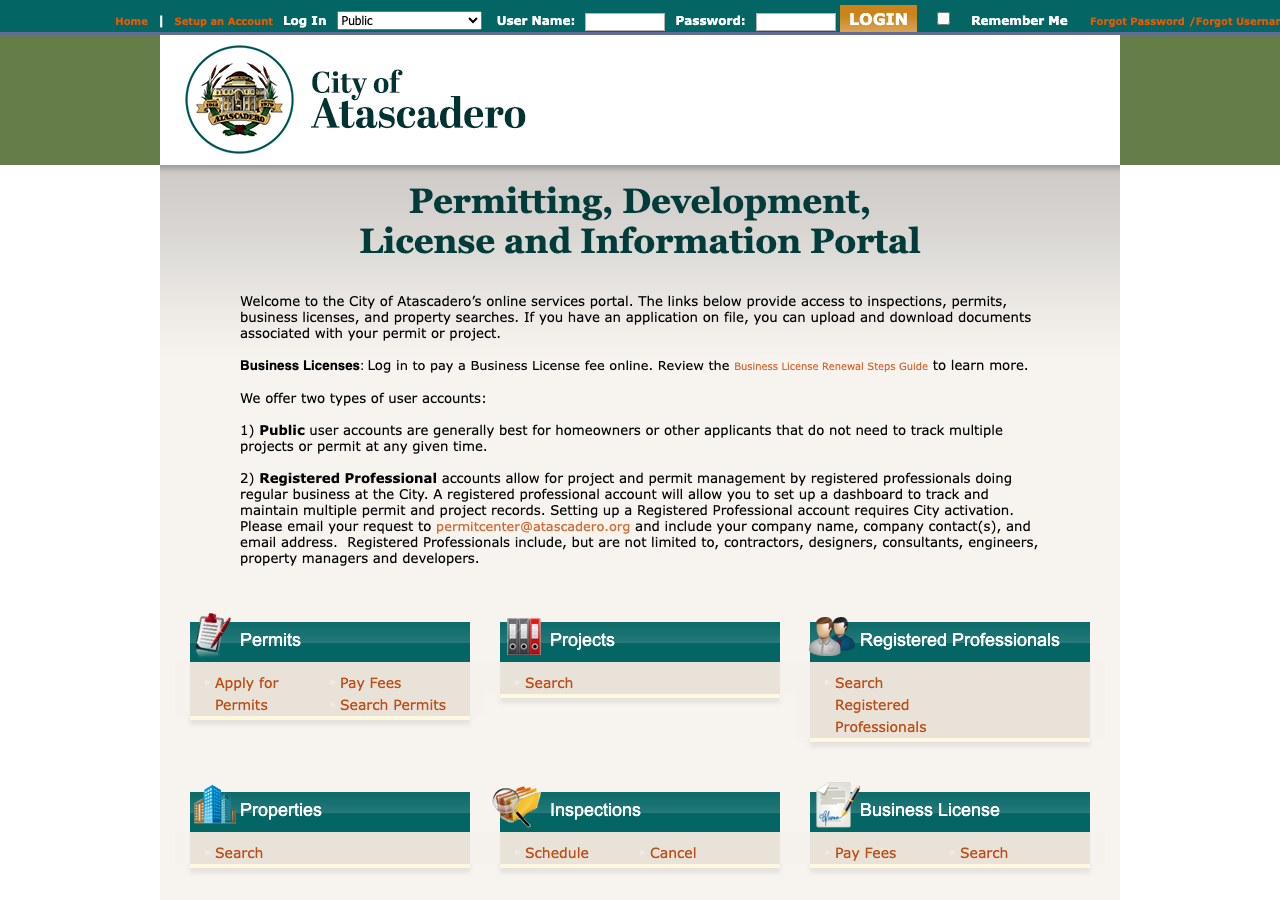
Average approval time — application to PTO
From the CPUC interconnection record. Bars show the average days taken each year; a year with no recorded projects is left blank rather than drawn as zero.