
City of Azusa
Los Angeles County
City of Azusa is a city authority in the State of California, serving 50,000 residents. 311 residential solar installs are on record here. This page is the permit route for that jurisdiction: the fifteen steps from working out who has a say over an address through to permission to operate, the documents this authority publishes, and 62 answers taken from those documents and dated.
Permitting 5 steps · 28 questions
Whether a permit is needed — Yes Q3 Electrical and building permits — Either Q4 Plan review — 1 to 3 business days Q18 Where you file — GoPost / TransTech ePlanSoft online plan-review portal (gopost-transtech.eplansoftreview.com, portal=azusa), Q20
- Permit required
- Yes98% source
- What it costs
- Residential PV <=15 kW: $450 flat, OR 45% of the valuation-based building-permit fee -- WHICHEVER IS LESS.88% source
- Plan review turnaround
- 1 to 3 business days90% source
- Key document
- published checklist (absence) cited by 6 open the document
-
Confirm who has a say over your address
A city address is usually permitted by the city, not the county — but not always, and some authorities keep building and hand electrical to someone else. Getting this wrong costs the whole submittal, because every requirement below belongs to whoever actually holds jurisdiction. Check the overlays in the same pass: an HOA, a historic district, a windstorm certification or a system-size cap can reshape the design, and all of them are cheaper to find now than after the array is laid out.
- Is this authority the AHJ for residential solar at this address? Yes 92% · department page
- What does this authority permit itself, and what does it delegate? Both 88% · department page
- Is a permit required for a residential rooftop PV system? Yes 98% · ordinance
- Is there a separate electrical permit, or is it combined? Either 88% · published checklist/bulletin
- Is a HOA or architectural approval required first? No 92% · ordinance
- Is a wind or windstorm certification required? No 65% · department page
- Is a Specific Use Permit or Council approval ever required? Yes, conditionally -- a Use Permit can be required if the Building Official finds, based on substantial evidence, that the system 'could have a specific, adverse impact upon the public health and safety'; denial/approval decisions are appealable to the Planning Commission. 92% · ordinance
- Is there a system-size cap on residential generation? No absolute cap on standard permitting, but the EXPEDITED/streamlined path is limited to systems <=10 kW AC nameplate (or <=30 kW thermal) per Sec. 14-11(a); above that, standard (non-expedited) review applies. Separately, Azusa Light & Water treats systems <=10 kW DC under true Net Energy Metering (NEM) and systems >10 kW DC (up to <1 MW DC) under a different Co-Energy Metering (CEM) time-of-use tariff -- a materially different (non-NEM) billing arrangement above 10 kW DC. 88% · ordinance + utility page
-
Check who is allowed to apply
Several authorities require the electrical permit to be pulled by a licensed electrician, or require the contractor to be registered with them BEFORE applying. Registration is not same-day. This is second on the list rather than fourth because it is the step most likely to stop the job before the drawings matter.
- Who is allowed to pull the electrical permit? Either 55% · utility agreement
- Must the contractor be registered with this authority before applying? Yes 82% · ordinance
- Is a homeowner permitted to self-install and self-permit? Yes 55% · ordinance (absence)
-
Build the submittal package
Almost everywhere wants a site plan, a one-line or three-line electrical diagram, equipment cut sheets with listings, and a structural attachment detail. Build it against the published checklist rather than the last jurisdiction you worked in — the checklist is what the reviewer marks against.
- What documents make up a complete submittal? Eligibility Checklist for Expedited Solar PV; completed permit application; Standard Electrical Plan (PV only) or engineered electrical plans; roof plan/site plan showing panel layout, fire-safety items, access pathways and label locations; expedited Structural Criteria form OR PE/SE-stamped structural calcs for non-qualifying systems; Electric Single Line Diagram; Electric Load Schedule; solar/wind generating-system electrical specifications and equipment certification/listing sheets; Battery/ESS specifications if applicable; California Solar Consumer Protection Guide (SCPG) acknowledgement pages initialed/signed; signed Solar Process Flow Chart; 3 original signed copies of the Azusa Light & Water NEM (or CEM) Interconnection Agreement submitted to ALW (with ALW Release Form returned) before Building Division submittal. 92% · utility agreement + published checklist
- How many copies, and in what format? Two (2) sets of plans to the Building Division (or electronic submittal); three (3) original signed copies of the NEM/CEM Interconnection Agreement to Azusa Light & Water, plus one (1) Solar Consumer Protection Guide. 90% · published checklist/bulletin
- Is a site plan required, and what must it show? Yes -- a roof/site plan showing PV or thermal panel layout, approximate roof-access-point location, code-compliant clear access pathways, PV system fire classification, and the locations of all required labels/markings and electrical disconnecting means. 90% · published checklist
- Is a one-line / three-line diagram required? Yes 92% · utility agreement
- Are string and conductor calculations required? Yes (implicit, via the standard-plan eligibility limits) 65% · published checklist
- Is a structural PE stamp required, and at what threshold? Structural PE/SE stamp not required if the system meets the expedited 'Structural Criteria' checklist; REQUIRED (CA-licensed Civil or Structural Engineer) for any system that does not qualify -- covering roof type/framing, panel weight/attachment method, and site-specific calculations. 92% · published checklist/bulletin
- Is an electrical PE stamp required, and at what threshold? No electrical PE/SE stamp threshold found for residential PV in any reviewed document (Submission Bulletin, Eligibility Checklist, NEM Agreement, ED-25/ED-27). 55% · published checklist (absence)
-
Apply and pay
Most authorities now take the whole application through a portal, and several states cap or constrain what a residential solar permit may cost. Check whether plan check is billed separately before you quote the job.
- Which permit portal does this authority use? GoPost / TransTech ePlanSoft online plan-review portal (gopost-transtech.eplansoftreview.com, portal=azusa), plus direct email submittal to buildingpermits@azusaca.gov for the expedited solar path. 88% · portal landing page
- Can the whole application be completed online? No (partially) -- documents/fees can be submitted and paid electronically, but the Submission Bulletin states the applicant must physically go to the Building Division ('213 E. Foothill Blvd.') to obtain (pick up) the issued permit. 70% · published checklist/bulletin
- What does a residential solar permit cost? Residential PV <=15 kW: $450 flat, OR 45% of the valuation-based building-permit fee -- WHICHEVER IS LESS. Residential PV >15 kW: $450 + $15/kW over 15 kW, or 45% of the valuation-based fee, whichever is less. 88% · fee schedule
- How is the fee calculated? Tiered / Per kW 85% · fee schedule
- Is there a separate plan-check fee? No -- combined 65% · fee schedule
-
Plan review — and start the utility in parallel
Interconnection is a separate process from the permit and usually the longer pole. Where the utility does not depend on the permit being issued, running both at once is the single biggest saving available on a residential job.
- What is the stated plan-review turnaround? 1 to 3 business days 90% · published checklist/bulletin
- How long is an issued permit valid before it expires? 365 days (1 year) from issuance or from the last approved inspection, whichever is later; extendable in increments of up to 180 days each (extension fee up to 25% of the original permit fee per extension). 96% · ordinance
- Which utility handles interconnection here? Azusa Light & Water (ALW) -- the City of Azusa's own municipally-owned electric utility, NOT Southern California Edison. 98% · utility/department page
- Where does the utility sit in the sequence? Before permit AND parallel at final -- ALW is not CPUC/Rule-21 jurisdictional (it is a municipal utility with its own rules). 92% · utility DG process flow chart
28 questions answered against City of Azusa’s own published documents
Q1 Is this authority the AHJ for residential solar at this address? Core Jurisdiction & scope
Yes
Why the confidence is not higherCity of Azusa Building & Safety Division issues building/electrical/PV permits for one- and two-family dwellings citywide (Azusa Municipal Code Sec. 14-11, permitting process for small residential rooftop solar). Jurisdiction is split: LACoFD holds fire (fee-for-service contract city, confirmed by name on fire.lacounty.gov/contracting/), and Azusa Light & Water (municipal utility) gates interconnection.
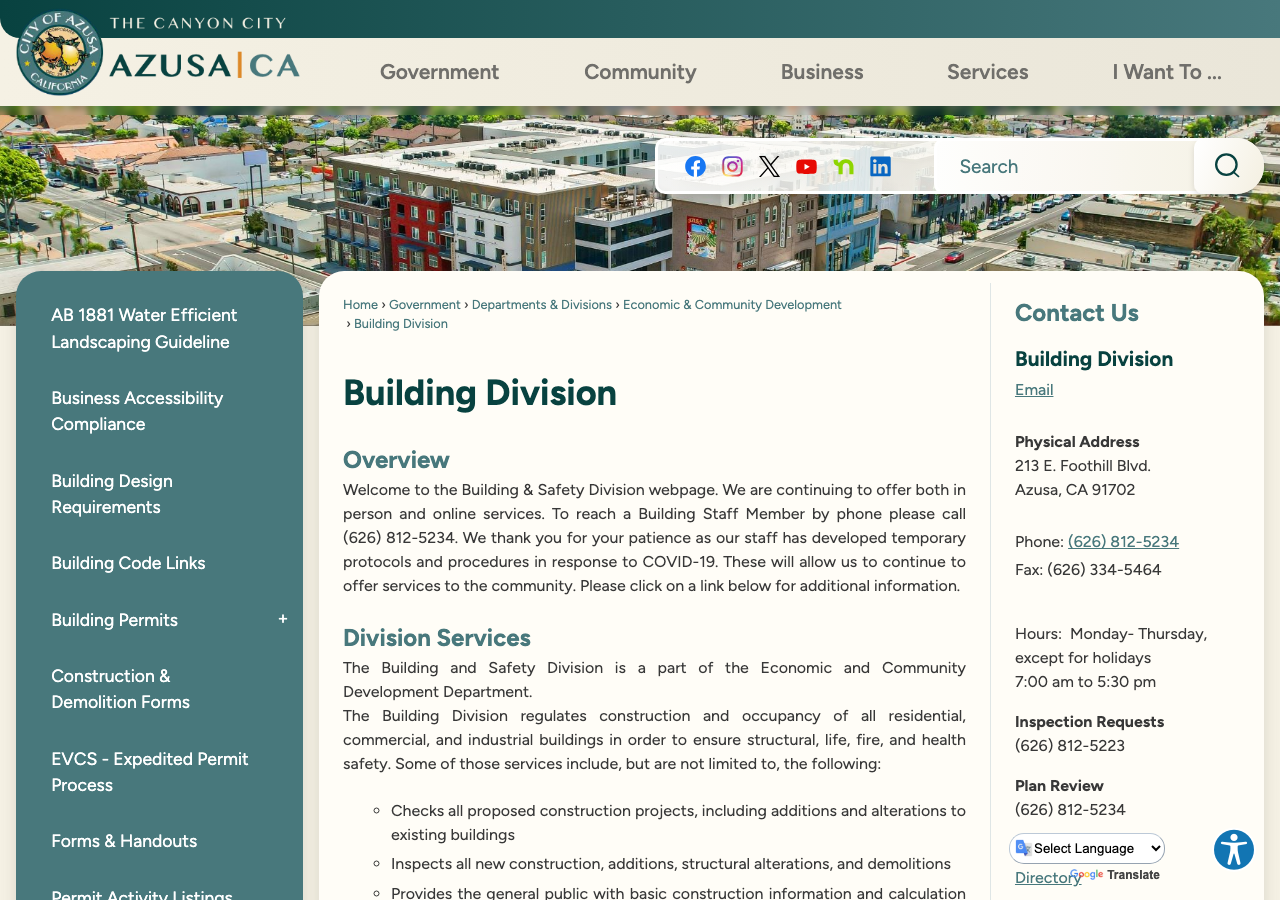
department page checked 2026-08-30 https://www.azusaca.gov/110/Building-Division
Q2 What does this authority permit itself, and what does it delegate? Core Jurisdiction & scope
Both
Why the confidence is not higherAzusa Building & Safety issues both building and electrical permits itself (azusaca.gov/110). Fire is delegated OUT to LACoFD for conventional PV review/inspection, but LACoFD itself retains (does not delegate) ESS>3kWh and PV-disconnect/RSD placarding -- see jurisdiction.why.
department page checked 2026-08-30 https://www.azusaca.gov/110/Building-Division
Q3 Is a permit required for a residential rooftop PV system? Core Jurisdiction & scope
Yes
Why the confidence is not higherAzusa Municipal Code Sec. 14-11(c)-(g): building official issues 'all required permits or authorizations' for small residential rooftop solar systems via an administrative, nondiscretionary process. Codified text pulled live via Municode's CodesContent API (the public library.municode.com page is a client-rendered Angular shell with no server text).
ordinance checked 2026-08-30 https://library.municode.com/ca/azusa/codes/code_of_ordinances?nodeId=MUCO_CH14BUBURE_ARTIINGE_S14-11PEPRSMREROSOENSY
Q4 Is there a separate electrical permit, or is it combined? Core Jurisdiction & scope
Either
Why the confidence is not higherA single 'photovoltaic permit' covers the PV work (Submission Bulletin Sec. 4: 'A photovoltaic permit is required for all photovoltaic systems'). A SEPARATE electrical permit is only triggered 'If the photovoltaic system requires an electrical panel upgrade,' along with a meter-spot request to Azusa Light & Water.
published checklist/bulletin checked 2026-08-30 https://www.azusaca.gov/DocumentCenter/View/30443
Q5 Who is allowed to pull the electrical permit? Core Who may apply
Either
Why the confidence is not higherNo Azusa-specific restriction on who pulls the electrical permit was found (searched Municode for 'owner-builder' = 0 hits, a proven absence since other terms return hits in the same search). Azusa Light & Water's own Interconnection Agreement and process flow chart address the submitting party generically as 'Customer/Contractor,' implying either may apply; this is inferred from state law (B&P Code Sec. 7044 owner-builder exemption applies statewide) rather than an explicit local statement.
utility agreement checked 2026-08-30 https://www.azusaca.gov/DocumentCenter/View/47495/5-NEM-Agreement-with-Battery-12112023
Q6 Must the contractor be registered with this authority before applying? Core Who may apply
Yes
Why the confidence is not higherAzusa Municipal Code Sec. 18-693 requires every state-licensed general/engineering/sub-contractor to pay the city's contractor business-license (gross-receipts) tax 'at the same time an application for any construction permit ... is applied for.'
ordinance checked 2026-08-30 https://library.municode.com/ca/azusa/codes/code_of_ordinances?nodeId=MUCO_CH18BU_ARTXMIBULI_S18-693CO
Q7 Is a homeowner permitted to self-install and self-permit? Who may apply
Yes
Why the confidence is not higherNo Azusa-specific bar on homeowner self-install/self-permit was found in Chapter 14 or Sec. 14-11 (searched Municode; 'owner-builder' returns 0 hits, proven absence via working search with passing positive/fabricated controls). This is an inference from statewide CA owner-builder law (B&P Code Sec. 7044), not an explicit Azusa statement, hence moderate confidence.
ordinance (absence) checked 2026-08-30 https://library.municode.com/ca/azusa/codes/code_of_ordinances?nodeId=MUCO_CH14BUBURE_ARTIINGE_S14-11PEPRSMREROSOENSY
Q8 What documents make up a complete submittal? Core Submittal package
Eligibility Checklist for Expedited Solar PV; completed permit application; Standard Electrical Plan (PV only) or engineered electrical plans; roof plan/site plan showing panel layout, fire-safety items, access pathways and label locations; expedited Structural Criteria form OR PE/SE-stamped structural calcs for non-qualifying systems; Electric Single Line Diagram; Electric Load Schedule; solar/wind generating-system electrical specifications and equipment certification/listing sheets; Battery/ESS specifications if applicable; California Solar Consumer Protection Guide (SCPG) acknowledgement pages initialed/signed; signed Solar Process Flow Chart; 3 original signed copies of the Azusa Light & Water NEM (or CEM) Interconnection Agreement submitted to ALW (with ALW Release Form returned) before Building Division submittal.
Why the confidence is not higherCompiled directly from ALW's own NEM Interconnection Agreement 'SUBMITTALS REQUIRED' list, the Eligibility Checklist (Toolkit Document #2), and the Submission Requirement Bulletin -- all the authority's/utility's own current documents, cross-checked against each other.
utility agreement + published checklist checked 2026-08-30 https://www.azusaca.gov/DocumentCenter/View/47495/5-NEM-Agreement-with-Battery-12112023
Q9 How many copies, and in what format? Submittal package
Two (2) sets of plans to the Building Division (or electronic submittal); three (3) original signed copies of the NEM/CEM Interconnection Agreement to Azusa Light & Water, plus one (1) Solar Consumer Protection Guide.
Why the confidence is not higherSubmission Bulletin Sec. 3 and the NEM Solar Process Flow Chart step 1/5 both state these counts explicitly.
published checklist/bulletin checked 2026-08-30 https://www.azusaca.gov/DocumentCenter/View/30443
Q10 Is a site plan required, and what must it show? Core Submittal package
Yes -- a roof/site plan showing PV or thermal panel layout, approximate roof-access-point location, code-compliant clear access pathways, PV system fire classification, and the locations of all required labels/markings and electrical disconnecting means.
Why the confidence is not higherSubmission Bulletin item 1(e) and Eligibility Checklist 'FIRE SAFETY REQUIREMENTS' item D, both the authority's own current documents.
published checklist checked 2026-08-30 https://www.azusaca.gov/DocumentCenter/View/30433
Q11 Is a one-line / three-line diagram required? Core Drawings & calculations
Yes
Why the confidence is not higher'Electric Single Line Diagram' is a required submittal per the NEM Interconnection Agreement, and a 'Standard Electrical Plan (PV only)' is required per the Submission Bulletin.
utility agreement checked 2026-08-30 https://www.azusaca.gov/DocumentCenter/View/47495/5-NEM-Agreement-with-Battery-12112023
Q12 Are string and conductor calculations required? Drawings & calculations
Yes (implicit, via the standard-plan eligibility limits)
Why the confidence is not higherThe Eligibility Checklist enforces string/MPPT and fuse/conductor-rating limits (max strings per MPPT, fuse ratings tied to module series fuse rating, bus-bar rating <=225A), and the NEM Agreement requires an 'Electric Load Schedule.' No standalone 'conductor calculation' form is separately named, so this is inferred rather than a single named document.
published checklist checked 2026-08-30 https://www.azusaca.gov/DocumentCenter/View/30433
Q13 Is a structural PE stamp required, and at what threshold? Core Engineering & stamps
Structural PE/SE stamp not required if the system meets the expedited 'Structural Criteria' checklist; REQUIRED (CA-licensed Civil or Structural Engineer) for any system that does not qualify -- covering roof type/framing, panel weight/attachment method, and site-specific calculations.
Why the confidence is not higherSubmission Bulletin item 1(f), the authority's current published bulletin.
published checklist/bulletin checked 2026-08-30 https://www.azusaca.gov/DocumentCenter/View/30443
Q14 Is an electrical PE stamp required, and at what threshold? Engineering & stamps
No electrical PE/SE stamp threshold found for residential PV in any reviewed document (Submission Bulletin, Eligibility Checklist, NEM Agreement, ED-25/ED-27).
Why the confidence is not higherAbsence proven by full read of all three solar-specific submittal documents plus the utility's engineering standards; none mention an electrical-engineer stamp requirement at any size threshold, consistent with normal CA practice of requiring only a structural (not electrical) PE for standard-plan residential PV.
published checklist (absence) checked 2026-08-30 https://www.azusaca.gov/DocumentCenter/View/30443
Q15 What does a residential solar permit cost? Core Fees
Residential PV <=15 kW: $450 flat, OR 45% of the valuation-based building-permit fee -- WHICHEVER IS LESS. Residential PV >15 kW: $450 + $15/kW over 15 kW, or 45% of the valuation-based fee, whichever is less.
Why the confidence is not higherCity of Azusa's Council-adopted 'Schedule of Fees and Charges (Development-Related) -- Building and Safety,' effective 2/2/2026 (item nos. 182-187), read from the extracted PDF text (not a summary). NOTE internal inconsistency: an older, still-linked 'Submission Requirement Bulletin - Solar' shows a different flat/tiered total ($369.01-$429.19 by valuation band) with no size breakpoint; that bulletin's PDF metadata was last touched July 2026 but its dollar figures look stale relative to the Council's Feb-2026 fee resolution, so the Council-adopted schedule is treated as authoritative here.
fee schedule checked 2026-08-30 https://www.azusaca.gov/DocumentCenter/View/50231/Fee-Schedule-Posted-Online-Final-2-2-26
Q16 How is the fee calculated? Core Fees
Tiered / Per kW
Why the confidence is not higherPer the current (2/2/2026) fee schedule: flat $450 up to 15 kW, then $15/kW increments above 15 kW, capped by an alternate 45%-of-declared-valuation formula (whichever amount is lower is charged). The superseded-looking Solar Bulletin instead shows a pure valuation-tiered table -- flag this contradiction.
fee schedule checked 2026-08-30 https://www.azusaca.gov/DocumentCenter/View/50231/Fee-Schedule-Posted-Online-Final-2-2-26
Q17 Is there a separate plan-check fee? Fees
No -- combined
Why the confidence is not higherThe current fee schedule (item 182) states 'Permit AND plan check fees for photovoltaic systems shall be assessed at 45% of the fee...' as one combined figure. However, the still-linked Submission Bulletin shows Plan-Check Fee and Building-Permit Fee as two separate columns -- an internal contradiction between the two authority documents; confidence lowered accordingly.
fee schedule checked 2026-08-30 https://www.azusaca.gov/DocumentCenter/View/50231/Fee-Schedule-Posted-Online-Final-2-2-26
Q18 What is the stated plan-review turnaround? Core Timeline & validity
1 to 3 business days
Why the confidence is not higherSubmission Bulletin Sec. 3: 'Standard photovoltaic and solar hot water plans will be reviewed within one to three Business days.'
published checklist/bulletin checked 2026-08-30 https://www.azusaca.gov/DocumentCenter/View/30443
Q19 How long is an issued permit valid before it expires? Timeline & validity
365 days (1 year) from issuance or from the last approved inspection, whichever is later; extendable in increments of up to 180 days each (extension fee up to 25% of the original permit fee per extension).
Why the confidence is not higherAzusa Municipal Code Sec. 14-44 (Expiration and extension of permits), as amended by Ord. No. 2025-06, Sec. 6, 11-3-25 -- current codified text.
ordinance checked 2026-08-30 https://library.municode.com/ca/azusa/codes/code_of_ordinances?nodeId=MUCO_CH14BUBURE_ARTIIBUCO_DIV1BUCOAD_S14-44EXEXPE
Q20 Which permit portal does this authority use? Core Portal & process
GoPost / TransTech ePlanSoft online plan-review portal (gopost-transtech.eplansoftreview.com, portal=azusa), plus direct email submittal to buildingpermits@azusaca.gov for the expedited solar path.
Why the confidence is not higherLink labeled 'Online Building Plan Submittal Portal' on the Building Division page resolves to this vendor portal; the Solar Submittal (Expedited) page separately directs applicants to email plans to buildingpermits@azusaca.gov.
portal landing page checked 2026-08-30 https://www.azusaca.gov/110/Building-Division
Q21 Can the whole application be completed online? Core Portal & process
No (partially) -- documents/fees can be submitted and paid electronically, but the Submission Bulletin states the applicant must physically go to the Building Division ('213 E. Foothill Blvd.') to obtain (pick up) the issued permit.
Why the confidence is not higherSubmission Bulletin Sec. 4 ('you will need to go the City of Azusa Building Division ... to obtain your permit') contradicts a fully online end-to-end process, even though electronic plan submittal is expressly permitted (Sec. 3) via portal or email.
published checklist/bulletin checked 2026-08-30 https://www.azusaca.gov/DocumentCenter/View/30443
Q22 Which utility handles interconnection here? Core Utility interconnection
Azusa Light & Water (ALW) -- the City of Azusa's own municipally-owned electric utility, NOT Southern California Edison.
Why the confidence is not higherOVERTURNS the brief's SCE assumption. Confirmed directly from the city's own Solar PV System Installation Procedures page and ALW's own Interconnection & Net Metering Agreement (Azusa Light & Water Department, a division of the City of Azusa municipal corporation).
utility/department page checked 2026-08-30 https://www.azusaca.gov/565/Solar-PV-System-Installation-Procedures
Q23 Where does the utility sit in the sequence? Core Utility interconnection
Before permit AND parallel at final -- ALW is not CPUC/Rule-21 jurisdictional (it is a municipal utility with its own rules).
Why the confidence is not higherALW gates permit issuance: the NEM Solar Process Flow Chart states 'Building and Safety will not issue permits without the [ALW] Release Form.' ALW then ALSO performs its own separate final utility inspection AFTER the Building final, before installing/energizing the NEM meter -- so ALW sits both before permit issuance and again in parallel with/after the building final.
utility DG process flow chart checked 2026-08-30 https://www.azusaca.gov/DocumentCenter/View/47493/3-English-NEM-Solar-Process-Flow-Chart-Residential-10-KW-DC-or-Less-Update-11292023-final
Q24 Is a HOA or architectural approval required first? Overlays & special cases
No
Why the confidence is not higherAzusa Municipal Code Sec. 14-11(j): 'The city shall not condition approval of an application on the approval of an association, as defined in Civil Code Sec. 4080' -- consistent with the CA Solar Rights Act (Civil Code Sec. 714).
ordinance checked 2026-08-30 https://library.municode.com/ca/azusa/codes/code_of_ordinances?nodeId=MUCO_CH14BUBURE_ARTIINGE_S14-11PEPRSMREROSOENSY
Q25 Is there a historic-district review? Overlays & special cases
Nothing published by this authority.
Where we lookedAzusa Municipal Code Sec. 14-11 (small-residential-rooftop-solar permitting ordinance) via Municode's CodesContent API, and the Development Code Historic Preservation provisions referenced from azusaca.gov/27/Government; no PV-specific historic-district review carve-out or requirement was located in the sections reviewed, and the general Historic Preservation chapter of the Development Code (Ch. 88) was not fully read section-by-section for a solar cross-reference within the time available.
Q26 Is a wind or windstorm certification required? Overlays & special cases
No
Why the confidence is not higherNo windstorm-certification program (of the Texas TDI type) was found for Azusa; the city's Building Design Requirements page instead cites standard ASCE 7 wind-design parameters (89 mph 3-second gust, Exposure C) as part of ordinary structural code compliance, not a separate certification requirement. That page is otherwise stale (still shows 2019 CBC), so this is a moderate-confidence negative.
department page checked 2026-08-30 https://www.azusaca.gov/950/Building-Design-Requirements
Q27 Is a Specific Use Permit or Council approval ever required? Overlays & special cases
Yes, conditionally -- a Use Permit can be required if the Building Official finds, based on substantial evidence, that the system 'could have a specific, adverse impact upon the public health and safety'; denial/approval decisions are appealable to the Planning Commission.
Why the confidence is not higherAzusa Municipal Code Sec. 14-11(h)-(i), current codified text (Ord. No. 2015-O10).
ordinance checked 2026-08-30 https://library.municode.com/ca/azusa/codes/code_of_ordinances?nodeId=MUCO_CH14BUBURE_ARTIINGE_S14-11PEPRSMREROSOENSY
Q28 Is there a system-size cap on residential generation? Overlays & special cases
No absolute cap on standard permitting, but the EXPEDITED/streamlined path is limited to systems <=10 kW AC nameplate (or <=30 kW thermal) per Sec. 14-11(a); above that, standard (non-expedited) review applies. Separately, Azusa Light & Water treats systems <=10 kW DC under true Net Energy Metering (NEM) and systems >10 kW DC (up to <1 MW DC) under a different Co-Energy Metering (CEM) time-of-use tariff -- a materially different (non-NEM) billing arrangement above 10 kW DC.
Why the confidence is not higherSec. 14-11(a) definition of 'small residential rooftop solar energy system' (AC-based, expedited path threshold) plus ALW's Solar PV System Installation Procedures page and NEM/CEM Interconnection Agreements (DC-based utility program threshold) -- two different thresholds using two different units (AC vs. DC), a nuance worth flagging.
ordinance + utility page checked 2026-08-30 https://www.azusaca.gov/565/Solar-PV-System-Installation-Procedures
Lines marked with a percentage were read off this authority’s own published documents. Unmarked guidance is general good practice, not this jurisdiction’s rule — always confirm against the authority before you submit.
Install 5 steps · 20 questions
-
Build to the code editions actually in force here
The NEC edition a jurisdiction enforces is often a cycle behind the newest one published, and local amendments sit on top of it. Rapid shutdown, conductor sizing and labelling all change between editions, so the edition in force is the first thing to establish, not the last.
- Which NEC edition is in force? 2023 90% · ordinance
- Which building code edition is in force? 2025 California Building Code and 2025 California Residential Code (Title 24 Parts 2 and 2.5) 90% · ordinance
- Which fire code edition is in force? 2023 Los Angeles County Fire Code (LACFC, LACC Title 32, Ordinances #23-0008 & 2023-0058, effective 2024-01-11) is the edition LACoFD -- the actual fire AHJ -- currently administers and fee-schedules against. 72% · fire district fee ordinance
- Are there local amendments to any of the above? Yes 85% · ordinance
- What is the installation judged against? The 2025 CBC/CRC/CEC as locally amended (Ch. 14 of the Azusa Municipal Code) for building/electrical; the 2023 LACFC as administered by LACoFD for fire-related aspects (ESS, PV disconnect/rapid-shutdown placarding); Azusa Light & Water's own Electric Service Requirements and ED-25/ED-27 engineering standards for the interconnection equipment; and the approved plan set. 82% · ordinance
-
Fire access, setbacks and pathways
Ridge setbacks and roof access pathways are fire-service requirements and they constrain the array layout. They are the most common cause of a redesign after the fire department comments on a plan set.
- What ridge setback and access pathways are required? Not specified by the city itself -- the Submission Bulletin instead directs applicants to 'Examples of clear path access pathways ... available in the State Fire Marshal Solar PV Installation Guide' rather than setting an Azusa-specific ridge-setback figure. Municode search for 'ridge' returns 0 PV-related hits (positive control 'National Electrical Code' returned 74 hits and fabricated control 'zzqqx' returned 0, so the search itself is proven working). 75% · published checklist (absence)
-
Rapid shutdown
Which rapid-shutdown rule applies follows directly from the NEC edition in force, and the initiation device has to be at a location the fire service can reach and identify. This is inspected, and it is labelled.
- Is rapid shutdown required, and to which NEC edition? Yes, per NEC 690.12 as incorporated into the 2023 NEC / 2025 California Electrical Code currently in force. 85% · adopting regulation + fire authority guide
-
Labels and placards
The NEC sets a baseline for permanent markings at the service equipment and the disconnecting means. On top of that, an authority may specify its own wording, and the utility may specify more again. Where any of them writes its own text, a generic off-the-shelf label set will not pass — this is the detail most often fixed on a return visit.
- Which placards does this authority require at the service equipment? City/Building-level (generic, NEC-referenced): sign identifying PV power-source system attributes at the DC disconnect; sign identifying the AC point of connection; sign identifying the switch for the alternative power system. Fire/LACoFD-level (retained by LACoFD, specific wording): 'LACoFD Electrical Power Source Disconnect Placarding System' -- an Exterior Placard reading 'F.D. -- ELECTRICAL / BLDG DISCONNECT / #X of Y' at each panel/enclosure/disconnect that must be operated, plus Panel-Interior Placards identifying specific breakers, wherever a PV/ESS/generator disconnect or rapid-shutdown initiation device exists. 90% · fire authority guide
- Does the authority specify placard wording of its own? Yes (via LACoFD, which retains this specific item) / No (Building Division has no verbatim wording of its own beyond generic NEC-style sign descriptions). 88% · fire authority guide
- Does it specify letter height, colour or material? Yes -- Exterior placards: minimum 2in x 3.5in weather-resistant plastic, engraved, red letters on a yellow background, solid all-capitals Arial font, minimum 24pt (28pt bold for 'F.D.' and '#X of Y'). Panel-Interior placards: minimum 7/16in x 3/4in, same color/material, bold Arial, minimum 24pt. Attachment by permanent, material/weather/surface-compatible epoxy. 95% · fire authority guide
- Is a site plan / facility map placard required, and what must it show? Yes, functionally -- a required plan-set drawing (not a posted physical placard) showing the roof layout of all panels/modules, clear access pathways, and approximate locations of electrical disconnecting means and roof-access points; and, where plans are required for ESS/disconnects, a formal 'Electrical Power Source Disconnect Schedule' table listing every energy source, its disconnection-number ('#X of Y'), and the disconnecting device/equipment. 78% · published checklist + fire authority guide
- Does the UTILITY specify placards beyond the AHJ's? No additional placard/labeling spec found in Azusa Light & Water's own engineering standards beyond generic equipment requirements (production meter model, lockability). 82% · utility engineering standard (absence)
- Where must the labels be placed? Per Azusa Light & Water (ED-25/ED-27): the main service panel, production meter socket, and AC disconnect must be within 8 feet of each other and a minimum of 10 inches apart, located outdoors, and accessible to the utility at all times. Per LACoFD (Appendix B): Exterior placards go on/immediately adjacent to each panel/enclosure or standalone disconnect switch that must be operated; Panel-Interior placards go inside a panel to identify specific breakers when multiple switches in one enclosure must be operated. 92% · utility engineering standard + fire authority guide
-
Disconnect, storage and listed equipment
Where the AC disconnect must sit relative to the meter is usually the utility's rule, not the building department's. Battery storage frequently carries its own permit, its own inspection and its own fire conditions.
- Where must the AC disconnect be, relative to the meter? Per Azusa Light & Water's own DG engineering standard (ED-25/ED-27): the main service, production meter socket, and AC disconnect shall be located within 8 feet of each other and a minimum of 10 inches apart, outdoors, and accessible to the utility at all times; the AC disconnect must be lockable in the off position. 95% · utility DG engineering standard
- Must equipment be on a specific approved list? Yes, implicitly -- standard UL listing, not a separate city-approved-products list. 85% · fire authority checklist
- Are batteries permitted, and under what conditions? Yes, under LACoFD's 2023 LACFC Sec. 1207.11 (Group R-3/R-4): max 20 kWh per individual ESS unit; 80 kWh aggregate per dwelling (in any combination of garage/exterior-wall/outdoor-ground locations); UL 9540 (unit) and UL 1741 (inverter, unless covered by the UL 9540 listing) required; installation restricted to detached garages, attached garages (separated per CRC R302.6), or outdoors/exterior walls meeting setback rules (>=5ft from lot lines/buildings/combustibles, >=10ft from vegetation, >=3ft from openings); banned from dwelling units, sleeping rooms, closets, bathrooms, basements, non-garage accessory structures, and vaults; >=3ft spacing between units; fire detection required for attached-garage installs; impact protection required if <36in above finished floor and subject to vehicle damage; remote disconnect device required for interior units. 95% · fire authority guide
- Is there a separate ESS permit or inspection? Yes -- ESS with a capacity above 3 kWh requires a SEPARATE LACoFD plan review and field inspection (not delegated to Azusa Building & Safety), billed at LACoFD's own fee-ordinance rates ($195 plan review for Group R-3/R-4, $390 field inspection, per Appendix QQ). 95% · fire authority checklist + fee ordinance
- Is a ground mount treated as a structure? Not explicitly addressed for solar in Azusa's Development Code (searched Municode; 'photovoltaic' returns exactly 1 hit citywide, i.e. Sec. 14-11 only -- a proven absence at the zoning-code level). A ground-mounted PV array would presumptively fall under the generic 'Accessory Structures' provisions (Development Code Sec. 88.42.020: max 1 story/20ft height, rear/side setbacks, 10ft separation from other structures), but no PV-specific text confirms this classification. 50% · ordinance (inferred)
- Is there a local rule on service upgrades or busbar sizing? Yes -- (1) For the expedited path, PV must interconnect to a single-phase 120/240V panel with a bus-bar rating of 225A or less; (2) Any new or upgraded service panel requires prior 'spot approval' from the Azusa Light & Water electric division before installation -- installing at an unapproved spot risks project delay until corrected. 90% · utility engineering standard
- Is a specific mounting system or attachment spacing required? No single prescriptive spacing table -- case-by-case via the 'expedited Structural Criteria' form (for qualifying systems) or PE/SE-stamped structural calculations covering roof-covering type, framing size/spacing, panel weight and support locations, attachment method, and (where an approved racking system is used) manufacturer documentation of max allowable weight and attachment method. 65% · published checklist/bulletin
20 questions answered against City of Azusa’s own published documents
Q29 Which NEC edition is in force? Core Code editions in force
2023
Why the confidence is not higherAzusa Municipal Code Sec. 14-1 (current codified text, last amended by Ord. No. 2025-06, Sec. 2, 11-3-25) adopts the '2025 California Electrical Code, Title 24 Part 3' -- and the 2025 CEC is based on the 2023 NEC (there is no '2025 NEC'). This OVERTURNS the city's own stale 'Building Design Requirements' webpage, which still lists the 2019 CEC and has evidently not been updated since at least two code cycles ago.
ordinance checked 2026-08-30 https://library.municode.com/ca/azusa/codes/code_of_ordinances?nodeId=MUCO_CH14BUBURE_ARTIINGE_S14-1CACOAD
Q30 Which building code edition is in force? Core Code editions in force
2025 California Building Code and 2025 California Residential Code (Title 24 Parts 2 and 2.5)
Why the confidence is not higherAzusa Municipal Code Sec. 14-1, current codified text (Ord. No. 2025-06, 11-3-25). Same discrepancy as q29 -- the city's own 'Building Design Requirements' webpage is stale and still shows the 2019 CBC; the codified ordinance text (which is the enforceable instrument) is treated as authoritative.
ordinance checked 2026-08-30 https://library.municode.com/ca/azusa/codes/code_of_ordinances?nodeId=MUCO_CH14BUBURE_ARTIINGE_S14-1CACOAD
Q31 Which fire code edition is in force? Code editions in force
2023 Los Angeles County Fire Code (LACFC, LACC Title 32, Ordinances #23-0008 & 2023-0058, effective 2024-01-11) is the edition LACoFD -- the actual fire AHJ -- currently administers and fee-schedules against.
Why the confidence is not higherINTERNAL CONTRADICTION FLAGGED: Azusa's own Municipal Code Sec. 30-36 (fire code adoption) has not been amended since Ord. No. 2017-O1 (4-17-17) and its codified text still literally reads '2017 Los Angeles County Fire Code.' But LACoFD -- which actually holds fire-code enforcement in Azusa as a fee-for-service contract city -- operates under, and fee-schedules against (Appendix QQ), the current 2023 LACFC. The city's static ordinance text is stale; LACoFD's own current fee ordinance is treated as the operative fire-code cycle.
fire district fee ordinance checked 2026-08-30 https://fire.lacounty.gov/wp-content/uploads/2025/10/2023-LACFC-Appendix-QQ-Certified-Ord-Eff.-2024-01-11-Secured.pdf
Q32 Are there local amendments to any of the above? Core Code editions in force
Yes
Why the confidence is not higherAzusa Municipal Code Ch. 14 contains multiple local amendments (Sec. 14-52 'California Building Code Chapter 1 Division II amended,' Sec. 14-53/14-54 roof-covering classification amendments, Art. XV Div. 2 pool/spa code amendments). LACoFD also enforces LA County-specific amendments to the CFC (LACC Title 32). Note AB 130 (Stats. 2025, Ch. 22) froze NEW more-restrictive residential local amendments from 1 Oct 2025 to 1 Jun 2031.
ordinance checked 2026-08-30 https://library.municode.com/ca/azusa/codes/code_of_ordinances?nodeId=MUCO_CH14BUBURE_ARTIIBUCO_DIV3BUCOAMMO_S14-52CABUCOCH1DIIIAM
Q33 What is the installation judged against? Core Electrical
The 2025 CBC/CRC/CEC as locally amended (Ch. 14 of the Azusa Municipal Code) for building/electrical; the 2023 LACFC as administered by LACoFD for fire-related aspects (ESS, PV disconnect/rapid-shutdown placarding); Azusa Light & Water's own Electric Service Requirements and ED-25/ED-27 engineering standards for the interconnection equipment; and the approved plan set.
Why the confidence is not higherSynthesized from Sec. 14-1 (code adoption), the LACoFD ESS/PV/Disconnects Guide, and ALW's ED-25/ED-27 standards -- all primary sources read directly.
ordinance checked 2026-08-30 https://library.municode.com/ca/azusa/codes/code_of_ordinances?nodeId=MUCO_CH14BUBURE_ARTIINGE_S14-1CACOAD
Q34 Is there a local rule on service upgrades or busbar sizing? Electrical
Yes -- (1) For the expedited path, PV must interconnect to a single-phase 120/240V panel with a bus-bar rating of 225A or less; (2) Any new or upgraded service panel requires prior 'spot approval' from the Azusa Light & Water electric division before installation -- installing at an unapproved spot risks project delay until corrected.
Why the confidence is not higherEligibility Checklist (Toolkit Doc #2), Electrical Requirements section; and ALW's own Electric Standards ED-25/ED-27, Note 1 (OCR-extracted from the image-only engineering-standard PDFs).
utility engineering standard checked 2026-08-30 https://www.azusaca.gov/DocumentCenter/View/24453/ED25
Q35 Is a specific mounting system or attachment spacing required? Structural & mounting
No single prescriptive spacing table -- case-by-case via the 'expedited Structural Criteria' form (for qualifying systems) or PE/SE-stamped structural calculations covering roof-covering type, framing size/spacing, panel weight and support locations, attachment method, and (where an approved racking system is used) manufacturer documentation of max allowable weight and attachment method.
Why the confidence is not higherSubmission Bulletin item 1(f) -- the authority's own document -- describes the required documentation but does not itself publish a universal attachment-spacing table.
published checklist/bulletin checked 2026-08-30 https://www.azusaca.gov/DocumentCenter/View/30443
Q36 What ridge setback and access pathways are required? Core Fire pathways & setbacks
Not specified by the city itself -- the Submission Bulletin instead directs applicants to 'Examples of clear path access pathways ... available in the State Fire Marshal Solar PV Installation Guide' rather than setting an Azusa-specific ridge-setback figure. Municode search for 'ridge' returns 0 PV-related hits (positive control 'National Electrical Code' returned 74 hits and fabricated control 'zzqqx' returned 0, so the search itself is proven working).
Why the confidence is not higherGenuine absence proven by a working, control-tested search of the Azusa Municipal Code plus direct text of the Submission Bulletin, which defers to the State Fire Marshal's guide / adopted fire code baseline rather than stating a local figure.
published checklist (absence) checked 2026-08-30 https://www.azusaca.gov/DocumentCenter/View/30443
Q37 Is rapid shutdown required, and to which NEC edition? Core Rapid shutdown
Yes, per NEC 690.12 as incorporated into the 2023 NEC / 2025 California Electrical Code currently in force.
Why the confidence is not higherSec. 14-1 adopts the 2025 CEC (2023 NEC base). LACoFD's own Guide/Appendix B expressly addresses 'PV/BIPV Rapid Shutdown function activation' placarding as part of its retained disconnect-placarding inspection scope, confirming RSD enforcement is live and current (not a stale pre-2019 scheme).
adopting regulation + fire authority guide checked 2026-08-30 https://fire.lacounty.gov/wp-content/uploads/2023/09/LACoFD-Guide-for-ESS-PV-and-Disconnects-Rev-3-2023-09-01-w-Appendices-SECURED.pdf
Q38 Which placards does this authority require at the service equipment? Core Labels Signage & labelling
City/Building-level (generic, NEC-referenced): sign identifying PV power-source system attributes at the DC disconnect; sign identifying the AC point of connection; sign identifying the switch for the alternative power system. Fire/LACoFD-level (retained by LACoFD, specific wording): 'LACoFD Electrical Power Source Disconnect Placarding System' -- an Exterior Placard reading 'F.D. -- ELECTRICAL / BLDG DISCONNECT / #X of Y' at each panel/enclosure/disconnect that must be operated, plus Panel-Interior Placards identifying specific breakers, wherever a PV/ESS/generator disconnect or rapid-shutdown initiation device exists.
Why the confidence is not higherCity list from the Submission Bulletin's inspection-checklist section; LACoFD spec from its Guide, Appendix B (Power Source Placarding), extracted with pdftotext -layout from the AES-256-encrypted-but-print-allowed PDF.
fire authority guide checked 2026-08-30 https://fire.lacounty.gov/wp-content/uploads/2023/09/LACoFD-Guide-for-ESS-PV-and-Disconnects-Rev-3-2023-09-01-w-Appendices-SECURED.pdf
Q39 Does the authority specify placard wording of its own? Core Labels Signage & labelling
Yes (via LACoFD, which retains this specific item) / No (Building Division has no verbatim wording of its own beyond generic NEC-style sign descriptions).
Why the confidence is not higherLACoFD Appendix B specifies exact verbiage ('F.D. -- ELECTRICAL / BLDG DISCONNECT / #X of Y') and word arrangement. The city's own Submission Bulletin and Eligibility Checklist describe placard FUNCTION ('sign identifying...') but no fixed wording template was found in either.
fire authority guide checked 2026-08-30 https://fire.lacounty.gov/wp-content/uploads/2023/09/LACoFD-Guide-for-ESS-PV-and-Disconnects-Rev-3-2023-09-01-w-Appendices-SECURED.pdf
Q40 Does it specify letter height, colour or material? Core Labels Signage & labelling
Yes -- Exterior placards: minimum 2in x 3.5in weather-resistant plastic, engraved, red letters on a yellow background, solid all-capitals Arial font, minimum 24pt (28pt bold for 'F.D.' and '#X of Y'). Panel-Interior placards: minimum 7/16in x 3/4in, same color/material, bold Arial, minimum 24pt. Attachment by permanent, material/weather/surface-compatible epoxy.
Why the confidence is not higherLACoFD Guide, Appendix B, Section II.B -- an exact, current (2023-09-01) specification read directly from the extracted PDF text.
fire authority guide checked 2026-08-30 https://fire.lacounty.gov/wp-content/uploads/2023/09/LACoFD-Guide-for-ESS-PV-and-Disconnects-Rev-3-2023-09-01-w-Appendices-SECURED.pdf
Q41 Is a site plan / facility map placard required, and what must it show? Core Labels Signage & labelling
Yes, functionally -- a required plan-set drawing (not a posted physical placard) showing the roof layout of all panels/modules, clear access pathways, and approximate locations of electrical disconnecting means and roof-access points; and, where plans are required for ESS/disconnects, a formal 'Electrical Power Source Disconnect Schedule' table listing every energy source, its disconnection-number ('#X of Y'), and the disconnecting device/equipment.
Why the confidence is not higherEligibility Checklist Fire Safety item D (city) and LACoFD Guide Appendix B.D 'Disconnect Schedule Examples' (fire) -- both the authority's/fire district's own current documents.
published checklist + fire authority guide checked 2026-08-30 https://www.azusaca.gov/DocumentCenter/View/30433
Q42 Does the UTILITY specify placards beyond the AHJ's? Core Labels Signage & labelling
No additional placard/labeling spec found in Azusa Light & Water's own engineering standards beyond generic equipment requirements (production meter model, lockability).
Why the confidence is not higherGenuine absence -- ALW's own Electric Standards ED-25 ('Requirements for Customers with Photovoltaic Generator') and ED-27 ('...with Photovoltaic & ESS') were OCR-extracted in full (image-only PDFs; pdftoppm + tesseract used since there was no text layer). Both address equipment spacing, meter model (Milbank 125-A), and 'AC disconnect shall be lockable in off position' -- no placard wording, size, or color requirement of ALW's own was found in either.
utility engineering standard (absence) checked 2026-08-30 https://www.azusaca.gov/DocumentCenter/View/24453/ED25
Q43 Where must the labels be placed? Core Labels Signage & labelling
Per Azusa Light & Water (ED-25/ED-27): the main service panel, production meter socket, and AC disconnect must be within 8 feet of each other and a minimum of 10 inches apart, located outdoors, and accessible to the utility at all times. Per LACoFD (Appendix B): Exterior placards go on/immediately adjacent to each panel/enclosure or standalone disconnect switch that must be operated; Panel-Interior placards go inside a panel to identify specific breakers when multiple switches in one enclosure must be operated.
Why the confidence is not higherBoth figures read directly from the utility's own OCR-extracted engineering standard and LACoFD's own Guide Appendix B.
utility engineering standard + fire authority guide checked 2026-08-30 https://www.azusaca.gov/DocumentCenter/View/24453/ED25
Q44 Must equipment be on a specific approved list? Equipment listing
Yes, implicitly -- standard UL listing, not a separate city-approved-products list.
Why the confidence is not higherLACoFD's Expedited Permitting Checklist requires UL 9540 listing for ESS units (whole unit or all components) and UL 1741 listing for ESS inverters (or as part of the UL 9540 listing), and explicitly bars ESS 'listed and labeled solely for utility or commercial use' from residential use. No separate Azusa-specific approved-equipment list was found.
fire authority checklist checked 2026-08-30 https://fire.lacounty.gov/wp-content/uploads/2023/09/Expedited-Permitting-Checklist-LACoFD-ESS-PV-Disconnects-2023-09-01-SECURED.pdf
Q45 Are batteries permitted, and under what conditions? Core Battery / ESS
Yes, under LACoFD's 2023 LACFC Sec. 1207.11 (Group R-3/R-4): max 20 kWh per individual ESS unit; 80 kWh aggregate per dwelling (in any combination of garage/exterior-wall/outdoor-ground locations); UL 9540 (unit) and UL 1741 (inverter, unless covered by the UL 9540 listing) required; installation restricted to detached garages, attached garages (separated per CRC R302.6), or outdoors/exterior walls meeting setback rules (>=5ft from lot lines/buildings/combustibles, >=10ft from vegetation, >=3ft from openings); banned from dwelling units, sleeping rooms, closets, bathrooms, basements, non-garage accessory structures, and vaults; >=3ft spacing between units; fire detection required for attached-garage installs; impact protection required if <36in above finished floor and subject to vehicle damage; remote disconnect device required for interior units.
Why the confidence is not higherRead directly from LACoFD's own current (2023-09-01) 'Guide for ESS, PV, and Disconnects,' Section III, citing specific 2023 LACFC Sec. 1207.11.x provisions.
fire authority guide checked 2026-08-30 https://fire.lacounty.gov/wp-content/uploads/2023/09/LACoFD-Guide-for-ESS-PV-and-Disconnects-Rev-3-2023-09-01-w-Appendices-SECURED.pdf
Q46 Is there a separate ESS permit or inspection? Battery / ESS
Yes -- ESS with a capacity above 3 kWh requires a SEPARATE LACoFD plan review and field inspection (not delegated to Azusa Building & Safety), billed at LACoFD's own fee-ordinance rates ($195 plan review for Group R-3/R-4, $390 field inspection, per Appendix QQ).
Why the confidence is not higherLACoFD Expedited Permitting Checklist Sec. I.2.b ('ESS installations with a capacity of more than 3 kWh ... requiring LACoFD inspection') and Appendix QQ fee tables (Table QQ104.3(4) item 13; Table QQ104.4(4) item 7) -- both current LACoFD-published documents.
fire authority checklist + fee ordinance checked 2026-08-30 https://fire.lacounty.gov/wp-content/uploads/2023/09/Expedited-Permitting-Checklist-LACoFD-ESS-PV-Disconnects-2023-09-01-SECURED.pdf
Q47 Is a ground mount treated as a structure? Core Ground mount
Not explicitly addressed for solar in Azusa's Development Code (searched Municode; 'photovoltaic' returns exactly 1 hit citywide, i.e. Sec. 14-11 only -- a proven absence at the zoning-code level). A ground-mounted PV array would presumptively fall under the generic 'Accessory Structures' provisions (Development Code Sec. 88.42.020: max 1 story/20ft height, rear/side setbacks, 10ft separation from other structures), but no PV-specific text confirms this classification.
Why the confidence is not higherInferred from the generic accessory-structure zoning section, not a PV-specific statement; the absence of any PV-specific ground-mount text was proven via a working, control-tested Municode search.
ordinance (inferred) checked 2026-08-30 https://library.municode.com/ca/azusa/codes/code_of_ordinances?nodeId=CH88DECO_ART4STSPLAUS_CH88.42STSPLAUS_88.42.020ACST
Q48 Where must the AC disconnect be, relative to the meter? Core Utility equipment
Per Azusa Light & Water's own DG engineering standard (ED-25/ED-27): the main service, production meter socket, and AC disconnect shall be located within 8 feet of each other and a minimum of 10 inches apart, outdoors, and accessible to the utility at all times; the AC disconnect must be lockable in the off position.
Why the confidence is not higherRead directly (via pdftoppm+tesseract OCR, since the PDF is image-only) from ALW's own current 'Requirements for Customers with Photovoltaic Generator' (ED-25) and '...with Photovoltaic & ESS' (ED-27) engineering standards. NOTE a related but distinct fire-code figure exists for a different purpose: LACFC Sec. 509.3 requires electrical-hazard disconnection/attenuation means to be grouped within 6 feet of the main service panel on the same wall plane -- this governs the fire department's disconnect-placarding scheme, not the utility's meter/disconnect spacing, and the two figures (8ft utility vs. 6ft fire) should not be conflated.
utility DG engineering standard checked 2026-08-30 https://www.azusaca.gov/DocumentCenter/View/24453/ED25
Lines marked with a percentage were read off this authority’s own published documents. Unmarked guidance is general good practice, not this jurisdiction’s rule — always confirm against the authority before you submit.
Inspection 5 steps · 14 questions
-
Book it
Booking is a portal, a phone call or an email depending on the authority, and the notice required is rarely zero. Book before the work is finished rather than after — the lead time, not the work, is usually what sets the date.
- How is an inspection booked? Phone 88% · published checklist/bulletin
- How much notice is required? Typically next business day 80% · published checklist/bulletin
-
Know who turns up
Some authorities inspect their own solar work; some delegate it, and a few do not inspect the PV equipment itself at all. Who is coming determines what they will look at.
- Does this AHJ perform its own final solar inspection? Delegated (split) 90% · ordinance + fire authority checklist
- If delegated, to whom? Los Angeles County Fire Department (LACoFD), Fire Prevention Division -- Regional/Specialty inspection office nearest the project (for ESS>3kWh and PV disconnect/rapid-shutdown placarding only; conventional PV itself is inspected by Azusa Building & Safety). 90% · fire authority checklist
-
Work the stages in order
A rough-in or mid-roof inspection, where one is required, has to happen before the work it covers is closed up. Missing a stage means opening something back up, and it is the most expensive kind of correction.
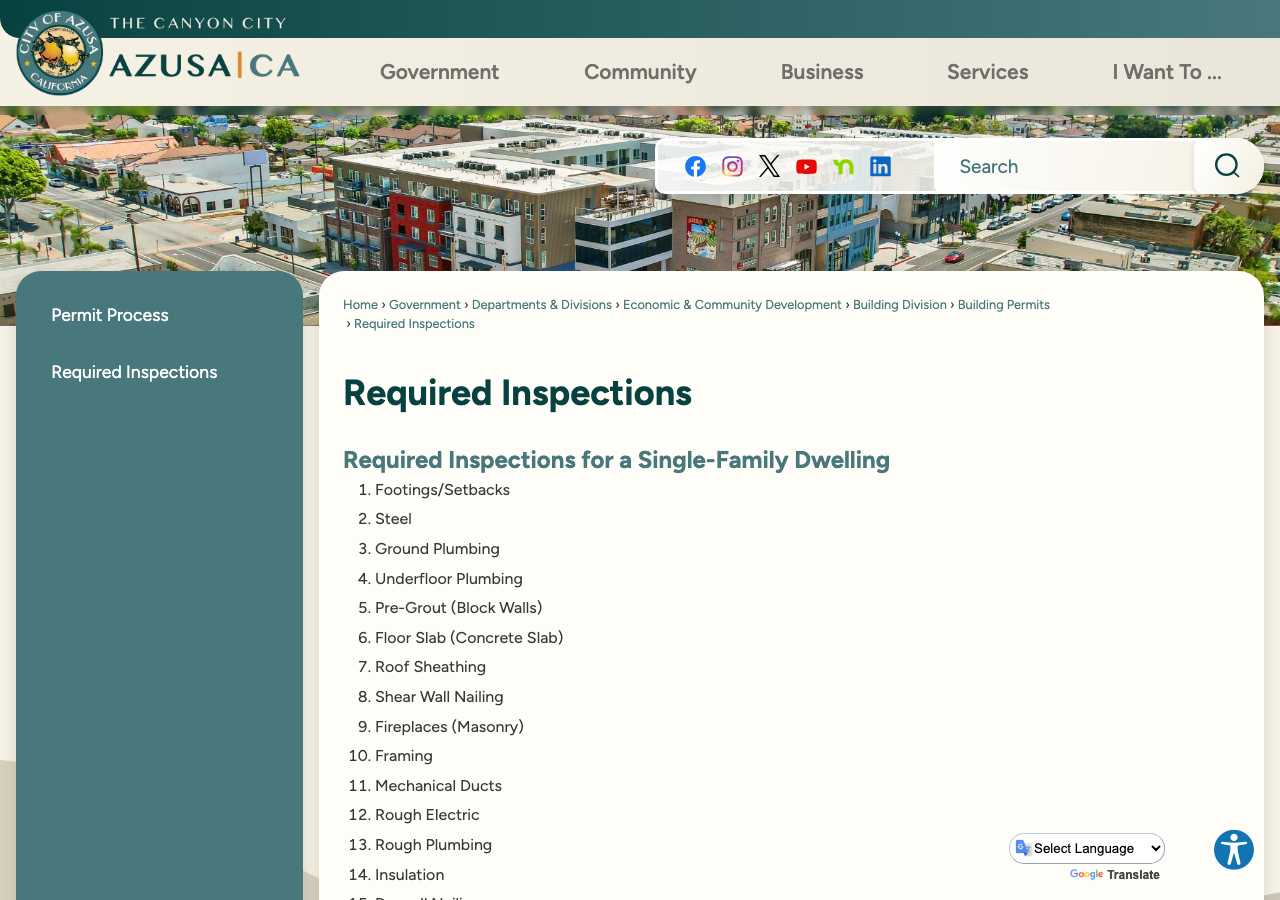
- Which inspections are required, and in what order? (1) Building permit application/plan check by Azusa Building & Safety; (2) if ESS>3kWh or a PV disconnect/rapid-shutdown placard is present, a separate LACoFD Fire Prevention plan review; (3) system installation; (4) single final Building & Safety inspection (only one inspection required for expedited PV per Sec. 14-11(k)); (5) if applicable, a separate LACoFD field inspection of the ESS/disconnect placarding; (6) Building & Safety releases the passed final to Azusa Light & Water; (7) ALW performs its own final utility inspection; (8) ALW installs and energizes the Solar NEM meter. 85% · process flow chart
- Is a rough-in or mid-roof inspection required? No 92% · ordinance
-
Have the paperwork on site
The approved plan set, the permit, and the equipment listings should be on site and reachable. Inspectors routinely verify that installed equipment matches what was approved, and that the labels are the ones the plan set promised.
- Is there a published inspection checklist? Yes 95% · fire authority checklist
- What must be on site at inspection? Approved plans/permit; module and inverter spec/cut sheets; for ESS, the ESS unit and inverter cut/specification sheets plus (if requested) the full installation manual and proof of UL 9540/UL 1741 listing; for LACoFD ESS/PV inspections specifically, digital proof of the construction permit and contractor licensing/billing information provided in advance by email. 85% · fire authority checklist
- Does the inspector verify labels and listings? Yes 95% · published checklist/bulletin
-
Sign-off, and permission to operate
Passing gives you a final or an equivalent sign-off. That is not the same as permission to operate: PTO comes from the utility, and who tells the utility the inspection passed varies. A system left switched off for weeks is usually waiting on this handover.
- What is issued on pass? Final 80% · process flow chart
- Who notifies the utility for PTO? AHJ 88% · process flow chart
- Is there a re-inspection fee? City (Building Division): $148.01/hour (Sec. 305.8 reinspection, per the fee schedule effective 2/2/2026, up from $143.00 the prior year). LACoFD (fire, ESS/PV disconnect placarding): $98.00 flat for 'additional inspections after initial inspection and one reinspection.' 90% · fee schedule
- How are corrections issued and cleared? Plan-review corrections: the Building Division notifies the applicant of required corrections; the applicant must correct and resubmit plans for additional plan check (may repeat). Field corrections: if a PV system fails inspection, 'a subsequent inspection is authorized' -- the applicant clears the noted deficiencies and requests re-inspection (a re-inspection fee applies at that point, see q59). 85% · published checklist/bulletin + ordinance
14 questions answered against City of Azusa’s own published documents
Q49 How is an inspection booked? Core Booking & scheduling
Phone
Why the confidence is not higherBuilding Division: 'On-site inspections can be scheduled by contacting the City of Azusa Building Division by telephone at (626) 812-5234' (Submission Bulletin Sec. 6). LACoFD ESS/PV inspections are booked by phone to the jurisdictional Regional Fire Prevention office, followed by an email of supporting documents.
published checklist/bulletin checked 2026-08-30 https://www.azusaca.gov/DocumentCenter/View/30443
Q50 How much notice is required? Core Booking & scheduling
Typically next business day
Why the confidence is not higherSubmission Bulletin Sec. 6: 'Inspection requests received within business hours are typically scheduled for the next business day. If next business day is not available, inspection should happen within a five-day window.' No fixed minimum advance-notice rule (e.g., '24 hours') is stated as such.
published checklist/bulletin checked 2026-08-30 https://www.azusaca.gov/DocumentCenter/View/30443
Q51 Are same-day or AM/PM windows offered? Booking & scheduling
Nothing published by this authority.
Where we lookedSubmission Requirement Bulletin - Solar (full text extracted with pdftotext -layout), Building Division page, and Required Inspections page -- none mention same-day or AM/PM inspection windows; the Bulletin only states next-business-day or five-day-window scheduling.
Q52 Does this AHJ perform its own final solar inspection? Core Who inspects
Delegated (split)
Why the confidence is not higherCity Building & Safety performs its own final Building inspection for conventional residential PV, and per Sec. 14-11(k) 'only one inspection shall be required' for expedited small residential rooftop solar, done 'in a timely manner by the City of Azusa Building Division.' LACoFD retains and performs its OWN separate inspection (not delegated to the city) for any ESS>3kWh and for PV disconnect/rapid-shutdown placarding. Azusa Light & Water ALSO performs its own separate utility acceptance inspection before energizing, outside the AHJ inspection chain.
ordinance + fire authority checklist checked 2026-08-30 https://library.municode.com/ca/azusa/codes/code_of_ordinances?nodeId=MUCO_CH14BUBURE_ARTIINGE_S14-11PEPRSMREROSOENSY
Q53 If delegated, to whom? Core Who inspects
Los Angeles County Fire Department (LACoFD), Fire Prevention Division -- Regional/Specialty inspection office nearest the project (for ESS>3kWh and PV disconnect/rapid-shutdown placarding only; conventional PV itself is inspected by Azusa Building & Safety).
Why the confidence is not higherLACoFD Expedited Permitting Checklist Sec. I.1.b instructs the applicant to 'Obtain jurisdictional FD Office Contact Information ... Refer to the LACoFD Fire Prevention Regional Inspection Office Phone List.'
fire authority checklist checked 2026-08-30 https://fire.lacounty.gov/wp-content/uploads/2023/09/Expedited-Permitting-Checklist-LACoFD-ESS-PV-Disconnects-2023-09-01-SECURED.pdf
Q54 Which inspections are required, and in what order? Core Stages & sequence
(1) Building permit application/plan check by Azusa Building & Safety; (2) if ESS>3kWh or a PV disconnect/rapid-shutdown placard is present, a separate LACoFD Fire Prevention plan review; (3) system installation; (4) single final Building & Safety inspection (only one inspection required for expedited PV per Sec. 14-11(k)); (5) if applicable, a separate LACoFD field inspection of the ESS/disconnect placarding; (6) Building & Safety releases the passed final to Azusa Light & Water; (7) ALW performs its own final utility inspection; (8) ALW installs and energizes the Solar NEM meter.
Why the confidence is not higherSynthesized from Sec. 14-11(k), the ALW NEM Solar Process Flow Chart, and the LACoFD Expedited Permitting Checklist -- three independent primary-source documents that together describe a consistent sequence.
process flow chart checked 2026-08-30 https://www.azusaca.gov/DocumentCenter/View/47493/3-English-NEM-Solar-Process-Flow-Chart-Residential-10-KW-DC-or-Less-Update-11292023-final
Q55 Is a rough-in or mid-roof inspection required? Stages & sequence
No
Why the confidence is not higherAzusa Municipal Code Sec. 14-11(k): 'For a small residential rooftop solar energy system eligible for expedited review, only one inspection shall be required.'
ordinance checked 2026-08-30 https://library.municode.com/ca/azusa/codes/code_of_ordinances?nodeId=MUCO_CH14BUBURE_ARTIINGE_S14-11PEPRSMREROSOENSY
Q56 Does the inspector verify labels and listings? Core What is checked
Yes
Why the confidence is not higherSubmission Bulletin Sec. 6 inspection checklist explicitly lists: module count/model number matching plans and spec sheets; 'Appropriate signs are properly constructed, installed and displayed' (DC disconnect sign, AC point-of-connection sign, alternative-power-system switch sign); and cross-checks of inverter/OCPD ratings against the values shown on the installed signs.
published checklist/bulletin checked 2026-08-30 https://www.azusaca.gov/DocumentCenter/View/30443
Q57 Is there a published inspection checklist? Core What is checked
Yes
Why the confidence is not higherCity: Submission Bulletin Sec. 6 publishes an inspection checklist. Fire: LACoFD separately publishes its own 'Expedited PV/ESS Permitting Process -- Inspection Checklist for Group R-3/R-4 ESS, PV, and Electrical-Disconnect Placarding.'
fire authority checklist checked 2026-08-30 https://fire.lacounty.gov/wp-content/uploads/2023/09/Expedited-Permitting-Checklist-LACoFD-ESS-PV-Disconnects-2023-09-01-SECURED.pdf
Q58 What must be on site at inspection? Core Documents on site
Approved plans/permit; module and inverter spec/cut sheets; for ESS, the ESS unit and inverter cut/specification sheets plus (if requested) the full installation manual and proof of UL 9540/UL 1741 listing; for LACoFD ESS/PV inspections specifically, digital proof of the construction permit and contractor licensing/billing information provided in advance by email.
Why the confidence is not higherSubmission Bulletin Sec. 6 ('Permit holders must be prepared to show conformance ... in the field') plus LACoFD Expedited Permitting Checklist Sec. II.1 (cut/spec sheets requirement) and Sec. I.1.a (documents to have ready before requesting inspection).
fire authority checklist checked 2026-08-30 https://fire.lacounty.gov/wp-content/uploads/2023/09/Expedited-Permitting-Checklist-LACoFD-ESS-PV-Disconnects-2023-09-01-SECURED.pdf
Q59 Is there a re-inspection fee? Corrections & re-inspection
City (Building Division): $148.01/hour (Sec. 305.8 reinspection, per the fee schedule effective 2/2/2026, up from $143.00 the prior year). LACoFD (fire, ESS/PV disconnect placarding): $98.00 flat for 'additional inspections after initial inspection and one reinspection.'
Why the confidence is not higherCity figure from the Council-adopted 2/2/2026 fee schedule item 204; LACoFD figure from Appendix QQ, Table QQ104.4(6) item 2 -- both current fee ordinances, read from extracted PDF text.
fee schedule checked 2026-08-30 https://www.azusaca.gov/DocumentCenter/View/50231/Fee-Schedule-Posted-Online-Final-2-2-26
Q60 How are corrections issued and cleared? Corrections & re-inspection
Plan-review corrections: the Building Division notifies the applicant of required corrections; the applicant must correct and resubmit plans for additional plan check (may repeat). Field corrections: if a PV system fails inspection, 'a subsequent inspection is authorized' -- the applicant clears the noted deficiencies and requests re-inspection (a re-inspection fee applies at that point, see q59).
Why the confidence is not higherSubmission Bulletin Sec. 3 (plan corrections) and Sec. 14-11(k) (subsequent inspection authorized after a failed expedited-PV inspection).
published checklist/bulletin + ordinance checked 2026-08-30 https://www.azusaca.gov/DocumentCenter/View/30443
Q61 What is issued on pass? Core Final sign-off & PTO
Final
Why the confidence is not higherA passed final Building & Safety inspection is 'released' by the city to Azusa Light & Water, which performs its own separate utility acceptance inspection and then installs/energizes the Solar NEM meter itself; no separate Certificate of Occupancy or 'green tag' terminology was found for a PV-only retrofit permit, and ALW explicitly states it 'does not issue Permission to Operate Letters.'
process flow chart checked 2026-08-30 https://www.azusaca.gov/DocumentCenter/View/47493/3-English-NEM-Solar-Process-Flow-Chart-Residential-10-KW-DC-or-Less-Update-11292023-final
Q62 Who notifies the utility for PTO? Core Final sign-off & PTO
AHJ
Why the confidence is not higherThe NEM Solar Process Flow Chart step 6A states Building & Safety, after passing its final inspection, 'will release to ALW' -- i.e., the AHJ (city) notifies the utility directly, rather than the installer doing so. ALW then performs its own final inspection and self-initiates energization; ALW explicitly 'does not issue Permission to Operate Letters,' so there is no separate formal PTO document for the installer to trigger.
process flow chart checked 2026-08-30 https://www.azusaca.gov/DocumentCenter/View/47493/3-English-NEM-Solar-Process-Flow-Chart-Residential-10-KW-DC-or-Less-Update-11292023-final
Lines marked with a percentage were read off this authority’s own published documents. Unmarked guidance is general good practice, not this jurisdiction’s rule — always confirm against the authority before you submit.
Jurisdiction & key facts
The standing 62-question set, answered for City of Azusa against this authority’s own published documents. Every answer carries the confidence it was recorded at and the document it came from. Where nothing is published we say so and show where we looked — a blank here is a finding, not a gap.
City of Azusa is the authority having jurisdiction 92% confidence
- Holds
- building and electrical
- Delegated to
- Los Angeles County Fire Department (LACoFD) holds fire-code jurisdiction (fee-for-service contract city); Azusa Light & Water (municipal electric utility) holds interconnection/net-metering and gates permit issuance
- Overridden by
- LACoFD retains (does NOT delegate to the city) inspection/placarding of ESS >3 kWh, certain BIPV, and ALL PV electrical-disconnect/rapid-shutdown placarding, even though it delegates conventional rooftop-PV plan review/inspection to Azusa Building & Safety; Azusa Light & Water's Release Form is a precondition the Building Division will not waive before issuing a permit
- Why not higher
- Azusa Building & Safety Division (part of Economic & Community Development Dept) issues building/electrical/photovoltaic permits (azusaca.gov/110, /117). Fire code enforcement in Azusa is NOT a city function: Azusa is explicitly named on LACoFD's own 'Fee-for-services Cities' list (13 cities annexed to/contracting with the County Fire Protection District), confirmed by direct grep of fire.lacounty.gov/contracting/ raw HTML. LACoFD's own Sept-2023 'Guide for ESS, PV, and Disconnects' states it has 'historically delegated fire-official authority for plan review and inspection of conventional residential solar-on-roof installations ... to the jurisdictional building and safety department' but that delegation 'does not extend to' ESS/BIPV or (per the companion Expedited Permitting Checklist) to PV disconnect/rapid-shutdown placarding, which LACoFD inspects itself. Separately, Azusa's own Solar Process Flow Chart (ALW/Building doc) states 'Building and Safety will not issue permits without the [Azusa Light & Water] Release Form' -- i.e., the utility gates permit issuance. Utility corrected from brief: Azusa runs its own municipally-owned electric utility, Azusa Light & Water (ALW), not SCE -- confirmed via azusaca.gov/565/Solar-PV-System-Installation-Procedures and ALW's own Interconnection & Net Metering Agreement, ED-25/ED-27 engineering standards.
- Permit required
- Yes98%
- Permit cost
- Residential PV <=15 kW: $450 flat, OR 45% of the valuation-based building-permit fee -- WHICHEVER IS LESS.88%
- Plan review
- 1 to 3 business days90%
- Portal
- GoPost / TransTech ePlanSoft online plan-review portal (gopost-transtech.eplansoftreview.com, portal=azusa),88%
- Electrical code
- 202390%
- Own placard wording
- Yes (via LACoFD, which retains this specific item) / No (Building Division has no verbatim wording of its own beyond generic NEC-style sign descriptions).88%
- Booking an inspection
- Phone88%
Labels & placards for this authority
City of Azusa writes its own placard wording. A standard NEC label set will not satisfy it — the exact text, and in most cases the size, colour and font, are specified below.
Wording 88%
Yes (via LACoFD, which retains this specific item) / No (Building Division has no verbatim wording of its own beyond generic NEC-style sign descriptions).
Size, colour & material 95%
Yes -- Exterior placards: minimum 2in x 3.5in weather-resistant plastic, engraved, red letters on a yellow background, solid all-capitals Arial font, minimum 24pt (28pt bold for 'F.D.' and '#X of Y'). Panel-Interior placards: minimum 7/16in x 3/4in, same color/material, bold Arial, minimum 24pt. Attachment by permanent, material/weather/surface-compatible epoxy.
Where they go 92%
Per Azusa Light & Water (ED-25/ED-27): the main service panel, production meter socket, and AC disconnect must be within 8 feet of each other and a minimum of 10 inches apart, located outdoors, and accessible to the utility at all times. Per LACoFD (Appendix B): Exterior placards go on/immediately adjacent to each panel/enclosure or standalone disconnect switch that must be operated; Panel-Interior placards go inside a panel to identify specific breakers when multiple switches in one enclosure must be operated.
What the utility wants on top 82%
No additional placard/labeling spec found in Azusa Light & Water's own engineering standards beyond generic equipment requirements (production meter model, lockability).
Each figure above is sourced and dated in the full answer set below (questions 38–43). Where an authority’s own published sheet is older than the code it has adopted, the answer says so.
Their website
Average approval time — application to PTO
From the CPUC interconnection record. Bars show the average days taken each year; a year with no recorded projects is left blank rather than drawn as zero.