
City of Banning
Riverside County
City of Banning is a city authority in the State of California, serving 29,505 residents. 128 residential solar installs are on record here. This page is the permit route for that jurisdiction: the fifteen steps from working out who has a say over an address through to permission to operate, the documents this authority publishes, and 62 answers taken from those documents and dated.
Permitting 5 steps · 28 questions
Whether a permit is needed — Yes Q3 Electrical and building permits — Combined Q4 Plan review — City: 1-3 business days for a complete electronic small-residential-solar application (codified, nondiscretionary); Q18 Where you file — SmartGov (ci-banning-ca.smartgovcommunity.com) for the City building permit; a separate paper, in-person process at BEU's office (176 E. Q20
- Permit required
- Yes95% source
- What it costs
- City Building Dept: $423.18 (residential rooftop, up to 10 kW), $595.68 (residential rooftop, over 10 kW), $790.68 (ground mount), $403.18 (solar water heater).90% source
- Plan review turnaround
- City: 1-3 business days for a complete electronic small-residential-solar application (codified, nondiscretionary); the Solar Handout separately states 'about 3-5 business days'.90% source
- Key document
- department handout cited by 7 open the document
-
Confirm who has a say over your address
A city address is usually permitted by the city, not the county — but not always, and some authorities keep building and hand electrical to someone else. Getting this wrong costs the whole submittal, because every requirement below belongs to whoever actually holds jurisdiction. Check the overlays in the same pass: an HOA, a historic district, a windstorm certification or a system-size cap can reshape the design, and all of them are cheaper to find now than after the array is laid out.
- Is this authority the AHJ for residential solar at this address? Yes 95% · department page
- What does this authority permit itself, and what does it delegate? Both (Building + Electrical, in-house, including its own municipal Electric Utility) -- Fire is Delegated to Riverside County Fire under a formal contract 90% · department page
- Is a permit required for a residential rooftop PV system? Yes 95% · municipal code
- Is there a separate electrical permit, or is it combined? Combined 70% · fee schedule
- Is a HOA or architectural approval required first? No -- codified prohibition on conditioning approval on HOA approval 92% · municipal code
- Is there a historic-district review? Yes, conditionally -- a use permit and/or design review MAY be required, at the Community Development Director's discretion, before installing solar on a building on the city's list of historic resources 90% · municipal code
- Is a wind or windstorm certification required? Yes, for solar specifically -- the Building & Safety Solar Handout requires PV racking be designed to the city's 'Special Wind Region', 130 mph Ultimate Design Wind Speed (Vult), Exposure C, with maximum standoff spacing of 48" O.C., stamped by a licensed engineer. NOTE: a separate, current general residential-plan handout states a baseline city design wind speed of 96 mph -- the two current city documents disagree and this run does not resolve which governs for PV. 80% · department handout
- Is a Specific Use Permit or Council approval ever required? Conditionally, yes -- the Chief Building Official may require a Conditional Use Permit if there is substantial evidence of a specific, adverse public-health-or-safety impact; appealable to the Planning Commission 88% · municipal code
- Is there a system-size cap on residential generation? Two distinct caps for two distinct purposes: (1) City streamlined-permit eligibility cap = 10 kW AC nameplate / 30 kW thermal, codified (above this, systems still may be permitted but go through standard, non-expedited review); (2) BEU financial/interconnection cap = 100% of the customer's historical annual consumption (or 2.4 kW default if no usage history exists), with an absolute ceiling of 99 kW for buy-back credit purposes 88% · municipal code
-
Check who is allowed to apply
Several authorities require the electrical permit to be pulled by a licensed electrician, or require the contractor to be registered with them BEFORE applying. Registration is not same-day. This is second on the list rather than fourth because it is the step most likely to stop the job before the drawings matter.
- Who is allowed to pull the electrical permit? Licensed contractor (C-10 Electrical, C-46 Solar, B General Building, or A General Engineering) or a CA Registered Electrical Engineer to prepare/sign plans; homeowner owner-builder permits exist generally in the city's process 80% · utility program guidelines
- Must the contractor be registered with this authority before applying? Yes -- must hold a City of Banning business license 75% · department handout
- Is a homeowner permitted to self-install and self-permit? Likely yes under California owner-builder law -- the city publishes an Owner-Builder Declaration and Owner Builders Pamphlet generally, but the solar-specific submittal packet (Signed Homeowner Solar Contract, Contractor's License required) assumes a licensed contractor and does not itself describe an owner-builder solar path 55% · department page
-
Build the submittal package
Almost everywhere wants a site plan, a one-line or three-line electrical diagram, equipment cut sheets with listings, and a structural attachment detail. Build it against the published checklist rather than the last jurisdiction you worked in — the checklist is what the reviewer marks against.
- What documents make up a complete submittal? Plan set stamped/approved by BEU + BEU service contract; calculations; Solar Eligibility Checklist; manufacturer spec sheets (modules, inverter, batteries, conductors, disconnects, overcurrent devices); signed Homeowner Solar Contract; contractor state license, city business license, and Worker's Comp Declaration 90% · department handout
- How many copies, and in what format? City: electronic submittal only, via the SmartGov portal (no paper copies specified). BEU (utility side): four (4) sets of 11x17 plans for its own plan check. 85% · utility program guidelines
- Is a site plan required, and what must it show? Yes -- a fully dimensioned plot/site plan showing PV module layout, conduit/conductor routing, all equipment (inverter, batteries, meters, disconnects), property lines, all structures, and (per BEU) the AC disconnect, production meter socket and inverter locations 90% · department handout
- Is a one-line / three-line diagram required? Yes 90% · department handout
- Are string and conductor calculations required? Yes 88% · department handout
- Is a structural PE stamp required, and at what threshold? Yes, for all residential rooftop solar submittals -- no size threshold stated: structural drawings and calculations must be stamped and signed by a CA-licensed architect or registered professional civil/structural engineer, addressing roofing type, framing, panel weight/attachment, and (per item 5) roof-load calcs specifically required if loading exceeds 6.5 lbs/sf 85% · department handout
- Is an electrical PE stamp required, and at what threshold? No separate electrical PE-stamp threshold found -- plans may instead be prepared/signed by a licensed C-10, C-46, B or A contractor in lieu of an electrical engineer 70% · utility program guidelines
-
Apply and pay
Most authorities now take the whole application through a portal, and several states cap or constrain what a residential solar permit may cost. Check whether plan check is billed separately before you quote the job.
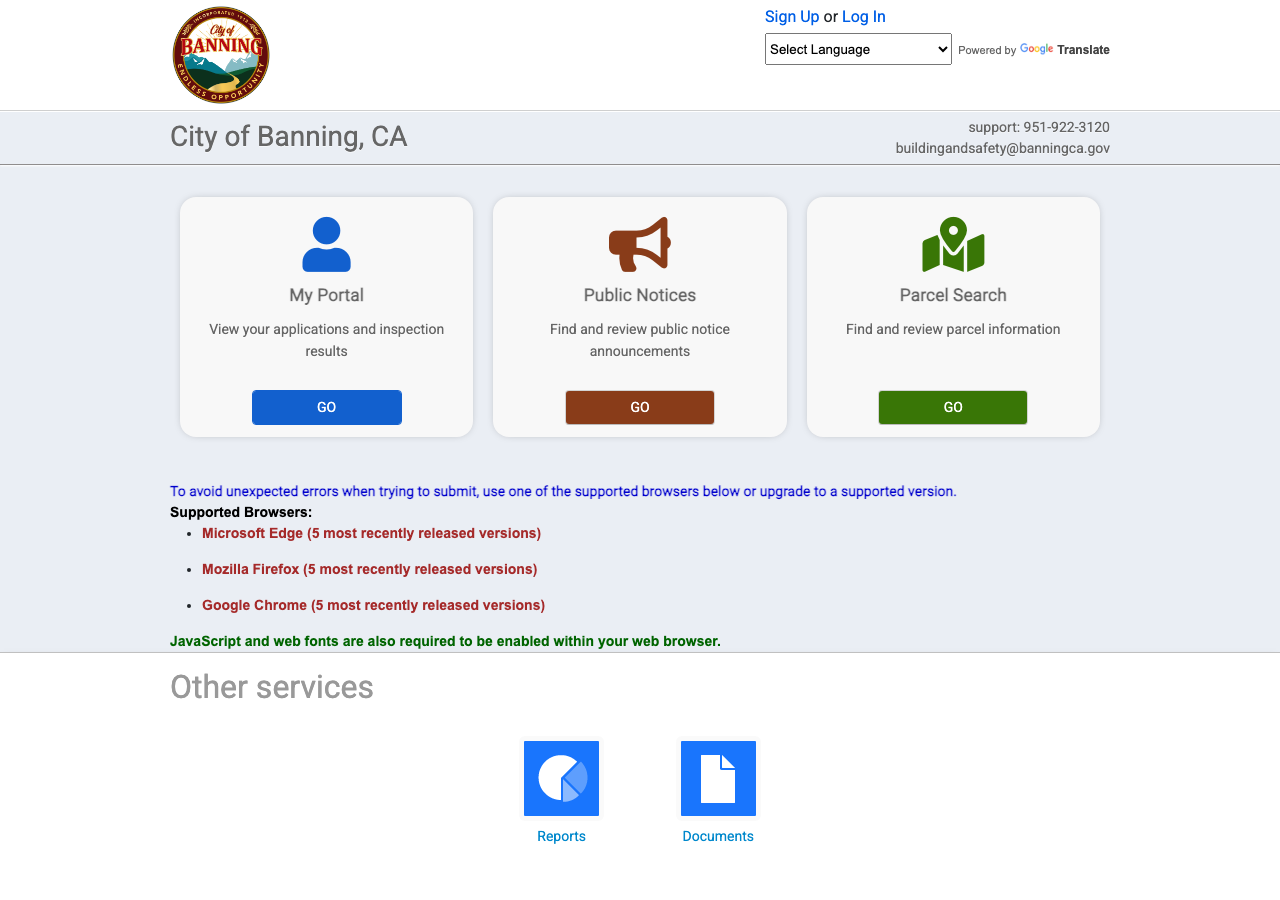
- Which permit portal does this authority use? SmartGov (ci-banning-ca.smartgovcommunity.com) for the City building permit; a separate paper, in-person process at BEU's office (176 E. Lincoln St.) for the utility application -- there is no single unified portal 90% · portal landing page
- Can the whole application be completed online? No -- the City building-permit portion can be completed online via SmartGov, but BEU's application must be signed in person at 176 E. Lincoln St., Banning, and BEU's inspection must be booked by phone 88% · department page
- What does a residential solar permit cost? City Building Dept: $423.18 (residential rooftop, up to 10 kW), $595.68 (residential rooftop, over 10 kW), $790.68 (ground mount), $403.18 (solar water heater). Separately, BEU: $500 flat application fee ($245 production meter + $255 review/plan-check/inspection). 90% · fee schedule
- How is the fee calculated? Tiered by system type and size bracket (Building Dept: flat fee per bracket -- up to 10kW / over 10kW / ground mount / water heater); BEU application fee is flat ($500) regardless of size 80% · fee schedule
- Is there a separate plan-check fee? Not clearly separate at the City (the per-bracket solar fee appears to bundle plan check; a generic 'Plan check $161.67' line exists for other permit types but is not shown against the solar lines). At BEU, yes -- $255 of the $500 application fee is explicitly 'reviewing, processing, approving the application, up to 3 plan checks and 3 inspections'. 60% · fee schedule
-
Plan review — and start the utility in parallel
Interconnection is a separate process from the permit and usually the longer pole. Where the utility does not depend on the permit being issued, running both at once is the single biggest saving available on a residential job.
- What is the stated plan-review turnaround? City: 1-3 business days for a complete electronic small-residential-solar application (codified, nondiscretionary); the Solar Handout separately states 'about 3-5 business days'. BEU: up to 45 days for its own application review, and up to a further 45 days for its own plan check. 90% · municipal code
- Which utility handles interconnection here? Banning Electric Utility (BEU) -- a not-for-profit, publicly-owned, non-CPUC municipal utility (SCPPA member), NOT Southern California Edison 95% · utility page
- Where does the utility sit in the sequence? Before permit, and again before final -- BEU application approval and BEU's own plan-check approval are required BEFORE the City Building & Safety plan check/permit can be submitted, and BEU's own field inspection (called first) must pass before Building & Safety schedules its final inspection 92% · utility program guidelines
28 questions answered against City of Banning’s own published documents
Q1 Is this authority the AHJ for residential solar at this address? Core Jurisdiction & scope
Yes
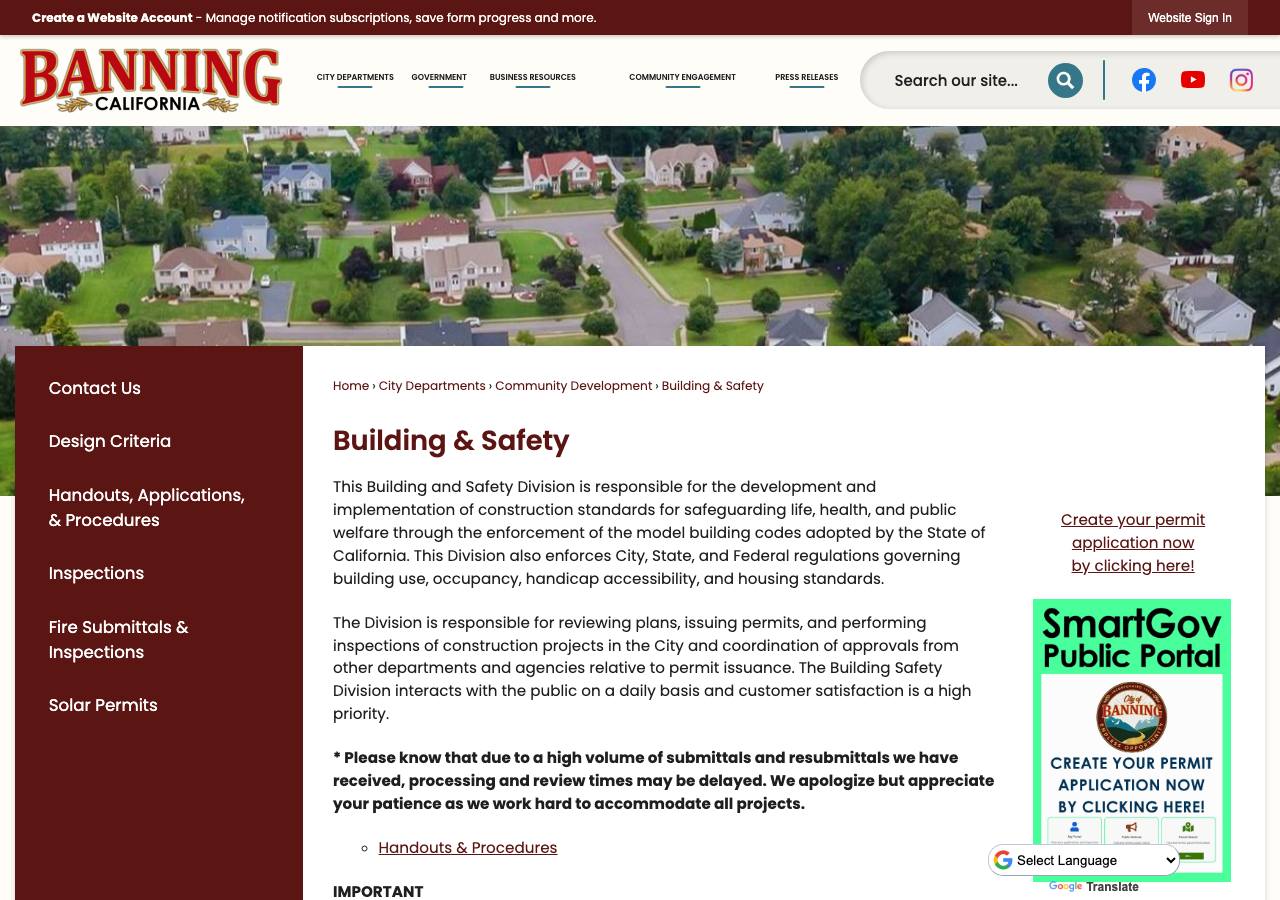
Why the confidence is not higherCity of Banning Building & Safety Division issues residential building permits, including for solar; its own Solar Permits page and Solar Handout both confirm a City building permit is required.
department page checked 2026-08-31 https://www.ci.banning.ca.us/944/Solar-Permits
Q2 What does this authority permit itself, and what does it delegate? Core Jurisdiction & scope
Both (Building + Electrical, in-house, including its own municipal Electric Utility) -- Fire is Delegated to Riverside County Fire under a formal contract
Why the confidence is not higherBuilding & Safety (Community Development) and Banning Electric Utility (Public Works) are both city-operated per their own pages; the Fire Marshal's own page states fire prevention is delivered by Riverside County Fire Department under contract.
department page checked 2026-08-31 https://www.ci.banning.ca.us/957/Office-of-the-Fire-Marshal
Q3 Is a permit required for a residential rooftop PV system? Core Jurisdiction & scope
Yes
Why the confidence is not higherBMC 15.12.010 makes a building permit mandatory for construction/alteration generally, and 15.12.100 (the codified small-rooftop-solar section) confirms permitting applies to all small residential rooftop solar systems.
municipal code checked 2026-08-31 https://library.municode.com/ca/banning/codes/code_of_ordinances?nodeId=TIT15BUCO_CH15.12PE_15.12.100PEPRSMROSOENSY
Q4 Is there a separate electrical permit, or is it combined? Core Jurisdiction & scope
Combined
Why the confidence is not higherThe city's Comprehensive User Fee Study lists a single 'Solar-residential rooftop' fee line (no separate electrical-permit line for solar), implying one combined building/electrical permit; BEU's parallel application/interconnection process is a separate, non-building-permit track.
fee schedule checked 2026-08-31 https://www.ci.banning.ca.us/DocumentCenter/View/14029/Banning-UF-Website-Version
Q5 Who is allowed to pull the electrical permit? Core Who may apply
Licensed contractor (C-10 Electrical, C-46 Solar, B General Building, or A General Engineering) or a CA Registered Electrical Engineer to prepare/sign plans; homeowner owner-builder permits exist generally in the city's process
Why the confidence is not higherBEU Program Guidelines Part B.1 names the exact license classes/EE registration required to prepare and sign PV plans.
utility program guidelines checked 2026-08-31 https://www.banningca.gov/DocumentCenter/View/222/Self-Generating-Facility-Program-Guidelines-PV
Q6 Must the contractor be registered with this authority before applying? Core Who may apply
Yes -- must hold a City of Banning business license
Why the confidence is not higherThe Building & Safety Solar Handout's required-documents list includes 'Contractor state license, Copy of City business license, and Worker's Comp Declaration' as a submittal item.
department handout checked 2026-08-31 https://www.ci.banning.ca.us/DocumentCenter/View/14018/Solar-Handout---City-of-Banning
Q7 Is a homeowner permitted to self-install and self-permit? Who may apply
Likely yes under California owner-builder law -- the city publishes an Owner-Builder Declaration and Owner Builders Pamphlet generally, but the solar-specific submittal packet (Signed Homeowner Solar Contract, Contractor's License required) assumes a licensed contractor and does not itself describe an owner-builder solar path
Why the confidence is not higherNo solar-specific owner-builder statement found; inferred from the city's general owner-builder forms and the fact none of the solar documents prohibit it outright.
department page checked 2026-08-31 https://www.ci.banning.ca.us/72/Handouts-Applications-Procedures
Q8 What documents make up a complete submittal? Core Submittal package
Plan set stamped/approved by BEU + BEU service contract; calculations; Solar Eligibility Checklist; manufacturer spec sheets (modules, inverter, batteries, conductors, disconnects, overcurrent devices); signed Homeowner Solar Contract; contractor state license, city business license, and Worker's Comp Declaration
Why the confidence is not higherVerbatim 'Required Documents' list from the Building & Safety Division's current Solar Handout.
department handout checked 2026-08-31 https://www.ci.banning.ca.us/DocumentCenter/View/14018/Solar-Handout---City-of-Banning
Q9 How many copies, and in what format? Submittal package
City: electronic submittal only, via the SmartGov portal (no paper copies specified). BEU (utility side): four (4) sets of 11x17 plans for its own plan check.
Why the confidence is not higherSolar Handout states 'All solar submittals must be submitted through the online portal SmartGov'; BEU Program Guidelines Part B.10.1 specifies four 11x17 sets for the utility's separate plan check.
utility program guidelines checked 2026-08-31 https://www.banningca.gov/DocumentCenter/View/222/Self-Generating-Facility-Program-Guidelines-PV
Q10 Is a site plan required, and what must it show? Core Submittal package
Yes -- a fully dimensioned plot/site plan showing PV module layout, conduit/conductor routing, all equipment (inverter, batteries, meters, disconnects), property lines, all structures, and (per BEU) the AC disconnect, production meter socket and inverter locations
Why the confidence is not higherCombines the Building & Safety Solar Handout's minimum submittal items 1 and 12 with BEU Program Guidelines Part B.2.a site-plan requirements.
department handout checked 2026-08-31 https://www.ci.banning.ca.us/DocumentCenter/View/14018/Solar-Handout---City-of-Banning
Q11 Is a one-line / three-line diagram required? Core Drawings & calculations
Yes
Why the confidence is not higherSolar Handout minimum submittal item 2 requires a 'Single-Line Diagram'; BEU Program Guidelines Part B.2.f requires a full electrical diagram.
department handout checked 2026-08-31 https://www.ci.banning.ca.us/DocumentCenter/View/14018/Solar-Handout---City-of-Banning
Q12 Are string and conductor calculations required? Drawings & calculations
Yes
Why the confidence is not higherSolar Handout items 6-7 require manufacturer specs and 'justification for all conductor and over-current device sizing'.
department handout checked 2026-08-31 https://www.ci.banning.ca.us/DocumentCenter/View/14018/Solar-Handout---City-of-Banning
Q13 Is a structural PE stamp required, and at what threshold? Core Engineering & stamps
Yes, for all residential rooftop solar submittals -- no size threshold stated: structural drawings and calculations must be stamped and signed by a CA-licensed architect or registered professional civil/structural engineer, addressing roofing type, framing, panel weight/attachment, and (per item 5) roof-load calcs specifically required if loading exceeds 6.5 lbs/sf
Why the confidence is not higherSolar Handout item 13 (and sub-items a-g) states this as a minimum submittal requirement for residential solar generally, without gating it to a system size; this is broader than many CA cities that only require a PE stamp above a threshold.
department handout checked 2026-08-31 https://www.ci.banning.ca.us/DocumentCenter/View/14018/Solar-Handout---City-of-Banning
Q14 Is an electrical PE stamp required, and at what threshold? Engineering & stamps
No separate electrical PE-stamp threshold found -- plans may instead be prepared/signed by a licensed C-10, C-46, B or A contractor in lieu of an electrical engineer
Why the confidence is not higherBEU Program Guidelines Part B.1 gives EE registration as one of several acceptable signers, alongside specific contractor classes, with no size-based trigger.
utility program guidelines checked 2026-08-31 https://www.banningca.gov/DocumentCenter/View/222/Self-Generating-Facility-Program-Guidelines-PV
Q15 What does a residential solar permit cost? Core Fees
City Building Dept: $423.18 (residential rooftop, up to 10 kW), $595.68 (residential rooftop, over 10 kW), $790.68 (ground mount), $403.18 (solar water heater). Separately, BEU: $500 flat application fee ($245 production meter + $255 review/plan-check/inspection).
Why the confidence is not higherCurrent City of Banning Comprehensive User Fee Study (adopted per its own 'Approved Fee' column) and BEU's own PV Application Checklist/Program Guidelines, read together -- these are two separate charges from two separate city divisions.
fee schedule checked 2026-08-31 https://www.ci.banning.ca.us/DocumentCenter/View/14029/Banning-UF-Website-Version
Q16 How is the fee calculated? Core Fees
Tiered by system type and size bracket (Building Dept: flat fee per bracket -- up to 10kW / over 10kW / ground mount / water heater); BEU application fee is flat ($500) regardless of size
Why the confidence is not higherFee schedule shows discrete dollar amounts per named category rather than a valuation-based or per-kW formula (except commercial, which is per-kW after 4kW).
fee schedule checked 2026-08-31 https://www.ci.banning.ca.us/DocumentCenter/View/14029/Banning-UF-Website-Version
Q17 Is there a separate plan-check fee? Fees
Not clearly separate at the City (the per-bracket solar fee appears to bundle plan check; a generic 'Plan check $161.67' line exists for other permit types but is not shown against the solar lines). At BEU, yes -- $255 of the $500 application fee is explicitly 'reviewing, processing, approving the application, up to 3 plan checks and 3 inspections'.
Why the confidence is not higherInferred from the structure of the fee schedule (no separate plan-check line is shown for the solar rows specifically) plus the BEU document's explicit itemization.
fee schedule checked 2026-08-31 https://www.ci.banning.ca.us/DocumentCenter/View/14029/Banning-UF-Website-Version
Q18 What is the stated plan-review turnaround? Core Timeline & validity
City: 1-3 business days for a complete electronic small-residential-solar application (codified, nondiscretionary); the Solar Handout separately states 'about 3-5 business days'. BEU: up to 45 days for its own application review, and up to a further 45 days for its own plan check.
Why the confidence is not higherBMC 15.12.100.G.1 states the statutory 1-3 business day nondiscretionary turnaround; Solar Handout gives a slightly longer practical estimate; BEU Program Guidelines give its own 45-day figures for two separate utility-side stages.
municipal code checked 2026-08-31 https://library.municode.com/ca/banning/codes/code_of_ordinances?nodeId=TIT15BUCO_CH15.12PE_15.12.100PEPRSMROSOENSY
Q19 How long is an issued permit valid before it expires? Timeline & validity
Nothing published by this authority.
Where we lookedBMC Chapter 15.12 (Permits), all sections, retrieved via the Municode API (jobId 487542, productId 16203) -- no permit-expiration/validity section found among 15.12.010-15.12.100
https://library.municode.com/ca/banning/codes/code_of_ordinances?nodeId=TIT15BUCO_CH15.12PE
Q20 Which permit portal does this authority use? Core Portal & process
SmartGov (ci-banning-ca.smartgovcommunity.com) for the City building permit; a separate paper, in-person process at BEU's office (176 E. Lincoln St.) for the utility application -- there is no single unified portal
Why the confidence is not higherCity's Solar Permits page and Handouts page both link the SmartGov portal for the building permit; the same page and BEU Program Guidelines both require the utility step to be signed in person at BEU's office.
portal landing page checked 2026-08-31 https://www.ci.banning.ca.us/944/Solar-Permits
Q21 Can the whole application be completed online? Core Portal & process
No -- the City building-permit portion can be completed online via SmartGov, but BEU's application must be signed in person at 176 E. Lincoln St., Banning, and BEU's inspection must be booked by phone
Why the confidence is not higherSolar Permits page sequencing plus BEU Program Guidelines Part A.3 ('Application MUST be signed in person') and Part C.1.1 ('Electric Utility MUST be contacted FIRST for inspection at (951) 922-3260').
department page checked 2026-08-31 https://www.ci.banning.ca.us/944/Solar-Permits
Q22 Which utility handles interconnection here? Core Utility interconnection
Banning Electric Utility (BEU) -- a not-for-profit, publicly-owned, non-CPUC municipal utility (SCPPA member), NOT Southern California Edison
Why the confidence is not higherCity's own Electric Utility landing page states this plainly; the brief's SCE assumption is wrong for the whole city (confirmed no split-territory evidence found).
utility page checked 2026-08-31 https://www.ci.banning.ca.us/57/Electric-Utility
Q23 Where does the utility sit in the sequence? Core Utility interconnection
Before permit, and again before final -- BEU application approval and BEU's own plan-check approval are required BEFORE the City Building & Safety plan check/permit can be submitted, and BEU's own field inspection (called first) must pass before Building & Safety schedules its final inspection
Why the confidence is not higherSolar Permits page 3-step sequence, and BEU Program Guidelines Parts A-D, describe the utility gating both the front (application/plan-check) and back (inspection/interconnection) ends of the process.
utility program guidelines checked 2026-08-31 https://www.banningca.gov/DocumentCenter/View/222/Self-Generating-Facility-Program-Guidelines-PV
Q24 Is a HOA or architectural approval required first? Overlays & special cases
No -- codified prohibition on conditioning approval on HOA approval
Why the confidence is not higherBMC 15.12.100.E.10: 'The city shall not condition approval of an application on the approval of an association, as defined in Section 4080 of the Civil Code.'
municipal code checked 2026-08-31 https://library.municode.com/ca/banning/codes/code_of_ordinances?nodeId=TIT15BUCO_CH15.12PE_15.12.100PEPRSMROSOENSY
Q25 Is there a historic-district review? Overlays & special cases
Yes, conditionally -- a use permit and/or design review MAY be required, at the Community Development Director's discretion, before installing solar on a building on the city's list of historic resources
Why the confidence is not higherBMC 15.12.100.D, verbatim.
municipal code checked 2026-08-31 https://library.municode.com/ca/banning/codes/code_of_ordinances?nodeId=TIT15BUCO_CH15.12PE_15.12.100PEPRSMROSOENSY
Q26 Is a wind or windstorm certification required? Overlays & special cases
Yes, for solar specifically -- the Building & Safety Solar Handout requires PV racking be designed to the city's 'Special Wind Region', 130 mph Ultimate Design Wind Speed (Vult), Exposure C, with maximum standoff spacing of 48" O.C., stamped by a licensed engineer. NOTE: a separate, current general residential-plan handout states a baseline city design wind speed of 96 mph -- the two current city documents disagree and this run does not resolve which governs for PV.
Why the confidence is not higherBoth figures come from current-looking City of Banning documents (Solar Handout, dated 3/2024; Residential Plan Submittal Requirements, Rev 04/26) that were not reconciled; San Gorgonio Pass is a documented ASCE 7 Special Wind Region, so a PV-specific higher design speed is plausible, but reported as a conflict rather than resolved.
department handout checked 2026-08-31 https://www.ci.banning.ca.us/DocumentCenter/View/14018/Solar-Handout---City-of-Banning
Q27 Is a Specific Use Permit or Council approval ever required? Overlays & special cases
Conditionally, yes -- the Chief Building Official may require a Conditional Use Permit if there is substantial evidence of a specific, adverse public-health-or-safety impact; appealable to the Planning Commission
Why the confidence is not higherBMC 15.12.100.G.1, verbatim.
municipal code checked 2026-08-31 https://library.municode.com/ca/banning/codes/code_of_ordinances?nodeId=TIT15BUCO_CH15.12PE_15.12.100PEPRSMROSOENSY
Q28 Is there a system-size cap on residential generation? Overlays & special cases
Two distinct caps for two distinct purposes: (1) City streamlined-permit eligibility cap = 10 kW AC nameplate / 30 kW thermal, codified (above this, systems still may be permitted but go through standard, non-expedited review); (2) BEU financial/interconnection cap = 100% of the customer's historical annual consumption (or 2.4 kW default if no usage history exists), with an absolute ceiling of 99 kW for buy-back credit purposes
Why the confidence is not higherCap (1) is BMC 15.12.100.A(1); cap (2) combines BEU's own 'Sizing Your Photovoltaic System' handout and the Distributed Self-Generation Buy-back Rider (DSG-1) special condition 2.
municipal code checked 2026-08-31 https://library.municode.com/ca/banning/codes/code_of_ordinances?nodeId=TIT15BUCO_CH15.12PE_15.12.100PEPRSMROSOENSY
Lines marked with a percentage were read off this authority’s own published documents. Unmarked guidance is general good practice, not this jurisdiction’s rule — always confirm against the authority before you submit.
Install 5 steps · 20 questions
-
Build to the code editions actually in force here
The NEC edition a jurisdiction enforces is often a cycle behind the newest one published, and local amendments sit on top of it. Rapid shutdown, conductor sizing and labelling all change between editions, so the edition in force is the first thing to establish, not the last.
- Which NEC edition is in force? 2023 88% · department handout
- Which building code edition is in force? 2025 California Building Code / California Residential Code (Ord. No. 1613, effective Jan 1, 2026, and now the current cycle as of this Aug 2026 check) 92% · department page
- Which fire code edition is in force? 2022 California Fire Code -- NOT yet on the 2025 cycle that Building/Electrical/Residential moved to 85% · department page
- Are there local amendments to any of the above? Yes 85% · department page
- What is the installation judged against? The 2025 CBC/CRC/CEC/CMC/CGBSC/CPC as locally amended by Ord. 1613, plus NEC, IEEE and UL/accredited-testing-lab standards, per BMC 15.12.100.E 85% · municipal code
-
Fire access, setbacks and pathways
Ridge setbacks and roof access pathways are fire-service requirements and they constrain the array layout. They are the most common cause of a redesign after the fire department comments on a plan set.
- What ridge setback and access pathways are required? 3 ft roof-plan setbacks per California Fire Code, plus code-compliant access pathways and roof access points shown on the roof plan 85% · department handout
-
Rapid shutdown
Which rapid-shutdown rule applies follows directly from the NEC edition in force, and the initiation device has to be at a location the fire service can reach and identify. This is inspected, and it is labelled.
- Is rapid shutdown required, and to which NEC edition? Not explicitly named in any local document found, but applies as a matter of the adopted 2023 NEC (§690.12) statewide 65% · department handout
-
Labels and placards
The NEC sets a baseline for permanent markings at the service equipment and the disconnecting means. On top of that, an authority may specify its own wording, and the utility may specify more again. Where any of them writes its own text, a generic off-the-shelf label set will not pass — this is the detail most often fixed on a return visit.
- Which placards does this authority require at the service equipment? AC disconnect placard, DC disconnect placard, PV Directory Plaque/Plaque on the service panel cover, Solar Load Center Label, and a 'Dual Power Supply Photovoltaic System' warning label -- all per Banning Electric Utility's own Standard Drawings SD 600-80 through SD 600-85 88% · utility standard drawing
- Does the authority specify placard wording of its own? Yes 88% · utility standard drawing
- Does it specify letter height, colour or material? Yes, in detail: red background with white lettering; Arial font, size no smaller than 12 and no larger than 28; metal or plastic, engraved or machine-printed letters (or electro-photo plating); permanently attached with epoxy or equivalent (screws/rivets NOT allowed); general placards 2"x5" to 3"x6"; the Directory Plaque is larger (minimum roughly 6"x8", partially garbled in the source scan) 80% · utility standard drawing
- Is a site plan / facility map placard required, and what must it show? Yes -- a PV Directory Plaque/Plaque must be placed on the customer side of the service panel in clear view, and must be unique to each house it represents (showing roof layout and equipment locations) 82% · utility standard drawing
- Does the UTILITY specify placards beyond the AHJ's? Yes, extensively -- BEU's own Standard Drawings (SD 600-80 through SD 600-85) specify a complete placard system (AC/DC disconnect labels, Directory Plaque, Solar Load Center Label, Dual Power Supply warning) that is separate from and in addition to the NEC/CEC Article 690/705 signage the AHJ enforces 88% · utility program guidelines
- Where must the labels be placed? Directory Plaque on the customer side of the service-panel cover; AC and DC disconnects each carry their own dedicated placard; Solar Load Center label centered on the top half of the load center's front cover 85% · utility standard drawing
-
Disconnect, storage and listed equipment
Where the AC disconnect must sit relative to the meter is usually the utility's rule, not the building department's. Battery storage frequently carries its own permit, its own inspection and its own fire conditions.
- Where must the AC disconnect be, relative to the meter? Within 10 feet AND in line of sight of the main electrical service panel (not the meter itself); the production meter socket must separately be mounted 48"-75" above grade to the center of the glass 90% · utility program guidelines
- Must equipment be on a specific approved list? Yes -- PV modules must meet UL 1703 and inverters UL 1741, and all components must be on the California Energy Commission's 'Eligible Equipment' list 88% · utility program guidelines
- Are batteries permitted, and under what conditions? Yes -- batteries/ESS are permitted, sized according to the paired PV system, subject to Riverside County Fire's Guideline OFM-16 fire-detection requirements (a listed heat/smoke detector interconnected to residential smoke alarms in the garage or room where the ESS sits, or the ESS is placed in an exterior location) and a separate RVC-OFM construction permit 85% · fire agency guideline
- Is there a separate ESS permit or inspection? Yes, at the Fire level -- a separate Riverside County Fire construction permit and deposit-based fee ($354, per current Ordinance 671.23 item 41 'Energy Storage Systems') applies. The City Building Department has no distinct ESS fee line in its own fee schedule, so ESS appears folded into the standard building/electrical permit at the City level. 80% · fire fee ordinance
- Is a ground mount treated as a structure? Yes, by inference -- Banning has no dedicated ground-mount solar zoning chapter; a ground-mounted PV array would fall under the general 'Accessory structures' rule (BMC 17.08.050: compatible materials/architecture with the primary dwelling, 5 ft interior side/rear setback if not within 10 ft of another structure). The Building Department's fee schedule does carry a distinct 'Solar-ground mount $790.68' line, confirming it is permitted and treated as its own structure category in practice. 75% · municipal code
- Is there a local rule on service upgrades or busbar sizing? Yes, several BEU-specific rules: (1) Solar Eligibility Checklist caps the service busbar at 225-A or less for the expedited path; (2) sum of main + backfed breaker ratings shall not exceed 120% of busbar/conductor rating; (3) backfed breaker sized at not less than 125% of maximum output current; (4) line-side taps are NOT ALLOWED -- all PV current must be back-fed through a load-side breaker 88% · department checklist
- Is a specific mounting system or attachment spacing required? Yes -- roof-attachment details required generally, and for solar specifically racking standoff spacing must not exceed 48" O.C. under the city's 130 mph Special Wind Region design basis 80% · department handout
20 questions answered against City of Banning’s own published documents
Q29 Which NEC edition is in force? Core Code editions in force
2023
Why the confidence is not higherCity's Residential Plan Submittal Requirements handout states the current cycle is based on the '2023 National Electric Code (NEC)', consistent with the statewide 2025 CEC/2023 NEC cycle.
department handout checked 2026-08-31 https://www.ci.banning.ca.us/DocumentCenter/View/15238/City-of-Banning-Residential-Plan-Check-Requirements_2026
Q30 Which building code edition is in force? Core Code editions in force
2025 California Building Code / California Residential Code (Ord. No. 1613, effective Jan 1, 2026, and now the current cycle as of this Aug 2026 check)
Why the confidence is not higherCity's own Handouts page public notice names Ord. 1613 and lists all eleven 2025 Title 24 parts it adopts, with the transition date; Municode confirms the code is 'codified through Ordinance No. 1613, passed November 12, 2025'.
department page checked 2026-08-31 https://www.ci.banning.ca.us/72/Handouts-Applications-Procedures
Q31 Which fire code edition is in force? Code editions in force
2022 California Fire Code -- NOT yet on the 2025 cycle that Building/Electrical/Residential moved to
Why the confidence is not higherThe Office of the Fire Marshal's own current page states it 'enforces the 2022 editions of the California Fire, Building, Electrical, Mechanical, Plumbing, and Residential Codes'. This is a genuine code-cycle lag: Ordinance 1613's own 2025-cycle adoption list (Building handouts page) does not include the Fire Code at all, so Fire appears to remain on a separate, older adoption cycle. A different, current city handout (Residential Plan Submittal Requirements, Rev 04/26) separately states the model-code basis is the '2024 International Fire Code (IFC)' -- likely a drafting shorthand rather than the actual CA-specific edition -- and is reported here rather than resolved.
department page checked 2026-08-31 https://www.ci.banning.ca.us/957/Office-of-the-Fire-Marshal
Q32 Are there local amendments to any of the above? Core Code editions in force
Yes
Why the confidence is not higherOrdinance 1613 codifies City amendments to all eleven 2025 Title 24 parts adopted; BMC 15.08.030 is titled specifically to interpret 'references to the amended construction codes'.
department page checked 2026-08-31 https://www.ci.banning.ca.us/72/Handouts-Applications-Procedures
Q33 What is the installation judged against? Core Electrical
The 2025 CBC/CRC/CEC/CMC/CGBSC/CPC as locally amended by Ord. 1613, plus NEC, IEEE and UL/accredited-testing-lab standards, per BMC 15.12.100.E
Why the confidence is not higherBMC 15.12.100.E.1-2, verbatim.
municipal code checked 2026-08-31 https://library.municode.com/ca/banning/codes/code_of_ordinances?nodeId=TIT15BUCO_CH15.12PE_15.12.100PEPRSMROSOENSY
Q34 Is there a local rule on service upgrades or busbar sizing? Electrical
Yes, several BEU-specific rules: (1) Solar Eligibility Checklist caps the service busbar at 225-A or less for the expedited path; (2) sum of main + backfed breaker ratings shall not exceed 120% of busbar/conductor rating; (3) backfed breaker sized at not less than 125% of maximum output current; (4) line-side taps are NOT ALLOWED -- all PV current must be back-fed through a load-side breaker
Why the confidence is not higherSolar Eligibility Checklist (Electrical Requirement C) plus BEU Program Guidelines Part B.3, B.5, B.7, all current documents.
department checklist checked 2026-08-31 https://www.banningca.gov/DocumentCenter/View/3696
Q35 Is a specific mounting system or attachment spacing required? Structural & mounting
Yes -- roof-attachment details required generally, and for solar specifically racking standoff spacing must not exceed 48" O.C. under the city's 130 mph Special Wind Region design basis
Why the confidence is not higherSolar Handout items 3 and 13(f).
department handout checked 2026-08-31 https://www.ci.banning.ca.us/DocumentCenter/View/14018/Solar-Handout---City-of-Banning
Q36 What ridge setback and access pathways are required? Core Fire pathways & setbacks
3 ft roof-plan setbacks per California Fire Code, plus code-compliant access pathways and roof access points shown on the roof plan
Why the confidence is not higherSolar Handout items 9 and 11.
department handout checked 2026-08-31 https://www.ci.banning.ca.us/DocumentCenter/View/14018/Solar-Handout---City-of-Banning
Q37 Is rapid shutdown required, and to which NEC edition? Core Rapid shutdown
Not explicitly named in any local document found, but applies as a matter of the adopted 2023 NEC (§690.12) statewide
Why the confidence is not higherSearched the Building & Safety Solar Handout (46 pp) and BEU's full Rules & Regulations, Program Guidelines and Standard Drawings for 'rapid shutdown' and '690.12' -- zero hits in either, with a passing positive control ('electrical', 25 hits) and a passing fabricated control ('zzqqx', 0 hits) confirming the search worked. Answer is inferred from the adopted NEC edition (q29), not stated locally.
department handout checked 2026-08-31 https://www.ci.banning.ca.us/DocumentCenter/View/14018/Solar-Handout---City-of-Banning
Q38 Which placards does this authority require at the service equipment? Core Labels Signage & labelling
AC disconnect placard, DC disconnect placard, PV Directory Plaque/Plaque on the service panel cover, Solar Load Center Label, and a 'Dual Power Supply Photovoltaic System' warning label -- all per Banning Electric Utility's own Standard Drawings SD 600-80 through SD 600-85
Why the confidence is not higherBEU's own PV Standard Drawings (revised 2014-2018, still the current linked version as of this check) plus the Solar Handout's 'Common Points of Inspection' list (signs at DC disconnect, AC disconnect, and a Dual Power Sources warning sign).
utility standard drawing checked 2026-08-31 https://www.ci.banning.ca.us/DocumentCenter/View/8750/Self-Generating-Facility---PV-Standard-Drawings
Q39 Does the authority specify placard wording of its own? Core Labels Signage & labelling
Yes
Why the confidence is not higherBEU Standard Drawings give verbatim wording ('DUAL POWER SUPPLY PHOTOVOLTAIC SYSTEM', 'ELECTRIC SHOCK HAZARD - DO NOT TOUCH TERMINALS') and a dedicated Directory Plaque layout template.
utility standard drawing checked 2026-08-31 https://www.ci.banning.ca.us/DocumentCenter/View/8750/Self-Generating-Facility---PV-Standard-Drawings
Q40 Does it specify letter height, colour or material? Core Labels Signage & labelling
Yes, in detail: red background with white lettering; Arial font, size no smaller than 12 and no larger than 28; metal or plastic, engraved or machine-printed letters (or electro-photo plating); permanently attached with epoxy or equivalent (screws/rivets NOT allowed); general placards 2"x5" to 3"x6"; the Directory Plaque is larger (minimum roughly 6"x8", partially garbled in the source scan)
Why the confidence is not higherBEU PV Standard Drawings, Notes sections on SD 600-84 (disconnect labels) and SD 600-85 (Directory Plaque); the PDF has a corrupted/garbled text layer from a bad font encoding, so the Directory Plaque's exact minimum dimension could not be fully confirmed and is given at reduced confidence.
utility standard drawing checked 2026-08-31 https://www.ci.banning.ca.us/DocumentCenter/View/8750/Self-Generating-Facility---PV-Standard-Drawings
Q41 Is a site plan / facility map placard required, and what must it show? Core Labels Signage & labelling
Yes -- a PV Directory Plaque/Plaque must be placed on the customer side of the service panel in clear view, and must be unique to each house it represents (showing roof layout and equipment locations)
Why the confidence is not higherBEU Standard Drawing SD 600-85 notes, verbatim ('DIRECTORY PLACARD MUST BE UNIQUE TO EACH HOUSE IT REPRESENTS (I.E. ROOF LAYOUT, EQUIPMENT LOCATION, ETC.)').
utility standard drawing checked 2026-08-31 https://www.ci.banning.ca.us/DocumentCenter/View/8750/Self-Generating-Facility---PV-Standard-Drawings
Q42 Does the UTILITY specify placards beyond the AHJ's? Core Labels Signage & labelling
Yes, extensively -- BEU's own Standard Drawings (SD 600-80 through SD 600-85) specify a complete placard system (AC/DC disconnect labels, Directory Plaque, Solar Load Center Label, Dual Power Supply warning) that is separate from and in addition to the NEC/CEC Article 690/705 signage the AHJ enforces
Why the confidence is not higherDirect reading of the utility's own standard-drawings PDF, which is referenced by name in the Building & Safety Program Guidelines ('Must meet requirements listed in the Electric Utility Standard Drawings').
utility program guidelines checked 2026-08-31 https://www.banningca.gov/DocumentCenter/View/222/Self-Generating-Facility-Program-Guidelines-PV
Q43 Where must the labels be placed? Core Labels Signage & labelling
Directory Plaque on the customer side of the service-panel cover; AC and DC disconnects each carry their own dedicated placard; Solar Load Center label centered on the top half of the load center's front cover
Why the confidence is not higherBEU Standard Drawings SD 600-84/85 placement notes.
utility standard drawing checked 2026-08-31 https://www.ci.banning.ca.us/DocumentCenter/View/8750/Self-Generating-Facility---PV-Standard-Drawings
Q44 Must equipment be on a specific approved list? Equipment listing
Yes -- PV modules must meet UL 1703 and inverters UL 1741, and all components must be on the California Energy Commission's 'Eligible Equipment' list
Why the confidence is not higherBEU Program Guidelines Part 3, verbatim.
utility program guidelines checked 2026-08-31 https://www.banningca.gov/DocumentCenter/View/222/Self-Generating-Facility-Program-Guidelines-PV
Q45 Are batteries permitted, and under what conditions? Core Battery / ESS
Yes -- batteries/ESS are permitted, sized according to the paired PV system, subject to Riverside County Fire's Guideline OFM-16 fire-detection requirements (a listed heat/smoke detector interconnected to residential smoke alarms in the garage or room where the ESS sits, or the ESS is placed in an exterior location) and a separate RVC-OFM construction permit
Why the confidence is not higherBEU Program Guidelines item 10 (ESS sized per the PV system) plus RVC-OFM's current Guideline OFM-16 'Residential Energy Storage Systems Fire Detection Requirements' (dated 10/8/2024), read together.
fire agency guideline checked 2026-08-31 https://www.rvcfire.org/pdf/fire-marshal/guideline-ofm/Residential%20ESS%20Guideline.pdf
Q46 Is there a separate ESS permit or inspection? Battery / ESS
Yes, at the Fire level -- a separate Riverside County Fire construction permit and deposit-based fee ($354, per current Ordinance 671.23 item 41 'Energy Storage Systems') applies. The City Building Department has no distinct ESS fee line in its own fee schedule, so ESS appears folded into the standard building/electrical permit at the City level.
Why the confidence is not higherCross-checked RVC-OFM's OFM-16 guideline (requiring its own construction permit) against Ordinance 671.23's fee table (named ESS line, $354) and against the City's own Building Department fee schedule, which control-verifiably has no 'energy storage' line (search for 'solar' returns hits, 'zzqqx' returns none).
fire fee ordinance checked 2026-08-31 https://rivcocob.org/sites/g/files/aldnop311/files/2025-01/671.23.pdf
Q47 Is a ground mount treated as a structure? Core Ground mount
Yes, by inference -- Banning has no dedicated ground-mount solar zoning chapter; a ground-mounted PV array would fall under the general 'Accessory structures' rule (BMC 17.08.050: compatible materials/architecture with the primary dwelling, 5 ft interior side/rear setback if not within 10 ft of another structure). The Building Department's fee schedule does carry a distinct 'Solar-ground mount $790.68' line, confirming it is permitted and treated as its own structure category in practice.
Why the confidence is not higherFull keyword search of the Zoning Title's Municode TOC ('ground mount', 'accessory', 'solar', 'photovoltaic') surfaced no PV-specific ground-mount section; 17.08.050 is the only generally-applicable accessory-structure provision.
municipal code checked 2026-08-31 https://library.municode.com/ca/banning/codes/code_of_ordinances?nodeId=TIT17ZO_DIVIILAUSDI_CH17.08REDI_ARTIILAUSDIDEST_17.08.050ACST
Q48 Where must the AC disconnect be, relative to the meter? Core Utility equipment
Within 10 feet AND in line of sight of the main electrical service panel (not the meter itself); the production meter socket must separately be mounted 48"-75" above grade to the center of the glass
Why the confidence is not higherBEU Program Guidelines item 4 and Part B.8-9, and matching notes on the utility's own PV Standard Drawings, all state this identically.
utility program guidelines checked 2026-08-31 https://www.banningca.gov/DocumentCenter/View/222/Self-Generating-Facility-Program-Guidelines-PV
Lines marked with a percentage were read off this authority’s own published documents. Unmarked guidance is general good practice, not this jurisdiction’s rule — always confirm against the authority before you submit.
Inspection 5 steps · 14 questions
-
Book it
Booking is a portal, a phone call or an email depending on the authority, and the notice required is rarely zero. Book before the work is finished rather than after — the lead time, not the work, is usually what sets the date.
- How is an inspection booked? Portal (Building & Safety, via SmartGov) and Phone (Fire, via the RivCo Fire application process; and BEU's own inspection, which must be called in to (951) 922-3260) 85% · department page
- How much notice is required? Next-business-day requests must be submitted before 4pm the previous business day (Building & Safety and Fire); no minimum notice period stated for BEU's own inspection beyond calling ahead 85% · department page
- Are same-day or AM/PM windows offered? Yes for Building & Safety -- AM window 8:00am-12:00pm, PM window 1:00pm-4:00pm (availability limited, not guaranteed). Fire inspections are only offered 9:00am-12:00pm, Mon-Wed. 88% · department page
-
Know who turns up
Some authorities inspect their own solar work; some delegate it, and a few do not inspect the PV equipment itself at all. Who is coming determines what they will look at.
- Does this AHJ perform its own final solar inspection? Yes -- Building & Safety performs the final building/electrical inspection, but only after BEU's own separate field inspection has already passed, and (per BMC 15.12.100.G.7) a separate Fire inspection is required only if no city/RivCo Fire agreement exists to inspect on the county's behalf 82% · department handout
- If delegated, to whom? Riverside County Fire Department, Office of the Fire Marshal (formal contract), for fire review/inspection; Banning Electric Utility (a City of Banning department, not a private firm) for the utility-side inspection 88% · department page
-
Work the stages in order
A rough-in or mid-roof inspection, where one is required, has to happen before the work it covers is closed up. Missing a stage means opening something back up, and it is the most expensive kind of correction.
- Which inspections are required, and in what order? BEU application + BEU plan check -> City Building & Safety plan check/permit -> construction (Job Card/Permit required on site) -> BEU field inspection (called first, 951-922-3260) -> Building & Safety final inspection (second) -> BEU sets the production meter and activates the system -> City Public Benefits Dept issues a Permission-to-Operate (PTO) letter 88% · utility program guidelines
- Is a rough-in or mid-roof inspection required? No -- not named as a distinct stage; the Solar Handout states only TWO on-site inspections are required (Electric Department, then Building & Safety), with no separate rough-in/mid-roof stage described, unless a main panel upgrade is also involved, which is inspected separately by both departments 78% · department handout
-
Have the paperwork on site
The approved plan set, the permit, and the equipment listings should be on site and reachable. Inspectors routinely verify that installed equipment matches what was approved, and that the labels are the ones the plan set promised.
- Is there a published inspection checklist? Yes -- the Solar Eligibility Checklist and the Solar Handout's 'Common Points of Inspection' list both function as published inspection checklists 85% · department checklist
- What must be on site at inspection? The Job Card/Permit must be on site at time of inspection; approved plans are implied as standard practice but not independently confirmed as a stated on-site requirement 75% · utility program guidelines
- Does the inspector verify labels and listings? Yes -- both BEU and Building & Safety inspections explicitly check equipment ratings against approved plans and confirm placards/signs are 'properly constructed, installed and displayed' 85% · department handout
-
Sign-off, and permission to operate
Passing gives you a final or an equivalent sign-off. That is not the same as permission to operate: PTO comes from the utility, and who tells the utility the inspection passed varies. A system left switched off for weeks is usually waiting on this handover.
- What is issued on pass? Final (Building & Safety sign-off) combined with a utility-issued 'Permission to Operate (PTO)' Letter / notice of completion from the City's Public Benefits Department 80% · utility program guidelines
- Who notifies the utility for PTO? Utility pulls -- Banning is its own utility, so BEU's Meter Test Technician internally notifies the City's Public Benefits Department once the production meter is set, and Public Benefits generates the PTO letter; there is no external private utility for an installer to separately notify 82% · utility program guidelines
- Is there a re-inspection fee? $110 (City Building Dept re-inspection fee); $60 minimum per additional BEU plan check or inspection beyond the three included in the $500 application fee 85% · fee schedule
- How are corrections issued and cleared? BEU issues corrections by email (approval or a request for revisions/documentation); the City issues a written correction notice detailing deficiencies for an incomplete application, per BMC 15.12.100.G.6, cleared through resubmission via SmartGov 75% · municipal code
14 questions answered against City of Banning’s own published documents
Q49 How is an inspection booked? Core Booking & scheduling
Portal (Building & Safety, via SmartGov) and Phone (Fire, via the RivCo Fire application process; and BEU's own inspection, which must be called in to (951) 922-3260)
Why the confidence is not higherInspections page directs SmartGov scheduling; Solar Handout directs a phone call to BEU for its inspection; Fire Submittals page requires the RivCo Fire application.
department page checked 2026-08-31 https://www.ci.banning.ca.us/804/Inspections
Q50 How much notice is required? Core Booking & scheduling
Next-business-day requests must be submitted before 4pm the previous business day (Building & Safety and Fire); no minimum notice period stated for BEU's own inspection beyond calling ahead
Why the confidence is not higherVerbatim from both the Inspections page and the Fire Submittals & Inspections page.
department page checked 2026-08-31 https://www.ci.banning.ca.us/804/Inspections
Q51 Are same-day or AM/PM windows offered? Booking & scheduling
Yes for Building & Safety -- AM window 8:00am-12:00pm, PM window 1:00pm-4:00pm (availability limited, not guaranteed). Fire inspections are only offered 9:00am-12:00pm, Mon-Wed.
Why the confidence is not higherVerbatim from the Inspections page and Fire Submittals & Inspections page.
department page checked 2026-08-31 https://www.ci.banning.ca.us/804/Inspections
Q52 Does this AHJ perform its own final solar inspection? Core Who inspects
Yes -- Building & Safety performs the final building/electrical inspection, but only after BEU's own separate field inspection has already passed, and (per BMC 15.12.100.G.7) a separate Fire inspection is required only if no city/RivCo Fire agreement exists to inspect on the county's behalf
Why the confidence is not higherCombines the codified sequence (15.12.100.G.7) with the Solar Handout's statement that only 'TWO on-site inspections are required' (Electric Department, then Building & Safety) -- implying Fire's separate inspection is folded in under the existing contract for qualifying small-residential systems.
department handout checked 2026-08-31 https://www.ci.banning.ca.us/DocumentCenter/View/14018/Solar-Handout---City-of-Banning
Q53 If delegated, to whom? Core Who inspects
Riverside County Fire Department, Office of the Fire Marshal (formal contract), for fire review/inspection; Banning Electric Utility (a City of Banning department, not a private firm) for the utility-side inspection
Why the confidence is not higherOffice of the Fire Marshal page states the arrangement explicitly; BEU is confirmed as an in-house city utility, not delegated.
department page checked 2026-08-31 https://www.ci.banning.ca.us/957/Office-of-the-Fire-Marshal
Q54 Which inspections are required, and in what order? Core Stages & sequence
BEU application + BEU plan check -> City Building & Safety plan check/permit -> construction (Job Card/Permit required on site) -> BEU field inspection (called first, 951-922-3260) -> Building & Safety final inspection (second) -> BEU sets the production meter and activates the system -> City Public Benefits Dept issues a Permission-to-Operate (PTO) letter
Why the confidence is not higherAssembled from the Solar Permits page's 3-step summary and BEU Program Guidelines Parts A-D, which lay out this exact sequence in detail with named steps and timeframes.
utility program guidelines checked 2026-08-31 https://www.banningca.gov/DocumentCenter/View/222/Self-Generating-Facility-Program-Guidelines-PV
Q55 Is a rough-in or mid-roof inspection required? Stages & sequence
No -- not named as a distinct stage; the Solar Handout states only TWO on-site inspections are required (Electric Department, then Building & Safety), with no separate rough-in/mid-roof stage described, unless a main panel upgrade is also involved, which is inspected separately by both departments
Why the confidence is not higherSolar Handout inspection section, explicit 'TWO on-site inspections' language, control-checked against the rest of the same document for any additional named inspection stage (none found).
department handout checked 2026-08-31 https://www.ci.banning.ca.us/DocumentCenter/View/14018/Solar-Handout---City-of-Banning
Q56 Does the inspector verify labels and listings? Core What is checked
Yes -- both BEU and Building & Safety inspections explicitly check equipment ratings against approved plans and confirm placards/signs are 'properly constructed, installed and displayed'
Why the confidence is not higherSolar Handout 'Common Points of Inspection' items 1, 4 and 5; BEU Program Guidelines Part C.2 lists placarding checks in detail.
department handout checked 2026-08-31 https://www.ci.banning.ca.us/DocumentCenter/View/14018/Solar-Handout---City-of-Banning
Q57 Is there a published inspection checklist? Core What is checked
Yes -- the Solar Eligibility Checklist and the Solar Handout's 'Common Points of Inspection' list both function as published inspection checklists
Why the confidence is not higherBoth documents are the city's own current publications.
department checklist checked 2026-08-31 https://www.banningca.gov/DocumentCenter/View/3696
Q58 What must be on site at inspection? Core Documents on site
The Job Card/Permit must be on site at time of inspection; approved plans are implied as standard practice but not independently confirmed as a stated on-site requirement
Why the confidence is not higherBEU Program Guidelines Part C.2, verbatim ('Job Card/Permit MUST be onsite at the time of the inspection').
utility program guidelines checked 2026-08-31 https://www.banningca.gov/DocumentCenter/View/222/Self-Generating-Facility-Program-Guidelines-PV
Q59 Is there a re-inspection fee? Corrections & re-inspection
$110 (City Building Dept re-inspection fee); $60 minimum per additional BEU plan check or inspection beyond the three included in the $500 application fee
Why the confidence is not higherCity fee schedule item 37 ('Re-inspection $110.00'); BEU Program Guidelines item 13 note.
fee schedule checked 2026-08-31 https://www.ci.banning.ca.us/DocumentCenter/View/14029/Banning-UF-Website-Version
Q60 How are corrections issued and cleared? Corrections & re-inspection
BEU issues corrections by email (approval or a request for revisions/documentation); the City issues a written correction notice detailing deficiencies for an incomplete application, per BMC 15.12.100.G.6, cleared through resubmission via SmartGov
Why the confidence is not higherBEU Program Guidelines Parts A.5, B.3; BMC 15.12.100.G.6 for the City side.
municipal code checked 2026-08-31 https://library.municode.com/ca/banning/codes/code_of_ordinances?nodeId=TIT15BUCO_CH15.12PE_15.12.100PEPRSMROSOENSY
Q61 What is issued on pass? Core Final sign-off & PTO
Final (Building & Safety sign-off) combined with a utility-issued 'Permission to Operate (PTO)' Letter / notice of completion from the City's Public Benefits Department
Why the confidence is not higherBEU Program Guidelines Parts D.1 and D.4 name the PTO Letter specifically; Building & Safety's own final-inspection sign-off is implied as the standard building-permit closeout, consistent with 15.12.100.G.7's 'only one inspection' language.
utility program guidelines checked 2026-08-31 https://www.banningca.gov/DocumentCenter/View/222/Self-Generating-Facility-Program-Guidelines-PV
Q62 Who notifies the utility for PTO? Core Final sign-off & PTO
Utility pulls -- Banning is its own utility, so BEU's Meter Test Technician internally notifies the City's Public Benefits Department once the production meter is set, and Public Benefits generates the PTO letter; there is no external private utility for an installer to separately notify
Why the confidence is not higherBEU Program Guidelines Part D.3-4, verbatim internal notification chain.
utility program guidelines checked 2026-08-31 https://www.banningca.gov/DocumentCenter/View/222/Self-Generating-Facility-Program-Guidelines-PV
Lines marked with a percentage were read off this authority’s own published documents. Unmarked guidance is general good practice, not this jurisdiction’s rule — always confirm against the authority before you submit.
Jurisdiction & key facts
The standing 62-question set, answered for City of Banning against this authority’s own published documents. Every answer carries the confidence it was recorded at and the document it came from. Where nothing is published we say so and show where we looked — a blank here is a finding, not a gap.
City of Banning is the authority having jurisdiction 92% confidence
- Holds
- Building & Electrical, in-house (Community Development / Building & Safety Division for building; Banning Electric Utility, a Public Works Agency division, for interconnection). Fire is delegated.
- Delegated to
- Riverside County Fire Department, Office of the Fire Marshal, under a formal contract (staffed at Banning City Hall, 99 E. Ramsey St.) for fire plan review and inspection
- Overridden by
- Banning Electric Utility (BEU) is a not-for-profit, publicly-owned, non-CPUC-jurisdictional municipal electric utility (SCPPA member) whose own Rules & Regulations, Self-Generating Facility Program Guidelines and rate riders govern interconnection, sizing and export compensation in place of CPUC Rule 21/NEM. BEU pre-approval (application + BEU plan check) is required BEFORE Symbium/City Building & Safety will process the permit, and BEU's own field inspection must pass before Building & Safety schedules its final inspection -- the utility gates both ends of the process.
- Why not higher
- City's own Building Safety, Solar Permits, and Electric Utility pages, plus BEU's current (9/23/25) Rules and Regulations and Program Guidelines, consistently describe this three-way split. The brief's utility field (SCE) is wrong: Banning runs its own municipal utility, confirmed on the city's own Electric Utility landing page and every BEU rate/rider document.
Check the code edition before you build
This authority's published code edition does not match what the state has adopted. That usually means the authority's ordinance has not been updated for the current cycle — but a local amendment can also be lawful. Confirm with the building department before you submit.
- Permit required
- Yes95%
- Permit cost
- City Building Dept: $423.18 (residential rooftop, up to 10 kW), $595.68 (residential rooftop, over 10 kW), $790.68 (ground mount), $403.18 (solar water heater).90%
- Plan review
- City: 1-3 business days for a complete electronic small-residential-solar application (codified, nondiscretionary); the Solar Handout separately states 'about 3-5 business days'.90%
- Portal
- SmartGov (ci-banning-ca.smartgovcommunity.com) for the City building permit; a separate paper, in-person process at BEU's office (176 E.90%
- Electrical code
- 202388%
- Own placard wording
- Yes88%
- Booking an inspection
- Portal (Building & Safety, via SmartGov) and Phone (Fire, via the RivCo Fire application process; and BEU's own inspection, which must be called in to (951) 922-3260)85%
Labels & placards for this authority
City of Banning writes its own placard wording. A standard NEC label set will not satisfy it — the exact text, and in most cases the size, colour and font, are specified below.
Wording 88%
Yes
Size, colour & material 80%
Yes, in detail: red background with white lettering; Arial font, size no smaller than 12 and no larger than 28; metal or plastic, engraved or machine-printed letters (or electro-photo plating); permanently attached with epoxy or equivalent (screws/rivets NOT allowed); general placards 2"x5" to 3"x6"; the Directory Plaque is larger (minimum roughly 6"x8", partially garbled in the source scan)
Where they go 85%
Directory Plaque on the customer side of the service-panel cover; AC and DC disconnects each carry their own dedicated placard; Solar Load Center label centered on the top half of the load center's front cover
What the utility wants on top 88%
Yes, extensively -- BEU's own Standard Drawings (SD 600-80 through SD 600-85) specify a complete placard system (AC/DC disconnect labels, Directory Plaque, Solar Load Center Label, Dual Power Supply warning) that is separate from and in addition to the NEC/CEC Article 690/705 signage the AHJ enforces
Each figure above is sourced and dated in the full answer set below (questions 38–43). Where an authority’s own published sheet is older than the code it has adopted, the answer says so.
Average approval time — application to PTO
From the CPUC interconnection record. Bars show the average days taken each year; a year with no recorded projects is left blank rather than drawn as zero.