
City of Benicia
Solano County
City of Benicia is a city authority in the State of California, serving 27,131 residents. 2,035 residential solar installs are on record here. This page is the permit route for that jurisdiction: the fifteen steps from working out who has a say over an address through to permission to operate, the documents this authority publishes, and 62 answers taken from those documents and dated.
Permitting 5 steps · 28 questions
Whether a permit is needed — Yes Q3 Electrical and building permits — Combined (base system); a separate additional Electrical Permit is required if a main/sub-panel upgrade is involved Q4 Plan review — Same day for express/complete SolarAPP+-style applications, or within 1-3 working days for a complete application meeting the approved checklist and standard plan Q18 Where you file — Benicia Permit Center (OpenGov, beniciaca.portal.opengov.com) for standard building permits; SolarAPP+ for eligible residential PV/PV+storage/BIPV systems Q20
- Permit required
- Yes95% source
- What it costs
- $450 flat for 0-15 kW AC, plus $15 per additional kW (or fraction) above 15 kW (Residential Solar System Table-6, 'Roof or Ground Mounted', explicitly includes backup batteries and EV charger);92% source
- Plan review turnaround
- Same day for express/complete SolarAPP+-style applications, or within 1-3 working days for a complete application meeting the approved checklist and standard plan90% source
- Key document
- ordinance, control-proven absence cited by 6 open the document
-
Confirm who has a say over your address
A city address is usually permitted by the city, not the county — but not always, and some authorities keep building and hand electrical to someone else. Getting this wrong costs the whole submittal, because every requirement below belongs to whoever actually holds jurisdiction. Check the overlays in the same pass: an HOA, a historic district, a windstorm certification or a system-size cap can reshape the design, and all of them are cheaper to find now than after the array is laid out.
- Is this authority the AHJ for residential solar at this address? Yes 95% · ordinance
- What does this authority permit itself, and what does it delegate? Both 78% · authority's own department page
- Is a permit required for a residential rooftop PV system? Yes 95% · ordinance + authority's own department page
- Is there a separate electrical permit, or is it combined? Combined (base system); a separate additional Electrical Permit is required if a main/sub-panel upgrade is involved 85% · authority's own current webpage
- Is a HOA or architectural approval required first? No 90% · ordinance
- Is there a historic-district review? Yes, but only for property in the Arsenal, the Downtown Historic District, or a designated Historic Resource 85% · authority's own current webpage + codified zoning title
- Is a wind or windstorm certification required? No 78% · ordinance, control-proven absence
- Is a Specific Use Permit or Council approval ever required? Yes, conditionally 90% · ordinance
- Is there a system-size cap on residential generation? 10 kW AC nameplate / 30 kW thermal cap, and the system must not exceed the maximum legal building height, to qualify as a 'small residential rooftop solar energy system' under the streamlined ordinance; scope is further limited to a 'single or duplex family dwelling'. This is a gate to the streamlined/expedited pathway defined by the ordinance itself, not a citywide absolute ceiling — the ordinance covers only systems meeting this definition (larger systems would fall outside Ch. 15.35 and go through standard review, not explicitly detailed). 92% · ordinance
-
Check who is allowed to apply
Several authorities require the electrical permit to be pulled by a licensed electrician, or require the contractor to be registered with them BEFORE applying. Registration is not same-day. This is second on the list rather than fourth because it is the step most likely to stop the job before the drawings matter.
- Who is allowed to pull the electrical permit? Licensed electrician (C-10) required specifically for any main-service or sub-panel work; the base PV building permit itself may be pulled by an owner-builder 85% · authority's own current webpage
- Must the contractor be registered with this authority before applying? Yes, in the general sense that any contractor doing business in the city must hold a city business tax certificate 60% · ordinance
- Is a homeowner permitted to self-install and self-permit? Yes 82% · authority's own department page
-
Build the submittal package
Almost everywhere wants a site plan, a one-line or three-line electrical diagram, equipment cut sheets with listings, and a structural attachment detail. Build it against the published checklist rather than the last jurisdiction you worked in — the checklist is what the reviewer marks against.
- What documents make up a complete submittal? Eligibility Checklist for Expedited Solar Photovoltaic Permitting for One- and Two-Family Dwellings ('PV Checklist SB2188') — General/Electrical/Structural/Fire Safety Y/N sections plus a completed permit application; large/complex projects otherwise use the general Residential Additions/Alterations submittal package (drawings, calcs, Title 24 forms) 82% · authority's own handout, dated 2019, still linked from current forms page
- How many copies, and in what format? Fully electronic only — PDF and JPG file formats accepted; no paper plans, resubmittals or revisions accepted; no specific electronic-copy count stated 78% · authority's own current webpage
- Is a site plan required, and what must it show? General site plan (min. 11x17", address, owner, property size, property lines/existing structures, proposed work outline with dimensions/setbacks) per the city's generic Site Plan Example handout, supplemented for solar by the PV eligibility checklist's own requirement for 'a diagram of the roof layout of all panels, modules, clear access pathways and approximate locations of electrical disconnecting means and roof access points' 82% · authority's own handout
-
Apply and pay
Most authorities now take the whole application through a portal, and several states cap or constrain what a residential solar permit may cost. Check whether plan check is billed separately before you quote the job.
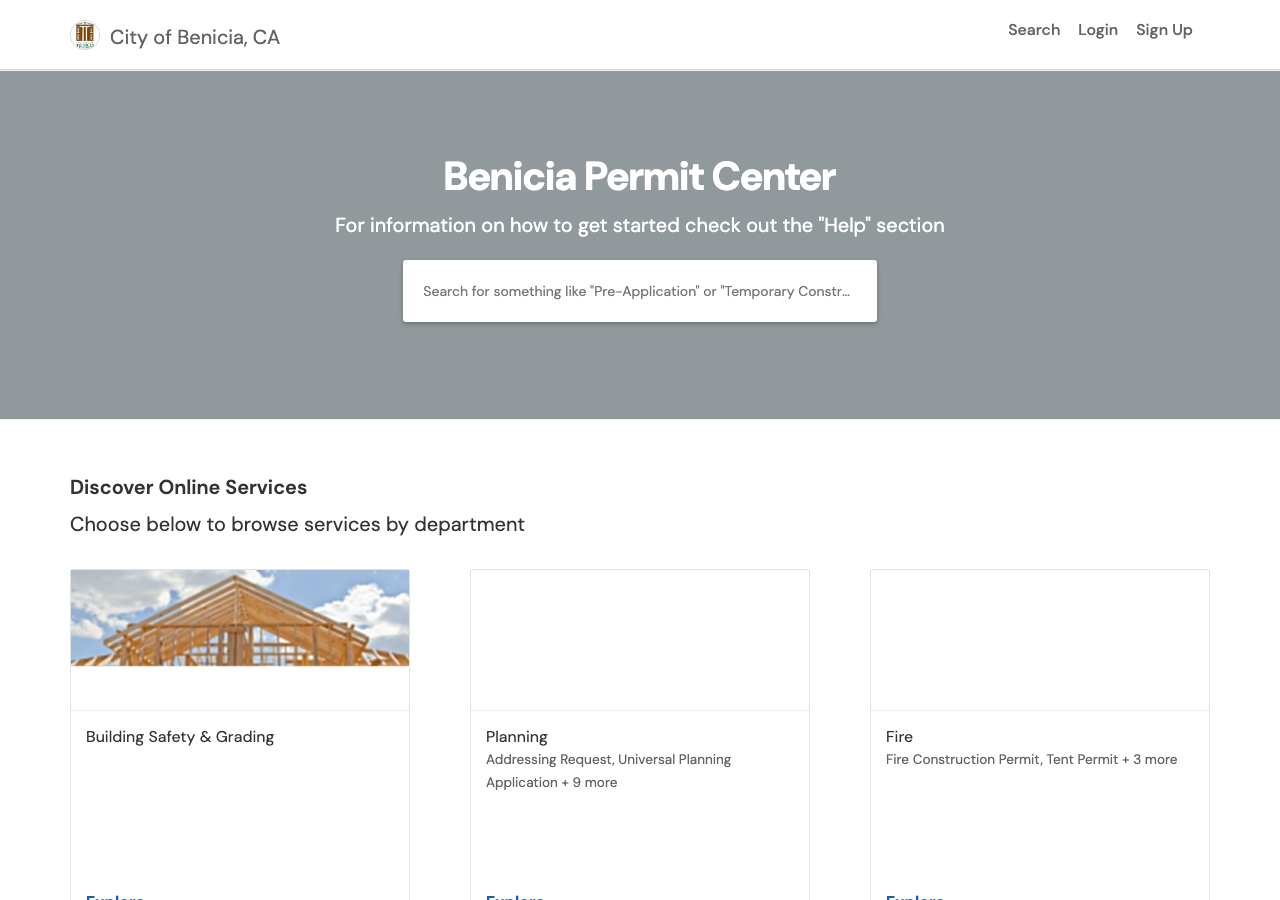
- Which permit portal does this authority use? Benicia Permit Center (OpenGov, beniciaca.portal.opengov.com) for standard building permits; SolarAPP+ for eligible residential PV/PV+storage/BIPV systems 92% · authority's own current webpage
- Can the whole application be completed online? Yes 90% · authority's own current webpage
- What does a residential solar permit cost? $450 flat for 0-15 kW AC, plus $15 per additional kW (or fraction) above 15 kW (Residential Solar System Table-6, 'Roof or Ground Mounted', explicitly includes backup batteries and EV charger); Fire Department charges an additional $504.10 for 'Solar Photovoltaic Power Systems' 92% · fee schedule, current
- How is the fee calculated? Tiered — flat base fee for a bracket, then a per-kW increment above the bracket ceiling (state AB 1414 model: $450 base 0-15kW + $15/kW thereafter) 90% · fee schedule, current
- Is there a separate plan-check fee? Yes — Fire Department plan review/permit fee ($504.10 PV / $1,290.30 ESS) is a distinct line item from Building's Table-6 fee, which itself is described as covering plan check/permit together for the building side 75% · fee schedule, current
-
Plan review — and start the utility in parallel
Interconnection is a separate process from the permit and usually the longer pole. Where the utility does not depend on the permit being issued, running both at once is the single biggest saving available on a residential job.
- What is the stated plan-review turnaround? Same day for express/complete SolarAPP+-style applications, or within 1-3 working days for a complete application meeting the approved checklist and standard plan 90% · ordinance
- How long is an issued permit valid before it expires? 180 days from acceptance to issuance if not issued; 365 days from issuance for inspections/final on most building permits (180 days for stand-alone mechanical/plumbing permits); the solar chapter itself does not set a separate validity period 78% · authority's own current webpage
- Which utility handles interconnection here? Pacific Gas & Electric (PG&E); no Community Choice Aggregation (CCA) program was found for Benicia 90% · authority's own department page + fee schedule + codified ordinance
- Where does the utility sit in the sequence? Parallel, with Permission to Operate (PTO) gated on the AHJ's final electrical inspection clearance 82% · utility tariff, independently re-verified
28 questions answered against City of Benicia’s own published documents
Q1 Is this authority the AHJ for residential solar at this address? Core Jurisdiction & scope
Yes
Why the confidence is not higherCity's own Development Services Dept administers BMC Title 15 (building/electrical) and BMC Ch. 15.35 codifies a dedicated streamlined residential rooftop solar permitting chapter (Ord. 25-11); Benicia is an incorporated city so Solano County has no jurisdiction here.
ordinance checked 2026-08-31 https://ecode360.com/print/BE4354?guid=49796506
Q2 What does this authority permit itself, and what does it delegate? Core Jurisdiction & scope
Both
Why the confidence is not higherBuilding Safety Division page: staff 'enforce building codes... coordinates the review of building projects, oversees inspection services, and issues building, mechanical, electrical and plumbing permits.' No contract firm, portal-subdomain, or named delegation was found anywhere on the department's own pages (checked buildingsafety, solar, contactdsd, buildingforms) — self-performed in-house, though no single named 'Building Official' was found to make this airtight.
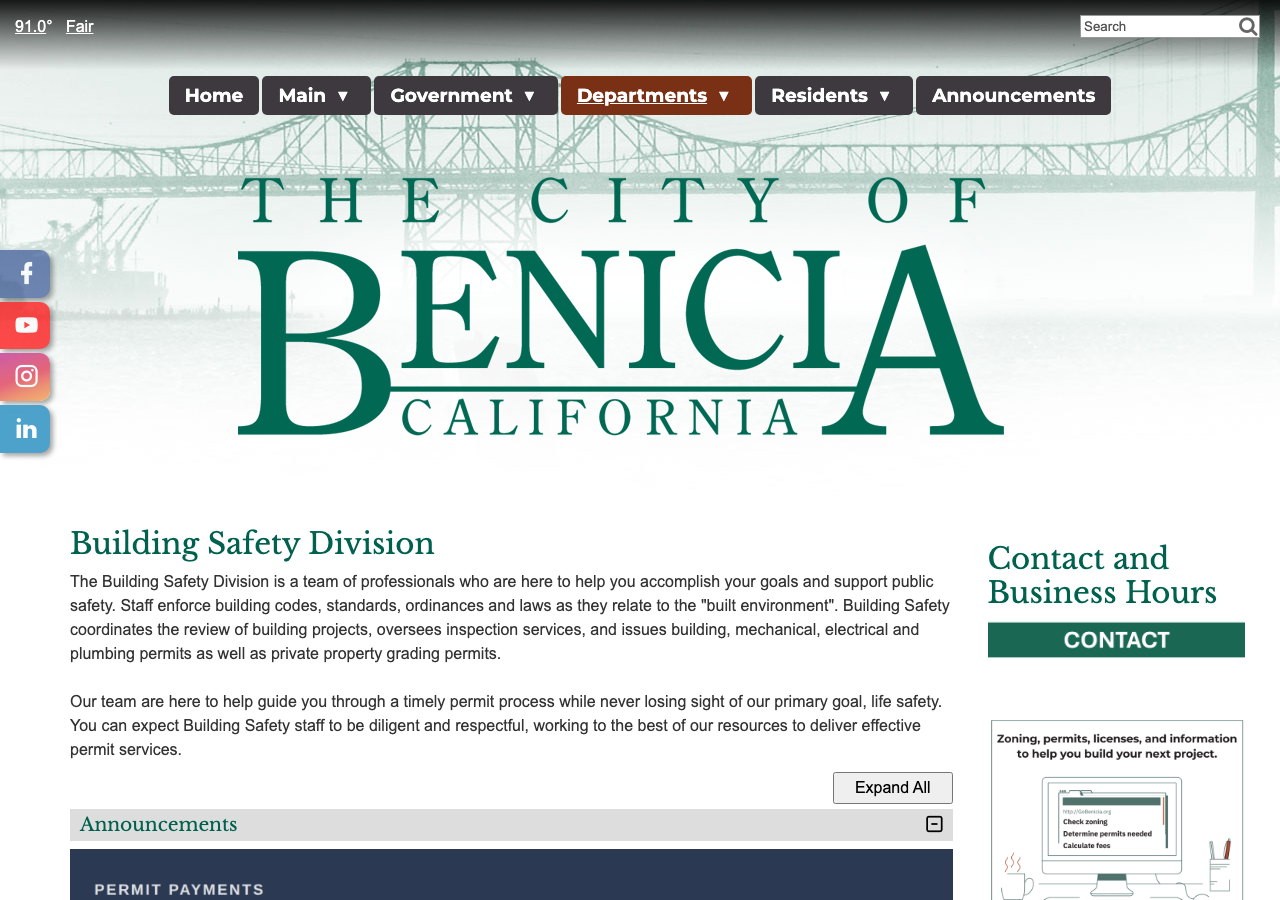
authority's own department page checked 2026-08-31 https://www.ci.benicia.ca.us/buildingsafety
Q3 Is a permit required for a residential rooftop PV system? Core Jurisdiction & scope
Yes
Why the confidence is not higherBMC 15.35.030(A): chapter 'applies to the permitting of all small residential rooftop solar energy systems'; doineedapermit page lists 'Installing or updating solar systems' among work requiring a building permit.
ordinance + authority's own department page checked 2026-08-31 https://www.ci.benicia.ca.us/doineedapermit
Q4 Is there a separate electrical permit, or is it combined? Core Jurisdiction & scope
Combined (base system); a separate additional Electrical Permit is required if a main/sub-panel upgrade is involved
Why the confidence is not higherSolar page, verbatim: 'Owner-builders must apply for a "Building Permit - Energy Improvements" with plan check. Any residential main service or sub panels will require C-10 licensed installers to apply for an additional "Express Permit - Electric" or "Electrical Permit" only permit.'
authority's own current webpage checked 2026-08-31 https://www.ci.benicia.ca.us/solar
Q5 Who is allowed to pull the electrical permit? Core Who may apply
Licensed electrician (C-10) required specifically for any main-service or sub-panel work; the base PV building permit itself may be pulled by an owner-builder
Why the confidence is not higherSame solar page passage as Q4: 'Any residential main service or sub panels will require C-10 licensed installers to apply for an additional... Electrical Permit'.
authority's own current webpage checked 2026-08-31 https://www.ci.benicia.ca.us/solar
Q6 Must the contractor be registered with this authority before applying? Core Who may apply
Yes, in the general sense that any contractor doing business in the city must hold a city business tax certificate
Why the confidence is not higherBMC 5.04.020: 'It is unlawful for a person to transact business in the city... without first complying with the requirements of this chapter.' This is a general business-license requirement, not a solar- or Building-Division-specific contractor registration; no solar-specific contractor pre-registration requirement was found.
ordinance checked 2026-08-31 https://ecode360.com/print/BE4354?guid=49790439
Q7 Is a homeowner permitted to self-install and self-permit? Who may apply
Yes
Why the confidence is not higherCity's own 'Owner-Builder Permits' page: 'The State of California allows homeowners to act as their own general contractor for projects on their principal residence... State laws about owner-builder can be found in Business & Professions Code section 7044.' The solar page itself contemplates an 'Owner-builders' pathway for the PV building permit (see Q4/Q5).
authority's own department page checked 2026-08-31 https://www.ci.benicia.ca.us/ownerbuilder
Q8 What documents make up a complete submittal? Core Submittal package
Eligibility Checklist for Expedited Solar Photovoltaic Permitting for One- and Two-Family Dwellings ('PV Checklist SB2188') — General/Electrical/Structural/Fire Safety Y/N sections plus a completed permit application; large/complex projects otherwise use the general Residential Additions/Alterations submittal package (drawings, calcs, Title 24 forms)
Why the confidence is not higherPDF header reads '250 East L Street, Benicia, CA' with a real internal file path footer ('F:\CDD\Building\Admin\Forms-Labels\Solar Permit'), confirming it is Benicia's own document, still linked from the current Building Safety Forms page. Note it is dated 'Revised 8/7/19' and still shows the department's former name (Community Development Department, now Development Services).
authority's own handout, dated 2019, still linked from current forms page checked 2026-08-31 https://www.ci.benicia.ca.us/vertical/Sites/%7BF991A639-AAED-4E1A-9735-86EA195E2C8D%7D/uploads/Photovoltaic_Toolkit_2019.pdf
Q9 How many copies, and in what format? Submittal package
Fully electronic only — PDF and JPG file formats accepted; no paper plans, resubmittals or revisions accepted; no specific electronic-copy count stated
Why the confidence is not higherBuilding Safety Division page: 'Permitting in Benicia is fully electronic. No paper plan submittals, resubmittals or revisions will be accepted... Electronic File Format: Only PDF and JPG file formats will be accepted for attachments.'
authority's own current webpage checked 2026-08-31 https://www.ci.benicia.ca.us/buildingsafety
Q10 Is a site plan required, and what must it show? Core Submittal package
General site plan (min. 11x17", address, owner, property size, property lines/existing structures, proposed work outline with dimensions/setbacks) per the city's generic Site Plan Example handout, supplemented for solar by the PV eligibility checklist's own requirement for 'a diagram of the roof layout of all panels, modules, clear access pathways and approximate locations of electrical disconnecting means and roof access points'
Why the confidence is not higherSite Plan Example handout (dated 04/18/2022, generic — not solar-specific) plus the solar-specific roof-diagram requirement in the PV eligibility checklist Fire Safety item D.
authority's own handout checked 2026-08-31 https://www.ci.benicia.ca.us/vertical/Sites/%7BF991A639-AAED-4E1A-9735-86EA195E2C8D%7D/uploads/Site_plan_Example_with_text_04.18.22.pdf
Q11 Is a one-line / three-line diagram required? Core Drawings & calculations
Nothing published by this authority.
Where we lookedFull text of BMC 15.35 (solar ordinance), the PV eligibility checklist (Photovoltaic_Toolkit_2019.pdf), the PV fire supplemental handout, and the general Residential Additions/Alterations submittal checklist — none of these name a one-line or three-line electrical diagram requirement by that term for solar specifically.
Q12 Are string and conductor calculations required? Drawings & calculations
Nothing published by this authority.
Where we lookedSame documents as Q11 — the PV checklist's Electrical Requirements section is a set of Y/N eligibility criteria (string/MPPT counts, bus-bar rating) rather than a requirement to submit string or conductor calculations.
Q13 Is a structural PE stamp required, and at what threshold? Core Engineering & stamps
Nothing published by this authority.
Where we lookedFull text of BMC 15.03-15.16 (adopted codes and amendments) and the PV checklist's Structural Requirements section ('Structural Criteria and supporting documentation is attached (if required)') — no numeric valuation or size threshold triggering a PE stamp was found, solar-specific or general.
Q14 Is an electrical PE stamp required, and at what threshold? Engineering & stamps
Nothing published by this authority.
Where we lookedSame documents as Q13 — no electrical PE-stamp threshold was found, solar-specific or general.
Q15 What does a residential solar permit cost? Core Fees
$450 flat for 0-15 kW AC, plus $15 per additional kW (or fraction) above 15 kW (Residential Solar System Table-6, 'Roof or Ground Mounted', explicitly includes backup batteries and EV charger); Fire Department charges an additional $504.10 for 'Solar Photovoltaic Power Systems'
Why the confidence is not higherFY2026-27 Master Fee Schedule (PDF CreationDate 18 Aug 2026, effective 07-01-2026), Building Fees line 69 'PV Solar includes Backup Batteries & EV Charger — Per Residential Solar Table-6 (Mandated by State)', Table-6 itself, and the separate Fire fee schedule line 71 'Solar Photovoltaic Power Systems $504.10'.
fee schedule, current checked 2026-08-31 https://beniciacarebuild.govoffice2.com/vertical/Sites/%7BF991A639-AAED-4E1A-9735-86EA195E2C8D%7D/uploads/FY2026-27_Master_Fee_Schedule_(1).pdf
Q16 How is the fee calculated? Core Fees
Tiered — flat base fee for a bracket, then a per-kW increment above the bracket ceiling (state AB 1414 model: $450 base 0-15kW + $15/kW thereafter)
Why the confidence is not higherResidential - Solar System Table-6 in the current Master Fee Schedule shows exactly this base+increment structure, explicitly labeled 'State Mandated Fees thru 1/1/25' (AB 1414 cap table).
fee schedule, current checked 2026-08-31 https://beniciacarebuild.govoffice2.com/vertical/Sites/%7BF991A639-AAED-4E1A-9735-86EA195E2C8D%7D/uploads/FY2026-27_Master_Fee_Schedule_(1).pdf
Q17 Is there a separate plan-check fee? Fees
Yes — Fire Department plan review/permit fee ($504.10 PV / $1,290.30 ESS) is a distinct line item from Building's Table-6 fee, which itself is described as covering plan check/permit together for the building side
Why the confidence is not higherMaster Fee Schedule Fire section lists 'Solar Photovoltaic Power Systems $504.10' and 'Energy Storage Systems $1,290.30' as separate, occupancy-unqualified line items under 'Special Hazards - Hazardous Materials', distinct from the Building section's Table-6 PV fee.
fee schedule, current checked 2026-08-31 https://beniciacarebuild.govoffice2.com/vertical/Sites/%7BF991A639-AAED-4E1A-9735-86EA195E2C8D%7D/uploads/FY2026-27_Master_Fee_Schedule_(1).pdf
Q18 What is the stated plan-review turnaround? Core Timeline & validity
Same day for express/complete SolarAPP+-style applications, or within 1-3 working days for a complete application meeting the approved checklist and standard plan
Why the confidence is not higherBMC 15.35.060(A): 'The building safety division shall issue a building permit or other nondiscretionary permit the same day for express applications, or within one to three working days when in receipt of a complete application that meets the requirements of the approved checklist and standard plan.'
ordinance checked 2026-08-31 https://ecode360.com/print/BE4354?guid=49796506
Q19 How long is an issued permit valid before it expires? Timeline & validity
180 days from acceptance to issuance if not issued; 365 days from issuance for inspections/final on most building permits (180 days for stand-alone mechanical/plumbing permits); the solar chapter itself does not set a separate validity period
Why the confidence is not higherBuilding Safety Division page 'EXPIRATION TIMEFRAMES': 'Plan Review and Issuance: 180 Days from application acceptance letter date; Inspections: 180 Days... for Mechanical and Plumbing stand-alone permits; 365 Days from permit issuance date for all others.'
authority's own current webpage checked 2026-08-31 https://www.ci.benicia.ca.us/buildingsafety
Q20 Which permit portal does this authority use? Core Portal & process
Benicia Permit Center (OpenGov, beniciaca.portal.opengov.com) for standard building permits; SolarAPP+ for eligible residential PV/PV+storage/BIPV systems
Why the confidence is not higherGetting Started page: 'The Benicia Permit Center is an online one-stop-shop... https://beniciaca.portal.opengov.com/'; Solar page describes SolarAPP+ as the automated route for eligible systems.
authority's own current webpage checked 2026-08-31 https://www.ci.benicia.ca.us/gettingstartedpermits
Q21 Can the whole application be completed online? Core Portal & process
Yes
Why the confidence is not higherBuilding Safety page: 'Permitting in Benicia is fully electronic... All Building Safety applications, plans, and documents must be submitted in Benicia's online permit portal.' SolarAPP+ additionally gives 'instantaneous permit issuance once permit application is completed.'
authority's own current webpage checked 2026-08-31 https://www.ci.benicia.ca.us/buildingsafety
Q22 Which utility handles interconnection here? Core Utility interconnection
Pacific Gas & Electric (PG&E); no Community Choice Aggregation (CCA) program was found for Benicia
Why the confidence is not higherThree independent city-side confirmations: (1) Building Safety Division page links 'PG&E Project Resources - Process Infographic' as a permit resource; (2) current Master Fee Schedule (Public Works encroachment fees) names 'PG&E, AT&T, cable, fiber optics' as utilities performing >$25,000 work in the public ROW; (3) codified BMC 13.12 (water rates, low-income discount) requires 'a recent PG&E bill noting participation in the PG&E CARE... program' as proof of income eligibility. No CCA (MCE, Sonoma Clean Power, 3CE, etc.) was found on any city page, PDF, or codified chapter searched (grep across ~12 pages/PDFs, 0 hits) — Solano County appears to have no CCA serving Benicia.
authority's own department page + fee schedule + codified ordinance checked 2026-08-31 https://www.ci.benicia.ca.us/buildingsafety
Q23 Where does the utility sit in the sequence? Core Utility interconnection
Parallel, with Permission to Operate (PTO) gated on the AHJ's final electrical inspection clearance
Why the confidence is not higherPG&E Electric Rule 21 (current tariff, downloaded fresh 31 Aug 2026, CreationDate 25 Jun 2026), Section D.13.b: PTO for NEM Generating Facilities ≤1MW requires 'evidence of Applicant's final electric inspection clearance from the Governmental Authority having jurisdiction over the Generating Facility.' This is a statewide PG&E rule, not Benicia-specific.
utility tariff, independently re-verified checked 2026-08-31 https://www.pge.com/tariffs/assets/pdf/tariffbook/ELEC_RULES_21.pdf
Q24 Is a HOA or architectural approval required first? Overlays & special cases
No
Why the confidence is not higherBMC 15.35.060(F): 'The city shall not condition approval of an application on the approval of an association, as defined in Section 4080 of the Civil Code.' Consistent with the state Solar Rights Act.
ordinance checked 2026-08-31 https://ecode360.com/print/BE4354?guid=49796506
Q25 Is there a historic-district review? Overlays & special cases
Yes, but only for property in the Arsenal, the Downtown Historic District, or a designated Historic Resource
Why the confidence is not higherdoineedapermit page, verbatim: 'A building Permit and Planning Division review is required for any exterior changes if the building is a multifamily or commercial structure, a designated Historic Resource, or is located in the Arsenal or in Downtown Historic District.' Confirmed in the codified zoning title: BMC 17.108.020(E)(2) exempts single-family residences from design review ONLY 'outside of an H historic overlay district' (i.e., inside one they are NOT exempt), and Ch. 17.54 (H Historic Overlay District) contains no PV-specific carve-out anywhere in its text (full chapter read). A rooftop PV array on a home in these two named districts is therefore subject to Development Services Director / Historic Preservation Review Commission design review as an exterior alteration.
authority's own current webpage + codified zoning title checked 2026-08-31 https://www.ci.benicia.ca.us/doineedapermit
Q26 Is a wind or windstorm certification required? Overlays & special cases
No
Why the confidence is not higherNo windstorm/wind-load certification requirement was found anywhere in BMC Title 15 (adopted codes and amendments, full text read); positive control ('electrical', 25 hits) and fabricated control ('zzqqx', 0 hits) confirm the search worked. Consistent with the general California pattern of relying on unamended CBC/ASCE 7 wind provisions rather than a separate certification.
ordinance, control-proven absence checked 2026-08-31 https://ecode360.com/print/BE4354?guid=49796506
Q27 Is a Specific Use Permit or Council approval ever required? Overlays & special cases
Yes, conditionally
Why the confidence is not higherBMC 15.35.060(A): 'The building official may require an applicant to apply for a use permit if the official finds, based on substantial evidence, that the solar energy system could have a specific, adverse impact upon the public health and safety. Such decisions may be appealed to the planning commission.'
ordinance checked 2026-08-31 https://ecode360.com/print/BE4354?guid=49796506
Q28 Is there a system-size cap on residential generation? Overlays & special cases
10 kW AC nameplate / 30 kW thermal cap, and the system must not exceed the maximum legal building height, to qualify as a 'small residential rooftop solar energy system' under the streamlined ordinance; scope is further limited to a 'single or duplex family dwelling'. This is a gate to the streamlined/expedited pathway defined by the ordinance itself, not a citywide absolute ceiling — the ordinance covers only systems meeting this definition (larger systems would fall outside Ch. 15.35 and go through standard review, not explicitly detailed).
Why the confidence is not higherBMC 15.35.010 definitions of 'Small residential rooftop solar energy system' and 'Solar energy system' (item 3: 'installed on a single or duplex family dwelling').
ordinance checked 2026-08-31 https://ecode360.com/print/BE4354?guid=49796506
Lines marked with a percentage were read off this authority’s own published documents. Unmarked guidance is general good practice, not this jurisdiction’s rule — always confirm against the authority before you submit.
Install 5 steps · 20 questions
-
Build to the code editions actually in force here
The NEC edition a jurisdiction enforces is often a cycle behind the newest one published, and local amendments sit on top of it. Rapid shutdown, conductor sizing and labelling all change between editions, so the edition in force is the first thing to establish, not the last.
- Which NEC edition is in force? 2025 California Electrical Code, which BMC 15.03.010(D) itself describes as 'the 2024 National Electrical Code with California amendments' — recorded as written; no '2024 NEC' edition actually exists (NFPA's most recent published cycle at this time is 2023), so this appears to be a drafting error in the same pattern seen in other CA cities' 2025-cycle ordinances (Amador, Foster City, Rancho Palos Verdes all miscite the underlying NEC edition). Adopted 'in its entirety with no amendments, deletions, or additions.' 80% · ordinance, drafting anomaly recorded as written
- Which building code edition is in force? 2025 California Building Code (2024 IBC with CA amendments), Volumes 1 and 2 — codified via Ord. 25-11 85% · ordinance, with a stale webpage passage flagged
- Which fire code edition is in force? 2025 California Fire Code (2024 IFC with CA amendments) — adopted via Ord. 25-10 90% · ordinance
- Are there local amendments to any of the above? Yes — extensive local amendments to both the Building Code (BMC Ch. 15.05, 15.08, 15.11, 15.16, 15.20 etc.) and the Fire Code (BMC 8.28.050, items A through Y: address identification, fire-flow tables, fire apparatus access road standards, sprinkler triggers, hydrant spacing, etc., all justified by named 'Climatic', 'Topographic' and 'Geologic' local-condition findings). No amendment specific to PV/ESS was found in either set. 92% · ordinance
- What is the installation judged against? The adopted 2025 CEC plus IEEE and accredited-testing-laboratory (e.g., UL) standards for electricity-producing systems, and CA Plumbing/Mechanical Code listing for solar water heating; for the expedited pathway, conformance to the city's standard plan/checklist which must itself substantially conform to the current California Solar Permitting Guidebook 85% · ordinance
-
Fire access, setbacks and pathways
Ridge setbacks and roof access pathways are fire-service requirements and they constrain the array layout. They are the most common cause of a redesign after the fire department comments on a plan set.
- What ridge setback and access pathways are required? Pathways: not fewer than two 36-inch pathways from lowest roof edge to ridge on separate roof planes (one on the street/driveway side), plus one 36-inch pathway on the same or adjacent plane as any PV array. Ridge setbacks: 18 inches each side of a horizontal ridge where the array covers ≤33% of the roof plan area (36 inches if >33%), or 18"/36" at 66%/>66% coverage where an automatic sprinkler system is installed. DC conductors must run the shortest path to minimize roof conduit. This is quoted essentially verbatim from (unamended) CFC §1204.2.1.1-.2.3 — no Benicia-specific local amendment to these figures was found in BMC 8.28.050's amendment list. 85% · authority's own current handout, quoting the state fire code
-
Rapid shutdown
Which rapid-shutdown rule applies follows directly from the NEC edition in force, and the initiation device has to be at a location the fire service can reach and identify. This is inspected, and it is labelled.
- Is rapid shutdown required, and to which NEC edition? Yes, rapid shutdown is required under the adopted 2025 CEC's §690.12 (whichever underlying NEC edition actually governs); no local amendment to this requirement was found 75% · ordinance, inferred from adopted NEC edition; control-proven absence of local rapid-shutdown text
-
Labels and placards
The NEC sets a baseline for permanent markings at the service equipment and the disconnecting means. On top of that, an authority may specify its own wording, and the utility may specify more again. Where any of them writes its own text, a generic off-the-shelf label set will not pass — this is the detail most often fixed on a return visit.
- Which placards does this authority require at the service equipment? No AHJ-specific placard beyond what the unamended 2025 CEC (e.g., §705.10-family labeling) and CFC already require; the city's own PV checklist only requires generically that 'All required markings and labels are provided' without naming any placard or specifying its content 60% · authority's own handout + ordinance, inferred absence
- Does the authority specify placard wording of its own? No 75% · ordinance, control-proven absence
- Does the UTILITY specify placards beyond the AHJ's? Yes, conditionally — a visible, manually-operated isolating switch with markings/signage clearly indicating open and closed positions, 'when required by Distribution Provider's operating practices' 75% · utility tariff, independently re-verified
-
Disconnect, storage and listed equipment
Where the AC disconnect must sit relative to the meter is usually the utility's rule, not the building department's. Battery storage frequently carries its own permit, its own inspection and its own fire conditions.
- Must equipment be on a specific approved list? Yes 88% · ordinance
- Are batteries permitted, and under what conditions? Batteries: the city's own documents conflict and this is reported rather than resolved. The 2019 PV eligibility checklist (still linked as the current 'PV Checklist SB2188' handout) makes 'Solar system is utility interactive and without battery storage' a General Requirement for its expedited checklist. But the live 2026 SolarAPP+ page explicitly lists 'Photovoltaic with Storage' and 'Building-Integrated Photovoltaic with Storage' among the eligible SolarAPP+ system types, and the current Master Fee Schedule bills 'PV Solar includes Backup Batteries & EV Charger' under a single residential fee table. The more recent, more specific SolarAPP+/fee-schedule material appears to supersede the 2019 no-battery eligibility item for the automated pathway, but no document explicitly says the 2019 checklist has been withdrawn. 65% · authority's own current webpage, in conflict with an older linked handout — reported, not resolved
- Is there a separate ESS permit or inspection? No separate ESS Building permit — batteries are billed under the same Residential Solar Table-6 line as the PV system ('PV Solar includes Backup Batteries & EV Charger'). The Fire Department, however, carries a distinct, separate fee line for 'Energy Storage Systems' ($1,290.30) apart from 'Solar Photovoltaic Power Systems' ($504.10), suggesting Fire treats ESS as a separate scope of review even though Building does not. 68% · fee schedule, current
- Is a ground mount treated as a structure? Yes, by inference 65% · ordinance, inferred from general zoning definition; utility-scale solar ordinance distinguished and excluded
- Is there a local rule on service upgrades or busbar sizing? 225A maximum single-phase bus bar rating is an eligibility gate for the expedited pathway (not a universal service-upgrade rule); no separate local rule on service-panel upgrades in general was found in the codified amendments 68% · authority's own handout, dated 2019, still linked from current forms page
- Is a specific mounting system or attachment spacing required? Minimum 3/4-inch EMT conduit and minimum #6 bare copper wire (bonding) required on the roof deck between panels, per the city's own PV eligibility checklist; no roof-attachment/clip spacing spec was found 68% · authority's own handout, dated 2019, still linked from current forms page
20 questions answered against City of Benicia’s own published documents
Q29 Which NEC edition is in force? Core Code editions in force
2025 California Electrical Code, which BMC 15.03.010(D) itself describes as 'the 2024 National Electrical Code with California amendments' — recorded as written; no '2024 NEC' edition actually exists (NFPA's most recent published cycle at this time is 2023), so this appears to be a drafting error in the same pattern seen in other CA cities' 2025-cycle ordinances (Amador, Foster City, Rancho Palos Verdes all miscite the underlying NEC edition). Adopted 'in its entirety with no amendments, deletions, or additions.'
Why the confidence is not higherBMC 15.03.010(D) (Ord. 25-11 § 1); the same ordinance also enacts Ch. 15.35 (solar), so the code-cycle text and the solar chapter are contemporaneous and current, not lagging.
ordinance, drafting anomaly recorded as written checked 2026-08-31 https://ecode360.com/print/BE4354?guid=49796506
Q30 Which building code edition is in force? Core Code editions in force
2025 California Building Code (2024 IBC with CA amendments), Volumes 1 and 2 — codified via Ord. 25-11
Why the confidence is not higherBMC 15.03.010(A). NOTE — internal inconsistency found: the Building Safety Division's own current webpage still states elsewhere, under 'CURRENT CALIFORNIA BUILDING CODE CYCLE', that 'The 2022 CA Building Codes published July 1st, 2022 are in effect' — that passage is stale relative to both the codified ordinance (Ord. 25-11, 2025 cycle) and the city's own separate 'codecycle' page, which correctly states the 2025 codes took effect 1 Jan 2026. Reporting the codified/current-page answer and flagging the stale passage rather than resolving it.
ordinance, with a stale webpage passage flagged checked 2026-08-31 https://ecode360.com/print/BE4354?guid=49796506
Q31 Which fire code edition is in force? Code editions in force
2025 California Fire Code (2024 IFC with CA amendments) — adopted via Ord. 25-10
Why the confidence is not higherBMC 8.28.010(A)-(B); the same 2025 CFC adoption is echoed on the city's 'Building Code Changes' page.
ordinance checked 2026-08-31 https://ecode360.com/print/BE4354?guid=49792484
Q32 Are there local amendments to any of the above? Core Code editions in force
Yes — extensive local amendments to both the Building Code (BMC Ch. 15.05, 15.08, 15.11, 15.16, 15.20 etc.) and the Fire Code (BMC 8.28.050, items A through Y: address identification, fire-flow tables, fire apparatus access road standards, sprinkler triggers, hydrant spacing, etc., all justified by named 'Climatic', 'Topographic' and 'Geologic' local-condition findings). No amendment specific to PV/ESS was found in either set.
Why the confidence is not higherBMC 8.28.010(C) local-condition findings and BMC 8.28.050 full amendment list.
ordinance checked 2026-08-31 https://ecode360.com/print/BE4354?guid=49792484
Q33 What is the installation judged against? Core Electrical
The adopted 2025 CEC plus IEEE and accredited-testing-laboratory (e.g., UL) standards for electricity-producing systems, and CA Plumbing/Mechanical Code listing for solar water heating; for the expedited pathway, conformance to the city's standard plan/checklist which must itself substantially conform to the current California Solar Permitting Guidebook
Why the confidence is not higherBMC 15.35.040(A)-(C) and 15.35.050(E).
ordinance checked 2026-08-31 https://ecode360.com/print/BE4354?guid=49796506
Q34 Is there a local rule on service upgrades or busbar sizing? Electrical
225A maximum single-phase bus bar rating is an eligibility gate for the expedited pathway (not a universal service-upgrade rule); no separate local rule on service-panel upgrades in general was found in the codified amendments
Why the confidence is not higherPhotovoltaic_Toolkit_2019.pdf, Electrical Requirements item C: 'The PV system is interconnected to a single-phase AC service panel of nominal 120/220 Vac with a bus bar rating of 225 A or less.' This is a 2019 eligibility-checklist item, still linked as the current 'PV Checklist SB2188' handout, not a provision found in the codified BMC 15.05/15.08 amendment chapters themselves.
authority's own handout, dated 2019, still linked from current forms page checked 2026-08-31 https://www.ci.benicia.ca.us/vertical/Sites/%7BF991A639-AAED-4E1A-9735-86EA195E2C8D%7D/uploads/Photovoltaic_Toolkit_2019.pdf
Q35 Is a specific mounting system or attachment spacing required? Structural & mounting
Minimum 3/4-inch EMT conduit and minimum #6 bare copper wire (bonding) required on the roof deck between panels, per the city's own PV eligibility checklist; no roof-attachment/clip spacing spec was found
Why the confidence is not higherPhotovoltaic_Toolkit_2019.pdf footer notes: 'Minimum 3/4" EMT is required in the City of Benicia' and 'Minimum #6 Bare is required on the roof deck between panels.'
authority's own handout, dated 2019, still linked from current forms page checked 2026-08-31 https://www.ci.benicia.ca.us/vertical/Sites/%7BF991A639-AAED-4E1A-9735-86EA195E2C8D%7D/uploads/Photovoltaic_Toolkit_2019.pdf
Q36 What ridge setback and access pathways are required? Core Fire pathways & setbacks
Pathways: not fewer than two 36-inch pathways from lowest roof edge to ridge on separate roof planes (one on the street/driveway side), plus one 36-inch pathway on the same or adjacent plane as any PV array. Ridge setbacks: 18 inches each side of a horizontal ridge where the array covers ≤33% of the roof plan area (36 inches if >33%), or 18"/36" at 66%/>66% coverage where an automatic sprinkler system is installed. DC conductors must run the shortest path to minimize roof conduit. This is quoted essentially verbatim from (unamended) CFC §1204.2.1.1-.2.3 — no Benicia-specific local amendment to these figures was found in BMC 8.28.050's amendment list.
Why the confidence is not higherPV_Solar_Supplemental.pdf ('Solar Photovoltaic Fire Safety Requirements for 1 & 2 Family Dwellings', a supplemental sheet to the PV eligibility checklist, CreationDate 14 Jan 2021, still the current linked handout).
authority's own current handout, quoting the state fire code checked 2026-08-31 https://www.ci.benicia.ca.us/vertical/Sites/%7BF991A639-AAED-4E1A-9735-86EA195E2C8D%7D/uploads/PV_Solar_Supplemental.pdf
Q37 Is rapid shutdown required, and to which NEC edition? Core Rapid shutdown
Yes, rapid shutdown is required under the adopted 2025 CEC's §690.12 (whichever underlying NEC edition actually governs); no local amendment to this requirement was found
Why the confidence is not higherInferred from the adopted CEC edition (BMC 15.03.010(D)); full-text search of Title 15 and Title 8 (fire code amendments) and both PV handouts for '690.12' and 'rapid shutdown' returned zero hits, while a positive control ('electrical', 25 hits) confirms the search worked — i.e., no local text overrides the state baseline either way.
ordinance, inferred from adopted NEC edition; control-proven absence of local rapid-shutdown text checked 2026-08-31 https://ecode360.com/print/BE4354?guid=49796506
Q38 Which placards does this authority require at the service equipment? Core Labels Signage & labelling
No AHJ-specific placard beyond what the unamended 2025 CEC (e.g., §705.10-family labeling) and CFC already require; the city's own PV checklist only requires generically that 'All required markings and labels are provided' without naming any placard or specifying its content
Why the confidence is not higherPhotovoltaic_Toolkit_2019.pdf, Fire Safety Requirements item C; BMC 15.03.010(D) states the CEC is 'adopted in its entirety with no amendments, deletions, or additions,' and no separate signage ordinance was found in Title 15 or Title 8 (control: 'electrical' 25 hits / 'zzqqx' 0 hits in Title 15).
authority's own handout + ordinance, inferred absence checked 2026-08-31 https://www.ci.benicia.ca.us/vertical/Sites/%7BF991A639-AAED-4E1A-9735-86EA195E2C8D%7D/uploads/Photovoltaic_Toolkit_2019.pdf
Q39 Does the authority specify placard wording of its own? Core Labels Signage & labelling
No
Why the confidence is not higherBMC 15.03.010(D) adopts the California Electrical Code 'in its entirety with no amendments, deletions, or additions,' and no separate placard-wording ordinance was found anywhere in Title 15 or Title 8 fire code amendments (BMC 8.28.050 A-Y list contains no signage/placard-wording item). Control: 'electrical' 25 hits / 'zzqqx' 0 hits confirms the search worked.
ordinance, control-proven absence checked 2026-08-31 https://ecode360.com/print/BE4354?guid=49796506
Q40 Does it specify letter height, colour or material? Core Labels Signage & labelling
Nothing published by this authority.
Where we lookedPV eligibility checklist, PV fire supplemental handout, BMC Title 15 (adopted codes, no CEC amendments) and BMC 8.28.050 fire code amendments — none specify letter height, colour, or material for any solar placard.
Q41 Is a site plan / facility map placard required, and what must it show? Core Labels Signage & labelling
Nothing published by this authority.
Where we lookedSame documents as Q40. The PV checklist requires a roof-layout diagram (panels, pathways, disconnect locations) as part of the SUBMITTAL package, but nothing states a posted site-plan/facility-map placard is required at the equipment itself.
Q42 Does the UTILITY specify placards beyond the AHJ's? Core Labels Signage & labelling
Yes, conditionally — a visible, manually-operated isolating switch with markings/signage clearly indicating open and closed positions, 'when required by Distribution Provider's operating practices'
Why the confidence is not higherPG&E Electric Rule 21 (fresh copy downloaded 31 Aug 2026), Section D.13.d [labelled H.1.d in some prior extractions]: 'Producer shall furnish and install a ganged, manually-operated isolating switch... The device must... include markings or signage that clearly indicates open and closed positions.' Statewide PG&E rule, not Benicia-specific.
utility tariff, independently re-verified checked 2026-08-31 https://www.pge.com/tariffs/assets/pdf/tariffbook/ELEC_RULES_21.pdf
Q43 Where must the labels be placed? Core Labels Signage & labelling
Nothing published by this authority.
Where we lookedPG&E's public Electric Rule 21 tariff (reviewed in full, downloaded fresh 31 Aug 2026) specifies a visible marked disconnect near the point of interconnection but does not give a precise meter-relative placement spec in the public text; no Benicia-specific document was found addressing label/placard placement relative to the meter.
https://www.pge.com/tariffs/assets/pdf/tariffbook/ELEC_RULES_21.pdf
Q44 Must equipment be on a specific approved list? Equipment listing
Yes
Why the confidence is not higherBMC 15.35.040(C): PV systems 'shall meet all applicable safety and performance standards established by the California Electrical Code, the Institute of Electrical and Electronics Engineers, and accredited testing laboratories such as Underwriters Laboratories.'
ordinance checked 2026-08-31 https://ecode360.com/print/BE4354?guid=49796506
Q45 Are batteries permitted, and under what conditions? Core Battery / ESS
Batteries: the city's own documents conflict and this is reported rather than resolved. The 2019 PV eligibility checklist (still linked as the current 'PV Checklist SB2188' handout) makes 'Solar system is utility interactive and without battery storage' a General Requirement for its expedited checklist. But the live 2026 SolarAPP+ page explicitly lists 'Photovoltaic with Storage' and 'Building-Integrated Photovoltaic with Storage' among the eligible SolarAPP+ system types, and the current Master Fee Schedule bills 'PV Solar includes Backup Batteries & EV Charger' under a single residential fee table. The more recent, more specific SolarAPP+/fee-schedule material appears to supersede the 2019 no-battery eligibility item for the automated pathway, but no document explicitly says the 2019 checklist has been withdrawn.
Why the confidence is not higherCompare solar.txt (SolarAPP+ 'System Eligibility' list) against Photovoltaic_Toolkit_2019.pdf General Requirement D, and against the Master Fee Schedule Table-6 description.
authority's own current webpage, in conflict with an older linked handout — reported, not resolved checked 2026-08-31 https://www.ci.benicia.ca.us/solar
Q46 Is there a separate ESS permit or inspection? Battery / ESS
No separate ESS Building permit — batteries are billed under the same Residential Solar Table-6 line as the PV system ('PV Solar includes Backup Batteries & EV Charger'). The Fire Department, however, carries a distinct, separate fee line for 'Energy Storage Systems' ($1,290.30) apart from 'Solar Photovoltaic Power Systems' ($504.10), suggesting Fire treats ESS as a separate scope of review even though Building does not.
Why the confidence is not higherMaster Fee Schedule: Building line 69 (Table-6, bundled) versus Fire lines 61 and 71 (itemized separately).
fee schedule, current checked 2026-08-31 https://beniciacarebuild.govoffice2.com/vertical/Sites/%7BF991A639-AAED-4E1A-9735-86EA195E2C8D%7D/uploads/FY2026-27_Master_Fee_Schedule_(1).pdf
Q47 Is a ground mount treated as a structure? Core Ground mount
Yes, by inference
Why the confidence is not higherBMC 17.12 defines 'Structure' broadly as 'anything constructed or erected that requires a location on the ground, including a building or a swimming pool but not including a fence...' — this would capture a ground-mounted PV array. No dedicated residential ground-mount solar provision exists in the zoning title; the only codified 'Solar' use classification in Title 17 (§17.70.420, 'Solar utilities') is a utility-scale, ≥5-acre, Open-Space-district-only classification and is NOT a residential accessory-structure provision (confirmed by reading its full text: Williamson Act protections, 10 MW aggregate cap, 5-acre minimum lot size, decommissioning plan requirement — all utility-scale hallmarks). Flagging the residential-structure conclusion as inference from the general zoning definition, not a solar-specific statement.
ordinance, inferred from general zoning definition; utility-scale solar ordinance distinguished and excluded checked 2026-08-31 https://ecode360.com/print/BE4354?guid=49799121
Q48 Where must the AC disconnect be, relative to the meter? Core Utility equipment
Nothing published by this authority.
Where we lookedPG&E's public Electric Rule 21 tariff (reviewed in full, fresh copy 31 Aug 2026) requires a visible disconnect 'near the Point of Interconnection' but does not give a precise meter-relative distance/placement spec in the publicly available tariff text (the finer spec is understood to sit in PG&E's gated Greenbook document in other GovBot runs); no Benicia-specific document addresses this either.
https://www.pge.com/tariffs/assets/pdf/tariffbook/ELEC_RULES_21.pdf
Lines marked with a percentage were read off this authority’s own published documents. Unmarked guidance is general good practice, not this jurisdiction’s rule — always confirm against the authority before you submit.
Inspection 5 steps · 14 questions
-
Book it
Booking is a portal, a phone call or an email depending on the authority, and the notice required is rarely zero. Book before the work is finished rather than after — the lead time, not the work, is usually what sets the date.
- How is an inspection booked? Portal (Benicia Permit Center / OpenGov) or Email 80% · authority's own current webpage
- How much notice is required? General building permits: by 3:00 PM the working day prior to the requested inspection (effectively ~1 business day notice). Small residential rooftop solar specifically: the ordinance instead guarantees the CITY will schedule within 2 business days of the request, with a 4-hour window. 85% · ordinance + authority's own department page
- Are same-day or AM/PM windows offered? Yes — a four-hour inspection window is guaranteed for small residential rooftop solar inspections 88% · ordinance
-
Know who turns up
Some authorities inspect their own solar work; some delegate it, and a few do not inspect the PV equipment itself at all. Who is coming determines what they will look at.
- Does this AHJ perform its own final solar inspection? Yes (self-performed) 75% · authority's own department page
- If delegated, to whom? N/A — not delegated; Building Safety Division self-performs (see Q52) 75% · authority's own department page
-
Work the stages in order
A rough-in or mid-roof inspection, where one is required, has to happen before the work it covers is closed up. Missing a stage means opening something back up, and it is the most expensive kind of correction.
- Which inspections are required, and in what order? For an eligible small residential rooftop solar energy system: only ONE consolidated inspection is required. Other (non-solar or non-eligible) building permits follow the general multi-stage sequence implied by the general permitting pages (plan review, issuance, then inspections through to final). 90% · ordinance
- Is a rough-in or mid-roof inspection required? No 80% · ordinance, inferred
-
Have the paperwork on site
The approved plan set, the permit, and the equipment listings should be on site and reachable. Inspectors routinely verify that installed equipment matches what was approved, and that the labels are the ones the plan set promised.
- Is there a published inspection checklist? Yes 78% · authority's own current webpage
- Does the inspector verify labels and listings? Yes 78% · authority's own current webpage + linked checklist
-
Sign-off, and permission to operate
Passing gives you a final or an equivalent sign-off. That is not the same as permission to operate: PTO comes from the utility, and who tells the utility the inspection passed varies. A system left switched off for weeks is usually waiting on this handover.
- Is there a re-inspection fee? $159.60 (Re-inspection Fee and/or Phasing Inspection Fee) 88% · fee schedule, current
- How are corrections issued and cleared? Incomplete APPLICATIONS: a written correction notice detailing all deficiencies is sent to the applicant for resubmission. Failed INSPECTIONS: a subsequent inspection is authorized, but for a small residential rooftop solar system it 'need not conform to the requirements of this chapter' (i.e., the 2-business-day/4-hour-window guarantee does not apply to the re-inspection). 78% · ordinance
14 questions answered against City of Benicia’s own published documents
Q49 How is an inspection booked? Core Booking & scheduling
Portal (Benicia Permit Center / OpenGov) or Email
Why the confidence is not higherBuilding Safety page: 'Building Inspection requests must be submitted... through the online permit center or by email to buildingsafety@ci.benicia.ca.us.'
authority's own current webpage checked 2026-08-31 https://www.ci.benicia.ca.us/buildingsafety
Q50 How much notice is required? Core Booking & scheduling
General building permits: by 3:00 PM the working day prior to the requested inspection (effectively ~1 business day notice). Small residential rooftop solar specifically: the ordinance instead guarantees the CITY will schedule within 2 business days of the request, with a 4-hour window.
Why the confidence is not higherBuilding Safety page: 'Building Inspection requests must be submitted by 3:00 PM the working day prior to an inspection...'; BMC 15.35.060(I): 'An inspection will be scheduled within two business days of a request and provide a four-hour inspection window.'
ordinance + authority's own department page checked 2026-08-31 https://ecode360.com/print/BE4354?guid=49796506
Q51 Are same-day or AM/PM windows offered? Booking & scheduling
Yes — a four-hour inspection window is guaranteed for small residential rooftop solar inspections
Why the confidence is not higherBMC 15.35.060(I): 'An inspection will be scheduled within two business days of a request and provide a four-hour inspection window.'
ordinance checked 2026-08-31 https://ecode360.com/print/BE4354?guid=49796506
Q52 Does this AHJ perform its own final solar inspection? Core Who inspects
Yes (self-performed)
Why the confidence is not higherBuilding Safety Division page describes the division itself as performing inspection services in-house; no delegation to a contract firm or another agency was found on any department, forms, or contact page searched. Confidence held at 75 rather than higher because no single named 'Building Official' was found to make the in-house finding airtight (per the caution that a clean in-house negative should rest on a named official/roster).
authority's own department page checked 2026-08-31 https://www.ci.benicia.ca.us/buildingsafety
Q53 If delegated, to whom? Core Who inspects
N/A — not delegated; Building Safety Division self-performs (see Q52)
Why the confidence is not higherSame basis as Q52.
authority's own department page checked 2026-08-31 https://www.ci.benicia.ca.us/buildingsafety
Q54 Which inspections are required, and in what order? Core Stages & sequence
For an eligible small residential rooftop solar energy system: only ONE consolidated inspection is required. Other (non-solar or non-eligible) building permits follow the general multi-stage sequence implied by the general permitting pages (plan review, issuance, then inspections through to final).
Why the confidence is not higherBMC 15.35.060(H): 'Only one inspection shall be required and performed by the building safety division for small residential rooftop solar energy systems eligible for expedited review.'
ordinance checked 2026-08-31 https://ecode360.com/print/BE4354?guid=49796506
Q55 Is a rough-in or mid-roof inspection required? Stages & sequence
No
Why the confidence is not higherConsistent with BMC 15.35.060(H)'s single-consolidated-inspection rule for eligible small residential rooftop solar systems; no separate rough-in or mid-roof inspection is specified anywhere in the solar ordinance or the two PV handouts.
ordinance, inferred checked 2026-08-31 https://ecode360.com/print/BE4354?guid=49796506
Q56 Does the inspector verify labels and listings? Core What is checked
Yes
Why the confidence is not higherSolar page states 'Field solar representative shall verify the inspection checklist prior to inspection,' and that checklist (Photovoltaic_Toolkit_2019.pdf) includes Fire Safety item C, 'All required markings and labels are provided,' as a checklist item.
authority's own current webpage + linked checklist checked 2026-08-31 https://www.ci.benicia.ca.us/solar
Q57 Is there a published inspection checklist? Core What is checked
Yes
Why the confidence is not higherSolar page: 'Field solar representative shall verify the inspection checklist prior to inspection... Any discrepancies may lead to delays in processing and/or inspection correction notice written.' The referenced checklist (the PV eligibility checklist, 'PV Checklist SB2188') is itself published on the Building Safety Forms page.
authority's own current webpage checked 2026-08-31 https://www.ci.benicia.ca.us/solar
Q58 What must be on site at inspection? Core Documents on site
Nothing published by this authority.
Where we lookedBuilding Safety Division page, Getting Started page, and both PV handouts — none state what document(s) (e.g., an inspection card, approved plans) must physically be on site at the time of a solar inspection.
Q59 Is there a re-inspection fee? Corrections & re-inspection
$159.60 (Re-inspection Fee and/or Phasing Inspection Fee)
Why the confidence is not higherFY2026-27 Master Fee Schedule, Building Inspection Fees section, line 35: 'Re-inspection Fee and/or Phasing Inspection Fee $159.60.' This is the general building re-inspection fee; no solar-specific re-inspection fee line was found.
fee schedule, current checked 2026-08-31 https://beniciacarebuild.govoffice2.com/vertical/Sites/%7BF991A639-AAED-4E1A-9735-86EA195E2C8D%7D/uploads/FY2026-27_Master_Fee_Schedule_(1).pdf
Q60 How are corrections issued and cleared? Corrections & re-inspection
Incomplete APPLICATIONS: a written correction notice detailing all deficiencies is sent to the applicant for resubmission. Failed INSPECTIONS: a subsequent inspection is authorized, but for a small residential rooftop solar system it 'need not conform to the requirements of this chapter' (i.e., the 2-business-day/4-hour-window guarantee does not apply to the re-inspection).
Why the confidence is not higherBMC 15.35.060(G) and (J).
ordinance checked 2026-08-31 https://ecode360.com/print/BE4354?guid=49796506
Q61 What is issued on pass? Core Final sign-off & PTO
Nothing published by this authority.
Where we lookedBMC 15.35 (solar ordinance, full text), Building Safety page, and both PV handouts — none state what is issued specifically on a passed residential solar inspection (e.g., a 'Final', green tag, or letter); the general Certificate of Occupancy chapter (BMC 15.04-series equivalents referenced via CBC §111) concerns new occupancy of a building, not an already-occupied home receiving a PV retrofit.
Q62 Who notifies the utility for PTO? Core Final sign-off & PTO
Nothing published by this authority.
Where we lookedPG&E's Electric Rule 21 (reviewed in full, fresh copy 31 Aug 2026) implies the interconnection Applicant/installer submits the NEM Interconnection Request including evidence of the AHJ's final inspection clearance, but no PG&E or Benicia document explicitly states whether the AHJ, the installer, or the homeowner is the party who formally notifies PG&E to trigger PTO.
https://www.pge.com/tariffs/assets/pdf/tariffbook/ELEC_RULES_21.pdf
Lines marked with a percentage were read off this authority’s own published documents. Unmarked guidance is general good practice, not this jurisdiction’s rule — always confirm against the authority before you submit.
Jurisdiction & key facts
The standing 62-question set, answered for City of Benicia against this authority’s own published documents. Every answer carries the confidence it was recorded at and the document it came from. Where nothing is published we say so and show where we looked — a blank here is a finding, not a gap.
City of Benicia is the authority having jurisdiction 88% confidence
- Holds
- Building and Electrical (self-performed in-house by the Building Safety Division within the Development Services Department); Fire plan review/inspection self-performed by the separate Benicia Fire Department (BMC Ch. 8.28)
- Overridden by
- PG&E Electric Rule 21 gates Permission-to-Operate on the AHJ's final inspection clearance (statewide utility rule, not a jurisdiction override); the state Solar Rights Act / AB 2188 (implemented via BMC 15.35) bars the city from conditioning approval on HOA/association approval; California's 2025 Title 24 code cycle and AB 130's freeze on more-restrictive residential amendments apply statewide.
- Why not higher
- City of Benicia is an incorporated city; Solano County is AHJ only for unincorporated territory and has no role here. Brief listed the department as ambiguous — Building, Electrical, Planning and Code Enforcement all in fact sit together in the 'Development Services Department' today, per the current site navigation and the Building Safety Division page; two of the department's own PDF handouts (the 2019 PV eligibility checklist and the 2022 Site Plan Example, both still linked from the current Forms page) instead show the FORMER department name 'Community Development Department' (CDD) in their file paths/headers — a genuine department rename over time, not a wrong department in the brief, but worth recording since it explains why older handouts and the current site disagree on the department name. Fire sits in a wholly separate Benicia Fire Department with its own fee schedule and its own BMC chapter (8.28), self-adopting the 2025 CFC with extensive local amendments; no delegation of building, electrical, or fire plan-check/inspection to any outside firm or agency was found on any department, forms, staff-contact, or fee-schedule page searched.
Check the code edition before you build
This authority's published code edition does not match what the state has adopted. That usually means the authority's ordinance has not been updated for the current cycle — but a local amendment can also be lawful. Confirm with the building department before you submit.
- Permit required
- Yes95%
- Permit cost
- $450 flat for 0-15 kW AC, plus $15 per additional kW (or fraction) above 15 kW (Residential Solar System Table-6, 'Roof or Ground Mounted',92%
- Plan review
- Same day for express/complete SolarAPP+-style applications, or within 1-3 working days for a complete application meeting the approved checklist and standard plan90%
- Portal
- Benicia Permit Center (OpenGov, beniciaca.portal.opengov.com) for standard building permits; SolarAPP+ for eligible residential PV/PV+storage/BIPV systems92%
- Electrical code
- 2025 California Electrical Code, which BMC 15.03.010(D) itself describes as 'the 2024 National Electrical Code with California amendments' — recorded as written;80%
- Own placard wording
- No75%
- Booking an inspection
- Portal (Benicia Permit Center / OpenGov) or Email80%
Labels & placards for this authority
Wording 75%
No
Size, colour & material None%
Where they go None%
What the utility wants on top 75%
Yes, conditionally — a visible, manually-operated isolating switch with markings/signage clearly indicating open and closed positions, 'when required by Distribution Provider's operating practices'
Each figure above is sourced and dated in the full answer set below (questions 38–43). Where an authority’s own published sheet is older than the code it has adopted, the answer says so.
Their website

Average approval time — application to PTO
From the CPUC interconnection record. Bars show the average days taken each year; a year with no recorded projects is left blank rather than drawn as zero.