
City of California City
Kern County
City of California City is a city authority in the State of California, serving 14,973 residents. 1,505 residential solar installs are on record here. This page is the permit route for that jurisdiction: the fifteen steps from working out who has a say over an address through to permission to operate, the documents this authority publishes, and 62 answers taken from those documents and dated.
Permitting 5 steps · 28 questions
Whether a permit is needed — Yes Q3 Electrical and building permits — Combined Q4 Plan review — Same day for over-the-counter applications, or within 3 business days for electronically filed applications. Q18 Where you file — SolarAPP+ (gosolarapp.org) for automated review of residential solar/BESS permits; the City's iworq portal (californiacity.portal.iworq.net) for all other building… Q20
- Permit required
- Yes95% source
- What it costs
- No dedicated flat fee for residential solar; the Building Permit fee is calculated per the general schedule: 'Building Permit Fees -- Based on most recent edition of the ICC International Code…80% source
- Plan review turnaround
- Same day for over-the-counter applications, or within 3 business days for electronically filed applications.95% source
- Key document
- department page + national platform requirement cited by 5 open the document
-
Confirm who has a say over your address
A city address is usually permitted by the city, not the county — but not always, and some authorities keep building and hand electrical to someone else. Getting this wrong costs the whole submittal, because every requirement below belongs to whoever actually holds jurisdiction. Check the overlays in the same pass: an HOA, a historic district, a windstorm certification or a system-size cap can reshape the design, and all of them are cheaper to find now than after the array is laid out.
- Is this authority the AHJ for residential solar at this address? Yes 95% · department page + municipal code
- What does this authority permit itself, and what does it delegate? Both (Building & Electrical, self-performed in-house). The City's own org chart (Community Development page) places Building organizationally under the Community Development Department, while the Building Department's own page describes itself as part of the Public Works Department -- an internal inconsistency in the City's own site, flagged rather than resolved. Fire code adoption/enforcement also appears self-performed by the City's own Fire Department based on FY2025-26 Adopted Budget personnel-level detail, though the City's current (May 2026) Master Fee Schedule states fire fees are 'established, charged, and collected by Kern County Fire' -- an unresolved contradiction between two of the City's own current documents. 70% · department page (internally conflicting) + adopted budget
- Is a permit required for a residential rooftop PV system? Yes 95% · municipal code
- Is there a separate electrical permit, or is it combined? Combined 75% · municipal code + fee schedule
- Is a HOA or architectural approval required first? No 95% · municipal code
- Is there a historic-district review? No 90% · zoning ordinance (control-proven absence)
- Is a wind or windstorm certification required? No separate wind/windstorm certification is required as a stated submittal item, but the City's own current 'Residential Design Criteria' handout -- which explicitly 'replaces Table R301.2 in Chapter 3 of the 2025 CRC' -- sets a governing Ultimate Design Wind Speed of 130 mph (Risk Category II), Exposure C, with Topographic Effects and Special Wind Region both flagged 'Yes' and a Windborne Debris Zone flagged 'Yes.' Any structural design, including solar racking, is implicitly judged against this table rather than a separate certification document. 75% · published design-criteria handout
- Is a Specific Use Permit or Council approval ever required? Not for a standard-conforming small residential rooftop system. MMC §8-12.06(a) allows the Building Official to require a use permit only if the official finds, based on substantial evidence, that the solar system 'could have a specific, adverse impact upon the public health and safety,' appealable per MMC §§2.64.170-.190. No Zoning Code permitted-uses table requires a CUP for ordinary residential rooftop PV. 85% · municipal code
- Is there a system-size cap on residential generation? Two uncoordinated figures: (1) the codified small-residential-rooftop-solar ordinance (MMC §8-12.02(l)) caps eligibility at 10 kilowatts AC nameplate rating or 30 kilowatts thermal, scoped to a single or duplex family dwelling; (2) the national SolarAPP+ platform the City directs solar/BESS applicants to gates its own automated review at systems <=38.4 kW AC (with service <=400A and busbar/disconnect <=225A) -- a platform-level technical eligibility ceiling, not a City ordinance. No separate zoning-use-table entry for solar generation was found in any residential or agricultural district (the RA District's own 'Permitted Uses' section, read in full, contains no solar entry). 85% · municipal code + national platform eligibility criteria
-
Check who is allowed to apply
Several authorities require the electrical permit to be pulled by a licensed electrician, or require the contractor to be registered with them BEFORE applying. Registration is not same-day. This is second on the list rather than fourth because it is the step most likely to stop the job before the drawings matter.
- Who is allowed to pull the electrical permit? Either 60% · department page + national platform requirement
- Must the contractor be registered with this authority before applying? No 55% · department page (absence)
- Is a homeowner permitted to self-install and self-permit? Not explicitly addressed by the City for the standard building-permit path; but the national SolarAPP+ platform the City directs solar/BESS applicants to explicitly EXCLUDES 'Systems installed by Homeowners' from SolarAPP+ eligibility, so a homeowner-installed system could not use that automated path and would need to follow the standard (non-SolarAPP+) building permit process instead, which MMC Ch. 8-12 does not itself bar. 55% · national platform eligibility criteria + municipal code (absence)
-
Build the submittal package
Almost everywhere wants a site plan, a one-line or three-line electrical diagram, equipment cut sheets with listings, and a structural attachment detail. Build it against the published checklist rather than the last jurisdiction you worked in — the checklist is what the reviewer marks against.
- What documents make up a complete submittal? For solar/BESS specifically: an application through the national SolarAPP+ platform (gosolarapp.org), which requires uploading a contractor's license and generates an Inspection Checklist, SolarAPP+ ID and job card on approval. For other building permits: an application through the City's iworq portal. No City-published, solar-specific submittal checklist PDF was found; the Building Department's own 'Permit Applications & Forms' page is marked 'under construction' with no solar document listed. 60% · department page + national platform
- How many copies, and in what format? Electronic only -- via the SolarAPP+ platform (solar/BESS) or the City's iworq portal (all other building permits). The Building Department page states 'All permit applications need to be completed online.' 70% · department page
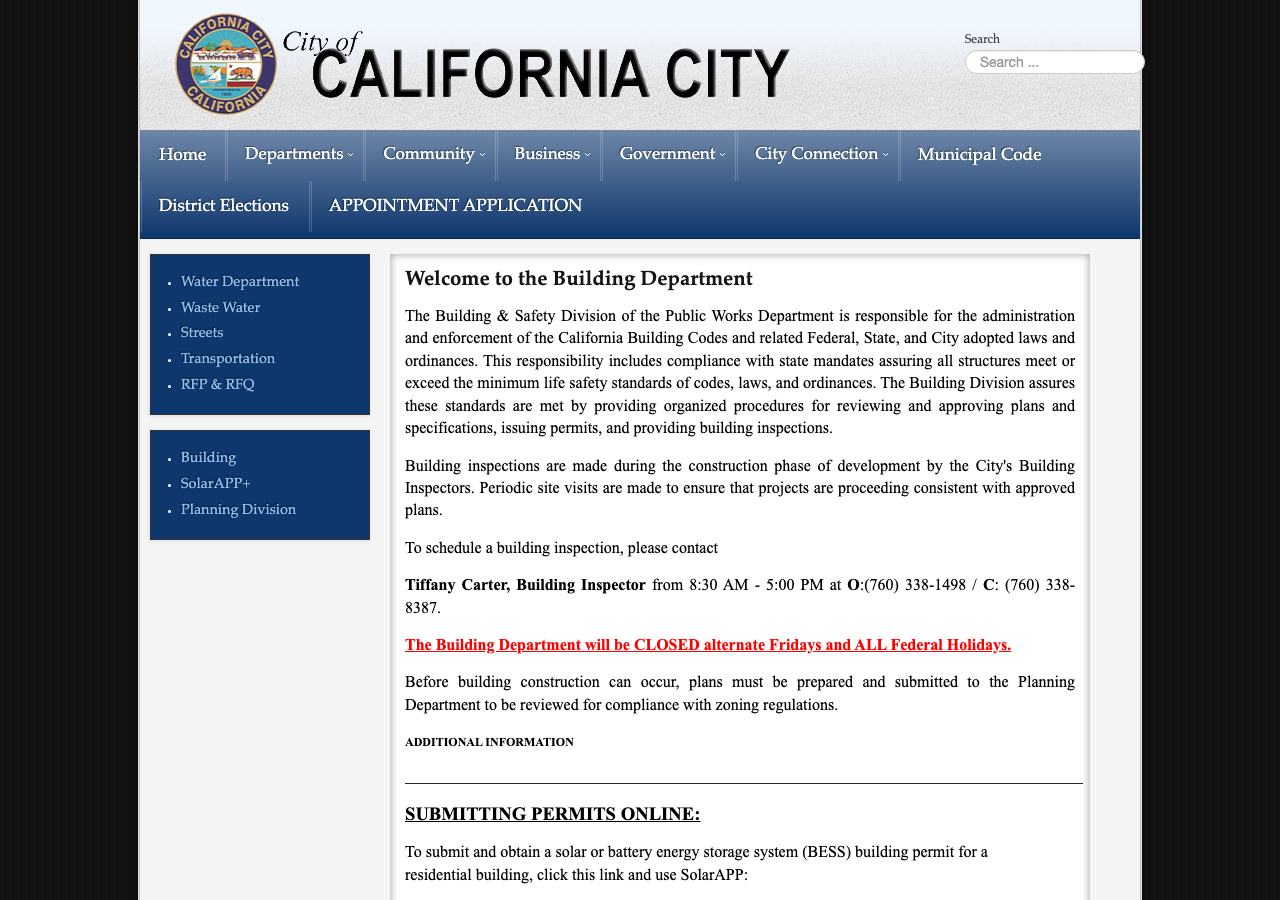
- Is a site plan required, and what must it show? No solar-specific site-plan content is published, but the City's general permitting text states: 'Before building construction can occur, plans must be prepared and submitted to the Planning Department to be reviewed for compliance with zoning regulations' -- implying a site plan showing conformance to setbacks/height/land use is required as part of the standard plan-review step that solar permits also pass through. 55% · department page
-
Apply and pay
Most authorities now take the whole application through a portal, and several states cap or constrain what a residential solar permit may cost. Check whether plan check is billed separately before you quote the job.
- Which permit portal does this authority use? SolarAPP+ (gosolarapp.org) for automated review of residential solar/BESS permits; the City's iworq portal (californiacity.portal.iworq.net) for all other building permit types, including issuance/payment following SolarAPP+ approval. 90% · portal
- Can the whole application be completed online? Yes, for SolarAPP+-eligible systems (automated review through approval); the resulting permit is then issued/paid through the iworq portal. 82% · department page + portal
- What does a residential solar permit cost? No dedicated flat fee for residential solar; the Building Permit fee is calculated per the general schedule: 'Building Permit Fees -- Based on most recent edition of the ICC International Code Council Building Valuation Data 2025 or most current,' plus a Minimum Permit Fee of $65.00 and an Application Fee of $50.00 (Building, electric, mechanical & plumbing combined), plus the state SB 1473 Green Building Standards fee ($1.00 per $25,000 of valuation or portion thereof). No 'solar' or 'photovoltaic' line item appears anywhere in the Master Fee Schedule (control-checked: 'electrical' 9 hits, 'zzqqx' 0 hits). 80% · adopted fee schedule
- How is the fee calculated? Valuation (per ICC Building Valuation Data), plus flat Minimum Permit and Application fees. 78% · adopted fee schedule
- Is there a separate plan-check fee? Yes -- plan review is calculated as a percentage of the building permit fee. 70% · adopted fee schedule
-
Plan review — and start the utility in parallel
Interconnection is a separate process from the permit and usually the longer pole. Where the utility does not depend on the permit being issued, running both at once is the single biggest saving available on a residential job.
- What is the stated plan-review turnaround? Same day for over-the-counter applications, or within 3 business days for electronically filed applications. 95% · municipal code
- How long is an issued permit valid before it expires? No solar-specific or City-wide local amendment to permit-validity/expiration was found; since MMC §8-1.01 adopts the 2019 California Building Code 'without amendments,' the state CBC default expiration rule (work must commence within 180 days of issuance, and the permit becomes invalid if work is suspended/abandoned for 180 days) is inferred to apply. 55% · municipal code (inference)
- Which utility handles interconnection here? Southern California Edison (SCE) 62% · city-approved planning document (EIR/GP distribution list)
28 questions answered against City of California City’s own published documents
Q1 Is this authority the AHJ for residential solar at this address? Core Jurisdiction & scope
Yes
Why the confidence is not higherCity's own Building Department page (self-performed, named staff on the city's own domain) states it administers and enforces the Building Codes and issues building permits; codified MMC Ch. 8-12 'Small Residential Solar Energy Systems Permits' (Ord. No. 15-731, 7-21-2015) confirms the City itself processes residential rooftop solar permits directly. California City is an incorporated city, not unincorporated Kern County territory.
department page + municipal code checked 2026-08-31 https://www.californiacity-ca.gov/CC/index.php/building
Q2 What does this authority permit itself, and what does it delegate? Core Jurisdiction & scope
Both (Building & Electrical, self-performed in-house). The City's own org chart (Community Development page) places Building organizationally under the Community Development Department, while the Building Department's own page describes itself as part of the Public Works Department -- an internal inconsistency in the City's own site, flagged rather than resolved. Fire code adoption/enforcement also appears self-performed by the City's own Fire Department based on FY2025-26 Adopted Budget personnel-level detail, though the City's current (May 2026) Master Fee Schedule states fire fees are 'established, charged, and collected by Kern County Fire' -- an unresolved contradiction between two of the City's own current documents.
Why the confidence is not higherNamed Building staff (Joe Barragan/Building Official, Tiffany Carter/Building Inspector) are on the city's own @californiacity-ca.gov domain with no staffing-firm evidence found; but the Community Development org chart separately lists the Building Official slot as 'OPEN POSITION' -- a staffing-vacancy inconsistency between two current city pages, not delegation. The FY2025-26 Adopted Budget (created 30 Jul 2025) budgets a City-employed 'Fire Suppression' payroll ($1,610,600 regular salaries, plus overtime/retirement/uniforms, totaling $2,763,150) and a 'Fire Code Enforce' payroll ($60,000 salary line, totaling $112,050) in the General Fund for FY2026 -- strong evidence of an in-house fire department, contradicting the Master Fee Schedule's Kern County Fire statement.
department page (internally conflicting) + adopted budget checked 2026-08-31 https://www.californiacity-ca.gov/CC/index.php/departments-1/community-development
Q3 Is a permit required for a residential rooftop PV system? Core Jurisdiction & scope
Yes
Why the confidence is not higherMMC §8-12.03 (Applicability): 'This chapter applies to the permitting of all small residential rooftop solar energy systems in the City.' Confirmed by the City's own SolarAPP+ page instructing applicants to obtain a building permit for residential solar/BESS.
municipal code checked 2026-08-31 https://library.municode.com/ca/california_city/codes/code_of_ordinances?nodeId=COOR_TIT8BURE_CH12SMRESOENSYPE_S8-12.03AP
Q4 Is there a separate electrical permit, or is it combined? Core Jurisdiction & scope
Combined
Why the confidence is not higherMMC §8-12.06(a) directs the Building Department to issue 'a building permit or other nondiscretionary permit' (singular) for a compliant small residential rooftop solar system; the Master Fee Schedule's Building Department Fees section lists a single 'Application Fees $50.00 -- Building, electric, mechanical & plumbing' line rather than separate per-trade application fees.
municipal code + fee schedule checked 2026-08-31 https://library.municode.com/ca/california_city/codes/code_of_ordinances?nodeId=COOR_TIT8BURE_CH12SMRESOENSYPE_S8-12.06EXPEREINRE
Q5 Who is allowed to pull the electrical permit? Core Who may apply
Either
Why the confidence is not higherThe national SolarAPP+ platform (which the City's own SolarAPP+ page directs applicants to for residential solar/BESS) requires the applicant to 'upload a copy of your license' before an application can proceed -- a licensed-contractor gate on that specific path. The codified MMC Ch. 8-12 solar ordinance itself imposes no licensed-contractor-only restriction for the underlying building permit.
department page + national platform requirement checked 2026-08-31 https://www.californiacity-ca.gov/CC/index.php/solarapp-plus
Q6 Must the contractor be registered with this authority before applying? Core Who may apply
No
Why the confidence is not higherNo solar- or contractor-specific city pre-registration step is described on the Building Department or SolarAPP+ pages beyond uploading a California contractor's license to the SolarAPP+ platform itself (not a separate City registration). The City's general Title 3 business-license requirement (MMC §3-2.3.201 et seq.) applies to businesses operating in the City generally, not as a stated gate on pulling a one-time construction permit. Absence-based inference.
department page (absence) checked 2026-08-31 https://www.californiacity-ca.gov/CC/index.php/solarapp-plus
Q7 Is a homeowner permitted to self-install and self-permit? Who may apply
Not explicitly addressed by the City for the standard building-permit path; but the national SolarAPP+ platform the City directs solar/BESS applicants to explicitly EXCLUDES 'Systems installed by Homeowners' from SolarAPP+ eligibility, so a homeowner-installed system could not use that automated path and would need to follow the standard (non-SolarAPP+) building permit process instead, which MMC Ch. 8-12 does not itself bar.
Why the confidence is not higherSolarAPP+'s own public eligibility article (linked from the City's SolarAPP+ page) lists homeowner-installed systems among those 'currently not within the scope of SolarAPP+'; MMC Ch. 8-12 imposes no licensed-contractor-only restriction of its own.
national platform eligibility criteria + municipal code (absence) checked 2026-08-31 https://help.solar-app.org/article/43-what-types-of-systems-are-eligible-for-solarapp-review
Q8 What documents make up a complete submittal? Core Submittal package
For solar/BESS specifically: an application through the national SolarAPP+ platform (gosolarapp.org), which requires uploading a contractor's license and generates an Inspection Checklist, SolarAPP+ ID and job card on approval. For other building permits: an application through the City's iworq portal. No City-published, solar-specific submittal checklist PDF was found; the Building Department's own 'Permit Applications & Forms' page is marked 'under construction' with no solar document listed.
Why the confidence is not higherCity's own Building Department and SolarAPP+ pages, read together; Permit Applications & Forms sub-page confirmed to carry no solar-specific document (checked 'Residential Permit Applications & Forms', 'General Information', and 'Commercial Permits' sub-pages, none solar-specific).
department page + national platform checked 2026-08-31 https://www.californiacity-ca.gov/CC/index.php/solarapp-plus
Q9 How many copies, and in what format? Submittal package
Electronic only -- via the SolarAPP+ platform (solar/BESS) or the City's iworq portal (all other building permits). The Building Department page states 'All permit applications need to be completed online.'
Why the confidence is not higherCity's own Building Department page instructs all applications to be completed online through one of the two named portals; no paper-copy count is published for the solar-specific route.
department page checked 2026-08-31 https://www.californiacity-ca.gov/CC/index.php/building
Q10 Is a site plan required, and what must it show? Core Submittal package
No solar-specific site-plan content is published, but the City's general permitting text states: 'Before building construction can occur, plans must be prepared and submitted to the Planning Department to be reviewed for compliance with zoning regulations' -- implying a site plan showing conformance to setbacks/height/land use is required as part of the standard plan-review step that solar permits also pass through.
Why the confidence is not higherCity's own Building Department page, general submittal-process paragraph; no solar-specific checklist naming site-plan content was found.
department page checked 2026-08-31 https://www.californiacity-ca.gov/CC/index.php/building
Q11 Is a one-line / three-line diagram required? Core Drawings & calculations
Nothing published by this authority.
Where we lookedSolarAPP+ page, Building Department page, and the Building Department's 'Permit Applications & Forms' / 'Residential Permit Applications & Forms' / 'General Information' sub-pages -- none states a one-line/three-line diagram requirement in the City's own words; SolarAPP+'s underlying document set is not published by the City itself and could not be independently confirmed for this jurisdiction.
Q12 Are string and conductor calculations required? Drawings & calculations
Nothing published by this authority.
Where we lookedSame document set as Q11 -- no City-published string/conductor calculation requirement found.
Q13 Is a structural PE stamp required, and at what threshold? Core Engineering & stamps
Nothing published by this authority.
Where we lookedBuilding Department page, SolarAPP+ page, and the City's own 'Residential Design Criteria' handout (which sets governing structural design parameters but does not itself state a PE-stamp trigger) -- no explicit structural PE-stamp threshold was found.
https://www.californiacity-ca.gov/CC/index.php/building/2026-residential-design-criteria/download
Q14 Is an electrical PE stamp required, and at what threshold? Engineering & stamps
Nothing published by this authority.
Where we lookedSame document set as Q13 -- no electrical PE-stamp threshold stated anywhere on the City's site.
Q15 What does a residential solar permit cost? Core Fees
No dedicated flat fee for residential solar; the Building Permit fee is calculated per the general schedule: 'Building Permit Fees -- Based on most recent edition of the ICC International Code Council Building Valuation Data 2025 or most current,' plus a Minimum Permit Fee of $65.00 and an Application Fee of $50.00 (Building, electric, mechanical & plumbing combined), plus the state SB 1473 Green Building Standards fee ($1.00 per $25,000 of valuation or portion thereof). No 'solar' or 'photovoltaic' line item appears anywhere in the Master Fee Schedule (control-checked: 'electrical' 9 hits, 'zzqqx' 0 hits).
Why the confidence is not higherMaster Fee Schedule (approved by City Council Resolution 26-3218, 10 Mar 2026; PDF dated 11 May 2026), Section 3 'Building Department Fees', read directly; the $65/$50 figures are the schedule's own 'REPLACEMENT FEE' column value alongside a struck-through prior figure ($56/$46), interpreted as the current fee since the resolution post-dates the prior figure.
adopted fee schedule checked 2026-08-31 https://www.californiacity-ca.gov/CC/images/Master%20Fee%20Schedule%205-11-26.pdf
Q16 How is the fee calculated? Core Fees
Valuation (per ICC Building Valuation Data), plus flat Minimum Permit and Application fees.
Why the confidence is not higherMaster Fee Schedule, Section 3: 'Building Permit Fees-Based on most recent edition of the ICC International Code Council Building Valuation Data 2025 or most current.' No separate flat, per-kW, per-panel, or tiered solar fee line exists.
adopted fee schedule checked 2026-08-31 https://www.californiacity-ca.gov/CC/images/Master%20Fee%20Schedule%205-11-26.pdf
Q17 Is there a separate plan-check fee? Fees
Yes -- plan review is calculated as a percentage of the building permit fee.
Why the confidence is not higherMaster Fee Schedule, Section 3: 'Unless otherwise noted, plan review fees are based upon 65% of the building permit fee. Review of Masterplan Set Fees will be calculated at 16.75% of the building permit fee,' and a separate 'Plan Check Fee $65.00 per Hour' line appears under Miscellaneous Applications.
adopted fee schedule checked 2026-08-31 https://www.californiacity-ca.gov/CC/images/Master%20Fee%20Schedule%205-11-26.pdf
Q18 What is the stated plan-review turnaround? Core Timeline & validity
Same day for over-the-counter applications, or within 3 business days for electronically filed applications.
Why the confidence is not higherMMC §8-12.06(a): the Building Department 'shall issue a building permit or other non-discretionary permit the same day for over-the-counter applications or within 3 business days for electronically filed applications' for compliant expedited solar applications.
municipal code checked 2026-08-31 https://library.municode.com/ca/california_city/codes/code_of_ordinances?nodeId=COOR_TIT8BURE_CH12SMRESOENSYPE_S8-12.06EXPEREINRE
Q19 How long is an issued permit valid before it expires? Timeline & validity
No solar-specific or City-wide local amendment to permit-validity/expiration was found; since MMC §8-1.01 adopts the 2019 California Building Code 'without amendments,' the state CBC default expiration rule (work must commence within 180 days of issuance, and the permit becomes invalid if work is suspended/abandoned for 180 days) is inferred to apply.
Why the confidence is not higherFull-text review of MMC Title 8, Chapter 1 (Building and Safety Code adoption) -- the chapter consists of a single adopting section with no local amendment to permit-expiration; inferred from the 'without amendments' language and the base CBC's standard rule.
municipal code (inference) checked 2026-08-31 https://library.municode.com/ca/california_city/codes/code_of_ordinances?nodeId=COOR_TIT8BURE_CH1BUSACO_S8-1.01AD
Q20 Which permit portal does this authority use? Core Portal & process
SolarAPP+ (gosolarapp.org) for automated review of residential solar/BESS permits; the City's iworq portal (californiacity.portal.iworq.net) for all other building permit types, including issuance/payment following SolarAPP+ approval.
Why the confidence is not higherCity's own SolarAPP+ page names both platforms explicitly and describes the two-step workflow (SolarAPP+ approval, then payment); the iworq portal URL is also linked from the general Building Department page.
portal checked 2026-08-31 https://www.californiacity-ca.gov/CC/index.php/solarapp-plus
Q21 Can the whole application be completed online? Core Portal & process
Yes, for SolarAPP+-eligible systems (automated review through approval); the resulting permit is then issued/paid through the iworq portal.
Why the confidence is not higherCity's own SolarAPP+ page: 'Submit Solar/Photovoltaic design at SolarAPP+... Once the license has been verified, you will be given access to the application for City of California City... An Inspection Checklist, a SolarAPP+ ID, and job card will be generated when approved,' followed by scheduling inspection directly with City staff.
department page + portal checked 2026-08-31 https://www.californiacity-ca.gov/CC/index.php/solarapp-plus
Q22 Which utility handles interconnection here? Core Utility interconnection
Southern California Edison (SCE)
Why the confidence is not higherNo franchise-ordinance chapter naming an electric utility exists in the City's own Municode (Title 5's only franchise article is for taxis; no electric/gas franchise chapter found in a full Title 5/Title 7 TOC walk). The best City-side evidence found is the City's own 2010 General Plan, whose EIR/document circulation distribution list names 'Mark Gowin, Southern California Edison, 510 So China Lake Blvd, Ridgecrest CA' as a notified reviewing agency -- confirming SCE as a relevant utility contact for the City, though not a direct 'SCE serves California City' sentence. PowerToChoose was not used per instructions.
city-approved planning document (EIR/GP distribution list) checked 2026-08-31 https://www.californiacity-ca.gov/CC/index.php/planning/final-general-plan-2009-2028/download
Q23 Where does the utility sit in the sequence? Core Utility interconnection
Nothing published by this authority.
Where we lookedPG&E's Rule 21 was deliberately NOT substituted for SCE's (a different utility's territory). SCE's own DG/NEM/Rule 21 pages (sce.com/regulatory/tariff-books and related tariff PDF URLs) returned genuine 404s to direct fetch; no City-side document was found stating the utility interconnection sequence.
Q24 Is a HOA or architectural approval required first? Overlays & special cases
No
Why the confidence is not higherMMC §8-12.06(e): 'The City shall not condition the approval of an application on the approval of an association as defined in Civil Code Section 4080.' Explicit codified statement.
municipal code checked 2026-08-31 https://library.municode.com/ca/california_city/codes/code_of_ordinances?nodeId=COOR_TIT8BURE_CH12SMRESOENSYPE_S8-12.06EXPEREINRE
Q25 Is there a historic-district review? Overlays & special cases
No
Why the confidence is not higherWalked the full Zoning chapter's Article list by name via the Municode API TOC (Articles 1 through 29) -- no Historic District, Historic Overlay, or Cultural Heritage district exists anywhere in the City's Zoning Code (Title 9, Ch. 2). Positive control passed: 'setback' returns 17 hits across the fetched article text; fabricated control 'zzqqx' returns 0 hits.
zoning ordinance (control-proven absence) checked 2026-08-31 https://library.municode.com/ca/california_city/codes/code_of_ordinances?nodeId=COOR_TIT9LAUSDE_CH2ZO_ART2REALZODI_S9-2.202HEFLSIST
Q26 Is a wind or windstorm certification required? Overlays & special cases
No separate wind/windstorm certification is required as a stated submittal item, but the City's own current 'Residential Design Criteria' handout -- which explicitly 'replaces Table R301.2 in Chapter 3 of the 2025 CRC' -- sets a governing Ultimate Design Wind Speed of 130 mph (Risk Category II), Exposure C, with Topographic Effects and Special Wind Region both flagged 'Yes' and a Windborne Debris Zone flagged 'Yes.' Any structural design, including solar racking, is implicitly judged against this table rather than a separate certification document.
Why the confidence is not higherCity of California City Building Department 'Design Criteria for Residential Structures' handout (internally stamped 'SW 6-6-23'; PDF file itself created 23 Oct 2025), read directly, cross-checked against the Building/SolarAPP+ pages and MMC Ch. 8-12 for a separate wind-certification requirement (none found).
published design-criteria handout checked 2026-08-31 https://www.californiacity-ca.gov/CC/index.php/building/2026-residential-design-criteria/download
Q27 Is a Specific Use Permit or Council approval ever required? Overlays & special cases
Not for a standard-conforming small residential rooftop system. MMC §8-12.06(a) allows the Building Official to require a use permit only if the official finds, based on substantial evidence, that the solar system 'could have a specific, adverse impact upon the public health and safety,' appealable per MMC §§2.64.170-.190. No Zoning Code permitted-uses table requires a CUP for ordinary residential rooftop PV.
Why the confidence is not higherMMC §8-12.06(a), read directly; cross-checked against the R1-R5 residential district 'Permitted Uses' sections, none of which mention solar.
municipal code checked 2026-08-31 https://library.municode.com/ca/california_city/codes/code_of_ordinances?nodeId=COOR_TIT8BURE_CH12SMRESOENSYPE_S8-12.06EXPEREINRE
Q28 Is there a system-size cap on residential generation? Overlays & special cases
Two uncoordinated figures: (1) the codified small-residential-rooftop-solar ordinance (MMC §8-12.02(l)) caps eligibility at 10 kilowatts AC nameplate rating or 30 kilowatts thermal, scoped to a single or duplex family dwelling; (2) the national SolarAPP+ platform the City directs solar/BESS applicants to gates its own automated review at systems <=38.4 kW AC (with service <=400A and busbar/disconnect <=225A) -- a platform-level technical eligibility ceiling, not a City ordinance. No separate zoning-use-table entry for solar generation was found in any residential or agricultural district (the RA District's own 'Permitted Uses' section, read in full, contains no solar entry).
Why the confidence is not higherMMC §8-12.02(l) and the SolarAPP+ national eligibility article (linked from the City's own SolarAPP+ page), read directly; RA District use table (MMC §9-2.401) checked line by line for a separate solar entry (as found in a neighbouring Kern County city's Agricultural district) -- none exists here.
municipal code + national platform eligibility criteria checked 2026-08-31 https://library.municode.com/ca/california_city/codes/code_of_ordinances?nodeId=COOR_TIT8BURE_CH12SMRESOENSYPE_S8-12.02DE
Lines marked with a percentage were read off this authority’s own published documents. Unmarked guidance is general good practice, not this jurisdiction’s rule — always confirm against the authority before you submit.
Install 5 steps · 20 questions
-
Build to the code editions actually in force here
The NEC edition a jurisdiction enforces is often a cycle behind the newest one published, and local amendments sit on top of it. Rapid shutdown, conductor sizing and labelling all change between editions, so the edition in force is the first thing to establish, not the last.
- Which NEC edition is in force? Codified: 2017 NEC (via the 2019 California Electrical Code, part of the 2019 Title 24 cycle adopted 'in all 12 parts... without amendments,' effective 1 Jan 2020, per MMC §8-1.01). But the City's own live SolarAPP+ page states solar/BESS review is checked against 'the 2025 California Building Code,' and the City's own current-dated 'Residential Design Criteria' handout is expressly written to replace a table in the '2025 CRC' -- both indicating the City's practical, current-day code cycle is 2025 (2023 NEC), a genuine gap against the still-2019-worded codified adoption section, which has not been re-amended since 2020. 78% · adopting ordinance (codified-vs-live lag)
- Which building code edition is in force? Codified: 2019 California Building Code and 2019 California Residential Code (2019 Title 24, all 12 parts, adopted 'without amendments,' MMC §8-1.01, Ord. No. 20-778, eff. 1 Jan 2020). Same lag as Q29 applies: the City's live SolarAPP+ page and current Residential Design Criteria handout both reference the 2025 cycle in practice. 80% · adopting ordinance
- Which fire code edition is in force? Not fixed to a specific year in the codified text: MMC §4-1.101 (Fire Prevention chapter, Title 4) adopts 'the Code designated as the "Fire Code," latest Edition, as recommended and adopted by the most recent Code adopted by the California Building Standards Commission' -- a self-updating, floating reference rather than a fixed edition. This differs structurally from the Building Code chapter (MMC §8-1.01), which names a fixed '2019' edition and has not been re-amended since 2020. Read literally, the Fire Code in force today would be whatever the CBSC's most recent adopted edition is (currently the 2025 CFC cycle), even though the parallel Building Code chapter is textually frozen at 2019. 80% · adopting ordinance
- Are there local amendments to any of the above? No local amendments to the base codes were found. MMC §8-1.01 states the City adopts the 2019 Title 24 codes 'without amendments.' The solar-specific provisions live in a separate chapter (MMC Ch. 8-12) rather than as an amendment to the base code text, and no PV-specific local amendment to the Building, Residential, Electrical, or Fire Code was found anywhere in Title 8 or Title 4. 85% · municipal code
- What is the installation judged against? The 2019 CBC/CRC/CEC/CFC (Title 24, all 12 parts, no local amendments, per MMC §8-1.01), plus MMC Ch. 8-12 (Small Residential Solar Energy Systems Permits), which requires solar-electric systems to 'meet all applicable safety and performance standards established by the California Electrical Code, the Institute of Electrical and Electronics Engineers, and accredited testing laboratories such as Underwriters Laboratories' (§8-12.04(c)). In current practice, per the City's own SolarAPP+ page and Residential Design Criteria handout, review is actually performed against the 2025-cycle codes. 82% · municipal code + published handout
-
Fire access, setbacks and pathways
Ridge setbacks and roof access pathways are fire-service requirements and they constrain the array layout. They are the most common cause of a redesign after the fire department comments on a plan set.
Nothing recorded for City of California City on this step yet — 1 question checked and found unpublished. The guidance above is general.
-
Rapid shutdown
Which rapid-shutdown rule applies follows directly from the NEC edition in force, and the initiation device has to be at a location the fire service can reach and identify. This is inspected, and it is labelled.
- Is rapid shutdown required, and to which NEC edition? Required by operation of the currently-adopted electrical code (whichever edition is in force, per Q29's codified-vs-live gap), since every California-adopted electrical code from the 2014 NEC onward incorporates §690.12 rapid shutdown -- but no California City document itself states this. A corpus-wide search of every City solar/building document (MMC Ch. 8-12, the SolarAPP+ page, the Building page, the Residential Design Criteria handout) returns zero hits for '690.12' or 'rapid shutdown' (positive control 'electrical' passed with multiple hits in the same documents; fabricated control 'zzqqx' returned zero). 62% · municipal code (inference) + control-proven absence of local statement
-
Labels and placards
The NEC sets a baseline for permanent markings at the service equipment and the disconnecting means. On top of that, an authority may specify its own wording, and the utility may specify more again. Where any of them writes its own text, a generic off-the-shelf label set will not pass — this is the detail most often fixed on a return visit.
Nothing recorded for City of California City on this step yet — 6 questions checked and found unpublished. The guidance above is general.
-
Disconnect, storage and listed equipment
Where the AC disconnect must sit relative to the meter is usually the utility's rule, not the building department's. Battery storage frequently carries its own permit, its own inspection and its own fire conditions.
- Must equipment be on a specific approved list? Yes -- solar electric systems must meet standards set by the California Electrical Code, IEEE, and accredited testing laboratories such as Underwriters Laboratories, and (for water heating) must be certified by an accredited listing agency under the California Plumbing and Mechanical Code. 88% · municipal code
- Are batteries permitted, and under what conditions? Yes -- the City's own SolarAPP+ page states applicants can 'submit and obtain a solar or battery energy storage system (BESS) building permit for a residential building' through SolarAPP+. Conditions follow the national SolarAPP+ platform's own eligibility gate: individual battery units <=20 kWh, with an 80 kWh aggregate ESS capacity cap depending on installed location. MMC Ch. 8-12 itself, however, is textually scoped only to 'solar energy system' and does not separately define or address batteries/ESS. 78% · department page + national platform eligibility criteria
- Is there a separate ESS permit or inspection? No separate ESS-specific permit or inspection process is described; the City's own SolarAPP+ page treats solar and BESS as a single combined permit ('a solar or battery energy storage system (BESS) building permit'), issued and inspected through the same process as rooftop PV. 60% · department page (absence of a separate process)
- Is a ground mount treated as a structure? Yes (inferred). No Zoning Code provision addresses ground-mounted solar specifically (control-checked: zero 'solar'/'photovoltaic' hits anywhere in the Zoning Code's 29 articles outside two industrial-district manufacturing-use classifications and a Tiny-Home-overlay utility-connection clause), and the national SolarAPP+ platform explicitly excludes ground-mounted systems from its own eligibility. By default, a ground-mounted array would fall under the Zoning Code's general Accessory Buildings rule: max. 17.5 ft height (15 ft in RM1/RM2), set back not less than 60% of lot depth (or 90 ft, whichever is less) from the front property line. 55% · zoning ordinance (inference) + national platform eligibility criteria
- Is there a local rule on service upgrades or busbar sizing? No City-codified busbar-sizing or service-upgrade ordinance was found (a full read of MMC Title 8 Ch. 1 turned up zero mentions of 'busbar,' '225A,' or '400A'). The 225A busbar/disconnect and 400A service figures that do appear are the national SolarAPP+ platform's own eligibility gate for its automated review path (systems with service >400A or busbar/disconnect >225A simply cannot use SolarAPP+), not a California City local rule. 60% · national platform eligibility criteria (absence locally)
20 questions answered against City of California City’s own published documents
Q29 Which NEC edition is in force? Core Code editions in force
Codified: 2017 NEC (via the 2019 California Electrical Code, part of the 2019 Title 24 cycle adopted 'in all 12 parts... without amendments,' effective 1 Jan 2020, per MMC §8-1.01). But the City's own live SolarAPP+ page states solar/BESS review is checked against 'the 2025 California Building Code,' and the City's own current-dated 'Residential Design Criteria' handout is expressly written to replace a table in the '2025 CRC' -- both indicating the City's practical, current-day code cycle is 2025 (2023 NEC), a genuine gap against the still-2019-worded codified adoption section, which has not been re-amended since 2020.
Why the confidence is not higherMMC §8-1.01, read directly from Municode (last touched by Ord. No. 20-778, 14 Jan 2020, per the codification's own history); cross-checked against the SolarAPP+ page's '2025 California Building Code' language and the Residential Design Criteria handout's '2025 CRC' reference.
adopting ordinance (codified-vs-live lag) checked 2026-08-31 https://library.municode.com/ca/california_city/codes/code_of_ordinances?nodeId=COOR_TIT8BURE_CH1BUSACO_S8-1.01AD
Q30 Which building code edition is in force? Core Code editions in force
Codified: 2019 California Building Code and 2019 California Residential Code (2019 Title 24, all 12 parts, adopted 'without amendments,' MMC §8-1.01, Ord. No. 20-778, eff. 1 Jan 2020). Same lag as Q29 applies: the City's live SolarAPP+ page and current Residential Design Criteria handout both reference the 2025 cycle in practice.
Why the confidence is not higherMMC §8-1.01, read directly from Municode.
adopting ordinance checked 2026-08-31 https://library.municode.com/ca/california_city/codes/code_of_ordinances?nodeId=COOR_TIT8BURE_CH1BUSACO_S8-1.01AD
Q31 Which fire code edition is in force? Code editions in force
Not fixed to a specific year in the codified text: MMC §4-1.101 (Fire Prevention chapter, Title 4) adopts 'the Code designated as the "Fire Code," latest Edition, as recommended and adopted by the most recent Code adopted by the California Building Standards Commission' -- a self-updating, floating reference rather than a fixed edition. This differs structurally from the Building Code chapter (MMC §8-1.01), which names a fixed '2019' edition and has not been re-amended since 2020. Read literally, the Fire Code in force today would be whatever the CBSC's most recent adopted edition is (currently the 2025 CFC cycle), even though the parallel Building Code chapter is textually frozen at 2019.
Why the confidence is not higherMMC §4-1.101, read directly from Municode; contrasted against MMC §8-1.01's fixed-year language.
adopting ordinance checked 2026-08-31 https://library.municode.com/ca/california_city/codes/code_of_ordinances?nodeId=COOR_TIT4PUSA_CH1FIPR_ART1FICO_S4-1.101ADFICO
Q32 Are there local amendments to any of the above? Core Code editions in force
No local amendments to the base codes were found. MMC §8-1.01 states the City adopts the 2019 Title 24 codes 'without amendments.' The solar-specific provisions live in a separate chapter (MMC Ch. 8-12) rather than as an amendment to the base code text, and no PV-specific local amendment to the Building, Residential, Electrical, or Fire Code was found anywhere in Title 8 or Title 4.
Why the confidence is not higherMMC §8-1.01 explicit 'without amendments' language, cross-checked against a full read of Title 8 (Building Regulations) and Title 4 Chapter 1 (Fire Prevention) -- neither contains a PV-specific or general technical amendment to the adopted codes.
municipal code checked 2026-08-31 https://library.municode.com/ca/california_city/codes/code_of_ordinances?nodeId=COOR_TIT8BURE_CH1BUSACO_S8-1.01AD
Q33 What is the installation judged against? Core Electrical
The 2019 CBC/CRC/CEC/CFC (Title 24, all 12 parts, no local amendments, per MMC §8-1.01), plus MMC Ch. 8-12 (Small Residential Solar Energy Systems Permits), which requires solar-electric systems to 'meet all applicable safety and performance standards established by the California Electrical Code, the Institute of Electrical and Electronics Engineers, and accredited testing laboratories such as Underwriters Laboratories' (§8-12.04(c)). In current practice, per the City's own SolarAPP+ page and Residential Design Criteria handout, review is actually performed against the 2025-cycle codes.
Why the confidence is not higherCombines MMC §8-1.01, MMC §8-12.04, and the SolarAPP+/Design Criteria documents.
municipal code + published handout checked 2026-08-31 https://library.municode.com/ca/california_city/codes/code_of_ordinances?nodeId=COOR_TIT8BURE_CH12SMRESOENSYPE_S8-12.04SOENSYRE
Q34 Is there a local rule on service upgrades or busbar sizing? Electrical
No City-codified busbar-sizing or service-upgrade ordinance was found (a full read of MMC Title 8 Ch. 1 turned up zero mentions of 'busbar,' '225A,' or '400A'). The 225A busbar/disconnect and 400A service figures that do appear are the national SolarAPP+ platform's own eligibility gate for its automated review path (systems with service >400A or busbar/disconnect >225A simply cannot use SolarAPP+), not a California City local rule.
Why the confidence is not higherFull-text search of MMC Title 8 (zero hits, control-checked: 'electrical' appears repeatedly elsewhere in the same title); SolarAPP+ national eligibility article confirms the 225A/400A figures as platform criteria.
national platform eligibility criteria (absence locally) checked 2026-08-31 https://help.solar-app.org/article/43-what-types-of-systems-are-eligible-for-solarapp-review
Q35 Is a specific mounting system or attachment spacing required? Structural & mounting
Nothing published by this authority.
Where we lookedMMC Title 8 (Building Regulations) in full, the Building Department page, and the 'Residential Design Criteria' handout -- none states a specific mounting-system or attachment-spacing requirement for solar; unlike some neighbouring Kern County cities, California City has not published an equivalent 'PV Toolkit'-style structural-criteria worksheet.
Q36 What ridge setback and access pathways are required? Core Fire pathways & setbacks
Nothing published by this authority.
Where we lookedMMC Title 4, Chapter 1 (Fire Prevention) in full -- contains no ridge-setback, roof-pathway, or PV-specific fire-access provision at all (control-checked: the chapter discusses burning, fireworks and hydrants, with zero PV/solar mentions); no separate City fire handout addressing PV roof pathways was found.
Q37 Is rapid shutdown required, and to which NEC edition? Core Rapid shutdown
Required by operation of the currently-adopted electrical code (whichever edition is in force, per Q29's codified-vs-live gap), since every California-adopted electrical code from the 2014 NEC onward incorporates §690.12 rapid shutdown -- but no California City document itself states this. A corpus-wide search of every City solar/building document (MMC Ch. 8-12, the SolarAPP+ page, the Building page, the Residential Design Criteria handout) returns zero hits for '690.12' or 'rapid shutdown' (positive control 'electrical' passed with multiple hits in the same documents; fabricated control 'zzqqx' returned zero).
Why the confidence is not higherCorpus-wide grep across all extracted City documents (zero hits for 'rapid shutdown'/'690.12'); MMC §8-1.01 codifies an electrical code edition that, by its own terms, includes §690.12.
municipal code (inference) + control-proven absence of local statement checked 2026-08-31 https://library.municode.com/ca/california_city/codes/code_of_ordinances?nodeId=COOR_TIT8BURE_CH1BUSACO_S8-1.01AD
Q38 Which placards does this authority require at the service equipment? Core Labels Signage & labelling
Nothing published by this authority.
Where we lookedMMC Title 8, MMC Title 4 Ch.1, the Building Department page, SolarAPP+ page, Residential Design Criteria handout, and the Standard Construction Details PDF (170 pages, OCR-clean text layer) -- none names a required placard/label set. Full-corpus search for 'solar'/'photovoltaic' across every fetched City document returns hits only inside MMC Ch. 8-12 (definitions) and two Zoning-Code manufacturing-use-classification entries (SIC 368); zero signage-specific hits anywhere (positive control 'electrical' passed in the same corpus; fabricated control 'zzqqx' returned zero).
Q39 Does the authority specify placard wording of its own? Core Labels Signage & labelling
Nothing published by this authority.
Where we lookedSame corpus as Q38 -- no City-specified placard wording found.
Q40 Does it specify letter height, colour or material? Core Labels Signage & labelling
Nothing published by this authority.
Where we lookedSame corpus as Q38 -- no letter-height, colour, or material specification found.
Q41 Is a site plan / facility map placard required, and what must it show? Core Labels Signage & labelling
Nothing published by this authority.
Where we lookedSame corpus as Q38 -- no facility-map/site-plan placard requirement found.
Q42 Does the UTILITY specify placards beyond the AHJ's? Core Labels Signage & labelling
Nothing published by this authority.
Where we lookedSCE's own DG/interconnection pages returned genuine 404s to direct fetch (see Q23); no City-side document states a utility-specific placard requirement.
Q43 Where must the labels be placed? Core Labels Signage & labelling
Nothing published by this authority.
Where we lookedSame corpus as Q38 -- no label-placement instructions found anywhere in the City's own documents.
Q44 Must equipment be on a specific approved list? Equipment listing
Yes -- solar electric systems must meet standards set by the California Electrical Code, IEEE, and accredited testing laboratories such as Underwriters Laboratories, and (for water heating) must be certified by an accredited listing agency under the California Plumbing and Mechanical Code.
Why the confidence is not higherMMC §8-12.04(b)-(c), read directly from Municode: an explicit codified equipment-standards/listing requirement, not merely a generic safety clause.
municipal code checked 2026-08-31 https://library.municode.com/ca/california_city/codes/code_of_ordinances?nodeId=COOR_TIT8BURE_CH12SMRESOENSYPE_S8-12.04SOENSYRE
Q45 Are batteries permitted, and under what conditions? Core Battery / ESS
Yes -- the City's own SolarAPP+ page states applicants can 'submit and obtain a solar or battery energy storage system (BESS) building permit for a residential building' through SolarAPP+. Conditions follow the national SolarAPP+ platform's own eligibility gate: individual battery units <=20 kWh, with an 80 kWh aggregate ESS capacity cap depending on installed location. MMC Ch. 8-12 itself, however, is textually scoped only to 'solar energy system' and does not separately define or address batteries/ESS.
Why the confidence is not higherCity's own SolarAPP+ page (explicit BESS mention) plus the SolarAPP+ national eligibility article's battery-specific criteria; MMC Ch. 8-12 checked in full and contains zero mentions of 'battery' or 'energy storage' (control-checked).
department page + national platform eligibility criteria checked 2026-08-31 https://www.californiacity-ca.gov/CC/index.php/solarapp-plus
Q46 Is there a separate ESS permit or inspection? Battery / ESS
No separate ESS-specific permit or inspection process is described; the City's own SolarAPP+ page treats solar and BESS as a single combined permit ('a solar or battery energy storage system (BESS) building permit'), issued and inspected through the same process as rooftop PV.
Why the confidence is not higherCity's own SolarAPP+ page wording; no ESS-specific fee line, permit type, or inspection stage was found anywhere on the City's site or in the Master Fee Schedule (control-checked: zero hits for 'battery'/'BESS'/'energy storage').
department page (absence of a separate process) checked 2026-08-31 https://www.californiacity-ca.gov/CC/index.php/solarapp-plus
Q47 Is a ground mount treated as a structure? Core Ground mount
Yes (inferred). No Zoning Code provision addresses ground-mounted solar specifically (control-checked: zero 'solar'/'photovoltaic' hits anywhere in the Zoning Code's 29 articles outside two industrial-district manufacturing-use classifications and a Tiny-Home-overlay utility-connection clause), and the national SolarAPP+ platform explicitly excludes ground-mounted systems from its own eligibility. By default, a ground-mounted array would fall under the Zoning Code's general Accessory Buildings rule: max. 17.5 ft height (15 ft in RM1/RM2), set back not less than 60% of lot depth (or 90 ft, whichever is less) from the front property line.
Why the confidence is not higherFull-text, control-proven search of the Zoning Code (positive control 'setback' 17 hits, fabricated 'zzqqx' 0 hits); MMC §9-2.304 (Accessory Buildings) read directly; SolarAPP+ national eligibility article confirms ground-mount exclusion from that platform.
zoning ordinance (inference) + national platform eligibility criteria checked 2026-08-31 https://library.municode.com/ca/california_city/codes/code_of_ordinances?nodeId=COOR_TIT9LAUSDE_CH2ZO_ART3GEREALREDI_S9-2.304ACBU
Q48 Where must the AC disconnect be, relative to the meter? Core Utility equipment
Nothing published by this authority.
Where we lookedSCE's own DG/Rule 21 documentation returned genuine 404s to direct fetch (see Q23); no City-side document states an AC-disconnect placement dimension relative to the meter.
Lines marked with a percentage were read off this authority’s own published documents. Unmarked guidance is general good practice, not this jurisdiction’s rule — always confirm against the authority before you submit.
Inspection 5 steps · 14 questions
-
Book it
Booking is a portal, a phone call or an email depending on the authority, and the notice required is rarely zero. Book before the work is finished rather than after — the lead time, not the work, is usually what sets the date.
- How is an inspection booked? Phone 88% · department page
- How much notice is required? Within 2 business days of the request. 90% · municipal code
- Are same-day or AM/PM windows offered? Yes -- a two-hour inspection window is provided (not stated as a fixed AM/PM slot, but a narrow 2-hour window). 88% · municipal code
-
Know who turns up
Some authorities inspect their own solar work; some delegate it, and a few do not inspect the PV equipment itself at all. Who is coming determines what they will look at.
- Does this AHJ perform its own final solar inspection? Yes 95% · municipal code
- If delegated, to whom? Not delegated -- performed in-house by the City's own Building Department per MMC §8-12.06(g). No fire-agency role in a typical residential solar inspection was found: the Fire Prevention chapter (Title 4, Ch. 1) contains no PV/solar provision at all. 85% · municipal code
-
Work the stages in order
A rough-in or mid-roof inspection, where one is required, has to happen before the work it covers is closed up. Missing a stage means opening something back up, and it is the most expensive kind of correction.
- Which inspections are required, and in what order? One inspection for expedited-eligible small residential rooftop solar systems (MMC §8-12.06(g)); if the system fails that inspection, 'a subsequent inspection is authorized but need not conform to the requirements of this chapter' (§8-12.06(i)), reverting to the standard re-inspection process. 88% · municipal code
- Is a rough-in or mid-roof inspection required? No 82% · municipal code
-
Have the paperwork on site
The approved plan set, the permit, and the equipment listings should be on site and reachable. Inspectors routinely verify that installed equipment matches what was approved, and that the labels are the ones the plan set promised.
- Is there a published inspection checklist? No published inspection checklist was found. The Building Department's own 'Permit Applications & Forms' and 'Standard Construction Details' pages are the only document hubs on the site and neither lists a solar-specific inspection checklist; the codified ordinance (MMC Ch. 8-12) itself functions as the only public standard. 60% · department page (absence)
- Does the inspector verify labels and listings? Yes (inferred). No City document explicitly states the inspector verifies labels/listings, but MMC §8-12.04(c) requires solar-electric equipment to meet CEC/UL/IEEE listing standards, which would be meaningless without field verification at the single mandated inspection. 50% · municipal code (inference)
-
Sign-off, and permission to operate
Passing gives you a final or an equivalent sign-off. That is not the same as permission to operate: PTO comes from the utility, and who tells the utility the inspection passed varies. A system left switched off for weeks is usually waiting on this handover.
- Is there a re-inspection fee? $150.00 82% · adopted fee schedule
- How are corrections issued and cleared? If an application is deemed incomplete, the Building Department sends a written correction notice detailing all deficiencies for resubmission (MMC §8-12.06(f)). If the installed system fails inspection, a subsequent inspection is authorized (§8-12.06(i)), which may incur the re-inspection fee (Q59) if it is a repeat inspection. 82% · municipal code + fee schedule
14 questions answered against City of California City’s own published documents
Q49 How is an inspection booked? Core Booking & scheduling
Phone
Why the confidence is not higherCity's own SolarAPP+ page, Step 2: 'Schedule Your Inspection -- Contact, Tiffany Carter at (760)338-8387.' The Building Department page similarly lists direct phone contact for scheduling.
department page checked 2026-08-31 https://www.californiacity-ca.gov/CC/index.php/solarapp-plus
Q50 How much notice is required? Core Booking & scheduling
Within 2 business days of the request.
Why the confidence is not higherMMC §8-12.06(h): 'An inspection will be scheduled within two business days of a request and will provide the applicant with a two-hour inspection window.'
municipal code checked 2026-08-31 https://library.municode.com/ca/california_city/codes/code_of_ordinances?nodeId=COOR_TIT8BURE_CH12SMRESOENSYPE_S8-12.06EXPEREINRE
Q51 Are same-day or AM/PM windows offered? Booking & scheduling
Yes -- a two-hour inspection window is provided (not stated as a fixed AM/PM slot, but a narrow 2-hour window).
Why the confidence is not higherMMC §8-12.06(h): '...will provide the applicant with a two-hour inspection window.'
municipal code checked 2026-08-31 https://library.municode.com/ca/california_city/codes/code_of_ordinances?nodeId=COOR_TIT8BURE_CH12SMRESOENSYPE_S8-12.06EXPEREINRE
Q52 Does this AHJ perform its own final solar inspection? Core Who inspects
Yes
Why the confidence is not higherMMC §8-12.06(g): 'Only one (1) inspection shall be required and performed by the Building Department for small residential rooftop solar energy systems eligible for expedited review.'
municipal code checked 2026-08-31 https://library.municode.com/ca/california_city/codes/code_of_ordinances?nodeId=COOR_TIT8BURE_CH12SMRESOENSYPE_S8-12.06EXPEREINRE
Q53 If delegated, to whom? Core Who inspects
Not delegated -- performed in-house by the City's own Building Department per MMC §8-12.06(g). No fire-agency role in a typical residential solar inspection was found: the Fire Prevention chapter (Title 4, Ch. 1) contains no PV/solar provision at all.
Why the confidence is not higherMMC §8-12.06(g), cross-checked against the Fire Prevention chapter's control-proven absence of any solar content.
municipal code checked 2026-08-31 https://library.municode.com/ca/california_city/codes/code_of_ordinances?nodeId=COOR_TIT8BURE_CH12SMRESOENSYPE_S8-12.06EXPEREINRE
Q54 Which inspections are required, and in what order? Core Stages & sequence
One inspection for expedited-eligible small residential rooftop solar systems (MMC §8-12.06(g)); if the system fails that inspection, 'a subsequent inspection is authorized but need not conform to the requirements of this chapter' (§8-12.06(i)), reverting to the standard re-inspection process.
Why the confidence is not higherMMC §8-12.06(g) and (i), read directly from Municode.
municipal code checked 2026-08-31 https://library.municode.com/ca/california_city/codes/code_of_ordinances?nodeId=COOR_TIT8BURE_CH12SMRESOENSYPE_S8-12.06EXPEREINRE
Q55 Is a rough-in or mid-roof inspection required? Stages & sequence
No
Why the confidence is not higherMMC §8-12.06(g) limits expedited-eligible systems to a single required inspection; no rough-in or mid-roof stage is described anywhere in MMC Ch. 8-12.
municipal code checked 2026-08-31 https://library.municode.com/ca/california_city/codes/code_of_ordinances?nodeId=COOR_TIT8BURE_CH12SMRESOENSYPE_S8-12.06EXPEREINRE
Q56 Does the inspector verify labels and listings? Core What is checked
Yes (inferred). No City document explicitly states the inspector verifies labels/listings, but MMC §8-12.04(c) requires solar-electric equipment to meet CEC/UL/IEEE listing standards, which would be meaningless without field verification at the single mandated inspection.
Why the confidence is not higherInference from MMC §8-12.04(c)'s equipment-listing requirement combined with §8-12.06(g)'s single-inspection mandate; no explicit inspector-checklist language found.
municipal code (inference) checked 2026-08-31 https://library.municode.com/ca/california_city/codes/code_of_ordinances?nodeId=COOR_TIT8BURE_CH12SMRESOENSYPE_S8-12.04SOENSYRE
Q57 Is there a published inspection checklist? Core What is checked
No published inspection checklist was found. The Building Department's own 'Permit Applications & Forms' and 'Standard Construction Details' pages are the only document hubs on the site and neither lists a solar-specific inspection checklist; the codified ordinance (MMC Ch. 8-12) itself functions as the only public standard.
Why the confidence is not higherChecked the Building Department page, its 'Permit Applications & Forms', 'Residential Permit Applications & Forms', 'Commercial Permits', 'General Information', and 'Standard Construction Details' sub-pages -- none links a solar-specific inspection checklist (the 'Standard Construction Details' document is a 2017 public-works engineering-standards set with zero solar content, control-checked).
department page (absence) checked 2026-08-31 https://www.californiacity-ca.gov/CC/index.php/building/permit-applications-forms
Q58 What must be on site at inspection? Core Documents on site
Nothing published by this authority.
Where we lookedBuilding Department page, SolarAPP+ page, and MMC Ch. 8-12 -- none states what must physically be on site at the inspection (approved plans, permit card, etc.) for a solar job specifically.
Q59 Is there a re-inspection fee? Corrections & re-inspection
$150.00
Why the confidence is not higherMaster Fee Schedule, Section 3 (Building Department Fees): 'Re-Inspection Fees $70.00 $150.00' -- the second (replacement) figure is the current fee under the schedule approved by City Council Resolution 26-3218 (10 Mar 2026, effective 11 May 2026).
adopted fee schedule checked 2026-08-31 https://www.californiacity-ca.gov/CC/images/Master%20Fee%20Schedule%205-11-26.pdf
Q60 How are corrections issued and cleared? Corrections & re-inspection
If an application is deemed incomplete, the Building Department sends a written correction notice detailing all deficiencies for resubmission (MMC §8-12.06(f)). If the installed system fails inspection, a subsequent inspection is authorized (§8-12.06(i)), which may incur the re-inspection fee (Q59) if it is a repeat inspection.
Why the confidence is not higherMMC §8-12.06(f) and (i), combined with the Master Fee Schedule's re-inspection fee line.
municipal code + fee schedule checked 2026-08-31 https://library.municode.com/ca/california_city/codes/code_of_ordinances?nodeId=COOR_TIT8BURE_CH12SMRESOENSYPE_S8-12.06EXPEREINRE
Q61 What is issued on pass? Core Final sign-off & PTO
Nothing published by this authority.
Where we lookedBuilding Department page, SolarAPP+ page, and MMC Ch. 8-12 -- none names the specific artifact issued on a passed final inspection (no 'Certificate of Occupancy,' 'Final,' or 'green tag' terminology found anywhere on the City's site for solar specifically).
Q62 Who notifies the utility for PTO? Core Final sign-off & PTO
Nothing published by this authority.
Where we lookedSCE's own interconnection/PTO process pages returned genuine 404s to direct fetch (see Q23); no City-side document was found addressing who notifies the utility for PTO.
Lines marked with a percentage were read off this authority’s own published documents. Unmarked guidance is general good practice, not this jurisdiction’s rule — always confirm against the authority before you submit.
Jurisdiction & key facts
The standing 62-question set, answered for City of California City against this authority’s own published documents. Every answer carries the confidence it was recorded at and the document it came from. Where nothing is published we say so and show where we looked — a blank here is a finding, not a gap.
City of California City is the authority having jurisdiction 80% confidence
- Holds
- Building and Electrical, self-performed in-house by the City's own Building Department (named staff Joe Barragan/Building Official and Tiffany Carter/Building Inspector on the city's own @californiacity-ca.gov domain, no staffing-firm evidence found against Willdan/CSG/4LEAF/Transtech/Interwest/EsGil/Bureau Veritas/Charles Abbott/BPR/Phillips Seabrook). Organizationally, the City's own Community Development org-chart page places Building under the Community Development Department, while the Building Department's own page describes itself as sitting under the Public Works Department -- a genuine internal inconsistency in the City's own site (the brief's assumption should be checked against BOTH). Fire code adoption is self-standing (MMC Title 4, Ch. 1, floating reference to 'the most recent Code adopted by the California Building Standards Commission,' enforced by 'the Fire Chief, or designee' per MMC §4-1.103) -- NOT delegated to Kern County Fire Department, a departure from the pattern confirmed for the neighbouring Kern County cities of Shafter, Arvin, Wasco and Ridgecrest. This is best evidenced by the City's own FY2025-26 Adopted Budget, which budgets a City-employed 'Fire Suppression' function (Regular Salaries $1,610,600 plus overtime, PERS retirement, cafeteria plan and uniforms, totaling $2,763,150) and a 'Fire Code Enforce' function (a $60,000-salary position, totaling $112,050) as General Fund personnel line items for FY2026 -- payroll-level detail inconsistent with a contracted-out department. This directly CONTRADICTS the City's own current Master Fee Schedule (approved 10 Mar 2026, effective 11 May 2026), which states in Section 12: 'Fire Department Fees are established, charged, and collected by Kern County Fire except for cannabis and code enforcement as listed below.' The City's own Fire Department website (calcityfire.us) described itself as fully independent through at least a 9 Jun 2026 Wayback capture (own Fire Chief, own Strategic Plan, ISO Classification, 'mutual and automatic aid agreements with Kern County Fire' as a SEPARATE cooperating agency) but now (31 Aug 2026) resolves only to a bare Apache directory listing with no live content -- consistent with either a site migration/outage or an unannounced, undocumented handover to KCFD occurring after the budget was adopted. This three-way tension (self-funded budget vs. fee-schedule sentence vs. dead department website) is reported, not resolved.
- Overridden by
- California Solar Rights Act (Civil Code §714/§4600) and AB 2188 (Gov. Code §65850.5 et seq.) apply statewide, echoed locally in MMC §8-12.06(e) barring HOA/association conditioning. MMC §8-12.05(f) cites Gov. Code §§65850.55 and 66015 and Health & Safety Code §17951 for fee compliance -- notably NOT §65850.5 or §65850.52 (SB 379), which are never cited anywhere in the chapter.
- Why not higher
- City's own Building Department and SolarAPP+ pages (self-performed, named staff at the City's own address) plus codified MMC Ch. 8-12 confirm the City itself processes and permits residential rooftop solar directly. Fire jurisdiction is reported at reduced confidence specifically because of the unresolved budget-vs-fee-schedule-vs-dead-website conflict described in 'holds' above -- a genuine, dated, three-source tension rather than a clean finding either way.
Check the code edition before you build
This authority's published code edition does not match what the state has adopted. That usually means the authority's ordinance has not been updated for the current cycle — but a local amendment can also be lawful. Confirm with the building department before you submit.
- Permit required
- Yes95%
- Permit cost
- No dedicated flat fee for residential solar; the Building Permit fee is calculated per the general schedule: 'Building Permit Fees -- Based on most recent edition of the ICC International…80%
- Plan review
- Same day for over-the-counter applications, or within 3 business days for electronically filed applications.95%
- Portal
- SolarAPP+ (gosolarapp.org) for automated review of residential solar/BESS permits; the City's iworq portal (californiacity.portal.iworq.net) for all other building permit types,90%
- Electrical code
- Codified: 2017 NEC (via the 2019 California Electrical Code, part of the 2019 Title 24 cycle adopted 'in all 12 parts... without amendments,' effective 1 Jan 2020, per MMC §8-1.01).78%
- Booking an inspection
- Phone88%
Labels & placards for this authority
Wording None%
Size, colour & material None%
Where they go None%
What the utility wants on top None%
Each figure above is sourced and dated in the full answer set below (questions 38–43). Where an authority’s own published sheet is older than the code it has adopted, the answer says so.
Their website
Average approval time — application to PTO
From the CPUC interconnection record. Bars show the average days taken each year; a year with no recorded projects is left blank rather than drawn as zero.