
City of Canyon Lake
Riverside County
City of Canyon Lake is a city authority in the State of California, serving 11,082 residents. 2,069 residential solar installs are on record here. This page is the permit route for that jurisdiction: the fifteen steps from working out who has a say over an address through to permission to operate, the documents this authority publishes, and 62 answers taken from those documents and dated.
Permitting 5 steps · 28 questions
Whether a permit is needed — Yes Q3 Electrical and building permits — Combined Q4 Plan review — 3 City business days for a complete electronic application on the standard track (MC 8.25.060(b)); Q18 Where you file — iWorq (branded on the city's own SolarApp+ page as 'E-OneStop Online Services'), at portal.iworq.net/CANYONLAKE for permit application, Q20
- Permit required
- Yes95% source
- What it costs
- Residential PV (all trades, flat): $478.00, per Citywide Fee Schedule item BL 37 — the schedule lists this figure identically under both a 'No Fire Review' and a 'With Fire Review' sub-line, i.e.88% source
- Plan review turnaround
- 3 City business days for a complete electronic application on the standard track (MC 8.25.060(b)); the SolarApp+ track is same-day/instant once a code-compliant application and fees are submitted.85% source
- Key document
- portal / department page cited by 7 open the document
-
Confirm who has a say over your address
A city address is usually permitted by the city, not the county — but not always, and some authorities keep building and hand electrical to someone else. Getting this wrong costs the whole submittal, because every requirement below belongs to whoever actually holds jurisdiction. Check the overlays in the same pass: an HOA, a historic district, a windstorm certification or a system-size cap can reshape the design, and all of them are cheaper to find now than after the array is laid out.
- Is this authority the AHJ for residential solar at this address? Yes 95% · department page
- What does this authority permit itself, and what does it delegate? Both 78% · municipal code
- Is a permit required for a residential rooftop PV system? Yes 95% · municipal code
- Is there a separate electrical permit, or is it combined? Combined 88% · fee schedule
- Is a HOA or architectural approval required first? No (for small residential rooftop solar specifically) 82% · municipal code
- Is there a historic-district review? No 82% · municipal code (TOC, absence proved)
- Is a Specific Use Permit or Council approval ever required? Yes 90% · municipal code
- Is there a system-size cap on residential generation? The EXPEDITED review path caps at 10 kW AC nameplate / 30 kW thermal, on a single- or two-family dwelling, per MC 8.25.020(g) — an AB 2188-era figure unchanged since the chapter's 2015 adoption. Larger residential systems are still permittable through the standard (non-expedited) plan-check track. Note: the live SolarApp+ platform Canyon Lake now uses nationally supports systems up to 38.4 kW AC; whether Canyon Lake's own SolarApp+ configuration is capped at the code's 10 kW or the platform's higher ceiling could not be confirmed. 78% · municipal code
-
Check who is allowed to apply
Several authorities require the electrical permit to be pulled by a licensed electrician, or require the contractor to be registered with them BEFORE applying. Registration is not same-day. This is second on the list rather than fourth because it is the step most likely to stop the job before the drawings matter.
- Who is allowed to pull the electrical permit? Either 60% · department page
- Must the contractor be registered with this authority before applying? Yes, for the SolarApp+ path (must register with the SolarApp+ platform and pay its $35 processing fee); the standard track only needs a normal iWorq portal account. 80% · department page
- Is a homeowner permitted to self-install and self-permit? Yes, via the standard (non-SolarApp+) track only 72% · department page / handout
-
Build the submittal package
Almost everywhere wants a site plan, a one-line or three-line electrical diagram, equipment cut sheets with listings, and a structural attachment detail. Build it against the published checklist rather than the last jurisdiction you worked in — the checklist is what the reviewer marks against.
- What documents make up a complete submittal? For SolarApp+: the SolarApp+-approved plan set downloaded from the platform, uploaded through the city's iWorq/E-OneStop portal, plus payment of city permit fees. A Canyon Lake-specific submittal checklist for the STANDARD (non-SolarApp+) solar track was not found; the city's general 2022-cycle 'Residential Plan Review' checklist (for new construction generally) only notes in passing that 'Separate building permits are required for grading, photovoltaic systems, fire sprinklers, as-built' without listing a PV-specific document set. 62% · department page
- How many copies, and in what format? Electronic submittal only 80% · department page
-
Apply and pay
Most authorities now take the whole application through a portal, and several states cap or constrain what a residential solar permit may cost. Check whether plan check is billed separately before you quote the job.
- Which permit portal does this authority use? iWorq (branded on the city's own SolarApp+ page as 'E-OneStop Online Services'), at portal.iworq.net/CANYONLAKE for permit application, plus separate Contractor and Owner/Builder iWorq portal instances (canyonlakeca.portal.iworq.net and canyonlkca.portal.iworq.net) for the standard track; a third, separate iWorq instance (canyonlakefd.portal.iworq.net) serves Fire Department permits. 88% · portal / department page
- Can the whole application be completed online? Yes 85% · department page
- What does a residential solar permit cost? Residential PV (all trades, flat): $478.00, per Citywide Fee Schedule item BL 37 — the schedule lists this figure identically under both a 'No Fire Review' and a 'With Fire Review' sub-line, i.e. Fire review does not add cost. Residential PV via SolarApp+ additionally carries a separate, non-city $35 SolarApp+ platform processing fee. Commercial PV (BL 36) is $1,061.00 flat (the schedule shows the same $1,061 figure for both the ≤50kW and >50kW tiers, which may be a schedule artifact rather than a deliberate design). 88% · fee schedule
- How is the fee calculated? Flat 82% · fee schedule
- Is there a separate plan-check fee? No 72% · fee schedule
-
Plan review — and start the utility in parallel
Interconnection is a separate process from the permit and usually the longer pole. Where the utility does not depend on the permit being issued, running both at once is the single biggest saving available on a residential job.
- What is the stated plan-review turnaround? 3 City business days for a complete electronic application on the standard track (MC 8.25.060(b)); the SolarApp+ track is same-day/instant once a code-compliant application and fees are submitted. 85% · municipal code
- Which utility handles interconnection here? Southern California Edison (SCE) 90% · department page
- Where does the utility sit in the sequence? Parallel, with a coordination requirement in main-panel-upgrade cases: those installs require a same-day joint SCE + city-inspector disconnect/reconnect appointment for torque testing. For a standard PV install with no panel upgrade, no utility dependency for permit issuance was found. 70% · department page
28 questions answered against City of Canyon Lake’s own published documents
Q1 Is this authority the AHJ for residential solar at this address? Core Jurisdiction & scope
Yes
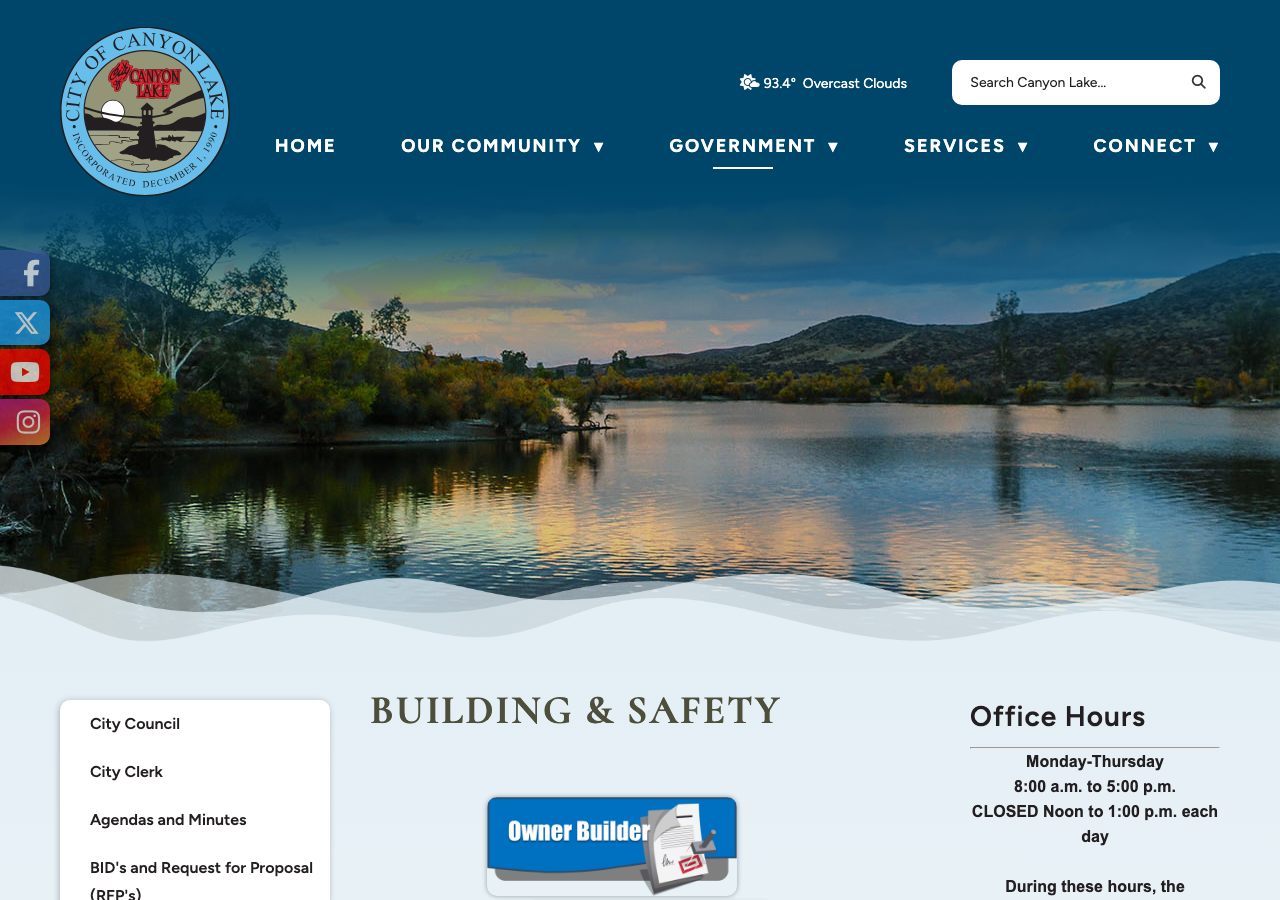
Why the confidence is not higherCity's own Building & Safety page issues residential solar permits directly (in-house counter, own iWorq portal, own inspectors), and MC Ch. 8.25 codifies the city's own expedited solar permitting process.
department page checked 2026-08-31 https://www.canyonlakeca.gov/buildingsafety
Q2 What does this authority permit itself, and what does it delegate? Core Jurisdiction & scope
Both
Why the confidence is not higherThe city issues both building and electrical permits for solar as a single combined permit (fee schedule item BL 37 is 'All Trades'). Reduced from 90+ because MC 8.25.020(b) defines the Building Official as 'the contract official designated by the City' — performance is contracted even though jurisdiction remains the city's.
municipal code checked 2026-08-31 https://web.archive.org/web/20240812144906/https://codelibrary.amlegal.com/codes/canyonlakeca/latest/canyonlake_ca/0-0-0-22121
Q3 Is a permit required for a residential rooftop PV system? Core Jurisdiction & scope
Yes
Why the confidence is not higherMC 8.25.030(a): 'This chapter applies to the permitting of all small residential rooftop solar systems in the City.' Confirmed independently by fee-schedule line BL 37 ('Photovoltaic System (Residential)').
municipal code checked 2026-08-31 https://web.archive.org/web/20240812145100/https://codelibrary.amlegal.com/codes/canyonlakeca/latest/canyonlake_ca/0-0-0-22142
Q4 Is there a separate electrical permit, or is it combined? Core Jurisdiction & scope
Combined
Why the confidence is not higherCitywide Fee Schedule FY2026-27, item BL 37 'Photovoltaic System (Residential) (All Trades)' — one flat fee covers all trades including electrical, i.e. no separate electrical-permit line for solar.
fee schedule checked 2026-08-31 https://canyonlakeca.govoffice3.com/uploads/dm/11550/2026Canyon_Lake_Citywide_Fee_Schedule_v6_FINAL_20252026_FEES_Copy2.pdf
Q5 Who is allowed to pull the electrical permit? Core Who may apply
Either
Why the confidence is not higherSolarApp+ path is contractor-only ('only available to appropriately-licensed contractors'). The standard (non-SolarApp+) track publishes a general Owner-Builder / Property Owners Package implying the standard CA B&P §7044 owner-builder self-permit exemption is available city-wide; no Canyon Lake document was found stating a solar-specific restriction on who pulls the electrical portion, so this is inferred rather than directly stated for solar.
department page checked 2026-08-31 https://www.canyonlakeca.gov/solarapp
Q6 Must the contractor be registered with this authority before applying? Core Who may apply
Yes, for the SolarApp+ path (must register with the SolarApp+ platform and pay its $35 processing fee); the standard track only needs a normal iWorq portal account.
Why the confidence is not higherDirectly stated on the city's own SolarApp+ page: 'The SolarAPP+ program is only available to appropriately-licensed contractors...' with a $35 processing fee to that platform (not a city fee).
department page checked 2026-08-31 https://www.canyonlakeca.gov/solarapp
Q7 Is a homeowner permitted to self-install and self-permit? Who may apply
Yes, via the standard (non-SolarApp+) track only
Why the confidence is not higherSolarApp+ is explicitly contractor-only. The city's separately published 'Owner-Builder Package' / 'Property Owners Package' implies the standard CA B&P §7044 self-permit route is available for the non-expedited track; no Canyon Lake document confirms this specifically for solar.
department page / handout checked 2026-08-31 https://www.canyonlakeca.gov/buildingsafety
Q8 What documents make up a complete submittal? Core Submittal package
For SolarApp+: the SolarApp+-approved plan set downloaded from the platform, uploaded through the city's iWorq/E-OneStop portal, plus payment of city permit fees. A Canyon Lake-specific submittal checklist for the STANDARD (non-SolarApp+) solar track was not found; the city's general 2022-cycle 'Residential Plan Review' checklist (for new construction generally) only notes in passing that 'Separate building permits are required for grading, photovoltaic systems, fire sprinklers, as-built' without listing a PV-specific document set.
Why the confidence is not higherSolarApp+ steps are stated plainly on the city's own SolarApp+ page. The gap for the standard path is real — looked in the Building & Safety handouts list and the general plan-review checklist and found no dedicated solar submittal checklist.
department page checked 2026-08-31 https://www.canyonlakeca.gov/solarapp
Q9 How many copies, and in what format? Submittal package
Electronic submittal only
Why the confidence is not higherBuilding & Safety page: 'Plans submitted for review shall be in electronic form _ONLY_.' Corroborated by MC 8.25.050(b), which requires the city to 'provide for electronic submission of such documents...including the use of electronic signatures' for the solar chapter specifically.
department page checked 2026-08-31 https://www.canyonlakeca.gov/buildingsafety
Q10 Is a site plan required, and what must it show? Core Submittal package
Nothing published by this authority.
Where we lookedMC 8.25.040 ('Rooftop solar energy system requirements') is the section that would state a site-plan requirement, but it is Cloudflare-blocked on amlegal.com (403 on both direct fetch and browser tool) and has no Wayback Machine capture (CDX API returned an empty result set for docid 0-0-0-22148). Also checked the city's general 'Residential Plan Review' checklist and the Building & Safety Permit Forms & Handouts list — neither contains a PV-specific site-plan spec.
Q11 Is a one-line / three-line diagram required? Core Drawings & calculations
Nothing published by this authority.
Where we lookedSame MC 8.25.040 access block as Q10, plus the Building & Safety Permit Forms & Handouts list (Owner-Builder Package, Building Permit Application, Permit Extension Application, Deputy Inspector Registration, Structural Observation Certification, AB1236 Checklist, Smoke Detector Retrofit — none address one-line/three-line diagrams). SolarApp+'s own platform implicitly requires this but that is a national platform requirement, not a Canyon Lake document.
Q12 Are string and conductor calculations required? Drawings & calculations
Nothing published by this authority.
Where we lookedSame as Q11.
Q13 Is a structural PE stamp required, and at what threshold? Core Engineering & stamps
Nothing published by this authority.
Where we lookedMC 8.25.040 (blocked, see Q10) and the city's dated 'Residential Plan Review' checklist, which requires 'digitally stamped and signed structural calculations from a licensed California design professional' for whole-house new construction generally but states no solar-specific kW or weight threshold.
Q14 Is an electrical PE stamp required, and at what threshold? Engineering & stamps
Nothing published by this authority.
Where we lookedSame as Q13 — no electrical PE-stamp threshold specific to solar found in the accessible documents.
Q15 What does a residential solar permit cost? Core Fees
Residential PV (all trades, flat): $478.00, per Citywide Fee Schedule item BL 37 — the schedule lists this figure identically under both a 'No Fire Review' and a 'With Fire Review' sub-line, i.e. Fire review does not add cost. Residential PV via SolarApp+ additionally carries a separate, non-city $35 SolarApp+ platform processing fee. Commercial PV (BL 36) is $1,061.00 flat (the schedule shows the same $1,061 figure for both the ≤50kW and >50kW tiers, which may be a schedule artifact rather than a deliberate design).
Why the confidence is not higherExtracted with pdftotext -layout directly from the FY2026-2027 Citywide Fee Schedule PDF (its own title page reads 'Fiscal Year 2026-2027' even though the file's URL/filename says '20252026' — the internal date, not the filename, is what's cited here). Confidence not higher because the identical BL36 figure across both commercial tiers looks like it could be a data-entry duplication rather than a deliberate flat rate, and because the underlying MC 8.25.080 ('Fees for rooftop solar systems') section, which would state the fee-setting methodology, could not be read (Cloudflare-blocked, no Wayback capture).
fee schedule checked 2026-08-31 https://canyonlakeca.govoffice3.com/uploads/dm/11550/2026Canyon_Lake_Citywide_Fee_Schedule_v6_FINAL_20252026_FEES_Copy2.pdf
Q16 How is the fee calculated? Core Fees
Flat
Why the confidence is not higherFee schedule item BL 37 shows a single flat 'Total Fee Amount' ($478) with the PC/Processing and Inspection sub-columns both marked 'NA' — not valuation-, per-kW-, or per-panel-based.
fee schedule checked 2026-08-31 https://canyonlakeca.govoffice3.com/uploads/dm/11550/2026Canyon_Lake_Citywide_Fee_Schedule_v6_FINAL_20252026_FEES_Copy2.pdf
Q17 Is there a separate plan-check fee? Fees
No
Why the confidence is not higherThe PV line item's Plan-Check/Processing and Inspection sub-columns are both 'NA' with only a single bundled Total shown, unlike most other Building & Safety line items on the same schedule which do split PC and Inspection into separate dollar amounts — indicating the PV fee is not itemized into a separate plan-check charge.
fee schedule checked 2026-08-31 https://canyonlakeca.govoffice3.com/uploads/dm/11550/2026Canyon_Lake_Citywide_Fee_Schedule_v6_FINAL_20252026_FEES_Copy2.pdf
Q18 What is the stated plan-review turnaround? Core Timeline & validity
3 City business days for a complete electronic application on the standard track (MC 8.25.060(b)); the SolarApp+ track is same-day/instant once a code-compliant application and fees are submitted.
Why the confidence is not higherDirect citation, MC 8.25.060(b): the Building Official 'shall issue a building permit...within three City business days for electronic applications upon receipt of a completed application.' SolarApp+ timing per the city's own SolarApp+ page description of the automated-approval process.
municipal code checked 2026-08-31 https://web.archive.org/web/20240812132333/https://codelibrary.amlegal.com/codes/canyonlakeca/latest/canyonlake_ca/0-0-0-22162
Q19 How long is an issued permit valid before it expires? Timeline & validity
Nothing published by this authority.
Where we lookedMC Chapter 8.02 ('Adoption of California Building Standards Codes'), which would carry any local amendment to the standard CBC 105.5 permit-expiration rule, is Cloudflare-blocked on amlegal.com with no Wayback Machine capture for either of its two sections (docids 0-0-0-21784 and 0-0-0-21789; CDX API returned empty for both). MC 8.25 (the solar chapter) does not itself address permit validity/expiration.
Q20 Which permit portal does this authority use? Core Portal & process
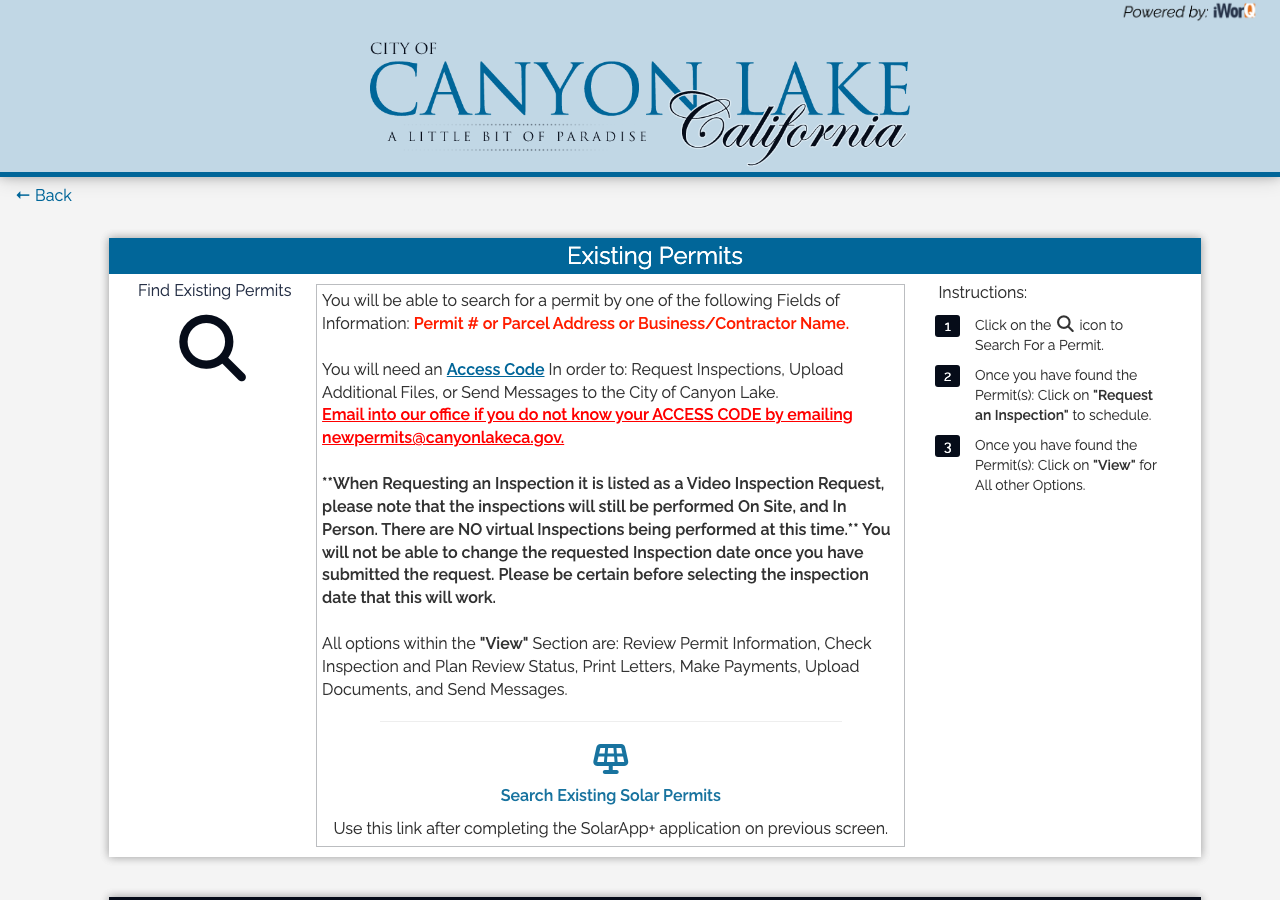
iWorq (branded on the city's own SolarApp+ page as 'E-OneStop Online Services'), at portal.iworq.net/CANYONLAKE for permit application, plus separate Contractor and Owner/Builder iWorq portal instances (canyonlakeca.portal.iworq.net and canyonlkca.portal.iworq.net) for the standard track; a third, separate iWorq instance (canyonlakefd.portal.iworq.net) serves Fire Department permits.
Why the confidence is not higherConfirmed by following the actual hyperlink target of 'E-OneStop Online Services' on the city's live SolarApp+ page, which resolves to portal.iworq.net/CANYONLAKE, and by the Building & Safety page's own listed Contractor/Owner-Builder portal links.
portal / department page checked 2026-08-31 https://www.canyonlakeca.gov/solarapp
Q21 Can the whole application be completed online? Core Portal & process
Yes
Why the confidence is not higherSolarApp+ path: full online design submission, pre-approval, plan download, permit application, fee payment all occur online per the city's own step-by-step SolarApp+ page. Standard track: iWorq portal supports online submission per the Building & Safety page.
department page checked 2026-08-31 https://www.canyonlakeca.gov/solarapp
Q22 Which utility handles interconnection here? Core Utility interconnection
Southern California Edison (SCE)
Why the confidence is not higherNamed directly and specifically by the city's own SolarApp+ page, which instructs applicants doing a main-panel upgrade to coordinate a disconnect/reconnect appointment 'with SCE, (sameday88@SCE.com)' — a first-party city statement, not inferred from PowerToChoose or a territory map.
department page checked 2026-08-31 https://www.canyonlakeca.gov/solarapp
Q23 Where does the utility sit in the sequence? Core Utility interconnection
Parallel, with a coordination requirement in main-panel-upgrade cases: those installs require a same-day joint SCE + city-inspector disconnect/reconnect appointment for torque testing. For a standard PV install with no panel upgrade, no utility dependency for permit issuance was found.
Why the confidence is not higherDirectly stated on the city's SolarApp+ page ('required to schedule a disconnect/reconnect with SCE...and with the city inspector for the same day...NO EXCEPTIONS'). Broader sequencing for PTO itself (after final inspection) is standard SCE Rule 21 practice, not confirmed against a Canyon Lake-specific document beyond this.
department page checked 2026-08-31 https://www.canyonlakeca.gov/solarapp
Q24 Is a HOA or architectural approval required first? Overlays & special cases
No (for small residential rooftop solar specifically)
Why the confidence is not higherMC 8.25.030(c): 'This chapter supersedes any requirements of the [Canyon Lake Property Owners] association.' MC 8.25.020(f)/(j) further limit the POA to only imposing 'reasonable restrictions' (capped at $1,000 or 10% efficiency loss). This is a direct, solar-specific override of the city's own general rule elsewhere (Building & Safety page: POA approval required 'if there is any exterior work involved, including...reroofing or other exterior modifications') — that general rule is for exterior work broadly and is expressly superseded for solar by Ch. 8.25.
municipal code checked 2026-08-31 https://web.archive.org/web/20240812145100/https://codelibrary.amlegal.com/codes/canyonlakeca/latest/canyonlake_ca/0-0-0-22142
Q25 Is there a historic-district review? Overlays & special cases
No
Why the confidence is not higherFull walk of Title 9 (Planning and Zoning) chapter table of contents (9.01 through 9.28) shows no historic-district or historic-preservation chapter of any kind: 9.01 Recycling Areas, 9.02/9.03 Reserved, 9.04 Hookah Lounges, 9.05 Pre-Application Review, 9.06 Marijuana Cultivation, 9.15 Hillside and Ridgeline Development, 9.20 Canyon Lake Village Overlay Zone, 9.25 Signs, 9.26 EV Charging Stations, 9.27 Emergency Shelters, 9.28 Mandatory Uses in Residential Zones. Not capped higher because this is a title-of-contents check, not a full-text search of every chapter.
municipal code (TOC, absence proved) checked 2026-08-31 https://web.archive.org/web/20250512093946/https://codelibrary.amlegal.com/codes/canyonlakeca/latest/canyonlake_ca/0-0-0-22682
Q26 Is a wind or windstorm certification required? Overlays & special cases
Nothing published by this authority.
Where we lookedMC 8.25 (all readable sections) and Title 9 (Planning and Zoning) full chapter TOC — no wind/windstorm certification requirement of any kind found; California generally does not impose a hurricane/high-wind design region requirement, but no explicit Canyon Lake exemption statement was found either.
Q27 Is a Specific Use Permit or Council approval ever required? Overlays & special cases
Yes
Why the confidence is not higherMC 8.25.060(c): 'The Building Official may require an applicant to apply for a conditional use permit if...the rooftop solar energy system could have a specific, adverse impact upon the public health and safety,' with denial requiring written findings and appeal 'to the City Council.'
municipal code checked 2026-08-31 https://web.archive.org/web/20240812132333/https://codelibrary.amlegal.com/codes/canyonlakeca/latest/canyonlake_ca/0-0-0-22162
Q28 Is there a system-size cap on residential generation? Overlays & special cases
The EXPEDITED review path caps at 10 kW AC nameplate / 30 kW thermal, on a single- or two-family dwelling, per MC 8.25.020(g) — an AB 2188-era figure unchanged since the chapter's 2015 adoption. Larger residential systems are still permittable through the standard (non-expedited) plan-check track. Note: the live SolarApp+ platform Canyon Lake now uses nationally supports systems up to 38.4 kW AC; whether Canyon Lake's own SolarApp+ configuration is capped at the code's 10 kW or the platform's higher ceiling could not be confirmed.
Why the confidence is not higherMC 8.25.020(g)(1)-(4) states the cap and dwelling-type/height conditions verbatim. The SolarApp+ platform-wide 38.4kW figure comes from NREL's own help documentation, not a Canyon Lake-specific statement, hence the caveat.
municipal code checked 2026-08-31 https://web.archive.org/web/20240812144906/https://codelibrary.amlegal.com/codes/canyonlakeca/latest/canyonlake_ca/0-0-0-22121
Lines marked with a percentage were read off this authority’s own published documents. Unmarked guidance is general good practice, not this jurisdiction’s rule — always confirm against the authority before you submit.
Install 5 steps · 20 questions
-
Build to the code editions actually in force here
The NEC edition a jurisdiction enforces is often a cycle behind the newest one published, and local amendments sit on top of it. Rapid shutdown, conductor sizing and labelling all change between editions, so the edition in force is the first thing to establish, not the last.
- Which NEC edition is in force? 2020 55% · department handout (dated)
- Which building code edition is in force? 2022 California Building Code (per the most recent document found); the current cycle may since have updated to the 2025 CBC (effective statewide 1 Jan 2026), unconfirmed. 58% · department handout (dated)
- Which fire code edition is in force? 2022 California Fire Code (per the most recent document found); may since have updated to the 2025 CFC, unconfirmed. 58% · department handout (dated)
- Are there local amendments to any of the above? Yes, at least for Fire 72% · municipal code (TOC)
- What is the installation judged against? The adopted CBC/CRC/CEC/CFC/CalGreen (2022 cycle per the most recent document found) as locally amended, plus MC 8.25.020(g)(2)'s own cross-reference requiring the system to conform 'to all applicable State fire, structural, electrical, and other building codes as adopted or amended by the City, and all State and City health and safety standards.' 72% · municipal code
-
Fire access, setbacks and pathways
Ridge setbacks and roof access pathways are fire-service requirements and they constrain the array layout. They are the most common cause of a redesign after the fire department comments on a plan set.
Nothing recorded for City of Canyon Lake on this step yet — 1 question checked and found unpublished. The guidance above is general.
-
Rapid shutdown
Which rapid-shutdown rule applies follows directly from the NEC edition in force, and the initiation device has to be at a location the fire service can reach and identify. This is inspected, and it is labelled.
- Is rapid shutdown required, and to which NEC edition? Yes, required (NEC Art. 690.12) — mandatory statewide since the 2019 CEC/2017 NEC cycle, and no Canyon Lake document found suggests any local exception. The specific base NEC edition currently enforced in Canyon Lake could not be confirmed beyond the 2020 NEC (2022 CEC) referenced by the city's 2023-dated checklist (see Q29). 55% · department handout (dated) + statewide code default
-
Labels and placards
The NEC sets a baseline for permanent markings at the service equipment and the disconnecting means. On top of that, an authority may specify its own wording, and the utility may specify more again. Where any of them writes its own text, a generic off-the-shelf label set will not pass — this is the detail most often fixed on a return visit.
Nothing recorded for City of Canyon Lake on this step yet — 6 questions checked and found unpublished. The guidance above is general.
-
Disconnect, storage and listed equipment
Where the AC disconnect must sit relative to the meter is usually the utility's rule, not the building department's. Battery storage frequently carries its own permit, its own inspection and its own fire conditions.
- Are batteries permitted, and under what conditions? Batteries appear to be permitted subject to a Fire Code operational permit: the Citywide Fee Schedule's Fire Fees section carries a 'Battery System' Fire Code Permit line at $431.00, distinct from and in addition to the Building PV permit. Specific residential ESS conditions (kWh caps, garage/exterior location rules, etc.) could not be confirmed — MC 8.25.040 (which would state solar/ESS-specific technical requirements) was inaccessible. 60% · fee schedule
- Is there a separate ESS permit or inspection? Possibly yes, on the Fire side 55% · fee schedule
- Is there a local rule on service upgrades or busbar sizing? A coordination/scheduling rule, not a numeric busbar-sizing rule: any project involving a main panel upgrade, main breaker derate, inline tap, or other modification subject to manufacturer torque specs must schedule a same-day joint SCE + city-inspector disconnect/reconnect appointment for torque testing ('NO EXCEPTIONS'). No local numeric override (e.g. a 120%-rule variant) was found. 65% · department page
20 questions answered against City of Canyon Lake’s own published documents
Q29 Which NEC edition is in force? Core Code editions in force
2020
Why the confidence is not higherThe city's own dated (CreationDate 28 Mar 2023) 'Residential Plan Review' checklist states it is 'Based on the 2022 California Building Standards Codes' and lists 'California Electrical Code (CEC)' among the codes referenced — the 2022 CEC amendment cycle is based on the 2020 NEC. Capped at 55 because the general code-adoption chapter (MC 8.02, which would state the currently-in-force edition and any update to the 2025 cycle effective statewide 1 Jan 2026) could not be read: amlegal.com is Cloudflare-blocked for this URL and no Wayback Machine capture exists for it (confirmed via CDX API, empty result).
department handout (dated) checked 2026-08-31 https://www.canyonlakeca.gov/vertical/sites/%7B914485A7-E93B-4BFA-A369-593050FBB784%7D/uploads/Canyon_Lake_2022_Residential_Plan_Review-Final.pdf
Q30 Which building code edition is in force? Core Code editions in force
2022 California Building Code (per the most recent document found); the current cycle may since have updated to the 2025 CBC (effective statewide 1 Jan 2026), unconfirmed.
Why the confidence is not higherSame 2023-dated checklist as Q29, and MC Chapter 8.02 is titled 'Adoption of California Building Standards Codes' confirming the mechanism exists, but its section text (which would confirm the current edition) is Cloudflare-blocked with no Wayback capture.
department handout (dated) checked 2026-08-31 https://www.canyonlakeca.gov/vertical/sites/%7B914485A7-E93B-4BFA-A369-593050FBB784%7D/uploads/Canyon_Lake_2022_Residential_Plan_Review-Final.pdf
Q31 Which fire code edition is in force? Code editions in force
2022 California Fire Code (per the most recent document found); may since have updated to the 2025 CFC, unconfirmed.
Why the confidence is not higherSame 2023-dated checklist explicitly lists 'California Fire Code (CFC)' among the 2022-cycle codes it is based on. Independently, MC Chapter 8.12 is titled 'Adoption of California Fire Code, As Amended,' confirming a fire-code adoption chapter exists, but its own section 8.12.010 (which states the specific edition) could not be read — Cloudflare-blocked, no Wayback capture.
department handout (dated) checked 2026-08-31 https://www.canyonlakeca.gov/vertical/sites/%7B914485A7-E93B-4BFA-A369-593050FBB784%7D/uploads/Canyon_Lake_2022_Residential_Plan_Review-Final.pdf
Q32 Are there local amendments to any of the above? Core Code editions in force
Yes, at least for Fire
Why the confidence is not higherMC Chapter 8.12's own title is 'Adoption of California Fire Code, AS AMENDED' — the word 'amended' is in the chapter title itself. The amendment content could not be read (section text Cloudflare-blocked, no Wayback capture), so scope/extent is unconfirmed.
municipal code (TOC) checked 2026-08-31 https://web.archive.org/web/20250814200947/https://codelibrary.amlegal.com/codes/canyonlakeca/latest/canyonlake_ca/0-0-0-4758
Q33 What is the installation judged against? Core Electrical
The adopted CBC/CRC/CEC/CFC/CalGreen (2022 cycle per the most recent document found) as locally amended, plus MC 8.25.020(g)(2)'s own cross-reference requiring the system to conform 'to all applicable State fire, structural, electrical, and other building codes as adopted or amended by the City, and all State and City health and safety standards.'
Why the confidence is not higherDirect citation of MC 8.25.020(g)(2) combined with the code-edition list in the city's dated Residential Plan Review checklist.
municipal code checked 2026-08-31 https://web.archive.org/web/20240812144906/https://codelibrary.amlegal.com/codes/canyonlakeca/latest/canyonlake_ca/0-0-0-22121
Q34 Is there a local rule on service upgrades or busbar sizing? Electrical
A coordination/scheduling rule, not a numeric busbar-sizing rule: any project involving a main panel upgrade, main breaker derate, inline tap, or other modification subject to manufacturer torque specs must schedule a same-day joint SCE + city-inspector disconnect/reconnect appointment for torque testing ('NO EXCEPTIONS'). No local numeric override (e.g. a 120%-rule variant) was found.
Why the confidence is not higherDirectly quoted from the city's own SolarApp+ page. The underlying MC 8.25.040 ('Rooftop solar energy system requirements'), which might contain a numeric busbar rule, could not be read — Cloudflare-blocked, no Wayback capture.
department page checked 2026-08-31 https://www.canyonlakeca.gov/solarapp
Q35 Is a specific mounting system or attachment spacing required? Structural & mounting
Nothing published by this authority.
Where we lookedMC 8.25.040 ('Rooftop solar energy system requirements'), the section that would state a mounting-system or attachment-spacing rule, is Cloudflare-blocked with no Wayback capture (docid 0-0-0-22148, empty CDX result).
Q36 What ridge setback and access pathways are required? Core Fire pathways & setbacks
Nothing published by this authority.
Where we lookedMC Chapter 8.12 ('Adoption of California Fire Code, As Amended') full section-title table of contents (8.12.010 through 8.12.520) shows no section titled for solar/PV/rooftop setbacks or fire-access pathways — a title-level check only, not a full-text search, since the section bodies themselves (e.g. 8.12.010 'Adoption', which could contain an unindexed CFC §1205 amendment) are Cloudflare-blocked with no Wayback capture for the sections tried (docid 0-0-0-21848 for 8.12.010, empty CDX result).
Q37 Is rapid shutdown required, and to which NEC edition? Core Rapid shutdown
Yes, required (NEC Art. 690.12) — mandatory statewide since the 2019 CEC/2017 NEC cycle, and no Canyon Lake document found suggests any local exception. The specific base NEC edition currently enforced in Canyon Lake could not be confirmed beyond the 2020 NEC (2022 CEC) referenced by the city's 2023-dated checklist (see Q29).
Why the confidence is not higherRapid shutdown under 690.12 is a mandatory NEC/CEC provision, not something a city can opt out of, so the 'Yes, required' half is high-confidence by California-wide default; the edition-specific half inherits the same uncertainty as Q29 (MC 8.02/8.25.040 unreadable).
department handout (dated) + statewide code default checked 2026-08-31 https://www.canyonlakeca.gov/vertical/sites/%7B914485A7-E93B-4BFA-A369-593050FBB784%7D/uploads/Canyon_Lake_2022_Residential_Plan_Review-Final.pdf
Q38 Which placards does this authority require at the service equipment? Core Labels Signage & labelling
Nothing published by this authority.
Where we lookedMC 8.25.040 (blocked, see Q35) and Chapter 8.12's fire-code TOC (no placard-titled section); no dedicated placard/signage handout was found among the Building & Safety Permit Forms & Handouts.
Q39 Does the authority specify placard wording of its own? Core Labels Signage & labelling
Nothing published by this authority.
Where we lookedSame as Q38.
Q40 Does it specify letter height, colour or material? Core Labels Signage & labelling
Nothing published by this authority.
Where we lookedSame as Q38.
Q41 Is a site plan / facility map placard required, and what must it show? Core Labels Signage & labelling
Nothing published by this authority.
Where we lookedSame as Q38; MC 8.25.040 blocked and no 705.10-style facility-map placard handout found on the city's site.
Q42 Does the UTILITY specify placards beyond the AHJ's? Core Labels Signage & labelling
Nothing published by this authority.
Where we lookedSCE's own Rule 21 interconnection overview page names an 'Accelerated Permission-To-Operate (PTO) Process' for energy storage but does not itemize placard/label requirements; SCE's fuller Electrical Service Requirements / Interconnection Handbook documents, which likely do contain this, were out of scope for a single-authority run.
Q43 Where must the labels be placed? Core Labels Signage & labelling
Nothing published by this authority.
Where we lookedSame SCE-page limitation as Q42, plus Canyon Lake's own Building & Safety and SolarApp+ pages, which give no label-placement spec beyond the default NEC/CEC-mandated locations.
Q44 Must equipment be on a specific approved list? Equipment listing
Nothing published by this authority.
Where we lookedMC 8.25 (readable sections), the city's dated Residential Plan Review checklist, and the Building & Safety handout list — no equipment-listing-specific requirement beyond the default adopted-code (NEC/CEC-listed-equipment) baseline was found.
Q45 Are batteries permitted, and under what conditions? Core Battery / ESS
Batteries appear to be permitted subject to a Fire Code operational permit: the Citywide Fee Schedule's Fire Fees section carries a 'Battery System' Fire Code Permit line at $431.00, distinct from and in addition to the Building PV permit. Specific residential ESS conditions (kWh caps, garage/exterior location rules, etc.) could not be confirmed — MC 8.25.040 (which would state solar/ESS-specific technical requirements) was inaccessible.
Why the confidence is not higherThe $431 line item is confirmed directly from the fee schedule PDF (extracted with pdftotext -layout) under the 'FIRE FEES > Fire Code Permit' heading, alongside other generic CFC operational-permit line items (Aerosol Products, Asbestos Removal, Auto Wrecking Yard, etc.). It is not explicitly labelled 'residential' vs 'commercial,' hence capped confidence.
fee schedule checked 2026-08-31 https://canyonlakeca.govoffice3.com/uploads/dm/11550/2026Canyon_Lake_Citywide_Fee_Schedule_v6_FINAL_20252026_FEES_Copy2.pdf
Q46 Is there a separate ESS permit or inspection? Battery / ESS
Possibly yes, on the Fire side
Why the confidence is not higherThe Fire Fees section's 'Battery System' permit fee ($431) is a separate line item from the Building 'Photovoltaic System (Residential)' fee (BL 37, $478) on the same Citywide Fee Schedule — suggesting a battery/ESS component could trigger its own Fire Code permit apart from the Building PV permit. It is unclear from the schedule alone whether this generic Fire Code Permit line is actually applied to small residential battery-backup systems or only to larger/commercial stationary storage, so this is inference from adjacent fee-schedule structure rather than a direct statement.
fee schedule checked 2026-08-31 https://canyonlakeca.govoffice3.com/uploads/dm/11550/2026Canyon_Lake_Citywide_Fee_Schedule_v6_FINAL_20252026_FEES_Copy2.pdf
Q47 Is a ground mount treated as a structure? Core Ground mount
Nothing published by this authority.
Where we lookedFull walk of Title 9 (Planning and Zoning) chapter TOC — no accessory-structure or solar/ground-mount chapter exists at all. The city's own Planning page states plainly that Canyon Lake adopted Riverside County's 1990 zoning code by reference and 'does not maintain a copy of the original 1990 code, nor a fully consolidated version incorporating all subsequent amendments' — so the operative zoning text that would classify a ground-mount array is not published by the city itself.
Q48 Where must the AC disconnect be, relative to the meter? Core Utility equipment
Nothing published by this authority.
Where we lookedSCE's Rule 21 overview page (see Q42) and Canyon Lake's Outside Agency / SolarApp+ pages — neither states an AC-disconnect-to-meter distance/placement rule.
Lines marked with a percentage were read off this authority’s own published documents. Unmarked guidance is general good practice, not this jurisdiction’s rule — always confirm against the authority before you submit.
Inspection 5 steps · 14 questions
-
Book it
Booking is a portal, a phone call or an email depending on the authority, and the notice required is rarely zero. Book before the work is finished rather than after — the lead time, not the work, is usually what sets the date.
- How is an inspection booked? Portal (email: inspections@canyonlakeca.gov) or Phone (inspection hotline 951-746-7972) 90% · department page
- How much notice is required? Effectively 1 business day — online inspection requests via email can be scheduled 'up until 5:00 p.m. the day before' the requested inspection date. 82% · department page
- Are same-day or AM/PM windows offered? General inspection hours are 9:00 a.m.–1:00 p.m. (afternoon slots by request, if available); applicants confirm a narrowed 2-3 hour arrival window by calling 951-746-7970 between 8:00-8:30 a.m. on the morning of the inspection. 88% · department page
-
Know who turns up
Some authorities inspect their own solar work; some delegate it, and a few do not inspect the PV equipment itself at all. Who is coming determines what they will look at.
- Does this AHJ perform its own final solar inspection? Yes 75% · department page
- If delegated, to whom? N/A — not delegated to an outside agency 72% · department page
-
Work the stages in order
A rough-in or mid-roof inspection, where one is required, has to happen before the work it covers is closed up. Missing a stage means opening something back up, and it is the most expensive kind of correction.
Nothing recorded for City of Canyon Lake on this step yet — 2 questions checked and found unpublished. The guidance above is general.
-
Have the paperwork on site
The approved plan set, the permit, and the equipment listings should be on site and reachable. Inspectors routinely verify that installed equipment matches what was approved, and that the labels are the ones the plan set promised.
- Is there a published inspection checklist? Yes, for the SolarApp+ path (the platform generates its own inspection checklist as part of the automated review); no separate Canyon Lake-published PV inspection checklist was found for the standard (non-SolarApp+) track. 60% · platform documentation
-
Sign-off, and permission to operate
Passing gives you a final or an equivalent sign-off. That is not the same as permission to operate: PTO comes from the utility, and who tells the utility the inspection passed varies. A system left switched off for weeks is usually waiting on this handover.
- What is issued on pass? Likely Final (a signed-off building permit), based on common California small-city practice for additions to existing single-family homes 50% · inference from comparable authority
- Who notifies the utility for PTO? Installer 62% · department page (inference) + standard utility practice
- Is there a re-inspection fee? No PV-specific re-inspection dollar figure was found; the schedule's only general re-inspection provision reads 'Re-inspection fees assessed under provisions of Section 305(g)...Actual Cost using FBHR (Fully Burdened Hourly Rate)...Includes up to 3 plan checks,' and sits in the Engineering/Grading fee section rather than a Building-wide section. 45% · fee schedule
- How are corrections issued and cleared? For plan-review deficiencies: 'a written corrections notice detailing all deficiencies in the application and any additional information or documentation required...shall be sent to the applicant for resubmission' (MC 8.25.060(a)(1)). Post-inspection correction process specifically was not confirmed (see Q54/55/56 not_found). 75% · municipal code
14 questions answered against City of Canyon Lake’s own published documents
Q49 How is an inspection booked? Core Booking & scheduling
Portal (email: inspections@canyonlakeca.gov) or Phone (inspection hotline 951-746-7972)
Why the confidence is not higherBoth methods stated directly on the city's Building & Safety and SolarApp+ pages.
department page checked 2026-08-31 https://www.canyonlakeca.gov/solarapp
Q50 How much notice is required? Core Booking & scheduling
Effectively 1 business day — online inspection requests via email can be scheduled 'up until 5:00 p.m. the day before' the requested inspection date.
Why the confidence is not higherDirectly stated on the city's SolarApp+ page.
department page checked 2026-08-31 https://www.canyonlakeca.gov/solarapp
Q51 Are same-day or AM/PM windows offered? Booking & scheduling
General inspection hours are 9:00 a.m.–1:00 p.m. (afternoon slots by request, if available); applicants confirm a narrowed 2-3 hour arrival window by calling 951-746-7970 between 8:00-8:30 a.m. on the morning of the inspection.
Why the confidence is not higherDirectly stated on the city's SolarApp+ and Building & Safety pages.
department page checked 2026-08-31 https://www.canyonlakeca.gov/solarapp
Q52 Does this AHJ perform its own final solar inspection? Core Who inspects
Yes
Why the confidence is not higherThe city's own Building & Safety inspectors (contact: inspections@canyonlakeca.gov, 951-746-7972) perform solar/PV inspections; not delegated to a third party. Confidence capped below 90 because the fee schedule's PV line separately prices 'No Fire Review' vs 'With Fire Review' at the same $478, implying the Fire Department (Canyon Lake's own, separate department since 1 Jan 2022) sometimes also reviews/inspects a PV job, and the exact division of labor between Building and Fire inspection was not confirmed.
department page checked 2026-08-31 https://www.canyonlakeca.gov/solarapp
Q53 If delegated, to whom? Core Who inspects
N/A — not delegated to an outside agency
Why the confidence is not higherFollows from Q52: Canyon Lake's own Building & Safety Division and its own (separately-standing) Fire Department perform inspections; neither function was found delegated to Riverside County or CAL FIRE.
department page checked 2026-08-31 https://www.canyonlakeca.gov/clfd
Q54 Which inspections are required, and in what order? Core Stages & sequence
Nothing published by this authority.
Where we lookedMC 8.25.070 ('Inspection requirements') is the section that would state the required inspection sequence; it is Cloudflare-blocked with no Wayback capture (docid 0-0-0-22171, empty CDX result). The city's Building & Safety and SolarApp+ pages describe how to book an inspection but not the itemized sequence of inspections for a PV job specifically.
Q55 Is a rough-in or mid-roof inspection required? Stages & sequence
Nothing published by this authority.
Where we lookedSame MC 8.25.070 access block as Q54.
Q56 Does the inspector verify labels and listings? Core What is checked
Nothing published by this authority.
Where we lookedMC 8.25.070 (blocked, see Q54) and the city's Inspections-related pages, none of which itemize what the inspector specifically checks.
Q57 Is there a published inspection checklist? Core What is checked
Yes, for the SolarApp+ path (the platform generates its own inspection checklist as part of the automated review); no separate Canyon Lake-published PV inspection checklist was found for the standard (non-SolarApp+) track.
Why the confidence is not higherSolarApp+'s national process includes a system-generated inspection checklist per NREL's own documentation; the city's Building & Safety Permit Forms & Handouts list was checked and does not include a standalone PV inspection checklist of its own.
platform documentation checked 2026-08-31 https://help.gosolarapp.org/article/43-what-types-of-systems-are-eligible-for-solarapp-review
Q58 What must be on site at inspection? Core Documents on site
Nothing published by this authority.
Where we lookedMC 8.25.070 (blocked, see Q54) and the general Building & Safety page, which describes the inspection-scheduling process but not what must be physically present on site at the time of inspection.
Q59 Is there a re-inspection fee? Corrections & re-inspection
No PV-specific re-inspection dollar figure was found; the schedule's only general re-inspection provision reads 'Re-inspection fees assessed under provisions of Section 305(g)...Actual Cost using FBHR (Fully Burdened Hourly Rate)...Includes up to 3 plan checks,' and sits in the Engineering/Grading fee section rather than a Building-wide section.
Why the confidence is not higherDirectly extracted from the Citywide Fee Schedule, but its placement under 'ENGINEERING FEES > Grading' rather than a general Building & Safety re-inspection line makes it unclear whether it is meant to govern solar re-inspections at all — hence the low confidence rather than a flat dollar answer.
fee schedule checked 2026-08-31 https://canyonlakeca.govoffice3.com/uploads/dm/11550/2026Canyon_Lake_Citywide_Fee_Schedule_v6_FINAL_20252026_FEES_Copy2.pdf
Q60 How are corrections issued and cleared? Corrections & re-inspection
For plan-review deficiencies: 'a written corrections notice detailing all deficiencies in the application and any additional information or documentation required...shall be sent to the applicant for resubmission' (MC 8.25.060(a)(1)). Post-inspection correction process specifically was not confirmed (see Q54/55/56 not_found).
Why the confidence is not higherDirect citation of MC 8.25.060(a)(1), which governs the completeness/plan-review stage of the expedited process; it does not by its own terms address post-inspection field corrections.
municipal code checked 2026-08-31 https://web.archive.org/web/20240812132333/https://codelibrary.amlegal.com/codes/canyonlakeca/latest/canyonlake_ca/0-0-0-22162
Q61 What is issued on pass? Core Final sign-off & PTO
Likely Final (a signed-off building permit), based on common California small-city practice for additions to existing single-family homes
Why the confidence is not higherInference from comparable California authorities (e.g. Fremont's FMC 15.10.110 exempts single-family/U-occupancy additions from a separate Certificate of Occupancy). No Canyon Lake-specific CBC-111-equivalent amendment text could be read to confirm this directly — MC 8.02/8.10 general-provisions chapters are Cloudflare-blocked with no Wayback capture.
inference from comparable authority checked 2026-08-31 https://web.archive.org/web/20250814200947/https://codelibrary.amlegal.com/codes/canyonlakeca/latest/canyonlake_ca/0-0-0-4758
Q62 Who notifies the utility for PTO? Core Final sign-off & PTO
Installer
Why the confidence is not higherStandard SCE Rule 21 practice is that the installer/contractor submits final permit sign-off documentation to SCE to trigger Permission to Operate; consistent with (though not stated verbatim by) the city's own SolarApp+ page, which ends the city-side process at final inspection and separately names an SCE contact (sameday88@SCE.com) for panel-upgrade coordination that installers, not the city, are directed to use.
department page (inference) + standard utility practice checked 2026-08-31 https://www.canyonlakeca.gov/solarapp
Lines marked with a percentage were read off this authority’s own published documents. Unmarked guidance is general good practice, not this jurisdiction’s rule — always confirm against the authority before you submit.
Jurisdiction & key facts
The standing 62-question set, answered for City of Canyon Lake against this authority’s own published documents. Every answer carries the confidence it was recorded at and the document it came from. Where nothing is published we say so and show where we looked — a blank here is a finding, not a gap.
City of Canyon Lake is the authority having jurisdiction 88% confidence
- Holds
- Both
- Delegated to
- Building & Safety functions appear to be staffed by a contracted individual rather than a direct city hire: MC 8.25.020(b) defines ‘Building Official’ as ‘the contract official designated by the City,’ even though the department page names David Harnden on a @canyonlakeca.gov email (city domain gives no delegation tell here — same shape as Soledad/Bell in the playbook). The contracting firm could not be identified by name given the search-budget exhaustion this run hit early. Fire is a separate, self-standing municipal department (Canyon Lake Fire Department, Chief Jeff LaTendresse) that ‘began operations on January 1, 2022’ — a lifecycle shape matching Avenal's: the city appears to have taken fire in-house from a prior county/CAL FIRE arrangement, though the pre-2022 arrangement itself was not confirmed this run.
- Overridden by
- CA Gov. Code §65850.5 (Solar Rights Act / AB 2188) — cited by MC 8.25.010 as the chapter's own stated basis; Civil Code §714 limits HOA/CC&R authority, and the city's own MC 8.25.030(c) goes further and states outright that the chapter ‘supersedes any requirements of the [Canyon Lake Property Owners] association.’
- Why not higher
- The city's own Building & Safety page and Municipal Code Chapter 8.25 (‘Expedited Streamline Permit Process for Small Residential Rooftop Solar Energy Systems,’ Ord. 163, passed 8-12-2015) show Canyon Lake issuing its own building and electrical permits for residential PV via SolarApp+ and a standard iWorq-based track, and its own Citywide Fee Schedule carries dedicated PV fee lines (BL 36/BL 37). Not delegated to Riverside County. Confidence is capped below 95 because (1) the Building Official is codified as a 'contract official' and the contracting firm's name could not be confirmed, and (2) three sections of Chapter 8.25 itself (8.25.040, .070, .080) could not be read — amlegal.com is behind a Cloudflare challenge that blocks both direct fetch and this run's browser tool, and no Wayback Machine capture exists for those three specific document IDs (confirmed via the CDX API, which returned an empty result set for each).
Check the code edition before you build
This authority's published code edition does not match what the state has adopted. That usually means the authority's ordinance has not been updated for the current cycle — but a local amendment can also be lawful. Confirm with the building department before you submit.
- Permit required
- Yes95%
- Permit cost
- Residential PV (all trades, flat): $478.00, per Citywide Fee Schedule item BL 37 — the schedule lists this figure identically under both a 'No Fire Review' and a 'With Fire Review'…88%
- Plan review
- 3 City business days for a complete electronic application on the standard track (MC 8.25.060(b));85%
- Portal
- iWorq (branded on the city's own SolarApp+ page as 'E-OneStop Online Services'), at portal.iworq.net/CANYONLAKE for permit application,88%
- Electrical code
- 202055%
- Booking an inspection
- Portal (email: inspections@canyonlakeca.gov) or Phone (inspection hotline 951-746-7972)90%
Labels & placards for this authority
Wording None%
Size, colour & material None%
Where they go None%
What the utility wants on top None%
Each figure above is sourced and dated in the full answer set below (questions 38–43). Where an authority’s own published sheet is older than the code it has adopted, the answer says so.
Average approval time — application to PTO
From the CPUC interconnection record. Bars show the average days taken each year; a year with no recorded projects is left blank rather than drawn as zero.