
City of Chino Hills
San Bernardino County
City of Chino Hills is a city authority in the State of California, serving 78,411 residents. 4,794 residential solar installs are on record here. This page is the permit route for that jurisdiction: the fifteen steps from working out who has a say over an address through to permission to operate, the documents this authority publishes, the 2025 Edition code cycle it enforces, and 62 answers taken from those documents and dated.
Permitting 5 steps · 28 questions
Whether a permit is needed — Yes Q3 Electrical and building permits — Combined Q4 Plan review — Fire district (CVFD, the gating review): same-day if submitted via the online portal or email between 8-11 a.m. Q18 Where you file — Virtual Development Services (VDS) — a Tyler Technologies EnerGov Self Service portal at eplselfservice.chinohills.org. Q20
- Permit required
- Yes96% source
- What it costs
- City: $450.00 flat (Photovoltaic Permit, Single-Family, roof- or ground-mounted) plus a 6% Technology Fee and a 0.08%-of-valuation General Plan Surcharge Fee.85% source
- Plan review turnaround
- Fire district (CVFD, the gating review): same-day if submitted via the online portal or email between 8-11 a.m.72% source
- Key document
- fire district plan-check requirements (PDF) + authority's own page cited by 8 open the document
-
Confirm who has a say over your address
A city address is usually permitted by the city, not the county — but not always, and some authorities keep building and hand electrical to someone else. Getting this wrong costs the whole submittal, because every requirement below belongs to whoever actually holds jurisdiction. Check the overlays in the same pass: an HOA, a historic district, a windstorm certification or a system-size cap can reshape the design, and all of them are cheaper to find now than after the array is laid out.
- Is this authority the AHJ for residential solar at this address? Yes 92% · authority's own page
- What does this authority permit itself, and what does it delegate? Both 88% · authority's own page + fee schedule
- Is a permit required for a residential rooftop PV system? Yes 96% · authority's own page
- Is there a separate electrical permit, or is it combined? Combined 75% · fee schedule
- Is a HOA or architectural approval required first? No 68% · authority's own page
- Is a wind or windstorm certification required? No 55% · authority's own page (absence) + general CA regulatory context
- Is a Specific Use Permit or Council approval ever required? No — not required for a standard by-right residential rooftop or ground-mounted PV permit. 60% · authority's own page
-
Check who is allowed to apply
Several authorities require the electrical permit to be pulled by a licensed electrician, or require the contractor to be registered with them BEFORE applying. Registration is not same-day. This is second on the list rather than fourth because it is the step most likely to stop the job before the drawings matter.
- Who is allowed to pull the electrical permit? Either 80% · fire district plan-check requirements (PDF)
- Must the contractor be registered with this authority before applying? No (city); Yes (fire district) 75% · authority's own page + fire district page
- Is a homeowner permitted to self-install and self-permit? Yes 82% · fire district plan-check requirements (PDF)
-
Build the submittal package
Almost everywhere wants a site plan, a one-line or three-line electrical diagram, equipment cut sheets with listings, and a structural attachment detail. Build it against the published checklist rather than the last jurisdiction you worked in — the checklist is what the reviewer marks against.
- What documents make up a complete submittal? SolarApp+ path: SolarApp+ approval packet + signed Smoke/CO Detector-Alarm form + Chino Valley Fire District (CVFD) approved plans, then City permit application with fees. CVFD's own submittal (required regardless of SolarApp+ use) requires: full dimensional site plan (property lines, structures, streets/alleys, setbacks, compass point); roof plan showing array/panel layout, fire setbacks, fire access pathways, conduit runs, main electrical service and inverter locations; total roof area and % covered by panels; a signage sheet showing required labeling per CEC/CFC; equipment specs/manufacturer cut sheets; and a set of wet-stamped structural calculations. 88% · fire district plan-check requirements (PDF) + authority's own page
- How many copies, and in what format? Electronic PDF only — no physical copies. 85% · fire district plan-check requirements (PDF)
- Is a site plan required, and what must it show? Yes — a full dimensional site plan is required reflecting property lines, all structures, streets, alleys, setbacks, and point of compass. 88% · fire district plan-check requirements (PDF)
- Is a one-line / three-line diagram required? Yes (functional equivalent) — a roof plan is required reflecting the array/panel layout, all conduit runs, and the locations of the main electrical service and inverter. 68% · fire district plan-check requirements (PDF)
- Is a structural PE stamp required, and at what threshold? A set of wet-stamped structural calculations is required with every residential PV submittal to the fire district (no stated size/weight threshold — CVFD's document says the calcs are 'used for reference only' by the fire district, implying the actual structural adequacy determination is the City Building Division's). 65% · fire district plan-check requirements (PDF)
-
Apply and pay
Most authorities now take the whole application through a portal, and several states cap or constrain what a residential solar permit may cost. Check whether plan check is billed separately before you quote the job.
- Which permit portal does this authority use? Virtual Development Services (VDS) — a Tyler Technologies EnerGov Self Service portal at eplselfservice.chinohills.org. 92% · portal landing page
- Can the whole application be completed online? Yes 80% · authority's own page
- What does a residential solar permit cost? City: $450.00 flat (Photovoltaic Permit, Single-Family, roof- or ground-mounted) plus a 6% Technology Fee and a 0.08%-of-valuation General Plan Surcharge Fee. Fire district (Chino Valley Fire District, a mandatory separate permit): $280.00 flat ('Solar Residential', fee code 1810). Combined baseline cost ≈ $730 plus the percentage surcharges. 85% · fee schedule
- How is the fee calculated? Flat 85% · fee schedule
- Is there a separate plan-check fee? No separate plan-check fee is charged up front — it is bundled into the $450 City PV permit fee. A $538 'Plan Check Re-Submittal' fee applies only after 3 review cycles. 78% · fee schedule
-
Plan review — and start the utility in parallel
Interconnection is a separate process from the permit and usually the longer pole. Where the utility does not depend on the permit being issued, running both at once is the single biggest saving available on a residential job.
- What is the stated plan-review turnaround? Fire district (CVFD, the gating review): same-day if submitted via the online portal or email between 8-11 a.m. on a Tuesday or Thursday (reviewed 1-3 p.m., permit issued same day); otherwise CVFD's regular queue is 7-10 business days. The City's own building/electrical plan-review turnaround for the PV permit itself is not separately published. 72% · fire district plan-check requirements (PDF)
- Which utility handles interconnection here? Southern California Edison (SCE) 95% · authority's own page
- Where does the utility sit in the sequence? Parallel to permitting, with SCE's Permission-to-Operate (PTO)/energization occurring after construction and City final inspection are complete. 62% · utility interconnection page
28 questions answered against City of Chino Hills’s own published documents
Q1 Is this authority the AHJ for residential solar at this address? Core Jurisdiction & scope
Yes
Why the confidence is not higherCity's own Building & Safety and dedicated Residential Solar pages describe the City issuing residential PV permits; the Community Development Director/Building & Safety Division is the building/electrical AHJ. Reduced slightly from 95 because permit issuance is gated on a separate special district (fire) approving first, so 'AHJ' is genuinely split — see jurisdiction block.
authority's own page checked 2026-08-30 https://www.chinohills.org/1926/Residential-Solar
Q2 What does this authority permit itself, and what does it delegate? Core Jurisdiction & scope
Both
Why the confidence is not higherThe City's Building & Safety Division issues a single 'Photovoltaic Permit' covering both building/structural and electrical review (fee schedule lists it once, under Electrical Permits). Fire/life-safety review is NOT delegated by the city — it sits with Chino Valley Independent Fire District, a coequal, separate special district that must approve first (see Residential Solar page: 'Apply separately with the Chino Valley Fire District to obtain Fire approval').
authority's own page + fee schedule checked 2026-08-30 https://www.chinohills.org/1926/Residential-Solar
Q3 Is a permit required for a residential rooftop PV system? Core Jurisdiction & scope
Yes
Why the confidence is not higher'A photovoltaic permit is required for all Single Family (roof-mounted) solar installations' — stated plainly on the City's dedicated Residential Solar page. Ground-mounted residential PV also has its own fee line in the Master Schedule of Fees, confirming a permit is likewise required for that configuration.
authority's own page checked 2026-08-30 https://www.chinohills.org/1926/Residential-Solar
Q4 Is there a separate electrical permit, or is it combined? Core Jurisdiction & scope
Combined
Why the confidence is not higherThe Master Schedule of Fees lists 'Photovoltaic Permit - Single-Family Home - Roof Mounted' and the ground-mounted equivalent as single line items under 'ELECTRICAL PERMITS AND FEES', i.e. one PV permit covers the work rather than separate building and electrical permits. Confidence held below 90 because no page explicitly states 'this is one combined permit' in those words — it is inferred from the fee schedule's single line item.
fee schedule checked 2026-08-30 https://www.chinohills.org/DocumentCenter/View/31120/Master-Schedule-of-Fees-Effective-January-1-2026
Q5 Who is allowed to pull the electrical permit? Core Who may apply
Either
Why the confidence is not higherChino Valley Fire District's PV plan-check requirements state: 'All work shall be performed by a California Licensed Contractor, unless the permit is being requested as owner/builder. The contractor shall have one of the following valid Contractor licenses: B, C-10, C-46.' This is the fire district's own submittal requirement, which gates the city permit, so it functionally governs who may apply for the whole project.
fire district plan-check requirements (PDF) checked 2026-08-30 https://ca-chinovalleyfire.civicplus.com/DocumentCenter/View/130/PV-Plan-Review-Requirements-Revised-041724-PDF
Q6 Must the contractor be registered with this authority before applying? Core Who may apply
No (city); Yes (fire district)
Why the confidence is not higherThe City's own Building & Safety page only points contractors to the general CSLB verification resource — no stated requirement to pre-register with the City before applying. Chino Valley Fire District, however, explicitly requires: 'You must have a current state contractor's license on file with our office before you can use the online permit portal' — and since CVFD approval is a prerequisite to the City permit, a contractor is effectively pre-vetted by the fire district, not the city.
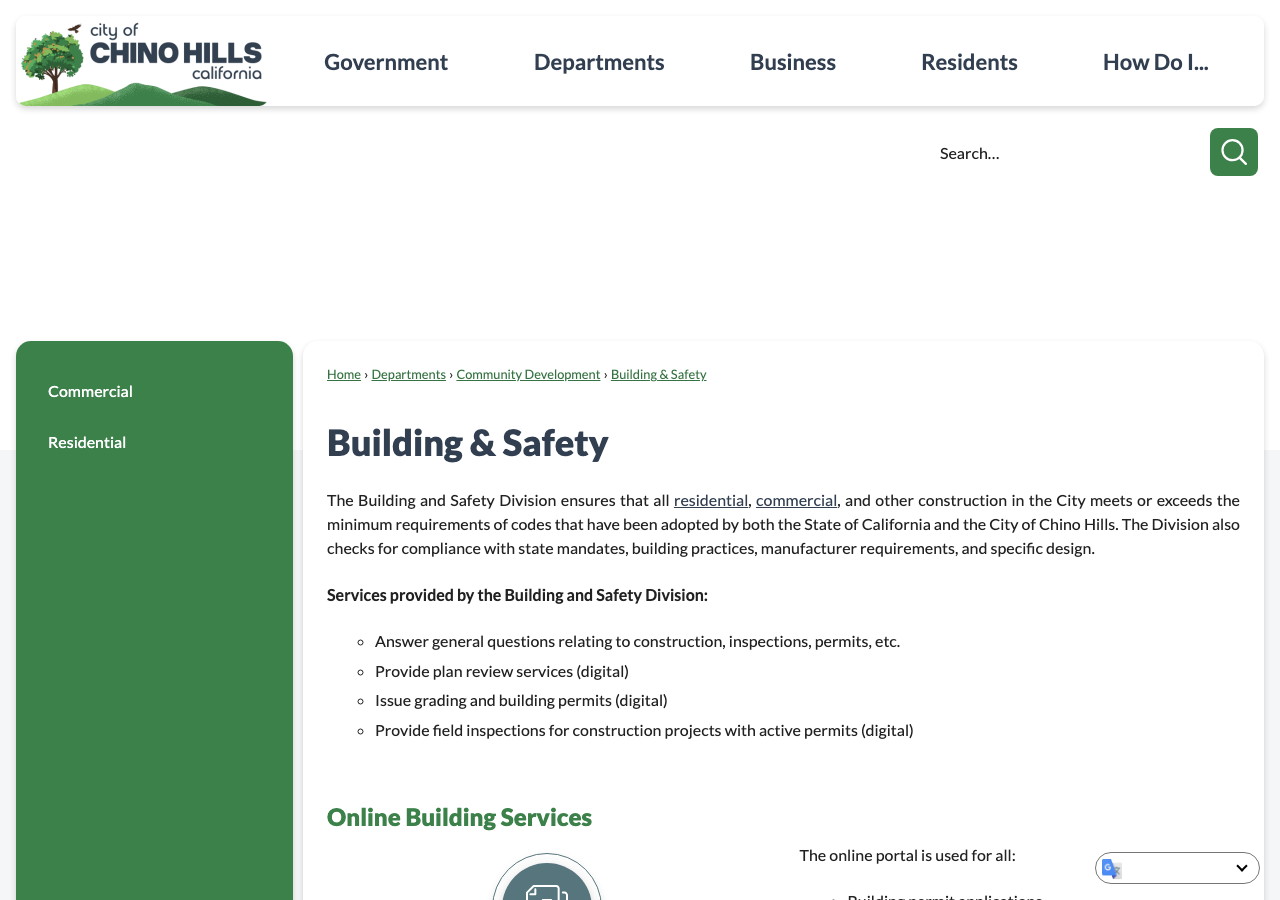
authority's own page + fire district page checked 2026-08-30 https://www.chinohills.org/122/Building-Safety
Q7 Is a homeowner permitted to self-install and self-permit? Who may apply
Yes
Why the confidence is not higherChino Valley Fire District's PV submittal requirements explicitly carve out an owner/builder path ('unless the permit is being requested as owner/builder'), and California's standard owner-builder permitting right applies at the city level since no contrary local rule was found.
fire district plan-check requirements (PDF) checked 2026-08-30 https://ca-chinovalleyfire.civicplus.com/DocumentCenter/View/130/PV-Plan-Review-Requirements-Revised-041724-PDF
Q8 What documents make up a complete submittal? Core Submittal package
SolarApp+ path: SolarApp+ approval packet + signed Smoke/CO Detector-Alarm form + Chino Valley Fire District (CVFD) approved plans, then City permit application with fees. CVFD's own submittal (required regardless of SolarApp+ use) requires: full dimensional site plan (property lines, structures, streets/alleys, setbacks, compass point); roof plan showing array/panel layout, fire setbacks, fire access pathways, conduit runs, main electrical service and inverter locations; total roof area and % covered by panels; a signage sheet showing required labeling per CEC/CFC; equipment specs/manufacturer cut sheets; and a set of wet-stamped structural calculations.
Why the confidence is not higherCombines the City's Residential Solar page (SolarApp+/permit-issuance items) with CVFD's 'Photovoltaic System Plan Check Submittal Requirements' PDF, which is the actual itemized checklist and is a precondition for the City permit. Both documents read directly, not summarized.
fire district plan-check requirements (PDF) + authority's own page checked 2026-08-30 https://ca-chinovalleyfire.civicplus.com/DocumentCenter/View/130/PV-Plan-Review-Requirements-Revised-041724-PDF
Q9 How many copies, and in what format? Submittal package
Electronic PDF only — no physical copies.
Why the confidence is not higherCVFD: 'The Chino Valley Fire District will no longer be offering in person over-the-counter plan review for photovoltaic systems/plans. All plans will only be accepted electronically.' City: SolarApp+ and the Virtual Development Services (EnerGov) portal both require uploading PDFs of required items at time of application.
fire district plan-check requirements (PDF) checked 2026-08-30 https://ca-chinovalleyfire.civicplus.com/DocumentCenter/View/130/PV-Plan-Review-Requirements-Revised-041724-PDF
Q10 Is a site plan required, and what must it show? Core Submittal package
Yes — a full dimensional site plan is required reflecting property lines, all structures, streets, alleys, setbacks, and point of compass.
Why the confidence is not higherDirectly quoted from CVFD's PV plan-check submittal requirements, which is the actual checklist governing what must be submitted before the City will issue its permit.
fire district plan-check requirements (PDF) checked 2026-08-30 https://ca-chinovalleyfire.civicplus.com/DocumentCenter/View/130/PV-Plan-Review-Requirements-Revised-041724-PDF
Q11 Is a one-line / three-line diagram required? Core Drawings & calculations
Yes (functional equivalent) — a roof plan is required reflecting the array/panel layout, all conduit runs, and the locations of the main electrical service and inverter.
Why the confidence is not higherCVFD's checklist requires this roof/electrical layout plan; it is not labeled 'one-line diagram' in those words but serves the same function and is a mandatory submittal item.
fire district plan-check requirements (PDF) checked 2026-08-30 https://ca-chinovalleyfire.civicplus.com/DocumentCenter/View/130/PV-Plan-Review-Requirements-Revised-041724-PDF
Q12 Are string and conductor calculations required? Drawings & calculations
Nothing published by this authority.
Where we lookedSearched CVFD's itemized PV plan-check submittal list (site plan, roof plan, roof-area %, signage sheet, specs/cut sheets, structural calcs) and the City's Residential Solar page for a named 'string and conductor calculations' or ampacity/voltage-drop calculation requirement; neither document names this as a required submittal item.
Q13 Is a structural PE stamp required, and at what threshold? Core Engineering & stamps
A set of wet-stamped structural calculations is required with every residential PV submittal to the fire district (no stated size/weight threshold — CVFD's document says the calcs are 'used for reference only' by the fire district, implying the actual structural adequacy determination is the City Building Division's).
Why the confidence is not higherCVFD's checklist requires 'Set of wet-stamped structural calcs (Used for reference only)' with no threshold language; I could not separately confirm a City-specific PE-stamp threshold because Chino Hills' Title 16/structural amendments were not extractable (Municode Angular shell — see note in why for zoning questions).
fire district plan-check requirements (PDF) checked 2026-08-30 https://ca-chinovalleyfire.civicplus.com/DocumentCenter/View/130/PV-Plan-Review-Requirements-Revised-041724-PDF
Q14 Is an electrical PE stamp required, and at what threshold? Engineering & stamps
Nothing published by this authority.
Where we lookedSearched CVFD's PV submittal checklist and the City's Building & Safety / Residential Solar pages for an electrical (as opposed to structural) PE-stamp requirement or threshold; none is stated in either document.
Q15 What does a residential solar permit cost? Core Fees
City: $450.00 flat (Photovoltaic Permit, Single-Family, roof- or ground-mounted) plus a 6% Technology Fee and a 0.08%-of-valuation General Plan Surcharge Fee. Fire district (Chino Valley Fire District, a mandatory separate permit): $280.00 flat ('Solar Residential', fee code 1810). Combined baseline cost ≈ $730 plus the percentage surcharges.
Why the confidence is not higherCity figure from the City's own current Master Schedule of Fees, Fines & Penalties PDF — note the Building Services section of that PDF is itself stamped 'Effective July 1, 2026', not the January 1, 2026 date in the document's URL/filename (classic stale-URL trap: read the revision stamp, not the link). Fire figure from CVFD's own Master Fee Schedule PDF, fee code 1810, flagged '[9] New Fee'; that document's header still reads 'Effective January 1, 2018' even though the fee code was added later (filename says revision 2022-01-18) — so the header date is stale too, but the $280 line item itself is current per CVFD's own published schedule.
fee schedule checked 2026-08-30 https://www.chinohills.org/DocumentCenter/View/31120/Master-Schedule-of-Fees-Effective-January-1-2026
Q16 How is the fee calculated? Core Fees
Flat
Why the confidence is not higherBoth the City's $450 PV permit fee and CVFD's $280 solar-residential fee are flat dollar amounts, not valuation-, per-kW-, or per-panel-based, per both agencies' own current fee schedules.
fee schedule checked 2026-08-30 https://www.chinohills.org/DocumentCenter/View/31120/Master-Schedule-of-Fees-Effective-January-1-2026
Q17 Is there a separate plan-check fee? Fees
No separate plan-check fee is charged up front — it is bundled into the $450 City PV permit fee. A $538 'Plan Check Re-Submittal' fee applies only after 3 review cycles.
Why the confidence is not higherCity's Master Schedule of Fees lists the PV permit as a single $450 line item with no companion plan-check line, and separately lists 'Plan Check Re-Submittal (after 3 reviews) — $538.00' as a contingent fee, not a standard upfront one.
fee schedule checked 2026-08-30 https://www.chinohills.org/DocumentCenter/View/31120/Master-Schedule-of-Fees-Effective-January-1-2026
Q18 What is the stated plan-review turnaround? Core Timeline & validity
Fire district (CVFD, the gating review): same-day if submitted via the online portal or email between 8-11 a.m. on a Tuesday or Thursday (reviewed 1-3 p.m., permit issued same day); otherwise CVFD's regular queue is 7-10 business days. The City's own building/electrical plan-review turnaround for the PV permit itself is not separately published.
Why the confidence is not higherCVFD's PV plan-check requirements PDF states the same-day/7-10-business-day turnaround explicitly. Because CVFD approval is a hard prerequisite to City permit issuance, this is the turnaround that actually controls the applicant's timeline; I looked on the City's Residential Solar and Building & Safety pages for a City-specific plan-check SLA and found none stated.
fire district plan-check requirements (PDF) checked 2026-08-30 https://ca-chinovalleyfire.civicplus.com/DocumentCenter/View/130/PV-Plan-Review-Requirements-Revised-041724-PDF
Q19 How long is an issued permit valid before it expires? Timeline & validity
Nothing published by this authority.
Where we lookedRead the full text of Building Code Adoption Ordinance No. 427 (the current 2025-cycle adoption ordinance) looking for a permit-expiration/validity-period amendment; it references 'work for which a permit has expired' twice but never states a duration or amends the standard CBC/CRC expiration section, so I could not confirm the City's actual permit-validity period from a primary source rather than assuming the generic model-code default.
https://www.chinohills.org/DocumentCenter/View/31524/Building-Code-Update-Ordinance
Q20 Which permit portal does this authority use? Core Portal & process
Virtual Development Services (VDS) — a Tyler Technologies EnerGov Self Service portal at eplselfservice.chinohills.org.
Why the confidence is not higherBoth the Residential Solar page and the Building & Safety page link the same portal for plan-check submittal, permit application, fee payment, and inspection requests.
portal landing page checked 2026-08-30 https://eplselfservice.chinohills.org/EnerGov_Prod/SelfService#/home
Q21 Can the whole application be completed online? Core Portal & process
Yes
Why the confidence is not higherBuilding & Safety page states plan review, permit issuance, and field-inspection scheduling are all 'digital' through the VDS/EnerGov portal; the Residential Solar page describes applying online and uploading all required PDFs with no in-person step described for the City side. (CVFD's separate, mandatory fire approval is obtained through CVFD's own online portal or email, not the City's — see jurisdiction notes.)
authority's own page checked 2026-08-30 https://www.chinohills.org/122/Building-Safety
Q22 Which utility handles interconnection here? Core Utility interconnection
Southern California Edison (SCE)
Why the confidence is not higherThe City's own dedicated utility page states plainly: 'Southern California Edison (SCE) ... serves the residents and businesses in the City of Chino Hills.' No Community Choice Aggregator was found — a city site-search for 'Community Choice Aggregation' returned no relevant hits, confirming SCE is the sole retail/interconnecting utility rather than assuming it from a lookup tool.
authority's own page checked 2026-08-30 https://www.chinohills.org/258/Southern-California-Edison-
Q23 Where does the utility sit in the sequence? Core Utility interconnection
Parallel to permitting, with SCE's Permission-to-Operate (PTO)/energization occurring after construction and City final inspection are complete.
Why the confidence is not higherInferred from SCE's Rule 21 page describing an online Grid Interconnection Processing Tool (GIPT) application process that customers/installers can run independently of city permitting, combined with standard Rule 21 practice that meter set/PTO follows a completed, inspected installation. I did not find a Chino-Hills-specific document stating this sequencing explicitly, so confidence is capped below 65.
utility interconnection page checked 2026-08-30 https://www.sce.com/business/generating-your-own-power/Grid-Interconnections/Interconnecting-Generation-under-Rule-21
Q24 Is a HOA or architectural approval required first? Overlays & special cases
No
Why the confidence is not higherNeither the City's Residential Solar page nor CVFD's itemized PV submittal checklist lists an HOA or architectural-review approval as a required document — both lists are exhaustive on their face (SolarApp+/CVFD packet items only), so this is a proven absence from the two governing checklists rather than a guess.
authority's own page checked 2026-08-30 https://www.chinohills.org/1926/Residential-Solar
Q25 Is there a historic-district review? Overlays & special cases
Nothing published by this authority.
Where we lookedLooked on the City's Development Code and Zoning pages for a historic-district overlay; the underlying zoning text (Title 16, Chino Hills Municipal Code) is hosted on Municode as an Angular JS application that returns an empty shell to both direct curl/WebFetch and Wayback Machine captures (confirmed via CDX: all captures of library.municode.com/ca/chino_hills are 1.7-2.6 KB, i.e. shell-only), so I could not read the actual code text to confirm or rule out a historic-district review requirement.
https://library.municode.com/ca/chino_hills/codes/code_of_ordinances
Q26 Is a wind or windstorm certification required? Overlays & special cases
No
Why the confidence is not higherCalifornia does not operate a wind/windstorm certification program analogous to the Texas Department of Insurance (TDI) windstorm certification; no such requirement appears in any City or fire-district solar material reviewed. This is an inference from the absence of any such state or local program, not a direct 'no' statement in a Chino Hills document, hence the reduced confidence.
authority's own page (absence) + general CA regulatory context checked 2026-08-30 https://www.chinohills.org/1926/Residential-Solar
Q27 Is a Specific Use Permit or Council approval ever required? Overlays & special cases
No — not required for a standard by-right residential rooftop or ground-mounted PV permit.
Why the confidence is not higherThe City's Residential Solar page and CVFD's submittal checklist describe a permit-only process (SolarApp+ or standard plan check) with no mention of a Conditional Use Permit, Specific Use Permit, or City Council approval step for a typical single-family installation. Zoning-code confirmation was not possible (see Q25/Q28 notes on the Municode Angular-shell problem), so this is held at moderate rather than high confidence.
authority's own page checked 2026-08-30 https://www.chinohills.org/1926/Residential-Solar
Q28 Is there a system-size cap on residential generation? Overlays & special cases
Nothing published by this authority.
Where we lookedLooked for a residential PV system-size cap (e.g., % of roof, kW limit, or lot-coverage limit for ground-mount) on the City's Residential Solar, Development Code, and Zoning pages. The governing zoning chapter (Title 16 of the Municipal Code) is hosted on Municode's Angular JS application, which returns an empty shell to curl, WebFetch, and every Wayback capture checked (all under 2.6 KB) — so I could not read the actual zoning text to confirm or rule out a cap.
https://library.municode.com/ca/chino_hills/codes/code_of_ordinances?nodeId=TIT16DECO
Lines marked with a percentage were read off this authority’s own published documents. Unmarked guidance is general good practice, not this jurisdiction’s rule — always confirm against the authority before you submit.
Install 5 steps · 20 questions
-
Build to the code editions actually in force here
The NEC edition a jurisdiction enforces is often a cycle behind the newest one published, and local amendments sit on top of it. Rapid shutdown, conductor sizing and labelling all change between editions, so the edition in force is the first thing to establish, not the last.
- Which NEC edition is in force? 2023 NEC (as amended, incorporated into the 2025 California Electrical Code) 88% · adopting ordinance
- Which building code edition is in force? 2025 California Building Code (Volumes 1 & 2) and 2025 California Residential Code 95% · adopting ordinance
- Which fire code edition is in force? 2022 California Fire Code (with 2021 IFC portions), per Chino Valley Independent Fire District Ordinance No. 2022-03 88% · adopting ordinance (OCR'd scan)
- Are there local amendments to any of the above? Yes 82% · adopting ordinance
- What is the installation judged against? The 2025 California Electrical Code (2023 NEC as amended) and 2025 CBC/CRC for the City permit, plus the 2022 California Fire Code and CVFD's own PV plan-check requirements (fire setbacks, access pathways, signage-per-code) for the fire district's separate, gating permit. 82% · fire district plan-check requirements (PDF)
-
Fire access, setbacks and pathways
Ridge setbacks and roof access pathways are fire-service requirements and they constrain the array layout. They are the most common cause of a redesign after the fire department comments on a plan set.
- What ridge setback and access pathways are required? Governed by the base 2022 California Fire Code (Section 605.11 rooftop PV fire-classification/access requirements) as adopted by CVFD Ordinance No. 2022-03; no CVFD-specific numeric ridge-setback amendment was found. CVFD's submittal checklist requires the roof plan to show 'fire setbacks, fire access pathways' but does not restate different numbers of its own. 62% · adopting ordinance (OCR'd scan) + fire district plan-check requirements (PDF)
-
Rapid shutdown
Which rapid-shutdown rule applies follows directly from the NEC edition in force, and the initiation device has to be at a location the fire service can reach and identify. This is inspected, and it is labelled.
- Is rapid shutdown required, and to which NEC edition? Yes — required to NEC 690.12, as incorporated by the 2025 California Electrical Code (based on the 2023 NEC). 85% · adopting ordinance (edition) + NEC 690.12 (state-adopted)
-
Labels and placards
The NEC sets a baseline for permanent markings at the service equipment and the disconnecting means. On top of that, an authority may specify its own wording, and the utility may specify more again. Where any of them writes its own text, a generic off-the-shelf label set will not pass — this is the detail most often fixed on a return visit.
- Which placards does this authority require at the service equipment? Placards/labels required at the service equipment per the California Electrical Code (NEC Article 690 marking requirements) and California Fire Code — CVFD requires a dedicated 'signage sheet' in the submittal showing all required labeling before it will approve the plan. 75% · fire district plan-check requirements (PDF)
- Does the authority specify placard wording of its own? No 80% · fire district plan-check requirements (PDF)
- Does it specify letter height, colour or material? Not specified by the City or fire district for PV service-equipment placards generally; the utility (SCE) does specify letter height for its own metering labels — 'All lettering shall be a minimum one-quarter inch in height' for Net Generation Output Metering tags. 70% · utility Electrical Service Requirements manual
- Is a site plan / facility map placard required, and what must it show? Yes (functional equivalent) — the roof plan required for fire-district approval must show the array/panel layout, fire setbacks, fire access pathways, conduit runs, and main electrical service/inverter locations, i.e. the facility-map information NEC 690/705.10 firefighter-safety placarding is meant to convey. 70% · fire district plan-check requirements (PDF)
- Does the UTILITY specify placards beyond the AHJ's? Yes — SCE's Electrical Service Requirements (ESR) manual requires Net Generation Output Metering (NGOM) equipment to be permanently labeled 'Net Generation Output Metering' on a machine-engraved phenolic tag, plus 'Grid side'/'Generation side' conductor-direction markings, and signage on isolation/lockable disconnect devices for SCE's padlock provisions. 88% · utility Electrical Service Requirements manual
- Where must the labels be placed? NGOM labels: on the meter panel or immediately adjacent to the meter socket. The AC disconnect (where a Generation Meter Adapter is used): installed directly adjacent to the meter, connected via liquid-tight flexible conduit (2 ft minimum, 3 ft maximum). 82% · utility Electrical Service Requirements manual
-
Disconnect, storage and listed equipment
Where the AC disconnect must sit relative to the meter is usually the utility's rule, not the building department's. Battery storage frequently carries its own permit, its own inspection and its own fire conditions.
- Where must the AC disconnect be, relative to the meter? Directly adjacent to the meter (utility requirement) — SCE requires 'a single, AC fuseable disconnect, with an external lockable handle... installed directly adjacent to the meter' where a Generation Meter Adapter is used, and more generally requires a disconnecting means with overcurrent protection at the meter location for every service. 85% · utility Electrical Service Requirements manual
- Must equipment be on a specific approved list? Partially — SCE maintains and references its own approved-equipment lists (UL Certified Power Control Systems, and pre-approved inverters) as part of Rule 21 review for certain interconnection types; no City- or CVFD-maintained 'approved equipment list' was found for the building/fire permits themselves. 65% · utility interconnection page
- Are batteries permitted, and under what conditions? Yes — batteries/ESS are permitted; the City's fee schedule carries a distinct 'Energy Storage System (not integrated with PV system) — $269.00' line, and CVFD's Master Fee Schedule carries a 'Special Equipment (batteries, ovens, dust, etc.) — $339.00' line (fee code 1620), separate from each agency's PV-specific fee. 75% · fee schedule
- Is there a separate ESS permit or inspection? Yes — an ESS not integrated with the PV system is a separately fee-coded item at both the City ($269) and the fire district ($339, 'Special Equipment'), implying a distinct review/inspection line from the PV permit itself. 72% · fee schedule
- Is a ground mount treated as a structure? Ambiguous/likely no separate structural 'accessory structure' treatment for permitting purposes — the City's fee schedule prices 'Photovoltaic Permit Residential - Ground Mounted' at the same $450 as roof-mounted, under the Electrical Permits section, rather than routing it through a distinct structural/accessory-building permit. 55% · fee schedule
20 questions answered against City of Chino Hills’s own published documents
Q29 Which NEC edition is in force? Core Code editions in force
2023 NEC (as amended, incorporated into the 2025 California Electrical Code)
Why the confidence is not higherBuilding Code Adoption Ordinance No. 427 adopts the '2025 California Electrical Code' by reference effective with the statewide 2025 Title 24 cycle; the 2025 CEC is based on the 2023 NEC per the California Building Standards Commission's code-adoption cycle. The ordinance itself names the CEC edition but does not spell out 'NEC 2023' verbatim, hence not scored at the top of the confidence band.
adopting ordinance checked 2026-08-30 https://www.chinohills.org/DocumentCenter/View/31524/Building-Code-Update-Ordinance
Q30 Which building code edition is in force? Core Code editions in force
2025 California Building Code (Volumes 1 & 2) and 2025 California Residential Code
Why the confidence is not higherOrdinance No. 427's title and recitals name these editions explicitly and directly (effective with the 2025 statewide code cycle); the City's Building & Safety page independently lists the same 2025-edition set as 'Currently Adopted Codes.'
adopting ordinance checked 2026-08-30 https://www.chinohills.org/DocumentCenter/View/31524/Building-Code-Update-Ordinance
Q31 Which fire code edition is in force? Code editions in force
2022 California Fire Code (with 2021 IFC portions), per Chino Valley Independent Fire District Ordinance No. 2022-03
Why the confidence is not higherOCR-read directly from CVFD's own Fire Code Ordinance PDF (scanned document, no text layer — extracted with pdftoppm + tesseract and verified against a positive control 'fire' = 188 hits / fabricated control 'zzqqx' = 0 hits). This is one cycle behind the City's 2025 building-code cycle — a genuine cross-agency mismatch, not an error: the City adopted the 2025 CBC/CRC/CEC in late 2025, but CVFD's fire code (a separate special district) has not been updated past the 2022 edition as of this check.
adopting ordinance (OCR'd scan) checked 2026-08-30 https://chinovalleyfire.org/DocumentCenter/View/127/Fire-Code-Ordinance-PDF
Q32 Are there local amendments to any of the above? Core Code editions in force
Yes
Why the confidence is not higherCity: Ordinance No. 427 amends the 2025 CRC/CBC for pools, decks, accessory structures, and code-enforcement notice procedures (none of the amendments read are solar-specific). Fire: CVFD Ordinance No. 2022-03 amends the 2022 CFC for wildland-urban-interface/access-road matters. Both were read in full; neither contains a solar/PV-specific amendment.
adopting ordinance checked 2026-08-30 https://www.chinohills.org/DocumentCenter/View/31524/Building-Code-Update-Ordinance
Q33 What is the installation judged against? Core Electrical
The 2025 California Electrical Code (2023 NEC as amended) and 2025 CBC/CRC for the City permit, plus the 2022 California Fire Code and CVFD's own PV plan-check requirements (fire setbacks, access pathways, signage-per-code) for the fire district's separate, gating permit.
Why the confidence is not higherSynthesized from Ordinance No. 427 (City code editions) and CVFD's PV Plan Review Requirements PDF, which explicitly ties its review to 'the California Electrical Code and the California Fire Code.'
fire district plan-check requirements (PDF) checked 2026-08-30 https://ca-chinovalleyfire.civicplus.com/DocumentCenter/View/130/PV-Plan-Review-Requirements-Revised-041724-PDF
Q34 Is there a local rule on service upgrades or busbar sizing? Electrical
Nothing published by this authority.
Where we lookedRead the full text of Ordinance No. 427 (79 pages, extracted with pdftotext -layout, positive control 'electrical' = 11 hits / fabricated control 'zzqqx' = 0 hits) looking for any amendment to service-upgrade, busbar, backfeed, or 120%-rule provisions; none found — the ordinance's amendments are limited to pools, decks/accessory structures, and code-enforcement procedure.
https://www.chinohills.org/DocumentCenter/View/31524/Building-Code-Update-Ordinance
Q35 Is a specific mounting system or attachment spacing required? Structural & mounting
Nothing published by this authority.
Where we lookedChecked CVFD's PV submittal checklist and Ordinance No. 427 for a locally specified mounting system, attachment type, or spacing requirement (as opposed to manufacturer ICC-ES listing compliance, which is implicit but not stated as a City/fire amendment); neither document specifies one.
Q36 What ridge setback and access pathways are required? Core Fire pathways & setbacks
Governed by the base 2022 California Fire Code (Section 605.11 rooftop PV fire-classification/access requirements) as adopted by CVFD Ordinance No. 2022-03; no CVFD-specific numeric ridge-setback amendment was found. CVFD's submittal checklist requires the roof plan to show 'fire setbacks, fire access pathways' but does not restate different numbers of its own.
Why the confidence is not higherCVFD Ordinance No. 2022-03 (OCR'd) contains no PV-specific setback amendment among its local findings/amendments sections; CVFD's PV plan-check PDF requires the pathways/setbacks to be shown on the plan but references compliance with code rather than a locally authored number.
adopting ordinance (OCR'd scan) + fire district plan-check requirements (PDF) checked 2026-08-30 https://chinovalleyfire.org/DocumentCenter/View/127/Fire-Code-Ordinance-PDF
Q37 Is rapid shutdown required, and to which NEC edition? Core Rapid shutdown
Yes — required to NEC 690.12, as incorporated by the 2025 California Electrical Code (based on the 2023 NEC).
Why the confidence is not higherRapid shutdown is a 2017-NEC-and-later requirement carried through the 2023 NEC/2025 CEC that the City has adopted by Ordinance No. 427; no local amendment removing or altering 690.12 was found in that ordinance.
adopting ordinance (edition) + NEC 690.12 (state-adopted) checked 2026-08-30 https://www.chinohills.org/DocumentCenter/View/31524/Building-Code-Update-Ordinance
Q38 Which placards does this authority require at the service equipment? Core Labels Signage & labelling
Placards/labels required at the service equipment per the California Electrical Code (NEC Article 690 marking requirements) and California Fire Code — CVFD requires a dedicated 'signage sheet' in the submittal showing all required labeling before it will approve the plan.
Why the confidence is not higherCVFD's PV Plan Review Requirements PDF: 'Signage sheet reflecting the required signage in accordance with the California Electrical Code and the California Fire Code. Examples of labeling, signs, etc. shall be provided on the plan.' No additional, City- or district-invented placard beyond code was found.
fire district plan-check requirements (PDF) checked 2026-08-30 https://ca-chinovalleyfire.civicplus.com/DocumentCenter/View/130/PV-Plan-Review-Requirements-Revised-041724-PDF
Q39 Does the authority specify placard wording of its own? Core Labels Signage & labelling
No
Why the confidence is not higherCVFD explicitly defers to state code wording rather than authoring its own: signage must be 'in accordance with the California Electrical Code and the California Fire Code' — the district requires proof of code-compliant signage, not a district-specific wording.
fire district plan-check requirements (PDF) checked 2026-08-30 https://ca-chinovalleyfire.civicplus.com/DocumentCenter/View/130/PV-Plan-Review-Requirements-Revised-041724-PDF
Q40 Does it specify letter height, colour or material? Core Labels Signage & labelling
Not specified by the City or fire district for PV service-equipment placards generally; the utility (SCE) does specify letter height for its own metering labels — 'All lettering shall be a minimum one-quarter inch in height' for Net Generation Output Metering tags.
Why the confidence is not higherNo City or CVFD document specifies placard letter height/color/material for the PV disconnect/service-equipment labels (an absence confirmed by reading both agencies' full PV documents). SCE's Electrical Service Requirements (ESR) manual, Section 12.3, gives the 1/4-inch minimum for its own NGOM equipment marking — a utility-level, not AHJ-level, specification.
utility Electrical Service Requirements manual checked 2026-08-30 https://edisonintl.sharepoint.com/:b:/t/Public/Misc/EVdZxrJXyA5EppaI_9fyHW8B-j83HKVapd0wMPOFmxuHQA?e=9HbTdO
Q41 Is a site plan / facility map placard required, and what must it show? Core Labels Signage & labelling
Yes (functional equivalent) — the roof plan required for fire-district approval must show the array/panel layout, fire setbacks, fire access pathways, conduit runs, and main electrical service/inverter locations, i.e. the facility-map information NEC 690/705.10 firefighter-safety placarding is meant to convey.
Why the confidence is not higherCVFD's PV Plan Review Requirements PDF lists this roof-plan content as a mandatory submittal item; it is not labeled a '705.10 placard' by name but serves that function and is required before permit issuance.
fire district plan-check requirements (PDF) checked 2026-08-30 https://ca-chinovalleyfire.civicplus.com/DocumentCenter/View/130/PV-Plan-Review-Requirements-Revised-041724-PDF
Q42 Does the UTILITY specify placards beyond the AHJ's? Core Labels Signage & labelling
Yes — SCE's Electrical Service Requirements (ESR) manual requires Net Generation Output Metering (NGOM) equipment to be permanently labeled 'Net Generation Output Metering' on a machine-engraved phenolic tag, plus 'Grid side'/'Generation side' conductor-direction markings, and signage on isolation/lockable disconnect devices for SCE's padlock provisions.
Why the confidence is not higherRead directly from SCE's current Electrical Service Requirements PDF, Section 12.3 'Equipment Marking/Labeling' and Section 12.5 'Switch and Disconnect Requirements' (document effective date printed on every page: 10-31-2025). This is the utility's own requirement, layered on top of, not replacing, the City/CVFD PV placard requirements.
utility Electrical Service Requirements manual checked 2026-08-30 https://edisonintl.sharepoint.com/:b:/t/Public/Misc/EVdZxrJXyA5EppaI_9fyHW8B-j83HKVapd0wMPOFmxuHQA?e=9HbTdO
Q43 Where must the labels be placed? Core Labels Signage & labelling
NGOM labels: on the meter panel or immediately adjacent to the meter socket. The AC disconnect (where a Generation Meter Adapter is used): installed directly adjacent to the meter, connected via liquid-tight flexible conduit (2 ft minimum, 3 ft maximum).
Why the confidence is not higherBoth requirements are stated explicitly in SCE's Electrical Service Requirements manual, Sections 12.3 and 12.8 (Generation Meter Adapter), effective 10-31-2025.
utility Electrical Service Requirements manual checked 2026-08-30 https://edisonintl.sharepoint.com/:b:/t/Public/Misc/EVdZxrJXyA5EppaI_9fyHW8B-j83HKVapd0wMPOFmxuHQA?e=9HbTdO
Q44 Must equipment be on a specific approved list? Equipment listing
Partially — SCE maintains and references its own approved-equipment lists (UL Certified Power Control Systems, and pre-approved inverters) as part of Rule 21 review for certain interconnection types; no City- or CVFD-maintained 'approved equipment list' was found for the building/fire permits themselves.
Why the confidence is not higherSCE's Rule 21 page states: 'Project uses a UL Certified Power Control System which has been pre-approved by SCE. A list of approved UL Certified Power Control Systems can be found...' and the equivalent for pre-approved inverters. This is a utility-level list, not an AHJ-level one, and I could not confirm it applies to every standard residential interconnection versus only specific project types.
utility interconnection page checked 2026-08-30 https://www.sce.com/business/generating-your-own-power/Grid-Interconnections/Interconnecting-Generation-under-Rule-21
Q45 Are batteries permitted, and under what conditions? Core Battery / ESS
Yes — batteries/ESS are permitted; the City's fee schedule carries a distinct 'Energy Storage System (not integrated with PV system) — $269.00' line, and CVFD's Master Fee Schedule carries a 'Special Equipment (batteries, ovens, dust, etc.) — $339.00' line (fee code 1620), separate from each agency's PV-specific fee.
Why the confidence is not higherBoth figures are read directly from each agency's own current, itemized fee schedule; neither document states installation conditions (e.g., garage-only, listing standard) for residential ESS beyond the fee itself, so this answers permissibility/fee structure rather than technical conditions.
fee schedule checked 2026-08-30 https://www.chinohills.org/DocumentCenter/View/31120/Master-Schedule-of-Fees-Effective-January-1-2026
Q46 Is there a separate ESS permit or inspection? Battery / ESS
Yes — an ESS not integrated with the PV system is a separately fee-coded item at both the City ($269) and the fire district ($339, 'Special Equipment'), implying a distinct review/inspection line from the PV permit itself.
Why the confidence is not higherInferred from both agencies' fee schedules listing ESS/battery review as separate line items from their respective solar/PV line items; neither document uses the word 'permit' explicitly next to the ESS fee, so this is an inference from fee structure rather than a direct statement.
fee schedule checked 2026-08-30 https://www.chinohills.org/DocumentCenter/View/31120/Master-Schedule-of-Fees-Effective-January-1-2026
Q47 Is a ground mount treated as a structure? Core Ground mount
Ambiguous/likely no separate structural 'accessory structure' treatment for permitting purposes — the City's fee schedule prices 'Photovoltaic Permit Residential - Ground Mounted' at the same $450 as roof-mounted, under the Electrical Permits section, rather than routing it through a distinct structural/accessory-building permit.
Why the confidence is not higherInferred solely from the fee schedule's placement of the ground-mount PV fee inside 'ELECTRICAL PERMITS AND FEES' at the same rate as roof-mount; I could not confirm from the Municode-hosted Title 16 zoning code (Angular shell, unreadable — see Q25/Q28) whether a ground-mount array over a given size still triggers a separate structural/accessory-structure determination.
fee schedule checked 2026-08-30 https://www.chinohills.org/DocumentCenter/View/31120/Master-Schedule-of-Fees-Effective-January-1-2026
Q48 Where must the AC disconnect be, relative to the meter? Core Utility equipment
Directly adjacent to the meter (utility requirement) — SCE requires 'a single, AC fuseable disconnect, with an external lockable handle... installed directly adjacent to the meter' where a Generation Meter Adapter is used, and more generally requires a disconnecting means with overcurrent protection at the meter location for every service.
Why the confidence is not higherRead directly from SCE's Electrical Service Requirements manual, Sections 11.0 and 12.8, effective 10-31-2025. Note: the 'on.sce.com/InterconnectionHandbook' shortlink and the Rule 21 tariff itself redirect to gated Microsoft SharePoint OAuth pages I could not open; this answer instead comes from the ESR manual, whose SharePoint 'Public' share link, unusually, resolved to a directly downloadable PDF via curl rather than an OAuth prompt (verified: HTTP 200, content-type application/pdf, 8.5 MB, dated 10-31-2025 throughout).
utility Electrical Service Requirements manual checked 2026-08-30 https://edisonintl.sharepoint.com/:b:/t/Public/Misc/EVdZxrJXyA5EppaI_9fyHW8B-j83HKVapd0wMPOFmxuHQA?e=9HbTdO
Lines marked with a percentage were read off this authority’s own published documents. Unmarked guidance is general good practice, not this jurisdiction’s rule — always confirm against the authority before you submit.
Inspection 5 steps · 14 questions
-
Book it
Booking is a portal, a phone call or an email depending on the authority, and the notice required is rarely zero. Book before the work is finished rather than after — the lead time, not the work, is usually what sets the date.
- How is an inspection booked? Portal 90% · authority's own page
- How much notice is required? Effectively next business day if requested by 2:00 p.m.; requests after 2:00 p.m. roll to the day following the next business day (e.g., after 2 p.m. Friday schedules for Tuesday). 88% · authority's own page
-
Know who turns up
Some authorities inspect their own solar work; some delegate it, and a few do not inspect the PV equipment itself at all. Who is coming determines what they will look at.
- Does this AHJ perform its own final solar inspection? Yes 78% · authority's own page
- If delegated, to whom? Not delegated for the building/electrical portion (City inspects that itself). The fire/life-safety portion is inspected by Chino Valley Independent Fire District, a separate special district with its own original jurisdiction over its own PV permit — not a delegation by the City but a coequal, gating agency. 75% · fire district page
-
Work the stages in order
A rough-in or mid-roof inspection, where one is required, has to happen before the work it covers is closed up. Missing a stage means opening something back up, and it is the most expensive kind of correction.
- Which inspections are required, and in what order? 1) CVFD PV plan review and CVFD permit issuance (must precede City permit — 'Each of these agencies will not issue building permits prior to approval and issuance of a permit from the Fire District'); 2) City building/electrical PV permit issuance via the VDS portal; 3) City field inspection(s) of the installed system; 4) (implied) CVFD field verification of its own permit conditions. 72% · fire district plan-check requirements (PDF)
-
Have the paperwork on site
The approved plan set, the permit, and the equipment listings should be on site and reachable. Inspectors routinely verify that installed equipment matches what was approved, and that the labels are the ones the plan set promised.
- Does the inspector verify labels and listings? Yes (inferred from practice) 68% · fire district plan-check requirements (PDF)
-
Sign-off, and permission to operate
Passing gives you a final or an equivalent sign-off. That is not the same as permission to operate: PTO comes from the utility, and who tells the utility the inspection passed varies. A system left switched off for weeks is usually waiting on this handover.
- Who notifies the utility for PTO? Installer 62% · utility interconnection page
- Is there a re-inspection fee? $336.00 90% · fee schedule
- How are corrections issued and cleared? Corrections are handled through the Virtual Development Services (EnerGov) portal; for the PV-specific revision path, the Residential Solar page states any revision to approved plans requires new approval from CVFD, from SolarApp+ (if that path was used), and from the Building & Safety Division before resubmission via the portal. 68% · authority's own page
14 questions answered against City of Chino Hills’s own published documents
Q49 How is an inspection booked? Core Booking & scheduling
Portal
Why the confidence is not higher'All inspection requests are made online through your Virtual Development Services customer portal' — City's Building & Safety page, current text.
authority's own page checked 2026-08-30 https://www.chinohills.org/122/Building-Safety
Q50 How much notice is required? Core Booking & scheduling
Effectively next business day if requested by 2:00 p.m.; requests after 2:00 p.m. roll to the day following the next business day (e.g., after 2 p.m. Friday schedules for Tuesday).
Why the confidence is not higherQuoted directly from the Building & Safety page's Inspections section, current text with a worked Friday example.
authority's own page checked 2026-08-30 https://www.chinohills.org/122/Building-Safety
Q51 Are same-day or AM/PM windows offered? Booking & scheduling
Nothing published by this authority.
Where we lookedRead the Building & Safety page's full Inspections paragraph (booking cutoff, cancellation, re-inspection-fee risk) looking for any stated AM/PM inspection window; none is mentioned — only the next-day booking cutoff.
Q52 Does this AHJ perform its own final solar inspection? Core Who inspects
Yes
Why the confidence is not higherBuilding & Safety page lists 'Provide field inspections for construction projects with active permits (digital)' as a Division service, meaning the City performs its own inspections rather than delegating the building/electrical portion. Note the fire district separately inspects for its own permit ('Construction-related inspection costs are included in the permit fees' — CVFD Inspections page), so on the fire side inspection sits with CVFD, not the City.
authority's own page checked 2026-08-30 https://www.chinohills.org/122/Building-Safety
Q53 If delegated, to whom? Core Who inspects
Not delegated for the building/electrical portion (City inspects that itself). The fire/life-safety portion is inspected by Chino Valley Independent Fire District, a separate special district with its own original jurisdiction over its own PV permit — not a delegation by the City but a coequal, gating agency.
Why the confidence is not higherSynthesized from the City's Building & Safety page (self-performed inspections) and CVFD's Inspections page statement that construction-related inspection costs are included in CVFD's own permit fees.
fire district page checked 2026-08-30 https://chinovalleyfire.org/176/Inspections
Q54 Which inspections are required, and in what order? Core Stages & sequence
1) CVFD PV plan review and CVFD permit issuance (must precede City permit — 'Each of these agencies will not issue building permits prior to approval and issuance of a permit from the Fire District'); 2) City building/electrical PV permit issuance via the VDS portal; 3) City field inspection(s) of the installed system; 4) (implied) CVFD field verification of its own permit conditions.
Why the confidence is not higherSteps 1-2 are stated explicitly in CVFD's PV Plan Review Requirements PDF and the City's Residential Solar page; step 3 is stated on the Building & Safety page; step 4 is inferred from CVFD's Inspections page statement that inspection costs are bundled into its permit fees, not from an explicit sequence diagram.
fire district plan-check requirements (PDF) checked 2026-08-30 https://ca-chinovalleyfire.civicplus.com/DocumentCenter/View/130/PV-Plan-Review-Requirements-Revised-041724-PDF
Q55 Is a rough-in or mid-roof inspection required? Stages & sequence
Nothing published by this authority.
Where we lookedLooked at the City's Residential Solar and Building & Safety pages and CVFD's PV plan-check PDF for a stated rough-in/mid-roof inspection requirement (as distinct from a single final); none of the three documents mentions an interim inspection stage for PV specifically.
Q56 Does the inspector verify labels and listings? Core What is checked
Yes (inferred from practice)
Why the confidence is not higherCVFD requires a 'signage sheet' showing all required labeling as part of the approved plan set, and standard field-inspection practice verifies the built condition (including installed labels) matches approved plans; no document states 'the inspector checks labels' in those exact words, so this is inference rather than a direct statement, capping confidence.
fire district plan-check requirements (PDF) checked 2026-08-30 https://ca-chinovalleyfire.civicplus.com/DocumentCenter/View/130/PV-Plan-Review-Requirements-Revised-041724-PDF
Q57 Is there a published inspection checklist? Core What is checked
Nothing published by this authority.
Where we lookedSearched the City's Building & Safety, Inspection Services (Public Works), and Residential Solar pages for a published, itemized field-inspection checklist specific to PV (as distinct from the pre-permit submittal checklist, which does exist); none was found — Public Works' 'Inspection Services' page covers right-of-way/grading, not building/electrical PV inspection.
Q58 What must be on site at inspection? Core Documents on site
Nothing published by this authority.
Where we lookedLooked on the Building & Safety and Residential Solar pages for a stated list of documents required to be on-site at the time of inspection (e.g., approved plans, permit card); neither page states this explicitly, only that inspections are booked through the portal.
Q59 Is there a re-inspection fee? Corrections & re-inspection
$336.00
Why the confidence is not higher'Re-Inspection Fee — $336.00' is listed in the City's current Master Schedule of Fees, Fines & Penalties (Building Services section); the Building & Safety page separately warns that 'if no one is home or access is not provided on the scheduled day, a re-inspection fee may be incurred,' confirming this fee applies to solar inspections like any other permit.
fee schedule checked 2026-08-30 https://www.chinohills.org/DocumentCenter/View/31120/Master-Schedule-of-Fees-Effective-January-1-2026
Q60 How are corrections issued and cleared? Corrections & re-inspection
Corrections are handled through the Virtual Development Services (EnerGov) portal; for the PV-specific revision path, the Residential Solar page states any revision to approved plans requires new approval from CVFD, from SolarApp+ (if that path was used), and from the Building & Safety Division before resubmission via the portal.
Why the confidence is not higherThe 'Revisions' section of the City's Residential Solar page states this three-way re-approval requirement; the general corrections/comments workflow inside the EnerGov portal itself is not documented in city-facing text I could read, so the process description leans on the revision-specific paragraph rather than a general inspection-correction SLA.
authority's own page checked 2026-08-30 https://www.chinohills.org/1926/Residential-Solar
Q61 What is issued on pass? Core Final sign-off & PTO
Nothing published by this authority.
Where we lookedChecked the Building & Safety and Residential Solar pages, and ran City site-search queries for 'green tag' and 'final inspection' (both searches worked — 'final inspection' alone returned 405 results, none naming a specific pass/fail document type for PV), looking for the specific document/term issued when a solar inspection passes (CO / Final / Green tag / Letter). None of the sources names one of these terms specifically for PV sign-off.
Q62 Who notifies the utility for PTO? Core Final sign-off & PTO
Installer
Why the confidence is not higherSCE's Rule 21 page describes generation-interconnection applications (including the completion/energization step) as something the customer/installer manages online through SCE's Grid Interconnection Processing Tool (GIPT), rather than the City submitting anything to SCE. No Chino-Hills-specific document states this in so many words, so confidence is held at the low end of the 'reliable secondary source / inference' band.
utility interconnection page checked 2026-08-30 https://www.sce.com/business/generating-your-own-power/Grid-Interconnections/Interconnecting-Generation-under-Rule-21
Lines marked with a percentage were read off this authority’s own published documents. Unmarked guidance is general good practice, not this jurisdiction’s rule — always confirm against the authority before you submit.
Jurisdiction & key facts
The standing 62-question set, answered for City of Chino Hills against this authority’s own published documents. Every answer carries the confidence it was recorded at and the document it came from. Where nothing is published we say so and show where we looked — a blank here is a finding, not a gap.
City of Chino Hills is the authority having jurisdiction 90% confidence
- Holds
- Building and Electrical — a single Photovoltaic Permit issued by the City's Community Development Department, Building & Safety Division
- Delegated to
- Fire/life-safety plan review and permit issuance sit with Chino Valley Independent Fire District (CVFD) — a separate special district with its own elected Board of Directors covering Chino Hills and the City of Chino, NOT a Chino Hills city department and NOT San Bernardino County Fire. The City states in writing that it 'will not issue building permits prior to approval and issuance of a permit from the Fire District,' making CVFD's approval a hard gate ahead of the City's own permit, not a delegation the City can waive.
- Overridden by
- None found overriding the City's building/electrical authority itself. SCE (the interconnecting utility, confirmed from the City's own utility page — no Community Choice Aggregator was found serving Chino Hills) separately controls interconnection and Permission-to-Operate under Rule 21, independent of City permitting.
- Why not higher
- The City's own Residential Solar and Building & Safety pages, plus its Fire department page ('Chino Valley Fire District ... is not a City Department but a separate political agency with its own elected Board of Directors'), together establish that the City is the AHJ for building/electrical but cannot issue its permit until CVFD — confirmed independently on CVFD's own site as serving Chino Hills — approves and issues its own PV permit first. This corrects the brief's suggestion to check for San Bernardino County Fire: county fire does not serve incorporated Chino Hills; CVFD, an independent special district, does.
Check the code edition before you build
This authority's published code edition does not match what the state has adopted. That usually means the authority's ordinance has not been updated for the current cycle — but a local amendment can also be lawful. Confirm with the building department before you submit.
- Permit required
- Yes96%
- Permit cost
- City: $450.00 flat (Photovoltaic Permit, Single-Family, roof- or ground-mounted) plus a 6% Technology Fee and a 0.08%-of-valuation General Plan Surcharge Fee.85%
- Plan review
- Fire district (CVFD, the gating review): same-day if submitted via the online portal or email between 8-11 a.m.72%
- Portal
- Virtual Development Services (VDS) — a Tyler Technologies EnerGov Self Service portal at eplselfservice.chinohills.org.92%
- Electrical code
- 2023 NEC (as amended, incorporated into the 2025 California Electrical Code)88%
- Own placard wording
- No80%
- Booking an inspection
- Portal90%
Labels & placards for this authority
Wording 80%
No
Size, colour & material 70%
Not specified by the City or fire district for PV service-equipment placards generally; the utility (SCE) does specify letter height for its own metering labels — 'All lettering shall be a minimum one-quarter inch in height' for Net Generation Output Metering tags.
Where they go 82%
NGOM labels: on the meter panel or immediately adjacent to the meter socket. The AC disconnect (where a Generation Meter Adapter is used): installed directly adjacent to the meter, connected via liquid-tight flexible conduit (2 ft minimum, 3 ft maximum).
What the utility wants on top 88%
Yes — SCE's Electrical Service Requirements (ESR) manual requires Net Generation Output Metering (NGOM) equipment to be permanently labeled 'Net Generation Output Metering' on a machine-engraved phenolic tag, plus 'Grid side'/'Generation side' conductor-direction markings, and signage on isolation/lockable disconnect devices for SCE's padlock provisions.
Each figure above is sourced and dated in the full answer set below (questions 38–43). Where an authority’s own published sheet is older than the code it has adopted, the answer says so.

Average approval time — application to PTO
From the CPUC interconnection record. Bars show the average days taken each year; a year with no recorded projects is left blank rather than drawn as zero.