
City of Chino
San Bernardino County
City of Chino is a city authority in the State of California, serving 91,403 residents. 8,037 residential solar installs are on record here. This page is the permit route for that jurisdiction: the fifteen steps from working out who has a say over an address through to permission to operate, the documents this authority publishes, the 2025 Edition code cycle it enforces, and 62 answers taken from those documents and dated.
Permitting 5 steps · 28 questions
Whether a permit is needed — Yes Q3 Electrical and building permits — Combined - issued as a single 'Residential Solar' application in the Accela ACA portal (per the City's SolarAPP+ How-To Guide) that bundles structural/roof-plan… Q4 Plan review — Same-day auto-issuance is available for eligible systems via SolarAPP+ (currently in pilot mode with limited access) through the ACA portal. Q18 Where you file — Accela Citizen Access (ACA) at aca.cityofchino.org/citizenaccess, paired with SolarAPP+ (solarapp.nrel.gov) for eligible systems. Q20
- Permit required
- Yes95% source
- What it costs
- $450.00 base fee (capped at $500.00) plus $15 per kW for each kW above 15 kW, for systems up to 51 kW - the typical residential tier.93% source
- Plan review turnaround
- Same-day auto-issuance is available for eligible systems via SolarAPP+ (currently in pilot mode with limited access) through the ACA portal.78% source
- Key document
- department checklist cited by 7 open the document
-
Confirm who has a say over your address
A city address is usually permitted by the city, not the county — but not always, and some authorities keep building and hand electrical to someone else. Getting this wrong costs the whole submittal, because every requirement below belongs to whoever actually holds jurisdiction. Check the overlays in the same pass: an HOA, a historic district, a windstorm certification or a system-size cap can reshape the design, and all of them are cheaper to find now than after the array is laid out.
- Is this authority the AHJ for residential solar at this address? Yes 95% · department page
- What does this authority permit itself, and what does it delegate? Both (Building and Electrical are issued/enforced by the City's Development Services Building Division); fire-code plan review/approval is held by the separate Chino Valley Fire District, not delegated by the City but a co-equal statutory approval the City requires before it will issue its own permit. 90% · department checklist
- Is a permit required for a residential rooftop PV system? Yes 95% · fee schedule
- Is there a separate electrical permit, or is it combined? Combined - issued as a single 'Residential Solar' application in the Accela ACA portal (per the City's SolarAPP+ How-To Guide) that bundles structural/roof-plan review and electrical review under one permit number, though the Building Fee Schedule files the PV fee line under the 'ELECTRICAL PERMITS' heading. 72% · department how-to guide
- Is a HOA or architectural approval required first? No - the City's Zoning Code states roof- and ground-mounted residential solar panels require no zoning clearance, and HOA/architectural review is not listed as a City permitting prerequisite. 72% · zoning ordinance (Series 500)
- Is there a historic-district review? No solar-specific historic-district trigger - the Renewable Energy Structures section (§20.501.050) contains no cross-reference to historic-district review, unlike other sections of the same Title 20 update (e.g., ADU and detached-garage-demolition provisions) which do explicitly reference 'architecturally and historically significant historic district' status. 68% · zoning ordinance (Series 500)
- Is a wind or windstorm certification required? No stand-alone wind/windstorm certification program - required wind design (Basic Wind Speed 110 MPH, Exposure C, per the Building Division's Current Codes Adopted sheet) is addressed within the structural/lateral calculations required by the Solar PV Submittal Requirements, not through a separate certification instrument. 68% · department reference sheet
- Is a Specific Use Permit or Council approval ever required? No - the Zoning Code exempts small residential rooftop solar from zoning clearance entirely (an expedited/ministerial review per Gov. Code §65850.5), so no Specific Use Permit or Council/Planning Commission approval is required. 82% · zoning ordinance (Series 500)
- Is there a system-size cap on residential generation? No explicit residential system-size (kW) cap found. The Zoning Code caps ground-mounted panel height at 8 feet and bars front-setback placement for multi-family/non-residential installations, but does not state a generation-capacity cap for single-family residential systems. 72% · zoning ordinance (Series 500)
-
Check who is allowed to apply
Several authorities require the electrical permit to be pulled by a licensed electrician, or require the contractor to be registered with them BEFORE applying. Registration is not same-day. This is second on the list rather than fourth because it is the step most likely to stop the job before the drawings matter.
- Who is allowed to pull the electrical permit? Either - a State-licensed contractor holding a B, C-46, or C-10 classification (or 'Qualified personal' with certification), or a homeowner acting as owner-builder per the Building Permit Application's owner-builder declaration. 88% · department checklist
- Must the contractor be registered with this authority before applying? No separate City pre-registration is described for the City's own ACA portal beyond a standard portal account and providing valid CA contractor license info at application. (Note: Chino Valley Fire District, which must separately approve PV plans, does require contractors to contact its office to add their company and license to its database before using its own online permit portal.) 62% · fire district checklist
- Is a homeowner permitted to self-install and self-permit? Yes 88% · permit application form
-
Build the submittal package
Almost everywhere wants a site plan, a one-line or three-line electrical diagram, equipment cut sheets with listings, and a structural attachment detail. Build it against the published checklist rather than the last jurisdiction you worked in — the checklist is what the reviewer marks against.
- What documents make up a complete submittal? Site plan, roof plan (with array/panel layout and dimensions), structural calculations (by PE/architect), electrical plan, manufacturer specification sheets, installation instructions and U.L. listings, plus a separate Chino Valley Fire District approval (site plan showing fire setbacks/access pathways, signage sheet, spec sheets, wet-stamped structural calcs for reference). 93% · department checklist
- How many copies, and in what format? Electronic only via the Accela ACA online portal: plan drawings as a single combined multipage PDF or PDF/A ('Plans' file, landscape orientation, min. 10pt font, bookmarked by sheet); supporting documents (calcs, specs) as separate PDFs, portrait allowed. Walk-in submittal on USB/CD is also accepted at the counter for the general plan submittal process. 85% · department checklist
- Is a site plan required, and what must it show? Yes - a site plan (projected with the roof plan) must show the location and dimensions of all PV equipment and arrays, property lines/setbacks, and (per the Fire District) fire access pathways and setbacks, main electrical service and inverter locations. 92% · department checklist
- Is a one-line / three-line diagram required? Yes (referred to in the submittal checklist as an 'electrical plan' rather than explicitly 'one-line/three-line diagram', but this is the industry-standard document required as part of the electrical plan submittal). 68% · department checklist
- Is a structural PE stamp required, and at what threshold? Yes, for all residential PV systems (no minimum-size exemption threshold stated) - structural calculations to verify supporting members are adequate, and lateral calculations per the roof-framing section, must be provided by a licensed professional engineer or architect. Note: the handout's internal citation is to '2022 C.BC 3403.2.3.1#2' even though the City's currently adopted edition is the 2025 CBC (Ord. 2013-009 §3) - the handout has not been updated to the current code cycle. 85% · department checklist
- Is an electrical PE stamp required, and at what threshold? No separate electrical PE-stamp threshold is specified; electrical plans/work must be prepared or performed under a licensed C-46/C-10/B contractor rather than requiring a stamped electrical engineering plan. 58% · department checklist
-
Apply and pay
Most authorities now take the whole application through a portal, and several states cap or constrain what a residential solar permit may cost. Check whether plan check is billed separately before you quote the job.
- Which permit portal does this authority use? Accela Citizen Access (ACA) at aca.cityofchino.org/citizenaccess, paired with SolarAPP+ (solarapp.nrel.gov) for eligible systems. 85% · department how-to guide
- Can the whole application be completed online? Yes, for eligible systems - SolarAPP+ automated review plus ACA online application and fee payment; note SolarAPP+ access is currently described as 'pilot mode' with limited access. 78% · department how-to guide
- What does a residential solar permit cost? $450.00 base fee (capped at $500.00) plus $15 per kW for each kW above 15 kW, for systems up to 51 kW - the typical residential tier. 93% · fee schedule
- How is the fee calculated? Tiered (a capped base fee plus a per-kW rate above a threshold; three tiers by system size: ≤15kW/up to 51kW, 51-250kW, >250kW). 93% · fee schedule
-
Plan review — and start the utility in parallel
Interconnection is a separate process from the permit and usually the longer pole. Where the utility does not depend on the permit being issued, running both at once is the single biggest saving available on a residential job.
- What is the stated plan-review turnaround? Same-day auto-issuance is available for eligible systems via SolarAPP+ (currently in pilot mode with limited access) through the ACA portal. For plans routed to the Fire District (a mandatory separate approval), same-day review is offered Tuesdays/Thursdays for submittals between 8-11am, otherwise 7-10 business days. General (non-solar-specific) City plan-check turnaround per an older Building FAQ is 4-5 weeks for first review, 1-2 weeks for subsequent reviews - that FAQ is dated Jan 2020 and may not reflect the current SolarAPP+ / expedited-review process required by Gov. Code §65850.5. 78% · department/district document
- How long is an issued permit valid before it expires? 180 days after issuance, or 180 days after work is suspended/abandoned; one no-cost 180-day extension may be granted by the Building Official if requested in writing before expiration. 80% · department FAQ
- Which utility handles interconnection here? Southern California Edison (SCE) 60% · utility company page (general, does not name Chino)
- Where does the utility sit in the sequence? Parallel/After permit - Contractor obtains the City (and Fire District) permit and completes installation and City final inspection independent of utility interconnection paperwork; Permission-to-Operate (PTO) from the utility follows completion, based on the standard sequence implied by the SolarAPP+ How-To Guide's own step 4 ('Getting an Inspection... once your project is complete'). 52% · department how-to guide
28 questions answered against City of Chino’s own published documents
Q1 Is this authority the AHJ for residential solar at this address? Core Jurisdiction & scope
Yes
Why the confidence is not higherCity's own Building Division page states it enforces the Uniform Building/Electrical Codes and issues permits citywide; the Solar Photovoltaic System Submittal Requirements handout is published specifically for residential-scale PV under this department.
department page checked 2026-08-30 https://www.cityofchino.org/178/Building
Q2 What does this authority permit itself, and what does it delegate? Core Jurisdiction & scope
Both (Building and Electrical are issued/enforced by the City's Development Services Building Division); fire-code plan review/approval is held by the separate Chino Valley Fire District, not delegated by the City but a co-equal statutory approval the City requires before it will issue its own permit.
Why the confidence is not higherCity Building page + Solar PV Submittal Requirements name the City as issuer; CVFD's own PV Plan Review doc states the City will not issue its permit before CVFD approval.
department checklist checked 2026-08-30 https://www.cityofchino.org/DocumentCenter/View/3820/Solar-Photovoltaic-System-Submittal-Requirements_2023-PDF
Q3 Is a permit required for a residential rooftop PV system? Core Jurisdiction & scope
Yes
Why the confidence is not higherSolar Photovoltaic System Submittal Requirements handout and the Building Division Fee Schedule both treat residential PV as a permitted activity with its own fee line ('Photovoltaic Systems').
fee schedule checked 2026-08-30 https://www.cityofchino.org/DocumentCenter/View/8335/Building-Fee-Schedule-Updated-June-25-2026-PDF
Q4 Is there a separate electrical permit, or is it combined? Core Jurisdiction & scope
Combined - issued as a single 'Residential Solar' application in the Accela ACA portal (per the City's SolarAPP+ How-To Guide) that bundles structural/roof-plan review and electrical review under one permit number, though the Building Fee Schedule files the PV fee line under the 'ELECTRICAL PERMITS' heading.
Why the confidence is not higherSolarAPP+ How-To Guide walks the applicant through one 'Building Permit Application > Residential > Residential Solar' path; the fee schedule places 'Photovoltaic Systems' fee under Electrical Permits rather than a separate Building Permit valuation line, which is somewhat ambiguous.
department how-to guide checked 2026-08-30 https://www.cityofchino.org/DocumentCenter/View/5958/SolarAPP-How-To-Guide-PDF
Q5 Who is allowed to pull the electrical permit? Core Who may apply
Either - a State-licensed contractor holding a B, C-46, or C-10 classification (or 'Qualified personal' with certification), or a homeowner acting as owner-builder per the Building Permit Application's owner-builder declaration.
Why the confidence is not higherSolar PV Submittal Requirements item 4 lists the allowed contractor classifications; the Building Permit Application form includes a standard CA owner-builder declaration section.
department checklist checked 2026-08-30 https://www.cityofchino.org/DocumentCenter/View/3820/Solar-Photovoltaic-System-Submittal-Requirements_2023-PDF
Q6 Must the contractor be registered with this authority before applying? Core Who may apply
No separate City pre-registration is described for the City's own ACA portal beyond a standard portal account and providing valid CA contractor license info at application. (Note: Chino Valley Fire District, which must separately approve PV plans, does require contractors to contact its office to add their company and license to its database before using its own online permit portal.)
Why the confidence is not higherNo City page describes contractor pre-registration; the CVFD PV Plan Review handout explicitly requires contractors be added to CVFD's database before using its portal, so this could be conflated with the City requirement if not read carefully.
fire district checklist checked 2026-08-30 https://www.chinovalleyfire.org/DocumentCenter/View/130/PV-Plan-Review-Requirements-PDF
Q7 Is a homeowner permitted to self-install and self-permit? Who may apply
Yes
Why the confidence is not higherThe City's Building Permit Application form includes an Owner-Builder Declaration section (2b) citing Business & Professions Code §7044, allowing an owner to self-perform work including presumably PV installation on their own residence.
permit application form checked 2026-08-30 https://www.cityofchino.org/DocumentCenter/View/5624/Building-Permit-Application-PDF
Q8 What documents make up a complete submittal? Core Submittal package
Site plan, roof plan (with array/panel layout and dimensions), structural calculations (by PE/architect), electrical plan, manufacturer specification sheets, installation instructions and U.L. listings, plus a separate Chino Valley Fire District approval (site plan showing fire setbacks/access pathways, signage sheet, spec sheets, wet-stamped structural calcs for reference).
Why the confidence is not higherCombines the City's own Solar Photovoltaic System Submittal Requirements and the Fire District's PV Plan Check Submittal Requirements, both current City/District documents.
department checklist checked 2026-08-30 https://www.cityofchino.org/DocumentCenter/View/3820/Solar-Photovoltaic-System-Submittal-Requirements_2023-PDF
Q9 How many copies, and in what format? Submittal package
Electronic only via the Accela ACA online portal: plan drawings as a single combined multipage PDF or PDF/A ('Plans' file, landscape orientation, min. 10pt font, bookmarked by sheet); supporting documents (calcs, specs) as separate PDFs, portrait allowed. Walk-in submittal on USB/CD is also accepted at the counter for the general plan submittal process.
Why the confidence is not higherCity's Plan Submittal Requirements handout describes the electronic format in detail; it is dated as a general (non-solar-specific) requirements doc but is the current published standard referenced by the solar handout.
department checklist checked 2026-08-30 https://www.cityofchino.org/DocumentCenter/View/3819/Plan-Submittal-Requirements-_2023-PDF
Q10 Is a site plan required, and what must it show? Core Submittal package
Yes - a site plan (projected with the roof plan) must show the location and dimensions of all PV equipment and arrays, property lines/setbacks, and (per the Fire District) fire access pathways and setbacks, main electrical service and inverter locations.
Why the confidence is not higherDirectly stated in both the City's Solar PV Submittal Requirements and CVFD's PV Plan Review Requirements.
department checklist checked 2026-08-30 https://www.cityofchino.org/DocumentCenter/View/3820/Solar-Photovoltaic-System-Submittal-Requirements_2023-PDF
Q11 Is a one-line / three-line diagram required? Core Drawings & calculations
Yes (referred to in the submittal checklist as an 'electrical plan' rather than explicitly 'one-line/three-line diagram', but this is the industry-standard document required as part of the electrical plan submittal).
Why the confidence is not higherThe City's own checklist item 1 lists 'electrical plan' as a required attachment but does not use the specific term 'one-line diagram'; inferring the standard meaning.
department checklist checked 2026-08-30 https://www.cityofchino.org/DocumentCenter/View/3820/Solar-Photovoltaic-System-Submittal-Requirements_2023-PDF
Q12 Are string and conductor calculations required? Drawings & calculations
Nothing published by this authority.
Where we lookedCity's Solar Photovoltaic System Submittal Requirements handout (lists site plan, roof plan, structural calcs, electrical plan, spec sheets/UL listings) - no line item for string sizing or conductor ampacity calculations specifically.
Q13 Is a structural PE stamp required, and at what threshold? Core Engineering & stamps
Yes, for all residential PV systems (no minimum-size exemption threshold stated) - structural calculations to verify supporting members are adequate, and lateral calculations per the roof-framing section, must be provided by a licensed professional engineer or architect. Note: the handout's internal citation is to '2022 C.BC 3403.2.3.1#2' even though the City's currently adopted edition is the 2025 CBC (Ord. 2013-009 §3) - the handout has not been updated to the current code cycle.
Why the confidence is not higherSolar PV Submittal Requirements items 4-5 state this plainly; the code-year mismatch between the handout (2022 CBC) and the City's current adoption table (2025 CBC) is a real tension, flagged rather than resolved.
department checklist checked 2026-08-30 https://www.cityofchino.org/DocumentCenter/View/3820/Solar-Photovoltaic-System-Submittal-Requirements_2023-PDF
Q14 Is an electrical PE stamp required, and at what threshold? Engineering & stamps
No separate electrical PE-stamp threshold is specified; electrical plans/work must be prepared or performed under a licensed C-46/C-10/B contractor rather than requiring a stamped electrical engineering plan.
Why the confidence is not higherSolar PV Submittal Requirements only requires PE/architect stamps for structural/lateral calcs (item 4-5), and separately lists allowed contractor classes (item 4, administrative); no electrical-PE-specific threshold appears anywhere in the checklist.
department checklist checked 2026-08-30 https://www.cityofchino.org/DocumentCenter/View/3820/Solar-Photovoltaic-System-Submittal-Requirements_2023-PDF
Q15 What does a residential solar permit cost? Core Fees
$450.00 base fee (capped at $500.00) plus $15 per kW for each kW above 15 kW, for systems up to 51 kW - the typical residential tier.
Why the confidence is not higherCurrent Building Division Fee Schedule, revision stamp 'REV Jun. 25, 26' effective 1 Jul 2026, lists this exact tier under 'Photovoltaic Systems'.
fee schedule checked 2026-08-30 https://www.cityofchino.org/DocumentCenter/View/8335/Building-Fee-Schedule-Updated-June-25-2026-PDF
Q16 How is the fee calculated? Core Fees
Tiered (a capped base fee plus a per-kW rate above a threshold; three tiers by system size: ≤15kW/up to 51kW, 51-250kW, >250kW).
Why the confidence is not higherDirectly stated in the same current fee schedule.
fee schedule checked 2026-08-30 https://www.cityofchino.org/DocumentCenter/View/8335/Building-Fee-Schedule-Updated-June-25-2026-PDF
Q17 Is there a separate plan-check fee? Fees
Nothing published by this authority.
Where we lookedBuilding Division Fee Schedule (current, eff. 1 Jul 2026) - lists a single tiered 'Photovoltaic Systems' fee line under Electrical Permits without a separately broken-out plan-check percentage, unlike the general 'BUILDING PERMITS' section which does list 'Plan Check Fees: Building-75% of building permit fee.' Could not determine whether that 75% plan-check add-on also applies to the PV fee line.
https://www.cityofchino.org/DocumentCenter/View/8335/Building-Fee-Schedule-Updated-June-25-2026-PDF
Q18 What is the stated plan-review turnaround? Core Timeline & validity
Same-day auto-issuance is available for eligible systems via SolarAPP+ (currently in pilot mode with limited access) through the ACA portal. For plans routed to the Fire District (a mandatory separate approval), same-day review is offered Tuesdays/Thursdays for submittals between 8-11am, otherwise 7-10 business days. General (non-solar-specific) City plan-check turnaround per an older Building FAQ is 4-5 weeks for first review, 1-2 weeks for subsequent reviews - that FAQ is dated Jan 2020 and may not reflect the current SolarAPP+ / expedited-review process required by Gov. Code §65850.5.
Why the confidence is not higherSolarAPP+ pilot status and the CVFD Tuesday/Thursday same-day window are current documents; the 4-5 week figure comes from a 2020-dated FAQ that predates SolarAPP+ adoption, so it is included as background rather than the primary answer.
department/district document checked 2026-08-30 https://www.chinovalleyfire.org/DocumentCenter/View/130/PV-Plan-Review-Requirements-PDF
Q19 How long is an issued permit valid before it expires? Timeline & validity
180 days after issuance, or 180 days after work is suspended/abandoned; one no-cost 180-day extension may be granted by the Building Official if requested in writing before expiration.
Why the confidence is not higherSourced from the Building Division's Frequently Asked Questions handout, revision stamp Jan 2020 - dated but reflects the standard CBC/CRC 180-day permit-expiration rule that has not changed in the 2025 code cycle.
department FAQ checked 2026-08-30 https://www.cityofchino.org/DocumentCenter/View/238/Building-Division-Frequently-Asked-Questions-PDF
Q20 Which permit portal does this authority use? Core Portal & process
Accela Citizen Access (ACA) at aca.cityofchino.org/citizenaccess, paired with SolarAPP+ (solarapp.nrel.gov) for eligible systems.
Why the confidence is not higherNamed repeatedly across the City's own Solar PV Submittal Requirements, Plan Submittal Requirements, and SolarAPP+ How-To Guide; the live portal itself reset the TLS connection to a scripted client during this run so it could not be independently loaded, but it is consistently cited as the current portal in dated 2023-2026 City documents.
department how-to guide checked 2026-08-30 https://www.cityofchino.org/DocumentCenter/View/5959/How-To-Apply-for-An-Online-Building-Permit-ACA-Building-How-To-Guide-PDF
Q21 Can the whole application be completed online? Core Portal & process
Yes, for eligible systems - SolarAPP+ automated review plus ACA online application and fee payment; note SolarAPP+ access is currently described as 'pilot mode' with limited access.
Why the confidence is not higherSolarAPP+ How-To Guide describes an end-to-end online flow (design submittal to solarapp.nrel.gov, application/fee payment via ACA, inspection scheduling online) but flags itself as pilot/limited-access.
department how-to guide checked 2026-08-30 https://www.cityofchino.org/DocumentCenter/View/5958/SolarAPP-How-To-Guide-PDF
Q22 Which utility handles interconnection here? Core Utility interconnection
Southern California Edison (SCE)
Why the confidence is not higherNo City of Chino document names the electric utility explicitly (checked Demographics, Economic Development/Site Selection, and Building/Zoning pages - none name a utility), and SCE's own site returned only a generic territory description ('180+ incorporated cities... excluding City of LA and some other cities') without naming Chino by name; SCE's Interconnection Handbook and Rule 21 pages were unreachable this run (see q42/q48). This is inference from Chino's location in San Bernardino County's west end, an area with no municipal electric utility, rather than a document that names Chino - flagged as the best-available rather than a confirmed source.
utility company page (general, does not name Chino) checked 2026-08-30 https://www.sce.com/about-us/who-we-are
Q23 Where does the utility sit in the sequence? Core Utility interconnection
Parallel/After permit - Contractor obtains the City (and Fire District) permit and completes installation and City final inspection independent of utility interconnection paperwork; Permission-to-Operate (PTO) from the utility follows completion, based on the standard sequence implied by the SolarAPP+ How-To Guide's own step 4 ('Getting an Inspection... once your project is complete').
Why the confidence is not higherNo Chino or SCE document specifies the exact utility-vs-permit sequencing; inferred from the SolarAPP+ guide's step ordering (design -> permit -> install -> inspect) and general SCE Rule 21 practice, which could not be independently confirmed this run because SCE's DG/Rule 21 documents were unreachable.
department how-to guide checked 2026-08-30 https://www.cityofchino.org/DocumentCenter/View/5958/SolarAPP-How-To-Guide-PDF
Q24 Is a HOA or architectural approval required first? Overlays & special cases
No - the City's Zoning Code states roof- and ground-mounted residential solar panels require no zoning clearance, and HOA/architectural review is not listed as a City permitting prerequisite.
Why the confidence is not higherChino Zoning Code (Title 20) §20.501.050.A.2: 'Roof and ground mounted solar panels are permitted, and no zoning clearance is required.' HOA review is a private-covenant matter governed by state Civil Code §714, not a City requirement, and is not referenced in this section.
zoning ordinance (Series 500) checked 2026-08-30 https://www.cityofchino.org/DocumentCenter/View/8751
Q25 Is there a historic-district review? Overlays & special cases
No solar-specific historic-district trigger - the Renewable Energy Structures section (§20.501.050) contains no cross-reference to historic-district review, unlike other sections of the same Title 20 update (e.g., ADU and detached-garage-demolition provisions) which do explicitly reference 'architecturally and historically significant historic district' status.
Why the confidence is not higherConfirmed by reading the full §20.501.050 Solar Panels subsection (no historic-district language) and noting the same document does use that exact language elsewhere for other use types, showing the drafters knew how to reference it and chose not to for solar.
zoning ordinance (Series 500) checked 2026-08-30 https://www.cityofchino.org/DocumentCenter/View/8751
Q26 Is a wind or windstorm certification required? Overlays & special cases
No stand-alone wind/windstorm certification program - required wind design (Basic Wind Speed 110 MPH, Exposure C, per the Building Division's Current Codes Adopted sheet) is addressed within the structural/lateral calculations required by the Solar PV Submittal Requirements, not through a separate certification instrument.
Why the confidence is not higherBuilding Division 'Current Codes Adopted' one-pager states the design wind parameters; the Solar PV Submittal Requirements require PE/architect structural and lateral calcs but do not reference any separate wind certificate.
department reference sheet checked 2026-08-30 https://www.cityofchino.org/DocumentCenter/View/3490/City-of-Chino-Ordinance-and-Design-Criteria-PDF
Q27 Is a Specific Use Permit or Council approval ever required? Overlays & special cases
No - the Zoning Code exempts small residential rooftop solar from zoning clearance entirely (an expedited/ministerial review per Gov. Code §65850.5), so no Specific Use Permit or Council/Planning Commission approval is required.
Why the confidence is not higherChino Zoning Code §20.501.050.A.2 directly states this.
zoning ordinance (Series 500) checked 2026-08-30 https://www.cityofchino.org/DocumentCenter/View/8751
Q28 Is there a system-size cap on residential generation? Overlays & special cases
No explicit residential system-size (kW) cap found. The Zoning Code caps ground-mounted panel height at 8 feet and bars front-setback placement for multi-family/non-residential installations, but does not state a generation-capacity cap for single-family residential systems.
Why the confidence is not higherRead the full §20.501.050.A Solar Panels subsection; size/height limits given are physical (height/setback), not electrical-capacity caps, and no separate kW cap appears anywhere else in the fee schedule or submittal requirements.
zoning ordinance (Series 500) checked 2026-08-30 https://www.cityofchino.org/DocumentCenter/View/8751
Lines marked with a percentage were read off this authority’s own published documents. Unmarked guidance is general good practice, not this jurisdiction’s rule — always confirm against the authority before you submit.
Install 5 steps · 20 questions
-
Build to the code editions actually in force here
The NEC edition a jurisdiction enforces is often a cycle behind the newest one published, and local amendments sit on top of it. Rapid shutdown, conductor sizing and labelling all change between editions, so the edition in force is the first thing to establish, not the last.
- Which NEC edition is in force? 2025 California Electrical Code (CEC), which is the state's amended adoption of the 2023 NEC, effective as part of the 2025 CA Building Standards Code cycle; adopted locally under Ordinance 2013-009 §3, with local amendments (YES). 85% · department reference sheet
- Which building code edition is in force? 2025 California Building Code, Volumes I & II, adopted under Ordinance 2013-009 §3, 2013; local amendments = YES. 93% · department page
- Which fire code edition is in force? 2025 California Fire Code, adopted under Ordinance 2013-01; local amendments = YES. Enforced by Chino Valley Fire District, a separate special district, not a City department. 88% · department reference sheet
- Are there local amendments to any of the above? Yes - local amendments exist for the CBC, CRC, CEC, CPC, CFC, the 2024 International Property Maintenance Code, and the 1997 Abatement of Dangerous Buildings code; no local amendments to the CMC, CalGreen, or Energy Code per the same sheet. 90% · department reference sheet
- What is the installation judged against? The 2025 California Building Code, California Residential Code, and California Electrical Code (with Chino's local amendments per Chapter 15 of the Municipal Code), plus the 2025 California Fire Code as enforced by Chino Valley Fire District. 85% · department page
-
Fire access, setbacks and pathways
Ridge setbacks and roof access pathways are fire-service requirements and they constrain the array layout. They are the most common cause of a redesign after the fire department comments on a plan set.
- What ridge setback and access pathways are required? The roof plan submitted to Chino Valley Fire District must show fire setbacks and fire access pathways, but the specific dimensional table (equivalent to CFC §605.11) was not independently retrievable this run - that table's content is ICC-copyrighted and not reproduced in the City's or District's published handouts. 62% · fire district checklist
-
Rapid shutdown
Which rapid-shutdown rule applies follows directly from the NEC edition in force, and the initiation device has to be at a location the fire service can reach and identify. This is inspected, and it is labelled.
- Is rapid shutdown required, and to which NEC edition? Rapid shutdown is required under the adopted 2025 California Electrical Code (the state's 2023-NEC-based cycle, which carries forward NEC 690.12 rapid-shutdown requirements); no Chino-specific bulletin naming 'rapid shutdown' by name was found, so this is an inference from the adopted code edition rather than an explicit local document. 65% · department reference sheet
-
Labels and placards
The NEC sets a baseline for permanent markings at the service equipment and the disconnecting means. On top of that, an authority may specify its own wording, and the utility may specify more again. Where any of them writes its own text, a generic off-the-shelf label set will not pass — this is the detail most often fixed on a return visit.
- Which placards does this authority require at the service equipment? Whatever placards the adopted 2025 California Electrical Code and 2025 California Fire Code require (e.g., main service/PV disconnect labels, rapid-shutdown label, directory signage) - Chino Valley Fire District's plan-review checklist requires a 'Signage sheet reflecting the required signage in accordance with the California Electrical Code and the California Fire Code,' with no additional AHJ-specific placard named beyond code. 78% · fire district checklist
- Does the authority specify placard wording of its own? No - the AHJ requires signage 'in accordance with the California Electrical Code and the California Fire Code' rather than specifying its own custom wording. 72% · fire district checklist
- Is a site plan / facility map placard required, and what must it show? The roof/site plan reviewed by both the City and Chino Valley Fire District must show array/panel layout, fire setbacks and access pathways, conduit runs, and the locations of the main electrical service and inverter - functioning as the facility-map information required at plan-check, though this is a review document rather than a described physical on-site placard. 60% · fire district checklist
- Where must the labels be placed? Not specified beyond code - CVFD's checklist requires a signage sheet but does not itself state placement (at the main service disconnect, PV disconnect, etc.); placement therefore follows the adopted 2025 CEC/CFC provisions rather than a separate City/District placement rule. 55% · fire district checklist
-
Disconnect, storage and listed equipment
Where the AC disconnect must sit relative to the meter is usually the utility's rule, not the building department's. Battery storage frequently carries its own permit, its own inspection and its own fire conditions.
- Must equipment be on a specific approved list? Yes - manufacturer specification sheets, installation instructions, and U.L. listings for all equipment must be attached to the plans. 88% · department checklist
- Are batteries permitted, and under what conditions? Yes - batteries/Energy Storage Systems are permitted and can be added to a PV permit application as an 'Add-on Energy Storage' component through SolarAPP+; conditions follow the adopted 2025 California Fire Code (local amendments = YES) enforced by Chino Valley Fire District, though no District-specific ESS bulletin (siting/separation distances) was found this run. 75% · department how-to guide
- Is there a separate ESS permit or inspection? No separate City permit - Energy Storage is added as a component within the same Residential Solar / Main Panel Upgrade permit application (SolarAPP+/ACA), carrying only its own $25 SolarAPP+ processing fee rather than a distinct City permit number. 72% · department how-to guide
- Is a ground mount treated as a structure? Yes - the Zoning Code regulates ground-mounted solar with structure-like standards (front-setback prohibition and an 8-foot height cap for multi-family/non-residential installations), and the Solar PV Submittal Requirements require PE/architect structural calculations regardless of mount type. 75% · zoning ordinance (Series 500)
- Is a specific mounting system or attachment spacing required? No city-specified spacing table for mounting/attachment systems; the mounting/racking design and roof-to-support connection detail (including flashing/waterproofing) must instead be substantiated by manufacturer specification sheets plus PE/architect structural and lateral calculations under items 2-5 of the Solar PV Submittal Requirements. 60% · department checklist
20 questions answered against City of Chino’s own published documents
Q29 Which NEC edition is in force? Core Code editions in force
2025 California Electrical Code (CEC), which is the state's amended adoption of the 2023 NEC, effective as part of the 2025 CA Building Standards Code cycle; adopted locally under Ordinance 2013-009 §3, with local amendments (YES).
Why the confidence is not higherThe Building Division's 'Current Codes Adopted' sheet lists '2025 California Electrical Code' with local amendments = YES; the underlying 2025 CEC cycle is the state's adoption of the 2023 NEC (a state-level fact, not independently re-verified against a CEC-specific city document this run).
department reference sheet checked 2026-08-30 https://www.cityofchino.org/DocumentCenter/View/3490/City-of-Chino-Ordinance-and-Design-Criteria-PDF
Q30 Which building code edition is in force? Core Code editions in force
2025 California Building Code, Volumes I & II, adopted under Ordinance 2013-009 §3, 2013; local amendments = YES.
Why the confidence is not higherBoth the Building Division landing page ('the City of Chino has adopted the 2025 Edition of the California Building Code with some amendments') and the Current Codes Adopted reference sheet confirm this.
department page checked 2026-08-30 https://www.cityofchino.org/178/Building
Q31 Which fire code edition is in force? Code editions in force
2025 California Fire Code, adopted under Ordinance 2013-01; local amendments = YES. Enforced by Chino Valley Fire District, a separate special district, not a City department.
Why the confidence is not higherBuilding Division's Current Codes Adopted sheet lists this; CVFD's own Inspections page confirms it 'enforces the current adopted edition of the California Fire Code [and] Chino Valley Fire District Standards.'
department reference sheet checked 2026-08-30 https://www.cityofchino.org/DocumentCenter/View/3490/City-of-Chino-Ordinance-and-Design-Criteria-PDF
Q32 Are there local amendments to any of the above? Core Code editions in force
Yes - local amendments exist for the CBC, CRC, CEC, CPC, CFC, the 2024 International Property Maintenance Code, and the 1997 Abatement of Dangerous Buildings code; no local amendments to the CMC, CalGreen, or Energy Code per the same sheet.
Why the confidence is not higherDirectly tabulated on the Building Division's one-page 'Current Codes Adopted' sheet with a Yes/No column per code.
department reference sheet checked 2026-08-30 https://www.cityofchino.org/DocumentCenter/View/3490/City-of-Chino-Ordinance-and-Design-Criteria-PDF
Q33 What is the installation judged against? Core Electrical
The 2025 California Building Code, California Residential Code, and California Electrical Code (with Chino's local amendments per Chapter 15 of the Municipal Code), plus the 2025 California Fire Code as enforced by Chino Valley Fire District.
Why the confidence is not higherCombines the Building Division's code-adoption page and reference sheet with the CVFD Inspections page describing its own code enforcement basis.
department page checked 2026-08-30 https://www.cityofchino.org/178/Building
Q34 Is there a local rule on service upgrades or busbar sizing? Electrical
Nothing published by this authority.
Where we lookedSolar Photovoltaic System Submittal Requirements handout and the current Building Fee Schedule - neither states a Chino-specific rule on service-panel/busbar upsizing (e.g., a local version of the NEC 705.12 120% rule); only the generic adopted 2025 CEC governs.
Q35 Is a specific mounting system or attachment spacing required? Structural & mounting
No city-specified spacing table for mounting/attachment systems; the mounting/racking design and roof-to-support connection detail (including flashing/waterproofing) must instead be substantiated by manufacturer specification sheets plus PE/architect structural and lateral calculations under items 2-5 of the Solar PV Submittal Requirements.
Why the confidence is not higherThe checklist requires a connection detail and PE calcs rather than citing a prescriptive spacing table, so the City appears to rely on engineered submittals rather than a fixed local standard.
department checklist checked 2026-08-30 https://www.cityofchino.org/DocumentCenter/View/3820/Solar-Photovoltaic-System-Submittal-Requirements_2023-PDF
Q36 What ridge setback and access pathways are required? Core Fire pathways & setbacks
The roof plan submitted to Chino Valley Fire District must show fire setbacks and fire access pathways, but the specific dimensional table (equivalent to CFC §605.11) was not independently retrievable this run - that table's content is ICC-copyrighted and not reproduced in the City's or District's published handouts.
Why the confidence is not higherCVFD's PV Plan Check Submittal Requirements requires the roof plan to reflect 'fire setbacks, fire access pathways' but gives no dimensions itself; the underlying numeric standard sits in the adopted 2025 CFC, which is copyrighted ICC content and was not reachable as free text this run.
fire district checklist checked 2026-08-30 https://www.chinovalleyfire.org/DocumentCenter/View/130/PV-Plan-Review-Requirements-PDF
Q37 Is rapid shutdown required, and to which NEC edition? Core Rapid shutdown
Rapid shutdown is required under the adopted 2025 California Electrical Code (the state's 2023-NEC-based cycle, which carries forward NEC 690.12 rapid-shutdown requirements); no Chino-specific bulletin naming 'rapid shutdown' by name was found, so this is an inference from the adopted code edition rather than an explicit local document.
Why the confidence is not higherBased on the Building Division's Current Codes Adopted sheet listing the 2025 CEC as in force; NEC 690.12 rapid shutdown is a standard feature of that code cycle, but no Chino-specific solar bulletin repeats the requirement by name.
department reference sheet checked 2026-08-30 https://www.cityofchino.org/DocumentCenter/View/3490/City-of-Chino-Ordinance-and-Design-Criteria-PDF
Q38 Which placards does this authority require at the service equipment? Core Labels Signage & labelling
Whatever placards the adopted 2025 California Electrical Code and 2025 California Fire Code require (e.g., main service/PV disconnect labels, rapid-shutdown label, directory signage) - Chino Valley Fire District's plan-review checklist requires a 'Signage sheet reflecting the required signage in accordance with the California Electrical Code and the California Fire Code,' with no additional AHJ-specific placard named beyond code.
Why the confidence is not higherDirectly quoted from CVFD's PV Plan Check Submittal Requirements document, the only document found that addresses signage/placards for Chino-area PV.
fire district checklist checked 2026-08-30 https://www.chinovalleyfire.org/DocumentCenter/View/130/PV-Plan-Review-Requirements-PDF
Q39 Does the authority specify placard wording of its own? Core Labels Signage & labelling
No - the AHJ requires signage 'in accordance with the California Electrical Code and the California Fire Code' rather than specifying its own custom wording.
Why the confidence is not higherCVFD's checklist ties signage to the state codes rather than prescribing City/District-specific wording; no City document was found specifying custom placard text either.
fire district checklist checked 2026-08-30 https://www.chinovalleyfire.org/DocumentCenter/View/130/PV-Plan-Review-Requirements-PDF
Q40 Does it specify letter height, colour or material? Core Labels Signage & labelling
Nothing published by this authority.
Where we lookedChino Valley Fire District's PV Plan Check Submittal Requirements (requires a 'signage sheet' but gives no letter-height/colour/material spec) and the City's Solar PV Submittal Requirements (silent on signage entirely) - neither document states a dimension, colour, or material spec for placards.
https://www.chinovalleyfire.org/DocumentCenter/View/130/PV-Plan-Review-Requirements-PDF
Q41 Is a site plan / facility map placard required, and what must it show? Core Labels Signage & labelling
The roof/site plan reviewed by both the City and Chino Valley Fire District must show array/panel layout, fire setbacks and access pathways, conduit runs, and the locations of the main electrical service and inverter - functioning as the facility-map information required at plan-check, though this is a review document rather than a described physical on-site placard.
Why the confidence is not higherCVFD's PV Plan Check Submittal Requirements lists these roof-plan contents; no separate physical facility-map placard specification (e.g., laminated card mounted at the service panel) was found in either City or District documents.
fire district checklist checked 2026-08-30 https://www.chinovalleyfire.org/DocumentCenter/View/130/PV-Plan-Review-Requirements-PDF
Q42 Does the UTILITY specify placards beyond the AHJ's? Core Labels Signage & labelling
Nothing published by this authority.
Where we lookedAttempted SCE's Interconnection Handbook (SharePoint SSO, unreachable) and SCE Rule 21 both directly (connection failed) and via Wayback Machine id_ raw capture (returned HTTP 503, matching the brief's noted site-wide Wayback replay outage this run); CDX API search for the specific Rule21_1_1.pdf capture returned no results, only unrelated captures from 2004-2011.
Q43 Where must the labels be placed? Core Labels Signage & labelling
Not specified beyond code - CVFD's checklist requires a signage sheet but does not itself state placement (at the main service disconnect, PV disconnect, etc.); placement therefore follows the adopted 2025 CEC/CFC provisions rather than a separate City/District placement rule.
Why the confidence is not higherNo City or District document independently states label placement; inferred from the adopted code edition referenced by the signage-sheet requirement.
fire district checklist checked 2026-08-30 https://www.chinovalleyfire.org/DocumentCenter/View/130/PV-Plan-Review-Requirements-PDF
Q44 Must equipment be on a specific approved list? Equipment listing
Yes - manufacturer specification sheets, installation instructions, and U.L. listings for all equipment must be attached to the plans.
Why the confidence is not higherSolar PV Submittal Requirements item 2 states this explicitly.
department checklist checked 2026-08-30 https://www.cityofchino.org/DocumentCenter/View/3820/Solar-Photovoltaic-System-Submittal-Requirements_2023-PDF
Q45 Are batteries permitted, and under what conditions? Core Battery / ESS
Yes - batteries/Energy Storage Systems are permitted and can be added to a PV permit application as an 'Add-on Energy Storage' component through SolarAPP+; conditions follow the adopted 2025 California Fire Code (local amendments = YES) enforced by Chino Valley Fire District, though no District-specific ESS bulletin (siting/separation distances) was found this run.
Why the confidence is not higherSolarAPP+ How-To Guide names Energy Storage as an eligible add-on component with its own $25 processing fee; the governing fire-code basis (2025 CFC, amended) is confirmed by the Building Division's code-adoption sheet, but no separate CVFD ESS-specific handout was located.
department how-to guide checked 2026-08-30 https://www.cityofchino.org/DocumentCenter/View/5958/SolarAPP-How-To-Guide-PDF
Q46 Is there a separate ESS permit or inspection? Battery / ESS
No separate City permit - Energy Storage is added as a component within the same Residential Solar / Main Panel Upgrade permit application (SolarAPP+/ACA), carrying only its own $25 SolarAPP+ processing fee rather than a distinct City permit number.
Why the confidence is not higherSolarAPP+ How-To Guide lists PV, Main Panel Upgrade, Subpanel, and Energy Storage as selectable components of one application; selecting components beyond these voids same-day auto-issuance, implying they otherwise ride on one permit.
department how-to guide checked 2026-08-30 https://www.cityofchino.org/DocumentCenter/View/5958/SolarAPP-How-To-Guide-PDF
Q47 Is a ground mount treated as a structure? Core Ground mount
Yes - the Zoning Code regulates ground-mounted solar with structure-like standards (front-setback prohibition and an 8-foot height cap for multi-family/non-residential installations), and the Solar PV Submittal Requirements require PE/architect structural calculations regardless of mount type.
Why the confidence is not higherChino Zoning Code §20.501.050.A.3.a-b and the Solar PV Submittal Requirements together show ground mounts are treated with structural/zoning standards similar to an accessory structure.
zoning ordinance (Series 500) checked 2026-08-30 https://www.cityofchino.org/DocumentCenter/View/8751
Q48 Where must the AC disconnect be, relative to the meter? Core Utility equipment
Nothing published by this authority.
Where we lookedSame SCE Rule 21 / Interconnection Handbook access attempts as q42 - both the live SCE URL and the Wayback id_ raw capture were unreachable (connection failure and HTTP 503 respectively) during this run.
Lines marked with a percentage were read off this authority’s own published documents. Unmarked guidance is general good practice, not this jurisdiction’s rule — always confirm against the authority before you submit.
Inspection 5 steps · 14 questions
-
Book it
Booking is a portal, a phone call or an email depending on the authority, and the notice required is rarely zero. Book before the work is finished rather than after — the lead time, not the work, is usually what sets the date.
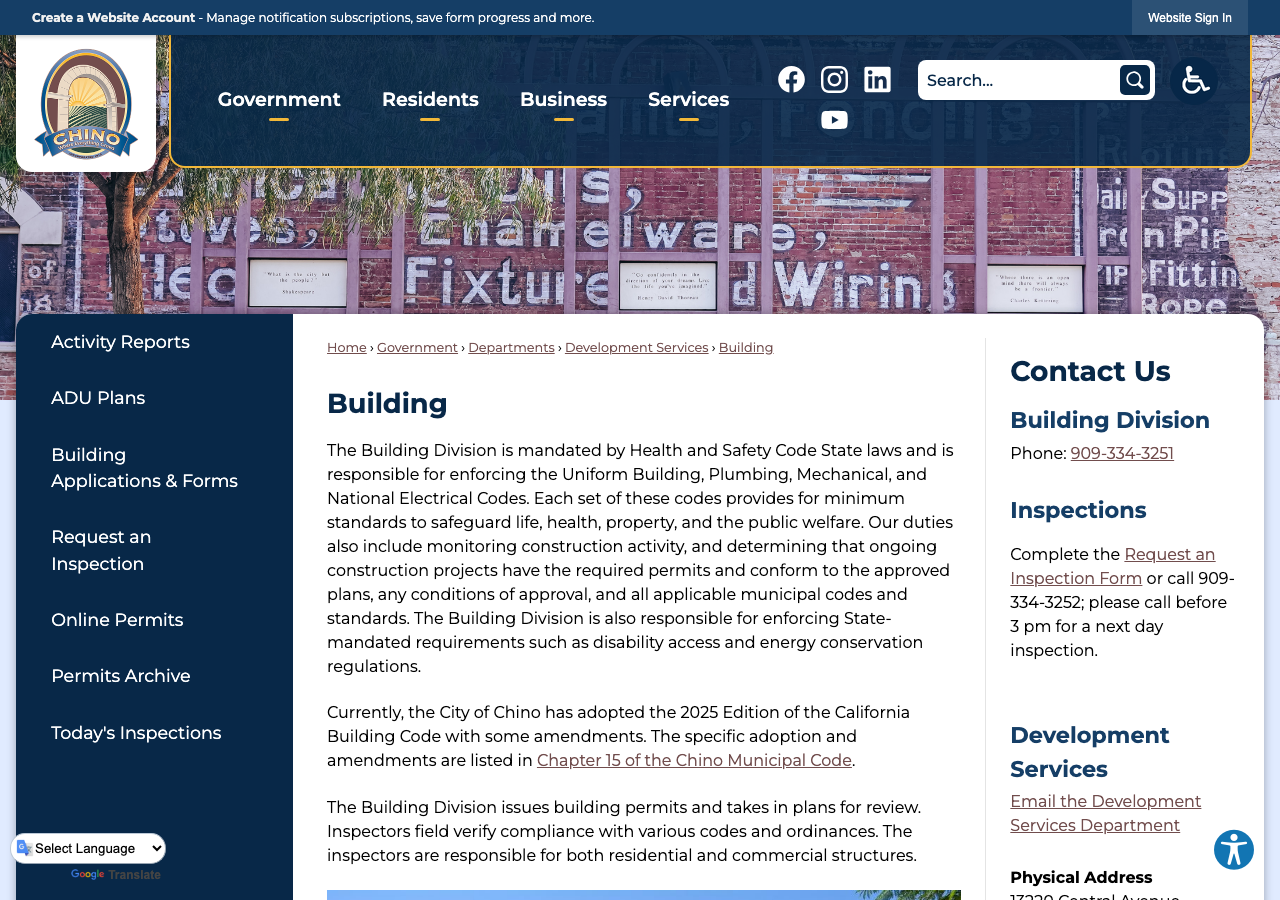
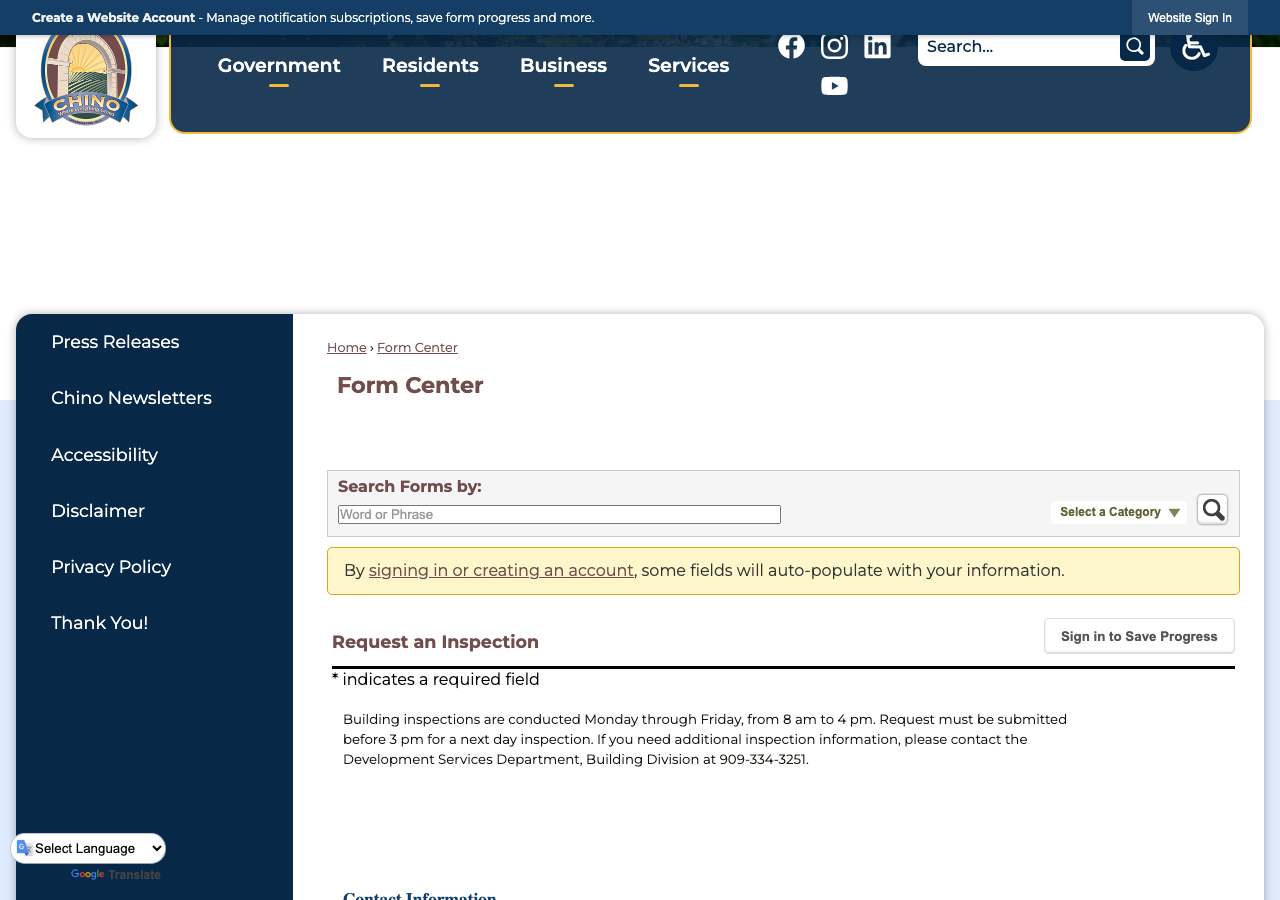
- How is an inspection booked? Portal (City's online 'Request an Inspection' FormCenter webform, or the ACA portal) or Phone (909-334-3251/909-334-3252). 88% · department page/form
- How much notice is required? Requests made before 3:00 pm are performed the next business day (effectively same-day-cutoff / 1 business day notice) for City building/electrical inspections. Chino Valley Fire District separately requires a minimum 48 hours' notice (excluding weekends/holidays) for its fire inspections. 88% · department page
- Are same-day or AM/PM windows offered? Yes - AM (8:00am-12:00 Noon) and PM (12:00 Noon-4:00pm) inspection windows are offered; the Request-an-Inspection form asks the applicant to select a 'Preferred Inspection Time Frame' of AM or PM. 92% · department page
-
Know who turns up
Some authorities inspect their own solar work; some delegate it, and a few do not inspect the PV equipment itself at all. Who is coming determines what they will look at.
- Does this AHJ perform its own final solar inspection? Yes for building/electrical (performed by the City's own Building Division); fire-related aspects (signage/setback/access-pathway compliance) are separately inspected/finaled by Chino Valley Fire District, a different governmental entity. 80% · department page
- If delegated, to whom? Chino Valley Fire District (for the fire-code portion of the review/inspection only; building/electrical remains with the City). 80% · district page
-
Work the stages in order
A rough-in or mid-roof inspection, where one is required, has to happen before the work it covers is closed up. Missing a stage means opening something back up, and it is the most expensive kind of correction.
- Which inspections are required, and in what order? No numbered solar-specific inspection sequence is separately published; general practice implied by the permit/job-card system (referenced in the Electrical Release handout) is: City building/electrical permit issuance -> installation -> City final building/electrical inspection, run alongside Fire District final sign-off for the fire-related scope. 55% · department handout
- Is a rough-in or mid-roof inspection required? No mid-roof/rough-in inspection is called out separately in the available submittal or inspection documents; only a final inspection is implied for a completed rooftop PV installation. 52% · department how-to guide
-
Have the paperwork on site
The approved plan set, the permit, and the equipment listings should be on site and reachable. Inspectors routinely verify that installed equipment matches what was approved, and that the labels are the ones the plan set promised.
- What must be on site at inspection? Approved/stamped plans and the job permit card must be on site; manufacturer specification sheets and the SolarAPP+ approval documentation (for systems permitted that way) should also be available, based on the same submittal package the inspector checks against. 55% · department handout
- Does the inspector verify labels and listings? Yes, by inference - the plan-check requires manufacturer spec sheets/UL listings and a signage sheet to be part of the approved plan set, which a field inspector would verify against the installed system and labeling at final. 60% · department checklist
-
Sign-off, and permission to operate
Passing gives you a final or an equivalent sign-off. That is not the same as permission to operate: PTO comes from the utility, and who tells the utility the inspection passed varies. A system left switched off for weeks is usually waiting on this handover.
- What is issued on pass? Final (the building/electrical permit is 'finaled'/closed upon passed inspection); a Certificate of Occupancy is not issued for a PV retrofit on an existing single-family home per the City's own FAQ, which limits CO issuance to new buildings/suites or significant use changes. 72% · department FAQ
- Who notifies the utility for PTO? Installer - standard CA practice has the contractor/installer submit the interconnection completion notice to the utility for Permission to Operate after the AHJ's final inspection; no Chino- or SCE-specific document could be independently confirmed this run because SCE's Rule 21/DG interconnection materials were unreachable. 50% · department how-to guide
- Is there a re-inspection fee? $252.00 per hour (2-hour minimum), or the total actual hourly cost to the jurisdiction if greater. 85% · fee schedule
14 questions answered against City of Chino’s own published documents
Q49 How is an inspection booked? Core Booking & scheduling
Portal (City's online 'Request an Inspection' FormCenter webform, or the ACA portal) or Phone (909-334-3251/909-334-3252).
Why the confidence is not higherBoth the Building Division landing page and the dedicated Request-an-Inspection FormCenter page describe these two channels.
department page/form checked 2026-08-30 https://www.cityofchino.org/FormCenter/Building-Division-4/Request-an-Inspection-46
Q50 How much notice is required? Core Booking & scheduling
Requests made before 3:00 pm are performed the next business day (effectively same-day-cutoff / 1 business day notice) for City building/electrical inspections. Chino Valley Fire District separately requires a minimum 48 hours' notice (excluding weekends/holidays) for its fire inspections.
Why the confidence is not higherCity's Building page and FAQ both state the 3pm cutoff; CVFD's Inspections page states the 48-hour minimum for its own inspections - these are two different AHJs with two different notice periods.
department page checked 2026-08-30 https://www.cityofchino.org/178/Building
Q51 Are same-day or AM/PM windows offered? Booking & scheduling
Yes - AM (8:00am-12:00 Noon) and PM (12:00 Noon-4:00pm) inspection windows are offered; the Request-an-Inspection form asks the applicant to select a 'Preferred Inspection Time Frame' of AM or PM.
Why the confidence is not higherDirectly stated on the City's Today's Inspections page and the Request an Inspection webform.
department page checked 2026-08-30 https://www.cityofchino.org/602/Todays-Inspections
Q52 Does this AHJ perform its own final solar inspection? Core Who inspects
Yes for building/electrical (performed by the City's own Building Division); fire-related aspects (signage/setback/access-pathway compliance) are separately inspected/finaled by Chino Valley Fire District, a different governmental entity.
Why the confidence is not higherCity Building page confirms City inspectors perform field verification; CVFD's own Inspections and PV Plan Review pages confirm the District independently inspects the fire-code aspects of the same project.
department page checked 2026-08-30 https://www.cityofchino.org/178/Building
Q53 If delegated, to whom? Core Who inspects
Chino Valley Fire District (for the fire-code portion of the review/inspection only; building/electrical remains with the City).
Why the confidence is not higherSame sourcing as q52 - CVFD is a legally separate special fire protection district, not a City department, and its own documents confirm it independently plan-checks and, per its Inspections page, performs fire and life-safety inspections.
district page checked 2026-08-30 https://www.chinovalleyfire.org/176/Inspections
Q54 Which inspections are required, and in what order? Core Stages & sequence
No numbered solar-specific inspection sequence is separately published; general practice implied by the permit/job-card system (referenced in the Electrical Release handout) is: City building/electrical permit issuance -> installation -> City final building/electrical inspection, run alongside Fire District final sign-off for the fire-related scope.
Why the confidence is not higherInferred from the Electrical Release handout's mention of a 'job card' and 'utility release' process plus the two-AHJ split described elsewhere; no single document lays out a numbered solar inspection sequence.
department handout checked 2026-08-30 https://www.cityofchino.org/DocumentCenter/View/197/Electrical-Release-PDF
Q55 Is a rough-in or mid-roof inspection required? Stages & sequence
No mid-roof/rough-in inspection is called out separately in the available submittal or inspection documents; only a final inspection is implied for a completed rooftop PV installation.
Why the confidence is not higherAbsence noted from reviewing the Solar PV Submittal Requirements, SolarAPP+ How-To Guide, and Today's Inspections/Request-an-Inspection pages, none of which mention a rough or mid-roof stage for PV specifically; not a full negative control against the municipal code (unreachable) so kept at moderate confidence.
department how-to guide checked 2026-08-30 https://www.cityofchino.org/DocumentCenter/View/5958/SolarAPP-How-To-Guide-PDF
Q56 Does the inspector verify labels and listings? Core What is checked
Yes, by inference - the plan-check requires manufacturer spec sheets/UL listings and a signage sheet to be part of the approved plan set, which a field inspector would verify against the installed system and labeling at final.
Why the confidence is not higherNo explicit 'the inspector verifies labels and listings' statement was found; inferred from the submittal requirements (UL listings, signage sheet) that these items form part of what a final inspection checks against approved plans.
department checklist checked 2026-08-30 https://www.cityofchino.org/DocumentCenter/View/3820/Solar-Photovoltaic-System-Submittal-Requirements_2023-PDF
Q57 Is there a published inspection checklist? Core What is checked
Nothing published by this authority.
Where we lookedCity's Solar Photovoltaic System Submittal Requirements (a plan-check submittal checklist, not an inspection checklist), Today's Inspections page, and Request-an-Inspection FormCenter page - none publish a distinct field inspection checklist for PV.
Q58 What must be on site at inspection? Core Documents on site
Approved/stamped plans and the job permit card must be on site; manufacturer specification sheets and the SolarAPP+ approval documentation (for systems permitted that way) should also be available, based on the same submittal package the inspector checks against.
Why the confidence is not higherNo dedicated 'what must be on site' page was found; inferred from the Electrical Release handout's reference to a 'utility release portion of the job card' being carried through inspection/final, and from the plan-check package (spec sheets, SolarAPP+ approval doc) required at submittal.
department handout checked 2026-08-30 https://www.cityofchino.org/DocumentCenter/View/197/Electrical-Release-PDF
Q59 Is there a re-inspection fee? Corrections & re-inspection
$252.00 per hour (2-hour minimum), or the total actual hourly cost to the jurisdiction if greater.
Why the confidence is not higherCurrent Building Fee Schedule, 'Re-inspection fee assessed under CBC Section C.B.C—$252.00 per hour**', effective 1 Jul 2026 per the revision stamp.
fee schedule checked 2026-08-30 https://www.cityofchino.org/DocumentCenter/View/8335/Building-Fee-Schedule-Updated-June-25-2026-PDF
Q60 How are corrections issued and cleared? Corrections & re-inspection
Nothing published by this authority.
Where we lookedBuilding Division page, Request-an-Inspection form, and Building FAQ - none describe how correction notices are issued or cleared for a failed inspection; only general re-inspection fee (q59) is documented.
https://www.cityofchino.org/DocumentCenter/View/238/Building-Division-Frequently-Asked-Questions-PDF
Q61 What is issued on pass? Core Final sign-off & PTO
Final (the building/electrical permit is 'finaled'/closed upon passed inspection); a Certificate of Occupancy is not issued for a PV retrofit on an existing single-family home per the City's own FAQ, which limits CO issuance to new buildings/suites or significant use changes.
Why the confidence is not higherBuilding Division FAQ (dated 2020) explains when a CO is and is not required; a rooftop PV addition to an existing occupied single-family home would not meet those CO triggers, leaving a standard permit 'final' as the closing action.
department FAQ checked 2026-08-30 https://www.cityofchino.org/DocumentCenter/View/238/Building-Division-Frequently-Asked-Questions-PDF
Q62 Who notifies the utility for PTO? Core Final sign-off & PTO
Installer - standard CA practice has the contractor/installer submit the interconnection completion notice to the utility for Permission to Operate after the AHJ's final inspection; no Chino- or SCE-specific document could be independently confirmed this run because SCE's Rule 21/DG interconnection materials were unreachable.
Why the confidence is not higherInferred from the general SolarAPP+/ACA process sequence (contractor-driven throughout) rather than a document that names who files for PTO; SCE's own Rule 21 and Interconnection Handbook pages were unreachable during this run (see q42/q48).
department how-to guide checked 2026-08-30 https://www.cityofchino.org/DocumentCenter/View/5958/SolarAPP-How-To-Guide-PDF
Lines marked with a percentage were read off this authority’s own published documents. Unmarked guidance is general good practice, not this jurisdiction’s rule — always confirm against the authority before you submit.
Jurisdiction & key facts
The standing 62-question set, answered for City of Chino against this authority’s own published documents. Every answer carries the confidence it was recorded at and the document it came from. Where nothing is published we say so and show where we looked — a blank here is a finding, not a gap.
City of Chino is the authority having jurisdiction 92% confidence
- Holds
- Building and Electrical
- Overridden by
- Fire-code review/approval for PV is held by Chino Valley Fire District (an independent special fire district serving Chino, Chino Hills and unincorporated County area), not by the City; the City's own Fire Prevention division for permitting purposes was folded into this district. CVFD approval must be obtained before the City will issue a building permit. State law (Gov. Code §65850.5, codified locally at Chino Municipal Code Title 20 §20.501.050.A.2) requires an expedited ministerial review and bars a zoning clearance for small residential rooftop solar.
- Why not higher
- City of Chino Development Services Building Division page states the Building Division 'issues building permits and takes in plans for review' and enforces the Uniform Building/Plumbing/Mechanical/National Electrical Codes, and its own Solar Photovoltaic System Submittal Requirements handout confirms electrical permits are pulled through the City while requiring separate Fire District approval. Chino Valley Fire District's own PV Plan Check Submittal Requirements document states in writing: 'Our requirements and process do not negate any plan check requirements from the City of Chino, Chino Hills, or San Bernardino County Building Departments. Each of these agencies will not issue building permits prior to approval and issuance of a permit from the Fire District.' This is a split-jurisdiction finding, not a single-authority answer.
- Permit required
- Yes95%
- Permit cost
- $450.00 base fee (capped at $500.00) plus $15 per kW for each kW above 15 kW, for systems up to 51 kW - the typical residential tier.93%
- Plan review
- Same-day auto-issuance is available for eligible systems via SolarAPP+ (currently in pilot mode with limited access) through the ACA portal.78%
- Portal
- Accela Citizen Access (ACA) at aca.cityofchino.org/citizenaccess, paired with SolarAPP+ (solarapp.nrel.gov) for eligible systems.85%
- Electrical code
- 2025 California Electrical Code (CEC), which is the state's amended adoption of the 2023 NEC, effective as part of the 2025 CA Building Standards Code cycle;85%
- Own placard wording
- No - the AHJ requires signage 'in accordance with the California Electrical Code and the California Fire Code' rather than specifying its own custom wording.72%
- Booking an inspection
- Portal (City's online 'Request an Inspection' FormCenter webform, or the ACA portal) or Phone (909-334-3251/909-334-3252).88%
Labels & placards for this authority
Wording 72%
No - the AHJ requires signage 'in accordance with the California Electrical Code and the California Fire Code' rather than specifying its own custom wording.
Size, colour & material None%
Where they go 55%
Not specified beyond code - CVFD's checklist requires a signage sheet but does not itself state placement (at the main service disconnect, PV disconnect, etc.); placement therefore follows the adopted 2025 CEC/CFC provisions rather than a separate City/District placement rule.
What the utility wants on top None%
Each figure above is sourced and dated in the full answer set below (questions 38–43). Where an authority’s own published sheet is older than the code it has adopted, the answer says so.
Their website

Average approval time — application to PTO
From the CPUC interconnection record. Bars show the average days taken each year; a year with no recorded projects is left blank rather than drawn as zero.