
City of Clayton
Contra Costa County
City of Clayton is a city authority in the State of California, serving 11,070 residents. 1,303 residential solar installs are on record here. This page is the permit route for that jurisdiction: the fifteen steps from working out who has a say over an address through to permission to operate, the documents this authority publishes, and 62 answers taken from those documents and dated.
Permitting 5 steps · 28 questions
Whether a permit is needed — Yes Q3 Electrical and building permits — Combined Q4 Plan review — SolarAPP+ path: permit auto-issues within minutes of SolarAPP+ approval plus ePermits submittal. Q18 Where you file — Contra Costa County's ePermit Center (Accela Citizen Access), at aca-prod.accela.com/CCC/Default.aspx Q20
- Permit required
- Yes95% source
- What it costs
- $272 minimum for a roof- or ground-mounted residential PV system ≤15 kW AC ($86 Building Permit/Inspection + $86 Plan Check + $100 Electrical Review), plus $15 per kW above 15 kW.90% source
- Plan review turnaround
- SolarAPP+ path: permit auto-issues within minutes of SolarAPP+ approval plus ePermits submittal. Standard path: no fixed day-count stated by the County's own text — Ordinance Code §718-12.004(b)…62% source
- Key document
- published checklist cited by 4 open the document
-
Confirm who has a say over your address
A city address is usually permitted by the city, not the county — but not always, and some authorities keep building and hand electrical to someone else. Getting this wrong costs the whole submittal, because every requirement below belongs to whoever actually holds jurisdiction. Check the overlays in the same pass: an HOA, a historic district, a windstorm certification or a system-size cap can reshape the design, and all of them are cheaper to find now than after the array is laid out.
- Is this authority the AHJ for residential solar at this address? Yes 92% · department page
- What does this authority permit itself, and what does it delegate? Delegated 90% · department page
- Is a permit required for a residential rooftop PV system? Yes 95% · county ordinance code
- Is there a separate electrical permit, or is it combined? Combined 82% · department page
- Is a HOA or architectural approval required first? No 65% · county ordinance code
- Is there a historic-district review? SolarAPP+ pathway explicitly excludes historic properties ('Property is NOT registered as a historic property' is a listed eligibility criterion); the standard (non-SolarAPP+) path has no distinct historic-district review provision identified in Chapter 718-12 or the County's checklists — a historic property would simply be routed away from SolarAPP+ to the standard review track. 55% · department page
- Is a Specific Use Permit or Council approval ever required? Staff-level City of Clayton Planning Department sign-off is required for any roof-mounted system in Clayton that is not flush-mounted or exceeds 10 kW, and for any ground-mounted system (which also needs a Sanitary or Environmental District sign-off) — but this is administrative Planning review, not a City Council hearing or a discretionary Conditional/Specific Use Permit. 78% · published checklist
- Is there a system-size cap on residential generation? 10 kW AC nameplate rating, or 30 kW thermal, for the streamlined 'small residential rooftop solar energy system' definition, on a detached single-family dwelling or duplex, not exceeding the zoning district's building height limit. Larger, non-flush, or non-qualifying systems remain permittable but exit the streamlined path (structural PE stamp and, in Clayton, Planning sign-off apply). 95% · county ordinance code
-
Check who is allowed to apply
Several authorities require the electrical permit to be pulled by a licensed electrician, or require the contractor to be registered with them BEFORE applying. Registration is not same-day. This is second on the list rather than fourth because it is the step most likely to stop the job before the drawings matter.
- Who is allowed to pull the electrical permit? Either 78% · department page
- Must the contractor be registered with this authority before applying? Yes (Clayton-specific business license), plus SolarAPP+ platform registration for that pathway 68% · department page
- Is a homeowner permitted to self-install and self-permit? Yes 75% · department page
-
Build the submittal package
Almost everywhere wants a site plan, a one-line or three-line electrical diagram, equipment cut sheets with listings, and a structural attachment detail. Build it against the published checklist rather than the last jurisdiction you worked in — the checklist is what the reviewer marks against.
- What documents make up a complete submittal? Completed building permit application; a bookmarked multi-page PDF plan set (or 3 paper sets) including roof/site plan, module locations, and equipment locations; manufacturer's installation & grounding instructions; manufacturer's spec sheets for modules, inverter/microinverter, power optimizers, alternate power sources, and racking; the County's 'Eligibility Checklist' (General/Electrical/Structural/Fire Safety sections); a completed 'Structural Criteria' checklist (or PE-stamped structural calcs if not eligible for the prescriptive path); a single-line electrical diagram showing the tie-in to the house electrical system and existing PG&E equipment; and a labels/markings sheet per CEC Article 690. For the SolarAPP+ path: the SolarAPP+ Approval Document plus manufacturer's spec sheets. 88% · published checklist
- How many copies, and in what format? In-office: 3 paper sets, 11x17 minimum. Online: 1 multi-page, bookmarked, unsecured PDF — 11x17 minimum landscape for residential roof-mounted systems, 24x36 minimum landscape for ground-mounted or commercial roof-mounted systems; drawings must be CAD-generated (no scans) and to scale; each sheet needs a blank 3.5in x 6in column reserved for County stamps; file max 100MB. 90% · published checklist
- Is a site plan required, and what must it show? Yes — a roof or ground site plan showing building footprint and property lines, all panels/modules, clear access pathways, location of main service, approximate locations of electrical disconnecting means, roof access points, and locations of any other structures on the property. 92% · published standard plan
- Is a one-line / three-line diagram required? Yes 85% · published checklist
- Are string and conductor calculations required? Yes 88% · published standard plan
- Is a structural PE stamp required, and at what threshold? Yes, conditionally — required if the array is not a fully prescriptive flush-mount install. The County's 'Required Structural Criteria for Residential Flush-Mounted Rooftop Solar Arrays' checklist requires 'project-specific drawings and calculations stamped and signed by a California-licensed Civil or Structural Engineer' whenever any roof-check, array-check, or anchor-spacing item on the prescriptive checklist is answered 'No'. 85% · published checklist
-
Apply and pay
Most authorities now take the whole application through a portal, and several states cap or constrain what a residential solar permit may cost. Check whether plan check is billed separately before you quote the job.
- Which permit portal does this authority use? Contra Costa County's ePermit Center (Accela Citizen Access), at aca-prod.accela.com/CCC/Default.aspx 92% · department page
- Can the whole application be completed online? Yes 88% · department page
- What does a residential solar permit cost? $272 minimum for a roof- or ground-mounted residential PV system ≤15 kW AC ($86 Building Permit/Inspection + $86 Plan Check + $100 Electrical Review), plus $15 per kW above 15 kW. The SolarAPP+ pathway adds a separate $35 (solar) + $25 (ESS add-on) fee paid directly to the SolarAPP+ platform, on top of these County fees. 90% · fee schedule
- How is the fee calculated? Tiered 85% · fee schedule
- Is there a separate plan-check fee? Yes 92% · fee schedule
-
Plan review — and start the utility in parallel
Interconnection is a separate process from the permit and usually the longer pole. Where the utility does not depend on the permit being issued, running both at once is the single biggest saving available on a residential job.
- What is the stated plan-review turnaround? SolarAPP+ path: permit auto-issues within minutes of SolarAPP+ approval plus ePermits submittal. Standard path: no fixed day-count stated by the County's own text — Ordinance Code §718-12.004(b) instead cross-references 'the timeline set forth in the then-current edition of the California Solar Permitting Guidebook published by the Governor's Office of Planning and Research' for the expedited-review timeline, rather than stating a number itself. 62% · county ordinance code
- Which utility handles interconnection here? PG&E (Pacific Gas & Electric) 80% · published checklist
28 questions answered against City of Clayton’s own published documents
Q1 Is this authority the AHJ for residential solar at this address? Core Jurisdiction & scope
Yes
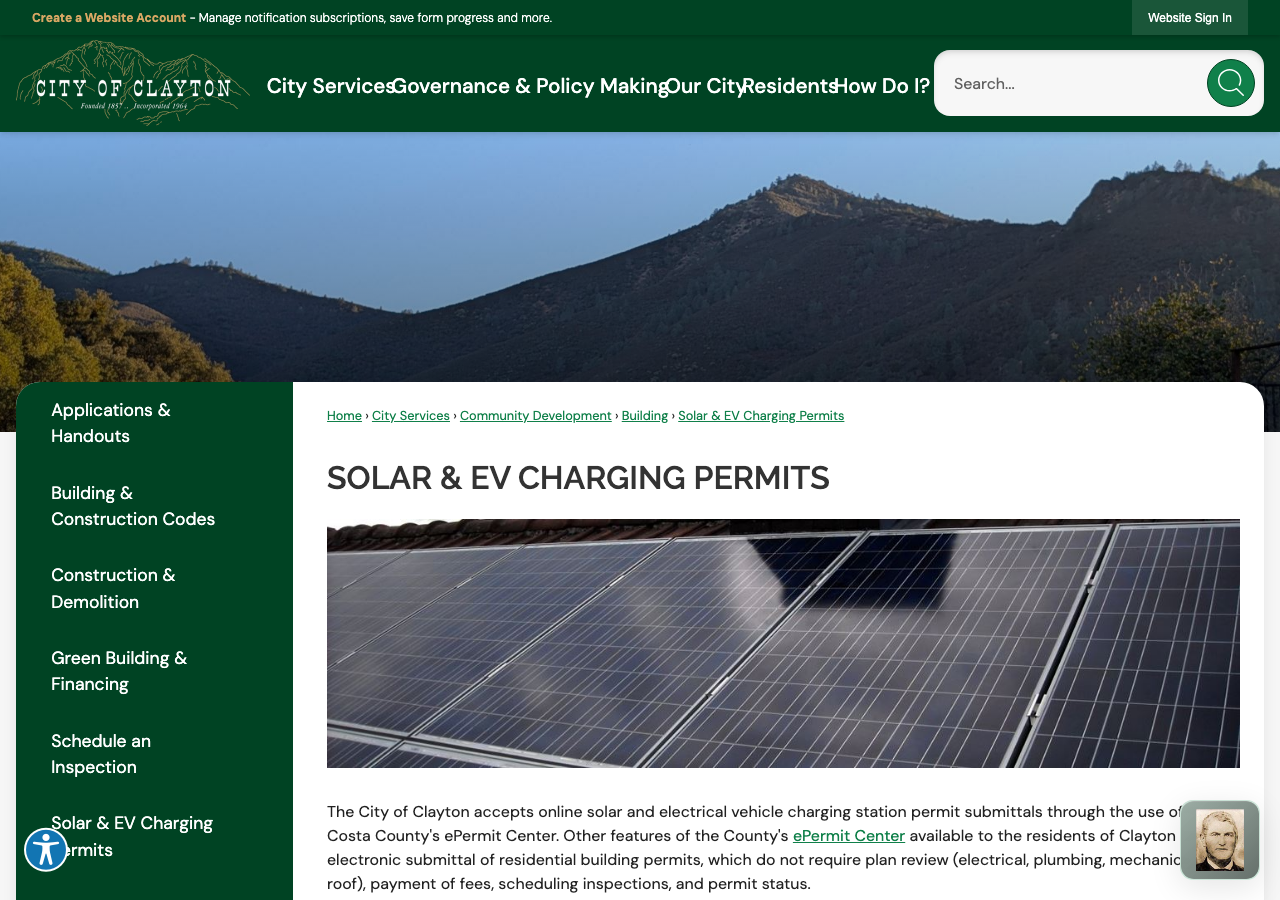
Why the confidence is not higherClayton is legally the AHJ of record for its territory, but it performs this role by contracting building/electrical permitting and inspection to Contra Costa County (a 'Contract City'), while retaining Planning entitlements itself. Confirmed from both sides: the County's own Permits page names Clayton as a Contract City, and Clayton's own Solar & EV Charging Permits page routes applicants to the County's ePermit Center.
department page checked 2026-08-31 https://www.contracosta.ca.gov/7947/Permits
Q2 What does this authority permit itself, and what does it delegate? Core Jurisdiction & scope
Delegated
Why the confidence is not higherClayton delegates 100% of building and electrical permitting, plan check, and inspection to Contra Costa County DCD; the city retains only Planning entitlements and its own business-license program. Clayton's own solar page states this outright, routing applicants to 'Contra Costa County's ePermit Center.'
department page checked 2026-08-31 https://www.claytonca.gov/178/Solar-EV-Charging-Permits
Q3 Is a permit required for a residential rooftop PV system? Core Jurisdiction & scope
Yes
Why the confidence is not higherContra Costa County Ordinance Code §718-12.002(a): 'A building permit is required to install a solar energy system.' This chapter is the operative code for Clayton parcels under the Contract City arrangement.
county ordinance code checked 2026-08-31 https://library.municode.com/ca/contra_costa_county/codes/ordinance_code?nodeId=TIT7BURE_DIV718MIPR_CH718-12SOENSY
Q4 Is there a separate electrical permit, or is it combined? Core Jurisdiction & scope
Combined
Why the confidence is not higherThe County's ePermit Center offers single permit types covering the whole system — 'Building - Residential Solar Photovoltaic', 'Building - Residential Solar Ground Mount', or 'SolarAPP+ - Approved Permit' — not a separate electrical permit for the PV portion. A standalone 'Building - Residential Electrical (BIE)' permit exists only for unrelated electrical work (e.g. EV chargers), confirming solar itself is not split into building+electrical permits.
department page checked 2026-08-31 https://www.contracosta.ca.gov/5829/Power-Permits-Solar-Generator-Energy-Sto
Q5 Who is allowed to pull the electrical permit? Core Who may apply
Either
Why the confidence is not higherSolarAPP+ path requires 'a licensed contractor that has previously registered with SolarAPP+.' The standard (non-SolarAPP+) ePermits path explicitly allows 'Owner-Builder' registration ('the property owner who is submitting applications for permits on their own property'), so a homeowner may self-permit via the standard track.
department page checked 2026-08-31 https://www.contracosta.ca.gov/9986/Registering-as-an-Applicant
Q6 Must the contractor be registered with this authority before applying? Core Who may apply
Yes (Clayton-specific business license), plus SolarAPP+ platform registration for that pathway
Why the confidence is not higherClayton's own SolarAPP+/solar page: 'Applicants for projects in Clayton, Hercules and Orinda must have an active business license with the city' before permit issuance. Separately, the SolarAPP+ pathway requires the contractor to be 'previously registered with SolarAPP+' (a national platform, not the County or city specifically). Lower confidence because 'this authority' is ambiguous between the city (business license — clearly Yes) and the county permitting body (no county-specific contractor pre-registration found beyond standard CSLB licensure).
department page checked 2026-08-31 https://www.contracosta.ca.gov/9880/SolarAPP-For-Solar-Installers
Q7 Is a homeowner permitted to self-install and self-permit? Who may apply
Yes
Why the confidence is not higherContra Costa County's 'Registering as an Applicant' page for the ePermits Center explicitly includes 'Owner-Builder' ('the property owner who is submitting applications for permits on their own property') as a registration category, alongside licensed contractors. Not solar-specific, but no solar carve-out excluding owner-builders was found (SolarAPP+ specifically requires a licensed contractor, but the standard path does not).
department page checked 2026-08-31 https://www.contracosta.ca.gov/9986/Registering-as-an-Applicant
Q8 What documents make up a complete submittal? Core Submittal package
Completed building permit application; a bookmarked multi-page PDF plan set (or 3 paper sets) including roof/site plan, module locations, and equipment locations; manufacturer's installation & grounding instructions; manufacturer's spec sheets for modules, inverter/microinverter, power optimizers, alternate power sources, and racking; the County's 'Eligibility Checklist' (General/Electrical/Structural/Fire Safety sections); a completed 'Structural Criteria' checklist (or PE-stamped structural calcs if not eligible for the prescriptive path); a single-line electrical diagram showing the tie-in to the house electrical system and existing PG&E equipment; and a labels/markings sheet per CEC Article 690. For the SolarAPP+ path: the SolarAPP+ Approval Document plus manufacturer's spec sheets.
Why the confidence is not higherCompiled directly from the County's own 'Required Eligibility Checklist for Residential Solar Photovoltaic Permits' and 'Photovoltaic System Checklist for Digital Plan Submittals' (May 4, 2020) PDFs, both extracted with pdftotext -layout, plus the SolarAPP+ department page for that pathway's document list.
published checklist checked 2026-08-31 https://www.contracosta.ca.gov/DocumentCenter/View/37433/DCD-PVR-Eligibility-and-Structural-checklist
Q9 How many copies, and in what format? Submittal package
In-office: 3 paper sets, 11x17 minimum. Online: 1 multi-page, bookmarked, unsecured PDF — 11x17 minimum landscape for residential roof-mounted systems, 24x36 minimum landscape for ground-mounted or commercial roof-mounted systems; drawings must be CAD-generated (no scans) and to scale; each sheet needs a blank 3.5in x 6in column reserved for County stamps; file max 100MB.
Why the confidence is not higherCounty's 'Photovoltaic System Checklist for Digital Plan Submittals' item 1, and 'Required Eligibility Checklist' item F, both state these formatting requirements verbatim.
published checklist checked 2026-08-31 https://www.contracosta.ca.gov/DocumentCenter/View/33726/PHOTOVOLTAIC-SYSTEM-CHECKLIST-DIGITAL-SUBMITTAL-May-4-2020
Q10 Is a site plan required, and what must it show? Core Submittal package
Yes — a roof or ground site plan showing building footprint and property lines, all panels/modules, clear access pathways, location of main service, approximate locations of electrical disconnecting means, roof access points, and locations of any other structures on the property.
Why the confidence is not higherVerbatim 'Items required to be shown' block on the Roof Layout Plan page of the County's own PV Toolkit Standard Plan templates (both Central/String and Microinverter versions), plus the Eligibility Checklist's fire-safety section requiring the same roof-layout diagram.
published standard plan checked 2026-08-31 https://www.contracosta.ca.gov/DocumentCenter/View/37431/DCD-Central-String-Inverter-Solar-Plan-Template
Q11 Is a one-line / three-line diagram required? Core Drawings & calculations
Yes
Why the confidence is not higher'Photovoltaic System Checklist for Digital Plan Submittals' item 3: 'Provide single line drawings of how the system ties into the house electrical system and the existing PG&E equipment.' The County's own Standard Plan templates also include Single Line Diagram placeholders (referenced in Steps 11/S11 of the Central/String template).
published checklist checked 2026-08-31 https://www.contracosta.ca.gov/DocumentCenter/View/33726/PHOTOVOLTAIC-SYSTEM-CHECKLIST-DIGITAL-SUBMITTAL-May-4-2020
Q12 Are string and conductor calculations required? Drawings & calculations
Yes
Why the confidence is not higherThe County's own 'Solar PV Standard Plan – Simplified' templates (Central/String Inverter and Microinverter/ACM versions) are themselves detailed string-sizing and conductor/OCPD calculation worksheets (module VOC/ISC, series-string voltage correction, conductor AWG and OCPD sizing tables, bus-bar 120%/100% rule per CEC 705.12(D)(2)) — required attachments per the digital-submittal checklist.
published standard plan checked 2026-08-31 https://www.contracosta.ca.gov/DocumentCenter/View/37431/DCD-Central-String-Inverter-Solar-Plan-Template
Q13 Is a structural PE stamp required, and at what threshold? Core Engineering & stamps
Yes, conditionally — required if the array is not a fully prescriptive flush-mount install. The County's 'Required Structural Criteria for Residential Flush-Mounted Rooftop Solar Arrays' checklist requires 'project-specific drawings and calculations stamped and signed by a California-licensed Civil or Structural Engineer' whenever any roof-check, array-check, or anchor-spacing item on the prescriptive checklist is answered 'No'.
Why the confidence is not higherVerbatim from Section 3 ('Summary') of the County's Structural Criteria checklist, bundled with the Residential Eligibility and Structural Checklist PDF.
published checklist checked 2026-08-31 https://www.contracosta.ca.gov/DocumentCenter/View/37433/DCD-PVR-Eligibility-and-Structural-checklist
Q14 Is an electrical PE stamp required, and at what threshold? Engineering & stamps
Nothing published by this authority.
Where we lookedCounty's Eligibility Checklist, Structural Criteria checklist, and both PV Toolkit Standard Plan templates (Central/String and Microinverter) — all extracted with pdftotext -layout; also checked Ordinance Code §718-12 and §76-2/76-4 (Electrical Code adoption and amendments). None state an electrical PE-stamp threshold distinct from the structural PE-stamp trigger; systems exceeding the simplified plan's electrical parameters are routed to a 'Comprehensive Standard Plan' without stating whether that requires an electrical engineer's stamp.
Q15 What does a residential solar permit cost? Core Fees
$272 minimum for a roof- or ground-mounted residential PV system ≤15 kW AC ($86 Building Permit/Inspection + $86 Plan Check + $100 Electrical Review), plus $15 per kW above 15 kW. The SolarAPP+ pathway adds a separate $35 (solar) + $25 (ESS add-on) fee paid directly to the SolarAPP+ platform, on top of these County fees.
Why the confidence is not higherContra Costa County's 'Land Development Fee Schedule' (adopted by the Board of Supervisors 5/24/2022, effective 8/10/2022, with a footnoted 1/1/2025 valuation update — current as checked), Section I(7)(i), read verbatim via pdftotext. SolarAPP+ figure confirmed from the County's own SolarAPP+ page raw HTML.
fee schedule checked 2026-08-31 https://www.contracosta.ca.gov/DocumentCenter/View/62479/Land-Development-Fee-Schedule-PDF
Q16 How is the fee calculated? Core Fees
Tiered
Why the confidence is not higherFlat components (Building Permit/Inspection, Plan Check, Electrical Review, each a fixed dollar amount) below 15 kW AC, with a per-kW surcharge ($15/kW) applied above the 15 kW threshold — a tiered structure rather than a pure flat, per-kW, or valuation basis.
fee schedule checked 2026-08-31 https://www.contracosta.ca.gov/DocumentCenter/View/62479/Land-Development-Fee-Schedule-PDF
Q17 Is there a separate plan-check fee? Fees
Yes
Why the confidence is not higherThe Land Development Fee Schedule lists 'Plan Check: $86 per permit' as a distinct line item from 'Building Permit/inspection: $86 per permit' and 'Electrical Review: $100 per permit' for residential PV ≤15 kW.
fee schedule checked 2026-08-31 https://www.contracosta.ca.gov/DocumentCenter/View/62479/Land-Development-Fee-Schedule-PDF
Q18 What is the stated plan-review turnaround? Core Timeline & validity
SolarAPP+ path: permit auto-issues within minutes of SolarAPP+ approval plus ePermits submittal. Standard path: no fixed day-count stated by the County's own text — Ordinance Code §718-12.004(b) instead cross-references 'the timeline set forth in the then-current edition of the California Solar Permitting Guidebook published by the Governor's Office of Planning and Research' for the expedited-review timeline, rather than stating a number itself.
Why the confidence is not higherSolarAPP+ turnaround confirmed directly on the County's SolarAPP+ page. The standard-path timeline is stated only by cross-reference to the state Guidebook (itself not independently re-verified in this run), so the exact business-day figure for the non-SolarAPP+ path is not confirmed from a Contra Costa-specific document.
county ordinance code checked 2026-08-31 https://library.municode.com/ca/contra_costa_county/codes/ordinance_code?nodeId=TIT7BURE_DIV718MIPR_CH718-12SOENSY
Q19 How long is an issued permit valid before it expires? Timeline & validity
Nothing published by this authority.
Where we lookedOrdinance Code Chapter 74-4 (CBC/CRC Amendments) — grepped for '105.5', 'expir', and 'permit shall be valid'; found no local amendment touching CBC/CRC §105.5 (permit expiration), meaning the stock, unamended 2025 CBC/CRC expiration rule would apply, but I did not independently pull the stock 2025 CBC §105.5 text in this session to confirm the exact day count.
https://library.municode.com/ca/contra_costa_county/codes/ordinance_code?nodeId=TIT7BURE_DIV74BUCO
Q20 Which permit portal does this authority use? Core Portal & process
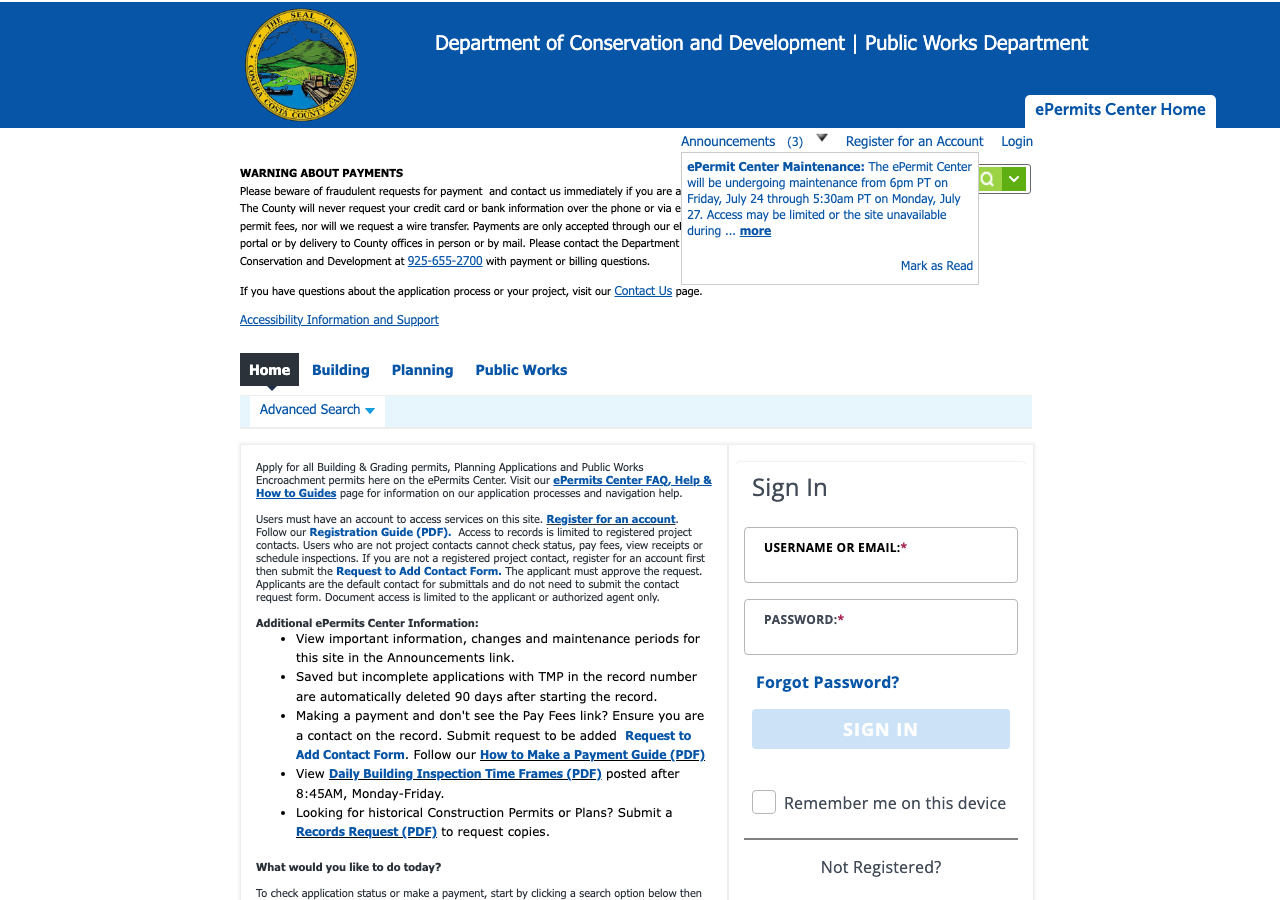
Contra Costa County's ePermit Center (Accela Citizen Access), at aca-prod.accela.com/CCC/Default.aspx
Why the confidence is not higherNamed directly on both Clayton's own Solar & EV Charging Permits page and the County's Application and Permit Center page as the destination for all solar/PV/ESS permit applications for Clayton parcels.
department page checked 2026-08-31 https://www.contracosta.ca.gov/4474/Application-and-Permit-Center
Q21 Can the whole application be completed online? Core Portal & process
Yes
Why the confidence is not higherCounty's Application and Permit Center page states 'Contra Costa County now has 100% digital permit application submittal for Building, Planning, and Pu[blic Works]'; the SolarAPP+ path is fully online end-to-end including auto-issuance.
department page checked 2026-08-31 https://www.contracosta.ca.gov/4474/Application-and-Permit-Center
Q22 Which utility handles interconnection here? Core Utility interconnection
PG&E (Pacific Gas & Electric)
Why the confidence is not higherContra Costa County's own 'Photovoltaic System Checklist for Digital Plan Submittals' instructs applicants (item 3) to 'provide single line drawings of how the system ties into the house electrical system and the existing PG&E equipment' — the County's own document naming the utility. Confidence is not higher because the document is dated May 2020 and phrases this as an example/instruction rather than a direct statement that 'PG&E is the interconnecting utility for Clayton.'
published checklist checked 2026-08-31 https://www.contracosta.ca.gov/DocumentCenter/View/33726/PHOTOVOLTAIC-SYSTEM-CHECKLIST-DIGITAL-SUBMITTAL-May-4-2020
Q23 Where does the utility sit in the sequence? Core Utility interconnection
Nothing published by this authority.
Where we lookedCounty's Power Permits page, SolarAPP+ page, and the digital-submittal checklist — none state whether PG&E interconnection must occur before, after, or in parallel with County permit issuance/final inspection.
https://www.contracosta.ca.gov/5829/Power-Permits-Solar-Generator-Energy-Sto
Q24 Is a HOA or architectural approval required first? Overlays & special cases
No
Why the confidence is not higherOrdinance Code §718-12.004(e)(3) instead cross-references Civil Code §714 (the state Solar Rights Act, which limits an HOA's ability to restrict or condition solar installations) rather than requiring prior HOA or architectural-committee sign-off as part of the County's permit process. No HOA/architectural-approval requirement appears in the Eligibility Checklist, the digital-submittal checklist, or Chapter 718-12 itself.
county ordinance code checked 2026-08-31 https://library.municode.com/ca/contra_costa_county/codes/ordinance_code?nodeId=TIT7BURE_DIV718MIPR_CH718-12SOENSY
Q25 Is there a historic-district review? Overlays & special cases
SolarAPP+ pathway explicitly excludes historic properties ('Property is NOT registered as a historic property' is a listed eligibility criterion); the standard (non-SolarAPP+) path has no distinct historic-district review provision identified in Chapter 718-12 or the County's checklists — a historic property would simply be routed away from SolarAPP+ to the standard review track.
Why the confidence is not higherSolarAPP+ exclusion is stated verbatim on the County's SolarAPP+ page. No separate historic-review clause was found for the standard path in Ordinance Code §718-12 or in either checklist PDF; Clayton's own Old Town Historic District, if any, was not separately checked against this project's scope.
department page checked 2026-08-31 https://www.contracosta.ca.gov/9880/SolarAPP-For-Solar-Installers
Q26 Is a wind or windstorm certification required? Overlays & special cases
Nothing published by this authority.
Where we lookedCounty's Eligibility Checklist, digital-submittal checklist, and Ordinance Code §718-12 — no wind/windstorm certification requirement of any kind was found.
Q27 Is a Specific Use Permit or Council approval ever required? Overlays & special cases
Staff-level City of Clayton Planning Department sign-off is required for any roof-mounted system in Clayton that is not flush-mounted or exceeds 10 kW, and for any ground-mounted system (which also needs a Sanitary or Environmental District sign-off) — but this is administrative Planning review, not a City Council hearing or a discretionary Conditional/Specific Use Permit.
Why the confidence is not higherCounty's 'Photovoltaic System Checklist for Digital Plan Submittals,' items 8 and 9, name Clayton by name for this requirement; nothing in Chapter 718-12 or either checklist mentions a Council hearing or CUP for residential-scale systems.
published checklist checked 2026-08-31 https://www.contracosta.ca.gov/DocumentCenter/View/33726/PHOTOVOLTAIC-SYSTEM-CHECKLIST-DIGITAL-SUBMITTAL-May-4-2020
Q28 Is there a system-size cap on residential generation? Overlays & special cases
10 kW AC nameplate rating, or 30 kW thermal, for the streamlined 'small residential rooftop solar energy system' definition, on a detached single-family dwelling or duplex, not exceeding the zoning district's building height limit. Larger, non-flush, or non-qualifying systems remain permittable but exit the streamlined path (structural PE stamp and, in Clayton, Planning sign-off apply).
Why the confidence is not higherContra Costa County Ordinance Code §718-12.004(e)(1),(4),(5) states this threshold verbatim, citing Gov. Code §65850.5 (not §65850.52 — the two should not be conflated). The County's Eligibility Checklist uses the same 10 kW AC figure for its expedited-review track.
county ordinance code checked 2026-08-31 https://library.municode.com/ca/contra_costa_county/codes/ordinance_code?nodeId=TIT7BURE_DIV718MIPR_CH718-12SOENSY
Lines marked with a percentage were read off this authority’s own published documents. Unmarked guidance is general good practice, not this jurisdiction’s rule — always confirm against the authority before you submit.
Install 5 steps · 20 questions
-
Build to the code editions actually in force here
The NEC edition a jurisdiction enforces is often a cycle behind the newest one published, and local amendments sit on top of it. Rapid shutdown, conductor sizing and labelling all change between editions, so the edition in force is the first thing to establish, not the last.
- Which NEC edition is in force? 2020 90% · county technical guideline
- Which building code edition is in force? 2025 California Building Code (Part 2, based on the 2021 IBC) and 2025 California Residential Code (Part 2.5, based on the 2021 IRC) 95% · county ordinance code
- Which fire code edition is in force? 2025 California Fire Code (Title 24, Part 9, based on the 2024 International Fire Code), adopted as 'the Fire Code of Contra Costa County, the Crockett-Carquinez Fire Protection District, and the Contra Costa County Fire Protection District' by CCCFPD Ordinance No. 2025-14 (adopted 11-18-2025). The 2025 California Wildland-Urban Interface Code (Part 7) is separately adopted by CCCFPD Ordinance No. 2025-15, which names 'the city of ... Clayton' among the covered jurisdictions. 92% · fire district ordinance
- Are there local amendments to any of the above? Yes 95% · county ordinance code
- What is the installation judged against? The installation is judged against the 2025 CBC/CRC/CEC/CFC/WUI Code as locally amended by Contra Costa County, Civil Code §714, and Government Code §65850.5, per Ordinance Code §718-12.002(b) and §718-12.004(e)(2)-(3). 90% · county ordinance code
-
Fire access, setbacks and pathways
Ridge setbacks and roof access pathways are fire-service requirements and they constrain the array layout. They are the most common cause of a redesign after the fire department comments on a plan set.
- What ridge setback and access pathways are required? The County requires a submitted 'diagram of the roof layout of all panels, modules, clear access pathways and approximate locations of electrical disconnecting means and roof access points,' but no numeric ridge-setback or pathway-width figures were found in the County's own eligibility/structural/digital-submittal checklists. No local Fire Code amendment addressing residential rooftop PV pathway/setback dimensions was found in Ordinance Code §722-2.004 (control-checked); the stock, unamended 2025 CFC §1205 provisions would govern by default. 55% · county ordinance code
-
Rapid shutdown
Which rapid-shutdown rule applies follows directly from the NEC edition in force, and the initiation device has to be at a location the fire service can reach and identify. This is inspected, and it is labelled.
- Is rapid shutdown required, and to which NEC edition? Rapid shutdown / NEC 690.12 is not mentioned anywhere in the County's own PV-specific documents — not the 'Required Eligibility Checklist' (v.08/2015), not either PV Toolkit Standard Plan template (Central/String or Microinverter/ACM), and not in the locally-amended Building, Electrical, or Fire Code chapters (§§74-4, 76-4, 722-2.004). The stock, unamended 2025 California Electrical Code (based on the 2020 NEC, which contains §690.12) would still require it as a matter of state code, but the AHJ's own guidance never names the requirement. 82% · published standard plan (control-checked absence)
-
Labels and placards
The NEC sets a baseline for permanent markings at the service equipment and the disconnecting means. On top of that, an authority may specify its own wording, and the utility may specify more again. Where any of them writes its own text, a generic off-the-shelf label set will not pass — this is the detail most often fixed on a return visit.
- Which placards does this authority require at the service equipment? Per the County's own Standard Plan templates, CEC/CRC/CFC-required markings must be installed: 'WARNING – INVERTER OUTPUT CONNECTION; DO NOT RELOCATE THIS OVERCURRENT DEVICE' (CEC 705.12(D)(7)); 'WARNING – DUAL POWER SOURCES ... SECOND SOURCE IS PHOTOVOLTAIC SYSTEM' (CEC 690.54 & 705.12(D)(4)); 'PV SYSTEM AC DISCONNECT' (CEC 690.54); 'PV SYSTEM DC DISCONNECT' (CEC 690.53); 'WARNING: PHOTOVOLTAIC POWER SOURCE' marked on junction/combiner boxes and conduit every 10 feet (CRC R331.2 / CFC 605.11.1); shock-hazard warnings for ungrounded systems (CEC 690.35(F)), ground-fault conditions (CEC 690.5(C)), and energized terminals (CEC 690.17); and a permanent plaque/directory denoting all electric power sources on the premises (CEC 705.12/705.10). 90% · published standard plan
- Does the authority specify placard wording of its own? Yes 75% · published standard plan
- Does it specify letter height, colour or material? Informational note only (not a hard mandate): 'ANSI Z535.4 provides guidelines for the design of safety signs and labels ... A phenolic plaque with contrasting colors between the text and background would meet the intent of the code for permanency. No type size is specified, but 20 point (3/8in) should be considered the minimum.' 80% · published standard plan
- Is a site plan / facility map placard required, and what must it show? CEC 705.12/705.10 requires 'a permanent plaque or directory denoting all electric power sources on or in the premises.' Separately, the submittal-stage roof-layout diagram (building footprint, panels/modules, clear access pathways, main service and disconnect locations, roof access points) functions as the facility map used in permitting, though it is not explicitly required to be posted at the service equipment as an as-built facility map. 72% · published standard plan
- Where must the labels be placed? At the specific component each label addresses: the inverter output overcurrent device (do-not-relocate label), the PV AC disconnect, the PV DC disconnect, the main service panel/directory (power-sources plaque), and — for the photovoltaic-power-source warning specifically — on junction/combiner boxes AND on conduit runs at intervals of every 10 feet. 78% · published standard plan
-
Disconnect, storage and listed equipment
Where the AC disconnect must sit relative to the meter is usually the utility's rule, not the building department's. Battery storage frequently carries its own permit, its own inspection and its own fire conditions.
- Must equipment be on a specific approved list? No 68% · published standard plan
- Are batteries permitted, and under what conditions? Yes, with conditions — batteries/ESS are permitted. A standalone Energy Storage System (added to an existing solar system or other power source) requires its own permit ('Building - Residential ESS/Battery Storage'), needing at minimum a site plan, an electrical single-line diagram, structural/mounting details, and manufacturer's specifications. New solar projects may include new ESS within the same PVR permit, but new/standalone ESS may NOT include modifications to an existing solar system in the same permit — those must be filed separately. 88% · department page
- Is there a separate ESS permit or inspection? Yes 90% · department page
- Is a ground mount treated as a structure? Yes 82% · published checklist
- Is there a local rule on service upgrades or busbar sizing? No single county-wide busbar figure — it varies by which simplified plan template is used: the Eligibility Checklist's expedited-review track caps the service panel at '200 A or less'; the County's own Central/String Inverter Standard Plan template caps it at '225 A or less'; the Microinverter/ACM template allows up to '400 A or less'. A project needing a main service panel upgrade beyond these figures exits the simplified track and must use the 'Comprehensive Standard Plan' (full engineering). 68% · published checklist
- Is a specific mounting system or attachment spacing required? Yes — a detailed prescriptive anchor-spacing table (max horizontal anchor spacing by roof slope and rafter spacing, e.g. 5/16in diameter lag screws with 2.5in embedment) is required in the County's 'Required Structural Criteria for Residential Flush-Mounted Rooftop Solar Arrays,' unless a PE-stamped project-specific calculation is substituted. 92% · published checklist
20 questions answered against City of Clayton’s own published documents
Q29 Which NEC edition is in force? Core Code editions in force
2020
Why the confidence is not higherThe County's own 'Current Building Codes, Ordinances & Technical Guidelines' document states: '2025 California Electrical Code Part 3 (based on the 2020 National Electrical Code)', matching Ordinance Code §76-2.002's adoption of the 2025 CEC. Document is dated (footer 'Updated 01/02/2026').
county technical guideline checked 2026-08-31 https://www.contracosta.ca.gov/DocumentCenter/View/1619
Q30 Which building code edition is in force? Core Code editions in force
2025 California Building Code (Part 2, based on the 2021 IBC) and 2025 California Residential Code (Part 2.5, based on the 2021 IRC)
Why the confidence is not higherContra Costa County Ordinance Code §74-2.002(a): 'The building code of this county is the 2025 California Building Code ... [and] the 2025 California Residential Code ...' Corroborated by the County's own 'Current Building Codes' technical document.
county ordinance code checked 2026-08-31 https://library.municode.com/ca/contra_costa_county/codes/ordinance_code?nodeId=TIT7BURE_DIV74BUCO
Q31 Which fire code edition is in force? Code editions in force
2025 California Fire Code (Title 24, Part 9, based on the 2024 International Fire Code), adopted as 'the Fire Code of Contra Costa County, the Crockett-Carquinez Fire Protection District, and the Contra Costa County Fire Protection District' by CCCFPD Ordinance No. 2025-14 (adopted 11-18-2025). The 2025 California Wildland-Urban Interface Code (Part 7) is separately adopted by CCCFPD Ordinance No. 2025-15, which names 'the city of ... Clayton' among the covered jurisdictions.
Why the confidence is not higherOrdinance Code §722-2.002 and the CCCFPD-published text of Ordinance 2025-14 give this verbatim; WUI Ordinance 2025-15 §722-4.010 names Clayton directly.
fire district ordinance checked 2026-08-31 https://www.cccfpd.org/DocumentCenter/View/436/WUI-Ordinance-No-2025-15-PDF
Q32 Are there local amendments to any of the above? Core Code editions in force
Yes
Why the confidence is not higherExtensive local amendments exist for each code: Ordinance Code Chapter 74-4 (CBC/CRC amendments, e.g. to Sections 103, 113, 105.2), Chapter 76-4 (CEC amendments), and §722-2.004 (CFC local amendments, e.g. adding fire-apparatus-access exceptions for 'solar photovoltaic power generation facilities' at CFC §503.1.1).
county ordinance code checked 2026-08-31 https://library.municode.com/ca/contra_costa_county/codes/ordinance_code?nodeId=TIT7BURE_DIV74BUCO
Q33 What is the installation judged against? Core Electrical
The installation is judged against the 2025 CBC/CRC/CEC/CFC/WUI Code as locally amended by Contra Costa County, Civil Code §714, and Government Code §65850.5, per Ordinance Code §718-12.002(b) and §718-12.004(e)(2)-(3).
Why the confidence is not higher§718-12.004(e)(2): 'The system, including its installation, conforms to all applicable fire, building, electrical, and other standard codes in this title'; (e)(3): 'The system conforms to all applicable requirements of Civil Code Section 714.'
county ordinance code checked 2026-08-31 https://library.municode.com/ca/contra_costa_county/codes/ordinance_code?nodeId=TIT7BURE_DIV718MIPR_CH718-12SOENSY
Q34 Is there a local rule on service upgrades or busbar sizing? Electrical
No single county-wide busbar figure — it varies by which simplified plan template is used: the Eligibility Checklist's expedited-review track caps the service panel at '200 A or less'; the County's own Central/String Inverter Standard Plan template caps it at '225 A or less'; the Microinverter/ACM template allows up to '400 A or less'. A project needing a main service panel upgrade beyond these figures exits the simplified track and must use the 'Comprehensive Standard Plan' (full engineering).
Why the confidence is not higherFigures taken directly, and the discrepancy between the 200A Eligibility Checklist figure and the 225A/400A Standard Plan template figures is real and unresolved in the County's own document set — both remain live, current documents.
published checklist checked 2026-08-31 https://www.contracosta.ca.gov/DocumentCenter/View/37433/DCD-PVR-Eligibility-and-Structural-checklist
Q35 Is a specific mounting system or attachment spacing required? Structural & mounting
Yes — a detailed prescriptive anchor-spacing table (max horizontal anchor spacing by roof slope and rafter spacing, e.g. 5/16in diameter lag screws with 2.5in embedment) is required in the County's 'Required Structural Criteria for Residential Flush-Mounted Rooftop Solar Arrays,' unless a PE-stamped project-specific calculation is substituted.
Why the confidence is not higherTable 1 ('Maximum Horizontal Anchor Spacing') and accompanying notes, extracted verbatim from the County's own Structural Criteria checklist PDF.
published checklist checked 2026-08-31 https://www.contracosta.ca.gov/DocumentCenter/View/37433/DCD-PVR-Eligibility-and-Structural-checklist
Q36 What ridge setback and access pathways are required? Core Fire pathways & setbacks
The County requires a submitted 'diagram of the roof layout of all panels, modules, clear access pathways and approximate locations of electrical disconnecting means and roof access points,' but no numeric ridge-setback or pathway-width figures were found in the County's own eligibility/structural/digital-submittal checklists. No local Fire Code amendment addressing residential rooftop PV pathway/setback dimensions was found in Ordinance Code §722-2.004 (control-checked); the stock, unamended 2025 CFC §1205 provisions would govern by default.
Why the confidence is not higherChecklist requirement quoted verbatim from the Eligibility Checklist's Fire Safety Requirements section. Absence of a local numeric amendment confirmed by reading the full text of Ordinance Code §722-2.004 (Local Amendments), which contains only non-residential PV provisions (fire-apparatus-access exception for ground PV facilities, parking-garage-canopy sprinkler exception) — control-checked with a positive 'electrical' hit count of 18 and a fabricated 'zzqqx' hit count of 0 across the Fire Code division text.
county ordinance code checked 2026-08-31 https://library.municode.com/ca/contra_costa_county/codes/ordinance_code?nodeId=TIT7BURE_DIV722FICO
Q37 Is rapid shutdown required, and to which NEC edition? Core Rapid shutdown
Rapid shutdown / NEC 690.12 is not mentioned anywhere in the County's own PV-specific documents — not the 'Required Eligibility Checklist' (v.08/2015), not either PV Toolkit Standard Plan template (Central/String or Microinverter/ACM), and not in the locally-amended Building, Electrical, or Fire Code chapters (§§74-4, 76-4, 722-2.004). The stock, unamended 2025 California Electrical Code (based on the 2020 NEC, which contains §690.12) would still require it as a matter of state code, but the AHJ's own guidance never names the requirement.
Why the confidence is not higherGrepped 'rapid shutdown' and '690.12' across all four extracted county PV PDFs and the three codified amendment divisions: zero hits in every document. Positive control ('electrical') returned hits in every document searched (3+ in the PV templates, 18 in the Electrical Code division); fabricated control ('zzqqx') returned zero hits everywhere, confirming the search itself was working.
published standard plan (control-checked absence) checked 2026-08-31 https://www.contracosta.ca.gov/DocumentCenter/View/37431/DCD-Central-String-Inverter-Solar-Plan-Template
Q38 Which placards does this authority require at the service equipment? Core Labels Signage & labelling
Per the County's own Standard Plan templates, CEC/CRC/CFC-required markings must be installed: 'WARNING – INVERTER OUTPUT CONNECTION; DO NOT RELOCATE THIS OVERCURRENT DEVICE' (CEC 705.12(D)(7)); 'WARNING – DUAL POWER SOURCES ... SECOND SOURCE IS PHOTOVOLTAIC SYSTEM' (CEC 690.54 & 705.12(D)(4)); 'PV SYSTEM AC DISCONNECT' (CEC 690.54); 'PV SYSTEM DC DISCONNECT' (CEC 690.53); 'WARNING: PHOTOVOLTAIC POWER SOURCE' marked on junction/combiner boxes and conduit every 10 feet (CRC R331.2 / CFC 605.11.1); shock-hazard warnings for ungrounded systems (CEC 690.35(F)), ground-fault conditions (CEC 690.5(C)), and energized terminals (CEC 690.17); and a permanent plaque/directory denoting all electric power sources on the premises (CEC 705.12/705.10).
Why the confidence is not higherVerbatim 'Markings' page of the County's own Central/String Inverter and Microinverter/ACM Standard Plan templates, extracted with pdftotext -layout.
published standard plan checked 2026-08-31 https://www.contracosta.ca.gov/DocumentCenter/View/37431/DCD-Central-String-Inverter-Solar-Plan-Template
Q39 Does the authority specify placard wording of its own? Core Labels Signage & labelling
Yes
Why the confidence is not higherThe County's own Standard Plan templates print the exact required wording for every placard. Confidence is not higher because this wording tracks the CEC/CRC/CFC's own required label text (690.53/690.54/705.12/R331.2/605.11.1) rather than being uniquely authored by Contra Costa County beyond adopting it into its standard plan.
published standard plan checked 2026-08-31 https://www.contracosta.ca.gov/DocumentCenter/View/37432/DCD-Microinverter-Solar-Plan-Template
Q40 Does it specify letter height, colour or material? Core Labels Signage & labelling
Informational note only (not a hard mandate): 'ANSI Z535.4 provides guidelines for the design of safety signs and labels ... A phenolic plaque with contrasting colors between the text and background would meet the intent of the code for permanency. No type size is specified, but 20 point (3/8in) should be considered the minimum.'
Why the confidence is not higherVerbatim from the 'Markings' page of both County Standard Plan templates.
published standard plan checked 2026-08-31 https://www.contracosta.ca.gov/DocumentCenter/View/37431/DCD-Central-String-Inverter-Solar-Plan-Template
Q41 Is a site plan / facility map placard required, and what must it show? Core Labels Signage & labelling
CEC 705.12/705.10 requires 'a permanent plaque or directory denoting all electric power sources on or in the premises.' Separately, the submittal-stage roof-layout diagram (building footprint, panels/modules, clear access pathways, main service and disconnect locations, roof access points) functions as the facility map used in permitting, though it is not explicitly required to be posted at the service equipment as an as-built facility map.
Why the confidence is not higherThe power-source directory language is verbatim from both Standard Plan templates; the roof-layout diagram requirement is verbatim from the Eligibility Checklist and Roof Layout Plan sheets.
published standard plan checked 2026-08-31 https://www.contracosta.ca.gov/DocumentCenter/View/37432/DCD-Microinverter-Solar-Plan-Template
Q42 Does the UTILITY specify placards beyond the AHJ's? Core Labels Signage & labelling
Nothing published by this authority.
Where we lookedCounty's Power Permits and SolarAPP+ pages, and the digital-submittal checklist (which names PG&E only as the point of electrical tie-in, not as a source of placard specs). PG&E's own Electric Rule 21 / interconnection handbook / DG manual was not independently fetched in this run, so no utility-specific placard requirement beyond the AHJ's own could be confirmed either way.
Q43 Where must the labels be placed? Core Labels Signage & labelling
At the specific component each label addresses: the inverter output overcurrent device (do-not-relocate label), the PV AC disconnect, the PV DC disconnect, the main service panel/directory (power-sources plaque), and — for the photovoltaic-power-source warning specifically — on junction/combiner boxes AND on conduit runs at intervals of every 10 feet.
Why the confidence is not higherCompiled from the placement notes embedded in the 'Markings' diagrams of both County Standard Plan templates (e.g. '[Marked on junction/combiner boxes and conduit every 10']').
published standard plan checked 2026-08-31 https://www.contracosta.ca.gov/DocumentCenter/View/37431/DCD-Central-String-Inverter-Solar-Plan-Template
Q44 Must equipment be on a specific approved list? Equipment listing
No
Why the confidence is not higherNo Contra Costa-specific approved-equipment list was found; the only equipment requirement identified is the generic state code requirement that 'listed and labeled equipment shall be installed and used in accordance with any instructions included in the listing or labeling (CEC 110.3)' and that PV equipment be 'identified and listed for the application (CEC 690.4[D])' — a general code requirement, not an authority-specific list.
published standard plan checked 2026-08-31 https://www.contracosta.ca.gov/DocumentCenter/View/37431/DCD-Central-String-Inverter-Solar-Plan-Template
Q45 Are batteries permitted, and under what conditions? Core Battery / ESS
Yes, with conditions — batteries/ESS are permitted. A standalone Energy Storage System (added to an existing solar system or other power source) requires its own permit ('Building - Residential ESS/Battery Storage'), needing at minimum a site plan, an electrical single-line diagram, structural/mounting details, and manufacturer's specifications. New solar projects may include new ESS within the same PVR permit, but new/standalone ESS may NOT include modifications to an existing solar system in the same permit — those must be filed separately.
Why the confidence is not higherVerbatim from the County's 'Residential Energy Storage Systems (ESS)' section of its Power Permits page: 'new solar projects or the modification to an existing solar system can include new EV chargers and/or new ESS. New backup generators, new ESS, new EV chargers cannot include new or modifications to an existing solar system. These permit types must be created separately.'
department page checked 2026-08-31 https://www.contracosta.ca.gov/5829/Power-Permits-Solar-Generator-Energy-Sto
Q46 Is there a separate ESS permit or inspection? Battery / ESS
Yes
Why the confidence is not higherThe County issues a distinct permit type, 'Building - Residential ESS/Battery Storage,' separate from the PV permit types, and states outright that new/standalone ESS 'permit types must be created separately' from solar.
department page checked 2026-08-31 https://www.contracosta.ca.gov/5829/Power-Permits-Solar-Generator-Energy-Sto
Q47 Is a ground mount treated as a structure? Core Ground mount
Yes
Why the confidence is not higherGround-mounted systems get their own distinct permit type ('Building - Residential Solar Ground Mount') and, per the digital-submittal checklist item 9, require approval from the City/County Planning Department AND a Sanitary or Environmental District prior to submittal — treatment consistent with an accessory structure rather than a simple equipment installation.
published checklist checked 2026-08-31 https://www.contracosta.ca.gov/DocumentCenter/View/33726/PHOTOVOLTAIC-SYSTEM-CHECKLIST-DIGITAL-SUBMITTAL-May-4-2020
Q48 Where must the AC disconnect be, relative to the meter? Core Utility equipment
Nothing published by this authority.
Where we lookedCounty's Eligibility Checklist, both PV Toolkit Standard Plan templates, and the digital-submittal checklist — none state an AC-disconnect placement rule relative to the utility meter. PG&E's own DG interconnection manual was not independently checked in this run.
Lines marked with a percentage were read off this authority’s own published documents. Unmarked guidance is general good practice, not this jurisdiction’s rule — always confirm against the authority before you submit.
Inspection 5 steps · 14 questions
-
Book it
Booking is a portal, a phone call or an email depending on the authority, and the notice required is rarely zero. Book before the work is finished rather than after — the lead time, not the work, is usually what sets the date.
- How is an inspection booked? Both Phone and Portal — schedule by phone via an automated IVR system at 925-646-4108 (weekdays), or online through the ePermits Center (aca-prod.accela.com/CCC). 90% · department page
- How much notice is required? Same-day is possible if requested by phone before 5:30 AM on a weekday; no standard multi-day minimum advance notice was found. Online cancellations/reschedules must be made before 6:00 AM on the inspection day. 80% · department page
- Are same-day or AM/PM windows offered? Same-day is offered (phone requests accepted until 5:30 AM). Daily inspection schedules are posted after 8:45 AM, and the county's general Inspections page describes 3-hour scheduling windows. 75% · department page
-
Know who turns up
Some authorities inspect their own solar work; some delegate it, and a few do not inspect the PV equipment itself at all. Who is coming determines what they will look at.
- Does this AHJ perform its own final solar inspection? Delegated 90% · department page
- If delegated, to whom? Contra Costa County Department of Conservation and Development, Building Inspection Division — performs the '120 Building-Final' inspection for PV. Contra Costa County Fire Protection District (Con Fire) has no distinct residential-PV fee line (suggesting no separate PV field inspection) but does charge for battery/ESS work ($944 minimum + $516 UL9540A review), implying Fire involvement specifically where a battery/ESS system is present. 82% · department page
-
Work the stages in order
A rough-in or mid-roof inspection, where one is required, has to happen before the work it covers is closed up. Missing a stage means opening something back up, and it is the most expensive kind of correction.
- Which inspections are required, and in what order? A single final inspection, scheduled as '120 Building-Final,' is the only PV inspection stage named in the County's own instructions. Standalone ESS/battery systems are a separately-permitted scope and would receive their own final inspection under that permit. 72% · department page
- Is a rough-in or mid-roof inspection required? No 60% · department page (inference)
-
Have the paperwork on site
The approved plan set, the permit, and the equipment listings should be on site and reachable. Inspectors routinely verify that installed equipment matches what was approved, and that the labels are the ones the plan set promised.
- Is there a published inspection checklist? Yes, functionally — the County publishes a 'Required Eligibility Checklist' (with a Structural Criteria checklist) used pre-permit, and a documented on-site requirements list for the inspection itself (SolarAPP+ page), though neither is labeled specifically as an 'Inspection Checklist.' 62% · published checklist
- What must be on site at inspection? A complete AS-BUILT plan set with manufacturer's specification sheets and grounding instructions (minimum 11x17, printed in color); the SolarAPP+ Approval document (if applicable); the Permit Card (2 pages); plus the County's general on-site requirements: the valid permit, reviewed/stamped plans, a representative age 18+ present, completed work ready for review, prior deficiencies corrected, and full access to the work area. 85% · department page
- Does the inspector verify labels and listings? Yes, by strong inference 65% · department page (inference)
-
Sign-off, and permission to operate
Passing gives you a final or an equivalent sign-off. That is not the same as permission to operate: PTO comes from the utility, and who tells the utility the inspection passed varies. A system left switched off for weeks is usually waiting on this handover.
- What is issued on pass? Final 82% · county ordinance code
- Is there a re-inspection fee? $150 per inspection trip (current Land Development Fee Schedule and confirmed again on the SolarAPP+ page). Note: the County's own older 'Required Eligibility Checklist' (dated v.08/2015) still quotes a stale $100 re-inspection figure — both are reported here per the discrepancy. 88% · fee schedule
- How are corrections issued and cleared? Incomplete applications: the building official notifies the applicant in writing of the additional information needed to complete the application. Failed inspections: the building official notifies the permittee in writing of the actions needed to comply with the permit and conducts additional inspections as necessary; the system may not be operated until the building official verifies in writing that it complies with the permit. 85% · county ordinance code
14 questions answered against City of Clayton’s own published documents
Q49 How is an inspection booked? Core Booking & scheduling
Both Phone and Portal — schedule by phone via an automated IVR system at 925-646-4108 (weekdays), or online through the ePermits Center (aca-prod.accela.com/CCC).
Why the confidence is not higherBoth methods stated directly and in parallel on the County's Inspections page and the SolarAPP+ 'Schedule an Inspection' instructions ('Schedule Inspections by Phone' / 'Schedule Inspections Online').
department page checked 2026-08-31 https://www.contracosta.ca.gov/4777/Inspections
Q50 How much notice is required? Core Booking & scheduling
Same-day is possible if requested by phone before 5:30 AM on a weekday; no standard multi-day minimum advance notice was found. Online cancellations/reschedules must be made before 6:00 AM on the inspection day.
Why the confidence is not higherVerbatim from the SolarAPP+ page's 'Schedule an Inspection' section and the general Inspections page.
department page checked 2026-08-31 https://www.contracosta.ca.gov/4777/Inspections
Q51 Are same-day or AM/PM windows offered? Booking & scheduling
Same-day is offered (phone requests accepted until 5:30 AM). Daily inspection schedules are posted after 8:45 AM, and the county's general Inspections page describes 3-hour scheduling windows.
Why the confidence is not higherSame-day cutoff time from the SolarAPP+ inspection-scheduling instructions; 3-hour-window/8:45 AM posting detail from the general Inspections page (not solar-specific, but describing the same phone/portal scheduling system used for solar).
department page checked 2026-08-31 https://www.contracosta.ca.gov/4777/Inspections
Q52 Does this AHJ perform its own final solar inspection? Core Who inspects
Delegated
Why the confidence is not higherThe City of Clayton performs no inspections of its own; Contra Costa County DCD's Building Inspection Division performs the sole final inspection for residential PV (scheduled as inspection type '120 Building-Final').
department page checked 2026-08-31 https://www.contracosta.ca.gov/9880/SolarAPP-For-Solar-Installers
Q53 If delegated, to whom? Core Who inspects
Contra Costa County Department of Conservation and Development, Building Inspection Division — performs the '120 Building-Final' inspection for PV. Contra Costa County Fire Protection District (Con Fire) has no distinct residential-PV fee line (suggesting no separate PV field inspection) but does charge for battery/ESS work ($944 minimum + $516 UL9540A review), implying Fire involvement specifically where a battery/ESS system is present.
Why the confidence is not higherBuilding-Final inspection type named on the County's own SolarAPP+ instructions; CCCFPD's Engineering/Plan Review Fee Schedule (Ordinance 2026-07, adopted 5/12/2026) confirmed to carry an Energy Storage System line but zero PV-specific line, control-checked (positive 'fire' hit count 25, fabricated 'zzqqx' hit count 0).
department page checked 2026-08-31 https://www.contracosta.ca.gov/9880/SolarAPP-For-Solar-Installers
Q54 Which inspections are required, and in what order? Core Stages & sequence
A single final inspection, scheduled as '120 Building-Final,' is the only PV inspection stage named in the County's own instructions. Standalone ESS/battery systems are a separately-permitted scope and would receive their own final inspection under that permit.
Why the confidence is not higher'120 Building-Final' is the only inspection type named anywhere in the County's SolarAPP+ or general Power Permits documentation for PV; no rough-in or interim inspection stage is mentioned.
department page checked 2026-08-31 https://www.contracosta.ca.gov/9880/SolarAPP-For-Solar-Installers
Q55 Is a rough-in or mid-roof inspection required? Stages & sequence
No
Why the confidence is not higherOnly one inspection type ('120 Building-Final') is named anywhere in the County's PV process documentation; no rough-in or mid-roof inspection stage was found. Confidence is moderate because this is an absence inferred from silence in process pages rather than an explicit 'one inspection only' statement in the codified chapter (unlike Brentwood's BMC §15.12.030(B), Contra Costa's own §718-12.004(d) does not cap the number of inspections explicitly).
department page (inference) checked 2026-08-31 https://www.contracosta.ca.gov/9880/SolarAPP-For-Solar-Installers
Q56 Does the inspector verify labels and listings? Core What is checked
Yes, by strong inference
Why the confidence is not higherThe SolarAPP+ inspection instructions require the AS-BUILT plan set with manufacturer's specification sheets, and warn: 'Inspector will charge a re-inspection fee of $150.00 if the above documents are not present, not in the format specified or system is not installed as per the plans at the time of inspection' — implying the inspector checks the installed equipment/labels against the submitted documentation.
department page (inference) checked 2026-08-31 https://www.contracosta.ca.gov/9880/SolarAPP-For-Solar-Installers
Q57 Is there a published inspection checklist? Core What is checked
Yes, functionally — the County publishes a 'Required Eligibility Checklist' (with a Structural Criteria checklist) used pre-permit, and a documented on-site requirements list for the inspection itself (SolarAPP+ page), though neither is labeled specifically as an 'Inspection Checklist.'
Why the confidence is not higherNo single document titled 'Inspection Checklist' was found; the closest equivalents are the pre-permit Eligibility/Structural Checklist and the SolarAPP+ page's list of documents required onsite for inspection day.
published checklist checked 2026-08-31 https://www.contracosta.ca.gov/DocumentCenter/View/37433/DCD-PVR-Eligibility-and-Structural-checklist
Q58 What must be on site at inspection? Core Documents on site
A complete AS-BUILT plan set with manufacturer's specification sheets and grounding instructions (minimum 11x17, printed in color); the SolarAPP+ Approval document (if applicable); the Permit Card (2 pages); plus the County's general on-site requirements: the valid permit, reviewed/stamped plans, a representative age 18+ present, completed work ready for review, prior deficiencies corrected, and full access to the work area.
Why the confidence is not higherSolarAPP+-specific list verbatim from the County's SolarAPP+ inspection instructions; general on-site requirements verbatim from the County's Inspections page.
department page checked 2026-08-31 https://www.contracosta.ca.gov/9880/SolarAPP-For-Solar-Installers
Q59 Is there a re-inspection fee? Corrections & re-inspection
$150 per inspection trip (current Land Development Fee Schedule and confirmed again on the SolarAPP+ page). Note: the County's own older 'Required Eligibility Checklist' (dated v.08/2015) still quotes a stale $100 re-inspection figure — both are reported here per the discrepancy.
Why the confidence is not higher$150 figure appears twice independently in current documents (Land Development Fee Schedule §I.F.1, and the SolarAPP+ page's inspection-day note); the $100 figure is a residual figure in a document dated 2015 that remains linked live from the County's current solar page.
fee schedule checked 2026-08-31 https://www.contracosta.ca.gov/DocumentCenter/View/62479/Land-Development-Fee-Schedule-PDF
Q60 How are corrections issued and cleared? Corrections & re-inspection
Incomplete applications: the building official notifies the applicant in writing of the additional information needed to complete the application. Failed inspections: the building official notifies the permittee in writing of the actions needed to comply with the permit and conducts additional inspections as necessary; the system may not be operated until the building official verifies in writing that it complies with the permit.
Why the confidence is not higherOrdinance Code §718-12.004(b) and (d) state both processes verbatim.
county ordinance code checked 2026-08-31 https://library.municode.com/ca/contra_costa_county/codes/ordinance_code?nodeId=TIT7BURE_DIV718MIPR_CH718-12SOENSY
Q61 What is issued on pass? Core Final sign-off & PTO
Final
Why the confidence is not higherOrdinance Code §718-12.004(d): 'No small residential rooftop solar energy system may be operated unless the building official verifies in writing that it complies with the building permit' — a written final verification/sign-off, consistent with the 'Final' option (the inspection type itself is named '120 Building-Final').
county ordinance code checked 2026-08-31 https://library.municode.com/ca/contra_costa_county/codes/ordinance_code?nodeId=TIT7BURE_DIV718MIPR_CH718-12SOENSY
Q62 Who notifies the utility for PTO? Core Final sign-off & PTO
Nothing published by this authority.
Where we lookedCounty's Power Permits, SolarAPP+, and Inspections pages — none state who (installer vs. County vs. PG&E) submits the Permission-to-Operate paperwork to the utility after final inspection.
https://www.contracosta.ca.gov/9880/SolarAPP-For-Solar-Installers
Lines marked with a percentage were read off this authority’s own published documents. Unmarked guidance is general good practice, not this jurisdiction’s rule — always confirm against the authority before you submit.
Jurisdiction & key facts
The standing 62-question set, answered for City of Clayton against this authority’s own published documents. Every answer carries the confidence it was recorded at and the document it came from. Where nothing is published we say so and show where we looked — a blank here is a finding, not a gap.
City of Clayton is the authority having jurisdiction 93% confidence
- Holds
- Planning entitlements/zoning review and its own business license only. All Building, Electrical, Mechanical, and Plumbing permitting, plan check, and inspection for residential solar are performed entirely by Contra Costa County under a 'Contract City' arrangement — Clayton has no in-house building or electrical division of its own.
- Delegated to
- Contra Costa County Department of Conservation and Development (DCD), Building Inspection Division — for all building/electrical/mechanical/plumbing permitting, plan check, and inspection. Contra Costa County Fire Protection District ('Con Fire' / CCCFPD) — for fire/WUI code adoption and enforcement, confirmed by name: CCCFPD's WUI Ordinance No. 2025-15 §722-4.010 lists 'the city of ... Clayton' among the jurisdictions covered by its Wildland-Urban Interface Code.
- Overridden by
- CA Gov. Code §65850.5 requires the expedited small-residential-rooftop-solar process the County has codified at Contra Costa County Ordinance Code §718-12.004 (10 kW AC / 30 kW thermal cap). The County's own 'Photovoltaic System Checklist for Digital Plan Submittals' (May 4, 2020), item 8, requires City of Clayton Planning Department sign-off for any roof-mounted system that is not flush-mounted or exceeds 10 kW; item 9 requires Planning AND a Sanitary or Environmental District sign-off for any ground-mounted system.
- Why not higher
- Contra Costa County's own 'Permits' and 'City and Agency Directory' pages name Clayton as one of five 'Contract Cities and Towns' for which the County — not the city — issues building permits, while the city 'provides its own planning entitlements.' Clayton's own city website's 'Solar & EV Charging Permits' page instructs applicants to submit through 'Contra Costa County's ePermit Center,' not a city portal. Contra Costa County Ordinance Code Chapter 718-12 (Solar Energy Systems) is the operative permitting chapter applied to Clayton parcels. Confidence is not higher only because I could not reach Clayton's own municipal code (library.municode.com/ca/clayton blocked WebFetch with 403) to see whether Clayton's own code contains a definitional hook mirroring Hercules' HMC §9-1.02.
- Permit required
- Yes95%
- Permit cost
- $272 minimum for a roof- or ground-mounted residential PV system ≤15 kW AC ($86 Building Permit/Inspection + $86 Plan Check + $100 Electrical Review), plus $15 per kW above 15 kW.90%
- Plan review
- SolarAPP+ path: permit auto-issues within minutes of SolarAPP+ approval plus ePermits submittal. Standard path: no fixed day-count stated by the County's own text — Ordinance Code…62%
- Portal
- Contra Costa County's ePermit Center (Accela Citizen Access), at aca-prod.accela.com/CCC/Default.aspx92%
- Electrical code
- 202090%
- Own placard wording
- Yes75%
- Booking an inspection
- Both Phone and Portal — schedule by phone via an automated IVR system at 925-646-4108 (weekdays), or online through the ePermits Center (aca-prod.accela.com/CCC).90%
Labels & placards for this authority
City of Clayton writes its own placard wording. A standard NEC label set will not satisfy it — the exact text, and in most cases the size, colour and font, are specified below.
Wording 75%
Yes
Size, colour & material 80%
Informational note only (not a hard mandate): 'ANSI Z535.4 provides guidelines for the design of safety signs and labels ... A phenolic plaque with contrasting colors between the text and background would meet the intent of the code for permanency. No type size is specified, but 20 point (3/8in) should be considered the minimum.'
Where they go 78%
At the specific component each label addresses: the inverter output overcurrent device (do-not-relocate label), the PV AC disconnect, the PV DC disconnect, the main service panel/directory (power-sources plaque), and — for the photovoltaic-power-source warning specifically — on junction/combiner boxes AND on conduit runs at intervals of every 10 feet.
What the utility wants on top None%
Each figure above is sourced and dated in the full answer set below (questions 38–43). Where an authority’s own published sheet is older than the code it has adopted, the answer says so.

Average approval time — application to PTO
From the CPUC interconnection record. Bars show the average days taken each year; a year with no recorded projects is left blank rather than drawn as zero.