
City of Colton
San Bernardino County
City of Colton is a city authority in the State of California, serving 53,909 residents. 276 residential solar installs are on record here. This page is the permit route for that jurisdiction: the fifteen steps from working out who has a say over an address through to permission to operate, the documents this authority publishes, and 62 answers taken from those documents and dated.
Permitting 5 steps · 28 questions
Whether a permit is needed — Yes Q3 Electrical and building permits — Combined Q4 Plan review — Standard <=10kW submittals using the City's own Standard Electrical Plan 'may be approved over the counter'; Q18 Where you file — Two separate portals: eTRAKiT for City building/planning/fire/public-works permits (www.coltonca.gov/1056/eTRAKiT), Q20
- Permit required
- Yes95% source
- What it costs
- $245 plan-check + $250 permit fee (B&S, PV up to 10 kVA) plus a separate $225 Electric Utility solar review charge = approximately $720 total for a residential PV system78% source
- Plan review turnaround
- Standard <=10kW submittals using the City's own Standard Electrical Plan 'may be approved over the counter'; non-standard/custom-designed systems go to further review with no stated turnaround;72% source
- Key document
- city bulletin + portal page cited by 9 open the document
-
Confirm who has a say over your address
A city address is usually permitted by the city, not the county — but not always, and some authorities keep building and hand electrical to someone else. Getting this wrong costs the whole submittal, because every requirement below belongs to whoever actually holds jurisdiction. Check the overlays in the same pass: an HOA, a historic district, a windstorm certification or a system-size cap can reshape the design, and all of them are cheaper to find now than after the array is laid out.
- Is this authority the AHJ for residential solar at this address? Yes 95% · authority's own page
- What does this authority permit itself, and what does it delegate? Both (Building & Electrical, combined, issued by the City); Fire Prevention (Colton Fire Dept) reviews separately only for sites in Very-High Fire Hazard Severity Zones; the City's own municipally-owned Electric Utility (CEU) additionally reviews/approves interconnection before a permit issues 88% · city bulletin
- Is a permit required for a residential rooftop PV system? Yes 95% · city bulletin
- Is there a separate electrical permit, or is it combined? Combined 80% · fee schedule
- Is a HOA or architectural approval required first? No city-imposed HOA/architectural review requirement found in Colton's solar permitting bulletins; any private HOA restriction would in any case be unenforceable against solar under the CA Solar Rights Act (Civil Code Section 714/4600), which the City's own Code Requirements bulletin cites directly 65% · city bulletin (absence)
- Is a wind or windstorm certification required? No — California uses ASCE 7-based wind-load engineering calculations for PV racking, not a Texas Department of Insurance-style windstorm certification 80% · city bulletin
- Is a Specific Use Permit or Council approval ever required? Planning Division review is required for all solar PV installations under 10kW as part of the standard permit process (a ministerial review, not a discretionary Specific Use Permit or Council hearing); no SUP/Council approval requirement was found for standard rooftop residential PV 75% · city bulletin
- Is there a system-size cap on residential generation? Yes — system output is capped at 100% of the property's actual trailing-12-month electric consumption with NO oversizing and NO exceptions; where 12 months of usage history is unavailable, the cap is 2 watts/sq ft of the home, or sizing per a CEC-approved Title 24 compliance program (CBECC, EnergyPro) 95% · utility's own webpage
-
Check who is allowed to apply
Several authorities require the electrical permit to be pulled by a licensed electrician, or require the contractor to be registered with them BEFORE applying. Registration is not same-day. This is second on the list rather than fourth because it is the step most likely to stop the job before the drawings matter.
- Who is allowed to pull the electrical permit? Either 88% · city standard plan form
- Must the contractor be registered with this authority before applying? Yes 80% · municipal code citation on department page
- Is a homeowner permitted to self-install and self-permit? Yes 85% · city standard plan form
-
Build the submittal package
Almost everywhere wants a site plan, a one-line or three-line electrical diagram, equipment cut sheets with listings, and a structural attachment detail. Build it against the published checklist rather than the last jurisdiction you worked in — the checklist is what the reviewer marks against.
- What documents make up a complete submittal? Completed permit application; a completed Standard Electrical Plan (for systems <=10kW using standard central-inverter or microinverter configurations) OR a designed electrical plan by a contractor/engineer showing disconnect locations, module/string counts, inverter/combiner make & model, one-line diagram, grounding/conductor specs, equipment cut sheets, required labeling, and a site diagram; structural support info if a prescriptive exemption doesn't apply 92% · city bulletin
- How many copies, and in what format? 3 complete sets of plans for the standard <10kW submittal; 2 complete permit packages of the Standard Electrical Plan form itself; submittal currently must be in person/paper because eTRAKiT's online fee-intake is reported broken 85% · city bulletin + portal page
- Is a site plan required, and what must it show? Yes — site diagram showing arrangement of panels on roof/ground, north arrow, lot dimensions, existing shading elements, and distance from property lines to adjacent buildings/structures (existing and proposed) 92% · city bulletin
- Is a one-line / three-line diagram required? Yes 92% · city bulletin
- Are string and conductor calculations required? Yes 92% · city standard plan form
- Is a structural PE stamp required, and at what threshold? No fixed numeric threshold published; the Building Official has discretion to waive structural calculations for roof-mounted PV where he can determine the added weight does not affect structural integrity, otherwise calculations demonstrating vertical/lateral/wind/seismic load compliance are required 65% · city bulletin
- Is an electrical PE stamp required, and at what threshold? Not required for the standard pre-approved Central Inverter/Microinverter plan (self-certified by contractor or homeowner); an electrical engineer stamp is only implied as an alternative path if a fully custom, non-standard electrical plan is submitted, and even then a licensed contractor (not necessarily a PE) may prepare it 60% · city bulletin
-
Apply and pay
Most authorities now take the whole application through a portal, and several states cap or constrain what a residential solar permit may cost. Check whether plan check is billed separately before you quote the job.
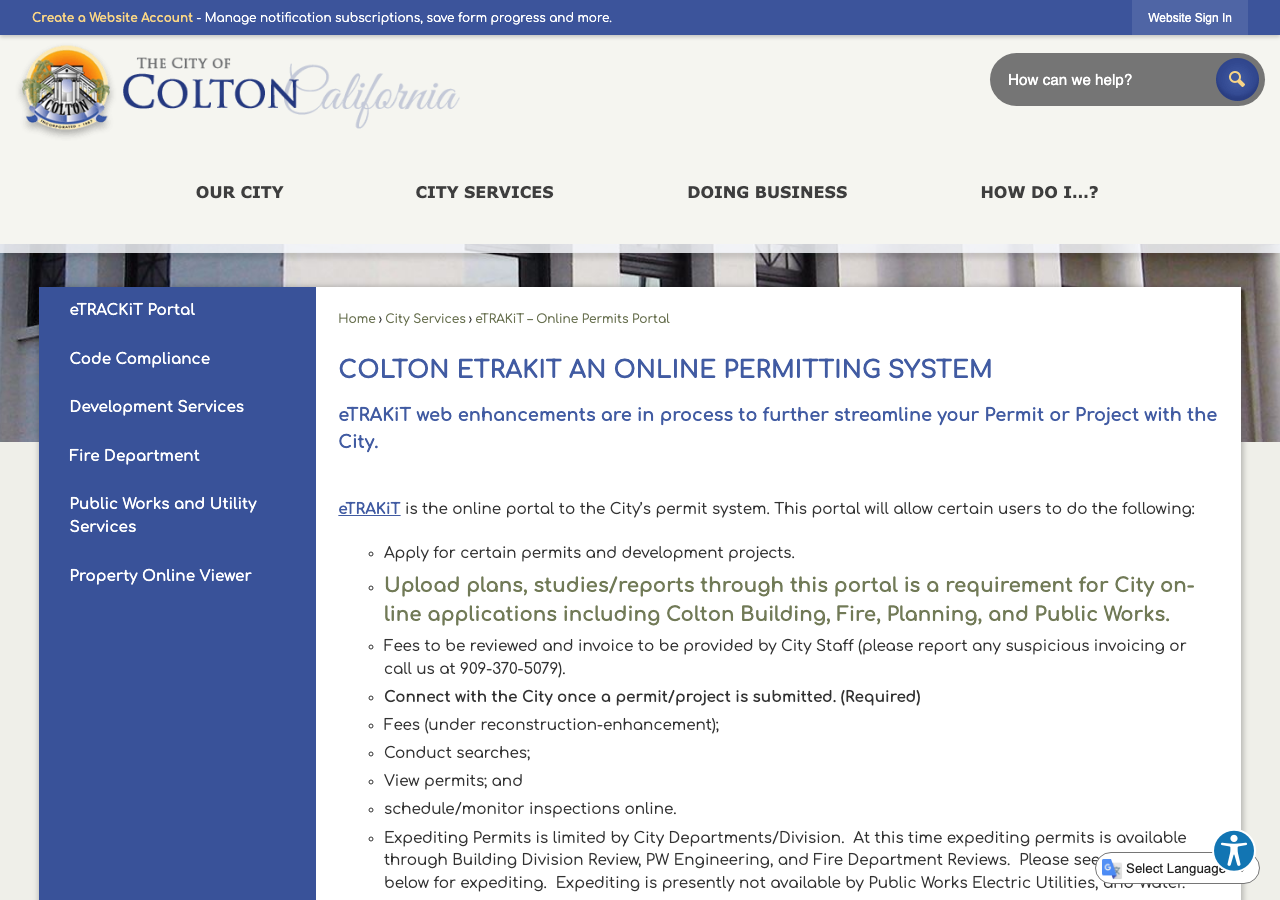
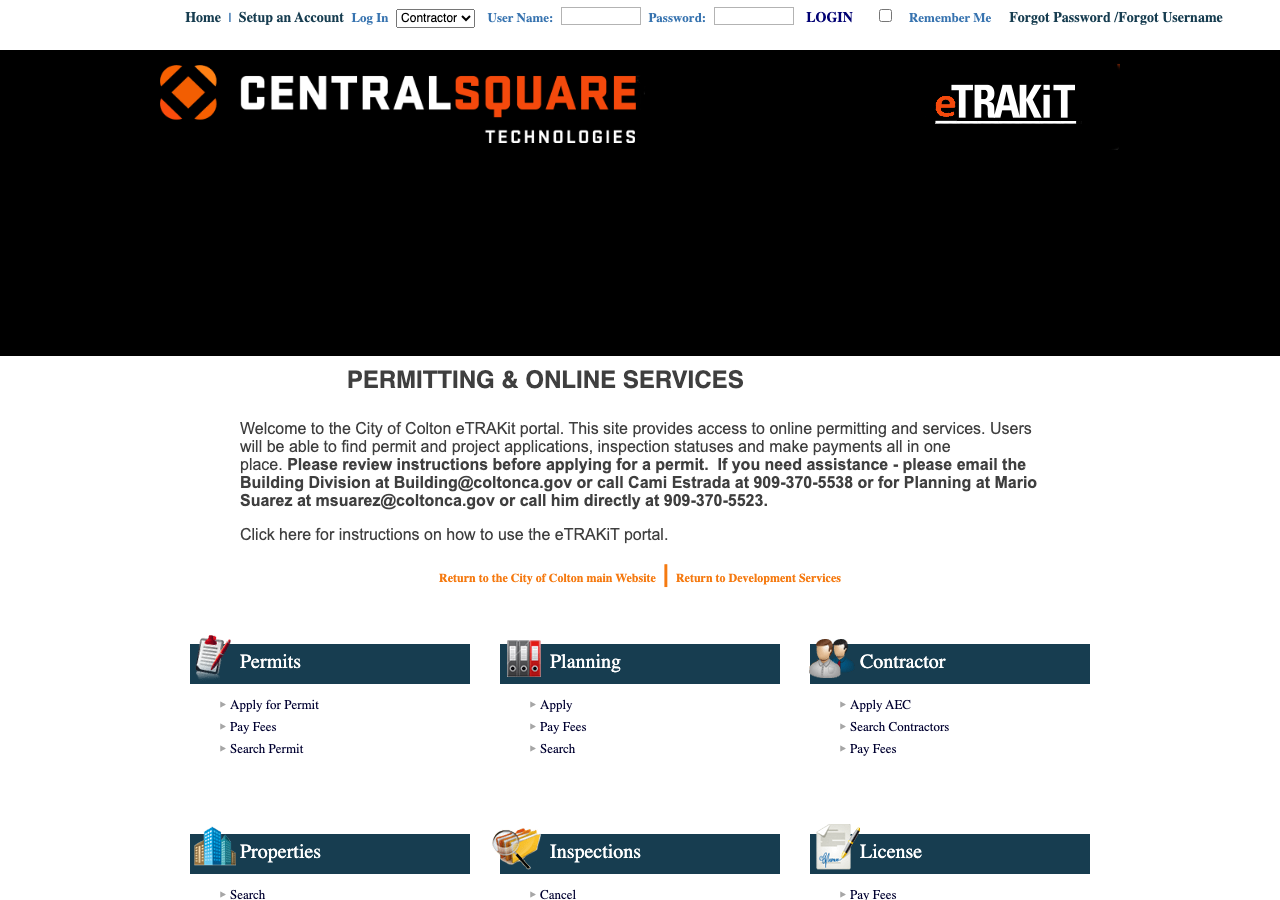
- Which permit portal does this authority use? Two separate portals: eTRAKiT for City building/planning/fire/public-works permits (www.coltonca.gov/1056/eTRAKiT), and PowerClerk (coltonpv.powerclerk.com) operated by Colton Electric Utility specifically for solar interconnection applications 90% · portal landing pages
- Can the whole application be completed online? Partially: the utility-side solar application is completed online via PowerClerk, but the City's own eTRAKiT page states (as of this check) that online fee payment is broken and directs applicants to submit plans and pay fees in person at 659 N. La Cadena Dr. 82% · portal landing page
- What does a residential solar permit cost? $245 plan-check + $250 permit fee (B&S, PV up to 10 kVA) plus a separate $225 Electric Utility solar review charge = approximately $720 total for a residential PV system 78% · fee schedule + department webpage
- How is the fee calculated? Flat (per system, up to 10kVA/10kW tier) 85% · fee schedule
- Is there a separate plan-check fee? Yes 90% · fee schedule
-
Plan review — and start the utility in parallel
Interconnection is a separate process from the permit and usually the longer pole. Where the utility does not depend on the permit being issued, running both at once is the single biggest saving available on a residential job.
- What is the stated plan-review turnaround? Standard <=10kW submittals using the City's own Standard Electrical Plan 'may be approved over the counter'; non-standard/custom-designed systems go to further review with no stated turnaround; commercial/industrial PV interconnection studies are stated at approximately 3 weeks 72% · city bulletin
- How long is an issued permit valid before it expires? Plan-check applications expire 180 days after the date of first application if no permit is issued (per the Building Permit/Plan Check Application form); no separate statement of issued-permit expiration for solar specifically was found — Colton's adopted 2022 CBC would conventionally apply the same 180-day standard to issued permits, but that section was not independently viewed 50% · permit application form
- Which utility handles interconnection here? Colton Electric Utility (CEU) — a City-owned, municipal electric utility. NOT Southern California Edison. 97% · utility's own webpage
- Where does the utility sit in the sequence? Before permit: the PowerClerk solar application and a $225 CEU solar review charge must be completed and paid BEFORE the City will issue the building permit 88% · utility's own webpage
28 questions answered against City of Colton’s own published documents
Q1 Is this authority the AHJ for residential solar at this address? Core Jurisdiction & scope
Yes
Why the confidence is not higherCity of Colton Building & Safety Division (Development Services) issues building/electrical permits for residential rooftop PV; Colton has its own dedicated Solar Program page and PV permit bulletins.
authority's own page checked 2026-08-30 https://www.coltonca.gov/354/Solar-Program
Q2 What does this authority permit itself, and what does it delegate? Core Jurisdiction & scope
Both (Building & Electrical, combined, issued by the City); Fire Prevention (Colton Fire Dept) reviews separately only for sites in Very-High Fire Hazard Severity Zones; the City's own municipally-owned Electric Utility (CEU) additionally reviews/approves interconnection before a permit issues
Why the confidence is not higherSolar PV permit bulletin (Requirements for Permit Application, Solar PV <10kW) lists Building Permit for PV + Planning review + Fire Construction Services approval only in VHFHSZ; Solar Program page shows CEU (municipal utility, not SCE) requires its own PowerClerk review/fee before permit issuance.
city bulletin checked 2026-08-30 https://www.ci.colton.ca.us/DocumentCenter/View/1652
Q3 Is a permit required for a residential rooftop PV system? Core Jurisdiction & scope
Yes
Why the confidence is not higherBulletin states a Building Permit for Photovoltaic is required for all solar PV installations under 10kW in single-family dwellings.
city bulletin checked 2026-08-30 https://www.ci.colton.ca.us/DocumentCenter/View/1652
Q4 Is there a separate electrical permit, or is it combined? Core Jurisdiction & scope
Combined
Why the confidence is not higherThe B&S fee schedule lists a single 'Photovoltaic, Single-Family Residence up to 10KVA' line under the Electrical permit fee table, issued as one Building Permit for Photovoltaic rather than two separate building+electrical permits.
fee schedule checked 2026-08-30 https://www.ci.colton.ca.us/DocumentCenter/View/6588/Residential-Fee-Schedule
Q5 Who is allowed to pull the electrical permit? Core Who may apply
Either
Why the confidence is not higherColton's own Standard Electrical Plan forms (Central Inverter and Microinverter) have an explicit Homeowner vs. Contractor checkbox and instruct: 'If homeowner is doing their own electric work, write "Homeowner" for electric contractor.'
city standard plan form checked 2026-08-30 https://www.ci.colton.ca.us/DocumentCenter/View/1649
Q6 Must the contractor be registered with this authority before applying? Core Who may apply
Yes
Why the confidence is not higherColton Municipal Code 5.02.030 requires any business, trade or occupation (including contractors, even those based outside the city) to obtain a City business license before transacting business in Colton; the Building Permit Application form has a mandatory 'City Business License #' field for contractors.
municipal code citation on department page checked 2026-08-30 https://www.coltonca.gov/308/Business-License
Q7 Is a homeowner permitted to self-install and self-permit? Who may apply
Yes
Why the confidence is not higherThe Standard Electrical Plan forms explicitly accommodate a 'Homeowner' installer, and the City separately publishes an Owner-Builder Handout and Owner-Builder Packet.
city standard plan form checked 2026-08-30 https://www.ci.colton.ca.us/DocumentCenter/View/1649
Q8 What documents make up a complete submittal? Core Submittal package
Completed permit application; a completed Standard Electrical Plan (for systems <=10kW using standard central-inverter or microinverter configurations) OR a designed electrical plan by a contractor/engineer showing disconnect locations, module/string counts, inverter/combiner make & model, one-line diagram, grounding/conductor specs, equipment cut sheets, required labeling, and a site diagram; structural support info if a prescriptive exemption doesn't apply
Why the confidence is not higherRequirements for Permit Application bulletin, Section 2 (Submittal Requirements).
city bulletin checked 2026-08-30 https://www.ci.colton.ca.us/DocumentCenter/View/1652
Q9 How many copies, and in what format? Submittal package
3 complete sets of plans for the standard <10kW submittal; 2 complete permit packages of the Standard Electrical Plan form itself; submittal currently must be in person/paper because eTRAKiT's online fee-intake is reported broken
Why the confidence is not higherBulletin item 2(c) requires '3 complete sets of plans'; Standard Electrical Plan forms instruct 'Provide two complete permit packages of these forms to the Public Counter Staff'; eTRAKiT portal page states online fee intake is experiencing errors and directs submittal in person at 659 N. La Cadena Dr.
city bulletin + portal page checked 2026-08-30 https://www.ci.colton.ca.us/DocumentCenter/View/1652
Q10 Is a site plan required, and what must it show? Core Submittal package
Yes — site diagram showing arrangement of panels on roof/ground, north arrow, lot dimensions, existing shading elements, and distance from property lines to adjacent buildings/structures (existing and proposed)
Why the confidence is not higherRequirements for Permit Application bulletin, item 2(d) 'Site diagram'.
city bulletin checked 2026-08-30 https://www.ci.colton.ca.us/DocumentCenter/View/1652
Q11 Is a one-line / three-line diagram required? Core Drawings & calculations
Yes
Why the confidence is not higherBulletin requires 'One-line diagram of system' as part of the electrical plan submittal.
city bulletin checked 2026-08-30 https://www.ci.colton.ca.us/DocumentCenter/View/1652
Q12 Are string and conductor calculations required? Drawings & calculations
Yes
Why the confidence is not higherStandard Electrical Plan forms (Central Inverter & Microinverter) require the applicant to calculate string voltage/current, conductor ampacity via a supplied temperature-correction table, and OCPD sizing.
city standard plan form checked 2026-08-30 https://www.ci.colton.ca.us/DocumentCenter/View/1649
Q13 Is a structural PE stamp required, and at what threshold? Core Engineering & stamps
No fixed numeric threshold published; the Building Official has discretion to waive structural calculations for roof-mounted PV where he can determine the added weight does not affect structural integrity, otherwise calculations demonstrating vertical/lateral/wind/seismic load compliance are required
Why the confidence is not higherSolar PV Code Requirements bulletin, Section 2.1.1 explicitly leaves the waiver decision to the Building Official's case-by-case determination and notes 'some jurisdictions may have a prescriptive approach... however, that varies by the enforcing agency' — Colton's own bulletin does not supply Colton-specific numeric criteria.
city bulletin checked 2026-08-30 https://www.ci.colton.ca.us/DocumentCenter/View/1650
Q14 Is an electrical PE stamp required, and at what threshold? Engineering & stamps
Not required for the standard pre-approved Central Inverter/Microinverter plan (self-certified by contractor or homeowner); an electrical engineer stamp is only implied as an alternative path if a fully custom, non-standard electrical plan is submitted, and even then a licensed contractor (not necessarily a PE) may prepare it
Why the confidence is not higherRequirements for Permit Application bulletin item 2(d): 'a designed Electrical Plan prepared by an electrical contractor OR electrical engineer' — no PE stamp is mandated at any kW threshold.
city bulletin checked 2026-08-30 https://www.ci.colton.ca.us/DocumentCenter/View/1652
Q15 What does a residential solar permit cost? Core Fees
$245 plan-check + $250 permit fee (B&S, PV up to 10 kVA) plus a separate $225 Electric Utility solar review charge = approximately $720 total for a residential PV system
Why the confidence is not higherB&S Residential Fee Schedule (PDF created 5 Feb 2020) lists 'Photovoltaic, Single-family Residence up to 10KVA' at $245.00 plan check / $250.00 permit; the live Solar Program page states 'As of March 2021, the City of Colton will now be collecting a $225.00 solar review charge. This charge must be paid prior to receiving a permit.' The two figures come from different dated sources and have not been re-published together in one current schedule.
fee schedule + department webpage checked 2026-08-30 https://www.ci.colton.ca.us/DocumentCenter/View/6588/Residential-Fee-Schedule
Q16 How is the fee calculated? Core Fees
Flat (per system, up to 10kVA/10kW tier)
Why the confidence is not higherFee schedule prices PV as a single flat figure for 'up to 10KVA' rather than per-panel/per-kW graduation within that tier; the utility's $225 solar review charge is also a flat charge.
fee schedule checked 2026-08-30 https://www.ci.colton.ca.us/DocumentCenter/View/6588/Residential-Fee-Schedule
Q17 Is there a separate plan-check fee? Fees
Yes
Why the confidence is not higherFee schedule lists 'Plan Check Fee' ($245) and 'Permit Fee' ($250) as two separate columns for the PV line item.
fee schedule checked 2026-08-30 https://www.ci.colton.ca.us/DocumentCenter/View/6588/Residential-Fee-Schedule
Q18 What is the stated plan-review turnaround? Core Timeline & validity
Standard <=10kW submittals using the City's own Standard Electrical Plan 'may be approved over the counter'; non-standard/custom-designed systems go to further review with no stated turnaround; commercial/industrial PV interconnection studies are stated at approximately 3 weeks
Why the confidence is not higherRequirements for Permit Application bulletin, Section 3 (Plan Review); Commercial/Industrial PV Requirements document states 'Interconnection study turn around shall be approximately three weeks once all information is provided' (this figure is for commercial, cited here only as the closest published turnaround figure).
city bulletin checked 2026-08-30 https://www.ci.colton.ca.us/DocumentCenter/View/1652
Q19 How long is an issued permit valid before it expires? Timeline & validity
Plan-check applications expire 180 days after the date of first application if no permit is issued (per the Building Permit/Plan Check Application form); no separate statement of issued-permit expiration for solar specifically was found — Colton's adopted 2022 CBC would conventionally apply the same 180-day standard to issued permits, but that section was not independently viewed
Why the confidence is not higherBuilding Permit Application form (rev. 12/4/2025), footer note: 'APPLICATION FOR PLAN CHECK ARE VALID FOR 180 DAYS FROM THE DATE OF THE FIRST APPLICATION.' This answers plan-check validity, not confirmed for post-issuance permit expiration.
permit application form checked 2026-08-30 https://www.coltonca.gov/documentcenter/view/324
Q20 Which permit portal does this authority use? Core Portal & process
Two separate portals: eTRAKiT for City building/planning/fire/public-works permits (www.coltonca.gov/1056/eTRAKiT), and PowerClerk (coltonpv.powerclerk.com) operated by Colton Electric Utility specifically for solar interconnection applications
Why the confidence is not highereTRAKiT portal page names Building/Fire/Planning/Public Works as eTRAKiT departments; Solar Program page: 'The City of Colton uses PowerClerk for its residential application process... coltonpv.powerclerk.com/MvcAccount/Login'.
portal landing pages checked 2026-08-30 https://www.coltonca.gov/354/Solar-Program
Q21 Can the whole application be completed online? Core Portal & process
Partially: the utility-side solar application is completed online via PowerClerk, but the City's own eTRAKiT page states (as of this check) that online fee payment is broken and directs applicants to submit plans and pay fees in person at 659 N. La Cadena Dr.
Why the confidence is not highereTRAKiT page: 'etrakit experiencing errors in fee intakes. Temporarily, please submit plans and pay fees in person...'
portal landing page checked 2026-08-30 https://www.coltonca.gov/1056/eTRAKiT-Online-Permits-Portal
Q22 Which utility handles interconnection here? Core Utility interconnection
Colton Electric Utility (CEU) — a City-owned, municipal electric utility. NOT Southern California Edison.
Why the confidence is not higherElectric Utility page: 'CITY OF COLTON ELECTRIC UTILITY... Powering Colton for 130 years'; Utility Billing Services page: 'The City of Colton provides electric, water, and wastewater services to its citizens... for the city owned utilities'; Solar Program page: applications go through 'City of Colton Electric Utility' via PowerClerk, not through an IOU Rule 21 process.
utility's own webpage checked 2026-08-30 https://www.coltonca.gov/162/Electric
Q23 Where does the utility sit in the sequence? Core Utility interconnection
Before permit: the PowerClerk solar application and a $225 CEU solar review charge must be completed and paid BEFORE the City will issue the building permit
Why the confidence is not higherSolar Program page: 'As of March 2021, The City of Colton will now be collecting a $225.00 solar review charge. This charge must be paid prior to receiving a permit for installation.'
utility's own webpage checked 2026-08-30 https://www.coltonca.gov/354/Solar-Program
Q24 Is a HOA or architectural approval required first? Overlays & special cases
No city-imposed HOA/architectural review requirement found in Colton's solar permitting bulletins; any private HOA restriction would in any case be unenforceable against solar under the CA Solar Rights Act (Civil Code Section 714/4600), which the City's own Code Requirements bulletin cites directly
Why the confidence is not higherSolar Photovoltaic (PV) System Code Requirements bulletin cites the California Solar Rights Act (Gov. Code Sec. 65850.5) and contains no HOA/architectural-review submittal requirement anywhere in its permit or submittal sections.
city bulletin (absence) checked 2026-08-30 https://www.ci.colton.ca.us/DocumentCenter/View/1650
Q25 Is there a historic-district review? Overlays & special cases
Nothing published by this authority.
Where we lookedSolar PV Code Requirements bulletin, Requirements for Permit Application bulletin, and both Standard Electrical Plan forms — none mention a historic district or historic-preservation overlay; Colton's Planning Division page/zoning ordinance were not separately reviewed for a historic-district map
Q26 Is a wind or windstorm certification required? Overlays & special cases
No — California uses ASCE 7-based wind-load engineering calculations for PV racking, not a Texas Department of Insurance-style windstorm certification
Why the confidence is not higherSolar PV Code Requirements bulletin, Section 2.1.2.3 'Wind design' requires ASCE/SEI 7 calculations, not any third-party windstorm certificate.
city bulletin checked 2026-08-30 https://www.ci.colton.ca.us/DocumentCenter/View/1650
Q27 Is a Specific Use Permit or Council approval ever required? Overlays & special cases
Planning Division review is required for all solar PV installations under 10kW as part of the standard permit process (a ministerial review, not a discretionary Specific Use Permit or Council hearing); no SUP/Council approval requirement was found for standard rooftop residential PV
Why the confidence is not higherRequirements for Permit Application bulletin item 1(b): 'Planning review is required for solar PV installations of this size.'
city bulletin checked 2026-08-30 https://www.ci.colton.ca.us/DocumentCenter/View/1652
Q28 Is there a system-size cap on residential generation? Overlays & special cases
Yes — system output is capped at 100% of the property's actual trailing-12-month electric consumption with NO oversizing and NO exceptions; where 12 months of usage history is unavailable, the cap is 2 watts/sq ft of the home, or sizing per a CEC-approved Title 24 compliance program (CBECC, EnergyPro)
Why the confidence is not higherSolar Program page (CEU): 'Customers may install systems up to 100% of their actual consumption... The City of Colton does not allow for any oversizing, there will be no exceptions... the maximum they will be approved to install is 2 watts per square foot... The City of Colton will accept the California Energy Commission approved building simulation compliance programs like CBECC, and Energy Pro.'
utility's own webpage checked 2026-08-30 https://www.coltonca.gov/354/Solar-Program
Lines marked with a percentage were read off this authority’s own published documents. Unmarked guidance is general good practice, not this jurisdiction’s rule — always confirm against the authority before you submit.
Install 5 steps · 20 questions
-
Build to the code editions actually in force here
The NEC edition a jurisdiction enforces is often a cycle behind the newest one published, and local amendments sit on top of it. Rapid shutdown, conductor sizing and labelling all change between editions, so the edition in force is the first thing to establish, not the last.
- Which NEC edition is in force? 2022 California Electrical Code (based on the 2020 NEC with CA amendments), per the City's own Jan 2023 code-adoption bulletin; note the statewide 2025 Title 24 cycle (based on the 2023 NEC) took effect 1 Jan 2026 and no newer Colton adoption ordinance/bulletin superseding the 2022 cycle could be located 60% · city bulletin
- Which building code edition is in force? 2022 California Building Code / California Residential Code, effective 1 Jan 2023 per the City's own bulletin; same caveat as Q29 about a possible unpublished 2025-cycle update 62% · city bulletin
- Which fire code edition is in force? 2022 California Fire Code, effective 1 Jan 2023 per the same City adoption bulletin; Colton Fire Department's own Fire Plan Submittal Application form leaves the 'Code Edition Used — CFC' field blank/project-specific rather than restating a fixed edition 55% · city bulletin
- Are there local amendments to any of the above? Yes 85% · city/utility bulletin
- What is the installation judged against? The adopted 2022 CBC/CRC/CEC/CFC (Title 24), interpreted through the City's own 'Solar Photovoltaic (PV) System Code Requirements' bulletin, plus Colton Electric Utility's EUSERC-based engineering standards for the interconnection/metering portion 82% · city bulletin
-
Fire access, setbacks and pathways
Ridge setbacks and roof access pathways are fire-service requirements and they constrain the array layout. They are the most common cause of a redesign after the fire department comments on a plan set.
- What ridge setback and access pathways are required? No Colton-specific ridge-setback/access-pathway amendment was found; the generic 2022 California Fire Code pathway/setback provisions (CFC 605.11 series) would apply by default since no local amendment text on this topic could be located 50% · fire department webpage (absence)
-
Rapid shutdown
Which rapid-shutdown rule applies follows directly from the NEC edition in force, and the initiation device has to be at a location the fire service can reach and identify. This is inspected, and it is labelled.
- Is rapid shutdown required, and to which NEC edition? The adopted 2022 CEC statutorily requires NEC 690.12 rapid shutdown, BUT this is a critical flag: Colton's own published 'Solar PV Standard Electrical Plan' forms (Central Inverter & Microinverter, both stamped 'Updated 1/11/2023') and its 'Solar Photovoltaic (PV) System Code Requirements' bulletin NEVER mention rapid shutdown or NEC/CEC Section 690.12 anywhere, and instead cite stale code sections ('Section 690.5 2010 CEC', 'Section 690.9 2013 CEC') for other requirements while nominally claiming 2022/2023 CEC compliance elsewhere in the same document 55% · city standard plan form (critical absence)
-
Labels and placards
The NEC sets a baseline for permanent markings at the service equipment and the disconnecting means. On top of that, an authority may specify its own wording, and the utility may specify more again. Where any of them writes its own text, a generic off-the-shelf label set will not pass — this is the detail most often fixed on a return visit.
- Which placards does this authority require at the service equipment? PV power source label at the DC disconnecting means (central-inverter systems); AC point-of-interconnection label (microinverter systems); a switch/label identifying the 'alternative power system' switch; plus utility production-meter/AC-disconnect labeling per CEU/EUSERC drawings 88% · city bulletin
- Does the authority specify placard wording of its own? No — Colton's bulletins restate the content NEC 690.53/690.54 already require (rated current/voltage, PV source ID) rather than inventing city-specific wording; for commercial systems the City instead requires the applicant to submit their own 'legend showing the locations and wording of all required signs' for review, i.e. the applicant proposes wording and the City reviews it 75% · city bulletin
- Does it specify letter height, colour or material? Yes, as a recommendation rather than a hard mandate: 'A phenolic plaque with contrasting colors between the text and background would meet the intent of the code for permanency. No type size is specified, but 20 point (3/8") should be considered the minimum.' 82% · city standard plan form
- Is a site plan / facility map placard required, and what must it show? No dedicated on-site facility-map/site-plan placard requirement (distinct from the plan-review site diagram used only for permitting) was found in any Colton building, fire, or utility document reviewed 60% · city bulletin (absence)
- Does the UTILITY specify placards beyond the AHJ's? The utility's own engineering drawings (EUSERC-based, and CEU's own PV+ESS interconnection diagrams 700.01–700.03) impose physical clearance/access requirements ('Requires CEU access 24/7, line of sight', 10-inch minimum clearances) but do not specify additional label wording beyond what the CEC already requires 68% · utility engineering standard (OCR'd)
- Where must the labels be placed? DC disconnect label at the PV DC disconnecting means; AC label at the point of interconnection; physically, the AC disconnect switch must sit within 10 ft of the main service panel and within line of sight of it, with a minimum 10-inch clearance from the edge of any enclosure (production meter, utility AC disconnect, customer AC disconnect all in the same run) 88% · utility engineering standard (OCR'd)
-
Disconnect, storage and listed equipment
Where the AC disconnect must sit relative to the meter is usually the utility's rule, not the building department's. Battery storage frequently carries its own permit, its own inspection and its own fire conditions.
- Where must the AC disconnect be, relative to the meter? The AC disconnect switch must be located within 10 feet of the main service panel and within line of sight of it, per Colton Electric Utility's EUSERC-based standard drawing 92% · utility engineering standard (OCR'd)
- Must equipment be on a specific approved list? Yes 92% · city bulletin
- Are batteries permitted, and under what conditions? Yes, with conditions: Colton Electric Utility publishes its own interconnection diagrams for PV + battery storage, both 'Partial Home Backup' and 'Full Home Backup' configurations (rev. 03-2023). Conditions include: customer must provide a bidirectional production meter for the battery storage; batteries/inverter must be fed from a breaker off the load center; and specified equipment (marked with a black square on CEU's diagrams) must remain accessible to CEU 24/7 and within line of sight 88% · utility engineering standard
- Is there a separate ESS permit or inspection? No dedicated ESS/battery permit or fee line was found in either the Building & Safety fee schedule (2020) or Colton Fire's Adopted Fees (dated 27 Aug 2025) — batteries appear to be reviewed under the same PV/electrical building permit rather than a stand-alone ESS permit 68% · fee schedule (absence)
- Is a ground mount treated as a structure? Context-dependent, not a flat Yes/No: a stand-alone ground-mounted PV structure with no use/occupancy underneath is 'generally considered equipment' (not a structure) for fire/roof classification purposes, but the same bulletin notes that when NOT treated as equipment it 'may be considered a structure' subject to property-line fire-separation setbacks 75% · city bulletin
- Is there a local rule on service upgrades or busbar sizing? Yes: line-side taps are prohibited citywide (only load-side connections approved); backfed PV breaker + main breaker may not exceed 120% of busbar rating; the Main Service Panel Change-Out bulletin sets minimum conductor gauge, riser size, and grounding electrode specs by amperage (100A/125A/200A+) for any panel upgrade tied to a PV install 88% · utility bulletin
- Is a specific mounting system or attachment spacing required? No Colton-specific prescriptive mounting/attachment-spacing table is published; the City's own Code Requirements bulletin explicitly notes that a prescriptive approach 'may vary by jurisdiction' and leaves the decision on when structural calculations can be waived to the Building Official case-by-case 70% · city bulletin (absence)
20 questions answered against City of Colton’s own published documents
Q29 Which NEC edition is in force? Core Code editions in force
2022 California Electrical Code (based on the 2020 NEC with CA amendments), per the City's own Jan 2023 code-adoption bulletin; note the statewide 2025 Title 24 cycle (based on the 2023 NEC) took effect 1 Jan 2026 and no newer Colton adoption ordinance/bulletin superseding the 2022 cycle could be located
Why the confidence is not higher'Plan Check Submittal Requirements' bulletin: 'Effective January 1, 2023 the City of Colton adopted the 2022 California Building, Electrical, Plumbing, Mechanical, Green Building, Energy and Fire Codes.' This is the most recent code-adoption statement found on the City's own site; a possible 2025-cycle update was searched for (site search, ordinance search) and not found.
city bulletin checked 2026-08-30 https://www.coltonca.gov/documentcenter/view/260
Q30 Which building code edition is in force? Core Code editions in force
2022 California Building Code / California Residential Code, effective 1 Jan 2023 per the City's own bulletin; same caveat as Q29 about a possible unpublished 2025-cycle update
Why the confidence is not higherSame 'Plan Check Submittal Requirements' bulletin and the Solar PV Code Requirements bulletin subtitle: 'Based on the 2022 California Building Code (CBC) and the 2022 California Residential Code (CRC)'.
city bulletin checked 2026-08-30 https://www.ci.colton.ca.us/DocumentCenter/View/1650
Q31 Which fire code edition is in force? Code editions in force
2022 California Fire Code, effective 1 Jan 2023 per the same City adoption bulletin; Colton Fire Department's own Fire Plan Submittal Application form leaves the 'Code Edition Used — CFC' field blank/project-specific rather than restating a fixed edition
Why the confidence is not higherPlan Check Submittal Requirements bulletin lists Fire Code among the codes adopted effective 1/1/2023; Colton Fire's Fire Plan Submittal Application (coltonfire.com) has a fillable, not pre-printed, CFC edition field.
city bulletin checked 2026-08-30 https://www.coltonca.gov/documentcenter/view/260
Q32 Are there local amendments to any of the above? Core Code editions in force
Yes
Why the confidence is not higherConfirmed local amendments beyond baseline NEC/CBC found in Colton's own utility documents: line-side taps are expressly disallowed ('Line side taps... are NOT allowed in the City of Colton; only load side connections will be approved' — Commercial/Industrial PV Requirements), and Colton Electric Utility/EUSERC drawings impose specific AC-disconnect placement (within 10 ft of main panel, line of sight) beyond generic NEC minimums.
city/utility bulletin checked 2026-08-30 https://www.coltonca.gov/documentcenter/view/6672
Q33 What is the installation judged against? Core Electrical
The adopted 2022 CBC/CRC/CEC/CFC (Title 24), interpreted through the City's own 'Solar Photovoltaic (PV) System Code Requirements' bulletin, plus Colton Electric Utility's EUSERC-based engineering standards for the interconnection/metering portion
Why the confidence is not higherSolar PV Code Requirements bulletin cover page; EUSERC drawings 500/501 explicitly labelled '2021 EUSERC MANUAL'.
city bulletin checked 2026-08-30 https://www.ci.colton.ca.us/DocumentCenter/View/1650
Q34 Is there a local rule on service upgrades or busbar sizing? Electrical
Yes: line-side taps are prohibited citywide (only load-side connections approved); backfed PV breaker + main breaker may not exceed 120% of busbar rating; the Main Service Panel Change-Out bulletin sets minimum conductor gauge, riser size, and grounding electrode specs by amperage (100A/125A/200A+) for any panel upgrade tied to a PV install
Why the confidence is not higherCommercial/Industrial PV Requirements document ('Line side taps... are NOT allowed'); Main Service Panel Change Out — Residential bulletin (CreationDate 6 Aug 2024) sets riser/conductor/grounding minimums per amperage tier.
utility bulletin checked 2026-08-30 https://www.coltonca.gov/documentcenter/view/6672
Q35 Is a specific mounting system or attachment spacing required? Structural & mounting
No Colton-specific prescriptive mounting/attachment-spacing table is published; the City's own Code Requirements bulletin explicitly notes that a prescriptive approach 'may vary by jurisdiction' and leaves the decision on when structural calculations can be waived to the Building Official case-by-case
Why the confidence is not higherSolar PV Code Requirements bulletin, Section 2.1.1.1 lists the parameters a jurisdiction 'could' adopt (max weight psf, fastener spacing, etc.) but does not supply Colton-specific numbers, meaning Colton has not published its own prescriptive table. Looked in: this bulletin (the only Colton document addressing structural mounting) and the two Standard Electrical Plan forms, neither of which contains a spacing table.
city bulletin (absence) checked 2026-08-30 https://www.ci.colton.ca.us/DocumentCenter/View/1650
Q36 What ridge setback and access pathways are required? Core Fire pathways & setbacks
No Colton-specific ridge-setback/access-pathway amendment was found; the generic 2022 California Fire Code pathway/setback provisions (CFC 605.11 series) would apply by default since no local amendment text on this topic could be located
Why the confidence is not higherSearched Colton Fire's 'Fire Standards' guideline list (which itemizes every published technical guideline, e.g. NFPA 13/13D/13R, alarms, spray booths, fuel modification) — no PV/solar or rooftop-pathway guideline is listed; positive control 'sprinkler' returned hits, fabricated control 'zzqqx' returned none, confirming the page content is real and searchable.
fire department webpage (absence) checked 2026-08-30 https://www.coltonfire.com/fire-standards-2/
Q37 Is rapid shutdown required, and to which NEC edition? Core Rapid shutdown
The adopted 2022 CEC statutorily requires NEC 690.12 rapid shutdown, BUT this is a critical flag: Colton's own published 'Solar PV Standard Electrical Plan' forms (Central Inverter & Microinverter, both stamped 'Updated 1/11/2023') and its 'Solar Photovoltaic (PV) System Code Requirements' bulletin NEVER mention rapid shutdown or NEC/CEC Section 690.12 anywhere, and instead cite stale code sections ('Section 690.5 2010 CEC', 'Section 690.9 2013 CEC') for other requirements while nominally claiming 2022/2023 CEC compliance elsewhere in the same document
Why the confidence is not higherFull-text read of all four solar bulletins (View/1649, 1650, 1651, 1652) — zero occurrences of '690.12' or 'rapid shutdown' in any of them, despite 690.53/690.54/690.15/690.17/705.12 all being cited by section number. This looks like a partially-updated, largely un-customized statewide PV-toolkit template; applicants relying on it would get no guidance on the array-boundary/1-foot rapid-shutdown marking requirement that actually governs signage layout.
city standard plan form (critical absence) checked 2026-08-30 https://www.ci.colton.ca.us/DocumentCenter/View/1649
Q38 Which placards does this authority require at the service equipment? Core Labels Signage & labelling
PV power source label at the DC disconnecting means (central-inverter systems); AC point-of-interconnection label (microinverter systems); a switch/label identifying the 'alternative power system' switch; plus utility production-meter/AC-disconnect labeling per CEU/EUSERC drawings
Why the confidence is not higherRequirements for Permit Application bulletin, inspection checklist: 'Sign identifying PV power source system attributes at DC disconnect... Sign identifying AC point of connection... Sign identifying switch for alternative power system.'
city bulletin checked 2026-08-30 https://www.ci.colton.ca.us/DocumentCenter/View/1652
Q39 Does the authority specify placard wording of its own? Core Labels Signage & labelling
No — Colton's bulletins restate the content NEC 690.53/690.54 already require (rated current/voltage, PV source ID) rather than inventing city-specific wording; for commercial systems the City instead requires the applicant to submit their own 'legend showing the locations and wording of all required signs' for review, i.e. the applicant proposes wording and the City reviews it
Why the confidence is not higherSolar PV Central Inverter/Microinverter bulletins quote CEC 690.53/690.54 label-content requirements verbatim rather than a City-authored script; Commercial/Industrial PV Requirements document: 'Signage Specs – Provide legend showing the locations and wording of all required signs or placards.'
city bulletin checked 2026-08-30 https://www.ci.colton.ca.us/DocumentCenter/View/1649
Q40 Does it specify letter height, colour or material? Core Labels Signage & labelling
Yes, as a recommendation rather than a hard mandate: 'A phenolic plaque with contrasting colors between the text and background would meet the intent of the code for permanency. No type size is specified, but 20 point (3/8") should be considered the minimum.'
Why the confidence is not higherSolar PV Standard Electrical Plan — Central Inverter System bulletin, final note (page 10).
city standard plan form checked 2026-08-30 https://www.ci.colton.ca.us/DocumentCenter/View/1649
Q41 Is a site plan / facility map placard required, and what must it show? Core Labels Signage & labelling
No dedicated on-site facility-map/site-plan placard requirement (distinct from the plan-review site diagram used only for permitting) was found in any Colton building, fire, or utility document reviewed
Why the confidence is not higherLooked in: Solar PV Code Requirements bulletin, both Standard Electrical Plan forms, the Commercial/Industrial PV Requirements document, and the Fire Standards guideline list — none describe a required posted facility/site map placard at the service equipment (only the permit-submittal site diagram and the standard 690.53/690.54 DC/AC labels are addressed).
city bulletin (absence) checked 2026-08-30 https://www.ci.colton.ca.us/DocumentCenter/View/1650
Q42 Does the UTILITY specify placards beyond the AHJ's? Core Labels Signage & labelling
The utility's own engineering drawings (EUSERC-based, and CEU's own PV+ESS interconnection diagrams 700.01–700.03) impose physical clearance/access requirements ('Requires CEU access 24/7, line of sight', 10-inch minimum clearances) but do not specify additional label wording beyond what the CEC already requires
Why the confidence is not higherRead Drawing 500 (AC Disconnect and Net/Performance Meter Wiring) and Drawing 501 (Customer-Owned Production Meter AC Disconnect Guidelines) in full via OCR (both 2021 EUSERC Manual); and the PV/ESS Interconnection Diagrams packet (dated 29 Aug 2023) — all address equipment placement/access, not placard text.
utility engineering standard (OCR'd) checked 2026-08-30 https://www.coltonca.gov/documentcenter/view/7506
Q43 Where must the labels be placed? Core Labels Signage & labelling
DC disconnect label at the PV DC disconnecting means; AC label at the point of interconnection; physically, the AC disconnect switch must sit within 10 ft of the main service panel and within line of sight of it, with a minimum 10-inch clearance from the edge of any enclosure (production meter, utility AC disconnect, customer AC disconnect all in the same run)
Why the confidence is not higherColton Electric Utility Drawing 501: 'The AC Disconnect Switch shall be located within 10' of the main service panel and within line of sight... A minimum 10" clearance is required from the edge of any enclosure.' (OCR'd from the drawing image.)
utility engineering standard (OCR'd) checked 2026-08-30 https://www.coltonca.gov/documentcenter/view/7506
Q44 Must equipment be on a specific approved list? Equipment listing
Yes
Why the confidence is not higherSolar PV Code Requirements bulletin, Part II item 1: 'The solar PV panel/module and other equipment used in the PV system shall be listed/certified by a nationally recognized listing/certification agency' (UL 1703 specifically referenced for panels elsewhere in the bulletin).
city bulletin checked 2026-08-30 https://www.ci.colton.ca.us/DocumentCenter/View/1650
Q45 Are batteries permitted, and under what conditions? Core Battery / ESS
Yes, with conditions: Colton Electric Utility publishes its own interconnection diagrams for PV + battery storage, both 'Partial Home Backup' and 'Full Home Backup' configurations (rev. 03-2023). Conditions include: customer must provide a bidirectional production meter for the battery storage; batteries/inverter must be fed from a breaker off the load center; and specified equipment (marked with a black square on CEU's diagrams) must remain accessible to CEU 24/7 and within line of sight
Why the confidence is not higher'PV AND ENERGY STORAGE REQUIREMENTS' packet (CreationDate 29 Aug 2023), drawings 700.02 'photovoltaic with energy storage Partial home backup' and 700.03 '...Full home backup': 'Customer to provide Bidirectional PM for the battery storage... EQUIPMENT ENCLOSED IN A BLACK SQUARE REQUIRE CEU ACCESS AT ALL TIMES.'
utility engineering standard checked 2026-08-30 https://www.coltonca.gov/documentcenter/view/8411
Q46 Is there a separate ESS permit or inspection? Battery / ESS
No dedicated ESS/battery permit or fee line was found in either the Building & Safety fee schedule (2020) or Colton Fire's Adopted Fees (dated 27 Aug 2025) — batteries appear to be reviewed under the same PV/electrical building permit rather than a stand-alone ESS permit
Why the confidence is not higherSearched both fee schedules for 'battery', 'storage', 'ESS' — no hits in the residential/commercial B&S schedule; Colton Fire's fee schedule (read line-by-line) has only 'Solar Panel - Commercial $352 hourly (3hr min)' and no battery/ESS line at all. Fabricated control 'zzqqx' returned zero hits in both PDFs; positive controls ('sprinkler', 'residential') returned expected hits, confirming the extraction was reliable.
fee schedule (absence) checked 2026-08-30 https://www.coltonfire.com/wp-content/uploads/2025/10/Adopted-Fees-2025.pdf
Q47 Is a ground mount treated as a structure? Core Ground mount
Context-dependent, not a flat Yes/No: a stand-alone ground-mounted PV structure with no use/occupancy underneath is 'generally considered equipment' (not a structure) for fire/roof classification purposes, but the same bulletin notes that when NOT treated as equipment it 'may be considered a structure' subject to property-line fire-separation setbacks
Why the confidence is not higherSolar PV Code Requirements bulletin, Sections 3.1.2 and 3.3.
city bulletin checked 2026-08-30 https://www.ci.colton.ca.us/DocumentCenter/View/1650
Q48 Where must the AC disconnect be, relative to the meter? Core Utility equipment
The AC disconnect switch must be located within 10 feet of the main service panel and within line of sight of it, per Colton Electric Utility's EUSERC-based standard drawing
Why the confidence is not higherDrawing 501 'Customer Owned Production Meter AC Disconnect Guidelines' (2021 EUSERC Manual, adopted by CEU): note 3, 'The AC Disconnect Switch shall be located within 10' of the main service panel and within line of sight.'
utility engineering standard (OCR'd) checked 2026-08-30 https://www.coltonca.gov/documentcenter/view/7506
Lines marked with a percentage were read off this authority’s own published documents. Unmarked guidance is general good practice, not this jurisdiction’s rule — always confirm against the authority before you submit.
Inspection 5 steps · 14 questions
-
Book it
Booking is a portal, a phone call or an email depending on the authority, and the notice required is rarely zero. Book before the work is finished rather than after — the lead time, not the work, is usually what sets the date.
- How is an inspection booked? Phone (Automated Inspection Line, 909-370-5131) or online via eTRAKiT for registered/logged-in users 90% · department webpage
- How much notice is required? 1 business day — call/request by 4:00–4:30 pm to get an inspection the next business day; Thursday/Friday requests roll to the following Monday (4-day work week, closed Fridays) 90% · department webpage
- Are same-day or AM/PM windows offered? Not specified — no AM/PM window selection is offered in any published Colton inspection material found; the routing slip covering all of that day's inspections is simply 'usually ready by 7:30 a.m.' 60% · department webpage (absence)
-
Know who turns up
Some authorities inspect their own solar work; some delegate it, and a few do not inspect the PV equipment itself at all. Who is coming determines what they will look at.
- Does this AHJ perform its own final solar inspection? Yes 90% · department webpage
- If delegated, to whom? N/A for standard sites (not delegated). For sites in a Very-High Fire Hazard Severity Zone, Fire Construction Services (Colton Fire Department, Community Risk Reduction Division) reviews/approves in addition to Building 82% · city bulletin
-
Work the stages in order
A rough-in or mid-roof inspection, where one is required, has to happen before the work it covers is closed up. Missing a stage means opening something back up, and it is the most expensive kind of correction.
- Which inspections are required, and in what order? Building permit issuance (after CEU PowerClerk review/fee) -> installation -> Building & Safety final inspection (verifies labels, listings, workmanship per the published checklist) -> Fire approval only if in a VHFHSZ -> CEU sets the production meter / interconnection 75% · synthesized from city bulletins
- Is a rough-in or mid-roof inspection required? Not specifically required for a standard <=10kW PV system — the published bulletin describes only a single final inspection with a detailed checklist, not a separate rough-in/mid-roof stage 60% · city bulletin (absence)
-
Have the paperwork on site
The approved plan set, the permit, and the equipment listings should be on site and reachable. Inspectors routinely verify that installed equipment matches what was approved, and that the labels are the ones the plan set promised.
- Is there a published inspection checklist? Yes 95% · city bulletin
- What must be on site at inspection? The completed Standard Electrical Plan form (or the approved custom electrical plan) plus ALL manufacturer system-installation instructions, per the City's own instruction printed on the form 90% · city standard plan form
- Does the inspector verify labels and listings? Yes 95% · city bulletin
-
Sign-off, and permission to operate
Passing gives you a final or an equivalent sign-off. That is not the same as permission to operate: PTO comes from the utility, and who tells the utility the inspection passed varies. A system left switched off for weeks is usually waiting on this handover.
- What is issued on pass? Final (a passed final inspection on the building permit record); Colton's own bulletin describes the outcome as 'final approval is granted for the solar system' rather than referencing a Certificate of Occupancy, a green tag, or a separate letter 68% · city bulletin
- Who notifies the utility for PTO? Not clearly published who formally 'notifies' the utility — but functionally the customer/installer initiates and carries the entire process through Colton Electric Utility's own PowerClerk portal from application through to production-meter set, since CEU is simultaneously the AHJ-adjacent reviewer and the interconnecting utility 45% · utility's own webpage
- Is there a re-inspection fee? No dedicated 'solar/PV re-inspection fee' line was found; a generic 'Other Inspection Fee... for which no fee is specifically indicated' at $65.00 appears in the 2020 B&S residential fee schedule and is the closest applicable published figure 50% · fee schedule
- How are corrections issued and cleared? Not explicitly documented for Building & Safety solar inspections specifically; Colton Fire's plan-review process (a comparable City process) issues corrections by email to a single 'Designated Project Contact' who must acknowledge receipt, with re-inspection/resubmission handled through the same counter contact 50% · fire department bulletin (comparable process)
14 questions answered against City of Colton’s own published documents
Q49 How is an inspection booked? Core Booking & scheduling
Phone (Automated Inspection Line, 909-370-5131) or online via eTRAKiT for registered/logged-in users
Why the confidence is not higherBuilding & Safety Division page: 'Inspection Line - 909-370-5131'; eTRAKiT page: 'To schedule an inspection, log-in OR use our Automated Phone System, (909) 370-5131.'
department webpage checked 2026-08-30 https://www.coltonca.gov/307/Building-Safety-Division
Q50 How much notice is required? Core Booking & scheduling
1 business day — call/request by 4:00–4:30 pm to get an inspection the next business day; Thursday/Friday requests roll to the following Monday (4-day work week, closed Fridays)
Why the confidence is not higherBuilding & Safety Division page: 'Please call by 4 pm to schedule an inspection the following day... Thursday and Friday calls roll over to the following Monday.'
department webpage checked 2026-08-30 https://www.coltonca.gov/307/Building-Safety-Division
Q51 Are same-day or AM/PM windows offered? Booking & scheduling
Not specified — no AM/PM window selection is offered in any published Colton inspection material found; the routing slip covering all of that day's inspections is simply 'usually ready by 7:30 a.m.'
Why the confidence is not higherLooked in: Building & Safety Division page and the Construction Permit — Inspections handout; neither offers an AM/PM or same-day window choice.
department webpage (absence) checked 2026-08-30 https://www.coltonca.gov/307/Building-Safety-Division
Q52 Does this AHJ perform its own final solar inspection? Core Who inspects
Yes
Why the confidence is not higherBuilding & Safety Division page: 'Building and Safety ensures building construction compliance with State Building Codes and local ordinances through plan check, permit, and inspection services'; the Solar PV bulletin's inspection checklist is explicitly a City Building inspection function ('contacting the Building and Safety Division').
department webpage checked 2026-08-30 https://www.coltonca.gov/307/Building-Safety-Division
Q53 If delegated, to whom? Core Who inspects
N/A for standard sites (not delegated). For sites in a Very-High Fire Hazard Severity Zone, Fire Construction Services (Colton Fire Department, Community Risk Reduction Division) reviews/approves in addition to Building
Why the confidence is not higherRequirements for Permit Application bulletin, item 1(c): 'Fire Construction Services approval is required for solar PV installations of this size on buildings located in the Very-High Fire Hazard Severity Zones.'
city bulletin checked 2026-08-30 https://www.ci.colton.ca.us/DocumentCenter/View/1652
Q54 Which inspections are required, and in what order? Core Stages & sequence
Building permit issuance (after CEU PowerClerk review/fee) -> installation -> Building & Safety final inspection (verifies labels, listings, workmanship per the published checklist) -> Fire approval only if in a VHFHSZ -> CEU sets the production meter / interconnection
Why the confidence is not higherSynthesized from: Solar Program page (utility review precedes permit); Requirements for Permit Application bulletin Sections 1, 3, 5 (VHFHSZ fire approval, then final building inspection); no single document lays out the full sequence end-to-end.
synthesized from city bulletins checked 2026-08-30 https://www.ci.colton.ca.us/DocumentCenter/View/1652
Q55 Is a rough-in or mid-roof inspection required? Stages & sequence
Not specifically required for a standard <=10kW PV system — the published bulletin describes only a single final inspection with a detailed checklist, not a separate rough-in/mid-roof stage
Why the confidence is not higherRequirements for Permit Application bulletin, Section 5 'Inspections' describes one inspection stage ('Once all permits... have been issued and the system has been installed, it must be inspected before final approval'); no rough-in stage is mentioned anywhere in this or the two Standard Electrical Plan forms.
city bulletin (absence) checked 2026-08-30 https://www.ci.colton.ca.us/DocumentCenter/View/1652
Q56 Does the inspector verify labels and listings? Core What is checked
Yes
Why the confidence is not higherRequirements for Permit Application bulletin, Section 5 inspection checklist explicitly requires: 'Number of PV modules and model number matches plans, and specification sheets number matches plans... Appropriate signs are properly constructed, installed, and displayed... Equipment ratings are consistent with application and installed signs.'
city bulletin checked 2026-08-30 https://www.ci.colton.ca.us/DocumentCenter/View/1652
Q57 Is there a published inspection checklist? Core What is checked
Yes
Why the confidence is not higherRequirements for Permit Application bulletin, Section 5, is itself a detailed, published field-inspection checklist covering module count/model match, grounding, conductor sizing, signage, and equipment listing ratings.
city bulletin checked 2026-08-30 https://www.ci.colton.ca.us/DocumentCenter/View/1652
Q58 What must be on site at inspection? Core Documents on site
The completed Standard Electrical Plan form (or the approved custom electrical plan) plus ALL manufacturer system-installation instructions, per the City's own instruction printed on the form
Why the confidence is not higherStandard Electrical Plan forms (both Central Inverter and Microinverter), 'Note to Applicant': 'Provide this document to the building inspector along with ALL system installation instructions at the job site.'
city standard plan form checked 2026-08-30 https://www.ci.colton.ca.us/DocumentCenter/View/1649
Q59 Is there a re-inspection fee? Corrections & re-inspection
No dedicated 'solar/PV re-inspection fee' line was found; a generic 'Other Inspection Fee... for which no fee is specifically indicated' at $65.00 appears in the 2020 B&S residential fee schedule and is the closest applicable published figure
Why the confidence is not higherB&S Residential Fee Schedule, Miscellaneous section: 'Inspection for which no fee is specifically indicated... $65.00.' A separate re-inspection-fee policy exists only for Business Occupancy Permit (BOP) inspections ('more than two re-inspections may cause a need for additional fees'), which is a different permit type, not solar/building.
fee schedule checked 2026-08-30 https://www.ci.colton.ca.us/DocumentCenter/View/6588/Residential-Fee-Schedule
Q60 How are corrections issued and cleared? Corrections & re-inspection
Not explicitly documented for Building & Safety solar inspections specifically; Colton Fire's plan-review process (a comparable City process) issues corrections by email to a single 'Designated Project Contact' who must acknowledge receipt, with re-inspection/resubmission handled through the same counter contact
Why the confidence is not higherColton Fire Prevention Division 'Designated Project Contact: Applicant Guide' bulletin describes the correction-notice process for Fire plan review in detail; no equivalent published document for Building & Safety's own correction process was located, so this is an inference from an adjacent City department's documented practice, not Building & Safety's own statement.
fire department bulletin (comparable process) checked 2026-08-30 https://www.coltonfire.com/prevention/
Q61 What is issued on pass? Core Final sign-off & PTO
Final (a passed final inspection on the building permit record); Colton's own bulletin describes the outcome as 'final approval is granted for the solar system' rather than referencing a Certificate of Occupancy, a green tag, or a separate letter
Why the confidence is not higherRequirements for Permit Application bulletin, Section 5: 'it must be inspected before final approval is granted for the solar system.'
city bulletin checked 2026-08-30 https://www.ci.colton.ca.us/DocumentCenter/View/1652
Q62 Who notifies the utility for PTO? Core Final sign-off & PTO
Not clearly published who formally 'notifies' the utility — but functionally the customer/installer initiates and carries the entire process through Colton Electric Utility's own PowerClerk portal from application through to production-meter set, since CEU is simultaneously the AHJ-adjacent reviewer and the interconnecting utility
Why the confidence is not higherSolar Program page describes the customer/installer as the party using PowerClerk end-to-end ('City of Colton residents may apply... using the PowerClerk online portal'); no separate document states who submits final inspection proof to trigger meter set/PTO.
utility's own webpage checked 2026-08-30 https://www.coltonca.gov/354/Solar-Program
Lines marked with a percentage were read off this authority’s own published documents. Unmarked guidance is general good practice, not this jurisdiction’s rule — always confirm against the authority before you submit.
Jurisdiction & key facts
The standing 62-question set, answered for City of Colton against this authority’s own published documents. Every answer carries the confidence it was recorded at and the document it came from. Where nothing is published we say so and show where we looked — a blank here is a finding, not a gap.
City of Colton is the authority having jurisdiction 92% confidence
- Holds
- Building and Electrical (City of Colton Development Services, Building & Safety Division — contract Building Official, city staff plan-check/inspection); Fire review by City of Colton Fire Department (own department, NOT San Bernardino County Fire) applies only to sites in Very-High Fire Hazard Severity Zones; interconnection/metering held by the City's own Colton Electric Utility (CEU), a municipally-owned utility
- Overridden by
- Colton Electric Utility — municipally owned and therefore NOT CPUC/Rule-21-jurisdictional — requires its own PowerClerk solar application and a $225 solar-review fee to be completed and PAID before the City will issue the building permit; CEU also imposes its own EUSERC-based engineering standards (AC disconnect within 10 ft of main panel/line-of-sight, two AC disconnects unless customer supplies the production meter, no line-side taps citywide) that supplement, and in the line-side-tap case restrict beyond, the baseline NEC.
- Why not higher
- Confirmed via the City's own live pages: the Electric page ('CITY OF COLTON ELECTRIC UTILITY... Powering Colton for 130 years') and Utility Billing Services page ('for the city owned utilities') both establish CEU as a municipal utility, not Southern California Edison as the brief's prior record assumed. Building & Safety Division page and staff directory (Corrie Kates, CBO, listed as 'Contract Building Official') confirm the City itself performs plan check/permitting with a contracted individual filling the Building Official role — not an outsourced firm and not a delegation of jurisdiction. Fire authority was confirmed by name via site search (coltonfire.com, Colton Fire Department, physical HQ at 303 East 'E' Street) rather than assumed from the eTRAKiT page's 'dsantos@confire.org' email, which is merely a shared-IT domain used by CONFIRE (the San Bernardino County fire-dispatch consolidation JPA) and does NOT indicate San Bernardino County Fire Protection District holds jurisdiction here.
Check the code edition before you build
This authority's published code edition does not match what the state has adopted. That usually means the authority's ordinance has not been updated for the current cycle — but a local amendment can also be lawful. Confirm with the building department before you submit.
- Permit required
- Yes95%
- Permit cost
- $245 plan-check + $250 permit fee (B&S, PV up to 10 kVA) plus a separate $225 Electric Utility solar review charge = approximately $720 total for a residential PV system78%
- Plan review
- Standard <=10kW submittals using the City's own Standard Electrical Plan 'may be approved over the counter';72%
- Portal
- Two separate portals: eTRAKiT for City building/planning/fire/public-works permits (www.coltonca.gov/1056/eTRAKiT),90%
- Electrical code
- 2022 California Electrical Code (based on the 2020 NEC with CA amendments), per the City's own Jan 2023 code-adoption bulletin;60%
- Own placard wording
- No — Colton's bulletins restate the content NEC 690.53/690.54 already require (rated current/voltage, PV source ID) rather than inventing city-specific wording;75%
- Booking an inspection
- Phone (Automated Inspection Line, 909-370-5131) or online via eTRAKiT for registered/logged-in users90%
Labels & placards for this authority
Wording 75%
No — Colton's bulletins restate the content NEC 690.53/690.54 already require (rated current/voltage, PV source ID) rather than inventing city-specific wording; for commercial systems the City instead requires the applicant to submit their own 'legend showing the locations and wording of all required signs' for review, i.e. the applicant proposes wording and the City reviews it
Size, colour & material 82%
Yes, as a recommendation rather than a hard mandate: 'A phenolic plaque with contrasting colors between the text and background would meet the intent of the code for permanency. No type size is specified, but 20 point (3/8") should be considered the minimum.'
Where they go 88%
DC disconnect label at the PV DC disconnecting means; AC label at the point of interconnection; physically, the AC disconnect switch must sit within 10 ft of the main service panel and within line of sight of it, with a minimum 10-inch clearance from the edge of any enclosure (production meter, utility AC disconnect, customer AC disconnect all in the same run)
What the utility wants on top 68%
The utility's own engineering drawings (EUSERC-based, and CEU's own PV+ESS interconnection diagrams 700.01–700.03) impose physical clearance/access requirements ('Requires CEU access 24/7, line of sight', 10-inch minimum clearances) but do not specify additional label wording beyond what the CEC already requires
Each figure above is sourced and dated in the full answer set below (questions 38–43). Where an authority’s own published sheet is older than the code it has adopted, the answer says so.
Average approval time — application to PTO
From the CPUC interconnection record. Bars show the average days taken each year; a year with no recorded projects is left blank rather than drawn as zero.