
City of Coronado
San Diego County
City of Coronado is a city authority in the State of California, serving 20,192 residents. 1,415 residential solar installs are on record here. This page is the permit route for that jurisdiction: the fifteen steps from working out who has a say over an address through to permission to operate, the documents this authority publishes, and 62 answers taken from those documents and dated.
Permitting 5 steps · 28 questions
Whether a permit is needed — Yes Q3 Electrical and building permits — Combined Q4 Plan review — Over-the-counter (~15-30 minutes) for Eligibility-Checklist-compliant systems; otherwise routed to 'Submitted - Internal' or 'Submitted - External' review, Q18 Where you file — CentralSquare TRAKiT (city's Building/Permitting system of record), plus SolarAPP+ for eligible contractor submittals Q20
- Permit required
- Yes96% source
- What it costs
- $0 base fee, plus actual plan-check costs from an outside contractor, capped at $500 for a residential roof-mounted system78% source
- Plan review turnaround
- Over-the-counter (~15-30 minutes) for Eligibility-Checklist-compliant systems; otherwise routed to 'Submitted - Internal' or 'Submitted - External' review,78% source
- Key document
- department page + eligibility checklist cited by 6 open the document
-
Confirm who has a say over your address
A city address is usually permitted by the city, not the county — but not always, and some authorities keep building and hand electrical to someone else. Getting this wrong costs the whole submittal, because every requirement below belongs to whoever actually holds jurisdiction. Check the overlays in the same pass: an HOA, a historic district, a windstorm certification or a system-size cap can reshape the design, and all of them are cheaper to find now than after the array is laid out.
- Is this authority the AHJ for residential solar at this address? Yes 95% · department page
- What does this authority permit itself, and what does it delegate? Both 90% · permit application form
- Is a permit required for a residential rooftop PV system? Yes 96% · fee schedule
- Is there a separate electrical permit, or is it combined? Combined 82% · permit application form + issued-permit log
- Is a HOA or architectural approval required first? No dedicated HOA/architectural approval trigger found for a standard rooftop PV retrofit 60% · department page (scope-based inference)
- Is there a historic-district review? Yes, for designated Historic Resources - a Historic Resource Alteration Permit (HAP) is required by CMC Ch. 84.20 for 'any exterior alteration' of a Designated Historic Resource, decided at a noticed public hearing before the Historic Resource Commission; no solar-specific exemption was found anywhere in the City's own Historic Preservation Program Guidebook 85% · department guidebook (control-proven)
- Is a wind or windstorm certification required? No dedicated windstorm-certification requirement found; the Eligibility Checklist's Structural Requirements do not include a Wind-Exposure screening item of the kind neighboring Imperial Beach's worksheet uses 60% · department checklist (partial absence)
- Is a Specific Use Permit or Council approval ever required? Not routinely - the standard Eligibility Checklist/OTC pathway does not mention a CUP; the only documented Council-level path found is specific to Historic Resources: if a Historic Resource Alteration Permit application 'includes requests for relief from zoning requirements,' the Historic Resource Commission makes a recommendation and the City Council holds its own noticed hearing (fee: 'HAP with Code Exceptions* (to City Council)' $146) 55% · fee schedule + guidebook
- Is there a system-size cap on residential generation? 10 kW AC nameplate gates the over-the-counter/expedited pathway for roof-mounted PV on one- and two-family dwellings; larger systems (and any system with battery storage) are not barred but are routed to standard, non-expedited plan review 90% · department checklist
-
Check who is allowed to apply
Several authorities require the electrical permit to be pulled by a licensed electrician, or require the contractor to be registered with them BEFORE applying. Registration is not same-day. This is second on the list rather than fourth because it is the step most likely to stop the job before the drawings matter.
- Who is allowed to pull the electrical permit? Either - licensed contractor (Contractor's License field) or owner-builder (must complete an Owner-Builder Verification Form) 85% · permit application form
- Must the contractor be registered with this authority before applying? Yes - a City of Coronado Business Certificate is required of any contractor doing business in the city 70% · department page + permit application form
- Is a homeowner permitted to self-install and self-permit? Yes 88% · permit application form
-
Build the submittal package
Almost everywhere wants a site plan, a one-line or three-line electrical diagram, equipment cut sheets with listings, and a structural attachment detail. Build it against the published checklist rather than the last jurisdiction you worked in — the checklist is what the reviewer marks against.
- What documents make up a complete submittal? Completed Building Permit Application; the Eligibility Checklist for Expedited Solar Photovoltaic (or, for non-eligible systems, standard plans); a complete plan set showing main service/utility disconnect location, module/string/inverter counts, one-line diagram, grounding/bonding and conductor/conduit sizing, battery locations if applicable, equipment cut sheets, CEC 690/705 labeling, and a site diagram plus a roof plan showing roof layout, panels, access point, code-compliant access pathways, fire classification and label locations 92% · department page
- How many copies, and in what format? Not stated specifically for solar; the City's general Plan Review Process handout (non-OTC categories) requires three (3) sets of construction drawings plus two (2) sets of supporting documentation, min/max plan sheet size 24 x 36 inches 60% · department handout
- Is a site plan required, and what must it show? Yes - a site diagram showing the arrangement of panels on the roof or ground, north arrow, lot dimensions and distance from property lines to adjacent buildings/structures (existing and proposed), plus a roof plan showing layout, access point, access pathways, fire classification and label locations 92% · department page
- Is a one-line / three-line diagram required? Yes 90% · department page
- Are string and conductor calculations required? Yes 82% · department page + eligibility checklist
- Is a structural PE stamp required, and at what threshold? Conditional - the Eligibility Checklist's Structural Requirements section requires 'Complete structural criteria and supporting documentation... (if required)' and screens for a sound, single (non-overlay) roof with no overhang; no dedicated public structural-criteria worksheet or PE-stamp threshold document (of the kind other San Diego County cities publish) was found on the City's site 60% · department checklist (partial absence)
-
Apply and pay
Most authorities now take the whole application through a portal, and several states cap or constrain what a residential solar permit may cost. Check whether plan check is billed separately before you quote the job.
- Which permit portal does this authority use? CentralSquare TRAKiT (city's Building/Permitting system of record), plus SolarAPP+ for eligible contractor submittals 85% · department page (SB 272 catalog)
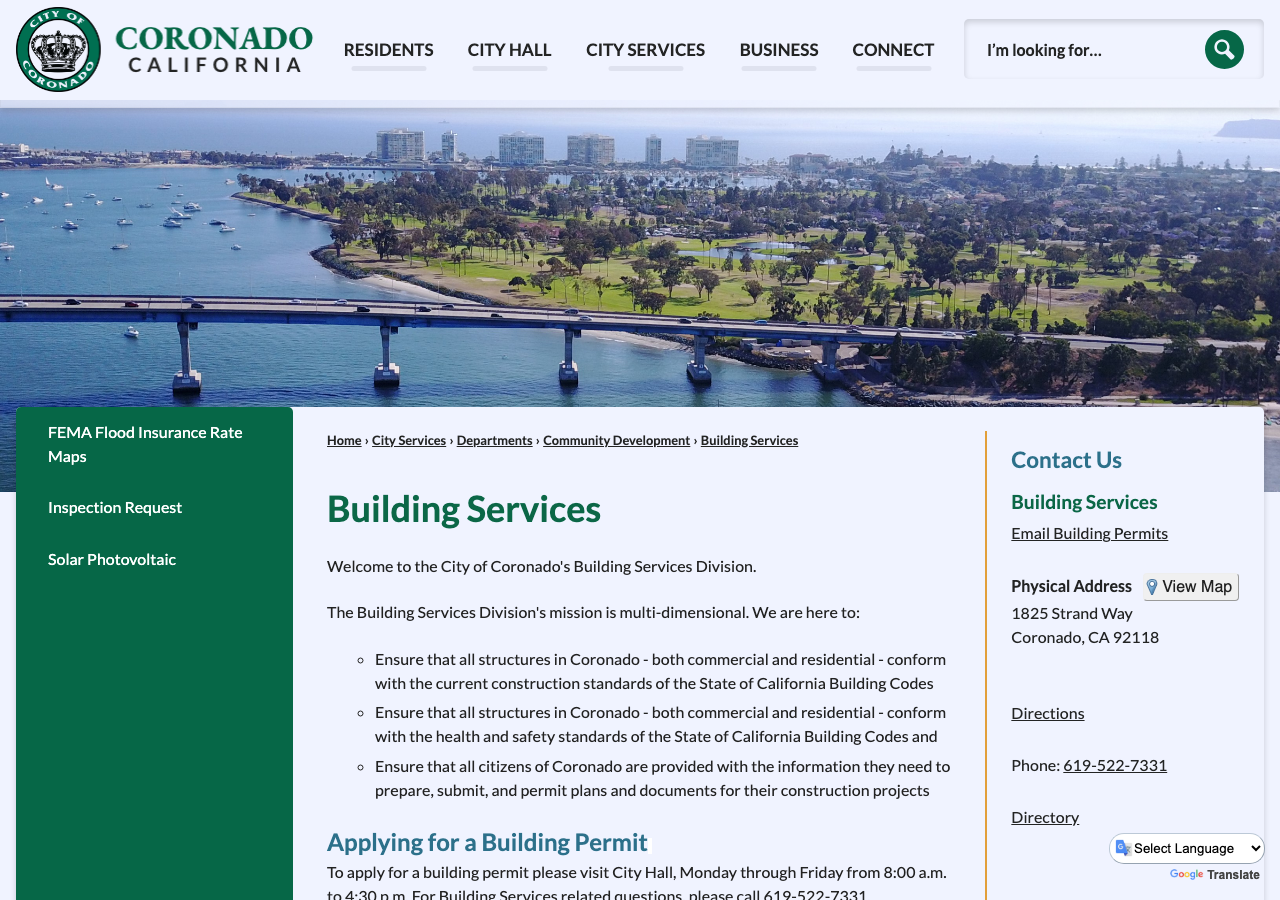
- Can the whole application be completed online? Partially/conflicting - SolarAPP+ allows a fully-online, instant path for eligible contractor submittals, but the Solar Photovoltaic page's own general instructions still state that 'Permit applications must be submitted to the City of Coronado Building Division in person at 1825 Strand Way' 65% · department page (internal conflict)
- What does a residential solar permit cost? $0 base fee, plus actual plan-check costs from an outside contractor, capped at $500 for a residential roof-mounted system 78% · fee schedule (conflict with department incentive page)
- How is the fee calculated? Flat ($0) with an actual-cost, outside-contractor plan-check pass-through capped at $500 for residential 75% · fee schedule
- Is there a separate plan-check fee? Effectively yes for non-eligible systems - the fee schedule's solar line separately passes through 'actual plan check costs from outside contractor' up to $500, and the City's own Plan Review Process handout confirms an 'External Plan Review' category is performed by 'the City of Coronado's Plan Review Consultant' and 'Third Party Plan Reviewers'; for eligibility-checklist-compliant systems reviewed over-the-counter, the Green Energy Incentive Program page advertises the permit as free 68% · department handout + fee schedule (conflict)
-
Plan review — and start the utility in parallel
Interconnection is a separate process from the permit and usually the longer pole. Where the utility does not depend on the permit being issued, running both at once is the single biggest saving available on a residential job.
- What is the stated plan-review turnaround? Over-the-counter (~15-30 minutes) for Eligibility-Checklist-compliant systems; otherwise routed to 'Submitted - Internal' or 'Submitted - External' review, both stated at roughly 10-12 business days for the initial round of comments 78% · department handout
- How long is an issued permit valid before it expires? Not stated specifically for an issued solar permit; the City's Plan Review Process handout (quoting adopted CBC Sec. 105.3.2) states a PLAN CHECK APPLICATION is deemed abandoned 180 days after filing unless pursued in good faith or a permit is issued, with one 90-day extension available on written request 55% · department handout (partial)
- Which utility handles interconnection here? SDG&E (San Diego Gas & Electric) 88% · department page + city infrastructure document
- Where does the utility sit in the sequence? After permit 68% · utility tariff (prior-run extraction)
28 questions answered against City of Coronado’s own published documents
Q1 Is this authority the AHJ for residential solar at this address? Core Jurisdiction & scope
Yes
Why the confidence is not higherCity's own Solar Photovoltaic page and Building Services page describe the City's own permitting process for residential PV; no delegation found.
department page checked 2026-08-31 https://www.coronado.ca.us/252/Solar-Photovoltaic
Q2 What does this authority permit itself, and what does it delegate? Core Jurisdiction & scope
Both
Why the confidence is not higherCommunity Development/Building Services performs plan check, permit issuance and inspection in-house; the universal Construction Permit Application even carries a dedicated 'PHOTOVOLTAIC' checkbox category distinct from 'BUILDING' and 'ELECTRICAL'.
permit application form checked 2026-08-31 https://www.coronado.ca.us/DocumentCenter/View/5243/Construction-Permit-Application
Q3 Is a permit required for a residential rooftop PV system? Core Jurisdiction & scope
Yes
Why the confidence is not higherSolar page requires a building permit application and eligibility checklist for all residential PV; Building Fee Schedule carries dedicated 'Solar Photovoltaic System - roof mounted' fee line.
fee schedule checked 2026-08-31 https://www.coronado.ca.us/DocumentCenter/View/9261
Q4 Is there a separate electrical permit, or is it combined? Core Jurisdiction & scope
Combined
Why the confidence is not higherOne Construction Permit Application form carries a single 'PHOTOVOLTAIC' permit-type checkbox (separate from 'ELECTRICAL'); the Single Inspection PV Checklist confirms only one consolidated inspection covers the whole install. Issued-permit logs record PV/battery work under one 'MPE' permit number rather than split Building+Electrical permits.
permit application form + issued-permit log checked 2026-08-31 https://www.coronado.ca.us/DocumentCenter/View/5243/Construction-Permit-Application
Q5 Who is allowed to pull the electrical permit? Core Who may apply
Either - licensed contractor (Contractor's License field) or owner-builder (must complete an Owner-Builder Verification Form)
Why the confidence is not higherThe City's universal Construction Permit Application has fields for both 'Contractor's License' and 'Business License,' and states plainly: 'OWNER/BUILDERS MUST COMPLETE AN OWNER-BUILDER VERIFICATION FORM' -- confirming both routes are recognized, not solar-specific but generally applicable.
permit application form checked 2026-08-31 https://www.coronado.ca.us/DocumentCenter/View/5243/Construction-Permit-Application
Q6 Must the contractor be registered with this authority before applying? Core Who may apply
Yes - a City of Coronado Business Certificate is required of any contractor doing business in the city
Why the confidence is not higherThe Construction Permit Application requires a 'Business License' field alongside 'Contractor's License'; the city's Business Certificate page confirms a $25/yr flat-fee certificate is required in lieu of a business-license tax for anyone doing business in Coronado. Not solar-specific.
department page + permit application form checked 2026-08-31 https://www.coronado.ca.us/253/Business-Certificate
Q7 Is a homeowner permitted to self-install and self-permit? Who may apply
Yes
Why the confidence is not higherThe universal Construction Permit Application explicitly provides for owner-builders ('OWNER/BUILDERS MUST COMPLETE AN OWNER-BUILDER VERIFICATION FORM'); no solar-specific bar on self-permitting was found.
permit application form checked 2026-08-31 https://www.coronado.ca.us/DocumentCenter/View/5243/Construction-Permit-Application
Q8 What documents make up a complete submittal? Core Submittal package
Completed Building Permit Application; the Eligibility Checklist for Expedited Solar Photovoltaic (or, for non-eligible systems, standard plans); a complete plan set showing main service/utility disconnect location, module/string/inverter counts, one-line diagram, grounding/bonding and conductor/conduit sizing, battery locations if applicable, equipment cut sheets, CEC 690/705 labeling, and a site diagram plus a roof plan showing roof layout, panels, access point, code-compliant access pathways, fire classification and label locations
Why the confidence is not higherDirect listing on the City's own Solar Photovoltaic page.
department page checked 2026-08-31 https://www.coronado.ca.us/252/Solar-Photovoltaic
Q9 How many copies, and in what format? Submittal package
Not stated specifically for solar; the City's general Plan Review Process handout (non-OTC categories) requires three (3) sets of construction drawings plus two (2) sets of supporting documentation, min/max plan sheet size 24 x 36 inches
Why the confidence is not higherHandout 302 'Plan Review Process' (revised March 2025) gives this as the general minimum for Submitted-Internal/External review; the Solar page itself only says applications 'must be submitted... in person' without restating a copy count, so this may not apply unchanged to the over-the-counter solar pathway.
department handout checked 2026-08-31 https://www.coronado.ca.us/DocumentCenter/View/967/Handout-302-Plan-Review-Process-PDF
Q10 Is a site plan required, and what must it show? Core Submittal package
Yes - a site diagram showing the arrangement of panels on the roof or ground, north arrow, lot dimensions and distance from property lines to adjacent buildings/structures (existing and proposed), plus a roof plan showing layout, access point, access pathways, fire classification and label locations
Why the confidence is not higherDirect listing on the City's Solar Photovoltaic page submittal requirements.
department page checked 2026-08-31 https://www.coronado.ca.us/252/Solar-Photovoltaic
Q11 Is a one-line / three-line diagram required? Core Drawings & calculations
Yes
Why the confidence is not higherSolar page requires a 'one-line diagram of system' in the plan set.
department page checked 2026-08-31 https://www.coronado.ca.us/252/Solar-Photovoltaic
Q12 Are string and conductor calculations required? Drawings & calculations
Yes
Why the confidence is not higherSolar page requires the plan set to 'specify grounding/bonding, conductor type and size, conduit type and size and number of conductors in each section of conduit'; Eligibility Checklist separately requires a minimum #8 grounding electrode conductor sized per NEC Table 250.122.
department page + eligibility checklist checked 2026-08-31 https://www.coronado.ca.us/252/Solar-Photovoltaic
Q13 Is a structural PE stamp required, and at what threshold? Core Engineering & stamps
Conditional - the Eligibility Checklist's Structural Requirements section requires 'Complete structural criteria and supporting documentation... (if required)' and screens for a sound, single (non-overlay) roof with no overhang; no dedicated public structural-criteria worksheet or PE-stamp threshold document (of the kind other San Diego County cities publish) was found on the City's site
Why the confidence is not higherEligibility Checklist for Expedited Solar Photovoltaic, Structural Requirements section; a targeted site search for a 'Structural Criteria' solar worksheet returned no dedicated document, unlike neighboring Imperial Beach.
department checklist (partial absence) checked 2026-08-31 https://www.coronado.ca.us/DocumentCenter/View/999
Q14 Is an electrical PE stamp required, and at what threshold? Engineering & stamps
Nothing published by this authority.
Where we lookedEligibility Checklist for Expedited Solar Photovoltaic, Solar Photovoltaic page, Handout 302 Plan Review Process, Handout 303 Building Plan Set Requirements
Q15 What does a residential solar permit cost? Core Fees
$0 base fee, plus actual plan-check costs from an outside contractor, capped at $500 for a residential roof-mounted system
Why the confidence is not higherBuilding Fee Schedule (Resolution 2026-13R, current FY2025-26 and proposed FY2026-27, both effective and current at time of check) line 61: 'Solar Photovoltaic System - roof mounted - Per Residential System (plus actual plan check costs from outside contractor) up to $500.' This appears to sit in tension with the City's own 'Green Energy Incentive Program' page, which advertises 'Free local permits for rooftop solar systems... home battery systems' (footnoted: 'free local permit waivers do not apply to mandated state of CA fees'). Reporting both; the $500 cap most plausibly applies only to non-eligible systems routed to the City's 'External Plan Review' (Plan Review Consultant/Third Party Plan Reviewer) track per Handout 302, while eligibility-checklist-compliant systems reviewed over-the-counter may be genuinely fee-free -- not resolved from the documents alone.
fee schedule (conflict with department incentive page) checked 2026-08-31 https://www.coronado.ca.us/DocumentCenter/View/9261
Q16 How is the fee calculated? Core Fees
Flat ($0) with an actual-cost, outside-contractor plan-check pass-through capped at $500 for residential
Why the confidence is not higherSame fee schedule line as Q15; commercial PV is priced the same way but capped at $1,000 for the first 300 sq ft, then $58/150 sq ft.
fee schedule checked 2026-08-31 https://www.coronado.ca.us/DocumentCenter/View/9261
Q17 Is there a separate plan-check fee? Fees
Effectively yes for non-eligible systems - the fee schedule's solar line separately passes through 'actual plan check costs from outside contractor' up to $500, and the City's own Plan Review Process handout confirms an 'External Plan Review' category is performed by 'the City of Coronado's Plan Review Consultant' and 'Third Party Plan Reviewers'; for eligibility-checklist-compliant systems reviewed over-the-counter, the Green Energy Incentive Program page advertises the permit as free
Why the confidence is not higherCross-reference of the Building Fee Schedule's solar line, Handout 302's three-tier plan-review-category description (over-the-counter / internal / external, the last naming a Plan Review Consultant and Third Party Plan Reviewers), and the Green Energy Incentive Program page.
department handout + fee schedule (conflict) checked 2026-08-31 https://www.coronado.ca.us/DocumentCenter/View/967/Handout-302-Plan-Review-Process-PDF
Q18 What is the stated plan-review turnaround? Core Timeline & validity
Over-the-counter (~15-30 minutes) for Eligibility-Checklist-compliant systems; otherwise routed to 'Submitted - Internal' or 'Submitted - External' review, both stated at roughly 10-12 business days for the initial round of comments
Why the confidence is not higherHandout 302 'Plan Review Process' describes these three review categories and their average timeframes; the Solar page itself does not restate a turnaround time but confirms expedited/over-the-counter approval is available for eligible systems.
department handout checked 2026-08-31 https://www.coronado.ca.us/DocumentCenter/View/967/Handout-302-Plan-Review-Process-PDF
Q19 How long is an issued permit valid before it expires? Timeline & validity
Not stated specifically for an issued solar permit; the City's Plan Review Process handout (quoting adopted CBC Sec. 105.3.2) states a PLAN CHECK APPLICATION is deemed abandoned 180 days after filing unless pursued in good faith or a permit is issued, with one 90-day extension available on written request
Why the confidence is not higherThis is the pre-issuance application-abandonment rule, not necessarily the post-issuance permit validity/expiration period, which was not separately located.
department handout (partial) checked 2026-08-31 https://www.coronado.ca.us/DocumentCenter/View/967/Handout-302-Plan-Review-Process-PDF
Q20 Which permit portal does this authority use? Core Portal & process
CentralSquare TRAKiT (city's Building/Permitting system of record), plus SolarAPP+ for eligible contractor submittals
Why the confidence is not higherThe City's own State-Required Catalog of Enterprise Systems (SB 272) lists 'CentralSquare TRAKiT' as the 'Building/Permitting' product used by Community Development, Engineering, Public Services and Fire; the Solar Photovoltaic page separately states 'Contractors may now apply for Solar Permits via SolarAPP+ and the City of Coronado online permitting system.'
department page (SB 272 catalog) checked 2026-08-31 https://www.coronado.ca.us/382/State-Required-Catalog-of-Enterprise-Sys
Q21 Can the whole application be completed online? Core Portal & process
Partially/conflicting - SolarAPP+ allows a fully-online, instant path for eligible contractor submittals, but the Solar Photovoltaic page's own general instructions still state that 'Permit applications must be submitted to the City of Coronado Building Division in person at 1825 Strand Way'
Why the confidence is not higherBoth statements appear on the same current Solar Photovoltaic page; reporting both rather than picking one.
department page (internal conflict) checked 2026-08-31 https://www.coronado.ca.us/252/Solar-Photovoltaic
Q22 Which utility handles interconnection here? Core Utility interconnection
SDG&E (San Diego Gas & Electric)
Why the confidence is not higherConfirmed from two City-side sources, not PowerToChoose: the City's own 'Go Green Coronado' Green Energy Incentive Program page links to 'SDG&E Considering Solar' as its solar resource, and the City's Utility Undergrounding Master Plan presentation (a city infrastructure-planning document) repeatedly names SDG&E as the electric utility whose facilities are being undergrounded citywide. No mention of San Diego Community Power (the regional CCA) was found anywhere on the City's own site; Coronado appears not to be an SDCP member city.
department page + city infrastructure document checked 2026-08-31 https://www.projectcoronado.org/go-green-coronado
Q23 Where does the utility sit in the sequence? Core Utility interconnection
After permit
Why the confidence is not higherSDG&E's Electric Rule 21 Sec. D.13.b (confirmed on the San Diego County standing extraction from a prior run, not independently re-pulled this session) processes PTO for NEM/NBT within 30 business days of receiving, among other things, evidence of the applicant's final electrical-inspection clearance from the AHJ -- i.e. after the City's permit/inspection process concludes.
utility tariff (prior-run extraction) checked 2026-08-31 https://tariffsprd.sdge.com/view/tariff/?utilId=SDGE&bookId=ELEC&tarfKey=96
Q24 Is a HOA or architectural approval required first? Overlays & special cases
No dedicated HOA/architectural approval trigger found for a standard rooftop PV retrofit
Why the confidence is not higherThe Design Review chapter's own application supplemental sheets (New Construction/Exterior Remodel, Signs, Awnings, Satellite Antennas, etc.) do not list solar PV as a triggering category, and CA's Solar Rights Act (Civil Code Sec. 714/4600) preempts HOA restriction regardless; not independently confirmed against the Design Review chapter's own text since the code portal was inaccessible this session.
department page (scope-based inference) checked 2026-08-31 https://www.coronado.ca.us/1138/Design-Review
Q25 Is there a historic-district review? Overlays & special cases
Yes, for designated Historic Resources - a Historic Resource Alteration Permit (HAP) is required by CMC Ch. 84.20 for 'any exterior alteration' of a Designated Historic Resource, decided at a noticed public hearing before the Historic Resource Commission; no solar-specific exemption was found anywhere in the City's own Historic Preservation Program Guidebook
Why the confidence is not higherCoronado Preservation Guidebook (CreationDate 3 Dec 2025) states plainly that a HAP 'is required for any exterior alteration, relocation, or demolition of a Historic Resource,' with findings tied to the Secretary of the Interior's Standards; a full-text search of the 20-page Guidebook found zero mentions of 'solar,' 'photovoltaic' or 'energy' (positive control: 'Commission' returns 32 hits, 'roof' 2 hits; fabricated control 'zzqqx' returns 0), so this is a control-proven absence of any carve-out, not a search failure. Fee: Historic Resource Alteration (HAP) Permit is $146 (subsidized).
department guidebook (control-proven) checked 2026-08-31 https://www.coronado.ca.us/DocumentCenter/View/8590/Coronado-Preservation-Guidebook
Q26 Is a wind or windstorm certification required? Overlays & special cases
No dedicated windstorm-certification requirement found; the Eligibility Checklist's Structural Requirements do not include a Wind-Exposure screening item of the kind neighboring Imperial Beach's worksheet uses
Why the confidence is not higherReviewed the full Eligibility Checklist for Expedited Solar Photovoltaic; its Structural Requirements section covers roof condition/overlay/overhang only, with no wind-exposure or wind-speed criterion, unlike Imperial Beach's 'Structural Criteria for Residential Flush-Mounted Solar Arrays' worksheet which screens for Wind Exposure D. Absence not control-proven against the full municipal code since the code portal was Cloudflare-blocked this session.
department checklist (partial absence) checked 2026-08-31 https://www.coronado.ca.us/DocumentCenter/View/999
Q27 Is a Specific Use Permit or Council approval ever required? Overlays & special cases
Not routinely - the standard Eligibility Checklist/OTC pathway does not mention a CUP; the only documented Council-level path found is specific to Historic Resources: if a Historic Resource Alteration Permit application 'includes requests for relief from zoning requirements,' the Historic Resource Commission makes a recommendation and the City Council holds its own noticed hearing (fee: 'HAP with Code Exceptions* (to City Council)' $146)
Why the confidence is not higherCoronado Preservation Guidebook and Planning Fee Schedule; no general (non-historic) special-use-permit trigger for solar was located.
fee schedule + guidebook checked 2026-08-31 https://www.coronado.ca.us/DocumentCenter/View/9236/Planning-Fee-Schedule-Effective-July-1-2026
Q28 Is there a system-size cap on residential generation? Overlays & special cases
10 kW AC nameplate gates the over-the-counter/expedited pathway for roof-mounted PV on one- and two-family dwellings; larger systems (and any system with battery storage) are not barred but are routed to standard, non-expedited plan review
Why the confidence is not higherEligibility Checklist for Expedited Solar Photovoltaic, General Requirements item A ('System size is 10 kW alternating current nameplate rating or less'); Solar page: 'Solar Photovoltaic Installations more than 10kW are not eligible for expedited plan reviews.'
department checklist checked 2026-08-31 https://www.coronado.ca.us/DocumentCenter/View/999
Lines marked with a percentage were read off this authority’s own published documents. Unmarked guidance is general good practice, not this jurisdiction’s rule — always confirm against the authority before you submit.
Install 5 steps · 20 questions
-
Build to the code editions actually in force here
The NEC edition a jurisdiction enforces is often a cycle behind the newest one published, and local amendments sit on top of it. Rapid shutdown, conductor sizing and labelling all change between editions, so the edition in force is the first thing to establish, not the last.
- Which NEC edition is in force? Uncertain/lagging - the City's own Plan Review Process handout, last revised March 2025, cites '2022 California Building Code' (i.e. the 2022 CEC, based on the 2020 NEC) as its authority; California's 2025 Title 24 cycle (2025 CEC, based on the 2023 NEC) took effect statewide 1 Jan 2026 by default, but no City document confirming local re-adoption or continued citation of the 2022 cycle after that date could be retrieved this session 50% · department handout (lag flagged)
- Which building code edition is in force? 2022 California Building Code cited in the City's most recently revised (March 2025) Plan Review Process handout; current statewide default since 1 Jan 2026 is the 2025 CBC, not independently confirmed as locally re-adopted this session 50% · department handout (lag flagged, code portal blocked)
- Which fire code edition is in force? Conflicting/stale evidence - a 2021 Wayback capture of the codified fire chapter (CMC 70.90.010) showed the 2019 California Fire Code adopted via Ord. 2096 (2019); a separate City FAQ page states the City regulates fireworks 'in accordance with the 2016 California Fire Code as amended and adopted by the City of Coronado.' Neither reflects a confirmed current adoption; the live code portal was unreachable this session 45% · archived municipal code + FAQ (conflicting, stale)
- Are there local amendments to any of the above? Yes, at least administratively - the 2021-captured Fire Code chapter amends CFC Sec. 202's definition of 'fireworks,' and the Plan Review Process handout quotes locally-adopted CBC administrative amendments (Sec. 105.3.2 application abandonment, extension provisions); whether any PV-specific technical amendment exists could not be confirmed because the code portal was Cloudflare-blocked 55% · department handout + archived code (partial)
- What is the installation judged against? The adopted CBC/CRC/CEC/CFC (edition uncertain this session, see Q29-31) as implemented through the City's own Eligibility Checklist for Expedited Solar Photovoltaic and its solar submittal requirements; no codified, numbered 'small residential rooftop solar' municipal code chapter (of the kind many other CA cities carry, e.g. an XX.YY 'Solar Energy Systems' chapter) was located, though the code portal being blocked means one may exist unseen 62% · department checklist (code portal blocked)
-
Fire access, setbacks and pathways
Ridge setbacks and roof access pathways are fire-service requirements and they constrain the array layout. They are the most common cause of a redesign after the fire department comments on a plan set.
- What ridge setback and access pathways are required? Clear access pathways dimensioned per CRC Sections R324.6.1-R324.6.2.1 80% · department checklist
-
Rapid shutdown
Which rapid-shutdown rule applies follows directly from the NEC edition in force, and the initiation device has to be at a location the fire service can reach and identify. This is inspected, and it is labelled.
- Is rapid shutdown required, and to which NEC edition? Rapid shutdown per CEC/NEC Sec. 690.12 is presumed required as a matter of the adopted electrical code, but the City's own solar documents never cite it by number -- the Eligibility Checklist (dated November 2020) cites only CEC Sec. 690.56 for markings/labels and never mentions '690.12' or the phrase 'rapid shutdown' anywhere in the City's solar document corpus checked 68% · department checklist (control-proven non-citation)
-
Labels and placards
The NEC sets a baseline for permanent markings at the service equipment and the disconnecting means. On top of that, an authority may specify its own wording, and the utility may specify more again. Where any of them writes its own text, a generic off-the-shelf label set will not pass — this is the detail most often fixed on a return visit.
- Which placards does this authority require at the service equipment? General labeling/markings 'as required by CEC, Sections 690 and 705' per the Solar page's submittal list, and markings/labels/placards 'per CEC sec 690.56' per the Eligibility Checklist's Fire Safety Requirements; no city-specific list of named placards (comparable to Imperial Beach's PV Minimum Construction Specifications sheet) was found 60% · department page (partial absence)
- Does the authority specify placard wording of its own? No 65% · department page (absence)
- Does it specify letter height, colour or material? No City-specific letter height, colour or material spec was found 62% · department page (absence)
- Is a site plan / facility map placard required, and what must it show? A site diagram/roof plan showing panel arrangement, north arrow, lot dimensions, property-line setbacks, roof access point, access pathways, fire classification and label locations is required in the submittal package; no separate field-mounted facility-map placard requirement (beyond NEC 705.10) was found 65% · department page
- Does the UTILITY specify placards beyond the AHJ's? Yes - SDG&E Rule 21 Sec. H.1.d 'Visible Disconnect Required' (open/closed markings, lockable, reachable 24/7, shown on the single-line diagram) 62% · utility tariff (prior-run extraction)
- Where must the labels be placed? Not specified beyond general CEC 690/705 labeling requirements; the City publishes no location-by-location placement diagram of its own 55% · department page (absence)
-
Disconnect, storage and listed equipment
Where the AC disconnect must sit relative to the meter is usually the utility's rule, not the building department's. Battery storage frequently carries its own permit, its own inspection and its own fire conditions.
- Must equipment be on a specific approved list? Yes, implicitly - equipment cut sheets for inverters, modules, AC/DC disconnects, combiners and wind generators are required in the plan set, and equipment must be labeled per CEC Sections 690/705, which in practice requires listed equipment 60% · department page (inference)
- Are batteries permitted, and under what conditions? Yes, permitted, but a system 'without storage batteries' is required to qualify for the expedited/over-the-counter pathway; a system WITH batteries is routed to standard (non-expedited) review. The Green Energy Incentive Program's free-permit waiver explicitly extends to 'Home Battery Systems.' 85% · department checklist + incentive page
- Is there a separate ESS permit or inspection? No separate ESS permit found - battery storage appears to be bundled into the same electrical/PV permit as the solar system 65% · issued-permits log (inference)
- Is a ground mount treated as a structure? Very likely yes, though not independently confirmed against the current code - the (2013-vintage, Wayback-archived) Zoning Definitions chapter defines 'Structure' broadly as 'anything over two feet in height above grade constructed or erected, which requires location on the ground or attached to something having a location on the ground,' with no photovoltaic carve-out (fences/walls under 8 ft, ornamental post lights, and certain underground-utility aboveground facilities are the only listed exceptions) 60% · archived municipal code (stale, flagged)
- Is there a local rule on service upgrades or busbar sizing? 225A is used as an ELIGIBILITY CEILING for the expedited/OTC pathway ('interconnected to a single-phase AC service panel of nominal 120/220 Vac with a bus bar rating of 225 amps or less'), not stated as a general local code minimum; no separate codified busbar-sizing ordinance (Palm Springs-style) was found or ruled out 70% · department checklist
- Is a specific mounting system or attachment spacing required? Only general criteria in the Eligibility Checklist: modules must not overhang any roof edge, the roof must be a single roof without a reroof overlay and appear structurally sound, and a roof plan with anchor layout must be attached; no dedicated anchor-spacing table or fastener specification (of the kind Imperial Beach publishes) was found on the City's site 60% · department checklist (partial absence)
20 questions answered against City of Coronado’s own published documents
Q29 Which NEC edition is in force? Core Code editions in force
Uncertain/lagging - the City's own Plan Review Process handout, last revised March 2025, cites '2022 California Building Code' (i.e. the 2022 CEC, based on the 2020 NEC) as its authority; California's 2025 Title 24 cycle (2025 CEC, based on the 2023 NEC) took effect statewide 1 Jan 2026 by default, but no City document confirming local re-adoption or continued citation of the 2022 cycle after that date could be retrieved this session
Why the confidence is not higherHandout 302 'Plan Review Process' (rev. March 2025) cites the 2022 CBC; the City's own municipal code (which would carry the current adopting ordinance) was Cloudflare-blocked on both codepublishing.com and coronado.municipal.codes across curl, WebFetch and CDP attempts this session, so the current in-force edition could not be independently confirmed.
department handout (lag flagged) checked 2026-08-31 https://www.coronado.ca.us/DocumentCenter/View/967/Handout-302-Plan-Review-Process-PDF
Q30 Which building code edition is in force? Core Code editions in force
2022 California Building Code cited in the City's most recently revised (March 2025) Plan Review Process handout; current statewide default since 1 Jan 2026 is the 2025 CBC, not independently confirmed as locally re-adopted this session
Why the confidence is not higherSame Handout 302 citation; code portal (codepublishing.com and coronado.municipal.codes) was Cloudflare-blocked throughout this session (curl 403, WebFetch 403, and CDP challenge did not clear after 50 seconds on two fresh browser profiles), so the current codified adoption ordinance could not be read directly.
department handout (lag flagged, code portal blocked) checked 2026-08-31 https://www.coronado.ca.us/DocumentCenter/View/967/Handout-302-Plan-Review-Process-PDF
Q31 Which fire code edition is in force? Code editions in force
Conflicting/stale evidence - a 2021 Wayback capture of the codified fire chapter (CMC 70.90.010) showed the 2019 California Fire Code adopted via Ord. 2096 (2019); a separate City FAQ page states the City regulates fireworks 'in accordance with the 2016 California Fire Code as amended and adopted by the City of Coronado.' Neither reflects a confirmed current adoption; the live code portal was unreachable this session
Why the confidence is not higherWayback capture (20210616161958) of codepublishing.com/CA/Coronado/html/Coronado70/Coronado7090.html, cross-checked against a City FAQ (coronado.ca.us/faq.aspx?qid=234) citing a different, older edition -- the two City-linked sources disagree with each other and neither is confirmed current; codepublishing.com itself returned a live Cloudflare challenge (title 'Attention Required!') to curl, WebFetch and CDP this session.
archived municipal code + FAQ (conflicting, stale) checked 2026-08-31 https://web.archive.org/web/20210616161958/https://www.codepublishing.com/CA/Coronado/html/Coronado70/Coronado7090.html
Q32 Are there local amendments to any of the above? Core Code editions in force
Yes, at least administratively - the 2021-captured Fire Code chapter amends CFC Sec. 202's definition of 'fireworks,' and the Plan Review Process handout quotes locally-adopted CBC administrative amendments (Sec. 105.3.2 application abandonment, extension provisions); whether any PV-specific technical amendment exists could not be confirmed because the code portal was Cloudflare-blocked
Why the confidence is not higherSame Wayback capture and Handout 302; PV-specific amendment content not independently verifiable this session.
department handout + archived code (partial) checked 2026-08-31 https://www.coronado.ca.us/DocumentCenter/View/967/Handout-302-Plan-Review-Process-PDF
Q33 What is the installation judged against? Core Electrical
The adopted CBC/CRC/CEC/CFC (edition uncertain this session, see Q29-31) as implemented through the City's own Eligibility Checklist for Expedited Solar Photovoltaic and its solar submittal requirements; no codified, numbered 'small residential rooftop solar' municipal code chapter (of the kind many other CA cities carry, e.g. an XX.YY 'Solar Energy Systems' chapter) was located, though the code portal being blocked means one may exist unseen
Why the confidence is not higherEligibility Checklist and Solar Photovoltaic page describe the standard in practice; a specific codified chapter number could not be located or ruled out given the Cloudflare block on codepublishing.com/coronado.municipal.codes.
department checklist (code portal blocked) checked 2026-08-31 https://www.coronado.ca.us/DocumentCenter/View/999
Q34 Is there a local rule on service upgrades or busbar sizing? Electrical
225A is used as an ELIGIBILITY CEILING for the expedited/OTC pathway ('interconnected to a single-phase AC service panel of nominal 120/220 Vac with a bus bar rating of 225 amps or less'), not stated as a general local code minimum; no separate codified busbar-sizing ordinance (Palm Springs-style) was found or ruled out
Why the confidence is not higherEligibility Checklist for Expedited Solar Photovoltaic, Electrical Requirements item C; municipal code itself (which would show whether a general local amendment also exists) was inaccessible this session.
department checklist checked 2026-08-31 https://www.coronado.ca.us/DocumentCenter/View/999
Q35 Is a specific mounting system or attachment spacing required? Structural & mounting
Only general criteria in the Eligibility Checklist: modules must not overhang any roof edge, the roof must be a single roof without a reroof overlay and appear structurally sound, and a roof plan with anchor layout must be attached; no dedicated anchor-spacing table or fastener specification (of the kind Imperial Beach publishes) was found on the City's site
Why the confidence is not higherEligibility Checklist, Structural Requirements section; targeted search for a Coronado structural-criteria worksheet found none.
department checklist (partial absence) checked 2026-08-31 https://www.coronado.ca.us/DocumentCenter/View/999
Q36 What ridge setback and access pathways are required? Core Fire pathways & setbacks
Clear access pathways dimensioned per CRC Sections R324.6.1-R324.6.2.1
Why the confidence is not higherEligibility Checklist for Expedited Solar Photovoltaic, Fire Safety Requirements item A, cites this directly; no local ridge-setback amendment was independently confirmed since the codified Fire Code chapter was unreachable this session.
department checklist checked 2026-08-31 https://www.coronado.ca.us/DocumentCenter/View/999
Q37 Is rapid shutdown required, and to which NEC edition? Core Rapid shutdown
Rapid shutdown per CEC/NEC Sec. 690.12 is presumed required as a matter of the adopted electrical code, but the City's own solar documents never cite it by number -- the Eligibility Checklist (dated November 2020) cites only CEC Sec. 690.56 for markings/labels and never mentions '690.12' or the phrase 'rapid shutdown' anywhere in the City's solar document corpus checked
Why the confidence is not higherControl-checked: grepped the Eligibility Checklist, both editions of the Single Inspection PV Checklist, the Building Fee Schedule and the Solar page's own text for '690.12' and 'rapid shutdown' -- zero hits, while other 690-series references (690.56) and a fabricated control term ('zzqqx') behaved as expected (one real hit, zero fabricated hits), so the search itself is sound. A 2020-dated handout not citing 690.12 by name matches a pattern seen in several other CA cities with similarly vintage handouts.
department checklist (control-proven non-citation) checked 2026-08-31 https://www.coronado.ca.us/DocumentCenter/View/999
Q38 Which placards does this authority require at the service equipment? Core Labels Signage & labelling
General labeling/markings 'as required by CEC, Sections 690 and 705' per the Solar page's submittal list, and markings/labels/placards 'per CEC sec 690.56' per the Eligibility Checklist's Fire Safety Requirements; no city-specific list of named placards (comparable to Imperial Beach's PV Minimum Construction Specifications sheet) was found
Why the confidence is not higherSolar Photovoltaic page and Eligibility Checklist; no dedicated placard-specification handout located on the Building Services page's full handout list.
department page (partial absence) checked 2026-08-31 https://www.coronado.ca.us/252/Solar-Photovoltaic
Q39 Does the authority specify placard wording of its own? Core Labels Signage & labelling
No
Why the confidence is not higherNo City-specific placard wording was found anywhere in the Solar page, Eligibility Checklist, Single Inspection PV Checklist or Building Handouts list; the City instead cross-references CEC 690.56 rather than dictating its own wording.
department page (absence) checked 2026-08-31 https://www.coronado.ca.us/252/Solar-Photovoltaic
Q40 Does it specify letter height, colour or material? Core Labels Signage & labelling
No City-specific letter height, colour or material spec was found
Why the confidence is not higherSame review as Q39 -- absence across all located solar/PV documents.
department page (absence) checked 2026-08-31 https://www.coronado.ca.us/252/Solar-Photovoltaic
Q41 Is a site plan / facility map placard required, and what must it show? Core Labels Signage & labelling
A site diagram/roof plan showing panel arrangement, north arrow, lot dimensions, property-line setbacks, roof access point, access pathways, fire classification and label locations is required in the submittal package; no separate field-mounted facility-map placard requirement (beyond NEC 705.10) was found
Why the confidence is not higherSolar Photovoltaic page submittal-requirements list.
department page checked 2026-08-31 https://www.coronado.ca.us/252/Solar-Photovoltaic
Q42 Does the UTILITY specify placards beyond the AHJ's? Core Labels Signage & labelling
Yes - SDG&E Rule 21 Sec. H.1.d 'Visible Disconnect Required' (open/closed markings, lockable, reachable 24/7, shown on the single-line diagram)
Why the confidence is not higherSourced from the San Diego County standing SDG&E Rule 21 extraction established on a prior run, not independently re-pulled this session.
utility tariff (prior-run extraction) checked 2026-08-31 https://tariffsprd.sdge.com/view/tariff/?utilId=SDGE&bookId=ELEC&tarfKey=96
Q43 Where must the labels be placed? Core Labels Signage & labelling
Not specified beyond general CEC 690/705 labeling requirements; the City publishes no location-by-location placement diagram of its own
Why the confidence is not higherAbsence across the Solar page, Eligibility Checklist and Single Inspection PV Checklist.
department page (absence) checked 2026-08-31 https://www.coronado.ca.us/252/Solar-Photovoltaic
Q44 Must equipment be on a specific approved list? Equipment listing
Yes, implicitly - equipment cut sheets for inverters, modules, AC/DC disconnects, combiners and wind generators are required in the plan set, and equipment must be labeled per CEC Sections 690/705, which in practice requires listed equipment
Why the confidence is not higherSolar page submittal list; the City does not publish its own separate 'approved equipment list.'
department page (inference) checked 2026-08-31 https://www.coronado.ca.us/252/Solar-Photovoltaic
Q45 Are batteries permitted, and under what conditions? Core Battery / ESS
Yes, permitted, but a system 'without storage batteries' is required to qualify for the expedited/over-the-counter pathway; a system WITH batteries is routed to standard (non-expedited) review. The Green Energy Incentive Program's free-permit waiver explicitly extends to 'Home Battery Systems.'
Why the confidence is not higherEligibility Checklist General Requirements item D ('Solar system is utility interactive and without storage batteries'); Solar page ('Larger systems or those equipped with storage batteries must be submitted for standard processing'); Go Green Coronado page lists home battery systems among the free-permit categories.
department checklist + incentive page checked 2026-08-31 https://www.coronado.ca.us/DocumentCenter/View/999
Q46 Is there a separate ESS permit or inspection? Battery / ESS
No separate ESS permit found - battery storage appears to be bundled into the same electrical/PV permit as the solar system
Why the confidence is not higherThe City's own issued-permits log shows a single permit record (e.g. an 'MPE' permit at 212 G Ave) covering '2X BATTERY STORAGE, LOAD CENTER, GATEWAY' together in one application by a solar contractor, rather than a separate ESS-only permit number; no standalone battery/ESS fee line exists in the Building Fee Schedule.
issued-permits log (inference) checked 2026-08-31 https://www.coronado.ca.us/documentcenter/view/3111
Q47 Is a ground mount treated as a structure? Core Ground mount
Very likely yes, though not independently confirmed against the current code - the (2013-vintage, Wayback-archived) Zoning Definitions chapter defines 'Structure' broadly as 'anything over two feet in height above grade constructed or erected, which requires location on the ground or attached to something having a location on the ground,' with no photovoltaic carve-out (fences/walls under 8 ft, ornamental post lights, and certain underground-utility aboveground facilities are the only listed exceptions)
Why the confidence is not higherCMC 86.04.765 as captured by the Wayback Machine on 3 Jun 2013 -- 13 years stale, flagged explicitly; the live code (codepublishing.com and coronado.municipal.codes) was Cloudflare-blocked this session so the current text could not be confirmed unchanged.
archived municipal code (stale, flagged) checked 2026-08-31 https://web.archive.org/web/20130603201150/http://codepublishing.com/ca/coronado/html/Coronado86/Coronado8604.html
Q48 Where must the AC disconnect be, relative to the meter? Core Utility equipment
Nothing published by this authority.
Where we lookedSDG&E's own Rule 21 (prior San Diego County standing extraction, tarfKey=96) and all located Coronado solar/PV documents (Solar page, Eligibility Checklist, Single Inspection PV Checklist) -- none give a meter-proximity or disconnect-distance spec
https://tariffsprd.sdge.com/view/tariff/?utilId=SDGE&bookId=ELEC&tarfKey=96
Lines marked with a percentage were read off this authority’s own published documents. Unmarked guidance is general good practice, not this jurisdiction’s rule — always confirm against the authority before you submit.
Inspection 5 steps · 14 questions
-
Book it
Booking is a portal, a phone call or an email depending on the authority, and the notice required is rarely zero. Book before the work is finished rather than after — the lead time, not the work, is usually what sets the date.
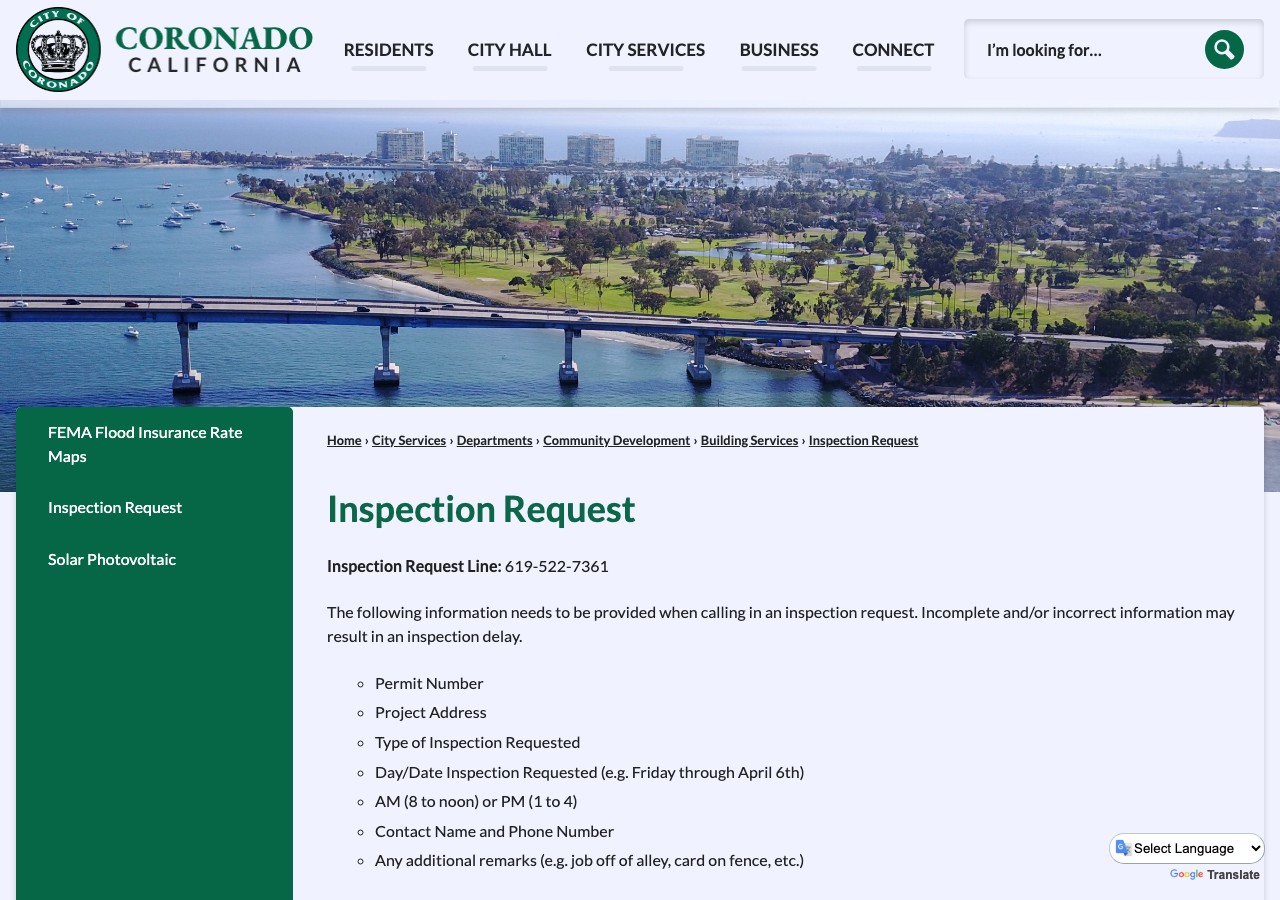
- How is an inspection booked? Phone 92% · department page
- How much notice is required? Effectively next business day - inspections called in before 4pm on a regular business day are scheduled for the next business day; requests left on weekends or City holidays are scheduled for the second business day 92% · department page
- Are same-day or AM/PM windows offered? Yes - AM (8 to noon) or PM (1 to 4) 88% · department page
-
Know who turns up
Some authorities inspect their own solar work; some delegate it, and a few do not inspect the PV equipment itself at all. Who is coming determines what they will look at.
- Does this AHJ perform its own final solar inspection? Yes 92% · department checklist
- If delegated, to whom? N/A - self-performed by the City's own Building Department 90% · department checklist
-
Work the stages in order
A rough-in or mid-roof inspection, where one is required, has to happen before the work it covers is closed up. Missing a stage means opening something back up, and it is the most expensive kind of correction.
- Which inspections are required, and in what order? A single consolidated final inspection after the system is fully installed 88% · department page + checklist
- Is a rough-in or mid-roof inspection required? No 88% · department checklist
-
Have the paperwork on site
The approved plan set, the permit, and the equipment listings should be on site and reachable. Inspectors routinely verify that installed equipment matches what was approved, and that the labels are the ones the plan set promised.
- Is there a published inspection checklist? Yes 95% · department checklist
- What must be on site at inspection? A safe/secure ladder already in place; junction box(es) accessible and open; the installed panel layout matching approved plans exactly (any deviation is an immediate failure); inverter(s)/junction boxes open for inspection; attic access ready if conduit runs through the attic; all ground rods/UFERs accessible with water/gas bonding verifiable; the main service panel dead front labeled, removed and set aside with placards matching approved plans; and the approved plan set plus the original permit inspection record card on site 90% · department checklist
- Does the inspector verify labels and listings? Yes 85% · department checklist
-
Sign-off, and permission to operate
Passing gives you a final or an equivalent sign-off. That is not the same as permission to operate: PTO comes from the utility, and who tells the utility the inspection passed varies. A system left switched off for weeks is usually waiting on this handover.
- What is issued on pass? Final (final approval of the solar system) 78% · department page
- Who notifies the utility for PTO? Installer (applicant), inferred 55% · utility tariff (inference)
- Is there a re-inspection fee? No dedicated PV re-inspection fee line; the general hourly rate would apply -- Electrical Inspection (per hour, 1/2 hour minimum) is $172 current / $178 proposed for FY2026-27 55% · fee schedule (inference)
- How are corrections issued and cleared? A field deviation from approved plans results in immediate failure of the inspection; if three or more items on the Single Inspection PV Checklist are not ready at the time of inspection, a re-inspection fee is assessed and must be paid before another inspection can be requested. For plan-check-stage corrections, comments are forwarded to the applicant for incorporation into revised drawings, which must be resubmitted until all reviewing authorities are satisfied 78% · department checklist + handout
14 questions answered against City of Coronado’s own published documents
Q49 How is an inspection booked? Core Booking & scheduling
Phone
Why the confidence is not higherDedicated Inspection Request page: 'Inspection Request Line: 619-522-7361,' listing the information to provide when calling in a request; no online scheduling option is offered.
department page checked 2026-08-31 https://www.coronado.ca.us/251/Inspection-Request
Q50 How much notice is required? Core Booking & scheduling
Effectively next business day - inspections called in before 4pm on a regular business day are scheduled for the next business day; requests left on weekends or City holidays are scheduled for the second business day
Why the confidence is not higherDirect quote from the Inspection Request page.
department page checked 2026-08-31 https://www.coronado.ca.us/251/Inspection-Request
Q51 Are same-day or AM/PM windows offered? Booking & scheduling
Yes - AM (8 to noon) or PM (1 to 4)
Why the confidence is not higherInspection Request page lists 'AM (8 to noon) or PM (1 to 4)' as one of the required fields when requesting an inspection.
department page checked 2026-08-31 https://www.coronado.ca.us/251/Inspection-Request
Q52 Does this AHJ perform its own final solar inspection? Core Who inspects
Yes
Why the confidence is not higherSingle Inspection PV Checklist (Handout 102, current edition March 2025) states its Authority as the 'City of Coronado Building Department' and describes a single inspection performed by City staff.
department checklist checked 2026-08-31 https://www.coronado.ca.us/DocumentCenter/View/982/Handout-102-PV-Single-Inspection-PDF
Q53 If delegated, to whom? Core Who inspects
N/A - self-performed by the City's own Building Department
Why the confidence is not higherSame Handout 102 citation as Q52.
department checklist checked 2026-08-31 https://www.coronado.ca.us/DocumentCenter/View/982/Handout-102-PV-Single-Inspection-PDF
Q54 Which inspections are required, and in what order? Core Stages & sequence
A single consolidated final inspection after the system is fully installed
Why the confidence is not higherSolar page: 'Once all permits to construct the solar installation have been issued and the system has been installed, it must be inspected before final approval is granted for the solar system'; Handout 102 is titled 'Single Inspection PV Checklist' and its purpose is explicitly 'to limit the number of inspections required.'
department page + checklist checked 2026-08-31 https://www.coronado.ca.us/252/Solar-Photovoltaic
Q55 Is a rough-in or mid-roof inspection required? Stages & sequence
No
Why the confidence is not higherThe whole design of Handout 102 is a 'single inspection' model; no rough-in or mid-roof inspection is described anywhere in the City's solar documents.
department checklist checked 2026-08-31 https://www.coronado.ca.us/DocumentCenter/View/982/Handout-102-PV-Single-Inspection-PDF
Q56 Does the inspector verify labels and listings? Core What is checked
Yes
Why the confidence is not higherHandout 102 requires 'Dead front of main service panel must be labeled, removed and set aside prior to inspector arrival. All placards must match approved plans and attached where required' -- confirming the inspector checks labels/placards against approved plans.
department checklist checked 2026-08-31 https://www.coronado.ca.us/DocumentCenter/View/982/Handout-102-PV-Single-Inspection-PDF
Q57 Is there a published inspection checklist? Core What is checked
Yes
Why the confidence is not higherThe 'Single Inspection PV Checklist' (Handout 102) is a published, itemized checklist available on the Building Services and Solar Photovoltaic pages.
department checklist checked 2026-08-31 https://www.coronado.ca.us/DocumentCenter/View/982/Handout-102-PV-Single-Inspection-PDF
Q58 What must be on site at inspection? Core Documents on site
A safe/secure ladder already in place; junction box(es) accessible and open; the installed panel layout matching approved plans exactly (any deviation is an immediate failure); inverter(s)/junction boxes open for inspection; attic access ready if conduit runs through the attic; all ground rods/UFERs accessible with water/gas bonding verifiable; the main service panel dead front labeled, removed and set aside with placards matching approved plans; and the approved plan set plus the original permit inspection record card on site
Why the confidence is not higherDirect itemized quote from Handout 102, 'Single Inspection PV Checklist' (current edition, March 2025).
department checklist checked 2026-08-31 https://www.coronado.ca.us/DocumentCenter/View/982/Handout-102-PV-Single-Inspection-PDF
Q59 Is there a re-inspection fee? Corrections & re-inspection
No dedicated PV re-inspection fee line; the general hourly rate would apply -- Electrical Inspection (per hour, 1/2 hour minimum) is $172 current / $178 proposed for FY2026-27
Why the confidence is not higherBuilding Fee Schedule contains no 're-inspection' line at all (searched full text); Handout 102 states that three or more missing items at inspection triggers 'a reinspection fee' without naming the amount, so the general Electrical Inspection hourly rate is the best available inference given solar is filed as an electrical/MPE-type permit.
fee schedule (inference) checked 2026-08-31 https://www.coronado.ca.us/DocumentCenter/View/9261
Q60 How are corrections issued and cleared? Corrections & re-inspection
A field deviation from approved plans results in immediate failure of the inspection; if three or more items on the Single Inspection PV Checklist are not ready at the time of inspection, a re-inspection fee is assessed and must be paid before another inspection can be requested. For plan-check-stage corrections, comments are forwarded to the applicant for incorporation into revised drawings, which must be resubmitted until all reviewing authorities are satisfied
Why the confidence is not higherHandout 102 (Single Inspection PV Checklist) plus Handout 302 (Plan Review Process) general correction-cycle description.
department checklist + handout checked 2026-08-31 https://www.coronado.ca.us/DocumentCenter/View/982/Handout-102-PV-Single-Inspection-PDF
Q61 What is issued on pass? Core Final sign-off & PTO
Final (final approval of the solar system)
Why the confidence is not higherSolar page: 'it must be inspected before final approval is granted for the solar system.' No specific 'Green tag' or 'CO' terminology was found used for PV.
department page checked 2026-08-31 https://www.coronado.ca.us/252/Solar-Photovoltaic
Q62 Who notifies the utility for PTO? Core Final sign-off & PTO
Installer (applicant), inferred
Why the confidence is not higherNo Coronado-specific statement was found; inferred from standard SDG&E Rule 21 practice (the applicant submits the interconnection application and provides the AHJ's final-inspection clearance to SDG&E) and the general pattern seen at other San Diego County cities with an otherwise similar process.
utility tariff (inference) checked 2026-08-31 https://tariffsprd.sdge.com/view/tariff/?utilId=SDGE&bookId=ELEC&tarfKey=96
Lines marked with a percentage were read off this authority’s own published documents. Unmarked guidance is general good practice, not this jurisdiction’s rule — always confirm against the authority before you submit.
Jurisdiction & key facts
The standing 62-question set, answered for City of Coronado against this authority’s own published documents. Every answer carries the confidence it was recorded at and the document it came from. Where nothing is published we say so and show where we looked — a blank here is a finding, not a gap.
City of Coronado is the authority having jurisdiction 90% confidence
- Holds
- Both
- Overridden by
- CA Gov. Code Sec. 65850.5 (AB 2188) mandates ministerial/expedited review for eligible small residential PV, which the City implements via its own Eligibility Checklist rather than a codified municipal-code chapter (none located). SDG&E (the utility, not the AHJ) separately gates grid interconnection/PTO under its own Rule 21. The California Coastal Commission retains appellate jurisdiction and direct jurisdiction over federal/port land in the Coastal Zone, though CMC 86.70.052(A) exempts 'improvements to existing single-family dwelling buildings' from the City's own coastal permit requirement, which almost always covers a rooftop PV retrofit. The City's Historic Resource Commission (CMC Ch. 84.20) holds a real, non-exempt discretionary review over any exterior alteration -- including rooftop PV -- on a Designated Historic Resource. Federal government property (Naval Air Station North Island, roughly a third of the peninsula) is outside City jurisdiction entirely; a draft NASNI Airport Land Use Compatibility Plan remains formally unadopted and contested by the City as of its own 2025-updated Current Projects page.
- Why not higher
- Community Development's own mission statement names 'Building construction plan check, permit issuance, and inspections' as an in-house CD program; the Building Services staff directory names a Building Official (Damion Nowak, dnowak@coronado.ca.us) and Building Inspector (Amanda Sprague) both on the city.ca.us domain, with an organizational chart showing a Building Official/Building Inspector line in-house under Building/Code Enforcement -- no staffing-firm domain or contract-plan-check appendix found anywhere in the fee schedule's line items for standard PV.
Check the code edition before you build
This authority's published code edition does not match what the state has adopted. That usually means the authority's ordinance has not been updated for the current cycle — but a local amendment can also be lawful. Confirm with the building department before you submit.
- Permit required
- Yes96%
- Permit cost
- $0 base fee, plus actual plan-check costs from an outside contractor, capped at $500 for a residential roof-mounted system78%
- Plan review
- Over-the-counter (~15-30 minutes) for Eligibility-Checklist-compliant systems; otherwise routed to 'Submitted - Internal' or 'Submitted - External' review,78%
- Portal
- CentralSquare TRAKiT (city's Building/Permitting system of record), plus SolarAPP+ for eligible contractor submittals85%
- Electrical code
- Uncertain/lagging - the City's own Plan Review Process handout, last revised March 2025, cites '2022 California Building Code' (i.e.50%
- Own placard wording
- No65%
- Booking an inspection
- Phone92%
Labels & placards for this authority
Wording 65%
No
Size, colour & material 62%
No City-specific letter height, colour or material spec was found
Where they go 55%
Not specified beyond general CEC 690/705 labeling requirements; the City publishes no location-by-location placement diagram of its own
What the utility wants on top 62%
Yes - SDG&E Rule 21 Sec. H.1.d 'Visible Disconnect Required' (open/closed markings, lockable, reachable 24/7, shown on the single-line diagram)
Each figure above is sourced and dated in the full answer set below (questions 38–43). Where an authority’s own published sheet is older than the code it has adopted, the answer says so.
Their website
Average approval time — application to PTO
From the CPUC interconnection record. Bars show the average days taken each year; a year with no recorded projects is left blank rather than drawn as zero.