
City of Culver City
Los Angeles County
City of Culver City is a city authority in the State of California, serving 40,779 residents. 1,220 residential solar installs are on record here. This page is the permit route for that jurisdiction: the fifteen steps from working out who has a say over an address through to permission to operate, the documents this authority publishes, and 62 answers taken from those documents and dated.
Permitting 5 steps · 28 questions
Whether a permit is needed — Yes Q3 Electrical and building permits — Either Q4 Plan review — 15-20 business days Q18 Where you file — Accela Citizen Access ('Culver City Online Permit Portal', aca-prod.accela.com/CULVERCITY) for general Building Safety permits; Q20
- Permit required
- Yes95% source
- What it costs
- Effectively $0 for a typical residential system. Current FY26-27 Comprehensive Fee Schedule lists a Building Division 'Solar/Photovoltaic - per GC 66015' fee of $450/permit (Residential PV up to…85% source
- Plan review turnaround
- 15-20 business days90% source
- Key document
- permit application form + generic handout cited by 6 open the document
-
Confirm who has a say over your address
A city address is usually permitted by the city, not the county — but not always, and some authorities keep building and hand electrical to someone else. Getting this wrong costs the whole submittal, because every requirement below belongs to whoever actually holds jurisdiction. Check the overlays in the same pass: an HOA, a historic district, a windstorm certification or a system-size cap can reshape the design, and all of them are cheaper to find now than after the array is laid out.
- Is this authority the AHJ for residential solar at this address? Yes 95% · department page
- What does this authority permit itself, and what does it delegate? Both 90% · ordinance/handout
- Is a permit required for a residential rooftop PV system? Yes 95% · permit application form
- Is there a separate electrical permit, or is it combined? Either 60% · adopting ordinance (2025 CBC local amendment, §117.3)
- Is a HOA or architectural approval required first? No 65% · department page / state law preemption
- Is there a historic-district review? Only for properties within a designated historic landmark/district: CCMC Ch.15.05 (Historic Preservation Program) provides for a 'Certificate of Appropriateness' process for exterior alterations, and no PV-specific carve-out from that chapter was found. California's Solar Rights Act (Civil Code §714) limits how far such review may restrict or deny a solar installation statewide. 55% · ordinance
- Is a wind or windstorm certification required? No / not applicable — California uses seismic and standard lateral (wind) load design rather than a separate 'windstorm certification.' The city's residential submittal checklist lists 'design of the lateral-force resisting system (seismic and wind loads)' as part of ordinary structural calculations, not a distinct wind-certification document. 75% · published checklist
- Is a Specific Use Permit or Council approval ever required? Not for standard residential rooftop PV. A Specific-Use/Council-level approval only arises under the separate >10,000 sq ft new-construction/major-renovation mandatory solar program (CBC §117.2), where the Community Development Director (not Council) may approve an in-lieu-fee or alternate-location exception — and that program explicitly excludes one- and two-family residences. 75% · adopting ordinance
- Is there a system-size cap on residential generation? No explicit residential system-size cap found in Culver City's own documents; the SB 379/Gov. Code §65850.52 ministerial 'instant permit' eligibility ceiling of 38.4 kW AC applies statewide to which systems qualify for the Symbium fast-track — larger systems are not prohibited, just routed to standard plan review. 55% · department page / state law
-
Check who is allowed to apply
Several authorities require the electrical permit to be pulled by a licensed electrician, or require the contractor to be registered with them BEFORE applying. Registration is not same-day. This is second on the list rather than fourth because it is the step most likely to stop the job before the drawings matter.
- Who is allowed to pull the electrical permit? Either 78% · department page
- Must the contractor be registered with this authority before applying? Yes 82% · department page
- Is a homeowner permitted to self-install and self-permit? Yes 70% · permit application form
-
Build the submittal package
Almost everywhere wants a site plan, a one-line or three-line electrical diagram, equipment cut sheets with listings, and a structural attachment detail. Build it against the published checklist rather than the last jurisdiction you worked in — the checklist is what the reviewer marks against.
- What documents make up a complete submittal? For the non-Symbium ('alternative') route: completed Electrical Permit Application plus a PDF of plans emailed to Building.Safety@culvercity.org. The Symbium/SB379 instant-permit route collects system/site information entirely inside the Symbium web app rather than as uploaded documents. A generic (non-customized, dated 2006/2007) 'Solar PV Inspection and Submittal Guidelines' template still linked from the current Building Safety Division page additionally calls for a basic site diagram, a one-line electrical diagram, and inverter/module (and battery, if used) cut sheets. 62% · permit application form + generic handout
- How many copies, and in what format? Two sets of electrical plans for any work that triggers plan review (PV/ESS is explicitly one of the checkbox triggers). Separately, the general residential submittal standard requires drawing sheets minimum 24"x36", black ink, drawn to scale and fully dimensioned; electronic submittal is accepted but must be printed full-size for inspection. 80% · permit application form
- Is a site plan required, and what must it show? Yes for the general residential submittal (site plan showing existing/proposed conditions is one of the required architectural drawings). The stale-but-still-linked 2006 solar guide additionally calls for a basic site diagram identifying the location of major PV equipment (not to scale). 65% · published checklist
- Is a one-line / three-line diagram required? Yes 65% · permit application form
- Are string and conductor calculations required? Yes 50% · generic handout (2006, not customized by city; predates 2014+ NEC)
- Is a structural PE stamp required, and at what threshold? No residential PV-specific structural PE-stamp threshold is published. The only figures found are inspector guidance inside the stale 2006 template: engineering calculations 'may be required' if array weight exceeds 5 lb/sq ft, or if the roof structure is over 30 years old. 45% · generic handout (2006)
-
Apply and pay
Most authorities now take the whole application through a portal, and several states cap or constrain what a residential solar permit may cost. Check whether plan check is billed separately before you quote the job.
- Which permit portal does this authority use? Accela Citizen Access ('Culver City Online Permit Portal', aca-prod.accela.com/CULVERCITY) for general Building Safety permits; the Symbium web platform is used specifically for SB 379 instant residential solar/ESS permits. 90% · portal landing page
- Can the whole application be completed online? Yes 82% · department page
- What does a residential solar permit cost? Effectively $0 for a typical residential system. Current FY26-27 Comprehensive Fee Schedule lists a Building Division 'Solar/Photovoltaic - per GC 66015' fee of $450/permit (Residential PV up to 15kW; +$15/kW over 15kW) plus a separate Electrical 'Photovoltaic-ESS' fee of $40 each, both subject to a 5.44% technology surcharge — but footnote [5] to that same schedule states 'Exempt up to $5,000 permit fee per Ord 2018-009 in effect until May 23, 2028,' which matches the codified CBC §117.3.A ('Plan check and permit fees...shall be waived' up to $5,000, extended to 5/23/2028). Since the underlying $450+ fee is well under $5,000, net city cost is $0 unless the system's fees exceed that cap. 85% · fee schedule
- How is the fee calculated? Tiered / per kW 82% · fee schedule
- Is there a separate plan-check fee? Yes 55% · fee schedule
-
Plan review — and start the utility in parallel
Interconnection is a separate process from the permit and usually the longer pole. Where the utility does not depend on the permit being issued, running both at once is the single biggest saving available on a residential job.
- What is the stated plan-review turnaround? 15-20 business days 90% · permit application form
- How long is an issued permit valid before it expires? Permit becomes invalid if work is not commenced within 12 months of issuance, or if suspended/abandoned for 180 days; extensions available (CCMC §15.02.105). 85% · department page
- Which utility handles interconnection here? Southern California Edison (SCE) 88% · published checklist
- Where does the utility sit in the sequence? No dependency for permit issuance itself; SCE clearance appears as a co-required item alongside (not gating) the building permit application on the city's own residential submittal checklist. Final utility interconnection/PTO with SCE follows standard statewide Rule 21 sequencing (after city final inspection), which was not independently verified against an SCE-specific document this run. 50% · published checklist
28 questions answered against City of Culver City’s own published documents
Q1 Is this authority the AHJ for residential solar at this address? Core Jurisdiction & scope
Yes
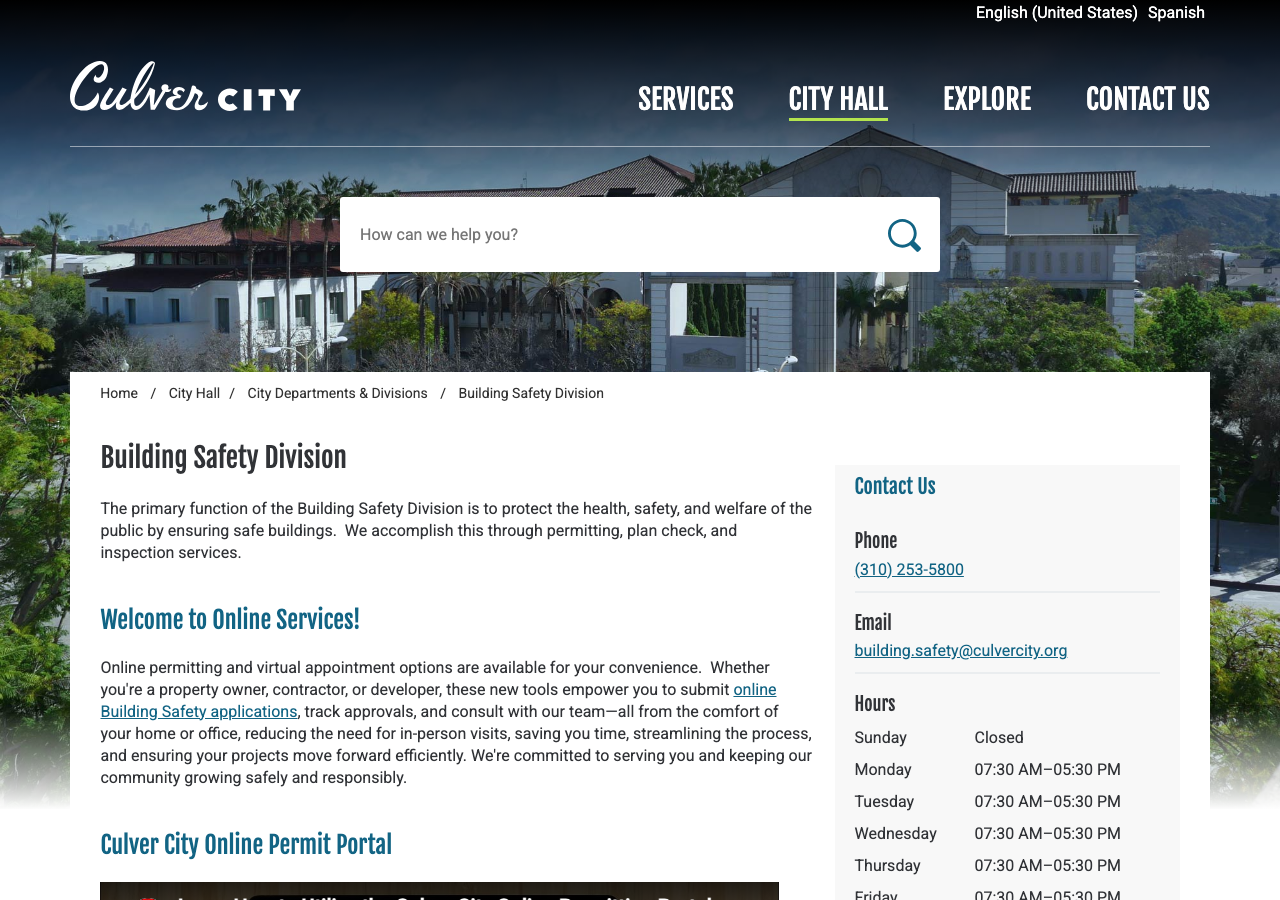
Why the confidence is not higherCity's Building Safety Division (Planning & Development Dept.) issues residential building and electrical permits directly, including the SB 379/Symbium instant solar & ESS permit; own Fire Department (culvercityfd.gov) reviews for roof access.
department page checked 2026-08-30 https://www.culvercity.gov/City-Hall/City-Departments/Planning-Development-Department/Building-Safety
Q2 What does this authority permit itself, and what does it delegate? Core Jurisdiction & scope
Both
Why the confidence is not higherBuilding Safety Division issues both building and electrical permits for PV (CCMC Ch.15.02); Culver City Fire Dept reviews separately for firefighter roof access per the city's own Mandatory Solar PV requirement doc, but does not itself issue the PV permit.
ordinance/handout checked 2026-08-30 https://www.culvercity.gov/files/assets/public/v/1/documents/city-manager/culvercitymandatorysolarph.pdf
Q3 Is a permit required for a residential rooftop PV system? Core Jurisdiction & scope
Yes
Why the confidence is not higherElectrical Permit Application (rev. 4/2025) lists a 'Photovoltaic (PV) System' fee line and requires plan review for any PV/ESS installation; CBC §117 (local amendment) also regulates PV permitting.
permit application form checked 2026-08-30 https://www.culvercity.gov/files/assets/public/v/4/documents/building-development/electrical-permit-application.pdf
Q4 Is there a separate electrical permit, or is it combined? Core Jurisdiction & scope
Either
Why the confidence is not higherOlder but still-cross-referenced 'Mandatory Solar Photovoltaic' ordinance text (now codified as CBC §117, current) states PV 'may be installed under its own electrical permit or may be installed as part of the overall electrical permit'; current fee schedule shows separate Building (PV) and Electrical (Photovoltaic-ESS) line items, and Symbium issues one combined solar/ESS permit for qualifying systems.
adopting ordinance (2025 CBC local amendment, §117.3) checked 2026-08-30 https://codelibrary.amlegal.com/codes/culvercity/latest/culvercity_ca/0-0-0-13669
Q5 Who is allowed to pull the electrical permit? Core Who may apply
Either
Why the confidence is not higherSymbium/SB 379 eligibility requires the contractor hold an A, B, C-10, or C-46 license; the Electrical Permit Application also accepts a 'Property Owner' as applicant (owner-builder), so a homeowner may pull the permit.
department page checked 2026-08-30 https://www.culvercity.gov/Services/Building-Development/Expedited-Solar-Permits
Q6 Must the contractor be registered with this authority before applying? Core Who may apply
Yes
Why the confidence is not higherElectrical Permit Application requires a 'Culver City Business License #' field for the contractor, and the EVSE permit page states 'Contractors will be required to have a current Culver City business license.'
department page checked 2026-08-30 https://www.culvercity.gov/Services/Building-Development/Electric-Vehicle-Service-Equipment-Permits
Q7 Is a homeowner permitted to self-install and self-permit? Who may apply
Yes
Why the confidence is not higherElectrical Permit Application lists 'Property Owner' as a distinct applicant type from 'Contractor'; city separately publishes an 'Owner Statement and Acknowledgment of Compliance' form and a CSLB owner-builder caution handout, indicating owner-builder self-permitting is accepted, though no page explicitly says homeowners may self-INSTALL a PV system.
permit application form checked 2026-08-30 https://www.culvercity.gov/files/assets/public/v/4/documents/building-development/electrical-permit-application.pdf
Q8 What documents make up a complete submittal? Core Submittal package
For the non-Symbium ('alternative') route: completed Electrical Permit Application plus a PDF of plans emailed to Building.Safety@culvercity.org. The Symbium/SB379 instant-permit route collects system/site information entirely inside the Symbium web app rather than as uploaded documents. A generic (non-customized, dated 2006/2007) 'Solar PV Inspection and Submittal Guidelines' template still linked from the current Building Safety Division page additionally calls for a basic site diagram, a one-line electrical diagram, and inverter/module (and battery, if used) cut sheets.
Why the confidence is not higherMixing a current, dated (4/2025) city form with a 2006 Brooks Engineering/Pace University generic template that the city has not customized (it still cites the 2002/2005 NEC and predates rapid shutdown) — flagged in the value itself so the staleness isn't silently propagated.
permit application form + generic handout checked 2026-08-30 https://www.culvercity.gov/files/assets/public/v/4/documents/building-development/electrical-permit-application.pdf
Q9 How many copies, and in what format? Submittal package
Two sets of electrical plans for any work that triggers plan review (PV/ESS is explicitly one of the checkbox triggers). Separately, the general residential submittal standard requires drawing sheets minimum 24"x36", black ink, drawn to scale and fully dimensioned; electronic submittal is accepted but must be printed full-size for inspection.
Why the confidence is not higherBoth figures are stated on current (2024/2025) city documents, but the sheet-size/format rule is the city's general residential standard, not solar-specific.
permit application form checked 2026-08-30 https://www.culvercity.gov/files/assets/public/v/4/documents/building-development/electrical-permit-application.pdf
Q10 Is a site plan required, and what must it show? Core Submittal package
Yes for the general residential submittal (site plan showing existing/proposed conditions is one of the required architectural drawings). The stale-but-still-linked 2006 solar guide additionally calls for a basic site diagram identifying the location of major PV equipment (not to scale).
Why the confidence is not higherCurrent general residential document confirms a site plan is required; the PV-specific detail on what it must show comes only from the non-customized 2006 template.
published checklist checked 2026-08-30 https://www.culvercity.gov/files/assets/public/v/1/documents/building-development/city-documents/residential-documents-for-submittal.pdf
Q11 Is a one-line / three-line diagram required? Core Drawings & calculations
Yes
Why the confidence is not higherPV/ESS installation is a plan-review trigger on the current Electrical Permit Application (2 sets of plans, 15-20 business day review); the one-line-diagram requirement itself is explicit only in the stale 2006 solar guide still linked by the city, not restated in a current PV-specific document.
permit application form checked 2026-08-30 https://www.culvercity.gov/files/assets/public/v/4/documents/building-development/electrical-permit-application.pdf
Q12 Are string and conductor calculations required? Drawings & calculations
Yes
Why the confidence is not higherOnly sourced from the non-customized 2006 'Solar PV Inspection and Submittal Guidelines' (string/conductor ampacity worksheet); no current city document restates this requirement, though it remains standard CEC/NEC compliance practice.
generic handout (2006, not customized by city; predates 2014+ NEC) checked 2026-08-30 https://www.culvercity.gov/files/assets/public/v/1/documents/city-manager/culvercitysolarpvinspectio.pdf
Q13 Is a structural PE stamp required, and at what threshold? Core Engineering & stamps
No residential PV-specific structural PE-stamp threshold is published. The only figures found are inspector guidance inside the stale 2006 template: engineering calculations 'may be required' if array weight exceeds 5 lb/sq ft, or if the roof structure is over 30 years old.
Why the confidence is not higherInference from a generic, non-customized 2006 handout still linked by the city; not an authoritative current city threshold.
generic handout (2006) checked 2026-08-30 https://www.culvercity.gov/files/assets/public/v/1/documents/city-manager/culvercitysolarpvinspectio.pdf
Q14 Is an electrical PE stamp required, and at what threshold? Engineering & stamps
Nothing published by this authority.
Where we lookedElectrical Permit Application, Documents Required for Residential Submittal, and the 2006 solar guide — none state an electrical PE-stamp threshold for residential PV
Q15 What does a residential solar permit cost? Core Fees
Effectively $0 for a typical residential system. Current FY26-27 Comprehensive Fee Schedule lists a Building Division 'Solar/Photovoltaic - per GC 66015' fee of $450/permit (Residential PV up to 15kW; +$15/kW over 15kW) plus a separate Electrical 'Photovoltaic-ESS' fee of $40 each, both subject to a 5.44% technology surcharge — but footnote [5] to that same schedule states 'Exempt up to $5,000 permit fee per Ord 2018-009 in effect until May 23, 2028,' which matches the codified CBC §117.3.A ('Plan check and permit fees...shall be waived' up to $5,000, extended to 5/23/2028). Since the underlying $450+ fee is well under $5,000, net city cost is $0 unless the system's fees exceed that cap.
Why the confidence is not higherTwo current city sources (the FY26-27 fee schedule and the codified 2025 CBC local amendment) agree on the $5,000 waiver cap and its 2028 sunset; the $450 base figure itself is the 'sticker' fee before the waiver is applied.
fee schedule checked 2026-08-30 https://www.culvercity.gov/files/assets/public/v/1/documents/finance/finance-dept-page/fiscal-year-2026-2027-comprehensive-fee-schedule.pdf
Q16 How is the fee calculated? Core Fees
Tiered / per kW
Why the confidence is not higherFY26-27 fee schedule: Residential Photovoltaic up to 15kW = $450 flat, then $15 per kW over 15kW (before the $5,000 waiver is applied).
fee schedule checked 2026-08-30 https://www.culvercity.gov/files/assets/public/v/1/documents/finance/finance-dept-page/fiscal-year-2026-2027-comprehensive-fee-schedule.pdf
Q17 Is there a separate plan-check fee? Fees
Yes
Why the confidence is not higherThe Building Division fee schedule carries a separate valuation-based 'Building Plan Check' fee category distinct from the permit-fee category, but the PV-specific line item is a single flat '$450/permit' figure that doesn't reference that valuation table, and CBC §117.3.A waives 'plan check AND permit fees' together as one category — so it is unclear whether a distinct PV plan-check charge is ever actually assessed separately.
fee schedule checked 2026-08-30 https://www.culvercity.gov/files/assets/public/v/1/documents/finance/finance-dept-page/fiscal-year-2026-2027-comprehensive-fee-schedule.pdf
Q18 What is the stated plan-review turnaround? Core Timeline & validity
15-20 business days
Why the confidence is not higherStated identically on the current (revised 4/2025) Electrical Permit Application and on the Building Safety Division's online-services page.
permit application form checked 2026-08-30 https://www.culvercity.gov/files/assets/public/v/4/documents/building-development/electrical-permit-application.pdf
Q19 How long is an issued permit valid before it expires? Timeline & validity
Permit becomes invalid if work is not commenced within 12 months of issuance, or if suspended/abandoned for 180 days; extensions available (CCMC §15.02.105).
Why the confidence is not higherStated on the Building Safety Division page, citing Culver City Municipal Code §15.02.105.
department page checked 2026-08-30 https://www.culvercity.gov/City-Hall/City-Departments/Planning-Development-Department/Building-Safety
Q20 Which permit portal does this authority use? Core Portal & process
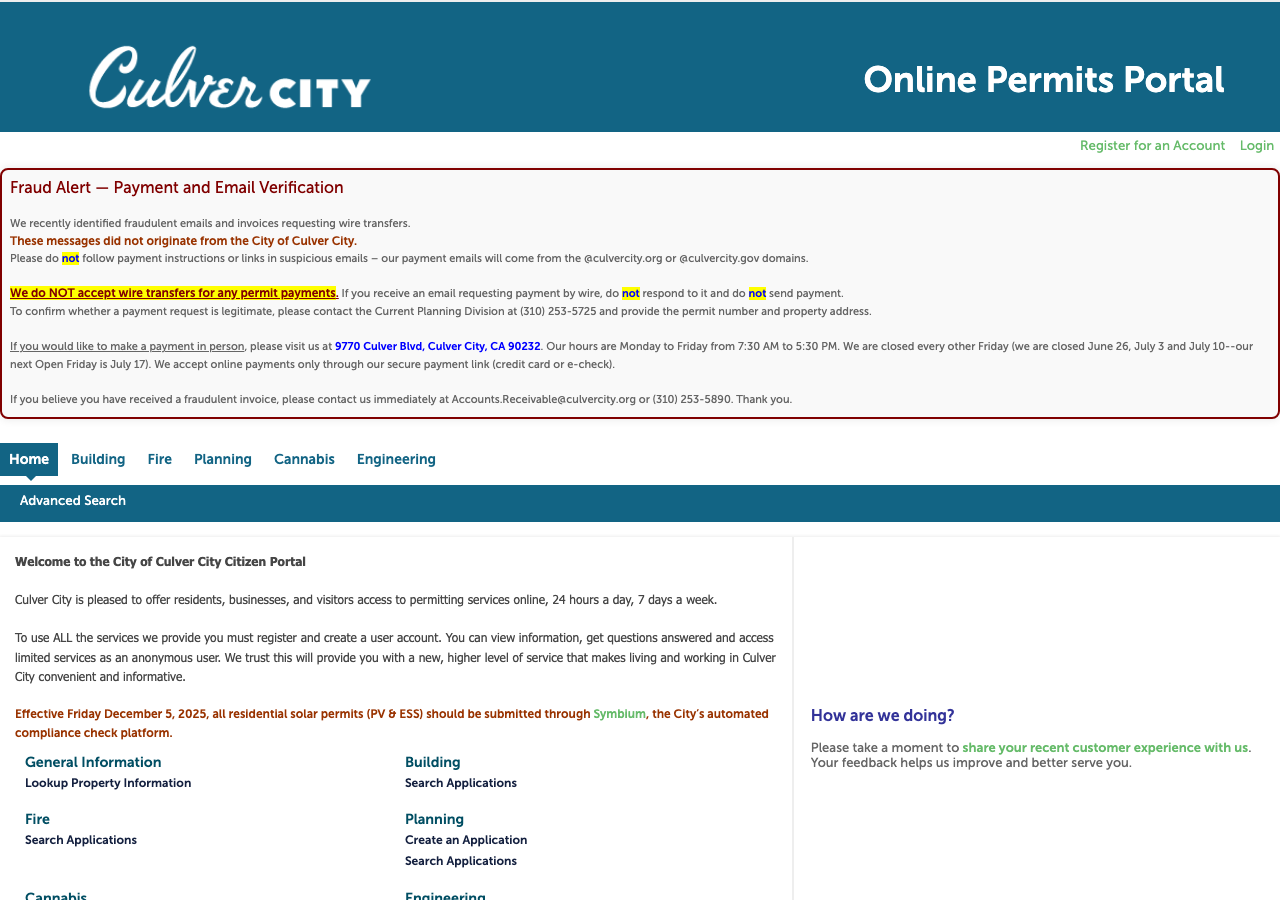
Accela Citizen Access ('Culver City Online Permit Portal', aca-prod.accela.com/CULVERCITY) for general Building Safety permits; the Symbium web platform is used specifically for SB 379 instant residential solar/ESS permits.
Why the confidence is not higherBoth portals are linked directly from the city's own Building Safety Division and Expedited Solar Permits pages.
portal landing page checked 2026-08-30 https://www.culvercity.gov/City-Hall/City-Departments/Planning-Development-Department/Building-Safety
Q21 Can the whole application be completed online? Core Portal & process
Yes
Why the confidence is not higherCity page states that via Symbium 'you don't have to leave Symbium to submit your permit application' and permits 'will be issued automatically, without manual review or an in-person visit' for qualifying systems.
department page checked 2026-08-30 https://www.culvercity.gov/Services/Building-Development/Expedited-Solar-Permits
Q22 Which utility handles interconnection here? Core Utility interconnection
Southern California Edison (SCE)
Why the confidence is not higherCity's own 'Documents Required for Residential Submittal' checklist lists 'Clearance from Southern California Edison' among required other-agency documents for residential building permits; Culver City is also a Clean Power Alliance (CCA) member community per CPA's own site, but CPA is a generation-only community-choice program — SCE remains the interconnecting/wires utility.
published checklist checked 2026-08-30 https://www.culvercity.gov/files/assets/public/v/1/documents/building-development/city-documents/residential-documents-for-submittal.pdf
Q23 Where does the utility sit in the sequence? Core Utility interconnection
No dependency for permit issuance itself; SCE clearance appears as a co-required item alongside (not gating) the building permit application on the city's own residential submittal checklist. Final utility interconnection/PTO with SCE follows standard statewide Rule 21 sequencing (after city final inspection), which was not independently verified against an SCE-specific document this run.
Why the confidence is not higherInferred from the co-listing on the city's residential document checklist plus general knowledge of statewide SCE Rule 21 practice; SCE's own DG interconnection manual was not reachable in this run.
published checklist checked 2026-08-30 https://www.culvercity.gov/files/assets/public/v/1/documents/building-development/city-documents/residential-documents-for-submittal.pdf
Q24 Is a HOA or architectural approval required first? Overlays & special cases
No
Why the confidence is not higherNo HOA/ARC pre-approval gate found in any Culver City solar-permitting document reviewed (Expedited Solar Permits page, Electrical Permit Application, or codified CBC §117); California's Solar Rights Act (Civil Code §714) independently preempts HOA denial/unreasonable-restriction of solar statewide.
department page / state law preemption checked 2026-08-30 https://www.culvercity.gov/Services/Building-Development/Expedited-Solar-Permits
Q25 Is there a historic-district review? Overlays & special cases
Only for properties within a designated historic landmark/district: CCMC Ch.15.05 (Historic Preservation Program) provides for a 'Certificate of Appropriateness' process for exterior alterations, and no PV-specific carve-out from that chapter was found. California's Solar Rights Act (Civil Code §714) limits how far such review may restrict or deny a solar installation statewide.
Why the confidence is not higherChecked the codified Historic Preservation chapter directly (TOC/section index) for a solar exception; found none — a proven absence within that chapter, not a full read of every subsection.
ordinance checked 2026-08-30 https://codelibrary.amlegal.com/codes/culvercity/latest/culvercity_ca/0-0-0-15260
Q26 Is a wind or windstorm certification required? Overlays & special cases
No / not applicable — California uses seismic and standard lateral (wind) load design rather than a separate 'windstorm certification.' The city's residential submittal checklist lists 'design of the lateral-force resisting system (seismic and wind loads)' as part of ordinary structural calculations, not a distinct wind-certification document.
Why the confidence is not higherConfirmed via the city's own Documents Required for Residential Submittal checklist; this is standard California practice, not unique to Culver City.
published checklist checked 2026-08-30 https://www.culvercity.gov/files/assets/public/v/1/documents/building-development/city-documents/residential-documents-for-submittal.pdf
Q27 Is a Specific Use Permit or Council approval ever required? Overlays & special cases
Not for standard residential rooftop PV. A Specific-Use/Council-level approval only arises under the separate >10,000 sq ft new-construction/major-renovation mandatory solar program (CBC §117.2), where the Community Development Director (not Council) may approve an in-lieu-fee or alternate-location exception — and that program explicitly excludes one- and two-family residences.
Why the confidence is not higherRead directly from the codified 2025 CBC local amendment §117 (Solar Photovoltaic Systems).
adopting ordinance checked 2026-08-30 https://codelibrary.amlegal.com/codes/culvercity/latest/culvercity_ca/0-0-0-13669
Q28 Is there a system-size cap on residential generation? Overlays & special cases
No explicit residential system-size cap found in Culver City's own documents; the SB 379/Gov. Code §65850.52 ministerial 'instant permit' eligibility ceiling of 38.4 kW AC applies statewide to which systems qualify for the Symbium fast-track — larger systems are not prohibited, just routed to standard plan review.
Why the confidence is not higherCulver City's Expedited Solar Permits page references SB 379 by name but does not itself restate the state's kW ceiling; the ceiling is state law, cited here as the applicable state floor.
department page / state law checked 2026-08-30 https://www.culvercity.gov/Services/Building-Development/Expedited-Solar-Permits
Lines marked with a percentage were read off this authority’s own published documents. Unmarked guidance is general good practice, not this jurisdiction’s rule — always confirm against the authority before you submit.
Install 5 steps · 20 questions
-
Build to the code editions actually in force here
The NEC edition a jurisdiction enforces is often a cycle behind the newest one published, and local amendments sit on top of it. Rapid shutdown, conductor sizing and labelling all change between editions, so the edition in force is the first thing to establish, not the last.
- Which NEC edition is in force? 2023 92% · adopting ordinance
- Which building code edition is in force? 2025 California Building Code (Title 24, Part 2), adopted with local amendments, CCMC §15.02.105. Note: one local-amendment section elsewhere in the same chapter (§1006.3.5, single-exit stairways) still internally cites 'the 2022 CBC' — an uncorrected holdover from before the 2025 cycle re-adoption. 88% · adopting ordinance
- Which fire code edition is in force? 2025 California Fire Code (Part 9), based on the 2024 International Fire Code, adopted by reference with local amendments, CCMC §9.02.005 (Ord. No. 2025-016). Culver City has its own Fire Department (culvercityfd.gov) — it is not served by LA County Fire. 92% · adopting ordinance
- Are there local amendments to any of the above? Yes 85% · adopting ordinance
- What is the installation judged against? 2025 California Electrical Code (2023 NEC), 2025 California Building Code (with local amendments), and 2025 California Fire Code (2024 IFC base), all as codified in CCMC Ch.15.02 and Ch.9.02. 88% · adopting ordinance
-
Fire access, setbacks and pathways
Ridge setbacks and roof access pathways are fire-service requirements and they constrain the array layout. They are the most common cause of a redesign after the fire department comments on a plan set.
Nothing recorded for City of Culver City on this step yet — 1 question checked and found unpublished. The guidance above is general.
-
Rapid shutdown
Which rapid-shutdown rule applies follows directly from the NEC edition in force, and the initiation device has to be at a location the fire service can reach and identify. This is inspected, and it is labelled.
- Is rapid shutdown required, and to which NEC edition? Rapid shutdown applies via the adopted 2025 California Electrical Code (based on the 2023 NEC, Art. 690.12); no local amendment removing or modifying it was found in CCMC §15.02.120. 68% · adopting ordinance / inference
-
Labels and placards
The NEC sets a baseline for permanent markings at the service equipment and the disconnecting means. On top of that, an authority may specify its own wording, and the utility may specify more again. Where any of them writes its own text, a generic off-the-shelf label set will not pass — this is the detail most often fixed on a return visit.
- Does the authority specify placard wording of its own? No 62% · adopting ordinance (absence)
-
Disconnect, storage and listed equipment
Where the AC disconnect must sit relative to the meter is usually the utility's rule, not the building department's. Battery storage frequently carries its own permit, its own inspection and its own fire conditions.
- Must equipment be on a specific approved list? No specific city-maintained 'approved equipment list' was found; standard requirement is UL-listing (modules to UL 1703/61730, inverters to UL 1741) as a function of the adopted CEC, not a separate city list. The 2006 stale template refers to a now-discontinued California Energy Commission 'eligible inverters/modules' list that is no longer the operative mechanism. 55% · adopting ordinance / inference
- Are batteries permitted, and under what conditions? Yes, batteries/ESS are permitted. The Symbium 'Expedited Solar Permits' flow explicitly supports 'Rooftop Solar or Battery Storage,' and the current fee schedule carries a distinct Electrical 'Photovoltaic-ESS' fee line. No Culver-City-specific ESS fire-code amendment (e.g., a local NFPA 855 modification) was found in the codified Fire Prevention chapter. 72% · department page
- Is there a separate ESS permit or inspection? No separate ESS-only permit — batteries are folded into the same combined 'Rooftop Solar or Battery Storage' Symbium application, but are billed as a distinct 'Photovoltaic-ESS' line item ($40) on the electrical fee schedule. 60% · department page + fee schedule
- Is a ground mount treated as a structure? Not explicitly addressed; the codified Accessory Residential Structures chapter (CCMC §17.400.100) has no solar-specific carve-out, so a ground-mounted PV array would default to being treated as an accessory structure subject to the same height/setback/floor-area rules as any other accessory structure on the lot. 55% · ordinance (absence)
- Is a specific mounting system or attachment spacing required? No current local amendment found; the only mounting/attachment-spacing guidance found anywhere in the city's materials is inspector guidance inside the stale, non-customized 2006/2007 'Solar PV Inspection and Submittal Guidelines' template (engineering review triggers based on array weight and roof age). 45% · generic handout (2006)
20 questions answered against City of Culver City’s own published documents
Q29 Which NEC edition is in force? Core Code editions in force
2023
Why the confidence is not higher2025 California Electrical Code (based on the 2023 NEC) adopted by reference, CCMC §15.02.120 (Ord. No. 2025-015 §6), with no local amendments listed.
adopting ordinance checked 2026-08-30 https://codelibrary.amlegal.com/codes/culvercity/latest/culvercity_ca/0-0-0-14456
Q30 Which building code edition is in force? Core Code editions in force
2025 California Building Code (Title 24, Part 2), adopted with local amendments, CCMC §15.02.105. Note: one local-amendment section elsewhere in the same chapter (§1006.3.5, single-exit stairways) still internally cites 'the 2022 CBC' — an uncorrected holdover from before the 2025 cycle re-adoption.
Why the confidence is not higherRead directly from the codified adoption section; the 2022-CBC holdover is flagged, not resolved.
adopting ordinance checked 2026-08-30 https://codelibrary.amlegal.com/codes/culvercity/latest/culvercity_ca/0-0-0-13669
Q31 Which fire code edition is in force? Code editions in force
2025 California Fire Code (Part 9), based on the 2024 International Fire Code, adopted by reference with local amendments, CCMC §9.02.005 (Ord. No. 2025-016). Culver City has its own Fire Department (culvercityfd.gov) — it is not served by LA County Fire.
Why the confidence is not higherAdoption section read directly; own-Fire-Department status confirmed by the culvercityfd.gov domain distinct from culvercity.gov.
adopting ordinance checked 2026-08-30 https://codelibrary.amlegal.com/codes/culvercity/latest/culvercity_ca/0-0-0-5101
Q32 Are there local amendments to any of the above? Core Code editions in force
Yes
Why the confidence is not higherLocal amendments confirmed to the CBC (§117 solar mandate/fee waiver, single-stair exception, reach codes, disability access board, etc., CCMC §15.02.105) and to the CFC (permit-fee, aviation, fireworks, and appeals provisions, CCMC Ch.9.02); no local amendment text found for the CEC, which is adopted by reference only (§15.02.120).
adopting ordinance checked 2026-08-30 https://codelibrary.amlegal.com/codes/culvercity/latest/culvercity_ca/0-0-0-13669
Q33 What is the installation judged against? Core Electrical
2025 California Electrical Code (2023 NEC), 2025 California Building Code (with local amendments), and 2025 California Fire Code (2024 IFC base), all as codified in CCMC Ch.15.02 and Ch.9.02.
Why the confidence is not higherComposite of the three adoption sections read directly.
adopting ordinance checked 2026-08-30 https://codelibrary.amlegal.com/codes/culvercity/latest/culvercity_ca/0-0-0-13669
Q34 Is there a local rule on service upgrades or busbar sizing? Electrical
Nothing published by this authority.
Where we lookedCCMC §15.02.120 (California Electrical Code adopted by reference) — read in full; contains only the adoption sentence and ordinance history, no added/amended text on service upgrades or busbar sizing
https://codelibrary.amlegal.com/codes/culvercity/latest/culvercity_ca/0-0-0-14456
Q35 Is a specific mounting system or attachment spacing required? Structural & mounting
No current local amendment found; the only mounting/attachment-spacing guidance found anywhere in the city's materials is inspector guidance inside the stale, non-customized 2006/2007 'Solar PV Inspection and Submittal Guidelines' template (engineering review triggers based on array weight and roof age).
Why the confidence is not higherRead the codified CBC and CEC local-amendment text in full — no PV mounting-spacing rule found there; the only source is the 2006 generic handout.
generic handout (2006) checked 2026-08-30 https://www.culvercity.gov/files/assets/public/v/1/documents/city-manager/culvercitysolarpvinspectio.pdf
Q36 What ridge setback and access pathways are required? Core Fire pathways & setbacks
Nothing published by this authority.
Where we lookedCulver City Fire Prevention chapter (CCMC §9.02.005-.065 and §9.02.300-.325) read in full with positive ('fire') and fabricated ('zzqqx') controls — no PV-specific ridge-setback or fire-access-pathway amendment found; base 2025 CFC/2024 IFC applies without local customization on this point
https://codelibrary.amlegal.com/codes/culvercity/latest/culvercity_ca/0-0-0-5112
Q37 Is rapid shutdown required, and to which NEC edition? Core Rapid shutdown
Rapid shutdown applies via the adopted 2025 California Electrical Code (based on the 2023 NEC, Art. 690.12); no local amendment removing or modifying it was found in CCMC §15.02.120.
Why the confidence is not higherPositive inference: the current NEC edition is confirmed adopted and the electrical-code adoption section has no added/amended text, but no Culver City document names '690.12' or 'rapid shutdown' explicitly.
adopting ordinance / inference checked 2026-08-30 https://codelibrary.amlegal.com/codes/culvercity/latest/culvercity_ca/0-0-0-14456
Q38 Which placards does this authority require at the service equipment? Core Labels Signage & labelling
Nothing published by this authority.
Where we lookedFire Prevention chapter local amendments and CBC §117 local amendment — both read in full with controls; no city-specific PV service-equipment placard spec found. The only PV-placard content anywhere in the city's materials is inside the stale, non-customized 2006 template (Guideline 2, item 3), which predates rapid-shutdown labeling and cannot be used to state current requirements.
Q39 Does the authority specify placard wording of its own? Core Labels Signage & labelling
No
Why the confidence is not higherSearched the codified CBC (§117) and CFC local amendments directly (with positive/fabricated controls) for city-specific placard wording — none found; the only placard wording in the city's materials ('PV System Disconnect') comes from the non-customized 2006 template, not a current city ordinance.
adopting ordinance (absence) checked 2026-08-30 https://codelibrary.amlegal.com/codes/culvercity/latest/culvercity_ca/0-0-0-13669
Q40 Does it specify letter height, colour or material? Core Labels Signage & labelling
Nothing published by this authority.
Where we lookedMinimum Signage Requirements PDF (checked in full — it governs building/business signage such as illuminated signs and monument signs, not PV disconnect placards) and the codified CBC/CFC local amendments — no PV-specific letter-height/colour/material spec found in any current city document
Q41 Is a site plan / facility map placard required, and what must it show? Core Labels Signage & labelling
Nothing published by this authority.
Where we lookedCBC §117 and CFC local amendments read in full — no city-specific facility-map/site-plan placard requirement beyond the base NEC/CFC 705.10 found
https://codelibrary.amlegal.com/codes/culvercity/latest/culvercity_ca/0-0-0-5112
Q42 Does the UTILITY specify placards beyond the AHJ's? Core Labels Signage & labelling
Nothing published by this authority.
Where we lookedCity's own Documents Required for Residential Submittal (only requires 'Clearance from Southern California Edison,' no placard spec stated); SCE's own DG interconnection/Rule 21 documentation was not independently reachable this run (WebSearch exhausted, sce.com not fetchable via the tools available), so this is an unverified gap rather than a proven absence
Q43 Where must the labels be placed? Core Labels Signage & labelling
Nothing published by this authority.
Where we lookedSame materials as Q38/40/41 — no Culver-City-specific label-placement rule found beyond generic NEC references in the stale 2006 template
Q44 Must equipment be on a specific approved list? Equipment listing
No specific city-maintained 'approved equipment list' was found; standard requirement is UL-listing (modules to UL 1703/61730, inverters to UL 1741) as a function of the adopted CEC, not a separate city list. The 2006 stale template refers to a now-discontinued California Energy Commission 'eligible inverters/modules' list that is no longer the operative mechanism.
Why the confidence is not higherBased on adoption of the current CEC without a found local equipment-list amendment, and awareness that the CEC's old eligible-equipment lists were discontinued years ago.
adopting ordinance / inference checked 2026-08-30 https://codelibrary.amlegal.com/codes/culvercity/latest/culvercity_ca/0-0-0-14456
Q45 Are batteries permitted, and under what conditions? Core Battery / ESS
Yes, batteries/ESS are permitted. The Symbium 'Expedited Solar Permits' flow explicitly supports 'Rooftop Solar or Battery Storage,' and the current fee schedule carries a distinct Electrical 'Photovoltaic-ESS' fee line. No Culver-City-specific ESS fire-code amendment (e.g., a local NFPA 855 modification) was found in the codified Fire Prevention chapter.
Why the confidence is not higherSymbium page and current fee schedule are both current, city-sourced documents; the absence of a local ESS fire amendment was checked directly in CCMC Ch.9.02 with controls.
department page checked 2026-08-30 https://www.culvercity.gov/Services/Building-Development/Expedited-Solar-Permits
Q46 Is there a separate ESS permit or inspection? Battery / ESS
No separate ESS-only permit — batteries are folded into the same combined 'Rooftop Solar or Battery Storage' Symbium application, but are billed as a distinct 'Photovoltaic-ESS' line item ($40) on the electrical fee schedule.
Why the confidence is not higherInferred by combining the Symbium application-flow description with the itemized current fee schedule; no document states explicitly whether an inspector treats ESS as a separately scheduled inspection.
department page + fee schedule checked 2026-08-30 https://www.culvercity.gov/files/assets/public/v/1/documents/finance/finance-dept-page/fiscal-year-2026-2027-comprehensive-fee-schedule.pdf
Q47 Is a ground mount treated as a structure? Core Ground mount
Not explicitly addressed; the codified Accessory Residential Structures chapter (CCMC §17.400.100) has no solar-specific carve-out, so a ground-mounted PV array would default to being treated as an accessory structure subject to the same height/setback/floor-area rules as any other accessory structure on the lot.
Why the confidence is not higherRead §17.400.100 in full — confirmed no PV mention; this is an inference from the absence of an exemption, not an explicit classification.
ordinance (absence) checked 2026-08-30 https://codelibrary.amlegal.com/codes/culvercity/latest/culvercity_ca/0-0-0-19640
Q48 Where must the AC disconnect be, relative to the meter? Core Utility equipment
Nothing published by this authority.
Where we lookedCity's own residential submittal checklist and Electrical Permit Application — neither states an AC-disconnect-to-meter placement rule; this is typically governed by SCE's own DG/Rule 21 manual, which was not independently reachable this run
Lines marked with a percentage were read off this authority’s own published documents. Unmarked guidance is general good practice, not this jurisdiction’s rule — always confirm against the authority before you submit.
Inspection 5 steps · 14 questions
-
Book it
Booking is a portal, a phone call or an email depending on the authority, and the notice required is rarely zero. Book before the work is finished rather than after — the lead time, not the work, is usually what sets the date.
- How is an inspection booked? Email (building.safety@culvercity.org), stating permit number(s), site address, inspection type, and desired date; inspections may also be conducted virtually via FaceTime or Cisco Webex Meet. 90% · department page
-
Know who turns up
Some authorities inspect their own solar work; some delegate it, and a few do not inspect the PV equipment itself at all. Who is coming determines what they will look at.
- Does this AHJ perform its own final solar inspection? Yes 82% · department page
- If delegated, to whom? N/A — not delegated; performed in-house by the Culver City Building Safety Division (with the Culver City Fire Department handling the roof-access/fire-safety component separately, also in-house). 78% · department page
-
Work the stages in order
A rough-in or mid-roof inspection, where one is required, has to happen before the work it covers is closed up. Missing a stage means opening something back up, and it is the most expensive kind of correction.
- Which inspections are required, and in what order? Not published as a numbered PV-specific sequence. CBC §117.3.C (the >10,000 sq ft mandatory-solar program) requires the PV system to be 'completed, inspected and fully operational' before final/temporary CO is issued. For standard residential PV, the only sequence description found (in the stale 2006 template) is a single field inspection covering equipment/wiring-per-plans, structural attachment, and signage — no explicit rough-in stage. 55% · adopting ordinance + generic handout
-
Have the paperwork on site
The approved plan set, the permit, and the equipment listings should be on site and reachable. Inspectors routinely verify that installed equipment matches what was approved, and that the labels are the ones the plan set promised.
- Is there a published inspection checklist? Yes, but only a stale one: the 'Culver City Solar PV Inspection and Submittal Guidelines' (a non-customized, generic 2006/2007 Brooks Engineering / Pace University Law School template, still linked from the current Building Safety Division page) is the only published PV plan-check/field-inspection checklist found; there is no current, city-authored PV checklist. 60% · generic handout (2006)
- What must be on site at inspection? At minimum, a copy of the approved one-line diagram and the plot/site plan should be available on site for the inspector, per the stale 2006 template; standard department practice (not solar-specific) also expects the approved stamped plans and permit card on site. 50% · generic handout (2006)
- Does the inspector verify labels and listings? Yes (by standard inspection practice) 55% · generic handout (2006)
-
Sign-off, and permission to operate
Passing gives you a final or an equivalent sign-off. That is not the same as permission to operate: PTO comes from the utility, and who tells the utility the inspection passed varies. A system left switched off for weeks is usually waiting on this handover.
- What is issued on pass? Final (signed-off inspection / permit finaled). CBC §117.3.C additionally ties issuance of any temporary or final Certificate of Occupancy, for projects subject to the >10,000 sq ft mandatory-solar program, to the PV system being completed, inspected and fully operational — implying a standard 'Final' inspection model for standalone residential PV permits, which are not new construction and so would not themselves generate a CO. 62% · adopting ordinance / inference
- Who notifies the utility for PTO? Installer (typical statewide SCE/Rule 21 practice) 50% · inference (state/utility practice)
- Is there a re-inspection fee? $160.75 per hour, 1-hour minimum (Building Division). Separately, the Fire Department charges a code-enforcement non-compliance re-inspection charge of $100 for the first additional inspection and $500 for each subsequent one (CCMC §9.02.315) — a distinct fee for uncorrected violations, not the routine building/electrical re-inspection fee. 88% · fee schedule
- How are corrections issued and cleared? For plan-check corrections: resubmittal sets (or, for minor revisions, an emailed summary + PDF) are dropped in the 'Building Safety Drop Off' bin at City Hall, sit 48-72 hours for sanitization, then staff route them and email confirmation/approval. No separate on-site field-correction notice procedure for inspections is published. 55% · department page
14 questions answered against City of Culver City’s own published documents
Q49 How is an inspection booked? Core Booking & scheduling
Email (building.safety@culvercity.org), stating permit number(s), site address, inspection type, and desired date; inspections may also be conducted virtually via FaceTime or Cisco Webex Meet.
Why the confidence is not higherStated directly on the Building Safety Division's online-services page.
department page checked 2026-08-30 https://www.culvercity.gov/City-Hall/City-Departments/Planning-Development-Department/Building-Safety
Q50 How much notice is required? Core Booking & scheduling
Nothing published by this authority.
Where we lookedBuilding Safety Division inspection-scheduling section, read in full — states only that 'inspection dates are not guaranteed' and a confirmation email follows scheduling; no minimum-business-days notice figure is published
Q51 Are same-day or AM/PM windows offered? Booking & scheduling
Nothing published by this authority.
Where we lookedSame inspection-scheduling section — no AM/PM or same-day window system is described; only 'date of desired inspection' and in-person-or-virtual format are mentioned
Q52 Does this AHJ perform its own final solar inspection? Core Who inspects
Yes
Why the confidence is not higherCulver City Building Safety Division performs its own electrical/building final inspections in-house (email-scheduled, in-person or virtual); the Fire Department separately reviews for firefighter roof access but the building/electrical final sign-off is Culver City's own.
department page checked 2026-08-30 https://www.culvercity.gov/City-Hall/City-Departments/Planning-Development-Department/Building-Safety
Q53 If delegated, to whom? Core Who inspects
N/A — not delegated; performed in-house by the Culver City Building Safety Division (with the Culver City Fire Department handling the roof-access/fire-safety component separately, also in-house).
Why the confidence is not higherSame sourcing as Q52; Culver City confirmed to run its own Fire Department (culvercityfd.gov) rather than relying on LA County Fire.
department page checked 2026-08-30 https://www.culvercityfd.gov/Home
Q54 Which inspections are required, and in what order? Core Stages & sequence
Not published as a numbered PV-specific sequence. CBC §117.3.C (the >10,000 sq ft mandatory-solar program) requires the PV system to be 'completed, inspected and fully operational' before final/temporary CO is issued. For standard residential PV, the only sequence description found (in the stale 2006 template) is a single field inspection covering equipment/wiring-per-plans, structural attachment, and signage — no explicit rough-in stage.
Why the confidence is not higherCombination of a current codified requirement (which applies to the >10,000 sq ft program, not standard residential) and a non-customized 2006 generic template for the residential sequence itself.
adopting ordinance + generic handout checked 2026-08-30 https://codelibrary.amlegal.com/codes/culvercity/latest/culvercity_ca/0-0-0-13669
Q55 Is a rough-in or mid-roof inspection required? Stages & sequence
Nothing published by this authority.
Where we lookedBuilding Safety Division inspection page and the 2006 solar-inspection template, both read in full — neither describes a separate rough-in or mid-roof inspection stage specific to PV
Q56 Does the inspector verify labels and listings? Core What is checked
Yes (by standard inspection practice)
Why the confidence is not higherThe only explicit checklist found (the non-customized 2006 template's field-inspection worksheet) has the inspector confirm PV module and inverter model numbers against cut sheets and listing labels, and check sign durability/content — consistent with ordinary NEC listing/labeling enforcement, but not restated in a current city document.
generic handout (2006) checked 2026-08-30 https://www.culvercity.gov/files/assets/public/v/1/documents/city-manager/culvercitysolarpvinspectio.pdf
Q57 Is there a published inspection checklist? Core What is checked
Yes, but only a stale one: the 'Culver City Solar PV Inspection and Submittal Guidelines' (a non-customized, generic 2006/2007 Brooks Engineering / Pace University Law School template, still linked from the current Building Safety Division page) is the only published PV plan-check/field-inspection checklist found; there is no current, city-authored PV checklist.
Why the confidence is not higherConfirmed the document is still live-linked from the current (2026) Building Safety Division page, but its content (citing the 2002/2005 NEC, no mention of rapid shutdown or NEC 690.12) is proven stale by direct extraction.
generic handout (2006) checked 2026-08-30 https://www.culvercity.gov/files/assets/public/v/1/documents/city-manager/culvercitysolarpvinspectio.pdf
Q58 What must be on site at inspection? Core Documents on site
At minimum, a copy of the approved one-line diagram and the plot/site plan should be available on site for the inspector, per the stale 2006 template; standard department practice (not solar-specific) also expects the approved stamped plans and permit card on site.
Why the confidence is not higherSourced from the non-customized 2006 template plus general department practice; not restated in a current PV-specific city document.
generic handout (2006) checked 2026-08-30 https://www.culvercity.gov/files/assets/public/v/1/documents/city-manager/culvercitysolarpvinspectio.pdf
Q59 Is there a re-inspection fee? Corrections & re-inspection
$160.75 per hour, 1-hour minimum (Building Division). Separately, the Fire Department charges a code-enforcement non-compliance re-inspection charge of $100 for the first additional inspection and $500 for each subsequent one (CCMC §9.02.315) — a distinct fee for uncorrected violations, not the routine building/electrical re-inspection fee.
Why the confidence is not higherBuilding figure is from the current FY26-27 Comprehensive Fee Schedule (supersedes the $103.25 figure in the September 2024 Building Permit Fee Schedule, a code/fee-cycle lag flagged here rather than silently resolved); fire figure read directly from the codified ordinance.
fee schedule checked 2026-08-30 https://www.culvercity.gov/files/assets/public/v/1/documents/finance/finance-dept-page/fiscal-year-2026-2027-comprehensive-fee-schedule.pdf
Q60 How are corrections issued and cleared? Corrections & re-inspection
For plan-check corrections: resubmittal sets (or, for minor revisions, an emailed summary + PDF) are dropped in the 'Building Safety Drop Off' bin at City Hall, sit 48-72 hours for sanitization, then staff route them and email confirmation/approval. No separate on-site field-correction notice procedure for inspections is published.
Why the confidence is not higherThis describes the plan-review correction cycle, which is documented; the field-inspection correction process specifically was not found published.
department page checked 2026-08-30 https://www.culvercity.gov/City-Hall/City-Departments/Planning-Development-Department/Building-Safety
Q61 What is issued on pass? Core Final sign-off & PTO
Final (signed-off inspection / permit finaled). CBC §117.3.C additionally ties issuance of any temporary or final Certificate of Occupancy, for projects subject to the >10,000 sq ft mandatory-solar program, to the PV system being completed, inspected and fully operational — implying a standard 'Final' inspection model for standalone residential PV permits, which are not new construction and so would not themselves generate a CO.
Why the confidence is not higherInferred from CBC §117.3.C plus the absence of any other stated sign-off document (e.g., 'green tag') in city materials.
adopting ordinance / inference checked 2026-08-30 https://codelibrary.amlegal.com/codes/culvercity/latest/culvercity_ca/0-0-0-13669
Q62 Who notifies the utility for PTO? Core Final sign-off & PTO
Installer (typical statewide SCE/Rule 21 practice)
Why the confidence is not higherNot stated by any Culver City document reviewed; this reflects general California IOU (SCE) Rule 21 practice rather than a city- or SCE-specific document confirmed in this run — SCE's own DG/PTO page was not reachable with the tools available this run.
inference (state/utility practice) checked 2026-08-30 https://www.culvercity.gov/files/assets/public/v/1/documents/building-development/city-documents/residential-documents-for-submittal.pdf
Lines marked with a percentage were read off this authority’s own published documents. Unmarked guidance is general good practice, not this jurisdiction’s rule — always confirm against the authority before you submit.
Jurisdiction & key facts
The standing 62-question set, answered for City of Culver City against this authority’s own published documents. Every answer carries the confidence it was recorded at and the document it came from. Where nothing is published we say so and show where we looked — a blank here is a finding, not a gap.
City of Culver City is the authority having jurisdiction 90% confidence
- Holds
- Building and Electrical (Planning & Development Dept., Building Safety Division); Culver City Fire Department reviews separately for firefighter roof access on PV systems
- Overridden by
- CA Gov. Code §65850.52 (SB 379) mandates ministerial/automated review via Symbium for qualifying residential solar+ESS systems; AB 130 (Stats. 2025, Ch. 22) freezes more-restrictive local residential code amendments 1 Oct 2025-1 Jun 2031; the 2025 CBC/CEC/CFC editions themselves are set by the CA Building Standards Commission, with Culver City adopting the CEC by reference without local amendment and the CBC/CFC with limited local amendments (e.g., codified §117 solar mandate/fee-waiver for large buildings, which explicitly excludes 1-2 family residences).
- Why not higher
- City's own Building Safety Division page and Electrical Permit Application confirm it issues both building and electrical permits and partners directly with Symbium for SB 379 instant solar permits. Culver City runs its own Fire Department (culvercityfd.gov, Fire Chief David L. White) rather than being served by LA County Fire — confirmed by the distinct .gov domain the city's own Fire Department link redirects to, correcting any assumption that LACoFD's residential-PV delegation pattern (seen in many other LA County cities) applies here.
https://www.culvercity.gov/Services/Building-Development/Expedited-Solar-Permits
- Permit required
- Yes95%
- Permit cost
- Effectively $0 for a typical residential system. Current FY26-27 Comprehensive Fee Schedule lists a Building Division 'Solar/Photovoltaic - per GC 66015' fee of $450/permit (Residential PV…85%
- Plan review
- 15-20 business days90%
- Portal
- Accela Citizen Access ('Culver City Online Permit Portal', aca-prod.accela.com/CULVERCITY) for general Building Safety permits;90%
- Electrical code
- 202392%
- Own placard wording
- No62%
- Booking an inspection
- Email (building.safety@culvercity.org), stating permit number(s), site address, inspection type, and desired date;90%
Labels & placards for this authority
Wording 62%
No
Size, colour & material None%
Where they go None%
What the utility wants on top None%
Each figure above is sourced and dated in the full answer set below (questions 38–43). Where an authority’s own published sheet is older than the code it has adopted, the answer says so.
Their website
Average approval time — application to PTO
From the CPUC interconnection record. Bars show the average days taken each year; a year with no recorded projects is left blank rather than drawn as zero.