
City of Dana Point
Orange County
City of Dana Point is a city authority in the State of California, serving 33,107 residents. 1,333 residential solar installs are on record here. This page is the permit route for that jurisdiction: the fifteen steps from working out who has a say over an address through to permission to operate, the documents this authority publishes, and 62 answers taken from those documents and dated.
Permitting 5 steps · 28 questions
Whether a permit is needed — Yes Q3 Electrical and building permits — Combined Q4 Plan review — Instantaneous (same-session) approval for qualifying Symbium submittals (licensed A/B/C-10/C-46 contractor, ≤38.4kW AC); Q18 Where you file — eTRAKiT (with Symbium as an add-on instant-permitting front end for qualifying residential solar/ESS applications) Q20
- Permit required
- Yes96% source
- What it costs
- $400 flat for 0-5 kW; $500 flat for systems over 5 kW; plus $33 for an unlisted PV component (e.g. battery)88% source
- Plan review turnaround
- Instantaneous (same-session) approval for qualifying Symbium submittals (licensed A/B/C-10/C-46 contractor, ≤38.4kW AC);65% source
- Key document
- authority's own page cited by 8 open the document
-
Confirm who has a say over your address
A city address is usually permitted by the city, not the county — but not always, and some authorities keep building and hand electrical to someone else. Getting this wrong costs the whole submittal, because every requirement below belongs to whoever actually holds jurisdiction. Check the overlays in the same pass: an HOA, a historic district, a windstorm certification or a system-size cap can reshape the design, and all of them are cheaper to find now than after the array is laid out.
- Is this authority the AHJ for residential solar at this address? Yes 95% · authority's own page
- What does this authority permit itself, and what does it delegate? Both (Building and Electrical are permitted directly by the City); Fire/life-safety review of ESS and non-standard-compliant PV is delegated to the Orange County Fire Authority (OCFA) 88% · ordinance
- Is a permit required for a residential rooftop PV system? Yes 96% · authority's own page
- Is there a separate electrical permit, or is it combined? Combined 65% · fee schedule
- Is a HOA or architectural approval required first? No — not found as a City requirement for solar specifically; DPMC's only codified HOA-approval requirement is for ADUs/JADUs, not PV 68% · ordinance
- Is there a historic-district review? Conditional — a historic-district/historic-resource review applies only if the parcel is a 'Designated historic resource' on the Dana Point Historical Resource Register or within a defined historic district; otherwise no historic review applies 62% · ordinance
- Is a wind or windstorm certification required? No 72% · ordinance
- Is a Specific Use Permit or Council approval ever required? Not for a standard rooftop PV retrofit; a discretionary Site Development Permit, Conditional Use Permit, or Council-level appeal could be triggered only in edge cases — e.g., a ground-mounted PV system treated as a new accessory structure, or a project in the Coastal Overlay District's appealable area 52% · ordinance
- Is there a system-size cap on residential generation? No hard kW cap is codified; DPMC §8.22.019 (the City's residential-rooftop-solar expediting ordinance) states no size limit. Administratively, the Symbium/expedited-review path is available only up to 38.4 kW AC nameplate (larger systems still permitted, just routed through standard eTRAKiT review rather than instant approval). 78% · authority's own page
-
Check who is allowed to apply
Several authorities require the electrical permit to be pulled by a licensed electrician, or require the contractor to be registered with them BEFORE applying. Registration is not same-day. This is second on the list rather than fourth because it is the step most likely to stop the job before the drawings matter.
- Who is allowed to pull the electrical permit? Either — a licensed contractor (A, B, C-10 or C-46) for the Symbium instant-permit path, or an owner-builder for an owner-occupied principal residence via the standard eTRAKiT path 62% · authority's own page
- Must the contractor be registered with this authority before applying? No 80% · authority's own page
- Is a homeowner permitted to self-install and self-permit? Conditionally — not via the expedited Symbium path (licensed-contractor-only), but general owner-builder permits are allowed for an owner-occupied principal residence via the standard eTRAKiT path 58% · authority's own page
-
Build the submittal package
Almost everywhere wants a site plan, a one-line or three-line electrical diagram, equipment cut sheets with listings, and a structural attachment detail. Build it against the published checklist rather than the last jurisdiction you worked in — the checklist is what the reviewer marks against.
- What documents make up a complete submittal? Permit application (Planning-approved); plans (site plan, roof/floor plan, elevations, MEP/electrical plans); Title 24 energy analysis where applicable; structural calculations (wet-stamped) unless waived; SDG&E Electrical Service Work Order for any new/modified electrical service; OCFA Fire Site Plan approval only if a fire-sprinkler system is triggered. PV itself may be submitted as a deferred submittal. 85% · published checklist
- How many copies, and in what format? 3 complete sets of plans (24"x36" preferred; 4 sets if a soils report is required); all permit applications must additionally be submitted electronically through eTRAKiT, and OTC submittals are electronic-only with no paper accepted 78% · published checklist
- Is a site plan required, and what must it show? Yes — must show property address, accurate footprint of existing/proposed structures, driveway, all property lines labeled and dimensioned, and setbacks from property lines; CDP-track submittals additionally require roof pitch, all roof-mounted equipment/screening locations, and vertical roof elevation data (NAVD 88) 78% · published checklist
- Is a structural PE stamp required, and at what threshold? No PV-specific structural PE-stamp threshold is published; B036-RES SUB requires 'Structural Calculations: two copies of the supporting calculations, wet stamped and signed, unless waived by the Building Official' for residential projects generally 55% · published checklist
- Is an electrical PE stamp required, and at what threshold? No dedicated electrical-PE threshold for solar; B035-MEP requires a Registered Design Professional for electrical service 400A or larger or for a 'complex electrical system as determined by the Building Official' (not solar-specific), and separately requires electrical load calculations (not necessarily a PE stamp) for 'Solar systems over 10KW.' 72% · published handout
-
Apply and pay
Most authorities now take the whole application through a portal, and several states cap or constrain what a residential solar permit may cost. Check whether plan check is billed separately before you quote the job.
- Which permit portal does this authority use? eTRAKiT (with Symbium as an add-on instant-permitting front end for qualifying residential solar/ESS applications) 96% · authority's own page
- Can the whole application be completed online? Yes 88% · authority's own page
- What does a residential solar permit cost? $400 flat for 0-5 kW; $500 flat for systems over 5 kW; plus $33 for an unlisted PV component (e.g. battery) 88% · fee schedule
- How is the fee calculated? Tiered (two kW bands: 0-5kW and over 5kW) 88% · fee schedule
- Is there a separate plan-check fee? Yes, on the standard eTRAKiT track (Plan Check Filing Fee $90 plus hourly Electrical Plan Check at $199/hr where applicable); the Symbium instant-permit track folds review into the automated approval and does not show a separate plan-check line 60% · fee schedule
-
Plan review — and start the utility in parallel
Interconnection is a separate process from the permit and usually the longer pole. Where the utility does not depend on the permit being issued, running both at once is the single biggest saving available on a residential job.
- What is the stated plan-review turnaround? Instantaneous (same-session) approval for qualifying Symbium submittals (licensed A/B/C-10/C-46 contractor, ≤38.4kW AC); no business-day turnaround figure is published for the standard (non-Symbium) eTRAKiT review track 65% · authority's own page
- How long is an issued permit valid before it expires? Work must commence within 12 months (365 days) of permit issuance; the permit is deemed abandoned if a required progress inspection is not passed within 6 months (180 days) 92% · ordinance
- Which utility handles interconnection here? San Diego Gas & Electric (SDG&E) 95% · authority's own handout
- Where does the utility sit in the sequence? No clear stated dependency for the interconnection/PTO step itself; the City's own documents only establish that an SDG&E Electrical Service Work Order is required as part of the *building* submittal package for any new/modified electrical service (i.e., utility coordination happens alongside/before permit issuance for the service-panel piece) 45% · published checklist
28 questions answered against City of Dana Point’s own published documents
Q1 Is this authority the AHJ for residential solar at this address? Core Jurisdiction & scope
Yes
Why the confidence is not higherCity's own Solar Permit page directs applicants to the City's eTRAKiT/Symbium process, and DPMC Ch. 8.22 (§8.22.019) codifies the City's residential rooftop PV expedited-permitting duty under Gov. Code §65850.5(g)(1).
authority's own page checked 2026-08-30 https://www.danapoint.org/Services/Permit-Center/Solar-Permit
Q2 What does this authority permit itself, and what does it delegate? Core Jurisdiction & scope
Both (Building and Electrical are permitted directly by the City); Fire/life-safety review of ESS and non-standard-compliant PV is delegated to the Orange County Fire Authority (OCFA)
Why the confidence is not higherSolar Permit page shows City issues the permit via eTRAKiT/Symbium; DPMC §8.24.010(c) names 'the Building Official and the Orange County Fire Authority' as jointly charged with fire-code administration; OCFA's own fee schedule carries separate PV 'Alternative Compliance' (PR362, requested-by-Building-Official basis) and Battery/ESS (PR375) plan-review/inspection lines.
ordinance checked 2026-08-30 https://ecode360.com/print/DA4921?guid=42944305
Q3 Is a permit required for a residential rooftop PV system? Core Jurisdiction & scope
Yes
Why the confidence is not higherDPMC §8.22.019 'Expediting Permitting Processing for Residential Rooftop Solar Photovoltaic Installations' and the City's Solar Permit page both describe a mandatory permit process (Symbium instant path or standard eTRAKiT path).
authority's own page checked 2026-08-30 https://www.danapoint.org/Services/Permit-Center/Solar-Permit
Q4 Is there a separate electrical permit, or is it combined? Core Jurisdiction & scope
Combined
Why the confidence is not higherThe Building Fees schedule lists 'Solar PV Systems' as its own single fee line (0-5kW $400 / over 5kW $500) alongside, not nested under, the separate itemized electrical (MPE) fee lines, and the City issues one eTRAKiT/Symbium permit per solar job; no document describes a standalone 'electrical permit' issued in addition to the solar permit for a straightforward PV retrofit.
fee schedule checked 2026-08-30 https://www.danapoint.org/files/assets/city/v/1/community-development/documents/building-amp-safety/handouts/2025/building-fees.pdf
Q5 Who is allowed to pull the electrical permit? Core Who may apply
Either — a licensed contractor (A, B, C-10 or C-46) for the Symbium instant-permit path, or an owner-builder for an owner-occupied principal residence via the standard eTRAKiT path
Why the confidence is not higherSolar Permit page: Symbium eligibility requires 'a licensed contractor with one or more of the following licenses: A, B, C-10, C-46'; B036-RES SUB separately states 'Current California law regarding Owner/Builder permits requires the property be the principal residence of the owner. Rental properties are required to use licensed contractors.' Neither document is solar-exclusive on the owner-builder point.
authority's own page checked 2026-08-30 https://www.danapoint.org/Services/Permit-Center/Solar-Permit
Q6 Must the contractor be registered with this authority before applying? Core Who may apply
No
Why the confidence is not higherCity of Dana Point Business Registration page: 'The City of Dana Point does not require a City Business License,' offering only a voluntary Business Registration Program; no contractor-registration-with-city step appears in the Solar Permit page (Symbium verifies the CSLB license itself, not a city registration).
authority's own page checked 2026-08-30 https://www.danapoint.org/Services/Permit-Center/Business-Registration
Q7 Is a homeowner permitted to self-install and self-permit? Who may apply
Conditionally — not via the expedited Symbium path (licensed-contractor-only), but general owner-builder permits are allowed for an owner-occupied principal residence via the standard eTRAKiT path
Why the confidence is not higherSolar Permit page limits Symbium eligibility to licensed A/B/C-10/C-46 contractors; B036-RES SUB's owner-builder language is general (not solar-specific), so this is an inference across two City documents rather than a direct statement.
authority's own page checked 2026-08-30 https://www.danapoint.org/Services/Permit-Center/Solar-Permit
Q8 What documents make up a complete submittal? Core Submittal package
Permit application (Planning-approved); plans (site plan, roof/floor plan, elevations, MEP/electrical plans); Title 24 energy analysis where applicable; structural calculations (wet-stamped) unless waived; SDG&E Electrical Service Work Order for any new/modified electrical service; OCFA Fire Site Plan approval only if a fire-sprinkler system is triggered. PV itself may be submitted as a deferred submittal.
Why the confidence is not higherB036-RES SUB 'Residential Submittal Requirements' (eff. 01/02/2023) documentation checklist; states 'Deferred submittals are limited to Roof Truss, Photovoltaic, and Fire sprinklers.'
published checklist checked 2026-08-30 https://www.danapoint.org/files/assets/city/v/1/community-development/documents/building-amp-safety/handouts/residential-sub.pdf
Q9 How many copies, and in what format? Submittal package
3 complete sets of plans (24"x36" preferred; 4 sets if a soils report is required); all permit applications must additionally be submitted electronically through eTRAKiT, and OTC submittals are electronic-only with no paper accepted
Why the confidence is not higherB036-RES SUB specifies 3 (or 4) physical sets; the newer Plan Review Services page states 'paper submissions will not be accepted' for OTC review — the two documents describe different tracks/dates and were not reconciled.
published checklist checked 2026-08-30 https://www.danapoint.org/files/assets/city/v/1/community-development/documents/building-amp-safety/handouts/residential-sub.pdf
Q10 Is a site plan required, and what must it show? Core Submittal package
Yes — must show property address, accurate footprint of existing/proposed structures, driveway, all property lines labeled and dimensioned, and setbacks from property lines; CDP-track submittals additionally require roof pitch, all roof-mounted equipment/screening locations, and vertical roof elevation data (NAVD 88)
Why the confidence is not higherB053-Plot Plan sample handout (general site-plan instructions) plus the Coastal Development Permit Application Checklist's Roof Plan section.
published checklist checked 2026-08-30 https://www.danapoint.org/files/assets/city/v/2/community-development/documents/planning/applications/coastal-development-permit-application.pdf
Q11 Is a one-line / three-line diagram required? Core Drawings & calculations
Nothing published by this authority.
Where we lookedSolar Permit page, B035-MEP handout, B036-RES SUB checklist, and the full Applications & Handouts list (65 PDFs) — none names a one-line/three-line diagram requirement for PV specifically
https://www.danapoint.org/Services/Permit-Center/Solar-Permit
Q12 Are string and conductor calculations required? Drawings & calculations
Nothing published by this authority.
Where we lookedSame documents as Q11 (Solar Permit page, B035-MEP, B036-RES SUB, Applications & Handouts list) — none states a string/conductor calculation requirement specific to PV; the only load-calculation worksheet found (city-of-dana-point-electrical-calculations.draft.pdf) is a general residential Article 220 service-load form, not a PV string calculation
Q13 Is a structural PE stamp required, and at what threshold? Core Engineering & stamps
No PV-specific structural PE-stamp threshold is published; B036-RES SUB requires 'Structural Calculations: two copies of the supporting calculations, wet stamped and signed, unless waived by the Building Official' for residential projects generally
Why the confidence is not higherGeneral submittal-requirements language in B036-RES SUB; B035-MEP's Registered-Design-Professional list (electrical service ≥400A, generators >8kW, Building-Official-determined complexity) does not name solar as a structural-stamp trigger.
published checklist checked 2026-08-30 https://www.danapoint.org/files/assets/city/v/1/community-development/documents/building-amp-safety/handouts/residential-sub.pdf
Q14 Is an electrical PE stamp required, and at what threshold? Engineering & stamps
No dedicated electrical-PE threshold for solar; B035-MEP requires a Registered Design Professional for electrical service 400A or larger or for a 'complex electrical system as determined by the Building Official' (not solar-specific), and separately requires electrical load calculations (not necessarily a PE stamp) for 'Solar systems over 10KW.'
Why the confidence is not higherB035-MEP Requirements handout (2022 code-cycle, eff. 01/02/2023), read in full via pdftoppm image capture of the 1-page PDF.
published handout checked 2026-08-30 https://www.danapoint.org/files/assets/city/v/1/community-development/documents/building-amp-safety/handouts/2024/b035mep-requirements.pdf
Q15 What does a residential solar permit cost? Core Fees
$400 flat for 0-5 kW; $500 flat for systems over 5 kW; plus $33 for an unlisted PV component (e.g. battery)
Why the confidence is not higherCity of Dana Point Building Department Fees schedule, line items 45-47; PDF's own 'Effective Date' stamp reads 10/01/2020 (verified via pdftoppm image of page 1) — this is the schedule currently linked live from the Schedule of Service Fees page, but the effective-date stamp is 6 years old.
fee schedule checked 2026-08-30 https://www.danapoint.org/files/assets/city/v/1/community-development/documents/building-amp-safety/handouts/2025/building-fees.pdf
Q16 How is the fee calculated? Core Fees
Tiered (two kW bands: 0-5kW and over 5kW)
Why the confidence is not higherSame Building Fees schedule lines 45-46 — two flat dollar amounts keyed to a kW threshold, not a true per-kW rate.
fee schedule checked 2026-08-30 https://www.danapoint.org/files/assets/city/v/1/community-development/documents/building-amp-safety/handouts/2025/building-fees.pdf
Q17 Is there a separate plan-check fee? Fees
Yes, on the standard eTRAKiT track (Plan Check Filing Fee $90 plus hourly Electrical Plan Check at $199/hr where applicable); the Symbium instant-permit track folds review into the automated approval and does not show a separate plan-check line
Why the confidence is not higherBuilding Fees schedule items 50, 84; Solar Permit page describing the Symbium instant-approval flow.
fee schedule checked 2026-08-30 https://www.danapoint.org/files/assets/city/v/1/community-development/documents/building-amp-safety/handouts/2025/building-fees.pdf
Q18 What is the stated plan-review turnaround? Core Timeline & validity
Instantaneous (same-session) approval for qualifying Symbium submittals (licensed A/B/C-10/C-46 contractor, ≤38.4kW AC); no business-day turnaround figure is published for the standard (non-Symbium) eTRAKiT review track
Why the confidence is not higherSolar Permit page describes the Symbium platform as providing 'instant solar permit' issuance without manual review; Plan Review Services page describes OTC review as capped at 'no more than 15 minutes' for minor items but gives no day-count SLA for standard plan check.
authority's own page checked 2026-08-30 https://www.danapoint.org/Services/Permit-Center/Solar-Permit
Q19 How long is an issued permit valid before it expires? Timeline & validity
Work must commence within 12 months (365 days) of permit issuance; the permit is deemed abandoned if a required progress inspection is not passed within 6 months (180 days)
Why the confidence is not higherDPMC §8.02.010(f), a local amendment to CBC §105.5 Expiration, read from the full Title 8 print export of the City's current eCode360 codification (through Ord. 26-05, adopted 6/2/2026).
ordinance checked 2026-08-30 https://ecode360.com/print/DA4921?guid=42944305
Q20 Which permit portal does this authority use? Core Portal & process
eTRAKiT (with Symbium as an add-on instant-permitting front end for qualifying residential solar/ESS applications)
Why the confidence is not higherSolar Permit page and Plan Review Services page both direct all applicants to eTRAKiT; Symbium-approved applications are then submitted through eTRAKiT for issuance.
authority's own page checked 2026-08-30 https://www.danapoint.org/Services/Permit-Center/Solar-Permit
Q21 Can the whole application be completed online? Core Portal & process
Yes
Why the confidence is not higherSolar Permit page: for qualifying systems 'you don’t have to leave Symbium to submit your permit application... your permit will be issued without manual review or an in-person visit'; Plan Review Services page confirms OTC/in-person review has been replaced by all-electronic eTRAKiT submittal.
authority's own page checked 2026-08-30 https://www.danapoint.org/Services/Permit-Center/Solar-Permit
Q22 Which utility handles interconnection here? Core Utility interconnection
San Diego Gas & Electric (SDG&E)
Why the confidence is not higherTwo of the City's own Building & Safety handouts state this directly and repeatedly: B027-Elect Svc ('following the SDG&E guidelines'... 'Contact the SDG&E service planner'... 'San Diego Gas and Electric service work order') and B036-RES SUB ('Electrical Service Work Order: A San Diego Gas & Electric Service Work Order is required for any new electrical service'). This contradicts the brief's SDG&E flag being 'unusual for Orange County' — it is confirmed correct for Dana Point specifically; SDG&E's own live sdge.com/solar page independently confirms SDG&E administers Rule 21/WDAT solar and battery interconnection.
authority's own handout checked 2026-08-30 https://www.danapoint.org/files/assets/city/v/1/community-development/documents/building-amp-safety/handouts/2024/b027elect-svc.pdf
Q23 Where does the utility sit in the sequence? Core Utility interconnection
No clear stated dependency for the interconnection/PTO step itself; the City's own documents only establish that an SDG&E Electrical Service Work Order is required as part of the *building* submittal package for any new/modified electrical service (i.e., utility coordination happens alongside/before permit issuance for the service-panel piece)
Why the confidence is not higherInference from B036-RES SUB's Electrical Service Work Order requirement; Dana Point's own materials do not describe the separate NEM/PTO interconnection sequence, and SDG&E's own residential NEM application page (sdge.com/.../apply-nem) returned 'You are not authorized to access this page' when checked live.
published checklist checked 2026-08-30 https://www.danapoint.org/files/assets/city/v/1/community-development/documents/building-amp-safety/handouts/residential-sub.pdf
Q24 Is a HOA or architectural approval required first? Overlays & special cases
No — not found as a City requirement for solar specifically; DPMC's only codified HOA-approval requirement is for ADUs/JADUs, not PV
Why the confidence is not higherFull-text search of Title 9 Zoning (eCode360 print export, controls: 24 'electrical' hits / 0 fabricated 'zzqqx' hits) found 'homeowner's association'/'HOA' only within the ADU/JADU chapter; California's Solar Rights Act (Civ. Code §714/§4600) would in any case preempt an HOA veto of solar.
ordinance checked 2026-08-30 https://ecode360.com/print/DA4921?guid=43080807
Q25 Is there a historic-district review? Overlays & special cases
Conditional — a historic-district/historic-resource review applies only if the parcel is a 'Designated historic resource' on the Dana Point Historical Resource Register or within a defined historic district; otherwise no historic review applies
Why the confidence is not higherDPMC Title 9 definitions (Historic Preservation chapter) define 'historic district,' 'designated historic resource,' and the 'Dana Point Historical Resource Register.'
ordinance checked 2026-08-30 https://ecode360.com/print/DA4921?guid=43080807
Q26 Is a wind or windstorm certification required? Overlays & special cases
No
Why the confidence is not higherFull-text search of Title 8 (Building/Electrical/Fire chapters) and Title 9 (Zoning) for 'windstorm', 'wind load', 'wind certification', 'wind speed' returned zero hits (controls: 'electrical' returned 32/24 hits respectively, fabricated 'zzqqx' returned 0); this is expected for a California jurisdiction, which does not use a TDI-style wind-zone certification.
ordinance checked 2026-08-30 https://ecode360.com/print/DA4921?guid=42944305
Q27 Is a Specific Use Permit or Council approval ever required? Overlays & special cases
Not for a standard rooftop PV retrofit; a discretionary Site Development Permit, Conditional Use Permit, or Council-level appeal could be triggered only in edge cases — e.g., a ground-mounted PV system treated as a new accessory structure, or a project in the Coastal Overlay District's appealable area
Why the confidence is not higherInference from DPMC Ch. 9.69 (Coastal Development Permit) appeal-area provisions and the general Site Development Permit application listed among Dana Point's Development Applications; no PV-specific SUP/Council trigger is stated anywhere in the City's own materials.
ordinance checked 2026-08-30 https://ecode360.com/print/DA4921?guid=43080807
Q28 Is there a system-size cap on residential generation? Overlays & special cases
No hard kW cap is codified; DPMC §8.22.019 (the City's residential-rooftop-solar expediting ordinance) states no size limit. Administratively, the Symbium/expedited-review path is available only up to 38.4 kW AC nameplate (larger systems still permitted, just routed through standard eTRAKiT review rather than instant approval).
Why the confidence is not higherDPMC §8.22.019 (no cap language) versus the Solar Permit page's Symbium eligibility criterion ('no larger than 38.4 kilowatts alternating current nameplate rating') — unlike 11 other CA cities checked in this survey, Dana Point's codified solar chapter does NOT carry a legacy AB 2188-era 10kW AC / 30kW thermal cap.
authority's own page checked 2026-08-30 https://www.danapoint.org/Services/Permit-Center/Solar-Permit
Lines marked with a percentage were read off this authority’s own published documents. Unmarked guidance is general good practice, not this jurisdiction’s rule — always confirm against the authority before you submit.
Install 5 steps · 20 questions
-
Build to the code editions actually in force here
The NEC edition a jurisdiction enforces is often a cycle behind the newest one published, and local amendments sit on top of it. Rapid shutdown, conductor sizing and labelling all change between editions, so the edition in force is the first thing to establish, not the last.
- Which NEC edition is in force? 2025 CEC (California Electrical Code), based on the 2023 NEC as adopted statewide 90% · ordinance
- Which building code edition is in force? 2025 CRC (California Residential Code), based on the 2024 IRC, and 2025 CBC — per the current codified ordinance; however the City's own live 'Plan Review Services' webpage still states 'The following codes are applicable beginning January 1, 2023: 2022 California Building Code... 2022 California Residential Code' — a direct conflict between the current codification and a live City webpage 82% · ordinance
- Which fire code edition is in force? 2025 CFC (California Fire Code), based on the 2024 IFC 88% · ordinance
- Are there local amendments to any of the above? Yes 95% · ordinance
- What is the installation judged against? The 2025 CRC/CBC/CEC/CFC as locally amended by DPMC Title 8 (including Ch. 8.22's residential-solar expediting ordinance and §8.14.010(g)'s CEC §690.13 PV-disconnect amendment), following a permitting process that 'substantially conforms' with Parts 3 and 4 of the California Solar Guidebook per §8.22.019 85% · ordinance
-
Fire access, setbacks and pathways
Ridge setbacks and roof access pathways are fire-service requirements and they constrain the array layout. They are the most common cause of a redesign after the fire department comments on a plan set.
- What ridge setback and access pathways are required? No local amendment to the fire-code ridge setback/roof-access-pathway rules was found; the City relies on the standard 2025 CFC/CRC provisions as adopted (no DPMC-specific R324/1205-style modification) 65% · ordinance
-
Rapid shutdown
Which rapid-shutdown rule applies follows directly from the NEC edition in force, and the initiation device has to be at a location the fire service can reach and identify. This is inspected, and it is labelled.
- Is rapid shutdown required, and to which NEC edition? Rapid shutdown is required per NEC 690.12 as incorporated into the 2025 CEC (based on the 2023 NEC); Dana Point's own code does not separately restate a rapid-shutdown rule — it is inherited from the adopted CEC edition, not a local amendment 62% · ordinance
-
Labels and placards
The NEC sets a baseline for permanent markings at the service equipment and the disconnecting means. On top of that, an authority may specify its own wording, and the utility may specify more again. Where any of them writes its own text, a generic off-the-shelf label set will not pass — this is the detail most often fixed on a return visit.
- Which placards does this authority require at the service equipment? Not separately published by the City or by OCFA — no city or OCFA document specifies AHJ-required placards for PV service equipment beyond what the adopted 2025 CEC/CFC require by default 65% · published handout list
- Does the authority specify placard wording of its own? No 65% · authority's own guideline
- Does it specify letter height, colour or material? Not specified by the City or OCFA 65% · authority's own guideline
-
Disconnect, storage and listed equipment
Where the AC disconnect must sit relative to the meter is usually the utility's rule, not the building department's. Battery storage frequently carries its own permit, its own inspection and its own fire conditions.
- Where must the AC disconnect be, relative to the meter? The PV disconnecting means must be 'installed at a readily accessible location either on the outside of a building or structure or inside nearest the point of entrance of the system conductors' — no specific distance from the meter is codified 88% · ordinance
- Must equipment be on a specific approved list? No dedicated approved-equipment list beyond the standard CEC listing/labeling requirement (NRTL-listed equipment) that applies to all electrical work 55% · authority's own page
- Are batteries permitted, and under what conditions? Yes — batteries/ESS are permitted, reviewed under the 2025 CFC's battery/energy-storage provisions and administered by OCFA (fee lines PR375/PR375i, 'Battery Systems, stationary storage and cell sites'); no additional Dana Point-specific ESS ordinance exists in DPMC Title 8 (0 hits for 'battery'/'energy storage') 75% · fee schedule
- Is there a separate ESS permit or inspection? Yes — OCFA's fee schedule carries separate plan-review and inspection line items for battery/ESS (PR375 plan review $963, PR375i inspection $233) distinct from the PV lines (PR362/PR362i) 80% · fee schedule
- Is a ground mount treated as a structure? Not addressed in Dana Point's zoning code — no ground-mount PV provision exists; the only 'ground-mounted' provisions in Title 9 govern antennas/satellite dishes, not solar. A ground-mounted PV array would default to the general Zoning Code 'Structure' definition and standard accessory-structure setback rules. 68% · ordinance
- Is there a local rule on service upgrades or busbar sizing? No dedicated PV/service-upgrade busbar-sizing rule found; the only related local rules are B035-MEP's Registered-Design-Professional trigger at 400A-or-larger electrical service, and B027-Elect Svc's temporary-service conductor/conduit sizing table (100-400A) for panel changeouts — neither is a 120%-rule-style busbar oversizing requirement for PV interconnection 68% · ordinance
20 questions answered against City of Dana Point’s own published documents
Q29 Which NEC edition is in force? Core Code editions in force
2025 CEC (California Electrical Code), based on the 2023 NEC as adopted statewide
Why the confidence is not higherDPMC §8.14.001: 'the City Council... hereby adopts by reference... the California Electrical Code (CEC), 2025 Edition' (amended by Ord. 25-10, 9/16/2025); confirmed independently by the City's own 2026-updated Residential Electrical Load Calculation worksheet, which states 'Calculations are based on the 2025 California Electrical Code (CEC).' Note: the live B027-Elect Svc handout (2020) still cites the 2019 CEC — an unreconciled lag.
ordinance checked 2026-08-30 https://ecode360.com/print/DA4921?guid=42944305
Q30 Which building code edition is in force? Core Code editions in force
2025 CRC (California Residential Code), based on the 2024 IRC, and 2025 CBC — per the current codified ordinance; however the City's own live 'Plan Review Services' webpage still states 'The following codes are applicable beginning January 1, 2023: 2022 California Building Code... 2022 California Residential Code' — a direct conflict between the current codification and a live City webpage
Why the confidence is not higherDPMC §8.03.001 (CRC, 2025 Edition, amended by Ord. 25-10, 9/16/2025) versus the Plan Review Services page's 'Building Codes in Effect' section (2022 cycle, eff. 1/1/2023) — both checked the same day; not reconciled.
ordinance checked 2026-08-30 https://ecode360.com/print/DA4921?guid=42944305
Q31 Which fire code edition is in force? Code editions in force
2025 CFC (California Fire Code), based on the 2024 IFC
Why the confidence is not higherDPMC §8.24.001: adopts 'the 2025 California Fire Code (CFC), based on the International Fire Code, 2024 Edition' (amended by Ord. 25-10, 9/16/2025, and further by Ord. 26-02, 2/3/2026).
ordinance checked 2026-08-30 https://ecode360.com/print/DA4921?guid=42944305
Q32 Are there local amendments to any of the above? Core Code editions in force
Yes
Why the confidence is not higherExtensive local amendments exist throughout DPMC Title 8, including a solar-specific one: §8.14.010(g) amends CEC §690.13 to specify PV-disconnect location.
ordinance checked 2026-08-30 https://ecode360.com/print/DA4921?guid=42944305
Q33 What is the installation judged against? Core Electrical
The 2025 CRC/CBC/CEC/CFC as locally amended by DPMC Title 8 (including Ch. 8.22's residential-solar expediting ordinance and §8.14.010(g)'s CEC §690.13 PV-disconnect amendment), following a permitting process that 'substantially conforms' with Parts 3 and 4 of the California Solar Guidebook per §8.22.019
Why the confidence is not higherDPMC §8.22.019 and the surrounding Title 8 code chapters.
ordinance checked 2026-08-30 https://ecode360.com/print/DA4921?guid=42944305
Q34 Is there a local rule on service upgrades or busbar sizing? Electrical
No dedicated PV/service-upgrade busbar-sizing rule found; the only related local rules are B035-MEP's Registered-Design-Professional trigger at 400A-or-larger electrical service, and B027-Elect Svc's temporary-service conductor/conduit sizing table (100-400A) for panel changeouts — neither is a 120%-rule-style busbar oversizing requirement for PV interconnection
Why the confidence is not higherFull-text search of Title 8's CEC amendment chapter (§8.14.010) for 'busbar' returned 0 hits (positive control 'electrical' = 32 hits, fabricated 'zzqqx' = 0 hits); cross-checked against B027 and B035 handouts.
ordinance checked 2026-08-30 https://ecode360.com/print/DA4921?guid=42944305
Q35 Is a specific mounting system or attachment spacing required? Structural & mounting
Nothing published by this authority.
Where we lookedSolar Permit page, B035-MEP, B036-RES SUB, and full Title 8 Building/Electrical chapters (eCode360 print export) — no mounting-system or attachment-spacing specification for PV found anywhere in Dana Point's own materials
Q36 What ridge setback and access pathways are required? Core Fire pathways & setbacks
No local amendment to the fire-code ridge setback/roof-access-pathway rules was found; the City relies on the standard 2025 CFC/CRC provisions as adopted (no DPMC-specific R324/1205-style modification)
Why the confidence is not higherFull-text search of DPMC Ch. 8.24 (California Fire Code amendments) and the fire-code section of Title 8 for 'ridge', 'setback', and '1205'/'R324' found no PV-specific pathway/setback amendment (controls: 'electrical' = 32 hits, 'zzqqx' = 0 hits).
ordinance checked 2026-08-30 https://ecode360.com/print/DA4921?guid=42944305
Q37 Is rapid shutdown required, and to which NEC edition? Core Rapid shutdown
Rapid shutdown is required per NEC 690.12 as incorporated into the 2025 CEC (based on the 2023 NEC); Dana Point's own code does not separately restate a rapid-shutdown rule — it is inherited from the adopted CEC edition, not a local amendment
Why the confidence is not higherDPMC §8.14.001 (adopting the 2025 CEC); a full-text search of Title 8 for '690.12' returned 0 hits, confirming this is not locally restated.
ordinance checked 2026-08-30 https://ecode360.com/print/DA4921?guid=42944305
Q38 Which placards does this authority require at the service equipment? Core Labels Signage & labelling
Not separately published by the City or by OCFA — no city or OCFA document specifies AHJ-required placards for PV service equipment beyond what the adopted 2025 CEC/CFC require by default
Why the confidence is not higherChecked: Solar Permit page, all 65 PDFs on the Applications & Handouts page, and OCFA's own Dec-2025 A-02 Submittal Process guideline (0 hits for 'photovoltaic'/'solar'/'battery', positive control 'sprinkler' = 10 hits, fabricated 'zzqqx' = 0 hits).
published handout list checked 2026-08-30 https://www.danapoint.org/Services/Permit-Center/Applications-Handouts
Q39 Does the authority specify placard wording of its own? Core Labels Signage & labelling
No
Why the confidence is not higherSame absence proof as Q38 — no Dana Point or OCFA document specifies placard wording of its own for PV.
authority's own guideline checked 2026-08-30 https://storageocfaprod001.blob.core.windows.net/blobocfaprod01/2025/12/A-02-Submittal-Process-and-Requirements-2025.pdf
Q40 Does it specify letter height, colour or material? Core Labels Signage & labelling
Not specified by the City or OCFA
Why the confidence is not higherSame absence proof as Q38/Q39.
authority's own guideline checked 2026-08-30 https://storageocfaprod001.blob.core.windows.net/blobocfaprod01/2025/12/A-02-Submittal-Process-and-Requirements-2025.pdf
Q41 Is a site plan / facility map placard required, and what must it show? Core Labels Signage & labelling
Nothing published by this authority.
Where we lookedSolar Permit page, Applications & Handouts list, B036-RES SUB, OCFA A-02 guideline — none describes a facility-map/site-plan placard requirement specific to PV beyond the generic CDP roof-plan items already captured in Q10
Q42 Does the UTILITY specify placards beyond the AHJ's? Core Labels Signage & labelling
Nothing published by this authority.
Where we lookedSDG&E's own solar/interconnection pages (sdge.com/solar, sdge.com/.../apply-nem, sdge.com/.../interconnections) — the NEM application page returned 'You are not authorized to access this page' and the dedicated interconnection URL 404'd; could not reach a placard/labeling spec page on SDG&E's own site
Q43 Where must the labels be placed? Core Labels Signage & labelling
Nothing published by this authority.
Where we lookedSame sources as Q38-40 — no label-placement specification found beyond generic code defaults
https://www.danapoint.org/Services/Permit-Center/Applications-Handouts
Q44 Must equipment be on a specific approved list? Equipment listing
No dedicated approved-equipment list beyond the standard CEC listing/labeling requirement (NRTL-listed equipment) that applies to all electrical work
Why the confidence is not higherNo Dana Point or OCFA document names a City- or OCFA-specific approved-products list for PV/ESS equipment; absence checked across Solar Permit page, Applications & Handouts, and OCFA A-02.
authority's own page checked 2026-08-30 https://www.danapoint.org/Services/Permit-Center/Solar-Permit
Q45 Are batteries permitted, and under what conditions? Core Battery / ESS
Yes — batteries/ESS are permitted, reviewed under the 2025 CFC's battery/energy-storage provisions and administered by OCFA (fee lines PR375/PR375i, 'Battery Systems, stationary storage and cell sites'); no additional Dana Point-specific ESS ordinance exists in DPMC Title 8 (0 hits for 'battery'/'energy storage')
Why the confidence is not higherOCFA's own current fee schedule (PD-Fee-Schedule-2026.pdf, eff. 9/1/2025) and a full-text search of DPMC Title 8 (0 hits for 'battery').
fee schedule checked 2026-08-30 https://storageocfaprod001.blob.core.windows.net/blobocfaprod01/2025/06/PD-Fee-Schedule-2026.pdf
Q46 Is there a separate ESS permit or inspection? Battery / ESS
Yes — OCFA's fee schedule carries separate plan-review and inspection line items for battery/ESS (PR375 plan review $963, PR375i inspection $233) distinct from the PV lines (PR362/PR362i)
Why the confidence is not higherOCFA PD-Fee-Schedule-2026.pdf, 'Photovoltaic System' and 'Battery Systems, stationary storage and cell sites' line items, both verified via pdftotext.
fee schedule checked 2026-08-30 https://storageocfaprod001.blob.core.windows.net/blobocfaprod01/2025/06/PD-Fee-Schedule-2026.pdf
Q47 Is a ground mount treated as a structure? Core Ground mount
Not addressed in Dana Point's zoning code — no ground-mount PV provision exists; the only 'ground-mounted' provisions in Title 9 govern antennas/satellite dishes, not solar. A ground-mounted PV array would default to the general Zoning Code 'Structure' definition and standard accessory-structure setback rules.
Why the confidence is not higherFull-text search of Title 9 Zoning for 'ground-mount' (5 hits, all under the Antennas chapter, none PV-related) and for 'solar' (3 hits, none addressing ground mounts); controls: 'electrical' = 24 hits, 'zzqqx' = 0 hits.
ordinance checked 2026-08-30 https://ecode360.com/print/DA4921?guid=43080807
Q48 Where must the AC disconnect be, relative to the meter? Core Utility equipment
The PV disconnecting means must be 'installed at a readily accessible location either on the outside of a building or structure or inside nearest the point of entrance of the system conductors' — no specific distance from the meter is codified
Why the confidence is not higherDPMC §8.14.010(g), a local amendment adding subsection (A) 'Location' to CEC §690.13, current through Ord. 25-10 (9/16/2025).
ordinance checked 2026-08-30 https://ecode360.com/print/DA4921?guid=42944305
Lines marked with a percentage were read off this authority’s own published documents. Unmarked guidance is general good practice, not this jurisdiction’s rule — always confirm against the authority before you submit.
Inspection 5 steps · 14 questions
-
Book it
Booking is a portal, a phone call or an email depending on the authority, and the notice required is rarely zero. Book before the work is finished rather than after — the lead time, not the work, is usually what sets the date.
- How is an inspection booked? Phone/SMS text — SelecTXT text-message scheduling at (888) 308-3015, or a phone call to Building & Safety at (949) 248-3564 / the Inspection Request Line at (949) 248-3590 90% · authority's own page
- How much notice is required? 1 business day — requests must be made (by call or SelecTXT) no later than 4:00 PM the business day before the desired inspection date 90% · authority's own page
- Are same-day or AM/PM windows offered? No same-day scheduling; AM/PM preference can be left as an optional comment but is 'not guaranteed' — 2-hour inspection time windows are posted online (Daily Inspections PDF) the evening before 82% · authority's own page
-
Know who turns up
Some authorities inspect their own solar work; some delegate it, and a few do not inspect the PV equipment itself at all. Who is coming determines what they will look at.
- Does this AHJ perform its own final solar inspection? Yes 88% · authority's own page
- If delegated, to whom? Not generally delegated for the building/electrical final; fire/life-safety aspects of ESS installations are delegated in part to OCFA, which bills a separate inspection line (PR375i) for battery systems 68% · fee schedule
-
Work the stages in order
A rough-in or mid-roof inspection, where one is required, has to happen before the work it covers is closed up. Missing a stage means opening something back up, and it is the most expensive kind of correction.
Nothing recorded for City of Dana Point on this step yet — 2 questions checked and found unpublished. The guidance above is general.
-
Have the paperwork on site
The approved plan set, the permit, and the equipment listings should be on site and reachable. Inspectors routinely verify that installed equipment matches what was approved, and that the labels are the ones the plan set promised.
- Is there a published inspection checklist? No dedicated published PV inspection checklist found 68% · published handout list
- What must be on site at inspection? A printed copy of all Symbium/eTRAKiT-approved plans and documents must be on site for field inspections, along with the posted inspection/permit card 85% · authority's own page
-
Sign-off, and permission to operate
Passing gives you a final or an equivalent sign-off. That is not the same as permission to operate: PTO comes from the utility, and who tells the utility the inspection passed varies. A system left switched off for weeks is usually waiting on this handover.
- Is there a re-inspection fee? $197 per discipline 88% · fee schedule
- How are corrections issued and cleared? Plan-check corrections are issued via a published 'Plan Review Correction Lists' resource (linked from the Plan Review Services page); field corrections found at inspection are cleared through the standard re-inspection process (see Q59 fee) 55% · authority's own page
14 questions answered against City of Dana Point’s own published documents
Q49 How is an inspection booked? Core Booking & scheduling
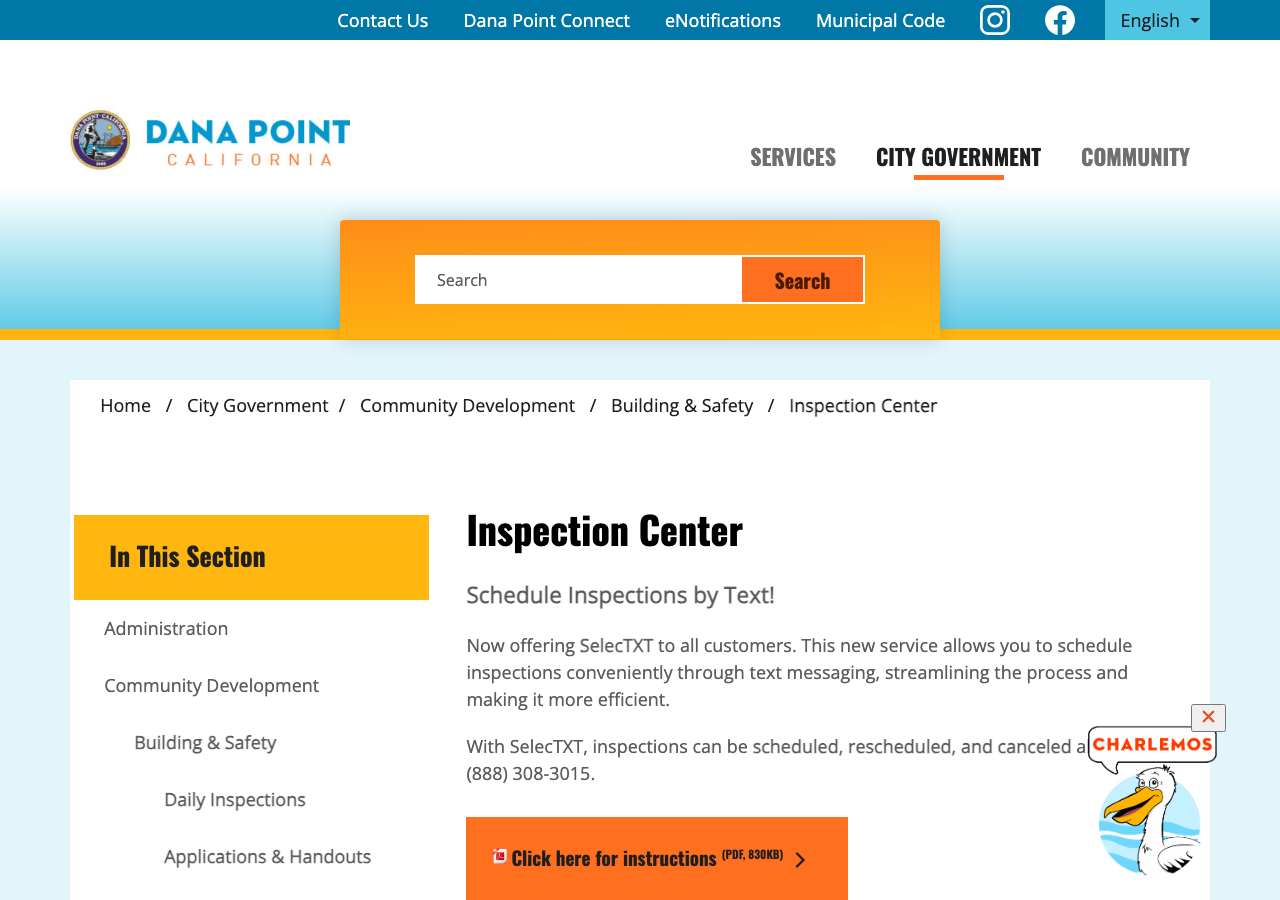
Phone/SMS text — SelecTXT text-message scheduling at (888) 308-3015, or a phone call to Building & Safety at (949) 248-3564 / the Inspection Request Line at (949) 248-3590
Why the confidence is not higherInspection Center page ('Now offering SelecTXT... inspections can be scheduled, rescheduled, and canceled all by text') and the Solar Permit page's 'Schedule an Inspection... call the INSPECTION REQUEST LINE.'
authority's own page checked 2026-08-30 https://www.danapoint.org/City-Government/Community-Development/Building-Safety/Inspection-Center
Q50 How much notice is required? Core Booking & scheduling
1 business day — requests must be made (by call or SelecTXT) no later than 4:00 PM the business day before the desired inspection date
Why the confidence is not higherSolar Permit page: 'Inspections must be scheduled no later than 4:00 P.M., the prior business day in order to be scheduled for the next business day'; Inspection Center page confirms 'Cancellations after 4:00 PM for the next day... are not allowed through SelecTXT.'
authority's own page checked 2026-08-30 https://www.danapoint.org/Services/Permit-Center/Solar-Permit
Q51 Are same-day or AM/PM windows offered? Booking & scheduling
No same-day scheduling; AM/PM preference can be left as an optional comment but is 'not guaranteed' — 2-hour inspection time windows are posted online (Daily Inspections PDF) the evening before
Why the confidence is not higherInspection Center page: 'Optional comments (e.g., gate code or AM/PM preference) may be included, but requested timeframes are not guaranteed'; the page gives two slightly different posting times (6:00 PM vs. 7:00 PM the night before) in different paragraphs — not reconciled.
authority's own page checked 2026-08-30 https://www.danapoint.org/City-Government/Community-Development/Building-Safety/Inspection-Center
Q52 Does this AHJ perform its own final solar inspection? Core Who inspects
Yes
Why the confidence is not higherSolar Permit page and Inspection Center page both describe the City of Dana Point Building and Safety Division's own inspectors (three named inspectors with @danapoint.org emails) performing field inspections.
authority's own page checked 2026-08-30 https://www.danapoint.org/City-Government/Community-Development/Building-Safety/Inspection-Center
Q53 If delegated, to whom? Core Who inspects
Not generally delegated for the building/electrical final; fire/life-safety aspects of ESS installations are delegated in part to OCFA, which bills a separate inspection line (PR375i) for battery systems
Why the confidence is not higherOCFA PD-Fee-Schedule-2026.pdf inspection-only line items; Inspection Center page names only in-house City inspectors for the general final.
fee schedule checked 2026-08-30 https://storageocfaprod001.blob.core.windows.net/blobocfaprod01/2025/06/PD-Fee-Schedule-2026.pdf
Q54 Which inspections are required, and in what order? Core Stages & sequence
Nothing published by this authority.
Where we lookedSolar Permit page, Inspection Center page, and Applications & Handouts list — none publishes a PV-specific inspection sequence/stage list (e.g., rough vs. final)
https://www.danapoint.org/City-Government/Community-Development/Building-Safety/Inspection-Center
Q55 Is a rough-in or mid-roof inspection required? Stages & sequence
Nothing published by this authority.
Where we lookedSame sources as Q54 — no statement on whether a rough-in or mid-roof inspection is required specifically for PV
https://www.danapoint.org/City-Government/Community-Development/Building-Safety/Inspection-Center
Q56 Does the inspector verify labels and listings? Core What is checked
Nothing published by this authority.
Where we lookedSolar Permit page, Inspection Center page, B027-Elect Svc field-inspection checklist — general electrical inspection items are listed (panel labeling, breaker labeling, etc.) but none explicitly states the inspector verifies PV equipment labels/listings
Q57 Is there a published inspection checklist? Core What is checked
No dedicated published PV inspection checklist found
Why the confidence is not higherChecked the full Applications & Handouts list (65 PDFs — general items like B016-Final and B006-Demo exist, no solar-specific inspection checklist) and the Inspection Center page, which links only a general 'Structural Observation & Deputy Inspection Forms' PDF and Daily Inspections time-window PDF, neither PV-specific.
published handout list checked 2026-08-30 https://www.danapoint.org/Services/Permit-Center/Applications-Handouts
Q58 What must be on site at inspection? Core Documents on site
A printed copy of all Symbium/eTRAKiT-approved plans and documents must be on site for field inspections, along with the posted inspection/permit card
Why the confidence is not higherSolar Permit page: 'A printed copy of all approved documents shall be on site for field inspections'; B027-Elect Svc's general field checklist additionally requires 'Electrical permit required and Inspection card posted on site.'
authority's own page checked 2026-08-30 https://www.danapoint.org/Services/Permit-Center/Solar-Permit
Q59 Is there a re-inspection fee? Corrections & re-inspection
$197 per discipline
Why the confidence is not higherBuilding Fees schedule, line 79 'Re-inspection Fee per Discipline — $197' (eff. 10/1/2020 per the PDF's own date stamp).
fee schedule checked 2026-08-30 https://www.danapoint.org/files/assets/city/v/1/community-development/documents/building-amp-safety/handouts/2025/building-fees.pdf
Q60 How are corrections issued and cleared? Corrections & re-inspection
Plan-check corrections are issued via a published 'Plan Review Correction Lists' resource (linked from the Plan Review Services page); field corrections found at inspection are cleared through the standard re-inspection process (see Q59 fee)
Why the confidence is not higherPlan Review Services page names 'Plan Review Correction Lists' among its Additional Information links, but the underlying document/process detail was not independently opened.
authority's own page checked 2026-08-30 https://www.danapoint.org/Services/Permit-Center/Plan-Review-Services
Q61 What is issued on pass? Core Final sign-off & PTO
Nothing published by this authority.
Where we lookedSolar Permit page and Inspection Center page — neither names the specific document/term (e.g. 'Final', 'Green tag', 'CO') issued upon a passed final solar inspection
https://www.danapoint.org/City-Government/Community-Development/Building-Safety/Inspection-Center
Q62 Who notifies the utility for PTO? Core Final sign-off & PTO
Nothing published by this authority.
Where we lookedDana Point's own Solar Permit/Inspection pages are silent on PTO notification; SDG&E's own residential NEM/interconnection application page (sdge.com/.../apply-nem) returned 'You are not authorized to access this page' when checked live, and the general interconnections URL 404'd
Lines marked with a percentage were read off this authority’s own published documents. Unmarked guidance is general good practice, not this jurisdiction’s rule — always confirm against the authority before you submit.
Jurisdiction & key facts
The standing 62-question set, answered for City of Dana Point against this authority’s own published documents. Every answer carries the confidence it was recorded at and the document it came from. Where nothing is published we say so and show where we looked — a blank here is a finding, not a gap.
City of Dana Point is the authority having jurisdiction 88% confidence
- Holds
- Building and Electrical (City of Dana Point Building & Safety Division, via eTRAKiT/Symbium); Fire/life-safety review delegated in part to the Orange County Fire Authority (OCFA) for ESS/battery systems and non-standard-compliant PV
- Delegated to
- Orange County Fire Authority (OCFA) — confirmed on OCFA's own member-cities page and via OCFA's current fee schedule's PV 'Alternative Compliance' and Battery/ESS line items; DPMC §8.24.010(c) names 'the Building Official and the Orange County Fire Authority' jointly as the fire code officials for Dana Point
- Overridden by
- Coastal Act / City's certified Local Coastal Program (DPMC Ch. 9.69) can require a discretionary Coastal Development Permit ahead of or alongside the building permit on bluff-top or beach-zone parcels, regardless of the PV permit's own expedited process; California Gov. Code §65850.5(g)(1) (cited directly in DPMC §8.22.019) sets the statewide floor for the expedited residential PV review process the City must follow.
- Why not higher
- City's own Solar Permit page, DPMC Title 8 Ch. 8.22/8.24, and OCFA's own member-cities page and fee schedule together establish that Dana Point Building & Safety is the primary AHJ for residential PV, OCFA holds a real but narrow delegated fire role, and the Coastal Overlay District is a genuine second layer of jurisdiction on a subset of parcels (bluff-top/beach-zone).
https://www.danapoint.org/Services/Permit-Center/Solar-Permit
Check the code edition before you build
This authority's published code edition does not match what the state has adopted. That usually means the authority's ordinance has not been updated for the current cycle — but a local amendment can also be lawful. Confirm with the building department before you submit.
- Permit required
- Yes96%
- Permit cost
- $400 flat for 0-5 kW; $500 flat for systems over 5 kW; plus $33 for an unlisted PV component (e.g. battery)88%
- Plan review
- Instantaneous (same-session) approval for qualifying Symbium submittals (licensed A/B/C-10/C-46 contractor, ≤38.4kW AC);65%
- Portal
- eTRAKiT (with Symbium as an add-on instant-permitting front end for qualifying residential solar/ESS applications)96%
- Electrical code
- 2025 CEC (California Electrical Code), based on the 2023 NEC as adopted statewide90%
- Own placard wording
- No65%
- Booking an inspection
- Phone/SMS text — SelecTXT text-message scheduling at (888) 308-3015, or a phone call to Building & Safety at (949) 248-3564 / the Inspection Request Line at (949) 248-359090%
Labels & placards for this authority
Wording 65%
No
Size, colour & material 65%
Not specified by the City or OCFA
Where they go None%
What the utility wants on top None%
Each figure above is sourced and dated in the full answer set below (questions 38–43). Where an authority’s own published sheet is older than the code it has adopted, the answer says so.
Their website
Average approval time — application to PTO
From the CPUC interconnection record. Bars show the average days taken each year; a year with no recorded projects is left blank rather than drawn as zero.