
City of Hayward
Alameda County
City of Hayward is a city authority in the State of California, serving 162,954 residents. 7,943 residential solar installs are on record here. This page is the permit route for that jurisdiction: the fifteen steps from working out who has a say over an address through to permission to operate, the documents this authority publishes, the 2025 California Electrical Code code cycle it enforces, and 62 answers taken from those documents and dated.
Permitting 5 steps · 28 questions
Whether a permit is needed — Yes Q3 Electrical and building permits — Combined Q4 Plan review — Effectively same-week: reviewed over the counter each Tuesday 9:00-11:30am under the 'Solar Tuesday' program; Q18 Where you file — EnerGov Self Service (Tyler Technologies) Q20
- Permit required
- Yes98% source
- What it costs
- $300 flat for residential flush-mounted systems (includes plan review and inspection); non-flush-mounted residential systems are also billed at the $300 flat PV rate but incur additional hourly…93% source
- Plan review turnaround
- Effectively same-week: reviewed over the counter each Tuesday 9:00-11:30am under the 'Solar Tuesday' program; if not submitted on a Tuesday, it is taken in and reviewed the following Tuesday88% source
- Key document
- inference from state law + department checklist silence cited by 15 open the document
-
Confirm who has a say over your address
A city address is usually permitted by the city, not the county — but not always, and some authorities keep building and hand electrical to someone else. Getting this wrong costs the whole submittal, because every requirement below belongs to whoever actually holds jurisdiction. Check the overlays in the same pass: an HOA, a historic district, a windstorm certification or a system-size cap can reshape the design, and all of them are cheaper to find now than after the array is laid out.
- Is this authority the AHJ for residential solar at this address? Yes 92% · department checklist
- What does this authority permit itself, and what does it delegate? Both 82% · fee/tax reference document
- Is a permit required for a residential rooftop PV system? Yes 98% · department checklist
- Is there a separate electrical permit, or is it combined? Combined 78% · fee schedule
- Is a HOA or architectural approval required first? No — not required by the City; the checklist's submittal list does not include HOA/architectural approval, and California's Solar Rights Act (Civil Code §714) restricts an HOA's ability to prohibit or unreasonably restrict residential solar 60% · department checklist (absence) + state law
- Is a wind or windstorm certification required? Yes, in substance — an engineer-stamped structural calculation verifying wind-load resistance is required whenever panels are mounted at an angle steeper than the roof (i.e., not flush) 88% · department checklist
- Is there a system-size cap on residential generation? No hard legal cap found; the 10 kW AC threshold in the checklist gates only which review track applies (over-the-counter 'Solar Tuesday' vs. standard review), not whether a system is allowed 80% · department checklist
-
Check who is allowed to apply
Several authorities require the electrical permit to be pulled by a licensed electrician, or require the contractor to be registered with them BEFORE applying. Registration is not same-day. This is second on the list rather than fourth because it is the step most likely to stop the job before the drawings matter.
- Who is allowed to pull the electrical permit? Either (licensed C-10/C-46 contractor, or homeowner as owner-builder) 50% · inference from state law + department checklist silence
- Is a homeowner permitted to self-install and self-permit? Yes (via owner-builder), not confirmed as Hayward-specific 50% · inference from state law + department checklist silence
-
Build the submittal package
Almost everywhere wants a site plan, a one-line or three-line electrical diagram, equipment cut sheets with listings, and a structural attachment detail. Build it against the published checklist rather than the last jurisdiction you worked in — the checklist is what the reviewer marks against.
- What documents make up a complete submittal? Roof plan (component locations, clearances, north arrow, designer contact, address, scope, applicable codes), attachment/structural details, single-line diagram, required-warning-label diagrams, and equipment cut sheets for every component shown 95% · department checklist
- How many copies, and in what format? 3 sets of plans, stapled together as a single set; cut sheets may be separate 92% · department checklist
- Is a site plan required, and what must it show? Yes — a roof plan showing required Fire Department access clearances, and the location of all system components (disconnects, service panel, inverter) 95% · department checklist
- Is a one-line / three-line diagram required? Yes — single-line diagram required, referencing CEC Articles 690 and 705 96% · department checklist
- Is a structural PE stamp required, and at what threshold? Yes, threshold = any panel tilted steeper than the roof pitch or non-flush mounting; flush-mounted panels are exempt 93% · department checklist
-
Apply and pay
Most authorities now take the whole application through a portal, and several states cap or constrain what a residential solar permit may cost. Check whether plan check is billed separately before you quote the job.
- Which permit portal does this authority use? EnerGov Self Service (Tyler Technologies) 92% · portal redirect, confirmed live
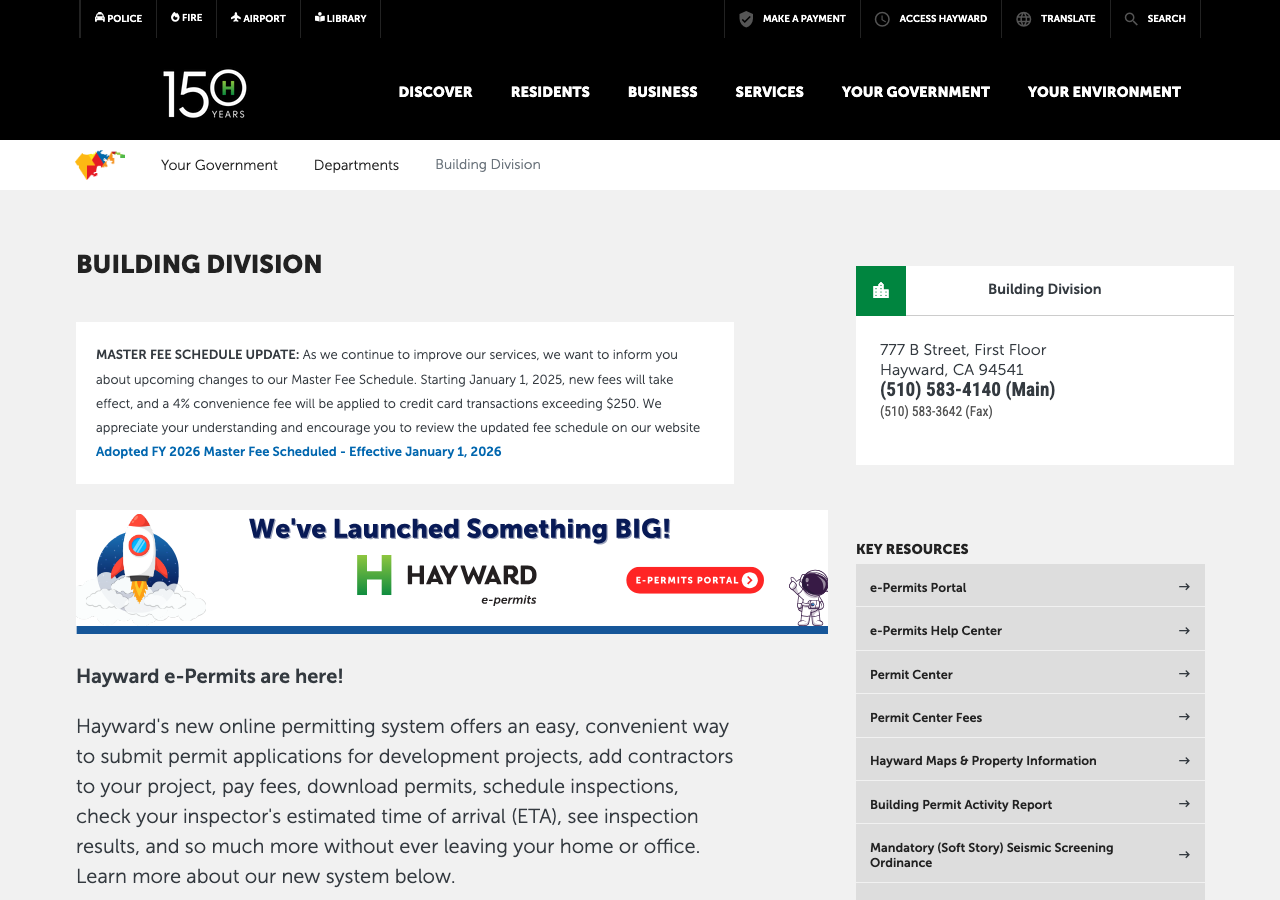
- Can the whole application be completed online? Yes — application submission, adding contractors, fee payment, permit download, inspection scheduling, inspector ETA tracking, and viewing inspection results are all described as available without an in-person visit 80% · department page
- What does a residential solar permit cost? $300 flat for residential flush-mounted systems (includes plan review and inspection); non-flush-mounted residential systems are also billed at the $300 flat PV rate but incur additional hourly plan-check charges for the required structural calculations 93% · adopted fee schedule
- How is the fee calculated? Flat 90% · adopted fee schedule
- Is there a separate plan-check fee? No separate plan-check line item for flush-mounted systems (bundled into the $300 flat fee); non-flush-mounted systems incur additional hourly plan-check charges rather than a second flat fee 85% · department checklist
-
Plan review — and start the utility in parallel
Interconnection is a separate process from the permit and usually the longer pole. Where the utility does not depend on the permit being issued, running both at once is the single biggest saving available on a residential job.
- What is the stated plan-review turnaround? Effectively same-week: reviewed over the counter each Tuesday 9:00-11:30am under the 'Solar Tuesday' program; if not submitted on a Tuesday, it is taken in and reviewed the following Tuesday 88% · department checklist
- How long is an issued permit valid before it expires? Not confirmed as a Hayward-specific figure; the statewide default under the adopted California Building Code (CBC §105.5) is that a permit expires if work does not commence within 180 days of issuance or is suspended for 180 days 50% · state code default; local amendment unverified
- Which utility handles interconnection here? Pacific Gas & Electric (PG&E) 65% · CCA utility's own statement + cross-jurisdiction consistency
- Where does the utility sit in the sequence? Parallel / No dependency at the permit-issuance stage — PG&E's interconnection application and PTO process run independently of the City's building-permit process; PTO is generally only granted after proof of the City's final inspection is provided 50% · inference from utility document + comparable jurisdiction
28 questions answered against City of Hayward’s own published documents
Q1 Is this authority the AHJ for residential solar at this address? Core Jurisdiction & scope
Yes
Why the confidence is not higherDevelopment Services Department Building Division issues residential PV permits directly per its own Residential Solar Requirements checklist; the same checklist tells applicants to use the City's GIS portal to 'Verify the address is within the City of Hayward and not within unincorporated Alameda County' before applying, confirming the City (not the County) is the AHJ for in-city addresses.
department checklist checked 2026-08-30 https://www.hayward-ca.gov/sites/default/files/documents/005-Residential-Solar-Checklist.pdf
Q2 What does this authority permit itself, and what does it delegate? Core Jurisdiction & scope
Both
Why the confidence is not higherSingle Building Division permit covers both trades: the Permit Fee and Tax Reference PDF states 'All sub-permits (plumbing, mechanical and electrical) are included in the fees for new construction and alterations,' and the FY2025 Master Fee Schedule lists Photovoltaic Systems as one line item (no separate electrical PV line).
fee/tax reference document checked 2026-08-30 https://www.hayward-ca.gov/sites/default/files/documents/000-Permit-Fee-and-Tax-Reference.pdf
Q3 Is a permit required for a residential rooftop PV system? Core Jurisdiction & scope
Yes
Why the confidence is not higherChecklist states plainly: 'Permits are required for all solar panel installations.'
department checklist checked 2026-08-30 https://www.hayward-ca.gov/sites/default/files/documents/005-Residential-Solar-Checklist.pdf
Q4 Is there a separate electrical permit, or is it combined? Core Jurisdiction & scope
Combined
Why the confidence is not higherElectrical work is billed and processed as an included sub-permit of the single Building/PV permit per the Fee/Tax Reference doc and the FY2025 fee schedule's single 'Photovoltaic Systems' line item; no separate electrical permit line for residential PV appears anywhere I read.
fee schedule checked 2026-08-30 https://www.hayward-ca.gov/sites/default/files/documents/fs-adopted-fy2025-master-fee-schedule.pdf
Q5 Who is allowed to pull the electrical permit? Core Who may apply
Either (licensed C-10/C-46 contractor, or homeowner as owner-builder)
Why the confidence is not higherNeither the checklist nor the fee docs restrict who may apply; this is inferred from California's general Contractors State License Law owner-builder allowance rather than a Hayward-specific statement, so capped below 60.
inference from state law + department checklist silence checked 2026-08-30 https://www.hayward-ca.gov/sites/default/files/documents/005-Residential-Solar-Checklist.pdf
Q6 Must the contractor be registered with this authority before applying? Core Who may apply
Nothing published by this authority.
Where we lookedPermit Center page (hayward-ca.gov/services/permit-center), e-Permits redirect target, Permit Fee and Tax Reference PDF — none state a contractor-registration or business-license precondition to applying for a permit
Q7 Is a homeowner permitted to self-install and self-permit? Who may apply
Yes (via owner-builder), not confirmed as Hayward-specific
Why the confidence is not higherCalifornia's owner-builder statute generally permits homeowner self-permitting statewide; Hayward's own checklist does not address this directly one way or the other, so this is a state-law inference capped below 60.
inference from state law + department checklist silence checked 2026-08-30 https://www.hayward-ca.gov/sites/default/files/documents/005-Residential-Solar-Checklist.pdf
Q8 What documents make up a complete submittal? Core Submittal package
Roof plan (component locations, clearances, north arrow, designer contact, address, scope, applicable codes), attachment/structural details, single-line diagram, required-warning-label diagrams, and equipment cut sheets for every component shown
Why the confidence is not higherDirectly enumerated, section by section, in the City's own checklist PDF.
department checklist checked 2026-08-30 https://www.hayward-ca.gov/sites/default/files/documents/005-Residential-Solar-Checklist.pdf
Q9 How many copies, and in what format? Submittal package
3 sets of plans, stapled together as a single set; cut sheets may be separate
Why the confidence is not higherChecklist: 'The submittal will require 3 sets of plans... Provide the following drawings stapled together in a single set of plans.'
department checklist checked 2026-08-30 https://www.hayward-ca.gov/sites/default/files/documents/005-Residential-Solar-Checklist.pdf
Q10 Is a site plan required, and what must it show? Core Submittal package
Yes — a roof plan showing required Fire Department access clearances, and the location of all system components (disconnects, service panel, inverter)
Why the confidence is not higherSection 1 (Roof Plan) of the checklist, with an accompanying labeled diagram.
department checklist checked 2026-08-30 https://www.hayward-ca.gov/sites/default/files/documents/005-Residential-Solar-Checklist.pdf
Q11 Is a one-line / three-line diagram required? Core Drawings & calculations
Yes — single-line diagram required, referencing CEC Articles 690 and 705
Why the confidence is not higherChecklist Section 3: 'It is the contractor's responsibility to fully comply with the requirements of Articles 690 & 705 in the California Electrical Code. Confirm that all relevant code items are communicated in the single line drawing.'
department checklist checked 2026-08-30 https://www.hayward-ca.gov/sites/default/files/documents/005-Residential-Solar-Checklist.pdf
Q12 Are string and conductor calculations required? Drawings & calculations
Nothing published by this authority.
Where we lookedResidential Solar Checklist PDF, read in full (all 5 pages via pdftotext -layout) — covers structural calcs for non-flush mounting but does not mention string sizing or conductor ampacity calculations as a submittal item
https://www.hayward-ca.gov/sites/default/files/documents/005-Residential-Solar-Checklist.pdf
Q13 Is a structural PE stamp required, and at what threshold? Core Engineering & stamps
Yes, threshold = any panel tilted steeper than the roof pitch or non-flush mounting; flush-mounted panels are exempt
Why the confidence is not higherChecklist: flush-mounted panels 'do not require structural calculations,' but panels 'tilted at a steeper angle than the roof will require structural calculations to verify wind load resistance... prepared by an engineer... stamped and signed.'
department checklist checked 2026-08-30 https://www.hayward-ca.gov/sites/default/files/documents/005-Residential-Solar-Checklist.pdf
Q14 Is an electrical PE stamp required, and at what threshold? Engineering & stamps
Nothing published by this authority.
Where we lookedResidential Solar Checklist PDF and Permit Fee and Tax Reference PDF, both read in full — neither mentions an electrical PE stamp requirement or threshold
https://www.hayward-ca.gov/sites/default/files/documents/005-Residential-Solar-Checklist.pdf
Q15 What does a residential solar permit cost? Core Fees
$300 flat for residential flush-mounted systems (includes plan review and inspection); non-flush-mounted residential systems are also billed at the $300 flat PV rate but incur additional hourly plan-check charges for the required structural calculations
Why the confidence is not higherChecklist: 'There is a total flat fee of $300 for flush mounted systems... For installations that require structural calculations... additional structural review fees will apply.' Matches FY2025 Master Fee Schedule (adopted 6/25/2024) item 12a: 'Residential (for systems that are not flush mounted, hourly plan check fees apply) — $300 flat rate, no admin fees.'
adopted fee schedule checked 2026-08-30 https://www.hayward-ca.gov/sites/default/files/documents/fs-adopted-fy2025-master-fee-schedule.pdf
Q16 How is the fee calculated? Core Fees
Flat
Why the confidence is not higherBoth the checklist and the FY2025 fee schedule show a single flat $300 charge for residential PV, not a valuation- or per-kW-based formula (per-kW pricing only appears for commercial PV over 50kW).
adopted fee schedule checked 2026-08-30 https://www.hayward-ca.gov/sites/default/files/documents/fs-adopted-fy2025-master-fee-schedule.pdf
Q17 Is there a separate plan-check fee? Fees
No separate plan-check line item for flush-mounted systems (bundled into the $300 flat fee); non-flush-mounted systems incur additional hourly plan-check charges rather than a second flat fee
Why the confidence is not higherChecklist and FY2025 fee schedule both describe one flat PV fee 'including plan review and inspection,' with only an hourly add-on for structural review, not a distinct plan-check fee schedule line.
department checklist checked 2026-08-30 https://www.hayward-ca.gov/sites/default/files/documents/005-Residential-Solar-Checklist.pdf
Q18 What is the stated plan-review turnaround? Core Timeline & validity
Effectively same-week: reviewed over the counter each Tuesday 9:00-11:30am under the 'Solar Tuesday' program; if not submitted on a Tuesday, it is taken in and reviewed the following Tuesday
Why the confidence is not higherChecklist: 'Flush mounted solar panel installations... for single-family homes are reviewed over the counter when submitted on Tuesdays... If not submitted on Tuesday, the application will be taken in and reviewed by the following Tuesday.' Non-flush/structural-review submittals may take longer but no separate turnaround is stated.
department checklist checked 2026-08-30 https://www.hayward-ca.gov/sites/default/files/documents/005-Residential-Solar-Checklist.pdf
Q19 How long is an issued permit valid before it expires? Timeline & validity
Not confirmed as a Hayward-specific figure; the statewide default under the adopted California Building Code (CBC §105.5) is that a permit expires if work does not commence within 180 days of issuance or is suspended for 180 days
Why the confidence is not higherNo Hayward document I could read (checklist, fee/tax reference, Development Services pages) states a local permit-validity period, and Hayward's Municipal Code — where a local amendment would appear — is a JS-only shell on Municode that returned no content via direct fetch, curl, the api.municode.com/CodesContent route, or Wayback (no snapshot found). This is the unamended state default, not a verified Hayward figure.
state code default; local amendment unverified checked 2026-08-30 https://www.hayward-ca.gov/sites/default/files/documents/005-Residential-Solar-Checklist.pdf
Q20 Which permit portal does this authority use? Core Portal & process
EnerGov Self Service (Tyler Technologies)
Why the confidence is not higherhayward-ca.gov/epermits (301) redirects to haywardca-energovpub.tylerhost.net/Apps/SelfService#/home, Tyler Technologies' EnerGov citizen portal.
portal redirect, confirmed live checked 2026-08-30 https://www.hayward-ca.gov/epermits
Q21 Can the whole application be completed online? Core Portal & process
Yes — application submission, adding contractors, fee payment, permit download, inspection scheduling, inspector ETA tracking, and viewing inspection results are all described as available without an in-person visit
Why the confidence is not higherPermit Center page: the e-Permits system offers 'an easy, convenient way to submit permit applications for development projects, add contractors to your project, pay fees, download permits, schedule inspections, check your inspector's estimated time of arrival (ETA), see inspection results... without ever leaving your home or office.' Could not independently confirm inside the EnerGov portal itself, which is a JS shell to automated fetch.
department page checked 2026-08-30 https://www.hayward-ca.gov/services/permit-center
Q22 Which utility handles interconnection here? Core Utility interconnection
Pacific Gas & Electric (PG&E)
Why the confidence is not higherNo Hayward-side document I read names the utility directly. Inferred from: (1) Alameda County's own AHJ record (job cards, ordinance) names PG&E as the interconnecting utility for the county generally, and Hayward is not a municipal-utility city (unlike the City of Alameda's Alameda Municipal Power); (2) Ava Community Energy's own page states 'We supply electricity to all accounts... and PG&E delivers it,' confirming PG&E remains the wires utility in Ava's East Bay service area, of which Hayward is a member jurisdiction. This is a city/utility-side cross-reference, not a ZIP-code lookup, but it is not a direct Hayward-published statement, hence capped at 65.
CCA utility's own statement + cross-jurisdiction consistency checked 2026-08-30 https://avaenergy.org/about/
Q23 Where does the utility sit in the sequence? Core Utility interconnection
Parallel / No dependency at the permit-issuance stage — PG&E's interconnection application and PTO process run independently of the City's building-permit process; PTO is generally only granted after proof of the City's final inspection is provided
Why the confidence is not higherNot stated in any Hayward document I read; inferred from the same pattern established at Alameda County (same utility, same state AB 2188 SolarAPP+ framework) and from PG&E's Greenbook describing post-installation, not pre-permit, requirements. Capped below 60 as an inference rather than a Hayward- or PG&E-published sequence statement.
inference from utility document + comparable jurisdiction checked 2026-08-30 https://www.pge.com/content/dam/pge/docs/account/service-requests/060559-r-07-disconnect-switch-requirements-for-distributed-generation-customers.pdf
Q24 Is a HOA or architectural approval required first? Overlays & special cases
No — not required by the City; the checklist's submittal list does not include HOA/architectural approval, and California's Solar Rights Act (Civil Code §714) restricts an HOA's ability to prohibit or unreasonably restrict residential solar
Why the confidence is not higherAbsence from the City's own submittal checklist plus the statewide Solar Rights Act floor; not a direct statement that HOA approval is never required.
department checklist (absence) + state law checked 2026-08-30 https://www.hayward-ca.gov/sites/default/files/documents/005-Residential-Solar-Checklist.pdf
Q25 Is there a historic-district review? Overlays & special cases
Nothing published by this authority.
Where we lookedResidential Solar Checklist PDF; Planning Division page (hayward-ca.gov/your-government/departments/development-services/planning-division) returned 404; Municode (where a historic-preservation ordinance would sit) is a JS-only shell — direct fetch, curl with iccsafe.org Referer analog headers, api.municode.com/CodesContent guess, and Wayback (no snapshot) all failed to return content
https://library.municode.com/ca/hayward/codes/municipal_code
Q26 Is a wind or windstorm certification required? Overlays & special cases
Yes, in substance — an engineer-stamped structural calculation verifying wind-load resistance is required whenever panels are mounted at an angle steeper than the roof (i.e., not flush)
Why the confidence is not higherChecklist: non-flush panels 'will require structural calculations to verify wind load resistance. The calculations must be prepared by an engineer and included with the submittal.' Not framed as a separate 'wind certification' document (no TDI-style regime in CA) but functionally equivalent.
department checklist checked 2026-08-30 https://www.hayward-ca.gov/sites/default/files/documents/005-Residential-Solar-Checklist.pdf
Q27 Is a Specific Use Permit or Council approval ever required? Overlays & special cases
Nothing published by this authority.
Where we lookedResidential Solar Checklist PDF, FY2025 Master Fee Schedule (searched for 'solar'/'photovoltaic' matches) — no mention of a Specific Use Permit or Council-approval trigger for residential PV; the zoning chapter that would define this sits behind Municode's inaccessible JS shell
https://www.hayward-ca.gov/sites/default/files/documents/fs-adopted-fy2025-master-fee-schedule.pdf
Q28 Is there a system-size cap on residential generation? Overlays & special cases
No hard legal cap found; the 10 kW AC threshold in the checklist gates only which review track applies (over-the-counter 'Solar Tuesday' vs. standard review), not whether a system is allowed
Why the confidence is not higherChecklist: '...for single-family homes are reviewed over the counter when submitted on Tuesdays... Flush mounted solar panel installations (less than 10 kilowatts)' — phrased as a program-eligibility threshold, with no statement barring larger systems.
department checklist checked 2026-08-30 https://www.hayward-ca.gov/sites/default/files/documents/005-Residential-Solar-Checklist.pdf
Lines marked with a percentage were read off this authority’s own published documents. Unmarked guidance is general good practice, not this jurisdiction’s rule — always confirm against the authority before you submit.
Install 5 steps · 20 questions
-
Build to the code editions actually in force here
The NEC edition a jurisdiction enforces is often a cycle behind the newest one published, and local amendments sit on top of it. Rapid shutdown, conductor sizing and labelling all change between editions, so the edition in force is the first thing to establish, not the last.
- Which NEC edition is in force? 2023 NEC, as adopted into the 2025 California Electrical Code (Title 24, Part 3), statewide effective 1 Jan 2026 52% · state adopting-agency page; NEC year inferred, local amendment unverified
- Which building code edition is in force? 2025 California Building Code (Title 24, Part 2), statewide effective 1 Jan 2026; Hayward's local amendment ordinance for the current cycle not verified 58% · state adopting-agency page; local amendment unverified
- Which fire code edition is in force? 2025 California Fire Code (Title 24, Part 9), statewide effective 1 Jan 2026; Hayward is confirmed to have its own fire ordinance in force (referenced by name in the City's own solar checklist) but its current-cycle amendment text was not retrievable 55% · department checklist (confirms a local fire ordinance exists) + state adoption cycle
- Are there local amendments to any of the above? Yes — Hayward has an established practice of adopting local amendments to state model codes: 2019 Ordinance No. 20-05 amended the California Energy Code and CALGreen (EV-charging provisions), and the solar checklist itself invokes a 'Hayward Fire Ordinance' for rooftop DC-disconnect placement. Current-cycle (2025) amendment text could not be retrieved. 68% · docketed ordinance text (2019 cycle) + department checklist reference to a fire ordinance
- What is the installation judged against? California Electrical Code (CEC) Articles 690 and 705 96% · department checklist
-
Fire access, setbacks and pathways
Ridge setbacks and roof access pathways are fire-service requirements and they constrain the array layout. They are the most common cause of a redesign after the fire department comments on a plan set.
- What ridge setback and access pathways are required? 3 ft clear from ridges, 3 ft clear from side edges, and 18 in clear on either side of valleys 95% · department checklist
-
Rapid shutdown
Which rapid-shutdown rule applies follows directly from the NEC edition in force, and the initiation device has to be at a location the fire service can reach and identify. This is inspected, and it is labelled.
- Is rapid shutdown required, and to which NEC edition? Yes — if no other rapid-shutdown means is present, a rooftop DC disconnect must be provided at the roof within 3 ft of the PV array along the access pathway, 'per Hayward Fire Ordinance'; the main service panel must carry a 'PHOTOVOLTAIC SYSTEM EQUIPPED WITH RAPID SHUTDOWN' label. The document (revised 4-8-20) does not itself state which NEC/CEC edition's rapid-shutdown rule (690.12) it is keyed to, and predates the current 2023 NEC array-level rapid-shutdown requirements. 72% · department checklist
-
Labels and placards
The NEC sets a baseline for permanent markings at the service equipment and the disconnecting means. On top of that, an authority may specify its own wording, and the utility may specify more again. Where any of them writes its own text, a generic off-the-shelf label set will not pass — this is the detail most often fixed on a return visit.
- Which placards does this authority require at the service equipment? Solar-circuit label (conduit/raceways/enclosures/junction boxes), 'Solar Electric System' label at the main service disconnect, an inverter label, a directory plaque (if disconnects are not co-located), a rapid-shutdown label at the main service panel, and PG&E's own 'Utility AC Disconnect Switch' label at the AC disconnect 93% · department checklist + utility spec
- Does the authority specify placard wording of its own? Yes — the checklist reproduces exact required wording ('CAUTION: SOLAR CIRCUIT', 'CAUTION: SOLAR ELECTRIC SYSTEM', 'WARNING: ELECTRIC SHOCK HAZARD DO NOT TOUCH THE TERMINAL...', 'PHOTOVOLTAIC SYSTEM EQUIPPED WITH RAPID SHUTDOWN'), though this wording mirrors the standard CEC Article 690 model labels rather than being uniquely Hayward's own invented text 82% · department checklist
- Does it specify letter height, colour or material? Not specified by the City itself — the checklist shows label graphics with no callout for letter height, color, or material. PG&E's Greenbook (Doc 060559) requires its own AC-disconnect label to be 'engraved phenolic or comply with ANSI Z535.4,' with lettering 'a minimum 3/8" high and in all capitals' — a utility-level, not AHJ-level, specification. 80% · utility spec (PG&E Greenbook), City silent
- Is a site plan / facility map placard required, and what must it show? Yes — the City requires a directory plaque at the service and PV disconnecting means when they are NOT co-located (citing CEC Art. 690.56(B)); PG&E's Greenbook separately requires a location map when the AC disconnect switch is not grouped with the meter, and for a Net Generation Output Meter (NGOM) installation 85% · department checklist + utility spec
- Does the UTILITY specify placards beyond the AHJ's? Yes — PG&E's Greenbook (Doc 060559, Rev. #07, 3/25/2022) requires a permanently attached 'UTILITY AC DISCONNECT SWITCH' label, engraved phenolic or ANSI Z535.4-compliant, minimum 3/8-inch all-capital lettering, plus a location map/contact-info sign if the disconnect is not adjacent to the PG&E meter or not accessible outside a locked premises — none of which appears in the City's own checklist 95% · utility interconnection spec
- Where must the labels be placed? Per City checklist: solar-circuit label on conduits/raceways/junction boxes; 'solar electric system' label at the main service disconnect; inverter label at the inverter; directory plaque at the service/PV disconnect locations if not co-located; rapid-shutdown label at the main service panel. Per PG&E Greenbook: AC-disconnect-switch label on the switch's front face, within 10 ft/line-of-sight of the PG&E meter. 90% · department checklist + utility spec
-
Disconnect, storage and listed equipment
Where the AC disconnect must sit relative to the meter is usually the utility's rule, not the building department's. Battery storage frequently carries its own permit, its own inspection and its own fire conditions.
- Where must the AC disconnect be, relative to the meter? Within 10 ft and in line of sight of PG&E's electric meter; must be at the same grade level if installed outdoors; wall- or pad-mounted units installed 48-75 inches above grade to the top of the enclosure; never on a roof, above-grade floor, or in a non-approved electric meter room 95% · utility interconnection spec
- Must equipment be on a specific approved list? Yes, at least for mounting hardware ('Only use listed mounting hardware'); PG&E's Greenbook separately requires disconnect switches be UL/NRTL certified and, up to 1200A, drawn from the Eaton/Siemens Safety Switch Cross-Reference Guides 82% · department checklist + utility spec
- Is a specific mounting system or attachment spacing required? No City-specified mounting system or attachment spacing; the requirement is to use only listed mounting hardware, verify component compatibility, and install per the manufacturer's instructions (flashing/counter-flashing at roof penetrations per manufacturer spec) 85% · department checklist
20 questions answered against City of Hayward’s own published documents
Q29 Which NEC edition is in force? Core Code editions in force
2023 NEC, as adopted into the 2025 California Electrical Code (Title 24, Part 3), statewide effective 1 Jan 2026
Why the confidence is not higherThe CA Building Standards Commission's own page confirms the 2025 code cycle is current ('Effective Date: January 1, 2026,' publication 7/1/2025), but did not itself state the underlying NEC year when I read it — the 2023 NEC base-year follows the standard triennial CA adoption pattern rather than a directly quoted DGS statement. Hayward's own current-cycle amendment ordinance (if any) could not be retrieved because Hayward's Municipal Code is a JS-only shell on Municode, blocked to direct fetch, curl, the CodesContent API guess, and Wayback (no snapshot).
state adopting-agency page; NEC year inferred, local amendment unverified checked 2026-08-30 https://www.dgs.ca.gov/BSC/Codes
Q30 Which building code edition is in force? Core Code editions in force
2025 California Building Code (Title 24, Part 2), statewide effective 1 Jan 2026; Hayward's local amendment ordinance for the current cycle not verified
Why the confidence is not higherCA DGS Building Standards Commission page states the 2025 edition is current, effective 1/1/2026. Hayward's own amendment ordinance text (equivalent to the 2019 Ordinance 20-05 I did read for the prior cycle) could not be retrieved for the current cycle because Hayward's Municipal Code is JS-rendered on Municode and blocked every access route tried.
state adopting-agency page; local amendment unverified checked 2026-08-30 https://www.dgs.ca.gov/BSC/Codes
Q31 Which fire code edition is in force? Code editions in force
2025 California Fire Code (Title 24, Part 9), statewide effective 1 Jan 2026; Hayward is confirmed to have its own fire ordinance in force (referenced by name in the City's own solar checklist) but its current-cycle amendment text was not retrievable
Why the confidence is not higherSame statewide cycle fact as building/electrical codes; Hayward's checklist itself references 'per Hayward Fire Ordinance' for rooftop DC disconnect placement, proving a local fire ordinance exists, but I could not read its current text because Municode is blocked.
department checklist (confirms a local fire ordinance exists) + state adoption cycle checked 2026-08-30 https://www.hayward-ca.gov/sites/default/files/documents/005-Residential-Solar-Checklist.pdf
Q32 Are there local amendments to any of the above? Core Code editions in force
Yes — Hayward has an established practice of adopting local amendments to state model codes: 2019 Ordinance No. 20-05 amended the California Energy Code and CALGreen (EV-charging provisions), and the solar checklist itself invokes a 'Hayward Fire Ordinance' for rooftop DC-disconnect placement. Current-cycle (2025) amendment text could not be retrieved.
Why the confidence is not higherOrdinance 20-05 was read directly (pdftotext) from the California Energy Commission's own docket filing, not summarized. The current-cycle equivalent is blocked behind Municode's JS shell (direct fetch, curl, api.municode.com/CodesContent guess, and Wayback all failed to return content), so this proves the City's pattern of amending, not the current-cycle specifics.
docketed ordinance text (2019 cycle) + department checklist reference to a fire ordinance checked 2026-08-30 https://efiling.energy.ca.gov/GetDocument.aspx?tn=232984-4
Q33 What is the installation judged against? Core Electrical
California Electrical Code (CEC) Articles 690 and 705
Why the confidence is not higherChecklist: 'It is the contractor's responsibility to fully comply with the requirements of Articles 690 & 705 in the California Electrical Code.'
department checklist checked 2026-08-30 https://www.hayward-ca.gov/sites/default/files/documents/005-Residential-Solar-Checklist.pdf
Q34 Is there a local rule on service upgrades or busbar sizing? Electrical
Nothing published by this authority.
Where we lookedResidential Solar Checklist PDF, read in full — no mention of a local rule on service-upgrade or busbar-sizing beyond referencing CEC Articles 690/705 generally; a local amendment (if any) would sit in the inaccessible Municode chapter
https://www.hayward-ca.gov/sites/default/files/documents/005-Residential-Solar-Checklist.pdf
Q35 Is a specific mounting system or attachment spacing required? Structural & mounting
No City-specified mounting system or attachment spacing; the requirement is to use only listed mounting hardware, verify component compatibility, and install per the manufacturer's instructions (flashing/counter-flashing at roof penetrations per manufacturer spec)
Why the confidence is not higherChecklist Section 2 (Attachment Details and Structural Information): 'Only use listed mounting hardware... Install per manufactures installation instructions.' No City-set spacing figures given.
department checklist checked 2026-08-30 https://www.hayward-ca.gov/sites/default/files/documents/005-Residential-Solar-Checklist.pdf
Q36 What ridge setback and access pathways are required? Core Fire pathways & setbacks
3 ft clear from ridges, 3 ft clear from side edges, and 18 in clear on either side of valleys
Why the confidence is not higherDirectly labeled on the checklist's roof-plan diagram: 'MAINTAIN 3' CLEAR FROM RIDGES,' '3' CLEAR FROM SIDE EDGES,' 'PROVIDE 18" CLEAR ON EITHER SIDE OF VALLEYS.'
department checklist checked 2026-08-30 https://www.hayward-ca.gov/sites/default/files/documents/005-Residential-Solar-Checklist.pdf
Q37 Is rapid shutdown required, and to which NEC edition? Core Rapid shutdown
Yes — if no other rapid-shutdown means is present, a rooftop DC disconnect must be provided at the roof within 3 ft of the PV array along the access pathway, 'per Hayward Fire Ordinance'; the main service panel must carry a 'PHOTOVOLTAIC SYSTEM EQUIPPED WITH RAPID SHUTDOWN' label. The document (revised 4-8-20) does not itself state which NEC/CEC edition's rapid-shutdown rule (690.12) it is keyed to, and predates the current 2023 NEC array-level rapid-shutdown requirements.
Why the confidence is not higherRequirement itself is explicit and quoted directly from the checklist diagram and label section; the NEC-edition linkage is my inference from the document's 2020 revision date, not a statement in the document.
department checklist checked 2026-08-30 https://www.hayward-ca.gov/sites/default/files/documents/005-Residential-Solar-Checklist.pdf
Q38 Which placards does this authority require at the service equipment? Core Labels Signage & labelling
Solar-circuit label (conduit/raceways/enclosures/junction boxes), 'Solar Electric System' label at the main service disconnect, an inverter label, a directory plaque (if disconnects are not co-located), a rapid-shutdown label at the main service panel, and PG&E's own 'Utility AC Disconnect Switch' label at the AC disconnect
Why the confidence is not higherCity labels enumerated with example wording and required-location diagrams in the checklist's page 4; PG&E's AC-disconnect label requirement is separately specified in PG&E's Greenbook Doc 060559.
department checklist + utility spec checked 2026-08-30 https://www.hayward-ca.gov/sites/default/files/documents/005-Residential-Solar-Checklist.pdf
Q39 Does the authority specify placard wording of its own? Core Labels Signage & labelling
Yes — the checklist reproduces exact required wording ('CAUTION: SOLAR CIRCUIT', 'CAUTION: SOLAR ELECTRIC SYSTEM', 'WARNING: ELECTRIC SHOCK HAZARD DO NOT TOUCH THE TERMINAL...', 'PHOTOVOLTAIC SYSTEM EQUIPPED WITH RAPID SHUTDOWN'), though this wording mirrors the standard CEC Article 690 model labels rather than being uniquely Hayward's own invented text
Why the confidence is not higherText is quoted directly from the checklist's label diagrams (page 4); confidence not higher because these appear to be the standard NEC/CEC 690 labels reproduced for applicant convenience, not a locally-authored wording requirement distinct from the code.
department checklist checked 2026-08-30 https://www.hayward-ca.gov/sites/default/files/documents/005-Residential-Solar-Checklist.pdf
Q40 Does it specify letter height, colour or material? Core Labels Signage & labelling
Not specified by the City itself — the checklist shows label graphics with no callout for letter height, color, or material. PG&E's Greenbook (Doc 060559) requires its own AC-disconnect label to be 'engraved phenolic or comply with ANSI Z535.4,' with lettering 'a minimum 3/8" high and in all capitals' — a utility-level, not AHJ-level, specification.
Why the confidence is not higherChecklist read page-by-page with no size/color/material text found for City-required labels; PG&E requirement is directly quoted from the Greenbook.
utility spec (PG&E Greenbook), City silent checked 2026-08-30 https://www.pge.com/content/dam/pge/docs/account/service-requests/060559-r-07-disconnect-switch-requirements-for-distributed-generation-customers.pdf
Q41 Is a site plan / facility map placard required, and what must it show? Core Labels Signage & labelling
Yes — the City requires a directory plaque at the service and PV disconnecting means when they are NOT co-located (citing CEC Art. 690.56(B)); PG&E's Greenbook separately requires a location map when the AC disconnect switch is not grouped with the meter, and for a Net Generation Output Meter (NGOM) installation
Why the confidence is not higherChecklist: 'When service disconnecting means and PV system disconnecting means are NOT located at the same location, install a directory plaque... Art. 690.56(B).' PG&E Greenbook: 'When the disconnect switch is not grouped with the meter panel provide a map showing the location.'
department checklist + utility spec checked 2026-08-30 https://www.hayward-ca.gov/sites/default/files/documents/005-Residential-Solar-Checklist.pdf
Q42 Does the UTILITY specify placards beyond the AHJ's? Core Labels Signage & labelling
Yes — PG&E's Greenbook (Doc 060559, Rev. #07, 3/25/2022) requires a permanently attached 'UTILITY AC DISCONNECT SWITCH' label, engraved phenolic or ANSI Z535.4-compliant, minimum 3/8-inch all-capital lettering, plus a location map/contact-info sign if the disconnect is not adjacent to the PG&E meter or not accessible outside a locked premises — none of which appears in the City's own checklist
Why the confidence is not higherQuoted directly from PG&E's Greenbook, extracted with pdftotext -layout from the actual PDF (verified not a soft-404/HTML shell); dated by its own revision stamp (Rev. #07, 3/25/2022), not the URL.
utility interconnection spec checked 2026-08-30 https://www.pge.com/content/dam/pge/docs/account/service-requests/060559-r-07-disconnect-switch-requirements-for-distributed-generation-customers.pdf
Q43 Where must the labels be placed? Core Labels Signage & labelling
Per City checklist: solar-circuit label on conduits/raceways/junction boxes; 'solar electric system' label at the main service disconnect; inverter label at the inverter; directory plaque at the service/PV disconnect locations if not co-located; rapid-shutdown label at the main service panel. Per PG&E Greenbook: AC-disconnect-switch label on the switch's front face, within 10 ft/line-of-sight of the PG&E meter.
Why the confidence is not higherCombines the City checklist's page-4 location callouts with PG&E Greenbook's Labeling section.
department checklist + utility spec checked 2026-08-30 https://www.hayward-ca.gov/sites/default/files/documents/005-Residential-Solar-Checklist.pdf
Q44 Must equipment be on a specific approved list? Equipment listing
Yes, at least for mounting hardware ('Only use listed mounting hardware'); PG&E's Greenbook separately requires disconnect switches be UL/NRTL certified and, up to 1200A, drawn from the Eaton/Siemens Safety Switch Cross-Reference Guides
Why the confidence is not higherChecklist Section 2 quote for mounting hardware; PG&E Greenbook 'Basic' and 'Functional' sections for disconnect switches.
department checklist + utility spec checked 2026-08-30 https://www.hayward-ca.gov/sites/default/files/documents/005-Residential-Solar-Checklist.pdf
Q45 Are batteries permitted, and under what conditions? Core Battery / ESS
Nothing published by this authority.
Where we lookedPermits A-Z list at hayward-ca.gov/services/permits (checked for battery/storage/ESS entries — none found; only 'Aboveground Storage Tanks' and 'Underground Storage Tank' unrelated to electrical ESS); Residential Solar Checklist PDF covers PV only, no battery/ESS language
Q46 Is there a separate ESS permit or inspection? Battery / ESS
Nothing published by this authority.
Where we lookedSame A-Z permits list and Residential Solar Checklist as q45 — no separate ESS permit or inspection process found
Q47 Is a ground mount treated as a structure? Core Ground mount
Nothing published by this authority.
Where we lookedResidential Solar Checklist PDF, which is scoped to roof-mounted systems throughout and never addresses ground-mount; the zoning definition of 'structure' that would answer this sits behind Municode's inaccessible JS shell
https://www.hayward-ca.gov/sites/default/files/documents/005-Residential-Solar-Checklist.pdf
Q48 Where must the AC disconnect be, relative to the meter? Core Utility equipment
Within 10 ft and in line of sight of PG&E's electric meter; must be at the same grade level if installed outdoors; wall- or pad-mounted units installed 48-75 inches above grade to the top of the enclosure; never on a roof, above-grade floor, or in a non-approved electric meter room
Why the confidence is not higherDirectly quoted from PG&E's Greenbook 'Location' section, extracted with pdftotext -layout from the actual PDF and dated by its own revision stamp (Rev. #07, 3/25/2022). This is a utility (PG&E) requirement, not a City of Hayward requirement — the City's checklist does not address AC-disconnect placement relative to the meter.
utility interconnection spec checked 2026-08-30 https://www.pge.com/content/dam/pge/docs/account/service-requests/060559-r-07-disconnect-switch-requirements-for-distributed-generation-customers.pdf
Lines marked with a percentage were read off this authority’s own published documents. Unmarked guidance is general good practice, not this jurisdiction’s rule — always confirm against the authority before you submit.
Inspection 5 steps · 14 questions
-
Book it
Booking is a portal, a phone call or an email depending on the authority, and the notice required is rarely zero. Book before the work is finished rather than after — the lead time, not the work, is usually what sets the date.
- How is an inspection booked? Portal — the EnerGov Self Service system is described as allowing applicants to 'schedule inspections' and 'check your inspector's estimated time of arrival (ETA)'; a phone route likely also exists via the Permit Center's main line (510-583-4140) but was not separately confirmed for inspection booking specifically 72% · department page description
- How much notice is required? Effectively next business day — must be requested before 11:30pm the night before the requested inspection day 88% · department checklist
-
Know who turns up
Some authorities inspect their own solar work; some delegate it, and a few do not inspect the PV equipment itself at all. Who is coming determines what they will look at.
- Does this AHJ perform its own final solar inspection? Yes 88% · department checklist
- If delegated, to whom? Not delegated — performed by the City of Hayward Development Services Department Building Division 88% · department checklist
-
Work the stages in order
A rough-in or mid-roof inspection, where one is required, has to happen before the work it covers is closed up. Missing a stage means opening something back up, and it is the most expensive kind of correction.
- Which inspections are required, and in what order? Plan submittal/review (Solar Tuesday or standard track) -> permit issuance -> construction -> Final Building Inspection, which covers the PV system's labels/components and a smoke/CO alarm check (or accepted self-certification in lieu of the alarm walk-through) 70% · department checklist
- Is a rough-in or mid-roof inspection required? No — the checklist describes only a single Final Building Inspection for a standard residential PV retrofit; no rough-in or mid-roof inspection stage is mentioned 62% · department checklist (absence)
-
Have the paperwork on site
The approved plan set, the permit, and the equipment listings should be on site and reachable. Inspectors routinely verify that installed equipment matches what was approved, and that the labels are the ones the plan set promised.
- Is there a published inspection checklist? Yes, in effect — the City's own 'Residential Solar Requirements' PDF functions as a published submittal-and-inspection-readiness checklist (drawing requirements plus final-inspection prerequisites); no separately named 'solar inspection checklist' document was found 65% · department checklist
- What must be on site at inspection? A safe ladder (free of defects, rated for a minimum of 250 pounds, extending 3 ft above the roof, secured to the building); the residence must be open for the smoke/CO alarm inspection unless a signed Smoke and Carbon Monoxide Alarm Self-Certification is submitted to the inspector at final 95% · department checklist
-
Sign-off, and permission to operate
Passing gives you a final or an equivalent sign-off. That is not the same as permission to operate: PTO comes from the utility, and who tells the utility the inspection passed varies. A system left switched off for weeks is usually waiting on this handover.
- What is issued on pass? Final — a passed Final Building Inspection closes out the PV alteration permit; no separate Certificate of Occupancy is issued for an accessory rooftop-PV permit on an existing single-family home 48% · department checklist (inference)
- Is there a re-inspection fee? No dedicated 'reinspection fee' line item found for building/solar permits; the FY2025 Master Fee Schedule's general 'Standard Hourly Rate' of $147/hour 'for plan check, inspections or other administrative services' (overtime rate $220.50/hr) would apply to any inspection beyond what the flat $300 PV fee covers 52% · adopted fee schedule (inference)
14 questions answered against City of Hayward’s own published documents
Q49 How is an inspection booked? Core Booking & scheduling
Portal — the EnerGov Self Service system is described as allowing applicants to 'schedule inspections' and 'check your inspector's estimated time of arrival (ETA)'; a phone route likely also exists via the Permit Center's main line (510-583-4140) but was not separately confirmed for inspection booking specifically
Why the confidence is not higherQuoted description from the Permit Center page; the underlying EnerGov portal itself is a JS shell that returned only login-page navigation elements to automated fetch, so the scheduling flow itself was not directly observed.
department page description checked 2026-08-30 https://www.hayward-ca.gov/services/permit-center
Q50 How much notice is required? Core Booking & scheduling
Effectively next business day — must be requested before 11:30pm the night before the requested inspection day
Why the confidence is not higherChecklist: 'A final Building Inspection shall be called for before 11:30pm the night before the requested day of inspection.'
department checklist checked 2026-08-30 https://www.hayward-ca.gov/sites/default/files/documents/005-Residential-Solar-Checklist.pdf
Q51 Are same-day or AM/PM windows offered? Booking & scheduling
Nothing published by this authority.
Where we lookedResidential Solar Checklist PDF (Inspection section, page 5) — states only the night-before-11:30pm call-in deadline, with no mention of AM/PM windows or same-day options; EnerGov portal itself returned only login-page nav elements to automated fetch, so its scheduling UI could not be checked directly
https://www.hayward-ca.gov/sites/default/files/documents/005-Residential-Solar-Checklist.pdf
Q52 Does this AHJ perform its own final solar inspection? Core Who inspects
Yes
Why the confidence is not higherChecklist describes a City-run 'Final Building Inspection' with City-specific prerequisites (ladder condition, smoke/CO alarm access) — no mention of delegation to a third party.
department checklist checked 2026-08-30 https://www.hayward-ca.gov/sites/default/files/documents/005-Residential-Solar-Checklist.pdf
Q53 If delegated, to whom? Core Who inspects
Not delegated — performed by the City of Hayward Development Services Department Building Division
Why the confidence is not higherSame basis as q52; the checklist is issued by, and describes inspections performed by, the Building Division itself.
department checklist checked 2026-08-30 https://www.hayward-ca.gov/sites/default/files/documents/005-Residential-Solar-Checklist.pdf
Q54 Which inspections are required, and in what order? Core Stages & sequence
Plan submittal/review (Solar Tuesday or standard track) -> permit issuance -> construction -> Final Building Inspection, which covers the PV system's labels/components and a smoke/CO alarm check (or accepted self-certification in lieu of the alarm walk-through)
Why the confidence is not higherAssembled from the checklist's fee, drawing, and inspection sections; the document does not itself lay out the sequence as a numbered list, and no separate rough-in stage is mentioned for a standard rooftop retrofit.
department checklist checked 2026-08-30 https://www.hayward-ca.gov/sites/default/files/documents/005-Residential-Solar-Checklist.pdf
Q55 Is a rough-in or mid-roof inspection required? Stages & sequence
No — the checklist describes only a single Final Building Inspection for a standard residential PV retrofit; no rough-in or mid-roof inspection stage is mentioned
Why the confidence is not higherInference from the absence of any rough-in/mid-roof language in the checklist's Inspection section (page 5), which lists only the Final Building Inspection, ladder, and smoke/CO alarm items.
department checklist (absence) checked 2026-08-30 https://www.hayward-ca.gov/sites/default/files/documents/005-Residential-Solar-Checklist.pdf
Q56 Does the inspector verify labels and listings? Core What is checked
Nothing published by this authority.
Where we lookedResidential Solar Checklist PDF — requires label diagrams on submitted plans but does not explicitly state that the field inspector verifies installed labels/equipment listings against those plans at final inspection
https://www.hayward-ca.gov/sites/default/files/documents/005-Residential-Solar-Checklist.pdf
Q57 Is there a published inspection checklist? Core What is checked
Yes, in effect — the City's own 'Residential Solar Requirements' PDF functions as a published submittal-and-inspection-readiness checklist (drawing requirements plus final-inspection prerequisites); no separately named 'solar inspection checklist' document was found
Why the confidence is not higherThe document itself is titled 'Residential Solar Requirements' and combines submittal checklist content with an Inspection section (ladder, smoke/CO alarms) — it is the closest thing to a published checklist I could locate, but it is not labeled as an inspection-specific checklist.
department checklist checked 2026-08-30 https://www.hayward-ca.gov/sites/default/files/documents/005-Residential-Solar-Checklist.pdf
Q58 What must be on site at inspection? Core Documents on site
A safe ladder (free of defects, rated for a minimum of 250 pounds, extending 3 ft above the roof, secured to the building); the residence must be open for the smoke/CO alarm inspection unless a signed Smoke and Carbon Monoxide Alarm Self-Certification is submitted to the inspector at final
Why the confidence is not higherDirectly quoted from the checklist's Inspection section (page 5).
department checklist checked 2026-08-30 https://www.hayward-ca.gov/sites/default/files/documents/005-Residential-Solar-Checklist.pdf
Q59 Is there a re-inspection fee? Corrections & re-inspection
No dedicated 'reinspection fee' line item found for building/solar permits; the FY2025 Master Fee Schedule's general 'Standard Hourly Rate' of $147/hour 'for plan check, inspections or other administrative services' (overtime rate $220.50/hr) would apply to any inspection beyond what the flat $300 PV fee covers
Why the confidence is not higherThe schedule has named 'Reinspection Fee' line items only for code-enforcement, tobacco, and cannabis licensing contexts ($117-$500), not for standard building/PV permits; the $147/hr general rate is the closest applicable mechanism but is not itself labeled a reinspection fee, so this is an inference rather than a direct statement.
adopted fee schedule (inference) checked 2026-08-30 https://www.hayward-ca.gov/sites/default/files/documents/fs-adopted-fy2025-master-fee-schedule.pdf
Q60 How are corrections issued and cleared? Corrections & re-inspection
Nothing published by this authority.
Where we lookedResidential Solar Checklist PDF and Permit Center page — neither describes a corrections process (how a failed inspection's items are documented or cleared) beyond the general night-before call-in procedure
Q61 What is issued on pass? Core Final sign-off & PTO
Final — a passed Final Building Inspection closes out the PV alteration permit; no separate Certificate of Occupancy is issued for an accessory rooftop-PV permit on an existing single-family home
Why the confidence is not higherThe checklist names the closing event a 'Final Building Inspection' but does not itself use the word 'Final' as a defined sign-off term or describe what document/tag is issued upon passing; this is standard California municipal practice for an alteration permit, inferred rather than directly stated.
department checklist (inference) checked 2026-08-30 https://www.hayward-ca.gov/sites/default/files/documents/005-Residential-Solar-Checklist.pdf
Q62 Who notifies the utility for PTO? Core Final sign-off & PTO
Nothing published by this authority.
Where we lookedPG&E Greenbook Doc 060559 (disconnect-switch requirements only, no PTO-notification process); Hayward's Residential Solar Checklist and Permit Center pages — none state who (installer vs. City vs. utility-pulled) notifies PG&E to trigger Permission to Operate; PG&E's own NEM/interconnection PTO-process page was not located within this run's search budget
Lines marked with a percentage were read off this authority’s own published documents. Unmarked guidance is general good practice, not this jurisdiction’s rule — always confirm against the authority before you submit.
Jurisdiction & key facts
The standing 62-question set, answered for City of Hayward against this authority’s own published documents. Every answer carries the confidence it was recorded at and the document it came from. Where nothing is published we say so and show where we looked — a blank here is a finding, not a gap.
City of Hayward is the authority having jurisdiction 90% confidence
- Holds
- building and electrical (combined single permit; electrical processed as an included sub-permit)
- Overridden by
- PG&E's own interconnection/Rule 21 requirements (Greenbook Doc 060559) govern AC-disconnect placement and utility-facing labeling independently of the City's permit; CA state law (AB 2188 SolarAPP+ framework and the CA Solar Rights Act, Civil Code §714) sets floors the City cannot go below
- Why not higher
- Hayward is an incorporated city with its own Development Services Department Building Division, which publishes and administers its own residential-solar checklist, fee schedule, and inspection requirements — distinct from Alameda County's separate AHJ record for unincorporated areas. The City's own checklist makes this boundary explicit, instructing applicants to use the City's GIS portal to 'Verify the address is within the City of Hayward and not within unincorporated Alameda County' before applying. Department-name check: building/electrical permitting sits in the 'Development Services Department' (Director Sara Buizer), confirmed consistently across the checklist letterhead, the fee/tax reference letterhead, and the Development Services department page — no name mismatch found for Hayward (unlike the Alameda County CDA/PWA case this brief warns about).
https://www.hayward-ca.gov/sites/default/files/documents/005-Residential-Solar-Checklist.pdf
- Permit required
- Yes98%
- Permit cost
- $300 flat for residential flush-mounted systems (includes plan review and inspection); non-flush-mounted residential systems are also billed at the $300 flat PV rate but incur additional…93%
- Plan review
- Effectively same-week: reviewed over the counter each Tuesday 9:00-11:30am under the 'Solar Tuesday' program; if not submitted on a Tuesday, it is taken in and reviewed the following Tuesday88%
- Portal
- EnerGov Self Service (Tyler Technologies)92%
- Electrical code
- 2023 NEC, as adopted into the 2025 California Electrical Code (Title 24, Part 3), statewide effective 1 Jan 202652%
- Own placard wording
- Yes — the checklist reproduces exact required wording ('CAUTION: SOLAR CIRCUIT', 'CAUTION: SOLAR ELECTRIC SYSTEM', 'WARNING: ELECTRIC SHOCK HAZARD DO NOT TOUCH THE TERMINAL...',82%
- Booking an inspection
- Portal — the EnerGov Self Service system is described as allowing applicants to 'schedule inspections' and 'check your inspector's estimated time of arrival (ETA)';72%
Labels & placards for this authority
City of Hayward writes its own placard wording. A standard NEC label set will not satisfy it — the exact text, and in most cases the size, colour and font, are specified below.
Wording 82%
Yes — the checklist reproduces exact required wording ('CAUTION: SOLAR CIRCUIT', 'CAUTION: SOLAR ELECTRIC SYSTEM', 'WARNING: ELECTRIC SHOCK HAZARD DO NOT TOUCH THE TERMINAL...', 'PHOTOVOLTAIC SYSTEM EQUIPPED WITH RAPID SHUTDOWN'), though this wording mirrors the standard CEC Article 690 model labels rather than being uniquely Hayward's own invented text
Size, colour & material 80%
Not specified by the City itself — the checklist shows label graphics with no callout for letter height, color, or material. PG&E's Greenbook (Doc 060559) requires its own AC-disconnect label to be 'engraved phenolic or comply with ANSI Z535.4,' with lettering 'a minimum 3/8" high and in all capitals' — a utility-level, not AHJ-level, specification.
Where they go 90%
Per City checklist: solar-circuit label on conduits/raceways/junction boxes; 'solar electric system' label at the main service disconnect; inverter label at the inverter; directory plaque at the service/PV disconnect locations if not co-located; rapid-shutdown label at the main service panel. Per PG&E Greenbook: AC-disconnect-switch label on the switch's front face, within 10 ft/line-of-sight of the PG&E meter.
What the utility wants on top 95%
Yes — PG&E's Greenbook (Doc 060559, Rev. #07, 3/25/2022) requires a permanently attached 'UTILITY AC DISCONNECT SWITCH' label, engraved phenolic or ANSI Z535.4-compliant, minimum 3/8-inch all-capital lettering, plus a location map/contact-info sign if the disconnect is not adjacent to the PG&E meter or not accessible outside a locked premises — none of which appears in the City's own checklist
Each figure above is sourced and dated in the full answer set below (questions 38–43). Where an authority’s own published sheet is older than the code it has adopted, the answer says so.

Average approval time — application to PTO
From the CPUC interconnection record. Bars show the average days taken each year; a year with no recorded projects is left blank rather than drawn as zero.