
City of Lawndale
Los Angeles County
City of Lawndale is a city authority in the State of California, serving 31,807 residents. 331 residential solar installs are on record here. This page is the permit route for that jurisdiction: the fifteen steps from working out who has a say over an address through to permission to operate, the documents this authority publishes, and 62 answers taken from those documents and dated.
Permitting 5 steps · 28 questions
Whether a permit is needed — Yes Q3 Electrical and building permits — Either Q4 Plan review — Same day for over-the-counter applications; 1 to 3 business days for electronic applications. Q18 Where you file — SolarApp+ (gosolarapp.org) for eligible residential PV/ESS systems; for non-eligible or commercial systems, Q20
- Permit required
- Yes95% source
- What it costs
- $450 flat up to 15 kW AC, plus $10 per additional kW above 15 kW (residential); commercial is $1,000 up to 50 kW, +$7/kW (51-250 kW), +$5/kW (above 250 kW).95% source
- Plan review turnaround
- Same day for over-the-counter applications; 1 to 3 business days for electronic applications.92% source
- Key document
- city ordinance + department page cited by 7 open the document
-
Confirm who has a say over your address
A city address is usually permitted by the city, not the county — but not always, and some authorities keep building and hand electrical to someone else. Getting this wrong costs the whole submittal, because every requirement below belongs to whoever actually holds jurisdiction. Check the overlays in the same pass: an HOA, a historic district, a windstorm certification or a system-size cap can reshape the design, and all of them are cheaper to find now than after the array is laid out.
- Is this authority the AHJ for residential solar at this address? Yes 92% · city ordinance + department page
- What does this authority permit itself, and what does it delegate? Delegated 90% · department staff page + provider-change notice
- Is a permit required for a residential rooftop PV system? Yes 95% · municipal code
- Is there a separate electrical permit, or is it combined? Either 80% · department page
- Is a HOA or architectural approval required first? No 70% · municipal code, inference
- Is there a historic-district review? No 80% · municipal code, control-proven absence
- Is a wind or windstorm certification required? No 65% · municipal code, inference
- Is a Specific Use Permit or Council approval ever required? No — LMC §15.32.060(A) directs the Community Development Director to run an 'administrative, nondiscretionary review process' for eligible small residential rooftop systems; no Specific Use Permit or Council hearing is contemplated for that pathway. 85% · municipal code
- Is there a system-size cap on residential generation? 10 kW AC nameplate / 30 kW thermal, and limited to single- or duplex-family dwellings, for the expedited 'small residential rooftop solar energy system' definition (LMC §15.32.020) — the AB 2188-era figure, not updated to the 38.4 kW AC ceiling used elsewhere under Gov. Code §65850.52. Separately, Title 17 §... exempts rooftop 'solar collectors' from the district's maximum building height limit (treated like penthouses/chimneys/antennas), so panel height is not capped by the underlying zone. 85% · municipal code
-
Check who is allowed to apply
Several authorities require the electrical permit to be pulled by a licensed electrician, or require the contractor to be registered with them BEFORE applying. Registration is not same-day. This is second on the list rather than fourth because it is the step most likely to stop the job before the drawings matter.
- Who is allowed to pull the electrical permit? Either 75% · published forms page
- Must the contractor be registered with this authority before applying? Yes 80% · department page
- Is a homeowner permitted to self-install and self-permit? Yes 70% · published forms page
-
Build the submittal package
Almost everywhere wants a site plan, a one-line or three-line electrical diagram, equipment cut sheets with listings, and a structural attachment detail. Build it against the published checklist rather than the last jurisdiction you worked in — the checklist is what the reviewer marks against.
- What documents make up a complete submittal? SolarApp+ approval documents; city Building Permit application for Solar PV systems; Electrical Permit application (if ESS or a panel upgrade is included); Licensed Contractor Declaration form (or Owner-Builder Declaration form); proof of contractor license; a city business license (via CitizenServe); and, for authorized agents, a notarized authorization letter plus a copy of the agent's driver's license/ID. 90% · department page
- Is a site plan required, and what must it show? For ESS installations, the LACoFD Guide requires a site plan showing graphic locations of all utility meters, AC & DC disconnects, inverters, and disconnect devices with notations. For a standalone PV system processed through SolarApp+, the site-plan content is defined by the SolarApp+ platform's own national standard checklist rather than a separate city-published specification. 65% · fire-authority technical guide
- Is a one-line / three-line diagram required? Yes 60% · fire-authority technical guide
- Are string and conductor calculations required? Yes 55% · national platform documentation, linked from the city's own SolarApp+ page
-
Apply and pay
Most authorities now take the whole application through a portal, and several states cap or constrain what a residential solar permit may cost. Check whether plan check is billed separately before you quote the job.
- Which permit portal does this authority use? SolarApp+ (gosolarapp.org) for eligible residential PV/ESS systems; for non-eligible or commercial systems, plans/calcs are submitted directly to cdd@lawndale.ca.gov (Building & Safety is now run by Willdan as of 28 May 2026, replacing the prior LA County plan-check portal); a city-issued business license is obtained via CitizenServe. 85% · department page
- Can the whole application be completed online? Yes, for SolarApp+-eligible residential systems (automated review, approval documents, and permit issuance are completed online); No for non-eligible or commercial systems, which still require emailed plan submittal to the city and a separately obtained business license. 75% · department page
- What does a residential solar permit cost? $450 flat up to 15 kW AC, plus $10 per additional kW above 15 kW (residential); commercial is $1,000 up to 50 kW, +$7/kW (51-250 kW), +$5/kW (above 250 kW). 95% · published fee schedule
- How is the fee calculated? Tiered 95% · published fee schedule
- Is there a separate plan-check fee? Yes 90% · published fee schedule
-
Plan review — and start the utility in parallel
Interconnection is a separate process from the permit and usually the longer pole. Where the utility does not depend on the permit being issued, running both at once is the single biggest saving available on a residential job.
- What is the stated plan-review turnaround? Same day for over-the-counter applications; 1 to 3 business days for electronic applications. 92% · municipal code
- How long is an issued permit valid before it expires? 365 days (1 year); extendable via two additional 6-month extensions (each requires a fee). 85% · department page
- Which utility handles interconnection here? Southern California Edison (SCE) 92% · department page
- Where does the utility sit in the sequence? After permit 55% · department page, inference
28 questions answered against City of Lawndale’s own published documents
Q1 Is this authority the AHJ for residential solar at this address? Core Jurisdiction & scope
Yes
Why the confidence is not higherLMC Ch. 15.32 (Expedited Permit Process for Small Residential Rooftop Solar Energy Systems) and the city's own SolarApp+ page both confirm the City of Lawndale issues the building/electrical permit for residential rooftop PV at this address; LA County retains no separate permitting role for PV itself (only LACoFD retains a narrow fire-code inspection scope — see jurisdiction.holds).
city ordinance + department page checked 2026-08-30 https://www.lawndale.ca.gov/government/departments/community_development/building_and_safety/solar_app
Q2 What does this authority permit itself, and what does it delegate? Core Jurisdiction & scope
Delegated
Why the confidence is not higherThe city itself is the permitting authority of record (LMC Title 15 adopts the LA County Building/Electrical/Fire/Residential codes by reference as the city's own code), but as of 28 May 2026 the city moved Building & Safety plan-check and inspection staffing from LA County to Willdan; the Building & Safety staff directory names 'Garrett Heumann, Building Inspector (Willdan Consultant)' and 'Fabian Valencia, Permit Technician (4 Leaf Inc. Consultant)' on the city's own department page. LACoFD separately retains fire-code review/inspection for disconnects, rapid shutdown and ESS >3kWh.
department staff page + provider-change notice checked 2026-08-30 https://www.lawndale.ca.gov/government/departments/community_development/building_and_safety/
Q3 Is a permit required for a residential rooftop PV system? Core Jurisdiction & scope
Yes
Why the confidence is not higherLMC §15.32.030(A): 'This chapter applies to the permitting of all small residential rooftop solar energy systems in the city.' The city's Building Permit Application work-item list explicitly includes 'Installation, alteration, or re-installation of commercial and residential solar PV systems.'
municipal code checked 2026-08-30 https://ecode360.com/43967105
Q4 Is there a separate electrical permit, or is it combined? Core Jurisdiction & scope
Either
Why the confidence is not higherThe city's own SolarApp+ process page instructs applicants to submit a 'Building Permit application for Solar PV systems' plus an 'Electrical Permit application (if an ESS or panel upgrade are included)' — i.e. a base PV-only install is processed on the Building Permit, and a separate Electrical Permit applies only when ESS or a panel upgrade is part of scope.
department page checked 2026-08-30 https://www.lawndale.ca.gov/government/departments/community_development/building_and_safety/solar_app
Q5 Who is allowed to pull the electrical permit? Core Who may apply
Either
Why the confidence is not higherThe city's Building & Safety forms list includes both a 'Licensed Contractor Declaration Form' and an 'Owner-Builder Declaration Form,' indicating either a licensed (C-10) electrician/contractor or an owner-builder may pull the permit; no PV-specific carve-out restricting this was found.
published forms page checked 2026-08-30 https://www.lawndale.ca.gov/i_want_to/apply_for/apply_for_permits
Q6 Must the contractor be registered with this authority before applying? Core Who may apply
Yes
Why the confidence is not higherThe city's SolarApp+ process (Step 3) instructs the installer to 'Obtain a city-issued business license online via CitizenServe' and submit a copy of the contractor's license before the city will issue the permit — i.e. registration (business license) with the city is required before permit issuance.
department page checked 2026-08-30 https://www.lawndale.ca.gov/government/departments/community_development/building_and_safety/solar_app
Q7 Is a homeowner permitted to self-install and self-permit? Who may apply
Yes
Why the confidence is not higherThe city publishes a standalone 'Owner-Builder Declaration Form' among its general Building & Safety forms, and LMC Ch. 15.32 contains no restriction limiting the expedited solar pathway to licensed contractors only; this is inferred from the general owner-builder allowance rather than a solar-specific statement.
published forms page checked 2026-08-30 https://www.lawndale.ca.gov/i_want_to/apply_for/apply_for_permits
Q8 What documents make up a complete submittal? Core Submittal package
SolarApp+ approval documents; city Building Permit application for Solar PV systems; Electrical Permit application (if ESS or a panel upgrade is included); Licensed Contractor Declaration form (or Owner-Builder Declaration form); proof of contractor license; a city business license (via CitizenServe); and, for authorized agents, a notarized authorization letter plus a copy of the agent's driver's license/ID.
Why the confidence is not higherVerbatim 4-step process on the city's own SolarApp+ page.
department page checked 2026-08-30 https://www.lawndale.ca.gov/government/departments/community_development/building_and_safety/solar_app
Q9 How many copies, and in what format? Submittal package
Nothing published by this authority.
Where we lookedthe city's SolarApp+ page and LMC §15.32.050(B) state that electronic submittal 'by email or the Internet' is available and that electronic signatures are accepted, and the 28 May 2026 provider-change notice tells applicants to submit plans and calculations electronically to cdd@lawndale.ca.gov — but no page states a required number of copies or file format for a solar-specific submittal
Q10 Is a site plan required, and what must it show? Core Submittal package
For ESS installations, the LACoFD Guide requires a site plan showing graphic locations of all utility meters, AC & DC disconnects, inverters, and disconnect devices with notations. For a standalone PV system processed through SolarApp+, the site-plan content is defined by the SolarApp+ platform's own national standard checklist rather than a separate city-published specification.
Why the confidence is not higherLACoFD Guide for ESS, PV & Disconnects, Site Plan Requirements section; no separate city-published site-plan spec for PV-only jobs was found (Lawndale relies on the SolarApp+ platform's own criteria for those).
fire-authority technical guide checked 2026-08-30 https://fire.lacounty.gov/wp-content/uploads/2023/09/LACoFD-Guide-for-ESS-PV-and-Disconnects-Rev-3-2023-09-01-w-Appendices-SECURED.pdf
Q11 Is a one-line / three-line diagram required? Core Drawings & calculations
Yes
Why the confidence is not higherInferred: LACoFD's ESS site-plan requirements call for graphic identification of all disconnects and conductors, and SolarApp+'s national underwriting standard (which Lawndale uses for eligible systems) requires a one-line diagram as a baseline submittal item; no Lawndale-specific document states this explicitly for PV-only jobs.
fire-authority technical guide checked 2026-08-30 https://fire.lacounty.gov/wp-content/uploads/2023/09/LACoFD-Guide-for-ESS-PV-and-Disconnects-Rev-3-2023-09-01-w-Appendices-SECURED.pdf
Q12 Are string and conductor calculations required? Drawings & calculations
Yes
Why the confidence is not higherString/conductor sizing calculations are part of the SolarApp+ platform's standard automated review criteria that Lawndale's expedited pathway relies on; this is inferred from SolarApp+'s published national eligibility/underwriting standard, not from a Lawndale-specific document.
national platform documentation, linked from the city's own SolarApp+ page checked 2026-08-30 https://help.gosolarapp.org/article/43-what-types-of-systems-are-eligible-for-solarapp-review
Q13 Is a structural PE stamp required, and at what threshold? Core Engineering & stamps
Nothing published by this authority.
Where we lookedLMC Title 15 (Building Code chapter), Ch. 15.32 (expedited solar chapter), and the city's own 'Clarification on Plan Submittal Requirements' flyer (BLDSFTY_PLANS_PREPARATION.pdf) — the flyer lists general PE/architect-stamp thresholds (e.g. lateral force resisting systems, roof-mounted mechanical equipment) but never mentions rooftop PV racking specifically, and is itself dated (references the 2013 CBC)
Q14 Is an electrical PE stamp required, and at what threshold? Engineering & stamps
Nothing published by this authority.
Where we lookedsame plan-submittal clarification flyer and Ch. 15.32 — neither addresses an electrical PE-stamp threshold for PV specifically
Q15 What does a residential solar permit cost? Core Fees
$450 flat up to 15 kW AC, plus $10 per additional kW above 15 kW (residential); commercial is $1,000 up to 50 kW, +$7/kW (51-250 kW), +$5/kW (above 250 kW).
Why the confidence is not higherCity of Lawndale Fee Schedule, 'Building Permit & Plan Check Fees,' effective 8/5/2025 — a dedicated 'Solar PV Systems – Residential' line, read directly from the extracted PDF text (not summarized).
published fee schedule checked 2026-08-30 https://cdnsm5-hosted.civiclive.com/UserFiles/Servers/Server_16676053/File/Government/Departments/Community%20Development/Building%20and%20Safety/Permit%20Fees/Building%20Permit%20&%20Plan%20Check%20Fees%20(2025).pdf
Q16 How is the fee calculated? Core Fees
Tiered
Why the confidence is not higherSame fee schedule: flat $450 base up to 15 kW plus a per-kW rate above that threshold — a tiered structure, not flat, valuation-based, or per-panel.
published fee schedule checked 2026-08-30 https://cdnsm5-hosted.civiclive.com/UserFiles/Servers/Server_16676053/File/Government/Departments/Community%20Development/Building%20and%20Safety/Permit%20Fees/Building%20Permit%20&%20Plan%20Check%20Fees%20(2025).pdf
Q17 Is there a separate plan-check fee? Fees
Yes
Why the confidence is not higherSame fee schedule: 'Building plan check fee (minimum) — plan check fee is based on 85% of required permit fees' is listed as a distinct line from the permit fee; the Electrical fee schedule likewise lists a separate plan-check line at 70% of the permit fee.
published fee schedule checked 2026-08-30 https://cdnsm5-hosted.civiclive.com/UserFiles/Servers/Server_16676053/File/Government/Departments/Community%20Development/Building%20and%20Safety/Permit%20Fees/Building%20Permit%20&%20Plan%20Check%20Fees%20(2025).pdf
Q18 What is the stated plan-review turnaround? Core Timeline & validity
Same day for over-the-counter applications; 1 to 3 business days for electronic applications.
Why the confidence is not higherLMC §15.32.060(B): 'The community development department shall issue a building permit or other nondiscretionary permit, on the same day for over-the-counter applications or within one to three business days for electronic applications, upon receipt of a complete application...'
municipal code checked 2026-08-30 https://ecode360.com/43967105
Q19 How long is an issued permit valid before it expires? Timeline & validity
365 days (1 year); extendable via two additional 6-month extensions (each requires a fee).
Why the confidence is not higherCity's 'About Building Permits' page, 'Quick Facts': 'Building Permits are valid for up to one year. Afterwards, two additional permit extensions, for up to six months each, must be paid for to extend the permits.' This is a general building-permit rule, not solar-specific, but nothing in Ch. 15.32 states a different validity period for solar permits.
department page checked 2026-08-30 https://www.lawndale.ca.gov/government/departments/community_development/permits_and_applications/about_building_permits
Q20 Which permit portal does this authority use? Core Portal & process
SolarApp+ (gosolarapp.org) for eligible residential PV/ESS systems; for non-eligible or commercial systems, plans/calcs are submitted directly to cdd@lawndale.ca.gov (Building & Safety is now run by Willdan as of 28 May 2026, replacing the prior LA County plan-check portal); a city-issued business license is obtained via CitizenServe.
Why the confidence is not higherCity's own SolarApp+ page names the gosolarapp.org login/registration portal and CitizenServe for business licensing; the 28 May 2026 provider-change notice confirms plan submittal is now by email rather than the former LA County portal.
department page checked 2026-08-30 https://www.lawndale.ca.gov/government/departments/community_development/building_and_safety/solar_app
Q21 Can the whole application be completed online? Core Portal & process
Yes, for SolarApp+-eligible residential systems (automated review, approval documents, and permit issuance are completed online); No for non-eligible or commercial systems, which still require emailed plan submittal to the city and a separately obtained business license.
Why the confidence is not higherDerived from the 4-step SolarApp+ process on the city's own page: Step 2 ('Submit for Automated Review Through SolarApp+') is fully online, but Step 3 still requires visiting the city's Permit Applications page, obtaining a CitizenServe business license, and providing contractor-license/authorization documents to the city — a hybrid, not a single unified online application.
department page checked 2026-08-30 https://www.lawndale.ca.gov/government/departments/community_development/building_and_safety/solar_app
Q22 Which utility handles interconnection here? Core Utility interconnection
Southern California Edison (SCE)
Why the confidence is not higherCity of Lawndale Public Works Department's own 'Quick Reference for Utility Providers' page lists 'Southern California Edison: (800) 655-4555' as the city's electric utility — a city-side source, not PowerToChoose.
department page checked 2026-08-30 https://www.lawndale.ca.gov/government/departments/public_works
Q23 Where does the utility sit in the sequence? Core Utility interconnection
After permit
Why the confidence is not higherInferred from the standard California NEM/interconnection sequence used with SolarApp+ (permit issuance and inspection precede utility PTO); no Lawndale- or SCE-specific document was found that states the sequence explicitly, and SCE's own DG/interconnection pages returned no usable content (soft-404 pattern noted across the CA survey) — see also Q62/Q48 not_found.
department page, inference checked 2026-08-30 https://www.lawndale.ca.gov/government/departments/community_development/building_and_safety/solar_app
Q24 Is a HOA or architectural approval required first? Overlays & special cases
No
Why the confidence is not higherLMC §15.32.060(F) ties any condition the city imposes back to the Civil Code §714 Solar Rights Act cost/efficiency test, and Ch. 17.30 (Design Review) is scoped to 'proposed new residential structures' in R-1 through R-4 zones, not additions such as rooftop PV — no HOA or architectural-review prerequisite for solar permitting was found in either chapter.
municipal code, inference checked 2026-08-30 https://ecode360.com/43967105
Q25 Is there a historic-district review? Overlays & special cases
No
Why the confidence is not higherSearched Title 17 (Zoning) for 'historic', 'landmark', and 'Certificate of Appropriateness'; positive control 'setback' returned 197 hits and fabricated control 'zzqqx' returned 0, confirming the search worked. The only 'historic district' references found are (a) an ADU eligibility clause and (b) a water-efficient-landscape-ordinance exemption category — there is no dedicated historic-overlay or landmark-review chapter in Lawndale's zoning code.
municipal code, control-proven absence checked 2026-08-30 https://ecode360.com/43967431
Q26 Is a wind or windstorm certification required? Overlays & special cases
No
Why the confidence is not higherNo wind/windstorm certification requirement for PV was found in Title 15 or 17; the only 'wind load analysis' hit in the zoning code is inside the wireless-communication-facility chapter (citing the 2010 CBC), unrelated to solar. This is a targeted rather than exhaustive search.
municipal code, inference checked 2026-08-30 https://ecode360.com/43967431
Q27 Is a Specific Use Permit or Council approval ever required? Overlays & special cases
No — LMC §15.32.060(A) directs the Community Development Director to run an 'administrative, nondiscretionary review process' for eligible small residential rooftop systems; no Specific Use Permit or Council hearing is contemplated for that pathway.
Why the confidence is not higherLMC §15.32.060(A).
municipal code checked 2026-08-30 https://ecode360.com/43967105
Q28 Is there a system-size cap on residential generation? Overlays & special cases
10 kW AC nameplate / 30 kW thermal, and limited to single- or duplex-family dwellings, for the expedited 'small residential rooftop solar energy system' definition (LMC §15.32.020) — the AB 2188-era figure, not updated to the 38.4 kW AC ceiling used elsewhere under Gov. Code §65850.52. Separately, Title 17 §... exempts rooftop 'solar collectors' from the district's maximum building height limit (treated like penthouses/chimneys/antennas), so panel height is not capped by the underlying zone.
Why the confidence is not higherLMC §15.32.020(definitions); Title 17 height-exception clause listing 'solar collectors' alongside penthouses, flag poles, and chimneys as exempt from height limits.
municipal code checked 2026-08-30 https://ecode360.com/43967105
Lines marked with a percentage were read off this authority’s own published documents. Unmarked guidance is general good practice, not this jurisdiction’s rule — always confirm against the authority before you submit.
Install 5 steps · 20 questions
-
Build to the code editions actually in force here
The NEC edition a jurisdiction enforces is often a cycle behind the newest one published, and local amendments sit on top of it. Rapid shutdown, conductor sizing and labelling all change between editions, so the edition in force is the first thing to establish, not the last.
- Which NEC edition is in force? 2023 NEC (adopted as part of the 2025 California Electrical Code / Title 27 LA County Electrical Code) 85% · municipal code
- Which building code edition is in force? 2025 California Building Code (as amended by Title 26, LA County Building Code), locally effective 4/2/2026; the 2022 CBC continues to govern plan-check applications submitted before that date. 92% · department notice
- Which fire code edition is in force? 2022 California Fire Code as locally amended by Title 32 of the LA County Code (the '2023 LACFC'), per LMC §15.20.010, last codified amendment Ord. 1203-23 — this chapter has NOT been updated to the 2025 cycle that building/electrical/residential are now on. 88% · municipal code
- Are there local amendments to any of the above? Yes 90% · municipal code
- What is the installation judged against? Compliance with the LA County Building, Electrical, Mechanical, and Fire Codes and the California Residential Code, each as adopted by reference into LMC Title 15, plus (for producing-electricity systems) CEC/IEEE/UL/CPUC safety and performance standards. 90% · municipal code
-
Fire access, setbacks and pathways
Ridge setbacks and roof access pathways are fire-service requirements and they constrain the array layout. They are the most common cause of a redesign after the fire department comments on a plan set.
Nothing recorded for City of Lawndale on this step yet — 1 question checked and found unpublished. The guidance above is general.
-
Rapid shutdown
Which rapid-shutdown rule applies follows directly from the NEC edition in force, and the initiation device has to be at a location the fire service can reach and identify. This is inspected, and it is labelled.
- Is rapid shutdown required, and to which NEC edition? Yes — rapid shutdown is required under 2023 NEC/CEC §690.12 (via the adopted 2025 CEC). LACoFD's own Disconnect Placarding System explicitly folds rapid-shutdown/hazard-control-system initiation devices into the required, placarded disconnect count for every PV system that has one. 80% · fire-authority technical guide
-
Labels and placards
The NEC sets a baseline for permanent markings at the service equipment and the disconnecting means. On top of that, an authority may specify its own wording, and the utility may specify more again. Where any of them writes its own text, a generic off-the-shelf label set will not pass — this is the detail most often fixed on a return visit.
- Which placards does this authority require at the service equipment? LACoFD's Electrical Power Source Disconnect Placarding System: an exterior placard reading 'F.D. – ELECTRICAL / BLDG DISCONNECT / #X of Y' at each disconnect location, plus a smaller panel-interior placard identifying the specific switch/breaker within a shared panel. 92% · fire-authority technical guide, linked from city page
- Does the authority specify placard wording of its own? Yes 92% · fire-authority technical guide
- Does it specify letter height, colour or material? Exterior placards: minimum 2in tall x 3.5in wide, weather-resistant plastic, verbiage engraved, red letters on a yellow background, solid all-capital Arial font minimum size 24 (28 bold for 'F.D.' and '#X of Y'). Panel-interior placards: minimum 7/16in x 3/4in, same color scheme, solid all-caps bold Arial minimum size 24. Attachment by permanent, material/weather/surface-compatible epoxy. 95% · fire-authority technical guide
- Is a site plan / facility map placard required, and what must it show? For ESS installations, a required site plan must show graphic locations (with notations) of all utility meters, AC & DC disconnects, and inverters. A standalone PV-only system processed through SolarApp+ does not have a separate Lawndale-published facility-map spec; that content is defined by the SolarApp+ platform's own national standard. 65% · fire-authority technical guide
- Where must the labels be placed? Exterior disconnect placards go on walls and/or the exteriors of electrical panels/enclosures, accessible from the exterior of the structure; interior placards go on the specific switch/breaker within a shared panel. Placement is determined by a C-10 electrician subject to fire-code-official approval. 90% · fire-authority technical guide
-
Disconnect, storage and listed equipment
Where the AC disconnect must sit relative to the meter is usually the utility's rule, not the building department's. Battery storage frequently carries its own permit, its own inspection and its own fire conditions.
- Where must the AC disconnect be, relative to the meter? No Lawndale- or SCE-specific meter-relative AC-disconnect spec was found; the closest authority-side proximity rule is LACoFD's fire-code requirement (LACFC §509, via the Disconnect Placarding System) that disconnection/attenuation means for electrical hazards be located within 6 feet of the main service panel, on the same wall plane. 55% · fire-authority technical guide
- Must equipment be on a specific approved list? Yes 85% · fire-authority checklist
- Are batteries permitted, and under what conditions? Yes, under conditions: individual ESS units capped at 20 kWh; aggregate capped at 80 kWh per site and by location (attached garage, detached garage, exterior wall, or outdoors on the ground); prohibited inside dwelling/sleeping units, closets, bathrooms, basements, or non-garage accessory structures absent an alternate-materials-and-methods request; UL 9540/1741 listing required; smoke/gas detection required where installed in an attached garage; impact protection required where subject to vehicle contact. 92% · fire-authority technical guide
- Is there a separate ESS permit or inspection? Yes 90% · published fire-code fee schedule
- Is a ground mount treated as a structure? Yes (inferred) 55% · municipal code, inference
- Is there a local rule on service upgrades or busbar sizing? Yes — LMC §15.08.030(A) adds CEC §220.41: new one- and two-family dwelling service panels/sub-panels must reserve an additional continuous load capacity of not less than 5 kVA per 2,000 sq ft of living space (or fraction), plus dedicated breaker space, specifically to accommodate a future energy storage system. 92% · municipal code
20 questions answered against City of Lawndale’s own published documents
Q29 Which NEC edition is in force? Core Code editions in force
2023 NEC (adopted as part of the 2025 California Electrical Code / Title 27 LA County Electrical Code)
Why the confidence is not higherLMC §15.08.010: 'The 2025 California Electrical Code as amended by Title 27 of the 2025 Los Angeles County Electrical Code... are adopted by the city as the city's electrical code' (last amended by Ord. 1212-26, eff. 3/2/2026). The 2025 CEC is statutorily based on the 2023 NEC statewide; Lawndale's own electrical chapter does not restate the base NEC edition by name.
municipal code checked 2026-08-30 https://ecode360.com/43967105
Q30 Which building code edition is in force? Core Code editions in force
2025 California Building Code (as amended by Title 26, LA County Building Code), locally effective 4/2/2026; the 2022 CBC continues to govern plan-check applications submitted before that date.
Why the confidence is not higherLMC §15.04.010 adopts the 2025 code; the city's own 'Code 2025 Update' notice flyer states the exact cutover: applications before 4/2/2026 remain on the 2022 code, on/after that date use the 2025 code.
department notice checked 2026-08-30 https://cdnsm5-hosted.civiclive.com/UserFiles/Servers/Server_16676053/File/Government/Departments/Community%20Development/Building%20and%20Safety/Code%202025%20Update.pdf
Q31 Which fire code edition is in force? Code editions in force
2022 California Fire Code as locally amended by Title 32 of the LA County Code (the '2023 LACFC'), per LMC §15.20.010, last codified amendment Ord. 1203-23 — this chapter has NOT been updated to the 2025 cycle that building/electrical/residential are now on.
Why the confidence is not higherLMC §15.20.010 verbatim; cross-checked against LACoFD's own current PV/ESS guide, which likewise still cites 'the 2023 edition of the Los Angeles County Fire Code (a locally amended version of the 2022 California Fire Code)' — a genuine code-cycle lag between fire and the rest of Title 15.
municipal code checked 2026-08-30 https://ecode360.com/43967105
Q32 Are there local amendments to any of the above? Core Code editions in force
Yes
Why the confidence is not higherMultiple local amendments found in Title 15, e.g. LMC §15.08.030(A) adding CEC §220.41 (ESS-ready panel capacity reserve for new 1-/2-family dwellings), and separate amendment sections in each of the Building, Electrical, Mechanical, and Plumbing code chapters.
municipal code checked 2026-08-30 https://ecode360.com/43967105
Q33 What is the installation judged against? Core Electrical
Compliance with the LA County Building, Electrical, Mechanical, and Fire Codes and the California Residential Code, each as adopted by reference into LMC Title 15, plus (for producing-electricity systems) CEC/IEEE/UL/CPUC safety and performance standards.
Why the confidence is not higherLMC §15.32.040 (Solar energy system requirements).
municipal code checked 2026-08-30 https://ecode360.com/43967105
Q34 Is there a local rule on service upgrades or busbar sizing? Electrical
Yes — LMC §15.08.030(A) adds CEC §220.41: new one- and two-family dwelling service panels/sub-panels must reserve an additional continuous load capacity of not less than 5 kVA per 2,000 sq ft of living space (or fraction), plus dedicated breaker space, specifically to accommodate a future energy storage system.
Why the confidence is not higherLMC §15.08.030(A), added by Ord. 1212-26, effective 3/2/2026 — a brand-new local amendment.
municipal code checked 2026-08-30 https://ecode360.com/43967105
Q35 Is a specific mounting system or attachment spacing required? Structural & mounting
Nothing published by this authority.
Where we lookedTitle 15 (Building/Residential/Electrical code chapters) and the LACoFD ESS/PV/Disconnects guide — neither specifies a mounting system or attachment-spacing requirement beyond the adopted CBC/CRC structural provisions; no Lawndale-specific racking-attachment spec was found
Q36 What ridge setback and access pathways are required? Core Fire pathways & setbacks
Nothing published by this authority.
Where we lookedLMC Ch. 15.20 (Fire Code) adopts the 2022 CFC/2023 LACFC by reference but the codified chapter text itself contains no PV-specific ridge-setback or roof-access-pathway amendment; the full text of the Title 32 LACFC amendments (which would contain any local CFC §705.11/605.11 modification) was not retrievable in this session
https://library.municode.com/ca/los_angeles_county/codes/code_of_ordinances?nodeId=TIT32FICO
Q37 Is rapid shutdown required, and to which NEC edition? Core Rapid shutdown
Yes — rapid shutdown is required under 2023 NEC/CEC §690.12 (via the adopted 2025 CEC). LACoFD's own Disconnect Placarding System explicitly folds rapid-shutdown/hazard-control-system initiation devices into the required, placarded disconnect count for every PV system that has one.
Why the confidence is not higherLACoFD Guide for ESS, PV & Disconnects, Appendix B item 6 ('PV/BIPV Rapid Shutdown function activation... shall be included in the total number of placards'); NEC edition per LMC §15.08.010 (2025 CEC, based on the 2023 NEC statewide).
fire-authority technical guide checked 2026-08-30 https://fire.lacounty.gov/wp-content/uploads/2023/09/LACoFD-Guide-for-ESS-PV-and-Disconnects-Rev-3-2023-09-01-w-Appendices-SECURED.pdf
Q38 Which placards does this authority require at the service equipment? Core Labels Signage & labelling
LACoFD's Electrical Power Source Disconnect Placarding System: an exterior placard reading 'F.D. – ELECTRICAL / BLDG DISCONNECT / #X of Y' at each disconnect location, plus a smaller panel-interior placard identifying the specific switch/breaker within a shared panel.
Why the confidence is not higherLACoFD Guide for ESS, PV & Disconnects, Appendix B (Power Source Placarding), linked directly from Lawndale's own SolarApp+ page as the applicable standard.
fire-authority technical guide, linked from city page checked 2026-08-30 https://fire.lacounty.gov/wp-content/uploads/2023/09/LACoFD-Guide-for-ESS-PV-and-Disconnects-Rev-3-2023-09-01-w-Appendices-SECURED.pdf
Q39 Does the authority specify placard wording of its own? Core Labels Signage & labelling
Yes
Why the confidence is not higherAppendix B specifies exact verbiage ('F.D. – ELECTRICAL / BLDG DISCONNECT / #X of Y') and word arrangement, 'as pictured,' with X/Y determined by a C-10 electrician subject to fire-code-official approval — the authority (LACoFD, whose spec the city's own solar page adopts) specifies wording.
fire-authority technical guide checked 2026-08-30 https://fire.lacounty.gov/wp-content/uploads/2023/09/LACoFD-Guide-for-ESS-PV-and-Disconnects-Rev-3-2023-09-01-w-Appendices-SECURED.pdf
Q40 Does it specify letter height, colour or material? Core Labels Signage & labelling
Exterior placards: minimum 2in tall x 3.5in wide, weather-resistant plastic, verbiage engraved, red letters on a yellow background, solid all-capital Arial font minimum size 24 (28 bold for 'F.D.' and '#X of Y'). Panel-interior placards: minimum 7/16in x 3/4in, same color scheme, solid all-caps bold Arial minimum size 24. Attachment by permanent, material/weather/surface-compatible epoxy.
Why the confidence is not higherLACoFD Guide for ESS, PV & Disconnects, Appendix B, items 1-4, extracted with pdftotext -layout (not summarized).
fire-authority technical guide checked 2026-08-30 https://fire.lacounty.gov/wp-content/uploads/2023/09/LACoFD-Guide-for-ESS-PV-and-Disconnects-Rev-3-2023-09-01-w-Appendices-SECURED.pdf
Q41 Is a site plan / facility map placard required, and what must it show? Core Labels Signage & labelling
For ESS installations, a required site plan must show graphic locations (with notations) of all utility meters, AC & DC disconnects, and inverters. A standalone PV-only system processed through SolarApp+ does not have a separate Lawndale-published facility-map spec; that content is defined by the SolarApp+ platform's own national standard.
Why the confidence is not higherLACoFD Guide for ESS, PV & Disconnects, ESS plan-content requirements section.
fire-authority technical guide checked 2026-08-30 https://fire.lacounty.gov/wp-content/uploads/2023/09/LACoFD-Guide-for-ESS-PV-and-Disconnects-Rev-3-2023-09-01-w-Appendices-SECURED.pdf
Q42 Does the UTILITY specify placards beyond the AHJ's? Core Labels Signage & labelling
Nothing published by this authority.
Where we lookedSCE's own DG/interconnection and Rule 21 pages (checked for a distinct utility placard/label requirement beyond LACoFD's) returned no usable content — a known soft-404 pattern for SCE's public DG pages across this survey; not substituted with another utility's document per playbook guidance
https://www.sce.com/business/generating-your-own-power/interconnections
Q43 Where must the labels be placed? Core Labels Signage & labelling
Exterior disconnect placards go on walls and/or the exteriors of electrical panels/enclosures, accessible from the exterior of the structure; interior placards go on the specific switch/breaker within a shared panel. Placement is determined by a C-10 electrician subject to fire-code-official approval.
Why the confidence is not higherLACoFD Guide for ESS, PV & Disconnects, Appendix B, items 3 and 7.
fire-authority technical guide checked 2026-08-30 https://fire.lacounty.gov/wp-content/uploads/2023/09/LACoFD-Guide-for-ESS-PV-and-Disconnects-Rev-3-2023-09-01-w-Appendices-SECURED.pdf
Q44 Must equipment be on a specific approved list? Equipment listing
Yes
Why the confidence is not higherFor ESS: LACoFD's checklist requires confirmation of UL 9540 listing (all components or as an entire unit) and UL 1741 inverter listing, and states equipment 'listed and labeled solely for utility or commercial use shall not be used for residential applications.' The adopted 2025 CEC likewise requires listed equipment generally.
fire-authority checklist checked 2026-08-30 https://fire.lacounty.gov/wp-content/uploads/2023/09/Expedited-Permitting-Checklist-LACoFD-ESS-PV-Disconnects-2023-09-01-SECURED.pdf
Q45 Are batteries permitted, and under what conditions? Core Battery / ESS
Yes, under conditions: individual ESS units capped at 20 kWh; aggregate capped at 80 kWh per site and by location (attached garage, detached garage, exterior wall, or outdoors on the ground); prohibited inside dwelling/sleeping units, closets, bathrooms, basements, or non-garage accessory structures absent an alternate-materials-and-methods request; UL 9540/1741 listing required; smoke/gas detection required where installed in an attached garage; impact protection required where subject to vehicle contact.
Why the confidence is not higherLACoFD Guide for ESS, PV & Disconnects, Sections II-III, extracted with pdftotext -layout.
fire-authority technical guide checked 2026-08-30 https://fire.lacounty.gov/wp-content/uploads/2023/09/LACoFD-Guide-for-ESS-PV-and-Disconnects-Rev-3-2023-09-01-w-Appendices-SECURED.pdf
Q46 Is there a separate ESS permit or inspection? Battery / ESS
Yes
Why the confidence is not higherLACoFD Appendix QQ fee schedule lists 'Energy storage system, Group R-3 and R-4 — $195.00' as a distinct field-inspection fee line, separate from the PV lines; LACoFD's checklist confirms ESS >3 kWh always requires its own LACoFD inspection regardless of the building permit path.
published fire-code fee schedule checked 2026-08-30 https://fire.lacounty.gov/wp-content/uploads/2025/10/2023-LACFC-Appendix-QQ-Certified-Ord-Eff.-2024-01-11-Secured.pdf
Q47 Is a ground mount treated as a structure? Core Ground mount
Yes (inferred)
Why the confidence is not higherNo PV-specific ground-mount carve-out exists in Title 17 (searched for 'ground mount' + 'solar' combinations — none found); Lawndale's generic 'accessory structure' definition ('a structure which is incidental or subordinate to the principal structure') would by default capture a ground-mounted PV array. This is inference from the absence of a specific exemption, not a direct statement.
municipal code, inference checked 2026-08-30 https://ecode360.com/43967431
Q48 Where must the AC disconnect be, relative to the meter? Core Utility equipment
No Lawndale- or SCE-specific meter-relative AC-disconnect spec was found; the closest authority-side proximity rule is LACoFD's fire-code requirement (LACFC §509, via the Disconnect Placarding System) that disconnection/attenuation means for electrical hazards be located within 6 feet of the main service panel, on the same wall plane.
Why the confidence is not higherLACoFD Guide for ESS, PV & Disconnects, Appendix B, citing LACFC §509 verbatim. This is a fire-code disconnect-clustering rule, not a utility meter-clearance spec — SCE's own DG pages returned no usable content (see Q42), so the true utility-side answer is unconfirmed.
fire-authority technical guide checked 2026-08-30 https://fire.lacounty.gov/wp-content/uploads/2023/09/LACoFD-Guide-for-ESS-PV-and-Disconnects-Rev-3-2023-09-01-w-Appendices-SECURED.pdf
Lines marked with a percentage were read off this authority’s own published documents. Unmarked guidance is general good practice, not this jurisdiction’s rule — always confirm against the authority before you submit.
Inspection 5 steps · 14 questions
-
Book it
Booking is a portal, a phone call or an email depending on the authority, and the notice required is rarely zero. Book before the work is finished rather than after — the lead time, not the work, is usually what sets the date.
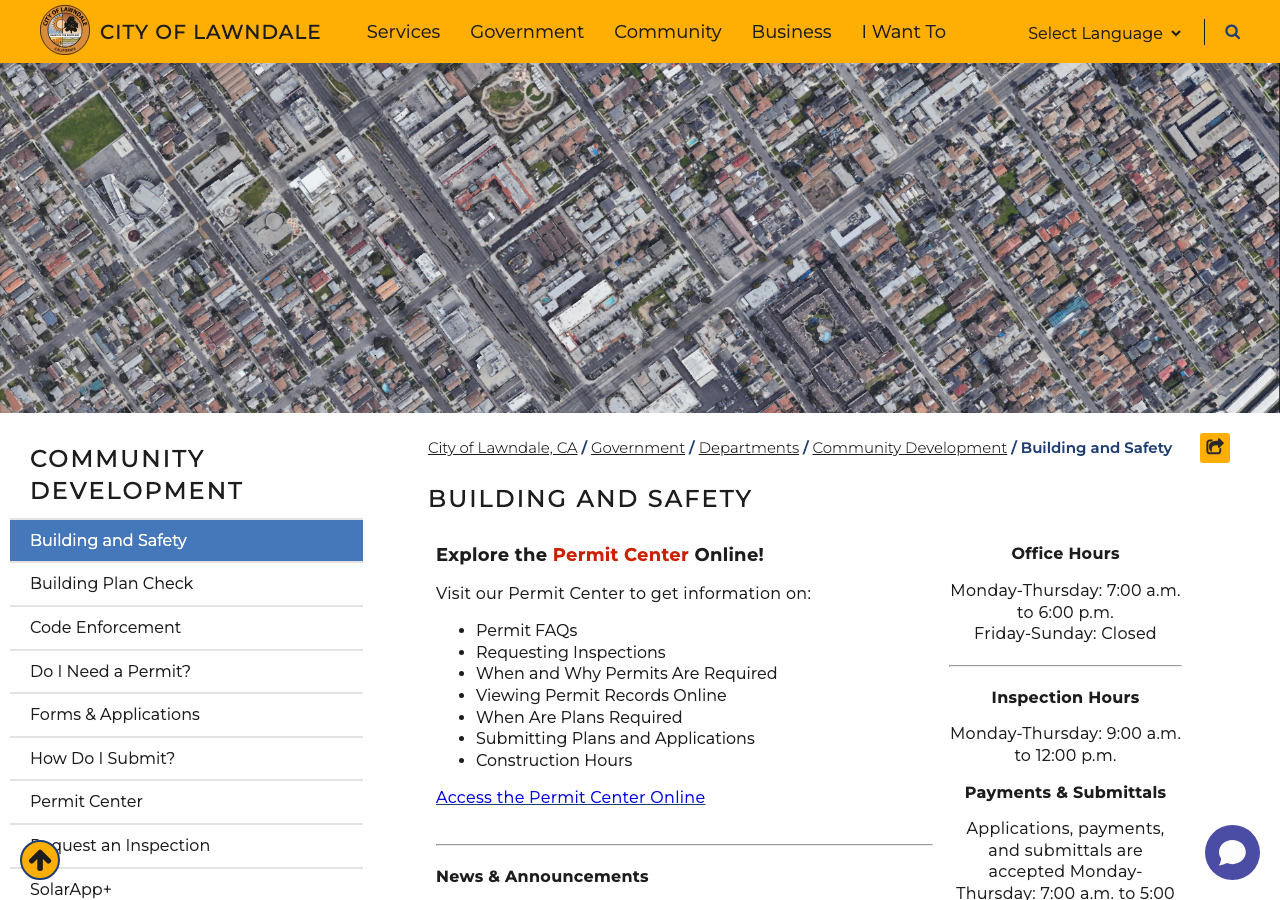
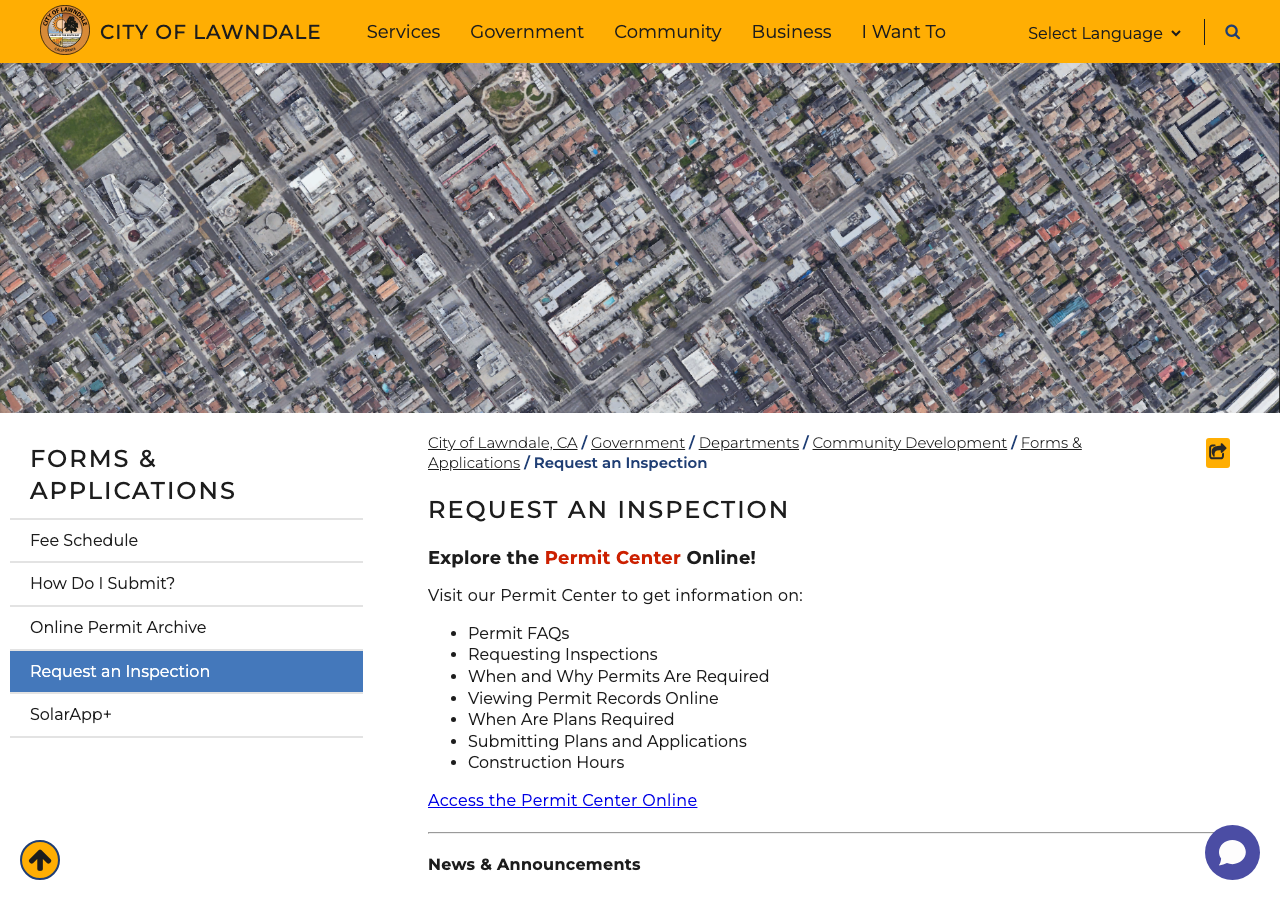
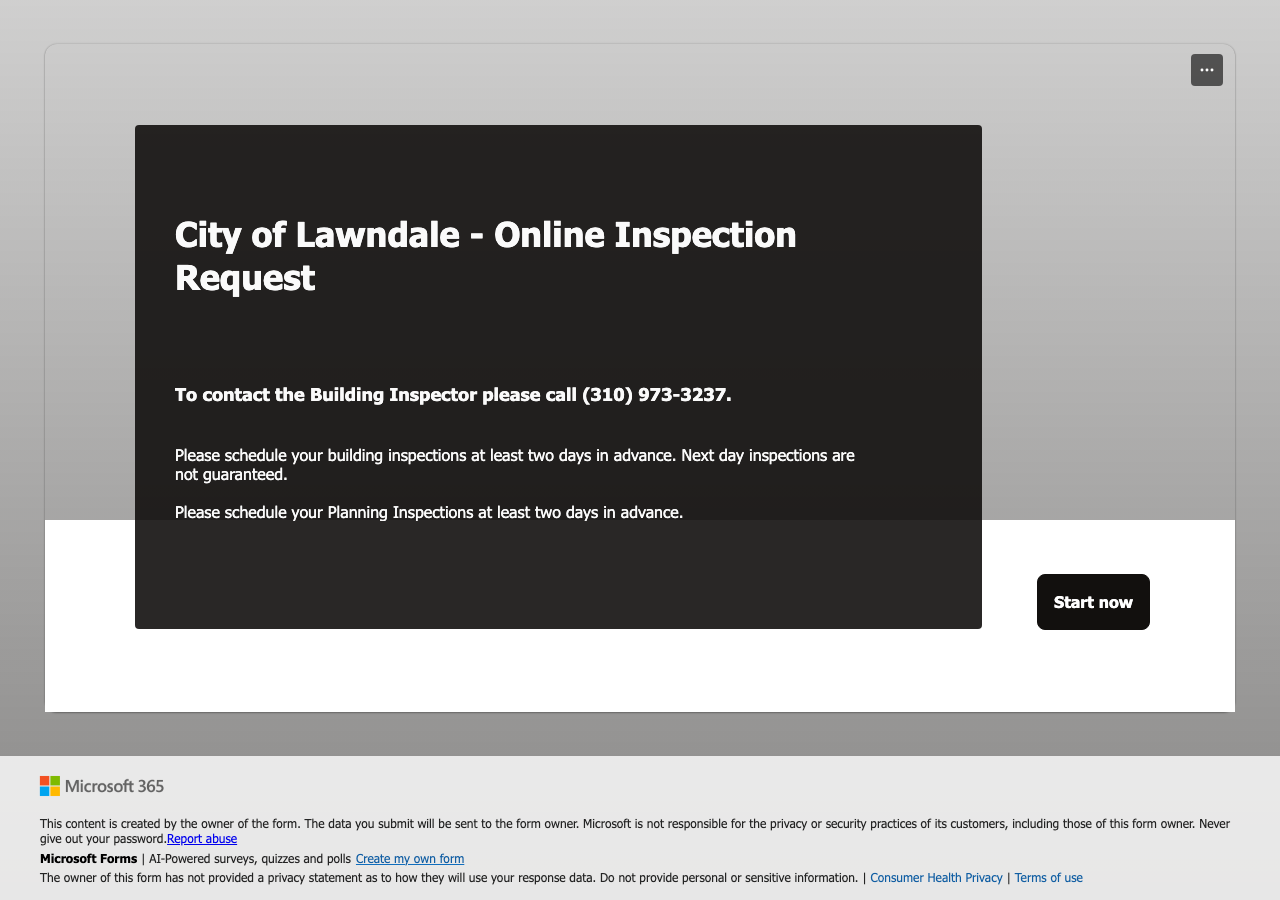
- How is an inspection booked? Phone (also an online inspection-request form) 88% · department page
- How much notice is required? At least two weeks in advance for building inspections ('Please schedule at least two weeks in advance to help ensure your preferred date is available'); at least two business days for Planning inspections. 75% · department page
- Are same-day or AM/PM windows offered? No — inspections occur only within fixed windows (Building & Safety: Monday-Thursday 9:00 a.m.-12:00 p.m.; Planning: Thursday 9:00 a.m.-12:00 p.m. only); no same-day service or AM/PM choice is offered, and the page states requested dates require staff confirmation. 75% · department page
-
Know who turns up
Some authorities inspect their own solar work; some delegate it, and a few do not inspect the PV equipment itself at all. Who is coming determines what they will look at.
- Does this AHJ perform its own final solar inspection? Delegated 88% · department staff page
- If delegated, to whom? Willdan Group (Building & Safety inspection, contracted by the city); LA County Fire Department (LACoFD) self-performs its own retained fire-code inspection scope directly. 88% · department staff page
-
Work the stages in order
A rough-in or mid-roof inspection, where one is required, has to happen before the work it covers is closed up. Missing a stage means opening something back up, and it is the most expensive kind of correction.
- Which inspections are required, and in what order? One Building & Safety inspection (performed by the Willdan-contracted inspector) for systems eligible for the LMC Ch. 15.32 expedited pathway, per §15.32.060(H) ('Only one inspection shall be required and performed by the building and safety division'); plus, where applicable, a separate LACoFD Fire Prevention inspection of disconnects/rapid-shutdown placarding (and of any ESS >3 kWh), booked directly with LACoFD. 85% · municipal code + department page
- Is a rough-in or mid-roof inspection required? No 80% · municipal code
-
Have the paperwork on site
The approved plan set, the permit, and the equipment listings should be on site and reachable. Inspectors routinely verify that installed equipment matches what was approved, and that the labels are the ones the plan set promised.
- Is there a published inspection checklist? Yes 95% · fire-authority checklist, linked from city page
- What must be on site at inspection? For the LACoFD inspection: digital proof of the construction permit obtained via the expedited permitting process (e.g. SolarApp+) including any inspection checklist provided with it; contractor name, license number, and phone; and full billing/invoicing contact information (name, address, email) for the Fire Prevention Division's inspection invoice. 85% · fire-authority checklist
- Does the inspector verify labels and listings? Yes 85% · fire-authority checklist
-
Sign-off, and permission to operate
Passing gives you a final or an equivalent sign-off. That is not the same as permission to operate: PTO comes from the utility, and who tells the utility the inspection passed varies. A system left switched off for weeks is usually waiting on this handover.
- What is issued on pass? Final (a passed final inspection sign-off) — no Certificate of Occupancy is issued for a rooftop PV addition since it is an alteration, not a change of occupancy. 55% · published fee schedule, inference
- Is there a re-inspection fee? $98.00 (LACoFD: 'Additional inspections after initial inspection and one reinspection'); the city's own Building/Electrical fee schedules have no dedicated PV re-inspection line — the closest city-side analog is the general 'Electrical inspection resulting from defective workmanship or materials' fee of $92.30. 85% · published fire-code fee schedule
- How are corrections issued and cleared? A written correction notice detailing all deficiencies is issued for resubmission when an application is deemed incomplete (LMC §15.32.060(G)). For SolarApp+ revisions specifically, the applicant resubmits revised plans through the SolarApp+ portal, downloads updated approval documents, and repeats the city permit-application and inspection-request steps; additional fees may apply for multiple revisions. 85% · municipal code + department page
14 questions answered against City of Lawndale’s own published documents
Q49 How is an inspection booked? Core Booking & scheduling
Phone (also an online inspection-request form)
Why the confidence is not higherCity's Inspections page: 'To schedule an inspection for an active building permit, call (310) 973-3237' and 'Call (310) 973-3236 or (310) 973-3230... or complete our online inspection request form!' — both booking channels are named, with phone given first/most specifically for building permits.
department page checked 2026-08-30 https://www.lawndale.ca.gov/government/departments/community_development/permits_and_applications/inspections
Q50 How much notice is required? Core Booking & scheduling
At least two weeks in advance for building inspections ('Please schedule at least two weeks in advance to help ensure your preferred date is available'); at least two business days for Planning inspections.
Why the confidence is not higherCity's Inspections page, Building & Safety Inspections section. Read literally as written, though the phrasing could also be read as a scheduling-availability recommendation rather than a strict minimum-notice rule.
department page checked 2026-08-30 https://www.lawndale.ca.gov/government/departments/community_development/permits_and_applications/inspections
Q51 Are same-day or AM/PM windows offered? Booking & scheduling
No — inspections occur only within fixed windows (Building & Safety: Monday-Thursday 9:00 a.m.-12:00 p.m.; Planning: Thursday 9:00 a.m.-12:00 p.m. only); no same-day service or AM/PM choice is offered, and the page states requested dates require staff confirmation.
Why the confidence is not higherCity's Inspections page.
department page checked 2026-08-30 https://www.lawndale.ca.gov/government/departments/community_development/permits_and_applications/inspections
Q52 Does this AHJ perform its own final solar inspection? Core Who inspects
Delegated
Why the confidence is not higherBuilding & Safety inspection is contracted to Willdan as of 28 May 2026 (staff page names 'Garrett Heumann, Building Inspector (Willdan Consultant)'); LACoFD separately performs its own retained-scope inspection (disconnects, rapid shutdown, ESS >3kWh) directly, not through the city.
department staff page checked 2026-08-30 https://www.lawndale.ca.gov/government/departments/community_development/building_and_safety/
Q53 If delegated, to whom? Core Who inspects
Willdan Group (Building & Safety inspection, contracted by the city); LA County Fire Department (LACoFD) self-performs its own retained fire-code inspection scope directly.
Why the confidence is not higherCity's Building & Safety department page names the Willdan-contracted inspector; SolarApp+ page gives a separate LACoFD phone number ((310) 263-2732) for fire inspections, confirming LACoFD is contacted directly rather than through the city.
department staff page checked 2026-08-30 https://www.lawndale.ca.gov/government/departments/community_development/building_and_safety/
Q54 Which inspections are required, and in what order? Core Stages & sequence
One Building & Safety inspection (performed by the Willdan-contracted inspector) for systems eligible for the LMC Ch. 15.32 expedited pathway, per §15.32.060(H) ('Only one inspection shall be required and performed by the building and safety division'); plus, where applicable, a separate LACoFD Fire Prevention inspection of disconnects/rapid-shutdown placarding (and of any ESS >3 kWh), booked directly with LACoFD.
Why the confidence is not higherLMC §15.32.060(H); city's SolarApp+ page Step 4 (separate LACoFD contact number for fire inspections).
municipal code + department page checked 2026-08-30 https://ecode360.com/43967105
Q55 Is a rough-in or mid-roof inspection required? Stages & sequence
No
Why the confidence is not higherLMC §15.32.060(H) states explicitly that only one inspection is required for expedited-eligible small residential rooftop solar systems; no separate rough-in or mid-roof inspection is described.
municipal code checked 2026-08-30 https://ecode360.com/43967105
Q56 Does the inspector verify labels and listings? Core What is checked
Yes
Why the confidence is not higherLACoFD's own Expedited PV/ESS Inspection Checklist is structured as a series of Y/N verification items covering placard specifications, wording, and equipment UL listings — i.e., verifying labels and listings is literally what the published inspection checklist checks.
fire-authority checklist checked 2026-08-30 https://fire.lacounty.gov/wp-content/uploads/2023/09/Expedited-Permitting-Checklist-LACoFD-ESS-PV-Disconnects-2023-09-01-SECURED.pdf
Q57 Is there a published inspection checklist? Core What is checked
Yes
Why the confidence is not higherThe 'Expedited PV/ESS Permitting Process — LACoFD Inspection Checklist for Group R-3/-4 ESS, PV, and Electrical-Disconnect Placarding' is published and linked directly from the city's own SolarApp+ page.
fire-authority checklist, linked from city page checked 2026-08-30 https://fire.lacounty.gov/wp-content/uploads/2023/09/Expedited-Permitting-Checklist-LACoFD-ESS-PV-Disconnects-2023-09-01-SECURED.pdf
Q58 What must be on site at inspection? Core Documents on site
For the LACoFD inspection: digital proof of the construction permit obtained via the expedited permitting process (e.g. SolarApp+) including any inspection checklist provided with it; contractor name, license number, and phone; and full billing/invoicing contact information (name, address, email) for the Fire Prevention Division's inspection invoice.
Why the confidence is not higherLACoFD Expedited-Permitting Checklist, Section I.1 ('Before Making Request for FD Inspection').
fire-authority checklist checked 2026-08-30 https://fire.lacounty.gov/wp-content/uploads/2023/09/Expedited-Permitting-Checklist-LACoFD-ESS-PV-Disconnects-2023-09-01-SECURED.pdf
Q59 Is there a re-inspection fee? Corrections & re-inspection
$98.00 (LACoFD: 'Additional inspections after initial inspection and one reinspection'); the city's own Building/Electrical fee schedules have no dedicated PV re-inspection line — the closest city-side analog is the general 'Electrical inspection resulting from defective workmanship or materials' fee of $92.30.
Why the confidence is not higherLACoFD Appendix QQ, Table QQ104.4(6) (Miscellaneous Field Inspection); City of Lawndale Electrical Permit Fees schedule, effective 8/5/2025.
published fire-code fee schedule checked 2026-08-30 https://fire.lacounty.gov/wp-content/uploads/2025/10/2023-LACFC-Appendix-QQ-Certified-Ord-Eff.-2024-01-11-Secured.pdf
Q60 How are corrections issued and cleared? Corrections & re-inspection
A written correction notice detailing all deficiencies is issued for resubmission when an application is deemed incomplete (LMC §15.32.060(G)). For SolarApp+ revisions specifically, the applicant resubmits revised plans through the SolarApp+ portal, downloads updated approval documents, and repeats the city permit-application and inspection-request steps; additional fees may apply for multiple revisions.
Why the confidence is not higherLMC §15.32.060(G); city's SolarApp+ page, 'SolarApp+ Revisions' section.
municipal code + department page checked 2026-08-30 https://ecode360.com/43967105
Q61 What is issued on pass? Core Final sign-off & PTO
Final (a passed final inspection sign-off) — no Certificate of Occupancy is issued for a rooftop PV addition since it is an alteration, not a change of occupancy.
Why the confidence is not higherInferred: the city's fee schedule lists 'Certificate of Occupancy' and 'Temporary Certificate of Occupancy' as distinct, separately-charged items tied to new construction/occupancy changes, and neither Ch. 15.32 nor the SolarApp+ page names a CO, green tag, or letter as the specific solar sign-off document — no document was found stating explicitly what is issued on a passed solar inspection.
published fee schedule, inference checked 2026-08-30 https://cdnsm5-hosted.civiclive.com/UserFiles/Servers/Server_16676053/File/Government/Departments/Community%20Development/Building%20and%20Safety/Permit%20Fees/Building%20Permit%20&%20Plan%20Check%20Fees%20(2025).pdf
Q62 Who notifies the utility for PTO? Core Final sign-off & PTO
Nothing published by this authority.
Where we lookedthe city's SolarApp+ page, LMC Ch. 15.32, and the Public Works utility-contacts page were checked for a statement of who submits the SCE PTO/interconnection notification; none address this, and SCE's own DG/interconnection pages returned no usable content (see Q42/Q48)
Lines marked with a percentage were read off this authority’s own published documents. Unmarked guidance is general good practice, not this jurisdiction’s rule — always confirm against the authority before you submit.
Jurisdiction & key facts
The standing 62-question set, answered for City of Lawndale against this authority’s own published documents. Every answer carries the confidence it was recorded at and the document it came from. Where nothing is published we say so and show where we looked — a blank here is a finding, not a gap.
City of Lawndale is the authority having jurisdiction 90% confidence
- Holds
- Building and Electrical (permit issuance; plan-check and inspection staffing contracted to Willdan/4Leaf as of 28 May 2026)
- Delegated to
- Willdan Group (Building & Safety plan check/inspection); 4Leaf Inc. (permit technician staffing)
- Overridden by
- LA County Fire Department (LACoFD) retains fire-code review/inspection for all PV disconnect/rapid-shutdown placarding and for any ESS with a capacity greater than 3 kWh (2023 LACFC §1207.11), regardless of who performs the building inspection; California Gov. Code §65850.5/§65850.52 (Solar Rights Act/AB 2188 expedited permitting) constrains how the city may condition or delay approval.
- Why not higher
- The brief listed this as a straightforward city AHJ, but the city's own 28 May 2026 notice ('Building & Safety Services') states plainly that Building & Safety services moved from LA County to Willdan, and the department's own staff page names both a Willdan-contracted Building Inspector and a 4Leaf-contracted Permit Technician working alongside the in-house Acting Community Development Director. This is a genuine, very recent (3-months-old) delegation the brief did not anticipate. Separately, LACoFD (not the city) retains the fire-code inspection scope for disconnects/rapid-shutdown placarding and ESS above 3 kWh, exactly as documented in LACoFD's own current PV/ESS guide, which Lawndale's own SolarApp+ page links directly as the applicable standard.
Check the code edition before you build
This authority's published code edition does not match what the state has adopted. That usually means the authority's ordinance has not been updated for the current cycle — but a local amendment can also be lawful. Confirm with the building department before you submit.
- Permit required
- Yes95%
- Permit cost
- $450 flat up to 15 kW AC, plus $10 per additional kW above 15 kW (residential); commercial is $1,000 up to 50 kW, +$7/kW (51-250 kW), +$5/kW (above 250 kW).95%
- Plan review
- Same day for over-the-counter applications; 1 to 3 business days for electronic applications.92%
- Portal
- SolarApp+ (gosolarapp.org) for eligible residential PV/ESS systems; for non-eligible or commercial systems,85%
- Electrical code
- 2023 NEC (adopted as part of the 2025 California Electrical Code / Title 27 LA County Electrical Code)85%
- Own placard wording
- Yes92%
- Booking an inspection
- Phone (also an online inspection-request form)88%
Labels & placards for this authority
City of Lawndale writes its own placard wording. A standard NEC label set will not satisfy it — the exact text, and in most cases the size, colour and font, are specified below.
Wording 92%
Yes
Size, colour & material 95%
Exterior placards: minimum 2in tall x 3.5in wide, weather-resistant plastic, verbiage engraved, red letters on a yellow background, solid all-capital Arial font minimum size 24 (28 bold for 'F.D.' and '#X of Y'). Panel-interior placards: minimum 7/16in x 3/4in, same color scheme, solid all-caps bold Arial minimum size 24. Attachment by permanent, material/weather/surface-compatible epoxy.
Where they go 90%
Exterior disconnect placards go on walls and/or the exteriors of electrical panels/enclosures, accessible from the exterior of the structure; interior placards go on the specific switch/breaker within a shared panel. Placement is determined by a C-10 electrician subject to fire-code-official approval.
What the utility wants on top None%
Each figure above is sourced and dated in the full answer set below (questions 38–43). Where an authority’s own published sheet is older than the code it has adopted, the answer says so.
Their website
Average approval time — application to PTO
From the CPUC interconnection record. Bars show the average days taken each year; a year with no recorded projects is left blank rather than drawn as zero.