
City of Livingston
Merced County
City of Livingston is a city authority in the State of California, serving 14,172 residents. 580 residential solar installs are on record here. This page is the permit route for that jurisdiction: the fifteen steps from working out who has a say over an address through to permission to operate, the documents this authority publishes, and 62 answers taken from those documents and dated.
Permitting 5 steps · 28 questions
Whether a permit is needed — Yes Q3 Electrical and building permits — Combined Q4 Plan review — 5 to 10 business days (for over-the-counter minor residential remodels/single-family work, Q18 Where you file — CSG Consultants' 'GreenVue Digital Permit Suite' online portal, at greenvue3.csgengr.com/livingston/public/PermitLogin.aspx, Q20
- Permit required
- Yes95% source
- What it costs
- No dedicated flat solar fee found. Building Permit Fee is calculated 'per Table 1-A of the CA Building Code...78% source
- Plan review turnaround
- 5 to 10 business days (for over-the-counter minor residential remodels/single-family work, which is how the Building Division categorizes small in-house plan checks;78% source
- Key document
- published checklist (OCR'd, image-only PDF) cited by 5 open the document
-
Confirm who has a say over your address
A city address is usually permitted by the city, not the county — but not always, and some authorities keep building and hand electrical to someone else. Getting this wrong costs the whole submittal, because every requirement below belongs to whoever actually holds jurisdiction. Check the overlays in the same pass: an HOA, a historic district, a windstorm certification or a system-size cap can reshape the design, and all of them are cheaper to find now than after the array is laid out.
- Is this authority the AHJ for residential solar at this address? Yes 95% · department page
- What does this authority permit itself, and what does it delegate? Delegated 90% · department page
- Is a permit required for a residential rooftop PV system? Yes 95% · ordinance
- Is there a separate electrical permit, or is it combined? Combined 88% · permit application (OCR'd, image-only PDF)
- Is a HOA or architectural approval required first? No (for eligible small residential rooftop systems) — but reported alongside a live tension in the code. 62% · ordinance
- Is there a historic-district review? No historic-district review chapter exists in the code. 70% · code TOC (absence proven by chapter-name walk)
- Is a wind or windstorm certification required? No dedicated windstorm-certification requirement beyond standard structural calculations; the city's own submittal checklist sets the design basis as 'Wind Exposure - C / Wind Speed 85 mph' as part of ordinary structural calcs, not a separate certification. 75% · published checklist (OCR'd)
- Is a Specific Use Permit or Council approval ever required? No — an eligible small residential rooftop solar application receives administrative approval only; no CUP or Council hearing is contemplated by the ordinance. 80% · ordinance
- Is there a system-size cap on residential generation? 10 kW AC nameplate / 30 kW thermal, on a single- or duplex-family dwelling, capped at the city's ordinary maximum legal building height (city code, LMC §4-8-1, unchanged since Ord. 624 in 2015 — the AB 2188-era figure). Separately and at the utility level, MID caps generation at 120% of the customer's estimated annual consumption (not a size cap but an output/consumption-based cap). 90% · ordinance + utility checklist
-
Check who is allowed to apply
Several authorities require the electrical permit to be pulled by a licensed electrician, or require the contractor to be registered with them BEFORE applying. Registration is not same-day. This is second on the list rather than fourth because it is the step most likely to stop the job before the drawings matter.
- Who is allowed to pull the electrical permit? Either 82% · permit application (OCR'd)
- Is a homeowner permitted to self-install and self-permit? Yes 90% · permit application / state-mandated disclosure (OCR'd)
-
Build the submittal package
Almost everywhere wants a site plan, a one-line or three-line electrical diagram, equipment cut sheets with listings, and a structural attachment detail. Build it against the published checklist rather than the last jurisdiction you worked in — the checklist is what the reviewer marks against.
- What documents make up a complete submittal? Complete building permit application; plan-check fee at submittal; plans to comply with 2019-cycle (checklist text, now updated to 2025) CBC/CMC/CEC/CFC/CGBC/CPC/CRC; electronic plans only; site plan; floor plans; MEP locations; elevations/sections; foundation/framing/roof plans; construction/connection details; Title 24 energy compliance forms; engineering calcs (wet-stamped); estimated valuation. Solar-specific additions (LMC §4-8-3(D)): applicant-funded structural evaluation, electrical-capacity verification, and the items on the city's standard PV checklist. 88% · published checklist (OCR'd, image-only PDF)
- How many copies, and in what format? Electronic plans only — 'NO Pencil Copies' / no hard copies (general checklist); LMC §4-8-3(D)(4) separately allows solar applicants to submit in person at the Building Department OR by electronic submittal (email/internet/fax), with electronic signatures accepted in lieu of a wet signature. 85% · published checklist (OCR'd)
- Is a site plan required, and what must it show? Yes — must show location of proposed and existing buildings, property lines, easements, north arrow and street name. 88% · published checklist (OCR'd)
- Is a one-line / three-line diagram required? Inferred yes — city's general checklist requires a plan showing 'location of all electrical... fixtures, outlets and equipment' and an 'electrical plan'; Merced Irrigation District's own PV Application Checklist independently requires a 'Single Line Diagram and Site Plan' as a mandatory attachment before interconnection. 65% · utility application checklist
- Is a structural PE stamp required, and at what threshold? No fixed numeric threshold found. General rule: plans need a wet-stamped signature only if prepared by a licensed architect or engineer (required for all commercial projects); for solar specifically LMC §4-8-3(D)(1) requires the applicant, at their own expense, to verify via 'standard engineering evaluation techniques' that the roof structure can carry the added wind/seismic/dead/live loads, but does not itself mandate a PE stamp for every residential job. 62% · checklist + ordinance
-
Apply and pay
Most authorities now take the whole application through a portal, and several states cap or constrain what a residential solar permit may cost. Check whether plan check is billed separately before you quote the job.
- Which permit portal does this authority use? CSG Consultants' 'GreenVue Digital Permit Suite' online portal, at greenvue3.csgengr.com/livingston/public/PermitLogin.aspx, linked directly from the city's Building Division page as '***CLICK HERE TO APPLY FOR A NEW PERMIT***'. 90% · permit portal
- Can the whole application be completed online? Likely yes for account holders, but not independently confirmed beyond the login screen — GreenVue is a full 'Digital Permit Suite' (implying online application, plan upload and payment), but it is credential-gated so the in-portal workflow could not be inspected without an account. 60% · permit portal (login-gated)
- What does a residential solar permit cost? No dedicated flat solar fee found. Building Permit Fee is calculated 'per Table 1-A of the CA Building Code... based on unit valuation'; Electrical/Plumbing/Mechanical fee is 'per Schedule B and Schedule C' (adopted by Resolution 2018-18, not published on the Building Documents page); Plan Check Fee is 75% of the building permit fee. State pass-through fees also apply: SMI (0.00013 or 0.00028 x valuation) and CBSC ($1 per $25,000 of valuation). 78% · published fee schedule
- How is the fee calculated? Valuation 88% · published fee schedule
- Is there a separate plan-check fee? Yes 90% · published fee schedule
-
Plan review — and start the utility in parallel
Interconnection is a separate process from the permit and usually the longer pole. Where the utility does not depend on the permit being issued, running both at once is the single biggest saving available on a residential job.
- What is the stated plan-review turnaround? 5 to 10 business days (for over-the-counter minor residential remodels/single-family work, which is how the Building Division categorizes small in-house plan checks; larger/CSG-routed reviews are not given a stated turnaround). 78% · department page
- How long is an issued permit valid before it expires? Not locally specified; the unamended 2025 California Building Code default (permit expires if work does not commence within 180 days or is suspended/abandoned for 180 days) would apply since LMC §4-1-3 adopts the CBC 'with appendices, and any subsequent amendments... as if fully set forth herein' with no local amendment to the permit-expiration section found. 55% · ordinance (inference)
- Which utility handles interconnection here? Merced Irrigation District (MID) — a publicly-owned power utility. NOT Pacific Gas & Electric as briefed: PG&E does not serve electric interconnection in Livingston. 95% · utility's own website
- Where does the utility sit in the sequence? After permit (with parallel elements) — the PV/interconnection application is submitted to MID up front, in parallel with the building permit, but MID's own field inspection, meter-set, and Permission to Operate (PTO) occur only AFTER the AHJ (City/CSG) final building inspection. 88% · utility application checklist
28 questions answered against City of Livingston’s own published documents
Q1 Is this authority the AHJ for residential solar at this address? Core Jurisdiction & scope
Yes
Why the confidence is not higherCity's Building Division (Community Development) issues building/electrical/PV permits directly; LMC Title 4 codifies a dedicated small-residential-rooftop-solar review chapter (Ch. 4-8, Ord. 624, 2015).
department page checked 2026-08-31 https://cityoflivingston.org/commdev/page/building-division
Q2 What does this authority permit itself, and what does it delegate? Core Jurisdiction & scope
Delegated
Why the confidence is not higherCity holds legal permitting authority and issues the permit, but plan check and inspection staffing for residential/commercial/industrial work is contracted to CSG Consultants, paid hourly by the City; the online permit portal is CSG's own 'GreenVue Digital Permit Suite' (greenvue3.csgengr.com/livingston), not a city-branded system.
department page checked 2026-08-31 https://cityoflivingston.org/commdev/page/building-division
Q3 Is a permit required for a residential rooftop PV system? Core Jurisdiction & scope
Yes
Why the confidence is not higherLMC §4-8-2(A): 'This chapter applies to the permitting of all small residential rooftop solar energy systems in the city'; the city's Application for Building Permit form has a dedicated 'Photovoltaic' project-type field (New/Revision/Panel Upgrade, Modules, kW).
ordinance checked 2026-08-31 https://codelibrary.amlegal.com/codes/livingstonca/latest/livingston_ca/0-0-0-3991
Q4 Is there a separate electrical permit, or is it combined? Core Jurisdiction & scope
Combined
Why the confidence is not higherThe single 'Application for Building Permit' form covers Building, Electrical, Plumbing, Mechanical, Water Heater AND Photovoltaic project types on one document with one fee block (Building Permit / PME / Plan Check / SMI / Green Fee); no separate stand-alone electrical-permit application exists on the Building Documents page.
permit application (OCR'd, image-only PDF) checked 2026-08-31 https://cityoflivingston.org/media/8176
Q5 Who is allowed to pull the electrical permit? Core Who may apply
Either
Why the confidence is not higherThe Application for Building Permit contains both a 'Licensed Contractor Declaration' (license #, class, expiration) and an 'Owner-Builder Declaration' section on the same form, so either a licensed contractor or the homeowner (as owner-builder) may sign for and pull the permit, including its electrical scope.
permit application (OCR'd) checked 2026-08-31 https://cityoflivingston.org/media/8176
Q6 Must the contractor be registered with this authority before applying? Core Who may apply
Nothing published by this authority.
Where we lookedCity's Business License page states a business license is required of businesses operating in the city and that some may need approval from Building/Planning/etc. before issuance, but it does not say whether an out-of-town contractor must hold a Livingston business license or register with the Building Division BEFORE a permit will be issued; the Application for Building Permit form itself asks only for state contractor license #/class/expiration, not a city registration number.
Q7 Is a homeowner permitted to self-install and self-permit? Who may apply
Yes
Why the confidence is not higherThe Application for Building Permit includes an 'Owner-Builder Declaration' (checkbox statements A/B/C under the Contractors' License Law exemption), and the city separately hands out a 'Notice of State Law Requirement' AB 2335 Owner-Builder Acknowledgment form before issuing an owner-builder permit.
permit application / state-mandated disclosure (OCR'd) checked 2026-08-31 https://cityoflivingston.org/media/8186
Q8 What documents make up a complete submittal? Core Submittal package
Complete building permit application; plan-check fee at submittal; plans to comply with 2019-cycle (checklist text, now updated to 2025) CBC/CMC/CEC/CFC/CGBC/CPC/CRC; electronic plans only; site plan; floor plans; MEP locations; elevations/sections; foundation/framing/roof plans; construction/connection details; Title 24 energy compliance forms; engineering calcs (wet-stamped); estimated valuation. Solar-specific additions (LMC §4-8-3(D)): applicant-funded structural evaluation, electrical-capacity verification, and the items on the city's standard PV checklist.
Why the confidence is not higherCity's own 'Minimum Plan Check Submittal Checklist' (dated doc, undergoing recent code-cycle text lag — still references '2019 CBC' though the city adopted the 2025 cycle 6-3-2026) lists 11 numbered submittal items plus solar-relevant engineering/Title 24 items; LMC §4-8-3(D) adds solar-specific pre-submittal verification duties.
published checklist (OCR'd, image-only PDF) checked 2026-08-31 https://cityoflivingston.org/media/8171
Q9 How many copies, and in what format? Submittal package
Electronic plans only — 'NO Pencil Copies' / no hard copies (general checklist); LMC §4-8-3(D)(4) separately allows solar applicants to submit in person at the Building Department OR by electronic submittal (email/internet/fax), with electronic signatures accepted in lieu of a wet signature.
Why the confidence is not higherMinimum Plan Check Submittal Checklist item 4, and LMC §4-8-3(D)(4)-(5).
published checklist (OCR'd) checked 2026-08-31 https://cityoflivingston.org/media/8171
Q10 Is a site plan required, and what must it show? Core Submittal package
Yes — must show location of proposed and existing buildings, property lines, easements, north arrow and street name.
Why the confidence is not higherMinimum Plan Check Submittal Checklist item 5B.
published checklist (OCR'd) checked 2026-08-31 https://cityoflivingston.org/media/8171
Q11 Is a one-line / three-line diagram required? Core Drawings & calculations
Inferred yes — city's general checklist requires a plan showing 'location of all electrical... fixtures, outlets and equipment' and an 'electrical plan'; Merced Irrigation District's own PV Application Checklist independently requires a 'Single Line Diagram and Site Plan' as a mandatory attachment before interconnection.
Why the confidence is not higherCity checklist does not use the term 'one-line diagram' verbatim; MID's Solar Application Checklist does, at the utility level.
utility application checklist checked 2026-08-31 https://mercedid.org/wp-content/uploads/2025/02/Solar-Application-Process-Final.pdf
Q12 Are string and conductor calculations required? Drawings & calculations
Nothing published by this authority.
Where we lookedCity's Minimum Plan Check Submittal Checklist and LMC Ch. 4-8 (solar chapter) — neither uses the terms 'string calculation' or 'conductor calculation'; only generic 'engineering calculations' are required.
Q13 Is a structural PE stamp required, and at what threshold? Core Engineering & stamps
No fixed numeric threshold found. General rule: plans need a wet-stamped signature only if prepared by a licensed architect or engineer (required for all commercial projects); for solar specifically LMC §4-8-3(D)(1) requires the applicant, at their own expense, to verify via 'standard engineering evaluation techniques' that the roof structure can carry the added wind/seismic/dead/live loads, but does not itself mandate a PE stamp for every residential job.
Why the confidence is not higherCombines the general Minimum Plan Check Submittal Checklist item 5I with the solar-specific structural-verification duty in LMC §4-8-3(D)(1); neither states a bright-line size/valuation trigger for requiring a stamp.
checklist + ordinance checked 2026-08-31 https://cityoflivingston.org/media/8171
Q14 Is an electrical PE stamp required, and at what threshold? Engineering & stamps
Nothing published by this authority.
Where we lookedSame checklist and LMC Ch. 4-8 — no electrical PE-stamp threshold stated (LMC §4-8-3(C) points to CEC/IEEE/UL/CPUC standards, not to a licensed-engineer stamp requirement).
https://codelibrary.amlegal.com/codes/livingstonca/latest/livingston_ca/0-0-0-3991
Q15 What does a residential solar permit cost? Core Fees
No dedicated flat solar fee found. Building Permit Fee is calculated 'per Table 1-A of the CA Building Code... based on unit valuation'; Electrical/Plumbing/Mechanical fee is 'per Schedule B and Schedule C' (adopted by Resolution 2018-18, not published on the Building Documents page); Plan Check Fee is 75% of the building permit fee. State pass-through fees also apply: SMI (0.00013 or 0.00028 x valuation) and CBSC ($1 per $25,000 of valuation).
Why the confidence is not higherCity's 'Schedule of Development Fees' (dated 2/17/22) BUILDING FEES section; Schedule B/C themselves were not locatable on the city's site so the exact electrical-fee dollar figure could not be confirmed.
published fee schedule checked 2026-08-31 https://cityoflivingston.org/media/8166
Q16 How is the fee calculated? Core Fees
Valuation
Why the confidence is not higherSchedule of Development Fees: 'Building Permit Fee — Per table 1-A of the CA Building Code... Calculated based on unit* evaluation'; Plan Check Fee set as a percentage (75%) of that valuation-based building permit fee.
published fee schedule checked 2026-08-31 https://cityoflivingston.org/media/8166
Q17 Is there a separate plan-check fee? Fees
Yes
Why the confidence is not higherSchedule of Development Fees: 'Plan Check Fee — 75% of building permit fee, as set forth in Table 1-A. Track Houses: 35% or normal plan review fee.'
published fee schedule checked 2026-08-31 https://cityoflivingston.org/media/8166
Q18 What is the stated plan-review turnaround? Core Timeline & validity
5 to 10 business days (for over-the-counter minor residential remodels/single-family work, which is how the Building Division categorizes small in-house plan checks; larger/CSG-routed reviews are not given a stated turnaround).
Why the confidence is not higherBuilding Division page: 'Turnaround time for minor residential remodels, single-family dwellings, and large tenant improvements will be five to ten business-working days.'
department page checked 2026-08-31 https://cityoflivingston.org/commdev/page/building-division
Q19 How long is an issued permit valid before it expires? Timeline & validity
Not locally specified; the unamended 2025 California Building Code default (permit expires if work does not commence within 180 days or is suspended/abandoned for 180 days) would apply since LMC §4-1-3 adopts the CBC 'with appendices, and any subsequent amendments... as if fully set forth herein' with no local amendment to the permit-expiration section found.
Why the confidence is not higherInference from the plain, unamended CBC-adoption language in LMC §4-1-3; the city's own submittal materials do not separately state a validity period.
ordinance (inference) checked 2026-08-31 https://codelibrary.amlegal.com/codes/livingstonca/latest/livingston_ca/0-0-0-2721
Q20 Which permit portal does this authority use? Core Portal & process
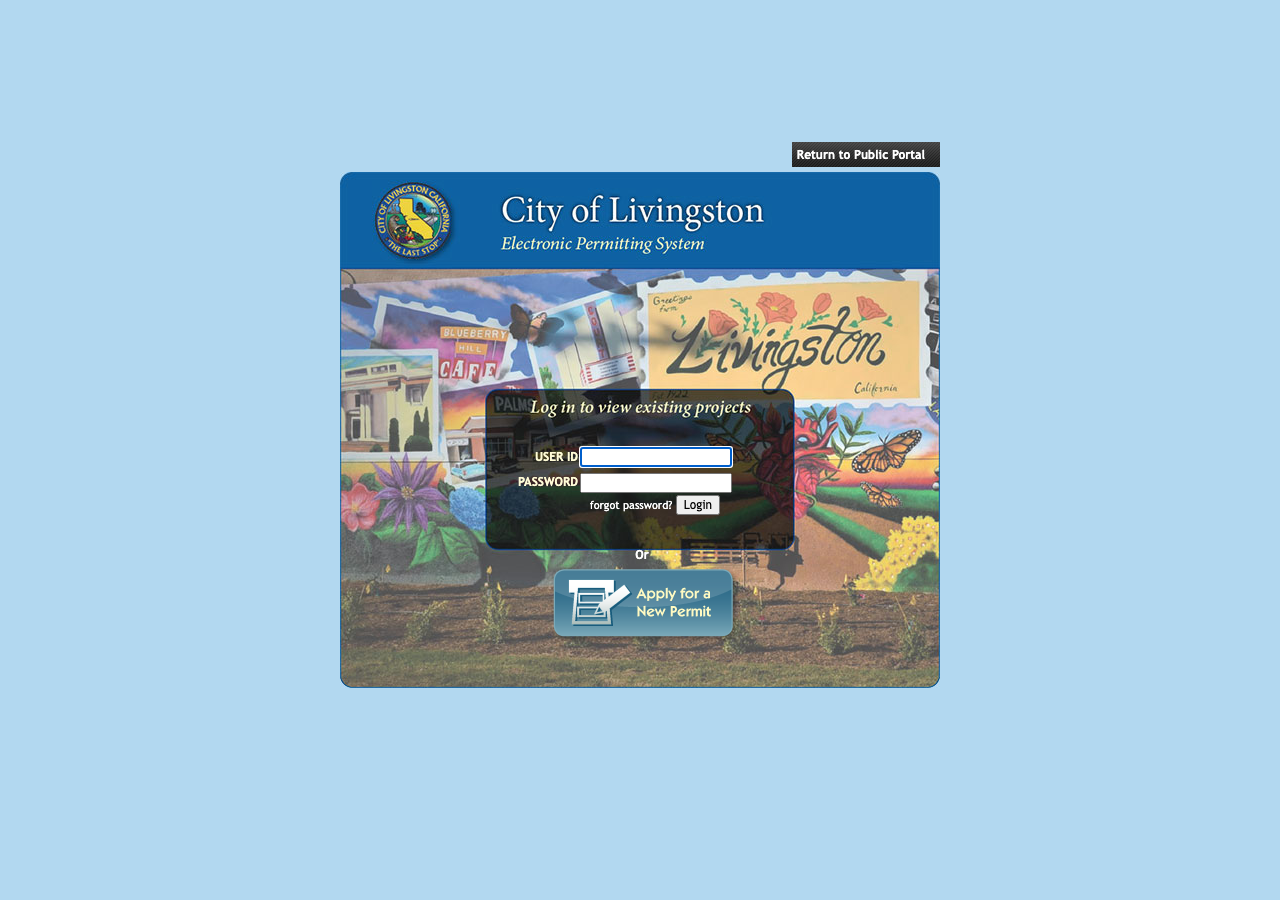
CSG Consultants' 'GreenVue Digital Permit Suite' online portal, at greenvue3.csgengr.com/livingston/public/PermitLogin.aspx, linked directly from the city's Building Division page as '***CLICK HERE TO APPLY FOR A NEW PERMIT***'.
Why the confidence is not higherPortal is hosted on CSG's own csgengr.com domain (not a city domain), confirming CSG operates it; login page itself is titled 'Digital Permit Suite - Login'.
permit portal checked 2026-08-31 http://greenvue3.csgengr.com/livingston/public/PermitLogin.aspx
Q21 Can the whole application be completed online? Core Portal & process
Likely yes for account holders, but not independently confirmed beyond the login screen — GreenVue is a full 'Digital Permit Suite' (implying online application, plan upload and payment), but it is credential-gated so the in-portal workflow could not be inspected without an account.
Why the confidence is not higherPortal login page only; could not verify the post-login application flow.
permit portal (login-gated) checked 2026-08-31 http://greenvue3.csgengr.com/livingston/public/PermitLogin.aspx
Q22 Which utility handles interconnection here? Core Utility interconnection
Merced Irrigation District (MID) — a publicly-owned power utility. NOT Pacific Gas & Electric as briefed: PG&E does not serve electric interconnection in Livingston.
Why the confidence is not higherMID's own homepage states verbatim: 'MID, as your local public power utility, provides competitive electric service to our customers in Livingston, Atwater, Winton and Merced.' The city's own Utilities page confirms the City itself only bills water, sewer and garbage (garbage via a Gilton Solid Waste contract) — no city electric billing, consistent with an outside POU rather than the city being its own POU.
utility's own website checked 2026-08-31 https://mercedid.org/
Q23 Where does the utility sit in the sequence? Core Utility interconnection
After permit (with parallel elements) — the PV/interconnection application is submitted to MID up front, in parallel with the building permit, but MID's own field inspection, meter-set, and Permission to Operate (PTO) occur only AFTER the AHJ (City/CSG) final building inspection.
Why the confidence is not higherMID's Solar Application Checklist, Step 4-5: contractor must first 'obtain and submit a copy of the Final Inspection Card from the governing city or county, along with voltage measurement photos' before 'MID Field Inspection... An MID technician then performs a field inspection... and the self-generation meter is installed upon approval,' followed by PTO.
utility application checklist checked 2026-08-31 https://mercedid.org/wp-content/uploads/2025/02/Solar-Application-Process-Final.pdf
Q24 Is a HOA or architectural approval required first? Overlays & special cases
No (for eligible small residential rooftop systems) — but reported alongside a live tension in the code.
Why the confidence is not higherLMC §4-8-4(C) explicitly limits city review of an eligible small residential rooftop solar application to 'whether the application meets all local, state and federal health and safety requirements,' which excludes discretionary HOA/architectural review. However, the city's general zoning Land Use Matrix separately states 'Site plan/design review is required for all uses involving new construction, significant exterior alterations...' with no express solar carve-out — reported as an unresolved tension rather than picked one way.
ordinance checked 2026-08-31 https://codelibrary.amlegal.com/codes/livingstonca/latest/livingston_ca/0-0-0-3991
Q25 Is there a historic-district review? Overlays & special cases
No historic-district review chapter exists in the code.
Why the confidence is not higherFull table-of-contents walk of Title 4 (Building Regulations, 9 chapters) and Title 5 (Zoning Regulations, 7 chapters) found no historic-preservation, landmark, or historic-district chapter anywhere; this is an absence proven by walking the TOC by chapter name, not a full-text search of the whole code.
code TOC (absence proven by chapter-name walk) checked 2026-08-31 https://codelibrary.amlegal.com/codes/livingstonca/latest/overview
Q26 Is a wind or windstorm certification required? Overlays & special cases
No dedicated windstorm-certification requirement beyond standard structural calculations; the city's own submittal checklist sets the design basis as 'Wind Exposure - C / Wind Speed 85 mph' as part of ordinary structural calcs, not a separate certification.
Why the confidence is not higherMinimum Plan Check Submittal Checklist, Structural Calculations section.
published checklist (OCR'd) checked 2026-08-31 https://cityoflivingston.org/media/8171
Q27 Is a Specific Use Permit or Council approval ever required? Overlays & special cases
No — an eligible small residential rooftop solar application receives administrative approval only; no CUP or Council hearing is contemplated by the ordinance.
Why the confidence is not higherLMC §4-8-4(B): 'Upon confirmation... the city shall administratively approve the application and issue all required permits or authorizations.'
ordinance checked 2026-08-31 https://codelibrary.amlegal.com/codes/livingstonca/latest/livingston_ca/0-0-0-3991
Q28 Is there a system-size cap on residential generation? Overlays & special cases
10 kW AC nameplate / 30 kW thermal, on a single- or duplex-family dwelling, capped at the city's ordinary maximum legal building height (city code, LMC §4-8-1, unchanged since Ord. 624 in 2015 — the AB 2188-era figure). Separately and at the utility level, MID caps generation at 120% of the customer's estimated annual consumption (not a size cap but an output/consumption-based cap).
Why the confidence is not higherLMC §4-8-1 'SMALL RESIDENTIAL ROOFTOP SOLAR ENERGY SYSTEM' definition; MID Solar Application Checklist, PV System Sizing Requirements item 1.
ordinance + utility checklist checked 2026-08-31 https://codelibrary.amlegal.com/codes/livingstonca/latest/livingston_ca/0-0-0-3991
Lines marked with a percentage were read off this authority’s own published documents. Unmarked guidance is general good practice, not this jurisdiction’s rule — always confirm against the authority before you submit.
Install 5 steps · 20 questions
-
Build to the code editions actually in force here
The NEC edition a jurisdiction enforces is often a cycle behind the newest one published, and local amendments sit on top of it. Rapid shutdown, conductor sizing and labelling all change between editions, so the edition in force is the first thing to establish, not the last.
- Which NEC edition is in force? 2023 NEC (as the base of the 2025 California Electrical Code) 88% · adopting ordinance
- Which building code edition is in force? 2025 California Building Code and 2025 California Residential Building Code, both with appendices 92% · adopting ordinance
- Which fire code edition is in force? Conflicting/unresolved: LMC §4-1-11 (Ord. 663, passed 6-3-2026, part of the same 2025 code-cycle re-adoption as Building/Electrical/Residential) says the city 'adopts the 2025 California Fire Code'; but the separately-numbered Title 7 fire chapter, LMC §7-2-3, still reads 'The California Fire Code, 2013 edition, is hereby adopted in its entirety' with 2012 IFC Appendix D additions, and shows no amendment history past that. Reported as written; not resolved. 70% · ordinance (internal conflict)
- Are there local amendments to any of the above? No local amendments found to the CBC, CEC, CFC(2025 citation) or CRC adoption sections — each reads as a plain, unamended adoption ('...is hereby adopted... and any subsequent amendments and/or new editions... as if fully set forth herein') with no added/deleted-section language attached, control-checked by reading all nine Chapter 1 adoption sections in full. 80% · ordinance (control-checked)
- What is the installation judged against? The 2025 CBC/CRC/CEC/CFC as adopted, plus solar-specific standards under LMC §4-8-3: state fire/structural/electrical/building codes as amended by the city, Cal. Civil Code §714(c)(3) (definitions) and §801.5; water-heating solar must be listed by an accredited agency under the CPMC; electricity-producing solar must meet CEC, IEEE and UL standards and applicable CPUC safety/reliability rules. 85% · ordinance
-
Fire access, setbacks and pathways
Ridge setbacks and roof access pathways are fire-service requirements and they constrain the array layout. They are the most common cause of a redesign after the fire department comments on a plan set.
Nothing recorded for City of Livingston on this step yet — 1 question checked and found unpublished. The guidance above is general.
-
Rapid shutdown
Which rapid-shutdown rule applies follows directly from the NEC edition in force, and the initiation device has to be at a location the fire service can reach and identify. This is inspected, and it is labelled.
- Is rapid shutdown required, and to which NEC edition? Required, under NEC Article 690.12, as part of the adopted 2023 NEC-based 2025 California Electrical Code; not called out separately in any local ordinance text (LMC Ch. 4-8 does not mention 690.12 or 'rapid shutdown' by name). 70% · adopting ordinance (inference)
-
Labels and placards
The NEC sets a baseline for permanent markings at the service equipment and the disconnecting means. On top of that, an authority may specify its own wording, and the utility may specify more again. Where any of them writes its own text, a generic off-the-shelf label set will not pass — this is the detail most often fixed on a return visit.
- Which placards does this authority require at the service equipment? No AHJ-specific placard requirement found in city code. The interconnecting UTILITY (Merced Irrigation District) requires two placards: 'WARNING! DUAL POWER SUPPLY SOLAR ELECTRIC SYSTEM' at the net meter panel, and 'DUAL POWER SUPPLY SOLAR ELECTRIC SYSTEM DISCONNECT' at the AC disconnect enclosure. 85% · utility construction standard
- Does the authority specify placard wording of its own? No city-level placard wording; Yes at the utility level (MID specifies the exact wording quoted above). 75% · utility construction standard
- Does it specify letter height, colour or material? No city-specified letter height/colour/material. MID's own spec: labels 'made of RED REFLECTIVE, WEATHER-RESISTANT MATERIAL WITH WHITE LETTERS,' lettering 'a minimum of 3/8in tall,' 'permanently attached to appropriate panel.' 85% · utility construction standard
- Does the UTILITY specify placards beyond the AHJ's? Yes — MID's own Net Metering Construction Standard (0-100kW) imposes utility-specific placards (Fig. 7) well beyond anything in the city's code, plus its own AC-disconnect and performance-meter location rules (see Q48). 90% · utility construction standard
- Where must the labels be placed? Per MID: the 'DUAL POWER SUPPLY SOLAR ELECTRIC SYSTEM' label is attached to the exterior of the net meter panel; the '...DISCONNECT' label is attached to the exterior of the AC disconnect enclosure. No separate city label-placement rule found. 85% · utility construction standard
-
Disconnect, storage and listed equipment
Where the AC disconnect must sit relative to the meter is usually the utility's rule, not the building department's. Battery storage frequently carries its own permit, its own inspection and its own fire conditions.
- Where must the AC disconnect be, relative to the meter? No AHJ-specified location. The interconnecting utility (MID) requires the performance meter socket AND a lockable, visible-open AC disconnect switch BOTH to be located within 10 ft of the customer's main service disconnect, installed in front of any fencing, gates or obstructions. 90% · utility construction standard
- Must equipment be on a specific approved list? Yes, in the general sense of listing/certification (not a named jurisdiction-approved-products list): solar water-heating equipment must be 'certified by an accredited listing agency' under the CPMC; electricity-producing equipment must meet CEC, IEEE and UL standards and applicable CPUC rules. 72% · ordinance
- Are batteries permitted, and under what conditions? Not specifically addressed in city code — a full-text check of the solar chapter, the Ch. 4-1 code-adoption sections and the Title 7 fire chapter found zero mentions of 'battery,' 'energy storage,' or 'ESS' anywhere (control-checked; positive controls such as 'electrical'/'fire' hit repeatedly in the same documents, and the fabricated control 'zzqqx' scored zero everywhere). Batteries would default to the unamended 2025 CFC/CRC/CEC provisions. Separately, MID's own solar process DOES accept battery/ESS systems, requiring an SLD showing the battery unit with an AC disconnect isolating it from the main panel. 60% · control-checked code absence + utility checklist
- Is there a separate ESS permit or inspection? No dedicated ESS permit/inspection track found. The city's own Application for Building Permit form has no separate battery/ESS checkbox — only 'Water Heater' and 'Photovoltaic' project types are listed alongside Building/Electrical/Plumbing/Mechanical. 58% · permit application (OCR'd)
- Is a ground mount treated as a structure? Not explicitly addressed — inferred to fall under general zoning accessory-structure rules, not a PV-specific structure classification. The city's expedited solar ordinance (LMC Ch. 4-8) is scoped only to 'small residential ROOFTOP solar energy system[s]' (§4-8-1), so a ground-mount array would not qualify for that streamlined administrative path at all and would instead be evaluated under the general zoning code (e.g., LMC §5-3-16-1 setback exceptions for freestanding accessory structures, §5-4-1 accessory uses) with no PV-specific carve-out found there either. 50% · ordinance (inference)
20 questions answered against City of Livingston’s own published documents
Q29 Which NEC edition is in force? Core Code editions in force
2023 NEC (as the base of the 2025 California Electrical Code)
Why the confidence is not higherLMC §4-1-7: 'The city hereby adopts the 2025 California Electrical Code... (Ord. 663, passed 6-3-2026).' The 2025 CEC is CA's Title 24 cycle based on the 2023 NEC (no separate '2025 NEC' exists).
adopting ordinance checked 2026-08-31 https://codelibrary.amlegal.com/codes/livingstonca/latest/livingston_ca/0-0-0-2771
Q30 Which building code edition is in force? Core Code editions in force
2025 California Building Code and 2025 California Residential Building Code, both with appendices
Why the confidence is not higherLMC §4-1-3 (CBC) and §4-1-12 (CRC), both 'Ord. 663, passed 6-3-2026.'
adopting ordinance checked 2026-08-31 https://codelibrary.amlegal.com/codes/livingstonca/latest/livingston_ca/0-0-0-2721
Q31 Which fire code edition is in force? Code editions in force
Conflicting/unresolved: LMC §4-1-11 (Ord. 663, passed 6-3-2026, part of the same 2025 code-cycle re-adoption as Building/Electrical/Residential) says the city 'adopts the 2025 California Fire Code'; but the separately-numbered Title 7 fire chapter, LMC §7-2-3, still reads 'The California Fire Code, 2013 edition, is hereby adopted in its entirety' with 2012 IFC Appendix D additions, and shows no amendment history past that. Reported as written; not resolved.
Why the confidence is not higherDirect text of both sections, fetched the same day from the same amlegal instance; §7-2-3 appears not to have been touched by the June 2026 omnibus code-cycle ordinance that updated Title 4 Chapter 1.
ordinance (internal conflict) checked 2026-08-31 https://codelibrary.amlegal.com/codes/livingstonca/latest/livingston_ca/0-0-0-7001
Q32 Are there local amendments to any of the above? Core Code editions in force
No local amendments found to the CBC, CEC, CFC(2025 citation) or CRC adoption sections — each reads as a plain, unamended adoption ('...is hereby adopted... and any subsequent amendments and/or new editions... as if fully set forth herein') with no added/deleted-section language attached, control-checked by reading all nine Chapter 1 adoption sections in full.
Why the confidence is not higherFull text of LMC §§4-1-3 through 4-1-12 (Building, Mechanical, Property Maintenance, Plumbing, Electrical, Historical Building, Energy, Green, Fire, Residential codes) read directly; none contain amendment/addition clauses.
ordinance (control-checked) checked 2026-08-31 https://codelibrary.amlegal.com/codes/livingstonca/latest/livingston_ca/0-0-0-2721
Q33 What is the installation judged against? Core Electrical
The 2025 CBC/CRC/CEC/CFC as adopted, plus solar-specific standards under LMC §4-8-3: state fire/structural/electrical/building codes as amended by the city, Cal. Civil Code §714(c)(3) (definitions) and §801.5; water-heating solar must be listed by an accredited agency under the CPMC; electricity-producing solar must meet CEC, IEEE and UL standards and applicable CPUC safety/reliability rules.
Why the confidence is not higherLMC §4-8-1 and §4-8-3(A)-(C).
ordinance checked 2026-08-31 https://codelibrary.amlegal.com/codes/livingstonca/latest/livingston_ca/0-0-0-3991
Q34 Is there a local rule on service upgrades or busbar sizing? Electrical
Nothing published by this authority.
Where we lookedLMC Ch. 4-1 (Building Administration Codes) read in full — no local busbar-sizing or service-upgrade amendment found (no Palm Springs-style 225A minimum or similar clause).
https://codelibrary.amlegal.com/codes/livingstonca/latest/livingston_ca/0-0-0-2771
Q35 Is a specific mounting system or attachment spacing required? Structural & mounting
Nothing published by this authority.
Where we lookedLMC Ch. 4-8 (solar chapter) and Ch. 4-1 (code adoption) — no mounting-system or attachment-spacing specification found beyond the general structural-adequacy verification duty in §4-8-3(D)(1).
https://codelibrary.amlegal.com/codes/livingstonca/latest/livingston_ca/0-0-0-3991
Q36 What ridge setback and access pathways are required? Core Fire pathways & setbacks
Nothing published by this authority.
Where we lookedLMC Title 7 Fire Prevention Code (Ch. 2) read in full and searched for 'ridge'/'setback'/'pathway' — the only 'ridge' hits were an unrelated bridge/apparatus-access-road section (§503.2.6); no PV-specific ridge-setback or access-pathway amendment exists in the adopted (2013-cited/2025-cited) fire code text.
https://codelibrary.amlegal.com/codes/livingstonca/latest/livingston_ca/0-0-0-7001
Q37 Is rapid shutdown required, and to which NEC edition? Core Rapid shutdown
Required, under NEC Article 690.12, as part of the adopted 2023 NEC-based 2025 California Electrical Code; not called out separately in any local ordinance text (LMC Ch. 4-8 does not mention 690.12 or 'rapid shutdown' by name).
Why the confidence is not higherInference from the plain 2025 CEC adoption (LMC §4-1-7) with no evidence the city has ever opted out of Art. 690.12; the solar chapter itself is silent on rapid shutdown.
adopting ordinance (inference) checked 2026-08-31 https://codelibrary.amlegal.com/codes/livingstonca/latest/livingston_ca/0-0-0-2771
Q38 Which placards does this authority require at the service equipment? Core Labels Signage & labelling
No AHJ-specific placard requirement found in city code. The interconnecting UTILITY (Merced Irrigation District) requires two placards: 'WARNING! DUAL POWER SUPPLY SOLAR ELECTRIC SYSTEM' at the net meter panel, and 'DUAL POWER SUPPLY SOLAR ELECTRIC SYSTEM DISCONNECT' at the AC disconnect enclosure.
Why the confidence is not higherMID Net Metering Construction Standard (0-100kW), Figure 7 'NET METERING SAFETY LABELS'; city's own solar chapter and building code adoption sections contain no placard text.
utility construction standard checked 2026-08-31 https://mercedid.org/wp-content/uploads/2025/05/MID-Net-Metering-Standards-0-100kW.pdf
Q39 Does the authority specify placard wording of its own? Core Labels Signage & labelling
No city-level placard wording; Yes at the utility level (MID specifies the exact wording quoted above).
Why the confidence is not higherSame MID Construction Standard, Figure 7; absence on the city side confirmed by reading LMC Ch. 4-8 and Ch. 4-1 in full (no placard-wording text).
utility construction standard checked 2026-08-31 https://mercedid.org/wp-content/uploads/2025/05/MID-Net-Metering-Standards-0-100kW.pdf
Q40 Does it specify letter height, colour or material? Core Labels Signage & labelling
No city-specified letter height/colour/material. MID's own spec: labels 'made of RED REFLECTIVE, WEATHER-RESISTANT MATERIAL WITH WHITE LETTERS,' lettering 'a minimum of 3/8in tall,' 'permanently attached to appropriate panel.'
Why the confidence is not higherMID Net Metering Construction Standard (0-100kW), Fig. 7 notes 1-3.
utility construction standard checked 2026-08-31 https://mercedid.org/wp-content/uploads/2025/05/MID-Net-Metering-Standards-0-100kW.pdf
Q41 Is a site plan / facility map placard required, and what must it show? Core Labels Signage & labelling
Nothing published by this authority.
Where we lookedLMC Ch. 4-8, Ch. 4-1, and the city's Minimum Plan Check Submittal Checklist — no site-plan/facility-map placard (705.10-style) requirement found distinct from the ordinary site-plan submittal item.
Q42 Does the UTILITY specify placards beyond the AHJ's? Core Labels Signage & labelling
Yes — MID's own Net Metering Construction Standard (0-100kW) imposes utility-specific placards (Fig. 7) well beyond anything in the city's code, plus its own AC-disconnect and performance-meter location rules (see Q48).
Why the confidence is not higherMID Net Metering Construction Standard, dated (CreationDate) 8 May 2025, original drawing dated 12/9/14.
utility construction standard checked 2026-08-31 https://mercedid.org/wp-content/uploads/2025/05/MID-Net-Metering-Standards-0-100kW.pdf
Q43 Where must the labels be placed? Core Labels Signage & labelling
Per MID: the 'DUAL POWER SUPPLY SOLAR ELECTRIC SYSTEM' label is attached to the exterior of the net meter panel; the '...DISCONNECT' label is attached to the exterior of the AC disconnect enclosure. No separate city label-placement rule found.
Why the confidence is not higherMID Net Metering Construction Standard, Fig. 7.
utility construction standard checked 2026-08-31 https://mercedid.org/wp-content/uploads/2025/05/MID-Net-Metering-Standards-0-100kW.pdf
Q44 Must equipment be on a specific approved list? Equipment listing
Yes, in the general sense of listing/certification (not a named jurisdiction-approved-products list): solar water-heating equipment must be 'certified by an accredited listing agency' under the CPMC; electricity-producing equipment must meet CEC, IEEE and UL standards and applicable CPUC rules.
Why the confidence is not higherLMC §4-8-3(B)-(C).
ordinance checked 2026-08-31 https://codelibrary.amlegal.com/codes/livingstonca/latest/livingston_ca/0-0-0-3991
Q45 Are batteries permitted, and under what conditions? Core Battery / ESS
Not specifically addressed in city code — a full-text check of the solar chapter, the Ch. 4-1 code-adoption sections and the Title 7 fire chapter found zero mentions of 'battery,' 'energy storage,' or 'ESS' anywhere (control-checked; positive controls such as 'electrical'/'fire' hit repeatedly in the same documents, and the fabricated control 'zzqqx' scored zero everywhere). Batteries would default to the unamended 2025 CFC/CRC/CEC provisions. Separately, MID's own solar process DOES accept battery/ESS systems, requiring an SLD showing the battery unit with an AC disconnect isolating it from the main panel.
Why the confidence is not higherAbsence proven across chapter8.html, chapter1.html (Ch. 4-1 sections), fire_ch1.html and fire_ch2.html with a grep sweep for battery/energy storage/ESS (zero hits) plus working positive ('electrical': 3-41 hits per file) and fabricated ('zzqqx': 0 hits) controls in the same files.
control-checked code absence + utility checklist checked 2026-08-31 https://mercedid.org/wp-content/uploads/2025/02/Solar-Application-Process-Final.pdf
Q46 Is there a separate ESS permit or inspection? Battery / ESS
No dedicated ESS permit/inspection track found. The city's own Application for Building Permit form has no separate battery/ESS checkbox — only 'Water Heater' and 'Photovoltaic' project types are listed alongside Building/Electrical/Plumbing/Mechanical.
Why the confidence is not higherApplication for Building Permit (OCR'd) checkbox layout; no city ordinance addressing ESS permitting was found (see Q45 control-check).
permit application (OCR'd) checked 2026-08-31 https://cityoflivingston.org/media/8176
Q47 Is a ground mount treated as a structure? Core Ground mount
Not explicitly addressed — inferred to fall under general zoning accessory-structure rules, not a PV-specific structure classification. The city's expedited solar ordinance (LMC Ch. 4-8) is scoped only to 'small residential ROOFTOP solar energy system[s]' (§4-8-1), so a ground-mount array would not qualify for that streamlined administrative path at all and would instead be evaluated under the general zoning code (e.g., LMC §5-3-16-1 setback exceptions for freestanding accessory structures, §5-4-1 accessory uses) with no PV-specific carve-out found there either.
Why the confidence is not higherLMC §4-8-1 definition text (rooftop-only scope) plus a full read of §5-3-16-1 and §5-4-1, neither of which mentions solar.
ordinance (inference) checked 2026-08-31 https://codelibrary.amlegal.com/codes/livingstonca/latest/livingston_ca/0-0-0-4364
Q48 Where must the AC disconnect be, relative to the meter? Core Utility equipment
No AHJ-specified location. The interconnecting utility (MID) requires the performance meter socket AND a lockable, visible-open AC disconnect switch BOTH to be located within 10 ft of the customer's main service disconnect, installed in front of any fencing, gates or obstructions.
Why the confidence is not higherMID Net Metering Standards (0-100kW), General Notes 2 and 4.
utility construction standard checked 2026-08-31 https://mercedid.org/wp-content/uploads/2025/05/MID-Net-Metering-Standards-0-100kW.pdf
Lines marked with a percentage were read off this authority’s own published documents. Unmarked guidance is general good practice, not this jurisdiction’s rule — always confirm against the authority before you submit.
Inspection 5 steps · 14 questions
-
Book it
Booking is a portal, a phone call or an email depending on the authority, and the notice required is rarely zero. Book before the work is finished rather than after — the lead time, not the work, is usually what sets the date.
- How is an inspection booked? Phone — the Building Division 'maintains a telephone-based inspection request system.' 85% · department page
- How much notice is required? Next-day — the telephone system 'provides next-day inspection service.' 85% · department page
- Are same-day or AM/PM windows offered? Same-day inspections are offered only when 'urgently needed and inspectors are available'; no standard AM/PM appointment-window system is advertised. 75% · department page
-
Know who turns up
Some authorities inspect their own solar work; some delegate it, and a few do not inspect the PV equipment itself at all. Who is coming determines what they will look at.
- Does this AHJ perform its own final solar inspection? Delegated 88% · department page
- If delegated, to whom? CSG Consultants, Inc. 92% · department page
-
Work the stages in order
A rough-in or mid-roof inspection, where one is required, has to happen before the work it covers is closed up. Missing a stage means opening something back up, and it is the most expensive kind of correction.
- Which inspections are required, and in what order? For an eligible small residential rooftop solar system: only ONE inspection is required, which 'may include a consolidated inspection by the building official and Fire Chief, or their designees.' If the system fails, one follow-on inspection is authorized (which need not itself be consolidated). 90% · ordinance
- Is a rough-in or mid-roof inspection required? No — the ordinance provides for a single consolidated final inspection for eligible expedited systems, with no separate rough-in/mid-roof stage described. 75% · ordinance
-
Have the paperwork on site
The approved plan set, the permit, and the equipment listings should be on site and reachable. Inspectors routinely verify that installed equipment matches what was approved, and that the labels are the ones the plan set promised.
- Is there a published inspection checklist? The ordinance itself REQUIRES one to exist — LMC §4-8-3(D)(6): 'The city's chief building official is hereby authorized by Council and shall adopt a standard plan and checklist of all requirements with which small residential rooftop solar energy systems shall comply to be eligible for expedited review' — but no such solar-specific standard plan/checklist was found published. The city's 'Building Documents and Forms' page lists 9 documents (ESCP, ESCP site map, Special Inspection Agreement, Schedule of Fees, Minimum Plan Check Submittal Checklist, Building Permit Application, Reroof Permit Application, Notice of State Law Requirement, EV Charging AB1236 Application) and none of them is solar-named or solar-specific. 75% · ordinance + department page (absence)
-
Sign-off, and permission to operate
Passing gives you a final or an equivalent sign-off. That is not the same as permission to operate: PTO comes from the utility, and who tells the utility the inspection passed varies. A system left switched off for weeks is usually waiting on this handover.
- What is issued on pass? Final building-permit approval/sign-off — the ordinance describes the outcome as the city issuing 'all required permits or authorizations' on a passed, complete application (§4-8-4(B)); no distinct Certificate-of-Occupancy or 'green tag' terminology for a residential PV retrofit was found. 58% · ordinance
- Who notifies the utility for PTO? Installer 90% · ordinance + utility checklist
- How are corrections issued and cleared? For an incomplete solar application: 'the city shall issue a written correction notice detailing all deficiencies in the application and any additional information required to be eligible for expedited permit issuance' (LMC §4-8-3(E)). General correction/re-inspection process for a failed field inspection is not separately described. 65% · ordinance
14 questions answered against City of Livingston’s own published documents
Q49 How is an inspection booked? Core Booking & scheduling
Phone — the Building Division 'maintains a telephone-based inspection request system.'
Why the confidence is not higherBuilding Division page.
department page checked 2026-08-31 https://cityoflivingston.org/commdev/page/building-division
Q50 How much notice is required? Core Booking & scheduling
Next-day — the telephone system 'provides next-day inspection service.'
Why the confidence is not higherBuilding Division page.
department page checked 2026-08-31 https://cityoflivingston.org/commdev/page/building-division
Q51 Are same-day or AM/PM windows offered? Booking & scheduling
Same-day inspections are offered only when 'urgently needed and inspectors are available'; no standard AM/PM appointment-window system is advertised.
Why the confidence is not higherBuilding Division page.
department page checked 2026-08-31 https://cityoflivingston.org/commdev/page/building-division
Q52 Does this AHJ perform its own final solar inspection? Core Who inspects
Delegated
Why the confidence is not higherThe Building Division page states the city 'has entered into contract with CSG Consultants to provide personnel for... building inspection services,' paid hourly; the city retains legal AHJ status but does not self-perform the inspection function.
department page checked 2026-08-31 https://cityoflivingston.org/commdev/page/building-division
Q53 If delegated, to whom? Core Who inspects
CSG Consultants, Inc.
Why the confidence is not higherBuilding Division page names CSG Consultants by name as the contracted provider of plan-check and inspection personnel; the city's permit portal is also CSG's own 'GreenVue' system hosted on csgengr.com.
department page checked 2026-08-31 https://cityoflivingston.org/commdev/page/building-division
Q54 Which inspections are required, and in what order? Core Stages & sequence
For an eligible small residential rooftop solar system: only ONE inspection is required, which 'may include a consolidated inspection by the building official and Fire Chief, or their designees.' If the system fails, one follow-on inspection is authorized (which need not itself be consolidated).
Why the confidence is not higherLMC §4-8-4(A).
ordinance checked 2026-08-31 https://codelibrary.amlegal.com/codes/livingstonca/latest/livingston_ca/0-0-0-3991
Q55 Is a rough-in or mid-roof inspection required? Stages & sequence
No — the ordinance provides for a single consolidated final inspection for eligible expedited systems, with no separate rough-in/mid-roof stage described.
Why the confidence is not higherLMC §4-8-4(A) ('only one inspection shall be required').
ordinance checked 2026-08-31 https://codelibrary.amlegal.com/codes/livingstonca/latest/livingston_ca/0-0-0-3991
Q56 Does the inspector verify labels and listings? Core What is checked
Nothing published by this authority.
Where we lookedLMC Ch. 4-8 and the Building Division page — neither explicitly states that the inspector checks equipment labels/listings, though §4-8-3(B)-(C) requires listed/certified equipment as a condition of approval.
https://codelibrary.amlegal.com/codes/livingstonca/latest/livingston_ca/0-0-0-3991
Q57 Is there a published inspection checklist? Core What is checked
The ordinance itself REQUIRES one to exist — LMC §4-8-3(D)(6): 'The city's chief building official is hereby authorized by Council and shall adopt a standard plan and checklist of all requirements with which small residential rooftop solar energy systems shall comply to be eligible for expedited review' — but no such solar-specific standard plan/checklist was found published. The city's 'Building Documents and Forms' page lists 9 documents (ESCP, ESCP site map, Special Inspection Agreement, Schedule of Fees, Minimum Plan Check Submittal Checklist, Building Permit Application, Reroof Permit Application, Notice of State Law Requirement, EV Charging AB1236 Application) and none of them is solar-named or solar-specific.
Why the confidence is not higherOrdinance requires the document to exist (§4-8-3(D)(6)-(7), which also requires it to 'substantially conform to... the California Solar Permitting Guidebook'); its absence was checked by reading the full, current Building Documents and Forms page.
ordinance + department page (absence) checked 2026-08-31 https://cityoflivingston.org/commdev/page/building-documents-and-forms
Q58 What must be on site at inspection? Core Documents on site
Nothing published by this authority.
Where we lookedBuilding Division page and Minimum Plan Check Submittal Checklist — neither states what documents/approvals must be physically on site at the time of inspection.
Q59 Is there a re-inspection fee? Corrections & re-inspection
Nothing published by this authority.
Where we lookedCity's 'Schedule of Development Fees' read in full — the only 'Inspection Fee' line found is a public-works/engineering fee (5% of approved Engineer's Estimate, for encroachment/grading permits), not a building/electrical re-inspection fee.
Q60 How are corrections issued and cleared? Corrections & re-inspection
For an incomplete solar application: 'the city shall issue a written correction notice detailing all deficiencies in the application and any additional information required to be eligible for expedited permit issuance' (LMC §4-8-3(E)). General correction/re-inspection process for a failed field inspection is not separately described.
Why the confidence is not higherLMC §4-8-3(E).
ordinance checked 2026-08-31 https://codelibrary.amlegal.com/codes/livingstonca/latest/livingston_ca/0-0-0-3991
Q61 What is issued on pass? Core Final sign-off & PTO
Final building-permit approval/sign-off — the ordinance describes the outcome as the city issuing 'all required permits or authorizations' on a passed, complete application (§4-8-4(B)); no distinct Certificate-of-Occupancy or 'green tag' terminology for a residential PV retrofit was found.
Why the confidence is not higherLMC §4-8-4(B).
ordinance checked 2026-08-31 https://codelibrary.amlegal.com/codes/livingstonca/latest/livingston_ca/0-0-0-3991
Q62 Who notifies the utility for PTO? Core Final sign-off & PTO
Installer
Why the confidence is not higherLMC §4-8-4(B) states the city's approval 'does not authorize an applicant to connect... to the local utility provider's electricity grid. The applicant is responsible for obtaining such approval or permission from the local utility provider.' MID's own process likewise has the contractor submit the AHJ's Final Inspection Card directly to MID.
ordinance + utility checklist checked 2026-08-31 https://codelibrary.amlegal.com/codes/livingstonca/latest/livingston_ca/0-0-0-3991
Lines marked with a percentage were read off this authority’s own published documents. Unmarked guidance is general good practice, not this jurisdiction’s rule — always confirm against the authority before you submit.
Jurisdiction & key facts
The standing 62-question set, answered for City of Livingston against this authority’s own published documents. Every answer carries the confidence it was recorded at and the document it came from. Where nothing is published we say so and show where we looked — a blank here is a finding, not a gap.
City of Livingston is the authority having jurisdiction 92% confidence
- Holds
- Building and Electrical (plan-check and inspection functions contracted to CSG Consultants; permit issuance and legal AHJ authority remain the City's); Fire is self-performed in-house via the City's own Fire Services Division (including a Volunteer Fire Department), not delegated to Merced County.
- Delegated to
- CSG Consultants, Inc. — residential/commercial/industrial plan check and building-inspection personnel, paid hourly by the City; the city's own online permit portal is CSG's branded 'GreenVue Digital Permit Suite' (greenvue3.csgengr.com/livingston).
- Overridden by
- CA Gov. Code §65850.5/§65850.52/§65850.55 and AB 2188 (streamlined, ministerial, fee-capped small-residential-rooftop-solar review), codified locally as LMC Ch. 4-8; AB 130 (Stats. 2025, Ch. 22) bars any NEW more-restrictive local residential-code amendment 1 Oct 2025-1 Jun 2031 (not implicated here — no such amendment was found).
- Why not higher
- The city's own Building Division page states outright that Livingston 'has entered into contract with CSG Consultants to provide personnel for residential, commercial and industrial plan checks and building inspection services' and pays CSG hourly, and its permit-application portal is CSG's own GreenVue system on csgengr.com. The city's municipal code (LMC Title 4) independently confirms the city itself holds Building Division authority under a Community Development-appointed Building Official (LMC §4-1-1/§4-1-2) and separately codifies its own AB2188 small-residential-rooftop-solar ordinance (LMC §§4-8-1 to 4-8-4, Ord. 624, 2015). Fire is NOT delegated outward: LMC §7-1-5 creates an in-house 'Fire Services Division... which shall include the Volunteer Fire Department,' under its own Fire Chief, inside a combined city 'Department of Public Safety' headed by a 'Director of Public Safety/Chief of Police AND Fire Chief.' The utility field in the brief (PG&E) is WRONG for electric interconnection: Merced Irrigation District (MID), a public-power utility, states on its own site that it 'provides competitive electric service to our customers in Livingston, Atwater, Winton and Merced,' runs its own residential PV/interconnection program (application fee, sizing cap, construction standards, its own placards and AC-disconnect location rule), and its field inspection/meter-set/PTO sequence runs strictly AFTER the City's (CSG-performed) building final inspection.
- Permit required
- Yes95%
- Permit cost
- No dedicated flat solar fee found. Building Permit Fee is calculated 'per Table 1-A of the CA Building Code...78%
- Plan review
- 5 to 10 business days (for over-the-counter minor residential remodels/single-family work, which is how the Building Division categorizes small in-house plan checks;78%
- Portal
- CSG Consultants' 'GreenVue Digital Permit Suite' online portal, at greenvue3.csgengr.com/livingston/public/PermitLogin.aspx,90%
- Electrical code
- 2023 NEC (as the base of the 2025 California Electrical Code)88%
- Own placard wording
- No city-level placard wording; Yes at the utility level (MID specifies the exact wording quoted above).75%
- Booking an inspection
- Phone — the Building Division 'maintains a telephone-based inspection request system.'85%
Labels & placards for this authority
Wording 75%
No city-level placard wording; Yes at the utility level (MID specifies the exact wording quoted above).
Size, colour & material 85%
No city-specified letter height/colour/material. MID's own spec: labels 'made of RED REFLECTIVE, WEATHER-RESISTANT MATERIAL WITH WHITE LETTERS,' lettering 'a minimum of 3/8in tall,' 'permanently attached to appropriate panel.'
Where they go 85%
Per MID: the 'DUAL POWER SUPPLY SOLAR ELECTRIC SYSTEM' label is attached to the exterior of the net meter panel; the '...DISCONNECT' label is attached to the exterior of the AC disconnect enclosure. No separate city label-placement rule found.
What the utility wants on top 90%
Yes — MID's own Net Metering Construction Standard (0-100kW) imposes utility-specific placards (Fig. 7) well beyond anything in the city's code, plus its own AC-disconnect and performance-meter location rules (see Q48).
Each figure above is sourced and dated in the full answer set below (questions 38–43). Where an authority’s own published sheet is older than the code it has adopted, the answer says so.
Their website
Average approval time — application to PTO
From the CPUC interconnection record. Bars show the average days taken each year; a year with no recorded projects is left blank rather than drawn as zero.