
City of Los Angeles
Los Angeles County
City of Los Angeles is the 2nd largest jurisdiction in California — 3,898,747 residents across 25 regions, with 3,053 residential solar installs on record. This page is the permit route for that jurisdiction: the fifteen steps from working out who has a say over an address through to permission to operate, the documents this authority publishes, and 62 answers taken from those documents and dated.
Permitting 5 steps · 28 questions
Whether a permit is needed — Yes. An electrical permit is always required. A building permit is required for the structural support unless one of two published exceptions is met (roof-mounted… Q3 Electrical and building permits — Separate — the electrical permit and the building permit are distinct permits from distinct LADBS sections (Electrical Plan Check vs Building Plan Check). Q4 Plan review — Zero for a qualifying system — the express PV permit is issued online with no plan check at all. Q18 Where you file — Two LADBS-run platforms: PermitLA (permitla.lacitydbs.org) for express/online permits, and ePlanLA for electronic plan review submittals. Q20
- Permit required
- Yes. An electrical permit is always required. A building permit is required for the structural support unless one of two published exceptions is met (roof-mounted flush systems on 1–2 family…95% source
- What it costs
- Electrical permit, itemised: modules $6.00 each, combiner box $6.00 each, inverter by kW band ($8.00 ≤3 kW, $18.00 3.1–5, $27.00 5.1–20, $39.00 20.1–50);70% source
- Plan review turnaround
- Zero for a qualifying system — the express PV permit is issued online with no plan check at all. Systems outside the express criteria go to Counter Plan Check (over-the-counter,78% source
- Key document
- information bulletin (P/GI 2023-027) + express bulletin cited by 11 open the document
-
Confirm who has a say over your address
A city address is usually permitted by the city, not the county — but not always, and some authorities keep building and hand electrical to someone else. Getting this wrong costs the whole submittal, because every requirement below belongs to whoever actually holds jurisdiction. Check the overlays in the same pass: an HOA, a historic district, a windstorm certification or a system-size cap can reshape the design, and all of them are cheaper to find now than after the array is laid out.
- Is this authority the AHJ for residential solar at this address? Yes — LADBS is the AHJ for residential solar within the City of Los Angeles (not LA County, which is a separate AHJ with its own codes). 95% · information bulletin (P/GI 2023-027)
- What does this authority permit itself, and what does it delegate? Both — LADBS permits building and electrical itself. Fire is LAFD's; utility interconnection and metering are LADWP's. 92% · information bulletin (P/GI 2023-027)
- Is a permit required for a residential rooftop PV system? Yes. An electrical permit is always required. A building permit is required for the structural support unless one of two published exceptions is met (roof-mounted flush systems on 1–2 family dwellings meeting a prescriptive list; the exemption never waives the electrical permit). 95% · information bulletin (P/GI 2023-027)
- Is there a separate electrical permit, or is it combined? Separate — the electrical permit and the building permit are distinct permits from distinct LADBS sections (Electrical Plan Check vs Building Plan Check). The express online PV permit is the electrical permit; a separate building permit 'may be required for the structural support'. 90% · information bulletin (P/GI 2026-003, effective 01-01-2026, revised 06-10-2026)
- Is there a historic-district review? No separate historic-district review, but a form is required: the applicant must sign the 'Advisory Notice for Installing Solar Equipment in Historic Buildings' before permit issuance, and LADBS staff attach it to the permit. The bulletin states expressly: 'No clearance is required from the Department of City Planning.' Separately, zoning-side overlays (HPOZ, Specific Plans, ICOs, CRA) still apply to structures supporting solar panels and associated equipment. 90% · information bulletin (P/GI 2023-027)
- Is a wind or windstorm certification required? No. There is no wind or windstorm certification product in Los Angeles. Wind is handled inside the structural design: plans must include 'the wind load on the vertical projection of the solar panel/collector' in the analysis, and ballasted arrays must comply with SEAOC Report PV2-2012 (prescriptive GCrn or wind-tunnel test). 65% · information bulletin §I.C.5, §VIII
- Is a Specific Use Permit or Council approval ever required? Not for rooftop residential. A Conditional Use Permit from the Department of City Planning is required for ground-mounted solar installed as the main use of a property (an electric generating facility). LADWP Feed-in-Tariff projects run under the FiT Program Master CUP; anything failing its conditions needs a separate CUP. 85% · information bulletin §II
- Is there a system-size cap on residential generation? No cap on residential generation as such, but two thresholds bite. LADBS express/online permitting is limited to 10 kW or less on a 1–2 family rooftop, with a service panel rating not exceeding 225 A; above that, plan check. LADWP net energy metering is limited to systems ≤ 1 MW-AC(CEC); above that the customer goes onto parallel-generation schedule CG-2 or CG-3. 85% · express bulletin + LADWP NEM Guidelines §1.0
-
Check who is allowed to apply
Several authorities require the electrical permit to be pulled by a licensed electrician, or require the contractor to be registered with them BEFORE applying. Registration is not same-day. This is second on the list rather than fourth because it is the step most likely to stop the job before the drawings matter.
- Who is allowed to pull the electrical permit? Either — LADBS issues permits to an Agent, an Owner, or a Contractor. A contractor needs a current CSLB licence plus a City of Los Angeles Business Tax Registration Certificate. BUT the online express PV permit is restricted: both the PV item and the PV+ESS item are marked '(Available online for Contractors only)'. 85% · information bulletin + department page (https://dbs.lacity.gov/services/contractor-step-by-step)
- Must the contractor be registered with this authority before applying? Yes — a contractor must hold a City of Los Angeles Business Tax Registration Certificate (BTRC) in addition to the state CSLB licence, and must present the licence/pocket ID and BTRC (or a newly paid receipt) at permit issuance. 75% · department page
- Is a homeowner permitted to self-install and self-permit? Yes — owner-builder permits are available (LADBS publishes an Owner-Builder Permits notice and declaration), and LADWP's NEM Guidelines state 'Systems may be self-installed by the customer or installed by a licensed contractor/installer.' Homeowners may apply for single-family e-permits of all types. The PV-specific express online route, however, is contractors-only. 80% · department form + utility guidelines
-
Build the submittal package
Almost everywhere wants a site plan, a one-line or three-line electrical diagram, equipment cut sheets with listings, and a structural attachment detail. Build it against the published checklist rather than the last jurisdiction you worked in — the checklist is what the reviewer marks against.
- What documents make up a complete submittal? Express online route (≤10 kW, 1–2 family rooftop): no plan submittal — the applicant enters the system data online and 'the installation shall meet the approved plans generated through the online system'. Counter/plan-check route: completed LADBS Solar PV Standard Plan and related specifications; roof plan showing module and anchor layout plus rafter layout; solar panels and method of attachment with installation details; dimensions/size/location of supports relative to property lines and adjacent buildings; sealing of roof penetrations; substantiating design calculations (including wind load on the vertical projection of the panel); equipment cut sheets; and, for historic buildings, the signed 'Advisory Notice for Installing Solar Equipment in Historic Buildings'. ESS adds LAFD Fire Plan Check submittal. 88% · information bulletin (P/GI 2023-027) + express bulletin
- How many copies, and in what format? Fully electronic. Express permits are 'issued only online at https://dbs.lacity.gov/' (PermitLA); plan-check submittals go through ePlanLA, LADBS's electronic plan review system. No paper copy count is published for either route. 80% · department page + express bulletin
- Is a site plan required, and what must it show? Yes. A roof plan is required showing the module and anchor layout AND the roof rafter layout; plans must also show dimensions, size and location of the supporting structure(s) relative to property lines and adjacent buildings, and sealing of roof penetrations. For the fire side the roof plan must show the roof access point, the code-compliant access pathways, the PV system fire classification, and the locations of all required labels and markings. The rapid-shutdown initiation device location must be shown on the site plan. 88% · information bulletin + LADBS Solar PV Standard Plan
- Is a one-line / three-line diagram required? Yes — a complete single-line diagram of the PV system and the utility interconnect is required. The LADBS Solar PV Standard Plan is itself built around single-line diagrams; LADWP may additionally require a single-line diagram permanently installed at the main service panel. 90% · plan-check correction sheet + standard plan
- Are string and conductor calculations required? Yes. The LADBS Solar PV Standard Plan works through numbered steps for maximum system voltage, source-circuit current, conductor sizing and OCPD sizing, and the values feed directly into the required 690.53/690.54 labels. The correction sheet demands per-string module counts, operating and open-circuit voltages, operating and short-circuit currents for each source circuit, array and sub-array. 85% · LADBS Solar PV Standard Plan (version April 2, 2020)
- Is a structural PE stamp required, and at what threshold? Threshold-based, not universal. No PE stamp where the system meets LADBS's building-permit exemption (Exception 2: flush-mounted on a 1–2 family dwelling, single roofing layer, sound structure, modules parallel to the roof plane, 2"–10" gap, no overhang of ridges/hips/gable ends/eaves, ≤4 psf PV, array ≤ half of total roof area, roof + rafter layout plan provided, manufacturer worksheets/calculator output attached, 5/16" lag screws with 2.5" embedment or manufacturer's fastener whichever is more stringent, structural design per the 2019 California Solar Permitting Guidebook 4th ed. 'Structural Criteria for Residential Rooftop Solar Energy Installations'). Outside that, Building Plan Check applies and substantiating design calculations are required; the Guidebook route LADBS hosts calls for drawings and calculations stamped and signed by a California-licensed civil or structural engineer. Ballasted (unattached) arrays always require an Engineer of Record plus a recorded owner affidavit and a Modification of Building Ordinance form. 85% · information bulletin (P/GI 2023-027) §I.A, §VIII
-
Apply and pay
Most authorities now take the whole application through a portal, and several states cap or constrain what a residential solar permit may cost. Check whether plan check is billed separately before you quote the job.
- Which permit portal does this authority use? Two LADBS-run platforms: PermitLA (permitla.lacitydbs.org) for express/online permits, and ePlanLA for electronic plan review submittals. LADBS Go is the mobile app for inspection requests and permit lookup. Utility side is separate: LADWP's Solar Automated Meter Spot at www.ladwp.com/nem. 88% · department page
- Can the whole application be completed online? Yes for a qualifying system — express PV and PV+ESS permits are 'issued only online', same visit, with no plan check, for licensed contractors. Non-qualifying projects are also submitted electronically, through ePlanLA. 90% · information bulletin (P/GI 2026-003)
- What does a residential solar permit cost? Electrical permit, itemised: modules $6.00 each, combiner box $6.00 each, inverter by kW band ($8.00 ≤3 kW, $18.00 3.1–5, $27.00 5.1–20, $39.00 20.1–50); microinverters are charged once on the summed kW rating, not per unit. Then a permit issuing fee of $23.00 (where sub-total 1 exceeds $90), plus D.S.C.S. of 3% and a Systems Surcharge of 6%. Worked example — 20 modules with microinverters totalling 8 kW: (20 × $6) + $27 = $147; +$23 issuing = $170; +3% + 6% ≈ $185. A separate valuation-based building permit fee applies when the structural exemption is not met. Whatever the arithmetic, Cal. Gov. Code §66015 caps the residential PV permit at $450 (+$15/kW above 15 kW). 70% · fee schedule (Rev 12/2016) + IB P/EC 2020-006 + Cal. Gov. Code §66015
- How is the fee calculated? Per panel and per component — $6 per module, $6 per combiner box, inverter priced by kW band, microinverters by summed kW; plus a fixed issuing fee and percentage surcharges. Not flat, not valuation-based, not per kW of array. (The building-permit side, when triggered, is valuation-based.) 85% · fee schedule + IB P/EC 2020-006
- Is there a separate plan-check fee? No on the express route — 'Express Permits (No Plan Check Required)', so no plan-check fee arises. Where the system falls outside the express criteria, Building or Electrical Plan Check applies and the building-side plan check is charged off the Building Permit Valuation Table. 62% · information bulletin + fee schedule page
-
Plan review — and start the utility in parallel
Interconnection is a separate process from the permit and usually the longer pole. Where the utility does not depend on the permit being issued, running both at once is the single biggest saving available on a residential job.
- What is the stated plan-review turnaround? Zero for a qualifying system — the express PV permit is issued online with no plan check at all. Systems outside the express criteria go to Counter Plan Check (over-the-counter, if a completed LADBS Solar PV Standard Plan and specifications are supplied) or Regular Plan Check; LADBS publishes no turnaround figure for either. 78% · information bulletin §X.B + express bulletin
- How long is an issued permit valid before it expires? Expires if construction has not started within six months of the issue date; expires two years from the date of issue if construction is not completed. Renewal required to continue. 70% · department publication (undated)
- Which utility handles interconnection here? Los Angeles Department of Water and Power (LADWP) — the City's own municipally owned utility. Not SCE, not PG&E. Note that pockets served by SCE exist near city boundaries, so confirm per address. 92% · information bulletin + LADWP NEM Guidelines
- Where does the utility sit in the sequence? Parallel, with a hard utility gate at the end. The customer opens a NEM application on LADWP's Solar Automated Meter Spot site to obtain an Interconnection Work Request number; LADBS permits and inspects independently ('LADBS will not refer plan check or permit applicants to LADWP'); then, 'once the Solar PV System is constructed and the permit has been finalized, LADBS will release the Project to LADWP for solar inspection and meter installation.' The system may not be operated — and may be physically locked — until all inspections are complete and a net meter is installed. 88% · utility NEM guidelines + LADBS bulletin
28 questions answered against City of Los Angeles’s own published documents
Q1 Is this authority the AHJ for residential solar at this address? Core Jurisdiction & scope
Yes — LADBS is the AHJ for residential solar within the City of Los Angeles (not LA County, which is a separate AHJ with its own codes).
Why the confidence is not higherLADBS's solar bulletin states it issues building and electrical permits for solar energy systems city-wide; nothing delegates residential rooftop PV out of LADBS.
information bulletin (P/GI 2023-027) checked 2026-08-28 https://dbs.lacity.gov/sites/default/files/efs/forms/pc17/ib-p-gi-2020-027.pdf
Q2 What does this authority permit itself, and what does it delegate? Core Jurisdiction & scope
Both — LADBS permits building and electrical itself. Fire is LAFD's; utility interconnection and metering are LADWP's.
Why the confidence is not higherBulletin sections I (Building Plan Check/Permit) and X (Electrical Plan Check and Permit) are both LADBS-issued; sections X.E.1 and X.E.3 hand fire to LAFD and interconnection to LADWP.
information bulletin (P/GI 2023-027) checked 2026-08-28 https://dbs.lacity.gov/sites/default/files/efs/forms/pc17/ib-p-gi-2020-027.pdf
Q3 Is a permit required for a residential rooftop PV system? Core Jurisdiction & scope
Yes. An electrical permit is always required. A building permit is required for the structural support unless one of two published exceptions is met (roof-mounted flush systems on 1–2 family dwellings meeting a prescriptive list; the exemption never waives the electrical permit).
Why the confidence is not higherBulletin §I.A: 'A building permit is required for the structural support of all solar energy systems', then Exceptions 1 and 2; §X.A: 'An electrical permit is required for the installation of solar photovoltaic systems.'
information bulletin (P/GI 2023-027) checked 2026-08-28 https://dbs.lacity.gov/sites/default/files/efs/forms/pc17/ib-p-gi-2020-027.pdf
Q4 Is there a separate electrical permit, or is it combined? Core Jurisdiction & scope
Separate — the electrical permit and the building permit are distinct permits from distinct LADBS sections (Electrical Plan Check vs Building Plan Check). The express online PV permit is the electrical permit; a separate building permit 'may be required for the structural support'.
Why the confidence is not higherStated in both the solar bulletin (§I.A, §X.A) and the express-permit bulletin item V-15(j). Not 95 because a system meeting the building-permit exemptions ends up with only the one electrical permit, so in practice the answer can look 'combined'.
information bulletin (P/GI 2026-003, effective 01-01-2026, revised 06-10-2026) checked 2026-08-28 https://dbs.lacity.gov/sites/default/files/efs/forms/pc17/ib-p-gi-2020-003-express-permits_rev-5-28-2024.pdf
Q5 Who is allowed to pull the electrical permit? Core Who may apply
Either — LADBS issues permits to an Agent, an Owner, or a Contractor. A contractor needs a current CSLB licence plus a City of Los Angeles Business Tax Registration Certificate. BUT the online express PV permit is restricted: both the PV item and the PV+ESS item are marked '(Available online for Contractors only)'.
Why the confidence is not higherThe contractor-only restriction is verbatim from the current express bulletin. The agent/owner/contractor breakdown comes from LADBS's contractor step-by-step page, which is a web page rather than a code section, and does not separately address who may pull an *electrical* permit.
information bulletin + department page (https://dbs.lacity.gov/services/contractor-step-by-step) checked 2026-08-28 https://dbs.lacity.gov/sites/default/files/efs/forms/pc17/ib-p-gi-2020-003-express-permits_rev-5-28-2024.pdf
Q6 Must the contractor be registered with this authority before applying? Core Who may apply
Yes — a contractor must hold a City of Los Angeles Business Tax Registration Certificate (BTRC) in addition to the state CSLB licence, and must present the licence/pocket ID and BTRC (or a newly paid receipt) at permit issuance.
Why the confidence is not higherFrom LADBS's own contractor/permit-issuance guidance rather than an ordinance; the page states the CSLB requirement explicitly and the BTRC requirement is LADBS's standard issuance condition. Not read out of LAMC directly.
department page checked 2026-08-28 https://dbs.lacity.gov/services/contractor-step-by-step
Q7 Is a homeowner permitted to self-install and self-permit? Who may apply
Yes — owner-builder permits are available (LADBS publishes an Owner-Builder Permits notice and declaration), and LADWP's NEM Guidelines state 'Systems may be self-installed by the customer or installed by a licensed contractor/installer.' Homeowners may apply for single-family e-permits of all types. The PV-specific express online route, however, is contractors-only.
Why the confidence is not higherTwo of the authority's own sources agree (LADBS owner-builder form + LADWP NEM Guidelines), but neither addresses self-permitting a PV system in those words, and the contractor-only express restriction cuts across it.
department form + utility guidelines checked 2026-08-28 https://dbs.lacity.gov/sites/default/files/efs/forms/pc14/owner-builder-permits.pdf
Q8 What documents make up a complete submittal? Core Submittal package
Express online route (≤10 kW, 1–2 family rooftop): no plan submittal — the applicant enters the system data online and 'the installation shall meet the approved plans generated through the online system'. Counter/plan-check route: completed LADBS Solar PV Standard Plan and related specifications; roof plan showing module and anchor layout plus rafter layout; solar panels and method of attachment with installation details; dimensions/size/location of supports relative to property lines and adjacent buildings; sealing of roof penetrations; substantiating design calculations (including wind load on the vertical projection of the panel); equipment cut sheets; and, for historic buildings, the signed 'Advisory Notice for Installing Solar Equipment in Historic Buildings'. ESS adds LAFD Fire Plan Check submittal.
Why the confidence is not higherAssembled from the authority's own bulletin §I.C and §X.B and the express bulletin. Not 95 because LADBS has no single consolidated residential-PV submittal checklist of its own — the generic California Solar Permitting Guidebook 'PV Toolkit #1' it hosts is the unfilled template with '[LIST TYPE OF PERMIT(S)]' placeholders still in it.
information bulletin (P/GI 2023-027) + express bulletin checked 2026-08-28 https://dbs.lacity.gov/sites/default/files/efs/forms/pc17/ib-p-gi-2020-027.pdf
Q9 How many copies, and in what format? Submittal package
Fully electronic. Express permits are 'issued only online at https://dbs.lacity.gov/' (PermitLA); plan-check submittals go through ePlanLA, LADBS's electronic plan review system. No paper copy count is published for either route.
Why the confidence is not higherBoth platforms are named on LADBS's own Plan Review & Permitting page and the express bulletin says 'issued only online'. Downgraded because LADBS still lists in-person permitting counters (Metro, Van Nuys, West LA, San Pedro, South LA) by appointment, so a paper path exists that is not described.
department page + express bulletin checked 2026-08-28 https://dbs.lacity.gov/services/plan-review-permitting
Q10 Is a site plan required, and what must it show? Core Submittal package
Yes. A roof plan is required showing the module and anchor layout AND the roof rafter layout; plans must also show dimensions, size and location of the supporting structure(s) relative to property lines and adjacent buildings, and sealing of roof penetrations. For the fire side the roof plan must show the roof access point, the code-compliant access pathways, the PV system fire classification, and the locations of all required labels and markings. The rapid-shutdown initiation device location must be shown on the site plan.
Why the confidence is not higherRoof-plan and property-line items are verbatim from LADBS bulletin §I.A Exc.2(h,j) and §I.C.1–4; the rapid-shutdown site-plan item is verbatim from the LADBS Solar PV Standard Plan step 19. The 'labels and markings shown on the roof plan' item comes from the Guidebook PV Toolkit document LADBS hosts rather than an LA-specific instruction.
information bulletin + LADBS Solar PV Standard Plan checked 2026-08-28 https://dbs.lacity.gov/sites/default/files/efs/forms/pc17/ib-p-gi-2020-027.pdf
Q11 Is a one-line / three-line diagram required? Core Drawings & calculations
Yes — a complete single-line diagram of the PV system and the utility interconnect is required. The LADBS Solar PV Standard Plan is itself built around single-line diagrams; LADWP may additionally require a single-line diagram permanently installed at the main service panel.
Why the confidence is not higherLADBS's supplemental correction sheet for solar PV item A.1.b requires it, and the Standard Plan contains the diagrams. The correction sheet is old (Rev. 10/29/09, still keyed to the 2008 LA Electrical Code) though still posted.
plan-check correction sheet + standard plan checked 2026-08-28 https://dbs.lacity.gov/sites/default/files/efs/forms/pc11/supplemental-correction-sheet-for-solar-photovoltaic-systems-pc-elec-corrlst111.pdf
Q12 Are string and conductor calculations required? Drawings & calculations
Yes. The LADBS Solar PV Standard Plan works through numbered steps for maximum system voltage, source-circuit current, conductor sizing and OCPD sizing, and the values feed directly into the required 690.53/690.54 labels. The correction sheet demands per-string module counts, operating and open-circuit voltages, operating and short-circuit currents for each source circuit, array and sub-array.
Why the confidence is not higherBoth LADBS documents require the numbers; the calculations are embedded in the Standard Plan form rather than demanded as a separate calc package, so 'required' is true but the format differs from a stamped calc set.
LADBS Solar PV Standard Plan (version April 2, 2020) checked 2026-08-28 https://dbs.lacity.gov/sites/default/files/efs/forms/pc17/solar-pv-central-inverter-standard-plan---comprehensive.pdf
Q13 Is a structural PE stamp required, and at what threshold? Core Engineering & stamps
Threshold-based, not universal. No PE stamp where the system meets LADBS's building-permit exemption (Exception 2: flush-mounted on a 1–2 family dwelling, single roofing layer, sound structure, modules parallel to the roof plane, 2"–10" gap, no overhang of ridges/hips/gable ends/eaves, ≤4 psf PV, array ≤ half of total roof area, roof + rafter layout plan provided, manufacturer worksheets/calculator output attached, 5/16" lag screws with 2.5" embedment or manufacturer's fastener whichever is more stringent, structural design per the 2019 California Solar Permitting Guidebook 4th ed. 'Structural Criteria for Residential Rooftop Solar Energy Installations'). Outside that, Building Plan Check applies and substantiating design calculations are required; the Guidebook route LADBS hosts calls for drawings and calculations stamped and signed by a California-licensed civil or structural engineer. Ballasted (unattached) arrays always require an Engineer of Record plus a recorded owner affidavit and a Modification of Building Ordinance form.
Why the confidence is not higherThe exemption criteria and the ballasted-array Engineer-of-Record requirement are verbatim LADBS. The 'stamped by a CA-licensed civil or structural engineer' wording comes from the Guidebook template LADBS hosts, not from an LA-specific sentence.
information bulletin (P/GI 2023-027) §I.A, §VIII checked 2026-08-28 https://dbs.lacity.gov/sites/default/files/efs/forms/pc17/ib-p-gi-2020-027.pdf
Q14 Is an electrical PE stamp required, and at what threshold? Engineering & stamps
Nothing published by this authority.
Where we lookedLADBS IB P/GI 2023-027 §X (Electrical Plan Check and Permit) in full, the express-permit bulletin's PV and PV+ESS criteria in full, the LADBS Solar PV Standard Plan (which is signed by the applicant, not a PE), and the Supplemental Correction Sheet for Solar Photovoltaic Systems. None mentions an electrical PE stamp or a threshold for one. LADBS's Regular Plan Check requirement is only 'a complete set of plans in accordance with Section 93.0207 of the Los Angeles Electrical Code', which I could not read (amlegal 403).
https://dbs.lacity.gov/sites/default/files/efs/forms/pc17/ib-p-gi-2020-027.pdf
Q15 What does a residential solar permit cost? Core Fees
Electrical permit, itemised: modules $6.00 each, combiner box $6.00 each, inverter by kW band ($8.00 ≤3 kW, $18.00 3.1–5, $27.00 5.1–20, $39.00 20.1–50); microinverters are charged once on the summed kW rating, not per unit. Then a permit issuing fee of $23.00 (where sub-total 1 exceeds $90), plus D.S.C.S. of 3% and a Systems Surcharge of 6%. Worked example — 20 modules with microinverters totalling 8 kW: (20 × $6) + $27 = $147; +$23 issuing = $170; +3% + 6% ≈ $185. A separate valuation-based building permit fee applies when the structural exemption is not met. Whatever the arithmetic, Cal. Gov. Code §66015 caps the residential PV permit at $450 (+$15/kW above 15 kW).
Why the confidence is not higherThe line items and the surcharge arithmetic are read directly off LADBS's Electrical Permits Fee Schedule and the microinverter bulletin, but that schedule is marked 'Rev 12/2016' and has no line reading 'solar permit'; the total is my computation, not a published figure. The state cap is current statute (in effect to 1 Jan 2034) but I found no LADBS page confirming how LADBS applies it.
fee schedule (Rev 12/2016) + IB P/EC 2020-006 + Cal. Gov. Code §66015 checked 2026-08-28 https://dbs.lacity.gov/sites/default/files/efs/forms/pc17/permit-fee-schedule-for-electrical-permits-pc-elec-feesched01.pdf
Q16 How is the fee calculated? Core Fees
Per panel and per component — $6 per module, $6 per combiner box, inverter priced by kW band, microinverters by summed kW; plus a fixed issuing fee and percentage surcharges. Not flat, not valuation-based, not per kW of array. (The building-permit side, when triggered, is valuation-based.)
Why the confidence is not higherDirectly from the 'Solar Voltaic System' block of LADBS's own electrical fee schedule and the microinverter fee bulletin. Held below 95 because the fee schedule is dated Rev 12/2016.
fee schedule + IB P/EC 2020-006 checked 2026-08-28 https://dbs.lacity.gov/sites/default/files/efs/forms/pc17/permit-fee-schedule-for-electrical-permits-pc-elec-feesched01.pdf
Q17 Is there a separate plan-check fee? Fees
No on the express route — 'Express Permits (No Plan Check Required)', so no plan-check fee arises. Where the system falls outside the express criteria, Building or Electrical Plan Check applies and the building-side plan check is charged off the Building Permit Valuation Table.
Why the confidence is not higherThe 'no plan check' half is verbatim from the bulletin title and text. The plan-check-fee half is inference: LADBS's electrical fee schedule contains no plan-check line at all, and I did not find a published plan-check fee specific to solar.
information bulletin + fee schedule page checked 2026-08-28 https://dbs.lacity.gov/sites/default/files/efs/forms/pc17/ib-p-gi-2020-003-express-permits_rev-5-28-2024.pdf
Q18 What is the stated plan-review turnaround? Core Timeline & validity
Zero for a qualifying system — the express PV permit is issued online with no plan check at all. Systems outside the express criteria go to Counter Plan Check (over-the-counter, if a completed LADBS Solar PV Standard Plan and specifications are supplied) or Regular Plan Check; LADBS publishes no turnaround figure for either.
Why the confidence is not higher'No Plan Check Required' and the counter-plan-check tier are both stated by LADBS. The absence of a published turnaround for Regular Plan Check is recorded separately under not_found.
information bulletin §X.B + express bulletin checked 2026-08-28 https://dbs.lacity.gov/sites/default/files/efs/forms/pc17/ib-p-gi-2020-027.pdf
Q19 How long is an issued permit valid before it expires? Timeline & validity
Expires if construction has not started within six months of the issue date; expires two years from the date of issue if construction is not completed. Renewal required to continue.
Why the confidence is not higherStated plainly in LADBS's Homeowner's Guide to Permits and Inspections, but that document carries no date or revision number and speaks to construction generally rather than to solar permits; I did not verify it against LAMC 91.106.
department publication (undated) checked 2026-08-28 https://dbs.lacity.gov/sites/default/files/efs/pdf/publications/misc/homeowners-guide-to-permits-inspections.pdf
Q20 Which permit portal does this authority use? Core Portal & process
Two LADBS-run platforms: PermitLA (permitla.lacitydbs.org) for express/online permits, and ePlanLA for electronic plan review submittals. LADBS Go is the mobile app for inspection requests and permit lookup. Utility side is separate: LADWP's Solar Automated Meter Spot at www.ladwp.com/nem.
Why the confidence is not higherAll named on LADBS's own service pages. Not 95 because I could not confirm from an LADBS source whether the express PV path runs on SolarAPP+ or on LADBS's in-house engine — third-party blogs assert SolarAPP+, and the express bulletin says only 'the approved plans generated through the online system'.
department page checked 2026-08-28 https://dbs.lacity.gov/services/plan-review-permitting
Q21 Can the whole application be completed online? Core Portal & process
Yes for a qualifying system — express PV and PV+ESS permits are 'issued only online', same visit, with no plan check, for licensed contractors. Non-qualifying projects are also submitted electronically, through ePlanLA.
Why the confidence is not higherVerbatim from the current express bulletin. Held below 95 because the ESS half still requires a separate LAFD Fire Plan Check approval and permit, which is not part of the LADBS online transaction.
information bulletin (P/GI 2026-003) checked 2026-08-28 https://dbs.lacity.gov/sites/default/files/efs/forms/pc17/ib-p-gi-2020-003-express-permits_rev-5-28-2024.pdf
Q22 Which utility handles interconnection here? Core Utility interconnection
Los Angeles Department of Water and Power (LADWP) — the City's own municipally owned utility. Not SCE, not PG&E. Note that pockets served by SCE exist near city boundaries, so confirm per address.
Why the confidence is not higherLADBS's own solar bulletin §X.E.3 names LADWP as the interconnection approver for city projects, and LADWP publishes the matching NEM guidelines and Electric Service Requirements. Not 95 only because service-territory edges within city limits are not settled by either document.
information bulletin + LADWP NEM Guidelines checked 2026-08-28 https://dbs.lacity.gov/sites/default/files/efs/forms/pc17/ib-p-gi-2020-027.pdf
Q23 Where does the utility sit in the sequence? Core Utility interconnection
Parallel, with a hard utility gate at the end. The customer opens a NEM application on LADWP's Solar Automated Meter Spot site to obtain an Interconnection Work Request number; LADBS permits and inspects independently ('LADBS will not refer plan check or permit applicants to LADWP'); then, 'once the Solar PV System is constructed and the permit has been finalized, LADBS will release the Project to LADWP for solar inspection and meter installation.' The system may not be operated — and may be physically locked — until all inspections are complete and a net meter is installed.
Why the confidence is not higherVerbatim from LADWP's NEM Guidelines §1.3.1–1.3.2 and LADBS's bulletin §X.E.3, which agree. The NEM Guidelines page is revised 11/23/2020 (document dated January 2021), so the mechanism may have been re-plumbed since.
utility NEM guidelines + LADBS bulletin checked 2026-08-28 https://www.ladwp.com/sites/default/files/documents/LADWP_Amended_Net_Energy_Metering_Guidelines_Document_January_2021_.pdf
Q24 Is a HOA or architectural approval required first? Overlays & special cases
Nothing published by this authority.
Where we lookedLADBS IB P/GI 2023-027 §II (Zoning Requirements) and §IX (Historical Buildings), and the express-permit bulletin's PV criteria. LADBS lists HPOZ, Specific Plans, ICOs and CRA as zoning constraints but never mentions HOA or architectural-committee approval as a permit prerequisite. I did not find an LADBS statement either requiring or disclaiming it, and did not verify how the state Solar Rights Act (Civ. Code §714) is applied locally.
https://dbs.lacity.gov/sites/default/files/efs/forms/pc17/ib-p-gi-2020-027.pdf
Q25 Is there a historic-district review? Overlays & special cases
No separate historic-district review, but a form is required: the applicant must sign the 'Advisory Notice for Installing Solar Equipment in Historic Buildings' before permit issuance, and LADBS staff attach it to the permit. The bulletin states expressly: 'No clearance is required from the Department of City Planning.' Separately, zoning-side overlays (HPOZ, Specific Plans, ICOs, CRA) still apply to structures supporting solar panels and associated equipment.
Why the confidence is not higherBoth statements are verbatim LADBS (bulletin §IX, §X.E.2 and §II). The residual uncertainty is that §II keeps HPOZ live as a zoning constraint while §IX waives Planning clearance, and the bulletin does not reconcile the two.
information bulletin (P/GI 2023-027) checked 2026-08-28 https://dbs.lacity.gov/sites/default/files/efs/forms/pc17/ib-p-gi-2020-027.pdf
Q26 Is a wind or windstorm certification required? Overlays & special cases
No. There is no wind or windstorm certification product in Los Angeles. Wind is handled inside the structural design: plans must include 'the wind load on the vertical projection of the solar panel/collector' in the analysis, and ballasted arrays must comply with SEAOC Report PV2-2012 (prescriptive GCrn or wind-tunnel test).
Why the confidence is not higherThis is an absence proved by reading LADBS's whole solar bulletin and the express bulletin's PV criteria, neither of which contains any certification requirement; the positive content on wind load is quoted. A negative in a fully-read document, not a statement that no such requirement exists.
information bulletin §I.C.5, §VIII checked 2026-08-28 https://dbs.lacity.gov/sites/default/files/efs/forms/pc17/ib-p-gi-2020-027.pdf
Q27 Is a Specific Use Permit or Council approval ever required? Overlays & special cases
Not for rooftop residential. A Conditional Use Permit from the Department of City Planning is required for ground-mounted solar installed as the main use of a property (an electric generating facility). LADWP Feed-in-Tariff projects run under the FiT Program Master CUP; anything failing its conditions needs a separate CUP.
Why the confidence is not higherVerbatim from bulletin §II. Held below 95 because the bulletin does not spell out where 'accessory' ends and 'main use' begins for a large residential ground mount.
information bulletin §II checked 2026-08-28 https://dbs.lacity.gov/sites/default/files/efs/forms/pc17/ib-p-gi-2020-027.pdf
Q28 Is there a system-size cap on residential generation? Overlays & special cases
No cap on residential generation as such, but two thresholds bite. LADBS express/online permitting is limited to 10 kW or less on a 1–2 family rooftop, with a service panel rating not exceeding 225 A; above that, plan check. LADWP net energy metering is limited to systems ≤ 1 MW-AC(CEC); above that the customer goes onto parallel-generation schedule CG-2 or CG-3.
Why the confidence is not higherBoth figures verbatim from the respective authority documents. The LADWP figure comes from NEM Guidelines revised 11/23/2020 and may have moved.
express bulletin + LADWP NEM Guidelines §1.0 checked 2026-08-28 https://dbs.lacity.gov/sites/default/files/efs/forms/pc17/ib-p-gi-2020-003-express-permits_rev-5-28-2024.pdf
Lines marked with a percentage were read off this authority’s own published documents. Unmarked guidance is general good practice, not this jurisdiction’s rule — always confirm against the authority before you submit.
Install 5 steps · 20 questions
-
Build to the code editions actually in force here
The NEC edition a jurisdiction enforces is often a cycle behind the newest one published, and local amendments sit on top of it. Rapid shutdown, conductor sizing and labelling all change between editions, so the edition in force is the first thing to establish, not the last.
- Which NEC edition is in force? Unresolved between two of LADBS's own documents. LADBS's current solar bulletin says electrical wiring 'shall comply with the applicable provisions of the 2023 Los Angeles Electrical Code (2023 LAEC)' — that is the 2022 CEC, i.e. NEC 2020. But LADBS moved to its 2026 code cycle on 1 Jan 2026 (its current bulletins reference the '2026 LABC' and '2026 LARC'), which would put the electrical code on the 2025 CEC, i.e. NEC 2023. The solar bulletin has not been reissued for the 2026 cycle. 52% · information bulletin §X.D (conflicts with 2026-cycle bulletins)
- Which building code edition is in force? 2026 Los Angeles Building Code / 2026 Los Angeles Residential Code, effective 1 Jan 2026. One- and two-family dwellings three stories or less comply with the 2026 LARC; over three stories, the 2026 LABC. (The state edition underneath is the 2025 California Building Standards Code.) 85% · information bulletin (P/GI 2026-009)
- Are there local amendments to any of the above? Yes — extensively. Los Angeles adopts the California codes with its own amendments (Los Angeles Building/Residential/Electrical/Fire Codes as LAMC Chapter IX), and the solar-specific local layer is real: LAMC 91.1301 and 93.690 are the bulletin's reference sections; LAFD Requirement No. 96 imposes LA-specific access, ventilation and marking rules; LAMC 12.21.1B3(c) and 12.22.C.20(f) govern solar height projections and ground-mount height; ballasted arrays require an LA-specific recorded affidavit and a Modification of Building Ordinance form; and LAMC 93.0218(a) sets LA's own solar permit fee table. 88% · information bulletin reference block + LAFD Requirement 96
- What is the installation judged against? The approved plans first, then: the California Building Code and Residential Code as amended by the City of Los Angeles; the California Electrical Code as amended by the City; roof access per LABC §3111.3.2 or LARC §R324.4 with pathways per LARC R324.1–R324.7.3 or LABC 3111.1–3111.3.5.1; roof access points, paths and clearances per the CFC as amended by the City; and, for one- and two-family dwellings, LAFD Requirement No. 96 as set out in the Fire Department Reference Requirements. The California Solar Permitting Guidebook is named as the governing practice document. 90% · information bulletin §XII
-
Fire access, setbacks and pathways
Ridge setbacks and roof access pathways are fire-service requirements and they constrain the array layout. They are the most common cause of a redesign after the fire department comments on a plan set.
- What ridge setback and access pathways are required? Sloped roofs (>2:12) on 1–2 family dwellings: 3-foot-wide clear access pathways to the ridge on both sides of each roof slope where panels are located, the 3' measured from the load-bearing (exterior) wall to the panel and excluding eaves and overhangs; panels no closer than 18" to a hip or valley where placed on both sides of it (may abut where on one side only, hip/valley of equal length). Ridge setback: panels no higher than 3 feet below the ridge, reduced to 18 inches below the ridge if panels are installed on only one side of the ridge. Flat roofs (<2:12): 3-foot-wide clear pathway around the perimeter edges. Dead ends over 25 feet must continue to the next pathway; travel distance must never exceed 150 feet before reaching another required pathway; arrays no greater than 150' × 150' in either axis. Roof access points must not require ground ladders over windows or doors and must be at load-bearing walls clear of tree limbs, wires and signs. Exempt: detached non-habitable Group U structures (parking shade structures, private garages, carports, solar trellises). Ground-mounted arrays: setbacks do not apply, but a clear brush-free area of 10 feet is required. 92% · LAFD Fire Department Reference Requirements (12/12/2014) + FPB Requirement No. 96 (12/14)
-
Rapid shutdown
Which rapid-shutdown rule applies follows directly from the NEC edition in force, and the initiation device has to be at a location the fire service can reach and identify. This is inspected, and it is labelled.
- Is rapid shutdown required, and to which NEC edition? Yes. Rapid shutdown per CEC 690.12. The rapid shutdown initiation device must be labelled per CEC 690.56(C), and its location must be shown on the site plan drawing. The initiation device may be the inverter output or input circuit disconnecting means, the service main disconnect, or a separate device as approved by the AHJ; it must be identified for the purpose, suitable for its environment, and listed as a disconnecting means, and a single initiation device must operate all disconnecting means needed for 690.12 compliance. CEC 705.12 additionally requires a permanent plaque or directory denoting all electric power sources on or in the premises AND the rapid shutdown initiation device. 78% · LADBS Solar PV Standard Plan step 19
-
Labels and placards
The NEC sets a baseline for permanent markings at the service equipment and the disconnecting means. On top of that, an authority may specify its own wording, and the utility may specify more again. Where any of them writes its own text, a generic off-the-shelf label set will not pass — this is the detail most often fixed on a return visit.
- Which placards does this authority require at the service equipment? At the service equipment specifically: (1) LAFD 'SOLAR DISCONNECT' at the main service disconnect; (2) CEC 705.12 permanent plaque or directory denoting all electric power sources on or in the premises and the rapid shutdown initiation device; (3) WARNING / DUAL POWER SOURCES / SECOND SOURCE IS PHOTOVOLTAIC SYSTEM with rated AC output current and normal operating voltage (CEC 690.54 & 705.12(D)(3)); (4) WARNING — INVERTER OUTPUT CONNECTION; DO NOT RELOCATE THIS OVERCURRENT DEVICE (705.12(D)(2)(3)(b), omitted if the panelboard is rated not less than the sum of all supplying overcurrent devices); (5) WARNING — THIS EQUIPMENT FED BY MULTIPLE SOURCES. TOTAL RATING OF ALL OVERCURRENT DEVICES, EXCLUDING MAIN SUPPLY OVERCURRENT DEVICE, SHALL NOT EXCEED AMPACITY OF BUSBAR (705.12(D)(2)(3)(c), on a new load centre). Elsewhere on the system: PV SYSTEM AC DISCONNECT rating placard (690.54); PV SYSTEM DC DISCONNECT placard with rated max power-point current and voltage, maximum circuit current and maximum system voltage (690.53); 'WARNING: PHOTOVOLTAIC POWER SOURCE' on DC conduit and enclosures (690.31(G)(3) and LAFD); PHOTOVOLTAIC SYSTEM EQUIPPED WITH RAPID SHUTDOWN (690.56(C)); ELECTRIC SHOCK HAZARD — DO NOT TOUCH TERMINALS… (690.17(E)); ground-fault and ungrounded-DC warnings where applicable (690.5(C), 690.35(F)). 88% · LADBS Solar PV Standard Plan 'Markings' page + LAFD Requirement 96
- Does the authority specify placard wording of its own? Yes — LAFD specifies exact wording of its own, beyond the CEC labels. Two placards with mandated verbiage: 'SOLAR DISCONNECT' (at the main service disconnect) and 'WARNING: PHOTOVOLTAIC POWER SOURCE' (on DC conduit, raceways, enclosures, cable assemblies, DC combiners and junction boxes). 92% · LAFD FPB Requirement No. 96 §5
- Does it specify letter height, colour or material? Yes, for the LAFD placards — Format: white lettering on a red background; minimum 3/8 inch letter height; all letters capitalised; Arial or similar font, non-bold. Material: reflective, weather-resistant material suitable for the environment, using UL 969 as the weather-rating standard; durable adhesive materials meet this requirement. The same format and material spec applies to both 'SOLAR DISCONNECT' and 'WARNING: PHOTOVOLTAIC POWER SOURCE'. For the CEC labels, LADBS's Standard Plan adds: ANSI Z535.4 guides the design of safety signs; a phenolic plaque with contrasting text and background meets the intent of the code for permanency; 'No type size is specified, but 20 point (3/8") should be considered the minimum.' 92% · LAFD Reference Requirements §4 + LADBS Solar PV Standard Plan
- Is a site plan / facility map placard required, and what must it show? Two distinct things. (a) Code-side: CEC 705.12 requires a permanent plaque or directory denoting all electric power sources on or in the premises and the rapid shutdown initiation device. (b) Utility-side: LADWP may require, at the main service panel location, a single-line diagram AND a plot plan showing the location of the energy source AC disconnect(s) — both to be approved by LADWP and installed by the customer as LADWP directs. On the plan-submittal side (not a placard), the roof plan must show roof layout, panels, roof access point, code-compliant access pathways, PV system fire classification and the locations of all required labels and markings. 78% · LADWP Electric Service Requirements 2024 Edition, Design Guide §8 (dated 05-02-24)
- Does the UTILITY specify placards beyond the AHJ's? Yes — LADWP requires signs beyond the AHJ's, under 'SIGNS AND LABELS' in the Electric Service Requirements: (a) a sign at the main service (meter) panel location identifying each energy source AC disconnect location; (b) a sign at each LADWP-specified energy source AC disconnect identifying the main service location; (c) a sign on each personnel entrance door for Customer Stations; (d) any other signs deemed necessary by LADWP to provide energy source AC disconnect location information. The customer provides and installs them 'as directed by the Department'. LADWP also supplies a sign for the customer to have installed on each LADWP-owned pad-mount transformer and Customer Station connected to the parallel-generation system. 88% · LADWP Electric Service Requirements 2024, Design Guide §8-M
- Where must the labels be placed? 'SOLAR DISCONNECT': at the main service disconnect — the marking may be placed within the main service disconnect, but must be placed on the outside cover if the main service disconnect is operable with the service panel closed. (Commercial: adjacent to the main service disconnect, clearly visible from where the disconnect is operated.) 'WARNING: PHOTOVOLTAIC POWER SOURCE': on interior and exterior DC conduit, raceways, enclosures and cable assemblies every 10 feet, within 1 foot of turns or bends, within 1 foot above and below penetrations of roof/ceiling assemblies, walls or barriers, and on all DC combiners and junction boxes. Markings must be readily visible from any direction of approach. Overhead/trellis arrays carry the same marking, labelling and warning signs as roof-mounted systems. CEC labels sit at the PV DC disconnecting means (690.53), at an accessible location at the PV AC disconnecting means (690.54), at the rapid shutdown initiation device (690.56(C)) and at the service equipment/load centre (705.12). LADWP signs sit at the main service (meter) panel and at each energy source AC disconnect. 90% · LAFD Requirement 96 §5 + LADBS Standard Plan + LADWP ESR §8-M
-
Disconnect, storage and listed equipment
Where the AC disconnect must sit relative to the meter is usually the utility's rule, not the building department's. Battery storage frequently carries its own permit, its own inspection and its own fire conditions.
- Where must the AC disconnect be, relative to the meter? AHJ rule (LAFD, 1–2 family): 'The main electrical meter, the photovoltaic (PV) disconnect, and the inverter shall be in the same location within sight of each other.' Where the inverter is inside a garage on a single-family dwelling or duplex, there must be a DC disconnect on the exterior of the building AND an AC disconnect on the exterior, and all disconnects must be placed adjacent to the main panel. Raceways running inside a concealed attic, floor or wall space must have a means of disconnect prior to entering the structure. Utility rule (LADWP): a dedicated AC utility disconnect may NOT be required for inverter-based PV up to and including 30 kW AC per premises, provided the supply voltage is under 600 V, the service main disconnect controls all power flow registered by the meter, sources are not connected through a line-side tap, the combination meter panel is self-contained (residential class 320 or less), there are no more than six self-contained meters per premises, and the service is not fed from the 34.5 kV sub-transmission system. Where a disconnect is required (≤100 kW aggregate), performance meters and AC disconnect switches must be readily accessible and located on the exterior wall of a building or other approved permanent structure, or in an approved meter room on the ground floor or first basement parking level. 88% · LAFD Reference Requirements item 1 + LAFD Req 96 §10–11 + LADWP ESR 2024 §8-L, §8-2
- Must equipment be on a specific approved list? Yes — 'The solar photovoltaic system shall be tested and listed by a City of Los Angeles recognized electrical testing laboratory', and LADBS publishes the roster of recognised laboratories. For the PV+ESS express route the ESS, the associated microgrid interconnect device (MID) and all associated equipment must be listed or certified by a Department-approved Electrical Testing Agency. Ballasted-array sliding tests must be done by an LA City approved test agency. 90% · information bulletin §X.C + express bulletin
- Are batteries permitted, and under what conditions? Yes, permitted. Express online route (contractors only) for a PV+ESS on a 1- or 2-family dwelling requires all of: ESS is AC-coupled and not exceeding 10 kW AC; connected to the load side of a single-phase 120/240 V end-fed or centre-fed service panel rated ≤225 A; the self-contained ESS, its microgrid interconnect device and all associated equipment listed or certified by a Department-approved Electrical Testing Agency; the PV system meets all the PV express criteria; no hybrid systems, BIPV or PV roll roofing; compliance with Article 705.12(B)(2)(3)(a), (b) or (c); modules roof-top mounted, crystalline or multi-crystalline; four or fewer strings, with or without one combiner box; AND the ESS submitted to the Fire Department for Fire Plan Check approval and permit. Note also that the plain-PV express criteria explicitly exclude systems with battery storage, so a battery moves the job onto the ESS route. LADWP requires preliminary review and inspection by an LADWP Distribution Engineer and ESR for all grid-interconnected energy storage systems. 90% · information bulletin (P/GI 2026-003) item V-16 + LADWP NEM Guidelines
- Is there a separate ESS permit or inspection? Yes — 'The ESS shall be submitted to the Fire Department for Fire Plan Check approval and permit.' That is an LAFD permit separate from the LADBS electrical permit. LADWP adds its own gate: all grid-interconnected ESS require preliminary review and inspection by an LADWP Distribution Engineer and ESR. 90% · information bulletin (P/GI 2026-003) item V-16(j)
- Is a ground mount treated as a structure? Yes. Ground-mounted panels are treated as a structure: they must conform to Zoning Code requirements as for a building or structure; where the height exceeds that permitted for a fence wall under LAMC 12.22.C.20(f), LADBS evaluates whether the proposed height is necessary for proper operation; panels installed in yards are evaluated by LAFD to ensure they do not impede life safety; structural support must comply with the applicable fire-rating classification of the LABC; ground-mounted arrays comply with LABC 3111.1–3111.3 or LARC R324.1–R324.7.3. Setback requirements do not apply to free-standing ground-mounted arrays, but a clear brush-free area of 10 feet is required. In the Grading Hillside Area (BOE Basic Grid Map A-13372) a grading pre-inspection is required. A CUP is needed where the ground mount is the main use of the property. 90% · information bulletin §II, §III, §VII, §XII
- Is there a local rule on service upgrades or busbar sizing? Yes, as express-route eligibility limits rather than as a standalone rule: the service panel rating must not exceed 225 A; AC must be 120/240 V single phase; no GFCI or AFCI overcurrent devices in the inverter's AC output; DC arc-fault protection per Article 690.11. For the PV+ESS route the connection must be to the load side of a single-phase 120/240 V end-fed or centre-fed panel rated ≤225 A and must comply with Article 705.12(B)(2)(3)(a), (b) or (c). Busbar loading is worked through the 705.12(D) table in the LADBS Standard Plan; where the main breaker is reduced, an Article 220 load calculation must accompany the Standard Plan. 85% · express bulletin + LADBS Solar PV Standard Plan
- Is a specific mounting system or attachment spacing required? Yes — prescriptive attachment rules, quoted: maximum spacing for supports 48" on centre; racking anchored to solid wood roof rafters or solid wood blocking with a minimum of one 5/16" diameter lag screw embedded at least 2½", or as recommended by the manufacturer, whichever is more stringent; maximum concentrated load imposed by any support on the roof structure 60 lb (0.18 kN); device installed within 24" of the roof below (Exception 1) or with a 2"–10" gap between module underside and roof surface (Exception 2); combined module and support weight ≤4 psf for PV; array ≤ half the total roof area; modules must not overhang ridges, hips, gable ends or eaves; roof must have only one layer of roofing material. Roof penetrations must be flashed and sealed by approved methods. 92% · information bulletin §I.A, §XII.B
20 questions answered against City of Los Angeles’s own published documents
Q29 Which NEC edition is in force? Core Code editions in force
Unresolved between two of LADBS's own documents. LADBS's current solar bulletin says electrical wiring 'shall comply with the applicable provisions of the 2023 Los Angeles Electrical Code (2023 LAEC)' — that is the 2022 CEC, i.e. NEC 2020. But LADBS moved to its 2026 code cycle on 1 Jan 2026 (its current bulletins reference the '2026 LABC' and '2026 LARC'), which would put the electrical code on the 2025 CEC, i.e. NEC 2023. The solar bulletin has not been reissued for the 2026 cycle.
Why the confidence is not higherNeither reading is confirmed by an LADBS document that names the electrical edition in the 2026 cycle. LADBS's own code-amendments page still posts only 2011- and 2014-vintage electrical amendment PDFs, and codelibrary.amlegal.com (where LADBS points for the LAMC) returned 403 to both curl and WebFetch, so LAMC 93.0700 could not be read. Treat this as needing a phone confirmation before use.
information bulletin §X.D (conflicts with 2026-cycle bulletins) checked 2026-08-28 https://dbs.lacity.gov/sites/default/files/efs/forms/pc17/ib-p-gi-2020-027.pdf
Q30 Which building code edition is in force? Core Code editions in force
2026 Los Angeles Building Code / 2026 Los Angeles Residential Code, effective 1 Jan 2026. One- and two-family dwellings three stories or less comply with the 2026 LARC; over three stories, the 2026 LABC. (The state edition underneath is the 2025 California Building Standards Code.)
Why the confidence is not higherVerbatim from LADBS Information Bulletin P/GI 2026-009, effective 01-01-2026, which also instructs applicants to state 'Applicable codes and editions (2026 LABC, 2026 LARC, etc.)' on their plans. The mapping to the 2025 California edition is inference, not an LADBS statement.
information bulletin (P/GI 2026-009) checked 2026-08-28 https://dbs.lacity.gov/sites/default/files/efs/forms/pc17/ib-p-gi-2020-009-doc_subm_new_.pdf
Q31 Which fire code edition is in force? Code editions in force
Nothing published by this authority.
Where we lookedLADBS IB P/GI 2023-027 (which cites 'the CFC as amended by the City of Los Angeles' and 'Los Angeles Fire Code Amendments' §57.316.4.1/57.316.4.3 without naming an edition), LADBS's LA City Code Amendments page (which posts only 2011- and 2013-vintage amendment PDFs), and the LADBS information bulletin index. LADBS names its 2026 LABC and 2026 LARC but I found no City document naming the current Los Angeles Fire Code edition. codelibrary.amlegal.com, where LADBS directs users for the LAMC, returned HTTP 403 to both curl and WebFetch.
Q32 Are there local amendments to any of the above? Core Code editions in force
Yes — extensively. Los Angeles adopts the California codes with its own amendments (Los Angeles Building/Residential/Electrical/Fire Codes as LAMC Chapter IX), and the solar-specific local layer is real: LAMC 91.1301 and 93.690 are the bulletin's reference sections; LAFD Requirement No. 96 imposes LA-specific access, ventilation and marking rules; LAMC 12.21.1B3(c) and 12.22.C.20(f) govern solar height projections and ground-mount height; ballasted arrays require an LA-specific recorded affidavit and a Modification of Building Ordinance form; and LAMC 93.0218(a) sets LA's own solar permit fee table.
Why the confidence is not higherEvery one of these local sections is cited by LADBS's own documents. Below 95 because I could not read the amendment text itself — amlegal 403'd — so this rests on LADBS's citations rather than the ordinance.
information bulletin reference block + LAFD Requirement 96 checked 2026-08-28 https://dbs.lacity.gov/sites/default/files/efs/forms/pc17/ib-p-gi-2020-027.pdf
Q33 What is the installation judged against? Core Electrical
The approved plans first, then: the California Building Code and Residential Code as amended by the City of Los Angeles; the California Electrical Code as amended by the City; roof access per LABC §3111.3.2 or LARC §R324.4 with pathways per LARC R324.1–R324.7.3 or LABC 3111.1–3111.3.5.1; roof access points, paths and clearances per the CFC as amended by the City; and, for one- and two-family dwellings, LAFD Requirement No. 96 as set out in the Fire Department Reference Requirements. The California Solar Permitting Guidebook is named as the governing practice document.
Why the confidence is not higherAll verbatim from bulletin §XII.B. Below 95 only because the section names 2023-cycle code sections and LADBS is now on its 2026 cycle.
information bulletin §XII checked 2026-08-28 https://dbs.lacity.gov/sites/default/files/efs/forms/pc17/ib-p-gi-2020-027.pdf
Q34 Is there a local rule on service upgrades or busbar sizing? Electrical
Yes, as express-route eligibility limits rather than as a standalone rule: the service panel rating must not exceed 225 A; AC must be 120/240 V single phase; no GFCI or AFCI overcurrent devices in the inverter's AC output; DC arc-fault protection per Article 690.11. For the PV+ESS route the connection must be to the load side of a single-phase 120/240 V end-fed or centre-fed panel rated ≤225 A and must comply with Article 705.12(B)(2)(3)(a), (b) or (c). Busbar loading is worked through the 705.12(D) table in the LADBS Standard Plan; where the main breaker is reduced, an Article 220 load calculation must accompany the Standard Plan.
Why the confidence is not higherAll verbatim from the current express bulletin and the LADBS Standard Plan. Held below 95 because the Standard Plan is version April 2, 2020 and still uses 705.12(D) numbering from the 2020-cycle code.
express bulletin + LADBS Solar PV Standard Plan checked 2026-08-28 https://dbs.lacity.gov/sites/default/files/efs/forms/pc17/ib-p-gi-2020-003-express-permits_rev-5-28-2024.pdf
Q35 Is a specific mounting system or attachment spacing required? Structural & mounting
Yes — prescriptive attachment rules, quoted: maximum spacing for supports 48" on centre; racking anchored to solid wood roof rafters or solid wood blocking with a minimum of one 5/16" diameter lag screw embedded at least 2½", or as recommended by the manufacturer, whichever is more stringent; maximum concentrated load imposed by any support on the roof structure 60 lb (0.18 kN); device installed within 24" of the roof below (Exception 1) or with a 2"–10" gap between module underside and roof surface (Exception 2); combined module and support weight ≤4 psf for PV; array ≤ half the total roof area; modules must not overhang ridges, hips, gable ends or eaves; roof must have only one layer of roofing material. Roof penetrations must be flashed and sealed by approved methods.
Why the confidence is not higherVerbatim from LADBS bulletin §I.A Exceptions 1 and 2 and §XII.B.5–6. These are exemption criteria, so strictly they are the conditions for skipping a building permit rather than a universal mandate — that is the reason it is not 95.
information bulletin §I.A, §XII.B checked 2026-08-28 https://dbs.lacity.gov/sites/default/files/efs/forms/pc17/ib-p-gi-2020-027.pdf
Q36 What ridge setback and access pathways are required? Core Fire pathways & setbacks
Sloped roofs (>2:12) on 1–2 family dwellings: 3-foot-wide clear access pathways to the ridge on both sides of each roof slope where panels are located, the 3' measured from the load-bearing (exterior) wall to the panel and excluding eaves and overhangs; panels no closer than 18" to a hip or valley where placed on both sides of it (may abut where on one side only, hip/valley of equal length). Ridge setback: panels no higher than 3 feet below the ridge, reduced to 18 inches below the ridge if panels are installed on only one side of the ridge. Flat roofs (<2:12): 3-foot-wide clear pathway around the perimeter edges. Dead ends over 25 feet must continue to the next pathway; travel distance must never exceed 150 feet before reaching another required pathway; arrays no greater than 150' × 150' in either axis. Roof access points must not require ground ladders over windows or doors and must be at load-bearing walls clear of tree limbs, wires and signs. Exempt: detached non-habitable Group U structures (parking shade structures, private garages, carports, solar trellises). Ground-mounted arrays: setbacks do not apply, but a clear brush-free area of 10 feet is required.
Why the confidence is not higherVerbatim from LAFD Requirement No. 96 §6.A and the LAFD Fire Department Reference Requirements for one- and two-family dwellings, cross-confirmed by LADBS bulletin §XII.B.1 and §XII.B.7. Not 95 because both LAFD documents are dated 12/2014 and predate the LARC R324 pathway provisions they now sit alongside; where they differ, LADBS §XII.B points at the code.
LAFD Fire Department Reference Requirements (12/12/2014) + FPB Requirement No. 96 (12/14) checked 2026-08-28 https://dbs.lacity.gov/sites/default/files/efs/forms/pc17/lafd-requirement-96-reference-solar-photovoltaic-system.pdf
Q37 Is rapid shutdown required, and to which NEC edition? Core Rapid shutdown
Yes. Rapid shutdown per CEC 690.12. The rapid shutdown initiation device must be labelled per CEC 690.56(C), and its location must be shown on the site plan drawing. The initiation device may be the inverter output or input circuit disconnecting means, the service main disconnect, or a separate device as approved by the AHJ; it must be identified for the purpose, suitable for its environment, and listed as a disconnecting means, and a single initiation device must operate all disconnecting means needed for 690.12 compliance. CEC 705.12 additionally requires a permanent plaque or directory denoting all electric power sources on or in the premises AND the rapid shutdown initiation device.
Why the confidence is not higherVerbatim from the LADBS Solar PV Standard Plan step 19, which is the authority's own form — but that form is version April 2, 2020 and is written against the 2020-cycle CEC. Which NEC edition's 690.12 applies now is the unresolved q29 issue, and 690.12's requirements changed materially between editions.
LADBS Solar PV Standard Plan step 19 checked 2026-08-28 https://dbs.lacity.gov/sites/default/files/efs/forms/pc17/solar-pv-central-inverter-standard-plan---comprehensive.pdf
Q38 Which placards does this authority require at the service equipment? Core Labels Signage & labelling
At the service equipment specifically: (1) LAFD 'SOLAR DISCONNECT' at the main service disconnect; (2) CEC 705.12 permanent plaque or directory denoting all electric power sources on or in the premises and the rapid shutdown initiation device; (3) WARNING / DUAL POWER SOURCES / SECOND SOURCE IS PHOTOVOLTAIC SYSTEM with rated AC output current and normal operating voltage (CEC 690.54 & 705.12(D)(3)); (4) WARNING — INVERTER OUTPUT CONNECTION; DO NOT RELOCATE THIS OVERCURRENT DEVICE (705.12(D)(2)(3)(b), omitted if the panelboard is rated not less than the sum of all supplying overcurrent devices); (5) WARNING — THIS EQUIPMENT FED BY MULTIPLE SOURCES. TOTAL RATING OF ALL OVERCURRENT DEVICES, EXCLUDING MAIN SUPPLY OVERCURRENT DEVICE, SHALL NOT EXCEED AMPACITY OF BUSBAR (705.12(D)(2)(3)(c), on a new load centre). Elsewhere on the system: PV SYSTEM AC DISCONNECT rating placard (690.54); PV SYSTEM DC DISCONNECT placard with rated max power-point current and voltage, maximum circuit current and maximum system voltage (690.53); 'WARNING: PHOTOVOLTAIC POWER SOURCE' on DC conduit and enclosures (690.31(G)(3) and LAFD); PHOTOVOLTAIC SYSTEM EQUIPPED WITH RAPID SHUTDOWN (690.56(C)); ELECTRIC SHOCK HAZARD — DO NOT TOUCH TERMINALS… (690.17(E)); ground-fault and ungrounded-DC warnings where applicable (690.5(C), 690.35(F)).
Why the confidence is not higherThe LAFD placard is verbatim from two LAFD documents; the rest is the label plate of LADBS's own Solar PV Standard Plan, which is what the plan-check and inspection staff work from. Below 95 because the Standard Plan is dated April 2, 2020 and its CEC article numbering is 2020-cycle.
LADBS Solar PV Standard Plan 'Markings' page + LAFD Requirement 96 checked 2026-08-28 https://dbs.lacity.gov/sites/default/files/efs/forms/pc17/solar-pv-central-inverter-standard-plan---comprehensive.pdf
Q39 Does the authority specify placard wording of its own? Core Labels Signage & labelling
Yes — LAFD specifies exact wording of its own, beyond the CEC labels. Two placards with mandated verbiage: 'SOLAR DISCONNECT' (at the main service disconnect) and 'WARNING: PHOTOVOLTAIC POWER SOURCE' (on DC conduit, raceways, enclosures, cable assemblies, DC combiners and junction boxes).
Why the confidence is not higherVerbatim and unambiguous in LAFD Requirement No. 96 §5.C.3.a and §5.D.1.b, repeated identically in the one- and two-family Reference Requirements §4.A.a and §4.B.b. Held below 95 only because both documents are dated 12/2014.
LAFD FPB Requirement No. 96 §5 checked 2026-08-28 https://dbs.lacity.gov/sites/default/files/efs/forms/pc17/lafd-requirement-96-solar-photovoltaic-system.pdf
Q40 Does it specify letter height, colour or material? Core Labels Signage & labelling
Yes, for the LAFD placards — Format: white lettering on a red background; minimum 3/8 inch letter height; all letters capitalised; Arial or similar font, non-bold. Material: reflective, weather-resistant material suitable for the environment, using UL 969 as the weather-rating standard; durable adhesive materials meet this requirement. The same format and material spec applies to both 'SOLAR DISCONNECT' and 'WARNING: PHOTOVOLTAIC POWER SOURCE'. For the CEC labels, LADBS's Standard Plan adds: ANSI Z535.4 guides the design of safety signs; a phenolic plaque with contrasting text and background meets the intent of the code for permanency; 'No type size is specified, but 20 point (3/8") should be considered the minimum.'
Why the confidence is not higherAll verbatim from LAFD Requirement No. 96 §5.C.3.b–c and the LADBS Standard Plan informational note. Held below 95 because the LAFD documents are 12/2014 and the Standard Plan note is explicitly advisory ('should be considered'), not mandatory.
LAFD Reference Requirements §4 + LADBS Solar PV Standard Plan checked 2026-08-28 https://dbs.lacity.gov/sites/default/files/efs/forms/pc17/lafd-requirement-96-reference-solar-photovoltaic-system.pdf
Q41 Is a site plan / facility map placard required, and what must it show? Core Labels Signage & labelling
Two distinct things. (a) Code-side: CEC 705.12 requires a permanent plaque or directory denoting all electric power sources on or in the premises and the rapid shutdown initiation device. (b) Utility-side: LADWP may require, at the main service panel location, a single-line diagram AND a plot plan showing the location of the energy source AC disconnect(s) — both to be approved by LADWP and installed by the customer as LADWP directs. On the plan-submittal side (not a placard), the roof plan must show roof layout, panels, roof access point, code-compliant access pathways, PV system fire classification and the locations of all required labels and markings.
Why the confidence is not higherThe LADWP plot-plan and single-line-diagram placards are verbatim from the 2024 Electric Service Requirements §8-M.3, but qualified 'when required by the Department' — so whether they land on a small residential job is a case-by-case LADWP call, not a published rule. The 705.12 plaque is from LADBS's own Standard Plan.
LADWP Electric Service Requirements 2024 Edition, Design Guide §8 (dated 05-02-24) checked 2026-08-28 https://www.ladwp.com/sites/default/files/2024-05/Electric%20Service%20Requirements%20Manual.pdf
Q42 Does the UTILITY specify placards beyond the AHJ's? Core Labels Signage & labelling
Yes — LADWP requires signs beyond the AHJ's, under 'SIGNS AND LABELS' in the Electric Service Requirements: (a) a sign at the main service (meter) panel location identifying each energy source AC disconnect location; (b) a sign at each LADWP-specified energy source AC disconnect identifying the main service location; (c) a sign on each personnel entrance door for Customer Stations; (d) any other signs deemed necessary by LADWP to provide energy source AC disconnect location information. The customer provides and installs them 'as directed by the Department'. LADWP also supplies a sign for the customer to have installed on each LADWP-owned pad-mount transformer and Customer Station connected to the parallel-generation system.
Why the confidence is not higherVerbatim from LADWP's own current manual (2024 Edition, June 01 2024). Below 95 because the section governs customer-owned parallel generating systems generally, and LADWP specifies no wording, letter height, colour or material for these signs — they are 'as directed by the Department', which means the field ESR decides.
LADWP Electric Service Requirements 2024, Design Guide §8-M checked 2026-08-28 https://www.ladwp.com/sites/default/files/2024-05/Electric%20Service%20Requirements%20Manual.pdf
Q43 Where must the labels be placed? Core Labels Signage & labelling
'SOLAR DISCONNECT': at the main service disconnect — the marking may be placed within the main service disconnect, but must be placed on the outside cover if the main service disconnect is operable with the service panel closed. (Commercial: adjacent to the main service disconnect, clearly visible from where the disconnect is operated.) 'WARNING: PHOTOVOLTAIC POWER SOURCE': on interior and exterior DC conduit, raceways, enclosures and cable assemblies every 10 feet, within 1 foot of turns or bends, within 1 foot above and below penetrations of roof/ceiling assemblies, walls or barriers, and on all DC combiners and junction boxes. Markings must be readily visible from any direction of approach. Overhead/trellis arrays carry the same marking, labelling and warning signs as roof-mounted systems. CEC labels sit at the PV DC disconnecting means (690.53), at an accessible location at the PV AC disconnecting means (690.54), at the rapid shutdown initiation device (690.56(C)) and at the service equipment/load centre (705.12). LADWP signs sit at the main service (meter) panel and at each energy source AC disconnect.
Why the confidence is not higherEvery placement is quoted from an authority document — LAFD Requirement 96 §5.C–D and §9.A.1, LADBS Standard Plan, LADWP ESR §8-M. Below 95 because the LAFD placements are 12/2014 vintage.
LAFD Requirement 96 §5 + LADBS Standard Plan + LADWP ESR §8-M checked 2026-08-28 https://dbs.lacity.gov/sites/default/files/efs/forms/pc17/lafd-requirement-96-solar-photovoltaic-system.pdf
Q44 Must equipment be on a specific approved list? Equipment listing
Yes — 'The solar photovoltaic system shall be tested and listed by a City of Los Angeles recognized electrical testing laboratory', and LADBS publishes the roster of recognised laboratories. For the PV+ESS express route the ESS, the associated microgrid interconnect device (MID) and all associated equipment must be listed or certified by a Department-approved Electrical Testing Agency. Ballasted-array sliding tests must be done by an LA City approved test agency.
Why the confidence is not higherVerbatim from bulletin §X.C and express bulletin item V-16(d). Below 95 because the roster link printed in the 2023 bulletin points at the retired ladbs.org domain.
information bulletin §X.C + express bulletin checked 2026-08-28 https://dbs.lacity.gov/sites/default/files/efs/forms/pc17/ib-p-gi-2020-027.pdf
Q45 Are batteries permitted, and under what conditions? Core Battery / ESS
Yes, permitted. Express online route (contractors only) for a PV+ESS on a 1- or 2-family dwelling requires all of: ESS is AC-coupled and not exceeding 10 kW AC; connected to the load side of a single-phase 120/240 V end-fed or centre-fed service panel rated ≤225 A; the self-contained ESS, its microgrid interconnect device and all associated equipment listed or certified by a Department-approved Electrical Testing Agency; the PV system meets all the PV express criteria; no hybrid systems, BIPV or PV roll roofing; compliance with Article 705.12(B)(2)(3)(a), (b) or (c); modules roof-top mounted, crystalline or multi-crystalline; four or fewer strings, with or without one combiner box; AND the ESS submitted to the Fire Department for Fire Plan Check approval and permit. Note also that the plain-PV express criteria explicitly exclude systems with battery storage, so a battery moves the job onto the ESS route. LADWP requires preliminary review and inspection by an LADWP Distribution Engineer and ESR for all grid-interconnected energy storage systems.
Why the confidence is not higherVerbatim from the current express bulletin item V-16 and LADWP's NEM Guidelines §2.0. Below 95 because LADBS's solar bulletin (P/GI 2023-027) predates the ESS express route and says nothing about batteries, so the two LADBS documents are not in step.
information bulletin (P/GI 2026-003) item V-16 + LADWP NEM Guidelines checked 2026-08-28 https://dbs.lacity.gov/sites/default/files/efs/forms/pc17/ib-p-gi-2020-003-express-permits_rev-5-28-2024.pdf
Q46 Is there a separate ESS permit or inspection? Battery / ESS
Yes — 'The ESS shall be submitted to the Fire Department for Fire Plan Check approval and permit.' That is an LAFD permit separate from the LADBS electrical permit. LADWP adds its own gate: all grid-interconnected ESS require preliminary review and inspection by an LADWP Distribution Engineer and ESR.
Why the confidence is not higherVerbatim from the express bulletin item V-16(j) and LADWP NEM Guidelines §2.0. Below 95 because neither document describes the LAFD fire permit's own fee, timeline or inspection.
information bulletin (P/GI 2026-003) item V-16(j) checked 2026-08-28 https://dbs.lacity.gov/sites/default/files/efs/forms/pc17/ib-p-gi-2020-003-express-permits_rev-5-28-2024.pdf
Q47 Is a ground mount treated as a structure? Core Ground mount
Yes. Ground-mounted panels are treated as a structure: they must conform to Zoning Code requirements as for a building or structure; where the height exceeds that permitted for a fence wall under LAMC 12.22.C.20(f), LADBS evaluates whether the proposed height is necessary for proper operation; panels installed in yards are evaluated by LAFD to ensure they do not impede life safety; structural support must comply with the applicable fire-rating classification of the LABC; ground-mounted arrays comply with LABC 3111.1–3111.3 or LARC R324.1–R324.7.3. Setback requirements do not apply to free-standing ground-mounted arrays, but a clear brush-free area of 10 feet is required. In the Grading Hillside Area (BOE Basic Grid Map A-13372) a grading pre-inspection is required. A CUP is needed where the ground mount is the main use of the property.
Why the confidence is not higherAll verbatim from bulletin §II, §III, §VII and §XII.B.7. Below 95 because the bulletin never uses the word 'structure' as a yes/no classification — the answer is assembled from how it is regulated.
information bulletin §II, §III, §VII, §XII checked 2026-08-28 https://dbs.lacity.gov/sites/default/files/efs/forms/pc17/ib-p-gi-2020-027.pdf
Q48 Where must the AC disconnect be, relative to the meter? Core Utility equipment
AHJ rule (LAFD, 1–2 family): 'The main electrical meter, the photovoltaic (PV) disconnect, and the inverter shall be in the same location within sight of each other.' Where the inverter is inside a garage on a single-family dwelling or duplex, there must be a DC disconnect on the exterior of the building AND an AC disconnect on the exterior, and all disconnects must be placed adjacent to the main panel. Raceways running inside a concealed attic, floor or wall space must have a means of disconnect prior to entering the structure. Utility rule (LADWP): a dedicated AC utility disconnect may NOT be required for inverter-based PV up to and including 30 kW AC per premises, provided the supply voltage is under 600 V, the service main disconnect controls all power flow registered by the meter, sources are not connected through a line-side tap, the combination meter panel is self-contained (residential class 320 or less), there are no more than six self-contained meters per premises, and the service is not fed from the 34.5 kV sub-transmission system. Where a disconnect is required (≤100 kW aggregate), performance meters and AC disconnect switches must be readily accessible and located on the exterior wall of a building or other approved permanent structure, or in an approved meter room on the ground floor or first basement parking level.
Why the confidence is not higherBoth halves are verbatim from authority documents that agree in effect. The LAFD 'within sight of each other' rule is from a 12/2014 document; the LADWP conditions are from the current 2024 manual. Note the two are not identical rules and a design should satisfy the stricter LAFD one.
LAFD Reference Requirements item 1 + LAFD Req 96 §10–11 + LADWP ESR 2024 §8-L, §8-2 checked 2026-08-28 https://dbs.lacity.gov/sites/default/files/efs/forms/pc17/lafd-requirement-96-reference-solar-photovoltaic-system.pdf
Lines marked with a percentage were read off this authority’s own published documents. Unmarked guidance is general good practice, not this jurisdiction’s rule — always confirm against the authority before you submit.
Inspection 5 steps · 14 questions
-
Book it
Booking is a portal, a phone call or an email depending on the authority, and the notice required is rarely zero. Book before the work is finished rather than after — the lead time, not the work, is usually what sets the date.
- How is an inspection booked? Portal or Phone — request online through LADBS's inspection request service or the LADBS Go mobile app, or by calling 311 within LA County ((866) 452-2489 / (866) 4LA-CITY), (213) 473-3231 from outside LA County, or (888) LA4Build. A Virtual Inspection programme (real-time video) also exists for eligible inspection types, requiring a signed agreement form emailed in advance. 88% · department page + FAQ node 2467 + Homeowner's Guide
- How much notice is required? At least 24 hours in advance. LADBS adds: 'Occasionally office workloads delay inspections an additional 24 hours.' 68% · department publication (undated)
-
Know who turns up
Some authorities inspect their own solar work; some delegate it, and a few do not inspect the PV equipment itself at all. Who is coming determines what they will look at.
- Does this AHJ perform its own final solar inspection? Yes for one- and two-family dwellings — the LADBS field inspector performs the inspection and, in the same visit, 'shall verify the requirements of the Los Angeles Fire Department Requirement No. 96 as outlined in the Fire Department Reference Requirements for Rooftop Photovoltaic (PV) Systems on One- and Two-Family Dwellings.' Solar systems in other occupancies are inspected by LAFD. Note this is not the only inspection: LADWP performs its own separate solar inspection, plus an ESR inspection for systems ≥10 kW AC and some special cases below that. 92% · information bulletin §XII.A + LADWP NEM Guidelines §1.3.2
- If delegated, to whom? Partially delegated / split: LAFD inspects solar systems in occupancies other than one- and two-family dwellings, and holds the fire permit and inspection for any ESS. LADWP performs the solar inspection and net-meter installation for every interconnected system, plus an ESR inspection for systems ≥10 kW AC. LADBS retains the 1–2 family PV inspection itself. 88% · information bulletin §XII.A.5 + LADWP NEM Guidelines
-
Work the stages in order
A rough-in or mid-roof inspection, where one is required, has to happen before the work it covers is closed up. Missing a stage means opening something back up, and it is the most expensive kind of correction.
- Which inspections are required, and in what order? 1. All applicable permits obtained (no inspection before then). 2. LADBS field inspection — approved plans and technical specifications available on site, a person familiar with the installation present to answer questions and provide access including a ladder (Cal. Code Regs. Title 8 compliant); inspector verifies the system is installed per approved plans and specifications and meets all applicable codes, and verifies LAFD Requirement No. 96. 3. Permit finalised — LADBS releases the project to LADWP. 4. LADWP ESR inspection (systems ≥10 kW AC and some special cases below). 5. LADWP solar inspection + net meter installation, coordinated by the LADWP Connection Center ((213) 367-6937). 6. Interconnection agreement signed where applicable; the system is unlocked by the LADWP net-meter installer and placed in service. 88% · information bulletin §XII.A + LADWP NEM Guidelines §1.3
-
Have the paperwork on site
The approved plan set, the permit, and the equipment listings should be on site and reachable. Inspectors routinely verify that installed equipment matches what was approved, and that the labels are the ones the plan set promised.
- Is there a published inspection checklist? Yes — LADBS hosts and cross-references 'PV Toolkit Document #7, Inspection Guide for PV Systems in One- and Two-Family Dwellings', a two-section checklist (a one-page field inspection guide plus a comprehensive reference). The bulletin names it as the governing electrical inspection reference for small rooftop PV on one- and two-family dwellings. There is also a Supplemental Correction Sheet for Solar Photovoltaic Systems (electrical) for plan check. 82% · inspection checklist hosted by LADBS + IB §XII.C
- What must be on site at inspection? All approved plans and related technical specifications must be available on site at the time of inspection. All applicable permits must be obtained prior to inspection. A person familiar with the installation must be on site to answer questions and provide access — including a ladder, complying with Cal. Code Regs. Title 8 — for inspection of all components. The signed Building Card (B-8) and the approved plans must be left on site: 'an inspection cannot be made without them.' 88% · information bulletin §XII.A + Homeowner's Guide
- Does the inspector verify labels and listings? Yes. LADBS's bulletin requires the field inspector to verify the system is installed per approved plans and specifications and meets all applicable codes, and to verify LAFD Requirement No. 96. The inspection guide LADBS hosts is explicit on both points: item 17, 'PV system markings, labels and signs according to the approved plan'; item 10, 'Equipment installed, listed and labeled according to the approved plan (e.g., PV modules, DC/DC converters, combiners, inverters, disconnects, load centers and electrical service equipment)'; item 11, 'For grid-connected systems, inverter is marked "utility interactive"'. 85% · PV Toolkit Document #7 hosted by LADBS + IB §XII.A.4
-
Sign-off, and permission to operate
Passing gives you a final or an equivalent sign-off. That is not the same as permission to operate: PTO comes from the utility, and who tells the utility the inspection passed varies. A system left switched off for weeks is usually waiting on this handover.
- What is issued on pass? Final — the inspector signs the Building Card (B-8) when the work has been inspected and approved. A Certificate of Occupancy is not issued for all work: 'In some cases, the Department will send you a Certificate of Occupancy when the inspector has signed the final approval. Not all construction work receives a Certificate of Occupancy.' A rooftop PV retrofit would normally get the signed final, not a CO. Separately, the finalised permit is what LADBS uses to release the project to LADWP. 65% · department publication (undated) + LADWP NEM Guidelines §1.3.1
- Who notifies the utility for PTO? AHJ — 'Once the Solar PV System is constructed and the permit has been finalized, City of Los Angeles Department of Building and Safety (LADBS) will release the Project to LADWP for solar inspection and meter installation.' The installer/customer's own duty is upstream: opening the NEM application on LADWP's Solar Automated Meter Spot site to obtain the Interconnection Work Request number, and signing the interconnection agreement where applicable. LADBS states separately that it 'will not refer plan check or permit applicants to LADWP' — obtaining LADWP's approvals is the applicant's responsibility. 85% · LADWP NEM Guidelines §1.3.1 + LADBS IB §X.E.3
- Is there a re-inspection fee? $90.00 — 'Extra Trip, each' on the LADBS Electrical Permits Fee Schedule. LADBS runs an online 'Pay Extra Trip Inspection Fee' service. (Special inspections in an existing building are charged at $104.00/hr, a different item.) 62% · fee schedule (Rev 12/2016) + LADBS online services
- How are corrections issued and cleared? The inspector leaves a pink correction notice (Form G-49) listing the corrections; the permit holder makes all the corrections on the notice and calls for inspection again. On a virtual inspection the inspector either approves or 'issues a correction notice via email', and re-inspections of corrections are handled through the same programme. Disputes go to the Satellite Office supervisor, who sits in the same office as the inspector and will meet on site. 70% · department publication (undated) + Virtual Inspection page
14 questions answered against City of Los Angeles’s own published documents
Q49 How is an inspection booked? Core Booking & scheduling
Portal or Phone — request online through LADBS's inspection request service or the LADBS Go mobile app, or by calling 311 within LA County ((866) 452-2489 / (866) 4LA-CITY), (213) 473-3231 from outside LA County, or (888) LA4Build. A Virtual Inspection programme (real-time video) also exists for eligible inspection types, requiring a signed agreement form emailed in advance.
Why the confidence is not higherAll routes are named on LADBS's own inspection pages. Below 95 because the numbers appear inconsistently across LADBS pages ((888) LA4Build on the FAQ node vs 311 / (213) 473-3231 in the Homeowner's Guide) and the Homeowner's Guide is undated.
department page + FAQ node 2467 + Homeowner's Guide checked 2026-08-28 https://dbs.lacity.gov/services/inspection
Q50 How much notice is required? Core Booking & scheduling
At least 24 hours in advance. LADBS adds: 'Occasionally office workloads delay inspections an additional 24 hours.'
Why the confidence is not higherVerbatim from LADBS's Homeowner's Guide to Permits and Inspections, but that publication carries no date or revision number and I found no confirmation of the 24-hour figure on LADBS's current inspection service pages.
department publication (undated) checked 2026-08-28 https://dbs.lacity.gov/sites/default/files/efs/pdf/publications/misc/homeowners-guide-to-permits-inspections.pdf
Q51 Are same-day or AM/PM windows offered? Booking & scheduling
Nothing published by this authority.
Where we lookedLADBS Inspection service page, the 'How do I schedule for inspection?' FAQ (node 2467), the Virtual Inspection programme page, and the Homeowner's Guide to Permits and Inspections. LADBS offers 'Off Hour and Additional Hour Requests' and scheduled virtual inspections with an agreed time, but publishes no AM/PM window or same-day option for standard inspections.
Q52 Does this AHJ perform its own final solar inspection? Core Who inspects
Yes for one- and two-family dwellings — the LADBS field inspector performs the inspection and, in the same visit, 'shall verify the requirements of the Los Angeles Fire Department Requirement No. 96 as outlined in the Fire Department Reference Requirements for Rooftop Photovoltaic (PV) Systems on One- and Two-Family Dwellings.' Solar systems in other occupancies are inspected by LAFD. Note this is not the only inspection: LADWP performs its own separate solar inspection, plus an ESR inspection for systems ≥10 kW AC and some special cases below that.
Why the confidence is not higherVerbatim from LADBS bulletin §XII.A.5 and LADWP NEM Guidelines §1.3.2. The split is clean and both sides state it. Below 95 because the LADBS bulletin is 2023-dated.
information bulletin §XII.A + LADWP NEM Guidelines §1.3.2 checked 2026-08-28 https://dbs.lacity.gov/sites/default/files/efs/forms/pc17/ib-p-gi-2020-027.pdf
Q53 If delegated, to whom? Core Who inspects
Partially delegated / split: LAFD inspects solar systems in occupancies other than one- and two-family dwellings, and holds the fire permit and inspection for any ESS. LADWP performs the solar inspection and net-meter installation for every interconnected system, plus an ESR inspection for systems ≥10 kW AC. LADBS retains the 1–2 family PV inspection itself.
Why the confidence is not higherBoth delegations are stated by the holding authorities' own documents. Below 95 because the LADBS bulletin says only 'contact the LAFD for further information regarding the LAFD inspection process' — it does not describe what LAFD's inspection covers.
information bulletin §XII.A.5 + LADWP NEM Guidelines checked 2026-08-28 https://dbs.lacity.gov/sites/default/files/efs/forms/pc17/ib-p-gi-2020-027.pdf
Q54 Which inspections are required, and in what order? Core Stages & sequence
1. All applicable permits obtained (no inspection before then). 2. LADBS field inspection — approved plans and technical specifications available on site, a person familiar with the installation present to answer questions and provide access including a ladder (Cal. Code Regs. Title 8 compliant); inspector verifies the system is installed per approved plans and specifications and meets all applicable codes, and verifies LAFD Requirement No. 96. 3. Permit finalised — LADBS releases the project to LADWP. 4. LADWP ESR inspection (systems ≥10 kW AC and some special cases below). 5. LADWP solar inspection + net meter installation, coordinated by the LADWP Connection Center ((213) 367-6937). 6. Interconnection agreement signed where applicable; the system is unlocked by the LADWP net-meter installer and placed in service.
Why the confidence is not higherSteps 1–2 verbatim from LADBS bulletin §XII.A; steps 3–6 verbatim from LADWP NEM Guidelines §1.3. Below 95 because LADWP's guidelines page is revised 11/23/2020 and the sequence may have been streamlined since.
information bulletin §XII.A + LADWP NEM Guidelines §1.3 checked 2026-08-28 https://dbs.lacity.gov/sites/default/files/efs/forms/pc17/ib-p-gi-2020-027.pdf
Q55 Is a rough-in or mid-roof inspection required? Stages & sequence
Nothing published by this authority.
Where we lookedLADBS IB P/GI 2023-027 §XII (Inspection Requirements for Solar Energy Systems) in full — it describes a single inspection against the approved plans and does not stage it. PV Toolkit Document #7 (the LADBS-hosted inspection guide) is likewise a single-visit checklist. The Homeowner's Guide lists groundwork/rough/final for construction generally but does not address PV. The general rule 'call for inspection before covering any work' would apply to concealed raceways, but LADBS names no rough-in or mid-roof solar inspection.
https://dbs.lacity.gov/sites/default/files/efs/forms/pc17/ib-p-gi-2020-027.pdf
Q56 Does the inspector verify labels and listings? Core What is checked
Yes. LADBS's bulletin requires the field inspector to verify the system is installed per approved plans and specifications and meets all applicable codes, and to verify LAFD Requirement No. 96. The inspection guide LADBS hosts is explicit on both points: item 17, 'PV system markings, labels and signs according to the approved plan'; item 10, 'Equipment installed, listed and labeled according to the approved plan (e.g., PV modules, DC/DC converters, combiners, inverters, disconnects, load centers and electrical service equipment)'; item 11, 'For grid-connected systems, inverter is marked "utility interactive"'.
Why the confidence is not higherThe LADBS bulletin obligation is verbatim; the item-level detail is from PV Toolkit Document #7, which LADBS hosts and cross-references, though that document is the generic Guidebook version with 'Your City logo here' still on it and its code references are to 2013 editions.
PV Toolkit Document #7 hosted by LADBS + IB §XII.A.4 checked 2026-08-28 https://dbs.lacity.gov/sites/default/files/efs/forms/misc/pvtoolkit7.pdf
Q57 Is there a published inspection checklist? Core What is checked
Yes — LADBS hosts and cross-references 'PV Toolkit Document #7, Inspection Guide for PV Systems in One- and Two-Family Dwellings', a two-section checklist (a one-page field inspection guide plus a comprehensive reference). The bulletin names it as the governing electrical inspection reference for small rooftop PV on one- and two-family dwellings. There is also a Supplemental Correction Sheet for Solar Photovoltaic Systems (electrical) for plan check.
Why the confidence is not higherThe document is on LADBS's own site and named in LADBS's bulletin §XII.C — so it is genuinely adopted. Held below 90 because it is the unbranded state Guidebook template, its code references are to 2013 CEC/CBC/CRC/CFC, and the correction sheet beside it is Rev. 10/29/09 keyed to the 2008 LA Electrical Code. Both are stale.
inspection checklist hosted by LADBS + IB §XII.C checked 2026-08-28 https://dbs.lacity.gov/sites/default/files/efs/forms/misc/pvtoolkit7.pdf
Q58 What must be on site at inspection? Core Documents on site
All approved plans and related technical specifications must be available on site at the time of inspection. All applicable permits must be obtained prior to inspection. A person familiar with the installation must be on site to answer questions and provide access — including a ladder, complying with Cal. Code Regs. Title 8 — for inspection of all components. The signed Building Card (B-8) and the approved plans must be left on site: 'an inspection cannot be made without them.'
Why the confidence is not higherFirst three items verbatim from LADBS bulletin §XII.A.1–3, which is solar-specific and current-ish (2023). The Building Card B-8 requirement comes from LADBS's undated Homeowner's Guide, which lowers the overall figure.
information bulletin §XII.A + Homeowner's Guide checked 2026-08-28 https://dbs.lacity.gov/sites/default/files/efs/forms/pc17/ib-p-gi-2020-027.pdf
Q59 Is there a re-inspection fee? Corrections & re-inspection
$90.00 — 'Extra Trip, each' on the LADBS Electrical Permits Fee Schedule. LADBS runs an online 'Pay Extra Trip Inspection Fee' service. (Special inspections in an existing building are charged at $104.00/hr, a different item.)
Why the confidence is not higherThe dollar figure is read directly off the authority's fee schedule and the payment service confirms the charge exists, but the schedule calls it 'Extra Trip' rather than 're-inspection' and does not state when it is levied; the schedule is also marked Rev 12/2016.
fee schedule (Rev 12/2016) + LADBS online services checked 2026-08-28 https://dbs.lacity.gov/sites/default/files/efs/forms/pc17/permit-fee-schedule-for-electrical-permits-pc-elec-feesched01.pdf
Q60 How are corrections issued and cleared? Corrections & re-inspection
The inspector leaves a pink correction notice (Form G-49) listing the corrections; the permit holder makes all the corrections on the notice and calls for inspection again. On a virtual inspection the inspector either approves or 'issues a correction notice via email', and re-inspections of corrections are handled through the same programme. Disputes go to the Satellite Office supervisor, who sits in the same office as the inspector and will meet on site.
Why the confidence is not higherThe G-49 mechanism and the dispute route are verbatim from LADBS's Homeowner's Guide, which is undated; the email-correction route is from the current Virtual Inspection page. The two describe different channels and LADBS does not publish a single consolidated corrections procedure.
department publication (undated) + Virtual Inspection page checked 2026-08-28 https://dbs.lacity.gov/sites/default/files/efs/pdf/publications/misc/homeowners-guide-to-permits-inspections.pdf
Q61 What is issued on pass? Core Final sign-off & PTO
Final — the inspector signs the Building Card (B-8) when the work has been inspected and approved. A Certificate of Occupancy is not issued for all work: 'In some cases, the Department will send you a Certificate of Occupancy when the inspector has signed the final approval. Not all construction work receives a Certificate of Occupancy.' A rooftop PV retrofit would normally get the signed final, not a CO. Separately, the finalised permit is what LADBS uses to release the project to LADWP.
Why the confidence is not higherThe B-8 sign-off and the CO caveat are verbatim, but from LADBS's undated Homeowner's Guide, which addresses construction generally and never mentions solar; the inference that PV gets a final rather than a CO is mine. The LADWP release is independently confirmed by LADWP.
department publication (undated) + LADWP NEM Guidelines §1.3.1 checked 2026-08-28 https://dbs.lacity.gov/sites/default/files/efs/pdf/publications/misc/homeowners-guide-to-permits-inspections.pdf
Q62 Who notifies the utility for PTO? Core Final sign-off & PTO
AHJ — 'Once the Solar PV System is constructed and the permit has been finalized, City of Los Angeles Department of Building and Safety (LADBS) will release the Project to LADWP for solar inspection and meter installation.' The installer/customer's own duty is upstream: opening the NEM application on LADWP's Solar Automated Meter Spot site to obtain the Interconnection Work Request number, and signing the interconnection agreement where applicable. LADBS states separately that it 'will not refer plan check or permit applicants to LADWP' — obtaining LADWP's approvals is the applicant's responsibility.
Why the confidence is not higherThe release mechanism is verbatim from LADWP's own NEM Guidelines, and LADBS's bulletin does not contradict it. Held below 95 because the NEM Guidelines page is revised 11/23/2020, and the two documents pull in slightly different directions — LADWP says LADBS pushes the release, LADBS says it will not refer applicants to LADWP.
LADWP NEM Guidelines §1.3.1 + LADBS IB §X.E.3 checked 2026-08-28 https://www.ladwp.com/sites/default/files/documents/LADWP_Amended_Net_Energy_Metering_Guidelines_Document_January_2021_.pdf
Lines marked with a percentage were read off this authority’s own published documents. Unmarked guidance is general good practice, not this jurisdiction’s rule — always confirm against the authority before you submit.
Jurisdiction & key facts
The standing 62-question set, answered for City of Los Angeles against this authority’s own published documents. Every answer carries the confidence it was recorded at and the document it came from. Where nothing is published we say so and show where we looked — a blank here is a finding, not a gap.
City of Los Angeles is the authority having jurisdiction 92% confidence
- Holds
- Building permit (structural support of the array) and electrical permit (the PV system itself). LADBS also performs the field inspection for rooftop PV on one- and two-family dwellings, and in that inspection verifies the LAFD's own Requirement No. 96 items on LAFD's behalf.
- Delegated to
- LAFD holds fire jurisdiction: it must approve electrical permits for PV except on one- or two-family rooftop systems that comply with the LAFD 'Department Reference Requirements for Rooftop PV Systems on One and Two Family Dwellings' (a note to that effect must be on the plans); LAFD inspects PV in all occupancies other than one- and two-family; and any interconnected ESS must go to LAFD for Fire Plan Check approval and a fire permit. LADWP (the city's own municipal utility) holds interconnection, metering and its own separate solar inspection — a system may not be operated, and may be physically locked, until LADWP's inspections are done and a net meter is installed.
- Overridden by
- California Solar Rights Act and AB 2188 — LADBS's own bulletin states that 'the permitting and installation of solar energy systems shall conform to California's Solar Rights Act and AB 2188'. Cal. Gov. Code §66015 caps the residential PV permit fee at $450 (+$15/kW above 15 kW) and runs to 1 Jan 2034.
- Why not higher
- LADBS's own solar bulletin (P/GI 2023-027) states plainly that it issues both the building and the electrical permit for solar, and sets out exactly where LAFD and LADWP approvals sit; LADWP's own NEM Guidelines confirm the LADWP-side inspections independently. Knocked below 95 only because the LADBS solar bulletin is dated 01/01/2023 and has not been reissued for LADBS's 2026 code cycle, so a few of its cross-references (e.g. '2023 Los Angeles Electrical Code') are stale.
https://dbs.lacity.gov/sites/default/files/efs/forms/pc17/ib-p-gi-2020-027.pdf
- Permit required
- Yes. An electrical permit is always required. A building permit is required for the structural support unless one of two published exceptions is met (roof-mounted flush systems on 1–2…95%
- Permit cost
- Electrical permit, itemised: modules $6.00 each, combiner box $6.00 each, inverter by kW band ($8.00 ≤3 kW, $18.00 3.1–5, $27.00 5.1–20, $39.00 20.1–50);70%
- Plan review
- Zero for a qualifying system — the express PV permit is issued online with no plan check at all. Systems outside the express criteria go to Counter Plan Check (over-the-counter,78%
- Portal
- Two LADBS-run platforms: PermitLA (permitla.lacitydbs.org) for express/online permits, and ePlanLA for electronic plan review submittals.88%
- Electrical code
- Unresolved between two of LADBS's own documents. LADBS's current solar bulletin says electrical wiring 'shall comply with the applicable provisions of the 2023 Los Angeles Electrical Code…52%
- Own placard wording
- Yes — LAFD specifies exact wording of its own, beyond the CEC labels. Two placards with mandated verbiage: 'SOLAR DISCONNECT' (at the main service disconnect) and 'WARNING: PHOTOVOLTAIC…92%
- Booking an inspection
- Portal or Phone — request online through LADBS's inspection request service or the LADBS Go mobile app, or by calling 311 within LA County ((866) 452-2489 / (866) 4LA-CITY),88%
Labels & placards for this authority
City of Los Angeles writes its own placard wording. A standard NEC label set will not satisfy it — the exact text, and in most cases the size, colour and font, are specified below.
Wording 92%
Yes — LAFD specifies exact wording of its own, beyond the CEC labels. Two placards with mandated verbiage: 'SOLAR DISCONNECT' (at the main service disconnect) and 'WARNING: PHOTOVOLTAIC POWER SOURCE' (on DC conduit, raceways, enclosures, cable assemblies, DC combiners and junction boxes).
Size, colour & material 92%
Yes, for the LAFD placards — Format: white lettering on a red background; minimum 3/8 inch letter height; all letters capitalised; Arial or similar font, non-bold. Material: reflective, weather-resistant material suitable for the environment, using UL 969 as the weather-rating standard; durable adhesive materials meet this requirement. The same format and material spec applies to both 'SOLAR DISCONNECT' and 'WARNING: PHOTOVOLTAIC POWER SOURCE'. For the CEC labels, LADBS's Standard Plan adds: ANSI Z535.4 guides the design of safety signs; a phenolic plaque with contrasting text and background meets the intent of the code for permanency; 'No type size is specified, but 20 point (3/8") should be considered the minimum.'
Where they go 90%
'SOLAR DISCONNECT': at the main service disconnect — the marking may be placed within the main service disconnect, but must be placed on the outside cover if the main service disconnect is operable with the service panel closed. (Commercial: adjacent to the main service disconnect, clearly visible from where the disconnect is operated.) 'WARNING: PHOTOVOLTAIC POWER SOURCE': on interior and exterior DC conduit, raceways, enclosures and cable assemblies every 10 feet, within 1 foot of turns or bends, within 1 foot above and below penetrations of roof/ceiling assemblies, walls or barriers, and on all DC combiners and junction boxes. Markings must be readily visible from any direction of approach. Overhead/trellis arrays carry the same marking, labelling and warning signs as roof-mounted systems. CEC labels sit at the PV DC disconnecting means (690.53), at an accessible location at the PV AC disconnecting means (690.54), at the rapid shutdown initiation device (690.56(C)) and at the service equipment/load centre (705.12). LADWP signs sit at the main service (meter) panel and at each energy source AC disconnect.
What the utility wants on top 88%
Yes — LADWP requires signs beyond the AHJ's, under 'SIGNS AND LABELS' in the Electric Service Requirements: (a) a sign at the main service (meter) panel location identifying each energy source AC disconnect location; (b) a sign at each LADWP-specified energy source AC disconnect identifying the main service location; (c) a sign on each personnel entrance door for Customer Stations; (d) any other signs deemed necessary by LADWP to provide energy source AC disconnect location information. The customer provides and installs them 'as directed by the Department'. LADWP also supplies a sign for the customer to have installed on each LADWP-owned pad-mount transformer and Customer Station connected to the parallel-generation system.
Each figure above is sourced and dated in the full answer set below (questions 38–43). Where an authority’s own published sheet is older than the code it has adopted, the answer says so.
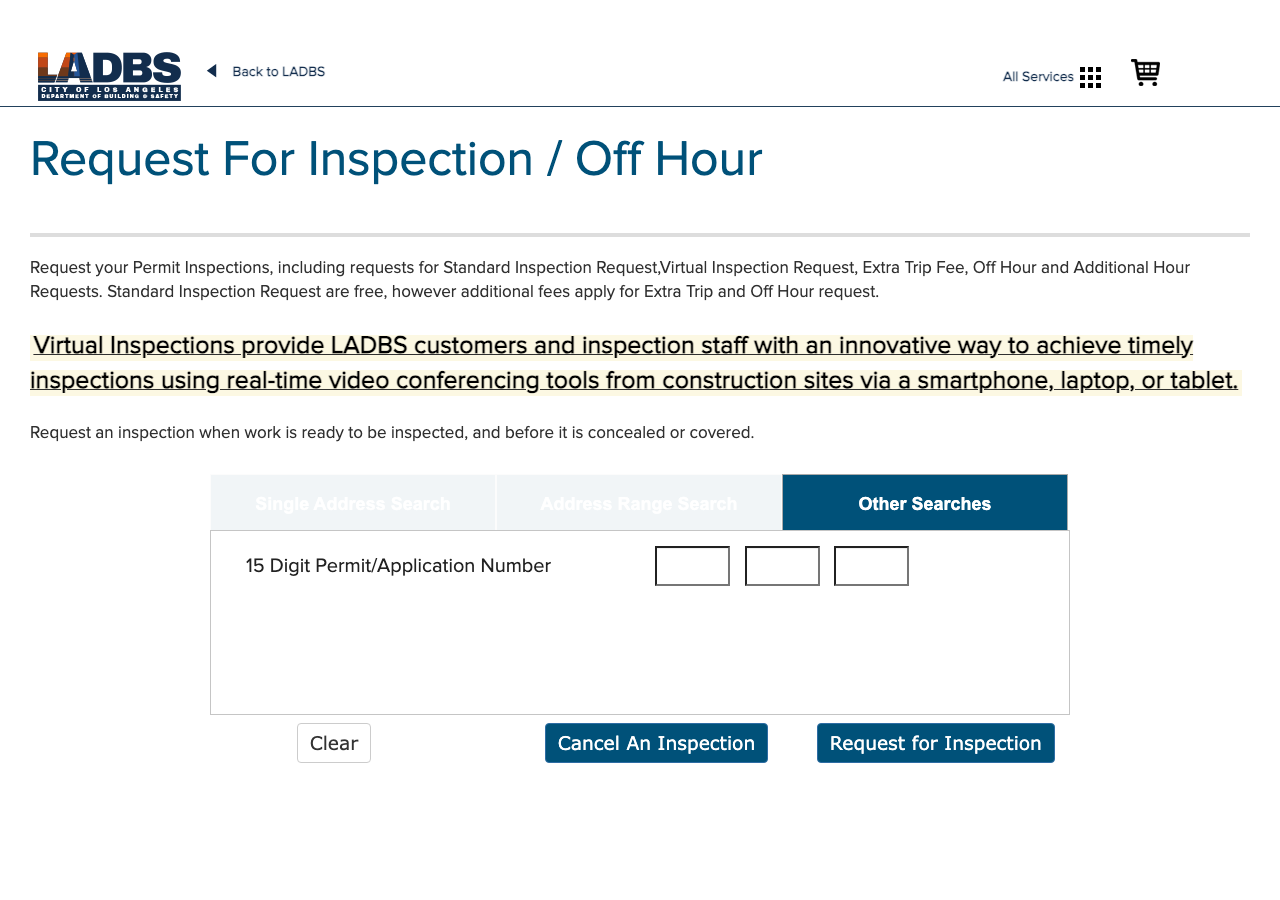
Average approval time — application to PTO
From the CPUC interconnection record. Bars show the average days taken each year; a year with no recorded projects is left blank rather than drawn as zero.