
City of Marina
Monterey County
City of Marina is a city authority in the State of California, serving 22,359 residents. 1,687 residential solar installs are on record here. This page is the permit route for that jurisdiction: the fifteen steps from working out who has a say over an address through to permission to operate, the documents this authority publishes, and 62 answers taken from those documents and dated.
Permitting 5 steps · 28 questions
Whether a permit is needed — Yes Q3 Electrical and building permits — Combined Q4 Plan review — Same day for over-the-counter applications, or 1-3 business days for electronic applications, Q18 Where you file — Citizenserve Online Permit Portal. Q20
- Permit required
- Yes98% source
- What it costs
- Itemized from the current fee schedule: Building/Electrical 'Combo Permit: Solar System' (SFR) $170 + Fire 'Photovoltaic Syst.85% source
- Plan review turnaround
- Same day for over-the-counter applications, or 1-3 business days for electronic applications, upon receipt of a complete application meeting the checklist/standard-plan requirements.95% source
- Key document
- permit application form cited by 5 open the document
-
Confirm who has a say over your address
A city address is usually permitted by the city, not the county — but not always, and some authorities keep building and hand electrical to someone else. Getting this wrong costs the whole submittal, because every requirement below belongs to whoever actually holds jurisdiction. Check the overlays in the same pass: an HOA, a historic district, a windstorm certification or a system-size cap can reshape the design, and all of them are cheaper to find now than after the array is laid out.
- Is this authority the AHJ for residential solar at this address? Yes 95% · municipal code
- What does this authority permit itself, and what does it delegate? Both 90% · department page
- Is a permit required for a residential rooftop PV system? Yes 98% · municipal code
- Is there a separate electrical permit, or is it combined? Combined 90% · fee schedule
- Is a HOA or architectural approval required first? No 90% · municipal code
- Is there a historic-district review? Conditional -- MMC 15.38.030(C): 'A use permit and/or architectural review may be required for properties on the city's list of historic resources as deemed necessary by the community development director.' Not required for non-listed properties. 92% · municipal code
- Is a wind or windstorm certification required? No 82% · municipal code
- Is a Specific Use Permit or Council approval ever required? Not required for a standard eligible system, which is administratively/nondiscretionarily approved by the Building Division per MMC 15.38.060(A). The Chief Building Official MAY require an administrative use permit only where there is 'substantial evidence' of a 'specific, adverse impact upon the public health and safety'; such a use-permit denial or requirement is appealable to the Planning Commission, not full Council. 88% · municipal code
- Is there a system-size cap on residential generation? Codified expedited-eligibility gate (not an absolute cap): 'no larger than ten kilowatts alternating current nameplate rating or thirty kilowatts thermal' (MMC 15.38.020(B)(1)), and the array 'does not exceed the maximum legal building height' (15.38.020(B)(4)). Systems above 10kW AC/30kW thermal are not barred but fall out of the MMC 15.38 ministerial/expedited track into standard plan review. Separately, Marina's zoning Height section (17.42.055) lists height exceptions for chimneys/vents/cupolas/spires and for towers/poles/water tanks, but does NOT include solar panels/collectors among either exception category -- a control-checked absence of any height BONUS for solar (distinct from the size-cap gate). 90% · municipal code
-
Check who is allowed to apply
Several authorities require the electrical permit to be pulled by a licensed electrician, or require the contractor to be registered with them BEFORE applying. Registration is not same-day. This is second on the list rather than fourth because it is the step most likely to stop the job before the drawings matter.
- Who is allowed to pull the electrical permit? Either 78% · permit application form
- Must the contractor be registered with this authority before applying? Yes 62% · permit application form
- Is a homeowner permitted to self-install and self-permit? Yes 88% · permit application form
-
Build the submittal package
Almost everywhere wants a site plan, a one-line or three-line electrical diagram, equipment cut sheets with listings, and a structural attachment detail. Build it against the published checklist rather than the last jurisdiction you worked in — the checklist is what the reviewer marks against.
- What documents make up a complete submittal? Per the City's 'Solar Eligibility Checklist for Expedited Plan Check / Permit Application' (PV Toolkit Document #2, localized with Marina's email and address): completed Building Permit Application; completed Eligibility Checklist (General/Electrical/Structural/Fire Safety sections); an 11x17 plan set signed by the designer; and 8.5x11 manufacturer's equipment specification sheets. 92% · published checklist
- How many copies, and in what format? Electronic -- the checklist's own Note 3 states applicants 'may submit electronically by emailing solarpermitting@ci.marina.ca.us' the application package as listed in Q8; the City's general Building Permits page separately directs all building permits to an Online Permit Portal (Citizenserve). 65% · published checklist
- Is a site plan required, and what must it show? Yes -- the Eligibility Checklist's Fire Safety section requires 'a diagram of the roof layout of all panels, modules, clear access pathways and approximate locations of electrical disconnecting means and roof access points,' and the General/Electrical sections require array/module layout, panel/subpanel size and MPPT/string configuration shown on the plan set. 90% · published checklist
-
Apply and pay
Most authorities now take the whole application through a portal, and several states cap or constrain what a residential solar permit may cost. Check whether plan check is billed separately before you quote the job.
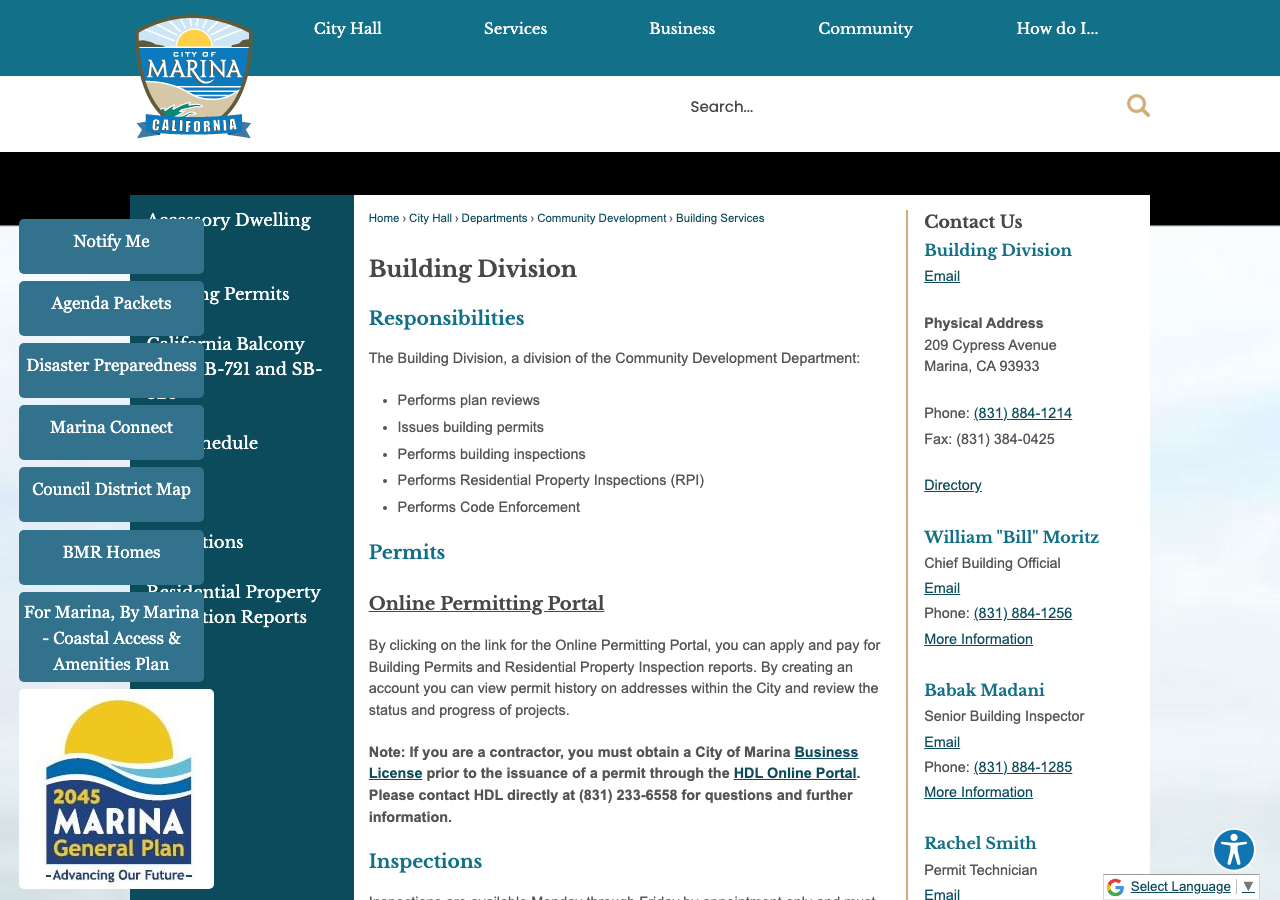
- Which permit portal does this authority use? Citizenserve Online Permit Portal. 90% · department page
- Can the whole application be completed online? Yes 88% · department page
- What does a residential solar permit cost? Itemized from the current fee schedule: Building/Electrical 'Combo Permit: Solar System' (SFR) $170 + Fire 'Photovoltaic Syst. Plan Review' $121 + general Permit Issuance fee $62 (Schedule C-2 header) = approximately $353 base, before any applicable Development Tech Surcharge (4%) or General Plan Maintenance surcharge (15%). 85% · fee schedule
- How is the fee calculated? Flat 85% · fee schedule
- Is there a separate plan-check fee? Yes 75% · fee schedule
-
Plan review — and start the utility in parallel
Interconnection is a separate process from the permit and usually the longer pole. Where the utility does not depend on the permit being issued, running both at once is the single biggest saving available on a residential job.
- What is the stated plan-review turnaround? Same day for over-the-counter applications, or 1-3 business days for electronic applications, upon receipt of a complete application meeting the checklist/standard-plan requirements. 95% · municipal code
- How long is an issued permit valid before it expires? 1 year (365 days) from issuance to achieving approval of a required inspection, with one 180-day extension available on written request, and further 180-day extensions available for a $1,000 (or original permit fee, whichever is less) fee per extension. 92% · municipal code
- Which utility handles interconnection here? PG&E (Pacific Gas & Electric Company) is the wires/interconnection utility; the City participates in Monterey Bay Community Power (MBCP, since rebranded region-wide to 3CE/Central Coast Community Energy) as its Community Choice Aggregator for electric generation, billed on the same PG&E bill. 82% · city-hosted utility flyer
28 questions answered against City of Marina’s own published documents
Q1 Is this authority the AHJ for residential solar at this address? Core Jurisdiction & scope
Yes
Why the confidence is not higherMMC 15.38.030(A): 'This chapter applies to the permitting of all small residential rooftop solar energy systems in the city.' Building Services Division is in-house per its own staff directory (all @cityofmarina.org).
municipal code checked 2026-08-31 https://marina.municipal.codes/Code/15.38.030
Q2 What does this authority permit itself, and what does it delegate? Core Jurisdiction & scope
Both
Why the confidence is not higherCity's own Building Permits page names in-house Building Services staff (Chief Building Official William Moritz, all @cityofmarina.org, no third-party firm named) issuing building AND electrical permits. Fire code adoption/enforcement is by Marina's own Fire Department (Fire Chief Kristan Maurer), also in-house -- not delegated to Monterey Fire, Seaside, or any county/JPA arrangement, unlike some neighboring Monterey County cities.
department page checked 2026-08-31 https://www.cityofmarina.org/123/Building-Permits
Q3 Is a permit required for a residential rooftop PV system? Core Jurisdiction & scope
Yes
Why the confidence is not higherMMC 15.38.030(A), quoted above.
municipal code checked 2026-08-31 https://marina.municipal.codes/Code/15.38.030
Q4 Is there a separate electrical permit, or is it combined? Core Jurisdiction & scope
Combined
Why the confidence is not higherCity's FY26 Fee Schedule (Reso. 2025-99, eff. 10/6/2025), Schedule C-2, lists a single 'Combo Permit: Solar System' line (SFR $170 / Non-SFR $492) alongside other combo-permit categories (EV Charging, Swimming Pool, In-Ground Spa) -- one combined permit/fee covers building+electrical for solar, not a separate electrical-only application.
fee schedule checked 2026-08-31 https://www.cityofmarina.org/documentcenter/view/16185
Q5 Who is allowed to pull the electrical permit? Core Who may apply
Either
Why the confidence is not higherThe City's Building Permit Application form (attached to the Solar Eligibility Checklist) has separate 'Owner-Builder/Agent' and 'Contractor' applicant blocks with no restriction to a specific electrician license class; the Owner-Builder's Declaration section explicitly allows an owner to pull the permit.
permit application form checked 2026-08-31 https://www.cityofmarina.org/documentcenter/view/5390
Q6 Must the contractor be registered with this authority before applying? Core Who may apply
Yes
Why the confidence is not higherThe Building Permit Application form has a 'CITY BUSINESS LICENSE #' field in the Contractor Info block, and the Fee Schedule carries a 'NEW BUSINESS LICENSE PROCESSING' fee (S-128) -- inference from the application form's own field plus the business-license fee schedule, not an explicit ordinance sentence requiring registration before a solar permit application specifically.
permit application form checked 2026-08-31 https://www.cityofmarina.org/documentcenter/view/5390
Q7 Is a homeowner permitted to self-install and self-permit? Who may apply
Yes
Why the confidence is not higherSame Building Permit Application form includes a full 'OWNER-BUILDER'S DECLARATION' section for self-permitting owners (Section 7044 B&P Code exemption checkboxes), and the City separately publishes an 'Owner Builder Packet' handout.
permit application form checked 2026-08-31 https://www.cityofmarina.org/documentcenter/view/5390
Q8 What documents make up a complete submittal? Core Submittal package
Per the City's 'Solar Eligibility Checklist for Expedited Plan Check / Permit Application' (PV Toolkit Document #2, localized with Marina's email and address): completed Building Permit Application; completed Eligibility Checklist (General/Electrical/Structural/Fire Safety sections); an 11x17 plan set signed by the designer; and 8.5x11 manufacturer's equipment specification sheets.
Why the confidence is not higherRead directly from the City's own current checklist PDF (note 3) via pdftotext.
published checklist checked 2026-08-31 https://www.cityofmarina.org/documentcenter/view/5390
Q9 How many copies, and in what format? Submittal package
Electronic -- the checklist's own Note 3 states applicants 'may submit electronically by emailing solarpermitting@ci.marina.ca.us' the application package as listed in Q8; the City's general Building Permits page separately directs all building permits to an Online Permit Portal (Citizenserve).
Why the confidence is not higherThe checklist's own submittal-email instruction uses the LEGACY 'ci.marina.ca.us' domain rather than the current 'cityofmarina.org' domain used everywhere else on the site -- flagged as a possible stale instruction inside an otherwise current-looking document; could not confirm whether paper/OTC submittal is still accepted for solar specifically.
published checklist checked 2026-08-31 https://www.cityofmarina.org/documentcenter/view/5390
Q10 Is a site plan required, and what must it show? Core Submittal package
Yes -- the Eligibility Checklist's Fire Safety section requires 'a diagram of the roof layout of all panels, modules, clear access pathways and approximate locations of electrical disconnecting means and roof access points,' and the General/Electrical sections require array/module layout, panel/subpanel size and MPPT/string configuration shown on the plan set.
Why the confidence is not higherVerbatim from the City's own current Solar Eligibility Checklist.
published checklist checked 2026-08-31 https://www.cityofmarina.org/documentcenter/view/5382
Q11 Is a one-line / three-line diagram required? Core Drawings & calculations
Nothing published by this authority.
Where we lookedSolar Eligibility Checklist (PV Toolkit Document #2) and Building Permit Application -- neither names a 'one-line' or 'three-line diagram' by that term; the checklist's electrical section implies an electrical layout is needed (MPPT/string counts, inverter configuration) but does not use the standard one-line-diagram language, and no separate 'Solar PV Standard Plan' document (referenced in MMC 15.38.050(C) as something the Building Division 'shall adopt') could be located on the City's site.
Q12 Are string and conductor calculations required? Drawings & calculations
Nothing published by this authority.
Where we lookedSame Solar Eligibility Checklist and Building Permit Application -- no explicit string/conductor calculation requirement stated by name; not published separately from the checklist.
Q13 Is a structural PE stamp required, and at what threshold? Core Engineering & stamps
Nothing published by this authority.
Where we lookedEligibility Checklist's Structural Requirements section only says 'A completed Structural Criteria and supporting documentation is attached (if required)' and cross-references a 'Structural Criteria' worksheet that is not itself published as a standalone document anywhere found on cityofmarina.org (checked the Building Forms page, the Building Permits page, and a site search for 'structural criteria').
Q14 Is an electrical PE stamp required, and at what threshold? Engineering & stamps
Nothing published by this authority.
Where we lookedNo electrical PE stamp threshold stated in the Eligibility Checklist, the Building Permit Application, or the Electrical Code chapter (MMC 15.28, a single one-section pure adoption chapter with no local amendments).
Q15 What does a residential solar permit cost? Core Fees
Itemized from the current fee schedule: Building/Electrical 'Combo Permit: Solar System' (SFR) $170 + Fire 'Photovoltaic Syst. Plan Review' $121 + general Permit Issuance fee $62 (Schedule C-2 header) = approximately $353 base, before any applicable Development Tech Surcharge (4%) or General Plan Maintenance surcharge (15%).
Why the confidence is not higherCity of Marina Fee Schedule, City Reso. No. 2025-99, effective October 6, 2025 (pdfinfo confirms CreationDate/ModDate 6 Oct 2025) -- current. Confidence held below 90 because the schedule's own surcharge lines read '4% of all Building Permit fees' and '15% surcharge of all Building Division Permit Fees' without stating explicitly whether the flat MEP Schedule C-2 combo-permit line is included in that base or not.
fee schedule checked 2026-08-31 https://www.cityofmarina.org/documentcenter/view/16185
Q16 How is the fee calculated? Core Fees
Flat
Why the confidence is not higherThe Solar Combo Permit and the Fire PV Plan Review are both flat dollar figures in the current fee schedule, distinct from the City's separate valuation-based general Building Permit / Building Plan Check tables (Schedule C-1) used for ordinary construction.
fee schedule checked 2026-08-31 https://www.cityofmarina.org/documentcenter/view/16185
Q17 Is there a separate plan-check fee? Fees
Yes
Why the confidence is not higherFire charges a distinct 'FIRE PHOTOVOLTAIC SYST. PLAN REVIEW $121 per plan' line separate from its field-inspection/permit fees. The Building/Electrical side's 'Combo Permit: Solar System' line, however, is a single flat figure that does not itself separately break out a plan-check component the way the general valuation-based Building Permit/Building Plan Check tables do.
fee schedule checked 2026-08-31 https://www.cityofmarina.org/documentcenter/view/16185
Q18 What is the stated plan-review turnaround? Core Timeline & validity
Same day for over-the-counter applications, or 1-3 business days for electronic applications, upon receipt of a complete application meeting the checklist/standard-plan requirements.
Why the confidence is not higherMMC 15.38.060(A), verbatim.
municipal code checked 2026-08-31 https://marina.municipal.codes/Code/15.38.060
Q19 How long is an issued permit valid before it expires? Timeline & validity
1 year (365 days) from issuance to achieving approval of a required inspection, with one 180-day extension available on written request, and further 180-day extensions available for a $1,000 (or original permit fee, whichever is less) fee per extension.
Why the confidence is not higherMMC 15.08.025 (Section 105.5 amended), adopted by Ord. 2025-16 in 2025 -- current CBC/local-amendment cycle. Note a drafting lag worth flagging: this 2025-adopted section still internally cross-references 'section 110.3 of the 2019 California Building Code' rather than the 2025 edition it is meant to amend.
municipal code checked 2026-08-31 https://marina.municipal.codes/Code/15.08.025
Q20 Which permit portal does this authority use? Core Portal & process
Citizenserve Online Permit Portal.
Why the confidence is not higherCity's Building Permits page: 'All building permits must be submitted online here: Online Permit Portal,' and the City's Re-Roofing Requirements handout names the platform explicitly: 'through the Citizenserve Permit Portal.'
department page checked 2026-08-31 https://www.cityofmarina.org/123/Building-Permits
Q21 Can the whole application be completed online? Core Portal & process
Yes
Why the confidence is not higherBuilding Permits page states plainly that all building permits must be submitted through the Online Permit Portal; the Re-Roofing handout confirms both permit submittal and inspection scheduling run through the same Citizenserve portal.
department page checked 2026-08-31 https://www.cityofmarina.org/123/Building-Permits
Q22 Which utility handles interconnection here? Core Utility interconnection
PG&E (Pacific Gas & Electric Company) is the wires/interconnection utility; the City participates in Monterey Bay Community Power (MBCP, since rebranded region-wide to 3CE/Central Coast Community Energy) as its Community Choice Aggregator for electric generation, billed on the same PG&E bill.
Why the confidence is not higherCity's own hosted 'MBCP Understanding Your Bill' flyer explains: 'PG&E will continue to charge for electric delivery... MBCP now procures energy on your behalf... both on one bill.' The sample bill in the flyer is dated 2018 (pre-rebrand to 3CE), so confidence is held below 90 for the current CCA brand name, though the underlying PG&E-delivery/CCA-generation structure matches the pattern independently confirmed for neighboring Monterey, Seaside and Soledad.
city-hosted utility flyer checked 2026-08-31 https://www.cityofmarina.org/documentcenter/view/7827
Q23 Where does the utility sit in the sequence? Core Utility interconnection
Nothing published by this authority.
Where we lookedCity's Building Permits, Inspections and MBCP-flyer pages -- none states where PG&E interconnection sits relative to the City's own permit sequence (before/after/parallel/no dependency). PG&E's own Rule 21 tariff was not independently retrieved in this run to confirm Marina-specific practice.
Q24 Is a HOA or architectural approval required first? Overlays & special cases
No
Why the confidence is not higherMMC 15.38.060(A) establishes an 'administrative, nondiscretionary review process' for standard-eligible systems with no HOA or architectural-review step; MMC 15.38.030(C) confines any architectural-review requirement to properties on the City's list of historic resources, 'as deemed necessary by the community development director.' State Solar Rights Act (Civil Code Sec. 714) would preempt a private HOA restriction in any event.
municipal code checked 2026-08-31 https://marina.municipal.codes/Code/15.38.060
Q25 Is there a historic-district review? Overlays & special cases
Conditional -- MMC 15.38.030(C): 'A use permit and/or architectural review may be required for properties on the city's list of historic resources as deemed necessary by the community development director.' Not required for non-listed properties.
Why the confidence is not higherVerbatim from the City's own codified solar ordinance.
municipal code checked 2026-08-31 https://marina.municipal.codes/Code/15.38.030
Q26 Is a wind or windstorm certification required? Overlays & special cases
No
Why the confidence is not higherMarina's Building Code chapter (MMC 15.08) contains only 6 total sections (adoption, 105.3.2, 105.5, 1505.1.1, non-adopted portions, and fire sprinklers) and its Electrical Code chapter (MMC 15.28) is a single one-section pure adoption with zero local amendments -- neither contains a wind/windstorm certification requirement. Read the full section list of both chapters to confirm no section was skipped.
municipal code checked 2026-08-31 https://marina.municipal.codes/Code/15.08
Q27 Is a Specific Use Permit or Council approval ever required? Overlays & special cases
Not required for a standard eligible system, which is administratively/nondiscretionarily approved by the Building Division per MMC 15.38.060(A). The Chief Building Official MAY require an administrative use permit only where there is 'substantial evidence' of a 'specific, adverse impact upon the public health and safety'; such a use-permit denial or requirement is appealable to the Planning Commission, not full Council.
Why the confidence is not higherMMC 15.38.060(A) and (C).
municipal code checked 2026-08-31 https://marina.municipal.codes/Code/15.38.060
Q28 Is there a system-size cap on residential generation? Overlays & special cases
Codified expedited-eligibility gate (not an absolute cap): 'no larger than ten kilowatts alternating current nameplate rating or thirty kilowatts thermal' (MMC 15.38.020(B)(1)), and the array 'does not exceed the maximum legal building height' (15.38.020(B)(4)). Systems above 10kW AC/30kW thermal are not barred but fall out of the MMC 15.38 ministerial/expedited track into standard plan review. Separately, Marina's zoning Height section (17.42.055) lists height exceptions for chimneys/vents/cupolas/spires and for towers/poles/water tanks, but does NOT include solar panels/collectors among either exception category -- a control-checked absence of any height BONUS for solar (distinct from the size-cap gate).
Why the confidence is not higherMMC 15.38.020 cites Gov. Code Sec.65850.5 (not the SB 379 Sec.65850.52) in 15.38.010 -- this is the pre-2015 AB 2188-era ordinance and predates SB 379; recorded as written, a documented statute conflation seen elsewhere in this corpus. Height-exception absence confirmed by reading 17.42.055 in full (recently amended by Ord. 2025-12/2025-09, so the omission is current, not stale).
municipal code checked 2026-08-31 https://marina.municipal.codes/Code/15.38.020
Lines marked with a percentage were read off this authority’s own published documents. Unmarked guidance is general good practice, not this jurisdiction’s rule — always confirm against the authority before you submit.
Install 5 steps · 20 questions
-
Build to the code editions actually in force here
The NEC edition a jurisdiction enforces is often a cycle behind the newest one published, and local amendments sit on top of it. Rapid shutdown, conductor sizing and labelling all change between editions, so the edition in force is the first thing to establish, not the last.
- Which NEC edition is in force? 2023 95% · municipal code
- Which building code edition is in force? 2025 California Building Code and 2025 California Residential Code, both adopted by Ord. 2025-16 (2025). 95% · municipal code
- Which fire code edition is in force? 2025 California Fire Code 95% · municipal code
- Are there local amendments to any of the above? Yes -- extensive CFC Chapter 12 (Solar/ESS) local amendments (MMC 15.32.550-15.32.610: placarding, hip/valley layout, ESS and fuel-cell signage) and CBC plan-review/permit-expiration amendments (MMC 15.08.020/.025), all current via Ord. 2025-16 (2025). BUT the Energy Code chapter (MMC 15.30) is still codified as 'California Energy Code, 2019 Edition' under Ord. 2019-03 (2019) -- a genuine cross-code lag: Building/Electrical/Fire/Residential are all on the 2025 cycle while Energy Code was never carried forward past 2019 in this same code. 92% · municipal code
- What is the installation judged against? Compliance with the California Electrical Code (2025, based on 2023 NEC), all applicable safety/performance standards of the CEC/IEEE/UL and, where applicable, CPUC rules for interconnection reliability -- per MMC 15.38.040(C); water-heating/pool-heating solar systems judged against accredited-listing-agency certification under the California Plumbing/Mechanical Code per 15.38.040(B). 90% · municipal code
-
Fire access, setbacks and pathways
Ridge setbacks and roof access pathways are fire-service requirements and they constrain the array layout. They are the most common cause of a redesign after the fire department comments on a plan set.
- What ridge setback and access pathways are required? A codified hip/valley setback: modules may not be placed closer than 1.5 feet to a hip or valley if modules are on both sides of it (placed directly adjacent is allowed if only one side of an equal-length hip/valley has modules) -- MMC 15.32.570 (CFC 1205.2.1.4, added by Ord. 2025-16). General 'clear access pathways' are required per the City's Eligibility Checklist Fire Safety section, but no additional ridge-setback figure beyond the hip/valley rule was found locally amended, meaning the unamended 2025 CFC 1205.4 pathway/setback figures apply by default. 85% · municipal code
-
Rapid shutdown
Which rapid-shutdown rule applies follows directly from the NEC edition in force, and the initiation device has to be at a location the fire service can reach and identify. This is inspected, and it is labelled.
- Is rapid shutdown required, and to which NEC edition? Rapid shutdown is required as a matter of the adopted 2025 California Electrical Code (based on 2023 NEC, Sec.690.12), which Marina adopts wholesale with no carve-out; no local ordinance text or City-published solar document explicitly names '690.12' or 'rapid shutdown' by name (checked the Eligibility Checklist, Building Permit Application, Re-Roof handout and Final Inspection handout -- zero hits for '690'). 75% · municipal code
-
Labels and placards
The NEC sets a baseline for permanent markings at the service equipment and the disconnecting means. On top of that, an authority may specify its own wording, and the utility may specify more again. Where any of them writes its own text, a generic off-the-shelf label set will not pass — this is the detail most often fixed on a return visit.
- Which placards does this authority require at the service equipment? Per MMC 15.32.550 (CFC 1205.1.1, added 2025): (1) a 'SOLAR DISCONNECT INSIDE PANEL' placard on the main service disconnect panel; (2) a 'SOLAR DISCONNECT' label at the inverter/PV circuit breaker; (3) additional signage (wording left to the fire code official) at any secondary power source (battery/generator) shutoff switch; (4) an installer-information placard (name + emergency phone) at the main disconnect. Separately, MMC 15.32.590/.600 (CFC 1207) require ESS disconnect placarding at/adjacent to the main panel and a 'BESS' placard for indoor battery installations; MMC 15.32.580 (CFC 1206.14) requires a 'FUEL CELL' placard for indoor fuel-cell systems. 96% · municipal code
- Does the authority specify placard wording of its own? Yes 96% · municipal code
- Does it specify letter height, colour or material? Yes -- Main-panel placard: red background, white capital letters at least 1/2 inch in a non-serif font, weather-resistant durable plastic with engraved letters (or other approved material). Circuit-disconnect label: contrasting-color capital letters at least 3/8 inch, non-serif font, durable adhesive material. BESS/FUEL CELL placards: 6-inch block letters with a 3/4-inch stroke on a contrasting background. 96% · municipal code
- Is a site plan / facility map placard required, and what must it show? A roof-layout diagram is required as part of the SUBMITTAL (not necessarily a physical placard): the Eligibility Checklist requires 'a diagram of the roof layout of all panels, modules, clear access pathways and approximate locations of electrical disconnecting means and roof access points.' No separate physical facility/site-map placard requirement at the service equipment (beyond the disconnect placards in Q38-40) was found. 70% · published checklist
- Where must the labels be placed? Main service disconnect panel exterior (SOLAR DISCONNECT INSIDE PANEL placard); adjacent to the inverter/PV circuit breaker (SOLAR DISCONNECT label); adjacent to the main disconnect (installer-information signage); at/adjacent to the main electrical panel for ESS disconnects. 92% · municipal code
-
Disconnect, storage and listed equipment
Where the AC disconnect must sit relative to the meter is usually the utility's rule, not the building department's. Battery storage frequently carries its own permit, its own inspection and its own fire conditions.
- Must equipment be on a specific approved list? Yes 85% · municipal code
- Are batteries permitted, and under what conditions? Batteries are permitted generally (the CFC's Chapter 12 ESS provisions are locally amended with their own disconnect/placarding rules -- MMC 15.32.590/.600), but a system 'without battery storage' is a GENERAL ELIGIBILITY requirement for the City's ministerial/expedited small-residential-rooftop-solar track (Eligibility Checklist Requirement D and MMC 15.38.020(B) small-system definition) -- a battery-paired system is not barred, it simply must go through the standard (non-expedited) permit review instead. 88% · published checklist
- Is there a separate ESS permit or inspection? No distinct ESS/battery permit TYPE appears in the current fee schedule (only a 'Combo Permit: Solar System' line and general Miscellaneous Building/Electrical Permit lines) -- a battery-paired system appears to be priced/processed as a standard (non-expedited) building/electrical permit, with the CFC ESS placarding/disconnect-location amendments (MMC 15.32.590/.600) enforced through that same review rather than a separately named ESS permit or inspection. 65% · fee schedule
- Is a ground mount treated as a structure? Not explicitly addressed -- Marina's R-1 zoning chapter (MMC 17.06.040) lists only four categories of permitted accessory structures (portable recreation structures; detached sheds/garages/outbuildings; screened nonportable recreation structures; garden structures) with no PV/solar or 'ground-mount' category named. A freestanding ground-mounted array would likely be captured by inference under the general accessory-structure rules (16 ft height cap, standard yard setbacks per 17.42.070) with no PV-specific carve-out, but this is inference, not a stated rule. 65% · municipal code
- Is there a local rule on service upgrades or busbar sizing? The City's own adopted Solar Eligibility Checklist (the standard plan/checklist required by MMC 15.38.050(C)) sets a 225A-or-less single-phase service busbar rating as one of several ELECTRICAL ELIGIBILITY criteria for the expedited/ministerial permitting path -- it is an eligibility gate for fast-track review, not a standalone codified electrical amendment: Marina's actual Electrical Code chapter (MMC 15.28) is a single-section pure adoption of the 2025 CEC with zero local amendment sections. 80% · published checklist
20 questions answered against City of Marina’s own published documents
Q29 Which NEC edition is in force? Core Code editions in force
2023
Why the confidence is not higherMMC 15.28.010: 'the California Electrical Code, 2025 Edition... are approved and adopted' (Ord. 2025-16, 2025). The 2025 CEC is based on the 2023 NEC (there is no '2025 NEC').
municipal code checked 2026-08-31 https://marina.municipal.codes/Code/15.28.010
Q30 Which building code edition is in force? Core Code editions in force
2025 California Building Code and 2025 California Residential Code, both adopted by Ord. 2025-16 (2025).
Why the confidence is not higherMMC 15.08.010 (CBC) and MMC 15.14.010 (CRC), both verbatim '2025 Edition... approved and adopted' by the same 2025 omnibus ordinance.
municipal code checked 2026-08-31 https://marina.municipal.codes/Code/15.08.010
Q31 Which fire code edition is in force? Code editions in force
2025 California Fire Code
Why the confidence is not higherMMC 15.32.005: 'the California Fire Code or CFC, 2025 Edition... are approved and adopted' (Ord. 2025-16, 2025).
municipal code checked 2026-08-31 https://marina.municipal.codes/Code/15.32.005
Q32 Are there local amendments to any of the above? Core Code editions in force
Yes -- extensive CFC Chapter 12 (Solar/ESS) local amendments (MMC 15.32.550-15.32.610: placarding, hip/valley layout, ESS and fuel-cell signage) and CBC plan-review/permit-expiration amendments (MMC 15.08.020/.025), all current via Ord. 2025-16 (2025). BUT the Energy Code chapter (MMC 15.30) is still codified as 'California Energy Code, 2019 Edition' under Ord. 2019-03 (2019) -- a genuine cross-code lag: Building/Electrical/Fire/Residential are all on the 2025 cycle while Energy Code was never carried forward past 2019 in this same code.
Why the confidence is not higherConfirmed by reading the full chapter-and-section list of MMC Title 15 and the individual adoption sections for each code (15.08.010, 15.14.010, 15.28.010, 15.30.010, 15.32.005).
municipal code checked 2026-08-31 https://marina.municipal.codes/Code/15.30.010
Q33 What is the installation judged against? Core Electrical
Compliance with the California Electrical Code (2025, based on 2023 NEC), all applicable safety/performance standards of the CEC/IEEE/UL and, where applicable, CPUC rules for interconnection reliability -- per MMC 15.38.040(C); water-heating/pool-heating solar systems judged against accredited-listing-agency certification under the California Plumbing/Mechanical Code per 15.38.040(B).
Why the confidence is not higherMMC 15.38.040, verbatim.
municipal code checked 2026-08-31 https://marina.municipal.codes/Code/15.38.040
Q34 Is there a local rule on service upgrades or busbar sizing? Electrical
The City's own adopted Solar Eligibility Checklist (the standard plan/checklist required by MMC 15.38.050(C)) sets a 225A-or-less single-phase service busbar rating as one of several ELECTRICAL ELIGIBILITY criteria for the expedited/ministerial permitting path -- it is an eligibility gate for fast-track review, not a standalone codified electrical amendment: Marina's actual Electrical Code chapter (MMC 15.28) is a single-section pure adoption of the 2025 CEC with zero local amendment sections.
Why the confidence is not higherDistinguishing an eligibility-checklist threshold from a codified local amendment, per known confusion elsewhere between national program eligibility figures and true local ordinance amendments.
published checklist checked 2026-08-31 https://www.cityofmarina.org/documentcenter/view/5390
Q35 Is a specific mounting system or attachment spacing required? Structural & mounting
Nothing published by this authority.
Where we lookedEligibility Checklist's submittal package requires manufacturer cut sheets for racking/mounting but states no specific attachment-spacing or mounting-system standard of its own; no separate mounting/attachment-spacing handout found on the Building Forms page.
Q36 What ridge setback and access pathways are required? Core Fire pathways & setbacks
A codified hip/valley setback: modules may not be placed closer than 1.5 feet to a hip or valley if modules are on both sides of it (placed directly adjacent is allowed if only one side of an equal-length hip/valley has modules) -- MMC 15.32.570 (CFC 1205.2.1.4, added by Ord. 2025-16). General 'clear access pathways' are required per the City's Eligibility Checklist Fire Safety section, but no additional ridge-setback figure beyond the hip/valley rule was found locally amended, meaning the unamended 2025 CFC 1205.4 pathway/setback figures apply by default.
Why the confidence is not higherMMC 15.32.570 read directly; confirmed no other CFC Chapter 12 amendment section addresses ridge setback beyond the hip/valley rule by reading the full amendment section list (15.32.550-.610).
municipal code checked 2026-08-31 https://marina.municipal.codes/Code/15.32.570
Q37 Is rapid shutdown required, and to which NEC edition? Core Rapid shutdown
Rapid shutdown is required as a matter of the adopted 2025 California Electrical Code (based on 2023 NEC, Sec.690.12), which Marina adopts wholesale with no carve-out; no local ordinance text or City-published solar document explicitly names '690.12' or 'rapid shutdown' by name (checked the Eligibility Checklist, Building Permit Application, Re-Roof handout and Final Inspection handout -- zero hits for '690').
Why the confidence is not higherInference from the wholesale 2025 CEC adoption (MMC 15.28.010) rather than an explicit local citation; the absence of the term '690' across every City PDF checked is a genuine, control-checked gap in Marina's own published materials, distinct from the codified requirement itself.
municipal code checked 2026-08-31 https://marina.municipal.codes/Code/15.28.010
Q38 Which placards does this authority require at the service equipment? Core Labels Signage & labelling
Per MMC 15.32.550 (CFC 1205.1.1, added 2025): (1) a 'SOLAR DISCONNECT INSIDE PANEL' placard on the main service disconnect panel; (2) a 'SOLAR DISCONNECT' label at the inverter/PV circuit breaker; (3) additional signage (wording left to the fire code official) at any secondary power source (battery/generator) shutoff switch; (4) an installer-information placard (name + emergency phone) at the main disconnect. Separately, MMC 15.32.590/.600 (CFC 1207) require ESS disconnect placarding at/adjacent to the main panel and a 'BESS' placard for indoor battery installations; MMC 15.32.580 (CFC 1206.14) requires a 'FUEL CELL' placard for indoor fuel-cell systems.
Why the confidence is not higherRead directly from the City's current (2025-adopted, Ord. 2025-16) locally-amended Fire Code chapter.
municipal code checked 2026-08-31 https://marina.municipal.codes/Code/15.32.550
Q39 Does the authority specify placard wording of its own? Core Labels Signage & labelling
Yes
Why the confidence is not higherExact wording specified verbatim: 'SOLAR DISCONNECT INSIDE PANEL', 'SOLAR DISCONNECT', 'BESS', 'FUEL CELL' (see Q38).
municipal code checked 2026-08-31 https://marina.municipal.codes/Code/15.32.550
Q40 Does it specify letter height, colour or material? Core Labels Signage & labelling
Yes -- Main-panel placard: red background, white capital letters at least 1/2 inch in a non-serif font, weather-resistant durable plastic with engraved letters (or other approved material). Circuit-disconnect label: contrasting-color capital letters at least 3/8 inch, non-serif font, durable adhesive material. BESS/FUEL CELL placards: 6-inch block letters with a 3/4-inch stroke on a contrasting background.
Why the confidence is not higherMMC 15.32.550, 15.32.580, 15.32.600, verbatim.
municipal code checked 2026-08-31 https://marina.municipal.codes/Code/15.32.550
Q41 Is a site plan / facility map placard required, and what must it show? Core Labels Signage & labelling
A roof-layout diagram is required as part of the SUBMITTAL (not necessarily a physical placard): the Eligibility Checklist requires 'a diagram of the roof layout of all panels, modules, clear access pathways and approximate locations of electrical disconnecting means and roof access points.' No separate physical facility/site-map placard requirement at the service equipment (beyond the disconnect placards in Q38-40) was found.
Why the confidence is not higherDistinguishing a submittal-plan requirement from a mounted facility placard; the Eligibility Checklist does not use CEC 705.10 terminology directly.
published checklist checked 2026-08-31 https://www.cityofmarina.org/documentcenter/view/5382
Q42 Does the UTILITY specify placards beyond the AHJ's? Core Labels Signage & labelling
Nothing published by this authority.
Where we lookedChecked the City's own solar documents (Eligibility Checklist, Fire Code amendments, Building Permit Application) for any reference to a PG&E-specific placard/signage requirement beyond the City's own; none of Marina's own published documents cite a PG&E document by name. PG&E's own DG/interconnection tariff documents were not independently retrieved in this run.
Q43 Where must the labels be placed? Core Labels Signage & labelling
Main service disconnect panel exterior (SOLAR DISCONNECT INSIDE PANEL placard); adjacent to the inverter/PV circuit breaker (SOLAR DISCONNECT label); adjacent to the main disconnect (installer-information signage); at/adjacent to the main electrical panel for ESS disconnects.
Why the confidence is not higherMMC 15.32.550 and 15.32.590, verbatim.
municipal code checked 2026-08-31 https://marina.municipal.codes/Code/15.32.550
Q44 Must equipment be on a specific approved list? Equipment listing
Yes
Why the confidence is not higherMMC 15.38.040(C): PV systems 'shall meet all applicable safety and performance standards established by the California Electrical Code, the Institute of Electrical and Electronics Engineers, and accredited testing laboratories such as Underwriters Laboratories.'
municipal code checked 2026-08-31 https://marina.municipal.codes/Code/15.38.040
Q45 Are batteries permitted, and under what conditions? Core Battery / ESS
Batteries are permitted generally (the CFC's Chapter 12 ESS provisions are locally amended with their own disconnect/placarding rules -- MMC 15.32.590/.600), but a system 'without battery storage' is a GENERAL ELIGIBILITY requirement for the City's ministerial/expedited small-residential-rooftop-solar track (Eligibility Checklist Requirement D and MMC 15.38.020(B) small-system definition) -- a battery-paired system is not barred, it simply must go through the standard (non-expedited) permit review instead.
Why the confidence is not higherMMC 15.38.020, the City's Eligibility Checklist, and MMC 15.32.590/.600 read together.
published checklist checked 2026-08-31 https://www.cityofmarina.org/documentcenter/view/5382
Q46 Is there a separate ESS permit or inspection? Battery / ESS
No distinct ESS/battery permit TYPE appears in the current fee schedule (only a 'Combo Permit: Solar System' line and general Miscellaneous Building/Electrical Permit lines) -- a battery-paired system appears to be priced/processed as a standard (non-expedited) building/electrical permit, with the CFC ESS placarding/disconnect-location amendments (MMC 15.32.590/.600) enforced through that same review rather than a separately named ESS permit or inspection.
Why the confidence is not higherAbsence-based inference from the current fee schedule (no ESS/battery line found) combined with the codified ESS fire-code amendments; not an explicit City statement that ESS inspection is or is not separate.
fee schedule checked 2026-08-31 https://www.cityofmarina.org/documentcenter/view/16185
Q47 Is a ground mount treated as a structure? Core Ground mount
Not explicitly addressed -- Marina's R-1 zoning chapter (MMC 17.06.040) lists only four categories of permitted accessory structures (portable recreation structures; detached sheds/garages/outbuildings; screened nonportable recreation structures; garden structures) with no PV/solar or 'ground-mount' category named. A freestanding ground-mounted array would likely be captured by inference under the general accessory-structure rules (16 ft height cap, standard yard setbacks per 17.42.070) with no PV-specific carve-out, but this is inference, not a stated rule.
Why the confidence is not higherRead the full accessory-structure list in MMC 17.06.040 plus the R-1 Building Height section (17.06.050); no PV or ground-mount-specific provision found anywhere in Title 17 that was checked.
municipal code checked 2026-08-31 https://marina.municipal.codes/Code/17.06.040
Q48 Where must the AC disconnect be, relative to the meter? Core Utility equipment
Nothing published by this authority.
Where we lookedChecked the Eligibility Checklist, Fire Code solar amendments (MMC 15.32.550-.610) and Building Permit Application for an AC-disconnect-to-meter proximity/location spec; none give a distance or location relative to the utility meter (only relative to the main panel/inverter). PG&E's own DG/Greenbook meter-proximity specification was not independently retrieved in this run.
Lines marked with a percentage were read off this authority’s own published documents. Unmarked guidance is general good practice, not this jurisdiction’s rule — always confirm against the authority before you submit.
Inspection 5 steps · 14 questions
-
Book it
Booking is a portal, a phone call or an email depending on the authority, and the notice required is rarely zero. Book before the work is finished rather than after — the lead time, not the work, is usually what sets the date.
- How is an inspection booked? Portal (Citizenserve, if the permit was submitted online), Email, or Phone (Inspection Line). 92% · department page
- Are same-day or AM/PM windows offered? General building inspections (per the Re-Roofing Requirements handout, not solar-specific) are 'typically available next day 8:00-12:00 (AM), and from 1:00-4:00 (PM)' -- AM/PM windows, generally next-day rather than same-day, though MMC 15.38.060(A) separately allows SAME-DAY permit ISSUANCE for over-the-counter solar applications. 78% · published handout
-
Know who turns up
Some authorities inspect their own solar work; some delegate it, and a few do not inspect the PV equipment itself at all. Who is coming determines what they will look at.
- Does this AHJ perform its own final solar inspection? Yes 95% · municipal code
- If delegated, to whom? Not applicable -- performed in-house by the City's own Building Division, not delegated to fire, a third-party firm, or another agency (see Q52). 90% · municipal code
-
Work the stages in order
A rough-in or mid-roof inspection, where one is required, has to happen before the work it covers is closed up. Missing a stage means opening something back up, and it is the most expensive kind of correction.
- Which inspections are required, and in what order? For eligible expedited systems: a single, consolidated inspection performed by the Building Division ('The inspection shall be done in a timely manner and should include consolidated inspections' -- MMC 15.38.060(H)). If it fails, a subsequent (re-)inspection is authorized (15.38.060(I)). Larger/non-expedited/ESS-paired systems would presumably follow the general residential inspection sequence (rough electrical, then final) though no solar-specific multi-stage sequence was found. 85% · municipal code
- Is a rough-in or mid-roof inspection required? No 85% · municipal code
-
Have the paperwork on site
The approved plan set, the permit, and the equipment listings should be on site and reachable. Inspectors routinely verify that installed equipment matches what was approved, and that the labels are the ones the plan set promised.
- Is there a published inspection checklist? Yes 75% · published checklist
- What must be on site at inspection? Approved plans and the issued permit must be on site. 90% · department page
- Does the inspector verify labels and listings? Yes (inferred) 70% · published checklist
-
Sign-off, and permission to operate
Passing gives you a final or an equivalent sign-off. That is not the same as permission to operate: PTO comes from the utility, and who tells the utility the inspection passed varies. A system left switched off for weeks is usually waiting on this handover.
- Is there a re-inspection fee? $148 (general 'Reinspections' line, Schedule C-2, Mechanical/Electrical/Plumbing Permit Fees) 78% · fee schedule
- How are corrections issued and cleared? For an incomplete APPLICATION: a written correction notice detailing all deficiencies is sent to the applicant for resubmission (MMC 15.38.060(F)). For a failed field INSPECTION: 'a subsequent inspection is authorized' (15.38.060(I)) -- no separate correction-notice mechanic described for inspection failures beyond re-inspection. 90% · municipal code
14 questions answered against City of Marina’s own published documents
Q49 How is an inspection booked? Core Booking & scheduling
Portal (Citizenserve, if the permit was submitted online), Email, or Phone (Inspection Line).
Why the confidence is not higherCity's Inspections page: 'You may also schedule an inspection through Online Permitting (if the permit was originally submitted online), Email, or by calling the Inspection Line at (831) 884-1241.'
department page checked 2026-08-31 https://www.cityofmarina.org/130/Inspections
Q50 How much notice is required? Core Booking & scheduling
Nothing published by this authority.
Where we lookedCity's Inspections page describes booking channels (portal/email/phone) and warns against calling before being ready, but states no specific advance-notice period (e.g. '24 hours' or '1 business day').
Q51 Are same-day or AM/PM windows offered? Booking & scheduling
General building inspections (per the Re-Roofing Requirements handout, not solar-specific) are 'typically available next day 8:00-12:00 (AM), and from 1:00-4:00 (PM)' -- AM/PM windows, generally next-day rather than same-day, though MMC 15.38.060(A) separately allows SAME-DAY permit ISSUANCE for over-the-counter solar applications.
Why the confidence is not higherRe-Roofing Requirements handout (Rev. 04/23/2025), a general (non-solar-specific) Building Division document.
published handout checked 2026-08-31 https://www.cityofmarina.org/documentcenter/view/15670
Q52 Does this AHJ perform its own final solar inspection? Core Who inspects
Yes
Why the confidence is not higherMMC 15.38.060(G): 'Only one inspection shall be required and performed by the building division for small residential rooftop solar energy systems eligible for expedited review.' (The identical model-ordinance phrasing appears in several Southern California cities in this corpus -- e.g. Claremont CMC 15.50.060(E), La Verne LVMC 18.106.060(F) -- confirming a shared statewide model-ordinance ancestor, now also confirmed here in Monterey County.)
municipal code checked 2026-08-31 https://marina.municipal.codes/Code/15.38.060
Q53 If delegated, to whom? Core Who inspects
Not applicable -- performed in-house by the City's own Building Division, not delegated to fire, a third-party firm, or another agency (see Q52).
Why the confidence is not higherMMC 15.38.060(G).
municipal code checked 2026-08-31 https://marina.municipal.codes/Code/15.38.060
Q54 Which inspections are required, and in what order? Core Stages & sequence
For eligible expedited systems: a single, consolidated inspection performed by the Building Division ('The inspection shall be done in a timely manner and should include consolidated inspections' -- MMC 15.38.060(H)). If it fails, a subsequent (re-)inspection is authorized (15.38.060(I)). Larger/non-expedited/ESS-paired systems would presumably follow the general residential inspection sequence (rough electrical, then final) though no solar-specific multi-stage sequence was found.
Why the confidence is not higherMMC 15.38.060(G)-(I).
municipal code checked 2026-08-31 https://marina.municipal.codes/Code/15.38.060
Q55 Is a rough-in or mid-roof inspection required? Stages & sequence
No
Why the confidence is not higherMMC 15.38.060(G) mandates only ONE inspection for eligible expedited systems, performed by the Building Division -- no separate rough-in or mid-roof inspection stage is codified for solar.
municipal code checked 2026-08-31 https://marina.municipal.codes/Code/15.38.060
Q56 Does the inspector verify labels and listings? Core What is checked
Yes (inferred)
Why the confidence is not higherThe Eligibility Checklist's own Fire Safety completeness item C ('All required markings and labels are provided') must be satisfied before/at the single consolidated inspection under MMC 15.38.060; not an explicit statement that the inspector personally verifies UL/CEC listings, but the checklist ties label/marking completeness directly to the inspection-eligible package.
published checklist checked 2026-08-31 https://www.cityofmarina.org/documentcenter/view/5382
Q57 Is there a published inspection checklist? Core What is checked
Yes
Why the confidence is not higherThe City's own 'Solar Eligibility Checklist for Expedited Plan Check / Permit Application' functions as the published pre-inspection completeness checklist (General/Electrical/Structural/Fire Safety items), though it is framed as a permitting eligibility checklist rather than a standalone field-inspection checklist.
published checklist checked 2026-08-31 https://www.cityofmarina.org/documentcenter/view/5382
Q58 What must be on site at inspection? Core Documents on site
Approved plans and the issued permit must be on site.
Why the confidence is not higherCity's Inspections page: 'Any time you are working on your project, have your approved plans and permits on site. No inspection will be approved without them.'
department page checked 2026-08-31 https://www.cityofmarina.org/130/Inspections
Q59 Is there a re-inspection fee? Corrections & re-inspection
$148 (general 'Reinspections' line, Schedule C-2, Mechanical/Electrical/Plumbing Permit Fees)
Why the confidence is not higherCurrent Fee Schedule, Reso. 2025-99, eff. 10/6/2025 -- this is a general reinspection fee, not a solar-specific line, so it is inference that it applies to a failed solar inspection under MMC 15.38.060(I)'s 'subsequent inspection.'
fee schedule checked 2026-08-31 https://www.cityofmarina.org/documentcenter/view/16185
Q60 How are corrections issued and cleared? Corrections & re-inspection
For an incomplete APPLICATION: a written correction notice detailing all deficiencies is sent to the applicant for resubmission (MMC 15.38.060(F)). For a failed field INSPECTION: 'a subsequent inspection is authorized' (15.38.060(I)) -- no separate correction-notice mechanic described for inspection failures beyond re-inspection.
Why the confidence is not higherMMC 15.38.060(F) and (I), verbatim.
municipal code checked 2026-08-31 https://marina.municipal.codes/Code/15.38.060
Q61 What is issued on pass? Core Final sign-off & PTO
Nothing published by this authority.
Where we lookedChecked the Eligibility Checklist, MMC 15.38.060, the Inspections page, and the 'Minimum Requirements for a Final Inspection of a Single Family Dwelling' handout (which discusses a whole-house 'FINALED UNDER MINIMUM CODE STANDARDS' note, not solar-specific) -- no document names what is specifically issued for a passed solar inspection (CO / Final / Green Tag / Letter).
Q62 Who notifies the utility for PTO? Core Final sign-off & PTO
Nothing published by this authority.
Where we lookedNone of Marina's own Building, Fire, or utility-adjacent pages (Building Permits, Inspections, MBCP flyer) state who is responsible for notifying PG&E/MBCP for Permission to Operate; PG&E's own NEM/Rule 21 interconnection documents were not independently retrieved in this run.
Lines marked with a percentage were read off this authority’s own published documents. Unmarked guidance is general good practice, not this jurisdiction’s rule — always confirm against the authority before you submit.
Jurisdiction & key facts
The standing 62-question set, answered for City of Marina against this authority’s own published documents. Every answer carries the confidence it was recorded at and the document it came from. Where nothing is published we say so and show where we looked — a blank here is a finding, not a gap.
City of Marina is the authority having jurisdiction 88% confidence
- Holds
- Building and Electrical permitting/plan-check/inspection, in-house (Community Development Department, Building Services Division -- Chief Building Official William 'Bill' Moritz, Senior Building Inspector Babak Madani, Permit Technician Rachel Smith, Code Enforcement Manager Marisa Huntley, all on the @cityofmarina.org domain, no third-party firm named anywhere checked -- staff directory, fee-schedule staffing, application forms). Fire code adoption AND enforcement (including the locally-amended CFC Chapter 12 solar/ESS placarding rules) is by the City's own Marina Fire Department (Fire Chief Kristan Maurer, own station at 211 Hillcrest Ave, own permits list, own fee-schedule lines including a dedicated 'FIRE PHOTOVOLTAIC SYST. PLAN REVIEW $121' line) -- NOT delegated to Monterey Fire Department, Seaside Fire, or any county/JPA arrangement, unlike some other Monterey County cities' briefs would suggest. MMC 15.38.060(G) requires only ONE combined inspection, performed by the Building Division, for expedited-eligible solar -- Fire does not run a separate field inspection for those systems.
- Overridden by
- Solar Rights Act (Civil Code Sec.714), incorporated into MMC 15.38.010/.060(E)-(F); AB 130 (Stats. 2025, Ch.22) freezes any MORE-restrictive local residential-code amendment 1 Oct 2025-1 Jun 2031 -- relevant because Marina's CBC/CRC/CEC/CFC were all re-adopted via Ord. 2025-16 in 2025, close to the freeze window. A separate local overlay reaches ground disturbance, not rooftop PV: MMC Ch.15.56 'Digging and Excavation on the Former Fort Ord' makes it unlawful to disturb TEN CUBIC FEET OR MORE of soil (Sec.15.56.040) without a Public Works permit within any city-council-designated 'ORD' (Ordnance Remediation) district on former Fort Ord land (Sec.15.56.030) -- a materially LOWER threshold than the 10-cubic-YARD figure found in neighboring Seaside's equivalent overlay, and one that plausibly reaches a residential ground-mount PV footing (though not rooftop PV, which involves no ground disturbance) if the specific parcel sits within a designated ORD district; could not confirm from the City's site which specific parcels currently carry that designation. Marina's own certified Local Coastal Program (MMC Ch.17.40, Coastal Zoning; Coastal Implementation Plan dated 1982) requires a Coastal Development Permit for development within the mapped Coastal Zone unless categorically excluded -- the code's own text (17.40.090(G)) states no categorical exclusion is currently in effect for Marina -- but the City's own fee schedule offers a distinct, cheaper 'Coastal Development Permit Exemption' application ($272, vs. $1,869 for a full CDP), which is plausibly the administrative route for a normal rooftop retrofit invoking the state Coastal Act's own SFR-improvement exemption (Pub. Res. Code Sec.30610); this is inference, not a City statement naming solar specifically.
- Why not higher
- City's own Building Permits staff directory (all @cityofmarina.org) and the codified small-residential-rooftop-solar ordinance (MMC 15.38) vest permitting authority in the City's own Building Division. Fire finding is the City's own current Fire Department page (2026 Fire Chief's message) plus its own fee schedule's PV-specific line. Reduced from 95 because (a) the exact boundary/parcels of the Fort Ord 'ORD' overlay districts could not be independently confirmed from the City's GIS or planning pages in this run, and (b) the LCP-certification/categorical-exclusion interplay for a routine rooftop PV retrofit specifically is inference bridging two of the City's own documents (the coastal ordinance text and the fee schedule's exemption line) rather than a single explicit City statement.
- Permit required
- Yes98%
- Permit cost
- Itemized from the current fee schedule: Building/Electrical 'Combo Permit: Solar System' (SFR) $170 + Fire 'Photovoltaic Syst.85%
- Plan review
- Same day for over-the-counter applications, or 1-3 business days for electronic applications, upon receipt of a complete application meeting the checklist/standard-plan requirements.95%
- Portal
- Citizenserve Online Permit Portal.90%
- Electrical code
- 202395%
- Own placard wording
- Yes96%
- Booking an inspection
- Portal (Citizenserve, if the permit was submitted online), Email, or Phone (Inspection Line).92%
Labels & placards for this authority
City of Marina writes its own placard wording. A standard NEC label set will not satisfy it — the exact text, and in most cases the size, colour and font, are specified below.
Wording 96%
Yes
Size, colour & material 96%
Yes -- Main-panel placard: red background, white capital letters at least 1/2 inch in a non-serif font, weather-resistant durable plastic with engraved letters (or other approved material). Circuit-disconnect label: contrasting-color capital letters at least 3/8 inch, non-serif font, durable adhesive material. BESS/FUEL CELL placards: 6-inch block letters with a 3/4-inch stroke on a contrasting background.
Where they go 92%
Main service disconnect panel exterior (SOLAR DISCONNECT INSIDE PANEL placard); adjacent to the inverter/PV circuit breaker (SOLAR DISCONNECT label); adjacent to the main disconnect (installer-information signage); at/adjacent to the main electrical panel for ESS disconnects.
What the utility wants on top None%
Each figure above is sourced and dated in the full answer set below (questions 38–43). Where an authority’s own published sheet is older than the code it has adopted, the answer says so.
Average approval time — application to PTO
From the CPUC interconnection record. Bars show the average days taken each year; a year with no recorded projects is left blank rather than drawn as zero.