
City of Monterey
Monterey County
City of Monterey is a city authority in the State of California, serving 30,218 residents. 1,156 residential solar installs are on record here. This page is the permit route for that jurisdiction: the fifteen steps from working out who has a say over an address through to permission to operate, the documents this authority publishes, and 62 answers taken from those documents and dated.
Permitting 5 steps · 28 questions
Whether a permit is needed — Yes Q3 Electrical and building permits — Combined Q4 Plan review — 3 business days for a complete expedited small-residential-rooftop-solar application (CORE, codified). Q18 Where you file — My Monterey Portal (www.mymontereyportal.org), also accessible via the 'MY Monterey Gov' mobile app -- a general municipal online permitting portal (Liferay-based… Q20
- Permit required
- Yes98% source
- What it costs
- $450 flat, for systems <=10kW AC (FY27 Master Fee Schedule); larger residential systems fall to the City's valuation-based Building Permit Fee table (tiered,92% source
- Plan review turnaround
- 3 business days for a complete expedited small-residential-rooftop-solar application (CORE, codified).92% source
- Key document
- published checklist cited by 6 open the document
-
Confirm who has a say over your address
A city address is usually permitted by the city, not the county — but not always, and some authorities keep building and hand electrical to someone else. Getting this wrong costs the whole submittal, because every requirement below belongs to whoever actually holds jurisdiction. Check the overlays in the same pass: an HOA, a historic district, a windstorm certification or a system-size cap can reshape the design, and all of them are cheaper to find now than after the array is laid out.
- Is this authority the AHJ for residential solar at this address? Yes 95% · municipal code
- What does this authority permit itself, and what does it delegate? Both 90% · department page
- Is a permit required for a residential rooftop PV system? Yes 98% · municipal code
- Is there a separate electrical permit, or is it combined? Combined 85% · permit application form
- Is a HOA or architectural approval required first? No HOA approval may be required as a condition of permit approval (City is affirmatively barred from conditioning on it); no architectural review is required for a standard rooftop PV retrofit on an existing single-family home outside a D-1/D-2 design-overlay district, since Sec.38-188's applicability list (new construction, 2-story additions, C/CO/CR/I-R/O/P districts, D-overlay districts) does not reach it. 85% · municipal code
- Is there a historic-district review? Conditionally yes for properties on the City's historic-resource lists. MCC Sec.9-88(c): 'A use permit and/or architectural review may be required for properties on the City's list of historic resources as deemed necessary by the Chief of Planning, Engineering, and Environmental Compliance.' Separately, MCC Sec.38-74b(D) routes any alteration on a surveyed/listed property that does NOT conform to the Secretary of the Interior's Standards to Historic Preservation Commission review; alterations that DO conform follow the regular permit process. Monterey's historic reach is unusually broad: it extends beyond formally H-1/H-2/H-D-zoned landmarks to any property on the City's Reconnaissance Survey List or Adopted Survey List (Sec.38-74a), which the City intends to eventually cover citywide. 90% · municipal code
- Is a wind or windstorm certification required? No separate wind/windstorm certification is required; wind (and seismic) loading is addressed through the standard CBC structural-analysis path -- e.g., ballasted systems require full engineering analysis under CBC Sec.1613.3 -- rather than a distinct certification document. 68% · published checklist
- Is a Specific Use Permit or Council approval ever required? Yes, possible in two situations: (1) the Chief Building Official may require a Use Permit if the official finds, based on substantial evidence, that the solar system 'could have a specific, adverse impact upon the public health and safety' (appealable to the Planning Commission); (2) a Use Permit and/or architectural review may be required for historic-listed properties at the Chief of Planning's discretion. 90% · municipal code
- Is there a system-size cap on residential generation? 10 kW AC nameplate / 30 kW thermal, for a system to qualify as a 'small residential rooftop solar energy system' eligible for the expedited/administrative permit path; also must be on a single- or duplex-family dwelling and not exceed the City's maximum legal building height. NOTE a live tension: MCC Sec.38-106(a) separately EXEMPTS 'existing structures for solar collection devices... on existing buildings' from height limits altogether, and Sec.38-106(b) allows up to 20 feet above the district height limit with a Use Permit -- both of which sit alongside, and are more generous than, the height cap baked into the Sec.9-86 solar-ordinance definition. Both are reported; neither is resolved. 88% · municipal code
-
Check who is allowed to apply
Several authorities require the electrical permit to be pulled by a licensed electrician, or require the contractor to be registered with them BEFORE applying. Registration is not same-day. This is second on the list rather than fourth because it is the step most likely to stop the job before the drawings matter.
- Who is allowed to pull the electrical permit? Either 88% · department FAQ page
- Must the contractor be registered with this authority before applying? No 62% · permit application form
- Is a homeowner permitted to self-install and self-permit? Yes 88% · department FAQ page
-
Build the submittal package
Almost everywhere wants a site plan, a one-line or three-line electrical diagram, equipment cut sheets with listings, and a structural attachment detail. Build it against the published checklist rather than the last jurisdiction you worked in — the checklist is what the reviewer marks against.
- What documents make up a complete submittal? Per the 'Solar Photovoltaic (PV) Systems Expedited Submittal Checklist' (Rev 12/30/2024): completed permit application; plans (min 11x17) as one PDF; the signed checklist itself; manufacturer's equipment spec sheets incorporated into plans; front sheet with owner/designer info, scope of work, occupancy/construction type, code editions cited; sheet index; site plan (array/module layout, panel/subpanel size+location, existing structures, ridgeline setbacks per CFC1205, property-line setbacks, north arrow); fire-sprinkler status; module/string counts; single-line diagram; roof-structural adequacy statement (full engineering analysis required if ballasted, per CBC1613.3); anchorage details; elevation showing wall-mounted equipment; PV cut sheets (modules, racking, inverter, microinverter, optimizers); grounding, wiring, and CEC-citation notes. 96% · published checklist
- How many copies, and in what format? Electronic only -- one combined PDF file, submitted by email or via the new online portal; no paper accepted. 92% · published checklist
- Is a site plan required, and what must it show? Yes -- must show PV array/modules (each string identified), location/size/amperage of main and sub electrical panels, all existing structures, setbacks from adjacent roof ridgelines per CFC Sec.1205, property-line setbacks, and a north arrow. 95% · published checklist
- Is a one-line / three-line diagram required? Yes 95% · published checklist
- Are string and conductor calculations required? Conditionally -- checklist states 'electrical load calculations may be required' and requires wire/breaker sizes be identified on the single-line diagram, but does not mandate a separate string/conductor calculation package for every job. 78% · published checklist
- Is a structural PE stamp required, and at what threshold? A structural statement/engineering analysis is required for all systems; a FULL PE structural engineering analysis is specifically required for ballasted systems, per CBC Sec.1613.3. 85% · published checklist
-
Apply and pay
Most authorities now take the whole application through a portal, and several states cap or constrain what a residential solar permit may cost. Check whether plan check is billed separately before you quote the job.
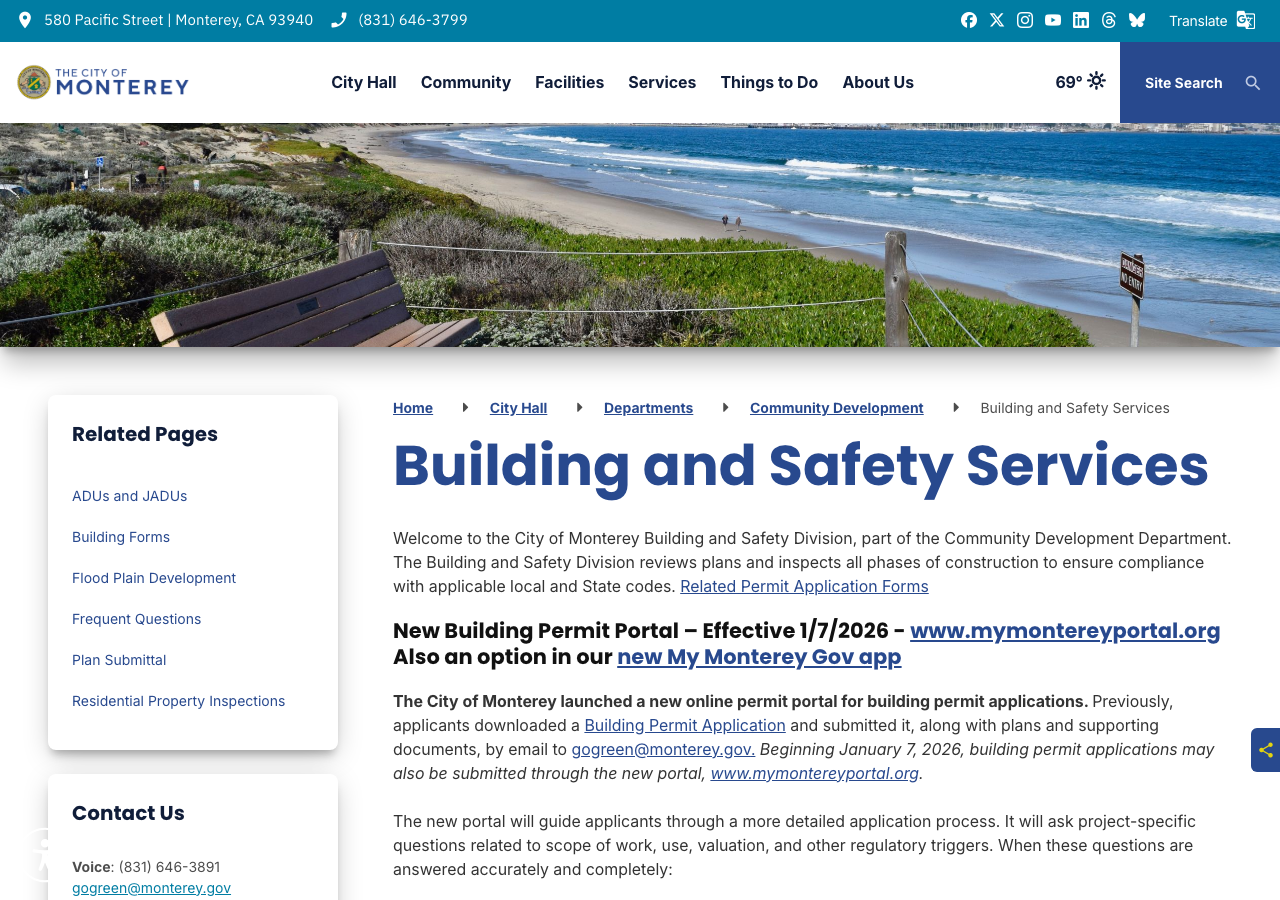
- Which permit portal does this authority use? My Monterey Portal (www.mymontereyportal.org), also accessible via the 'MY Monterey Gov' mobile app -- a general municipal online permitting portal (Liferay-based 'Monterey Online Service Center'), effective 1/7/2026. Not SolarAPP+ or Symbium branded. 88% · department page
- Can the whole application be completed online? Largely yes for building permits (including solar PV) as of 1/7/2026 -- 'Required plan reviews are automatically identified, applicable fees are automatically calculated'; project-specific checklists (e.g. the Solar Checklist) are uploaded as part of the same portal submittal. The City's page also still separately offers email submittal (gogreen@monterey.gov) as of the same page text, so a fully paperless email path also remains available in parallel. 80% · department page
- What does a residential solar permit cost? $450 flat, for systems <=10kW AC (FY27 Master Fee Schedule); larger residential systems fall to the City's valuation-based Building Permit Fee table (tiered, starting $116.50 for $0-$1,000 valuation) plus a separate Plan Check fee. 92% · fee schedule
- How is the fee calculated? Flat for <=10kW AC ($450, state-mandated cap); Valuation-based/tiered for systems over that threshold. 85% · fee schedule
- Is there a separate plan-check fee? For <=10kW, no -- the $450 is a single all-inclusive fee under the state fee cap. For larger systems requiring full plan check, yes, a separate Plan Check fee (hourly $185/hr, or the tiered Plan Check-Project Valuation table) applies. 72% · fee schedule
-
Plan review — and start the utility in parallel
Interconnection is a separate process from the permit and usually the longer pole. Where the utility does not depend on the permit being issued, running both at once is the single biggest saving available on a residential job.
- What is the stated plan-review turnaround? 3 business days for a complete expedited small-residential-rooftop-solar application (CORE, codified). General (non-expedited) building-permit plan review is stated separately as ~15-20 business days depending on project size. 92% · municipal code
- How long is an issued permit valid before it expires? A submitted application expires after 180 days if no permit is issued. Once issued, a permit expires if the project has not passed one of its required inspections within one year of issuance (extendable in 90-day increments, up to 10 times, on written request). 88% · municipal code
- Which utility handles interconnection here? Pacific Gas & Electric (PG&E) 95% · city utilities page
- Where does the utility sit in the sequence? Parallel, with PG&E approval required in hand by the time of the Meter Release/final electrical inspection -- not a precondition to permit issuance itself. 68% · published checklist
28 questions answered against City of Monterey’s own published documents
Q1 Is this authority the AHJ for residential solar at this address? Core Jurisdiction & scope
Yes
Why the confidence is not higherMCC Sec.9-88(a): 'This article applies to the permitting of all small residential rooftop solar energy systems in the City.' Building & Safety Division is in-house per its own staff directory (all @monterey.gov).
municipal code checked 2026-08-31 https://monterey.municipal.codes/Code/9-88
Q2 What does this authority permit itself, and what does it delegate? Core Jurisdiction & scope
Both
Why the confidence is not higherBuilding and Electrical are both issued/inspected in-house by the Community Development Dept's Building and Safety Division (named staff on city domain). Fire is enforced by Monterey's own Fire Dept, which separately also serves as contract provider to 4 neighboring jurisdictions (delegation runs outward, not in).
department page checked 2026-08-31 https://monterey.gov/your_city_hall/departments/community_development/building_and_safety_services/index.php
Q3 Is a permit required for a residential rooftop PV system? Core Jurisdiction & scope
Yes
Why the confidence is not higherMCC Sec.9-88(a), quoted above, plus the Building Permit Application form itself lists 'solar PV systems' as a covered project type.
municipal code checked 2026-08-31 https://monterey.municipal.codes/Code/9-88
Q4 Is there a separate electrical permit, or is it combined? Core Jurisdiction & scope
Combined
Why the confidence is not higherA single 'Building Permit Application' form is used for 're-roofs, mechanical, electrical, plumbing, solar PV systems... and all other building projects' -- there is no separate stand-alone electrical-only application path for solar specifically.
permit application form checked 2026-08-31 https://monterey.gov/Document-Center/Departments/Community-Development/Building-Safety/Building-Forms/Building-Permit-Application.pdf
Q5 Who is allowed to pull the electrical permit? Core Who may apply
Either
Why the confidence is not higherFAQ page and the Solar Checklist both state: 'Permits may only be issued to the property owner or a properly licensed contractor.' Not restricted to a specific electrician license class in the City's own text.
department FAQ page checked 2026-08-31 https://monterey.gov/your_city_hall/departments/community_development/building_and_safety_services/frequent_questions.php
Q6 Must the contractor be registered with this authority before applying? Core Who may apply
No
Why the confidence is not higherThe Building Permit Application form has a field for CSLB 'License No.' but no separate City business-license/contractor-registration field or instruction anywhere in the Solar Checklist, OTC Electrical Checklist, or FAQ. Absence-based inference from the City's own application form, not an explicit 'no registration required' statement.
permit application form checked 2026-08-31 https://monterey.gov/Document-Center/Departments/Community-Development/Building-Safety/Building-Forms/Building-Permit-Application.pdf
Q7 Is a homeowner permitted to self-install and self-permit? Who may apply
Yes
Why the confidence is not higherSame FAQ/Checklist language: permits may be issued to 'the property owner' directly, i.e., owner-builder self-permit is allowed. FAQ separately warns owner-builders 'should be careful and understand the risks involved.'
department FAQ page checked 2026-08-31 https://monterey.gov/your_city_hall/departments/community_development/building_and_safety_services/frequent_questions.php
Q8 What documents make up a complete submittal? Core Submittal package
Per the 'Solar Photovoltaic (PV) Systems Expedited Submittal Checklist' (Rev 12/30/2024): completed permit application; plans (min 11x17) as one PDF; the signed checklist itself; manufacturer's equipment spec sheets incorporated into plans; front sheet with owner/designer info, scope of work, occupancy/construction type, code editions cited; sheet index; site plan (array/module layout, panel/subpanel size+location, existing structures, ridgeline setbacks per CFC1205, property-line setbacks, north arrow); fire-sprinkler status; module/string counts; single-line diagram; roof-structural adequacy statement (full engineering analysis required if ballasted, per CBC1613.3); anchorage details; elevation showing wall-mounted equipment; PV cut sheets (modules, racking, inverter, microinverter, optimizers); grounding, wiring, and CEC-citation notes.
Why the confidence is not higherRead directly from the City's own current (Dec 2024) checklist PDF via pdftotext.
published checklist checked 2026-08-31 https://monterey.gov/Document-Center/Departments/Community-Development/Building-Safety/Building-Forms/Solar-Checklist.pdf
Q9 How many copies, and in what format? Submittal package
Electronic only -- one combined PDF file, submitted by email or via the new online portal; no paper accepted.
Why the confidence is not higherGeneral Intake Checklist: 'A plan set in PDF format... this must be ONE DOCUMENT.' FAQ: 'We are no longer able to accept paper plans and documents.' Building & Safety page: 'The Building & Safety Division is paperless.'
published checklist checked 2026-08-31 https://monterey.gov/Document-Center/Departments/Community-Development/Building-Safety/Building-Forms/General-Intake-Checklist.pdf
Q10 Is a site plan required, and what must it show? Core Submittal package
Yes -- must show PV array/modules (each string identified), location/size/amperage of main and sub electrical panels, all existing structures, setbacks from adjacent roof ridgelines per CFC Sec.1205, property-line setbacks, and a north arrow.
Why the confidence is not higherVerbatim from the Solar Checklist site-plan bullet list.
published checklist checked 2026-08-31 https://monterey.gov/Document-Center/Departments/Community-Development/Building-Safety/Building-Forms/Solar-Checklist.pdf
Q11 Is a one-line / three-line diagram required? Core Drawings & calculations
Yes
Why the confidence is not higherSolar Checklist: 'Provide a Single Line Diagram, identifying the size (amperage) and location of main electrical service and electrical sub-panel... Identify wire sizes and circuit breakers/fuse size.'
published checklist checked 2026-08-31 https://monterey.gov/Document-Center/Departments/Community-Development/Building-Safety/Building-Forms/Solar-Checklist.pdf
Q12 Are string and conductor calculations required? Drawings & calculations
Conditionally -- checklist states 'electrical load calculations may be required' and requires wire/breaker sizes be identified on the single-line diagram, but does not mandate a separate string/conductor calculation package for every job.
Why the confidence is not higherChecklist wording is conditional ('may be required'), not an absolute mandate, on its face.
published checklist checked 2026-08-31 https://monterey.gov/Document-Center/Departments/Community-Development/Building-Safety/Building-Forms/Solar-Checklist.pdf
Q13 Is a structural PE stamp required, and at what threshold? Core Engineering & stamps
A structural statement/engineering analysis is required for all systems; a FULL PE structural engineering analysis is specifically required for ballasted systems, per CBC Sec.1613.3.
Why the confidence is not higherChecklist: 'Ballasted systems require a full engineering analysis per CBC 1613.3.' For non-ballasted, only 'a statement or engineering analysis that the existing roof framing is adequate' is required, leaving the PE-stamp threshold for attached systems somewhat open (Building Official discretion).
published checklist checked 2026-08-31 https://monterey.gov/Document-Center/Departments/Community-Development/Building-Safety/Building-Forms/Solar-Checklist.pdf
Q14 Is an electrical PE stamp required, and at what threshold? Engineering & stamps
Nothing published by this authority.
Where we lookedSolar Checklist (full text) and OTC Electrical Checklist -- neither states an electrical-PE-stamp threshold distinct from the general structural-PE trigger already answered at q13
Q15 What does a residential solar permit cost? Core Fees
$450 flat, for systems <=10kW AC (FY27 Master Fee Schedule); larger residential systems fall to the City's valuation-based Building Permit Fee table (tiered, starting $116.50 for $0-$1,000 valuation) plus a separate Plan Check fee.
Why the confidence is not higherMaster Fee Schedule (pdfinfo CreationDate 10 Aug 2026, current FY27 document), 'Residential Solar/PV Installation Permit (under 10kW) $450.00', footnoted 'Residential solar permit fees are set by the State of California for 10kW and under' -- i.e. the Gov. Code Sec.65850.55/AB1414 statewide fee cap.
fee schedule checked 2026-08-31 https://monterey.gov/Document-Center/Departments/Finance/Schedule-of-Fees-Fines/Master-Fee-Schedule.pdf
Q16 How is the fee calculated? Core Fees
Flat for <=10kW AC ($450, state-mandated cap); Valuation-based/tiered for systems over that threshold.
Why the confidence is not higherSame Master Fee Schedule; the $450 line is explicitly capped 'for 10kW and under' by state law, and the schedule's general 'Building Permit Fees - Project Valuation' table is the only other residential construction-fee mechanism found for larger jobs.
fee schedule checked 2026-08-31 https://monterey.gov/Document-Center/Departments/Finance/Schedule-of-Fees-Fines/Master-Fee-Schedule.pdf
Q17 Is there a separate plan-check fee? Fees
For <=10kW, no -- the $450 is a single all-inclusive fee under the state fee cap. For larger systems requiring full plan check, yes, a separate Plan Check fee (hourly $185/hr, or the tiered Plan Check-Project Valuation table) applies.
Why the confidence is not higherInferred from the fee schedule's structure: the $450 line has no separate plan-check line item next to it, while the general (non-solar) 'Hourly Plan Check Fee $185.00' and 'Plan Check - Project Valuation' table exist as the schedule's only other plan-check mechanisms.
fee schedule checked 2026-08-31 https://monterey.gov/Document-Center/Departments/Finance/Schedule-of-Fees-Fines/Master-Fee-Schedule.pdf
Q18 What is the stated plan-review turnaround? Core Timeline & validity
3 business days for a complete expedited small-residential-rooftop-solar application (CORE, codified). General (non-expedited) building-permit plan review is stated separately as ~15-20 business days depending on project size.
Why the confidence is not higherMCC Sec.9-91(a): the Permits and Inspections Office 'shall... have a building permit or other nondiscretionary permit ready to be issued within three business days of receipt of a complete application.' FAQ page (undated) gives the general non-solar figure of 15-20 business days, cited only as context.
municipal code checked 2026-08-31 https://monterey.municipal.codes/Code/9-91
Q19 How long is an issued permit valid before it expires? Timeline & validity
A submitted application expires after 180 days if no permit is issued. Once issued, a permit expires if the project has not passed one of its required inspections within one year of issuance (extendable in 90-day increments, up to 10 times, on written request).
Why the confidence is not higherBuilding Permit Application form (180-day application expiration) and MCC Sec.9-1/Sec.9-1.1 (2025 CBC/CRC local amendments to Sec.105.5/R105.5, both amended by Ord.3712, codified April 2026).
municipal code checked 2026-08-31 https://monterey.municipal.codes/Code/9-1
Q20 Which permit portal does this authority use? Core Portal & process
My Monterey Portal (www.mymontereyportal.org), also accessible via the 'MY Monterey Gov' mobile app -- a general municipal online permitting portal (Liferay-based 'Monterey Online Service Center'), effective 1/7/2026. Not SolarAPP+ or Symbium branded.
Why the confidence is not higherCity's own Building and Safety Services page announces the new portal by name and effective date; portal's own HTML shows no SolarAPP+/Symbium branding, only a Liferay 'Online Service Center' stack.
department page checked 2026-08-31 https://monterey.gov/your_city_hall/departments/community_development/building_and_safety_services/index.php
Q21 Can the whole application be completed online? Core Portal & process
Largely yes for building permits (including solar PV) as of 1/7/2026 -- 'Required plan reviews are automatically identified, applicable fees are automatically calculated'; project-specific checklists (e.g. the Solar Checklist) are uploaded as part of the same portal submittal. The City's page also still separately offers email submittal (gogreen@monterey.gov) as of the same page text, so a fully paperless email path also remains available in parallel.
Why the confidence is not higherCity's own Building and Safety Services page, which describes the portal's scope and explicitly lists 'Solar PV systems' as included, while also still listing the email route on the same page.
department page checked 2026-08-31 https://monterey.gov/your_city_hall/departments/community_development/building_and_safety_services/index.php
Q22 Which utility handles interconnection here? Core Utility interconnection
Pacific Gas & Electric (PG&E)
Why the confidence is not higherCity's own 'Utilities, Disposal, Sustainability' page lists 'Gas and Electricity - Pacific Gas & Electric - pge.com'; the City's Over-the-Counter Electrical Panel Replacement checklist independently requires 'an approved PG&E project application' at the Meter Release Inspection and states 'All upgrades shall comply with PG&E Green Book Standards.' Not taken from PowerToChoose.
city utilities page checked 2026-08-31 https://monterey.gov/community/utilities_disposal_sustainability.php
Q23 Where does the utility sit in the sequence? Core Utility interconnection
Parallel, with PG&E approval required in hand by the time of the Meter Release/final electrical inspection -- not a precondition to permit issuance itself.
Why the confidence is not higherOTC Electrical Checklist: 'At the time of the Meter Release Inspection, all replacements shall have an approved PG&E project application.' This document is for panel replacements specifically; no equivalent solar-specific statement of utility sequencing was found in the Solar Checklist itself, so this is an inference from an adjacent City document.
published checklist checked 2026-08-31 https://monterey.gov/Document-Center/Departments/Community-Development/Building-Safety/Building-Forms/Over-the-Counter-Electrical-Checklist.pdf
Q24 Is a HOA or architectural approval required first? Overlays & special cases
No HOA approval may be required as a condition of permit approval (City is affirmatively barred from conditioning on it); no architectural review is required for a standard rooftop PV retrofit on an existing single-family home outside a D-1/D-2 design-overlay district, since Sec.38-188's applicability list (new construction, 2-story additions, C/CO/CR/I-R/O/P districts, D-overlay districts) does not reach it.
Why the confidence is not higherMCC Sec.9-91(f): 'The City shall not condition approval of an application on the approval of an association, as defined in Section 4080 of the Civil Code.' MCC Sec.38-188(A) applicability list read in full and does not include rooftop-only retrofits on standard R-1/R-E lots.
municipal code checked 2026-08-31 https://monterey.municipal.codes/Code/9-91
Q25 Is there a historic-district review? Overlays & special cases
Conditionally yes for properties on the City's historic-resource lists. MCC Sec.9-88(c): 'A use permit and/or architectural review may be required for properties on the City's list of historic resources as deemed necessary by the Chief of Planning, Engineering, and Environmental Compliance.' Separately, MCC Sec.38-74b(D) routes any alteration on a surveyed/listed property that does NOT conform to the Secretary of the Interior's Standards to Historic Preservation Commission review; alterations that DO conform follow the regular permit process. Monterey's historic reach is unusually broad: it extends beyond formally H-1/H-2/H-D-zoned landmarks to any property on the City's Reconnaissance Survey List or Adopted Survey List (Sec.38-74a), which the City intends to eventually cover citywide.
Why the confidence is not higherDirect quotes from the City's own current codified solar ordinance and Historic Properties article (Title 38, Article 15), current through Ord. 3721 (July 2026). The trigger is explicitly discretionary ('may be required...as deemed necessary'), not automatic -- flagged as such rather than flattened into a blanket yes.
municipal code checked 2026-08-31 https://monterey.municipal.codes/Code/9-88
Q26 Is a wind or windstorm certification required? Overlays & special cases
No separate wind/windstorm certification is required; wind (and seismic) loading is addressed through the standard CBC structural-analysis path -- e.g., ballasted systems require full engineering analysis under CBC Sec.1613.3 -- rather than a distinct certification document.
Why the confidence is not higherNo mention of a wind/windstorm certification anywhere in the Solar Checklist or MCC Sec.9-89 (system requirements); California does not use a TDI-style windstorm-certification framework. Absence checked in the two documents most likely to carry it.
published checklist checked 2026-08-31 https://monterey.gov/Document-Center/Departments/Community-Development/Building-Safety/Building-Forms/Solar-Checklist.pdf
Q27 Is a Specific Use Permit or Council approval ever required? Overlays & special cases
Yes, possible in two situations: (1) the Chief Building Official may require a Use Permit if the official finds, based on substantial evidence, that the solar system 'could have a specific, adverse impact upon the public health and safety' (appealable to the Planning Commission); (2) a Use Permit and/or architectural review may be required for historic-listed properties at the Chief of Planning's discretion.
Why the confidence is not higherMCC Sec.9-91(a) and Sec.9-88(c), quoted verbatim above.
municipal code checked 2026-08-31 https://monterey.municipal.codes/Code/9-91
Q28 Is there a system-size cap on residential generation? Overlays & special cases
10 kW AC nameplate / 30 kW thermal, for a system to qualify as a 'small residential rooftop solar energy system' eligible for the expedited/administrative permit path; also must be on a single- or duplex-family dwelling and not exceed the City's maximum legal building height. NOTE a live tension: MCC Sec.38-106(a) separately EXEMPTS 'existing structures for solar collection devices... on existing buildings' from height limits altogether, and Sec.38-106(b) allows up to 20 feet above the district height limit with a Use Permit -- both of which sit alongside, and are more generous than, the height cap baked into the Sec.9-86 solar-ordinance definition. Both are reported; neither is resolved.
Why the confidence is not higherMCC Sec.9-86(b), the codified definitional section, unmodified since Ord. 3520 (2015) -- the classic AB2188-era cap the survey has seen in many other CA cities. Sec.38-106 read in full independently, same current codification (through Ord. 3721).
municipal code checked 2026-08-31 https://monterey.municipal.codes/Code/9-86
Lines marked with a percentage were read off this authority’s own published documents. Unmarked guidance is general good practice, not this jurisdiction’s rule — always confirm against the authority before you submit.
Install 5 steps · 20 questions
-
Build to the code editions actually in force here
The NEC edition a jurisdiction enforces is often a cycle behind the newest one published, and local amendments sit on top of it. Rapid shutdown, conductor sizing and labelling all change between editions, so the edition in force is the first thing to establish, not the last.
- Which NEC edition is in force? 2023 95% · municipal code
- Which building code edition is in force? 2025 California Building Code (+ Appendix J), 2025 California Historic Building Code, 2025 California Existing Building Code, 2025 California Residential Code. 95% · municipal code
- Which fire code edition is in force? 2025 California Fire Code 95% · municipal code
- Are there local amendments to any of the above? Yes -- extensive local amendments to the CBC (Sec.9-1), CRC (Sec.9-1.1), CPC (Sec.9-2) and, most substantively, the CFC (Sec.13-0.2, which adds the PV/ESS/fuel-cell placard specification and a hip-and-valley module-spacing rule). No separate local amendment article currently exists for the CEC itself -- the two slots that would have held Electrical/Mechanical amendments (Sec.9-3, Sec.9-4) are both marked 'Repealed.' 90% · municipal code
- What is the installation judged against? The 2025 CEC (Art. 690/705), 2025 CBC/CRC as locally amended, and the 2025 CFC as locally amended (esp. the Sec.1205/1206/1207 placarding and pathway amendments) -- per the Solar Checklist's own code references. 92% · published checklist
-
Fire access, setbacks and pathways
Ridge setbacks and roof access pathways are fire-service requirements and they constrain the array layout. They are the most common cause of a redesign after the fire department comments on a plan set.
- What ridge setback and access pathways are required? Base (unamended) 2025 CFC Sec.1205.2 governs standard ridge setbacks/access pathways; the City's local amendment does not change the base ridge-setback figure but (a) deletes CFC Sec.1205.2.1 Exceptions 1 and 2, and (b) adds a hip-and-valley-specific spacing rule (Sec.1205.2.1.4, >=1.5 ft spacing where modules are on both sides of a hip/valley). 85% · municipal code
-
Rapid shutdown
Which rapid-shutdown rule applies follows directly from the NEC edition in force, and the initiation device has to be at a location the fire service can reach and identify. This is inspected, and it is labelled.
- Is rapid shutdown required, and to which NEC edition? Yes, rapid shutdown applies under the 2025 CEC (2023 NEC Sec.690.12 basis), which the City has adopted without amendment. Notably, the City's OWN Solar Checklist never cites Sec.690.12 by number anywhere -- it cites 690.31, 690.43 and 705.12(B)(2) at length but not 690.12 -- consistent with the pattern seen in several other CA cities' handouts. 78% · published checklist
-
Labels and placards
The NEC sets a baseline for permanent markings at the service equipment and the disconnecting means. On top of that, an authority may specify its own wording, and the utility may specify more again. Where any of them writes its own text, a generic off-the-shelf label set will not pass — this is the detail most often fixed on a return visit.
- Which placards does this authority require at the service equipment? Per the locally-amended CFC (new Sec.1205.1.1, 'Signing and Marking'): (1) a Main Panel Exterior placard reading 'SOLAR DISCONNECT INSIDE PANEL'; (2) a Circuit Disconnecting Means label reading 'SOLAR DISCONNECT'; (3) additional signage for secondary power sources (battery/generator/other) showing the shutoff location; (4) installer-information signage (name + emergency phone) at the main disconnect. Separately, ESS/BESS gets a 'BESS' placard and stationary fuel cells get a 'FUEL CELL' placard. 96% · municipal code
- Does the authority specify placard wording of its own? Yes 96% · municipal code
- Does it specify letter height, colour or material? Main Panel placard: red background, white capital letters >=1/2 inch, non-serif font, weather-resistant durable plastic with engraved letters. Circuit label: contrasting-color capital letters >=3/8 inch, non-serif font, durable adhesive material. BESS and FUEL CELL placards: 6-inch block letters with 3/4-inch stroke on a contrasting background. 96% · municipal code
- Is a site plan / facility map placard required, and what must it show? A detailed SITE PLAN (drawing, part of the plan set) is required per the Solar Checklist (array/module layout, panel locations, setbacks, north arrow). A separate physical facility-map PLACARD at the service equipment, beyond the base CEC Sec.705.10 labeling the Solar Checklist already references ('Include permanent labeling and safety signage as required by CEC, Sections 690 and 705'), was not found as a distinct local requirement. 72% · published checklist
- Where must the labels be placed? Main-panel placard: exterior of the main service disconnect panel. Circuit-disconnect label: adjacent to the circuit breaker controlling the inverter/PV controller. Secondary-power-source signage: at/showing the location of the secondary power source shutoff switch. Installer-info signage: adjacent to the main disconnect. BESS/ESS disconnect and placarding: located at or adjacent to the main electrical panel. 92% · municipal code
-
Disconnect, storage and listed equipment
Where the AC disconnect must sit relative to the meter is usually the utility's rule, not the building department's. Battery storage frequently carries its own permit, its own inspection and its own fire conditions.
- Must equipment be on a specific approved list? No City-specific approved-equipment list; equipment must instead meet CEC/IEEE/UL/CPUC safety and performance standards generally (MCC Sec.9-89(c)), and cut sheets are submitted for review rather than checked against a pre-approved list. 78% · municipal code
- Are batteries permitted, and under what conditions? Yes, with conditions -- the locally-amended CFC requires an ESS disconnect at/adjacent to the main panel with placarding, and a 'BESS' placard (6in block letters) where a battery energy storage system is installed inside a structure. The Solar Checklist itself directs ESS applicants to 'complete the ESS separate checklist' -- that specific document was not located by name on the City's Building Forms page and is flagged as unconfirmed (see not_found for q46 detail). 85% · municipal code
- Is there a separate ESS permit or inspection? Yes, effectively -- the Master Fee Schedule carries a distinct 'Fire Plan Review and Inspections, Battery Systems $354.00' line, separate from the building permit fee, and the Solar Checklist tells ESS applicants to use 'the ESS separate checklist' (a document referenced but not located by name on the current Building Forms page). 78% · fee schedule
- Is there a local rule on service upgrades or busbar sizing? No local minimum-busbar or service-upgrade sizing rule beyond the state CEC itself was found. The City's Over-the-Counter Electrical Panel Replacement checklist cites only standard CEC sections (110.3, 310.15, 230.24, 230.67(A), etc.) with no locally-set numeric minimum (e.g., no Palm-Springs-style 225A local minimum). 75% · published checklist
- Is a specific mounting system or attachment spacing required? Yes -- 'Provide details for waterproof secure anchorage to roof. Anchors to be staggered' (Solar Checklist). Separately, the locally-amended CFC adds a hip-and-valley module-spacing rule: modules must be >=1.5 ft from a hip or valley if placed on both sides of it; if placed on only one side of an equal-length hip/valley, modules may be directly adjacent. 90% · municipal code
20 questions answered against City of Monterey’s own published documents
Q29 Which NEC edition is in force? Core Code editions in force
2023
Why the confidence is not higher2025 California Electrical Code is adopted at MCC Sec.9-0.1 (list item 6), which is the 2023 NEC as amended by the state for the 2025 CA code cycle (effective statewide 1 Jan 2026). Section recently amended by Ord.3712, codified April 2026, current through Ord.3721 (July 2026).
municipal code checked 2026-08-31 https://monterey.municipal.codes/Code/9-0.1
Q30 Which building code edition is in force? Core Code editions in force
2025 California Building Code (+ Appendix J), 2025 California Historic Building Code, 2025 California Existing Building Code, 2025 California Residential Code.
Why the confidence is not higherMCC Sec.9-0.1, current codification.
municipal code checked 2026-08-31 https://monterey.municipal.codes/Code/9-0.1
Q31 Which fire code edition is in force? Code editions in force
2025 California Fire Code
Why the confidence is not higherMCC Sec.13-0.1: 'the 2025 California Fire Code is hereby adopted and incorporated by reference' (Ord.3712 Sec.8, 2025).
municipal code checked 2026-08-31 https://monterey.municipal.codes/Code/13-0.1
Q32 Are there local amendments to any of the above? Core Code editions in force
Yes -- extensive local amendments to the CBC (Sec.9-1), CRC (Sec.9-1.1), CPC (Sec.9-2) and, most substantively, the CFC (Sec.13-0.2, which adds the PV/ESS/fuel-cell placard specification and a hip-and-valley module-spacing rule). No separate local amendment article currently exists for the CEC itself -- the two slots that would have held Electrical/Mechanical amendments (Sec.9-3, Sec.9-4) are both marked 'Repealed.'
Why the confidence is not higherAll sections read directly and dated (Ord.3712, codified April 2026; current through Ord.3721, July 2026).
municipal code checked 2026-08-31 https://monterey.municipal.codes/Code/13-0.2
Q33 What is the installation judged against? Core Electrical
The 2025 CEC (Art. 690/705), 2025 CBC/CRC as locally amended, and the 2025 CFC as locally amended (esp. the Sec.1205/1206/1207 placarding and pathway amendments) -- per the Solar Checklist's own code references.
Why the confidence is not higherSolar Checklist cites CEC 690.31, 690.43, 705.12(B)(2), CBC 1613.3, and CFC Section 1205 by number; cross-checked against the current codified adoption sections.
published checklist checked 2026-08-31 https://monterey.gov/Document-Center/Departments/Community-Development/Building-Safety/Building-Forms/Solar-Checklist.pdf
Q34 Is there a local rule on service upgrades or busbar sizing? Electrical
No local minimum-busbar or service-upgrade sizing rule beyond the state CEC itself was found. The City's Over-the-Counter Electrical Panel Replacement checklist cites only standard CEC sections (110.3, 310.15, 230.24, 230.67(A), etc.) with no locally-set numeric minimum (e.g., no Palm-Springs-style 225A local minimum).
Why the confidence is not higherOTC Electrical Checklist read in full; MCC Article 1.5 (Amendments to California Codes) has no CEC-amendments article currently in force (Sec.9-3/9-4 repealed).
published checklist checked 2026-08-31 https://monterey.gov/Document-Center/Departments/Community-Development/Building-Safety/Building-Forms/Over-the-Counter-Electrical-Checklist.pdf
Q35 Is a specific mounting system or attachment spacing required? Structural & mounting
Yes -- 'Provide details for waterproof secure anchorage to roof. Anchors to be staggered' (Solar Checklist). Separately, the locally-amended CFC adds a hip-and-valley module-spacing rule: modules must be >=1.5 ft from a hip or valley if placed on both sides of it; if placed on only one side of an equal-length hip/valley, modules may be directly adjacent.
Why the confidence is not higherSolar Checklist anchorage language, and MCC Sec.13-0.2 item 'rr' (new CFC Sec.1205.2.1.4), both read directly.
municipal code checked 2026-08-31 https://monterey.municipal.codes/Code/13-0.2
Q36 What ridge setback and access pathways are required? Core Fire pathways & setbacks
Base (unamended) 2025 CFC Sec.1205.2 governs standard ridge setbacks/access pathways; the City's local amendment does not change the base ridge-setback figure but (a) deletes CFC Sec.1205.2.1 Exceptions 1 and 2, and (b) adds a hip-and-valley-specific spacing rule (Sec.1205.2.1.4, >=1.5 ft spacing where modules are on both sides of a hip/valley).
Why the confidence is not higherMCC Sec.13-0.2 read in full; no separate numeric ridge-setback figure (e.g. '18 inches') appears in Monterey's own amendment, unlike some peer cities, so the base CFC figure controls.
municipal code checked 2026-08-31 https://monterey.municipal.codes/Code/13-0.2
Q37 Is rapid shutdown required, and to which NEC edition? Core Rapid shutdown
Yes, rapid shutdown applies under the 2025 CEC (2023 NEC Sec.690.12 basis), which the City has adopted without amendment. Notably, the City's OWN Solar Checklist never cites Sec.690.12 by number anywhere -- it cites 690.31, 690.43 and 705.12(B)(2) at length but not 690.12 -- consistent with the pattern seen in several other CA cities' handouts.
Why the confidence is not higherInferred from the unmodified base-code adoption (no local CEC amendment article exists to alter it) plus a direct grep of the Solar Checklist's own text, which never mentions 690.12.
published checklist checked 2026-08-31 https://monterey.gov/Document-Center/Departments/Community-Development/Building-Safety/Building-Forms/Solar-Checklist.pdf
Q38 Which placards does this authority require at the service equipment? Core Labels Signage & labelling
Per the locally-amended CFC (new Sec.1205.1.1, 'Signing and Marking'): (1) a Main Panel Exterior placard reading 'SOLAR DISCONNECT INSIDE PANEL'; (2) a Circuit Disconnecting Means label reading 'SOLAR DISCONNECT'; (3) additional signage for secondary power sources (battery/generator/other) showing the shutoff location; (4) installer-information signage (name + emergency phone) at the main disconnect. Separately, ESS/BESS gets a 'BESS' placard and stationary fuel cells get a 'FUEL CELL' placard.
Why the confidence is not higherVerbatim from MCC Sec.13-0.2 (local CFC amendment 'pp' through 'uu'), Ord.3712, codified April 2026, current through Ord.3721.
municipal code checked 2026-08-31 https://monterey.municipal.codes/Code/13-0.2
Q39 Does the authority specify placard wording of its own? Core Labels Signage & labelling
Yes
Why the confidence is not higherSame section -- exact quoted wording for each placard.
municipal code checked 2026-08-31 https://monterey.municipal.codes/Code/13-0.2
Q40 Does it specify letter height, colour or material? Core Labels Signage & labelling
Main Panel placard: red background, white capital letters >=1/2 inch, non-serif font, weather-resistant durable plastic with engraved letters. Circuit label: contrasting-color capital letters >=3/8 inch, non-serif font, durable adhesive material. BESS and FUEL CELL placards: 6-inch block letters with 3/4-inch stroke on a contrasting background.
Why the confidence is not higherVerbatim, same local CFC amendment.
municipal code checked 2026-08-31 https://monterey.municipal.codes/Code/13-0.2
Q41 Is a site plan / facility map placard required, and what must it show? Core Labels Signage & labelling
A detailed SITE PLAN (drawing, part of the plan set) is required per the Solar Checklist (array/module layout, panel locations, setbacks, north arrow). A separate physical facility-map PLACARD at the service equipment, beyond the base CEC Sec.705.10 labeling the Solar Checklist already references ('Include permanent labeling and safety signage as required by CEC, Sections 690 and 705'), was not found as a distinct local requirement.
Why the confidence is not higherSolar Checklist's site-plan bullet list is explicit; no additional local facility-map placard spec beyond the generic CEC 690/705 reference was found in either the Solar Checklist or the CFC amendments.
published checklist checked 2026-08-31 https://monterey.gov/Document-Center/Departments/Community-Development/Building-Safety/Building-Forms/Solar-Checklist.pdf
Q42 Does the UTILITY specify placards beyond the AHJ's? Core Labels Signage & labelling
Nothing published by this authority.
Where we lookedOTC Electrical Checklist and city utilities page reference PG&E 'Green Book Standards' generically but the actual PG&E Greenbook/TD-2306M meter-proximity and placarding spec document is gated ('See your PG&E Job Owner for access') and was not independently retrieved, consistent with prior GovBot runs on PG&E territory
Q43 Where must the labels be placed? Core Labels Signage & labelling
Main-panel placard: exterior of the main service disconnect panel. Circuit-disconnect label: adjacent to the circuit breaker controlling the inverter/PV controller. Secondary-power-source signage: at/showing the location of the secondary power source shutoff switch. Installer-info signage: adjacent to the main disconnect. BESS/ESS disconnect and placarding: located at or adjacent to the main electrical panel.
Why the confidence is not higherVerbatim, MCC Sec.13-0.2.
municipal code checked 2026-08-31 https://monterey.municipal.codes/Code/13-0.2
Q44 Must equipment be on a specific approved list? Equipment listing
No City-specific approved-equipment list; equipment must instead meet CEC/IEEE/UL/CPUC safety and performance standards generally (MCC Sec.9-89(c)), and cut sheets are submitted for review rather than checked against a pre-approved list.
Why the confidence is not higherMCC Sec.9-89(c) and the Solar Checklist's cut-sheet requirement, read together; no 'approved products list' language found.
municipal code checked 2026-08-31 https://monterey.municipal.codes/Code/9-89
Q45 Are batteries permitted, and under what conditions? Core Battery / ESS
Yes, with conditions -- the locally-amended CFC requires an ESS disconnect at/adjacent to the main panel with placarding, and a 'BESS' placard (6in block letters) where a battery energy storage system is installed inside a structure. The Solar Checklist itself directs ESS applicants to 'complete the ESS separate checklist' -- that specific document was not located by name on the City's Building Forms page and is flagged as unconfirmed (see not_found for q46 detail).
Why the confidence is not higherMCC Sec.13-0.2 (Sec.1207.4.1.1 and Sec.1207.4.8-6) and the Solar Checklist's own text.
municipal code checked 2026-08-31 https://monterey.municipal.codes/Code/13-0.2
Q46 Is there a separate ESS permit or inspection? Battery / ESS
Yes, effectively -- the Master Fee Schedule carries a distinct 'Fire Plan Review and Inspections, Battery Systems $354.00' line, separate from the building permit fee, and the Solar Checklist tells ESS applicants to use 'the ESS separate checklist' (a document referenced but not located by name on the current Building Forms page).
Why the confidence is not higherMaster Fee Schedule fire-fee section, current FY27 document; Solar Checklist's own cross-reference to a separate ESS checklist that could not be independently retrieved.
fee schedule checked 2026-08-31 https://monterey.gov/Document-Center/Departments/Finance/Schedule-of-Fees-Fines/Master-Fee-Schedule.pdf
Q47 Is a ground mount treated as a structure? Core Ground mount
Nothing published by this authority.
Where we lookedFull Title 38 (Zoning Ordinance) table of contents walked by name (~230 sections, all Articles 1-30) plus Title 9 Article 9 (solar ordinance) -- no ground-mount-specific classification or accessory-structure treatment for solar arrays found by section title. Full text of all 230 individual zoning sections was not fetched, so this is a TOC-level absence, not a full-text-proven one.
Q48 Where must the AC disconnect be, relative to the meter? Core Utility equipment
Nothing published by this authority.
Where we lookedSolar Checklist, OTC Electrical Checklist, and CFC local amendments (Sec.13-0.2) -- none state an AC-disconnect-to-meter distance/location rule; likely lives in PG&E's own (gated) Greenbook rather than a City document
Lines marked with a percentage were read off this authority’s own published documents. Unmarked guidance is general good practice, not this jurisdiction’s rule — always confirm against the authority before you submit.
Inspection 5 steps · 14 questions
-
Book it
Booking is a portal, a phone call or an email depending on the authority, and the notice required is rarely zero. Book before the work is finished rather than after — the lead time, not the work, is usually what sets the date.
- How is an inspection booked? Phone -- 'Call 831-646-3890 to schedule' (used for both the Meter Release and Final Electrical inspections in the OTC Electrical Checklist); no dedicated online inspection-scheduling feature was independently confirmed for the new My Monterey Portal. 80% · published checklist
-
Know who turns up
Some authorities inspect their own solar work; some delegate it, and a few do not inspect the PV equipment itself at all. Who is coming determines what they will look at.
- Does this AHJ perform its own final solar inspection? Yes 95% · municipal code
- If delegated, to whom? Not delegated for the building/electrical final -- performed by the City's own Permits and Inspections Office. Fire may perform 'a separate fire inspection' per the same code section, and Monterey Fire's own Permits & Plan Review page discloses that PLAN REVIEW (not necessarily inspection) is sometimes routed to 'our third-party reviewer' during high-volume periods. 80% · department page
-
Work the stages in order
A rough-in or mid-roof inspection, where one is required, has to happen before the work it covers is closed up. Missing a stage means opening something back up, and it is the most expensive kind of correction.
- Which inspections are required, and in what order? For a qualifying expedited small-residential-rooftop system: a single consolidated final inspection by the Permits and Inspections Office, with a separate fire inspection possible. For adjacent electrical panel work (not solar-specific), the OTC checklist describes a two-stage Meter Release then Final Electrical sequence. 85% · municipal code
- Is a rough-in or mid-roof inspection required? No -- explicitly a single consolidated inspection for expedited-review solar systems, not a separate rough-in/mid-roof stage. 85% · municipal code
-
Have the paperwork on site
The approved plan set, the permit, and the equipment listings should be on site and reachable. Inspectors routinely verify that installed equipment matches what was approved, and that the labels are the ones the plan set promised.
- Is there a published inspection checklist? Yes for adjacent electrical panel work -- the OTC Electrical Checklist contains an explicit inspector-facing checklist ('Inspector to check the following...') for Meter Release and Final Electrical inspections. No equivalent stand-alone INSPECTION checklist (as distinct from the submittal Solar Checklist) was found specifically for solar PV. 70% · published checklist
- Does the inspector verify labels and listings? Yes, by inference -- the Solar Checklist requires manufacturer cut sheets/equipment specs and CEC/UL-listing compliance (Sec.9-89(c)) be part of the submittal, and the locally-amended CFC placards are a final-inspection item by nature; no single City document states outright 'the inspector verifies labels and listings.' 62% · published checklist
-
Sign-off, and permission to operate
Passing gives you a final or an equivalent sign-off. That is not the same as permission to operate: PTO comes from the utility, and who tells the utility the inspection passed varies. A system left switched off for weeks is usually waiting on this handover.
- What is issued on pass? Final (a passed final/consolidated inspection closing out the permit) -- inferred; the City's documents never use CO/'green tag'/'letter' terminology for solar specifically. 58% · municipal code
- Is there a re-inspection fee? $242.00 (general 'Missed inspections or work not complete' fee) -- no solar-specific re-inspection fee line was found separate from this general one. 78% · fee schedule
- How are corrections issued and cleared? For an incomplete APPLICATION: a written correction notice detailing all deficiencies is sent to the applicant for resubmission (Sec.9-91(g)). For a FAILED INSPECTION: a subsequent inspection is authorized and need not conform to the expedited-review requirements of the article (Sec.9-91(j)). 85% · municipal code
14 questions answered against City of Monterey’s own published documents
Q49 How is an inspection booked? Core Booking & scheduling
Phone -- 'Call 831-646-3890 to schedule' (used for both the Meter Release and Final Electrical inspections in the OTC Electrical Checklist); no dedicated online inspection-scheduling feature was independently confirmed for the new My Monterey Portal.
Why the confidence is not higherOTC Electrical Checklist, read directly; the new portal's scope statement (Building and Safety Services page) does not explicitly mention inspection scheduling as one of its listed functions.
published checklist checked 2026-08-31 https://monterey.gov/Document-Center/Departments/Community-Development/Building-Safety/Building-Forms/Over-the-Counter-Electrical-Checklist.pdf
Q50 How much notice is required? Core Booking & scheduling
Nothing published by this authority.
Where we lookedOTC Electrical Checklist and Fire Permits/Plan Review page -- neither states a minimum notice period (e.g. '24 hours') for scheduling a building/electrical inspection
Q51 Are same-day or AM/PM windows offered? Booking & scheduling
Nothing published by this authority.
Where we lookedFire's own Permits, Plan Review & Inspections page states a 2-hour arrival window for FIRE inspections starting 1 Jan 2026, but this is fire-specific; no equivalent AM/PM or same-day-window statement was found for building/electrical solar inspections
https://monterey.gov/your_city_hall/departments/fire/permits_plan_review_inspections.php
Q52 Does this AHJ perform its own final solar inspection? Core Who inspects
Yes
Why the confidence is not higherMCC Sec.9-91(h): 'Only one inspection shall be required and performed by the Permits and Inspections Office for small residential rooftop solar energy systems eligible for expedited review.'
municipal code checked 2026-08-31 https://monterey.municipal.codes/Code/9-91
Q53 If delegated, to whom? Core Who inspects
Not delegated for the building/electrical final -- performed by the City's own Permits and Inspections Office. Fire may perform 'a separate fire inspection' per the same code section, and Monterey Fire's own Permits & Plan Review page discloses that PLAN REVIEW (not necessarily inspection) is sometimes routed to 'our third-party reviewer' during high-volume periods.
Why the confidence is not higherMCC Sec.9-91(h) plus Monterey Fire's own Permits, Plan Review & Inspections page.
department page checked 2026-08-31 https://monterey.gov/your_city_hall/departments/fire/permits_plan_review_inspections.php
Q54 Which inspections are required, and in what order? Core Stages & sequence
For a qualifying expedited small-residential-rooftop system: a single consolidated final inspection by the Permits and Inspections Office, with a separate fire inspection possible. For adjacent electrical panel work (not solar-specific), the OTC checklist describes a two-stage Meter Release then Final Electrical sequence.
Why the confidence is not higherMCC Sec.9-91(h)-(i) for solar; OTC Electrical Checklist for the panel-replacement comparison case.
municipal code checked 2026-08-31 https://monterey.municipal.codes/Code/9-91
Q55 Is a rough-in or mid-roof inspection required? Stages & sequence
No -- explicitly a single consolidated inspection for expedited-review solar systems, not a separate rough-in/mid-roof stage.
Why the confidence is not higherMCC Sec.9-91(h): 'Only one inspection shall be required.'
municipal code checked 2026-08-31 https://monterey.municipal.codes/Code/9-91
Q56 Does the inspector verify labels and listings? Core What is checked
Yes, by inference -- the Solar Checklist requires manufacturer cut sheets/equipment specs and CEC/UL-listing compliance (Sec.9-89(c)) be part of the submittal, and the locally-amended CFC placards are a final-inspection item by nature; no single City document states outright 'the inspector verifies labels and listings.'
Why the confidence is not higherInference from two of the City's own documents (Solar Checklist + CFC placard amendment) rather than an explicit statement of inspection practice.
published checklist checked 2026-08-31 https://monterey.gov/Document-Center/Departments/Community-Development/Building-Safety/Building-Forms/Solar-Checklist.pdf
Q57 Is there a published inspection checklist? Core What is checked
Yes for adjacent electrical panel work -- the OTC Electrical Checklist contains an explicit inspector-facing checklist ('Inspector to check the following...') for Meter Release and Final Electrical inspections. No equivalent stand-alone INSPECTION checklist (as distinct from the submittal Solar Checklist) was found specifically for solar PV.
Why the confidence is not higherOTC Electrical Checklist read directly; Solar Checklist is a submittal document, not an inspection checklist, on its face.
published checklist checked 2026-08-31 https://monterey.gov/Document-Center/Departments/Community-Development/Building-Safety/Building-Forms/Over-the-Counter-Electrical-Checklist.pdf
Q58 What must be on site at inspection? Core Documents on site
Nothing published by this authority.
Where we lookedOTC Electrical Checklist references a 'Job Card' (e.g. '0302 on the Job Card') and a torque wrench requirement at inspection, but no City document lists a complete 'what must be on site' set specifically for a solar PV inspection
Q59 Is there a re-inspection fee? Corrections & re-inspection
$242.00 (general 'Missed inspections or work not complete' fee) -- no solar-specific re-inspection fee line was found separate from this general one.
Why the confidence is not higherMaster Fee Schedule, current FY27 document, Building Permits section.
fee schedule checked 2026-08-31 https://monterey.gov/Document-Center/Departments/Finance/Schedule-of-Fees-Fines/Master-Fee-Schedule.pdf
Q60 How are corrections issued and cleared? Corrections & re-inspection
For an incomplete APPLICATION: a written correction notice detailing all deficiencies is sent to the applicant for resubmission (Sec.9-91(g)). For a FAILED INSPECTION: a subsequent inspection is authorized and need not conform to the expedited-review requirements of the article (Sec.9-91(j)).
Why the confidence is not higherMCC Sec.9-91(g) and (j), quoted directly.
municipal code checked 2026-08-31 https://monterey.municipal.codes/Code/9-91
Q61 What is issued on pass? Core Final sign-off & PTO
Final (a passed final/consolidated inspection closing out the permit) -- inferred; the City's documents never use CO/'green tag'/'letter' terminology for solar specifically.
Why the confidence is not higherInferred from the single-consolidated-final-inspection structure of Sec.9-91(h); no explicit sign-off document name given by the City.
municipal code checked 2026-08-31 https://monterey.municipal.codes/Code/9-91
Q62 Who notifies the utility for PTO? Core Final sign-off & PTO
Nothing published by this authority.
Where we lookedOTC Electrical Checklist implies PG&E coordination happens around the Meter Release Inspection but does not state who (installer vs. AHJ vs. utility) formally notifies PG&E for PTO on a solar interconnection specifically; PG&E's own interconnection/Rule 21 pages were not fetched in this run
Lines marked with a percentage were read off this authority’s own published documents. Unmarked guidance is general good practice, not this jurisdiction’s rule — always confirm against the authority before you submit.
Jurisdiction & key facts
The standing 62-question set, answered for City of Monterey against this authority’s own published documents. Every answer carries the confidence it was recorded at and the document it came from. Where nothing is published we say so and show where we looked — a blank here is a finding, not a gap.
City of Monterey is the authority having jurisdiction 92% confidence
- Holds
- Building and Electrical permitting/plan-check/inspection, in-house (Community Development Department, Building and Safety Division — named staff Kevin Morgan (Senior Inspector), Sergio Oseguera (Building Inspector), Laura Fisher (Building Technician), all on the @monterey.gov domain, no third-party firm named). Fire Code adoption/enforcement is by the City's own Monterey Fire Department (MFD), which ALSO acts as the contract fire provider OUTWARD to Pacific Grove, Carmel-by-the-Sea, Sand City, the Naval Postgraduate School/DLI, La Mesa Village and Monterey Regional Airport (MFD's own page: 'The City of Monterey Fire Department proudly serves Monterey, Pacific Grove, Carmel-by-the-Sea, Sand City, Naval Postgraduate School, La Mesa Village, and Monterey Regional Airport'). Monterey Fire's Deferred-Submittal plan-review forms are split by client group: one for 'Monterey, Sand City or Carmel' and a separate one 'for properties in Pacific Grove' -- confirming the direction runs from Monterey outward, not into it. MFD's Fire Prevention page also discloses it sometimes routes plan review to 'our third-party reviewer' when in-house volume is high, a nuance not in the brief.
- Overridden by
- Solar Rights Act, Civil Code Sec.714, codified locally at MCC Sec.9-91(f) ('The City shall not condition approval of an application on the approval of an association'); AB 130 (Stats. 2025, Ch. 22) freezes any MORE-restrictive local residential code amendment 1 Oct 2025-1 Jun 2031 -- relevant because Monterey's own CBC/CRC/CFC amendments were re-codified via Ord. 3712 in April 2026, inside the freeze window, so any new restrictive residential amendment adopted after 1 Oct 2025 would need one of AB 130's narrow exceptions; Gov. Code Sec.65850.55 (AB 1414) state fee cap is what the City's own Master Fee Schedule footnote cites for the $450 <=10kW flat fee.
- Why not higher
- City's own Building and Safety Services page names in-house staff on the city domain and the codified small-residential-rooftop-solar ordinance (MCC Sec.9-86 to Sec.9-91) vests permitting authority in the City's own 'Permits and Inspections Office'. Fire-service-area finding is the City's own Fire Department homepage plus its own Fire Prevention Permits/Plan Review page (both current, referencing 2026 news items). Reduced from 95 only because the exact live status of the Pacific Grove/Sand City/Carmel fire CONTRACTS (vs. mutual aid) was not independently confirmed from a signed agreement, only from MFD's own service-area statement and its own dual application forms.
- Permit required
- Yes98%
- Permit cost
- $450 flat, for systems <=10kW AC (FY27 Master Fee Schedule); larger residential systems fall to the City's valuation-based Building Permit Fee table (tiered,92%
- Plan review
- 3 business days for a complete expedited small-residential-rooftop-solar application (CORE, codified).92%
- Portal
- My Monterey Portal (www.mymontereyportal.org), also accessible via the 'MY Monterey Gov' mobile app -- a general municipal online permitting portal (Liferay-based 'Monterey Online Service…88%
- Electrical code
- 202395%
- Own placard wording
- Yes96%
- Booking an inspection
- Phone -- 'Call 831-646-3890 to schedule' (used for both the Meter Release and Final Electrical inspections in the OTC Electrical Checklist);80%
Labels & placards for this authority
City of Monterey writes its own placard wording. A standard NEC label set will not satisfy it — the exact text, and in most cases the size, colour and font, are specified below.
Wording 96%
Yes
Size, colour & material 96%
Main Panel placard: red background, white capital letters >=1/2 inch, non-serif font, weather-resistant durable plastic with engraved letters. Circuit label: contrasting-color capital letters >=3/8 inch, non-serif font, durable adhesive material. BESS and FUEL CELL placards: 6-inch block letters with 3/4-inch stroke on a contrasting background.
Where they go 92%
Main-panel placard: exterior of the main service disconnect panel. Circuit-disconnect label: adjacent to the circuit breaker controlling the inverter/PV controller. Secondary-power-source signage: at/showing the location of the secondary power source shutoff switch. Installer-info signage: adjacent to the main disconnect. BESS/ESS disconnect and placarding: located at or adjacent to the main electrical panel.
What the utility wants on top None%
Each figure above is sourced and dated in the full answer set below (questions 38–43). Where an authority’s own published sheet is older than the code it has adopted, the answer says so.
Their website

Average approval time — application to PTO
From the CPUC interconnection record. Bars show the average days taken each year; a year with no recorded projects is left blank rather than drawn as zero.