
City of Napa
Napa County
City of Napa is a city authority in the State of California, serving 79,246 residents. 6,263 residential solar installs are on record here. This page is the permit route for that jurisdiction: the fifteen steps from working out who has a say over an address through to permission to operate, the documents this authority publishes, and 62 answers taken from those documents and dated.
Permitting 5 steps · 28 questions
Whether a permit is needed — Yes Q3 Electrical and building permits — Combined Q4 Plan review — Two tracks: 'Express Review' — plans reviewed at the counter in 10–15 minutes for rooftop PV under 10 kW; Q18 Where you file — eTRAKiT — but only for inspection scheduling and (per the Building Division page) NOT for permit submittals. Q20
- Permit required
- Yes95% source
- What it costs
- Residential Solar Photovoltaic Permit & Inspection: fee based on 10 kW tiers, $472 (maximum fee $500) — Building Division, includes minimum electrical permit processing.88% source
- Plan review turnaround
- Two tracks: 'Express Review' — plans reviewed at the counter in 10–15 minutes for rooftop PV under 10 kW;92% source
- Key document
- fee schedule (City Fees and Charges, eff. 02/03/2025) cited by 5 open the document
-
Confirm who has a say over your address
A city address is usually permitted by the city, not the county — but not always, and some authorities keep building and hand electrical to someone else. Getting this wrong costs the whole submittal, because every requirement below belongs to whoever actually holds jurisdiction. Check the overlays in the same pass: an HOA, a historic district, a windstorm certification or a system-size cap can reshape the design, and all of them are cheaper to find now than after the array is laid out.
- Is this authority the AHJ for residential solar at this address? Yes 95% · department page
- What does this authority permit itself, and what does it delegate? Both 90% · department page + fee schedule
- Is a permit required for a residential rooftop PV system? Yes 95% · department page
- Is there a separate electrical permit, or is it combined? Combined 85% · fee schedule (City Fees and Charges, eff. 02/03/2025)
- Is a HOA or architectural approval required first? No 60% · published checklist (absence)
- Is a wind or windstorm certification required? No / not applicable 65% · published checklist (absence)
- Is a Specific Use Permit or Council approval ever required? No, for a standard residential rooftop system — the City's own Fee Schedule ties the solar permit to CA Gov. Code §65850.5's nondiscretionary-permit mandate, which forecloses a Conditional-Use/Council-approval step for qualifying rooftop systems. 60% · fee schedule / state-law citation
-
Check who is allowed to apply
Several authorities require the electrical permit to be pulled by a licensed electrician, or require the contractor to be registered with them BEFORE applying. Registration is not same-day. This is second on the list rather than fourth because it is the step most likely to stop the job before the drawings matter.
- Who is allowed to pull the electrical permit? Either 92% · department FAQ
- Must the contractor be registered with this authority before applying? Yes 92% · department FAQ
- Is a homeowner permitted to self-install and self-permit? Yes 85% · published form
-
Build the submittal package
Almost everywhere wants a site plan, a one-line or three-line electrical diagram, equipment cut sheets with listings, and a structural attachment detail. Build it against the published checklist rather than the last jurisdiction you worked in — the checklist is what the reviewer marks against.
- What documents make up a complete submittal? Application + 2 full sets of plans (residential; 3 for commercial) containing Title Page, Site Plan, Structural Calculations, Single Line Electrical diagram, Attachment Details, Footing Details (ground-mount), and cut sheets for all equipment; plus a signed copy of the homeowner contract and proof of an active City of Napa business license. Separately, Fire Prevention requires the plans to also carry a symbol legend, sprinkler status, %-of-roof-area occupied by arrays, a labeled project/roof photo, dimensioned pathways and setbacks, egress-window locations, BIPV detail if applicable, and ESS/battery elevation views. 92% · published checklist (PDF)
- How many copies, and in what format? 2 full sets of plans for residential (3 for commercial), minimum 11"x17" sheet size; no stated electronic-upload option since there is no online submittal portal. 88% · department page
- Is a site plan required, and what must it show? Yes — site plan required, minimum 11"x17", must show North arrow, scale, property lines, access/driveways, existing and proposed structures with dimensions/setbacks, floodplain limits if applicable, disturbed-soil area, and utility points of connection. For solar specifically, Fire Prevention additionally requires a project/roof photo and dimensioned roof pathways and setbacks on the same or an accompanying plan sheet. 90% · published checklist (PDF)
- Is a one-line / three-line diagram required? Yes 92% · department page
-
Apply and pay
Most authorities now take the whole application through a portal, and several states cap or constrain what a residential solar permit may cost. Check whether plan check is billed separately before you quote the job.
- Which permit portal does this authority use? eTRAKiT — but only for inspection scheduling and (per the Building Division page) NOT for permit submittals. 90% · department page
- Can the whole application be completed online? No 92% · department page
- What does a residential solar permit cost? Residential Solar Photovoltaic Permit & Inspection: fee based on 10 kW tiers, $472 (maximum fee $500) — Building Division, includes minimum electrical permit processing. PLUS a separate Fire Prevention Solar PV plan-check review fee of $85 (maximum $500). Combined worst case is roughly $500–$585 for a typical residential system. 88% · fee schedule (City Fees and Charges, eff. 02/03/2025)
- How is the fee calculated? Tiered 85% · fee schedule
- Is there a separate plan-check fee? Yes 90% · fee schedule (City Fees and Charges, eff. 02/03/2025)
-
Plan review — and start the utility in parallel
Interconnection is a separate process from the permit and usually the longer pole. Where the utility does not depend on the permit being issued, running both at once is the single biggest saving available on a residential job.
- What is the stated plan-review turnaround? Two tracks: 'Express Review' — plans reviewed at the counter in 10–15 minutes for rooftop PV under 10 kW; 'Full Review' — up to 21 business days for first review, up to 14 business days for any resubmittal/secondary review. 92% · department page / FAQ
- Which utility handles interconnection here? PG&E is the distribution utility that handles physical interconnection (meter, AC disconnect, Rule 21/NEM application, Permission-to-Operate). The default electric generation provider (CCA) for City of Napa customers is Marin Clean Energy (MCE) — the City has been an MCE member community since 2016. PG&E remains the wires/interconnection party regardless of MCE enrollment. 85% · utility (CCA) website
- Where does the utility sit in the sequence? Parallel, with a dependency at the final step: the PG&E interconnection application can be filed independent of and in parallel with the City permit, but PG&E's Permission-to-Operate (energization) requires a completed final field inspection and is only issued after all reviews — in practice after the City's building/electrical final. 62% · utility program page
28 questions answered against City of Napa’s own published documents
Q1 Is this authority the AHJ for residential solar at this address? Core Jurisdiction & scope
Yes
Why the confidence is not higherCity of Napa Building Division (1600 First St.) is the operating department; its Solar PV page describes its own over-the-counter solar submittal process and requires confirming the project address is 'in City limits and not the County.'
department page checked 2026-08-30 https://www.cityofnapa.org/1037/Solar-PV
Q2 What does this authority permit itself, and what does it delegate? Core Jurisdiction & scope
Both
Why the confidence is not higherBuilding Division issues a combined building+electrical solar permit; Fire Prevention Division separately reviews/inspects the fire-code-driven elements (pathways, setbacks, ESS) under its own fee line items. Not full 95 because the precise statutory division of duties between the two City divisions is described by their published fee items/handouts, not by a single ordinance I could read directly (ecode360 blocked).
department page + fee schedule checked 2026-08-30 https://www.cityofnapa.org/665/Prevention
Q3 Is a permit required for a residential rooftop PV system? Core Jurisdiction & scope
Yes
Why the confidence is not higherSolar PV is not on the 2025 CBC §105.2 permit-exempt list published on the Permits and Plan Review page, and the Fee Schedule carries a dedicated line item (#2.2.47a) for a 'Residential Solar Photovoltaic Permit & Inspection.'
department page checked 2026-08-30 https://www.cityofnapa.org/758/Permits-and-Plan-Review-Information
Q4 Is there a separate electrical permit, or is it combined? Core Jurisdiction & scope
Combined
Why the confidence is not higherFee Schedule item 2.2.47a is explicitly worded 'Includes minimum Electrical permit processing fee' — one flat/tiered fee, one submittal, folding electrical into the building permit. There is no separate stand-alone electrical-permit line for solar.
fee schedule (City Fees and Charges, eff. 02/03/2025) checked 2026-08-30 https://www.cityofnapa.org/DocumentCenter/View/6647/Fire-Permit-Fee-Schedule
Q5 Who is allowed to pull the electrical permit? Core Who may apply
Either
Why the confidence is not higherCity FAQ states plainly: 'Unless you, as the property owner, are doing the work yourself, you must hold an active contractor's license with the State of California' — i.e. licensed contractor or owner-builder.
department FAQ checked 2026-08-30 https://www.cityofnapa.org/1038/Frequently-Asked-Questions
Q6 Must the contractor be registered with this authority before applying? Core Who may apply
Yes
Why the confidence is not higherCity FAQ, verbatim: 'Yes. all contractors and sub-contractors for any construction work in the City of Napa are required to have an active City of Napa business license.' The Solar PV page repeats this as a walk-in prerequisite. This is a City business-license requirement, not a separate trade-contractor registry.
department FAQ checked 2026-08-30 https://www.cityofnapa.org/1038/Frequently-Asked-Questions
Q7 Is a homeowner permitted to self-install and self-permit? Who may apply
Yes
Why the confidence is not higherImplied directly by the FAQ's contractor-license answer (owner doing the work themselves is the stated exception) and by the generic 'Owner - Builder' form published under Building Applications, Checklists and Forms. Not solar-specific, so held at 85 rather than 95.
published form checked 2026-08-30 https://www.cityofnapa.org/DocumentCenter/View/3184
Q8 What documents make up a complete submittal? Core Submittal package
Application + 2 full sets of plans (residential; 3 for commercial) containing Title Page, Site Plan, Structural Calculations, Single Line Electrical diagram, Attachment Details, Footing Details (ground-mount), and cut sheets for all equipment; plus a signed copy of the homeowner contract and proof of an active City of Napa business license. Separately, Fire Prevention requires the plans to also carry a symbol legend, sprinkler status, %-of-roof-area occupied by arrays, a labeled project/roof photo, dimensioned pathways and setbacks, egress-window locations, BIPV detail if applicable, and ESS/battery elevation views.
Why the confidence is not higherCombines the City's own Solar PV walk-in checklist with the Fire Prevention Division's dedicated 'Solar Plan Submittal Requirements' handout, both current City documents.
published checklist (PDF) checked 2026-08-30 https://www.cityofnapa.org/DocumentCenter/View/6649/Solar-Plan-Submittal-Requirements
Q9 How many copies, and in what format? Submittal package
2 full sets of plans for residential (3 for commercial), minimum 11"x17" sheet size; no stated electronic-upload option since there is no online submittal portal.
Why the confidence is not higherStated directly on the Solar PV page and matches the general 11x17 minimum on the Full-Review submittal requirements.
department page checked 2026-08-30 https://www.cityofnapa.org/1037/Solar-PV
Q10 Is a site plan required, and what must it show? Core Submittal package
Yes — site plan required, minimum 11"x17", must show North arrow, scale, property lines, access/driveways, existing and proposed structures with dimensions/setbacks, floodplain limits if applicable, disturbed-soil area, and utility points of connection. For solar specifically, Fire Prevention additionally requires a project/roof photo and dimensioned roof pathways and setbacks on the same or an accompanying plan sheet.
Why the confidence is not higherGeneral Site Plan Requirements handout plus the solar-specific Fire Prevention handout, both current City documents.
published checklist (PDF) checked 2026-08-30 https://www.cityofnapa.org/DocumentCenter/View/7673/SITE-PLAN-REQUIREMENTS-AND-SAMPLE-PLAN-PDF
Q11 Is a one-line / three-line diagram required? Core Drawings & calculations
Yes
Why the confidence is not higherSolar PV page lists 'Single Line Electrical' as a required plan sheet for every submittal.
department page checked 2026-08-30 https://www.cityofnapa.org/1037/Solar-PV
Q12 Are string and conductor calculations required? Drawings & calculations
Nothing published by this authority.
Where we lookedCity's Solar PV walk-in checklist (cityofnapa.org/1037) and Fire Prevention's Solar Plan Submittal Requirements PDF — both list 'Single Line Electrical' but do not separately itemize string or conductor-sizing calculations as a distinct required document.
Q13 Is a structural PE stamp required, and at what threshold? Core Engineering & stamps
Nothing published by this authority.
Where we lookedSolar PV checklist and general Residential Building Checklist PDF — both require 'Structural Calculations' generically but state no PV-specific weight/threshold at which a PE stamp (vs. a prescriptive standard) is required.
Q14 Is an electrical PE stamp required, and at what threshold? Engineering & stamps
Nothing published by this authority.
Where we lookedSame Solar PV checklist and Building Applications/Checklists page — no electrical PE-stamp threshold stated anywhere for residential PV; California typically allows a licensed C-10/C-46 contractor's single-line diagram without a PE stamp for standard residential systems, but no Napa document says so explicitly.
https://www.cityofnapa.org/769/Building-Applications-Checklists-and-For
Q15 What does a residential solar permit cost? Core Fees
Residential Solar Photovoltaic Permit & Inspection: fee based on 10 kW tiers, $472 (maximum fee $500) — Building Division, includes minimum electrical permit processing. PLUS a separate Fire Prevention Solar PV plan-check review fee of $85 (maximum $500). Combined worst case is roughly $500–$585 for a typical residential system.
Why the confidence is not higherBoth figures are line items in the City's current Master Fee Schedule ('City Fees and Charges'), effective 02/03/2025 per the stamp on every page — a dated, current, primary source. Not 95 because the fee-amount column formula ('Fee based on 10 KVW') is not itself spelled out as a full rate table in the schedule text I could extract.
fee schedule (City Fees and Charges, eff. 02/03/2025) checked 2026-08-30 https://www.cityofnapa.org/DocumentCenter/View/6647/Fire-Permit-Fee-Schedule
Q16 How is the fee calculated? Core Fees
Tiered
Why the confidence is not higherFee item 2.2.47a is described as 'Fee based on 10 KVW' with a stated maximum fee of $500 — a tiered structure with a cap, not a flat rate or per-kW-uncapped rate.
fee schedule checked 2026-08-30 https://www.cityofnapa.org/DocumentCenter/View/6647/Fire-Permit-Fee-Schedule
Q17 Is there a separate plan-check fee? Fees
Yes
Why the confidence is not higherFee item 2.2.47a states the flat building/electrical fee 'Does not include Fire Prevention Plan Check Review' and cross-references the separate Fire Prevention solar plan-check fee (residential $85, item 6.11.17b) — a genuinely separate, itemized plan-check fee on top of the building permit fee.
fee schedule (City Fees and Charges, eff. 02/03/2025) checked 2026-08-30 https://www.cityofnapa.org/DocumentCenter/View/6647/Fire-Permit-Fee-Schedule
Q18 What is the stated plan-review turnaround? Core Timeline & validity
Two tracks: 'Express Review' — plans reviewed at the counter in 10–15 minutes for rooftop PV under 10 kW; 'Full Review' — up to 21 business days for first review, up to 14 business days for any resubmittal/secondary review.
Why the confidence is not higherBoth the Permits and Plan Review Information page and the department FAQ state these figures directly and consistently with each other.
department page / FAQ checked 2026-08-30 https://www.cityofnapa.org/1038/Frequently-Asked-Questions
Q19 How long is an issued permit valid before it expires? Timeline & validity
Nothing published by this authority.
Where we lookedBuilding Division, Permits and Plan Review Information, and FAQ pages — none states a specific permit-validity/expiration period for an issued solar permit; the FAQ's refund-policy answer quotes CBC §107.6 on fee refunds but not §105.5 on permit expiration.
https://www.cityofnapa.org/758/Permits-and-Plan-Review-Information
Q20 Which permit portal does this authority use? Core Portal & process
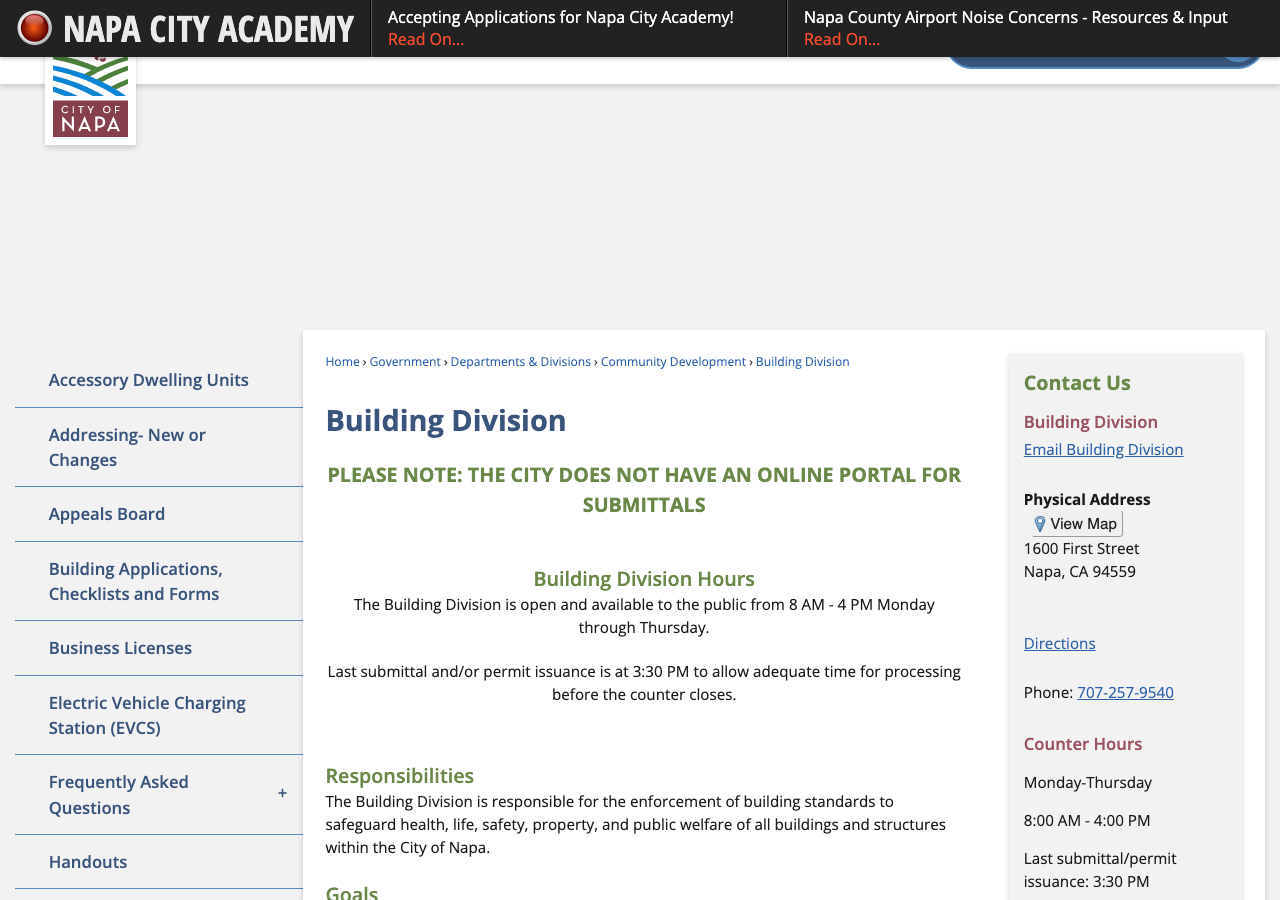
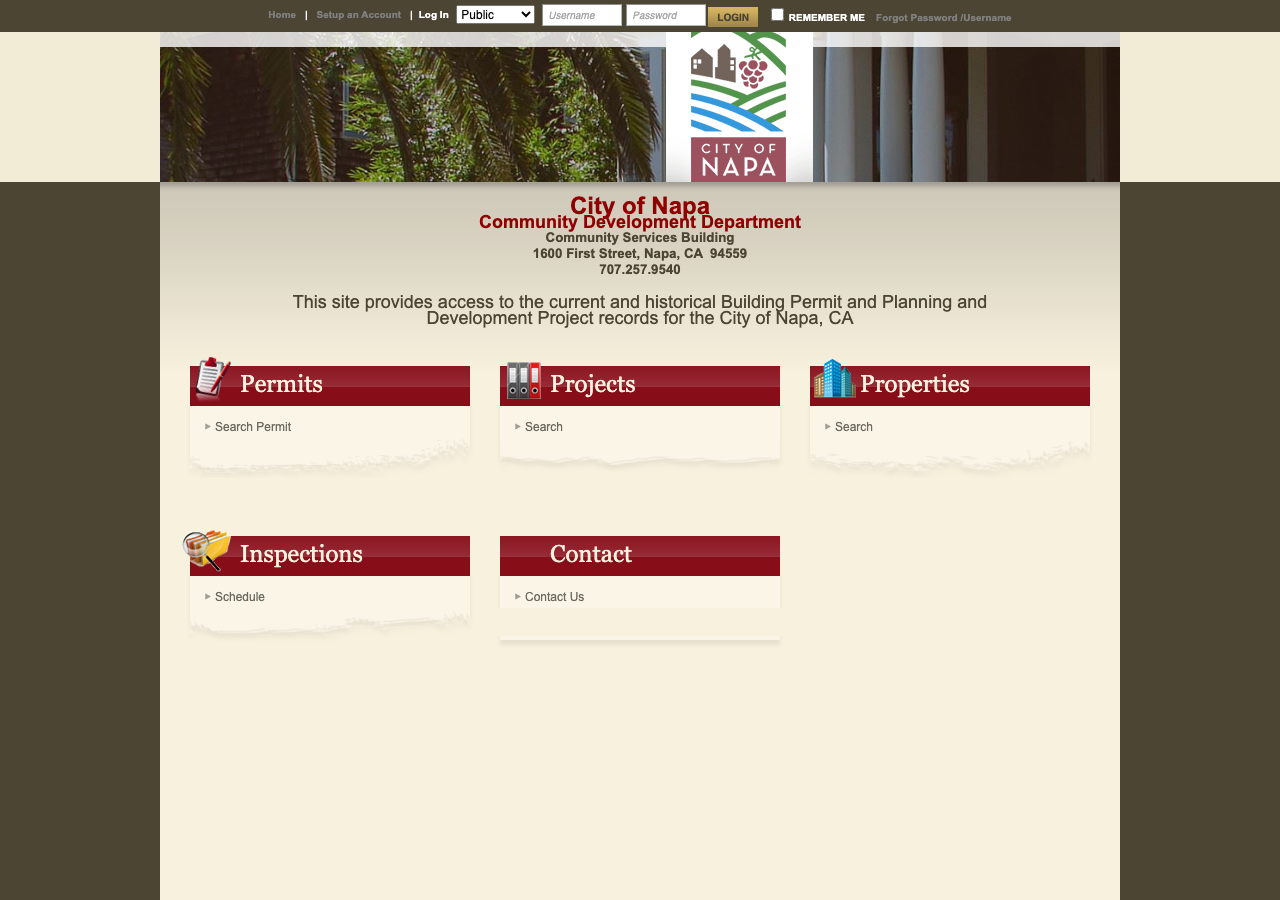
eTRAKiT — but only for inspection scheduling and (per the Building Division page) NOT for permit submittals.
Why the confidence is not higherBoth the Building Division and Permits pages carry the banner 'PLEASE NOTE: THE CITY DOES NOT HAVE AN ONLINE PORTAL FOR SUBMITTALS,' and separately link eTRAKiT for 'Online Inspection Scheduling.' Solar submittals are explicitly walk-in/over-the-counter only.
department page checked 2026-08-30 https://www.cityofnapa.org/228/Building-Division
Q21 Can the whole application be completed online? Core Portal & process
No
Why the confidence is not higherDirectly stated on the Building Division and Permits pages; confirmed by the Solar PV page describing walk-in submittal by appointment only, Monday–Thursday 8:30am–3:30pm. No evidence of SolarAPP+ use was found.
department page checked 2026-08-30 https://www.cityofnapa.org/758/Permits-and-Plan-Review-Information
Q22 Which utility handles interconnection here? Core Utility interconnection
PG&E is the distribution utility that handles physical interconnection (meter, AC disconnect, Rule 21/NEM application, Permission-to-Operate). The default electric generation provider (CCA) for City of Napa customers is Marin Clean Energy (MCE) — the City has been an MCE member community since 2016. PG&E remains the wires/interconnection party regardless of MCE enrollment.
Why the confidence is not higherMCE's own member-communities page states 'City of Napa — MCE member community since 2016'; PG&E territory and Greenbook/NEM documents confirm PG&E still owns the distribution interconnection process for any CCA member. Not higher because MCE's page was read via a summarizing fetch rather than a directly parsed PDF/HTML dump.
utility (CCA) website checked 2026-08-30 https://www.mcecleanenergy.org/member-communities/
Q23 Where does the utility sit in the sequence? Core Utility interconnection
Parallel, with a dependency at the final step: the PG&E interconnection application can be filed independent of and in parallel with the City permit, but PG&E's Permission-to-Operate (energization) requires a completed final field inspection and is only issued after all reviews — in practice after the City's building/electrical final.
Why the confidence is not higherBased on PG&E's own general NEM/solar process description ('After all reviews are complete, including a final field inspection, PG&E will issue Permission to Operate') rather than a Napa-specific statement of sequence; genuinely a utility-level answer, not an AHJ one.
utility program page checked 2026-08-30 https://www.pge.com/en/about/doing-business-with-pge/interconnections/net-energy-metering-aggregation-program.html
Q24 Is a HOA or architectural approval required first? Overlays & special cases
No
Why the confidence is not higherNot listed as a submittal requirement on the City's own Solar PV checklist or Building checklists; CA Civil Code §714 (Solar Rights Act) also bars HOAs from unreasonably restricting rooftop solar. Confidence held at 60 because this is an absence-based inference from the checklist, not an explicit City statement that HOA approval is never required.
published checklist (absence) checked 2026-08-30 https://www.cityofnapa.org/1037/Solar-PV
Q25 Is there a historic-district review? Overlays & special cases
Nothing published by this authority.
Where we lookedPlanning Division's Heritage Napa page (historic survey/inventory program covering Alta Heights, Napa Abajo-Fuller Park, Downtown, City-Wide districts) — describes survey and inventory work but does not publish a specific residential-solar historic-district review procedure or trigger.
Q26 Is a wind or windstorm certification required? Overlays & special cases
No / not applicable
Why the confidence is not higherNo wind/windstorm certification analogous to a Texas TDI process was found anywhere in the City's building or solar documents; California's wind-load analysis is folded into standard structural calculations under CBC/ASCE 7 rather than issued as a separate certificate.
published checklist (absence) checked 2026-08-30 https://www.cityofnapa.org/DocumentCenter/View/3192
Q27 Is a Specific Use Permit or Council approval ever required? Overlays & special cases
No, for a standard residential rooftop system — the City's own Fee Schedule ties the solar permit to CA Gov. Code §65850.5's nondiscretionary-permit mandate, which forecloses a Conditional-Use/Council-approval step for qualifying rooftop systems.
Why the confidence is not higherInferred from the state-law citation on the fee schedule rather than a Napa ordinance text I could read directly (Title 17 zoning ordinance is on the Cloudflare-blocked ecode360 host); ground-mount arrays outside the state-law-covered categories may be treated differently, which I could not verify.
fee schedule / state-law citation checked 2026-08-30 https://www.cityofnapa.org/DocumentCenter/View/6647/Fire-Permit-Fee-Schedule
Q28 Is there a system-size cap on residential generation? Overlays & special cases
Nothing published by this authority.
Where we lookedSolar PV page, Solar Plan Submittal Requirements PDF, and the solar Fee Schedule items (2.2.47a/b, 6.11.17a/b) — none states a system-size (kW) cap on residential generation; sizing is governed by the state NEM tariff's load-based limits rather than a City ordinance cap, but no City document says this in so many words.
https://www.cityofnapa.org/DocumentCenter/View/6649/Solar-Plan-Submittal-Requirements
Lines marked with a percentage were read off this authority’s own published documents. Unmarked guidance is general good practice, not this jurisdiction’s rule — always confirm against the authority before you submit.
Install 5 steps · 20 questions
-
Build to the code editions actually in force here
The NEC edition a jurisdiction enforces is often a cycle behind the newest one published, and local amendments sit on top of it. Rapid shutdown, conductor sizing and labelling all change between editions, so the edition in force is the first thing to establish, not the last.
- Which NEC edition is in force? 2023 NEC, as incorporated into the 2025 California Electrical Code (part of the City's 2025 California Codes adoption). 65% · department page (dated, internally inconsistent)
- Which building code edition is in force? 2025 California Building Code (per City Municipal Code §15.04.010) — subject to the same Jan-2025-vs-Jan-2026 effective-date conflict noted for q29. 70% · department page
- Which fire code edition is in force? 2025 California Fire Code 88% · department handout (PDF)
- Are there local amendments to any of the above? Yes 80% · department page (citation only)
- What is the installation judged against? The 2025 California Building/Electrical/Fire Codes as locally amended (NMC Title 15), plus the Fire Prevention Division's own 'Solar Plan Submittal Requirements' handout criteria (pathways, setbacks, ESS elevation views, roof-area percentage, egress openings). 80% · department handout (PDF)
-
Fire access, setbacks and pathways
Ridge setbacks and roof access pathways are fire-service requirements and they constrain the array layout. They are the most common cause of a redesign after the fire department comments on a plan set.
- What ridge setback and access pathways are required? Dimensioned roof pathways and setbacks must be shown on the plan; the City's own solar handout requires this but does not itself state the numeric values (which come from the adopted 2025 CFC's standard residential PV pathway/setback tables rather than from a Napa-specific amendment). 62% · department handout (PDF)
-
Rapid shutdown
Which rapid-shutdown rule applies follows directly from the NEC edition in force, and the initiation device has to be at a location the fire service can reach and identify. This is inspected, and it is labelled.
- Is rapid shutdown required, and to which NEC edition? Rapid shutdown is required, governed by NEC 690.12 as adopted in the current CEC cycle (2023 NEC base text carried into the 2025 CEC). 55% · inference from code-cycle adoption
-
Labels and placards
The NEC sets a baseline for permanent markings at the service equipment and the disconnecting means. On top of that, an authority may specify its own wording, and the utility may specify more again. Where any of them writes its own text, a generic off-the-shelf label set will not pass — this is the detail most often fixed on a return visit.
- Which placards does this authority require at the service equipment? At minimum: the NEC 690/705-family placards/labels required by the adopted CEC/CFC (main service disconnect labeling, PV system disconnect, rapid-shutdown label, etc.), PLUS — where an AC disconnect is installed for a line/supply-side tap — PG&E's own required 'engraved placard (signage), indicating there is a line/supply side connection,' installed on the metering equipment. 70% · utility manual (PG&E Greenbook, current rev.)
- Is a site plan / facility map placard required, and what must it show? Yes, effectively — the required roof/site plan sheet must include a labeled project/roof photo, dimensioned pathways and setbacks, percentage of roof occupied by arrays, and (if present) BIPV/ESS elevation details; the City does not separately name this a '705.10 facility placard' but requires the equivalent information on the plan set. 68% · department handout (PDF)
- Does the UTILITY specify placards beyond the AHJ's? Yes — PG&E requires an engraved placard/signage on the metering equipment identifying a line/supply-side tap connection, in addition to whatever the AHJ requires under the adopted NEC. 85% · utility manual (PG&E Greenbook)
- Where must the labels be placed? PG&E's line/supply-side-tap placard must be installed on the metering equipment itself. AHJ-required NEC labels (rapid shutdown, PV disconnect, etc.) go at the disconnecting means/service equipment per the adopted code; no Napa-specific placement handout beyond that was found. 68% · utility manual (PG&E Greenbook)
-
Disconnect, storage and listed equipment
Where the AC disconnect must sit relative to the meter is usually the utility's rule, not the building department's. Battery storage frequently carries its own permit, its own inspection and its own fire conditions.
- Where must the AC disconnect be, relative to the meter? For a typical residential self-contained, socket-based, single-phase meter panel rated 320A or less with an inverter-based (string/micro-inverter) system, PG&E does NOT require a separate AC disconnect. For all other meter-panel configurations (transformer-rated, non-inverter-based, or K-base meters of any rating), an AC disconnect IS required, installed between the meter and the main breaker (ahead of the main breaker for a line/supply-side tap), with an engraved placard on the metering equipment. 85% · utility manual (PG&E Greenbook, current rev.)
- Are batteries permitted, and under what conditions? Yes — batteries/ESS are permitted; the Fire Prevention Division treats them as a distinct reviewed scope requiring 'Details of all ESS/Battery systems including an elevation view' on the plans, and prices a dedicated fee for 'Battery systems' review. 85% · department handout (PDF) + fee schedule
- Is there a separate ESS permit or inspection? Yes — Fire Prevention prices battery systems as their own reviewed/inspected line item ($325, 'Includes 1 inspection'), separate from the Building Division's solar permit inspection. 80% · fee schedule
- Is a ground mount treated as a structure? Yes, effectively — the City's own Solar PV submittal checklist requires 'Footing Details' specifically for 'Ground Mounted Systems,' treating them as a structural/foundation element subject to the same structural-calculation and footing-detail scrutiny as any other structure. 65% · department page
20 questions answered against City of Napa’s own published documents
Q29 Which NEC edition is in force? Core Code editions in force
2023 NEC, as incorporated into the 2025 California Electrical Code (part of the City's 2025 California Codes adoption).
Why the confidence is not higherThe City's Building Division page states it 'adopted the 2025 California Building Code effective January 1, 2025' (NMC §15.04.010), while its own Permits and Plan Review page separately says permits applied for 'on January 1, 2026, or after must comply with adopted 2025 California Codes' — a direct, unresolved date conflict between the City's own pages that I am flagging rather than silently picking one. The CEC (and therefore NEC edition) itself was not independently verified because Title 15 electrical-code text sits on the Cloudflare-blocked ecode360 host.
department page (dated, internally inconsistent) checked 2026-08-30 https://www.cityofnapa.org/228/Building-Division
Q30 Which building code edition is in force? Core Code editions in force
2025 California Building Code (per City Municipal Code §15.04.010) — subject to the same Jan-2025-vs-Jan-2026 effective-date conflict noted for q29.
Why the confidence is not higherDirectly stated on the Building Division page, cross-referenced by the Permits page's 'permits applied for on or after Jan 1, 2026 must comply with 2025 CA Codes' language and by the Solar Plan Submittal Requirements handout, which references '2025 California Fire Code, California Building Code.'
department page checked 2026-08-30 https://www.cityofnapa.org/228/Building-Division
Q31 Which fire code edition is in force? Code editions in force
2025 California Fire Code
Why the confidence is not higherThe Fire Prevention Division's own 'Solar Plan Submittal Requirements' handout states plans must comply with 'the 2025 California Fire Code, California Building Code and related Standards as amended and adopted by the City of Napa' — the Fire Department's own current document.
department handout (PDF) checked 2026-08-30 https://www.cityofnapa.org/DocumentCenter/View/6649/Solar-Plan-Submittal-Requirements
Q32 Are there local amendments to any of the above? Core Code editions in force
Yes
Why the confidence is not higherNMC §15.04.010 (building code adoption with amendments) and a separate recent ordinance adopting the state's Local Responsibility Area Fire Hazard Severity Zone maps are both cited on City pages as local amendments; NMC 15.42 (the solar-specific chapter cited on the fee schedule) is itself a local addition implementing state law. Full chapter text could not be read directly (ecode360 blocked), so this is inferred from citations rather than the ordinance text itself.
department page (citation only) checked 2026-08-30 https://www.cityofnapa.org/228/Building-Division
Q33 What is the installation judged against? Core Electrical
The 2025 California Building/Electrical/Fire Codes as locally amended (NMC Title 15), plus the Fire Prevention Division's own 'Solar Plan Submittal Requirements' handout criteria (pathways, setbacks, ESS elevation views, roof-area percentage, egress openings).
Why the confidence is not higherSynthesized from the City's own adoption statement and its Fire Prevention solar handout; the underlying code text itself sits on the blocked ecode360 host.
department handout (PDF) checked 2026-08-30 https://www.cityofnapa.org/DocumentCenter/View/6649/Solar-Plan-Submittal-Requirements
Q34 Is there a local rule on service upgrades or busbar sizing? Electrical
Nothing published by this authority.
Where we looked'Main Panel Upgrade Inspection Prep' handout — covers NEC 110.26 clearance, grounding/bonding and conductor-torque requirements generically for any panel swap, but does not state a solar-specific busbar-rating or 120%-rule local amendment; no other Napa document addresses service-upgrade/busbar sizing for solar interconnection specifically.
https://www.cityofnapa.org/DocumentCenter/View/14858/Main-Panel-Upgrade-Inspection-Prep-PDF
Q35 Is a specific mounting system or attachment spacing required? Structural & mounting
Nothing published by this authority.
Where we lookedSolar PV page, Solar Plan Submittal Requirements PDF, Residential Building Checklist — none specifies a required mounting system or attachment/spacing standard beyond generic 'Attachment Details' as a submittal item; no numeric spacing requirement or approved-system list was found.
Q36 What ridge setback and access pathways are required? Core Fire pathways & setbacks
Dimensioned roof pathways and setbacks must be shown on the plan; the City's own solar handout requires this but does not itself state the numeric values (which come from the adopted 2025 CFC's standard residential PV pathway/setback tables rather than from a Napa-specific amendment).
Why the confidence is not higherThe Fire Prevention 'Solar Plan Submittal Requirements' PDF explicitly requires items 5 and 6 ('Detail pathways including dimensions' / 'Detail setbacks including dimensions') but is a plan-content checklist, not a numeric-standards document; no Napa-specific numeric departure from the state Fire Code's default residential PV setback/pathway table was found.
department handout (PDF) checked 2026-08-30 https://www.cityofnapa.org/DocumentCenter/View/6649/Solar-Plan-Submittal-Requirements
Q37 Is rapid shutdown required, and to which NEC edition? Core Rapid shutdown
Rapid shutdown is required, governed by NEC 690.12 as adopted in the current CEC cycle (2023 NEC base text carried into the 2025 CEC).
Why the confidence is not higherNo Napa-specific page states this explicitly; this is standard-adoption inference from the City's stated 2025 CA Code cycle rather than a Napa document naming rapid shutdown by name.
inference from code-cycle adoption checked 2026-08-30 https://www.cityofnapa.org/228/Building-Division
Q38 Which placards does this authority require at the service equipment? Core Labels Signage & labelling
At minimum: the NEC 690/705-family placards/labels required by the adopted CEC/CFC (main service disconnect labeling, PV system disconnect, rapid-shutdown label, etc.), PLUS — where an AC disconnect is installed for a line/supply-side tap — PG&E's own required 'engraved placard (signage), indicating there is a line/supply side connection,' installed on the metering equipment.
Why the confidence is not higherCombines the adopted-code inference (q29/30/31) with PG&E's own current Greenbook (TD-7001M, Rev. 2026-04, eff. 6/22/2026) Table 6-3 note. No Napa-specific placard handout beyond the general Solar Plan Submittal Requirements was found.
utility manual (PG&E Greenbook, current rev.) checked 2026-08-30 https://www.pge.com/assets/pge/docs/account/service-requests/greenbook-manual-full.pdf
Q39 Does the authority specify placard wording of its own? Core Labels Signage & labelling
Nothing published by this authority.
Where we lookedSolar Plan Submittal Requirements PDF and general Handouts page — neither specifies City-authored placard wording; labeling requirements referenced are generic 'legible text' instructions, not a prescribed wording.
https://www.cityofnapa.org/DocumentCenter/View/6649/Solar-Plan-Submittal-Requirements
Q40 Does it specify letter height, colour or material? Core Labels Signage & labelling
Nothing published by this authority.
Where we lookedSame Solar Plan Submittal Requirements PDF and Handouts page — no letter-height, color, or material specification found; document only says 'all text shall be legible.'
Q41 Is a site plan / facility map placard required, and what must it show? Core Labels Signage & labelling
Yes, effectively — the required roof/site plan sheet must include a labeled project/roof photo, dimensioned pathways and setbacks, percentage of roof occupied by arrays, and (if present) BIPV/ESS elevation details; the City does not separately name this a '705.10 facility placard' but requires the equivalent information on the plan set.
Why the confidence is not higherFire Prevention's Solar Plan Submittal Requirements PDF lists these items directly, but the document is framed as a plan-content checklist, not explicitly cross-referenced to NEC 705.10 by name.
department handout (PDF) checked 2026-08-30 https://www.cityofnapa.org/DocumentCenter/View/6649/Solar-Plan-Submittal-Requirements
Q42 Does the UTILITY specify placards beyond the AHJ's? Core Labels Signage & labelling
Yes — PG&E requires an engraved placard/signage on the metering equipment identifying a line/supply-side tap connection, in addition to whatever the AHJ requires under the adopted NEC.
Why the confidence is not higherStated directly in PG&E's current Greenbook (TD-7001M-06, 'Electric Generation Interconnection,' Rev. 2026-04, eff. 6/22/2026), Table 6-3 note (a). This is a utility-level requirement, correctly attributed to PG&E rather than the City.
utility manual (PG&E Greenbook) checked 2026-08-30 https://www.pge.com/assets/pge/docs/account/service-requests/greenbook-manual-full.pdf
Q43 Where must the labels be placed? Core Labels Signage & labelling
PG&E's line/supply-side-tap placard must be installed on the metering equipment itself. AHJ-required NEC labels (rapid shutdown, PV disconnect, etc.) go at the disconnecting means/service equipment per the adopted code; no Napa-specific placement handout beyond that was found.
Why the confidence is not higherPG&E placard placement is stated directly in the current Greenbook; AHJ label placement is inferred from standard adopted-NEC practice rather than a Napa-specific placement diagram.
utility manual (PG&E Greenbook) checked 2026-08-30 https://www.pge.com/assets/pge/docs/account/service-requests/greenbook-manual-full.pdf
Q44 Must equipment be on a specific approved list? Equipment listing
Nothing published by this authority.
Where we lookedSolar PV page, Solar Plan Submittal Requirements PDF, Building Applications/Checklists page — none references a City-maintained approved-equipment list; standard NRTL-listing requirements under the adopted code appear to apply instead, but no City document states this as an 'approved list' requirement.
Q45 Are batteries permitted, and under what conditions? Core Battery / ESS
Yes — batteries/ESS are permitted; the Fire Prevention Division treats them as a distinct reviewed scope requiring 'Details of all ESS/Battery systems including an elevation view' on the plans, and prices a dedicated fee for 'Battery systems' review.
Why the confidence is not higherDirectly stated in the current Fire Prevention Solar Plan Submittal Requirements handout (item 9) and the Master Fee Schedule item 6.11.8 ('Battery systems,' $325 per review, includes 1 inspection, CA Fire Code Ch. 1).
department handout (PDF) + fee schedule checked 2026-08-30 https://www.cityofnapa.org/DocumentCenter/View/6649/Solar-Plan-Submittal-Requirements
Q46 Is there a separate ESS permit or inspection? Battery / ESS
Yes — Fire Prevention prices battery systems as their own reviewed/inspected line item ($325, 'Includes 1 inspection'), separate from the Building Division's solar permit inspection.
Why the confidence is not higherFee Schedule item 6.11.8, current (eff. 02/03/2025).
fee schedule checked 2026-08-30 https://www.cityofnapa.org/DocumentCenter/View/6647/Fire-Permit-Fee-Schedule
Q47 Is a ground mount treated as a structure? Core Ground mount
Yes, effectively — the City's own Solar PV submittal checklist requires 'Footing Details' specifically for 'Ground Mounted Systems,' treating them as a structural/foundation element subject to the same structural-calculation and footing-detail scrutiny as any other structure.
Why the confidence is not higherStated on the Solar PV page's plan-set list; the Title 17 zoning-ordinance classification (accessory structure vs. utility equipment, for setback purposes) could not be independently confirmed because it sits on the Cloudflare-blocked ecode360 host.
department page checked 2026-08-30 https://www.cityofnapa.org/1037/Solar-PV
Q48 Where must the AC disconnect be, relative to the meter? Core Utility equipment
For a typical residential self-contained, socket-based, single-phase meter panel rated 320A or less with an inverter-based (string/micro-inverter) system, PG&E does NOT require a separate AC disconnect. For all other meter-panel configurations (transformer-rated, non-inverter-based, or K-base meters of any rating), an AC disconnect IS required, installed between the meter and the main breaker (ahead of the main breaker for a line/supply-side tap), with an engraved placard on the metering equipment.
Why the confidence is not higherPG&E's current Greenbook (TD-7001M-06, Rev. 2026-04, eff. 6/22/2026), Section 6.3, Table 6-3 'Requirements for AC Disconnect Switches' and the notes immediately following it. Verified this is the correct, current PG&E document (not the near-miss risk flagged in the brief) by reading its title page and revision stamp directly.
utility manual (PG&E Greenbook, current rev.) checked 2026-08-30 https://www.pge.com/assets/pge/docs/account/service-requests/greenbook-manual-full.pdf
Lines marked with a percentage were read off this authority’s own published documents. Unmarked guidance is general good practice, not this jurisdiction’s rule — always confirm against the authority before you submit.
Inspection 5 steps · 14 questions
-
Book it
Booking is a portal, a phone call or an email depending on the authority, and the notice required is rarely zero. Book before the work is finished rather than after — the lead time, not the work, is usually what sets the date.
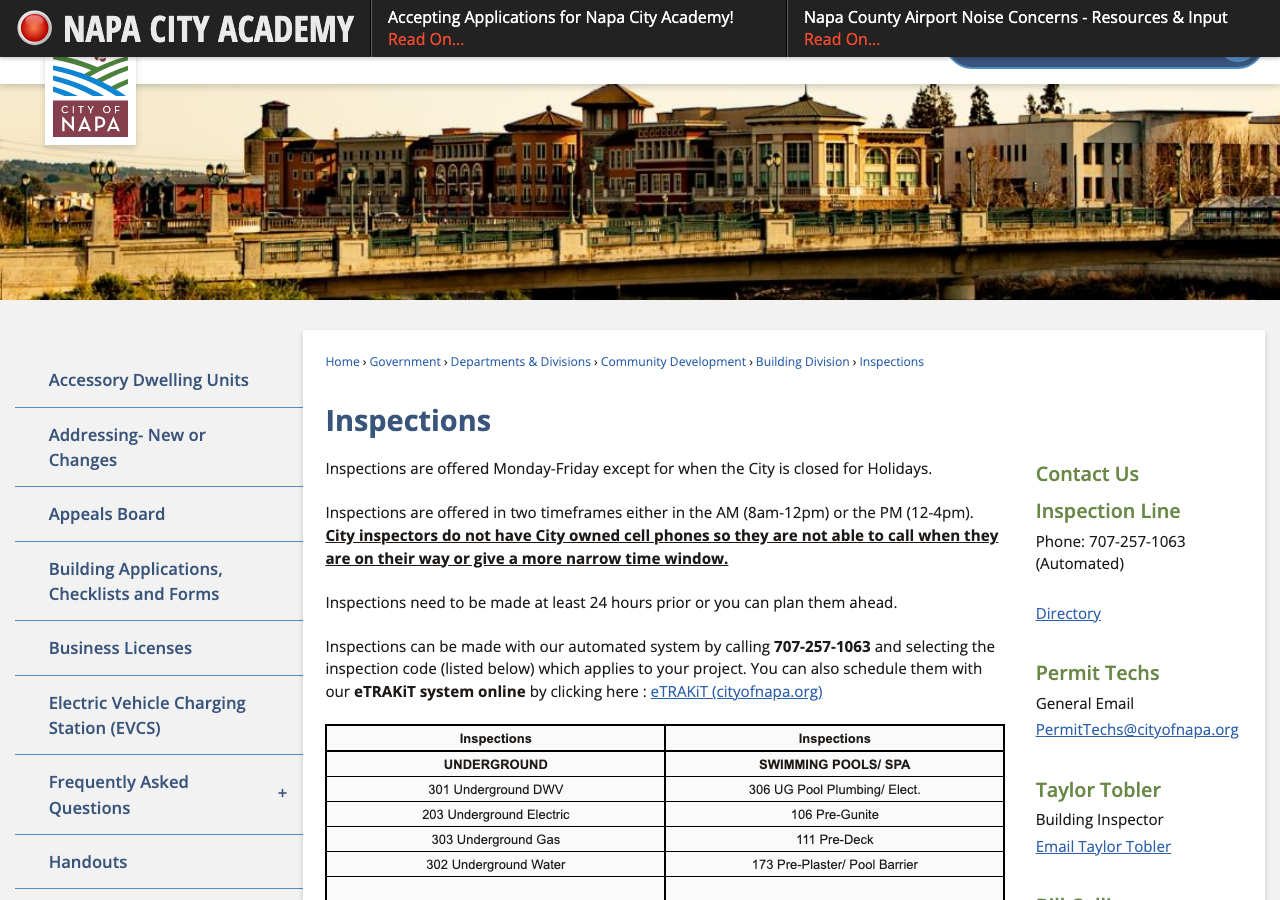
- How is an inspection booked? Portal (eTRAKiT online scheduling) or Phone (automated line 707-257-1063, or calling Permit Techs at 707-257-9540). 92% · department page
- How much notice is required? At least 24 hours' notice (can also be scheduled further ahead). 90% · department page
- Are same-day or AM/PM windows offered? Yes — AM window 8am–12pm or PM window 12–4pm; no same-day or narrower window, and inspectors carry no City cell phone so cannot call ahead. 92% · department page
-
Know who turns up
Some authorities inspect their own solar work; some delegate it, and a few do not inspect the PV equipment itself at all. Who is coming determines what they will look at.
- Does this AHJ perform its own final solar inspection? Yes 88% · department page
- If delegated, to whom? Not delegated — held internally between the City's own Building Division (building/electrical final) and its own Fire Department/Fire Prevention Division (fire-code-driven scope). No third-party or county inspection agency involved for standard residential PV. 85% · department page
-
Work the stages in order
A rough-in or mid-roof inspection, where one is required, has to happen before the work it covers is closed up. Missing a stage means opening something back up, and it is the most expensive kind of correction.
- Which inspections are required, and in what order? Based on the City's published inspection-code list, the electrical-scope inspections relevant to a rooftop PV/battery job are: 203 Underground Electric (if trenching), 220 Under Floor Electric (if applicable), 240 Rough Electric, 280 Electric Service/Release, then 999 Final Building. Fire Prevention's own solar/battery review runs in parallel and is cleared before the Building Final per the Inspections page note ('All applicable finals to be approved prior to Building Final'). 72% · department page
-
Have the paperwork on site
The approved plan set, the permit, and the equipment listings should be on site and reachable. Inspectors routinely verify that installed equipment matches what was approved, and that the labels are the ones the plan set promised.
- Is there a published inspection checklist? Yes, in the form of pre-inspection prep handouts (e.g. 'Main Panel Upgrade Inspection Prep,' itemizing exactly what the inspector checks for panel work) and the Fire Prevention 'Solar Plan Submittal Requirements' handout for the plan-review stage; there is no single document titled a 'solar final inspection checklist.' 72% · published checklist (PDF)
- What must be on site at inspection? The issued permit, the job card, and the approved/stamped set of plans must all be posted or available on-site in an easily visible location for the inspector's use. 90% · department FAQ
-
Sign-off, and permission to operate
Passing gives you a final or an equivalent sign-off. That is not the same as permission to operate: PTO comes from the utility, and who tells the utility the inspection passed varies. A system left switched off for weeks is usually waiting on this handover.
- What is issued on pass? Final (a signed-off job card/'999 Final Building' inspection); this is a permit-final rather than a separate Certificate of Occupancy for a retrofit solar installation on an existing single-family home. 75% · department page
- Who notifies the utility for PTO? Installer (in practice) — PG&E's own solar-getting-started process describes the customer's contractor as the party that 'will install and help you connect your system to PG&E's grid' and manages the interconnection application on the customer's behalf. 55% · utility program page
- Is there a re-inspection fee? Full Cost, billed per hour (no flat dollar figure published). 85% · fee schedule
14 questions answered against City of Napa’s own published documents
Q49 How is an inspection booked? Core Booking & scheduling
Portal (eTRAKiT online scheduling) or Phone (automated line 707-257-1063, or calling Permit Techs at 707-257-9540).
Why the confidence is not higherStated directly and consistently on both the Inspections page and the department FAQ.
department page checked 2026-08-30 https://www.cityofnapa.org/1044/Inspections
Q50 How much notice is required? Core Booking & scheduling
At least 24 hours' notice (can also be scheduled further ahead).
Why the confidence is not higherStated directly on the Inspections page: 'Inspections need to be made at least 24 hours prior or you can plan them ahead.'
department page checked 2026-08-30 https://www.cityofnapa.org/1044/Inspections
Q51 Are same-day or AM/PM windows offered? Booking & scheduling
Yes — AM window 8am–12pm or PM window 12–4pm; no same-day or narrower window, and inspectors carry no City cell phone so cannot call ahead.
Why the confidence is not higherStated directly on the Inspections page.
department page checked 2026-08-30 https://www.cityofnapa.org/1044/Inspections
Q52 Does this AHJ perform its own final solar inspection? Core Who inspects
Yes
Why the confidence is not higherCity Building inspectors perform the building/electrical final; the City's own Fire Department (not county/CAL FIRE) separately performs any fire-scope final for the solar/ESS items it reviewed. Both are 'the AHJ's own' inspectors, not a delegated third party.
department page checked 2026-08-30 https://www.cityofnapa.org/1044/Inspections
Q53 If delegated, to whom? Core Who inspects
Not delegated — held internally between the City's own Building Division (building/electrical final) and its own Fire Department/Fire Prevention Division (fire-code-driven scope). No third-party or county inspection agency involved for standard residential PV.
Why the confidence is not higherConfirmed the Fire Department is the City's own department (est. 1906), not a county or CAL FIRE contract, from the Fire Department's own page.
department page checked 2026-08-30 https://www.cityofnapa.org/352/Fire-Department
Q54 Which inspections are required, and in what order? Core Stages & sequence
Based on the City's published inspection-code list, the electrical-scope inspections relevant to a rooftop PV/battery job are: 203 Underground Electric (if trenching), 220 Under Floor Electric (if applicable), 240 Rough Electric, 280 Electric Service/Release, then 999 Final Building. Fire Prevention's own solar/battery review runs in parallel and is cleared before the Building Final per the Inspections page note ('All applicable finals to be approved prior to Building Final').
Why the confidence is not higherCompiled from the City's general Inspections page code list, which is not solar-specific — there is no dedicated 'PV rough' or 'PV final' code, so this is an inference of which general codes apply to a solar job rather than a solar-specific sequence document.
department page checked 2026-08-30 https://www.cityofnapa.org/1044/Inspections
Q55 Is a rough-in or mid-roof inspection required? Stages & sequence
Nothing published by this authority.
Where we lookedInspections page's full inspection-code list (Underground, Underfloor, Foundation, Structural, Trade Roughs, Fire Prevention, etc.) — no distinct 'roof-mount' or 'mid-roof' inspection code exists in the list; rough electrical (240) is the closest generic category.
Q56 Does the inspector verify labels and listings? Core What is checked
Nothing published by this authority.
Where we lookedInspections page and department FAQ — neither states explicitly whether the final inspector checks equipment labels/listings as a discrete, named inspection step (as opposed to general code-compliance verification).
Q57 Is there a published inspection checklist? Core What is checked
Yes, in the form of pre-inspection prep handouts (e.g. 'Main Panel Upgrade Inspection Prep,' itemizing exactly what the inspector checks for panel work) and the Fire Prevention 'Solar Plan Submittal Requirements' handout for the plan-review stage; there is no single document titled a 'solar final inspection checklist.'
Why the confidence is not higherBoth documents are current City publications found under Building Applications, Checklists and Forms / Fire Prevention resources, but neither is titled specifically as a solar *inspection* checklist (one is panel-specific, the other is plan-submittal-specific).
published checklist (PDF) checked 2026-08-30 https://www.cityofnapa.org/DocumentCenter/View/14858/Main-Panel-Upgrade-Inspection-Prep-PDF
Q58 What must be on site at inspection? Core Documents on site
The issued permit, the job card, and the approved/stamped set of plans must all be posted or available on-site in an easily visible location for the inspector's use.
Why the confidence is not higherStated directly in the department FAQ: 'Your approved plans, job card and any other documents you received must be posted/available on the job site... The job card and plan must be kept on-site and available for the inspector's use.'
department FAQ checked 2026-08-30 https://www.cityofnapa.org/1038/Frequently-Asked-Questions
Q59 Is there a re-inspection fee? Corrections & re-inspection
Full Cost, billed per hour (no flat dollar figure published).
Why the confidence is not higherFee Schedule item 2.3.2 'Re-inspection fee — Per hour — Full Cost,' current schedule effective 02/03/2025.
fee schedule checked 2026-08-30 https://www.cityofnapa.org/DocumentCenter/View/6647/Fire-Permit-Fee-Schedule
Q60 How are corrections issued and cleared? Corrections & re-inspection
Nothing published by this authority.
Where we lookedInspections page, FAQ, and Building Applications/Checklists page — none describes a formal corrections-notice or correction-clearance procedure; the job-card system is described for tracking passed inspections but not for issuing/clearing corrections.
Q61 What is issued on pass? Core Final sign-off & PTO
Final (a signed-off job card/'999 Final Building' inspection); this is a permit-final rather than a separate Certificate of Occupancy for a retrofit solar installation on an existing single-family home.
Why the confidence is not higherInferred from the Inspections page's code list ending in '999 Final Building' and the FAQ's description of the job-card process; no document uses the word 'Final' as a formal defined term for solar specifically.
department page checked 2026-08-30 https://www.cityofnapa.org/1044/Inspections
Q62 Who notifies the utility for PTO? Core Final sign-off & PTO
Installer (in practice) — PG&E's own solar-getting-started process describes the customer's contractor as the party that 'will install and help you connect your system to PG&E's grid' and manages the interconnection application on the customer's behalf.
Why the confidence is not higherThis is PG&E's generic description of the customer/contractor relationship, not a Napa-specific or PG&E-mandated statement of who MUST file; in practice either the customer or the installer can submit the NEM interconnection application.
utility program page checked 2026-08-30 https://www.pge.com/en/about/doing-business-with-pge/interconnections/net-energy-metering-aggregation-program.html
Lines marked with a percentage were read off this authority’s own published documents. Unmarked guidance is general good practice, not this jurisdiction’s rule — always confirm against the authority before you submit.
Jurisdiction & key facts
The standing 62-question set, answered for City of Napa against this authority’s own published documents. Every answer carries the confidence it was recorded at and the document it came from. Where nothing is published we say so and show where we looked — a blank here is a finding, not a gap.
City of Napa is the authority having jurisdiction 92% confidence
- Holds
- Building and electrical permitting/inspection sit together at the City's Building Division (combined submittal, 1600 First St.). The City's own Fire Department (established 1906, NOT contracted to Napa County Fire or CAL FIRE) runs a genuine PARALLEL review/inspection track for the fire-code-driven parts of a solar/ESS installation — it has its own published 'Solar Plan Submittal Requirements' handout and its own separate, itemized Fire Prevention plan-check fees for 'Solar Photovoltaic Power Systems' (Residential $85, Commercial $278) and 'Battery systems' ($325, incl. 1 inspection) on top of the Building Division's flat solar permit fee. This is the exact San Ramon-Valley-FPD pattern the brief asked to check for.
- Overridden by
- CA Gov. Code §65850.5 (Solar Rights Act permit-streamlining mandate) is cited by name as the legal authority for the City's own solar fee item (Fee Schedule #2.2.47, 'Solar Photovoltaic Permit,' authority column reads 'CA Code Section 65850.5'; the underlying municipal code chapter is NMC 15.42). AB 130 (Stats. 2025, Ch. 22) additionally freezes any MORE-restrictive residential local amendment from 1 Oct 2025 to 1 Jun 2031.
- Why not higher
- City's own Building Division and Fire Prevention Division pages, its Solar PV page, and its Master Fee Schedule (eff. 2/3/2025) all independently confirm the City issues its own building/electrical permits and that Fire Prevention runs a separate, fee-bearing review lane for solar/ESS. Confidence is not higher only because the underlying municipal code chapter (NMC 15.42, Title 17 zoning) could not be read directly — ecode360.com, which now hosts Napa's code (via a qcode.us -> resolve.ecode360.com redirect), returned a Cloudflare 'Just a moment...' managed challenge (cf-mitigated: challenge) to both curl with the iccsafe.org Referer and to WebFetch; the ordinance's existence and citation are confirmed only indirectly, through the fee schedule and department handouts.
- Permit required
- Yes95%
- Permit cost
- Residential Solar Photovoltaic Permit & Inspection: fee based on 10 kW tiers, $472 (maximum fee $500) — Building Division, includes minimum electrical permit processing.88%
- Plan review
- Two tracks: 'Express Review' — plans reviewed at the counter in 10–15 minutes for rooftop PV under 10 kW;92%
- Portal
- eTRAKiT — but only for inspection scheduling and (per the Building Division page) NOT for permit submittals.90%
- Electrical code
- 2023 NEC, as incorporated into the 2025 California Electrical Code (part of the City's 2025 California Codes adoption).65%
- Booking an inspection
- Portal (eTRAKiT online scheduling) or Phone (automated line 707-257-1063, or calling Permit Techs at 707-257-9540).92%
Labels & placards for this authority
Wording None%
Size, colour & material None%
Where they go 68%
PG&E's line/supply-side-tap placard must be installed on the metering equipment itself. AHJ-required NEC labels (rapid shutdown, PV disconnect, etc.) go at the disconnecting means/service equipment per the adopted code; no Napa-specific placement handout beyond that was found.
What the utility wants on top 85%
Yes — PG&E requires an engraved placard/signage on the metering equipment identifying a line/supply-side tap connection, in addition to whatever the AHJ requires under the adopted NEC.
Each figure above is sourced and dated in the full answer set below (questions 38–43). Where an authority’s own published sheet is older than the code it has adopted, the answer says so.
Their website

Average approval time — application to PTO
From the CPUC interconnection record. Bars show the average days taken each year; a year with no recorded projects is left blank rather than drawn as zero.