
City of National City
San Diego County
City of National City is a city authority in the State of California, serving 56,173 residents. 1,880 residential solar installs are on record here. This page is the permit route for that jurisdiction: the fifteen steps from working out who has a say over an address through to permission to operate, the documents this authority publishes, and 62 answers taken from those documents and dated.
Permitting 5 steps · 28 questions
Whether a permit is needed — Yes Q3 Electrical and building permits — Combined Q4 Plan review — Symbium-qualifying systems: instantaneous / real-time. Non-qualifying systems (via CityWorks, standard plan review): approx. Q18 Where you file — Symbium (automated ministerial platform, embedded at nationalcityca.gov, jurisdiction=national_city) for qualifying residential solar/ESS; Q20
- Permit required
- Yes95% source
- What it costs
- $431.00 flat ('Photovoltaic System' line item)92% source
- Plan review turnaround
- Symbium-qualifying systems: instantaneous / real-time. Non-qualifying systems (via CityWorks, standard plan review): approx.60% source
- Key document
- absence across department documents cited by 12 open the document
-
Confirm who has a say over your address
A city address is usually permitted by the city, not the county — but not always, and some authorities keep building and hand electrical to someone else. Getting this wrong costs the whole submittal, because every requirement below belongs to whoever actually holds jurisdiction. Check the overlays in the same pass: an HOA, a historic district, a windstorm certification or a system-size cap can reshape the design, and all of them are cheaper to find now than after the array is laid out.
- Is this authority the AHJ for residential solar at this address? Yes 95% · department page
- What does this authority permit itself, and what does it delegate? Both 90% · fee schedule
- Is a permit required for a residential rooftop PV system? Yes 95% · department handout
- Is there a separate electrical permit, or is it combined? Combined 65% · department page
- Is a HOA or architectural approval required first? No (state law preempts) 75% · state statute + absence in city sources
- Is a wind or windstorm certification required? No 55% · absence across department documents
- Is a Specific Use Permit or Council approval ever required? No — ministerial approval, no Council/SUP required for a qualifying residential system 72% · state statute (companion section to the SB 379 platform NC uses) + absence in city sources
- Is there a system-size cap on residential generation? 38.4 kW AC nameplate (paired solar+ESS) is the ceiling the city's mandated automated platform (Symbium, per SB 379) must be able to process; no additional National-City-specific residential generation size cap was found for systems reviewed through standard (non-automated) plan review. 82% · state statute
-
Check who is allowed to apply
Several authorities require the electrical permit to be pulled by a licensed electrician, or require the contractor to be registered with them BEFORE applying. Registration is not same-day. This is second on the list rather than fourth because it is the step most likely to stop the job before the drawings matter.
- Who is allowed to pull the electrical permit? Either 88% · department handout
- Must the contractor be registered with this authority before applying? Yes 85% · department handout
- Is a homeowner permitted to self-install and self-permit? Yes 80% · department handout
-
Build the submittal package
Almost everywhere wants a site plan, a one-line or three-line electrical diagram, equipment cut sheets with listings, and a structural attachment detail. Build it against the published checklist rather than the last jurisdiction you worked in — the checklist is what the reviewer marks against.
- What documents make up a complete submittal? Cover page (vicinity map, site plan, scope of work, APN, owner info, signature, applicable codes) plus additional pages as applicable (foundation, floor plan, framing, elevations, sections, Title 24 energy calcs). For qualifying systems, Symbium's own online intake (address + system specs) substitutes for the paper package and issues the permit instantly; non-qualifying systems submit the standard package electronically via the CityWorks/PublicAccess portal. 70% · department handout
- How many copies, and in what format? Four copies of drawings (min. 24"x36"), with an explicit exception: 'Plan sheets for signage and solar projects may be 11" x 17" in size. All fonts shall be size 16 or larger.' Two copies of engineering calculations when required. This applies to the standard/CityWorks paper-based route; Symbium-qualifying applications are submitted and issued fully digitally with no paper copies. 82% · department handout
- Is a site plan required, and what must it show? Yes. Site plan must show the shape and dimensions of the parcel, all existing structures including accessory structures, location(s) of proposed work, dimensions between structures on the property, and dimensions from structures to the property line. Aerial images (Google Earth, MapQuest, etc.) are explicitly not accepted. 82% · department handout
- Is a one-line / three-line diagram required? Yes (inferred) 55% · inference — no NC-specific text found
- Is a structural PE stamp required, and at what threshold? No stated solar-specific threshold; general rule: plans for 'conventional construction' (level lot, no special foundation, no structural engineering required) may be prepared by someone other than a licensed architect/engineer, implying anything triggering structural engineering (e.g., non-conventional roof mounting, ground-mount, added dead/live load beyond code) needs a licensed preparer/stamp. 62% · department handout
-
Apply and pay
Most authorities now take the whole application through a portal, and several states cap or constrain what a residential solar permit may cost. Check whether plan check is billed separately before you quote the job.
- Which permit portal does this authority use? Symbium (automated ministerial platform, embedded at nationalcityca.gov, jurisdiction=national_city) for qualifying residential solar/ESS; CityWorks / Tyler Technologies 'PublicAccess' portal (ncpermits.nationalcityca.gov/ncpermits) for all other building/electrical permit applications including non-qualifying or disqualified solar/ESS. 90% · department page
- Can the whole application be completed online? Yes for Symbium-qualifying systems (fully automated online application through to permit issuance). Partial/unclear for the CityWorks route — electronic submittal is confirmed ('can still submit electronically via CityWorks') but full online payment/issuance was not independently confirmed since the portal is a JavaScript single-page app. 65% · department page
- What does a residential solar permit cost? $431.00 flat ('Photovoltaic System' line item) 92% · fee schedule
- How is the fee calculated? Flat 88% · fee schedule
- Is there a separate plan-check fee? Yes (citywide policy, not solar-specific) 68% · department handout
-
Plan review — and start the utility in parallel
Interconnection is a separate process from the permit and usually the longer pole. Where the utility does not depend on the permit being issued, running both at once is the single biggest saving available on a residential job.
- What is the stated plan-review turnaround? Symbium-qualifying systems: instantaneous / real-time. Non-qualifying systems (via CityWorks, standard plan review): approx. 10-30 business days, per the Fire Department's plan-review page for the analogous non-automated permit/plan-review process (Building's own page does not give a numeric turnaround, so this figure is transferred from the Fire Prevention plan-review page describing the same general permit/plan-review workflow). 60% · department page
- How long is an issued permit valid before it expires? Work must commence within 12 calendar months of issuance; the permit becomes null and void if work is suspended/abandoned for 6 calendar months at a stretch, or if the total job exceeds 3 calendar years from issuance. (Separately, an un-issued plan-check application is deemed abandoned 6 months after filing, extendable up to three 3-month extensions at 25% of the plan-check fee each.) 85% · department handout
- Which utility handles interconnection here? SDG&E (San Diego Gas & Electric) 88% · department handout
- Where does the utility sit in the sequence? After permit / parallel-late 65% · department page
28 questions answered against City of National City’s own published documents
Q1 Is this authority the AHJ for residential solar at this address? Core Jurisdiction & scope
Yes
Why the confidence is not higherCity of National City's own Building Division page states the city reviews and permits residential solar/ESS directly and has partnered with Symbium for automated permitting under SB 379.
department page checked 2026-08-30 https://www.nationalcityca.gov/government/community-development/building
Q2 What does this authority permit itself, and what does it delegate? Core Jurisdiction & scope
Both
Why the confidence is not higherBuilding Division issues both building and electrical permits for residential PV/ESS (fee schedule lists both Building and Electrical Permit Fee sections; Info Guide confirms 'ELECTRICAL PERMITS are required when...solar photovoltaic systems are installed or modified'). No delegation to San Diego County found.
fee schedule checked 2026-08-30 https://www.nationalcityca.gov/home/showpublisheddocument/36538/639135004182100000
Q3 Is a permit required for a residential rooftop PV system? Core Jurisdiction & scope
Yes
Why the confidence is not higherInfo Guide for Plan Checks, Building Permits, and Inspections lists 'Any solar installation' (item 7) among work requiring a permit, and the Master Fee Schedule carries a dedicated 'Photovoltaic System' permit fee line.
department handout checked 2026-08-30 https://www.nationalcityca.gov/home/showpublisheddocument/34421/638797148124300000
Q4 Is there a separate electrical permit, or is it combined? Core Jurisdiction & scope
Combined
Why the confidence is not higherThe Streamlined Solar/ESS page defines single unified permit types (SOLAR RESIDENTIAL / SOLAR WITH ESS RESIDENTIAL / ESS ONLY RESIDENTIAL) issued by the Building Division, and the fee schedule carries one flat 'Photovoltaic System' fee rather than separate building+electrical PV lines. Confidence reduced because the Info Guide separately labels 'ELECTRICAL PERMITS' as their own category, so the two documents are not perfectly reconciled.
department page checked 2026-08-30 https://www.nationalcityca.gov/government/community-development/building/streamlined-residential-solar-permits
Q5 Who is allowed to pull the electrical permit? Core Who may apply
Either
Why the confidence is not higherInfo Guide: 'Property Owners, State of California Licensed Contractors, or Agent for property owner or contractor may pull a permit' with required paperwork for each category.
department handout checked 2026-08-30 https://www.nationalcityca.gov/home/showpublisheddocument/34421/638797148124300000
Q6 Must the contractor be registered with this authority before applying? Core Who may apply
Yes
Why the confidence is not higherInfo Guide requires contractors to present a 'Current City of National City Business License' at time of permit issuance, in addition to their state CSLB license and workers' comp proof.
department handout checked 2026-08-30 https://www.nationalcityca.gov/home/showpublisheddocument/34421/638797148124300000
Q7 Is a homeowner permitted to self-install and self-permit? Who may apply
Yes
Why the confidence is not higherProperty owners are listed as an eligible permit-puller in the Info Guide's 'Who May Obtain a Permit' section (with ID and proof-of-ownership requirements), i.e. owner-builder self-permitting is allowed; the document does not carve out solar as an exception.
department handout checked 2026-08-30 https://www.nationalcityca.gov/home/showpublisheddocument/34421/638797148124300000
Q8 What documents make up a complete submittal? Core Submittal package
Cover page (vicinity map, site plan, scope of work, APN, owner info, signature, applicable codes) plus additional pages as applicable (foundation, floor plan, framing, elevations, sections, Title 24 energy calcs). For qualifying systems, Symbium's own online intake (address + system specs) substitutes for the paper package and issues the permit instantly; non-qualifying systems submit the standard package electronically via the CityWorks/PublicAccess portal.
Why the confidence is not higherGeneral Info Guide submittal list is authority-wide, not solar-specific; Symbium's own item-by-item checklist is a JavaScript widget (symbium.com/embed-search) that could not be read as static text, so the automated-path checklist itself is inferred rather than directly quoted.
department handout checked 2026-08-30 https://www.nationalcityca.gov/home/showpublisheddocument/34421/638797148124300000
Q9 How many copies, and in what format? Submittal package
Four copies of drawings (min. 24"x36"), with an explicit exception: 'Plan sheets for signage and solar projects may be 11" x 17" in size. All fonts shall be size 16 or larger.' Two copies of engineering calculations when required. This applies to the standard/CityWorks paper-based route; Symbium-qualifying applications are submitted and issued fully digitally with no paper copies.
Why the confidence is not higherInfo Guide explicitly carves out solar (and signage) plan sheets for the smaller 11x17 format, confirming the office does receive paper solar submittals outside Symbium.
department handout checked 2026-08-30 https://www.nationalcityca.gov/home/showpublisheddocument/34421/638797148124300000
Q10 Is a site plan required, and what must it show? Core Submittal package
Yes. Site plan must show the shape and dimensions of the parcel, all existing structures including accessory structures, location(s) of proposed work, dimensions between structures on the property, and dimensions from structures to the property line. Aerial images (Google Earth, MapQuest, etc.) are explicitly not accepted.
Why the confidence is not higherInfo Guide 'Cover Page' requirements are general (not solar-specific) but apply to any building/electrical permit submittal including standard-track solar.
department handout checked 2026-08-30 https://www.nationalcityca.gov/home/showpublisheddocument/34421/638797148124300000
Q11 Is a one-line / three-line diagram required? Core Drawings & calculations
Yes (inferred)
Why the confidence is not higherNot stated in any National City document found (Info Guide, Streamlined Solar page, Document Library titles). A one-line diagram is required practice for NEC 690/705 plan review virtually everywhere in California and Symbium's automated review necessarily consumes electrical system data equivalent to one, but no NC-specific text was located requiring it in writing.
inference — no NC-specific text found checked 2026-08-30 https://www.nationalcityca.gov/government/community-development/building/streamlined-residential-solar-permits
Q12 Are string and conductor calculations required? Drawings & calculations
Nothing published by this authority.
Where we lookedInfo Guide for Plan Checks (general engineering-calc language, not solar-specific), Streamlined Solar page, Document Library titles — none state a string/conductor-calculation requirement for residential PV specifically.
https://www.nationalcityca.gov/home/showpublisheddocument/34421/638797148124300000
Q13 Is a structural PE stamp required, and at what threshold? Core Engineering & stamps
No stated solar-specific threshold; general rule: plans for 'conventional construction' (level lot, no special foundation, no structural engineering required) may be prepared by someone other than a licensed architect/engineer, implying anything triggering structural engineering (e.g., non-conventional roof mounting, ground-mount, added dead/live load beyond code) needs a licensed preparer/stamp.
Why the confidence is not higherInfo Guide 'Plan Preparation' section is a general building-wide rule, not written for solar; applying it to roof-mount PV racking is an inference.
department handout checked 2026-08-30 https://www.nationalcityca.gov/home/showpublisheddocument/34421/638797148124300000
Q14 Is an electrical PE stamp required, and at what threshold? Engineering & stamps
Nothing published by this authority.
Where we lookedInfo Guide, Streamlined Solar page, Fee Schedule — none mention an electrical PE-stamp requirement or threshold for residential PV.
https://www.nationalcityca.gov/home/showpublisheddocument/34421/638797148124300000
Q15 What does a residential solar permit cost? Core Fees
$431.00 flat ('Photovoltaic System' line item)
Why the confidence is not higherCity of National City FY 2026-27 Master Fee Schedule ('Master Fee Schedule — After July 1, 2026'), adopted April 21, 2026, effective July 1, 2026 per the PDF's own creation metadata (Apr 30, 2026) — this is the current schedule as of the check date. Line 84 under Building Permit Fees: 'Photovoltaic System $431.00.' Note: a separate, superseded 'Master Fee Schedule - To June 30, 2026' also exists on the same page; the July-forward schedule was used as authoritative per the dated-document rule.
fee schedule checked 2026-08-30 https://www.nationalcityca.gov/home/showpublisheddocument/36538/639135004182100000
Q16 How is the fee calculated? Core Fees
Flat
Why the confidence is not higherThe Photovoltaic System line in the Master Fee Schedule is a single flat dollar figure, not tiered by kW/panel count/valuation.
fee schedule checked 2026-08-30 https://www.nationalcityca.gov/home/showpublisheddocument/36538/639135004182100000
Q17 Is there a separate plan-check fee? Fees
Yes (citywide policy, not solar-specific)
Why the confidence is not higherInfo Guide states: 'PLAN CHECK FEES for buildings are based on 40% of building permit fees for commercial/industrial/residential projects, excluding electrical, mechanical and plumbing plans' — i.e. a plan-check fee is charged in addition to the permit fee as a citywide rule. It is not clear from the two documents together whether the $431 Photovoltaic System line already nets in this 40% or is additional to it.
department handout checked 2026-08-30 https://www.nationalcityca.gov/home/showpublisheddocument/34421/638797148124300000
Q18 What is the stated plan-review turnaround? Core Timeline & validity
Symbium-qualifying systems: instantaneous / real-time. Non-qualifying systems (via CityWorks, standard plan review): approx. 10-30 business days, per the Fire Department's plan-review page for the analogous non-automated permit/plan-review process (Building's own page does not give a numeric turnaround, so this figure is transferred from the Fire Prevention plan-review page describing the same general permit/plan-review workflow).
Why the confidence is not higherThe 10-30 business day figure comes from the Fire Prevention plan-review page, not a Building-specific solar bulletin, so it is a comparable-process inference rather than a solar-specific published turnaround.
department page checked 2026-08-30 https://www.nationalcityca.gov/government/fire/fire-prevention/get-plan-reviews-permits
Q19 How long is an issued permit valid before it expires? Timeline & validity
Work must commence within 12 calendar months of issuance; the permit becomes null and void if work is suspended/abandoned for 6 calendar months at a stretch, or if the total job exceeds 3 calendar years from issuance. (Separately, an un-issued plan-check application is deemed abandoned 6 months after filing, extendable up to three 3-month extensions at 25% of the plan-check fee each.)
Why the confidence is not higherInfo Guide, Section 'Expiration of Permit' and 'Expiration of Plan Review' — general building-code provision, applies citywide including solar permits; not solar-specific language.
department handout checked 2026-08-30 https://www.nationalcityca.gov/home/showpublisheddocument/34421/638797148124300000
Q20 Which permit portal does this authority use? Core Portal & process
Symbium (automated ministerial platform, embedded at nationalcityca.gov, jurisdiction=national_city) for qualifying residential solar/ESS; CityWorks / Tyler Technologies 'PublicAccess' portal (ncpermits.nationalcityca.gov/ncpermits) for all other building/electrical permit applications including non-qualifying or disqualified solar/ESS.
Why the confidence is not higherStreamlined Residential Solar and Energy Storage System Permits page names both platforms explicitly and links to each; the CityWorks URL was independently confirmed live (returns the Tyler 'PublicAccess' citizen-access app).
department page checked 2026-08-30 https://www.nationalcityca.gov/government/community-development/building/streamlined-residential-solar-permits
Q21 Can the whole application be completed online? Core Portal & process
Yes for Symbium-qualifying systems (fully automated online application through to permit issuance). Partial/unclear for the CityWorks route — electronic submittal is confirmed ('can still submit electronically via CityWorks') but full online payment/issuance was not independently confirmed since the portal is a JavaScript single-page app.
Why the confidence is not higherStreamlined Solar page text plus direct inspection of the CityWorks portal home page (loads as a Tyler Technologies 'PublicAccess' SPA, content not extractable by static fetch).
department page checked 2026-08-30 https://www.nationalcityca.gov/government/community-development/building/streamlined-residential-solar-permits
Q22 Which utility handles interconnection here? Core Utility interconnection
SDG&E (San Diego Gas & Electric)
Why the confidence is not higherTwo independent city-side confirmations: (1) National City's own Info Guide states service-panel upgrades/relocations 'need SDG&E work order' in the same sentence describing when electrical permits are required for solar PV installs; (2) the city's own San Diego Community Power (SDCP) page states SDCP is a Community Choice Aggregator whose power 'is transmitted and delivered through SDG&E infrastructure' — i.e. SDG&E remains the wires/interconnection utility even though National City is enrolled in SDCP (the CCA) for generation/billing since April 2023. PowerToChoose was not used.
department handout checked 2026-08-30 https://www.nationalcityca.gov/home/showpublisheddocument/34421/638797148124300000
Q23 Where does the utility sit in the sequence? Core Utility interconnection
After permit / parallel-late
Why the confidence is not higherBuilding Inspections page lists the Electrical 'FINAL' inspection as occurring 'prior to energization by the utility company' — i.e. the city's permit and final-inspection process is completed before SDG&E energizes/interconnects the system. Confidence is moderate because this is stated generically for all electrical work, not solar-specifically, and SDG&E's own interconnection-application timeline (which can start in parallel with permitting) was not independently verified.
department page checked 2026-08-30 https://www.nationalcityca.gov/government/community-development/building/building-inspections
Q24 Is a HOA or architectural approval required first? Overlays & special cases
No (state law preempts)
Why the confidence is not higherCalifornia's Solar Rights Act (Civil Code §714, and §4600 for common-interest developments) prohibits HOA/CC&R restrictions that significantly increase the cost or decrease the efficiency of a solar system; this is statewide and applies in National City regardless of any local HOA covenant. No NC-specific HOA/architectural-review requirement for solar was found in Building or Planning documents.
state statute + absence in city sources checked 2026-08-30 https://www.nationalcityca.gov/government/community-development/planning
Q25 Is there a historic-district review? Overlays & special cases
Nothing published by this authority.
Where we lookedPlanning Division page (lists Downtown Specific Plan, Westside Specific Plan, historic sites page) and Building Division page/Info Guide — no historic-district review requirement specific to rooftop solar was found; the zoning code itself (Title 18, Municode) could not be read (Municode's Angular front end returns no static content and its API endpoints 404 on guessed paths).
https://www.nationalcityca.gov/government/community-development/planning
Q26 Is a wind or windstorm certification required? Overlays & special cases
No
Why the confidence is not higherNo wind/windstorm certification requirement appears in any National City building or solar document reviewed (Info Guide, Streamlined Solar page, Fee Schedule); California's Title 24 wind-load provisions are handled through standard structural plan review rather than a separate windstorm certificate, unlike coastal Texas jurisdictions. Confidence is capped because the zoning/building ordinance itself was not directly readable.
absence across department documents checked 2026-08-30 https://www.nationalcityca.gov/home/showpublisheddocument/34421/638797148124300000
Q27 Is a Specific Use Permit or Council approval ever required? Overlays & special cases
No — ministerial approval, no Council/SUP required for a qualifying residential system
Why the confidence is not higherCalifornia Government Code §65850.5 requires cities to treat small residential solar systems as an allowed accessory use, approved ministerially through a building permit rather than a discretionary Conditional Use Permit or Council action; consistent with this, no NC document mentions a Specific Use Permit or Council approval step for a code-compliant residential PV/ESS project.
state statute (companion section to the SB 379 platform NC uses) + absence in city sources checked 2026-08-30 https://leginfo.legislature.ca.gov/faces/codes_displaySection.xhtml?lawCode=GOV§ionNum=65850.52
Q28 Is there a system-size cap on residential generation? Overlays & special cases
38.4 kW AC nameplate (paired solar+ESS) is the ceiling the city's mandated automated platform (Symbium, per SB 379) must be able to process; no additional National-City-specific residential generation size cap was found for systems reviewed through standard (non-automated) plan review.
Why the confidence is not higherGovernment Code §65850.52(b)(1)(A), the SB 379 statute National City cites as the legal basis for its Symbium partnership, sets the 38.4 kW AC figure for the systems the mandatory automated platform must handle. This is a state-law figure that governs the mandatory-platform scope; it is not itself a hard cap on what NC will permit above that size via standard review.
state statute checked 2026-08-30 https://leginfo.legislature.ca.gov/faces/codes_displaySection.xhtml?lawCode=GOV§ionNum=65850.52
Lines marked with a percentage were read off this authority’s own published documents. Unmarked guidance is general good practice, not this jurisdiction’s rule — always confirm against the authority before you submit.
Install 5 steps · 20 questions
-
Build to the code editions actually in force here
The NEC edition a jurisdiction enforces is often a cycle behind the newest one published, and local amendments sit on top of it. Rapid shutdown, conductor sizing and labelling all change between editions, so the edition in force is the first thing to establish, not the last.
- Which NEC edition is in force? 2023 85% · department page + statewide code-cycle correlation
- Which building code edition is in force? 2025 California Building Code (Title 24, Part 2) 90% · department page
- Which fire code edition is in force? 2025 California Fire Code (Title 24, Part 9) 88% · department page
- What is the installation judged against? The 2025 California Building, Electrical, Mechanical, Plumbing, Energy, Fire, Residential and Green Codes as adopted by the California Building Standards Commission (whether or not amended locally — see Q32 absence). 85% · department page
-
Fire access, setbacks and pathways
Ridge setbacks and roof access pathways are fire-service requirements and they constrain the array layout. They are the most common cause of a redesign after the fire department comments on a plan set.
Nothing recorded for City of National City on this step yet — 1 question checked and found unpublished. The guidance above is general.
-
Rapid shutdown
Which rapid-shutdown rule applies follows directly from the NEC edition in force, and the initiation device has to be at a location the fire service can reach and identify. This is inspected, and it is labelled.
- Is rapid shutdown required, and to which NEC edition? Yes — rapid shutdown is required as a function of the 2023 NEC (§690.12) adopted via the 2025 California Electrical Code; no NC-specific bulletin describing array-boundary vs. controlled-conductor requirements was found (i.e., no evidence the city is still keyed to a pre-2019 rapid-shutdown scheme). 68% · inference from adopted NEC edition
-
Labels and placards
The NEC sets a baseline for permanent markings at the service equipment and the disconnecting means. On top of that, an authority may specify its own wording, and the utility may specify more again. Where any of them writes its own text, a generic off-the-shelf label set will not pass — this is the detail most often fixed on a return visit.
- Does the authority specify placard wording of its own? No 62% · absence across department documents, controls run (see Q38)
- Does it specify letter height, colour or material? Not specified by the City 58% · absence across department documents
- Is a site plan / facility map placard required, and what must it show? Not specified by the City beyond the underlying NEC §705.10 permanent-plaque/directory requirement that comes with the adopted 2023 NEC; no NC-specific facility-map or site-plan placard bulletin was found. 55% · inference from adopted NEC edition
-
Disconnect, storage and listed equipment
Where the AC disconnect must sit relative to the meter is usually the utility's rule, not the building department's. Battery storage frequently carries its own permit, its own inspection and its own fire conditions.
- Are batteries permitted, and under what conditions? Yes — the City's automated platform is explicitly branded 'Streamlined Residential Solar and Energy Storage System Permits' and covers energy storage systems paired with or independent of solar (permit types include 'SOLAR WITH ESS RESIDENTIAL' and 'ESS ONLY RESIDENTIAL'). Unlike SolarAPP+-only cities, National City's Symbium-based ministerial path does NOT exclude batteries on its face. Specific kWh caps, fire-code (NFPA 855) siting conditions, or other conditions were not found in a published NC document. 78% · department page
- Is there a separate ESS permit or inspection? Partially — ESS gets its own Building-Division permit TYPE ('ESS Only Residential') distinct from the solar-only type, but there is no separate Fire-Department-issued ESS/battery operational permit: the Fire Prevention Division's full published list of permit-application-form categories (Canopy, Fire Alarm, Fire Sprinkler, Hydrant, Knox Box, Operational Permit/Commodities Report, Special Fire Services, Tank, etc.) contains no solar/battery/ESS category, and the current Fire fee schedule has no ESS/battery fee line. 72% · department page + fee schedule, controls run
20 questions answered against City of National City’s own published documents
Q29 Which NEC edition is in force? Core Code editions in force
2023
Why the confidence is not higherNational City's Building Division page states the city uses '...the 2025 California Building, Electrical, Mechanical, Plumbing, Energy, Fire, Residential and Green Codes as adopted by the State of California Building Standards Commission.' The 2025 California Electrical Code (Title 24, Part 3) cycle is based on the 2023 NEC; this correlation is standard statewide BSC practice, not independently re-derived from the NEC text itself in this run.
department page + statewide code-cycle correlation checked 2026-08-30 https://www.nationalcityca.gov/government/community-development/building
Q30 Which building code edition is in force? Core Code editions in force
2025 California Building Code (Title 24, Part 2)
Why the confidence is not higherBuilding Division page lists 'California Building...Codes as adopted by the State' among the current adopted set.
department page checked 2026-08-30 https://www.nationalcityca.gov/government/community-development/building
Q31 Which fire code edition is in force? Code editions in force
2025 California Fire Code (Title 24, Part 9)
Why the confidence is not higherSame Building Division statement explicitly lists 'Fire' among the 2025 codes the city uses.
department page checked 2026-08-30 https://www.nationalcityca.gov/government/community-development/building
Q32 Are there local amendments to any of the above? Core Code editions in force
Nothing published by this authority.
Where we lookedBuilding Division page states the city 'uses the 2025 California...Codes as adopted by the State' with no local-amendment ordinance number cited; the codified adoption ordinance itself (Municipal Code, Title 15) could not be read because Municode's Angular front end serves no static content and guessed API endpoints (api.municode.com) returned 404. Cannot confirm presence or absence of local amendments.
https://www.nationalcityca.gov/government/community-development/building
Q33 What is the installation judged against? Core Electrical
The 2025 California Building, Electrical, Mechanical, Plumbing, Energy, Fire, Residential and Green Codes as adopted by the California Building Standards Commission (whether or not amended locally — see Q32 absence).
Why the confidence is not higherBuilding Division page.
department page checked 2026-08-30 https://www.nationalcityca.gov/government/community-development/building
Q34 Is there a local rule on service upgrades or busbar sizing? Electrical
Nothing published by this authority.
Where we lookedInfo Guide mentions 'service panels are upgraded and or relocated (need SDG&E work order)' but states nothing about a local busbar-sizing or 120%-rule amendment; no other NC document addresses this.
https://www.nationalcityca.gov/home/showpublisheddocument/34421/638797148124300000
Q35 Is a specific mounting system or attachment spacing required? Structural & mounting
Nothing published by this authority.
Where we lookedNo National City document (Info Guide, Streamlined Solar page, Document Library titles, Fee Schedule) specifies a mounting-system or attachment-spacing requirement of its own; would sit in the structural provisions of the adopted CBC/CRC, which was not independently reachable beyond the codes-in-force statement.
https://www.nationalcityca.gov/government/community-development/building
Q36 What ridge setback and access pathways are required? Core Fire pathways & setbacks
Nothing published by this authority.
Where we lookedNo National City fire-code amendment document was reachable (Municode fire-code chapter blocked as in Q32); Fire Prevention pages and permit-forms list do not mention a solar-specific ridge-setback/access-pathway rule.
https://www.nationalcityca.gov/government/fire/fire-prevention
Q37 Is rapid shutdown required, and to which NEC edition? Core Rapid shutdown
Yes — rapid shutdown is required as a function of the 2023 NEC (§690.12) adopted via the 2025 California Electrical Code; no NC-specific bulletin describing array-boundary vs. controlled-conductor requirements was found (i.e., no evidence the city is still keyed to a pre-2019 rapid-shutdown scheme).
Why the confidence is not higherInferred directly from the adopted code edition in Q29/Q30 rather than a dedicated NC solar bulletin, since no such bulletin exists in the Document Library title list.
inference from adopted NEC edition checked 2026-08-30 https://www.nationalcityca.gov/government/community-development/building
Q38 Which placards does this authority require at the service equipment? Core Labels Signage & labelling
Nothing published by this authority.
Where we lookedChecked the Document Library's full handout title list (Building Permit Application, Fee Schedules, EV Charging Guidelines, CALGreen measures, Fire Protection Plan Submittals, Info Guide, Professional Plan Preparation Requirements, Smoke/CO Retrofit, Storage Water Heater Requirements, etc.) and the Streamlined Solar page — no placard/label specification document exists among them. Positive control 'electric' and fabricated control 'zzqqx' run against the same extracted title list: 'electric' hit, 'zzqqx' did not, confirming the extraction was working.
https://www.nationalcityca.gov/government/community-development/building/document-library
Q39 Does the authority specify placard wording of its own? Core Labels Signage & labelling
No
Why the confidence is not higherNo NC document (Document Library titles, Info Guide, Streamlined Solar page) specifies placard wording of its own; the city appears to rely on NEC 690/705 marking requirements as adopted rather than adding local wording.
absence across department documents, controls run (see Q38) checked 2026-08-30 https://www.nationalcityca.gov/government/community-development/building/document-library
Q40 Does it specify letter height, colour or material? Core Labels Signage & labelling
Not specified by the City
Why the confidence is not higherSame absence as Q38/Q39 — no letter-height, colour, or material spec found in any NC document reviewed.
absence across department documents checked 2026-08-30 https://www.nationalcityca.gov/government/community-development/building/document-library
Q41 Is a site plan / facility map placard required, and what must it show? Core Labels Signage & labelling
Not specified by the City beyond the underlying NEC §705.10 permanent-plaque/directory requirement that comes with the adopted 2023 NEC; no NC-specific facility-map or site-plan placard bulletin was found.
Why the confidence is not higherInference from adopted code edition; no dedicated NC document found.
inference from adopted NEC edition checked 2026-08-30 https://www.nationalcityca.gov/government/community-development/building
Q42 Does the UTILITY specify placards beyond the AHJ's? Core Labels Signage & labelling
Nothing published by this authority.
Where we lookedAttempted SDG&E's own site (sdge.com/solar, /residential/solar/solar-contractor-support-center, /more-information/customer-generation, and guessed Rule-21/interconnection URLs) looking for a residential PV/ESS placard specification; none of the reachable pages contained a placard document or link (mostly wholesale/CAISO interconnection material). Could not locate SDG&E's residential NEM placard bulletin within this run.
Q43 Where must the labels be placed? Core Labels Signage & labelling
Nothing published by this authority.
Where we lookedSame search as Q42 — no SDG&E or NC document specifying label placement was reachable.
Q44 Must equipment be on a specific approved list? Equipment listing
Nothing published by this authority.
Where we lookedNo equipment-approved-list document found in the Document Library title list or the Streamlined Solar/Info Guide pages.
https://www.nationalcityca.gov/government/community-development/building/document-library
Q45 Are batteries permitted, and under what conditions? Core Battery / ESS
Yes — the City's automated platform is explicitly branded 'Streamlined Residential Solar and Energy Storage System Permits' and covers energy storage systems paired with or independent of solar (permit types include 'SOLAR WITH ESS RESIDENTIAL' and 'ESS ONLY RESIDENTIAL'). Unlike SolarAPP+-only cities, National City's Symbium-based ministerial path does NOT exclude batteries on its face. Specific kWh caps, fire-code (NFPA 855) siting conditions, or other conditions were not found in a published NC document.
Why the confidence is not higherStreamlined Solar page's title and its enumerated permit types are the direct evidence; the underlying kWh/condition detail is not available as static text because the Symbium widget is a JavaScript app.
department page checked 2026-08-30 https://www.nationalcityca.gov/government/community-development/building/streamlined-residential-solar-permits
Q46 Is there a separate ESS permit or inspection? Battery / ESS
Partially — ESS gets its own Building-Division permit TYPE ('ESS Only Residential') distinct from the solar-only type, but there is no separate Fire-Department-issued ESS/battery operational permit: the Fire Prevention Division's full published list of permit-application-form categories (Canopy, Fire Alarm, Fire Sprinkler, Hydrant, Knox Box, Operational Permit/Commodities Report, Special Fire Services, Tank, etc.) contains no solar/battery/ESS category, and the current Fire fee schedule has no ESS/battery fee line.
Why the confidence is not higherCross-checked two current Fire Department sources (Permit Application Forms page and the FY2026-27 fee schedule's Fire section) — both show a complete, itemised list with no ESS/battery entry. Positive control 'fire' hit on the forms page; fabricated 'zzqqx' did not, confirming extraction worked.
department page + fee schedule, controls run checked 2026-08-30 https://www.nationalcityca.gov/government/fire/fire-prevention/get-plan-reviews-permits/permit-application-forms
Q47 Is a ground mount treated as a structure? Core Ground mount
Nothing published by this authority.
Where we lookedZoning Code (Title 18, Municode) could not be read — Municode's Angular SPA returns no static content and api.municode.com endpoints guessed for this run 404'd. No NC Building/Planning handout addresses whether a ground-mount array is classified as an accessory structure.
https://library.municode.com/ca/national_city/codes/code_of_ordinances?nodeId=CD_ORD_TIT18ZO
Q48 Where must the AC disconnect be, relative to the meter? Core Utility equipment
Nothing published by this authority.
Where we lookedNo NC or SDG&E document specifying AC-disconnect placement relative to the meter was reachable within this run (see Q42/Q43 search).
Lines marked with a percentage were read off this authority’s own published documents. Unmarked guidance is general good practice, not this jurisdiction’s rule — always confirm against the authority before you submit.
Inspection 5 steps · 14 questions
-
Book it
Booking is a portal, a phone call or an email depending on the authority, and the notice required is rarely zero. Book before the work is finished rather than after — the lead time, not the work, is usually what sets the date.
- How is an inspection booked? Portal 88% · department page
- How much notice is required? 1 business day (24 hours) 85% · department page
- Are same-day or AM/PM windows offered? Yes — AM/PM windows 85% · department page
-
Know who turns up
Some authorities inspect their own solar work; some delegate it, and a few do not inspect the PV equipment itself at all. Who is coming determines what they will look at.
- Does this AHJ perform its own final solar inspection? Yes 85% · department page
- If delegated, to whom? N/A — not delegated; performed by City of National City Building Division 82% · department page
-
Work the stages in order
A rough-in or mid-roof inspection, where one is required, has to happen before the work it covers is closed up. Missing a stage means opening something back up, and it is the most expensive kind of correction.
- Which inspections are required, and in what order? General sequence for electrical work (which governs a PV/ESS install): Groundwork -> Rough Wiring -> Final ('after all fixtures, receptacles, switches, sub-panels, and circuits are installed, identified and prior to energization by the utility company'). For a roof-mount PV retrofit not altering framing, typically only the Electrical Final applies; if reroofing or structural work accompanies the install, the parallel Framing/Diaphragm/Final building sequence also applies. No solar-specific inspection type is separately named on the city's own list. 62% · department page
- Is a rough-in or mid-roof inspection required? No (not as a distinct named type for solar) 52% · inference from general inspection-type list
-
Have the paperwork on site
The approved plan set, the permit, and the equipment listings should be on site and reachable. Inspectors routinely verify that installed equipment matches what was approved, and that the labels are the ones the plan set promised.
- Is there a published inspection checklist? No dedicated solar inspection checklist found; only a general, non-solar-specific 'Inspection Types' guide is published (footings, framing, insulation, drywall, final; groundwork, rough wiring, electrical final; etc.). 60% · absence across department documents
- What must be on site at inspection? The Building Inspection Record card and the approved (stamped) plans must both be maintained on the job site and made available to the inspector at time of inspection or as requested. 90% · department page
- Does the inspector verify labels and listings? Yes (inferred) 55% · inference from general inspection practice
-
Sign-off, and permission to operate
Passing gives you a final or an equivalent sign-off. That is not the same as permission to operate: PTO comes from the utility, and who tells the utility the inspection passed varies. A system left switched off for weeks is usually waiting on this handover.
- What is issued on pass? Final 65% · inference from general inspection-type list
- Who notifies the utility for PTO? Installer (inferred) 50% · inference — not independently confirmed at utility level
- Is there a re-inspection fee? $139.00 ('Compliance Inspections/Reinspection's') 82% · fee schedule
- How are corrections issued and cleared? Inspector posts a correction notice on the job site when work deviates from approved plans/codes; the permittee must correct the work and request a re-inspection before proceeding to the next phase (or as allowed by the inspector). 85% · department page
14 questions answered against City of National City’s own published documents
Q49 How is an inspection booked? Core Booking & scheduling
Portal
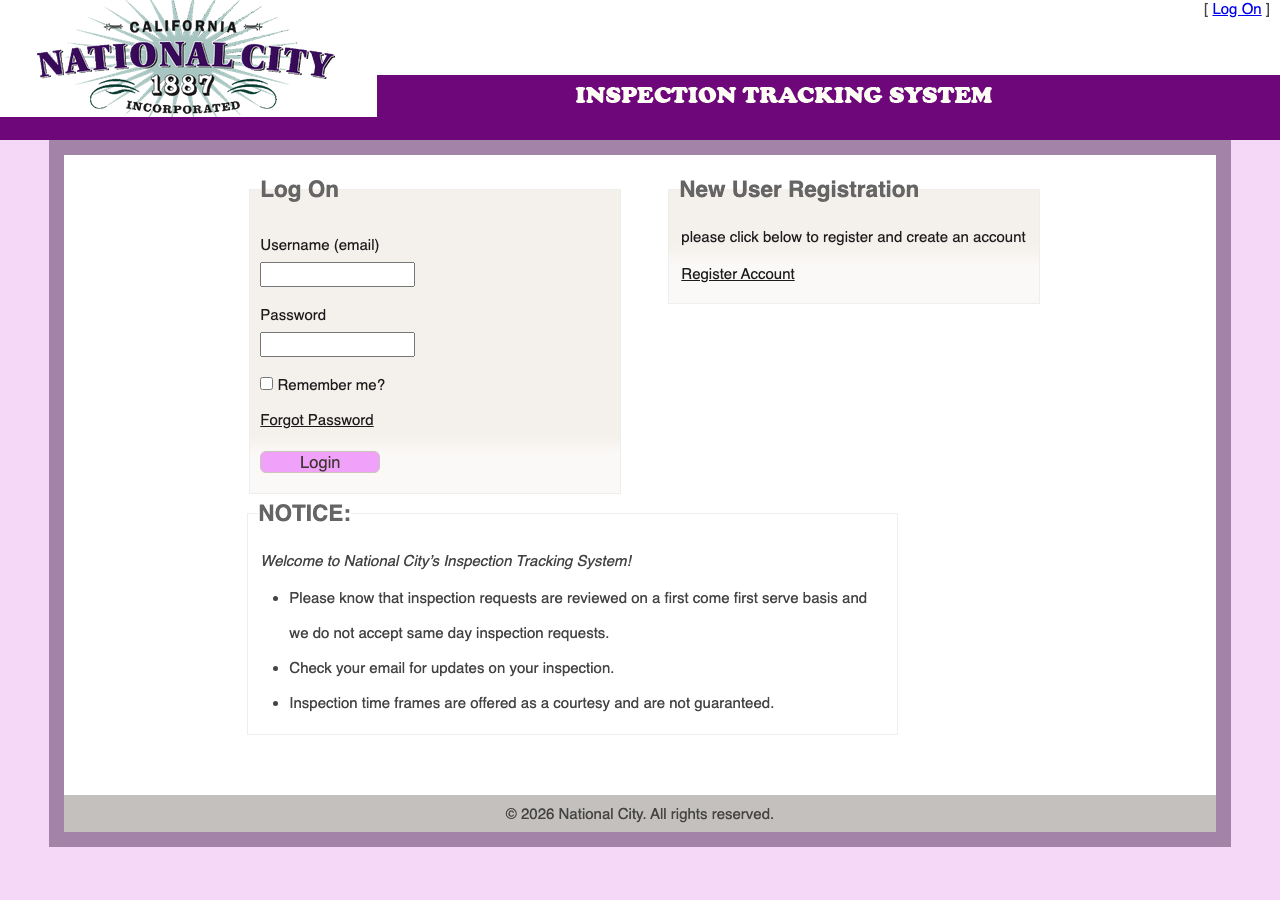
Why the confidence is not higherBuilding Inspections page: 'National City has implemented a convenient web-based inspection tracking system that will allow you to schedule an inspection and track real-time results... CLICK HERE to get started!' — inspection requests are created after logging into an online account.
department page checked 2026-08-30 https://www.nationalcityca.gov/government/community-development/building/building-inspections
Q50 How much notice is required? Core Booking & scheduling
1 business day (24 hours)
Why the confidence is not higherBuilding Inspections page: 'Inspections must be requested 24 hours in advance.'
department page checked 2026-08-30 https://www.nationalcityca.gov/government/community-development/building/building-inspections
Q51 Are same-day or AM/PM windows offered? Booking & scheduling
Yes — AM/PM windows
Why the confidence is not higherBuilding Inspections page instructs the requester to 'Select a preferred time frame of AM or PM'; inspections run approx. 9:00am-12:00pm and 1:00pm-4:00pm, Monday-Thursday (no Friday inspections).
department page checked 2026-08-30 https://www.nationalcityca.gov/government/community-development/building/building-inspections
Q52 Does this AHJ perform its own final solar inspection? Core Who inspects
Yes
Why the confidence is not higherBuilding Division performs its own field inspections (in-house inspectors per the Building Inspections page); no indication of delegation to the County or a JPA for solar/electrical final inspections. National City runs its own Fire Department (not a JPA like Heartland Fire & Rescue), and Building/Electrical sits with the city's own Building Division.
department page checked 2026-08-30 https://www.nationalcityca.gov/government/community-development/building/building-inspections
Q53 If delegated, to whom? Core Who inspects
N/A — not delegated; performed by City of National City Building Division
Why the confidence is not higherSame source as Q52; no delegation language found anywhere in Building or Fire pages.
department page checked 2026-08-30 https://www.nationalcityca.gov/government/community-development/building/building-inspections
Q54 Which inspections are required, and in what order? Core Stages & sequence
General sequence for electrical work (which governs a PV/ESS install): Groundwork -> Rough Wiring -> Final ('after all fixtures, receptacles, switches, sub-panels, and circuits are installed, identified and prior to energization by the utility company'). For a roof-mount PV retrofit not altering framing, typically only the Electrical Final applies; if reroofing or structural work accompanies the install, the parallel Framing/Diaphragm/Final building sequence also applies. No solar-specific inspection type is separately named on the city's own list.
Why the confidence is not higherBuilding Inspections page 'Inspection Types' section lists these categories generically (not solar-specific), so applying them to PV/ESS is an inference from the general list rather than a solar-specific published sequence.
department page checked 2026-08-30 https://www.nationalcityca.gov/government/community-development/building/building-inspections
Q55 Is a rough-in or mid-roof inspection required? Stages & sequence
No (not as a distinct named type for solar)
Why the confidence is not higherThe Building Inspections page's list of inspection types has no 'rough-in' or 'mid-roof' category specific to solar; a rough-in inspection would only be triggered if reroofing/structural work is involved, which is a general Building-Code inference rather than a stated solar rule.
inference from general inspection-type list checked 2026-08-30 https://www.nationalcityca.gov/government/community-development/building/building-inspections
Q56 Does the inspector verify labels and listings? Core What is checked
Yes (inferred)
Why the confidence is not higherBuilding Inspections page states inspectors check work against 'approved plans and all applicable codes and standards' and issue correction notices for deviations; verifying equipment labels/listings is standard practice for enforcing NEC/UL compliance, but no NC document explicitly calls out label/listing verification for solar.
inference from general inspection practice checked 2026-08-30 https://www.nationalcityca.gov/government/community-development/building/building-inspections
Q57 Is there a published inspection checklist? Core What is checked
No dedicated solar inspection checklist found; only a general, non-solar-specific 'Inspection Types' guide is published (footings, framing, insulation, drywall, final; groundwork, rough wiring, electrical final; etc.).
Why the confidence is not higherBuilding Inspections page content reviewed in full; Document Library title list also checked — no 'solar inspection checklist' document exists among the published handouts.
absence across department documents checked 2026-08-30 https://www.nationalcityca.gov/government/community-development/building/building-inspections
Q58 What must be on site at inspection? Core Documents on site
The Building Inspection Record card and the approved (stamped) plans must both be maintained on the job site and made available to the inspector at time of inspection or as requested.
Why the confidence is not higherBuilding Inspections page, 'AT TIME OF INSPECTION' section.
department page checked 2026-08-30 https://www.nationalcityca.gov/government/community-development/building/building-inspections
Q59 Is there a re-inspection fee? Corrections & re-inspection
$139.00 ('Compliance Inspections/Reinspection's')
Why the confidence is not higherFY 2026-27 Master Fee Schedule (effective July 1, 2026), Building Permit Fees section, line 58.
fee schedule checked 2026-08-30 https://www.nationalcityca.gov/home/showpublisheddocument/36538/639135004182100000
Q60 How are corrections issued and cleared? Corrections & re-inspection
Inspector posts a correction notice on the job site when work deviates from approved plans/codes; the permittee must correct the work and request a re-inspection before proceeding to the next phase (or as allowed by the inspector).
Why the confidence is not higherBuilding Inspections page, general inspection-process description.
department page checked 2026-08-30 https://www.nationalcityca.gov/government/community-development/building/building-inspections
Q61 What is issued on pass? Core Final sign-off & PTO
Final
Why the confidence is not higherBuilding Inspections page lists 'FINAL INSPECTION' (building) and a separate electrical 'FINAL' as the terminal inspection type; for a residential PV/ESS retrofit (not new construction) no Certificate of Occupancy is issued — a passed Final is the terminal city sign-off. Not explicitly stated as the solar outcome in writing, so treated as inferred from the general inspection-type list.
inference from general inspection-type list checked 2026-08-30 https://www.nationalcityca.gov/government/community-development/building/building-inspections
Q62 Who notifies the utility for PTO? Core Final sign-off & PTO
Installer (inferred)
Why the confidence is not higherNo National City or SDG&E document found in this run states who submits the Permission-to-Operate request; standard SDG&E/CPUC Rule 21 net-energy-metering practice has the installer/customer submit the interconnection application and request PTO after the AHJ's final inspection passes, consistent with the Building Inspections page's note that electrical 'FINAL' occurs 'prior to energization by the utility company.' Not independently confirmed from an SDG&E document (see Q42/Q43 search failure).
inference — not independently confirmed at utility level checked 2026-08-30 https://www.nationalcityca.gov/government/community-development/building/building-inspections
Lines marked with a percentage were read off this authority’s own published documents. Unmarked guidance is general good practice, not this jurisdiction’s rule — always confirm against the authority before you submit.
Jurisdiction & key facts
The standing 62-question set, answered for City of National City against this authority’s own published documents. Every answer carries the confidence it was recorded at and the document it came from. Where nothing is published we say so and show where we looked — a blank here is a finding, not a gap.
City of National City is the authority having jurisdiction 88% confidence
- Holds
- Building and Electrical (city's own Building Division); Fire Prevention Division (its own department, not a JPA) handles fire plan review/permits generally but shows no solar/ESS-specific permit category or fee line
- Overridden by
- California Government Code §65850.52 (SB 379) requires the city's automated Symbium platform for qualifying systems up to 38.4 kW AC; Government Code §65850.5 makes small residential solar systems a ministerial, non-discretionary approval; Civil Code §714/§4600 (Solar Rights Act) preempts HOA/CC&R restrictions; AB 130 (Stats. 2025, Ch. 22) freezes more-restrictive local residential code amendments 1 Oct 2025 - 1 Jun 2031.
- Why not higher
- National City is an independent general-law city with its own Building Division (permits + inspects both building and electrical) and its own Fire Department (not part of a JPA such as Heartland Fire & Rescue) — confirmed from the city's own Building and Fire Department pages. No evidence of delegation to San Diego County was found. San Diego Community Power (a CCA the city joined in April 2023) affects generation billing only; the city's own SDCP page states power 'is transmitted and delivered through SDG&E infrastructure,' confirming SDG&E remains the interconnecting utility.
https://www.nationalcityca.gov/government/community-development/building
- Permit required
- Yes95%
- Permit cost
- $431.00 flat ('Photovoltaic System' line item)92%
- Plan review
- Symbium-qualifying systems: instantaneous / real-time. Non-qualifying systems (via CityWorks, standard plan review): approx.60%
- Portal
- Symbium (automated ministerial platform, embedded at nationalcityca.gov, jurisdiction=national_city) for qualifying residential solar/ESS;90%
- Electrical code
- 202385%
- Own placard wording
- No62%
- Booking an inspection
- Portal88%
Labels & placards for this authority
Wording 62%
No
Size, colour & material 58%
Not specified by the City
Where they go None%
What the utility wants on top None%
Each figure above is sourced and dated in the full answer set below (questions 38–43). Where an authority’s own published sheet is older than the code it has adopted, the answer says so.
Their website
Average approval time — application to PTO
From the CPUC interconnection record. Bars show the average days taken each year; a year with no recorded projects is left blank rather than drawn as zero.