
City of Orinda
Contra Costa County
City of Orinda is a city authority in the State of California, serving 19,514 residents. 1,909 residential solar installs are on record here. This page is the permit route for that jurisdiction: the fifteen steps from working out who has a say over an address through to permission to operate, the documents this authority publishes, and 62 answers taken from those documents and dated.
Permitting 5 steps · 28 questions
Whether a permit is needed — Yes Q3 Electrical and building permits — Combined Q4 Plan review — Initial completeness review: about 4-5 business days (county's 'Step 1: Initial Review'); Q18 Where you file — Contra Costa County's ePermits Center (epermits.cccounty.us) for the building/electrical permit itself; Q20
- Permit required
- Yes96% source
- What it costs
- $272 flat for a residential PV system ≤15 kW AC ($86 Building Permit/Inspection + $86 Plan Check + $100 Electrical Review), plus $15/kW above 15 kW AC.95% source
- Plan review turnaround
- Initial completeness review: about 4-5 business days (county's 'Step 1: Initial Review'); full plan-review duration after that is not fixed and depends on project complexity and correction cycles.70% source
- Key document
- department page cited by 6 open the document
-
Confirm who has a say over your address
A city address is usually permitted by the city, not the county — but not always, and some authorities keep building and hand electrical to someone else. Getting this wrong costs the whole submittal, because every requirement below belongs to whoever actually holds jurisdiction. Check the overlays in the same pass: an HOA, a historic district, a windstorm certification or a system-size cap can reshape the design, and all of them are cheaper to find now than after the array is laid out.
- Is this authority the AHJ for residential solar at this address? Yes 95% · department page
- What does this authority permit itself, and what does it delegate? Delegated 95% · department page
- Is a permit required for a residential rooftop PV system? Yes 96% · municipal code
- Is there a separate electrical permit, or is it combined? Combined 80% · fee schedule
- Is a HOA or architectural approval required first? No -- not required by the AHJ 55% · municipal code
- Is there a historic-district review? No -- not for a typical residential PV retrofit 55% · municipal code
- Is a wind or windstorm certification required? No 65% · municipal code
- Is a Specific Use Permit or Council approval ever required? No -- not typically for a standard rooftop PV retrofit 55% · municipal code
- Is there a system-size cap on residential generation? 10 kW AC nameplate (or 30 kW thermal) is the ceiling for eligibility under the City's ministerial/expedited 'small residential rooftop solar energy system' process; it must also be sited on a rooftop of a detached SFR or duplex and not exceed the zoning district's building height limit. This is a gate for the streamlined path (citing Gov. Code section 65850.5), not an absolute ban on larger systems, which would go through standard review. 95% · municipal code
-
Check who is allowed to apply
Several authorities require the electrical permit to be pulled by a licensed electrician, or require the contractor to be registered with them BEFORE applying. Registration is not same-day. This is second on the list rather than fourth because it is the step most likely to stop the job before the drawings matter.
- Who is allowed to pull the electrical permit? Either 75% · department page
- Must the contractor be registered with this authority before applying? No 55% · department page
- Is a homeowner permitted to self-install and self-permit? Yes 78% · department page
-
Build the submittal package
Almost everywhere wants a site plan, a one-line or three-line electrical diagram, equipment cut sheets with listings, and a structural attachment detail. Build it against the published checklist rather than the last jurisdiction you worked in — the checklist is what the reviewer marks against.
- What documents make up a complete submittal? Complete digital plan set: roof/site plan showing module and equipment locations, existing roof framing, single-line diagram tying the system into the house electrical panel and PG&E service, manufacturer installation/grounding instructions and spec sheets (modules, inverter, racking, batteries if any), plus the County's Residential PV Eligibility & Structural Checklist (and Structural Criteria worksheet if any item on it fails). 90% · published checklist
- How many copies, and in what format? Digital: one bookmarked, unsecured, multi-page PDF, min 11x17 landscape (24x36 for ground-mount/commercial roof), max 100MB, drawn to scale from drafting software (no scans), 3.5in x 6in blank column reserved for county stamps. Paper (in-office only): 3 sets, 11x17 minimum. 88% · published checklist
- Is a site plan required, and what must it show? Yes -- a roof plan (roof-mount) or site plan (ground-mount) showing module/array locations, existing roof framing, inverter/battery/equipment locations, plus a separate roof-access/pathway diagram showing disconnect and roof-access-point locations. 88% · published checklist
- Is a one-line / three-line diagram required? Yes 92% · published checklist
- Are string and conductor calculations required? Yes 75% · published checklist
- Is a structural PE stamp required, and at what threshold? Required only if the array fails the County's own 'Structural Criteria for Residential Flush-Mounted Solar Arrays' prescriptive checks (roof condition, anchor horizontal spacing per Table 1, wind-uplift/fastener check) -- if any item is checked NO, project-specific drawings and calculations stamped and signed by a California-licensed Civil or Structural Engineer must be attached. 85% · published checklist
-
Apply and pay
Most authorities now take the whole application through a portal, and several states cap or constrain what a residential solar permit may cost. Check whether plan check is billed separately before you quote the job.
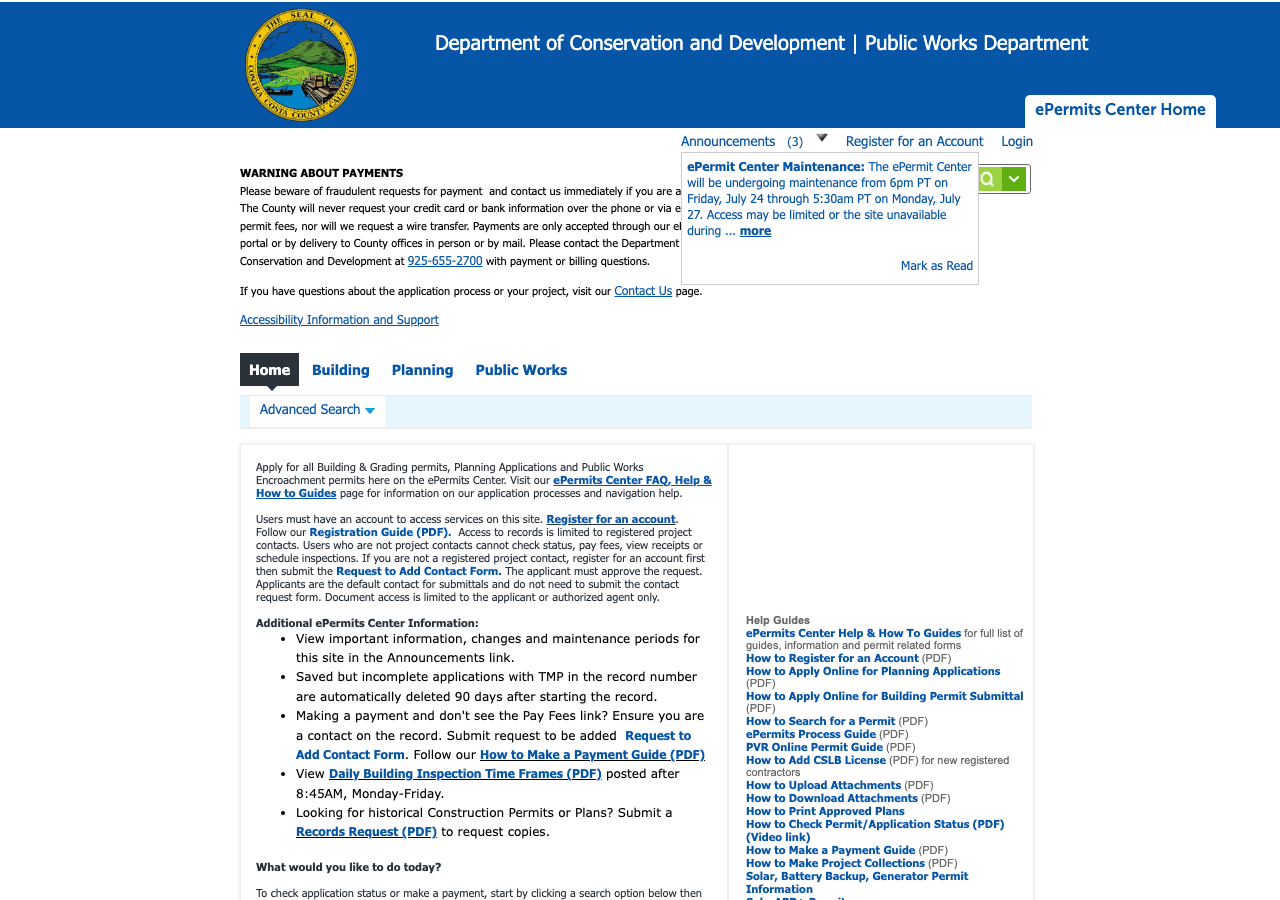
- Which permit portal does this authority use? Contra Costa County's ePermits Center (epermits.cccounty.us) for the building/electrical permit itself; Orinda's own 'Application Submittal Portal' for the (usually-waived) Planning step; SolarAPP+ offered as an optional software-driven pathway for qualifying residential rooftop PV. 90% · department page
- Can the whole application be completed online? Yes 85% · department page
- What does a residential solar permit cost? $272 flat for a residential PV system ≤15 kW AC ($86 Building Permit/Inspection + $86 Plan Check + $100 Electrical Review), plus $15/kW above 15 kW AC. Thermal systems: $258 flat ≤10 kWth ($86+$86+$86), plus $15/kWth above 10 kWth. 95% · fee schedule
- How is the fee calculated? Tiered / Per kW 90% · fee schedule
- Is there a separate plan-check fee? Yes 92% · fee schedule
-
Plan review — and start the utility in parallel
Interconnection is a separate process from the permit and usually the longer pole. Where the utility does not depend on the permit being issued, running both at once is the single biggest saving available on a residential job.
- What is the stated plan-review turnaround? Initial completeness review: about 4-5 business days (county's 'Step 1: Initial Review'); full plan-review duration after that is not fixed and depends on project complexity and correction cycles. Orinda's optional SolarAPP+ pathway (where used) issues instantly on submittal but was not separately confirmed as active for Orinda specifically. 70% · department page
- How long is an issued permit valid before it expires? Approximately 365 days of inactivity, inferred 55% · fee schedule
- Which utility handles interconnection here? Pacific Gas & Electric (PG&E) 90% · department page
- Where does the utility sit in the sequence? Parallel, with Permission-to-Operate gated on the AHJ's final inspection clearance 75% · utility tariff
28 questions answered against City of Orinda’s own published documents
Q1 Is this authority the AHJ for residential solar at this address? Core Jurisdiction & scope
Yes
Why the confidence is not higherCity's own Building Permits page states plainly that a building permit is required for solar and that 'Only Contra Costa County Building Department issues building permits' -- the City IS the AHJ of record for zoning/Planning but delegates the operative building-permit function; confirmed by OMC 15.60.010 requiring a building permit for any solar energy system.
department page checked 2026-08-31 https://www.cityoforinda.org/432/Building-Permits
Q2 What does this authority permit itself, and what does it delegate? Core Jurisdiction & scope
Delegated
Why the confidence is not higherCity's own Building Permits FAQ: 'The City of Orinda does not have its own building department and contracts with Contra Costa County for building services.' Planning Dept. retains zoning/design review (but that review is explicitly waived for flush roof-mount residential solar, per the same page's FAQ). Fire code enforcement is separately assigned to Moraga-Orinda Fire District by OMC 8.20.030.
department page checked 2026-08-31 https://www.cityoforinda.org/432/Building-Permits
Q3 Is a permit required for a residential rooftop PV system? Core Jurisdiction & scope
Yes
Why the confidence is not higherOMC 15.60.010(A): 'A building permit is required to install a solar energy system.' "Solar energy system" defined per Civil Code section 801.5.
municipal code checked 2026-08-31 https://library.municode.com/ca/orinda/codes/code_of_ordinances?nodeId=TIT15BUCO_CH15.60SOENSY
Q4 Is there a separate electrical permit, or is it combined? Core Jurisdiction & scope
Combined
Why the confidence is not higherContra Costa County's residential PV fee bundles Building Permit/Inspection, Plan Check and Electrical Review into one per-permit fee schedule and one application; there is no separate freestanding electrical-only permit process described for residential PV.
fee schedule checked 2026-08-31 https://www.contracosta.ca.gov/DocumentCenter/View/62479/Land-Development-Fee-Schedule-PDF
Q5 Who is allowed to pull the electrical permit? Core Who may apply
Either
Why the confidence is not higherContra Costa County's own permit-application page offers a 'Building Permit Declarations Form for licensed contractors or property owners' -- i.e. either a licensed contractor or an owner-builder may pull the permit; no Orinda-specific restriction found.
department page checked 2026-08-31 https://www.contracosta.ca.gov/7863/Applying-for-a-Building-or-Grading-Permi
Q6 Must the contractor be registered with this authority before applying? Core Who may apply
No
Why the confidence is not higherNo Orinda- or county-specific contractor pre-registration requirement (beyond standard CSLB licensing) was found on the county's Applying-for-a-Permit page or in the Orinda solar chapter (OMC 15.60); this is an absence found by checking the place it would be, not an unlooked gap, but no explicit negative statement exists either.
department page checked 2026-08-31 https://www.contracosta.ca.gov/7863/Applying-for-a-Building-or-Grading-Permi
Q7 Is a homeowner permitted to self-install and self-permit? Who may apply
Yes
Why the confidence is not higherCounty's own building-permit application flow provides an owner-builder declarations path ('Building Permit Declarations Form for licensed contractors or property owners'); Orinda's own Building Permits FAQ describes a homeowner directly obtaining a 'permanent residential back-up generator' permit with no contractor requirement, indicating owner-permitting is accepted for comparable residential electrical/mechanical work.
department page checked 2026-08-31 https://www.contracosta.ca.gov/7863/Applying-for-a-Building-or-Grading-Permi
Q8 What documents make up a complete submittal? Core Submittal package
Complete digital plan set: roof/site plan showing module and equipment locations, existing roof framing, single-line diagram tying the system into the house electrical panel and PG&E service, manufacturer installation/grounding instructions and spec sheets (modules, inverter, racking, batteries if any), plus the County's Residential PV Eligibility & Structural Checklist (and Structural Criteria worksheet if any item on it fails).
Why the confidence is not higherContra Costa County's 'Residential Photovoltaic System Requirements Checklist' (eligibility/structural) and 'Photovoltaic System Checklist for Digital Plan Submittals' spell out the submittal item-by-item; both are the currently-linked documents on the county's live Applying-for-a-Permit page (the 'digital submittal' doc is mislabeled 'Commercial' on that page but its own body text and title confirm it covers residential roof-mounted systems too).
published checklist checked 2026-08-31 https://www.contracosta.ca.gov/DocumentCenter/View/37433/DCD-PVR-Eligibility-and-Structural-checklist
Q9 How many copies, and in what format? Submittal package
Digital: one bookmarked, unsecured, multi-page PDF, min 11x17 landscape (24x36 for ground-mount/commercial roof), max 100MB, drawn to scale from drafting software (no scans), 3.5in x 6in blank column reserved for county stamps. Paper (in-office only): 3 sets, 11x17 minimum.
Why the confidence is not higherCounty's 'Photovoltaic System Checklist for Digital Plan Submittals' (pdfinfo CreationDate 2 May 2020) item 1, and the Eligibility Checklist item F, both currently linked and downloaded/extracted directly.
published checklist checked 2026-08-31 https://www.contracosta.ca.gov/DocumentCenter/View/33726
Q10 Is a site plan required, and what must it show? Core Submittal package
Yes -- a roof plan (roof-mount) or site plan (ground-mount) showing module/array locations, existing roof framing, inverter/battery/equipment locations, plus a separate roof-access/pathway diagram showing disconnect and roof-access-point locations.
Why the confidence is not higherCounty Eligibility Checklist item F and Fire Safety Requirements item C; Digital Submittal Checklist item 2.
published checklist checked 2026-08-31 https://www.contracosta.ca.gov/DocumentCenter/View/37433/DCD-PVR-Eligibility-and-Structural-checklist
Q11 Is a one-line / three-line diagram required? Core Drawings & calculations
Yes
Why the confidence is not higherCounty's Digital Submittal Checklist item 3: 'Provide single line drawings of how the system ties into the house electrical system and the existing PG&E equipment.'
published checklist checked 2026-08-31 https://www.contracosta.ca.gov/DocumentCenter/View/33726
Q12 Are string and conductor calculations required? Drawings & calculations
Yes
Why the confidence is not higherCounty Eligibility Checklist's Electrical Requirements section caps strings per MPPT input (4 with inverter-integrated source-circuit fusing, 2 without), fuse ratings, inverter count and combiner count -- effectively requiring string/conductor accounting to qualify for the expedited path.
published checklist checked 2026-08-31 https://www.contracosta.ca.gov/DocumentCenter/View/37433/DCD-PVR-Eligibility-and-Structural-checklist
Q13 Is a structural PE stamp required, and at what threshold? Core Engineering & stamps
Required only if the array fails the County's own 'Structural Criteria for Residential Flush-Mounted Solar Arrays' prescriptive checks (roof condition, anchor horizontal spacing per Table 1, wind-uplift/fastener check) -- if any item is checked NO, project-specific drawings and calculations stamped and signed by a California-licensed Civil or Structural Engineer must be attached.
Why the confidence is not higherCounty's own Structural Criteria checklist, Summary section B/C, downloaded and extracted with pdftotext.
published checklist checked 2026-08-31 https://www.contracosta.ca.gov/DocumentCenter/View/37433/DCD-PVR-Eligibility-and-Structural-checklist
Q14 Is an electrical PE stamp required, and at what threshold? Engineering & stamps
Nothing published by this authority.
Where we lookedCounty Eligibility Checklist's Electrical Requirements section and OMC Ch. 15.12 (Electrical Code, adoption-only, no local amendments found); no separate electrical-PE-stamp threshold found anywhere in the county checklist or city code.
Q15 What does a residential solar permit cost? Core Fees
$272 flat for a residential PV system ≤15 kW AC ($86 Building Permit/Inspection + $86 Plan Check + $100 Electrical Review), plus $15/kW above 15 kW AC. Thermal systems: $258 flat ≤10 kWth ($86+$86+$86), plus $15/kWth above 10 kWth.
Why the confidence is not higherContra Costa County Land Development Fee Schedule, adopted by the Board of Supervisors 24 May 2022, effective 10 Aug 2022 (PDF re-rendered/re-dated Dec 2024 per pdfinfo, rates unchanged); downloaded and extracted directly. This is the fee actually paid since Orinda has no building department of its own.
fee schedule checked 2026-08-31 https://www.contracosta.ca.gov/DocumentCenter/View/62479/Land-Development-Fee-Schedule-PDF
Q16 How is the fee calculated? Core Fees
Tiered / Per kW
Why the confidence is not higherFlat base fee up to a size threshold (15 kW AC for PV, 10 kWth for thermal), then a fixed additional amount per kW above that threshold; see County Land Development Fee Schedule.
fee schedule checked 2026-08-31 https://www.contracosta.ca.gov/DocumentCenter/View/62479/Land-Development-Fee-Schedule-PDF
Q17 Is there a separate plan-check fee? Fees
Yes
Why the confidence is not higherCounty fee schedule lists Plan Check ($86) as a distinct line item from Building Permit/Inspection ($86) and Electrical Review ($100) for residential PV.
fee schedule checked 2026-08-31 https://www.contracosta.ca.gov/DocumentCenter/View/62479/Land-Development-Fee-Schedule-PDF
Q18 What is the stated plan-review turnaround? Core Timeline & validity
Initial completeness review: about 4-5 business days (county's 'Step 1: Initial Review'); full plan-review duration after that is not fixed and depends on project complexity and correction cycles. Orinda's optional SolarAPP+ pathway (where used) issues instantly on submittal but was not separately confirmed as active for Orinda specifically.
Why the confidence is not higherContra Costa County's own 'Applying for a Building or Grading Permit' page, Step 1-3 narrative, fetched and read directly; no authority-specific published maximum plan-review duration was found beyond the 4-5 business day initial-completeness figure.
department page checked 2026-08-31 https://www.contracosta.ca.gov/7863/Applying-for-a-Building-or-Grading-Permi
Q19 How long is an issued permit valid before it expires? Timeline & validity
Approximately 365 days of inactivity, inferred
Why the confidence is not higherNo explicit 'permit expires after N days' clause was found; the county fee schedule's own Renewal Fee section distinguishes permits 'expired less than 365 days' (50% of original fee to renew) from 'expired 365 days or more' (100% of original fee), implying 365 days is the operative threshold, though this is a renewal-fee rule rather than a stated expiration duration.
fee schedule checked 2026-08-31 https://www.contracosta.ca.gov/DocumentCenter/View/62479/Land-Development-Fee-Schedule-PDF
Q20 Which permit portal does this authority use? Core Portal & process
Contra Costa County's ePermits Center (epermits.cccounty.us) for the building/electrical permit itself; Orinda's own 'Application Submittal Portal' for the (usually-waived) Planning step; SolarAPP+ offered as an optional software-driven pathway for qualifying residential rooftop PV.
Why the confidence is not higherCounty's Applying-for-a-Permit page (SolarAPP+ section, ePermits Center references) and Orinda's own Building Permits / Planning pages, fetched directly.
department page checked 2026-08-31 https://www.contracosta.ca.gov/7863/Applying-for-a-Building-or-Grading-Permi
Q21 Can the whole application be completed online? Core Portal & process
Yes
Why the confidence is not higherCounty's ePermits Center supports full online submittal, review-comment communication and payment; SolarAPP+ is a fully online, software-driven permit path for qualifying residential PV. Orinda's own Planning submittal (where required) is also online-only ('Submittals by email are not accepted').
department page checked 2026-08-31 https://www.contracosta.ca.gov/7863/Applying-for-a-Building-or-Grading-Permi
Q22 Which utility handles interconnection here? Core Utility interconnection
Pacific Gas & Electric (PG&E)
Why the confidence is not higherMultiple City of Orinda-side documents confirm PG&E: the City's own FAQ states PG&E 'is the agency responsible for maintaining the majority of streetlights for the City'; the City's own Wilder Trail Feasibility Study (2025) identifies '2 sets of Overhead 12kV PG&E Electric Lines' and '2 sets of Overhead 115kV PG&E Electric Lines' crossing city infrastructure; the City's Housing Resources page lists Pacific Gas & Electric energy-assistance programs. A site-search for a CCA ('MCE'/'Clean Energy') on the City's own website returned zero relevant hits (positive control 'PG&E' returned 830 hits, fabricated control 'zzqqx' returned 'No results found', confirming the search itself works) -- so Orinda does not appear to be enrolled in a Community Choice Aggregator; PG&E is both the wires utility and default generation provider.
department page checked 2026-08-31 https://www.cityoforinda.org/569/Housing-Resources
Q23 Where does the utility sit in the sequence? Core Utility interconnection
Parallel, with Permission-to-Operate gated on the AHJ's final inspection clearance
Why the confidence is not higherStandard PG&E Rule 21 sequence (per PG&E's own current tariff, confirmed generally applicable and not authority-specific): interconnection application can be filed in parallel with the building-permit process, but PTO under Rule 21 Section D.13.b is processed only upon 'evidence of Applicant's final electric inspection clearance from the Governmental Authority having jurisdiction' -- i.e. the county's final building/electrical sign-off gates PTO, not permit issuance itself.
utility tariff checked 2026-08-31 https://www.pge.com/tariffs/assets/pdf/tariffbook/ELEC_RULES_21.pdf
Q24 Is a HOA or architectural approval required first? Overlays & special cases
No -- not required by the AHJ
Why the confidence is not higherNo HOA/architectural-approval-required clause was found in OMC Title 17 (Zoning), the Design Review chapter (17.30), or the solar chapter (15.60); a targeted text search for 'homeowners association'/'HOA' across the fetched zoning, building and solar chapters returned zero hits (the same chapters returned many hits for control terms like 'building permit', confirming the check worked). This does not rule out a private CC&R requirement, only that the City/County does not condition its own permit on one.
municipal code checked 2026-08-31 https://library.municode.com/ca/orinda/codes/code_of_ordinances?nodeId=TIT15BUCO_CH15.60SOENSY
Q25 Is there a historic-district review? Overlays & special cases
No -- not for a typical residential PV retrofit
Why the confidence is not higherOMC Ch. 17.25 (Historic Landmarks, 25 sections) contains zero mentions of 'solar' or 'certificate of appropriateness' (control-checked: the chapter's own text was fully extracted and searched); Design Review triggers in Ch. 17.30.3 do not include roof-mounted equipment. This is an inference from a full-chapter absence, not an explicit exemption clause.
municipal code checked 2026-08-31 https://library.municode.com/ca/orinda/codes/code_of_ordinances?nodeId=TIT17ZO_CH17.25HILA
Q26 Is a wind or windstorm certification required? Overlays & special cases
No
Why the confidence is not higherNo wind/windstorm certification (TDI-style) requirement exists in California's adopted codes or in Orinda's Building/Electrical Code chapters (OMC 15.08, 15.12) -- these are adoption-only with no such provision; this is a Texas-specific mechanism (Texas Department of Insurance) with no California equivalent, control-checked against the adopted chapters.
municipal code checked 2026-08-31 https://library.municode.com/ca/orinda/codes/code_of_ordinances?nodeId=TIT15BUCO_CH15.12ELCO
Q27 Is a Specific Use Permit or Council approval ever required? Overlays & special cases
No -- not typically for a standard rooftop PV retrofit
Why the confidence is not higherOMC 15.60.020 sets the ministerial/expedited review path for small residential rooftop solar with no cross-reference to Ch. 17.31 (General Use Permit) or a Specific Use Permit process; larger or non-conforming systems would presumably route through ordinary zoning process, but no PV-specific SUP trigger was found.
municipal code checked 2026-08-31 https://library.municode.com/ca/orinda/codes/code_of_ordinances?nodeId=TIT15BUCO_CH15.60SOENSY
Q28 Is there a system-size cap on residential generation? Overlays & special cases
10 kW AC nameplate (or 30 kW thermal) is the ceiling for eligibility under the City's ministerial/expedited 'small residential rooftop solar energy system' process; it must also be sited on a rooftop of a detached SFR or duplex and not exceed the zoning district's building height limit. This is a gate for the streamlined path (citing Gov. Code section 65850.5), not an absolute ban on larger systems, which would go through standard review.
Why the confidence is not higherOMC 15.60.020(E)(1)-(5), extracted directly from Municode.
municipal code checked 2026-08-31 https://library.municode.com/ca/orinda/codes/code_of_ordinances?nodeId=TIT15BUCO_CH15.60SOENSY
Lines marked with a percentage were read off this authority’s own published documents. Unmarked guidance is general good practice, not this jurisdiction’s rule — always confirm against the authority before you submit.
Install 5 steps · 20 questions
-
Build to the code editions actually in force here
The NEC edition a jurisdiction enforces is often a cycle behind the newest one published, and local amendments sit on top of it. Rapid shutdown, conductor sizing and labelling all change between editions, so the edition in force is the first thing to establish, not the last.
- Which NEC edition is in force? 2023 NEC, as incorporated into the 2025 California Electrical Code (CEC) 90% · adopting ordinance
- Which building code edition is in force? 2025 California Building Code / 2025 California Residential Code 95% · adopting ordinance
- Which fire code edition is in force? City's own codified Fire Safety chapter (OMC 8.20.010) still names the 2022 California Fire Code (per Moraga-Orinda Fire District Ordinance 23-01, ratified by the City in 2023) -- but MOFD's own Ordinances & Resolutions page shows Ordinance 26-01, 'Adopting the 2025 edition of the California Fire Code ... and repealing Ordinance 23-01', posted around 16 Jan 2026. The City's codified fire chapter has not yet been updated to reflect MOFD's newer adoption -- a code-cycle lag between the city code and the fire district's actual current code. 80% · department page
- Are there local amendments to any of the above? Yes, generally -- but none found specific to solar/PV/rapid shutdown/busbar sizing. 88% · municipal code
- What is the installation judged against? The installation is judged against the adopted 2025 CBC/CRC/CEC/CALGreen (as locally amended, none of which touch solar specifically), Civil Code section 714 (Solar Rights Act, per OMC 15.60.020(E)(3)), Gov. Code section 65850.5, and Contra Costa County's own Residential PV Eligibility & Structural Checklist for the expedited path. 85% · municipal code
-
Fire access, setbacks and pathways
Ridge setbacks and roof access pathways are fire-service requirements and they constrain the array layout. They are the most common cause of a redesign after the fire department comments on a plan set.
- What ridge setback and access pathways are required? A specific ridge-setback distance is not codified locally (not found in OMC or the county checklist); the county's Fire Safety Requirements do require 'a diagram of the roof layout of all panels, modules, clear access pathways and approximate locations of electrical disconnecting means and roof access points' as part of every submittal, and roof-access points must avoid overhead obstructions and be at strong points of construction -- but no numeric ridge-setback figure is stated in any Orinda- or Contra Costa-side document found. 65% · published checklist
-
Rapid shutdown
Which rapid-shutdown rule applies follows directly from the NEC edition in force, and the initiation device has to be at a location the fire service can reach and identify. This is inspected, and it is labelled.
- Is rapid shutdown required, and to which NEC edition? Rapid shutdown is required under NEC 690.12 as incorporated into the 2023 NEC / 2025 CEC statewide adoption; no Orinda- or MOFD-specific document was found that separately cites or amends section 690.12. 65% · adopting ordinance
-
Labels and placards
The NEC sets a baseline for permanent markings at the service equipment and the disconnecting means. On top of that, an authority may specify its own wording, and the utility may specify more again. Where any of them writes its own text, a generic off-the-shelf label set will not pass — this is the detail most often fixed on a return visit.
- Is a site plan / facility map placard required, and what must it show? Yes -- a roof-layout diagram showing all panel/module locations, clear access pathways, and the approximate locations of electrical disconnecting means and roof access points is a required part of every submittal (this functions as the site/facility-map placard-equivalent document). 85% · published checklist
- Does the UTILITY specify placards beyond the AHJ's? Yes -- PG&E Rule 21 section H.1.d requires a 'Visible Disconnect' with open/closed position markings, lockable and reachable 24/7, and shown on the single-line diagram -- a utility-side signage requirement independent of the AHJ's. 80% · utility tariff
-
Disconnect, storage and listed equipment
Where the AC disconnect must sit relative to the meter is usually the utility's rule, not the building department's. Battery storage frequently carries its own permit, its own inspection and its own fire conditions.
- Where must the AC disconnect be, relative to the meter? PG&E Rule 21 section H.1.d requires the AC disconnect be visible, lockable, reachable 24/7 and carry open/closed markings; no specific distance (e.g. '3 ft' or '10 ft') from the meter was found in any PG&E, Orinda or Contra Costa document reviewed -- PG&E's more detailed Greenbook meter-proximity specification (TD-7001M / TD-2306M) is access-gated to PG&E-affiliated users and could not be retrieved. 65% · utility tariff
- Must equipment be on a specific approved list? No dedicated city/county-approved equipment list found -- standard CEC-listed/UL-listed component requirements apply via the manufacturer spec-sheet submittal requirement. 55% · published checklist
- Are batteries permitted, and under what conditions? Yes -- batteries/ESS are permitted. Moraga-Orinda Fire District's current fee schedule prices a dedicated 'Energy Storage Systems' fire construction permit (PR14.1, $1,151/permit) and a 'UL 9540A Modification' fee (PR14.3, $627/project), confirming ESS is a recognized, permitted installation category with its own fire plan-review and inspection. 80% · fee schedule
- Is there a separate ESS permit or inspection? Yes -- MOFD prices Energy Storage Systems (PR14.1) as a fire construction permit distinct from Solar Photovoltaic Power Systems (PR14.2); each bundles 1 plan review, 1 resubmittal, 1 inspection and 1 reinspection under the 'FIRE CONSTRUCTION PERMITS' category. It is not clear from the fee schedule alone whether every residential rooftop PV job (as opposed to only ESS or larger/non-exempt installs) actually triggers a MOFD permit in practice, so this is reported at moderate confidence. 70% · fee schedule
- Is a ground mount treated as a structure? Likely yes, by inference -- Contra Costa County's own City & Agency Directory page lists 'ground mount solar systems' explicitly among the project types requiring Central Contra Costa Sanitary District review (alongside 'new structures', 'additions', 'retaining walls' and other structures needing excavation review), and the county's residential solar fee schedule prices roof-mount and ground-mount PV under the same line items without differentiating structural classification. Orinda's own zoning code has no PV-specific ground-mount provision; a ground rack would most likely be classified as an 'accessory structure' under OMC 17.4.22 (min. 50 ft setback from any street-frontage property line) by default, though this is inference, not an explicit statement. 65% · department page
- Is there a local rule on service upgrades or busbar sizing? No general local CEC amendment to busbar sizing exists (control-checked absence in OMC 15.12). But Contra Costa County's own expedited-eligibility checklist for residential PV requires the system be 'interconnected to a single-phase AC service panel of nominal 120/220 Vac with a bus bar rating of 200 A or less' as a condition of using the streamlined/expedited review path -- an eligibility ceiling, not a minimum, and the opposite direction from the Palm Springs-style '225A minimum' amendment seen elsewhere. 80% · published checklist
- Is a specific mounting system or attachment spacing required? Yes -- the County's 'Structural Criteria for Residential Flush-Mounted Solar Arrays' worksheet specifies: modules parallel to roof plane with a 2in-10in gap to the roof surface; array weight capped at 4 psf (PV) / 5 psf (thermal); array covering no more than half the total roof area; and a maximum-horizontal-anchor-spacing table (Table 1) that varies by roof slope (flat-6:12, 7:12-12:12, 13:12-24:12) and rafter spacing (16in/24in/32in o.c.), plus a wind-uplift/fastener check. 88% · published checklist
20 questions answered against City of Orinda’s own published documents
Q29 Which NEC edition is in force? Core Code editions in force
2023 NEC, as incorporated into the 2025 California Electrical Code (CEC)
Why the confidence is not higherOMC 15.12.010(A): 'The electrical code of the city is the 2025 California Electrical Code ... as amended by the changes ... set forth herein' (Ord. No. 25-07, adopted 13 Jan 2026); the 2025 CEC is based on the 2023 NEC per the statewide 2025 Title 24 cycle.
adopting ordinance checked 2026-08-31 https://library.municode.com/ca/orinda/codes/code_of_ordinances?nodeId=TIT15BUCO_CH15.12ELCO
Q30 Which building code edition is in force? Core Code editions in force
2025 California Building Code / 2025 California Residential Code
Why the confidence is not higherOMC 15.08.010(A) and 15.09.010(A), both adopted by Ord. No. 25-07 (13 Jan 2026), current per Municode codification through Ord. 25-07 (banner dated).
adopting ordinance checked 2026-08-31 https://library.municode.com/ca/orinda/codes/code_of_ordinances?nodeId=TIT15BUCO_CH15.08BUCO
Q31 Which fire code edition is in force? Code editions in force
City's own codified Fire Safety chapter (OMC 8.20.010) still names the 2022 California Fire Code (per Moraga-Orinda Fire District Ordinance 23-01, ratified by the City in 2023) -- but MOFD's own Ordinances & Resolutions page shows Ordinance 26-01, 'Adopting the 2025 edition of the California Fire Code ... and repealing Ordinance 23-01', posted around 16 Jan 2026. The City's codified fire chapter has not yet been updated to reflect MOFD's newer adoption -- a code-cycle lag between the city code and the fire district's actual current code.
Why the confidence is not higherOMC 8.20.010 (Municode) compared against MOFD's own Ordinances & Resolutions listing, which names 'Ordinance 26-01' with that exact repeal language.
department page checked 2026-08-31 https://www.mofd.org/our-district/fuels-mitigation-fire-prevention/ordinances-resolutions
Q32 Are there local amendments to any of the above? Core Code editions in force
Yes, generally -- but none found specific to solar/PV/rapid shutdown/busbar sizing.
Why the confidence is not higherOMC 15.08 (Building Code) and 15.09 (CRC) carry local amendments (e.g. retaining-wall permit-exemption threshold, construction-document requirements); OMC 15.10 (CALGreen) amends waste-diversion thresholds. But a full-text search of the extracted Building Code, CRC, CALGreen and Electrical Code chapters for 'solar', 'photovoltaic', '690.12', 'rapid shutdown', 'busbar'/'bus bar' and 'attic' returned zero hits in every chapter (fabricated control 'zzqqx' also zero, and the positive control 'electrical'/'building permit' hit repeatedly, confirming the chapters were actually searched, not merely absent from view) -- so Orinda has no PV-specific electrical/building local amendment.
municipal code checked 2026-08-31 https://library.municode.com/ca/orinda/codes/code_of_ordinances?nodeId=TIT15BUCO_CH15.12ELCO
Q33 What is the installation judged against? Core Electrical
The installation is judged against the adopted 2025 CBC/CRC/CEC/CALGreen (as locally amended, none of which touch solar specifically), Civil Code section 714 (Solar Rights Act, per OMC 15.60.020(E)(3)), Gov. Code section 65850.5, and Contra Costa County's own Residential PV Eligibility & Structural Checklist for the expedited path.
Why the confidence is not higherOMC 15.60.010(B) and 15.60.020(E)(2)-(3); County Eligibility Checklist.
municipal code checked 2026-08-31 https://library.municode.com/ca/orinda/codes/code_of_ordinances?nodeId=TIT15BUCO_CH15.60SOENSY
Q34 Is there a local rule on service upgrades or busbar sizing? Electrical
No general local CEC amendment to busbar sizing exists (control-checked absence in OMC 15.12). But Contra Costa County's own expedited-eligibility checklist for residential PV requires the system be 'interconnected to a single-phase AC service panel of nominal 120/220 Vac with a bus bar rating of 200 A or less' as a condition of using the streamlined/expedited review path -- an eligibility ceiling, not a minimum, and the opposite direction from the Palm Springs-style '225A minimum' amendment seen elsewhere.
Why the confidence is not higherCounty Eligibility Checklist, Electrical Requirements item C, extracted directly; OMC Ch. 15.12 searched and found to contain no busbar provision at all.
published checklist checked 2026-08-31 https://www.contracosta.ca.gov/DocumentCenter/View/37433/DCD-PVR-Eligibility-and-Structural-checklist
Q35 Is a specific mounting system or attachment spacing required? Structural & mounting
Yes -- the County's 'Structural Criteria for Residential Flush-Mounted Solar Arrays' worksheet specifies: modules parallel to roof plane with a 2in-10in gap to the roof surface; array weight capped at 4 psf (PV) / 5 psf (thermal); array covering no more than half the total roof area; and a maximum-horizontal-anchor-spacing table (Table 1) that varies by roof slope (flat-6:12, 7:12-12:12, 13:12-24:12) and rafter spacing (16in/24in/32in o.c.), plus a wind-uplift/fastener check.
Why the confidence is not higherContra Costa County Structural Criteria checklist (same document as the Eligibility Checklist), extracted with pdftotext -layout and read directly.
published checklist checked 2026-08-31 https://www.contracosta.ca.gov/DocumentCenter/View/37433/DCD-PVR-Eligibility-and-Structural-checklist
Q36 What ridge setback and access pathways are required? Core Fire pathways & setbacks
A specific ridge-setback distance is not codified locally (not found in OMC or the county checklist); the county's Fire Safety Requirements do require 'a diagram of the roof layout of all panels, modules, clear access pathways and approximate locations of electrical disconnecting means and roof access points' as part of every submittal, and roof-access points must avoid overhead obstructions and be at strong points of construction -- but no numeric ridge-setback figure is stated in any Orinda- or Contra Costa-side document found.
Why the confidence is not higherContra Costa County Eligibility Checklist, Fire Safety Requirements section, and its 'Roof Access and Pathways' page, extracted directly; OMC 8.20 (Fire Safety) contains no numeric pathway/setback figures of its own.
published checklist checked 2026-08-31 https://www.contracosta.ca.gov/DocumentCenter/View/37433/DCD-PVR-Eligibility-and-Structural-checklist
Q37 Is rapid shutdown required, and to which NEC edition? Core Rapid shutdown
Rapid shutdown is required under NEC 690.12 as incorporated into the 2023 NEC / 2025 CEC statewide adoption; no Orinda- or MOFD-specific document was found that separately cites or amends section 690.12.
Why the confidence is not higherInferred from the statewide 2025 CEC adoption (OMC 15.12.010); a full-text search of the extracted Electrical Code, Building Code and county PV checklists for '690.12' and 'rapid shutdown' returned zero hits everywhere, meaning the requirement is inherited from the adopted NEC rather than locally restated.
adopting ordinance checked 2026-08-31 https://library.municode.com/ca/orinda/codes/code_of_ordinances?nodeId=TIT15BUCO_CH15.12ELCO
Q38 Which placards does this authority require at the service equipment? Core Labels Signage & labelling
Nothing published by this authority.
Where we lookedContra Costa County's PV checklists, MOFD's fee schedule, permit-applications page and standard-details-and-specifications page -- none publish an itemized placard list for PV service equipment beyond the general 'all required markings and labels are provided' checklist item.
Q39 Does the authority specify placard wording of its own? Core Labels Signage & labelling
Nothing published by this authority.
Where we lookedSame documents as Q38; no AHJ-specific placard wording found (the county checklist only requires that 'fire classification of solar system is provided' and markings/labels exist, without prescribing exact text).
Q40 Does it specify letter height, colour or material? Core Labels Signage & labelling
Nothing published by this authority.
Where we lookedSame documents as Q38/39; no letter-height, colour or material specification found in any Orinda- or Contra Costa-side document reviewed.
Q41 Is a site plan / facility map placard required, and what must it show? Core Labels Signage & labelling
Yes -- a roof-layout diagram showing all panel/module locations, clear access pathways, and the approximate locations of electrical disconnecting means and roof access points is a required part of every submittal (this functions as the site/facility-map placard-equivalent document).
Why the confidence is not higherCounty Eligibility Checklist, Fire Safety Requirements item C.
published checklist checked 2026-08-31 https://www.contracosta.ca.gov/DocumentCenter/View/37433/DCD-PVR-Eligibility-and-Structural-checklist
Q42 Does the UTILITY specify placards beyond the AHJ's? Core Labels Signage & labelling
Yes -- PG&E Rule 21 section H.1.d requires a 'Visible Disconnect' with open/closed position markings, lockable and reachable 24/7, and shown on the single-line diagram -- a utility-side signage requirement independent of the AHJ's.
Why the confidence is not higherPG&E Electric Rule 21 (current tariff, downloaded/confirmed per standing utility documentation), section H.1.d.
utility tariff checked 2026-08-31 https://www.pge.com/tariffs/assets/pdf/tariffbook/ELEC_RULES_21.pdf
Q43 Where must the labels be placed? Core Labels Signage & labelling
Nothing published by this authority.
Where we lookedCounty PV checklists and MOFD's own site do not specify an exact label-placement location beyond 'at electrical disconnecting means' as shown on the required roof diagram; no distance/height/visibility specification was found.
Q44 Must equipment be on a specific approved list? Equipment listing
No dedicated city/county-approved equipment list found -- standard CEC-listed/UL-listed component requirements apply via the manufacturer spec-sheet submittal requirement.
Why the confidence is not higherCounty Eligibility Checklist requires manufacturer spec sheets for all major components (modules, inverter, racking, batteries) but does not reference or require selection from any city- or county-maintained approved-equipment list.
published checklist checked 2026-08-31 https://www.contracosta.ca.gov/DocumentCenter/View/37433/DCD-PVR-Eligibility-and-Structural-checklist
Q45 Are batteries permitted, and under what conditions? Core Battery / ESS
Yes -- batteries/ESS are permitted. Moraga-Orinda Fire District's current fee schedule prices a dedicated 'Energy Storage Systems' fire construction permit (PR14.1, $1,151/permit) and a 'UL 9540A Modification' fee (PR14.3, $627/project), confirming ESS is a recognized, permitted installation category with its own fire plan-review and inspection.
Why the confidence is not higherMOFD 'Schedule of Fees for District Services (July 1, 2026)', PR14 category, fetched via rendered browser and extracted directly.
fee schedule checked 2026-08-31 https://www.mofd.org/business/fee-schedule/district-fee-schedule
Q46 Is there a separate ESS permit or inspection? Battery / ESS
Yes -- MOFD prices Energy Storage Systems (PR14.1) as a fire construction permit distinct from Solar Photovoltaic Power Systems (PR14.2); each bundles 1 plan review, 1 resubmittal, 1 inspection and 1 reinspection under the 'FIRE CONSTRUCTION PERMITS' category. It is not clear from the fee schedule alone whether every residential rooftop PV job (as opposed to only ESS or larger/non-exempt installs) actually triggers a MOFD permit in practice, so this is reported at moderate confidence.
Why the confidence is not higherMOFD Schedule of Fees for District Services (July 1, 2026), PR14 category.
fee schedule checked 2026-08-31 https://www.mofd.org/business/fee-schedule/district-fee-schedule
Q47 Is a ground mount treated as a structure? Core Ground mount
Likely yes, by inference -- Contra Costa County's own City & Agency Directory page lists 'ground mount solar systems' explicitly among the project types requiring Central Contra Costa Sanitary District review (alongside 'new structures', 'additions', 'retaining walls' and other structures needing excavation review), and the county's residential solar fee schedule prices roof-mount and ground-mount PV under the same line items without differentiating structural classification. Orinda's own zoning code has no PV-specific ground-mount provision; a ground rack would most likely be classified as an 'accessory structure' under OMC 17.4.22 (min. 50 ft setback from any street-frontage property line) by default, though this is inference, not an explicit statement.
Why the confidence is not higherContra Costa County City and Agency Directory page (Sanitation and Sanitary Districts section) and OMC 17.4.22.
department page checked 2026-08-31 https://www.contracosta.ca.gov/9984/City-and-Agency-Directory
Q48 Where must the AC disconnect be, relative to the meter? Core Utility equipment
PG&E Rule 21 section H.1.d requires the AC disconnect be visible, lockable, reachable 24/7 and carry open/closed markings; no specific distance (e.g. '3 ft' or '10 ft') from the meter was found in any PG&E, Orinda or Contra Costa document reviewed -- PG&E's more detailed Greenbook meter-proximity specification (TD-7001M / TD-2306M) is access-gated to PG&E-affiliated users and could not be retrieved.
Why the confidence is not higherPG&E Electric Rule 21, section H.1.d.
utility tariff checked 2026-08-31 https://www.pge.com/tariffs/assets/pdf/tariffbook/ELEC_RULES_21.pdf
Lines marked with a percentage were read off this authority’s own published documents. Unmarked guidance is general good practice, not this jurisdiction’s rule — always confirm against the authority before you submit.
Inspection 5 steps · 14 questions
-
Book it
Booking is a portal, a phone call or an email depending on the authority, and the notice required is rarely zero. Book before the work is finished rather than after — the lead time, not the work, is usually what sets the date.
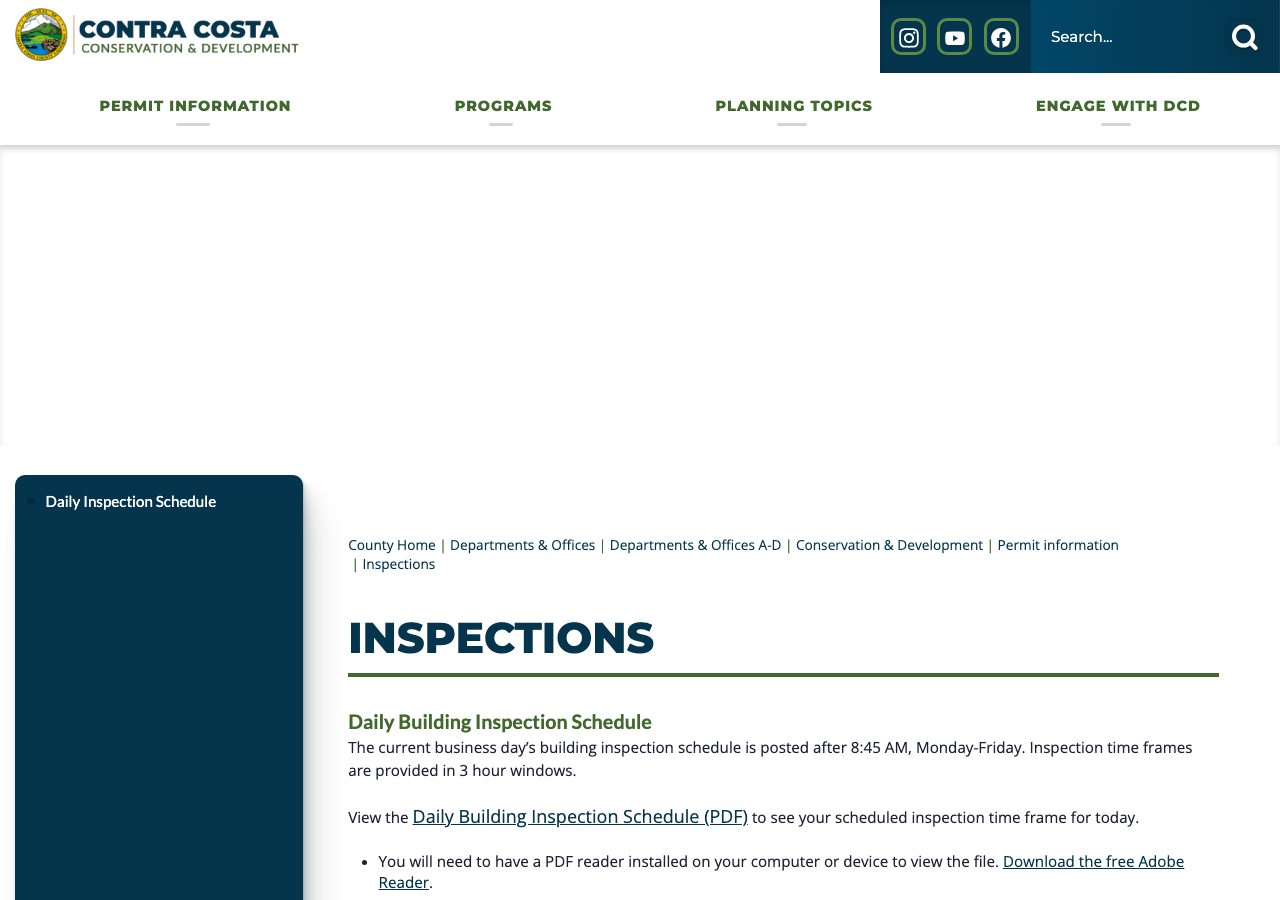
- How is an inspection booked? Portal / Phone 90% · department page
-
Know who turns up
Some authorities inspect their own solar work; some delegate it, and a few do not inspect the PV equipment itself at all. Who is coming determines what they will look at.
- Does this AHJ perform its own final solar inspection? Delegated 90% · department page
- If delegated, to whom? Contra Costa County Building Inspection Division (Department of Conservation and Development) for building/electrical; Moraga-Orinda Fire District for fire, where a MOFD fire construction permit applies. 90% · department page
-
Work the stages in order
A rough-in or mid-roof inspection, where one is required, has to happen before the work it covers is closed up. Missing a stage means opening something back up, and it is the most expensive kind of correction.
- Which inspections are required, and in what order? Building/electrical final inspection by Contra Costa County (after plan-check approval and fee payment); where a MOFD fire construction permit applies (e.g. ESS, or any job MOFD classifies under its PR14 category), MOFD separately performs its own plan review and field inspection under its own 'FIRE CONSTRUCTION PERMITS' bundle (1 plan review, 1 resubmittal, 1 inspection, 1 reinspection). The precise sequencing between the county's and MOFD's inspections for a given job was not documented in any single source found. 70% · department page
-
Have the paperwork on site
The approved plan set, the permit, and the equipment listings should be on site and reachable. Inspectors routinely verify that installed equipment matches what was approved, and that the labels are the ones the plan set promised.
- Is there a published inspection checklist? Yes -- the County's Residential PV Eligibility & Structural Checklist functions as the published pre-inspection/plan-review checklist; a separate dedicated 'field inspection checklist' distinct from this document was not found. 65% · published checklist
- What must be on site at inspection? Approved, stamped plan set (matching what was submitted/approved), the completed and initialed Eligibility Checklist, and manufacturer spec sheets for major components -- inferred from the county's own submittal and review-process description rather than an explicit 'bring these documents to inspection' instruction. 50% · department page
- Does the inspector verify labels and listings? Yes 80% · published checklist
-
Sign-off, and permission to operate
Passing gives you a final or an equivalent sign-off. That is not the same as permission to operate: PTO comes from the utility, and who tells the utility the inspection passed varies. A system left switched off for weeks is usually waiting on this handover.
- What is issued on pass? Final (building-permit final inspection sign-off / approval to operate the system) -- no separate Certificate of Occupancy is issued for a residential PV retrofit; OMC 15.60.020(D) independently bars operating the system 'unless the City Building Official verifies in writing that it complies with the building permit,' which in practice is performed by the County on the City's behalf. 70% · municipal code
- Who notifies the utility for PTO? Installer 70% · utility tariff
- Is there a re-inspection fee? $150 per inspection trip (current Contra Costa County Land Development Fee Schedule, general reinspection line, applicable to building/electrical). Note: the county's own PV Eligibility Checklist (dated Nov 2015, still the live linked document) separately warns of a stale $100 re-inspection fee tied specifically to non-compliant plan formatting at the field-inspection stage -- both figures are reported since both documents are currently live. 85% · fee schedule
- How are corrections issued and cleared? Corrections are communicated by the plan reviewer by email or phone during the plan-review step; applicants may authorize the reviewer to make minor red-line corrections directly on plans without further contact (per the Eligibility Checklist's initialed authorization clause). No formal written-notice-and-response timeline was found. 70% · department page
14 questions answered against City of Orinda’s own published documents
Q49 How is an inspection booked? Core Booking & scheduling
Portal / Phone
Why the confidence is not higherOrinda's own Building Permits FAQ: 'All building inspections are handled by the Building Department. Schedule your inspection online or call the automated number: (925) 646-4108,' referring applicants to Contra Costa County's ePermits Center or its automated phone line.
department page checked 2026-08-31 https://www.cityoforinda.org/432/Building-Permits
Q50 How much notice is required? Core Booking & scheduling
Nothing published by this authority.
Where we lookedContra Costa County's Applying-for-a-Permit page and Orinda's own Building Permits FAQ; neither states a minimum-notice period (in business days) for scheduling an inspection.
https://www.contracosta.ca.gov/7863/Applying-for-a-Building-or-Grading-Permi
Q51 Are same-day or AM/PM windows offered? Booking & scheduling
Nothing published by this authority.
Where we lookedSame sources as Q50; no mention of same-day or AM/PM inspection windows was found.
https://www.contracosta.ca.gov/7863/Applying-for-a-Building-or-Grading-Permi
Q52 Does this AHJ perform its own final solar inspection? Core Who inspects
Delegated
Why the confidence is not higherBuilding/electrical final inspection is performed by Contra Costa County's Building Inspection Division, not the City of Orinda, per the City's own Building Permits FAQ ('The City of Orinda does not have its own building department...Only Contra Costa County Building Department issues building permits'); fire-side inspection for jobs triggering a MOFD fire construction permit is performed by Moraga-Orinda Fire District, per its own fee schedule bundling '1 inspection and 1 reinspection' into each fire construction permit.
department page checked 2026-08-31 https://www.cityoforinda.org/432/Building-Permits
Q53 If delegated, to whom? Core Who inspects
Contra Costa County Building Inspection Division (Department of Conservation and Development) for building/electrical; Moraga-Orinda Fire District for fire, where a MOFD fire construction permit applies.
Why the confidence is not higherSame sources as Q52, plus OMC 8.20.030 naming MOFD as the fire-code enforcement agency.
department page checked 2026-08-31 https://www.cityoforinda.org/432/Building-Permits
Q54 Which inspections are required, and in what order? Core Stages & sequence
Building/electrical final inspection by Contra Costa County (after plan-check approval and fee payment); where a MOFD fire construction permit applies (e.g. ESS, or any job MOFD classifies under its PR14 category), MOFD separately performs its own plan review and field inspection under its own 'FIRE CONSTRUCTION PERMITS' bundle (1 plan review, 1 resubmittal, 1 inspection, 1 reinspection). The precise sequencing between the county's and MOFD's inspections for a given job was not documented in any single source found.
Why the confidence is not higherContra Costa County Applying-for-a-Permit page (Steps 1-6) and MOFD Schedule of Fees, PR14 category / 'Fire Construction Permits' heading.
department page checked 2026-08-31 https://www.contracosta.ca.gov/7863/Applying-for-a-Building-or-Grading-Permi
Q55 Is a rough-in or mid-roof inspection required? Stages & sequence
Nothing published by this authority.
Where we lookedContra Costa County's Applying-for-a-Permit page and the PV Eligibility Checklist; neither describes a distinct rough-in or mid-roof inspection stage separate from the final PV inspection.
https://www.contracosta.ca.gov/7863/Applying-for-a-Building-or-Grading-Permi
Q56 Does the inspector verify labels and listings? Core What is checked
Yes
Why the confidence is not higherCounty Eligibility Checklist's Fire Safety Requirements item B explicitly requires 'All required markings and labels are provided' as a condition checked at plan review/inspection.
published checklist checked 2026-08-31 https://www.contracosta.ca.gov/DocumentCenter/View/37433/DCD-PVR-Eligibility-and-Structural-checklist
Q57 Is there a published inspection checklist? Core What is checked
Yes -- the County's Residential PV Eligibility & Structural Checklist functions as the published pre-inspection/plan-review checklist; a separate dedicated 'field inspection checklist' distinct from this document was not found.
Why the confidence is not higherContra Costa County Eligibility Checklist, currently linked from the county's own Applying-for-a-Permit page.
published checklist checked 2026-08-31 https://www.contracosta.ca.gov/DocumentCenter/View/37433/DCD-PVR-Eligibility-and-Structural-checklist
Q58 What must be on site at inspection? Core Documents on site
Approved, stamped plan set (matching what was submitted/approved), the completed and initialed Eligibility Checklist, and manufacturer spec sheets for major components -- inferred from the county's own submittal and review-process description rather than an explicit 'bring these documents to inspection' instruction.
Why the confidence is not higherContra Costa County Eligibility Checklist and Applying-for-a-Permit process page (Steps 1-6).
department page checked 2026-08-31 https://www.contracosta.ca.gov/7863/Applying-for-a-Building-or-Grading-Permi
Q59 Is there a re-inspection fee? Corrections & re-inspection
$150 per inspection trip (current Contra Costa County Land Development Fee Schedule, general reinspection line, applicable to building/electrical). Note: the county's own PV Eligibility Checklist (dated Nov 2015, still the live linked document) separately warns of a stale $100 re-inspection fee tied specifically to non-compliant plan formatting at the field-inspection stage -- both figures are reported since both documents are currently live.
Why the confidence is not higherContra Costa County Land Development Fee Schedule (general reinspection fee) and the PV Eligibility Checklist (stale $100 figure), both extracted directly with pdfinfo-confirmed dates.
fee schedule checked 2026-08-31 https://www.contracosta.ca.gov/DocumentCenter/View/62479/Land-Development-Fee-Schedule-PDF
Q60 How are corrections issued and cleared? Corrections & re-inspection
Corrections are communicated by the plan reviewer by email or phone during the plan-review step; applicants may authorize the reviewer to make minor red-line corrections directly on plans without further contact (per the Eligibility Checklist's initialed authorization clause). No formal written-notice-and-response timeline was found.
Why the confidence is not higherContra Costa County Applying-for-a-Permit page (Step 3) and the Eligibility Checklist's initialed authorization section.
department page checked 2026-08-31 https://www.contracosta.ca.gov/7863/Applying-for-a-Building-or-Grading-Permi
Q61 What is issued on pass? Core Final sign-off & PTO
Final (building-permit final inspection sign-off / approval to operate the system) -- no separate Certificate of Occupancy is issued for a residential PV retrofit; OMC 15.60.020(D) independently bars operating the system 'unless the City Building Official verifies in writing that it complies with the building permit,' which in practice is performed by the County on the City's behalf.
Why the confidence is not higherOMC 15.60.020(D) and Contra Costa County's building-permit final-inspection process.
municipal code checked 2026-08-31 https://library.municode.com/ca/orinda/codes/code_of_ordinances?nodeId=TIT15BUCO_CH15.60SOENSY
Q62 Who notifies the utility for PTO? Core Final sign-off & PTO
Installer
Why the confidence is not higherThe installer/applicant typically submits the interconnection/PTO application to PG&E, including evidence of the AHJ's final electrical-inspection clearance, which PG&E Rule 21 section D.13.b requires before processing PTO -- so the County's inspection clearance is the precondition, but the installer is the party that notifies/submits to the utility.
utility tariff checked 2026-08-31 https://www.pge.com/tariffs/assets/pdf/tariffbook/ELEC_RULES_21.pdf
Lines marked with a percentage were read off this authority’s own published documents. Unmarked guidance is general good practice, not this jurisdiction’s rule — always confirm against the authority before you submit.
Jurisdiction & key facts
The standing 62-question set, answered for City of Orinda against this authority’s own published documents. Every answer carries the confidence it was recorded at and the document it came from. Where nothing is published we say so and show where we looked — a blank here is a finding, not a gap.
City of Orinda is the authority having jurisdiction 92% confidence
- Holds
- Planning/zoning retained by the City (waived for flush roof-mount residential solar); Building and Electrical permitting, plan-check and inspection delegated to Contra Costa County; Fire code adoption/enforcement, WUI/defensible-space standards and PV/ESS fire construction permits delegated to Moraga-Orinda Fire District (MOFD), an independent special district.
- Delegated to
- Contra Costa County Building Inspection Division / Dept. of Conservation and Development (building & electrical); Moraga-Orinda Fire District (fire)
- Overridden by
- Gov. Code section 65850.5 (ministerial small-residential-solar permitting, codified locally at OMC Ch. 15.60) and AB 130 (Stats. 2025, Ch. 22) freezing more-restrictive local residential code amendments 1 Oct 2025 - 1 Jun 2031
- Why not higher
- The brief's framing of Orinda as a normal city AHJ needs correcting: the City's own Building Permits page states outright 'The City of Orinda does not have its own building department and contracts with Contra Costa County for building services' and 'Only Contra Costa County Building Department issues building permits.' Independently confirmed from the other side: Contra Costa County's own 'City and Agency Directory' names Orinda as one of five 'Contract Cities and Towns' (with Clayton, Hercules, Lafayette and Moraga) for which the County provides building permitting services while the city retains only planning entitlements. Fire code enforcement is separately assigned by OMC 8.20.030 to the Moraga-Orinda Fire District, citing MOFD Ordinance 23-01 and City Council Resolution 22-23; MOFD is confirmed genuinely independent (own elected Board with its own 'Board Election Procedures' page, own budget/fee schedule/ordinances, and at least one named sitting Director -- 'Danziger', per MOFD's own 2026 resolutions -- who does not appear on Orinda's 5-member City Council roster), not a governance shell or council-fused district. Because the City's own Planning review is explicitly waived for flush roof-mount residential PV (per the same Building Permits FAQ), the City's actual operative role in a typical residential solar job approaches zero: the homeowner deals with the County for the permit and with MOFD only if a fire construction permit is triggered.
Check the code edition before you build
This authority's published code edition does not match what the state has adopted. That usually means the authority's ordinance has not been updated for the current cycle — but a local amendment can also be lawful. Confirm with the building department before you submit.
- Permit required
- Yes96%
- Permit cost
- $272 flat for a residential PV system ≤15 kW AC ($86 Building Permit/Inspection + $86 Plan Check + $100 Electrical Review), plus $15/kW above 15 kW AC.95%
- Plan review
- Initial completeness review: about 4-5 business days (county's 'Step 1: Initial Review'); full plan-review duration after that is not fixed and depends on project complexity and correction…70%
- Portal
- Contra Costa County's ePermits Center (epermits.cccounty.us) for the building/electrical permit itself; Orinda's own 'Application Submittal Portal' for the (usually-waived) Planning step;90%
- Electrical code
- 2023 NEC, as incorporated into the 2025 California Electrical Code (CEC)90%
- Booking an inspection
- Portal / Phone90%
Labels & placards for this authority
Wording None%
Size, colour & material None%
Where they go None%
What the utility wants on top 80%
Yes -- PG&E Rule 21 section H.1.d requires a 'Visible Disconnect' with open/closed position markings, lockable and reachable 24/7, and shown on the single-line diagram -- a utility-side signage requirement independent of the AHJ's.
Each figure above is sourced and dated in the full answer set below (questions 38–43). Where an authority’s own published sheet is older than the code it has adopted, the answer says so.
Their website
Average approval time — application to PTO
From the CPUC interconnection record. Bars show the average days taken each year; a year with no recorded projects is left blank rather than drawn as zero.