
City of Pasadena
Los Angeles County
City of Pasadena is a city authority in the State of California, serving 138,699 residents. 747 residential solar installs are on record here. This page is the permit route for that jurisdiction: the fifteen steps from working out who has a say over an address through to permission to operate, the documents this authority publishes, and 62 answers taken from those documents and dated.
Permitting 5 steps · 28 questions
Whether a permit is needed — Yes Q3 Electrical and building permits — Combined Q4 Plan review — Simple/complete submittals can be reviewed over-the-counter in about 5-10 minutes; more complex plans go to a queued 'behind-the-counter' review taking… Q18 Where you file — Tyler Technologies EnerGov 'Citizen Self Service' (Permit Center Online) at mypermits.cityofpasadena.net; Q20
- Permit required
- Yes90% source
- What it costs
- $450 flat (Building Services electrical/PV fee, 0-15 kW AC, item 314; +$15/kW above 15 kW) PLUS a separate Fire Department 'PV System (Single Family Dwelling)' plan-review/inspection fee of $315…80% source
- Plan review turnaround
- Simple/complete submittals can be reviewed over-the-counter in about 5-10 minutes; more complex plans go to a queued 'behind-the-counter' review taking approximately two to four weeks.80% source
- Key document
- checklist cited by 9 open the document
-
Confirm who has a say over your address
A city address is usually permitted by the city, not the county — but not always, and some authorities keep building and hand electrical to someone else. Getting this wrong costs the whole submittal, because every requirement below belongs to whoever actually holds jurisdiction. Check the overlays in the same pass: an HOA, a historic district, a windstorm certification or a system-size cap can reshape the design, and all of them are cheaper to find now than after the array is laid out.
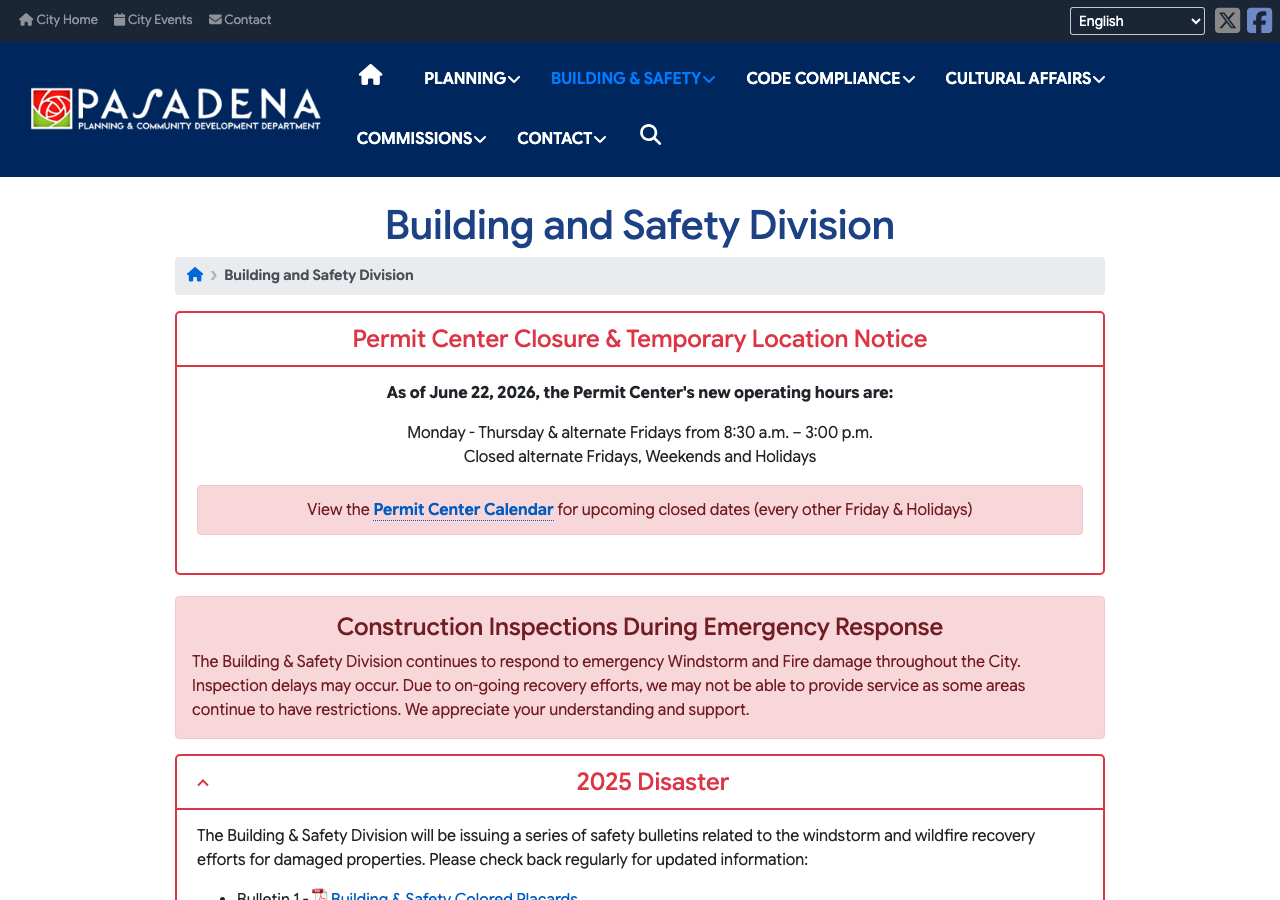
- Is this authority the AHJ for residential solar at this address? Yes. The City of Pasadena (Planning & Community Development Department, Building & Safety Division, plus its own Fire Department) is the AHJ for building/electrical/fire permitting of residential rooftop solar within city limits; Pasadena is a charter city with its own departments, not served by LA County Building & Safety or LA County Fire. 90% · department page
- What does this authority permit itself, and what does it delegate? Both 90% · fee schedule
- Is a permit required for a residential rooftop PV system? Yes 90% · ordinance handout
- Is there a separate electrical permit, or is it combined? Combined 80% · fee schedule
- Is a HOA or architectural approval required first? Conditionally yes — PWP's interconnection application package requires a 'Letter of Approval from the Home Owners Association's Board of Directors (if applicable)'; there is no separate citywide architectural-review requirement for solar outside HOA-governed properties or historic districts (see q25). 70% · utility page
- Is there a historic-district review? Yes. The City's PV Permit Issuance Checklist itself asks whether the project is 'affiliated with any historic resource' (flagging additional submittal requirements) and whether there is an active Planning Case requiring incorporation into 'Design Review'; separately, any exterior alteration within one of Pasadena's designated Historic Districts requires a Certificate of Appropriateness, and the City's own Design Guidelines for Historic Districts specifically direct that solar panels avoid front roof planes, lie flush with the roof, and use non-reflective finishes. 75% · design guidelines
- Is a wind or windstorm certification required? No 50% · checklist
- Is a Specific Use Permit or Council approval ever required? Not required for by-right accessory rooftop PV on a single-family lot; however, the City's own PV checklist flags that a residential system producing 10 kW or more must be routed to Building for a determination of whether the project 'constitutes a commercial use,' which could in turn trigger a Conditional Use Permit or other entitlement. 65% · checklist
- Is there a system-size cap on residential generation? No fixed zoning-wide kW cap, but two practical caps apply: (a) the City's checklist treats a residential system of 10 kW or more as needing a commercial-use determination; (b) PWP limits net-metered system sizing to no more than 150% of the customer's trailing 12-month average annual consumption (or 2 W DC per sq ft of conditioned floor area for new accounts with no billing history), per Public Resources Code §25782. 80% · utility page
-
Check who is allowed to apply
Several authorities require the electrical permit to be pulled by a licensed electrician, or require the contractor to be registered with them BEFORE applying. Registration is not same-day. This is second on the list rather than fourth because it is the step most likely to stop the job before the drawings matter.
- Who is allowed to pull the electrical permit? Either — plans/installation must be signed by a California-licensed C-46 (Solar) or C-10 (Electrical) contractor, or a homeowner may self-permit as an owner-builder 65% · checklist
- Must the contractor be registered with this authority before applying? Yes 85% · department page
- Is a homeowner permitted to self-install and self-permit? Yes 60% · form
-
Build the submittal package
Almost everywhere wants a site plan, a one-line or three-line electrical diagram, equipment cut sheets with listings, and a structural attachment detail. Build it against the published checklist rather than the last jurisdiction you worked in — the checklist is what the reviewer marks against.
- What documents make up a complete submittal? Site/plot plan showing PV layout & dimensions; roof plan projection; structural wind-uplift calculations (ASCE 7) stamped by a CA-licensed civil/structural engineer; circuit-sizing/voltage calculations and single-line diagram signed by a CA-licensed EE or C-46/C-10 contractor; manufacturer spec sheets, installation instructions and equipment listings (UL 1703 matching roof fire class); plus PWP's separate interconnection package (single-line diagram, site plan, NEM enrollment form, signed customer/installer contract, copy of electric bill, interconnection agreement, HOA approval letter if applicable). 85% · checklist
- How many copies, and in what format? 3 sets of plans, minimum 11" x 17", plus 1 CD or flash drive (PDF files) 85% · department page
- Is a site plan required, and what must it show? Yes — must show roof plan projection with dimensions of all PV equipment and arrays; PWP additionally requires the site plan to show the main service panel, AC disconnect, meter, any automatic transfer switch, and labeling of all existing/new equipment. 85% · checklist
- Is a one-line / three-line diagram required? Yes 92% · checklist
- Are string and conductor calculations required? Yes 88% · checklist
- Is a structural PE stamp required, and at what threshold? Yes, for all rooftop residential PV — structural calculations for wind uplift (checklist cites ASCE 7-10) must be stamped/signed by a State-registered Civil or Structural Engineer; no minimum system-size exemption threshold is stated in the checklist. 70% · checklist
- Is an electrical PE stamp required, and at what threshold? No mandatory PE stamp — circuit/voltage calculations may instead be prepared and signed by a California-licensed C-46 or C-10 contractor in lieu of a licensed Electrical Engineer. 75% · checklist
-
Apply and pay
Most authorities now take the whole application through a portal, and several states cap or constrain what a residential solar permit may cost. Check whether plan check is billed separately before you quote the job.
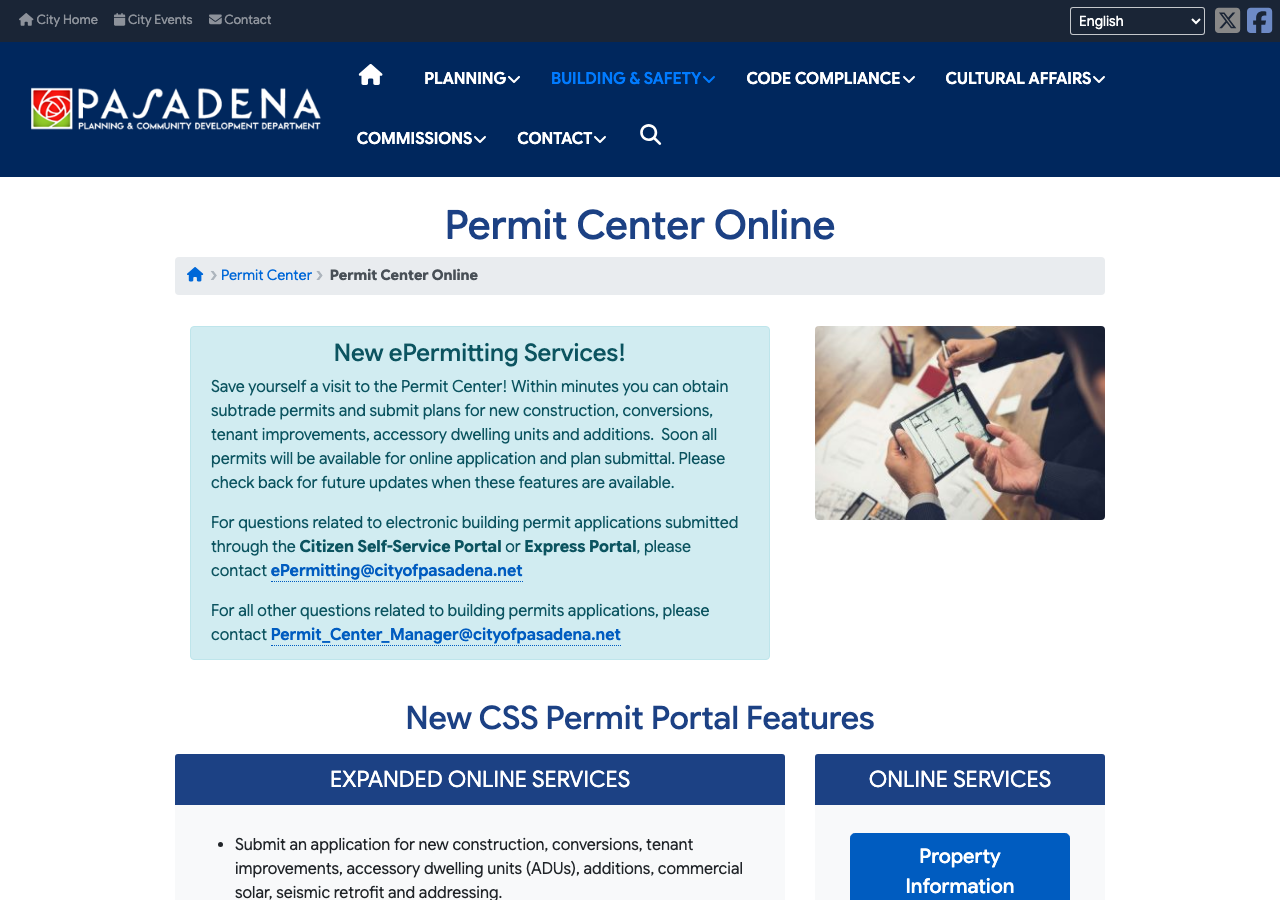
- Which permit portal does this authority use? Tyler Technologies EnerGov 'Citizen Self Service' (Permit Center Online) at mypermits.cityofpasadena.net; PWP's interconnection process runs on a separate third-party portal, PowerClerk. 90% · portal landing page
- Can the whole application be completed online? Partially — Citizen Self Service/Express Permit Portal allows fully-online submittal for ADUs, tenant improvements, additions, commercial solar and seismic retrofit, and issues sub-trade (mechanical/electrical/plumbing) express permits within minutes; residential rooftop PV is not explicitly listed among the categories the City currently requires (or confirms) can be submitted fully online, so a full plan-review PV submittal may still need an in-person/paper component. 55% · department page
- What does a residential solar permit cost? $450 flat (Building Services electrical/PV fee, 0-15 kW AC, item 314; +$15/kW above 15 kW) PLUS a separate Fire Department 'PV System (Single Family Dwelling)' plan-review/inspection fee of $315 (item 225) = roughly $765 total for a typical ≤15kW system. 80% · fee schedule
- How is the fee calculated? Tiered / Per kW (flat base fee for 0-15 kW AC, plus a per-kW adder above 15 kW) 85% · fee schedule
- Is there a separate plan-check fee? No — the residential PV/ESS fee (item 314) is labeled a 'Total Fee', implying plan review is bundled into the flat/per-kW amount rather than billed separately. 60% · fee schedule
-
Plan review — and start the utility in parallel
Interconnection is a separate process from the permit and usually the longer pole. Where the utility does not depend on the permit being issued, running both at once is the single biggest saving available on a residential job.
- What is the stated plan-review turnaround? Simple/complete submittals can be reviewed over-the-counter in about 5-10 minutes; more complex plans go to a queued 'behind-the-counter' review taking approximately two to four weeks. 80% · department page
- How long is an issued permit valid before it expires? 180 days from date of issuance 90% · department page
- Which utility handles interconnection here? Pasadena Water and Power (PWP) — a municipally-owned electric utility operated by the City of Pasadena itself, not Southern California Edison. CPUC Rule 21 does not apply here; PWP sets its own interconnection rules under PMC Ch. 13.04 and PWP Regulation 23. 95% · utility page
- Where does the utility sit in the sequence? Before permit (with a second utility touchpoint after permit) — the customer must obtain PWP 'Initial Review' approval via PowerClerk BEFORE applying for the City building permit; after the permit is issued, construction is done, and City Building & Safety/Fire sign off, the installer separately requests PTO from PWP, which performs its own inspection and meter swap AFTER the AHJ's final sign-off, before energization is authorized. 90% · utility DG manual / department page
28 questions answered against City of Pasadena’s own published documents
Q1 Is this authority the AHJ for residential solar at this address? Core Jurisdiction & scope
Yes. The City of Pasadena (Planning & Community Development Department, Building & Safety Division, plus its own Fire Department) is the AHJ for building/electrical/fire permitting of residential rooftop solar within city limits; Pasadena is a charter city with its own departments, not served by LA County Building & Safety or LA County Fire.
Why the confidence is not higherCity's own Building & Safety page and its own FY2027 fee schedule (with a full independent Fire Department fee section including EMS) demonstrate the city runs its own building, electrical and fire functions rather than delegating to the county.
department page checked 2026-08-30 https://www.cityofpasadena.net/planning/building-and-safety/
Q2 What does this authority permit itself, and what does it delegate? Core Jurisdiction & scope
Both
Why the confidence is not higherFY2027 General Fee Schedule item 314 'Residential PV Solar and ESS (Total Fee)' is a single combined building+electrical fee issued by Planning & Community Development / Building Services; nothing is delegated to LA County.
fee schedule checked 2026-08-30 https://www.cityofpasadena.net/finance/wp-content/uploads/sites/27/FY-2027-General-Fee-Schedule-Adopted.pdf
Q3 Is a permit required for a residential rooftop PV system? Core Jurisdiction & scope
Yes
Why the confidence is not higherThe City's own 'Work Exempt from Building, Electrical, Mechanical & Plumbing Permit' handout lists exempt work and does not include any solar/PV exemption; the PV-specific permit issuance checklist confirms a permit process exists.
ordinance handout checked 2026-08-30 https://www.cityofpasadena.net/planning/wp-content/uploads/sites/30/Work-Exempt-from-Building-Electrical-Mechanical-and-Plumbing-Permit.pdf
Q4 Is there a separate electrical permit, or is it combined? Core Jurisdiction & scope
Combined
Why the confidence is not higherFee schedule item 314 is explicitly labeled '(Total Fee)' covering PV Solar and ESS together (electrical trade), issued alongside the building permit process; no separate stand-alone electrical-only PV fee line exists.
fee schedule checked 2026-08-30 https://www.cityofpasadena.net/finance/wp-content/uploads/sites/27/FY-2027-General-Fee-Schedule-Adopted.pdf
Q5 Who is allowed to pull the electrical permit? Core Who may apply
Either — plans/installation must be signed by a California-licensed C-46 (Solar) or C-10 (Electrical) contractor, or a homeowner may self-permit as an owner-builder
Why the confidence is not higherPV checklist item 11 requires plans be signed by a C-46/C-10 licensed contractor doing the work; the City separately publishes an Owner-Building-Declaration form used for owner-builder self-permitting generally, but no PV-specific text was found confirming homeowners self-install PV.
checklist checked 2026-08-30 https://www.cityofpasadena.net/planning/wp-content/uploads/sites/30/Residential-Photovoltaic-Power-Systems-Permit-Issuance-Checklist.pdf
Q6 Must the contractor be registered with this authority before applying? Core Who may apply
Yes
Why the confidence is not higherPermit Center Online page states: 'Business license required for all contractors and agent to contractors pulling permits.'
department page checked 2026-08-30 https://www.cityofpasadena.net/planning/permit-center/permit-center-online/
Q7 Is a homeowner permitted to self-install and self-permit? Who may apply
Yes
Why the confidence is not higherCity publishes a general Owner-Building-Declaration form used for owner-builder self-permitting; no PV-specific restriction against homeowner self-install was found, but no PV-specific confirmation either.
form checked 2026-08-30 https://www.cityofpasadena.net/planning/wp-content/uploads/sites/30/Owner-Building-Declaration.pdf
Q8 What documents make up a complete submittal? Core Submittal package
Site/plot plan showing PV layout & dimensions; roof plan projection; structural wind-uplift calculations (ASCE 7) stamped by a CA-licensed civil/structural engineer; circuit-sizing/voltage calculations and single-line diagram signed by a CA-licensed EE or C-46/C-10 contractor; manufacturer spec sheets, installation instructions and equipment listings (UL 1703 matching roof fire class); plus PWP's separate interconnection package (single-line diagram, site plan, NEM enrollment form, signed customer/installer contract, copy of electric bill, interconnection agreement, HOA approval letter if applicable).
Why the confidence is not higherCombines the City's PV Permit Issuance Checklist (building-side) with PWP's Solar Application Instructions (utility-side); both are the authorities' own current pages/forms.
checklist checked 2026-08-30 https://www.cityofpasadena.net/planning/wp-content/uploads/sites/30/Residential-Photovoltaic-Power-Systems-Permit-Issuance-Checklist.pdf
Q9 How many copies, and in what format? Submittal package
3 sets of plans, minimum 11" x 17", plus 1 CD or flash drive (PDF files)
Why the confidence is not higherStated on the 'Apply for Permit' page ('Plan Submittal Requirements') and matches the PV checklist's own '3 sets minimum 11x17' language.
department page checked 2026-08-30 https://www.cityofpasadena.net/planning/permit-center/apply-for-permit/
Q10 Is a site plan required, and what must it show? Core Submittal package
Yes — must show roof plan projection with dimensions of all PV equipment and arrays; PWP additionally requires the site plan to show the main service panel, AC disconnect, meter, any automatic transfer switch, and labeling of all existing/new equipment.
Why the confidence is not higherPV checklist item 1 (building side) plus PWP ESR §VIII.F.2 (utility side, OCR'd from the current Sept-2025 Electric Service Requirements PDF).
checklist checked 2026-08-30 https://www.cityofpasadena.net/planning/wp-content/uploads/sites/30/Residential-Photovoltaic-Power-Systems-Permit-Issuance-Checklist.pdf
Q11 Is a one-line / three-line diagram required? Core Drawings & calculations
Yes
Why the confidence is not higherPV checklist item 4 requires an electrical single-line diagram; PWP also independently requires one for interconnection.
checklist checked 2026-08-30 https://www.cityofpasadena.net/planning/wp-content/uploads/sites/30/Residential-Photovoltaic-Power-Systems-Permit-Issuance-Checklist.pdf
Q12 Are string and conductor calculations required? Drawings & calculations
Yes
Why the confidence is not higherPV checklist items 5-6 require correct circuit sizing and current calculations under CEC Art. 690.8/690.7, signed by a CA-licensed EE or C-46/C-10 contractor.
checklist checked 2026-08-30 https://www.cityofpasadena.net/planning/wp-content/uploads/sites/30/Residential-Photovoltaic-Power-Systems-Permit-Issuance-Checklist.pdf
Q13 Is a structural PE stamp required, and at what threshold? Core Engineering & stamps
Yes, for all rooftop residential PV — structural calculations for wind uplift (checklist cites ASCE 7-10) must be stamped/signed by a State-registered Civil or Structural Engineer; no minimum system-size exemption threshold is stated in the checklist.
Why the confidence is not higherPV checklist item 7 is explicit but the checklist itself is dated 3/22/17 and still references 2016 CEC/ASCE 7-10, so wording may lag the currently-adopted 2025 code cycle even though it remains the document the City has published.
checklist checked 2026-08-30 https://www.cityofpasadena.net/planning/wp-content/uploads/sites/30/Residential-Photovoltaic-Power-Systems-Permit-Issuance-Checklist.pdf
Q14 Is an electrical PE stamp required, and at what threshold? Engineering & stamps
No mandatory PE stamp — circuit/voltage calculations may instead be prepared and signed by a California-licensed C-46 or C-10 contractor in lieu of a licensed Electrical Engineer.
Why the confidence is not higherPV checklist items 5, 6 and 11 give 'CA licensed Electrical Engineer OR CA Licensed Contractor classification C-46 or C-10' as alternatives.
checklist checked 2026-08-30 https://www.cityofpasadena.net/planning/wp-content/uploads/sites/30/Residential-Photovoltaic-Power-Systems-Permit-Issuance-Checklist.pdf
Q15 What does a residential solar permit cost? Core Fees
$450 flat (Building Services electrical/PV fee, 0-15 kW AC, item 314; +$15/kW above 15 kW) PLUS a separate Fire Department 'PV System (Single Family Dwelling)' plan-review/inspection fee of $315 (item 225) = roughly $765 total for a typical ≤15kW system.
Why the confidence is not higherBoth fee lines are explicit, current (FY2027, in effect as of Aug 2026) adopted fee-schedule entries under two different department sections; I could not confirm from a narrative page whether item 225 is charged on every residential PV job or only in specific circumstances (its commercial counterpart, item 203, is explicitly conditional 'if requested by building official' but item 225 carries no such qualifier).
fee schedule checked 2026-08-30 https://www.cityofpasadena.net/finance/wp-content/uploads/sites/27/FY-2027-General-Fee-Schedule-Adopted.pdf
Q16 How is the fee calculated? Core Fees
Tiered / Per kW (flat base fee for 0-15 kW AC, plus a per-kW adder above 15 kW)
Why the confidence is not higherFY2027 fee schedule item 314 structure: '0-15 kW (AC) $450.00; More than 15 kW per kW $15.00'.
fee schedule checked 2026-08-30 https://www.cityofpasadena.net/finance/wp-content/uploads/sites/27/FY-2027-General-Fee-Schedule-Adopted.pdf
Q17 Is there a separate plan-check fee? Fees
No — the residential PV/ESS fee (item 314) is labeled a 'Total Fee', implying plan review is bundled into the flat/per-kW amount rather than billed separately.
Why the confidence is not higherInference from the 'Total Fee' label; a separate plan-resubmittal fee (item 231, $315) would only apply on the 3rd+ submittal, which is a different circumstance than a routine separate plan-check fee.
fee schedule checked 2026-08-30 https://www.cityofpasadena.net/finance/wp-content/uploads/sites/27/FY-2027-General-Fee-Schedule-Adopted.pdf
Q18 What is the stated plan-review turnaround? Core Timeline & validity
Simple/complete submittals can be reviewed over-the-counter in about 5-10 minutes; more complex plans go to a queued 'behind-the-counter' review taking approximately two to four weeks.
Why the confidence is not higherExact wording from the City's 'Apply for Permit' page describing its general plan-review process (not solar-specific, but solar routinely qualifies for over-the-counter/expedited handling under the California Solar Permitting Guidebook that the City's own checklist cites).
department page checked 2026-08-30 https://www.cityofpasadena.net/planning/permit-center/apply-for-permit/
Q19 How long is an issued permit valid before it expires? Timeline & validity
180 days from date of issuance
Why the confidence is not higherStated verbatim on the 'Apply for Permit' page under 'Permit Expiration'; one extension possible at the Building Official's discretion if requested in writing before expiration.
department page checked 2026-08-30 https://www.cityofpasadena.net/planning/permit-center/apply-for-permit/
Q20 Which permit portal does this authority use? Core Portal & process
Tyler Technologies EnerGov 'Citizen Self Service' (Permit Center Online) at mypermits.cityofpasadena.net; PWP's interconnection process runs on a separate third-party portal, PowerClerk.
Why the confidence is not higherConfirmed via the mypermits.cityofpasadena.net EnerGov landing page and the PWP solar pages referencing PowerClerk.
portal landing page checked 2026-08-30 https://www.cityofpasadena.net/planning/permit-center/permit-center-online/
Q21 Can the whole application be completed online? Core Portal & process
Partially — Citizen Self Service/Express Permit Portal allows fully-online submittal for ADUs, tenant improvements, additions, commercial solar and seismic retrofit, and issues sub-trade (mechanical/electrical/plumbing) express permits within minutes; residential rooftop PV is not explicitly listed among the categories the City currently requires (or confirms) can be submitted fully online, so a full plan-review PV submittal may still need an in-person/paper component.
Why the confidence is not higherThe 'Apply for Permit' page's list of mandatory-online categories names 'solar (commercial)' but not residential solar; this is an inference from an incomplete list rather than an explicit statement either way.
department page checked 2026-08-30 https://www.cityofpasadena.net/planning/permit-center/apply-for-permit/
Q22 Which utility handles interconnection here? Core Utility interconnection
Pasadena Water and Power (PWP) — a municipally-owned electric utility operated by the City of Pasadena itself, not Southern California Edison. CPUC Rule 21 does not apply here; PWP sets its own interconnection rules under PMC Ch. 13.04 and PWP Regulation 23.
Why the confidence is not higherConfirmed directly from PWP's own website and Electric Service Requirements document, not from a ZIP-code utility lookup.
utility page checked 2026-08-30 https://pwp.cityofpasadena.net/solar-eligibility-and-requirements/
Q23 Where does the utility sit in the sequence? Core Utility interconnection
Before permit (with a second utility touchpoint after permit) — the customer must obtain PWP 'Initial Review' approval via PowerClerk BEFORE applying for the City building permit; after the permit is issued, construction is done, and City Building & Safety/Fire sign off, the installer separately requests PTO from PWP, which performs its own inspection and meter swap AFTER the AHJ's final sign-off, before energization is authorized.
Why the confidence is not higherBoth PWP's 'Solar Application Instructions' page and its Sept-2025 Electric Service Requirements §VIII.E describe this exact before-permit/after-permit two-touch sequence in the same words.
utility DG manual / department page checked 2026-08-30 https://pwp.cityofpasadena.net/solar-application-instructions/
Q24 Is a HOA or architectural approval required first? Overlays & special cases
Conditionally yes — PWP's interconnection application package requires a 'Letter of Approval from the Home Owners Association's Board of Directors (if applicable)'; there is no separate citywide architectural-review requirement for solar outside HOA-governed properties or historic districts (see q25).
Why the confidence is not higherExplicit line item on both PWP's Solar Application Instructions page and the Sept-2025 Electric Service Requirements document list of application documents.
utility page checked 2026-08-30 https://pwp.cityofpasadena.net/solar-application-instructions/
Q25 Is there a historic-district review? Overlays & special cases
Yes. The City's PV Permit Issuance Checklist itself asks whether the project is 'affiliated with any historic resource' (flagging additional submittal requirements) and whether there is an active Planning Case requiring incorporation into 'Design Review'; separately, any exterior alteration within one of Pasadena's designated Historic Districts requires a Certificate of Appropriateness, and the City's own Design Guidelines for Historic Districts specifically direct that solar panels avoid front roof planes, lie flush with the roof, and use non-reflective finishes.
Why the confidence is not higherChecklist is dated 3/22/17 and the Design Guidelines document is dated April 2002 (still the version currently posted); both are the City's own current published documents even though old, so confidence is capped for dating rather than authenticity.
design guidelines checked 2026-08-30 https://www.cityofpasadena.net/planning/wp-content/uploads/sites/30/Design-Guidelines-For-Historic-Districts-in-Pasadena.pdf
Q26 Is a wind or windstorm certification required? Overlays & special cases
No
Why the confidence is not higherNo windstorm/wind-speed certification analogous to a Texas TDI WPI-8 was found anywhere in the City's PV checklist, design parameters, or fee schedule; wind loading is instead addressed through an ordinary ASCE 7 structural wind-uplift calculation as part of the standard structural PE stamp (see q13). This is an inference from absence across the documents reached, not a state-law citation.
checklist checked 2026-08-30 https://www.cityofpasadena.net/planning/wp-content/uploads/sites/30/Residential-Photovoltaic-Power-Systems-Permit-Issuance-Checklist.pdf
Q27 Is a Specific Use Permit or Council approval ever required? Overlays & special cases
Not required for by-right accessory rooftop PV on a single-family lot; however, the City's own PV checklist flags that a residential system producing 10 kW or more must be routed to Building for a determination of whether the project 'constitutes a commercial use,' which could in turn trigger a Conditional Use Permit or other entitlement.
Why the confidence is not higherDirect language from the City's PV Permit Issuance Checklist page 1.
checklist checked 2026-08-30 https://www.cityofpasadena.net/planning/wp-content/uploads/sites/30/Residential-Photovoltaic-Power-Systems-Permit-Issuance-Checklist.pdf
Q28 Is there a system-size cap on residential generation? Overlays & special cases
No fixed zoning-wide kW cap, but two practical caps apply: (a) the City's checklist treats a residential system of 10 kW or more as needing a commercial-use determination; (b) PWP limits net-metered system sizing to no more than 150% of the customer's trailing 12-month average annual consumption (or 2 W DC per sq ft of conditioned floor area for new accounts with no billing history), per Public Resources Code §25782.
Why the confidence is not higherCombines the City's own PV checklist (city-side 10kW trigger) with PWP's Solar Eligibility and Requirements page (utility-side sizing cap).
utility page checked 2026-08-30 https://pwp.cityofpasadena.net/solar-eligibility-and-requirements/
Lines marked with a percentage were read off this authority’s own published documents. Unmarked guidance is general good practice, not this jurisdiction’s rule — always confirm against the authority before you submit.
Install 5 steps · 20 questions
-
Build to the code editions actually in force here
The NEC edition a jurisdiction enforces is often a cycle behind the newest one published, and local amendments sit on top of it. Rapid shutdown, conductor sizing and labelling all change between editions, so the edition in force is the first thing to establish, not the last.
- Which NEC edition is in force? 2023 (via the 2025 California Electrical Code, which the City adopts by PMC; the 2025 CEC cycle is based on the 2023 NFPA 70 NEC and is effective statewide from 1 Jan 2026) 80% · adopting regulation
- Which building code edition is in force? 2025 California Building Code (Volumes 1 & 2 and Appendices) and 2025 California Residential Code, adopted by the Pasadena Municipal Code 90% · adopting regulation
- Which fire code edition is in force? 2025 California Fire Code, adopted by the Pasadena Municipal Code 90% · adopting regulation
- Are there local amendments to any of the above? Yes (expected) — the handout states the codes are 'adopted by PMC', implying a local adopting ordinance that conventionally carries local amendments, but the specific amendment text could not be verified in this run. 55% · department page
- What is the installation judged against? 2025 CEC Articles 690 & 705; 2025 CRC (including R324 fire setbacks); manufacturer's listing/installation instructions; UL 1703 fire classification matching the roof assembly; and explicit compliance with the 'California Solar Permitting Guidebook' (cited by name in the City's own PV checklist item 13). 80% · checklist
-
Fire access, setbacks and pathways
Ridge setbacks and roof access pathways are fire-service requirements and they constrain the array layout. They are the most common cause of a redesign after the fire department comments on a plan set.
Nothing recorded for City of Pasadena on this step yet — 1 question checked and found unpublished. The guidance above is general.
-
Rapid shutdown
Which rapid-shutdown rule applies follows directly from the NEC edition in force, and the initiation device has to be at a location the fire service can reach and identify. This is inspected, and it is labelled.
Nothing recorded for City of Pasadena on this step yet — 1 question checked and found unpublished. The guidance above is general.
-
Labels and placards
The NEC sets a baseline for permanent markings at the service equipment and the disconnecting means. On top of that, an authority may specify its own wording, and the utility may specify more again. Where any of them writes its own text, a generic off-the-shelf label set will not pass — this is the detail most often fixed on a return visit.
- Which placards does this authority require at the service equipment? (1) A 'WARNING – DUAL POWER SOURCE' label at the main service panel stating power is supplied both by the utility and a solar PV system; (2) a labelled AC disconnect ('CAUTION – PHOTOVOLTAIC SYSTEM AC DISCONNECT' with operating current/voltage fields); (3) a facility/plot-plan placard. 90% · utility DG manual
- Does the authority specify placard wording of its own? Yes — PWP specifies exact placard wording (see q38) in its Electric Service Requirements, Fig. 8.3 / Dwg SV-906. 90% · utility DG manual
- Does it specify letter height, colour or material? Color/material: labels shall be red background with white numbers and letters; permanently and securely attached at the meter and AC disconnect; if a placard (rather than a label) is used it must be mechanically attached. No specific minimum letter height (in inches) is given. 85% · utility DG manual
- Is a site plan / facility map placard required, and what must it show? Yes — 'A placard containing a plot plan with the location of the main service panel, solar/energy storage equipment, and AC disconnect is required for all distributed generation projects.' Addressing placards are additionally required on any parcel with multiple meters, identifying which meter/main-breaker the solar/ESS is interconnected to. 90% · utility DG manual
- Does the UTILITY specify placards beyond the AHJ's? Yes, substantially — PWP's Signage requirements (exact wording, color, material and placement, plus the plot-plan/addressing placards) go well beyond anything the City's own PV Permit Issuance Checklist specifies, which contains no placard wording, color or material requirements at all. 90% · utility DG manual
- Where must the labels be placed? Dual-power-source warning label at the main service panel; AC-disconnect caution label/placard at the AC disconnect; plot-plan/facility placard mechanically or permanently attached 'at the meter and AC disconnects.' 85% · utility DG manual
-
Disconnect, storage and listed equipment
Where the AC disconnect must sit relative to the meter is usually the utility's rule, not the building department's. Battery storage frequently carries its own permit, its own inspection and its own fire conditions.
- Where must the AC disconnect be, relative to the meter? Per PWP's current (Sept 2025) Electric Service Requirements §VIII.C.1(c): the AC disconnect 'shall be located within ten (10) feet of the main service panel and within line of sight' (an alternate location needs advance PWP Electric Service Planning approval). Note a conflict: PWP's public 'Solar Eligibility and Requirements' web page instead states an 8-foot / line-of-sight-of-the-utility-METER rule — the newer, dated PDF was treated as controlling. 65% · utility DG manual
- Must equipment be on a specific approved list? Yes — PV modules, inverters and meters must appear on the CEC's 'Eligible Equipment Lists,' and roof-mounted modules must carry a UL 1703 fire classification equal to the roof assembly's own classification. 88% · utility page
- Are batteries permitted, and under what conditions? Batteries/ESS are permitted subject to PWP review: a backup system must serve only a subpanel of essential loads (no backfeed to the main service panel), must include an automatic transfer switch to prevent parallel operation with PWP's grid during an outage, must be reviewed and approved by PWP before construction begins, and is subject to a PWP commissioning test (witnessed field test) before Permission to Operate is issued. 78% · utility DG manual
- Is there a separate ESS permit or inspection? No — the City bundles PV and ESS into a single permit/fee: FY2027 fee item 314 is titled 'Residential PV Solar and ESS (Total Fee).' 72% · fee schedule
- Is a ground mount treated as a structure? Yes — the City's PV checklist requires ground-mounted systems to state maximum height above grade and confirm compliance with zoning setbacks and lot-coverage requirements, treating the array as a site structure rather than mere rooftop equipment. 80% · checklist
20 questions answered against City of Pasadena’s own published documents
Q29 Which NEC edition is in force? Core Code editions in force
2023 (via the 2025 California Electrical Code, which the City adopts by PMC; the 2025 CEC cycle is based on the 2023 NFPA 70 NEC and is effective statewide from 1 Jan 2026)
Why the confidence is not higherCity's 'Design Parameters and Special Considerations' handout lists '2025 California Electrical Code' among its currently adopted standards; the NEC-edition correspondence for the 2025 CEC cycle is a matter of the statewide code-adoption schedule, not independently re-verified in a Pasadena-specific document in this run.
adopting regulation checked 2026-08-30 https://www.cityofpasadena.net/planning/wp-content/uploads/sites/30/Design-Parameters-and-Special-Considerations-2025.pdf
Q30 Which building code edition is in force? Core Code editions in force
2025 California Building Code (Volumes 1 & 2 and Appendices) and 2025 California Residential Code, adopted by the Pasadena Municipal Code
Why the confidence is not higherListed explicitly at the top of the City's current 'Design Parameters and Special Considerations' Building & Safety handout.
adopting regulation checked 2026-08-30 https://www.cityofpasadena.net/planning/wp-content/uploads/sites/30/Design-Parameters-and-Special-Considerations-2025.pdf
Q31 Which fire code edition is in force? Code editions in force
2025 California Fire Code, adopted by the Pasadena Municipal Code
Why the confidence is not higherListed explicitly on the same current 'Design Parameters and Special Considerations' handout.
adopting regulation checked 2026-08-30 https://www.cityofpasadena.net/planning/wp-content/uploads/sites/30/Design-Parameters-and-Special-Considerations-2025.pdf
Q32 Are there local amendments to any of the above? Core Code editions in force
Yes (expected) — the handout states the codes are 'adopted by PMC', implying a local adopting ordinance that conventionally carries local amendments, but the specific amendment text could not be verified in this run.
Why the confidence is not higherlibrary.municode.com/ca/pasadena (Title 14, Building Code) is a JavaScript-rendered shell to a plain fetch/curl and its API returned 404 for guessed node/job IDs, so the actual amendment language was not readable; this is recorded as capped-confidence inference, not a proved absence.
department page checked 2026-08-30 https://www.cityofpasadena.net/planning/permit-center/codes-and-regulations/
Q33 What is the installation judged against? Core Electrical
2025 CEC Articles 690 & 705; 2025 CRC (including R324 fire setbacks); manufacturer's listing/installation instructions; UL 1703 fire classification matching the roof assembly; and explicit compliance with the 'California Solar Permitting Guidebook' (cited by name in the City's own PV checklist item 13).
Why the confidence is not higherSynthesized from the PV Permit Issuance Checklist items 5, 6, 8, 9, 10, 13, 14 (checklist itself dated 2017 and references the 2016 code cycle by number, but the underlying articles carry forward under the current 2025 cycle).
checklist checked 2026-08-30 https://www.cityofpasadena.net/planning/wp-content/uploads/sites/30/Residential-Photovoltaic-Power-Systems-Permit-Issuance-Checklist.pdf
Q34 Is there a local rule on service upgrades or busbar sizing? Electrical
Nothing published by this authority.
Where we lookedPWP Electric Service Requirements (Sept 2025, 197 pages, OCR'd via pdftoppm+tesseract) Sections I (Character of Service), V (Meters), VI-VII (Switchboards), and VIII (Distributed Generation); PWP Regulation 23 (2018 interconnection standard, text-extractable)
Q35 Is a specific mounting system or attachment spacing required? Structural & mounting
Nothing published by this authority.
Where we lookedCity's Residential PV Permit Issuance Checklist and Design Parameters and Special Considerations handout — neither publishes a prescriptive mounting/attachment-spacing table; only a performance-based structural wind-uplift stamp and a general flashing/waterproofing detail requirement were found
Q36 What ridge setback and access pathways are required? Core Fire pathways & setbacks
Nothing published by this authority.
Where we lookedRidge-setback/pathway figures were only located in the CAL FIRE 'Solar Photovoltaic Installation Guideline' that the City hosts as an informational handout (a state-authored document, not a Pasadena-drafted amendment); no Pasadena-specific deviation from the statewide CRC R324/Fire Code figures was located, so this is recorded as not_found for a city-specific amendment rather than answered under q36 as a city rule
Q37 Is rapid shutdown required, and to which NEC edition? Core Rapid shutdown
Nothing published by this authority.
Where we lookedCity's Design Parameters and Special Considerations handout confirms the 2025 CEC generally but does not separately restate or amend NEC 690.12 rapid-shutdown language; Building & Safety Applications and Forms page and PV checklist do not mention rapid shutdown by name
Q38 Which placards does this authority require at the service equipment? Core Labels Signage & labelling
(1) A 'WARNING – DUAL POWER SOURCE' label at the main service panel stating power is supplied both by the utility and a solar PV system; (2) a labelled AC disconnect ('CAUTION – PHOTOVOLTAIC SYSTEM AC DISCONNECT' with operating current/voltage fields); (3) a facility/plot-plan placard.
Why the confidence is not higherOCR'd directly from PWP's current Electric Service Requirements, Figure 8.3 'Labelling Requirements for Solar Systems' (Drawing SV-906) — this PDF is 197 pages and image-only; pdftotext returned nothing and the figure was only recovered via pdftoppm + tesseract OCR.
utility DG manual checked 2026-08-30 https://pwp.cityofpasadena.net/wp-content/uploads/2023/04/Electric-Service-Requirements_2025_09_03.pdf
Q39 Does the authority specify placard wording of its own? Core Labels Signage & labelling
Yes — PWP specifies exact placard wording (see q38) in its Electric Service Requirements, Fig. 8.3 / Dwg SV-906.
Why the confidence is not higherSame OCR'd drawing as q38.
utility DG manual checked 2026-08-30 https://pwp.cityofpasadena.net/wp-content/uploads/2023/04/Electric-Service-Requirements_2025_09_03.pdf
Q40 Does it specify letter height, colour or material? Core Labels Signage & labelling
Color/material: labels shall be red background with white numbers and letters; permanently and securely attached at the meter and AC disconnect; if a placard (rather than a label) is used it must be mechanically attached. No specific minimum letter height (in inches) is given.
Why the confidence is not higherNotes 1-3 beneath Figure 8.3 in PWP's current Electric Service Requirements, recovered via OCR.
utility DG manual checked 2026-08-30 https://pwp.cityofpasadena.net/wp-content/uploads/2023/04/Electric-Service-Requirements_2025_09_03.pdf
Q41 Is a site plan / facility map placard required, and what must it show? Core Labels Signage & labelling
Yes — 'A placard containing a plot plan with the location of the main service panel, solar/energy storage equipment, and AC disconnect is required for all distributed generation projects.' Addressing placards are additionally required on any parcel with multiple meters, identifying which meter/main-breaker the solar/ESS is interconnected to.
Why the confidence is not higherPWP Electric Service Requirements §VIII.C 'Signage' items 3-4, OCR'd from the current Sept-2025 PDF.
utility DG manual checked 2026-08-30 https://pwp.cityofpasadena.net/wp-content/uploads/2023/04/Electric-Service-Requirements_2025_09_03.pdf
Q42 Does the UTILITY specify placards beyond the AHJ's? Core Labels Signage & labelling
Yes, substantially — PWP's Signage requirements (exact wording, color, material and placement, plus the plot-plan/addressing placards) go well beyond anything the City's own PV Permit Issuance Checklist specifies, which contains no placard wording, color or material requirements at all.
Why the confidence is not higherDirect comparison of the two authorities' own current documents.
utility DG manual checked 2026-08-30 https://pwp.cityofpasadena.net/wp-content/uploads/2023/04/Electric-Service-Requirements_2025_09_03.pdf
Q43 Where must the labels be placed? Core Labels Signage & labelling
Dual-power-source warning label at the main service panel; AC-disconnect caution label/placard at the AC disconnect; plot-plan/facility placard mechanically or permanently attached 'at the meter and AC disconnects.'
Why the confidence is not higherPWP Electric Service Requirements Fig. 8.3 note 2, OCR'd.
utility DG manual checked 2026-08-30 https://pwp.cityofpasadena.net/wp-content/uploads/2023/04/Electric-Service-Requirements_2025_09_03.pdf
Q44 Must equipment be on a specific approved list? Equipment listing
Yes — PV modules, inverters and meters must appear on the CEC's 'Eligible Equipment Lists,' and roof-mounted modules must carry a UL 1703 fire classification equal to the roof assembly's own classification.
Why the confidence is not higherCombines PWP's Solar Eligibility and Requirements page (equipment list requirement) with the City's own PV checklist item 8 (UL 1703 matching fire classification).
utility page checked 2026-08-30 https://pwp.cityofpasadena.net/solar-eligibility-and-requirements/
Q45 Are batteries permitted, and under what conditions? Core Battery / ESS
Batteries/ESS are permitted subject to PWP review: a backup system must serve only a subpanel of essential loads (no backfeed to the main service panel), must include an automatic transfer switch to prevent parallel operation with PWP's grid during an outage, must be reviewed and approved by PWP before construction begins, and is subject to a PWP commissioning test (witnessed field test) before Permission to Operate is issued.
Why the confidence is not higherOCR'd directly from PWP's current (Sept 2025) Electric Service Requirements §VIII.C.2(c) and §G; city-side fire-code siting/quantity rules for residential ESS were not independently located in this run.
utility DG manual checked 2026-08-30 https://pwp.cityofpasadena.net/wp-content/uploads/2023/04/Electric-Service-Requirements_2025_09_03.pdf
Q46 Is there a separate ESS permit or inspection? Battery / ESS
No — the City bundles PV and ESS into a single permit/fee: FY2027 fee item 314 is titled 'Residential PV Solar and ESS (Total Fee).'
Why the confidence is not higherExplicit fee-schedule line-item title is the clearest evidence, though this speaks to fee structure rather than an explicit ordinance statement about permit/inspection structure.
fee schedule checked 2026-08-30 https://www.cityofpasadena.net/finance/wp-content/uploads/sites/27/FY-2027-General-Fee-Schedule-Adopted.pdf
Q47 Is a ground mount treated as a structure? Core Ground mount
Yes — the City's PV checklist requires ground-mounted systems to state maximum height above grade and confirm compliance with zoning setbacks and lot-coverage requirements, treating the array as a site structure rather than mere rooftop equipment.
Why the confidence is not higherDirect checklist language ('If Ground-Mounted: Does the project comply with setbacks and lot coverage requirements?').
checklist checked 2026-08-30 https://www.cityofpasadena.net/planning/wp-content/uploads/sites/30/Residential-Photovoltaic-Power-Systems-Permit-Issuance-Checklist.pdf
Q48 Where must the AC disconnect be, relative to the meter? Core Utility equipment
Per PWP's current (Sept 2025) Electric Service Requirements §VIII.C.1(c): the AC disconnect 'shall be located within ten (10) feet of the main service panel and within line of sight' (an alternate location needs advance PWP Electric Service Planning approval). Note a conflict: PWP's public 'Solar Eligibility and Requirements' web page instead states an 8-foot / line-of-sight-of-the-utility-METER rule — the newer, dated PDF was treated as controlling.
Why the confidence is not higherTwo current PWP-published sources disagree (10 ft from main panel vs. 8 ft from meter); confidence reduced to reflect that unresolved conflict rather than picking one silently.
utility DG manual checked 2026-08-30 https://pwp.cityofpasadena.net/wp-content/uploads/2023/04/Electric-Service-Requirements_2025_09_03.pdf
Lines marked with a percentage were read off this authority’s own published documents. Unmarked guidance is general good practice, not this jurisdiction’s rule — always confirm against the authority before you submit.
Inspection 5 steps · 14 questions
-
Book it
Booking is a portal, a phone call or an email depending on the authority, and the notice required is rarely zero. Book before the work is finished rather than after — the lead time, not the work, is usually what sets the date.
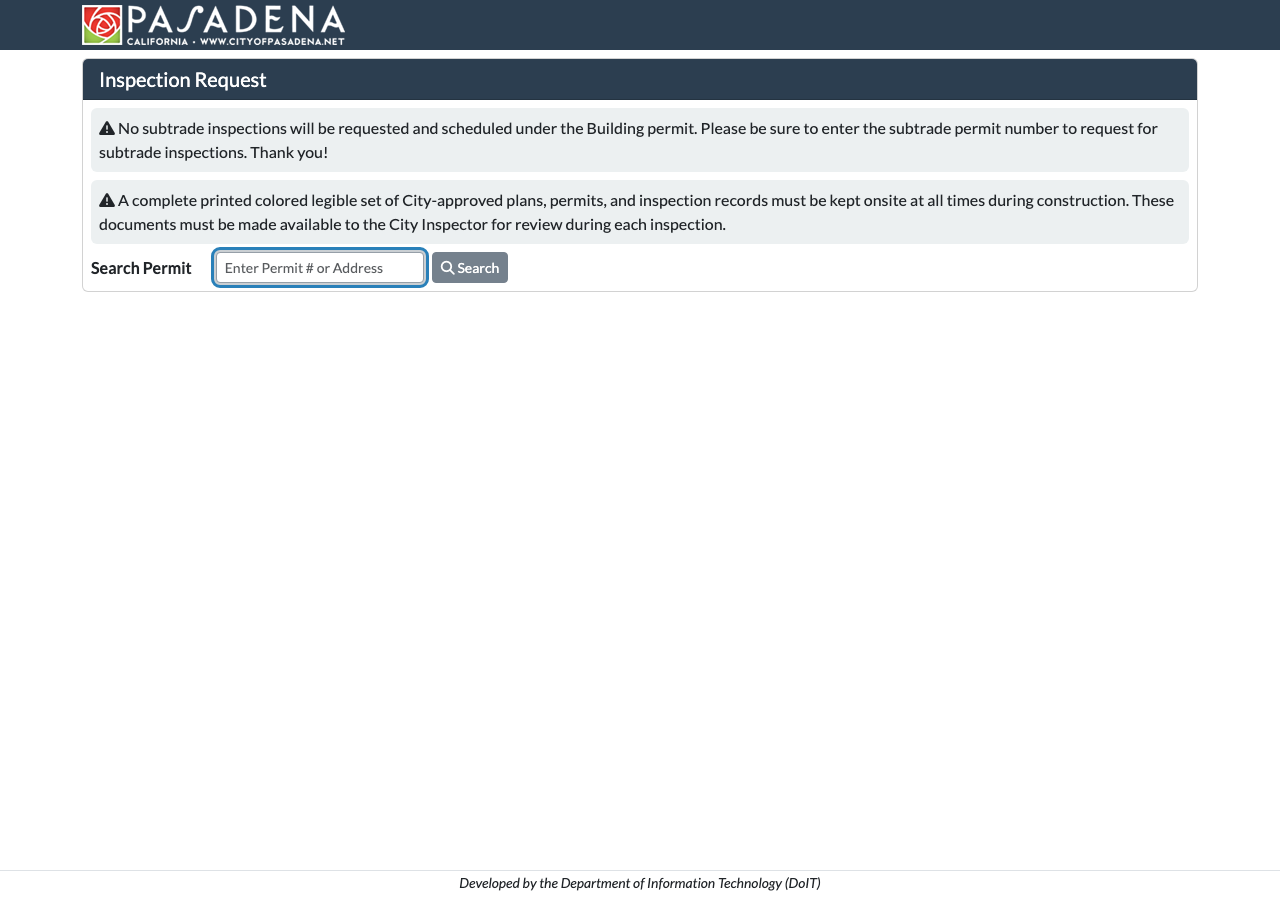
- How is an inspection booked? Portal (Tyler EnerGov Citizen Self Service / Inspection Portal at mypermits.cityofpasadena.net), with call/text/email confirmation of the inspection window. 78% · department page
- Are same-day or AM/PM windows offered? An inspection window is provided with the booking confirmation ('receive call/text/email confirmation with inspection window'); no explicit AM/PM split terminology was found. 55% · department page
-
Know who turns up
Some authorities inspect their own solar work; some delegate it, and a few do not inspect the PV equipment itself at all. Who is coming determines what they will look at.
- Does this AHJ perform its own final solar inspection? Yes — City Building & Safety and City Fire perform their own final inspections; not delegated to LA County. PWP separately performs its own post-permit interconnection inspection before issuing Permission to Operate. 85% · utility page
- If delegated, to whom? N/A — not delegated; the City performs its own code inspections (see q52). PWP's inspection is a separate utility interconnection step, not a delegation of AHJ code-inspection authority. 78% · utility page
-
Work the stages in order
A rough-in or mid-roof inspection, where one is required, has to happen before the work it covers is closed up. Missing a stage means opening something back up, and it is the most expensive kind of correction.
- Which inspections are required, and in what order? (1) PWP 'Initial Review' approval via PowerClerk; (2) City building/electrical (and Fire, where applicable) permit issuance; (3) construction; (4) City Building & Safety/Fire final inspection sign-off; (5) installer submits PTO request + final sign-off copy to PWP via PowerClerk; (6) PWP field inspection; (7) PWP replaces meter with a bi-directional solar meter; (8) PWP issues Permission to Operate. 85% · utility page
-
Have the paperwork on site
The approved plan set, the permit, and the equipment listings should be on site and reachable. Inspectors routinely verify that installed equipment matches what was approved, and that the labels are the ones the plan set promised.
- Is there a published inspection checklist? Yes, in substance — the City publishes a 'Residential Photovoltaic Power Systems Permit Issuance Checklist' (dated 3/22/17) used by staff to verify submittal completeness against 14 numbered code-compliance items; it is framed as a plan-review/permit-issuance checklist rather than a document explicitly labeled a field-inspection checklist. 60% · checklist
- What must be on site at inspection? Inspection card/permit folder and the approved stamped plans must be available; for PWP's separate step, either physical access to the main service panel from the street (installer/customer need not be present) or photos uploaded to PowerClerk for a virtual inspection. 55% · department page
- Does the inspector verify labels and listings? Yes — equipment listing (UL 1703 roof-fire-classification match, CEC Eligible Equipment List membership) is a condition of permit issuance per the City's own checklist, and PWP separately verifies as-installed labeling and equipment against the submitted single-line/site-plan documents during its own field inspection. 62% · checklist
-
Sign-off, and permission to operate
Passing gives you a final or an equivalent sign-off. That is not the same as permission to operate: PTO comes from the utility, and who tells the utility the inspection passed varies. A system left switched off for weeks is usually waiting on this handover.
- What is issued on pass? Final — a 'Building Final Inspection Sign-off' is what the AHJ issues on passing; PWP explicitly requires a copy of this document before it will proceed with its own PTO inspection. 85% · utility page
- Who notifies the utility for PTO? Installer (on the customer's behalf) — the customer/installer submits the PTO request package, including the Building Final Inspection Sign-off, through PWP's PowerClerk portal; PWP does not automatically pull the sign-off from the City. 80% · utility page
- Is there a re-inspection fee? $128 general Building & Safety reinspection fee (FY2027 fee schedule item 236, 'charged when project is not ready for inspection or not approved during initial inspection'); a related $64 fee (50% of the base fee) applies if a booked inspection is cancelled with less than 24 hours' notice (item 237). 80% · fee schedule
- How are corrections issued and cleared? At plan-review stage, the City uses a 'concurrent plan review' process producing one consolidated corrections report across all reviewing departments/divisions. At field-inspection stage, a failed item is noted on the inspection card and a paid reinspection ($128, item 236) is required once the correction is made. 55% · department page
14 questions answered against City of Pasadena’s own published documents
Q49 How is an inspection booked? Core Booking & scheduling
Portal (Tyler EnerGov Citizen Self Service / Inspection Portal at mypermits.cityofpasadena.net), with call/text/email confirmation of the inspection window.
Why the confidence is not higherConfirmed from the Permit Center Online page's own description; the public-facing cityofpasadena.net/inspections URL itself renders only a JavaScript/Cloudflare shell to a plain fetch and could not be read directly — its existence and function were instead confirmed from the linking department page's text.
department page checked 2026-08-30 https://www.cityofpasadena.net/planning/permit-center/permit-center-online/
Q50 How much notice is required? Core Booking & scheduling
Nothing published by this authority.
Where we lookedPermit Center Online page, Apply for Permit page, and FY2027 General Fee Schedule (which only states a 24-hour advance-notice requirement to CANCEL a booked inspection, item 237, not how much notice is required to BOOK one)
https://www.cityofpasadena.net/planning/permit-center/permit-center-online/
Q51 Are same-day or AM/PM windows offered? Booking & scheduling
An inspection window is provided with the booking confirmation ('receive call/text/email confirmation with inspection window'); no explicit AM/PM split terminology was found.
Why the confidence is not higherDirect wording from the Permit Center Online page; whether the 'window' is framed as AM/PM specifically is not stated.
department page checked 2026-08-30 https://www.cityofpasadena.net/planning/permit-center/permit-center-online/
Q52 Does this AHJ perform its own final solar inspection? Core Who inspects
Yes — City Building & Safety and City Fire perform their own final inspections; not delegated to LA County. PWP separately performs its own post-permit interconnection inspection before issuing Permission to Operate.
Why the confidence is not higherPWP's own Solar Application Instructions state 'Installers are responsible for obtaining Fire and Building and Safety inspection signoffs' before PWP's separate PTO inspection.
utility page checked 2026-08-30 https://pwp.cityofpasadena.net/solar-application-instructions/
Q53 If delegated, to whom? Core Who inspects
N/A — not delegated; the City performs its own code inspections (see q52). PWP's inspection is a separate utility interconnection step, not a delegation of AHJ code-inspection authority.
Why the confidence is not higherSame source as q52.
utility page checked 2026-08-30 https://pwp.cityofpasadena.net/solar-application-instructions/
Q54 Which inspections are required, and in what order? Core Stages & sequence
(1) PWP 'Initial Review' approval via PowerClerk; (2) City building/electrical (and Fire, where applicable) permit issuance; (3) construction; (4) City Building & Safety/Fire final inspection sign-off; (5) installer submits PTO request + final sign-off copy to PWP via PowerClerk; (6) PWP field inspection; (7) PWP replaces meter with a bi-directional solar meter; (8) PWP issues Permission to Operate.
Why the confidence is not higherDirectly sequenced from PWP's Solar Application Instructions page and corroborated by the matching narrative in PWP's Sept-2025 Electric Service Requirements §VIII.E.
utility page checked 2026-08-30 https://pwp.cityofpasadena.net/solar-application-instructions/
Q55 Is a rough-in or mid-roof inspection required? Stages & sequence
Nothing published by this authority.
Where we lookedCity's PV Permit Issuance Checklist, Apply for Permit page, and PWP's Solar Application Instructions/Electric Service Requirements — all describe a single final combined inspection sequence; none states whether a separate rough-in or mid-roof inspection is required before the roof is closed up
Q56 Does the inspector verify labels and listings? Core What is checked
Yes — equipment listing (UL 1703 roof-fire-classification match, CEC Eligible Equipment List membership) is a condition of permit issuance per the City's own checklist, and PWP separately verifies as-installed labeling and equipment against the submitted single-line/site-plan documents during its own field inspection.
Why the confidence is not higherInferred from the checklist's listing requirements plus PWP's described inspection scope ('verify and inspect that the system was installed as designed and specified'); no city document explicitly states inspectors check label wording in the field.
checklist checked 2026-08-30 https://www.cityofpasadena.net/planning/wp-content/uploads/sites/30/Residential-Photovoltaic-Power-Systems-Permit-Issuance-Checklist.pdf
Q57 Is there a published inspection checklist? Core What is checked
Yes, in substance — the City publishes a 'Residential Photovoltaic Power Systems Permit Issuance Checklist' (dated 3/22/17) used by staff to verify submittal completeness against 14 numbered code-compliance items; it is framed as a plan-review/permit-issuance checklist rather than a document explicitly labeled a field-inspection checklist.
Why the confidence is not higherThe document exists and is current on the City's own site, but its title and content are oriented to permit issuance, not explicitly to the final field inspection.
checklist checked 2026-08-30 https://www.cityofpasadena.net/planning/wp-content/uploads/sites/30/Residential-Photovoltaic-Power-Systems-Permit-Issuance-Checklist.pdf
Q58 What must be on site at inspection? Core Documents on site
Inspection card/permit folder and the approved stamped plans must be available; for PWP's separate step, either physical access to the main service panel from the street (installer/customer need not be present) or photos uploaded to PowerClerk for a virtual inspection.
Why the confidence is not higherThe inspection-card requirement is stated generally (in the Temporary Certificate of Occupancy section of the Apply for Permit page) rather than specifically for PV; the PWP access/virtual-inspection detail is PV-specific and from PWP's own Solar Application Instructions page.
department page checked 2026-08-30 https://www.cityofpasadena.net/planning/permit-center/apply-for-permit/
Q59 Is there a re-inspection fee? Corrections & re-inspection
$128 general Building & Safety reinspection fee (FY2027 fee schedule item 236, 'charged when project is not ready for inspection or not approved during initial inspection'); a related $64 fee (50% of the base fee) applies if a booked inspection is cancelled with less than 24 hours' notice (item 237).
Why the confidence is not higherBoth are explicit current adopted fee-schedule line items; neither is PV-specific but both apply to any Building & Safety permit including PV.
fee schedule checked 2026-08-30 https://www.cityofpasadena.net/finance/wp-content/uploads/sites/27/FY-2027-General-Fee-Schedule-Adopted.pdf
Q60 How are corrections issued and cleared? Corrections & re-inspection
At plan-review stage, the City uses a 'concurrent plan review' process producing one consolidated corrections report across all reviewing departments/divisions. At field-inspection stage, a failed item is noted on the inspection card and a paid reinspection ($128, item 236) is required once the correction is made.
Why the confidence is not higherThe concurrent-review description is from the Permit Center Online page; the field-correction process is inferred from the existence and wording of the reinspection fee line rather than from an explicit narrative description of the correction workflow.
department page checked 2026-08-30 https://www.cityofpasadena.net/planning/permit-center/permit-center-online/
Q61 What is issued on pass? Core Final sign-off & PTO
Final — a 'Building Final Inspection Sign-off' is what the AHJ issues on passing; PWP explicitly requires a copy of this document before it will proceed with its own PTO inspection.
Why the confidence is not higherDirect wording from PWP's Solar Application Instructions / Electric Service Requirements PTO-request document list.
utility page checked 2026-08-30 https://pwp.cityofpasadena.net/solar-application-instructions/
Q62 Who notifies the utility for PTO? Core Final sign-off & PTO
Installer (on the customer's behalf) — the customer/installer submits the PTO request package, including the Building Final Inspection Sign-off, through PWP's PowerClerk portal; PWP does not automatically pull the sign-off from the City.
Why the confidence is not higherDirect wording from PWP's Solar Application Instructions page describing the PTO Request step.
utility page checked 2026-08-30 https://pwp.cityofpasadena.net/solar-application-instructions/
Lines marked with a percentage were read off this authority’s own published documents. Unmarked guidance is general good practice, not this jurisdiction’s rule — always confirm against the authority before you submit.
Jurisdiction & key facts
The standing 62-question set, answered for City of Pasadena against this authority’s own published documents. Every answer carries the confidence it was recorded at and the document it came from. Where nothing is published we say so and show where we looked — a blank here is a finding, not a gap.
City of Pasadena is the authority having jurisdiction 88% confidence
- Holds
- Building and Electrical (combined permit/fee), plus its own Fire Department review/inspection for solar-specific items
- Overridden by
- Not overridden for code enforcement, but Pasadena Water and Power (a municipally-owned electric utility, not SCE — so CPUC Rule 21 does not apply) runs a mandatory, separately-sequenced interconnection process: PWP 'Initial Review' approval must be obtained BEFORE a City building permit can be applied for, and a separate PWP field inspection + Permission-to-Operate letter is required AFTER the City's own final inspection sign-off, before the system may be energized.
- Why not higher
- Pasadena is a charter city with its own Planning & Community Development/Building & Safety Division and its own Fire Department (confirmed by its independent FY2027 fee schedule, including full EMS/ambulance fee lines) — not served by LA County Building & Safety or LA County Fire. The utility sequencing point is explicit and identical across two of PWP's own current documents (its Solar Application Instructions page and its Sept-2025 Electric Service Requirements).
https://www.cityofpasadena.net/planning/building-and-safety/
- Permit required
- Yes90%
- Permit cost
- $450 flat (Building Services electrical/PV fee, 0-15 kW AC, item 314; +$15/kW above 15 kW) PLUS a separate Fire Department 'PV System (Single Family Dwelling)' plan-review/inspection fee of…80%
- Plan review
- Simple/complete submittals can be reviewed over-the-counter in about 5-10 minutes; more complex plans go to a queued 'behind-the-counter' review taking approximately two to four weeks.80%
- Portal
- Tyler Technologies EnerGov 'Citizen Self Service' (Permit Center Online) at mypermits.cityofpasadena.net; PWP's interconnection process runs on a separate third-party portal, PowerClerk.90%
- Electrical code
- 2023 (via the 2025 California Electrical Code, which the City adopts by PMC; the 2025 CEC cycle is based on the 2023 NFPA 70 NEC and is effective statewide from 1 Jan 2026)80%
- Own placard wording
- Yes — PWP specifies exact placard wording (see q38) in its Electric Service Requirements, Fig. 8.3 / Dwg SV-906.90%
- Booking an inspection
- Portal (Tyler EnerGov Citizen Self Service / Inspection Portal at mypermits.cityofpasadena.net), with call/text/email confirmation of the inspection window.78%
Labels & placards for this authority
City of Pasadena writes its own placard wording. A standard NEC label set will not satisfy it — the exact text, and in most cases the size, colour and font, are specified below.
Wording 90%
Yes — PWP specifies exact placard wording (see q38) in its Electric Service Requirements, Fig. 8.3 / Dwg SV-906.
Size, colour & material 85%
Color/material: labels shall be red background with white numbers and letters; permanently and securely attached at the meter and AC disconnect; if a placard (rather than a label) is used it must be mechanically attached. No specific minimum letter height (in inches) is given.
Where they go 85%
Dual-power-source warning label at the main service panel; AC-disconnect caution label/placard at the AC disconnect; plot-plan/facility placard mechanically or permanently attached 'at the meter and AC disconnects.'
What the utility wants on top 90%
Yes, substantially — PWP's Signage requirements (exact wording, color, material and placement, plus the plot-plan/addressing placards) go well beyond anything the City's own PV Permit Issuance Checklist specifies, which contains no placard wording, color or material requirements at all.
Each figure above is sourced and dated in the full answer set below (questions 38–43). Where an authority’s own published sheet is older than the code it has adopted, the answer says so.
Their website

Average approval time — application to PTO
From the CPUC interconnection record. Bars show the average days taken each year; a year with no recorded projects is left blank rather than drawn as zero.