
City of Perris
Riverside County
City of Perris is a city authority in the State of California, serving 78,700 residents. 8,064 residential solar installs are on record here. This page is the permit route for that jurisdiction: the fifteen steps from working out who has a say over an address through to permission to operate, the documents this authority publishes, and 62 answers taken from those documents and dated.
Permitting 5 steps · 28 questions
Whether a permit is needed — Yes Q3 Electrical and building permits — Combined Q4 Plan review — Instant/automated for residential solar & battery storage submitted via Symbium ('Your permit will be issued automatically, Q18 Where you file — Two portals: Accela Citizen Access (ACA) for general building/fire/ADU permits, and a dedicated Symbium Instant Permitting platform (embedded at… Q20
- Permit required
- Yes95% source
- Plan review turnaround
- Instant/automated for residential solar & battery storage submitted via Symbium ('Your permit will be issued automatically, eliminating manual review or site visits');75% source
- Key document
- department page cited by 6 open the document
-
Confirm who has a say over your address
A city address is usually permitted by the city, not the county — but not always, and some authorities keep building and hand electrical to someone else. Getting this wrong costs the whole submittal, because every requirement below belongs to whoever actually holds jurisdiction. Check the overlays in the same pass: an HOA, a historic district, a windstorm certification or a system-size cap can reshape the design, and all of them are cheaper to find now than after the array is laid out.
- Is this authority the AHJ for residential solar at this address? Yes 95% · department page
- What does this authority permit itself, and what does it delegate? Both (Building and Electrical) — held by the City's own Development Services/Building Division. Fire-code plan review is also held in-house (the Building Official is concurrently the Fire Marshal); only fire SUPPRESSION/emergency response is contracted out, to CAL FIRE/Riverside County Fire Department. 85% · department page
- Is a permit required for a residential rooftop PV system? Yes 95% · department page
- Is there a separate electrical permit, or is it combined? Combined 70% · department page
- Is a HOA or architectural approval required first? No — the city does not require HOA/architectural approval as a permitting precondition. The city's own PV cover-sheet attachment carries only a caution to homeowners ('Your homeowners' association may have potential limitations applicable to your project'), and California's Solar Rights Act (Civil Code §714) limits HOA authority to unreasonably restrict solar installations statewide. 65% · state statute
- Is a wind or windstorm certification required? No — none of the city's solar submittal materials (legacy PV bulletins) or the current Symbium/Building Department pages mention a wind or windstorm certification requirement; this is not a documented feature of California residential solar permitting generally (unlike, e.g., Texas coastal wind-zone rules). 55% · permit bulletin (2016 code cycle)
-
Check who is allowed to apply
Several authorities require the electrical permit to be pulled by a licensed electrician, or require the contractor to be registered with them BEFORE applying. Registration is not same-day. This is second on the list rather than fourth because it is the step most likely to stop the job before the drawings matter.
- Who is allowed to pull the electrical permit? Licensed contractor — a California C-46 (Solar) or C-10 (Electrical) state-licensed contractor typically pulls the permit; the city's own (legacy) OTC agreement form required a 'State Contractors License #' before a solar company could obtain permits over the counter. 55% · permit bulletin (dated 1/1/17)
- Must the contractor be registered with this authority before applying? No separate city registration step is described for the current Symbium pathway — the platform itself verifies the contractor's and business license at the time of application ('Symbium also verifies your contractor's and business licenses'). A now-superseded manual/over-the-counter process previously required contractors to sign a 'Solar Company OTC Permit Agreement' with the city before using the OTC counter. 65% · department page
- Is a homeowner permitted to self-install and self-permit? Not addressed by the city's solar-specific pages. Under general California owner-builder law (Business & Professions Code, administered by CSLB) a homeowner may pull an owner-builder permit including for electrical work if they sign the required disclosures; the city's solar/Symbium materials do not separately confirm whether owner-builders can use the Symbium instant-permit path. 50% · state licensing board guidance
-
Build the submittal package
Almost everywhere wants a site plan, a one-line or three-line electrical diagram, equipment cut sheets with listings, and a structural attachment detail. Build it against the published checklist rather than the last jurisdiction you worked in — the checklist is what the reviewer marks against.
- What documents make up a complete submittal? Two parallel submittal paths exist. (1) Symbium instant-permitting: an online questionnaire (property address, installation type — Rooftop Solar or Battery Storage — and system specs) that Symbium checks against code automatically; no paper plan set described. (2) The city's legacy manual/Accela submittal checklist (2016-code-cycle bulletin) called for: 3 sets of construction plans, a dimensioned cover sheet/site plan, roof or ground-mount plan with panel locations, panel anchorage/attachment details (mounting-manufacturer cut sheet), an electrical one-line diagram, and equipment (inverter/panel) cut sheets showing listed-product status. 60% · permit bulletin (2016 code cycle, rev. 1/1/17)
- How many copies, and in what format? Legacy bulletin specifies 3 sets of construction plans for the manual/Accela path; the Symbium instant-permit path is fully digital (no physical copies). 55% · permit bulletin (2016 code cycle, rev. 1/1/17)
- Is a site plan required, and what must it show? Yes. Manual-path bulletin requires a 'full dimensioned site plan' showing lot size, street, alley, easements, parking, structures, and property lines/dimensions. The Symbium path instead auto-pulls the parcel/property record when the applicant enters the property address. 65% · permit bulletin (2016 code cycle, rev. 1/1/17)
- Is a one-line / three-line diagram required? Yes 70% · permit bulletin (2016 code cycle, rev. 1/1/17)
- Are string and conductor calculations required? Yes 65% · permit bulletin/plan attachment (rev. undated, references 2016 CEC)
- Is a structural PE stamp required, and at what threshold? Yes — no numeric threshold stated; ALL structural plans/calculations submitted must be stamped. 'All structural plans and calculations are required by the State of California to be stamped by the Engineer of Record and wet signed on each sheet.' 70% · permit bulletin/plan attachment
-
Apply and pay
Most authorities now take the whole application through a portal, and several states cap or constrain what a residential solar permit may cost. Check whether plan check is billed separately before you quote the job.
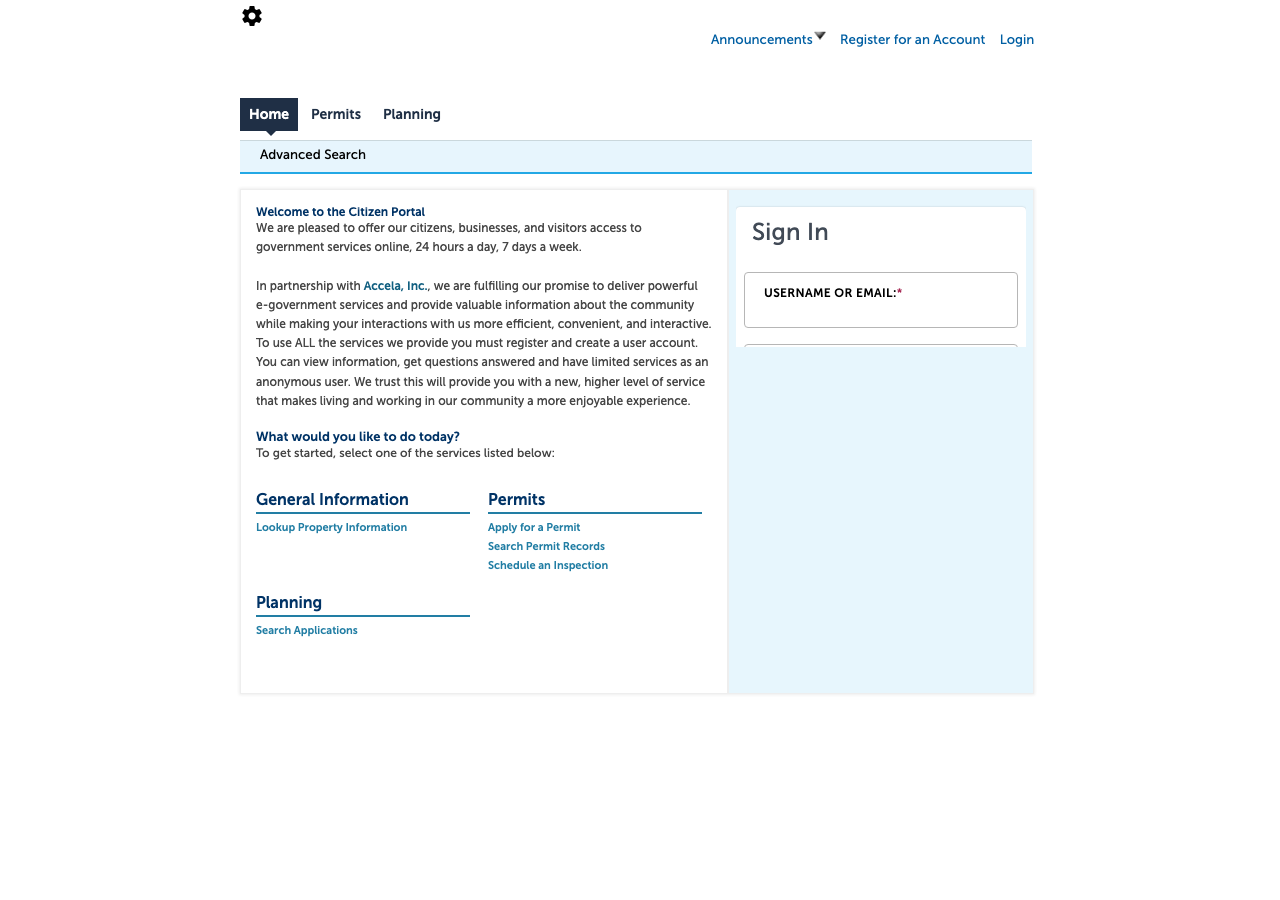
- Which permit portal does this authority use? Two portals: Accela Citizen Access (ACA) for general building/fire/ADU permits, and a dedicated Symbium Instant Permitting platform (embedded at symbium.com/embed-search, jurisdiction=perris) specifically for residential rooftop-solar and battery-storage permits. 95% · department page
- Can the whole application be completed online? Yes for residential solar/battery via Symbium — the entire application, compliance check, payment and permit issuance happen online, per the city's own description ('Apply Online... Your permit will be issued automatically'). Accela Citizen Access also supports online applications for other building permit types. 90% · department page
-
Plan review — and start the utility in parallel
Interconnection is a separate process from the permit and usually the longer pole. Where the utility does not depend on the permit being issued, running both at once is the single biggest saving available on a residential job.
- What is the stated plan-review turnaround? Instant/automated for residential solar & battery storage submitted via Symbium ('Your permit will be issued automatically, eliminating manual review or site visits'); turnaround for the standard Accela building-permit path is not separately published. 75% · department page
- Which utility handles interconnection here? Southern California Edison (SCE) owns the distribution wires and handles interconnection/Rule 21/NEM and Permission-to-Operate for Perris addresses. Western Community Energy (WCE), a joint-powers-authority Community Choice Aggregator that Perris joined at program launch in April 2020, is the default electricity GENERATION provider, but WCE explicitly does not touch the wires: 'Edison will continue to distribute it to you through their power lines.' 85% · utility/CCA public FAQ
- Where does the utility sit in the sequence? Parallel — under SCE's generally-published Rule 21 process, the interconnection application/agreement and Permission-to-Operate run alongside (not strictly before or after) the city building-permit process; SCE will not energize/grant PTO until the system passes, but installers commonly submit to SCE and the city concurrently. This is SCE's general public process, not confirmed as a Perris-specific sequencing rule. 50% · utility program page
28 questions answered against City of Perris’s own published documents
Q1 Is this authority the AHJ for residential solar at this address? Core Jurisdiction & scope
Yes
Why the confidence is not higherCity's own Building Department page states the Building Division enforces the City's Building Codes 'through public information, plan check, permit and inspection services' and directly links to Building/Fire/Solar/ADU permit applications; the dedicated Symbium Solar Permits page confirms the city itself issues residential solar/battery permits.
department page checked 2026-08-30 https://web.archive.org/web/20251011225642/https://www.cityofperris.org/departments/development-services/building-department
Q2 What does this authority permit itself, and what does it delegate? Core Jurisdiction & scope
Both (Building and Electrical) — held by the City's own Development Services/Building Division. Fire-code plan review is also held in-house (the Building Official is concurrently the Fire Marshal); only fire SUPPRESSION/emergency response is contracted out, to CAL FIRE/Riverside County Fire Department.
Why the confidence is not higherBuilding Dept page shows Building Division issuing Building, Fire, Solar and ADU permits. The Fire Marshal's own page names Jorge Caballero as 'Building Official/Fire Marshal' (one person, one office) and states: 'The city partners with CAL FIRE Riverside County Fire Department to provide fire rescue services, respond to traffic accidents, and provide emergency medical assistance' while 'The Fire Marshal's Office is committed to ensuring fire prevention services.' So fire-code plan review/inspection is NOT delegated to the county; only rescue/EMS response is. This corrects a brief-style assumption that a Riverside-County-served city necessarily has fire prevention delegated too.
department page checked 2026-08-30 https://web.archive.org/web/20260513123156/https://www.cityofperris.org/departments/development-services/fire-marshal
Q3 Is a permit required for a residential rooftop PV system? Core Jurisdiction & scope
Yes
Why the confidence is not higherThe Building Department page and the dedicated 'City of Perris Solar Permits' (Symbium) page both describe a residential solar/battery permit application and issuance process; a permit is plainly required.
department page checked 2026-08-30 https://web.archive.org/web/20260421132839/https://www.cityofperris.org/departments/development-services/building-department/symbium-solar-permits
Q4 Is there a separate electrical permit, or is it combined? Core Jurisdiction & scope
Combined
Why the confidence is not higherThe Symbium instant-permitting page frames residential solar/battery as a single application resulting in one automatically-issued permit ('Your permit will be issued automatically'), not separate building and electrical permits. Not verified for the non-Symbium/Accela path for larger or non-qualifying systems.
department page checked 2026-08-30 https://web.archive.org/web/20260421132839/https://www.cityofperris.org/departments/development-services/building-department/symbium-solar-permits
Q5 Who is allowed to pull the electrical permit? Core Who may apply
Licensed contractor — a California C-46 (Solar) or C-10 (Electrical) state-licensed contractor typically pulls the permit; the city's own (legacy) OTC agreement form required a 'State Contractors License #' before a solar company could obtain permits over the counter.
Why the confidence is not higherCity's 'Solar Company Over the Counter Permit Agreement' (legacy bulletin, last revision stamp 1/1/17) requires the applying company to state its State Contractors License number. CSLB classification rules (state law, not city-specific) require a C-46 or C-10 license for solar electrical work. Current Symbium-era practice not separately confirmed on this point.
permit bulletin (dated 1/1/17) checked 2026-08-30 http://web.archive.org/web/20180525165331/http://www.cityofperris.org/city-hall/forms/building-forms/SolarOverCounter.pdf
Q6 Must the contractor be registered with this authority before applying? Core Who may apply
No separate city registration step is described for the current Symbium pathway — the platform itself verifies the contractor's and business license at the time of application ('Symbium also verifies your contractor's and business licenses'). A now-superseded manual/over-the-counter process previously required contractors to sign a 'Solar Company OTC Permit Agreement' with the city before using the OTC counter.
Why the confidence is not higherCity's own Symbium Solar Permits page states contractor/business license verification is built into the online application; this appears to replace the older manual OTC registration step evidenced by the legacy 'Solar Company Over the Counter Permit Agreement' PDF (rev. 1/1/17), which is no longer linked from the current Building Department page.
department page checked 2026-08-30 https://web.archive.org/web/20260421132839/https://www.cityofperris.org/departments/development-services/building-department/symbium-solar-permits
Q7 Is a homeowner permitted to self-install and self-permit? Who may apply
Not addressed by the city's solar-specific pages. Under general California owner-builder law (Business & Professions Code, administered by CSLB) a homeowner may pull an owner-builder permit including for electrical work if they sign the required disclosures; the city's solar/Symbium materials do not separately confirm whether owner-builders can use the Symbium instant-permit path.
Why the confidence is not higherNo Perris-specific statement found on homeowner self-install for solar; answer relies on generally-applicable CSLB owner-builder rules rather than a Perris document naming solar specifically.
state licensing board guidance checked 2026-08-30 https://www.cslb.ca.gov/Consumers/Hire_A_Contractor/Homeowner_Guide.aspx
Q8 What documents make up a complete submittal? Core Submittal package
Two parallel submittal paths exist. (1) Symbium instant-permitting: an online questionnaire (property address, installation type — Rooftop Solar or Battery Storage — and system specs) that Symbium checks against code automatically; no paper plan set described. (2) The city's legacy manual/Accela submittal checklist (2016-code-cycle bulletin) called for: 3 sets of construction plans, a dimensioned cover sheet/site plan, roof or ground-mount plan with panel locations, panel anchorage/attachment details (mounting-manufacturer cut sheet), an electrical one-line diagram, and equipment (inverter/panel) cut sheets showing listed-product status.
Why the confidence is not higherSymbium page (current) describes the online-questionnaire path; the itemized checklist comes from the city's 'Submittal Requirements – Photovoltaic System, Ground or Roof Mounted, 2016 Codes' bulletin (rev. 1/1/17), which is no longer linked from the current Building Department page — treated as evidence of the standard (non-instant) path, not confirmed still current verbatim.
permit bulletin (2016 code cycle, rev. 1/1/17) checked 2026-08-30 http://web.archive.org/web/20180525165557/http://www.cityofperris.org/city-hall/forms/building-info/PhotovoltaicSystemGroundRoof.pdf
Q9 How many copies, and in what format? Submittal package
Legacy bulletin specifies 3 sets of construction plans for the manual/Accela path; the Symbium instant-permit path is fully digital (no physical copies).
Why the confidence is not higherSame 2016-cycle bulletin as Q8; format for the current instant-permit path inferred from Symbium being a fully online platform.
permit bulletin (2016 code cycle, rev. 1/1/17) checked 2026-08-30 http://web.archive.org/web/20180525165557/http://www.cityofperris.org/city-hall/forms/building-info/PhotovoltaicSystemGroundRoof.pdf
Q10 Is a site plan required, and what must it show? Core Submittal package
Yes. Manual-path bulletin requires a 'full dimensioned site plan' showing lot size, street, alley, easements, parking, structures, and property lines/dimensions. The Symbium path instead auto-pulls the parcel/property record when the applicant enters the property address.
Why the confidence is not higherCombination of the legacy PV submittal bulletin and the current Symbium page's described workflow ('Input the property address... Symbium will display detailed information about the property and its permit history').
permit bulletin (2016 code cycle, rev. 1/1/17) checked 2026-08-30 http://web.archive.org/web/20180525165557/http://www.cityofperris.org/city-hall/forms/building-info/PhotovoltaicSystemGroundRoof.pdf
Q11 Is a one-line / three-line diagram required? Core Drawings & calculations
Yes
Why the confidence is not higherLegacy submittal bulletin item 5: 'Electrical one line diagram... Show panels, inverter, main panel disconnects and wire size.' This is also a standard CEC/permit-plan requirement independent of code year, so likely still applicable to the manual/Accela path; not separately confirmed for Symbium's own internal review.
permit bulletin (2016 code cycle, rev. 1/1/17) checked 2026-08-30 http://web.archive.org/web/20180525165557/http://www.cityofperris.org/city-hall/forms/building-info/PhotovoltaicSystemGroundRoof.pdf
Q12 Are string and conductor calculations required? Drawings & calculations
Yes
Why the confidence is not higherThe 'Residential Photovoltaic Solar Systems' attachment requires, at permit issuance, calculations for solar-breaker sizing based on main panel type (100% for center-fed, 120% for end-fed busbars), i.e. conductor/breaker calculations tied to NEC-style busbar rules.
permit bulletin/plan attachment (rev. undated, references 2016 CEC) checked 2026-08-30 http://web.archive.org/web/20180525165325/http://www.cityofperris.org/city-hall/forms/building-forms/SolarVoltaicSytemsPermitAttachment_0918-14.pdf
Q13 Is a structural PE stamp required, and at what threshold? Core Engineering & stamps
Yes — no numeric threshold stated; ALL structural plans/calculations submitted must be stamped. 'All structural plans and calculations are required by the State of California to be stamped by the Engineer of Record and wet signed on each sheet.'
Why the confidence is not higherCity's own 'Residential Photovoltaic Solar Systems' required-standards attachment, item (i). No dollar/size threshold is given — it applies whenever structural calculations are submitted (e.g., roof or ground-mount structural review).
permit bulletin/plan attachment checked 2026-08-30 http://web.archive.org/web/20180525165325/http://www.cityofperris.org/city-hall/forms/building-forms/SolarVoltaicSytemsPermitAttachment_0918-14.pdf
Q14 Is an electrical PE stamp required, and at what threshold? Engineering & stamps
Nothing published by this authority.
Where we lookedChecked the Building Department page, the Symbium Solar Permits page, and the three legacy PV submittal/attachment bulletins (SolarOverCounter, PhotovoltaicSystemGroundRoof, ResidentialPhotovoltaicSolarSystems) for any electrical PE-stamp threshold; only a structural PE-stamp requirement (Q13) is stated, with no separate electrical-engineer stamp threshold mentioned anywhere.
Q15 What does a residential solar permit cost? Core Fees
Nothing published by this authority.
Where we lookedChecked the Building Department page, Finance department page and its 'Other Documents'/CAFR/budget subpages, the Planning fee-schedule PDF, and the Accela portal landing page for a residential solar/PV permit fee amount; none publish one. The legacy bulletins state only that 'All fee will be figured at the time of issuance of permit' with no schedule attached, and Symbium computes/collects the fee at checkout without a published public rate sheet.
Q16 How is the fee calculated? Core Fees
Nothing published by this authority.
Where we lookedSame search as Q15 (Building Dept, Finance, Planning fee PDF, Accela, Symbium page) — no fee-calculation method (flat/valuation/per-kW/tiered) is published anywhere found; legacy bulletin explicitly defers the fee to time of issuance.
Q17 Is there a separate plan-check fee? Fees
Nothing published by this authority.
Where we lookedSame search as Q15/Q16 — no separate plan-check fee is published on any city fee, Finance, or Building Department page found.
Q18 What is the stated plan-review turnaround? Core Timeline & validity
Instant/automated for residential solar & battery storage submitted via Symbium ('Your permit will be issued automatically, eliminating manual review or site visits'); turnaround for the standard Accela building-permit path is not separately published.
Why the confidence is not higherCity's own Symbium Solar Permits page states automatic issuance for the SB 379 instant-permitting track. No turnaround figure found for the conventional Accela plan-check path.
department page checked 2026-08-30 https://web.archive.org/web/20260421132839/https://www.cityofperris.org/departments/development-services/building-department/symbium-solar-permits
Q19 How long is an issued permit valid before it expires? Timeline & validity
Nothing published by this authority.
Where we lookedChecked the Building Department page, the Symbium Solar Permits page, and the legacy PV bulletins for a stated permit-validity/expiration period; none is published. (Perris's Municode code-of-ordinances library — where a general permit-expiration section such as an adopted CBC 105.5 equivalent would be codified — is an Angular JS shell that returns only a ~2KB app shell to both direct fetch and Wayback captures; see jurisdiction note on Municode access.)
https://library.municode.com/ca/perris/codes/code_of_ordinances
Q20 Which permit portal does this authority use? Core Portal & process
Two portals: Accela Citizen Access (ACA) for general building/fire/ADU permits, and a dedicated Symbium Instant Permitting platform (embedded at symbium.com/embed-search, jurisdiction=perris) specifically for residential rooftop-solar and battery-storage permits.
Why the confidence is not higherBuilding Department page's 'Building Permit' service links to https://aca.accela.com/perris/default.aspx; the separate 'Symbium Solar Permits' page embeds Symbium and states the city 'collaborat[ed] with Symbium to implement an automated permitting platform that meets the requirements of SB 379.'
department page checked 2026-08-30 https://web.archive.org/web/20260421132839/https://www.cityofperris.org/departments/development-services/building-department/symbium-solar-permits
Q21 Can the whole application be completed online? Core Portal & process
Yes for residential solar/battery via Symbium — the entire application, compliance check, payment and permit issuance happen online, per the city's own description ('Apply Online... Your permit will be issued automatically'). Accela Citizen Access also supports online applications for other building permit types.
Why the confidence is not higherCity's Symbium Solar Permits page, step-by-step instructions.
department page checked 2026-08-30 https://web.archive.org/web/20260421132839/https://www.cityofperris.org/departments/development-services/building-department/symbium-solar-permits
Q22 Which utility handles interconnection here? Core Utility interconnection
Southern California Edison (SCE) owns the distribution wires and handles interconnection/Rule 21/NEM and Permission-to-Operate for Perris addresses. Western Community Energy (WCE), a joint-powers-authority Community Choice Aggregator that Perris joined at program launch in April 2020, is the default electricity GENERATION provider, but WCE explicitly does not touch the wires: 'Edison will continue to distribute it to you through their power lines.'
Why the confidence is not higherWCE's own public FAQ names Perris as one of the CCA's April-2020 launch cities and states in plain language that SCE remains the utility delivering/distributing power and handling outages. This matches the govbot brief's flagged CCA pattern (retail generation vs. wires/interconnection utility are different entities) — confirmed from primary sources rather than assumed.
utility/CCA public FAQ checked 2026-08-30 https://westerncommunityenergy.com/
Q23 Where does the utility sit in the sequence? Core Utility interconnection
Parallel — under SCE's generally-published Rule 21 process, the interconnection application/agreement and Permission-to-Operate run alongside (not strictly before or after) the city building-permit process; SCE will not energize/grant PTO until the system passes, but installers commonly submit to SCE and the city concurrently. This is SCE's general public process, not confirmed as a Perris-specific sequencing rule.
Why the confidence is not higherBased on SCE's public Rule 21/grid-interconnection landing page (utility-level, not a Perris-specific document); the gated SCE Interconnection Handbook (on.sce.com/InterconnectionHandbook), which would give the authoritative step order, redirects through a Microsoft/SharePoint OAuth login and could not be reached.
utility program page checked 2026-08-30 https://www.sce.com/business/smart-energy-solar/solar-for-business/grid-interconnections/interconnecting-generation-under-rule-21
Q24 Is a HOA or architectural approval required first? Overlays & special cases
No — the city does not require HOA/architectural approval as a permitting precondition. The city's own PV cover-sheet attachment carries only a caution to homeowners ('Your homeowners' association may have potential limitations applicable to your project'), and California's Solar Rights Act (Civil Code §714) limits HOA authority to unreasonably restrict solar installations statewide.
Why the confidence is not higherCity's PV Cover Sheet (part of the PhotovoltaicSystemGroundRoof bulletin) flags HOA limitations only as a notice to the homeowner, not as a submittal requirement; Civil Code §714 is the statewide backstop making a city-required HOA sign-off unusual for solar specifically.
state statute checked 2026-08-30 https://leginfo.legislature.ca.gov/faces/codes_displaySection.xhtml?sectionNum=714.&lawCode=CIV
Q25 Is there a historic-district review? Overlays & special cases
Nothing published by this authority.
Where we lookedChecked the Building Department, Planning, Municipal Code landing, and the three legacy PV bulletins for any historic-district or historic-overlay review requirement specific to solar; none is mentioned. Perris's zoning/historic-preservation ordinance itself could not be reached (Municode Angular shell, see jurisdiction note), so a true citywide historic-district carve-out cannot be ruled out beyond what these sources cover.
https://library.municode.com/ca/perris/codes/code_of_ordinances
Q26 Is a wind or windstorm certification required? Overlays & special cases
No — none of the city's solar submittal materials (legacy PV bulletins) or the current Symbium/Building Department pages mention a wind or windstorm certification requirement; this is not a documented feature of California residential solar permitting generally (unlike, e.g., Texas coastal wind-zone rules).
Why the confidence is not higherAbsence checked against the itemized submittal checklist in the 2016-cycle PV Ground/Roof-Mount bulletin (which lists site plan, structural, electrical, and equipment-cutsheet items but nothing wind-certification related) and against the current Symbium and Building Department pages.
permit bulletin (2016 code cycle) checked 2026-08-30 http://web.archive.org/web/20180525165557/http://www.cityofperris.org/city-hall/forms/building-info/PhotovoltaicSystemGroundRoof.pdf
Q27 Is a Specific Use Permit or Council approval ever required? Overlays & special cases
Nothing published by this authority.
Where we lookedChecked the Building Department, Symbium Solar Permits, and Municipal Code landing pages for any Specific Use Permit / Council-approval trigger for residential rooftop PV; none is mentioned. Perris's zoning code (which would define any such CUP trigger, e.g. for oversized ground mounts) sits in Municode and could not be reached — see jurisdiction note on Municode access.
https://library.municode.com/ca/perris/codes/code_of_ordinances
Q28 Is there a system-size cap on residential generation? Overlays & special cases
Nothing published by this authority.
Where we lookedChecked the Building Department, Symbium, and legacy PV bulletins for a city-imposed system-size cap on residential generation; none is published. Sizing limits for net-energy-metered systems in California are set by the NEM tariff/CPUC rules at the utility level (SCE), not by city ordinance, and no Perris-specific cap could be found.
Lines marked with a percentage were read off this authority’s own published documents. Unmarked guidance is general good practice, not this jurisdiction’s rule — always confirm against the authority before you submit.
Install 5 steps · 20 questions
-
Build to the code editions actually in force here
The NEC edition a jurisdiction enforces is often a cycle behind the newest one published, and local amendments sit on top of it. Rapid shutdown, conductor sizing and labelling all change between editions, so the edition in force is the first thing to establish, not the last.
- Which NEC edition is in force? 2023 NEC (as NFPA 70, incorporated into the 2025 California Electrical Code, Title 24 Part 3), effective statewide 1 Jan 2026. Not separately confirmed whether Perris has adopted this without amendment, because Perris's Municode code library is an Angular JS application shell that returns no rendered content to direct fetch, curl, or Wayback capture (all captures are ~1.8–2.6 KB app shells). 60% · state adopting agency
- Which building code edition is in force? 2025 California Building Code (Title 24, Part 2), effective statewide 1 Jan 2026. The city's own Fire Marshal page confirms it enforces 'the current editions of the California Code of Regulations, Title 24 [including] the California Building Code' without naming a specific year. 65% · department page
- Which fire code edition is in force? 2025 California Fire Code (Title 24, Part 9), effective statewide 1 Jan 2026, per the same statewide triennial cycle; the city's Fire Marshal page confirms it enforces the 'current edition' of the CFC without naming the year. 65% · department page
- Are there local amendments to any of the above? Not confirmed for Perris specifically — the city's Municode code library (where local amendments would be codified) is an inaccessible Angular JS shell (see jurisdiction note). Statewide, AB 130 (Stats. 2025, Ch. 22) bars any CITY from adopting a NEW more-restrictive residential local amendment from 1 Oct 2025 through 1 Jun 2031, so no new residential amendment could lawfully have been added in that window even if one existed. 55% · municipal code (inaccessible — cited to show the gap)
- What is the installation judged against? CEC (California Electrical Code) Articles 690 and 705, and California Fire Code §605.11 (solar photovoltaic power systems) — per the city's own required-standards attachment: installations 'shall...be in full compliance with Articles 690 and 705 of the adopted California Electrical Code (CEC) and Section 605.11 of the California Fire Code (CFC).' 75% · permit bulletin/plan attachment
-
Fire access, setbacks and pathways
Ridge setbacks and roof access pathways are fire-service requirements and they constrain the array layout. They are the most common cause of a redesign after the fire department comments on a plan set.
Nothing recorded for City of Perris on this step yet — 1 question checked and found unpublished. The guidance above is general.
-
Rapid shutdown
Which rapid-shutdown rule applies follows directly from the NEC edition in force, and the initiation device has to be at a location the fire service can reach and identify. This is inspected, and it is labelled.
- Is rapid shutdown required, and to which NEC edition? Yes, by operation of the 2023 NEC §690.12 rapid-shutdown requirement, adopted statewide as part of the 2025 California Electrical Code effective 1 Jan 2026 — California has no mechanism for a city to opt out of NEC safety articles. No Perris-specific rapid-shutdown bulletin was found; the city's own PV bulletins predate rapid shutdown's current form and do not mention it. 55% · state adopting agency
-
Labels and placards
The NEC sets a baseline for permanent markings at the service equipment and the disconnecting means. On top of that, an authority may specify its own wording, and the utility may specify more again. Where any of them writes its own text, a generic off-the-shelf label set will not pass — this is the detail most often fixed on a return visit.
- Which placards does this authority require at the service equipment? Per the city's own (dated) required-standards handout: a DC-side shock-hazard warning sign at/near the inverter (2016 CEC Art. 690.17-style wording), a single-120V-supply warning where applicable (Art. 690.10(c)-style), a ground-fault warning (Art. 690.5(a)-style), and a bipolar-array disconnection warning (Art. 690.7(e)-style); plus, per the inspection-standards attachment, signs identifying the PV system's DC disconnect, the AC point of connection, and the switch for the alternate power system. 60% · permit bulletin (2016 code cycle, rev. 1/1/17)
- Does the authority specify placard wording of its own? Yes, in the sense that the city's own PV Cover Sheet reproduces verbatim warning-label text for the installer to post — but that wording is itself the NEC/CEC-mandated Article 690 warning language, not city-original phrasing beyond selecting which NEC warnings apply. 55% · permit bulletin (2016 code cycle, rev. 1/1/17)
- Where must the labels be placed? Per the city's (dated) bulletin: the DC-side shock-hazard warning is to be a 'Permanent sign or painted stencil near the inverter'; the DC-disconnect identification sign is placed at the DC disconnect; the AC point-of-connection sign is placed at that point of connection. 55% · permit bulletin (2016 code cycle, rev. 1/1/17)
-
Disconnect, storage and listed equipment
Where the AC disconnect must sit relative to the meter is usually the utility's rule, not the building department's. Battery storage frequently carries its own permit, its own inspection and its own fire conditions.
- Must equipment be on a specific approved list? Equipment must be a 'listed product' (i.e., UL-listed) — 'Inverter and panel must be a listed product' — rather than drawn from a city-maintained proprietary approved-manufacturer list. 65% · permit bulletin (2016 code cycle, rev. 1/1/17)
- Are batteries permitted, and under what conditions? Yes — the city's current Symbium Instant Permitting platform offers 'Battery Storage Installation' as one of its two residential Property-Improvement application types (alongside 'Rooftop Solar'), meaning batteries/ESS are permitted through the same automated SB 379 pathway as solar. 80% · department page
- Is there a separate ESS permit or inspection? Batteries/ESS appear to be filed as their own permit-application type within Symbium (a distinct 'Battery Storage Installation' button/workflow, separate from 'Rooftop Solar'), but it is not confirmed whether a combined solar+battery project is issued as one permit or two. 55% · department page
- Is a ground mount treated as a structure? Yes — a ground-mounted array is treated as a structure requiring its own footing/structural details, and (uniquely for ground mounts) must be 'protected and surrounded by a 5 foot high fence,' beyond the panel-anchorage requirements that apply to roof mounts. 65% · permit bulletin (2016 code cycle, rev. 1/1/17)
- Is there a local rule on service upgrades or busbar sizing? Yes — busbar/backfeed sizing rule tied to panel type: on a center-fed main panel, added solar breaker(s) are limited to 100% of bus/main-breaker rating (i.e., generally no additional solar breaker without a main-breaker downgrade justified by NEC Art. 220 load calculations); on an end-fed panel, up to 120% of bus rating is allowed. 70% · permit bulletin/plan attachment
- Is a specific mounting system or attachment spacing required? Yes — manufacturer-specific mounting details are required (e.g., Unirac or Tilerac), lag screws must penetrate a minimum of 2 inches into solid-sawn structural members (not exceeding manufacturer fastener limits for engineered members), and ground-mounted arrays require footing/structural details plus a 5-foot-high protective fence around the array. 65% · permit bulletin (2016 code cycle, rev. 1/1/17)
20 questions answered against City of Perris’s own published documents
Q29 Which NEC edition is in force? Core Code editions in force
2023 NEC (as NFPA 70, incorporated into the 2025 California Electrical Code, Title 24 Part 3), effective statewide 1 Jan 2026. Not separately confirmed whether Perris has adopted this without amendment, because Perris's Municode code library is an Angular JS application shell that returns no rendered content to direct fetch, curl, or Wayback capture (all captures are ~1.8–2.6 KB app shells).
Why the confidence is not higherCalifornia Building Standards Commission's own Codes page states the 2025 Title 24 cycle 'will be published July 1, 2025, with an effective date of January 1, 2026'; the 2023 NEC-based CEC is part of that same triennial cycle. City-specific confirmation blocked by Municode's JS-only rendering.
state adopting agency checked 2026-08-30 https://www.dgs.ca.gov/BSC/Codes
Q30 Which building code edition is in force? Core Code editions in force
2025 California Building Code (Title 24, Part 2), effective statewide 1 Jan 2026. The city's own Fire Marshal page confirms it enforces 'the current editions of the California Code of Regulations, Title 24 [including] the California Building Code' without naming a specific year.
Why the confidence is not higherCombination of the city's Fire Marshal page (own source, confirms Title 24/CBC enforcement in principle, undated as to edition year) and the state Building Standards Commission's effective-date statement for the 2025 cycle.
department page checked 2026-08-30 https://web.archive.org/web/20260513123156/https://www.cityofperris.org/departments/development-services/fire-marshal
Q31 Which fire code edition is in force? Code editions in force
2025 California Fire Code (Title 24, Part 9), effective statewide 1 Jan 2026, per the same statewide triennial cycle; the city's Fire Marshal page confirms it enforces the 'current edition' of the CFC without naming the year.
Why the confidence is not higherCity's Fire Marshal page states enforcement of 'the current editions of the California Code of Regulations, Title 24. This includes the California Fire Code...'; specific-year confirmation relies on the statewide BSC cycle rather than a Perris-specific ordinance (Municode inaccessible).
department page checked 2026-08-30 https://web.archive.org/web/20260513123156/https://www.cityofperris.org/departments/development-services/fire-marshal
Q32 Are there local amendments to any of the above? Core Code editions in force
Not confirmed for Perris specifically — the city's Municode code library (where local amendments would be codified) is an inaccessible Angular JS shell (see jurisdiction note). Statewide, AB 130 (Stats. 2025, Ch. 22) bars any CITY from adopting a NEW more-restrictive residential local amendment from 1 Oct 2025 through 1 Jun 2031, so no new residential amendment could lawfully have been added in that window even if one existed.
Why the confidence is not higherAB 130's statewide freeze on new residential local amendments is a matter of enacted state law; whether Perris has any pre-existing (pre-freeze) local amendments on the books could not be verified because the municipal code is unreachable.
municipal code (inaccessible — cited to show the gap) checked 2026-08-30 https://library.municode.com/ca/perris/codes/code_of_ordinances
Q33 What is the installation judged against? Core Electrical
CEC (California Electrical Code) Articles 690 and 705, and California Fire Code §605.11 (solar photovoltaic power systems) — per the city's own required-standards attachment: installations 'shall...be in full compliance with Articles 690 and 705 of the adopted California Electrical Code (CEC) and Section 605.11 of the California Fire Code (CFC).'
Why the confidence is not higherCity's 'Residential Photovoltaic Solar Systems' required-standards handout, which is attached to approved plans. The article/section numbers (690, 705, 605.11) have remained stable structural references across California code cycles even though this particular document dates to the 2016 code cycle.
permit bulletin/plan attachment checked 2026-08-30 http://web.archive.org/web/20180525165325/http://www.cityofperris.org/city-hall/forms/building-forms/SolarVoltaicSytemsPermitAttachment_0918-14.pdf
Q34 Is there a local rule on service upgrades or busbar sizing? Electrical
Yes — busbar/backfeed sizing rule tied to panel type: on a center-fed main panel, added solar breaker(s) are limited to 100% of bus/main-breaker rating (i.e., generally no additional solar breaker without a main-breaker downgrade justified by NEC Art. 220 load calculations); on an end-fed panel, up to 120% of bus rating is allowed.
Why the confidence is not higherCity's own 'Residential Photovoltaic Solar Systems' attachment, item 1, gives this calculation explicitly and requires the installer to check which panel type applies and sign next to it. This mirrors the standard NEC 705.12(B) 120%/100% busbar rule, so it likely remains applicable even though the source document is dated.
permit bulletin/plan attachment checked 2026-08-30 http://web.archive.org/web/20180525165325/http://www.cityofperris.org/city-hall/forms/building-forms/SolarVoltaicSytemsPermitAttachment_0918-14.pdf
Q35 Is a specific mounting system or attachment spacing required? Structural & mounting
Yes — manufacturer-specific mounting details are required (e.g., Unirac or Tilerac), lag screws must penetrate a minimum of 2 inches into solid-sawn structural members (not exceeding manufacturer fastener limits for engineered members), and ground-mounted arrays require footing/structural details plus a 5-foot-high protective fence around the array.
Why the confidence is not higherCity's 'Submittal Requirements – Photovoltaic System, Ground or Roof Mounted' bulletin, items 4 and 9. Dated to the 2016 code cycle but describes structural/mounting practice that is unlikely to have reversed.
permit bulletin (2016 code cycle, rev. 1/1/17) checked 2026-08-30 http://web.archive.org/web/20180525165557/http://www.cityofperris.org/city-hall/forms/building-info/PhotovoltaicSystemGroundRoof.pdf
Q36 What ridge setback and access pathways are required? Core Fire pathways & setbacks
Nothing published by this authority.
Where we lookedChecked the Fire Marshal page, the Building Department page, and all three legacy PV submittal/attachment bulletins for a stated ridge-setback distance or fire-access-pathway dimension (the type of table normally found at CFC §605.11.1.1/1.2); none of the found documents include specific setback distances or pathway widths, only a general citation to 'Section 605.11 of the California Fire Code.'
Q37 Is rapid shutdown required, and to which NEC edition? Core Rapid shutdown
Yes, by operation of the 2023 NEC §690.12 rapid-shutdown requirement, adopted statewide as part of the 2025 California Electrical Code effective 1 Jan 2026 — California has no mechanism for a city to opt out of NEC safety articles. No Perris-specific rapid-shutdown bulletin was found; the city's own PV bulletins predate rapid shutdown's current form and do not mention it.
Why the confidence is not higherInference from statewide code adoption (BSC effective-date statement) rather than a Perris-specific document; the city's legacy PV bulletins (2016 code cycle) are silent on rapid shutdown, consistent with predating its current prominence rather than the city having opted out (which is not legally possible).
state adopting agency checked 2026-08-30 https://www.dgs.ca.gov/BSC/Codes
Q38 Which placards does this authority require at the service equipment? Core Labels Signage & labelling
Per the city's own (dated) required-standards handout: a DC-side shock-hazard warning sign at/near the inverter (2016 CEC Art. 690.17-style wording), a single-120V-supply warning where applicable (Art. 690.10(c)-style), a ground-fault warning (Art. 690.5(a)-style), and a bipolar-array disconnection warning (Art. 690.7(e)-style); plus, per the inspection-standards attachment, signs identifying the PV system's DC disconnect, the AC point of connection, and the switch for the alternate power system.
Why the confidence is not higherTwo city bulletins: the PV Cover Sheet ('REQUIRED SIGNAGE') and the 'Residential Photovoltaic Solar Systems' inspection-points list. Both are dated to the 2016 NEC/CEC numbering (current 2023 NEC has renumbered/consolidated several Art. 690 warning-label requirements), so exact article citations may no longer match current code text even if the underlying warning concept persists.
permit bulletin (2016 code cycle, rev. 1/1/17) checked 2026-08-30 http://web.archive.org/web/20180525165557/http://www.cityofperris.org/city-hall/forms/building-info/PhotovoltaicSystemGroundRoof.pdf
Q39 Does the authority specify placard wording of its own? Core Labels Signage & labelling
Yes, in the sense that the city's own PV Cover Sheet reproduces verbatim warning-label text for the installer to post — but that wording is itself the NEC/CEC-mandated Article 690 warning language, not city-original phrasing beyond selecting which NEC warnings apply.
Why the confidence is not higherPV Cover Sheet 'REQUIRED SIGNAGE' section quotes specific warning sentences tied to (now-renumbered) CEC Article 690 subsections; no additional city-only wording was found beyond reproducing code-mandated text.
permit bulletin (2016 code cycle, rev. 1/1/17) checked 2026-08-30 http://web.archive.org/web/20180525165557/http://www.cityofperris.org/city-hall/forms/building-info/PhotovoltaicSystemGroundRoof.pdf
Q40 Does it specify letter height, colour or material? Core Labels Signage & labelling
Nothing published by this authority.
Where we lookedChecked the PV Cover Sheet 'REQUIRED SIGNAGE' section and the inspection-points attachment for letter-height, colour or material specification; neither document specifies anything beyond the required warning text itself (one note says a warning may be a 'Permanent sign or painted stencil near the inverter', which speaks to method but not size/colour/material).
Q41 Is a site plan / facility map placard required, and what must it show? Core Labels Signage & labelling
Nothing published by this authority.
Where we lookedChecked the Fire Marshal page, Building Department page, and all three legacy PV bulletins for a site-plan/facility-map placard requirement (NEC 705.10-style multiple-source placard) at the service equipment or a main disconnect; none of the found documents describe this specific placard type.
Q42 Does the UTILITY specify placards beyond the AHJ's? Core Labels Signage & labelling
Nothing published by this authority.
Where we lookedThe authoritative utility document for this — SCE's Interconnection Handbook — is gated: on.sce.com/InterconnectionHandbook redirects through a login.microsoftonline.com OAuth prompt into an Edison-internal SharePoint site (confirmed by following the redirect chain with curl), and no equivalent public SCE page enumerating placard requirements beyond NEC/CEC could be located. SCE's public Rule 21 landing page and its linked 'Grid Interconnection Sample Drawings' PDF (4.8MB) contain no extractable placard-specific text — the PDF is image/diagram-based with no text layer for that content.
Q43 Where must the labels be placed? Core Labels Signage & labelling
Per the city's (dated) bulletin: the DC-side shock-hazard warning is to be a 'Permanent sign or painted stencil near the inverter'; the DC-disconnect identification sign is placed at the DC disconnect; the AC point-of-connection sign is placed at that point of connection.
Why the confidence is not higherCity's PV Cover Sheet and inspection-points attachment. Placement described only in general terms tied to each device, not with exact dimensional/height instructions, and the source predates the current code cycle.
permit bulletin (2016 code cycle, rev. 1/1/17) checked 2026-08-30 http://web.archive.org/web/20180525165557/http://www.cityofperris.org/city-hall/forms/building-info/PhotovoltaicSystemGroundRoof.pdf
Q44 Must equipment be on a specific approved list? Equipment listing
Equipment must be a 'listed product' (i.e., UL-listed) — 'Inverter and panel must be a listed product' — rather than drawn from a city-maintained proprietary approved-manufacturer list.
Why the confidence is not higherCity's PV Ground/Roof-Mount submittal bulletin, item 6(a). This is a UL-listing requirement, not a city-specific equipment directory.
permit bulletin (2016 code cycle, rev. 1/1/17) checked 2026-08-30 http://web.archive.org/web/20180525165557/http://www.cityofperris.org/city-hall/forms/building-info/PhotovoltaicSystemGroundRoof.pdf
Q45 Are batteries permitted, and under what conditions? Core Battery / ESS
Yes — the city's current Symbium Instant Permitting platform offers 'Battery Storage Installation' as one of its two residential Property-Improvement application types (alongside 'Rooftop Solar'), meaning batteries/ESS are permitted through the same automated SB 379 pathway as solar.
Why the confidence is not higherCity's Symbium Solar Permits page: 'Choose Installation Type: Click on the "Rooftop Solar" or "Battery Storage Installation" button under the Property Improvements section.' No separate battery-specific conditions (e.g., fire-rated enclosure, setback) are spelled out on this page.
department page checked 2026-08-30 https://web.archive.org/web/20260421132839/https://www.cityofperris.org/departments/development-services/building-department/symbium-solar-permits
Q46 Is there a separate ESS permit or inspection? Battery / ESS
Batteries/ESS appear to be filed as their own permit-application type within Symbium (a distinct 'Battery Storage Installation' button/workflow, separate from 'Rooftop Solar'), but it is not confirmed whether a combined solar+battery project is issued as one permit or two.
Why the confidence is not higherInference from the Symbium page's description of two distinct Property-Improvement buttons; the page does not describe the combined-project case.
department page checked 2026-08-30 https://web.archive.org/web/20260421132839/https://www.cityofperris.org/departments/development-services/building-department/symbium-solar-permits
Q47 Is a ground mount treated as a structure? Core Ground mount
Yes — a ground-mounted array is treated as a structure requiring its own footing/structural details, and (uniquely for ground mounts) must be 'protected and surrounded by a 5 foot high fence,' beyond the panel-anchorage requirements that apply to roof mounts.
Why the confidence is not higherCity's PV Ground/Roof-Mount submittal bulletin, items 4(b) and 9.
permit bulletin (2016 code cycle, rev. 1/1/17) checked 2026-08-30 http://web.archive.org/web/20180525165557/http://www.cityofperris.org/city-hall/forms/building-info/PhotovoltaicSystemGroundRoof.pdf
Q48 Where must the AC disconnect be, relative to the meter? Core Utility equipment
Nothing published by this authority.
Where we lookedSCE's Interconnection Handbook (the source that would specify AC-disconnect placement relative to the meter) is gated behind a Microsoft/SharePoint OAuth login at on.sce.com/InterconnectionHandbook (confirmed via redirect trace). SCE's public Rule 21 page and its 'Grid Interconnection Sample Drawings' PDF were checked; the PDF is diagram/image-based with no extractable text describing disconnect-to-meter placement, and no Perris-specific document addresses this either.
Lines marked with a percentage were read off this authority’s own published documents. Unmarked guidance is general good practice, not this jurisdiction’s rule — always confirm against the authority before you submit.
Inspection 5 steps · 14 questions
-
Book it
Booking is a portal, a phone call or an email depending on the authority, and the notice required is rarely zero. Book before the work is finished rather than after — the lead time, not the work, is usually what sets the date.
- How is an inspection booked? Not applicable to Symbium-issued residential solar/battery permits, which the city states are issued 'automatically, eliminating manual review or site visits' (see Q52) — there is no inspection to book on that track. For other building permits, the Accela Citizen Access portal and the Building Division phone line (951-943-5003) are the general booking channels. 55% · department page
-
Know who turns up
Some authorities inspect their own solar work; some delegate it, and a few do not inspect the PV equipment itself at all. Who is coming determines what they will look at.
- Does this AHJ perform its own final solar inspection? No — for residential solar/battery permits issued through the city's Symbium Instant Permitting platform, the city's own page states the permit is issued 'automatically, eliminating manual review or site visits.' This is a genuine self-certification model, not merely marketing language, and it directly changes the answers to the rest of this Inspection section for that permit track. 90% · department page
- If delegated, to whom? N/A — no inspection is performed under the Symbium self-certification pathway (see Q52), so there is no delegation of a final inspection to another agency for that track. 70% · department page
-
Work the stages in order
A rough-in or mid-roof inspection, where one is required, has to happen before the work it covers is closed up. Missing a stage means opening something back up, and it is the most expensive kind of correction.
- Which inspections are required, and in what order? N/A under the Symbium self-certification pathway — no field inspections occur at all for qualifying residential solar/battery permits. Non-qualifying systems or those filed via Accela are not documented with a specific inspection sequence anywhere found. 55% · department page
- Is a rough-in or mid-roof inspection required? No, under the Symbium track — there are no site visits at all, so there is no separate rough-in/mid-roof inspection either. 70% · department page
-
Have the paperwork on site
The approved plan set, the permit, and the equipment listings should be on site and reachable. Inspectors routinely verify that installed equipment matches what was approved, and that the labels are the ones the plan set promised.
- Is there a published inspection checklist? A detailed checklist existed for the city's PRE-Symbium manual permit process ('Residential Photovoltaic Solar Systems' attachment lists specific inspector checkpoints: module/model match to plans, workmanlike array wiring, proper grounding, accessible electrical boxes, fastening/sealing per spec, conductor sizing, required signage present and consistent with equipment ratings, engineer-stamped structural calcs on site, CO/smoke-detector compliance noted, and UL 1703 fire-classification compliance). It is not confirmed whether this checklist is still operative now that the city's default residential path (Symbium) performs no site visit at all (see Q52), so there may be a live contradiction between the two documents. 55% · permit bulletin/plan attachment
- What must be on site at inspection? N/A under Symbium (no inspection occurs). For the legacy manual process, required on-site items included: the approved plans matching the installation, and an OSHA-approved ladder (long enough to project 3 feet above the roofline) provided by the contractor before the inspector's arrival. 55% · permit bulletin/plan attachment
- Does the inspector verify labels and listings? N/A under the current self-certification model — there is no city inspector visiting the site to verify labels/listings for Symbium-issued permits; compliance (including UL-listing per Q44) is attested by the licensed contractor and checked by the Symbium software at the application stage rather than in the field. 55% · department page
-
Sign-off, and permission to operate
Passing gives you a final or an equivalent sign-off. That is not the same as permission to operate: PTO comes from the utility, and who tells the utility the inspection passed varies. A system left switched off for weeks is usually waiting on this handover.
- Who notifies the utility for PTO? Typically the installer/customer — under SCE's general public Rule 21/NEM process, the installer or customer submits the interconnection application and, after SCE's review/meter work, SCE grants Permission to Operate; this is SCE's standard statewide practice rather than a Perris-specific rule, and the authoritative step-by-step (the SCE Interconnection Handbook) could not be reached (see Q42/Q48). 50% · utility program page
- How are corrections issued and cleared? Under the legacy manual process: if plans need to change after approval, the contractor must resubmit 'revised' plans and have them accepted before calling for field inspection, specifically to avoid an additional inspection fee. Not confirmed how (or whether) corrections are issued/cleared under the no-site-visit Symbium pathway, since there is no field inspection to generate a correction notice on that track. 55% · permit bulletin/plan attachment
14 questions answered against City of Perris’s own published documents
Q49 How is an inspection booked? Core Booking & scheduling
Not applicable to Symbium-issued residential solar/battery permits, which the city states are issued 'automatically, eliminating manual review or site visits' (see Q52) — there is no inspection to book on that track. For other building permits, the Accela Citizen Access portal and the Building Division phone line (951-943-5003) are the general booking channels.
Why the confidence is not higherInferred from the Symbium page's explicit no-site-visit language plus the Building Department page's general Accela-portal and phone-contact information; no dedicated 'schedule a solar inspection' page was found.
department page checked 2026-08-30 https://web.archive.org/web/20260421132839/https://www.cityofperris.org/departments/development-services/building-department/symbium-solar-permits
Q50 How much notice is required? Core Booking & scheduling
Nothing published by this authority.
Where we lookedChecked the Building Department page, Symbium Solar Permits page, and Fire Marshal page for a stated inspection-notice lead time (e.g., '24/48 business hours'); none is published, consistent with the Symbium track having no site-visit inspection at all (see Q52).
Q51 Are same-day or AM/PM windows offered? Booking & scheduling
Nothing published by this authority.
Where we lookedChecked the Building Department and Symbium pages for AM/PM or same-day inspection-window language; none is published.
Q52 Does this AHJ perform its own final solar inspection? Core Who inspects
No — for residential solar/battery permits issued through the city's Symbium Instant Permitting platform, the city's own page states the permit is issued 'automatically, eliminating manual review or site visits.' This is a genuine self-certification model, not merely marketing language, and it directly changes the answers to the rest of this Inspection section for that permit track.
Why the confidence is not higherCity of Perris Symbium Solar Permits page, 'Apply Online' step: 'Submit and pay for your permit application directly through Symbium. Your permit will be issued automatically, eliminating manual review or site visits.' Not confirmed whether SCE independently requires its own meter-set visit before granting Permission to Operate (a utility-level step, separate from the city's inspection).
department page checked 2026-08-30 https://web.archive.org/web/20260421132839/https://www.cityofperris.org/departments/development-services/building-department/symbium-solar-permits
Q53 If delegated, to whom? Core Who inspects
N/A — no inspection is performed under the Symbium self-certification pathway (see Q52), so there is no delegation of a final inspection to another agency for that track.
Why the confidence is not higherFollows directly from the city's own no-site-visit statement on the Symbium page; a standard (non-Symbium) building permit would presumably still be inspected by the city's own Building Division, not delegated.
department page checked 2026-08-30 https://web.archive.org/web/20260421132839/https://www.cityofperris.org/departments/development-services/building-department/symbium-solar-permits
Q54 Which inspections are required, and in what order? Core Stages & sequence
N/A under the Symbium self-certification pathway — no field inspections occur at all for qualifying residential solar/battery permits. Non-qualifying systems or those filed via Accela are not documented with a specific inspection sequence anywhere found.
Why the confidence is not higherSame city-page statement as Q52; no separate inspection-sequence document located for the conventional Accela building-permit track.
department page checked 2026-08-30 https://web.archive.org/web/20260421132839/https://www.cityofperris.org/departments/development-services/building-department/symbium-solar-permits
Q55 Is a rough-in or mid-roof inspection required? Stages & sequence
No, under the Symbium track — there are no site visits at all, so there is no separate rough-in/mid-roof inspection either.
Why the confidence is not higherFollows from the city's 'eliminating manual review or site visits' statement on the Symbium Solar Permits page.
department page checked 2026-08-30 https://web.archive.org/web/20260421132839/https://www.cityofperris.org/departments/development-services/building-department/symbium-solar-permits
Q56 Does the inspector verify labels and listings? Core What is checked
N/A under the current self-certification model — there is no city inspector visiting the site to verify labels/listings for Symbium-issued permits; compliance (including UL-listing per Q44) is attested by the licensed contractor and checked by the Symbium software at the application stage rather than in the field.
Why the confidence is not higherInference from the 'eliminating manual review or site visits' language; the older manual-permit inspection-points bulletin (Q57) did require an inspector to check listed-product labels, but that appears superseded for the now-default Symbium track.
department page checked 2026-08-30 https://web.archive.org/web/20260421132839/https://www.cityofperris.org/departments/development-services/building-department/symbium-solar-permits
Q57 Is there a published inspection checklist? Core What is checked
A detailed checklist existed for the city's PRE-Symbium manual permit process ('Residential Photovoltaic Solar Systems' attachment lists specific inspector checkpoints: module/model match to plans, workmanlike array wiring, proper grounding, accessible electrical boxes, fastening/sealing per spec, conductor sizing, required signage present and consistent with equipment ratings, engineer-stamped structural calcs on site, CO/smoke-detector compliance noted, and UL 1703 fire-classification compliance). It is not confirmed whether this checklist is still operative now that the city's default residential path (Symbium) performs no site visit at all (see Q52), so there may be a live contradiction between the two documents.
Why the confidence is not higherDirect read of the city's own 'Residential Photovoltaic Solar Systems' attachment (a real, detailed checklist) set against the current Symbium page's 'eliminating manual review or site visits' language — flagging the contradiction rather than picking one silently, per instructions on stale vs. current code-adoption pages.
permit bulletin/plan attachment checked 2026-08-30 http://web.archive.org/web/20180525165325/http://www.cityofperris.org/city-hall/forms/building-forms/SolarVoltaicSytemsPermitAttachment_0918-14.pdf
Q58 What must be on site at inspection? Core Documents on site
N/A under Symbium (no inspection occurs). For the legacy manual process, required on-site items included: the approved plans matching the installation, and an OSHA-approved ladder (long enough to project 3 feet above the roofline) provided by the contractor before the inspector's arrival.
Why the confidence is not higherCity's 'Residential Photovoltaic Solar Systems' attachment, 'At the time of inspection' section, items 1–2 — kept for completeness on the non-Symbium path even though the Symbium-track answer is N/A per Q52.
permit bulletin/plan attachment checked 2026-08-30 http://web.archive.org/web/20180525165325/http://www.cityofperris.org/city-hall/forms/building-forms/SolarVoltaicSytemsPermitAttachment_0918-14.pdf
Q59 Is there a re-inspection fee? Corrections & re-inspection
Nothing published by this authority.
Where we lookedThe city's own 'Residential Photovoltaic Solar Systems' attachment confirms a reinspection fee exists in principle ('If the work requested for the inspection is clearly NOT READY when the Inspector arrives, a Reinspection fee may be assessed') but states no dollar amount, and no fee schedule naming one could be found on the Building Department, Finance, or Planning fee pages (see also Q15–17).
Q60 How are corrections issued and cleared? Corrections & re-inspection
Under the legacy manual process: if plans need to change after approval, the contractor must resubmit 'revised' plans and have them accepted before calling for field inspection, specifically to avoid an additional inspection fee. Not confirmed how (or whether) corrections are issued/cleared under the no-site-visit Symbium pathway, since there is no field inspection to generate a correction notice on that track.
Why the confidence is not higherCity's 'Residential Photovoltaic Solar Systems' attachment, 'At the time of permit issuance' section, item 2.
permit bulletin/plan attachment checked 2026-08-30 http://web.archive.org/web/20180525165325/http://www.cityofperris.org/city-hall/forms/building-forms/SolarVoltaicSytemsPermitAttachment_0918-14.pdf
Q61 What is issued on pass? Core Final sign-off & PTO
Nothing published by this authority.
Where we lookedNo document describes what is issued 'on pass' for the Symbium self-certification pathway — since no field inspection occurs (Q52), it is unclear whether the automatically-issued permit record itself functions as the final approval, or whether a separate final/CO document follows. Checked the Symbium page, Building Department page, and Accela portal landing description; none address this explicitly.
Q62 Who notifies the utility for PTO? Core Final sign-off & PTO
Typically the installer/customer — under SCE's general public Rule 21/NEM process, the installer or customer submits the interconnection application and, after SCE's review/meter work, SCE grants Permission to Operate; this is SCE's standard statewide practice rather than a Perris-specific rule, and the authoritative step-by-step (the SCE Interconnection Handbook) could not be reached (see Q42/Q48).
Why the confidence is not higherBased on SCE's general public Rule 21 interconnection landing page (utility-level, not Perris-specific); the gated Interconnection Handbook would be the definitive source for exactly who notifies SCE for PTO.
utility program page checked 2026-08-30 https://www.sce.com/business/smart-energy-solar/solar-for-business/grid-interconnections/interconnecting-generation-under-rule-21
Lines marked with a percentage were read off this authority’s own published documents. Unmarked guidance is general good practice, not this jurisdiction’s rule — always confirm against the authority before you submit.
Jurisdiction & key facts
The standing 62-question set, answered for City of Perris against this authority’s own published documents. Every answer carries the confidence it was recorded at and the document it came from. Where nothing is published we say so and show where we looked — a blank here is a finding, not a gap.
City of Perris is the authority having jurisdiction 85% confidence
- Holds
- Building and Electrical (own Building Division); fire-code plan review and prevention also held in-house by the same Development Services Dept. (Building Official doubles as Fire Marshal). Fire SUPPRESSION/emergency response is contracted out to CAL FIRE/Riverside County Fire Department. Electric utility interconnection is a separate track held by Southern California Edison (SCE), which owns the distribution wires; Western Community Energy (WCE), a CCA joined by Perris in April 2020, supplies default generation only and explicitly does not touch interconnection.
- Delegated to
- CAL FIRE / Riverside County Fire Department (fire suppression & emergency response only, not fire-code plan review/inspection); SCE (interconnection/Rule 21/PTO, a utility-level function separate from city permitting)
- Overridden by
- CA Gov. Code §65850.52 (SB 379, streamlined/automated residential solar permitting — implemented locally via the city's Symbium platform); CA AB 130 (Stats. 2025 Ch. 22) freezing new local residential code amendments 1 Oct 2025–1 Jun 2031; Civil Code §714 (Solar Rights Act, limits HOA restrictions); SCE Rule 21/CPUC NEM tariff governs interconnection and system-size eligibility independently of the city permit.
- Why not higher
- Perris is an incorporated city with its own Development Services/Building Division, which issues Building, Fire, ADU and Solar permits directly per its own department page, and operates a dedicated Symbium Instant Permitting platform for residential solar/battery per SB 379. This is NOT delegated to Riverside County. The one genuine correction to a brief-style assumption: although the city sits in Riverside County (heavily CAL FIRE-served territory), Perris's OWN Fire Marshal's Office performs fire-code prevention/plan review in-house — the Building Official and Fire Marshal are the same person — and only fire SUPPRESSION/EMS response is contracted to CAL FIRE Riverside County Fire Department. No evidence was found of Riverside County Fire billing a separate PV/ESS plan-review line item in Perris (unlike Napa or San Ramon Valley FPD) — Perris's own Fire Marshal function appears folded into the Building Division, not a parallel county review track, though no city fee schedule could be located either way (see Q15–17).
- Permit required
- Yes95%
- Plan review
- Instant/automated for residential solar & battery storage submitted via Symbium ('Your permit will be issued automatically, eliminating manual review or site visits');75%
- Portal
- Two portals: Accela Citizen Access (ACA) for general building/fire/ADU permits, and a dedicated Symbium Instant Permitting platform (embedded at symbium.com/embed-search,95%
- Electrical code
- 2023 NEC (as NFPA 70, incorporated into the 2025 California Electrical Code, Title 24 Part 3), effective statewide 1 Jan 2026.60%
- Own placard wording
- Yes, in the sense that the city's own PV Cover Sheet reproduces verbatim warning-label text for the installer to post — but that wording is itself the NEC/CEC-mandated Article 690 warning…55%
- Booking an inspection
- Not applicable to Symbium-issued residential solar/battery permits, which the city states are issued 'automatically,55%
Labels & placards for this authority
City of Perris writes its own placard wording. A standard NEC label set will not satisfy it — the exact text, and in most cases the size, colour and font, are specified below.
Wording 55%
Yes, in the sense that the city's own PV Cover Sheet reproduces verbatim warning-label text for the installer to post — but that wording is itself the NEC/CEC-mandated Article 690 warning language, not city-original phrasing beyond selecting which NEC warnings apply.
Size, colour & material None%
Where they go 55%
Per the city's (dated) bulletin: the DC-side shock-hazard warning is to be a 'Permanent sign or painted stencil near the inverter'; the DC-disconnect identification sign is placed at the DC disconnect; the AC point-of-connection sign is placed at that point of connection.
What the utility wants on top None%
Each figure above is sourced and dated in the full answer set below (questions 38–43). Where an authority’s own published sheet is older than the code it has adopted, the answer says so.
Their website
Average approval time — application to PTO
From the CPUC interconnection record. Bars show the average days taken each year; a year with no recorded projects is left blank rather than drawn as zero.