
City of Pittsburg
Contra Costa County
City of Pittsburg is a city authority in the State of California, serving 76,416 residents. 5,365 residential solar installs are on record here. This page is the permit route for that jurisdiction: the fifteen steps from working out who has a say over an address through to permission to operate, the documents this authority publishes, and 62 answers taken from those documents and dated.
Permitting 5 steps · 28 questions
Whether a permit is needed — Yes Q3 Electrical and building permits — Combined Q4 Plan review — Approximately 1-3 business days for standard (non-Symbium) plan review; effectively instantaneous/same-day for SB 379-eligible systems processed through the Symbium… Q18 Where you file — Accela Citizen Access (via pittsburgca.gov/permitcenter) for standard building/electrical permitting and inspection scheduling; Q20
- Permit required
- Yes95% source
- Plan review turnaround
- Approximately 1-3 business days for standard (non-Symbium) plan review; effectively instantaneous/same-day for SB 379-eligible systems processed through the Symbium automated permitting portal.90% source
- Key document
- submittal checklist cited by 8 open the document
-
Confirm who has a say over your address
A city address is usually permitted by the city, not the county — but not always, and some authorities keep building and hand electrical to someone else. Getting this wrong costs the whole submittal, because every requirement below belongs to whoever actually holds jurisdiction. Check the overlays in the same pass: an HOA, a historic district, a windstorm certification or a system-size cap can reshape the design, and all of them are cheaper to find now than after the array is laid out.
- Is this authority the AHJ for residential solar at this address? Yes 95% · city ordinance / department page
- What does this authority permit itself, and what does it delegate? Both 90% · adopted ordinance
- Is a permit required for a residential rooftop PV system? Yes 95% · department page
- Is there a separate electrical permit, or is it combined? Combined 80% · department page
- Is a HOA or architectural approval required first? No 70% · adopted ordinance / inference
- Is there a historic-district review? Conditional — only if the property is within a City-designated historic building/district (PMC Ch. 15.84) or otherwise subject to Design Review (PMC Ch. 18.36); there is no solar-specific carve-out or trigger in the ordinance. 55% · adopted ordinance
- Is a wind or windstorm certification required? No 85% · adopted ordinance / code search
- Is a Specific Use Permit or Council approval ever required? No — for a standard residential rooftop PV system the process is ministerial under PMC 15.16.060 (the state SB 379-mandated expedited checklist review); no ordinance provision was found requiring a Specific Use Permit or City Council approval for residential rooftop solar specifically. 65% · adopted ordinance / inference
- Is there a system-size cap on residential generation? No hard cap on residential system size, but only systems no larger than 10 kW AC (or 30 kW thermal) on a single/duplex-family dwelling qualify as a 'small residential rooftop solar energy system' eligible for the expedited/ministerial SB 379 review process; larger systems still get a building/electrical permit through standard plan review, just not the same-day/administrative-approval track. 85% · adopted ordinance
-
Check who is allowed to apply
Several authorities require the electrical permit to be pulled by a licensed electrician, or require the contractor to be registered with them BEFORE applying. Registration is not same-day. This is second on the list rather than fourth because it is the step most likely to stop the job before the drawings matter.
- Who is allowed to pull the electrical permit? Either 90% · adopted ordinance
- Must the contractor be registered with this authority before applying? Yes 80% · submittal checklist
- Is a homeowner permitted to self-install and self-permit? Yes 90% · adopted ordinance
-
Build the submittal package
Almost everywhere wants a site plan, a one-line or three-line electrical diagram, equipment cut sheets with listings, and a structural attachment detail. Build it against the published checklist rather than the last jurisdiction you worked in — the checklist is what the reviewer marks against.
- What documents make up a complete submittal? Cover sheet (address, owner, plot/vicinity plan, page index, code references, contractor CA license #); roof plan showing modules, fire-district access, main panel/disconnect location; side/elevation view (roof pitch, stories, existing roofing); panel anchorage/attachment details with manufacturer install instructions and design engineer approval; electrical one-line diagram (designer name, panels, inverter, disconnects, OCPD, conductor sizes line+ground, note any service upgrade); list of all labels to be applied; equipment cut sheets showing UL/agency listing. 95% · submittal checklist
- How many copies, and in what format? Three complete sets of 11x17 construction plans required at the time of permit issuance (hard copies, provided by applicant); initial submittal for review is made electronically (via email to permit@ci.pittsburg.ca.us or through the city's Photovoltaic Electronic Plan Check portal). 90% · submittal checklist
- Is a site plan required, and what must it show? Yes — the cover sheet must include a plot plan or aerial vicinity map, and the roof plan must note all modules, fire-district access, and the location of the electrical main panel and solar disconnects. 90% · submittal checklist
- Is a one-line / three-line diagram required? Yes 95% · submittal checklist
- Are string and conductor calculations required? Yes 75% · submittal checklist
- Is a structural PE stamp required, and at what threshold? No fixed dollar/weight threshold is published; a structural PE stamp is not explicitly required for standard residential systems. The submittal checklist instead requires 'manufacturer's installation instructions and design engineer approvals' for panel anchorage/attachment details, which in practice is satisfied by the module/racking manufacturer's engineered attachment letter rather than a project-specific PE stamp for typical installations. 55% · submittal checklist
- Is an electrical PE stamp required, and at what threshold? Not explicitly required for standard residential PV systems; California's Business & Professions Code generally exempts standard residential rooftop PV electrical design from a stamped engineering requirement, and no Pittsburg-specific ordinance or checklist item imposes an electrical PE stamp threshold. 50% · submittal checklist
-
Apply and pay
Most authorities now take the whole application through a portal, and several states cap or constrain what a residential solar permit may cost. Check whether plan check is billed separately before you quote the job.
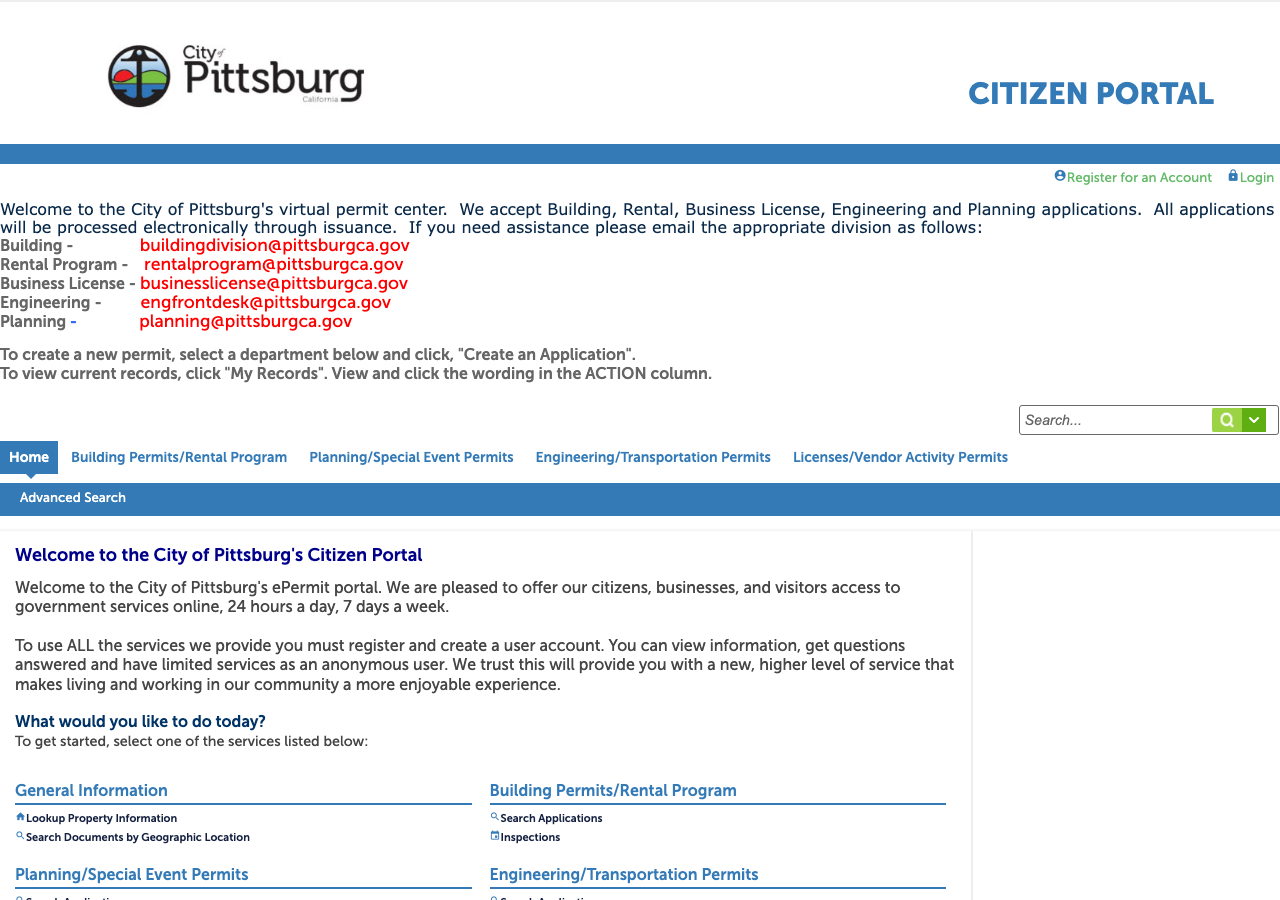
- Which permit portal does this authority use? Accela Citizen Access (via pittsburgca.gov/permitcenter) for standard building/electrical permitting and inspection scheduling; Symbium for SB 379 'Instant Residential Solar/ESS' permits (A, B, C-10, C-46 contractors only); a separate city-run 'Photovoltaic Electronic Plan Check' portal for PV/ESS plan submittals outside the Symbium pathway. 90% · portal landing page
- Can the whole application be completed online? No 85% · department page
-
Plan review — and start the utility in parallel
Interconnection is a separate process from the permit and usually the longer pole. Where the utility does not depend on the permit being issued, running both at once is the single biggest saving available on a residential job.
- What is the stated plan-review turnaround? Approximately 1-3 business days for standard (non-Symbium) plan review; effectively instantaneous/same-day for SB 379-eligible systems processed through the Symbium automated permitting portal. 90% · department page
- How long is an issued permit valid before it expires? 180 days from permit issuance to obtain an inspection/commence work; one 180-day extension may be requested; permits may be considered expired after one year regardless of progress. 90% · department page / FAQ
- Which utility handles interconnection here? Pacific Gas & Electric (PG&E) handles interconnection, Net Energy Metering and the physical distribution grid in Pittsburg. MCE (Marin Clean Energy), the Contra Costa County community choice aggregator that Pittsburg joined in 2018, is the default electricity generation supplier/biller for most residential accounts, but MCE does not perform interconnection engineering — that remains with PG&E as the wires utility under Electric Rule 21. 90% · utility website / DG manual
- Where does the utility sit in the sequence? After permit / parallel — the city's own ordinance is explicit that permit issuance does not authorize grid connection. 80% · adopted ordinance
28 questions answered against City of Pittsburg’s own published documents
Q1 Is this authority the AHJ for residential solar at this address? Core Jurisdiction & scope
Yes
Why the confidence is not higherCity of Pittsburg Building Division issues its own building and electrical permits for residential rooftop PV per PMC 15.08.010 (CBC) and 15.16.010 (CEC); the city's own solar permit page confirms it processes residential solar/ESS applications directly (via Symbium for SB 379 instant permits, or Accela for standard review).
city ordinance / department page checked 2026-08-30 https://web.archive.org/web/20260610144728/https://www.pittsburgca.gov/services/community-development/building/apply-for-residential-solar-permits
Q2 What does this authority permit itself, and what does it delegate? Core Jurisdiction & scope
Both
Why the confidence is not higherThe city's Building Division adopts and enforces both the California Building Code (PMC 15.08.010) and California Electrical Code (PMC 15.16.010), i.e. it permits itself for building and electrical. Fire-code enforcement is delegated by ordinance to the Contra Costa County Fire Protection District (Con Fire) under PMC 15.20.020, and utility interconnection sits with PG&E, not the city.
adopted ordinance checked 2026-08-30 https://www.codepublishing.com/CA/Pittsburg/html/Pittsburg15/Pittsburg1508.html
Q3 Is a permit required for a residential rooftop PV system? Core Jurisdiction & scope
Yes
Why the confidence is not higherCity's residential solar page ('Instant Residential Solar Permit/ESS') and the Residential Rooftop Photovoltaic Submittal Requirements handout both describe a mandatory permit application/plan-review process for rooftop PV; PMC 15.16.060 codifies the state-mandated (Gov. Code 65850.5) expedited permitting ordinance for small residential rooftop solar, which presupposes a permit is required.
department page checked 2026-08-30 https://web.archive.org/web/20260610144728/https://www.pittsburgca.gov/services/community-development/building/apply-for-residential-solar-permits
Q4 Is there a separate electrical permit, or is it combined? Core Jurisdiction & scope
Combined
Why the confidence is not higherThe city's solar page lists 'Solar or Electric Vehicle Permit' as one permit type covering the PV installation (structural + electrical) and a separate 'Electrical Permit (MSP Only)' as a distinct permit type used only when a main service panel upgrade is part of the scope of work. So the base PV system is a single combined permit; an MSP upgrade requires an additional separate electrical permit.
department page checked 2026-08-30 https://web.archive.org/web/20260610144728/https://www.pittsburgca.gov/services/community-development/building/apply-for-residential-solar-permits
Q5 Who is allowed to pull the electrical permit? Core Who may apply
Either
Why the confidence is not higherPMC 15.16.020: an electrical permit may be issued to (A) a person holding a valid CA electrical contractor's license, or (B) the bona fide owner-occupant of a single-family dwelling, duplex, or condo unit performing all the labor themselves. The city's Instant/Symbium SB 379 pathway is restricted to A, B, C-10 or C-46 licensed contractors; the standard (non-instant) pathway allows either a licensed contractor or an owner-builder under 15.16.020.
adopted ordinance checked 2026-08-30 https://www.codepublishing.com/CA/Pittsburg/html/Pittsburg15/Pittsburg1516.html
Q6 Must the contractor be registered with this authority before applying? Core Who may apply
Yes
Why the confidence is not higherThe Residential Rooftop Photovoltaic Submittal Requirements handout states 'a City of Pittsburg Business License must be obtained. Staff will verify CA license standing and Workmen's Compensation Insurance standing' as part of the submittal process, i.e. the contractor must hold a current city business license before/at permit application.
submittal checklist checked 2026-08-30 https://web.archive.org/web/20240521082906/https://www.pittsburgca.gov/home/showpublisheddocument/7548/637479142624630000
Q7 Is a homeowner permitted to self-install and self-permit? Who may apply
Yes
Why the confidence is not higherPMC 15.16.020(B) expressly allows the bona fide owner of a single-family dwelling, duplex, or condo unit to pull the electrical permit and self-perform the labor (owner-builder), so self-install/self-permit is permitted outside the contractor-only Symbium/SB 379 instant pathway.
adopted ordinance checked 2026-08-30 https://www.codepublishing.com/CA/Pittsburg/html/Pittsburg15/Pittsburg1516.html
Q8 What documents make up a complete submittal? Core Submittal package
Cover sheet (address, owner, plot/vicinity plan, page index, code references, contractor CA license #); roof plan showing modules, fire-district access, main panel/disconnect location; side/elevation view (roof pitch, stories, existing roofing); panel anchorage/attachment details with manufacturer install instructions and design engineer approval; electrical one-line diagram (designer name, panels, inverter, disconnects, OCPD, conductor sizes line+ground, note any service upgrade); list of all labels to be applied; equipment cut sheets showing UL/agency listing.
Why the confidence is not higherDirectly enumerated, item by item, in the city's own 'Residential Rooftop Photovoltaic Submittal Requirements' handout published by the Building Division.
submittal checklist checked 2026-08-30 https://web.archive.org/web/20240521082906/https://www.pittsburgca.gov/home/showpublisheddocument/7548/637479142624630000
Q9 How many copies, and in what format? Submittal package
Three complete sets of 11x17 construction plans required at the time of permit issuance (hard copies, provided by applicant); initial submittal for review is made electronically (via email to permit@ci.pittsburg.ca.us or through the city's Photovoltaic Electronic Plan Check portal).
Why the confidence is not higher'Three complete sets of 11x17 construction plans are required' and 'Initial submittal can be made online' are both stated verbatim in the Residential Rooftop Photovoltaic Submittal Requirements handout and corroborated by the separate ePlan Photovoltaic Electronic Plan Check portal page.
submittal checklist checked 2026-08-30 https://web.archive.org/web/20240521082906/https://www.pittsburgca.gov/home/showpublisheddocument/7548/637479142624630000
Q10 Is a site plan required, and what must it show? Core Submittal package
Yes — the cover sheet must include a plot plan or aerial vicinity map, and the roof plan must note all modules, fire-district access, and the location of the electrical main panel and solar disconnects.
Why the confidence is not higherExplicit requirement in the city's Residential Rooftop Photovoltaic Submittal Requirements handout, items 1(b) and 2(a).
submittal checklist checked 2026-08-30 https://web.archive.org/web/20240521082906/https://www.pittsburgca.gov/home/showpublisheddocument/7548/637479142624630000
Q11 Is a one-line / three-line diagram required? Core Drawings & calculations
Yes
Why the confidence is not higherSubmittal handout item 2(d) requires an 'Electrical one line diagram including name of the designer' noting panels, inverter, disconnects, OCPDs and conductor sizes.
submittal checklist checked 2026-08-30 https://web.archive.org/web/20240521082906/https://www.pittsburgca.gov/home/showpublisheddocument/7548/637479142624630000
Q12 Are string and conductor calculations required? Drawings & calculations
Yes
Why the confidence is not higherThe required one-line diagram must note 'conductor sizes both line and grounding,' which functionally requires conductor sizing calculations; the handout does not use the phrase 'string calculations' by name, so this is inferred from the conductor-sizing requirement rather than a separately labeled calc package.
submittal checklist checked 2026-08-30 https://web.archive.org/web/20240521082906/https://www.pittsburgca.gov/home/showpublisheddocument/7548/637479142624630000
Q13 Is a structural PE stamp required, and at what threshold? Core Engineering & stamps
No fixed dollar/weight threshold is published; a structural PE stamp is not explicitly required for standard residential systems. The submittal checklist instead requires 'manufacturer's installation instructions and design engineer approvals' for panel anchorage/attachment details, which in practice is satisfied by the module/racking manufacturer's engineered attachment letter rather than a project-specific PE stamp for typical installations.
Why the confidence is not higherInferred from the Residential Rooftop Photovoltaic Submittal Requirements handout's panel-anchorage clause; no separate ordinance or checklist item sets an explicit stamp threshold, so confidence is reduced.
submittal checklist checked 2026-08-30 https://web.archive.org/web/20240521082906/https://www.pittsburgca.gov/home/showpublisheddocument/7548/637479142624630000
Q14 Is an electrical PE stamp required, and at what threshold? Engineering & stamps
Not explicitly required for standard residential PV systems; California's Business & Professions Code generally exempts standard residential rooftop PV electrical design from a stamped engineering requirement, and no Pittsburg-specific ordinance or checklist item imposes an electrical PE stamp threshold.
Why the confidence is not higherNo city document (ordinance, submittal checklist, or FAQ) imposes an electrical PE-stamp requirement or threshold; this is an inference from the absence of any such requirement combined with the standard statewide exemption, not a direct city statement.
submittal checklist checked 2026-08-30 https://web.archive.org/web/20240521082906/https://www.pittsburgca.gov/home/showpublisheddocument/7548/637479142624630000
Q15 What does a residential solar permit cost? Core Fees
Nothing published by this authority.
Where we lookedChecked the Building Division home page resources list, the Residential Rooftop Photovoltaic Submittal Requirements handout, Submittal Handouts/Forms page, the Planning Dept.'s 'Forms, Fees & Factsheets' page, and PMC Title 3.30 (which sets fees by Council resolution rather than in the code text itself) — no dollar figure for a residential solar/PV permit fee was found published at any stable, dated city URL.
Q16 How is the fee calculated? Core Fees
Nothing published by this authority.
Where we lookedSame locations checked as Q15. PMC 3.30.020 confirms building-service fees are set by Council resolution to recover the cost of service (implying a cost-recovery/valuation-style structure, consistent with standard CA municipal practice), but no Pittsburg-specific fee-schedule document stating the calculation method (flat/valuation/per-kW/per-panel/tiered) for residential solar permits was locatable.
https://www.codepublishing.com/CA/Pittsburg/html/Pittsburg03/Pittsburg0330.html
Q17 Is there a separate plan-check fee? Fees
Nothing published by this authority.
Where we lookedChecked the same fee-related pages as Q15/16 plus the city's photovoltaic e-plan check page — none states whether a plan-check fee is charged separately from the permit fee for residential PV at the city (building) level. (Note: Contra Costa County FPD does charge a separate, distinctly-priced Engineering/Plan Review fee for Energy Storage Systems, but that is the fire district's fee, not the city's building permit fee — see Q45/Q46.)
Q18 What is the stated plan-review turnaround? Core Timeline & validity
Approximately 1-3 business days for standard (non-Symbium) plan review; effectively instantaneous/same-day for SB 379-eligible systems processed through the Symbium automated permitting portal.
Why the confidence is not higherCity's residential solar page states verbatim: 'permit processing will take approximately 1-3 business days, depending on staff availability' for non-Symbium submittals, while describing the Symbium partnership as providing 'instantaneous plan review' for SB 379-qualifying systems.
department page checked 2026-08-30 https://web.archive.org/web/20260610144728/https://www.pittsburgca.gov/services/community-development/building/apply-for-residential-solar-permits
Q19 How long is an issued permit valid before it expires? Timeline & validity
180 days from permit issuance to obtain an inspection/commence work; one 180-day extension may be requested; permits may be considered expired after one year regardless of progress.
Why the confidence is not higherBuilding Division FAQ page states: 'It is the duty of the permit holder to obtain an inspection within 180 days of permit issuance... The permit holder can request "one" 180 day extension. All permits may be considered expired regardless if the work has not been completed with one year of issuance.'
department page / FAQ checked 2026-08-30 https://web.archive.org/web/20260515134249/https://www.pittsburgca.gov/services/community-development/building/building-faqs
Q20 Which permit portal does this authority use? Core Portal & process
Accela Citizen Access (via pittsburgca.gov/permitcenter) for standard building/electrical permitting and inspection scheduling; Symbium for SB 379 'Instant Residential Solar/ESS' permits (A, B, C-10, C-46 contractors only); a separate city-run 'Photovoltaic Electronic Plan Check' portal for PV/ESS plan submittals outside the Symbium pathway.
Why the confidence is not higherAll three portals are named and linked directly from the city's Building Division home page, solar permit page, and photovoltaic e-plan check page.
portal landing page checked 2026-08-30 https://web.archive.org/web/20260610153717/https://www.pittsburgca.gov/services/community-development/building
Q21 Can the whole application be completed online? Core Portal & process
No
Why the confidence is not higherOnly the Symbium SB 379 instant pathway (limited to A/B/C-10/C-46 contractors) is fully online end to end. The standard/non-Symbium path submits plans electronically but the photovoltaic e-plan check page explicitly states: 'Once they are approved and ready to be downloaded, print them out and come to the Building Division at City Hall to pay for and obtain your permit' — i.e. an in-person step is still required to pay for and receive the permit.
department page checked 2026-08-30 https://web.archive.org/web/20260207170035/https://www.pittsburgca.gov/services/community-development/building/photovoltaic-electronic-plan-check
Q22 Which utility handles interconnection here? Core Utility interconnection
Pacific Gas & Electric (PG&E) handles interconnection, Net Energy Metering and the physical distribution grid in Pittsburg. MCE (Marin Clean Energy), the Contra Costa County community choice aggregator that Pittsburg joined in 2018, is the default electricity generation supplier/biller for most residential accounts, but MCE does not perform interconnection engineering — that remains with PG&E as the wires utility under Electric Rule 21.
Why the confidence is not higherMCE's own service-area page lists Pittsburg as a Contra Costa County member jurisdiction since 2018; PG&E's Greenbook (TD-7001M) is the governing interconnection manual referenced for AC-disconnect and signage requirements region-wide, confirming PG&E remains the interconnecting utility for PV/NEM regardless of CCA generation service.
utility website / DG manual checked 2026-08-30 https://www.mcecleanenergy.org/service-area/
Q23 Where does the utility sit in the sequence? Core Utility interconnection
After permit / parallel — the city's own ordinance is explicit that permit issuance does not authorize grid connection.
Why the confidence is not higherPMC 15.16.060(H): 'Such approval does not authorize an applicant to connect the small residential rooftop energy system to the local utility provider's electricity grid. The applicant is responsible for obtaining such approval or permission from the local utility provider.' Utility (PG&E) interconnection/PTO approval therefore follows permit issuance and passes through its own parallel process.
adopted ordinance checked 2026-08-30 https://www.codepublishing.com/CA/Pittsburg/html/Pittsburg15/Pittsburg1516.html
Q24 Is a HOA or architectural approval required first? Overlays & special cases
No
Why the confidence is not higherNo Pittsburg ordinance conditions a residential solar permit on HOA or architectural approval; California's Solar Rights Act (Civil Code §714) generally bars an association from unreasonably restricting residential solar installations, and the city's own SB 379 expedited checklist process (PMC 15.16.060) does not list HOA/architectural sign-off as a submittal item. Confidence is not higher because this is an inference from the absence of any such requirement plus state law, not a city document saying so explicitly.
adopted ordinance / inference checked 2026-08-30 https://www.codepublishing.com/CA/Pittsburg/html/Pittsburg15/Pittsburg1516.html
Q25 Is there a historic-district review? Overlays & special cases
Conditional — only if the property is within a City-designated historic building/district (PMC Ch. 15.84) or otherwise subject to Design Review (PMC Ch. 18.36); there is no solar-specific carve-out or trigger in the ordinance.
Why the confidence is not higherPMC 15.84 requires design review for 'a designated historic building or any property located within a designated historic district or the design review area'; a codepublishing full-text search for 'solar' and 'photovoltaic' returned no hits inside Chapter 15.84 or 18.36, so there is no solar-specific historic-district rule — only the generic trigger for any property within such a district.
adopted ordinance checked 2026-08-30 https://www.codepublishing.com/CA/Pittsburg/html/Pittsburg15/Pittsburg1584.html
Q26 Is a wind or windstorm certification required? Overlays & special cases
No
Why the confidence is not higherA full-text search of the Pittsburg Municipal Code for 'wind' returns only sign-structure wind-load and grading/erosion hits — there is no windstorm-certification requirement (a Texas/TDI-style concept that does not exist in California building regulation); positive control ('electrical', 28 hits) and fabricated control ('zzqqx', 0 hits) both behaved correctly in the same search session, validating this absence.
adopted ordinance / code search checked 2026-08-30 https://www.codepublishing.com/CA/Pittsburg/
Q27 Is a Specific Use Permit or Council approval ever required? Overlays & special cases
No — for a standard residential rooftop PV system the process is ministerial under PMC 15.16.060 (the state SB 379-mandated expedited checklist review); no ordinance provision was found requiring a Specific Use Permit or City Council approval for residential rooftop solar specifically.
Why the confidence is not higherPMC 15.16.060 describes an administrative/ministerial approval process ('the building official shall administratively approve the application'); a code search for 'solar' and 'photovoltaic' surfaced no use-permit or Council-approval requirement tied to residential PV. A larger/atypical system (e.g., large ground-mount) could conceivably require zoning review, but no such text was located.
adopted ordinance / inference checked 2026-08-30 https://www.codepublishing.com/CA/Pittsburg/html/Pittsburg15/Pittsburg1516.html
Q28 Is there a system-size cap on residential generation? Overlays & special cases
No hard cap on residential system size, but only systems no larger than 10 kW AC (or 30 kW thermal) on a single/duplex-family dwelling qualify as a 'small residential rooftop solar energy system' eligible for the expedited/ministerial SB 379 review process; larger systems still get a building/electrical permit through standard plan review, just not the same-day/administrative-approval track.
Why the confidence is not higherPMC 15.16.060(A) defines 'small residential rooftop solar energy system' with the 10 kW AC / 30 kW thermal threshold, tracking Civil Code §801.5; this is a review-track threshold, not stated anywhere as an absolute size cap on residential generation.
adopted ordinance checked 2026-08-30 https://www.codepublishing.com/CA/Pittsburg/html/Pittsburg15/Pittsburg1516.html
Lines marked with a percentage were read off this authority’s own published documents. Unmarked guidance is general good practice, not this jurisdiction’s rule — always confirm against the authority before you submit.
Install 5 steps · 20 questions
-
Build to the code editions actually in force here
The NEC edition a jurisdiction enforces is often a cycle behind the newest one published, and local amendments sit on top of it. Rapid shutdown, conductor sizing and labelling all change between editions, so the edition in force is the first thing to establish, not the last.
- Which NEC edition is in force? 2020 NEC (as the base of the 2022 California Electrical Code) — but see note on a drafting inconsistency and a possible more-current statewide cycle. 60% · adopted ordinance / department handout
- Which building code edition is in force? 2022 California Building Code (based on the 2021 IBC), adopted by Ord. 22-1505 §5 (2023); codepublishing.com shows the code 'current through Ordinance 25-1531, passed June 2, 2025' still reciting the 2022 CBC, i.e. no newer cycle has been codified as of that supplement. 75% · adopted ordinance
- Which fire code edition is in force? 2022 California Fire Code (based on the 2021 IFC), adopted and extensively amended by Contra Costa County Fire Protection District Ordinance No. 2022-34 / codified at PMC 15.20.010-.040. 85% · adopted ordinance
- Are there local amendments to any of the above? Yes 95% · adopted ordinance
- What is the installation judged against? The 2022 California Electrical Code, 2022 CBC/CRC as locally amended by the City, and the 2022 California Fire Code as amended by Contra Costa County FPD Ordinance No. 2022-34 — all as adopted under PMC Title 15. 85% · adopted ordinance
-
Fire access, setbacks and pathways
Ridge setbacks and roof access pathways are fire-service requirements and they constrain the array layout. They are the most common cause of a redesign after the fire department comments on a plan set.
- What ridge setback and access pathways are required? No Pittsburg- or Con Fire-specific local amendment on rooftop PV ridge setback or fire-access pathways was found; the default 2022 California Fire Code / California Residential Code standard rooftop-access setback and pathway provisions (based on the statewide-adopted 2021 IFC/2019-cycle solar access rules) apply without further local modification. 65% · adopted ordinance / code search
-
Rapid shutdown
Which rapid-shutdown rule applies follows directly from the NEC edition in force, and the initiation device has to be at a location the fire service can reach and identify. This is inspected, and it is labelled.
- Is rapid shutdown required, and to which NEC edition? Yes, rapid shutdown is required under NEC 690.12 as incorporated by the 2022 California Electrical Code; no local amendment modifies or removes this requirement. 80% · adopted ordinance / inference from code adoption
-
Labels and placards
The NEC sets a baseline for permanent markings at the service equipment and the disconnecting means. On top of that, an authority may specify its own wording, and the utility may specify more again. Where any of them writes its own text, a generic off-the-shelf label set will not pass — this is the detail most often fixed on a return visit.
- Which placards does this authority require at the service equipment? Code-required NEC/CEC labels generally (the submittal checklist requires the applicant to 'list and show all appropriate labels to be applied'); plus, at the utility side, PG&E requires permanent signage at the meter panel identifying an interconnected alternative generation source, per its Greenbook. 70% · submittal checklist / utility manual
- Is a site plan / facility map placard required, and what must it show? Not separately named by the city; the NEC 690.56(C) baseline (a placard/directory identifying all electric power sources at the service disconnect, for systems with multiple sources) applies via the adopted 2022 CEC. No additional city-specific 'facility map' placard requirement beyond that code baseline was located. 55% · adopted ordinance / inference
- Does the UTILITY specify placards beyond the AHJ's? Yes — PG&E requires permanent signage at the meter panel for any interconnected distributed generation (solar, wind, or battery storage), and additional signage/maps at the meter panel identifying the AC disconnect's location whenever that disconnect is more than 10 feet away from, or out of the line of sight of, the meter panel. 90% · utility DG manual (PG&E Greenbook TD-7001M)
- Where must the labels be placed? At the meter panel — permanent DG-interconnection signage is affixed to the meter panel itself; the AC disconnect (when required) is located after the meter, with an engraved placard on the metering equipment for any line/supply-side connection; if the AC disconnect is sited more than 10 feet from, or out of sight of, the meter panel, a directional sign/map must also be posted at the meter panel. 90% · utility DG manual (PG&E Greenbook TD-7001M)
-
Disconnect, storage and listed equipment
Where the AC disconnect must sit relative to the meter is usually the utility's rule, not the building department's. Battery storage frequently carries its own permit, its own inspection and its own fire conditions.
- Where must the AC disconnect be, relative to the meter? AC disconnect required for all self-contained or transformer-rated meter panels EXCEPT single-phase, socket-based, self-contained meter panels rated 320A or less (those are exempt unless K-base metering, in which case a disconnect is always required). Where required, it is located after the meter (for line/supply-side taps ahead of the main breaker, a fusible AC disconnect plus an engraved placard on the metering equipment is required); a non-fusible disconnect may be used only if tied to a dedicated, factory 'solar-ready' generation breaker in the meter panel. 90% · utility DG manual (PG&E Greenbook TD-7001M)
- Must equipment be on a specific approved list? Yes, in the general sense that equipment must carry recognized agency listing (e.g., UL) — the submittal checklist requires 'cut sheets for all associated electrical equipment noting appropriate agency approvals such as UL' — but there is no separate, proprietary city-maintained 'approved equipment list' beyond that code-listing requirement. 75% · submittal checklist
- Are batteries permitted, and under what conditions? Batteries/ESS are permitted; the city issues a combined 'Instant Residential Solar and Battery Storage Permit' (for A/B/C-10/C-46 contractors via Symbium), so battery storage rides on the same building-permit track as PV. On the fire side, Contra Costa County FPD treats 'Battery Systems/Energy Storage' as its own billable plan-review line item ($944 minimum fee, per its ordinance 2026-07 fee schedule effective 13 Jul 2026), implying UL 9540A/ NFPA-standard review applies, though no Pittsburg-specific residential battery ordinance text (siting, quantity limits) was located. 60% · fee schedule
- Is there a separate ESS permit or inspection? Effectively yes at the fire-review level — Contra Costa County FPD charges and performs a separate 'Energy Storage System' plan review ($944 minimum) distinct from its other line items, even though the City issues one combined building/electrical permit for solar-plus-battery installations. 80% · fee schedule
20 questions answered against City of Pittsburg’s own published documents
Q29 Which NEC edition is in force? Core Code editions in force
2020 NEC (as the base of the 2022 California Electrical Code) — but see note on a drafting inconsistency and a possible more-current statewide cycle.
Why the confidence is not higherThe city's own 'Current Building Codes' handout states the 2022 CEC 'incorporates by adoption and reprints the 2020 National Electrical Code with California amendments,' which matches the standard NFPA-to-CEC 3-year offset (2020 NEC -> 2022 CEC). However, PMC §15.16.010 itself (codepublishing.com, current through Ord. 25-1531, June 2, 2025) instead recites 'based on the 2021 National Electrical Code' — an internal contradiction, likely a copy/paste drafting error carried over from the CBC/IBC boilerplate. Separately, California's statewide 2025 Title 24 cycle (2025 CEC, based on the 2023 NEC) took effect 1 Jan 2026; no Pittsburg-specific re-adoption ordinance for that cycle was located as of this check, so the city's own published documents may now be stale.
adopted ordinance / department handout checked 2026-08-30 https://web.archive.org/web/20240521082827/https://www.pittsburgca.gov/home/showpublisheddocument/14937/638173399294670000
Q30 Which building code edition is in force? Core Code editions in force
2022 California Building Code (based on the 2021 IBC), adopted by Ord. 22-1505 §5 (2023); codepublishing.com shows the code 'current through Ordinance 25-1531, passed June 2, 2025' still reciting the 2022 CBC, i.e. no newer cycle has been codified as of that supplement.
Why the confidence is not higherPMC 15.08.010 text and the codepublishing 'current through' banner both confirm the 2022 CBC is the last codified edition; because Ord. 25-1531 predates the 1 Jan 2026 statewide effective date of the 2025 Title 24 cycle, it is unclear whether Pittsburg has since locally amended for 2025 — reducing confidence.
adopted ordinance checked 2026-08-30 https://www.codepublishing.com/CA/Pittsburg/html/Pittsburg15/Pittsburg1508.html
Q31 Which fire code edition is in force? Code editions in force
2022 California Fire Code (based on the 2021 IFC), adopted and extensively amended by Contra Costa County Fire Protection District Ordinance No. 2022-34 / codified at PMC 15.20.010-.040.
Why the confidence is not higherPMC 15.20.010: 'the city council adopts and enacts as the fire code of the city the 2022 California Fire Code... (based on the 2021 International Fire Code)'; Con Fire's own Construction and Permitting page separately cites 'California Code of Regulations Title 24, Part 9: 2022 California Fire Code and as amended by... Ordinance No. 2022-34.'
adopted ordinance checked 2026-08-30 https://www.codepublishing.com/CA/Pittsburg/html/Pittsburg15/Pittsburg1520.html
Q32 Are there local amendments to any of the above? Core Code editions in force
Yes
Why the confidence is not higherPMC 15.08.040 (CBC administrative amendments), 15.16.040 (CEC amendments, including electrical-permit applicant qualifications), and 15.20.040 (extensive CFC amendments carried forward by Con Fire) are all locally amended chapters of the adopted state codes.
adopted ordinance checked 2026-08-30 https://www.codepublishing.com/CA/Pittsburg/html/Pittsburg15/Pittsburg1508.html
Q33 What is the installation judged against? Core Electrical
The 2022 California Electrical Code, 2022 CBC/CRC as locally amended by the City, and the 2022 California Fire Code as amended by Contra Costa County FPD Ordinance No. 2022-34 — all as adopted under PMC Title 15.
Why the confidence is not higherDirectly drawn from the adoption sections (15.08.010, 15.16.010, 15.20.010) of Pittsburg Municipal Code Title 15.
adopted ordinance checked 2026-08-30 https://www.codepublishing.com/CA/Pittsburg/html/Pittsburg15/Pittsburg1508.html
Q34 Is there a local rule on service upgrades or busbar sizing? Electrical
Nothing published by this authority.
Where we lookedChecked PMC 15.16.040 (the full text of the local CEC amendments) for any service-upgrade or busbar-sizing rule (e.g., a local 120%-rule variant or main-panel-upgrade-specific provision) — none exists; the amendments only cover appeals-board reference, definitions, and the SB 379/EV-charging sections. No separate handout on service upgrades or busbar sizing was found in the Construction Handouts list either.
https://www.codepublishing.com/CA/Pittsburg/html/Pittsburg15/Pittsburg1516.html
Q35 Is a specific mounting system or attachment spacing required? Structural & mounting
Nothing published by this authority.
Where we lookedChecked the Residential Rooftop Photovoltaic Submittal Requirements handout and the Construction Handouts list — neither publishes a prescriptive mounting-system or attachment-spacing standard; the submittal checklist only requires 'manufacturer's installation instructions and design engineer approvals' for panel anchorage, without the city itself specifying spacing or a particular mounting system.
Q36 What ridge setback and access pathways are required? Core Fire pathways & setbacks
No Pittsburg- or Con Fire-specific local amendment on rooftop PV ridge setback or fire-access pathways was found; the default 2022 California Fire Code / California Residential Code standard rooftop-access setback and pathway provisions (based on the statewide-adopted 2021 IFC/2019-cycle solar access rules) apply without further local modification.
Why the confidence is not higherA full-text codepublishing search of the entire Pittsburg Municipal Code for 'solar', 'photovoltaic', 'setback', and 'pathway' turned up no PV-specific ridge-setback or access-pathway amendment in Chapter 15.20 (Fire Code amendments) or elsewhere; the fabricated control ('zzqqx', 0 hits) and positive control ('electrical', 28 hits) confirm the search was functioning, so this is a genuine, proven absence of local amendment rather than an unsearched gap.
adopted ordinance / code search checked 2026-08-30 https://www.codepublishing.com/CA/Pittsburg/html/Pittsburg15/Pittsburg1520.html
Q37 Is rapid shutdown required, and to which NEC edition? Core Rapid shutdown
Yes, rapid shutdown is required under NEC 690.12 as incorporated by the 2022 California Electrical Code; no local amendment modifies or removes this requirement.
Why the confidence is not higherPMC 15.16.010 adopts the 2022 CEC in full (with only the specific administrative/definitional amendments listed in 15.16.040, none of which touch Article 690); rapid shutdown is a base-code requirement of NEC 690.12, carried through unmodified.
adopted ordinance / inference from code adoption checked 2026-08-30 https://www.codepublishing.com/CA/Pittsburg/html/Pittsburg15/Pittsburg1516.html
Q38 Which placards does this authority require at the service equipment? Core Labels Signage & labelling
Code-required NEC/CEC labels generally (the submittal checklist requires the applicant to 'list and show all appropriate labels to be applied'); plus, at the utility side, PG&E requires permanent signage at the meter panel identifying an interconnected alternative generation source, per its Greenbook.
Why the confidence is not higherCity's Residential Rooftop Photovoltaic Submittal Requirements handout item 2(e) requires labeling to be listed and shown on plans, but does not itself enumerate a placard list; the utility-side placard requirement is separately and explicitly documented in PG&E's TD-7001M Greenbook §7.7.
submittal checklist / utility manual checked 2026-08-30 https://web.archive.org/web/20240521082906/https://www.pittsburgca.gov/home/showpublisheddocument/7548/637479142624630000
Q39 Does the authority specify placard wording of its own? Core Labels Signage & labelling
Nothing published by this authority.
Where we lookedResidential Rooftop Photovoltaic Submittal Requirements handout, Construction Handouts list, and PMC Chapter 15.16/15.20 — none contain city-authored placard wording; only a generic instruction to 'list and show all appropriate labels' (i.e., defers to NEC-required label text) was found.
Q40 Does it specify letter height, colour or material? Core Labels Signage & labelling
Nothing published by this authority.
Where we lookedSame documents as Q39 (submittal handout, construction handouts list, PMC 15.16/15.20 amendments) — no letter height, colour, or material specification for placards was found; only NEC-referenced labeling is required.
Q41 Is a site plan / facility map placard required, and what must it show? Core Labels Signage & labelling
Not separately named by the city; the NEC 690.56(C) baseline (a placard/directory identifying all electric power sources at the service disconnect, for systems with multiple sources) applies via the adopted 2022 CEC. No additional city-specific 'facility map' placard requirement beyond that code baseline was located.
Why the confidence is not higherNo PMC provision or Building Division handout imposes a facility-map placard requirement beyond the codified 2022 CEC; this is an inference from silence plus the statewide-adopted NEC baseline, not a direct city statement.
adopted ordinance / inference checked 2026-08-30 https://www.codepublishing.com/CA/Pittsburg/html/Pittsburg15/Pittsburg1516.html
Q42 Does the UTILITY specify placards beyond the AHJ's? Core Labels Signage & labelling
Yes — PG&E requires permanent signage at the meter panel for any interconnected distributed generation (solar, wind, or battery storage), and additional signage/maps at the meter panel identifying the AC disconnect's location whenever that disconnect is more than 10 feet away from, or out of the line of sight of, the meter panel.
Why the confidence is not higherPG&E TD-7001M Greenbook (Publication Date 04/22/2026, Effective 06/22/2026, Rev 2026-04), Section 7.7 'Labeling Requirements': 'Customers who install distributed generation (e.g., solar, wind, battery storage)... are required to install permanent signage affixed to the panel... Signage and maps also are required at the meter panel for the... AC disconnect switch location when it is more than 10 feet away and out of the line of sight from the meter panel.' Title-page verified directly from the fetched PDF, matching the exact revision the brief flagged.
utility DG manual (PG&E Greenbook TD-7001M) checked 2026-08-30 https://www.pge.com/assets/pge/docs/account/service-requests/greenbook-manual-full.pdf
Q43 Where must the labels be placed? Core Labels Signage & labelling
At the meter panel — permanent DG-interconnection signage is affixed to the meter panel itself; the AC disconnect (when required) is located after the meter, with an engraved placard on the metering equipment for any line/supply-side connection; if the AC disconnect is sited more than 10 feet from, or out of sight of, the meter panel, a directional sign/map must also be posted at the meter panel.
Why the confidence is not higherPG&E Greenbook TD-7001M §6.3 (Table 6-3 and note (a)) and §7.7 Labeling Requirements, as fetched and title-page verified.
utility DG manual (PG&E Greenbook TD-7001M) checked 2026-08-30 https://www.pge.com/assets/pge/docs/account/service-requests/greenbook-manual-full.pdf
Q44 Must equipment be on a specific approved list? Equipment listing
Yes, in the general sense that equipment must carry recognized agency listing (e.g., UL) — the submittal checklist requires 'cut sheets for all associated electrical equipment noting appropriate agency approvals such as UL' — but there is no separate, proprietary city-maintained 'approved equipment list' beyond that code-listing requirement.
Why the confidence is not higherResidential Rooftop Photovoltaic Submittal Requirements handout, item 2(f).
submittal checklist checked 2026-08-30 https://web.archive.org/web/20240521082906/https://www.pittsburgca.gov/home/showpublisheddocument/7548/637479142624630000
Q45 Are batteries permitted, and under what conditions? Core Battery / ESS
Batteries/ESS are permitted; the city issues a combined 'Instant Residential Solar and Battery Storage Permit' (for A/B/C-10/C-46 contractors via Symbium), so battery storage rides on the same building-permit track as PV. On the fire side, Contra Costa County FPD treats 'Battery Systems/Energy Storage' as its own billable plan-review line item ($944 minimum fee, per its ordinance 2026-07 fee schedule effective 13 Jul 2026), implying UL 9540A/ NFPA-standard review applies, though no Pittsburg-specific residential battery ordinance text (siting, quantity limits) was located.
Why the confidence is not higherCity's submittal-forms page lists 'Instant Residential Solar and Battery Storage Permits for C-46 Contractors' as a document title; Con Fire's Engineering/Plan Review Fee Schedule (Ordinance 2026-07, adopted 5/12/2026, effective 7/13/2026) lists 'Battery Systems/Energy Storage — minimum fee $944.00' and 'UL9540A Review — minimum fee $516.00' as distinct line items. No separate PMC chapter specifically regulating residential batteries (siting/quantity) was found via full-text search.
fee schedule checked 2026-08-30 https://drive.google.com/file/d/1f7L1Otr4s0_oJTdQKE_Zu_E-ke6xHHRR/view
Q46 Is there a separate ESS permit or inspection? Battery / ESS
Effectively yes at the fire-review level — Contra Costa County FPD charges and performs a separate 'Energy Storage System' plan review ($944 minimum) distinct from its other line items, even though the City issues one combined building/electrical permit for solar-plus-battery installations.
Why the confidence is not higherSame Con Fire fee schedule as Q45 (Ordinance 2026-07, item 11, 'Energy Storage System'), read together with the city's single combined 'Instant Residential Solar and Battery Storage Permit' document title.
fee schedule checked 2026-08-30 https://drive.google.com/file/d/1f7L1Otr4s0_oJTdQKE_Zu_E-ke6xHHRR/view
Q47 Is a ground mount treated as a structure? Core Ground mount
Nothing published by this authority.
Where we lookedFull-text search of the entire Pittsburg Municipal Code (codepublishing.com) for 'ground mount' and 'ground-mounted' returned zero hits; Chapter 18.84 (Special Land Use Regulations) and 18.08 (Use Classifications) were also checked directly for any ground-mount PV accessory-structure provision — none found. Fabricated control ('zzqqx') returned 0 hits and positive control ('electrical') returned 28 hits in the same search session, confirming the search mechanism worked.
Q48 Where must the AC disconnect be, relative to the meter? Core Utility equipment
AC disconnect required for all self-contained or transformer-rated meter panels EXCEPT single-phase, socket-based, self-contained meter panels rated 320A or less (those are exempt unless K-base metering, in which case a disconnect is always required). Where required, it is located after the meter (for line/supply-side taps ahead of the main breaker, a fusible AC disconnect plus an engraved placard on the metering equipment is required); a non-fusible disconnect may be used only if tied to a dedicated, factory 'solar-ready' generation breaker in the meter panel.
Why the confidence is not higherPG&E Greenbook TD-7001M §6.3, Table 6-3 'Requirements for AC Disconnect Switches' and notes (a)-(d), title-page verified as Publication Date 04/22/2026, Effective 06/22/2026, Rev 2026-04.
utility DG manual (PG&E Greenbook TD-7001M) checked 2026-08-30 https://www.pge.com/assets/pge/docs/account/service-requests/greenbook-manual-full.pdf
Lines marked with a percentage were read off this authority’s own published documents. Unmarked guidance is general good practice, not this jurisdiction’s rule — always confirm against the authority before you submit.
Inspection 5 steps · 14 questions
-
Book it
Booking is a portal, a phone call or an email depending on the authority, and the notice required is rarely zero. Book before the work is finished rather than after — the lead time, not the work, is usually what sets the date.
- How is an inspection booked? Portal — inspections are requested through the city's online permitting portal (Accela); phone assistance is available for applicants not registered online. 90% · department page / FAQ
- How much notice is required? 24 hours advance notice (i.e., effectively next business day). 85% · department page / FAQ
- Are same-day or AM/PM windows offered? AM/PM windows are offered: morning inspections 8:00 am-12:00 pm, afternoon inspections 12:30-3:30 pm; no confirming call is given, but applicants may call between 8:00-9:00 am the day of inspection to confirm. 85% · department page / FAQ
-
Know who turns up
Some authorities inspect their own solar work; some delegate it, and a few do not inspect the PV equipment itself at all. Who is coming determines what they will look at.
- Does this AHJ perform its own final solar inspection? Yes for building/electrical — the City of Pittsburg Building Division performs its own final building and electrical inspections. Fire-safety aspects may be consolidated with, or delegated to, Contra Costa County FPD for SB 379-eligible small residential systems. 85% · adopted ordinance / department page
- If delegated, to whom? Contra Costa County Fire Protection District (Con Fire) — for the fire-safety component of a consolidated inspection, or for any fire-code items outside the scope the city's SB 379 consolidated-inspection agreement covers. 80% · adopted ordinance
-
Work the stages in order
A rough-in or mid-roof inspection, where one is required, has to happen before the work it covers is closed up. Missing a stage means opening something back up, and it is the most expensive kind of correction.
- Which inspections are required, and in what order? For SB 379-qualifying small residential PV/ESS systems: a single, consolidated final inspection (potentially combining building and fire). For standard/non-qualifying systems processed through the regular Accela path, inspections follow the normal building-permit sequence (e.g., rough/framing as applicable, then final electrical/building) though no separate PV-specific inspection sequence document was found. 80% · adopted ordinance
- Is a rough-in or mid-roof inspection required? No, not for SB 379-eligible small residential systems — PMC 15.16.060(F) limits these to a single required inspection (no separate rough-in/mid-roof stage). For larger, non-qualifying systems this was not separately documented. 70% · adopted ordinance
-
Have the paperwork on site
The approved plan set, the permit, and the equipment listings should be on site and reachable. Inspectors routinely verify that installed equipment matches what was approved, and that the labels are the ones the plan set promised.
- What must be on site at inspection? The issued permit and the approved (stamped) plan set must be on site and available to the inspector; if the applicant/owner will not be present, a completed and posted 'Permission to Inspect' notice is required, and any stand-in must be at least 18 and have the permit and approved plans ready. 75% · department page / FAQ
- Does the inspector verify labels and listings? Yes, by standard building-inspection practice — the submittal checklist requires equipment cut sheets to show UL/agency listings and requires all labels to be identified on the plans, which the inspector verifies as installed against the approved plan set at final inspection. 55% · submittal checklist / inference
-
Sign-off, and permission to operate
Passing gives you a final or an equivalent sign-off. That is not the same as permission to operate: PTO comes from the utility, and who tells the utility the inspection passed varies. A system left switched off for weeks is usually waiting on this handover.
- What is issued on pass? Final (permit finaled/closed out in the Accela system); no distinct 'green tag' or separate Certificate of Occupancy terminology was found used for residential rooftop PV specifically (a CO applies to new occupancies, not typically to an accessory PV retrofit on an existing dwelling). 55% · department page / inference
- Who notifies the utility for PTO? The installer/applicant — the city ordinance places the burden of obtaining utility approval to energize/connect squarely on the applicant, not the city. 90% · adopted ordinance
- How are corrections issued and cleared? A written correction notice is issued detailing all deficiencies and any additional information required; the applicant clears corrections by resubmitting/curing the noted items before the building official will approve and issue (or, post-issuance, before final sign-off). 80% · adopted ordinance
14 questions answered against City of Pittsburg’s own published documents
Q49 How is an inspection booked? Core Booking & scheduling
Portal — inspections are requested through the city's online permitting portal (Accela); phone assistance is available for applicants not registered online.
Why the confidence is not higherBuilding Division FAQ: 'Inspection requests are now scheduled through the online permitting portal up to 24-hours in advance. If you are not registered and need assistance please contact the Building Division at (925) 252-4910.'
department page / FAQ checked 2026-08-30 https://web.archive.org/web/20260515134249/https://www.pittsburgca.gov/services/community-development/building/building-faqs
Q50 How much notice is required? Core Booking & scheduling
24 hours advance notice (i.e., effectively next business day).
Why the confidence is not higherBuilding Division FAQ states inspection requests are 'scheduled through the online permitting portal up to 24-hours in advance'; the Building Division home page separately advertises 'next-day inspections.'
department page / FAQ checked 2026-08-30 https://web.archive.org/web/20260515134249/https://www.pittsburgca.gov/services/community-development/building/building-faqs
Q51 Are same-day or AM/PM windows offered? Booking & scheduling
AM/PM windows are offered: morning inspections 8:00 am-12:00 pm, afternoon inspections 12:30-3:30 pm; no confirming call is given, but applicants may call between 8:00-9:00 am the day of inspection to confirm.
Why the confidence is not higherVerbatim from the Building Division FAQ 'How do I schedule an inspection?' entry.
department page / FAQ checked 2026-08-30 https://web.archive.org/web/20260515134249/https://www.pittsburgca.gov/services/community-development/building/building-faqs
Q52 Does this AHJ perform its own final solar inspection? Core Who inspects
Yes for building/electrical — the City of Pittsburg Building Division performs its own final building and electrical inspections. Fire-safety aspects may be consolidated with, or delegated to, Contra Costa County FPD for SB 379-eligible small residential systems.
Why the confidence is not higherPMC 15.16.060(F): 'only one inspection shall be required... which shall be done in a timely manner and may include a consolidated inspection by the building official and fire chief'; the Building Division home page also lists inspection of Building/Electrical/Mechanical/Plumbing among its 'Construction Inspection' functions.
adopted ordinance / department page checked 2026-08-30 https://www.codepublishing.com/CA/Pittsburg/html/Pittsburg15/Pittsburg1516.html
Q53 If delegated, to whom? Core Who inspects
Contra Costa County Fire Protection District (Con Fire) — for the fire-safety component of a consolidated inspection, or for any fire-code items outside the scope the city's SB 379 consolidated-inspection agreement covers.
Why the confidence is not higherPMC 15.20.020 delegates fire-code enforcement in the city to Con Fire; PMC 15.16.060(F) expressly contemplates a joint building-official/fire-chief inspection for qualifying small residential PV systems.
adopted ordinance checked 2026-08-30 https://www.codepublishing.com/CA/Pittsburg/html/Pittsburg15/Pittsburg1520.html
Q54 Which inspections are required, and in what order? Core Stages & sequence
For SB 379-qualifying small residential PV/ESS systems: a single, consolidated final inspection (potentially combining building and fire). For standard/non-qualifying systems processed through the regular Accela path, inspections follow the normal building-permit sequence (e.g., rough/framing as applicable, then final electrical/building) though no separate PV-specific inspection sequence document was found.
Why the confidence is not higherPMC 15.16.060(F) explicitly limits SB 379-eligible systems to one inspection; the Building Division's general inspection scheduling and FAQ pages describe the standard scheduling mechanics but do not publish a distinct PV inspection sequence beyond that.
adopted ordinance checked 2026-08-30 https://www.codepublishing.com/CA/Pittsburg/html/Pittsburg15/Pittsburg1516.html
Q55 Is a rough-in or mid-roof inspection required? Stages & sequence
No, not for SB 379-eligible small residential systems — PMC 15.16.060(F) limits these to a single required inspection (no separate rough-in/mid-roof stage). For larger, non-qualifying systems this was not separately documented.
Why the confidence is not higherPMC 15.16.060(F): 'only one inspection shall be required.' No Pittsburg document was found describing a rough-in/mid-roof stage for non-qualifying systems, so the answer for that subset carries lower confidence and is folded into this single answer rather than split.
adopted ordinance checked 2026-08-30 https://www.codepublishing.com/CA/Pittsburg/html/Pittsburg15/Pittsburg1516.html
Q56 Does the inspector verify labels and listings? Core What is checked
Yes, by standard building-inspection practice — the submittal checklist requires equipment cut sheets to show UL/agency listings and requires all labels to be identified on the plans, which the inspector verifies as installed against the approved plan set at final inspection.
Why the confidence is not higherInferred from the Residential Rooftop Photovoltaic Submittal Requirements handout's cut-sheet/labeling requirements (items 2(e)-(f)); no separate city document explicitly states 'the inspector verifies labels and listings,' so this is a reasonable but not directly documented inference.
submittal checklist / inference checked 2026-08-30 https://web.archive.org/web/20240521082906/https://www.pittsburgca.gov/home/showpublisheddocument/7548/637479142624630000
Q57 Is there a published inspection checklist? Core What is checked
Nothing published by this authority.
Where we lookedChecked the Building Division's 'Today's Inspections' page, Building FAQs, Construction Handouts list, and Submittal Handouts/Forms list — a submittal (pre-permit) checklist exists (the Residential Rooftop Photovoltaic Submittal Requirements handout), but no separate published PV/ESS INSPECTION checklist (i.e., a document listing what the inspector checks at the site visit) was found at any of those locations.
Q58 What must be on site at inspection? Core Documents on site
The issued permit and the approved (stamped) plan set must be on site and available to the inspector; if the applicant/owner will not be present, a completed and posted 'Permission to Inspect' notice is required, and any stand-in must be at least 18 and have the permit and approved plans ready.
Why the confidence is not higherBuilding Division FAQ 'Do I need to be there for an inspection?': 'They must have the permit and approved plans at the ready' and the 'Permission to Inspect' notice/form requirement for unattended inspections.
department page / FAQ checked 2026-08-30 https://web.archive.org/web/20260515134249/https://www.pittsburgca.gov/services/community-development/building/building-faqs
Q59 Is there a re-inspection fee? Corrections & re-inspection
Nothing published by this authority.
Where we lookedChecked the Building FAQ (which confirms a reinspection fee exists and is assessed per PMC 15.08.040 §109.5 but states no dollar amount), the Submittal Handouts/Forms list, the Planning Dept.'s 'Forms, Fees & Factsheets' page, and PMC Title 3.30 (fee-setting ordinance, which defers actual amounts to Council resolution) — no dollar figure for the reinspection fee, nor a general permit/plan-check fee schedule, was locatable at a stable, dated city URL.
Q60 How are corrections issued and cleared? Corrections & re-inspection
A written correction notice is issued detailing all deficiencies and any additional information required; the applicant clears corrections by resubmitting/curing the noted items before the building official will approve and issue (or, post-issuance, before final sign-off).
Why the confidence is not higherPMC 15.16.060(G): 'Upon receipt of an incomplete application, the building official shall issue a written correction notice detailing all deficiencies in the application and any additional information required.'
adopted ordinance checked 2026-08-30 https://www.codepublishing.com/CA/Pittsburg/html/Pittsburg15/Pittsburg1516.html
Q61 What is issued on pass? Core Final sign-off & PTO
Final (permit finaled/closed out in the Accela system); no distinct 'green tag' or separate Certificate of Occupancy terminology was found used for residential rooftop PV specifically (a CO applies to new occupancies, not typically to an accessory PV retrofit on an existing dwelling).
Why the confidence is not higherInferred from standard CA municipal permit-closeout practice and the Building FAQ's description of when a 'Certificate of Occupancy' is issued (new occupancies only, not retrofits); no Pittsburg document specifically names the pass/fail sign-off artifact for a PV final inspection, so confidence is reduced.
department page / inference checked 2026-08-30 https://web.archive.org/web/20260515134249/https://www.pittsburgca.gov/services/community-development/building/building-faqs
Q62 Who notifies the utility for PTO? Core Final sign-off & PTO
The installer/applicant — the city ordinance places the burden of obtaining utility approval to energize/connect squarely on the applicant, not the city.
Why the confidence is not higherPMC 15.16.060(H): 'Such approval does not authorize an applicant to connect the small residential rooftop energy system to the local utility provider's electricity grid. The applicant is responsible for obtaining such approval or permission from the local utility provider.'
adopted ordinance checked 2026-08-30 https://www.codepublishing.com/CA/Pittsburg/html/Pittsburg15/Pittsburg1516.html
Lines marked with a percentage were read off this authority’s own published documents. Unmarked guidance is general good practice, not this jurisdiction’s rule — always confirm against the authority before you submit.
Jurisdiction & key facts
The standing 62-question set, answered for City of Pittsburg against this authority’s own published documents. Every answer carries the confidence it was recorded at and the document it came from. Where nothing is published we say so and show where we looked — a blank here is a finding, not a gap.
City of Pittsburg is the authority having jurisdiction 90% confidence
- Holds
- Building and Electrical
- Delegated to
- Contra Costa County Fire Protection District (Con Fire) for fire-code enforcement (PMC 15.20.020); PG&E for utility interconnection/NEM (MCE is the CCA generation supplier, not the interconnecting utility)
- Overridden by
- State law (Gov. Code 65850.5 / SB 379, codified locally at PMC 15.16.060) mandates the ministerial expedited review process the city must follow for qualifying small residential PV; Civil Code 714 (Solar Rights Act) limits any HOA/association override; utility (PG&E) interconnection/PTO approval is a separate, parallel authorization the city's own ordinance says it cannot substitute for.
- Why not higher
- The City of Pittsburg Building Division (Community Development Dept.) directly adopts and enforces the California Building Code (PMC 15.08.010) and California Electrical Code (PMC 15.16.010), issues its own residential solar/ESS permits (via Symbium for SB 379 instant permits or Accela/e-plan check otherwise), and its own FAQ/solar pages describe the full permit-to-inspection cycle. Fire-code enforcement inside city limits is delegated by ordinance (PMC 15.20.020) to the separate Contra Costa County Fire Protection District special district, confirmed both by Pittsburg's own 'Contra Costa Fire Department' page reference and Con Fire's own construction-and-permitting page. Electricity is delivered on PG&E's wires (interconnection/NEM/AC-disconnect and placard rules governed by PG&E's Greenbook, TD-7001M) even though MCE, the Contra Costa County community-choice aggregator Pittsburg joined in 2018, is the default generation billing entity for most residential accounts — MCE is not part of the interconnection or building-permit chain.
https://www.codepublishing.com/CA/Pittsburg/html/Pittsburg15/Pittsburg1508.html
Check the code edition before you build
This authority's published code edition does not match what the state has adopted. That usually means the authority's ordinance has not been updated for the current cycle — but a local amendment can also be lawful. Confirm with the building department before you submit.
- Permit required
- Yes95%
- Plan review
- Approximately 1-3 business days for standard (non-Symbium) plan review; effectively instantaneous/same-day for SB 379-eligible systems processed through the Symbium automated permitting…90%
- Portal
- Accela Citizen Access (via pittsburgca.gov/permitcenter) for standard building/electrical permitting and inspection scheduling;90%
- Electrical code
- 2020 NEC (as the base of the 2022 California Electrical Code) — but see note on a drafting inconsistency and a possible more-current statewide cycle.60%
- Booking an inspection
- Portal — inspections are requested through the city's online permitting portal (Accela); phone assistance is available for applicants not registered online.90%
Labels & placards for this authority
Wording None%
Size, colour & material None%
Where they go 90%
At the meter panel — permanent DG-interconnection signage is affixed to the meter panel itself; the AC disconnect (when required) is located after the meter, with an engraved placard on the metering equipment for any line/supply-side connection; if the AC disconnect is sited more than 10 feet from, or out of sight of, the meter panel, a directional sign/map must also be posted at the meter panel.
What the utility wants on top 90%
Yes — PG&E requires permanent signage at the meter panel for any interconnected distributed generation (solar, wind, or battery storage), and additional signage/maps at the meter panel identifying the AC disconnect's location whenever that disconnect is more than 10 feet away from, or out of the line of sight of, the meter panel.
Each figure above is sourced and dated in the full answer set below (questions 38–43). Where an authority’s own published sheet is older than the code it has adopted, the answer says so.
Their website
Average approval time — application to PTO
From the CPUC interconnection record. Bars show the average days taken each year; a year with no recorded projects is left blank rather than drawn as zero.