
City of Redlands
San Bernardino County
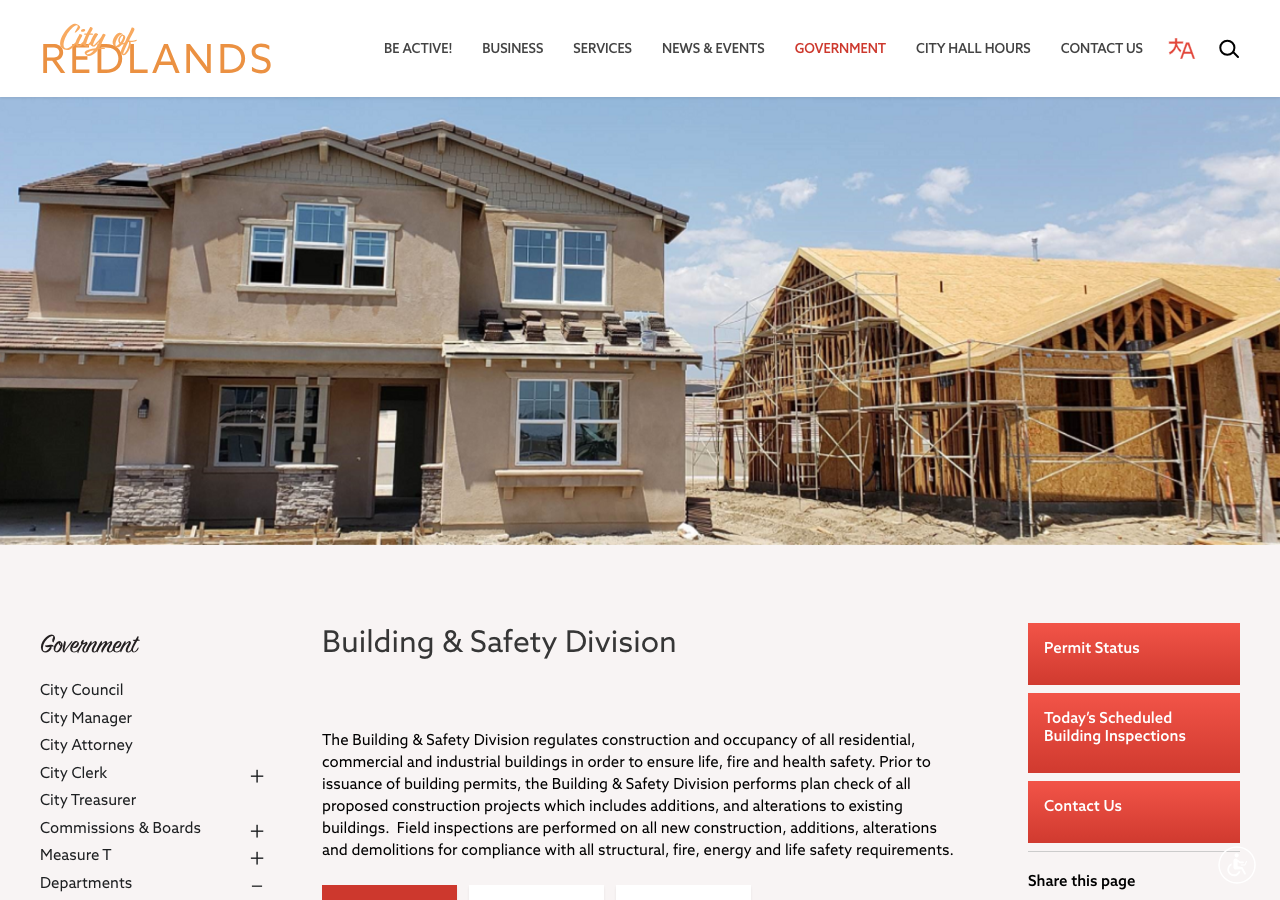
City of Redlands is a city authority in the State of California, serving 73,168 residents. 5,964 residential solar installs are on record here. This page is the permit route for that jurisdiction: the fifteen steps from working out who has a say over an address through to permission to operate, the documents this authority publishes, and 62 answers taken from those documents and dated.
Permitting 5 steps · 28 questions
Whether a permit is needed — Yes Q3 Electrical and building permits — Combined Q4 Plan review — Same-day (over-the-counter) for roof-mounted systems ≤10kW AC without battery storage meeting the Eligibility Checklist; Q18 Where you file — Redlands Online Public Portal (gis.cityofredlands.org/POL) for permit application/payment/printing, Q20
- Permit required
- Yes95% source
- What it costs
- $450 flat for 0-15 kW AC, plus $15.00 per additional kW above 15 kW (residential). Non-residential is a different, higher tiered schedule (0-50kW $1,000/kW; over that lower marginal rates).85% source
- Plan review turnaround
- Same-day (over-the-counter) for roof-mounted systems ≤10kW AC without battery storage meeting the Eligibility Checklist; 10 business days for systems >10kW AC or any ground-mounted system.88% source
- Key document
- department checklist cited by 4 open the document
-
Confirm who has a say over your address
A city address is usually permitted by the city, not the county — but not always, and some authorities keep building and hand electrical to someone else. Getting this wrong costs the whole submittal, because every requirement below belongs to whoever actually holds jurisdiction. Check the overlays in the same pass: an HOA, a historic district, a windstorm certification or a system-size cap can reshape the design, and all of them are cheaper to find now than after the array is laid out.
- Is this authority the AHJ for residential solar at this address? Yes 95% · department page
- What does this authority permit itself, and what does it delegate? Both 90% · fee schedule
- Is a permit required for a residential rooftop PV system? Yes 95% · department handout
- Is there a separate electrical permit, or is it combined? Combined 78% · fee schedule
- Is a HOA or architectural approval required first? No city requirement found for prior HOA/architectural approval as a permit precondition; California Civil Code §714 substantially limits an HOA's ability to prohibit or unreasonably restrict residential solar, which is the operative constraint statewide. 55% · state statute
- Is a wind or windstorm certification required? No separate wind/windstorm certification process; wind is one of the standard structural design parameters (Risk Category I-IV wind speeds of 90-107 mph, Exposure per 2022 CBC §1609.4.3) folded into the ordinary structural calculations/handout, not a stand-alone certificate like Texas TDI. 70% · department handout
-
Check who is allowed to apply
Several authorities require the electrical permit to be pulled by a licensed electrician, or require the contractor to be registered with them BEFORE applying. Registration is not same-day. This is second on the list rather than fourth because it is the step most likely to stop the job before the drawings matter.
- Who is allowed to pull the electrical permit? Either 82% · department handout
- Must the contractor be registered with this authority before applying? Yes 68% · permit application form
- Is a homeowner permitted to self-install and self-permit? Yes 82% · department handout
-
Build the submittal package
Almost everywhere wants a site plan, a one-line or three-line electrical diagram, equipment cut sheets with listings, and a structural attachment detail. Build it against the published checklist rather than the last jurisdiction you worked in — the checklist is what the reviewer marks against.
- What documents make up a complete submittal? For expedited/OTC solar: completed Eligibility Checklist, permit application, Solar PV Standard Plan (Central or Micro-inverter) with manufacturer spec sheets/installation instructions/UL listings, roof plan/diagram (panel layout, pathways, disconnect and roof-access locations), and (if triggered) wet/digitally-stamped structural pages. For >10kW or ground-mount, a full custom plan set per 'Guidelines for Solar Plan Submittal' (electrical panel schedule, structural load calcs, construction details/specs) replaces the standard plan. 88% · department checklist
- How many copies, and in what format? 3 sets of hard-copy plans required at permit issuance (payment made in person); for the SolarAPP+ path, submittal/approval is fully digital via solarapp.nrel.gov before permit issuance. 72% · department page
- Is a site plan required, and what must it show? Yes -- a roof plan/diagram showing the location and dimensions of all PV equipment/arrays, clear access pathways, and approximate locations of electrical disconnecting means and roof access points. 88% · department checklist
- Is a one-line / three-line diagram required? Yes 90% · standard plan / checklist
- Are string and conductor calculations required? Yes 92% · standard plan / checklist
- Is a structural PE stamp required, and at what threshold? Not required for a standard single-family roof-mount installation ('structural engineering calculations are not required for single-family residences' per the SolarAPP+ page); a wet or digitally-stamped PE/architect structural package IS required when the design exceeds the racking manufacturer's installation criteria, and for ground-mount systems (footings/bolting calcs). 80% · department checklist
- Is an electrical PE stamp required, and at what threshold? No distinct electrical PE-stamp threshold found; the standard plan may instead be signed by a State-licensed contractor holding an A, B, C-46 or C-10 classification, OR by a licensed electrical engineer -- the engineer stamp is an alternative to contractor sign-off, not a size-triggered requirement. 68% · department checklist
-
Apply and pay
Most authorities now take the whole application through a portal, and several states cap or constrain what a residential solar permit may cost. Check whether plan check is billed separately before you quote the job.
- Which permit portal does this authority use? Redlands Online Public Portal (gis.cityofredlands.org/POL) for permit application/payment/printing, plus solarapp.nrel.gov (SolarAPP+) for eligible systems' automated plan review. 88% · department page / portal
- Can the whole application be completed online? Yes, for SolarAPP+-eligible systems: design submittal, permit application, and payment can all be completed online, then the permit is printed and inspection booked by QR code. For the standard/expedited-but-non-SolarApp path, payment must be made in person and 3 hard-copy plan sets are required at issuance -- so 'fully online' is conditional on the SolarAPP+ path. 78% · department page
- What does a residential solar permit cost? $450 flat for 0-15 kW AC, plus $15.00 per additional kW above 15 kW (residential). Non-residential is a different, higher tiered schedule (0-50kW $1,000/kW; over that lower marginal rates). 85% · fee schedule
- How is the fee calculated? Tiered 82% · fee schedule
- Is there a separate plan-check fee? No separate Building & Safety plan-check line item for solar (the BS52/BS53 fee reads as an all-in flat/tiered fee). However, the Fire Department runs its OWN separate, billable plan-review fee for solar even 'where no permit or inspection is required' (FD19, $123, explicitly naming 'solar (commercial/residential, TI)') plus its own inspection fee (FD100) -- a genuine second, parallel fee track outside the building permit. 75% · fee schedule
-
Plan review — and start the utility in parallel
Interconnection is a separate process from the permit and usually the longer pole. Where the utility does not depend on the permit being issued, running both at once is the single biggest saving available on a residential job.
- What is the stated plan-review turnaround? Same-day (over-the-counter) for roof-mounted systems ≤10kW AC without battery storage meeting the Eligibility Checklist; 10 business days for systems >10kW AC or any ground-mounted system. 88% · department page
- Which utility handles interconnection here? Southern California Edison (SCE) 82% · city sustainability page (utility named)
- Where does the utility sit in the sequence? Parallel 45% · utility document (gated -- inference from statewide Rule 21 practice)
28 questions answered against City of Redlands’s own published documents
Q1 Is this authority the AHJ for residential solar at this address? Core Jurisdiction & scope
Yes
Why the confidence is not higherCity of Redlands Building & Safety Division runs its own permit portal, fee schedule and SolarAPP+ program for residential PV; no evidence of county or delegated review for rooftop solar.
department page checked 2026-08-30 https://www.redlands.gov/building-safety-division/
Q2 What does this authority permit itself, and what does it delegate? Core Jurisdiction & scope
Both
Why the confidence is not higherBuilding & Safety self-performs building AND electrical review/permitting for solar (single 'Solar' permit, single fee line item BS52/BS53). The Fire Department additionally runs its own PARALLEL review/inspection track for solar and battery systems with its own fee line items (FD19 solar plan review, FD100 solar PV inspection, FD86 battery inspection) -- not a delegation, but a second in-house AHJ function that a survey collapsing to 'Building only' would miss.
fee schedule checked 2026-08-30 https://www.redlands.gov/fire-fees/
Q3 Is a permit required for a residential rooftop PV system? Core Jurisdiction & scope
Yes
Why the confidence is not higher'Do I Need a Permit?' handout explicitly lists 'Photovoltaic systems' under Electrical permits required.
department handout checked 2026-08-30 https://www.redlands.gov/wp-content/uploads/2019/03/doineedapermit2019.pdf
Q4 Is there a separate electrical permit, or is it combined? Core Jurisdiction & scope
Combined
Why the confidence is not higherThe fee schedule carries a single 'Solar Energy Systems' line (BS52/BS53) under DSD-Building & Safety Flat Fees, not separate building and electrical permit fees; the standard plans and eligibility checklist likewise describe one 'solar photovoltaic permit' covering structural, electrical and fire-safety review together.
fee schedule checked 2026-08-30 https://www.redlands.gov/wp-content/uploads/2025/12/resolution8045feeschedulebuildingsafety.pdf
Q5 Who is allowed to pull the electrical permit? Core Who may apply
Either
Why the confidence is not higher'Who Can Pull a Permit' allows Property Owner (with ID), Property Owner's Representative (notarized Authorized Agent Letter), Licensed Contractor, or Licensed Contractor's Employee to pull any building/electrical permit -- not restricted to a licensed electrician. Note the SolarAPP+ pilot path is Licensed-Contractor-only.
department handout checked 2026-08-30 https://www.redlands.gov/wp-content/uploads/2019/03/whocanpullapermit.pdf
Q6 Must the contractor be registered with this authority before applying? Core Who may apply
Yes
Why the confidence is not higherThe city's Building Permit Application form (rev. 7/14/2019) has a required 'City Business License #' field for the Contractor/Architect/Engineer and for the Primary Contact, implying a City of Redlands business license must be held/verified before/at permit issuance. Not stated as an absolute precondition to submit, so confidence is capped.
permit application form checked 2026-08-30 https://www.redlands.gov/wp-content/uploads/2020/07/buildingpermitapplicationrev5_16_19.pdf
Q7 Is a homeowner permitted to self-install and self-permit? Who may apply
Yes
Why the confidence is not higher'Who Can Pull a Permit' allows the Property Owner to pull permits with ID, and the Building Permit Application form has an explicit 'Owner/Builder' checkbox routing to the 'Property Owner's Package', confirming owner-builder self-permitting is allowed.
department handout checked 2026-08-30 https://www.redlands.gov/wp-content/uploads/2019/03/whocanpullapermit.pdf
Q8 What documents make up a complete submittal? Core Submittal package
For expedited/OTC solar: completed Eligibility Checklist, permit application, Solar PV Standard Plan (Central or Micro-inverter) with manufacturer spec sheets/installation instructions/UL listings, roof plan/diagram (panel layout, pathways, disconnect and roof-access locations), and (if triggered) wet/digitally-stamped structural pages. For >10kW or ground-mount, a full custom plan set per 'Guidelines for Solar Plan Submittal' (electrical panel schedule, structural load calcs, construction details/specs) replaces the standard plan.
Why the confidence is not higherDirectly enumerated in the city's own 'Residential Photovoltaic Checklist for Expedited Processing' / OTC checklist document, corroborated by the Building & Safety Division page's description of the Guidelines and standard plans.
department checklist checked 2026-08-30 https://www.redlands.gov/wp-content/uploads/2022/05/checklist_for_over_the_counter_plan_check.pdf
Q9 How many copies, and in what format? Submittal package
3 sets of hard-copy plans required at permit issuance (payment made in person); for the SolarAPP+ path, submittal/approval is fully digital via solarapp.nrel.gov before permit issuance.
Why the confidence is not higherStated on the Building & Safety Division page. Generic (non-solar) residential plan check calls for 5 full sets on 24x36 paper, but that is the general new-construction/addition checklist, not the solar-specific instruction, so I used the solar-specific figure.
department page checked 2026-08-30 https://www.redlands.gov/building-safety-division/
Q10 Is a site plan required, and what must it show? Core Submittal package
Yes -- a roof plan/diagram showing the location and dimensions of all PV equipment/arrays, clear access pathways, and approximate locations of electrical disconnecting means and roof access points.
Why the confidence is not higherOTC/expedited checklist, Fire Safety Requirements item D, and the 'Guidelines for Solar Plan Submittal' ROOF PLAN section (via checklist_for_over_the_counter_plan_check.pdf) both specify this.
department checklist checked 2026-08-30 https://www.redlands.gov/wp-content/uploads/2022/05/checklist_for_over_the_counter_plan_check.pdf
Q11 Is a one-line / three-line diagram required? Core Drawings & calculations
Yes
Why the confidence is not higherBoth Solar PV Standard Plans (Central/String Inverter and Microinverter/ACM) require completing Single Line Diagrams (four variants depending on combiner/OCPD configuration).
standard plan / checklist checked 2026-08-30 https://www.redlands.gov/wp-content/uploads/2019/10/central_inverters.pdf
Q12 Are string and conductor calculations required? Drawings & calculations
Yes
Why the confidence is not higherThe standard plans require detailed string/source-circuit counts, VOC/ISC calculations with temperature correction factors, conductor sizing tables (AWG by inverter output current), and OCPD sizing -- all string and conductor calculations.
standard plan / checklist checked 2026-08-30 https://www.redlands.gov/wp-content/uploads/2019/10/central_inverters.pdf
Q13 Is a structural PE stamp required, and at what threshold? Core Engineering & stamps
Not required for a standard single-family roof-mount installation ('structural engineering calculations are not required for single-family residences' per the SolarAPP+ page); a wet or digitally-stamped PE/architect structural package IS required when the design exceeds the racking manufacturer's installation criteria, and for ground-mount systems (footings/bolting calcs).
Why the confidence is not higherSolarAPP+ pilot program page states no structural calcs needed for SFR; the OTC checklist's STRUCTURAL REQUIREMENTS item and the 'Guidelines for Solar Plan Submittal' ROOF PLAN section both require PE/architect calcs once the racking manufacturer's criteria are exceeded.
department checklist checked 2026-08-30 https://www.redlands.gov/wp-content/uploads/2022/05/checklist_for_over_the_counter_plan_check.pdf
Q14 Is an electrical PE stamp required, and at what threshold? Engineering & stamps
No distinct electrical PE-stamp threshold found; the standard plan may instead be signed by a State-licensed contractor holding an A, B, C-46 or C-10 classification, OR by a licensed electrical engineer -- the engineer stamp is an alternative to contractor sign-off, not a size-triggered requirement.
Why the confidence is not higher'Guidelines for Solar Plan Submittal' (embedded in checklist_for_over_the_counter_plan_check.pdf) ADMINISTRATIVE section names these signing options with no kW threshold distinguishing when a PE is mandatory.
department checklist checked 2026-08-30 https://www.redlands.gov/wp-content/uploads/2022/05/checklist_for_over_the_counter_plan_check.pdf
Q15 What does a residential solar permit cost? Core Fees
$450 flat for 0-15 kW AC, plus $15.00 per additional kW above 15 kW (residential). Non-residential is a different, higher tiered schedule (0-50kW $1,000/kW; over that lower marginal rates).
Why the confidence is not higherFee Schedule (Exhibit A to Resolution No. 8522, adopted ~Dec 5 2023) line items BS52 (0-15kW, 'New Fee' Year1=Year2=Year3=$450) and BS53 (each additional kW >15kW, $15 flat across all years). Note the file is still served under the old filename 'resolution8045...' though its content is Resolution 8522 -- read the stamp, not the URL.
fee schedule checked 2026-08-30 https://www.redlands.gov/wp-content/uploads/2025/12/resolution8045feeschedulebuildingsafety.pdf
Q16 How is the fee calculated? Core Fees
Tiered
Why the confidence is not higherFlat base fee for a 0-15kW tier, then a separate lower per-kW marginal rate for capacity above 15kW -- a tiered structure, not a pure per-kW or flat fee.
fee schedule checked 2026-08-30 https://www.redlands.gov/wp-content/uploads/2025/12/resolution8045feeschedulebuildingsafety.pdf
Q17 Is there a separate plan-check fee? Fees
No separate Building & Safety plan-check line item for solar (the BS52/BS53 fee reads as an all-in flat/tiered fee). However, the Fire Department runs its OWN separate, billable plan-review fee for solar even 'where no permit or inspection is required' (FD19, $123, explicitly naming 'solar (commercial/residential, TI)') plus its own inspection fee (FD100) -- a genuine second, parallel fee track outside the building permit.
Why the confidence is not higherFire Master Fee Schedule (Resolution 8522) FD19 and FD100 line items; Building & Safety flat-fee schedule shows no separate plan-check row nested under BS52/BS53.
fee schedule checked 2026-08-30 https://www.redlands.gov/fire-fees/
Q18 What is the stated plan-review turnaround? Core Timeline & validity
Same-day (over-the-counter) for roof-mounted systems ≤10kW AC without battery storage meeting the Eligibility Checklist; 10 business days for systems >10kW AC or any ground-mounted system.
Why the confidence is not higher'Guidelines for Solar Plan Submittal' page states these two turnaround tracks explicitly.
department page checked 2026-08-30 https://www.redlands.gov/guidelines-solar-plan-submittal/
Q19 How long is an issued permit valid before it expires? Timeline & validity
Nothing published by this authority.
Where we lookedRedlands' own permit application, checklists, standard plans, and fee schedule for a stated permit-validity/expiration period; found none. The 180-day default is a statewide CBC §105.5 provision, but I could not confirm Redlands' own adopting ordinance/local amendment (American Legal codelibrary.amlegal.com/codes/redlandsca 403'd on both curl and WebFetch; Wayback Machine returned 'Temporarily Offline' on every capture attempt during this run), so I am not asserting a number without a Redlands-specific source.
https://codelibrary.amlegal.com/codes/redlandsca/latest/overview
Q20 Which permit portal does this authority use? Core Portal & process
Redlands Online Public Portal (gis.cityofredlands.org/POL) for permit application/payment/printing, plus solarapp.nrel.gov (SolarAPP+) for eligible systems' automated plan review.
Why the confidence is not higherBoth named and linked on the Building & Safety Division page and the SolarAPP+ pilot program page.
department page / portal checked 2026-08-30 https://www.redlands.gov/building-safety-division/
Q21 Can the whole application be completed online? Core Portal & process
Yes, for SolarAPP+-eligible systems: design submittal, permit application, and payment can all be completed online, then the permit is printed and inspection booked by QR code. For the standard/expedited-but-non-SolarApp path, payment must be made in person and 3 hard-copy plan sets are required at issuance -- so 'fully online' is conditional on the SolarAPP+ path.
Why the confidence is not higherSolarAPP+ pilot program page 4-step process (fully online through payment) vs. the Building & Safety Division page's statement that payment must be in person with hard-copy plans for the general portal path.
department page checked 2026-08-30 https://www.redlands.gov/solarapp-pilot-program/
Q22 Which utility handles interconnection here? Core Utility interconnection
Southern California Edison (SCE)
Why the confidence is not higherThe City has no municipal electric utility -- Utilities Customer Service page confirms the City itself bills only water, wastewater, solid waste and street cleaning (no electric). The City's own Sustainability page directs residents to 'SoCal Edison' rebate programs including the 'SCE Solar Billing Plan' for their own solar installations, which is a city-source naming of the interconnecting utility, though it stops short of a formal SCE territory-map citation, hence not a 95+.
city sustainability page (utility named) checked 2026-08-30 https://www.redlands.gov/sustainability/
Q23 Where does the utility sit in the sequence? Core Utility interconnection
Parallel
Why the confidence is not higherSCE's own Interconnection Handbook is gated: on.sce.com/InterconnectionHandbook 302-redirects into an Edison-International SharePoint document library requiring Microsoft auth (confirmed by fetch and curl -- FedAuth cookie issued, no anonymous access). This value is inferred from standard statewide CPUC Rule 21 practice (NEM application can be filed alongside city permitting, but Permission to Operate requires proof of the city's final inspection/permit), not confirmed against SCE's own document for Redlands specifically.
utility document (gated -- inference from statewide Rule 21 practice) checked 2026-08-30 https://on.sce.com/InterconnectionHandbook
Q24 Is a HOA or architectural approval required first? Overlays & special cases
No city requirement found for prior HOA/architectural approval as a permit precondition; California Civil Code §714 substantially limits an HOA's ability to prohibit or unreasonably restrict residential solar, which is the operative constraint statewide.
Why the confidence is not higherNo Redlands ordinance or checklist item requires proof of HOA sign-off before permit submittal in any document reviewed (permit application, checklists, guidelines). Falling back to state law as the governing constraint rather than a city-confirmed 'No'.
state statute checked 2026-08-30 https://leginfo.legislature.ca.gov/faces/codes_displaySection.xhtml?lawCode=CIV§ionNum=714.
Q25 Is there a historic-district review? Overlays & special cases
Nothing published by this authority.
Where we lookedHistoric and Scenic Preservation Commission page (no solar-specific mention); could not reach the municipal code chapter on the historic overlay/zoning district (American Legal 403, Wayback offline) to check for a solar-specific historic-review carve-out or requirement.
https://www.redlands.gov/historic-and-scenic-preservation-commission/
Q26 Is a wind or windstorm certification required? Overlays & special cases
No separate wind/windstorm certification process; wind is one of the standard structural design parameters (Risk Category I-IV wind speeds of 90-107 mph, Exposure per 2022 CBC §1609.4.3) folded into the ordinary structural calculations/handout, not a stand-alone certificate like Texas TDI.
Why the confidence is not higherCity's own 'Structure Design Criteria' handout for Building & Safety lists wind speed/exposure design values directly, with no separate wind-cert line item anywhere in the permit application, checklists, or fee schedule.
department handout checked 2026-08-30 https://www.redlands.gov/wp-content/uploads/2025/06/structure_design_criteria_handout.pdf
Q27 Is a Specific Use Permit or Council approval ever required? Overlays & special cases
Nothing published by this authority.
Where we lookedChecked the permit application, both Eligibility/OTC checklists, both Standard Plans and the Guidelines for Solar Plan Submittal page for any Special Use Permit / City Council approval trigger for residential rooftop PV; none of them mention one. Could not cross-check the zoning ordinance itself (American Legal 403, Wayback offline) to confirm this is a true code-level absence rather than a page-level one.
Q28 Is there a system-size cap on residential generation? Overlays & special cases
Nothing published by this authority.
Where we lookedChecked the fee schedule, both checklists and both standard plans for a stated maximum system size/production cap for residential generation; found kW thresholds that govern WHICH REVIEW PATH applies (10kW for expedited, 15kW fee-tier break) but no stated ceiling on system size itself. Could not check the zoning code directly (American Legal 403, Wayback offline).
https://www.redlands.gov/wp-content/uploads/2022/05/checklist_for_over_the_counter_plan_check.pdf
Lines marked with a percentage were read off this authority’s own published documents. Unmarked guidance is general good practice, not this jurisdiction’s rule — always confirm against the authority before you submit.
Install 5 steps · 20 questions
-
Build to the code editions actually in force here
The NEC edition a jurisdiction enforces is often a cycle behind the newest one published, and local amendments sit on top of it. Rapid shutdown, conductor sizing and labelling all change between editions, so the edition in force is the first thing to establish, not the last.
- Which NEC edition is in force? Ambiguous/likely stale: the city's own OTC solar checklist explicitly cites the '2019 CEC' for electrical compliance, but California's statewide code cycle moved to the 2022 CEC (2023 as adopted, based on 2020 NEC) effective Jan 1 2023 and then to the 2025 CEC (based on 2023 NFPA 70) effective Jan 1 2026 -- meaning Redlands' own posted solar checklist is at least one, likely two, code cycles behind the code that is now legally in force statewide under Title 24. I could not confirm via the adopting ordinance which edition Redlands has actually locally adopted for 2026 because American Legal (codelibrary.amlegal.com/codes/redlandsca) 403s on both curl and WebFetch, and Wayback Machine was returning 'Temporarily Offline' for every capture attempt during this run. 45% · department checklist (conflicts with statewide code cycle)
- Which building code edition is in force? Ambiguous/likely stale, same conflict as NEC: the city's most recently-dated structural handout (uploaded 2025-06) cites the 2022 CBC/CRC, while the solar-specific OTC checklist cites the 2019 CBC. Neither reflects the 2025 CBC cycle that took effect statewide 1 Jan 2026. Could not verify the current locally-adopted edition because the municipal code (American Legal) 403'd and Wayback was offline during this run. 45% · department handout (conflicts with an older city PDF and with the statewide cycle)
- Are there local amendments to any of the above? Yes -- the City has adopted its own solar-specific administrative amendments/implementation rules beyond bare code text: an Eligibility Checklist gating which systems qualify for expedited review (10kW AC cap, ≤225A single-phase 120/240V bus, no battery storage, ≤2 central inverters, roof-mount only), and two 'Simplified' Standard Plans (Central/String and Microinverter) that are stricter/narrower than the code's own general allowances. 72% · department page / checklists
- What is the installation judged against? The California Building Standards Code (CBC/CRC/CEC) as locally amended, PLUS Redlands' own Solar PV Standard Plans (Central/String Inverter and Microinverter) and Eligibility Checklist for anything routed through the expedited or SolarAPP+ paths; anything outside those parameters is judged against a full custom plan submittal per the 'Guidelines for Solar Plan Submittal.' 78% · standard plan
-
Fire access, setbacks and pathways
Ridge setbacks and roof access pathways are fire-service requirements and they constrain the array layout. They are the most common cause of a redesign after the fire department comments on a plan set.
Nothing recorded for City of Redlands on this step yet — 1 question checked and found unpublished. The guidance above is general.
-
Rapid shutdown
Which rapid-shutdown rule applies follows directly from the NEC edition in force, and the initiation device has to be at a location the fire service can reach and identify. This is inspected, and it is labelled.
- Is rapid shutdown required, and to which NEC edition? Yes, rapid shutdown is required. 82% · department handout (signage spec)
-
Labels and placards
The NEC sets a baseline for permanent markings at the service equipment and the disconnecting means. On top of that, an authority may specify its own wording, and the utility may specify more again. Where any of them writes its own text, a generic off-the-shelf label set will not pass — this is the detail most often fixed on a return visit.
- Which placards does this authority require at the service equipment? Yes -- multiple placards at the service equipment: PV Power Source rating label, 'PHOTOVOLTAIC SYSTEM EQUIPPED WITH RAPID SHUTDOWN', shock-hazard warnings at AC/DC disconnects, an inverter-output-connection 'do not relocate' label, a ground-fault warning (ungrounded systems), and a permanent multiple-power-source directory/plaque at the service equipment location. 92% · department handout (signage spec)
- Does the authority specify placard wording of its own? Yes. 92% · department handout (signage spec)
- Does it specify letter height, colour or material? Yes -- reflective, red background with white lettering, 3/8-inch letter height, all capital letters, Arial or similar font, weather-resistant material (e.g. engraved plastic). 95% · department handout (signage spec)
- Is a site plan / facility map placard required, and what must it show? Yes -- a roof-layout diagram is required showing all panel/module locations, clear access pathways, and the approximate locations of electrical disconnecting means and roof access points. 85% · department checklist
- Where must the labels be placed? Placards go at (a) each service equipment location and at every electric power production source (permanent directory/plaque), (b) adjacent to the PV breaker (inverter-output label), and (c) on DC photovoltaic source circuits every 10 feet and at every enclosure/wall/partition/ceiling/floor section break. 90% · department handout (signage spec)
-
Disconnect, storage and listed equipment
Where the AC disconnect must sit relative to the meter is usually the utility's rule, not the building department's. Battery storage frequently carries its own permit, its own inspection and its own fire conditions.
- Where must the AC disconnect be, relative to the meter? The center-to-center distance between the main service meter and the AC disconnect shall be 60 inches (5 feet) maximum. 80% · department handout (signage spec)
- Must equipment be on a specific approved list? Yes, in the general sense that all PV equipment must be listed/labeled for its application and installed per its listing instructions (CEC 110.3, 690.4(D)) -- not a separate Redlands-specific 'approved products list' beyond that. 78% · standard plan
- Are batteries permitted, and under what conditions? Batteries are permitted but are explicitly EXCLUDED from the expedited/OTC path, the SolarAPP+ pilot, and both Simplified Standard Plans (all three require the system be 'without battery storage' / non-hybrid). A battery/ESS addition must go through the full, non-expedited plan-check process. 85% · department checklist
- Is there a separate ESS permit or inspection? Yes -- the Fire Department's Construction Inspections fee schedule carries a distinct 'Battery Systems' inspection line (FD86), separate from the 'Solar - Photovoltaic' inspection line (FD100). 80% · fee schedule
- Is a ground mount treated as a structure? Effectively yes -- ground-mounted systems are excluded from SolarAPP+ ('No ballasted or ground-mounted systems') and from the Simplified Standard Plans, and require structural engineering calculations 'indicating required footings and solar panel required bolting' through the standard (10-business-day) plan-review path, i.e. treated with structural rigor comparable to a structure rather than a roof retrofit. 70% · department page
- Is there a local rule on service upgrades or busbar sizing? Yes -- the expedited/standard-plan path is capped at a single-phase AC service panel of nominal 120/240V with a bus-bar rating of 225A or less, interconnected on the load side; any higher busbar rating or 3-phase/other configuration is pushed out of the Simplified Standard Plan into the full 'Comprehensive Standard Plan' (i.e., custom engineered submittal, no fast-track). 85% · standard plan / checklist
- Is a specific mounting system or attachment spacing required? No city-specified attachment spacing or mounting-system standard; the plans defer entirely to the racking manufacturer's own installation instructions/criteria, and require a PE-stamped structural package only when the design EXCEEDS those manufacturer criteria. 65% · department checklist
20 questions answered against City of Redlands’s own published documents
Q29 Which NEC edition is in force? Core Code editions in force
Ambiguous/likely stale: the city's own OTC solar checklist explicitly cites the '2019 CEC' for electrical compliance, but California's statewide code cycle moved to the 2022 CEC (2023 as adopted, based on 2020 NEC) effective Jan 1 2023 and then to the 2025 CEC (based on 2023 NFPA 70) effective Jan 1 2026 -- meaning Redlands' own posted solar checklist is at least one, likely two, code cycles behind the code that is now legally in force statewide under Title 24. I could not confirm via the adopting ordinance which edition Redlands has actually locally adopted for 2026 because American Legal (codelibrary.amlegal.com/codes/redlandsca) 403s on both curl and WebFetch, and Wayback Machine was returning 'Temporarily Offline' for every capture attempt during this run.
Why the confidence is not higherDirect quote from checklist_for_over_the_counter_plan_check.pdf ('Provide Electrical drawings to show compliance with the applicable provisions of the 2019 CEC') set against the known statewide Title 24 code-cycle calendar; adopting ordinance unreachable.
department checklist (conflicts with statewide code cycle) checked 2026-08-30 https://www.redlands.gov/wp-content/uploads/2022/05/checklist_for_over_the_counter_plan_check.pdf
Q30 Which building code edition is in force? Core Code editions in force
Ambiguous/likely stale, same conflict as NEC: the city's most recently-dated structural handout (uploaded 2025-06) cites the 2022 CBC/CRC, while the solar-specific OTC checklist cites the 2019 CBC. Neither reflects the 2025 CBC cycle that took effect statewide 1 Jan 2026. Could not verify the current locally-adopted edition because the municipal code (American Legal) 403'd and Wayback was offline during this run.
Why the confidence is not higherStructure Design Criteria handout ('2022 CRC R301.2.2.1.1; 2022 CBC 1613.2.5...') vs. checklist_for_over_the_counter_plan_check.pdf ('Check the deflection... per CBC 2019 Table 1604.3' and '...per the 2019 CBC').
department handout (conflicts with an older city PDF and with the statewide cycle) checked 2026-08-30 https://www.redlands.gov/wp-content/uploads/2025/06/structure_design_criteria_handout.pdf
Q31 Which fire code edition is in force? Code editions in force
Nothing published by this authority.
Where we lookedChecked the Community Risk Reduction Guidelines & Standards page (a full enumerated list of every current RFD guideline PDF -- sprinkler systems, private mains, utility ID signs, high-pile storage, WUI, fire master plan, etc.) for a stated fire-code edition or a solar-specific fire bulletin; none names an edition and none is solar-specific. This is a genuine absence on that page (I read the whole list, not a keyword search), but I could not check the adopting ordinance itself (American Legal 403, Wayback offline) for the base fire-code edition.
https://www.redlands.gov/community-risk-reduction-guidelines-and-standards/
Q32 Are there local amendments to any of the above? Core Code editions in force
Yes -- the City has adopted its own solar-specific administrative amendments/implementation rules beyond bare code text: an Eligibility Checklist gating which systems qualify for expedited review (10kW AC cap, ≤225A single-phase 120/240V bus, no battery storage, ≤2 central inverters, roof-mount only), and two 'Simplified' Standard Plans (Central/String and Microinverter) that are stricter/narrower than the code's own general allowances.
Why the confidence is not higherEligibility Checklist and both Standard Plans are City of Redlands Building & Safety Division publications layering additional local conditions on top of the adopted CEC/CBC.
department page / checklists checked 2026-08-30 https://www.redlands.gov/guidelines-solar-plan-submittal/
Q33 What is the installation judged against? Core Electrical
The California Building Standards Code (CBC/CRC/CEC) as locally amended, PLUS Redlands' own Solar PV Standard Plans (Central/String Inverter and Microinverter) and Eligibility Checklist for anything routed through the expedited or SolarAPP+ paths; anything outside those parameters is judged against a full custom plan submittal per the 'Guidelines for Solar Plan Submittal.'
Why the confidence is not higherBoth standard plans state: 'Systems must be in compliance with current California Building Standards Codes and local amendments of the authority having jurisdiction (AHJ).'
standard plan checked 2026-08-30 https://www.redlands.gov/wp-content/uploads/2019/10/central_inverters.pdf
Q34 Is there a local rule on service upgrades or busbar sizing? Electrical
Yes -- the expedited/standard-plan path is capped at a single-phase AC service panel of nominal 120/240V with a bus-bar rating of 225A or less, interconnected on the load side; any higher busbar rating or 3-phase/other configuration is pushed out of the Simplified Standard Plan into the full 'Comprehensive Standard Plan' (i.e., custom engineered submittal, no fast-track).
Why the confidence is not higherExplicit scope/eligibility language on both Solar PV Standard Plans and the Eligibility Checklist.
standard plan / checklist checked 2026-08-30 https://www.redlands.gov/wp-content/uploads/2019/10/central_inverters.pdf
Q35 Is a specific mounting system or attachment spacing required? Structural & mounting
No city-specified attachment spacing or mounting-system standard; the plans defer entirely to the racking manufacturer's own installation instructions/criteria, and require a PE-stamped structural package only when the design EXCEEDS those manufacturer criteria.
Why the confidence is not higherEligibility Checklist STRUCTURAL REQUIREMENTS item A ('if design exceeds the racking manufacturer's installation criteria'); no independent city spacing table found in the standard plans or handouts.
department checklist checked 2026-08-30 https://www.redlands.gov/wp-content/uploads/2021/11/eligibilitychecklistforexpeditedsolarphotovoltaicpermitting2.pdf
Q36 What ridge setback and access pathways are required? Core Fire pathways & setbacks
Nothing published by this authority.
Where we lookedChecked the Community Risk Reduction Guidelines & Standards page (full document list, no solar-specific fire PDF present) and the Eligibility/OTC checklists (which only require the Y/N item 'Clear access pathways provided,' no dimensions). No Redlands document states a specific ridge setback or pathway width in inches/feet; could not confirm whether a numeric standard exists in the adopted fire code itself (American Legal 403, Wayback offline).
https://www.redlands.gov/community-risk-reduction-guidelines-and-standards/
Q37 Is rapid shutdown required, and to which NEC edition? Core Rapid shutdown
Yes, rapid shutdown is required.
Why the confidence is not higherThe city's own Solar Signage Requirements handout shows a mandatory placard reading 'PHOTOVOLTAIC SYSTEM EQUIPPED WITH RAPID SHUTDOWN' at the main service/AC disconnect -- direct evidence the installation must have and label rapid shutdown per (whichever CEC edition is currently adopted, itself ambiguous per Q29/Q30) Article 690.12.
department handout (signage spec) checked 2026-08-30 https://www.redlands.gov/wp-content/uploads/2019/03/solar_signage_requirements.pdf
Q38 Which placards does this authority require at the service equipment? Core Labels Signage & labelling
Yes -- multiple placards at the service equipment: PV Power Source rating label, 'PHOTOVOLTAIC SYSTEM EQUIPPED WITH RAPID SHUTDOWN', shock-hazard warnings at AC/DC disconnects, an inverter-output-connection 'do not relocate' label, a ground-fault warning (ungrounded systems), and a permanent multiple-power-source directory/plaque at the service equipment location.
Why the confidence is not higherFull placard set illustrated and specified in the city's Solar Signage Requirements handout.
department handout (signage spec) checked 2026-08-30 https://www.redlands.gov/wp-content/uploads/2019/03/solar_signage_requirements.pdf
Q39 Does the authority specify placard wording of its own? Core Labels Signage & labelling
Yes.
Why the confidence is not higherThe handout prints the exact required wording for every placard (e.g. 'WARNING ELECTRICAL SHOCK HAZARD. DO NOT TOUCH TERMINALS...') rather than just citing a code section.
department handout (signage spec) checked 2026-08-30 https://www.redlands.gov/wp-content/uploads/2019/03/solar_signage_requirements.pdf
Q40 Does it specify letter height, colour or material? Core Labels Signage & labelling
Yes -- reflective, red background with white lettering, 3/8-inch letter height, all capital letters, Arial or similar font, weather-resistant material (e.g. engraved plastic).
Why the confidence is not higherExplicit specification block on the Solar Signage Requirements handout.
department handout (signage spec) checked 2026-08-30 https://www.redlands.gov/wp-content/uploads/2019/03/solar_signage_requirements.pdf
Q41 Is a site plan / facility map placard required, and what must it show? Core Labels Signage & labelling
Yes -- a roof-layout diagram is required showing all panel/module locations, clear access pathways, and the approximate locations of electrical disconnecting means and roof access points.
Why the confidence is not higherOTC/Eligibility Checklist Fire Safety Requirements item D.
department checklist checked 2026-08-30 https://www.redlands.gov/wp-content/uploads/2022/05/checklist_for_over_the_counter_plan_check.pdf
Q42 Does the UTILITY specify placards beyond the AHJ's? Core Labels Signage & labelling
Nothing published by this authority.
Where we lookedSCE's Interconnection Handbook -- the only utility-specific placard/labeling document that would answer this -- is inaccessible: on.sce.com/InterconnectionHandbook 302-redirects to an Edison International SharePoint library that issues a FedAuth cookie and requires Microsoft sign-in (confirmed by both WebFetch and curl -I during this run). I could not find an un-gated SCE page describing placards beyond what the City's own signage handout already specifies.
Q43 Where must the labels be placed? Core Labels Signage & labelling
Placards go at (a) each service equipment location and at every electric power production source (permanent directory/plaque), (b) adjacent to the PV breaker (inverter-output label), and (c) on DC photovoltaic source circuits every 10 feet and at every enclosure/wall/partition/ceiling/floor section break.
Why the confidence is not higherPlacement instructions printed directly on the Solar Signage Requirements handout.
department handout (signage spec) checked 2026-08-30 https://www.redlands.gov/wp-content/uploads/2019/03/solar_signage_requirements.pdf
Q44 Must equipment be on a specific approved list? Equipment listing
Yes, in the general sense that all PV equipment must be listed/labeled for its application and installed per its listing instructions (CEC 110.3, 690.4(D)) -- not a separate Redlands-specific 'approved products list' beyond that.
Why the confidence is not higherStandard plans state: 'All PV equipment shall be listed by a recognized test lab' and cite CEC 110.3/690.4(D).
standard plan checked 2026-08-30 https://www.redlands.gov/wp-content/uploads/2019/10/central_inverters.pdf
Q45 Are batteries permitted, and under what conditions? Core Battery / ESS
Batteries are permitted but are explicitly EXCLUDED from the expedited/OTC path, the SolarAPP+ pilot, and both Simplified Standard Plans (all three require the system be 'without battery storage' / non-hybrid). A battery/ESS addition must go through the full, non-expedited plan-check process.
Why the confidence is not higherEligibility Checklist item D, SolarAPP+ page ('Batteries and energy storage systems are not mentioned as eligible'), and both Standard Plans' SCOPE paragraphs all exclude storage batteries from the fast-track routes.
department checklist checked 2026-08-30 https://www.redlands.gov/wp-content/uploads/2021/11/eligibilitychecklistforexpeditedsolarphotovoltaicpermitting2.pdf
Q46 Is there a separate ESS permit or inspection? Battery / ESS
Yes -- the Fire Department's Construction Inspections fee schedule carries a distinct 'Battery Systems' inspection line (FD86), separate from the 'Solar - Photovoltaic' inspection line (FD100).
Why the confidence is not higherFire Master Fee Schedule (Resolution 8522), Construction Inspections section, FD86 vs FD100.
fee schedule checked 2026-08-30 https://www.redlands.gov/fire-fees/
Q47 Is a ground mount treated as a structure? Core Ground mount
Effectively yes -- ground-mounted systems are excluded from SolarAPP+ ('No ballasted or ground-mounted systems') and from the Simplified Standard Plans, and require structural engineering calculations 'indicating required footings and solar panel required bolting' through the standard (10-business-day) plan-review path, i.e. treated with structural rigor comparable to a structure rather than a roof retrofit.
Why the confidence is not higher'Guidelines for Solar Plan Submittal' page (ground-mount = plan review, 10 business days, structural calcs for footings/bolting) and SolarAPP+ page exclusion language.
department page checked 2026-08-30 https://www.redlands.gov/guidelines-solar-plan-submittal/
Q48 Where must the AC disconnect be, relative to the meter? Core Utility equipment
The center-to-center distance between the main service meter and the AC disconnect shall be 60 inches (5 feet) maximum.
Why the confidence is not higherExplicit dimensional note on the city's Solar Signage Requirements handout diagram.
department handout (signage spec) checked 2026-08-30 https://www.redlands.gov/wp-content/uploads/2019/03/solar_signage_requirements.pdf
Lines marked with a percentage were read off this authority’s own published documents. Unmarked guidance is general good practice, not this jurisdiction’s rule — always confirm against the authority before you submit.
Inspection 5 steps · 14 questions
-
Book it
Booking is a portal, a phone call or an email depending on the authority, and the notice required is rarely zero. Book before the work is finished rather than after — the lead time, not the work, is usually what sets the date.
- How is an inspection booked? Portal -- Building & Safety inspections (including SolarAPP+ jobs) are booked online at veribook.com/lp/CityOfRedlands (also reachable by QR code on the job card). Fire Prevention inspections are booked separately via an Outlook booking page, a different tool from Building's. 85% · department page
-
Know who turns up
Some authorities inspect their own solar work; some delegate it, and a few do not inspect the PV equipment itself at all. Who is coming determines what they will look at.
- Does this AHJ perform its own final solar inspection? Yes 78% · fee schedule / department pages
- If delegated, to whom? N/A -- not delegated to an outside agency. Both inspecting bodies (Building & Safety Division and Fire Prevention) are City of Redlands departments. 80% · department page
-
Work the stages in order
A rough-in or mid-roof inspection, where one is required, has to happen before the work it covers is closed up. Missing a stage means opening something back up, and it is the most expensive kind of correction.
- Which inspections are required, and in what order? Permit issuance (OTC same-day or after up to 10-business-day plan review) -> installation -> a single final Building & Safety inspection (electrical/structural/fire-safety items on the Eligibility Checklist are checked at this one visit for a standard roof-mount) -> for systems triggering a Fire Department line item (all solar per FD100, plus batteries per FD86), a separate Fire inspection -> permit closed -> owner/installer proceeds to SCE for Permission to Operate. 55% · department page (composite)
-
Have the paperwork on site
The approved plan set, the permit, and the equipment listings should be on site and reachable. Inspectors routinely verify that installed equipment matches what was approved, and that the labels are the ones the plan set promised.
- Is there a published inspection checklist? Yes 90% · department checklist
- What must be on site at inspection? Manufacturer's specification sheets, installation instructions and UL listings for the inverter(s), modules, combiner/junction boxes and racking system; the approved/stamped plan set (standard plan worksheet or comprehensive plans); and the issued permit/job card. 72% · standard plan (inferred inspection-day requirement)
- Does the inspector verify labels and listings? Yes 80% · department checklist
-
Sign-off, and permission to operate
Passing gives you a final or an equivalent sign-off. That is not the same as permission to operate: PTO comes from the utility, and who tells the utility the inspection passed varies. A system left switched off for weeks is usually waiting on this handover.
- Is there a re-inspection fee? $146 per hour (Re-Inspection, BS7) -- there is no solar-specific re-inspection fee; this is the general Building & Safety hourly re-inspection rate that would apply. 62% · fee schedule
14 questions answered against City of Redlands’s own published documents
Q49 How is an inspection booked? Core Booking & scheduling
Portal -- Building & Safety inspections (including SolarAPP+ jobs) are booked online at veribook.com/lp/CityOfRedlands (also reachable by QR code on the job card). Fire Prevention inspections are booked separately via an Outlook booking page, a different tool from Building's.
Why the confidence is not higherBoth booking tools are named and linked from the Building & Safety Division and Fire Inspections pages respectively; the SolarAPP+ page explicitly directs solar inspection requests to Veribook.
department page checked 2026-08-30 https://www.redlands.gov/building-safety-division/
Q50 How much notice is required? Core Booking & scheduling
Nothing published by this authority.
Where we lookedVeribook.com/lp/CityOfRedlands (the inspection-booking tool linked from both the Building & Safety Division and SolarAPP+ pages) is a JavaScript scheduling app; the static page served to curl/WebFetch is a bare redirect shell with no notice-period text in its HTML.
Q51 Are same-day or AM/PM windows offered? Booking & scheduling
Nothing published by this authority.
Where we lookedSame tool and same limitation as Q50 -- Veribook's booking calendar (AM/PM or same-day slot availability) is rendered client-side and not present in the static HTML returned to curl or WebFetch.
Q52 Does this AHJ perform its own final solar inspection? Core Who inspects
Yes
Why the confidence is not higherBuilding & Safety self-performs the final building/electrical inspection in-house (via its own Veribook queue); the Fire Department separately self-performs its own solar-PV inspection (FD100) and battery-systems inspection (FD86) -- neither is delegated to an outside agency, but note there ARE effectively two separate City inspectors/departments in the loop for a system with a battery.
fee schedule / department pages checked 2026-08-30 https://www.redlands.gov/fire-fees/
Q53 If delegated, to whom? Core Who inspects
N/A -- not delegated to an outside agency. Both inspecting bodies (Building & Safety Division and Fire Prevention) are City of Redlands departments.
Why the confidence is not higherNo third-party inspection agency (e.g. a private engineering firm) referenced anywhere in the permit, checklist, fee-schedule or portal pages reviewed for this run.
department page checked 2026-08-30 https://www.redlands.gov/building-safety-division/
Q54 Which inspections are required, and in what order? Core Stages & sequence
Permit issuance (OTC same-day or after up to 10-business-day plan review) -> installation -> a single final Building & Safety inspection (electrical/structural/fire-safety items on the Eligibility Checklist are checked at this one visit for a standard roof-mount) -> for systems triggering a Fire Department line item (all solar per FD100, plus batteries per FD86), a separate Fire inspection -> permit closed -> owner/installer proceeds to SCE for Permission to Operate.
Why the confidence is not higherSynthesized from the SolarAPP+ page's 4-step process ('Schedule inspection'), the Eligibility Checklist's single consolidated checklist covering electrical/structural/fire items, and the Fire fee schedule's separate FD100/FD86 inspection lines; no single city document lays out the full sequence end-to-end, so this is a composite, not a direct quote.
department page (composite) checked 2026-08-30 https://www.redlands.gov/solarapp-pilot-program/
Q55 Is a rough-in or mid-roof inspection required? Stages & sequence
Nothing published by this authority.
Where we lookedChecked the Eligibility Checklist, OTC checklist, both Standard Plans and the Guidelines for Solar Plan Submittal page; all describe a single consolidated final inspection model for standard roof-mount PV with no mid-roof/rough-in stage named anywhere.
https://www.redlands.gov/wp-content/uploads/2022/05/checklist_for_over_the_counter_plan_check.pdf
Q56 Does the inspector verify labels and listings? Core What is checked
Yes
Why the confidence is not higherEligibility Checklist Fire Safety Requirements item C requires 'All required markings and labels are provided' as a condition checked as part of the (expedited) permitting/inspection process.
department checklist checked 2026-08-30 https://www.redlands.gov/wp-content/uploads/2021/11/eligibilitychecklistforexpeditedsolarphotovoltaicpermitting2.pdf
Q57 Is there a published inspection checklist? Core What is checked
Yes
Why the confidence is not higherThe 'Residential Photovoltaic Checklist for Expedited Processing' (a.k.a. checklist_for_over_the_counter_plan_check.pdf) is a published, city-issued checklist covering general/electrical/structural/fire-safety items for solar PV.
department checklist checked 2026-08-30 https://www.redlands.gov/wp-content/uploads/2022/05/checklist_for_over_the_counter_plan_check.pdf
Q58 What must be on site at inspection? Core Documents on site
Manufacturer's specification sheets, installation instructions and UL listings for the inverter(s), modules, combiner/junction boxes and racking system; the approved/stamped plan set (standard plan worksheet or comprehensive plans); and the issued permit/job card.
Why the confidence is not higherBoth Solar PV Standard Plans require these documents to be 'provided'/'attached' as part of the submittal, and standard CA practice is that the same package plus the permit card must be available at inspection; not an explicit 'bring this to your inspection' list from Redlands itself, hence capped confidence.
standard plan (inferred inspection-day requirement) checked 2026-08-30 https://www.redlands.gov/wp-content/uploads/2019/10/central_inverters.pdf
Q59 Is there a re-inspection fee? Corrections & re-inspection
$146 per hour (Re-Inspection, BS7) -- there is no solar-specific re-inspection fee; this is the general Building & Safety hourly re-inspection rate that would apply.
Why the confidence is not higherFee Schedule (Resolution 8522) BS7 'Re-Inspection' line, Per Hour, New Fee $146 across Year 1-3. No line item specific to solar re-inspections exists in either the Building & Safety or Fire fee schedules.
fee schedule checked 2026-08-30 https://www.redlands.gov/wp-content/uploads/2025/12/resolution8045feeschedulebuildingsafety.pdf
Q60 How are corrections issued and cleared? Corrections & re-inspection
Nothing published by this authority.
Where we lookedChecked the One Stop Permit Center, Building & Safety Division and Building Permit Status pages for a stated corrections/re-inspection procedure beyond the existence of a 'Compliance Inspections/Reinspections' (BS4) and 'Re-Inspection' (BS7) fee line; none describes HOW corrections are issued or cleared (e.g. red-tag process, correction letter, resubmittal route).
Q61 What is issued on pass? Core Final sign-off & PTO
Nothing published by this authority.
Where we lookedChecked the permit application, checklists, standard plans and fee schedule for the specific document/tag issued on a passed final (CO vs. Final vs. Green Tag vs. Letter); none of the documents I could access use any of these terms for solar. Not confident enough to guess between 'Final' and 'Green tag' for a CA jurisdiction without a document naming one.
Q62 Who notifies the utility for PTO? Core Final sign-off & PTO
Nothing published by this authority.
Where we lookedChecked the Building & Safety, SolarAPP+ and Sustainability pages, plus attempted SCE's Interconnection Handbook (gated, see Q42/Q23), for a statement of who submits the PTO request to SCE. None of the reachable Redlands-side documents address the utility-notification step at all, and the one document that would (SCE's own handbook) is inaccessible.
Lines marked with a percentage were read off this authority’s own published documents. Unmarked guidance is general good practice, not this jurisdiction’s rule — always confirm against the authority before you submit.
Jurisdiction & key facts
The standing 62-question set, answered for City of Redlands against this authority’s own published documents. Every answer carries the confidence it was recorded at and the document it came from. Where nothing is published we say so and show where we looked — a blank here is a finding, not a gap.
City of Redlands is the authority having jurisdiction 88% confidence
- Holds
- Building and Electrical (Building & Safety Division, self-performed, single combined solar permit) PLUS a parallel Fire Prevention plan-review and inspection track for solar/battery systems with its own fee schedule (FD19, FD86, FD100) -- both functions sit inside the City of Redlands, so this is not a delegation, but a survey that only asks 'does Building hold it' would miss Fire's independent billable role.
- Overridden by
- Not overridden as to WHO is the AHJ. However, California state law constrains WHAT Redlands may require: Gov. Code §65850.5 (SB 379 lineage, now largely superseded/overlaid by §65850.52) restricts discretionary review of small residential rooftop systems, and AB 130 (Stats. 2025, Ch. 22) freezes local residential-code amendments more restrictive than the state code from 1 Oct 2025 to 1 Jun 2031 -- meaning any Redlands-specific solar amendment adopted or attempted after that date is presumptively void unless it fits one of AB 130's narrow exceptions. I did not find Redlands attempting such an amendment; noting this as the operative state-level constraint on local authority, not evidence that Redlands lacks jurisdiction.
- Why not higher
- Building & Safety Division runs its own permit portal (gis.cityofredlands.org/POL), its own fee schedule, its own SolarAPP+ program and its own standard plans -- unambiguous self-performance for building/electrical. Redlands has NO municipal electric utility (Utilities Customer Service page: City bills only water/wastewater/solid waste/street cleaning), so it is not itself an electric-service gatekeeper the way some municipal-utility cities are; SCE holds that separate, non-AHJ role. The brief's suggestion to check for an outsourced-plan-review vendor (Willdan/Interwest/CSG/Bureau Veritas) turned up nothing -- all solar plan review and inspection functions found were in-house to Building & Safety or Fire.
Check the code edition before you build
This authority's published code edition does not match what the state has adopted. That usually means the authority's ordinance has not been updated for the current cycle — but a local amendment can also be lawful. Confirm with the building department before you submit.
- Permit required
- Yes95%
- Permit cost
- $450 flat for 0-15 kW AC, plus $15.00 per additional kW above 15 kW (residential). Non-residential is a different, higher tiered schedule (0-50kW $1,000/kW; over that lower marginal rates).85%
- Plan review
- Same-day (over-the-counter) for roof-mounted systems ≤10kW AC without battery storage meeting the Eligibility Checklist; 10 business days for systems >10kW AC or any ground-mounted system.88%
- Portal
- Redlands Online Public Portal (gis.cityofredlands.org/POL) for permit application/payment/printing, plus solarapp.nrel.gov (SolarAPP+) for eligible systems' automated plan review.88%
- Electrical code
- Ambiguous/likely stale: the city's own OTC solar checklist explicitly cites the '2019 CEC' for electrical compliance,45%
- Own placard wording
- Yes.92%
- Booking an inspection
- Portal -- Building & Safety inspections (including SolarAPP+ jobs) are booked online at veribook.com/lp/CityOfRedlands (also reachable by QR code on the job card).85%
Labels & placards for this authority
City of Redlands writes its own placard wording. A standard NEC label set will not satisfy it — the exact text, and in most cases the size, colour and font, are specified below.
Wording 92%
Yes.
Size, colour & material 95%
Yes -- reflective, red background with white lettering, 3/8-inch letter height, all capital letters, Arial or similar font, weather-resistant material (e.g. engraved plastic).
Where they go 90%
Placards go at (a) each service equipment location and at every electric power production source (permanent directory/plaque), (b) adjacent to the PV breaker (inverter-output label), and (c) on DC photovoltaic source circuits every 10 feet and at every enclosure/wall/partition/ceiling/floor section break.
What the utility wants on top None%
Each figure above is sourced and dated in the full answer set below (questions 38–43). Where an authority’s own published sheet is older than the code it has adopted, the answer says so.
Their website


Average approval time — application to PTO
From the CPUC interconnection record. Bars show the average days taken each year; a year with no recorded projects is left blank rather than drawn as zero.