
City of Riverside
Riverside County
City of Riverside is a city authority in the State of California, serving 314,998 residents. 10,884 residential solar installs are on record here. This page is the permit route for that jurisdiction: the fifteen steps from working out who has a say over an address through to permission to operate, the documents this authority publishes, and 62 answers taken from those documents and dated.
Permitting 5 steps · 28 questions
Whether a permit is needed — Yes Q3 Electrical and building permits — Combined Q4 Plan review — 3 business days Q18 Where you file — Public Permit Portal, powered by the POSSE Land Management System (LMS); solar applications additionally route through SolarAPP+. Q20
- Permit required
- Yes97% source
- What it costs
- $175.00 plan-check + $175.00 permit fee (≈$350 total) for systems ≤15kW, plus $7.50/kW (each component) beyond 15kW — OR a flat $100.50 'Expedited Solar Energy System' fee for SolarAPP+ projects up…78% source
- Plan review turnaround
- 3 business days90% source
- Key document
- fee schedule PDF (extracted with pdftotext, not a summarizer) cited by 4 open the document
-
Confirm who has a say over your address
A city address is usually permitted by the city, not the county — but not always, and some authorities keep building and hand electrical to someone else. Getting this wrong costs the whole submittal, because every requirement below belongs to whoever actually holds jurisdiction. Check the overlays in the same pass: an HOA, a historic district, a windstorm certification or a system-size cap can reshape the design, and all of them are cheaper to find now than after the array is laid out.
- Is this authority the AHJ for residential solar at this address? Yes 95% · authority permit page + municipal code
- What does this authority permit itself, and what does it delegate? Both 88% · authority permit page
- Is a permit required for a residential rooftop PV system? Yes 97% · municipal code
- Is there a separate electrical permit, or is it combined? Combined 78% · fee schedule PDF
- Is there a historic-district review? Yes (implied) — SolarAPP+ eligibility explicitly excludes structures that are not 'legal, permitted, and code-compliant (not historic),' meaning historic-district properties are routed to standard (non-expedited) review rather than being reviewed the same way. 70% · authority program page
- Is there a system-size cap on residential generation? Yes — utility-side cap of 150% of the customer's historical 12-month energy usage (or 2 W/sq ft of living space for new customers without history) under RPU's Self-Generation Program/NEM; separately, RMC 16.22 defines 'small residential rooftop' (eligible for streamlined review) as ≤10kW AC / 30kW thermal, and SolarAPP+ caps expedited processing at 38kW. 85% · authority utility program page + municipal code
-
Check who is allowed to apply
Several authorities require the electrical permit to be pulled by a licensed electrician, or require the contractor to be registered with them BEFORE applying. Registration is not same-day. This is second on the list rather than fourth because it is the step most likely to stop the job before the drawings matter.
- Who is allowed to pull the electrical permit? Any contractor (of specific licensed classes) 80% · department bulletin
- Must the contractor be registered with this authority before applying? Yes 85% · authority program page
- Is a homeowner permitted to self-install and self-permit? No 70% · authority program page
-
Build the submittal package
Almost everywhere wants a site plan, a one-line or three-line electrical diagram, equipment cut sheets with listings, and a structural attachment detail. Build it against the published checklist rather than the last jurisdiction you worked in — the checklist is what the reviewer marks against.
- What documents make up a complete submittal? Submittal is generated/managed through the SolarAPP+ software (project details, PV layout, equipment specs) and then uploaded with its Unique ID to the city's Public Permit Portal; content requirements are set by RMC 16.22.060 (structural and electrical self-verification). 80% · authority program page + municipal code
- How many copies, and in what format? Electronic only, via SolarAPP+ and the Public Permit Portal — no physical copies specified for the solar path. 70% · department bulletin
- Is a site plan required, and what must it show? Yes — a site/roof plan showing panel layout and equipment locations is required; RPU also requires 'a detailed drawing showing the location of the Generating Facility' before approving the application. 75% · utility standard (dated 2011, still the current linked document)
- Is a one-line / three-line diagram required? Yes 85% · utility standard
- Are string and conductor calculations required? Not separately documented as a required standalone calculation package; RMC 16.22.060 only requires the applicant to 'verify, using standard electrical inspection techniques,' that existing wiring/panels are adequately sized — SolarAPP+'s national software does collect string/conductor sizing data as structured inputs to auto-check code compliance. 60% · municipal code
- Is a structural PE stamp required, and at what threshold? No PE stamp required for typical small residential rooftop PV (≤10kW AC / 30kW thermal, wood-frame single-family roof) — RMC 16.22.060 allows applicant self-verification of structural adequacy via 'standard engineering evaluation techniques,' and BPC §5537 exempts wood-frame single-family dwellings up to two stories from mandatory PE/architect design. 75% · department bulletin
- Is an electrical PE stamp required, and at what threshold? No PE stamp required for typical residential PV electrical design — licensed C-10/C-46 contractors may design the electrical system they install, per BPC §6737.3, referenced in the city's own licensing bulletin. 75% · department bulletin
-
Apply and pay
Most authorities now take the whole application through a portal, and several states cap or constrain what a residential solar permit may cost. Check whether plan check is billed separately before you quote the job.
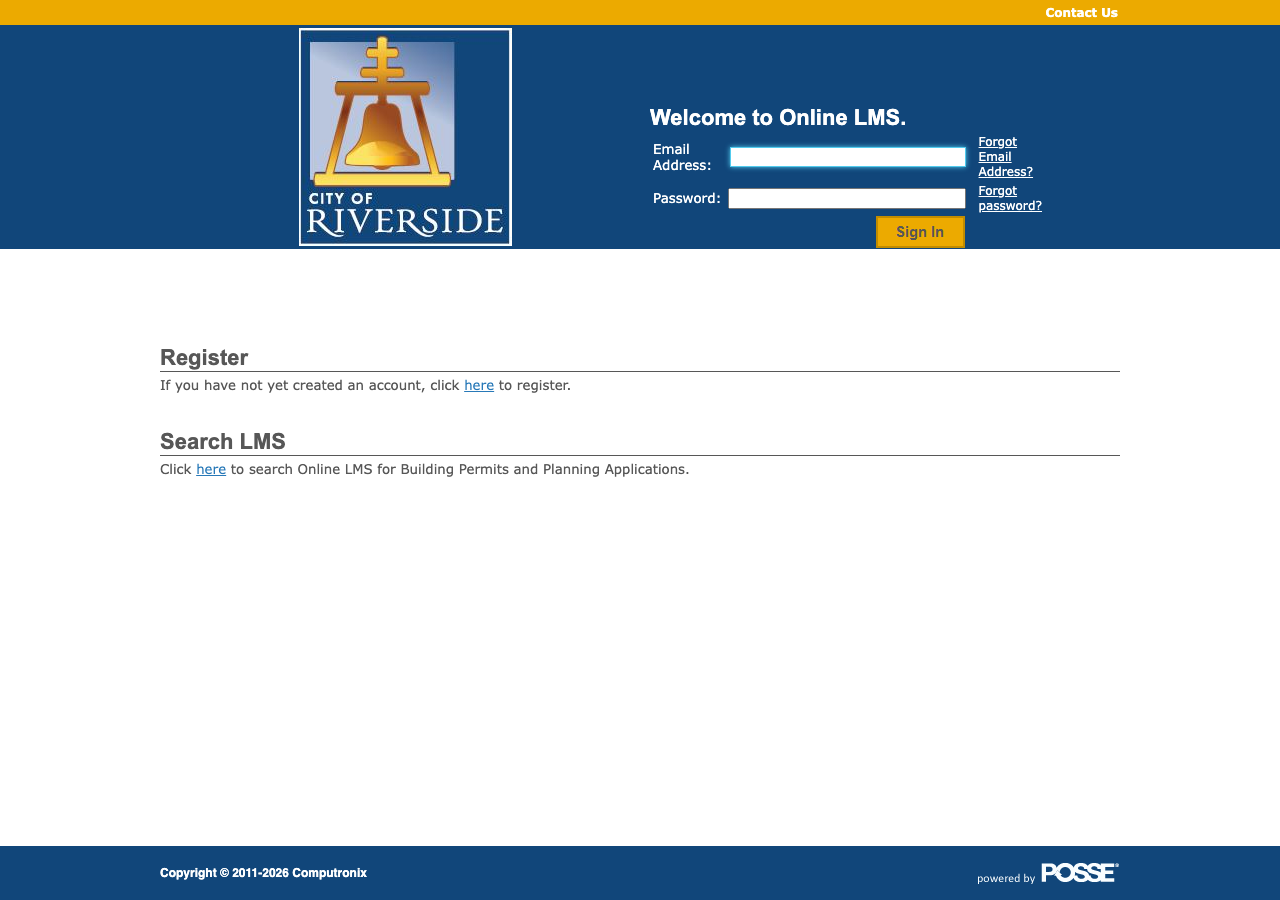
- Which permit portal does this authority use? Public Permit Portal, powered by the POSSE Land Management System (LMS); solar applications additionally route through SolarAPP+. 95% · authority portal page
- Can the whole application be completed online? Yes 95% · authority portal page
- What does a residential solar permit cost? $175.00 plan-check + $175.00 permit fee (≈$350 total) for systems ≤15kW, plus $7.50/kW (each component) beyond 15kW — OR a flat $100.50 'Expedited Solar Energy System' fee for SolarAPP+ projects up to 38kW, plus a separate $25 SolarAPP+ software processing fee paid to the SolarAPP+ platform. 78% · fee schedule PDF (extracted with pdftotext, not a summarizer)
- How is the fee calculated? Tiered (flat base for ≤15kW, then per-kW beyond) for standard review; Flat for the SolarAPP+ expedited path. 80% · fee schedule PDF
- Is there a separate plan-check fee? Yes 92% · fee schedule PDF
-
Plan review — and start the utility in parallel
Interconnection is a separate process from the permit and usually the longer pole. Where the utility does not depend on the permit being issued, running both at once is the single biggest saving available on a residential job.
- What is the stated plan-review turnaround? 3 business days 90% · authority department page
- How long is an issued permit valid before it expires? 1 year from issuance (permit becomes null and void if work not commenced within 1 year, or is suspended/without progress for 1 year); the Building Official may grant extensions of up to 180 days at a time. 90% · municipal code
- Which utility handles interconnection here? Riverside Public Utilities (RPU) — the City's own municipally-owned electric utility, NOT Southern California Edison. 97% · authority utility page
- Where does the utility sit in the sequence? After permit — the building permit must be finaled first; the city inspector then notifies RPU to release the meter and interconnect. 92% · authority utility page
28 questions answered against City of Riverside’s own published documents
Q1 Is this authority the AHJ for residential solar at this address? Core Jurisdiction & scope
Yes
Why the confidence is not higherCity's own Building & Safety Division processes and permits residential rooftop PV; codified in RMC 16.22 (Solar Streamlined Permitting Process).
authority permit page + municipal code checked 2026-08-30 https://www.riversideca.gov/cedd/building-safety/building-safety-services/permits
Q2 What does this authority permit itself, and what does it delegate? Core Jurisdiction & scope
Both
Why the confidence is not higherBuilding & Safety Division issues Building, Electrical, Plumbing, and Mechanical permits itself; no evidence of delegation to county or another agency for residential solar.
authority permit page checked 2026-08-30 https://www.riversideca.gov/cedd/building-safety/building-safety-services/permits
Q3 Is a permit required for a residential rooftop PV system? Core Jurisdiction & scope
Yes
Why the confidence is not higherRMC 16.22.020 applies to 'all small residential rooftop solar energy systems'; RPU's own solar page states 'must receive a City of Riverside permit.'
municipal code checked 2026-08-30 https://library.municode.com/ca/riverside/codes/code_of_ordinances?nodeId=PTIICOOR_TIT16BUCO_CH16.22SOSTPEPR_16.22.040SOENSYRE
Q4 Is there a separate electrical permit, or is it combined? Core Jurisdiction & scope
Combined
Why the confidence is not higherFee schedule lists one 'Residential Solar Energy System' line item (not separate building vs. electrical lines) and SolarAPP+/Public Permit Portal process it as a single 'Solar PV Permit' application.
fee schedule PDF checked 2026-08-30 http://www.riversideca.gov/cedd/sites/riversideca.gov.cedd/files/pdf/building/forms/126_BUILDING%20FEES_V2.0.pdf
Q5 Who is allowed to pull the electrical permit? Core Who may apply
Any contractor (of specific licensed classes)
Why the confidence is not higherCity's PV Re-Roofing Policy bulletin specifies removal/reinstall/modification of PV must be by a licensed C-46 solar contractor, C-10 electrical contractor, or B general building contractor; SolarAPP+ requires a 'Valid State Contractors License' generally, not electrician-specific.
department bulletin checked 2026-08-30 http://www.riversideca.gov/cedd/sites/riversideca.gov.cedd/files/pdf/building/forms/224_PV-REROOF_V1.0.pdf
Q6 Must the contractor be registered with this authority before applying? Core Who may apply
Yes
Why the confidence is not higherSolarAPP+ page requires both a 'Valid State Contractors License' AND a 'City Business License' to apply.
authority program page checked 2026-08-30 https://www.riversideca.gov/cedd/building-safety/online-permits/solarapp
Q7 Is a homeowner permitted to self-install and self-permit? Who may apply
No
Why the confidence is not higherSolarAPP+ (the city's primary solar path) is explicitly 'Contractors only — not homeowners directly.' General building-permit owner-builder provisions exist in state law and are referenced generically on the city's permits page, but no city document confirms an owner-builder path specifically for new PV installs outside SolarAPP+.
authority program page checked 2026-08-30 https://www.riversideca.gov/cedd/building-safety/online-permits/solarapp
Q8 What documents make up a complete submittal? Core Submittal package
Submittal is generated/managed through the SolarAPP+ software (project details, PV layout, equipment specs) and then uploaded with its Unique ID to the city's Public Permit Portal; content requirements are set by RMC 16.22.060 (structural and electrical self-verification).
Why the confidence is not higherCombines the SolarAPP+ 4-step process description with the codified pre-application verification duties in RMC 16.22.060.
authority program page + municipal code checked 2026-08-30 https://www.riversideca.gov/cedd/building-safety/online-permits/solarapp
Q9 How many copies, and in what format? Submittal package
Electronic only, via SolarAPP+ and the Public Permit Portal — no physical copies specified for the solar path.
Why the confidence is not higherThe city's general 'Paper Plan Review Submittals Matrix' (2-7 full sets by project Type A-F) does not list solar as one of its project types, consistent with solar being processed entirely electronically through SolarAPP+.
department bulletin checked 2026-08-30 http://www.riversideca.gov/cedd/sites/riversideca.gov.cedd/files/pdf/101_SUBMITTAL-MATRIX_V1.1.pdf
Q10 Is a site plan required, and what must it show? Core Submittal package
Yes — a site/roof plan showing panel layout and equipment locations is required; RPU also requires 'a detailed drawing showing the location of the Generating Facility' before approving the application.
Why the confidence is not higherGeneral plan-check page lists site plan among required drawings; RPU's 2011 Interconnection Standards separately require a location drawing RPU must approve before project approval.
utility standard (dated 2011, still the current linked document) checked 2026-08-30 http://riversideca.gov/utilities/sites/riversideca.gov.utilities/files/pdf/CITY%20OF%20RIVERSIDE%20Interconnection%20Standards%20Final%206-24-2011_0.pdf
Q11 Is a one-line / three-line diagram required? Core Drawings & calculations
Yes
Why the confidence is not higherRPU's Interconnection Standards state a 'Schematic Diagram' (one-line, schematic, or full wiring diagram) 'is required by the Building Division and RPU Engineering during the review and approval process.'
utility standard checked 2026-08-30 http://riversideca.gov/utilities/sites/riversideca.gov.utilities/files/pdf/CITY%20OF%20RIVERSIDE%20Interconnection%20Standards%20Final%206-24-2011_0.pdf
Q12 Are string and conductor calculations required? Drawings & calculations
Not separately documented as a required standalone calculation package; RMC 16.22.060 only requires the applicant to 'verify, using standard electrical inspection techniques,' that existing wiring/panels are adequately sized — SolarAPP+'s national software does collect string/conductor sizing data as structured inputs to auto-check code compliance.
Why the confidence is not higherNo city bulletin explicitly requires a submitted 'string and conductor calculations' document; the requirement is embedded in RMC 16.22.060's verification duty and in SolarAPP+'s built-in logic rather than a discrete filed calc sheet.
municipal code checked 2026-08-30 https://library.municode.com/ca/riverside/codes/code_of_ordinances?nodeId=PTIICOOR_TIT16BUCO_CH16.22SOSTPEPR_16.22.040SOENSYRE
Q13 Is a structural PE stamp required, and at what threshold? Core Engineering & stamps
No PE stamp required for typical small residential rooftop PV (≤10kW AC / 30kW thermal, wood-frame single-family roof) — RMC 16.22.060 allows applicant self-verification of structural adequacy via 'standard engineering evaluation techniques,' and BPC §5537 exempts wood-frame single-family dwellings up to two stories from mandatory PE/architect design.
Why the confidence is not higherCombines RMC 16.22.060(A)(1) with the city's own 'When is a Licensed Architect or Professional Engineer Required' bulletin, which exempts conventional wood-frame single-family construction absent unusual risk.
department bulletin checked 2026-08-30 http://www.riversideca.gov/cedd/sites/riversideca.gov.cedd/files/pdf/building/forms/239_WHEN%20IS%20A%20LICENSED%20ARCHITECT%20OR%20ENGINEER%20REQUIRED_V1.0.pdf
Q14 Is an electrical PE stamp required, and at what threshold? Engineering & stamps
No PE stamp required for typical residential PV electrical design — licensed C-10/C-46 contractors may design the electrical system they install, per BPC §6737.3, referenced in the city's own licensing bulletin.
Why the confidence is not higherSame bulletin explicitly states contractors may design and sign electrical/mechanical systems 'if they also install them.'
department bulletin checked 2026-08-30 http://www.riversideca.gov/cedd/sites/riversideca.gov.cedd/files/pdf/building/forms/239_WHEN%20IS%20A%20LICENSED%20ARCHITECT%20OR%20ENGINEER%20REQUIRED_V1.0.pdf
Q15 What does a residential solar permit cost? Core Fees
$175.00 plan-check + $175.00 permit fee (≈$350 total) for systems ≤15kW, plus $7.50/kW (each component) beyond 15kW — OR a flat $100.50 'Expedited Solar Energy System' fee for SolarAPP+ projects up to 38kW, plus a separate $25 SolarAPP+ software processing fee paid to the SolarAPP+ platform.
Why the confidence is not higherFee schedule (effective July 1, 2026) lists both a tiered per-kW 'Residential Solar Energy System' line and a flat 'Expedited Solar Energy System (Up to 38 KW)' line at $100.50; the PDF's column layout makes the exact plan-check/permit split for the tiered line somewhat ambiguous, so this is presented with that caveat.
fee schedule PDF (extracted with pdftotext, not a summarizer) checked 2026-08-30 http://www.riversideca.gov/cedd/sites/riversideca.gov.cedd/files/pdf/building/forms/126_BUILDING%20FEES_V2.0.pdf
Q16 How is the fee calculated? Core Fees
Tiered (flat base for ≤15kW, then per-kW beyond) for standard review; Flat for the SolarAPP+ expedited path.
Why the confidence is not higherSame fee schedule PDF shows both structures side by side.
fee schedule PDF checked 2026-08-30 http://www.riversideca.gov/cedd/sites/riversideca.gov.cedd/files/pdf/building/forms/126_BUILDING%20FEES_V2.0.pdf
Q17 Is there a separate plan-check fee? Fees
Yes
Why the confidence is not higherEvery line item in the fee schedule, including solar, carries a separate 'Plan Check Fee' column distinct from 'Permit Fee.'
fee schedule PDF checked 2026-08-30 http://www.riversideca.gov/cedd/sites/riversideca.gov.cedd/files/pdf/building/forms/126_BUILDING%20FEES_V2.0.pdf
Q18 What is the stated plan-review turnaround? Core Timeline & validity
3 business days
Why the confidence is not higherPlan-check page states: 'Small residential rooftop solar PV projects 10 kW or less are reviewed within 3 business days in accordance with state law' (AB 2188/Solar Rights Act expedited-review mandate).
authority department page checked 2026-08-30 https://www.riversideca.gov/cedd/building-safety/building-safety-services/plan-check
Q19 How long is an issued permit valid before it expires? Timeline & validity
1 year from issuance (permit becomes null and void if work not commenced within 1 year, or is suspended/without progress for 1 year); the Building Official may grant extensions of up to 180 days at a time.
Why the confidence is not higherRMC 16.04.310 'Expiration of permits,' current text per Ord. 7748 (2025).
municipal code checked 2026-08-30 https://library.municode.com/ca/riverside/codes/code_of_ordinances?nodeId=PTIICOOR_TIT16BUCO_CH16.04AD_16.04.310EXPE
Q20 Which permit portal does this authority use? Core Portal & process
Public Permit Portal, powered by the POSSE Land Management System (LMS); solar applications additionally route through SolarAPP+.
Why the confidence is not higherDirectly stated on the Public Permit Portal page.
authority portal page checked 2026-08-30 https://www.riversideca.gov/cedd/building-safety/online-services/public-permit-portal
Q21 Can the whole application be completed online? Core Portal & process
Yes
Why the confidence is not higherPortal page: applicants can 'remotely submit permit applications and electronic plans, pay fees, track progress, complete permit issuance, schedule and receive inspection results' without visiting City Hall.
authority portal page checked 2026-08-30 https://www.riversideca.gov/cedd/building-safety/online-services/public-permit-portal
Q22 Which utility handles interconnection here? Core Utility interconnection
Riverside Public Utilities (RPU) — the City's own municipally-owned electric utility, NOT Southern California Edison.
Why the confidence is not higherConfirms the brief's flag: riversideca.gov/utilities describes RPU as a publicly-owned utility serving Riverside since 1895, and the city's own solar page treats RPU (not SCE) as the interconnecting utility.
authority utility page checked 2026-08-30 https://www.riversideca.gov/utilities/residents/solar-info/all-about-solar
Q23 Where does the utility sit in the sequence? Core Utility interconnection
After permit — the building permit must be finaled first; the city inspector then notifies RPU to release the meter and interconnect.
Why the confidence is not higherRPU's 'All About Solar' page: 'RPU will be notified by the inspector to release the meter and to interconnect the system to the grid' after permit completion.
authority utility page checked 2026-08-30 https://www.riversideca.gov/utilities/residents/solar-info/all-about-solar
Q24 Is a HOA or architectural approval required first? Overlays & special cases
Nothing published by this authority.
Where we lookedCity permits page, SolarAPP+ program page, RPU All About Solar/FAQ/Self-Generation pages, RMC Ch. 16.22 — none mention HOA or architectural-review approval as a city-required precondition (this would be a private HOA/CC&R matter, not a municipal permitting requirement)
https://www.riversideca.gov/cedd/building-safety/online-permits/solarapp
Q25 Is there a historic-district review? Overlays & special cases
Yes (implied) — SolarAPP+ eligibility explicitly excludes structures that are not 'legal, permitted, and code-compliant (not historic),' meaning historic-district properties are routed to standard (non-expedited) review rather than being reviewed the same way.
Why the confidence is not higherInference from SolarAPP+ program eligibility page; no separate historic-review ordinance text for solar was located.
authority program page checked 2026-08-30 https://www.riversideca.gov/cedd/building-safety/online-permits/solarapp
Q26 Is a wind or windstorm certification required? Overlays & special cases
Nothing published by this authority.
Where we lookedRMC Ch. 16.08 (Building Code, incl. Local Design Criteria page which does address wind-speed/seismic design parameters generally via ASCE Hazard Tool, but nothing PV- or windstorm-certification-specific), RMC Ch. 16.22 (Solar), SolarAPP+ page — inland Riverside is not in a designated coastal windstorm zone and no certification requirement was found
Q27 Is a Specific Use Permit or Council approval ever required? Overlays & special cases
Nothing published by this authority.
Where we lookedRMC Ch. 16.22 (Solar Streamlined Permitting), Building & Safety permits page, Planning page links — no Specific Use Permit or Council-approval requirement for standard residential rooftop PV was found
Q28 Is there a system-size cap on residential generation? Overlays & special cases
Yes — utility-side cap of 150% of the customer's historical 12-month energy usage (or 2 W/sq ft of living space for new customers without history) under RPU's Self-Generation Program/NEM; separately, RMC 16.22 defines 'small residential rooftop' (eligible for streamlined review) as ≤10kW AC / 30kW thermal, and SolarAPP+ caps expedited processing at 38kW.
Why the confidence is not higherCombines RPU Self-Generation Program page (150% rule) with RMC 16.22.030 definitions and the SolarAPP+ eligibility page (38kW ceiling).
authority utility program page + municipal code checked 2026-08-30 https://www.riversideca.gov/utilities/residents/solar-info/self-generation-program
Lines marked with a percentage were read off this authority’s own published documents. Unmarked guidance is general good practice, not this jurisdiction’s rule — always confirm against the authority before you submit.
Install 5 steps · 20 questions
-
Build to the code editions actually in force here
The NEC edition a jurisdiction enforces is often a cycle behind the newest one published, and local amendments sit on top of it. Rapid shutdown, conductor sizing and labelling all change between editions, so the edition in force is the first thing to establish, not the last.
- Which NEC edition is in force? 2023 85% · municipal code
- Which building code edition is in force? 2025 California Building Code (Title 24, Part 2), effective January 1, 2026 95% · municipal code
- Which fire code edition is in force? 2025 California Fire Code (based on the 2024 International Fire Code), adopted by Ord. 7745, effective November 18, 2025 95% · municipal code
- Are there local amendments to any of the above? Yes — extensive local amendments exist to the Building Code (e.g., deleted CBC appendices/sections, added sprinkler, noise-insulation, geologic-investigation, and placard sections) and to the Fire Code (dozens of added/amended sections), but none of the amendments found are solar-PV-specific. 88% · municipal code (controlled keyword search)
- What is the installation judged against? California Electrical Code (2025 ed.) Articles 690/705 for PV, per RMC 16.22.040(C) which also invokes IEEE and UL/accredited-lab standards and applicable CPUC safety/reliability rules; RPU's interconnection standard separately requires NEC 690/705, NESC, IEEE 1547, and UL 1741/1703 compliance. 85% · municipal code + utility standard
-
Fire access, setbacks and pathways
Ridge setbacks and roof access pathways are fire-service requirements and they constrain the array layout. They are the most common cause of a redesign after the fire department comments on a plan set.
- What ridge setback and access pathways are required? No Riverside-specific ridge setback/pathway ordinance found; the unamended 2025 California Fire Code (2024 IFC)/NEC 690 default fire-pathway and setback requirements govern. 65% · municipal code (controlled absence)
-
Rapid shutdown
Which rapid-shutdown rule applies follows directly from the NEC edition in force, and the initiation device has to be at a location the fire service can reach and identify. This is inspected, and it is labelled.
- Is rapid shutdown required, and to which NEC edition? Yes — rapid shutdown is required per NEC 690.12 as incorporated into the 2025 California Electrical Code; no local amendment deletes or modifies NEC Article 690 (Chapter 16.16 contains only an adoption section and an inspections section, no article-level amendments). 80% · municipal code
-
Labels and placards
The NEC sets a baseline for permanent markings at the service equipment and the disconnecting means. On top of that, an authority may specify its own wording, and the utility may specify more again. Where any of them writes its own text, a generic off-the-shelf label set will not pass — this is the detail most often fixed on a return visit.
- Which placards does this authority require at the service equipment? Base 2025 CEC/NEC-required placards (e.g., NEC 690/705 rapid-shutdown and disconnect labels) apply; additionally, the city's own PV Re-Roof policy requires a 'PV roof layout placard mounted to the electric panel' used to verify panels are reinstalled in their original location after a re-roof. 78% · department bulletin
- Does the authority specify placard wording of its own? No independently-worded placard text found beyond referencing the 'PV roof layout placard' by name; no verbatim required wording was located in any published city document. 55% · department page
- Is a site plan / facility map placard required, and what must it show? Yes, in substance — RPU's Interconnection Standards require a 'detailed drawing showing the location of the Generating Facility' approved by RPU before project approval, and the PV Re-Roof policy's 'PV roof layout placard' effectively documents the array's as-built layout at the electric panel. 70% · utility standard
- Does the UTILITY specify placards beyond the AHJ's? Yes — RPU's Interconnection Standards require (a) the customer's directional over/under-current device at the service panel be 'marked to indicate power source and connection to RPU's distribution system,' and (b) a UL-approved, visible-break, lockable disconnect switch located adjacent to RPU's meters. 75% · utility standard (dated 2011)
- Where must the labels be placed? At the main service panel (directional-device marking) and at the AC disconnect switch, which must be located adjacent to the RPU meters. 70% · utility standard (dated 2011)
-
Disconnect, storage and listed equipment
Where the AC disconnect must sit relative to the meter is usually the utility's rule, not the building department's. Battery storage frequently carries its own permit, its own inspection and its own fire conditions.
- Where must the AC disconnect be, relative to the meter? The AC/production disconnect must be located adjacent to RPU's meters (visible-break type, in a lockable metal enclosure, accessible to RPU at all times); the RPU production meter itself must be located outdoors, a minimum of 10 inches and maximum of 6 feet from the existing RPU service meter. 85% · utility standard (dated 2011)
- Must equipment be on a specific approved list? Yes — UL 1741 (inverters/charge controllers), UL 1703 (flat-plate PV modules), IEEE 1547/1262/929 compliance, and CEC (California Energy Commission) approval for use in California are all required per RPU's interconnection standard and RMC 16.22.040(C). 80% · utility standard + municipal code
- Are batteries permitted, and under what conditions? Batteries/ESS are not prohibited by the city, but they are explicitly excluded from the SolarAPP+ expedited path ('No existing OR new battery energy storage system (ESS)' eligible); battery installations must go through standard (non-expedited) plan review, governed by the unamended 2025 CFC (2024 IFC) energy-storage provisions — no Riverside-specific battery ordinance was found. 75% · authority program page
- Is there a separate ESS permit or inspection? Likely yes (inferred) — since SolarAPP+ (the combined solar permit/single-inspection path) excludes ESS entirely, a battery would require its own standard permit and inspection outside the SolarAPP+/RMC 16.22 streamlined process, though no city document states this in so many words. 65% · fee schedule PDF (absence noted) + authority program page
- Is a ground mount treated as a structure? Yes (inferred) — SolarAPP+ explicitly excludes 'ground mount or ballasted systems' from the expedited residential path, meaning ground-mounted PV must go through standard full plan review as its own structure (consistent with the general fee schedule's separate 'Structures Other Than Buildings' category). 70% · authority program page
- Is there a local rule on service upgrades or busbar sizing? No Riverside-specific ordinance amendment on service upgrades/busbar sizing was found; RMC 16.22.060(A)(2) requires the applicant to self-verify that 'main panel and subpanel sizes are adequately sized... to carry all new photovoltaic electrical loads,' which defers to the unamended NEC 705.12 busbar rules. 70% · municipal code + department page
20 questions answered against City of Riverside’s own published documents
Q29 Which NEC edition is in force? Core Code editions in force
2023
Why the confidence is not higherRMC 16.16.020 adopts the 'California Electrical Code, 2025 Edition' (Ord. 7748, 2025), effective Jan 1, 2026. California's standard 3-year adoption offset means the 2025 CEC cycle is based on the 2023 NEC, though the ordinance text itself only names the CEC edition, not the underlying NEC year explicitly.
municipal code checked 2026-08-30 https://library.municode.com/ca/riverside/codes/code_of_ordinances?nodeId=PTIICOOR_TIT16BUCO_CH16.16ELCO_16.16.020CAELCOADILBUOF
Q30 Which building code edition is in force? Core Code editions in force
2025 California Building Code (Title 24, Part 2), effective January 1, 2026
Why the confidence is not higherRMC 16.08.020, current text per Ord. 7748 (2025).
municipal code checked 2026-08-30 https://library.municode.com/ca/riverside/codes/code_of_ordinances?nodeId=PTIICOOR_TIT16BUCO_CH16.08BUCO_16.08.020CABUCOADILBUOF
Q31 Which fire code edition is in force? Code editions in force
2025 California Fire Code (based on the 2024 International Fire Code), adopted by Ord. 7745, effective November 18, 2025
Why the confidence is not higherRMC 16.32.020, which repealed and re-enacted the entire fire chapter in late 2025.
municipal code checked 2026-08-30 https://library.municode.com/ca/riverside/codes/code_of_ordinances?nodeId=PTIICOOR_TIT16BUCO_CH16.32FIPR_16.32.020INFICOADILFIMA
Q32 Are there local amendments to any of the above? Core Code editions in force
Yes — extensive local amendments exist to the Building Code (e.g., deleted CBC appendices/sections, added sprinkler, noise-insulation, geologic-investigation, and placard sections) and to the Fire Code (dozens of added/amended sections), but none of the amendments found are solar-PV-specific.
Why the confidence is not higherDirectly reviewed RMC 16.08.030-.205 and the Fire Prevention chapter's TOC/text. A keyword control check of the ~58KB Fire Prevention chapter text found zero hits for 'solar,' 'photovoltaic,' 'rooftop,' 'setback,' 'pathway,' 'rapid shutdown,' or 'placard,' while positive controls ('hazardous': 10 hits, 'fire apparatus': 7 hits) and a fabricated control ('zzqqx': 0 hits) confirmed the search itself was working — so the absence of PV-specific fire amendments is a genuine, controlled finding, not a broken search.
municipal code (controlled keyword search) checked 2026-08-30 https://library.municode.com/ca/riverside/codes/code_of_ordinances?nodeId=PTIICOOR_TIT16BUCO_CH16.32FIPR_16.32.020INFICOADILFIMA
Q33 What is the installation judged against? Core Electrical
California Electrical Code (2025 ed.) Articles 690/705 for PV, per RMC 16.22.040(C) which also invokes IEEE and UL/accredited-lab standards and applicable CPUC safety/reliability rules; RPU's interconnection standard separately requires NEC 690/705, NESC, IEEE 1547, and UL 1741/1703 compliance.
Why the confidence is not higherDirect text of RMC 16.22.040(C) plus RPU's 2011 Interconnection Standards document.
municipal code + utility standard checked 2026-08-30 https://library.municode.com/ca/riverside/codes/code_of_ordinances?nodeId=PTIICOOR_TIT16BUCO_CH16.22SOSTPEPR_16.22.040SOENSYRE
Q34 Is there a local rule on service upgrades or busbar sizing? Electrical
No Riverside-specific ordinance amendment on service upgrades/busbar sizing was found; RMC 16.22.060(A)(2) requires the applicant to self-verify that 'main panel and subpanel sizes are adequately sized... to carry all new photovoltaic electrical loads,' which defers to the unamended NEC 705.12 busbar rules.
Why the confidence is not higherRMC 16.22 text reviewed directly; no separate busbar-sizing bulletin located on the Forms/Handouts/Bulletins page.
municipal code + department page checked 2026-08-30 https://www.riversideca.gov/cedd/building-safety/forms-handouts-bulletins
Q35 Is a specific mounting system or attachment spacing required? Structural & mounting
Nothing published by this authority.
Where we lookedRMC Ch. 16.08 (Building Code amendments 16.08.030-.205), Forms/Handouts/Bulletins page, PV Re-Roof bulletin — no Riverside-specific mounting-system or attachment-spacing amendment was found; SolarAPP+ relies on manufacturer-listed mounting per national standard
https://www.riversideca.gov/cedd/building-safety/forms-handouts-bulletins
Q36 What ridge setback and access pathways are required? Core Fire pathways & setbacks
No Riverside-specific ridge setback/pathway ordinance found; the unamended 2025 California Fire Code (2024 IFC)/NEC 690 default fire-pathway and setback requirements govern.
Why the confidence is not higherControlled keyword search (see Q32 methodology) of the Fire Prevention chapter returned zero hits for 'setback' or 'pathway' against passing positive/fabricated controls, indicating no local amendment exists — so the base (state-model) code default applies.
municipal code (controlled absence) checked 2026-08-30 https://library.municode.com/ca/riverside/codes/code_of_ordinances?nodeId=PTIICOOR_TIT16BUCO_CH16.32FIPR_16.32.020INFICOADILFIMA
Q37 Is rapid shutdown required, and to which NEC edition? Core Rapid shutdown
Yes — rapid shutdown is required per NEC 690.12 as incorporated into the 2025 California Electrical Code; no local amendment deletes or modifies NEC Article 690 (Chapter 16.16 contains only an adoption section and an inspections section, no article-level amendments).
Why the confidence is not higherRMC 16.16 reviewed in full; contains no amendments to NEC Article 690.
municipal code checked 2026-08-30 https://library.municode.com/ca/riverside/codes/code_of_ordinances?nodeId=PTIICOOR_TIT16BUCO_CH16.16ELCO_16.16.020CAELCOADILBUOF
Q38 Which placards does this authority require at the service equipment? Core Labels Signage & labelling
Base 2025 CEC/NEC-required placards (e.g., NEC 690/705 rapid-shutdown and disconnect labels) apply; additionally, the city's own PV Re-Roof policy requires a 'PV roof layout placard mounted to the electric panel' used to verify panels are reinstalled in their original location after a re-roof.
Why the confidence is not higherPV Re-Roof bulletin explicitly names this placard; no other Riverside-specific placard requirement was found beyond it.
department bulletin checked 2026-08-30 http://www.riversideca.gov/cedd/sites/riversideca.gov.cedd/files/pdf/building/forms/224_PV-REROOF_V1.0.pdf
Q39 Does the authority specify placard wording of its own? Core Labels Signage & labelling
No independently-worded placard text found beyond referencing the 'PV roof layout placard' by name; no verbatim required wording was located in any published city document.
Why the confidence is not higherReviewed PV Re-Roof bulletin, Forms/Handouts/Bulletins page, and RMC 16.22; none specify exact placard wording.
department page checked 2026-08-30 https://www.riversideca.gov/cedd/building-safety/forms-handouts-bulletins
Q40 Does it specify letter height, colour or material? Core Labels Signage & labelling
Nothing published by this authority.
Where we lookedPV Re-Roof bulletin, Forms/Handouts/Bulletins page, RMC Ch. 16.16 (Electrical) and Ch. 16.32 (Fire) — no letter-height, colour, or material specification for any solar placard was found
https://www.riversideca.gov/cedd/building-safety/forms-handouts-bulletins
Q41 Is a site plan / facility map placard required, and what must it show? Core Labels Signage & labelling
Yes, in substance — RPU's Interconnection Standards require a 'detailed drawing showing the location of the Generating Facility' approved by RPU before project approval, and the PV Re-Roof policy's 'PV roof layout placard' effectively documents the array's as-built layout at the electric panel.
Why the confidence is not higherCombination of RPU 2011 Interconnection Standards and the PV Re-Roof bulletin; no single city document frames this explicitly as a '705.10 facility map placard.'
utility standard checked 2026-08-30 http://riversideca.gov/utilities/sites/riversideca.gov.utilities/files/pdf/CITY%20OF%20RIVERSIDE%20Interconnection%20Standards%20Final%206-24-2011_0.pdf
Q42 Does the UTILITY specify placards beyond the AHJ's? Core Labels Signage & labelling
Yes — RPU's Interconnection Standards require (a) the customer's directional over/under-current device at the service panel be 'marked to indicate power source and connection to RPU's distribution system,' and (b) a UL-approved, visible-break, lockable disconnect switch located adjacent to RPU's meters.
Why the confidence is not higherSource document is dated 2011 but remains the current live-linked interconnection standard on the RPU developers page; flagged as dated in case it has been superseded by an unpublished update.
utility standard (dated 2011) checked 2026-08-30 http://riversideca.gov/utilities/sites/riversideca.gov.utilities/files/pdf/CITY%20OF%20RIVERSIDE%20Interconnection%20Standards%20Final%206-24-2011_0.pdf
Q43 Where must the labels be placed? Core Labels Signage & labelling
At the main service panel (directional-device marking) and at the AC disconnect switch, which must be located adjacent to the RPU meters.
Why the confidence is not higherSame 2011 RPU Interconnection Standards document.
utility standard (dated 2011) checked 2026-08-30 http://riversideca.gov/utilities/sites/riversideca.gov.utilities/files/pdf/CITY%20OF%20RIVERSIDE%20Interconnection%20Standards%20Final%206-24-2011_0.pdf
Q44 Must equipment be on a specific approved list? Equipment listing
Yes — UL 1741 (inverters/charge controllers), UL 1703 (flat-plate PV modules), IEEE 1547/1262/929 compliance, and CEC (California Energy Commission) approval for use in California are all required per RPU's interconnection standard and RMC 16.22.040(C).
Why the confidence is not higherRPU 2011 Interconnection Standards, Section B.11, cross-referenced with RMC 16.22.040(C).
utility standard + municipal code checked 2026-08-30 http://riversideca.gov/utilities/sites/riversideca.gov.utilities/files/pdf/CITY%20OF%20RIVERSIDE%20Interconnection%20Standards%20Final%206-24-2011_0.pdf
Q45 Are batteries permitted, and under what conditions? Core Battery / ESS
Batteries/ESS are not prohibited by the city, but they are explicitly excluded from the SolarAPP+ expedited path ('No existing OR new battery energy storage system (ESS)' eligible); battery installations must go through standard (non-expedited) plan review, governed by the unamended 2025 CFC (2024 IFC) energy-storage provisions — no Riverside-specific battery ordinance was found.
Why the confidence is not higherSolarAPP+ eligibility page explicitly excludes ESS; controlled search of the Fire Prevention chapter found no battery/ESS-specific local amendment.
authority program page checked 2026-08-30 https://www.riversideca.gov/cedd/building-safety/online-permits/solarapp
Q46 Is there a separate ESS permit or inspection? Battery / ESS
Likely yes (inferred) — since SolarAPP+ (the combined solar permit/single-inspection path) excludes ESS entirely, a battery would require its own standard permit and inspection outside the SolarAPP+/RMC 16.22 streamlined process, though no city document states this in so many words.
Why the confidence is not higherInference from the SolarAPP+ ESS exclusion; the general fee schedule does not list a distinct 'battery' or 'ESS' fee line item, which is itself notable.
fee schedule PDF (absence noted) + authority program page checked 2026-08-30 http://www.riversideca.gov/cedd/sites/riversideca.gov.cedd/files/pdf/building/forms/126_BUILDING%20FEES_V2.0.pdf
Q47 Is a ground mount treated as a structure? Core Ground mount
Yes (inferred) — SolarAPP+ explicitly excludes 'ground mount or ballasted systems' from the expedited residential path, meaning ground-mounted PV must go through standard full plan review as its own structure (consistent with the general fee schedule's separate 'Structures Other Than Buildings' category).
Why the confidence is not higherSolarAPP+ eligibility page exclusion, cross-referenced against the general fee schedule's structure categories.
authority program page checked 2026-08-30 https://www.riversideca.gov/cedd/building-safety/online-permits/solarapp
Q48 Where must the AC disconnect be, relative to the meter? Core Utility equipment
The AC/production disconnect must be located adjacent to RPU's meters (visible-break type, in a lockable metal enclosure, accessible to RPU at all times); the RPU production meter itself must be located outdoors, a minimum of 10 inches and maximum of 6 feet from the existing RPU service meter.
Why the confidence is not higherRPU 2011 Interconnection Standards, Sections B.8-B.9.
utility standard (dated 2011) checked 2026-08-30 http://riversideca.gov/utilities/sites/riversideca.gov.utilities/files/pdf/CITY%20OF%20RIVERSIDE%20Interconnection%20Standards%20Final%206-24-2011_0.pdf
Lines marked with a percentage were read off this authority’s own published documents. Unmarked guidance is general good practice, not this jurisdiction’s rule — always confirm against the authority before you submit.
Inspection 5 steps · 14 questions
-
Book it
Booking is a portal, a phone call or an email depending on the authority, and the notice required is rarely zero. Book before the work is finished rather than after — the lead time, not the work, is usually what sets the date.
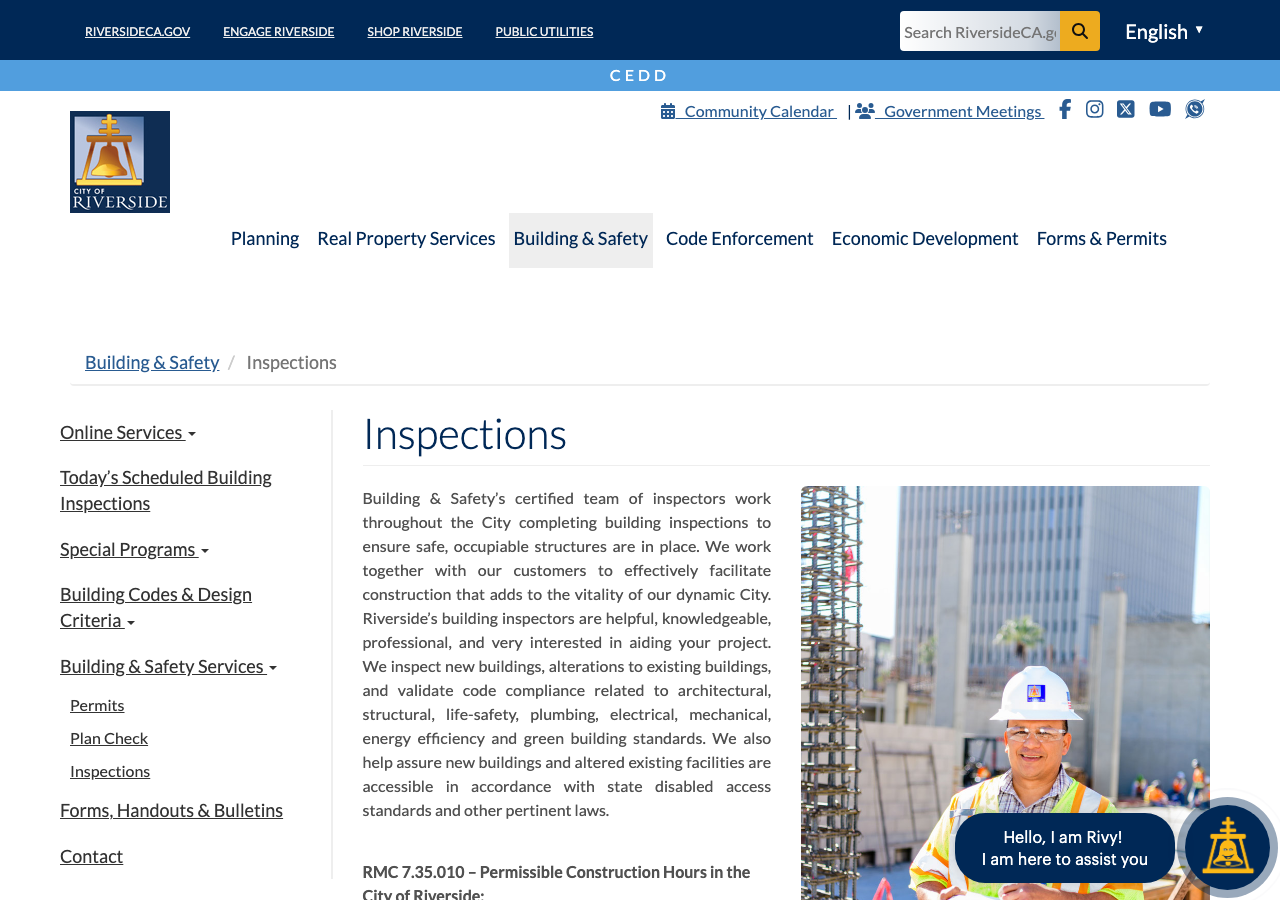
- How is an inspection booked? Phone (Automated Inspection Request Line) or Portal 90% · authority department page
- How much notice is required? Call before 5:00 pm to schedule for the following business day (effectively next-business-day / minimum ~1 business day notice) 85% · authority department page
- Are same-day or AM/PM windows offered? No dedicated AM/PM window selection system found; applicants may call between 7:30-8:00am the morning of the inspection to coordinate an approximate time with the inspector. 70% · authority department page
-
Know who turns up
Some authorities inspect their own solar work; some delegate it, and a few do not inspect the PV equipment itself at all. Who is coming determines what they will look at.
- Does this AHJ perform its own final solar inspection? Yes 92% · municipal code
- If delegated, to whom? N/A — not delegated; performed in-house by the Building & Safety Division. 90% · municipal code
-
Work the stages in order
A rough-in or mid-roof inspection, where one is required, has to happen before the work it covers is closed up. Missing a stage means opening something back up, and it is the most expensive kind of correction.
- Which inspections are required, and in what order? For SolarAPP+-eligible small residential systems: a single final inspection after installation is complete (RMC 16.22.060(B)). For a re-roof performed with an existing PV system: (1) roof-deck inspection after PV/old roofing removed and before new roofing, then (2) a final roofing inspection verifying panels are reinstalled per the PV roof-layout placard; PV modifications under a separate permit get their own final inspection. 85% · municipal code + department bulletin
- Is a rough-in or mid-roof inspection required? Only in the re-roof-with-existing-PV scenario (a roof-deck inspection before new roofing is installed); standard new PV installs get just the single final inspection under RMC 16.22.060(B). 75% · department bulletin
-
Have the paperwork on site
The approved plan set, the permit, and the equipment listings should be on site and reachable. Inspectors routinely verify that installed equipment matches what was approved, and that the labels are the ones the plan set promised.
- Is there a published inspection checklist? Not published as a standalone document that could be located; RMC 16.22.050(D)-(E) legally requires the Building & Safety Division to adopt 'a standard plan and checklist' substantially conforming to the California Solar Permitting Guidebook, but in practice this appears to be embodied in the SolarAPP+ software's built-in compliance checklist rather than a separate PDF on the Forms/Handouts/Bulletins page. 65% · department page (statutory duty vs. document not located)
- What must be on site at inspection? SolarAPP+ plans and job cards (with the Unique ID), the Permit Inspection Card, and the approved/stamped construction plans. 88% · authority program page
- Does the inspector verify labels and listings? Yes 78% · department bulletin
-
Sign-off, and permission to operate
Passing gives you a final or an equivalent sign-off. That is not the same as permission to operate: PTO comes from the utility, and who tells the utility the inspection passed varies. A system left switched off for weeks is usually waiting on this handover.
- What is issued on pass? Final (the Building Inspector signs/dates the Permit Inspection Card / permit is 'finaled'); the city does not issue a separate PTO letter — 'Permission to Operate' is achieved once the city permit is finaled AND RPU installs the net meter, and customers must contact RPU directly for written PTO confirmation. 85% · authority utility page
- Who notifies the utility for PTO? AHJ (the city's building inspector notifies RPU to release the meter and interconnect, after permit finalization) 90% · authority utility page
- Is there a re-inspection fee? $98.00 (Building Reinspection flat fee) 85% · fee schedule PDF
- How are corrections issued and cleared? A written correction notice detailing all deficiencies is issued to the applicant for resubmission (RMC 16.22.060(A)(3) for solar specifically); general practice per the inspections page is that the inspector leaves a correction notice on failure and a re-inspection is required after corrections are made. 85% · municipal code
14 questions answered against City of Riverside’s own published documents
Q49 How is an inspection booked? Core Booking & scheduling
Phone (Automated Inspection Request Line) or Portal
Why the confidence is not higherInspections page gives the automated phone line (951-826-5361); SolarAPP+ page separately says 'Request inspection through Portal or phone.'
authority department page checked 2026-08-30 https://www.riversideca.gov/cedd/building-safety/building-safety-services/inspections
Q50 How much notice is required? Core Booking & scheduling
Call before 5:00 pm to schedule for the following business day (effectively next-business-day / minimum ~1 business day notice)
Why the confidence is not higherInspections page instructions for the Automated Inspection Request Line.
authority department page checked 2026-08-30 https://www.riversideca.gov/cedd/building-safety/building-safety-services/inspections
Q51 Are same-day or AM/PM windows offered? Booking & scheduling
No dedicated AM/PM window selection system found; applicants may call between 7:30-8:00am the morning of the inspection to coordinate an approximate time with the inspector.
Why the confidence is not higherInspections page describes morning-of coordination rather than a booked window.
authority department page checked 2026-08-30 https://www.riversideca.gov/cedd/building-safety/building-safety-services/inspections
Q52 Does this AHJ perform its own final solar inspection? Core Who inspects
Yes
Why the confidence is not higherBuilding & Safety Division inspectors perform the final solar inspection themselves; RMC 16.22.060(B) confirms 'only one inspection shall be required and performed by the Building and Safety Division' for eligible small residential systems.
municipal code checked 2026-08-30 https://library.municode.com/ca/riverside/codes/code_of_ordinances?nodeId=PTIICOOR_TIT16BUCO_CH16.22SOSTPEPR_16.22.040SOENSYRE
Q53 If delegated, to whom? Core Who inspects
N/A — not delegated; performed in-house by the Building & Safety Division.
Why the confidence is not higherSee Q52.
municipal code checked 2026-08-30 https://library.municode.com/ca/riverside/codes/code_of_ordinances?nodeId=PTIICOOR_TIT16BUCO_CH16.22SOSTPEPR_16.22.040SOENSYRE
Q54 Which inspections are required, and in what order? Core Stages & sequence
For SolarAPP+-eligible small residential systems: a single final inspection after installation is complete (RMC 16.22.060(B)). For a re-roof performed with an existing PV system: (1) roof-deck inspection after PV/old roofing removed and before new roofing, then (2) a final roofing inspection verifying panels are reinstalled per the PV roof-layout placard; PV modifications under a separate permit get their own final inspection.
Why the confidence is not higherRMC 16.22.060(B) plus the PV Re-Roof bulletin's explicit inspection sequence.
municipal code + department bulletin checked 2026-08-30 http://www.riversideca.gov/cedd/sites/riversideca.gov.cedd/files/pdf/building/forms/224_PV-REROOF_V1.0.pdf
Q55 Is a rough-in or mid-roof inspection required? Stages & sequence
Only in the re-roof-with-existing-PV scenario (a roof-deck inspection before new roofing is installed); standard new PV installs get just the single final inspection under RMC 16.22.060(B).
Why the confidence is not higherPV Re-Roof bulletin vs. RMC 16.22.060(B).
department bulletin checked 2026-08-30 http://www.riversideca.gov/cedd/sites/riversideca.gov.cedd/files/pdf/building/forms/224_PV-REROOF_V1.0.pdf
Q56 Does the inspector verify labels and listings? Core What is checked
Yes
Why the confidence is not higherPV Re-Roof bulletin: inspector 'will verify the PV panels have been re-installed in the same location as shown on the PV roof layout placard'; general inspections page states inspectors 'validate code compliance.'
department bulletin checked 2026-08-30 http://www.riversideca.gov/cedd/sites/riversideca.gov.cedd/files/pdf/building/forms/224_PV-REROOF_V1.0.pdf
Q57 Is there a published inspection checklist? Core What is checked
Not published as a standalone document that could be located; RMC 16.22.050(D)-(E) legally requires the Building & Safety Division to adopt 'a standard plan and checklist' substantially conforming to the California Solar Permitting Guidebook, but in practice this appears to be embodied in the SolarAPP+ software's built-in compliance checklist rather than a separate PDF on the Forms/Handouts/Bulletins page.
Why the confidence is not higherForms/Handouts/Bulletins page was reviewed directly and lists no separate solar checklist beyond the PV Re-Roof policy and fee schedule.
department page (statutory duty vs. document not located) checked 2026-08-30 https://www.riversideca.gov/cedd/building-safety/forms-handouts-bulletins
Q58 What must be on site at inspection? Core Documents on site
SolarAPP+ plans and job cards (with the Unique ID), the Permit Inspection Card, and the approved/stamped construction plans.
Why the confidence is not higherSolarAPP+ page: 'Your SolarAPP+ plans and job cards are required to be present during your scheduled inspections'; general inspections page requires the Permit Inspection Card and stamped plans on site.
authority program page checked 2026-08-30 https://www.riversideca.gov/cedd/building-safety/online-permits/solarapp
Q59 Is there a re-inspection fee? Corrections & re-inspection
$98.00 (Building Reinspection flat fee)
Why the confidence is not higherFee schedule (effective July 1, 2026) lists 'Building Reinspection — $98.00 each' as the only reinspection fee category; not solar-specific but applies generally.
fee schedule PDF checked 2026-08-30 http://www.riversideca.gov/cedd/sites/riversideca.gov.cedd/files/pdf/building/forms/126_BUILDING%20FEES_V2.0.pdf
Q60 How are corrections issued and cleared? Corrections & re-inspection
A written correction notice detailing all deficiencies is issued to the applicant for resubmission (RMC 16.22.060(A)(3) for solar specifically); general practice per the inspections page is that the inspector leaves a correction notice on failure and a re-inspection is required after corrections are made.
Why the confidence is not higherRMC 16.22.060(A)(3) plus the general Building Inspection process page.
municipal code checked 2026-08-30 https://library.municode.com/ca/riverside/codes/code_of_ordinances?nodeId=PTIICOOR_TIT16BUCO_CH16.22SOSTPEPR_16.22.040SOENSYRE
Q61 What is issued on pass? Core Final sign-off & PTO
Final (the Building Inspector signs/dates the Permit Inspection Card / permit is 'finaled'); the city does not issue a separate PTO letter — 'Permission to Operate' is achieved once the city permit is finaled AND RPU installs the net meter, and customers must contact RPU directly for written PTO confirmation.
Why the confidence is not higherRPU 'All About Solar' page explicitly distinguishes city permit finalization from RPU's own net-meter installation and states the city does not issue formal PTO letters.
authority utility page checked 2026-08-30 https://www.riversideca.gov/utilities/residents/solar-info/all-about-solar
Q62 Who notifies the utility for PTO? Core Final sign-off & PTO
AHJ (the city's building inspector notifies RPU to release the meter and interconnect, after permit finalization)
Why the confidence is not higherRPU 'All About Solar' page: 'RPU will be notified by the inspector to release the meter and to interconnect the system to the grid.'
authority utility page checked 2026-08-30 https://www.riversideca.gov/utilities/residents/solar-info/all-about-solar
Lines marked with a percentage were read off this authority’s own published documents. Unmarked guidance is general good practice, not this jurisdiction’s rule — always confirm against the authority before you submit.
Jurisdiction & key facts
The standing 62-question set, answered for City of Riverside against this authority’s own published documents. Every answer carries the confidence it was recorded at and the document it came from. Where nothing is published we say so and show where we looked — a blank here is a finding, not a gap.
City of Riverside is the authority having jurisdiction 95% confidence
- Holds
- Both — Building & Safety Division (within Community & Economic Development Dept.) issues both building and electrical permits and performs inspections for residential rooftop solar
- Overridden by
- Interconnection/grid connection is gated by Riverside Public Utilities (RPU), the city's own municipal electric utility — NOT Southern California Edison. RPU is not a separate AHJ for the permit but must approve interconnection (Electric Rule 22) and install the net meter before Permission to Operate; the city inspector notifies RPU only after the building permit is finaled.
- Why not higher
- Confirmed via the city's own Building & Safety pages and RMC Ch. 16.22 (Solar Streamlined Permitting) that the city itself permits and inspects residential PV; confirmed via riversideca.gov/utilities and the RPU 'All About Solar' page that Riverside runs its own publicly-owned electric utility (since 1895), so the brief's flag that SCE is likely NOT the interconnecting utility here is correct.
https://www.riversideca.gov/utilities/residents/solar-info/all-about-solar
- Permit required
- Yes97%
- Permit cost
- $175.00 plan-check + $175.00 permit fee (≈$350 total) for systems ≤15kW, plus $7.50/kW (each component) beyond 15kW — OR a flat $100.50 'Expedited Solar Energy System' fee for SolarAPP+…78%
- Plan review
- 3 business days90%
- Portal
- Public Permit Portal, powered by the POSSE Land Management System (LMS); solar applications additionally route through SolarAPP+.95%
- Electrical code
- 202385%
- Own placard wording
- No independently-worded placard text found beyond referencing the 'PV roof layout placard' by name; no verbatim required wording was located in any published city document.55%
- Booking an inspection
- Phone (Automated Inspection Request Line) or Portal90%
Labels & placards for this authority
Wording 55%
No independently-worded placard text found beyond referencing the 'PV roof layout placard' by name; no verbatim required wording was located in any published city document.
Size, colour & material None%
Where they go 70%
At the main service panel (directional-device marking) and at the AC disconnect switch, which must be located adjacent to the RPU meters.
What the utility wants on top 75%
Yes — RPU's Interconnection Standards require (a) the customer's directional over/under-current device at the service panel be 'marked to indicate power source and connection to RPU's distribution system,' and (b) a UL-approved, visible-break, lockable disconnect switch located adjacent to RPU's meters.
Each figure above is sourced and dated in the full answer set below (questions 38–43). Where an authority’s own published sheet is older than the code it has adopted, the answer says so.
Their website

Average approval time — application to PTO
From the CPUC interconnection record. Bars show the average days taken each year; a year with no recorded projects is left blank rather than drawn as zero.