
City of Sacramento
Sacramento County
City of Sacramento is a city authority in the State of California, serving 524,943 residents. This page is the permit route for that jurisdiction: the fifteen steps from working out who has a say over an address through to permission to operate, the documents this authority publishes, and 61 answers taken from those documents and dated.
Permitting 5 steps · 27 questions
Whether a permit is needed — Yes Q3 Electrical and building permits — Combined Q4 Plan review — 24 hours per review cycle (Cycle 1, 2, and 3 each listed as '24 hours') for Photovoltaic, Batteries, and EV Charging Stations Q18 Where you file — Public Permit Portal — Accela Citizen Access (City of Sacramento instance) Q20
- Permit required
- Yes95% source
- What it costs
- $450 flat for a residential PV system up to 15 kW AC, plus $15.00 per kW for each kW above 15 kW. (A parallel $450 flat fee applies to residential ground-mounted solar water heater systems up to…95% source
- Plan review turnaround
- 24 hours per review cycle (Cycle 1, 2, and 3 each listed as '24 hours') for Photovoltaic, Batteries, and EV Charging Stations95% source
- Key document
- checklist (absence) + ordinance cross-reference cited by 7 open the document
-
Confirm who has a say over your address
A city address is usually permitted by the city, not the county — but not always, and some authorities keep building and hand electrical to someone else. Getting this wrong costs the whole submittal, because every requirement below belongs to whoever actually holds jurisdiction. Check the overlays in the same pass: an HOA, a historic district, a windstorm certification or a system-size cap can reshape the design, and all of them are cheaper to find now than after the array is laid out.
- What does this authority permit itself, and what does it delegate? Both — the City of Sacramento Building Division (Community Development Department) issues a single combined building/electrical permit for residential solar; SMUD (utility) separately approves interconnection but the city does not delegate its own permit authority to SMUD or anyone else. 90% · department page
- Is a permit required for a residential rooftop PV system? Yes 95% · department page
- Is there a separate electrical permit, or is it combined? Combined 80% · department page + checklist
- Is a HOA or architectural approval required first? No — not required by the city as part of its permit submittal 65% · checklist (absence) + ordinance cross-reference
- Is there a historic-district review? Yes, if the property sits within a design review district, preservation district, or is a historic landmark — the general permit-exemption list is void in those areas, and CDD-0198 requires the applicant to meet with Planning staff before submittal to confirm zoning/overlay compliance. 70% · department page
- Is a wind or windstorm certification required? No windstorm/insurance-style certification found or applicable — California does not operate a Texas-Department-of-Insurance-style windstorm certification program; structural wind loading is instead addressed through the adopted California Building Code design provisions. 65% · checklist (absence)
- Is a Specific Use Permit or Council approval ever required? No Specific Use Permit or Council approval identified as required for a typical accessory residential rooftop PV system — the zoning code treats solar as an allowed accessory feature with its own dimensional standards (height variance / yard projection allowance) rather than a discretionary use. 55% · ordinance (secondary-sourced)
- Is there a system-size cap on residential generation? No single hard generation cap found for the standard permit path (the fee schedule scales per kW indefinitely above 15kW with no stated ceiling). The SolarAPP+ expedited path is limited by the SolarAPP+ program's own eligibility rules (1-2 unit residential/ADU only); SMUD separately caps exports to about 110% of the customer's own electrical usage on its interconnection side. 60% · fee schedule + utility checklist
-
Check who is allowed to apply
Several authorities require the electrical permit to be pulled by a licensed electrician, or require the contractor to be registered with them BEFORE applying. Registration is not same-day. This is second on the list rather than fourth because it is the step most likely to stop the job before the drawings matter.
- Who is allowed to pull the electrical permit? Either — a licensed contractor (SMUD recommends C-10, C-46, or B) or the homeowner as owner-builder 80% · department page
- Must the contractor be registered with this authority before applying? No separate city registration found beyond holding a valid CA state contractor license (verified via CSLB) 70% · department page
- Is a homeowner permitted to self-install and self-permit? Yes 70% · department page
-
Build the submittal package
Almost everywhere wants a site plan, a one-line or three-line electrical diagram, equipment cut sheets with listings, and a structural attachment detail. Build it against the published checklist rather than the last jurisdiction you worked in — the checklist is what the reviewer marks against.
- What documents make up a complete submittal? Non-SolarAPP+ path: CDD Building Application for Solar Energy Systems, SMUD interconnection letter, construction plans, and equipment specifications (site plan, roof framing plan, install details/cut sheets, one-line diagram, and structural calcs if a tile roof or >2 roofing overlays) per CDD-0198. SolarAPP+ path: SolarAPP+ approval documents + SolarAPP+ Approval ID + CDD Building Application for Solar Energy Systems + SMUD interconnection letter + construction plans. 90% · department page + checklist
- How many copies, and in what format? Electronic only — no paper copies accepted 90% · department page
- Is a site plan required, and what must it show? Yes. Must be a scaled, dimensioned site plan showing: all property-line dimensions, dimensions/locations of all structures, location of all electric service and PV equipment (meters, inverters, AC & DC disconnects, new or existing), distance from property line to the equipment wall, bordering streets/alleys, and any fence/wall/tree within 5 ft of the PV equipment, plus a project-data block with owner/contractor contact info. 95% · checklist
- Is a one-line / three-line diagram required? Yes 95% · checklist
- Are string and conductor calculations required? Yes — load calculations for the arrays and wire types/sizes are required as part of the one-line diagram package; service load calcs required if derating the main breaker. 90% · checklist
- Is a structural PE stamp required, and at what threshold? Yes, for tile roofs (or systems with panels integrated into roof tiles) or roofs with more than two overlays of roofing material — structural calculations must be stamped and wet-signed by a California-licensed design professional. No PE stamp is required for a standard composition-shingle roof within these limits. 95% · checklist
- Is an electrical PE stamp required, and at what threshold? No electrical PE stamp requirement found — the checklist asks only for manufacturer cut sheets and a one-line diagram, not a stamped electrical calculation package. 75% · checklist
-
Apply and pay
Most authorities now take the whole application through a portal, and several states cap or constrain what a residential solar permit may cost. Check whether plan check is billed separately before you quote the job.
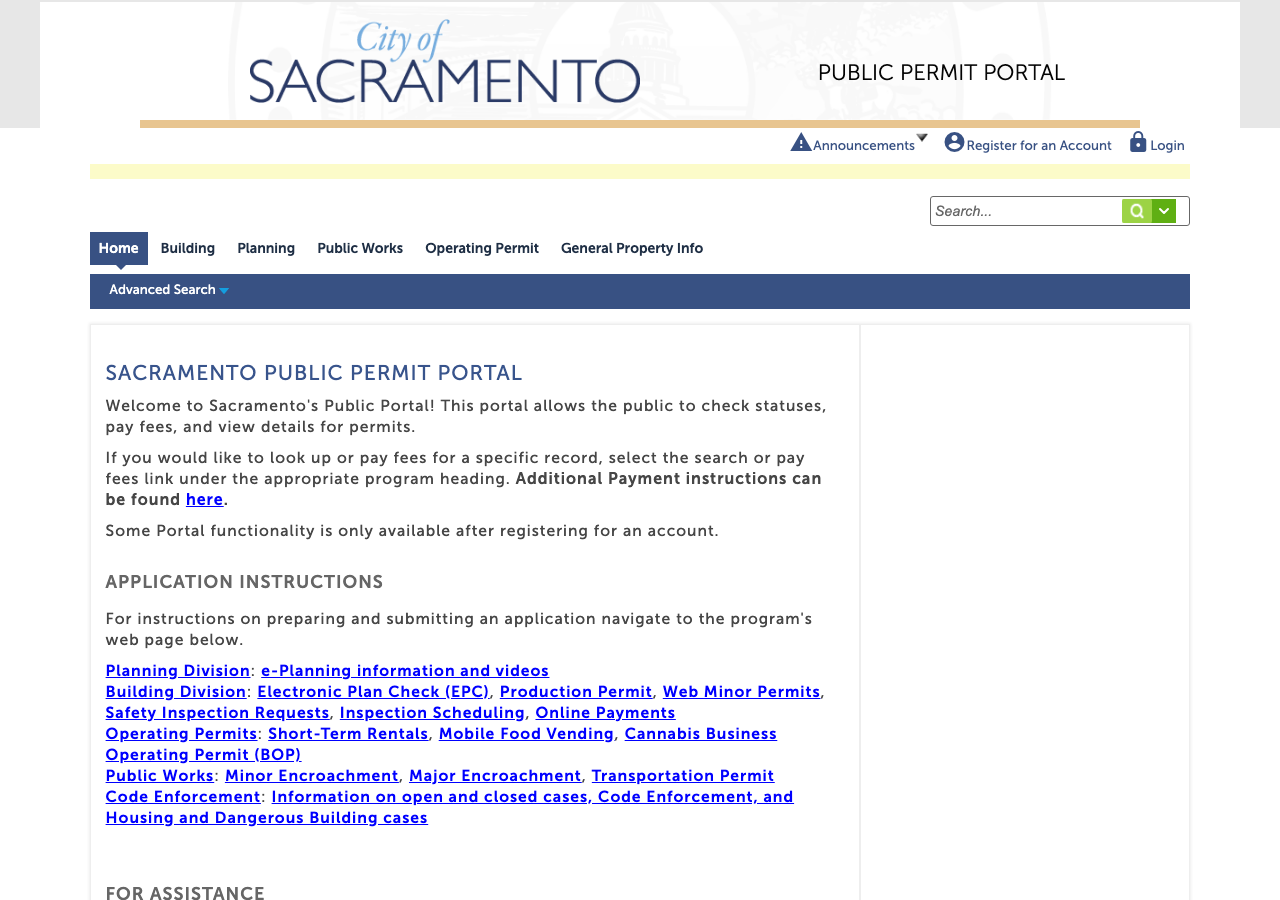
- Which permit portal does this authority use? Public Permit Portal — Accela Citizen Access (City of Sacramento instance) 90% · portal landing page
- Can the whole application be completed online? Yes 90% · department page
- What does a residential solar permit cost? $450 flat for a residential PV system up to 15 kW AC, plus $15.00 per kW for each kW above 15 kW. (A parallel $450 flat fee applies to residential ground-mounted solar water heater systems up to 120-gallon tanks.) 95% · fee schedule
- How is the fee calculated? Tiered — flat base fee up to a kW threshold, then a per-kW increment above it ($450 flat ≤15kW, then $15/kW above) 90% · fee schedule
- Is there a separate plan-check fee? No separate plan-check fee — the flat/tiered fee is described as covering 'application intake, Building Plan Review, Building Inspection' (and Planning review for commercial) in one number. 85% · fee schedule
-
Plan review — and start the utility in parallel
Interconnection is a separate process from the permit and usually the longer pole. Where the utility does not depend on the permit being issued, running both at once is the single biggest saving available on a residential job.
- What is the stated plan-review turnaround? 24 hours per review cycle (Cycle 1, 2, and 3 each listed as '24 hours') for Photovoltaic, Batteries, and EV Charging Stations 95% · department page (published cycle-time schedule)
- How long is an issued permit valid before it expires? Permit becomes null and void if work is not commenced within 12 months of issuance, or if commenced work is suspended/abandoned for 180 days. 60% · ordinance (secondary-sourced)
- Which utility handles interconnection here? SMUD (Sacramento Municipal Utility District) — a municipally owned utility, not PG&E, despite Sacramento sitting inside PG&E's broader NEM territory boundary in some third-party lookups. 95% · department page + utility site
- Where does the utility sit in the sequence? Before/parallel with permit issuance — the City's own permit workflow requires the SMUD interconnection letter (or SolarAPP+ approval bundle) to be uploaded as part of the building-permit application itself, and SMUD's customer-facing sequence describes SMUD reviewing/approving the interconnection application before the contractor 'obtains permits.' 80% · utility page + department page
27 questions answered against City of Sacramento’s own published documents
Q2 What does this authority permit itself, and what does it delegate? Core Jurisdiction & scope
Both — the City of Sacramento Building Division (Community Development Department) issues a single combined building/electrical permit for residential solar; SMUD (utility) separately approves interconnection but the city does not delegate its own permit authority to SMUD or anyone else.
Why the confidence is not higherResidential Solar page shows one city permit process requiring a 'SMUD interconnection letter' as an upload, i.e. SMUD's role is a prerequisite document, not a delegation of the city's permit/inspection authority.
department page checked 2026-08-30 https://www.cityofsacramento.gov/community-development/building/permit-services/residential-solar
Q3 Is a permit required for a residential rooftop PV system? Core Jurisdiction & scope
Yes
Why the confidence is not higherCity's Required Building Permits page lists the categories requiring a permit and the permit-exemption list does not include solar; the Residential Solar page describes a mandatory permit process (SolarAPP+ or standard).
department page checked 2026-08-30 https://www.cityofsacramento.gov/community-development/building/permit-services/required-permits
Q4 Is there a separate electrical permit, or is it combined? Core Jurisdiction & scope
Combined
Why the confidence is not higherThe city's 'Residential Solar' web permit type covers both structural/building and electrical scope in one submittal/one permit record (CDD-0198 checklist covers both structural and electrical requirements under one document).
department page + checklist checked 2026-08-30 https://www.cityofsacramento.gov/community-development/building/permit-services/residential-solar
Q5 Who is allowed to pull the electrical permit? Core Who may apply
Either — a licensed contractor (SMUD recommends C-10, C-46, or B) or the homeowner as owner-builder
Why the confidence is not higher'Anyone may apply' per Who May Apply page (property owner as owner-builder, or licensed contractor); SolarAPP+ path itself is restricted to licensed contractors only, but the standard non-SolarAPP+ path allows owner-builder.
department page checked 2026-08-30 https://www.cityofsacramento.gov/community-development/building/permit-services/who-may-apply-for-a-permit
Q6 Must the contractor be registered with this authority before applying? Core Who may apply
No separate city registration found beyond holding a valid CA state contractor license (verified via CSLB)
Why the confidence is not higherSolarAPP+ signup requires 'contractor license information' (state CSLB license) to register; no city-specific contractor registry was found on the Building Division pages reviewed.
department page checked 2026-08-30 https://www.cityofsacramento.gov/community-development/building/permit-services/residential-solar
Q7 Is a homeowner permitted to self-install and self-permit? Who may apply
Yes
Why the confidence is not higherWho May Apply page: property owners may pull permits as owner-builder and sign the state owner-builder verification; this is a general city rule, not a solar-specific carve-out (SolarAPP+ itself is contractor-only, but the standard path is open to owner-builders).
department page checked 2026-08-30 https://www.cityofsacramento.gov/community-development/building/permit-services/who-may-apply-for-a-permit
Q8 What documents make up a complete submittal? Core Submittal package
Non-SolarAPP+ path: CDD Building Application for Solar Energy Systems, SMUD interconnection letter, construction plans, and equipment specifications (site plan, roof framing plan, install details/cut sheets, one-line diagram, and structural calcs if a tile roof or >2 roofing overlays) per CDD-0198. SolarAPP+ path: SolarAPP+ approval documents + SolarAPP+ Approval ID + CDD Building Application for Solar Energy Systems + SMUD interconnection letter + construction plans.
Why the confidence is not higherDirectly from the Residential Solar page's step-by-step instructions and the CDD-0198 submission checklist (revised 01-01-2026).
department page + checklist checked 2026-08-30 https://www.cityofsacramento.gov/community-development/building/permit-services/residential-solar
Q9 How many copies, and in what format? Submittal package
Electronic only — no paper copies accepted
Why the confidence is not higherElectronic Plan Check page: 'All projects that require plan review must be submitted electronically through the Public Permit Portal... Paper plans will not be accepted.'
department page checked 2026-08-30 https://www.cityofsacramento.gov/community-development/building/permit-services/electronic-plan-check
Q10 Is a site plan required, and what must it show? Core Submittal package
Yes. Must be a scaled, dimensioned site plan showing: all property-line dimensions, dimensions/locations of all structures, location of all electric service and PV equipment (meters, inverters, AC & DC disconnects, new or existing), distance from property line to the equipment wall, bordering streets/alleys, and any fence/wall/tree within 5 ft of the PV equipment, plus a project-data block with owner/contractor contact info.
Why the confidence is not higherCDD-0198 Submission Checklist for Residential Photovoltaic Installations, 'General Requirements' item 1 (revised 01-01-2026).
checklist checked 2026-08-30 https://www.cityofsacramento.gov/content/dam/portal/cdd/Building/Forms/CDD-0198_Submission-Checklist-for-Res-Photovoltaic-Install.pdf
Q11 Is a one-line / three-line diagram required? Core Drawings & calculations
Yes
Why the confidence is not higherCDD-0198 'Electrical Requirements' item 2 requires a one-line diagram with load calcs, wire types/sizes, all associated equipment/disconnects, and grounding details.
checklist checked 2026-08-30 https://www.cityofsacramento.gov/content/dam/portal/cdd/Building/Forms/CDD-0198_Submission-Checklist-for-Res-Photovoltaic-Install.pdf
Q12 Are string and conductor calculations required? Drawings & calculations
Yes — load calculations for the arrays and wire types/sizes are required as part of the one-line diagram package; service load calcs required if derating the main breaker.
Why the confidence is not higherCDD-0198 Electrical Requirements item 2.
checklist checked 2026-08-30 https://www.cityofsacramento.gov/content/dam/portal/cdd/Building/Forms/CDD-0198_Submission-Checklist-for-Res-Photovoltaic-Install.pdf
Q13 Is a structural PE stamp required, and at what threshold? Core Engineering & stamps
Yes, for tile roofs (or systems with panels integrated into roof tiles) or roofs with more than two overlays of roofing material — structural calculations must be stamped and wet-signed by a California-licensed design professional. No PE stamp is required for a standard composition-shingle roof within these limits.
Why the confidence is not higherCDD-0198 'Structural Requirements' item 3.
checklist checked 2026-08-30 https://www.cityofsacramento.gov/content/dam/portal/cdd/Building/Forms/CDD-0198_Submission-Checklist-for-Res-Photovoltaic-Install.pdf
Q14 Is an electrical PE stamp required, and at what threshold? Engineering & stamps
No electrical PE stamp requirement found — the checklist asks only for manufacturer cut sheets and a one-line diagram, not a stamped electrical calculation package.
Why the confidence is not higherRead CDD-0198 'Electrical Requirements' in full; no PE-stamp language appears there (contrast with the explicit stamp requirement under Structural Requirements item 3).
checklist checked 2026-08-30 https://www.cityofsacramento.gov/content/dam/portal/cdd/Building/Forms/CDD-0198_Submission-Checklist-for-Res-Photovoltaic-Install.pdf
Q15 What does a residential solar permit cost? Core Fees
$450 flat for a residential PV system up to 15 kW AC, plus $15.00 per kW for each kW above 15 kW. (A parallel $450 flat fee applies to residential ground-mounted solar water heater systems up to 120-gallon tanks.)
Why the confidence is not higherCity of Sacramento Fees & Charges open-data record, Fee ID 3189 ('Streamlined Permit for Residential & Commercial Solar PV and Solar Water Heater Systems'), attached fee-detail sheet effective 19 Jul 2025, adopted by Resolution 2024-0153.
fee schedule checked 2026-08-30 https://services5.arcgis.com/54falWtcpty3V47Z/arcgis/rest/services/Fees_And_Charges/FeatureServer/1/11/attachments/10
Q16 How is the fee calculated? Core Fees
Tiered — flat base fee up to a kW threshold, then a per-kW increment above it ($450 flat ≤15kW, then $15/kW above)
Why the confidence is not higherSame fee-detail sheet as Q15.
fee schedule checked 2026-08-30 https://services5.arcgis.com/54falWtcpty3V47Z/arcgis/rest/services/Fees_And_Charges/FeatureServer/1/11/attachments/10
Q17 Is there a separate plan-check fee? Fees
No separate plan-check fee — the flat/tiered fee is described as covering 'application intake, Building Plan Review, Building Inspection' (and Planning review for commercial) in one number.
Why the confidence is not higherFee record 3189 long description: pre-configured fee 'cover[s] staff time expended as part of Planning review (on commercial projects), Building Plan Review, Building Inspection, and application intake.'
fee schedule checked 2026-08-30 https://services5.arcgis.com/54falWtcpty3V47Z/arcgis/rest/services/Fees_And_Charges/FeatureServer/1/11/attachments/10
Q18 What is the stated plan-review turnaround? Core Timeline & validity
24 hours per review cycle (Cycle 1, 2, and 3 each listed as '24 hours') for Photovoltaic, Batteries, and EV Charging Stations
Why the confidence is not higherCDD-0294 'Cycle Times for Building Plan Review', Residential table, revised 03-04-2026 — the fastest category listed, distinct from the 12-20 day cycles for other residential permit types.
department page (published cycle-time schedule) checked 2026-08-30 https://www.cityofsacramento.gov/content/dam/portal/cdd/Building/Forms/CDD-0294_Projected-Cycle-Times-for-Building-Plan-Review.pdf
Q19 How long is an issued permit valid before it expires? Timeline & validity
Permit becomes null and void if work is not commenced within 12 months of issuance, or if commenced work is suspended/abandoned for 180 days.
Why the confidence is not higherSacramento City Code §15.08.140 'Permits — Expiration of permits — Extension' — sourced via a secondary aggregation of the amlegal-hosted code text; amlegal's own page returned a Cloudflare challenge to direct fetch (both curl and WebFetch), so the primary text could not be independently re-verified in this run.
ordinance (secondary-sourced) checked 2026-08-30 https://codelibrary.amlegal.com/codes/sacramentoca/latest/sacramento_ca/0-0-0-28179
Q20 Which permit portal does this authority use? Core Portal & process
Public Permit Portal — Accela Citizen Access (City of Sacramento instance)
Why the confidence is not higherResidential Solar page repeatedly directs applicants to 'the City of Sacramento Public Permit Portal'; the live Accela instance is at this URL.
portal landing page checked 2026-08-30 https://aca-prod.accela.com/SACRAMENTO/Default.aspx
Q21 Can the whole application be completed online? Core Portal & process
Yes
Why the confidence is not higherResidential Solar page's step-by-step instructions show the entire flow — application, document upload, payment, and permit issuance — occurring online in the Public Permit Portal, with a Record Number issued after online payment.
department page checked 2026-08-30 https://www.cityofsacramento.gov/community-development/building/permit-services/residential-solar
Q22 Which utility handles interconnection here? Core Utility interconnection
SMUD (Sacramento Municipal Utility District) — a municipally owned utility, not PG&E, despite Sacramento sitting inside PG&E's broader NEM territory boundary in some third-party lookups.
Why the confidence is not higherCity's own Residential Solar page requires a 'SMUD interconnection letter' as a submittal item; SMUD's own site independently confirms it is the interconnecting utility for Sacramento addresses.
department page + utility site checked 2026-08-30 https://www.cityofsacramento.gov/community-development/building/permit-services/residential-solar
Q23 Where does the utility sit in the sequence? Core Utility interconnection
Before/parallel with permit issuance — the City's own permit workflow requires the SMUD interconnection letter (or SolarAPP+ approval bundle) to be uploaded as part of the building-permit application itself, and SMUD's customer-facing sequence describes SMUD reviewing/approving the interconnection application before the contractor 'obtains permits.'
Why the confidence is not higherResidential Solar page upload requirements; SMUD 'Getting Started with Solar' page, Step 4: 'SMUD reviews and approves the application. Your contractor obtains permits, installs the system and has it inspected.'
utility page + department page checked 2026-08-30 https://www.smud.org/Going-Green/Solar-for-Your-Home/Getting-started
Q24 Is a HOA or architectural approval required first? Overlays & special cases
No — not required by the city as part of its permit submittal
Why the confidence is not higherCDD-0198's submission checklist itemizes every required document and does not include HOA/architectural approval; California Civil Code §714 independently limits HOA authority to block solar, which the city's own zoning-ordinance definition of 'small residential rooftop solar energy system' cross-references.
checklist (absence) + ordinance cross-reference checked 2026-08-30 https://www.cityofsacramento.gov/content/dam/portal/cdd/Building/Forms/CDD-0198_Submission-Checklist-for-Res-Photovoltaic-Install.pdf
Q25 Is there a historic-district review? Overlays & special cases
Yes, if the property sits within a design review district, preservation district, or is a historic landmark — the general permit-exemption list is void in those areas, and CDD-0198 requires the applicant to meet with Planning staff before submittal to confirm zoning/overlay compliance.
Why the confidence is not higherRequired Building Permits page: '*Unless within a design review or preservation district (or a historic landmark)'; CDD-0198 General Requirements item 2.
department page checked 2026-08-30 https://www.cityofsacramento.gov/community-development/building/permit-services/required-permits
Q26 Is a wind or windstorm certification required? Overlays & special cases
No windstorm/insurance-style certification found or applicable — California does not operate a Texas-Department-of-Insurance-style windstorm certification program; structural wind loading is instead addressed through the adopted California Building Code design provisions.
Why the confidence is not higherCDD-0198's full Structural and Electrical Requirements sections list every document the city requires, and none references a windstorm certificate.
checklist (absence) checked 2026-08-30 https://www.cityofsacramento.gov/content/dam/portal/cdd/Building/Forms/CDD-0198_Submission-Checklist-for-Res-Photovoltaic-Install.pdf
Q27 Is a Specific Use Permit or Council approval ever required? Overlays & special cases
No Specific Use Permit or Council approval identified as required for a typical accessory residential rooftop PV system — the zoning code treats solar as an allowed accessory feature with its own dimensional standards (height variance / yard projection allowance) rather than a discretionary use.
Why the confidence is not higherSacramento City Code §17.600.145 (solar energy systems standards), located via search summary; the primary amlegal text could not be directly re-fetched in this run (Cloudflare-blocked), so this is a lower-confidence secondary-sourced finding.
ordinance (secondary-sourced) checked 2026-08-30 https://codelibrary.amlegal.com/codes/sacramentoca/latest/sacramento_ca/0-0-0-28065
Q28 Is there a system-size cap on residential generation? Overlays & special cases
No single hard generation cap found for the standard permit path (the fee schedule scales per kW indefinitely above 15kW with no stated ceiling). The SolarAPP+ expedited path is limited by the SolarAPP+ program's own eligibility rules (1-2 unit residential/ADU only); SMUD separately caps exports to about 110% of the customer's own electrical usage on its interconnection side.
Why the confidence is not higherFee-detail sheet (Q15 source) shows uncapped per-kW scaling; Residential Solar page SolarAPP+ eligibility section; SMUD Residential Interconnection Checklist.
fee schedule + utility checklist checked 2026-08-30 https://www.smud.org/-/media/Documents/Going-Green/Solar-and-Storage/Residential-Solar-Interconnection-Checklist.ashx
Lines marked with a percentage were read off this authority’s own published documents. Unmarked guidance is general good practice, not this jurisdiction’s rule — always confirm against the authority before you submit.
Install 5 steps · 20 questions
-
Build to the code editions actually in force here
The NEC edition a jurisdiction enforces is often a cycle behind the newest one published, and local amendments sit on top of it. Rapid shutdown, conductor sizing and labelling all change between editions, so the edition in force is the first thing to establish, not the last.
- Which NEC edition is in force? 2023 95% · adopting ordinance
- Which building code edition is in force? 2025 California Building Standards Code (CBC based on the 2024 IBC; CRC based on the 2024 IRC), effective 1 Jan 2026, with Sacramento local amendments 95% · adopting ordinance + department page
- Which fire code edition is in force? 2022 California Fire Code (Sacramento City Code Chapter 15.36) was the last edition I could confirm — an archived snapshot from 31 Dec 2025 (one day before the 2025 building-code cycle took effect) still shows the chapter titled '2022 CALIFORNIA FIRE CODE.' I could not confirm whether the city has since adopted the 2025 California Fire Code alongside its 2025 building-code ordinance, because amlegal's chapter content is a JavaScript app that returned a Cloudflare challenge page to both a direct fetch and a Wayback Machine deep-link fetch. 55% · code library (archived, possibly stale)
- Are there local amendments to any of the above? Yes 90% · adopting ordinance
- What is the installation judged against? The 2025 California Building Standards Code (2024 IBC/IRC-based CBC/CRC) and 2025 California Electrical Code (2023 NEC-based), as locally amended by Ordinance 2025-0031, plus SMUD's Electric Service Requirements (T014) for interconnection equipment/metering. 85% · adopting ordinance
-
Fire access, setbacks and pathways
Ridge setbacks and roof access pathways are fire-service requirements and they constrain the array layout. They are the most common cause of a redesign after the fire department comments on a plan set.
Nothing recorded for City of Sacramento on this step yet — 1 question checked and found unpublished. The guidance above is general.
-
Rapid shutdown
Which rapid-shutdown rule applies follows directly from the NEC edition in force, and the initiation device has to be at a location the fire service can reach and identify. This is inspected, and it is labelled.
- Is rapid shutdown required, and to which NEC edition? Yes, rapid shutdown is required under NEC 690.12 as incorporated into the 2023-NEC-based 2025 California Electrical Code, which is the edition Sacramento has adopted (Ordinance 2025-0031). This is a statewide NEC requirement rather than a city-specific carve-out; CDD-0198 does not name '690.12' explicitly but requires full grounding/one-line documentation consistent with it. 75% · adopting ordinance (inferred from code edition)
-
Labels and placards
The NEC sets a baseline for permanent markings at the service equipment and the disconnecting means. On top of that, an authority may specify its own wording, and the utility may specify more again. Where any of them writes its own text, a generic off-the-shelf label set will not pass — this is the detail most often fixed on a return visit.
- Which placards does this authority require at the service equipment? The city does not publish its own placard specification for solar beyond requiring code compliance; the required placards are the standard NEC/CEC-mandated set (service disconnect marking, PV system disconnect identification, rapid-shutdown label, etc.). SMUD's own Electric Service Requirements state: 'Labels shall conform to the current California Electric Code, NEC, and Authority Having Jurisdiction' — i.e. the utility defers to the code and to whichever AHJ applies rather than adding a distinct citywide placard of its own. 65% · utility engineering spec
- Does the authority specify placard wording of its own? No — the city's own checklist (CDD-0198) specifies no placard wording of its own, and SMUD's ESR explicitly defers labeling to 'the current California Electric Code, NEC, and Authority Having Jurisdiction' rather than dictating its own wording. 70% · checklist + utility engineering spec (absence)
- Does the UTILITY specify placards beyond the AHJ's? Yes, in specific configurations. SMUD's Electric Service Requirements (T014) require: the Power Production Meter and Visible Disconnect Device be within sight and within 10 ft of each other with no obstruction (§7.1.4, §8.6); an ESS disconnect within 10 ft of the utility meter, or if that is not achievable, a 'geolocation placard' at each disconnect showing the location of the others (§7.3.5.1-.3); and where PV AC/DC and ESS disconnects are not within sight of each other, placards/directories must be installed at each disconnect location indicating where all others are (§7.3.6.5). For labeling wording specifically, though, SMUD defers to the CEC/NEC/AHJ (§10) rather than prescribing its own. 85% · utility engineering spec
- Where must the labels be placed? At the utility meter, at the main service panel, and at each disconnect: the Power Production Meter and Visible Disconnect Device(s) must be installed in a location readily accessible to SMUD 24/7/365, within sight and within 10 ft of each other with no obstruction between them; an ESS disconnect must be within 10 ft of the Main Panel/utility meter or within line of sight of it, with geolocation placards required at each disconnect otherwise. 85% · utility engineering spec
-
Disconnect, storage and listed equipment
Where the AC disconnect must sit relative to the meter is usually the utility's rule, not the building department's. Battery storage frequently carries its own permit, its own inspection and its own fire conditions.
- Where must the AC disconnect be, relative to the meter? The AC (Visible) Disconnect Device and the Power Production Meter must be located within sight of each other and within 10 feet, with no obstruction in between; where that is not achievable, SMUD requires an alternate arrangement it must approve (e.g., an additional disconnect, or labeling per NEC/AHJ). 90% · utility engineering spec
- Must equipment be on a specific approved list? Yes — PV modules and inverters must be CEC-listed/approved, and all equipment must be approved by a Nationally Recognized Testing Laboratory (NRTL). 85% · utility checklist + engineering spec
- Are batteries permitted, and under what conditions? Yes, batteries/ESS are permitted, subject to SMUD's Electric Service Requirements conditions: a disconnect switch dedicated to the ESS, located within 10 ft of and within sight of the main service equipment (or a geolocation placard otherwise), proper disconnect ordering relative to the DG and load, and compliance with NEC/AHJ labeling. On the city side, ESS/batteries are reviewed under the same fast 24-hour cycle-time category as PV. 80% · utility engineering spec + department cycle-time schedule
- Is there a separate ESS permit or inspection? No distinct separate ESS permit/inspection type was identified — the city's own plan-review cycle-time schedule groups 'Photovoltaic, Batteries, EV Charging Stations' as a single residential review category rather than listing ESS separately. 55% · department cycle-time schedule (absence)
- Is there a local rule on service upgrades or busbar sizing? No Sacramento-specific local amendment on service-upgrade sizing or busbar rating was found; CDD-0198 only asks for 'service load calculations if derating the main breaker,' which is standard NEC 705.12 practice rather than a distinct city rule. 60% · checklist (absence) + ordinance
- Is a specific mounting system or attachment spacing required? No prescriptive spacing number is published by the city itself — CDD-0198 requires the applicant to 'provide enough information to clearly verify the size, type, and spacing of all fasteners' via manufacturer installation instructions and cut sheets, with a stamped structural calc required for tile roofs or >2 roofing overlays. 80% · checklist
20 questions answered against City of Sacramento’s own published documents
Q29 Which NEC edition is in force? Core Code editions in force
2023
Why the confidence is not higherSacramento City Code §15.04.050 (as amended by Ordinance 2025-0031, effective 1 Jan 2026): 'The CEC[California Electrical Code, 2025 Edition]...is based on and...amends the provisions of the 2023 National Electrical Code.'
adopting ordinance checked 2026-08-30 https://www.cityofsacramento.gov/content/dam/portal/cdd/Building/building-codes/OR2025-0031-Ordinance-Deleting-Chapter-15.38-Amending-Various-Provisions-of-Title-15-Adopting-Local-Amendments-CA-BSC_2025-1202.pdf
Q30 Which building code edition is in force? Core Code editions in force
2025 California Building Standards Code (CBC based on the 2024 IBC; CRC based on the 2024 IRC), effective 1 Jan 2026, with Sacramento local amendments
Why the confidence is not higherOrdinance 2025-0031, adopted 2 Dec 2025, amending Sac. City Code §15.04.050; City's own Building Codes page confirms 'As of January 1, 2026, the City of Sacramento is requiring all new plan review and permit applications to comply with the 2025 California Building Standards Codes.'
adopting ordinance + department page checked 2026-08-30 https://www.cityofsacramento.gov/community-development/building/building-codes
Q31 Which fire code edition is in force? Code editions in force
2022 California Fire Code (Sacramento City Code Chapter 15.36) was the last edition I could confirm — an archived snapshot from 31 Dec 2025 (one day before the 2025 building-code cycle took effect) still shows the chapter titled '2022 CALIFORNIA FIRE CODE.' I could not confirm whether the city has since adopted the 2025 California Fire Code alongside its 2025 building-code ordinance, because amlegal's chapter content is a JavaScript app that returned a Cloudflare challenge page to both a direct fetch and a Wayback Machine deep-link fetch.
Why the confidence is not higherWayback Machine capture of the amlegal chapter-15.36 landing page, 31 Dec 2025.
code library (archived, possibly stale) checked 2026-08-30 https://web.archive.org/web/20251231120225/https://codelibrary.amlegal.com/codes/sacramentoca/latest/sacramento_ca/0-0-0-28378
Q32 Are there local amendments to any of the above? Core Code editions in force
Yes
Why the confidence is not higherOrdinance 2025-0031 itself is a local-amendment ordinance: 'the amendments are reasonably necessary because of local climatic, geological, or topographical conditions' — amending CBC/CRC/CEC/CMC/CPC provisions.
adopting ordinance checked 2026-08-30 https://www.cityofsacramento.gov/content/dam/portal/cdd/Building/building-codes/OR2025-0031-Ordinance-Deleting-Chapter-15.38-Amending-Various-Provisions-of-Title-15-Adopting-Local-Amendments-CA-BSC_2025-1202.pdf
Q33 What is the installation judged against? Core Electrical
The 2025 California Building Standards Code (2024 IBC/IRC-based CBC/CRC) and 2025 California Electrical Code (2023 NEC-based), as locally amended by Ordinance 2025-0031, plus SMUD's Electric Service Requirements (T014) for interconnection equipment/metering.
Why the confidence is not higherOrdinance 2025-0031; SMUD ESR T014.
adopting ordinance checked 2026-08-30 https://www.cityofsacramento.gov/content/dam/portal/cdd/Building/building-codes/OR2025-0031-Ordinance-Deleting-Chapter-15.38-Amending-Various-Provisions-of-Title-15-Adopting-Local-Amendments-CA-BSC_2025-1202.pdf
Q34 Is there a local rule on service upgrades or busbar sizing? Electrical
No Sacramento-specific local amendment on service-upgrade sizing or busbar rating was found; CDD-0198 only asks for 'service load calculations if derating the main breaker,' which is standard NEC 705.12 practice rather than a distinct city rule.
Why the confidence is not higherCDD-0198 Electrical Requirements item 2; Ordinance 2025-0031's list of amended CBC/CRC/CEC sections (reviewed in full) does not include a busbar/service-upgrade-specific solar provision.
checklist (absence) + ordinance checked 2026-08-30 https://www.cityofsacramento.gov/content/dam/portal/cdd/Building/Forms/CDD-0198_Submission-Checklist-for-Res-Photovoltaic-Install.pdf
Q35 Is a specific mounting system or attachment spacing required? Structural & mounting
No prescriptive spacing number is published by the city itself — CDD-0198 requires the applicant to 'provide enough information to clearly verify the size, type, and spacing of all fasteners' via manufacturer installation instructions and cut sheets, with a stamped structural calc required for tile roofs or >2 roofing overlays.
Why the confidence is not higherCDD-0198 Structural Requirements items 2-3.
checklist checked 2026-08-30 https://www.cityofsacramento.gov/content/dam/portal/cdd/Building/Forms/CDD-0198_Submission-Checklist-for-Res-Photovoltaic-Install.pdf
Q36 What ridge setback and access pathways are required? Core Fire pathways & setbacks
Nothing published by this authority.
Where we lookedSacramento City Code Chapter 15.36 (local fire code amendments) via codelibrary.amlegal.com — both a direct fetch (WebFetch and curl with browser UA/referer) and a Wayback Machine deep-link fetch of the specific amendment sub-page (0-0-0-28394) returned either a Cloudflare 'Just a moment...' challenge or no archived snapshot at all. Could not confirm whether Sacramento's local fire-code amendments modify the standard CFC rooftop-access/ridge-setback pathway requirements for PV.
https://codelibrary.amlegal.com/codes/sacramentoca/latest/sacramento_ca/0-0-0-28394
Q37 Is rapid shutdown required, and to which NEC edition? Core Rapid shutdown
Yes, rapid shutdown is required under NEC 690.12 as incorporated into the 2023-NEC-based 2025 California Electrical Code, which is the edition Sacramento has adopted (Ordinance 2025-0031). This is a statewide NEC requirement rather than a city-specific carve-out; CDD-0198 does not name '690.12' explicitly but requires full grounding/one-line documentation consistent with it.
Why the confidence is not higherOrdinance 2025-0031 (2023 NEC adoption); CDD-0198.
adopting ordinance (inferred from code edition) checked 2026-08-30 https://www.cityofsacramento.gov/content/dam/portal/cdd/Building/building-codes/OR2025-0031-Ordinance-Deleting-Chapter-15.38-Amending-Various-Provisions-of-Title-15-Adopting-Local-Amendments-CA-BSC_2025-1202.pdf
Q38 Which placards does this authority require at the service equipment? Core Labels Signage & labelling
The city does not publish its own placard specification for solar beyond requiring code compliance; the required placards are the standard NEC/CEC-mandated set (service disconnect marking, PV system disconnect identification, rapid-shutdown label, etc.). SMUD's own Electric Service Requirements state: 'Labels shall conform to the current California Electric Code, NEC, and Authority Having Jurisdiction' — i.e. the utility defers to the code and to whichever AHJ applies rather than adding a distinct citywide placard of its own.
Why the confidence is not higherSMUD ESR T014 §10 'Labeling'; CDD-0198 contains no placard-wording requirement.
utility engineering spec checked 2026-08-30 https://www.smud.org/-/media/Documents/Business-Solutions-and-Rebates/Design-and-Constructions-Services/T014-Residential-Rev-7_2025-with-Cover-Page.ashx
Q39 Does the authority specify placard wording of its own? Core Labels Signage & labelling
No — the city's own checklist (CDD-0198) specifies no placard wording of its own, and SMUD's ESR explicitly defers labeling to 'the current California Electric Code, NEC, and Authority Having Jurisdiction' rather than dictating its own wording.
Why the confidence is not higherCDD-0198 (absence); SMUD ESR T014 §10.
checklist + utility engineering spec (absence) checked 2026-08-30 https://www.smud.org/-/media/Documents/Business-Solutions-and-Rebates/Design-and-Constructions-Services/T014-Residential-Rev-7_2025-with-Cover-Page.ashx
Q40 Does it specify letter height, colour or material? Core Labels Signage & labelling
Nothing published by this authority.
Where we lookedCDD-0198 (Residential PV Submission Checklist, full text read) and SMUD ESR T014 (full labeling section read) — neither specifies letter height, color, or material for any required placard/label; both only require conformance to 'the current CEC, NEC, and Authority Having Jurisdiction.'
Q41 Is a site plan / facility map placard required, and what must it show? Core Labels Signage & labelling
Nothing published by this authority.
Where we lookedResidential Solar page, CDD-0198 checklist, and SMUD ESR T014 — CDD-0198 requires a site plan drawing as part of the plan-check submittal, but no document reviewed described a posted/onsite 'facility map' placard requirement distinct from that submittal drawing.
Q42 Does the UTILITY specify placards beyond the AHJ's? Core Labels Signage & labelling
Yes, in specific configurations. SMUD's Electric Service Requirements (T014) require: the Power Production Meter and Visible Disconnect Device be within sight and within 10 ft of each other with no obstruction (§7.1.4, §8.6); an ESS disconnect within 10 ft of the utility meter, or if that is not achievable, a 'geolocation placard' at each disconnect showing the location of the others (§7.3.5.1-.3); and where PV AC/DC and ESS disconnects are not within sight of each other, placards/directories must be installed at each disconnect location indicating where all others are (§7.3.6.5). For labeling wording specifically, though, SMUD defers to the CEC/NEC/AHJ (§10) rather than prescribing its own.
Why the confidence is not higherSMUD Electric Service Requirements — Residential Distributed Generation, Engineering Spec T014 (dated February 2026 on its title page, despite the published filename saying 'Rev-7_2025' — dated from the document's own revision stamp per the source itself, not the URL).
utility engineering spec checked 2026-08-30 https://www.smud.org/-/media/Documents/Business-Solutions-and-Rebates/Design-and-Constructions-Services/T014-Residential-Rev-7_2025-with-Cover-Page.ashx
Q43 Where must the labels be placed? Core Labels Signage & labelling
At the utility meter, at the main service panel, and at each disconnect: the Power Production Meter and Visible Disconnect Device(s) must be installed in a location readily accessible to SMUD 24/7/365, within sight and within 10 ft of each other with no obstruction between them; an ESS disconnect must be within 10 ft of the Main Panel/utility meter or within line of sight of it, with geolocation placards required at each disconnect otherwise.
Why the confidence is not higherSMUD ESR T014 §§7.1.4, 7.3.5, 7.3.9, 8.3, 8.6.
utility engineering spec checked 2026-08-30 https://www.smud.org/-/media/Documents/Business-Solutions-and-Rebates/Design-and-Constructions-Services/T014-Residential-Rev-7_2025-with-Cover-Page.ashx
Q44 Must equipment be on a specific approved list? Equipment listing
Yes — PV modules and inverters must be CEC-listed/approved, and all equipment must be approved by a Nationally Recognized Testing Laboratory (NRTL).
Why the confidence is not higherSMUD Residential Interconnection Checklist: 'Ensure PV equipment and inverter are listed and approved by the CEC'; SMUD ESR T014 §8.8: 'All equipment shall be approved by a National Recognized Testing Laboratory (NRTL).'
utility checklist + engineering spec checked 2026-08-30 https://www.smud.org/-/media/Documents/Going-Green/Solar-and-Storage/Residential-Solar-Interconnection-Checklist.ashx
Q45 Are batteries permitted, and under what conditions? Core Battery / ESS
Yes, batteries/ESS are permitted, subject to SMUD's Electric Service Requirements conditions: a disconnect switch dedicated to the ESS, located within 10 ft of and within sight of the main service equipment (or a geolocation placard otherwise), proper disconnect ordering relative to the DG and load, and compliance with NEC/AHJ labeling. On the city side, ESS/batteries are reviewed under the same fast 24-hour cycle-time category as PV.
Why the confidence is not higherSMUD ESR T014 §7.3 (ESS provisions); CDD-0294 groups 'Photovoltaic, Batteries, EV Charging Stations' as one review category.
utility engineering spec + department cycle-time schedule checked 2026-08-30 https://www.smud.org/-/media/Documents/Business-Solutions-and-Rebates/Design-and-Constructions-Services/T014-Residential-Rev-7_2025-with-Cover-Page.ashx
Q46 Is there a separate ESS permit or inspection? Battery / ESS
No distinct separate ESS permit/inspection type was identified — the city's own plan-review cycle-time schedule groups 'Photovoltaic, Batteries, EV Charging Stations' as a single residential review category rather than listing ESS separately.
Why the confidence is not higherCDD-0294 Residential table (single combined row for PV/Batteries/EV chargers).
department cycle-time schedule (absence) checked 2026-08-30 https://www.cityofsacramento.gov/content/dam/portal/cdd/Building/Forms/CDD-0294_Projected-Cycle-Times-for-Building-Plan-Review.pdf
Q47 Is a ground mount treated as a structure? Core Ground mount
Nothing published by this authority.
Where we lookedRequired Building Permits page and CDD-0198 checklist — neither addresses ground-mounted PV racking specifically or states whether it is treated as an accessory structure under the building code.
https://www.cityofsacramento.gov/community-development/building/permit-services/required-permits
Q48 Where must the AC disconnect be, relative to the meter? Core Utility equipment
The AC (Visible) Disconnect Device and the Power Production Meter must be located within sight of each other and within 10 feet, with no obstruction in between; where that is not achievable, SMUD requires an alternate arrangement it must approve (e.g., an additional disconnect, or labeling per NEC/AHJ).
Why the confidence is not higherSMUD Electric Service Requirements — Residential DG, T014, §§7.1.4 and 8.6 (title page dated February 2026).
utility engineering spec checked 2026-08-30 https://www.smud.org/-/media/Documents/Business-Solutions-and-Rebates/Design-and-Constructions-Services/T014-Residential-Rev-7_2025-with-Cover-Page.ashx
Lines marked with a percentage were read off this authority’s own published documents. Unmarked guidance is general good practice, not this jurisdiction’s rule — always confirm against the authority before you submit.
Inspection 5 steps · 14 questions
-
Book it
Booking is a portal, a phone call or an email depending on the authority, and the notice required is rarely zero. Book before the work is finished rather than after — the lead time, not the work, is usually what sets the date.
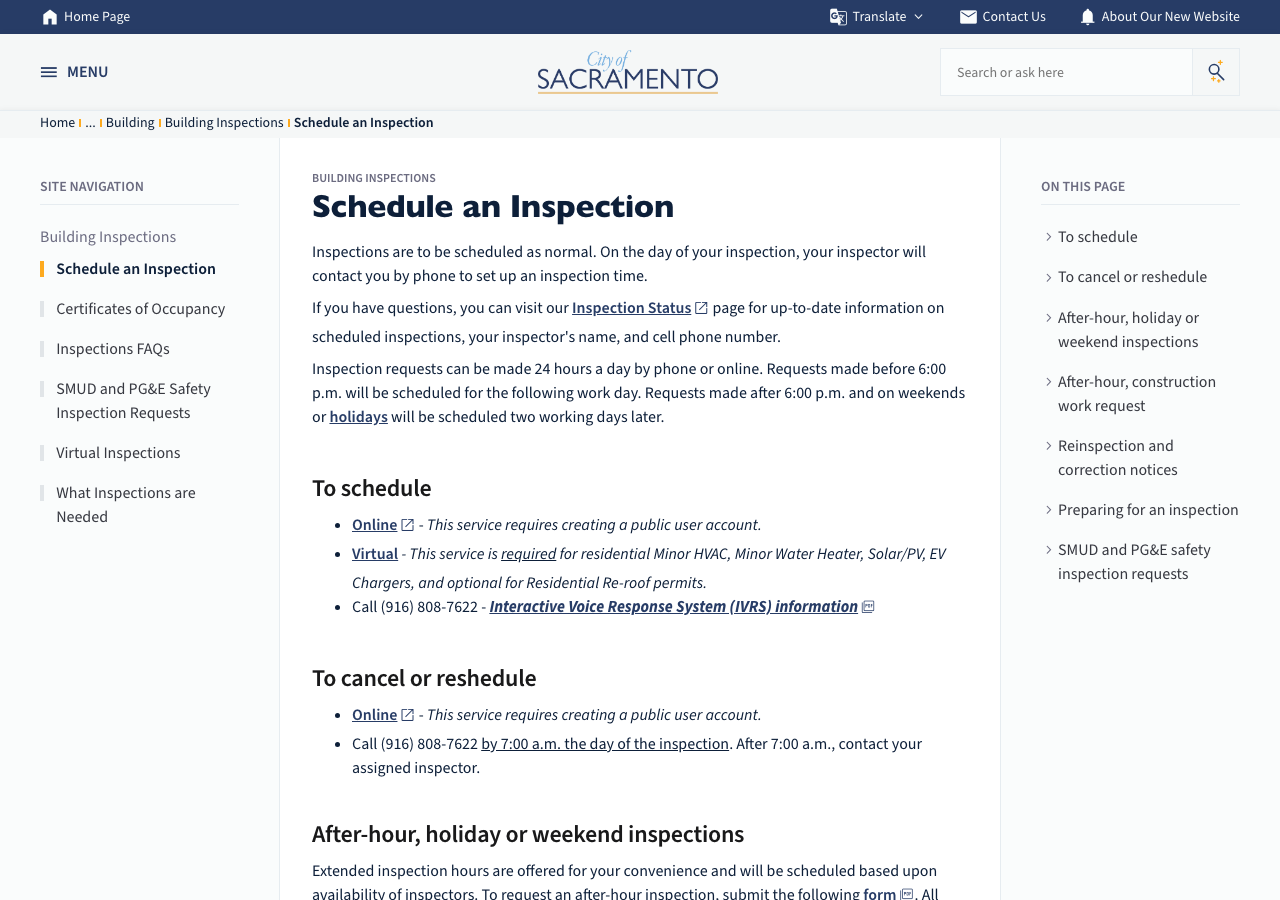
- How is an inspection booked? Portal (Public Permit Portal / VuSpex for the now-mandatory virtual solar inspection) or Phone (916-808-7622, 24-hour IVRS) 90% · department page
- How much notice is required? At least 1 business day — requests made before 6:00 p.m. are scheduled for the next work day; requests after 6:00 p.m. or on a weekend/holiday are scheduled two working days later. The 'What Inspections are Needed' page separately states 'At least one business day prior to your anticipated inspection date, schedule an inspection.' 90% · department page
- Are same-day or AM/PM windows offered? No AM/PM window is offered for standard in-person inspections — the inspector calls the applicant by phone on the day of inspection to arrange a time. Virtual (VuSpex) inspections, which are now mandatory for Solar/PV, instead give a confirmed appointment time slot at scheduling. 75% · department page
-
Know who turns up
Some authorities inspect their own solar work; some delegate it, and a few do not inspect the PV equipment itself at all. Who is coming determines what they will look at.
- Does this AHJ perform its own final solar inspection? Yes — the city performs its own final solar inspection, but as of 12 Jan 2026 it must be done virtually via the VuSpex platform for residential Solar/PV permits (mandatory, not optional). 90% · department page
- If delegated, to whom? N/A — not delegated; performed by the City of Sacramento Building Division itself (via mandatory virtual/VuSpex inspection). 85% · department page
-
Work the stages in order
A rough-in or mid-roof inspection, where one is required, has to happen before the work it covers is closed up. Missing a stage means opening something back up, and it is the most expensive kind of correction.
- Which inspections are required, and in what order? For the Solar/PV web-permit type, the listed available inspection types are Virtual Electrical Final and Virtual Building Final — i.e. a final-stage inspection, not a staged sequence of rough-in/frame/final like new construction. 70% · department page
- Is a rough-in or mid-roof inspection required? No — no rough-in or mid-roof inspection stage is listed for the Solar/PV web-permit type; only final inspection types (Virtual Electrical Final / Virtual Building Final) are listed as available for it. 65% · department page (absence)
-
Have the paperwork on site
The approved plan set, the permit, and the equipment listings should be on site and reachable. Inspectors routinely verify that installed equipment matches what was approved, and that the labels are the ones the plan set promised.
- Is there a published inspection checklist? No solar/PV-specific inspection checklist is published — the 'What Inspections are Needed' page publishes checklists only for Residential Frame, Slab-on-Grade, Raised-Floor Foundation, and SMUD/PG&E Safety Inspections; Solar/PV is not among the listed checklist types (a separate document, CDD-0198, is a submittal/plan checklist, not an inspection checklist). 65% · department page (absence)
- What must be on site at inspection? Approved plans and documents, the inspection permit jacket, an adult (18+) present to provide access (for most projects — small exterior-only work like some re-roofs may be inspected without anyone present), all work uncovered/unconcealed, adequate lighting in inspection areas, and household pets secured away from the site. 90% · department page
- Does the inspector verify labels and listings? Likely yes, though not stated in a solar-specific checklist — the Virtual Inspections 'tips for success' instruct the applicant to ensure the camera/lighting lets the inspector 'clearly see all required elements,' and SMUD/CEC listing is a submittal requirement the inspector would be verifying against the approved plans on file. 60% · department page (inference)
-
Sign-off, and permission to operate
Passing gives you a final or an equivalent sign-off. That is not the same as permission to operate: PTO comes from the utility, and who tells the utility the inspection passed varies. A system left switched off for weeks is usually waiting on this handover.
- What is issued on pass? Final — a residential 1-2 unit solar retrofit closes out on a passed final inspection/permit finaled; the city's Certificate of Occupancy process (TCO/CO) is described as applying to commercial new buildings, additions, remodels, and tenant improvements, not routine residential alterations like a PV retrofit. 70% · department page (inference)
- Who notifies the utility for PTO? Installer/contractor — SMUD requires the customer/contractor to complete and submit the online interconnection application and obtain SMUD's approval, and SMUD's own 'Getting Started' sequence has the contractor completing the process end-to-end (permits, install, inspection) before 'SMUD does a final safety inspection and meter installation'; SMUD does not describe the city as the party that notifies it. 55% · utility page
- Is there a re-inspection fee? $216 minimum (one hour at the Building Division's staff hourly rate), charged at the inspector's discretion after repeated inspections show no progress. 85% · fee schedule
- How are corrections issued and cleared? The inspector issues a correction notice at the failed inspection; the applicant/contractor completes the corrections and reschedules the reinspection once ready, and a reinspection fee may be assessed if the corrections are found incomplete at the reinspection. 85% · department page
14 questions answered against City of Sacramento’s own published documents
Q49 How is an inspection booked? Core Booking & scheduling
Portal (Public Permit Portal / VuSpex for the now-mandatory virtual solar inspection) or Phone (916-808-7622, 24-hour IVRS)
Why the confidence is not higherSchedule an Inspection page: 'Inspection requests can be made 24 hours a day by phone or online... Virtual - This service is required for residential Minor HVAC, Minor Water Heater, Solar/PV, EV Chargers.'
department page checked 2026-08-30 https://www.cityofsacramento.gov/community-development/building/inspections/schedule-inspection
Q50 How much notice is required? Core Booking & scheduling
At least 1 business day — requests made before 6:00 p.m. are scheduled for the next work day; requests after 6:00 p.m. or on a weekend/holiday are scheduled two working days later. The 'What Inspections are Needed' page separately states 'At least one business day prior to your anticipated inspection date, schedule an inspection.'
Why the confidence is not higherSchedule an Inspection page.
department page checked 2026-08-30 https://www.cityofsacramento.gov/community-development/building/inspections/schedule-inspection
Q51 Are same-day or AM/PM windows offered? Booking & scheduling
No AM/PM window is offered for standard in-person inspections — the inspector calls the applicant by phone on the day of inspection to arrange a time. Virtual (VuSpex) inspections, which are now mandatory for Solar/PV, instead give a confirmed appointment time slot at scheduling.
Why the confidence is not higherSchedule an Inspection page ('your inspector will contact you by phone to set up an inspection time'); Virtual Inspections page ('you'll be able to set up an appointment and will receive a confirmed time slot').
department page checked 2026-08-30 https://www.cityofsacramento.gov/community-development/building/inspections/virtual-inspections
Q52 Does this AHJ perform its own final solar inspection? Core Who inspects
Yes — the city performs its own final solar inspection, but as of 12 Jan 2026 it must be done virtually via the VuSpex platform for residential Solar/PV permits (mandatory, not optional).
Why the confidence is not higherVirtual Inspections page: 'Starting January 12, 2026, virtual inspections will be required for the following residential web permit types: Minor HVAC, Minor Water Heater, Solar/PV, EV Chargers.'
department page checked 2026-08-30 https://www.cityofsacramento.gov/community-development/building/inspections/virtual-inspections
Q53 If delegated, to whom? Core Who inspects
N/A — not delegated; performed by the City of Sacramento Building Division itself (via mandatory virtual/VuSpex inspection).
Why the confidence is not higherSame source as Q52.
department page checked 2026-08-30 https://www.cityofsacramento.gov/community-development/building/inspections/virtual-inspections
Q54 Which inspections are required, and in what order? Core Stages & sequence
For the Solar/PV web-permit type, the listed available inspection types are Virtual Electrical Final and Virtual Building Final — i.e. a final-stage inspection, not a staged sequence of rough-in/frame/final like new construction.
Why the confidence is not higherVirtual Inspections page 'Available Inspection Types' list.
department page checked 2026-08-30 https://www.cityofsacramento.gov/community-development/building/inspections/virtual-inspections
Q55 Is a rough-in or mid-roof inspection required? Stages & sequence
No — no rough-in or mid-roof inspection stage is listed for the Solar/PV web-permit type; only final inspection types (Virtual Electrical Final / Virtual Building Final) are listed as available for it.
Why the confidence is not higherVirtual Inspections page; 'What Inspections are Needed' page lists Frame/Foundation checklists for new construction but no separate solar rough-in checklist.
department page (absence) checked 2026-08-30 https://www.cityofsacramento.gov/community-development/building/inspections/virtual-inspections
Q56 Does the inspector verify labels and listings? Core What is checked
Likely yes, though not stated in a solar-specific checklist — the Virtual Inspections 'tips for success' instruct the applicant to ensure the camera/lighting lets the inspector 'clearly see all required elements,' and SMUD/CEC listing is a submittal requirement the inspector would be verifying against the approved plans on file.
Why the confidence is not higherVirtual Inspections page tips section; SMUD Residential Interconnection Checklist (CEC-listed equipment requirement).
department page (inference) checked 2026-08-30 https://www.cityofsacramento.gov/community-development/building/inspections/virtual-inspections
Q57 Is there a published inspection checklist? Core What is checked
No solar/PV-specific inspection checklist is published — the 'What Inspections are Needed' page publishes checklists only for Residential Frame, Slab-on-Grade, Raised-Floor Foundation, and SMUD/PG&E Safety Inspections; Solar/PV is not among the listed checklist types (a separate document, CDD-0198, is a submittal/plan checklist, not an inspection checklist).
Why the confidence is not higherWhat Inspections are Needed page.
department page (absence) checked 2026-08-30 https://www.cityofsacramento.gov/community-development/building/inspections/what-inspections-are-needed
Q58 What must be on site at inspection? Core Documents on site
Approved plans and documents, the inspection permit jacket, an adult (18+) present to provide access (for most projects — small exterior-only work like some re-roofs may be inspected without anyone present), all work uncovered/unconcealed, adequate lighting in inspection areas, and household pets secured away from the site.
Why the confidence is not higherSchedule an Inspection page, 'Preparing for an inspection' section; corroborated by Inspections FAQs page.
department page checked 2026-08-30 https://www.cityofsacramento.gov/community-development/building/inspections/schedule-inspection
Q59 Is there a re-inspection fee? Corrections & re-inspection
$216 minimum (one hour at the Building Division's staff hourly rate), charged at the inspector's discretion after repeated inspections show no progress.
Why the confidence is not higherCity Fees & Charges record, Fee ID 3131 ('Reinspection Fee (Building)'): 'Staff hourly rate with a minimum of one hour' — staff hourly rate confirmed at $216 in Fee ID 3130; authorized by Ordinance 2010-014 / Resolution 2026-0121.
fee schedule checked 2026-08-30 https://services5.arcgis.com/54falWtcpty3V47Z/arcgis/rest/services/Fees_And_Charges/FeatureServer/1/query?where=CU_FEEID%3D3131&outFields=*&f=json
Q60 How are corrections issued and cleared? Corrections & re-inspection
The inspector issues a correction notice at the failed inspection; the applicant/contractor completes the corrections and reschedules the reinspection once ready, and a reinspection fee may be assessed if the corrections are found incomplete at the reinspection.
Why the confidence is not higherSchedule an Inspection page, 'Reinspection and correction notices' section.
department page checked 2026-08-30 https://www.cityofsacramento.gov/community-development/building/inspections/schedule-inspection
Q61 What is issued on pass? Core Final sign-off & PTO
Final — a residential 1-2 unit solar retrofit closes out on a passed final inspection/permit finaled; the city's Certificate of Occupancy process (TCO/CO) is described as applying to commercial new buildings, additions, remodels, and tenant improvements, not routine residential alterations like a PV retrofit.
Why the confidence is not higherCertificates of Occupancy page ('A Certificate of Occupancy (C of O) are required for commercial new buildings, additions, remodels, and tenant improvement...').
department page (inference) checked 2026-08-30 https://www.cityofsacramento.gov/community-development/building/inspections/certificates-of-occupancy
Q62 Who notifies the utility for PTO? Core Final sign-off & PTO
Installer/contractor — SMUD requires the customer/contractor to complete and submit the online interconnection application and obtain SMUD's approval, and SMUD's own 'Getting Started' sequence has the contractor completing the process end-to-end (permits, install, inspection) before 'SMUD does a final safety inspection and meter installation'; SMUD does not describe the city as the party that notifies it.
Why the confidence is not higherSMUD 'Getting Started with Solar' page, Step 3-4.
utility page checked 2026-08-30 https://www.smud.org/Going-Green/Solar-for-Your-Home/Getting-started
Lines marked with a percentage were read off this authority’s own published documents. Unmarked guidance is general good practice, not this jurisdiction’s rule — always confirm against the authority before you submit.
Jurisdiction & key facts
The standing 61-question set, answered for City of Sacramento against this authority’s own published documents. Every answer carries the confidence it was recorded at and the document it came from. Where nothing is published we say so and show where we looked — a blank here is a finding, not a gap.
City of Sacramento is the authority having jurisdiction 90% confidence
- Holds
- building and electrical (combined residential solar permit)
- Overridden by
- Utility interconnection (SMUD) runs as a parallel/prerequisite approval the city requires evidence of, not a jurisdictional override; California Gov. Code SS65850.5/65850.52 (SolarAPP+ / ministerial-review mandate) and Civil Code SS714 (HOA solar protections) constrain city process and zoning discretion respectively but do not shift AHJ status away from the city.
- Why not higher
- The Building Division sits within the Community Development Department (breadcrumb and URL structure consistent across every Building/Permit Services/Building Fees page fetched), and its own Residential Solar page runs the entire building+electrical permit end-to-end through the city's Public Permit Portal, requiring a SMUD interconnection letter as a supporting document rather than routing any permit authority to SMUD. No county or special district was found to hold any part of building/electrical review for solar within incorporated Sacramento city limits.
https://www.cityofsacramento.gov/community-development/building/permit-services/residential-solar
- Permit required
- Yes95%
- Permit cost
- $450 flat for a residential PV system up to 15 kW AC, plus $15.00 per kW for each kW above 15 kW.95%
- Plan review
- 24 hours per review cycle (Cycle 1, 2, and 3 each listed as '24 hours') for Photovoltaic, Batteries, and EV Charging Stations95%
- Portal
- Public Permit Portal — Accela Citizen Access (City of Sacramento instance)90%
- Electrical code
- 202395%
- Own placard wording
- No — the city's own checklist (CDD-0198) specifies no placard wording of its own, and SMUD's ESR explicitly defers labeling to 'the current California Electric Code, NEC,70%
- Booking an inspection
- Portal (Public Permit Portal / VuSpex for the now-mandatory virtual solar inspection) or Phone (916-808-7622, 24-hour IVRS)90%
Labels & placards for this authority
Wording 70%
No — the city's own checklist (CDD-0198) specifies no placard wording of its own, and SMUD's ESR explicitly defers labeling to 'the current California Electric Code, NEC, and Authority Having Jurisdiction' rather than dictating its own wording.
Size, colour & material None%
Where they go 85%
At the utility meter, at the main service panel, and at each disconnect: the Power Production Meter and Visible Disconnect Device(s) must be installed in a location readily accessible to SMUD 24/7/365, within sight and within 10 ft of each other with no obstruction between them; an ESS disconnect must be within 10 ft of the Main Panel/utility meter or within line of sight of it, with geolocation placards required at each disconnect otherwise.
What the utility wants on top 85%
Yes, in specific configurations. SMUD's Electric Service Requirements (T014) require: the Power Production Meter and Visible Disconnect Device be within sight and within 10 ft of each other with no obstruction (§7.1.4, §8.6); an ESS disconnect within 10 ft of the utility meter, or if that is not achievable, a 'geolocation placard' at each disconnect showing the location of the others (§7.3.5.1-.3); and where PV AC/DC and ESS disconnects are not within sight of each other, placards/directories must be installed at each disconnect location indicating where all others are (§7.3.6.5). For labeling wording specifically, though, SMUD defers to the CEC/NEC/AHJ (§10) rather than prescribing its own.
Each figure above is sourced and dated in the full answer set below (questions 38–43). Where an authority’s own published sheet is older than the code it has adopted, the answer says so.
Their website

Average approval time — application to PTO
From the CPUC interconnection record. Bars show the average days taken each year; a year with no recorded projects is left blank rather than drawn as zero.