
City of San Carlos
San Mateo County
City of San Carlos is a city authority in the State of California, serving 30,722 residents. 2,209 residential solar installs are on record here. This page is the permit route for that jurisdiction: the fifteen steps from working out who has a say over an address through to permission to operate, the documents this authority publishes, and 62 answers taken from those documents and dated.
Permitting 5 steps · 28 questions
Whether a permit is needed — Yes Q3 Electrical and building permits — Combined -- a single permit is issued for the PV install, categorized as an 'Electrical Permit' for fee purposes ('PV Solar Fee, Per Permit, Q4 Plan review — SolarAPP+-eligible systems: processed instantly. Non-eligible / commercial systems: typically 3-5 business days. Q18 Where you file — Two portals in sequence: SolarAPP+ (gosolarapp.org) for automated eligibility/plan review, Q20
- Permit required
- Yes95% source
- What it costs
- $348 flat, per permit (PV Solar Fee)90% source
- Plan review turnaround
- SolarAPP+-eligible systems: processed instantly. Non-eligible / commercial systems: typically 3-5 business days.92% source
- Key document
- municipal code + standard plan forms cited by 4 open the document
-
Confirm who has a say over your address
A city address is usually permitted by the city, not the county — but not always, and some authorities keep building and hand electrical to someone else. Getting this wrong costs the whole submittal, because every requirement below belongs to whoever actually holds jurisdiction. Check the overlays in the same pass: an HOA, a historic district, a windstorm certification or a system-size cap can reshape the design, and all of them are cheaper to find now than after the array is laid out.
- Is this authority the AHJ for residential solar at this address? Yes 95% · municipal code
- What does this authority permit itself, and what does it delegate? Both (Building and Electrical), self-performed in-house 88% · department page
- Is a permit required for a residential rooftop PV system? Yes 95% · municipal code
- Is there a separate electrical permit, or is it combined? Combined -- a single permit is issued for the PV install, categorized as an 'Electrical Permit' for fee purposes ('PV Solar Fee, Per Permit, $348') even though the Building Division administers it as 'the building permit application' per SCMC 15.16.060 62% · fee schedule
- Is a HOA or architectural approval required first? No -- SCMC 15.16.060 explicitly bars conditioning approval on an association: 'The City of San Carlos shall not provide conditional approval of an application for a small residential rooftop solar energy system on the approval of an association, as defined in Section 4080 of the Civil Code.' 92% · municipal code
- Is there a historic-district review? No dedicated historic-district review chapter was found. Title 18 (Zoning)'s full 41-chapter table of contents lists no 'Historic' or 'Preservation' chapter, and the Design Review chapter (18.29) does not name historic status as a trigger. Only the state California Historical Building Code (Title 24, Part 8) is adopted (SCMC 15.04.100), which is an alternative-compliance path for qualified historic buildings, not a design-review gate. 70% · municipal code TOC
- Is a wind or windstorm certification required? No wind/windstorm certification requirement was found in any San Carlos solar document (ordinance, submittal bulletin, or eligibility checklist). 72% · municipal code + department PDFs (absence proven)
- Is a Specific Use Permit or Council approval ever required? Only if the Planning Division makes a written finding, based on substantial evidence, that the solar system 'could have a specific, adverse impact upon the public health and safety' -- otherwise no Use Permit or Council approval is required. 90% · municipal code
- Is there a system-size cap on residential generation? Codified cap: 10 kW AC nameplate / 30 kW thermal (SCMC 15.16.020.B.1), applicable only to single-family or duplex dwellings, panel/array not exceeding the maximum legal building height. Both currently-linked Standard Plans (Microinverter and Central/String Inverter) independently cap at the same 10 kW AC inverter output. No higher live SolarAPP+ ceiling (e.g. 38.4 kW AC, seen in several other CA cities) is published anywhere on San Carlos's own Solar Permitting page. 88% · municipal code + standard plan forms
-
Check who is allowed to apply
Several authorities require the electrical permit to be pulled by a licensed electrician, or require the contractor to be registered with them BEFORE applying. Registration is not same-day. This is second on the list rather than fourth because it is the step most likely to stop the job before the drawings matter.
- Who is allowed to pull the electrical permit? Either -- for single-family dwellings, attached/detached garages, carports, or accessory buildings, a licensed contractor is NOT required, so the homeowner or any contractor may pull the electrical permit; a California-licensed electrical contractor is required for all other occupancies 90% · municipal code
- Must the contractor be registered with this authority before applying? Yes -- an active City of San Carlos business license/registration is required before applying 88% · department page
- Is a homeowner permitted to self-install and self-permit? Yes, for a single-family dwelling, garage, carport, or accessory structure 82% · municipal code
-
Build the submittal package
Almost everywhere wants a site plan, a one-line or three-line electrical diagram, equipment cut sheets with listings, and a structural attachment detail. Build it against the published checklist rather than the last jurisdiction you worked in — the checklist is what the reviewer marks against.
- What documents make up a complete submittal? For SolarAPP+-eligible systems: pass the SolarAPP+ Eligibility Checklist (or attach the rejection screenshot), a completed one-page Building Permit Application Form uploaded to the permit portal, and an active San Carlos business license, submitted through SolarAPP+ (gosolarapp.org) then the City's Customer Self-Service portal. For non-eligible/commercial systems: permit application form plus a Standard Electrical Plan (one-line diagram, module/inverter counts, grounding/bonding, equipment cut sheets) or engineered structural drawings, per the City's 2015 Toolkit-based submittal bulletin, still linked from the current Solar Permitting page. 78% · department page + linked PDFs
- How many copies, and in what format? Fully digital -- no paper submittals accepted. 'The Building Division processes new permit applications and issues approved permits electronically. Paper plans are not accepted. Please make all submittals digital.' 90% · department page
- Is a site plan required, and what must it show? Yes. Per the 2015 (San Carlos-branded) submittal bulletin: a site diagram showing panel arrangement, north arrow, lot dimensions, and distances from property lines to adjacent structures; plus a roof plan showing PV layout, approximate roof-access point, code-compliant access pathways, PV fire classification, and label locations. 72% · submittal bulletin
- Is a one-line / three-line diagram required? Yes 85% · standard plan form
- Are string and conductor calculations required? Yes -- both Standard Plans (Microinverter/ACM and Central/String Inverter) require branch-circuit counts, conductor/derating worksheets, and ambient-temperature correction factors. 82% · standard plan form
- Is a structural PE stamp required, and at what threshold? A structural PE (CA-licensed Civil or Structural Engineer) stamp is required only for systems that fail the pre-approved structural eligibility criteria: PV+hardware weight <= 4.0 psf (5 psf for solar thermal), no more than half the roof area covered, flush-mount with a 2-10in gap, specific anchor-spacing tables, no snow load >15 psf, and defined wind-exposure limits. Systems meeting all criteria need no PE stamp. 72% · generic statewide template (flagged, not city-customized)
-
Apply and pay
Most authorities now take the whole application through a portal, and several states cap or constrain what a residential solar permit may cost. Check whether plan check is billed separately before you quote the job.
- Which permit portal does this authority use? Two portals in sequence: SolarAPP+ (gosolarapp.org) for automated eligibility/plan review, then the City's Tyler Technologies EnerGov Customer Self-Service (CSS) portal (sancarlosca-energovweb.tylerhost.net) for permit issuance and inspection scheduling. 92% · department page
- Can the whole application be completed online? Yes, functionally -- SolarAPP+ submission is fully online, and the required one-page Building Permit Application Form is completed and then uploaded as an attachment within the CSS portal (not a native web form for that piece). 80% · department page
- What does a residential solar permit cost? $348 flat, per permit (PV Solar Fee) 90% · fee schedule
- How is the fee calculated? Flat 90% · fee schedule
- Is there a separate plan-check fee? No -- the current fee schedule lists a single 'PV Solar Fee' line with no companion plan-check fee, unlike general Building Permits which show a separate Plan Check Fee line at every valuation tier. 72% · fee schedule
-
Plan review — and start the utility in parallel
Interconnection is a separate process from the permit and usually the longer pole. Where the utility does not depend on the permit being issued, running both at once is the single biggest saving available on a residential job.
- What is the stated plan-review turnaround? SolarAPP+-eligible systems: processed instantly. Non-eligible / commercial systems: typically 3-5 business days. 92% · department page
- How long is an issued permit valid before it expires? Permits are void 180 days after the last major inspection (not from issuance) 92% · department handout
- Which utility handles interconnection here? PG&E (Pacific Gas and Electric Company) is the wires/interconnection utility. WestLight Energy (formerly Peninsula Clean Energy, rebranded per the CCA's own action) is the Community Choice Aggregation generation provider and is NOT the interconnection utility. 88% · city climate plan
- Where does the utility sit in the sequence? After permit / gates PTO on the City's final inspection: PG&E's current Electric Rule 21 (Advice 7692-E, effective 29 Aug 2025) SS H.13.b requires 'evidence of Applicant's final electric inspection clearance from the Governmental Authority having jurisdiction' before Distribution Provider (PG&E) processes Permission to Operate. 88% · utility tariff
28 questions answered against City of San Carlos’s own published documents
Q1 Is this authority the AHJ for residential solar at this address? Core Jurisdiction & scope
Yes
Why the confidence is not higherSCMC 15.04.050.C, the City's 2025 California Electrical Code local amendment, defines 'Authority Having Jurisdiction (AHJ)' as 'the Building Official of the City of San Carlos.'
municipal code checked 2026-08-31 https://www.codepublishing.com/CA/SanCarlos/html/SanCarlos15/SanCarlos1504.html
Q2 What does this authority permit itself, and what does it delegate? Core Jurisdiction & scope
Both (Building and Electrical), self-performed in-house
Why the confidence is not higherCity's own current Inspection Information handout (Aug 2025) lists five Building Inspectors all on the @cityofsancarlos.org domain with no contract-firm addresses; the Building Division 'processes new permit applications and issues approved permits' per its own index page.
department page checked 2026-08-31 https://www.cityofsancarlos.org/city_hall/departments_and_divisions/community_development/building/index.php
Q3 Is a permit required for a residential rooftop PV system? Core Jurisdiction & scope
Yes
Why the confidence is not higherSCMC 15.16.040 requires all solar energy systems to meet applicable code and permit standards; the current FY2026-27 fee schedule lists a dedicated 'PV Solar Fee' permit line.
municipal code checked 2026-08-31 https://www.codepublishing.com/CA/SanCarlos/html/SanCarlos15/SanCarlos1516.html
Q4 Is there a separate electrical permit, or is it combined? Core Jurisdiction & scope
Combined -- a single permit is issued for the PV install, categorized as an 'Electrical Permit' for fee purposes ('PV Solar Fee, Per Permit, $348') even though the Building Division administers it as 'the building permit application' per SCMC 15.16.060
Why the confidence is not higherThe current Master Fee Schedule lists 'PV Solar Fee' only under the Electrical Permit heading with no companion Building Permit line, but SCMC 15.16.060's own text repeatedly calls it 'the application for the installation... of a solar system' processed by the Building Division alongside 'building permit applications' language in the 2015 submittal bulletin -- the two documents label it differently, so this is a moderate-confidence reading of a single combined permit rather than two parallel ones.
fee schedule checked 2026-08-31 https://www.cityofsancarlos.org/Document%20Center/City%20Hall/Departments%20And%20Divisions/Administrative%20Services/Finance/City%20Fees%20%26%20Cost%20of%20Services/User%20fees/SanCarlos_MFS_FY2027%20-%20Building.pdf?t=202607011154420
Q5 Who is allowed to pull the electrical permit? Core Who may apply
Either -- for single-family dwellings, attached/detached garages, carports, or accessory buildings, a licensed contractor is NOT required, so the homeowner or any contractor may pull the electrical permit; a California-licensed electrical contractor is required for all other occupancies
Why the confidence is not higherSCMC 15.04.050.A (2025 CEC local amendment, Ord. 1629, 2025) states this exception verbatim.
municipal code checked 2026-08-31 https://www.codepublishing.com/CA/SanCarlos/html/SanCarlos15/SanCarlos1504.html
Q6 Must the contractor be registered with this authority before applying? Core Who may apply
Yes -- an active City of San Carlos business license/registration is required before applying
Why the confidence is not higherThe City's own Solar Permitting page instructs applicants to 'Confirm that you have an active San Carlos Business License prior to applying,' and the Business License page states businesses located outside San Carlos but providing services within it 'are still required to obtain a business license.'
department page checked 2026-08-31 https://www.cityofsancarlos.org/city_hall/departments_and_divisions/community_development/building/building_permits/solar_permitting.php
Q7 Is a homeowner permitted to self-install and self-permit? Who may apply
Yes, for a single-family dwelling, garage, carport, or accessory structure
Why the confidence is not higherFollows from SCMC 15.04.050.A's exception permitting non-licensed-contractor electrical work in those occupancies; no document was found explicitly using the words 'owner-builder self-permit,' so this is a direct but slightly indirect inference from the electrical-permit rule.
municipal code checked 2026-08-31 https://www.codepublishing.com/CA/SanCarlos/html/SanCarlos15/SanCarlos1504.html
Q8 What documents make up a complete submittal? Core Submittal package
For SolarAPP+-eligible systems: pass the SolarAPP+ Eligibility Checklist (or attach the rejection screenshot), a completed one-page Building Permit Application Form uploaded to the permit portal, and an active San Carlos business license, submitted through SolarAPP+ (gosolarapp.org) then the City's Customer Self-Service portal. For non-eligible/commercial systems: permit application form plus a Standard Electrical Plan (one-line diagram, module/inverter counts, grounding/bonding, equipment cut sheets) or engineered structural drawings, per the City's 2015 Toolkit-based submittal bulletin, still linked from the current Solar Permitting page.
Why the confidence is not higherCombines the current (Sept 2025) SolarAPP+ Eligibility Checklist and live Solar Permitting page with a 2015-dated 'Solar Permitting Submittal Requirements' bulletin that is San Carlos-branded (has the City's own address, phone, and a solarpermits@cityofsancarlos.org email) but not re-dated since 2015; no contradicting current document was found.
department page + linked PDFs checked 2026-08-31 https://www.cityofsancarlos.org/city_hall/departments_and_divisions/community_development/building/building_permits/solar_permitting.php
Q9 How many copies, and in what format? Submittal package
Fully digital -- no paper submittals accepted. 'The Building Division processes new permit applications and issues approved permits electronically. Paper plans are not accepted. Please make all submittals digital.'
Why the confidence is not higherQuoted verbatim from the Building Division's own current index page.
department page checked 2026-08-31 https://www.cityofsancarlos.org/city_hall/departments_and_divisions/community_development/building/index.php
Q10 Is a site plan required, and what must it show? Core Submittal package
Yes. Per the 2015 (San Carlos-branded) submittal bulletin: a site diagram showing panel arrangement, north arrow, lot dimensions, and distances from property lines to adjacent structures; plus a roof plan showing PV layout, approximate roof-access point, code-compliant access pathways, PV fire classification, and label locations.
Why the confidence is not higherOnly source found is the 2015 bulletin; no more recent City document restates the site-plan content requirement, though nothing contradicts it either.
submittal bulletin checked 2026-08-31 https://www.cityofsancarlos.org/Document%20Center/City%20Hall/Departments%20And%20Divisions/Community%20Development/Building/Building%20Permits/Solar%20Permitting/Solar%20Permitting%20Submittal.pdf?t=202408011754130
Q11 Is a one-line / three-line diagram required? Core Drawings & calculations
Yes
Why the confidence is not higherRequired by the 2015 submittal bulletin and built into both currently-linked Standard Plan forms (Microinverter/ACM and Central/String Inverter), which each include a one-line-diagram field.
standard plan form checked 2026-08-31 https://www.cityofsancarlos.org/Document%20Center/City%20Hall/Departments%20And%20Divisions/Community%20Development/Building/Building%20Permits/Solar%20Permitting/Standard%20Plan%20%20Central%20Str.pdf?t=202408011751480
Q12 Are string and conductor calculations required? Drawings & calculations
Yes -- both Standard Plans (Microinverter/ACM and Central/String Inverter) require branch-circuit counts, conductor/derating worksheets, and ambient-temperature correction factors.
Why the confidence is not higherRead directly from both currently-linked Standard Plan PDFs.
standard plan form checked 2026-08-31 https://www.cityofsancarlos.org/Document%20Center/City%20Hall/Departments%20And%20Divisions/Community%20Development/Building/Building%20Permits/Solar%20Permitting/Standard%20Plan%20%20Microinvert.pdf?t=202408011753230
Q13 Is a structural PE stamp required, and at what threshold? Core Engineering & stamps
A structural PE (CA-licensed Civil or Structural Engineer) stamp is required only for systems that fail the pre-approved structural eligibility criteria: PV+hardware weight <= 4.0 psf (5 psf for solar thermal), no more than half the roof area covered, flush-mount with a 2-10in gap, specific anchor-spacing tables, no snow load >15 psf, and defined wind-exposure limits. Systems meeting all criteria need no PE stamp.
Why the confidence is not higherCombines the current (Sept 2025) SolarAPP+ Eligibility Checklist's '4.0 psf' criterion with the 2015 submittal bulletin's PE-stamp trigger language and the generic (uncustomized) statewide 'PV Toolkit Document #5' Structural Criteria template still linked from the City's live Solar Permitting page -- that template still contains its own unfilled 'introductory text provided for jurisdiction's reference only, do not attach' instructional notes and cites the 2013 CBC/CRC, so it is flagged as not San Carlos-customized even though the City links it as its current 'Structural Criteria' document.
generic statewide template (flagged, not city-customized) checked 2026-08-31 https://www.cityofsancarlos.org/Document%20Center/City%20Hall/Departments%20And%20Divisions/Community%20Development/Building/Building%20Permits/Solar%20Permitting/Structural%20Criteria.pdf?t=202408011750470
Q14 Is an electrical PE stamp required, and at what threshold? Engineering & stamps
Nothing published by this authority.
Where we lookedSCMC 15.04.050 (CEC local amendments, full text), the 2015 submittal bulletin, the Sept 2025 SolarAPP+ Eligibility Checklist, and both current Standard Plan forms -- none state a distinct threshold for when an electrical (as opposed to structural) PE stamp is required.
https://www.codepublishing.com/CA/SanCarlos/html/SanCarlos15/SanCarlos1504.html
Q15 What does a residential solar permit cost? Core Fees
$348 flat, per permit (PV Solar Fee)
Why the confidence is not higherCurrent FY2026-27 Master Fee Schedule -- Building, effective 1 Jul 2026, PDF CreationDate 26 Jun 2026, lists 'PV Solar Fee ... Per Permit ... $348' as a single line under Electrical Permit with no residential/commercial split shown for solar specifically (contrast with the superseded 2015 bulletin's $198 residential / $286 commercial split).
fee schedule checked 2026-08-31 https://www.cityofsancarlos.org/Document%20Center/City%20Hall/Departments%20And%20Divisions/Administrative%20Services/Finance/City%20Fees%20%26%20Cost%20of%20Services/User%20fees/SanCarlos_MFS_FY2027%20-%20Building.pdf?t=202607011154420
Q16 How is the fee calculated? Core Fees
Flat
Why the confidence is not higherSame current fee schedule line as q15 -- 'Per Permit' flat amount, not tied to valuation, kW, or panel count.
fee schedule checked 2026-08-31 https://www.cityofsancarlos.org/Document%20Center/City%20Hall/Departments%20And%20Divisions/Administrative%20Services/Finance/City%20Fees%20%26%20Cost%20of%20Services/User%20fees/SanCarlos_MFS_FY2027%20-%20Building.pdf?t=202607011154420
Q17 Is there a separate plan-check fee? Fees
No -- the current fee schedule lists a single 'PV Solar Fee' line with no companion plan-check fee, unlike general Building Permits which show a separate Plan Check Fee line at every valuation tier.
Why the confidence is not higherInference from the structure of the current fee schedule: general building permits explicitly separate 'Building Permit Fee' and 'Plan Check Fee'; the solar line does not, and SolarAPP+-eligible systems get instant automated review with no manual plan-check step.
fee schedule checked 2026-08-31 https://www.cityofsancarlos.org/Document%20Center/City%20Hall/Departments%20And%20Divisions/Administrative%20Services/Finance/City%20Fees%20%26%20Cost%20of%20Services/User%20fees/SanCarlos_MFS_FY2027%20-%20Building.pdf?t=202607011154420
Q18 What is the stated plan-review turnaround? Core Timeline & validity
SolarAPP+-eligible systems: processed instantly. Non-eligible / commercial systems: typically 3-5 business days.
Why the confidence is not higherStated directly on the City's current Solar Permitting page.
department page checked 2026-08-31 https://www.cityofsancarlos.org/city_hall/departments_and_divisions/community_development/building/building_permits/solar_permitting.php
Q19 How long is an issued permit valid before it expires? Timeline & validity
Permits are void 180 days after the last major inspection (not from issuance)
Why the confidence is not higherQuoted verbatim from the City's current 'Inspection Information' handout, PDF CreationDate 5 Aug 2025.
department handout checked 2026-08-31 https://www.cityofsancarlos.org/BLD%20-%20Inspection%20Information.pdf?t=202508061146540
Q20 Which permit portal does this authority use? Core Portal & process
Two portals in sequence: SolarAPP+ (gosolarapp.org) for automated eligibility/plan review, then the City's Tyler Technologies EnerGov Customer Self-Service (CSS) portal (sancarlosca-energovweb.tylerhost.net) for permit issuance and inspection scheduling.
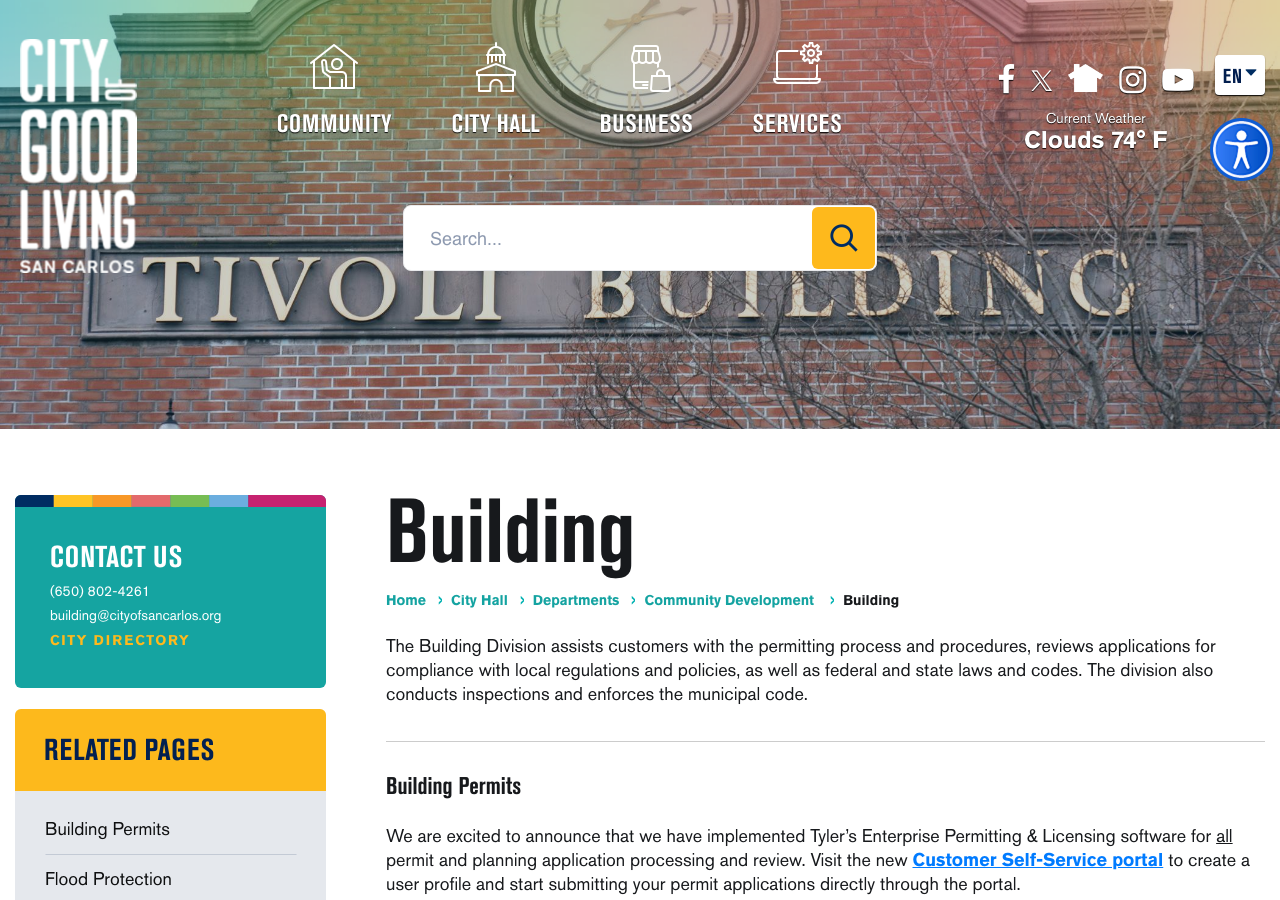
Why the confidence is not higherBoth named and linked on the City's current Solar Permitting and Building Permits pages; the City's Building Permits page states it implemented 'Tyler's Enterprise Permitting & Licensing (EP&L) software' as of 3 Jun 2025.
department page checked 2026-08-31 https://www.cityofsancarlos.org/city_hall/departments_and_divisions/community_development/building/building_permits/solar_permitting.php
Q21 Can the whole application be completed online? Core Portal & process
Yes, functionally -- SolarAPP+ submission is fully online, and the required one-page Building Permit Application Form is completed and then uploaded as an attachment within the CSS portal (not a native web form for that piece).
Why the confidence is not higherCity's own Solar Permitting page: 'At this time we are still requiring a completed Building Permit Application Form. Once completed, please upload the one-page form on the attachments upload portion of the online application.'
department page checked 2026-08-31 https://www.cityofsancarlos.org/city_hall/departments_and_divisions/community_development/building/building_permits/index.php
Q22 Which utility handles interconnection here? Core Utility interconnection
PG&E (Pacific Gas and Electric Company) is the wires/interconnection utility. WestLight Energy (formerly Peninsula Clean Energy, rebranded per the CCA's own action) is the Community Choice Aggregation generation provider and is NOT the interconnection utility.
Why the confidence is not higherCity's own 2021 Climate Mitigation and Adaptation Plan states PCE 'supplies electricity to most customers in San Carlos and uses sources of electricity that emit fewer GHGs than electricity supplied from Pacific Gas and Electric Company (PG&E)' -- i.e. PG&E is the underlying wires utility PCE/WestLight displaces for generation only. The City's current (2026) Home Electrification page separately confirms the CCA's rebrand: 'WestLight Energy (formerly Peninsula Clean Energy).' PowerToChoose was not used per standing instruction.
city climate plan checked 2026-08-31 https://www.cityofsancarlos.org/Document%20Center/City%20Hall/Departments%20And%20Divisions/City%20Manager/Sustainability/Climate%20Action/CMAP%20Final.pdf?t=202606241446430
Q23 Where does the utility sit in the sequence? Core Utility interconnection
After permit / gates PTO on the City's final inspection: PG&E's current Electric Rule 21 (Advice 7692-E, effective 29 Aug 2025) SS H.13.b requires 'evidence of Applicant's final electric inspection clearance from the Governmental Authority having jurisdiction' before Distribution Provider (PG&E) processes Permission to Operate.
Why the confidence is not higherRead directly from PG&E's own current tariff PDF, re-downloaded and grepped this run (not inherited from a prior run); PDF is PG&E's own current Electric Rule 21, effective 29 Aug 2025.
utility tariff checked 2026-08-31 https://www.pge.com/tariffs/assets/pdf/tariffbook/ELEC_RULES_21.pdf
Q24 Is a HOA or architectural approval required first? Overlays & special cases
No -- SCMC 15.16.060 explicitly bars conditioning approval on an association: 'The City of San Carlos shall not provide conditional approval of an application for a small residential rooftop solar energy system on the approval of an association, as defined in Section 4080 of the Civil Code.'
Why the confidence is not higherQuoted verbatim from the current Municipal Code chapter (Ord. 1494, 2015, unamended since, per the 'current through Ord. 1637' codification banner).
municipal code checked 2026-08-31 https://www.codepublishing.com/CA/SanCarlos/html/SanCarlos15/SanCarlos1516.html
Q25 Is there a historic-district review? Overlays & special cases
No dedicated historic-district review chapter was found. Title 18 (Zoning)'s full 41-chapter table of contents lists no 'Historic' or 'Preservation' chapter, and the Design Review chapter (18.29) does not name historic status as a trigger. Only the state California Historical Building Code (Title 24, Part 8) is adopted (SCMC 15.04.100), which is an alternative-compliance path for qualified historic buildings, not a design-review gate.
Why the confidence is not higherControl-proven by walking the entire Title 18 chapter list by name (18.01-18.41) rather than assuming absence, plus reading Chapter 18.29's applicability section in full; positive control ('setback') returned 36 hits in the same chapter search, fabricated control ('zzqqx') returned 0.
municipal code TOC checked 2026-08-31 https://www.codepublishing.com/CA/SanCarlos/html/SanCarlos18/SanCarlos18.html
Q26 Is a wind or windstorm certification required? Overlays & special cases
No wind/windstorm certification requirement was found in any San Carlos solar document (ordinance, submittal bulletin, or eligibility checklist).
Why the confidence is not higherGrepped the electrical/building code chapter, the 2015 submittal bulletin, and the Sept 2025 SolarAPP+ eligibility checklist for 'wind certif' and 'windstorm' with zero hits; this is a Texas TDI-style requirement type with no California coastal-wind-pool analogue, and San Carlos's own structural criteria instead use ASCE 7-based wind-exposure categories rather than a third-party certification.
municipal code + department PDFs (absence proven) checked 2026-08-31 https://www.codepublishing.com/CA/SanCarlos/html/SanCarlos15/SanCarlos1504.html
Q27 Is a Specific Use Permit or Council approval ever required? Overlays & special cases
Only if the Planning Division makes a written finding, based on substantial evidence, that the solar system 'could have a specific, adverse impact upon the public health and safety' -- otherwise no Use Permit or Council approval is required.
Why the confidence is not higherSCMC 15.16.060, current codification.
municipal code checked 2026-08-31 https://www.codepublishing.com/CA/SanCarlos/html/SanCarlos15/SanCarlos1516.html
Q28 Is there a system-size cap on residential generation? Overlays & special cases
Codified cap: 10 kW AC nameplate / 30 kW thermal (SCMC 15.16.020.B.1), applicable only to single-family or duplex dwellings, panel/array not exceeding the maximum legal building height. Both currently-linked Standard Plans (Microinverter and Central/String Inverter) independently cap at the same 10 kW AC inverter output. No higher live SolarAPP+ ceiling (e.g. 38.4 kW AC, seen in several other CA cities) is published anywhere on San Carlos's own Solar Permitting page.
Why the confidence is not higherSCMC 15.16.020 read in full; both Standard Plan PDFs' own SCOPE paragraphs read in full; the Solar Permitting page and Sept 2025 SolarAPP+ Eligibility Checklist were checked and neither states a numeric kW ceiling of its own -- unlike the codified/live-mismatch pattern seen elsewhere in this survey (San Bruno, Menlo Park, Los Gatos), San Carlos's codified and published caps are consistent with each other at 10 kW AC, which is itself worth noting as a contrast.
municipal code + standard plan forms checked 2026-08-31 https://www.codepublishing.com/CA/SanCarlos/html/SanCarlos15/SanCarlos1516.html
Lines marked with a percentage were read off this authority’s own published documents. Unmarked guidance is general good practice, not this jurisdiction’s rule — always confirm against the authority before you submit.
Install 5 steps · 20 questions
-
Build to the code editions actually in force here
The NEC edition a jurisdiction enforces is often a cycle behind the newest one published, and local amendments sit on top of it. Rapid shutdown, conductor sizing and labelling all change between editions, so the edition in force is the first thing to establish, not the last.
- Which NEC edition is in force? 2023 NEC, via the 2025 California Electrical Code (Title 24, Part 3) 95% · municipal code
- Which building code edition is in force? 2025 California Building Code (Title 24, Part 2) and 2025 California Residential Code (Title 24, Part 2.5) 95% · municipal code
- Which fire code edition is in force? 2025 California Fire Code (Title 24, Part 9), which itself adopts the 2024 International Fire Code as its base document 95% · municipal code
- Are there local amendments to any of the above? Yes -- multiple local amendments exist, e.g.: CEC AHJ definition (15.04.050.C); CEC SS705.20 disconnect amendment requiring an emergency power-off switch for ESS/battery back-up not at the main connection (15.04.050.D); CBC fence/retaining-wall permit-exemption tweaks (15.04.040.B); and a CFC SS503.1.1 exception allowing fire apparatus access roads to be 'exempted or modified for solar photovoltaic power generation facilities' (15.04.110). 92% · municipal code
- What is the installation judged against? The 2025 CBC/CRC/CEC/CFC as locally amended by SCMC 15.04, plus the SCMC 15.16 (AB 2188) eligibility criteria for the expedited path, enforced by the Building Official as AHJ. 85% · municipal code
-
Fire access, setbacks and pathways
Ridge setbacks and roof access pathways are fire-service requirements and they constrain the array layout. They are the most common cause of a redesign after the fire department comments on a plan set.
- What ridge setback and access pathways are required? No local fire-code amendment to CFC Chapter 12 (Solar Photovoltaic Power Systems) or SS1205 ridge setback/access pathway rules was found; the unamended 2025 CFC governs. 78% · municipal code (absence proven)
-
Rapid shutdown
Which rapid-shutdown rule applies follows directly from the NEC edition in force, and the initiation device has to be at a location the fire service can reach and identify. This is inspected, and it is labelled.
- Is rapid shutdown required, and to which NEC edition? Rapid shutdown is required under the unamended 2025 CEC SS690.12 (2023 NEC-based); the only local electrical amendment touching shutdown is SS705.20 (disconnecting means), which layers on an additional requirement that ESS/battery back-up systems not located at the main connection have their own readily-accessible emergency power-off switch. 75% · municipal code
-
Labels and placards
The NEC sets a baseline for permanent markings at the service equipment and the disconnecting means. On top of that, an authority may specify its own wording, and the utility may specify more again. Where any of them writes its own text, a generic off-the-shelf label set will not pass — this is the detail most often fixed on a return visit.
- Which placards does this authority require at the service equipment? Per the 2015 (San Carlos-branded) submittal bulletin's inspection checklist: a sign identifying PV power source system attributes at the DC disconnect, a sign identifying the AC point of connection, and a sign identifying the switch for an alternative power system. 58% · submittal bulletin (stale, 2015)
- Does the authority specify placard wording of its own? No -- the City does not specify its own placard wording; it points to CEC SS690 and SS705 labeling requirements generally ('Labeling of equipment as required by CEC, Sections 690 and 705'). 62% · submittal bulletin (stale, 2015)
- Does it specify letter height, colour or material? No independent letter-height, colour, or material spec found; relies on default CEC SS690/705 label requirements. 58% · submittal bulletin (stale, 2015)
- Is a site plan / facility map placard required, and what must it show? No local amendment to CEC SS705.10 (placards/directories) was found; the unamended 2025 CEC governs, requiring the standard directory/placard at service equipment. 70% · municipal code
- Does the UTILITY specify placards beyond the AHJ's? Yes, in part: PG&E's current Electric Rule 21 (SS H.1.d) requires a visible, manually-operated isolating disconnect near the Point of Interconnection with 'markings or signage that clearly indicates open and closed positions.' The finer meter-proximity/placard-content spec (PG&E's Greenbook document TD-2306M) is access-gated ('See your PG&E Job Owner for access') and could not be retrieved. 80% · utility tariff
- Where must the labels be placed? At the DC disconnect and at the AC point of interconnection, per the 2015 submittal bulletin; the current codes default to CEC SS690/705 placement rules with no local amendment found. 60% · submittal bulletin (stale, 2015)
-
Disconnect, storage and listed equipment
Where the AC disconnect must sit relative to the meter is usually the utility's rule, not the building department's. Battery storage frequently carries its own permit, its own inspection and its own fire conditions.
- Must equipment be on a specific approved list? Yes -- modules, inverters, and (where applicable) energy storage systems/batteries must be listed in the California Energy Commission's database of approved equipment. 90% · eligibility checklist
- Are batteries permitted, and under what conditions? Yes, with conditions: for the expedited SolarAPP+ path, lithium-ion only, weighing under 400 lbs with center of mass under 4 ft from the floor in high seismic zones (SDC D/E/F), CEC-listed, paired with new PV, and not installed within the habitable space of a dwelling unit. Independently, SCMC 15.04.050.D requires any ESS/battery back-up system not located at the main power connection to have its own readily-accessible emergency power-off switch shutting down all its output conductors. 85% · eligibility checklist + municipal code
- Is there a separate ESS permit or inspection? No separate ESS permit -- a new ESS is processed within the same SolarAPP+ PV application, subject to additional ESS-specific eligibility criteria (marked 'PV + Storage (ST) Only' in the checklist's key). 65% · eligibility checklist
- Is a ground mount treated as a structure? Yes, by inference -- SCMC 18.41.020's zoning definition of 'Structure' ('anything constructed or erected, the use of which requires location on the ground or attachment to something having location on the ground') is broad enough to capture a ground-mounted array as an accessory structure, and the current SolarAPP+ Eligibility Checklist expressly excludes 'No ground mounted systems' from the expedited path, meaning any ground mount routes to full plan review. 75% · municipal code (zoning definitions)
- Is there a local rule on service upgrades or busbar sizing? No local amendment on service upgrades or busbar sizing was found. 80% · municipal code (absence proven)
- Is a specific mounting system or attachment spacing required? Only the generic, uncustomized statewide 'PV Toolkit Document #5' (anchor horizontal-spacing tables by roof slope/rafter spacing, e.g. flat-6:12 slope at 16in o.c. = 5'-4" spacing for PV) -- this document is San Carlos's own currently-linked 'Structural Criteria' PDF, but it still carries its own unfilled '(Introductory text provided for jurisdiction's reference only. Do not attach to Criteria that follow.)' notes and cites the 2013 CBC/CRC, meaning it was never customized for San Carlos. 58% · generic statewide template (flagged, not city-customized)
20 questions answered against City of San Carlos’s own published documents
Q29 Which NEC edition is in force? Core Code editions in force
2023 NEC, via the 2025 California Electrical Code (Title 24, Part 3)
Why the confidence is not higherSCMC 15.04.050 adopts 'Title 24, Part 3, California Electrical Code, 2025 Edition' by reference; the 2025 CEC is based on the 2023 NEC (no '2025 NEC' or '2024 NEC' exists).
municipal code checked 2026-08-31 https://www.codepublishing.com/CA/SanCarlos/html/SanCarlos15/SanCarlos1504.html
Q30 Which building code edition is in force? Core Code editions in force
2025 California Building Code (Title 24, Part 2) and 2025 California Residential Code (Title 24, Part 2.5)
Why the confidence is not higherSCMC 15.04.040 and 15.04.045, adopted by Ord. 1629 (2025).
municipal code checked 2026-08-31 https://www.codepublishing.com/CA/SanCarlos/html/SanCarlos15/SanCarlos1504.html
Q31 Which fire code edition is in force? Code editions in force
2025 California Fire Code (Title 24, Part 9), which itself adopts the 2024 International Fire Code as its base document
Why the confidence is not higherSCMC 15.04.110: 'Adoption of the 2024 International Fire Code and the 2025 California Fire Code... These codes are hereby adopted in their entirety.'
municipal code checked 2026-08-31 https://www.codepublishing.com/CA/SanCarlos/html/SanCarlos15/SanCarlos1504.html
Q32 Are there local amendments to any of the above? Core Code editions in force
Yes -- multiple local amendments exist, e.g.: CEC AHJ definition (15.04.050.C); CEC SS705.20 disconnect amendment requiring an emergency power-off switch for ESS/battery back-up not at the main connection (15.04.050.D); CBC fence/retaining-wall permit-exemption tweaks (15.04.040.B); and a CFC SS503.1.1 exception allowing fire apparatus access roads to be 'exempted or modified for solar photovoltaic power generation facilities' (15.04.110).
Why the confidence is not higherAll read directly from the current (Ord. 1629, 2025) codified chapter, full text.
municipal code checked 2026-08-31 https://www.codepublishing.com/CA/SanCarlos/html/SanCarlos15/SanCarlos1504.html
Q33 What is the installation judged against? Core Electrical
The 2025 CBC/CRC/CEC/CFC as locally amended by SCMC 15.04, plus the SCMC 15.16 (AB 2188) eligibility criteria for the expedited path, enforced by the Building Official as AHJ.
Why the confidence is not higherSynthesis of SCMC 15.04 and 15.16, both read in full this run.
municipal code checked 2026-08-31 https://www.codepublishing.com/CA/SanCarlos/html/SanCarlos15/SanCarlos1504.html
Q34 Is there a local rule on service upgrades or busbar sizing? Electrical
No local amendment on service upgrades or busbar sizing was found.
Why the confidence is not higherGrepped the full CEC local-amendment section (15.04.050, A-D only) for 'busbar', 'bus bar', '225A', and 'service upgrade' with zero hits; positive control 'electrical' returned 11 hits and fabricated control 'zzqqx' returned 0 in the same file, confirming the search worked.
municipal code (absence proven) checked 2026-08-31 https://www.codepublishing.com/CA/SanCarlos/html/SanCarlos15/SanCarlos1504.html
Q35 Is a specific mounting system or attachment spacing required? Structural & mounting
Only the generic, uncustomized statewide 'PV Toolkit Document #5' (anchor horizontal-spacing tables by roof slope/rafter spacing, e.g. flat-6:12 slope at 16in o.c. = 5'-4" spacing for PV) -- this document is San Carlos's own currently-linked 'Structural Criteria' PDF, but it still carries its own unfilled '(Introductory text provided for jurisdiction's reference only. Do not attach to Criteria that follow.)' notes and cites the 2013 CBC/CRC, meaning it was never customized for San Carlos.
Why the confidence is not higherConfirmed by direct extraction with pdftotext -layout; this is the same failure mode documented elsewhere in this survey (e.g. Montclair's Solar Structural Criteria) -- a generic template linked as if it were the City's own current standard.
generic statewide template (flagged, not city-customized) checked 2026-08-31 https://www.cityofsancarlos.org/Document%20Center/City%20Hall/Departments%20And%20Divisions/Community%20Development/Building/Building%20Permits/Solar%20Permitting/Structural%20Criteria.pdf?t=202408011750470
Q36 What ridge setback and access pathways are required? Core Fire pathways & setbacks
No local fire-code amendment to CFC Chapter 12 (Solar Photovoltaic Power Systems) or SS1205 ridge setback/access pathway rules was found; the unamended 2025 CFC governs.
Why the confidence is not higherRead the full ~36KB codified fire-code amendment section (SCMC 15.04.110) end to end and grepped it for '1205', 'ridge', 'setback', and 'pathway' -- only 'setback' appears once, in an unrelated car-stacker/car-puzzler provision. Positive controls ('sprinkler'=37, 'access road'=6) and fabricated control ('zzqqx'=0) in the same file confirm the search worked.
municipal code (absence proven) checked 2026-08-31 https://www.codepublishing.com/CA/SanCarlos/html/SanCarlos15/SanCarlos1504.html
Q37 Is rapid shutdown required, and to which NEC edition? Core Rapid shutdown
Rapid shutdown is required under the unamended 2025 CEC SS690.12 (2023 NEC-based); the only local electrical amendment touching shutdown is SS705.20 (disconnecting means), which layers on an additional requirement that ESS/battery back-up systems not located at the main connection have their own readily-accessible emergency power-off switch.
Why the confidence is not higherFull text of SCMC 15.04.050 read; no SS690.12-specific local amendment exists (sections A-D only, none naming 690.12), so the state edition governs by default.
municipal code checked 2026-08-31 https://www.codepublishing.com/CA/SanCarlos/html/SanCarlos15/SanCarlos1504.html
Q38 Which placards does this authority require at the service equipment? Core Labels Signage & labelling
Per the 2015 (San Carlos-branded) submittal bulletin's inspection checklist: a sign identifying PV power source system attributes at the DC disconnect, a sign identifying the AC point of connection, and a sign identifying the switch for an alternative power system.
Why the confidence is not higherOnly source found is the 2015 bulletin; no more recent City document restates placard requirements, and no independent wording/format is specified beyond referencing CEC SS690/705.
submittal bulletin (stale, 2015) checked 2026-08-31 https://www.cityofsancarlos.org/Document%20Center/City%20Hall/Departments%20And%20Divisions/Community%20Development/Building/Building%20Permits/Solar%20Permitting/Solar%20Permitting%20Submittal.pdf?t=202408011754130
Q39 Does the authority specify placard wording of its own? Core Labels Signage & labelling
No -- the City does not specify its own placard wording; it points to CEC SS690 and SS705 labeling requirements generally ('Labeling of equipment as required by CEC, Sections 690 and 705').
Why the confidence is not higherOnly source is the 2015 submittal bulletin; no current document adds City-specific wording.
submittal bulletin (stale, 2015) checked 2026-08-31 https://www.cityofsancarlos.org/Document%20Center/City%20Hall/Departments%20And%20Divisions/Community%20Development/Building/Building%20Permits/Solar%20Permitting/Solar%20Permitting%20Submittal.pdf?t=202408011754130
Q40 Does it specify letter height, colour or material? Core Labels Signage & labelling
No independent letter-height, colour, or material spec found; relies on default CEC SS690/705 label requirements.
Why the confidence is not higherSame 2015 bulletin is the only document addressing labeling at all; no dimensioned sample sheet (of the Manhattan Beach/Hollister type) was found anywhere on the City's site.
submittal bulletin (stale, 2015) checked 2026-08-31 https://www.cityofsancarlos.org/Document%20Center/City%20Hall/Departments%20And%20Divisions/Community%20Development/Building/Building%20Permits/Solar%20Permitting/Solar%20Permitting%20Submittal.pdf?t=202408011754130
Q41 Is a site plan / facility map placard required, and what must it show? Core Labels Signage & labelling
No local amendment to CEC SS705.10 (placards/directories) was found; the unamended 2025 CEC governs, requiring the standard directory/placard at service equipment.
Why the confidence is not higherSS705.10 does not appear among the four local CEC amendments (A-D) in SCMC 15.04.050.
municipal code checked 2026-08-31 https://www.codepublishing.com/CA/SanCarlos/html/SanCarlos15/SanCarlos1504.html
Q42 Does the UTILITY specify placards beyond the AHJ's? Core Labels Signage & labelling
Yes, in part: PG&E's current Electric Rule 21 (SS H.1.d) requires a visible, manually-operated isolating disconnect near the Point of Interconnection with 'markings or signage that clearly indicates open and closed positions.' The finer meter-proximity/placard-content spec (PG&E's Greenbook document TD-2306M) is access-gated ('See your PG&E Job Owner for access') and could not be retrieved.
Why the confidence is not higherRead directly from PG&E's own current Rule 21 tariff, re-verified this run, not inherited; the gated Greenbook limitation matches this survey's prior findings for PG&E territory generally.
utility tariff checked 2026-08-31 https://www.pge.com/tariffs/assets/pdf/tariffbook/ELEC_RULES_21.pdf
Q43 Where must the labels be placed? Core Labels Signage & labelling
At the DC disconnect and at the AC point of interconnection, per the 2015 submittal bulletin; the current codes default to CEC SS690/705 placement rules with no local amendment found.
Why the confidence is not higher2015 bulletin is the only source naming specific locations; no superseding current document found.
submittal bulletin (stale, 2015) checked 2026-08-31 https://www.cityofsancarlos.org/Document%20Center/City%20Hall/Departments%20And%20Divisions/Community%20Development/Building/Building%20Permits/Solar%20Permitting/Solar%20Permitting%20Submittal.pdf?t=202408011754130
Q44 Must equipment be on a specific approved list? Equipment listing
Yes -- modules, inverters, and (where applicable) energy storage systems/batteries must be listed in the California Energy Commission's database of approved equipment.
Why the confidence is not higherStated directly in the current (16 Sept 2025) SolarAPP+ Eligibility Checklist, hosted on the City's own site.
eligibility checklist checked 2026-08-31 https://www.cityofsancarlos.org/SolarAPP%20Eligibility%20Checklist.pdf?t=202510151900060
Q45 Are batteries permitted, and under what conditions? Core Battery / ESS
Yes, with conditions: for the expedited SolarAPP+ path, lithium-ion only, weighing under 400 lbs with center of mass under 4 ft from the floor in high seismic zones (SDC D/E/F), CEC-listed, paired with new PV, and not installed within the habitable space of a dwelling unit. Independently, SCMC 15.04.050.D requires any ESS/battery back-up system not located at the main power connection to have its own readily-accessible emergency power-off switch shutting down all its output conductors.
Why the confidence is not higherCombines the current (Sept 2025) SolarAPP+ Eligibility Checklist's ESS criteria with the current codified CEC SS705.20 local amendment.
eligibility checklist + municipal code checked 2026-08-31 https://www.cityofsancarlos.org/SolarAPP%20Eligibility%20Checklist.pdf?t=202510151900060
Q46 Is there a separate ESS permit or inspection? Battery / ESS
No separate ESS permit -- a new ESS is processed within the same SolarAPP+ PV application, subject to additional ESS-specific eligibility criteria (marked 'PV + Storage (ST) Only' in the checklist's key).
Why the confidence is not higherInferred from the structure of the current SolarAPP+ Eligibility Checklist, which lists ESS criteria inline with PV criteria under one checklist rather than as a separate form; no standalone 'ESS permit' or 'ESS fee' line appears on the current Building fee schedule.
eligibility checklist checked 2026-08-31 https://www.cityofsancarlos.org/SolarAPP%20Eligibility%20Checklist.pdf?t=202510151900060
Q47 Is a ground mount treated as a structure? Core Ground mount
Yes, by inference -- SCMC 18.41.020's zoning definition of 'Structure' ('anything constructed or erected, the use of which requires location on the ground or attachment to something having location on the ground') is broad enough to capture a ground-mounted array as an accessory structure, and the current SolarAPP+ Eligibility Checklist expressly excludes 'No ground mounted systems' from the expedited path, meaning any ground mount routes to full plan review.
Why the confidence is not higherNo PV-specific ground-mount carve-out or exemption was found in Title 18; this is the same 'broad structure definition, no PV carve-out' shape documented elsewhere in this survey (e.g. Pacifica), flagged as inference.
municipal code (zoning definitions) checked 2026-08-31 https://www.codepublishing.com/CA/SanCarlos/html/SanCarlos18/SanCarlos1841.html
Q48 Where must the AC disconnect be, relative to the meter? Core Utility equipment
Nothing published by this authority.
Where we lookedPG&E's current Electric Rule 21 tariff (re-downloaded and grepped this run for 'meter', 'disconnect', and proximity language) states only that a visible disconnect must be near the Point of Interconnection with open/closed markings; the fine meter-proximity distance spec lives in PG&E's gated Greenbook document TD-2306M ('See your PG&E Job Owner for access'), which could not be retrieved. No San Carlos-specific document adds a distance requirement.
https://www.pge.com/tariffs/assets/pdf/tariffbook/ELEC_RULES_21.pdf
Lines marked with a percentage were read off this authority’s own published documents. Unmarked guidance is general good practice, not this jurisdiction’s rule — always confirm against the authority before you submit.
Inspection 5 steps · 14 questions
-
Book it
Booking is a portal, a phone call or an email depending on the authority, and the notice required is rarely zero. Book before the work is finished rather than after — the lead time, not the work, is usually what sets the date.
- How is an inspection booked? Portal -- inspections are requested through the Tyler EnerGov Customer Self-Service (CSS) portal. 92% · department page
- How much notice is required? For small residential rooftop solar specifically, SCMC 15.16.060 commits the Building Division to schedule the inspection 'within three business days, upon request.' 82% · municipal code
- Are same-day or AM/PM windows offered? Yes -- a 90-minute arrival window, viewable (without login) on the portal's 'Today's Inspections' page starting at 8:30 a.m. the morning of the inspection. 92% · department handout
-
Know who turns up
Some authorities inspect their own solar work; some delegate it, and a few do not inspect the PV equipment itself at all. Who is coming determines what they will look at.
- Does this AHJ perform its own final solar inspection? Yes 90% · municipal code
- If delegated, to whom? N/A for building/electrical (self-performed). Fire is conditionally delegated in-house to the 'City of San Carlos Fire Department' / the shared San Carlos and Redwood City Fire Department, only 'if required' per the Building Official's determination. 82% · municipal code
-
Work the stages in order
A rough-in or mid-roof inspection, where one is required, has to happen before the work it covers is closed up. Missing a stage means opening something back up, and it is the most expensive kind of correction.
- Which inspections are required, and in what order? One Building Division inspection (final) for SolarAPP+-eligible systems, plus a conditional, separate Fire Department inspection 'if required.' 85% · municipal code
- Is a rough-in or mid-roof inspection required? No -- the Municipal Code states only one inspection is required for expedited-eligible systems, with no separate rough-in or mid-roof inspection. 85% · municipal code
-
Have the paperwork on site
The approved plan set, the permit, and the equipment listings should be on site and reachable. Inspectors routinely verify that installed equipment matches what was approved, and that the labels are the ones the plan set promised.
- Is there a published inspection checklist? Yes -- SolarAPP+ generates a project-specific Inspection Checklist that applicants must download before scheduling ('Download the Inspection Checklist to be reviewed during the inspection'); a generic checklist also exists in the 2015 submittal bulletin. 80% · department page
- What must be on site at inspection? A paper copy of the stamped, approved, properly-scaled set of plans must be on the job site at all times (it is 'the contractor's responsibility to provide and maintain' it); color is recommended but not required. 88% · department handout
- Does the inspector verify labels and listings? Yes, per the 2015 submittal bulletin's inspection checklist, which lists verifying signage ('Appropriate signs are properly constructed, installed and displayed') and equipment ratings/listings among the inspector's common checkpoints. 62% · submittal bulletin (stale, 2015)
-
Sign-off, and permission to operate
Passing gives you a final or an equivalent sign-off. That is not the same as permission to operate: PTO comes from the utility, and who tells the utility the inspection passed varies. A system left switched off for weeks is usually waiting on this handover.
- Who notifies the utility for PTO? Installer -- the installer/applicant submits the interconnection request to PG&E, and PG&E processes Permission to Operate only after receiving 'evidence of Applicant's final electric inspection clearance from the Governmental Authority having jurisdiction,' per PG&E's own current Rule 21. 82% · utility tariff
- Is there a re-inspection fee? $232/hour (1-hour minimum) during normal business hours; $501 (2-hour minimum) plus $250/additional hour outside business hours, for second and each additional re-inspection. 90% · fee schedule
- How are corrections issued and cleared? At the application-intake stage, an incomplete SolarAPP+/solar application gets a written correction notice detailing deficiencies, and is deemed approved if not denied within 45 days of a complete resubmission (unless a reasonable additional-information request is pending). At the inspection stage, SCMC 15.16.060 states that if the installation does not conform to approved plans or code, 'an additional follow-up inspection, or inspections, shall be required' and 'a subsequent inspection is authorized.' 70% · municipal code
14 questions answered against City of San Carlos’s own published documents
Q49 How is an inspection booked? Core Booking & scheduling
Portal -- inspections are requested through the Tyler EnerGov Customer Self-Service (CSS) portal.
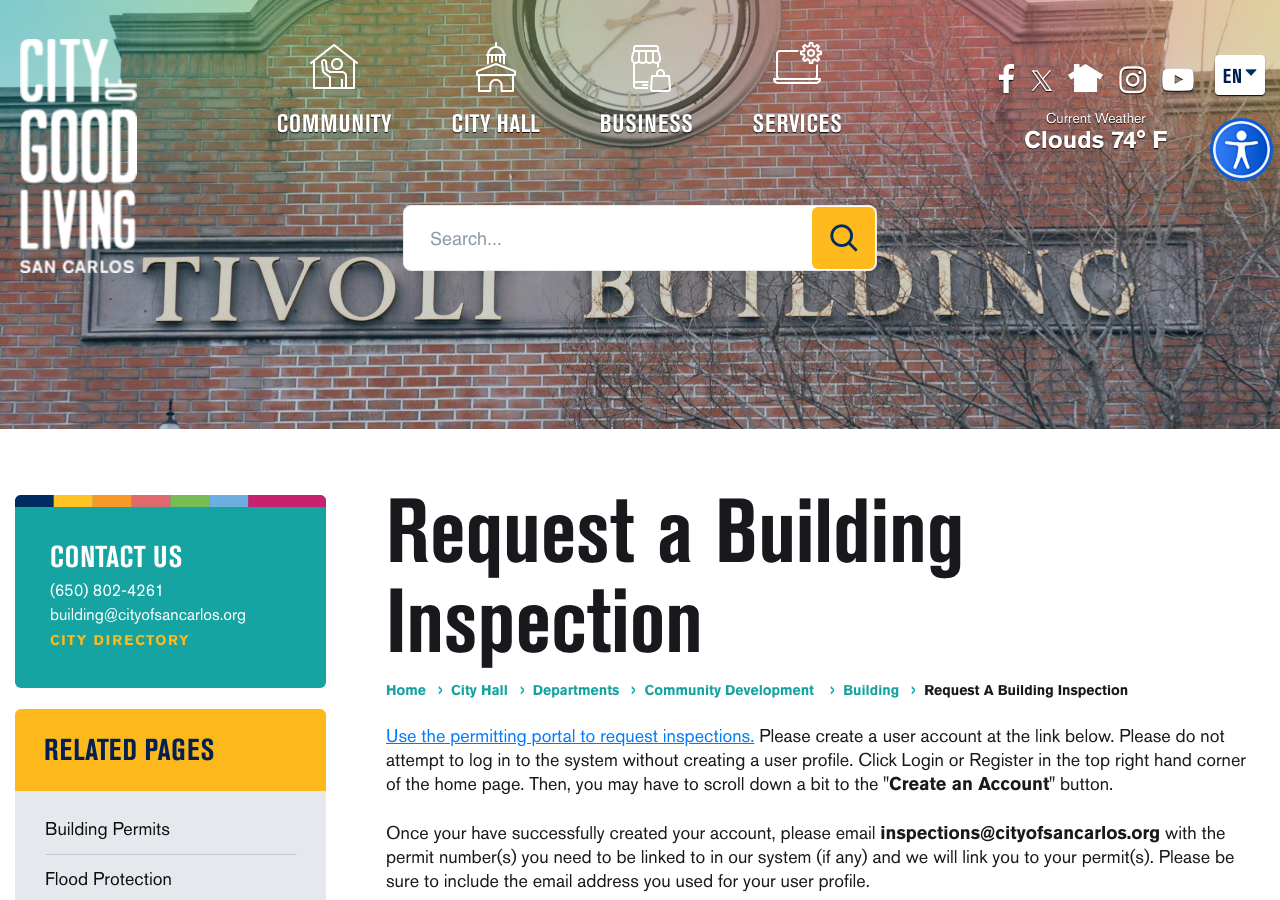
Why the confidence is not higherCity's own current 'Request a Building Inspection' page: 'Use the permitting portal to request inspections.'
department page checked 2026-08-31 https://www.cityofsancarlos.org/city_hall/departments_and_divisions/community_development/building/request_a_building_inspection.php
Q50 How much notice is required? Core Booking & scheduling
For small residential rooftop solar specifically, SCMC 15.16.060 commits the Building Division to schedule the inspection 'within three business days, upon request.'
Why the confidence is not higherDirect codified commitment specific to the solar chapter, still current per the code's 'through Ord. 1637' banner; note this describes the City's scheduling turnaround rather than a minimum advance-notice period the applicant must give, which was not separately published.
municipal code checked 2026-08-31 https://www.codepublishing.com/CA/SanCarlos/html/SanCarlos15/SanCarlos1516.html
Q51 Are same-day or AM/PM windows offered? Booking & scheduling
Yes -- a 90-minute arrival window, viewable (without login) on the portal's 'Today's Inspections' page starting at 8:30 a.m. the morning of the inspection.
Why the confidence is not higherStated on both the City's 'Request a Building Inspection' page and its current Inspection Information handout (Aug 2025).
department handout checked 2026-08-31 https://www.cityofsancarlos.org/BLD%20-%20Inspection%20Information.pdf?t=202508061146540
Q52 Does this AHJ perform its own final solar inspection? Core Who inspects
Yes
Why the confidence is not higherSCMC 15.16.060: 'Only one inspection shall be required and performed by the Building Division for small residential rooftop solar energy systems eligible for expedited review.'
municipal code checked 2026-08-31 https://www.codepublishing.com/CA/SanCarlos/html/SanCarlos15/SanCarlos1516.html
Q53 If delegated, to whom? Core Who inspects
N/A for building/electrical (self-performed). Fire is conditionally delegated in-house to the 'City of San Carlos Fire Department' / the shared San Carlos and Redwood City Fire Department, only 'if required' per the Building Official's determination.
Why the confidence is not higherSCMC 15.16.060: 'A separate fire inspection may be performed by the City of San Carlos Fire Department, if required.'
municipal code checked 2026-08-31 https://www.codepublishing.com/CA/SanCarlos/html/SanCarlos15/SanCarlos1516.html
Q54 Which inspections are required, and in what order? Core Stages & sequence
One Building Division inspection (final) for SolarAPP+-eligible systems, plus a conditional, separate Fire Department inspection 'if required.'
Why the confidence is not higherSCMC 15.16.060, read in full.
municipal code checked 2026-08-31 https://www.codepublishing.com/CA/SanCarlos/html/SanCarlos15/SanCarlos1516.html
Q55 Is a rough-in or mid-roof inspection required? Stages & sequence
No -- the Municipal Code states only one inspection is required for expedited-eligible systems, with no separate rough-in or mid-roof inspection.
Why the confidence is not higherSCMC 15.16.060.
municipal code checked 2026-08-31 https://www.codepublishing.com/CA/SanCarlos/html/SanCarlos15/SanCarlos1516.html
Q56 Does the inspector verify labels and listings? Core What is checked
Yes, per the 2015 submittal bulletin's inspection checklist, which lists verifying signage ('Appropriate signs are properly constructed, installed and displayed') and equipment ratings/listings among the inspector's common checkpoints.
Why the confidence is not higherOnly source found addressing what is checked is the 2015 bulletin; no current document restates this, though nothing found contradicts it.
submittal bulletin (stale, 2015) checked 2026-08-31 https://www.cityofsancarlos.org/Document%20Center/City%20Hall/Departments%20And%20Divisions/Community%20Development/Building/Building%20Permits/Solar%20Permitting/Solar%20Permitting%20Submittal.pdf?t=202408011754130
Q57 Is there a published inspection checklist? Core What is checked
Yes -- SolarAPP+ generates a project-specific Inspection Checklist that applicants must download before scheduling ('Download the Inspection Checklist to be reviewed during the inspection'); a generic checklist also exists in the 2015 submittal bulletin.
Why the confidence is not higherText quoted directly from the City's current Solar Permitting page; the SolarAPP+-generated checklist itself is per-project and was not independently retrievable outside an active application.
department page checked 2026-08-31 https://www.cityofsancarlos.org/city_hall/departments_and_divisions/community_development/building/building_permits/solar_permitting.php
Q58 What must be on site at inspection? Core Documents on site
A paper copy of the stamped, approved, properly-scaled set of plans must be on the job site at all times (it is 'the contractor's responsibility to provide and maintain' it); color is recommended but not required.
Why the confidence is not higherQuoted verbatim from the current Inspection Information handout (Aug 2025).
department handout checked 2026-08-31 https://www.cityofsancarlos.org/BLD%20-%20Inspection%20Information.pdf?t=202508061146540
Q59 Is there a re-inspection fee? Corrections & re-inspection
$232/hour (1-hour minimum) during normal business hours; $501 (2-hour minimum) plus $250/additional hour outside business hours, for second and each additional re-inspection.
Why the confidence is not higherCurrent FY2026-27 Master Fee Schedule -- Building, effective 1 Jul 2026.
fee schedule checked 2026-08-31 https://www.cityofsancarlos.org/Document%20Center/City%20Hall/Departments%20And%20Divisions/Administrative%20Services/Finance/City%20Fees%20%26%20Cost%20of%20Services/User%20fees/SanCarlos_MFS_FY2027%20-%20Building.pdf?t=202607011154420
Q60 How are corrections issued and cleared? Corrections & re-inspection
At the application-intake stage, an incomplete SolarAPP+/solar application gets a written correction notice detailing deficiencies, and is deemed approved if not denied within 45 days of a complete resubmission (unless a reasonable additional-information request is pending). At the inspection stage, SCMC 15.16.060 states that if the installation does not conform to approved plans or code, 'an additional follow-up inspection, or inspections, shall be required' and 'a subsequent inspection is authorized.'
Why the confidence is not higherBoth processes read directly from SCMC 15.16.060 and 15.16.050; the code does not separately detail HOW a correction notice is delivered post-inspection (portal comment vs. email vs. phone), so this answer covers the documented stages but not that mechanical detail.
municipal code checked 2026-08-31 https://www.codepublishing.com/CA/SanCarlos/html/SanCarlos15/SanCarlos1516.html
Q61 What is issued on pass? Core Final sign-off & PTO
Nothing published by this authority.
Where we lookedThe current Inspection Information handout, the 'Request a Building Inspection' page, and SCMC 15.16.060 -- none name what document or status (Final, CO, Green tag, Letter) is issued on a passed solar inspection.
Q62 Who notifies the utility for PTO? Core Final sign-off & PTO
Installer -- the installer/applicant submits the interconnection request to PG&E, and PG&E processes Permission to Operate only after receiving 'evidence of Applicant's final electric inspection clearance from the Governmental Authority having jurisdiction,' per PG&E's own current Rule 21.
Why the confidence is not higherPG&E Rule 21 SS H.13.b places the submission burden on the 'Applicant' (installer/customer), with the AHJ's final clearance as a precondition PG&E checks for, not something the City itself transmits.
utility tariff checked 2026-08-31 https://www.pge.com/tariffs/assets/pdf/tariffbook/ELEC_RULES_21.pdf
Lines marked with a percentage were read off this authority’s own published documents. Unmarked guidance is general good practice, not this jurisdiction’s rule — always confirm against the authority before you submit.
Jurisdiction & key facts
The standing 62-question set, answered for City of San Carlos against this authority’s own published documents. Every answer carries the confidence it was recorded at and the document it came from. Where nothing is published we say so and show where we looked — a blank here is a finding, not a gap.
City of San Carlos is the authority having jurisdiction 92% confidence
- Holds
- Building and electrical, both self-performed in-house by the City's Building Division. The California Electrical Code local amendment (SCMC 15.04.050.C) states verbatim: 'the Authority Having Jurisdiction is the Building Official of the City of San Carlos.' Building inspectors (D. Johnston, K. Kim, D. Kulda, R. Lord, D. Mauldin) all carry @cityofsancarlos.org addresses on the City's own current Inspection Information handout, with no contract-firm domain anywhere (no Willdan/Transtech/4LEAF/CSG/Interwest pattern) -- a clean in-house negative on delegation. Fire code review/inspection is separately held by the 'San Carlos and Redwood City Fire Department,' a shared department the City's own Fire page describes as: 'San Carlos partners with Redwood City for our fire and emergency services.' Planning/zoning does not gate a standard SolarAPP+-eligible rooftop PV install.
- Overridden by
- State law constrains rather than replaces City review: Gov. Code 65850.5 / Civil Code 714 (Solar Rights Act) and AB 2188 (codified at SCMC 15.16) force administrative, non-discretionary review of small residential rooftop solar (<=10 kW AC / 30 kW thermal), bar conditioning approval on HOA/association approval, and require a written adverse-impact finding before a discretionary Use Permit can be required. PG&E's Electric Rule 21 SS D.13.b gates Permission-to-Operate on 'evidence of Applicant's final electric inspection clearance from the Governmental Authority having jurisdiction' -- i.e., PG&E acts only after the City's own final inspection, not before or in parallel. Fire review is conditional: SCMC 15.16.060 states 'A separate fire inspection may be performed by the City of San Carlos Fire Department, if required' -- not mandatory on every job.
- Why not higher
- SCMC 15.04.050.C (2025 CEC local amendment, in force per Ord. 1629 of 2025) names the Building Official as AHJ in as many words; SCMC 15.16 (Ord. 1494, 2015, still current per the Municipal Code's 'current through Ord. 1637, June 22, 2026' banner) is the codified AB 2188 chapter; the City's own Solar Permitting page confirms SolarAPP+ is mandatory for eligible residential systems. Confidence is not higher only because the exact legal form of the Redwood City/San Carlos fire arrangement (JPA vs. shared-services/contract) could not be confirmed -- redwoodcity.org returned 403 to every fetch technique tried (plain curl with rotated UAs/headers, WebFetch, Wayback) and no JPA-formation document was located.
https://www.codepublishing.com/CA/SanCarlos/html/SanCarlos15/SanCarlos1504.html
- Permit required
- Yes95%
- Permit cost
- $348 flat, per permit (PV Solar Fee)90%
- Plan review
- SolarAPP+-eligible systems: processed instantly. Non-eligible / commercial systems: typically 3-5 business days.92%
- Portal
- Two portals in sequence: SolarAPP+ (gosolarapp.org) for automated eligibility/plan review, then the City's Tyler Technologies EnerGov Customer Self-Service (CSS) portal…92%
- Electrical code
- 2023 NEC, via the 2025 California Electrical Code (Title 24, Part 3)95%
- Own placard wording
- No -- the City does not specify its own placard wording; it points to CEC SS690 and SS705 labeling requirements generally ('Labeling of equipment as required by CEC, Sections 690 and 705').62%
- Booking an inspection
- Portal -- inspections are requested through the Tyler EnerGov Customer Self-Service (CSS) portal.92%
Labels & placards for this authority
Wording 62%
No -- the City does not specify its own placard wording; it points to CEC SS690 and SS705 labeling requirements generally ('Labeling of equipment as required by CEC, Sections 690 and 705').
Size, colour & material 58%
No independent letter-height, colour, or material spec found; relies on default CEC SS690/705 label requirements.
Where they go 60%
At the DC disconnect and at the AC point of interconnection, per the 2015 submittal bulletin; the current codes default to CEC SS690/705 placement rules with no local amendment found.
What the utility wants on top 80%
Yes, in part: PG&E's current Electric Rule 21 (SS H.1.d) requires a visible, manually-operated isolating disconnect near the Point of Interconnection with 'markings or signage that clearly indicates open and closed positions.' The finer meter-proximity/placard-content spec (PG&E's Greenbook document TD-2306M) is access-gated ('See your PG&E Job Owner for access') and could not be retrieved.
Each figure above is sourced and dated in the full answer set below (questions 38–43). Where an authority’s own published sheet is older than the code it has adopted, the answer says so.
Their website
Average approval time — application to PTO
From the CPUC interconnection record. Bars show the average days taken each year; a year with no recorded projects is left blank rather than drawn as zero.