
City of San Clemente
Orange County
City of San Clemente is a city authority in the State of California, serving 64,293 residents. 5,796 residential solar installs are on record here. This page is the permit route for that jurisdiction: the fifteen steps from working out who has a say over an address through to permission to operate, the documents this authority publishes, and 62 answers taken from those documents and dated.
Permitting 5 steps · 28 questions
Whether a permit is needed — Yes Q3 Electrical and building permits — Combined Q4 Where you file — eTRAKiT (https://cdweb.san-clemente.org/eTRAKiT/login.aspx), plus SolarAPP+ (https://solarapp.nrel.gov/) as an optional expedited front-end for eligible systems… Q20
- Permit required
- Yes95% source
- What it costs
- No flat solar fee; calculated from the general Building Permit Fee valuation table (Resolution 08-80): e.g.65% source
- Key document
- published checklist cited by 8 open the document
-
Confirm who has a say over your address
A city address is usually permitted by the city, not the county — but not always, and some authorities keep building and hand electrical to someone else. Getting this wrong costs the whole submittal, because every requirement below belongs to whoever actually holds jurisdiction. Check the overlays in the same pass: an HOA, a historic district, a windstorm certification or a system-size cap can reshape the design, and all of them are cheaper to find now than after the array is laid out.
- Is this authority the AHJ for residential solar at this address? Yes 95% · department page
- What does this authority permit itself, and what does it delegate? Both 90% · department page
- Is a permit required for a residential rooftop PV system? Yes 95% · adopting ordinance
- Is there a separate electrical permit, or is it combined? Combined 65% · department page
- Is a HOA or architectural approval required first? No 78% · AHJ form / ordinance
- Is there a historic-district review? No for a typical single-family rooftop PV retrofit; conditionally Yes only if the property is a historically-designated site, within 300 feet of one, or inside the A-D Architectural Design Overlay District (the 'Pier Bowl' area) — in which case Discretionary Design Review under the city's Design Guidelines and Zoning Ordinance Sec. 5.21 applies. 78% · design guidelines
- Is a wind or windstorm certification required? No 70% · adopting ordinance
- Is a Specific Use Permit or Council approval ever required? Not required for a standard residential rooftop PV permit. A Specific/Conditional Use Permit or Planning Commission/Council action could be triggered only incidentally — e.g., a ground-mount array that cannot meet zoning setbacks, or a property inside the historic/Architectural Overlay District requiring Discretionary Design Review escalation — but no PV-specific SUP/Council-approval trigger is stated in any reviewed document. 50% · design guidelines / inference
-
Check who is allowed to apply
Several authorities require the electrical permit to be pulled by a licensed electrician, or require the contractor to be registered with them BEFORE applying. Registration is not same-day. This is second on the list rather than fourth because it is the step most likely to stop the job before the drawings matter.
- Who is allowed to pull the electrical permit? Either 85% · department page
- Must the contractor be registered with this authority before applying? No 50% · department page
- Is a homeowner permitted to self-install and self-permit? Yes 80% · department page
-
Build the submittal package
Almost everywhere wants a site plan, a one-line or three-line electrical diagram, equipment cut sheets with listings, and a structural attachment detail. Build it against the published checklist rather than the last jurisdiction you worked in — the checklist is what the reviewer marks against.
- What documents make up a complete submittal? Solar Permit Application form; plans and structural/electrical calculations (PDF only); HOA Confirmation Form (BA-1) — checked as exempt for rooftop solar under the Solar Rights Act citation on the form itself; OCFA Fillable SFD form; Special Inspections form and Engineer's Structural Observation form if triggered by non-prescriptive framing/attachment. 85% · published checklist
- How many copies, and in what format? PDF only, submitted electronically to SolarPermits@San-Clemente.org (or via SolarAPP+ website for eligible projects). 'No links or Dropbox submissions accepted.' Standard (non-solar) building permits separately require 3 physical plan sets dropped at City Hall, but the solar-specific pathway is described as electronic/PDF-only. 85% · department page
- Is a site plan required, and what must it show? Yes — the BI-5 'Typical Plot Plan' checklist requires: property boundaries/dimensions, bordering street names/widths, existing and proposed structures, distances to property lines, easements, and utility locations (electrical, gas, water, sewer). The solar checklist additionally requires an exterior elevation showing equipment and label locations/heights. 85% · published checklist
- Is a one-line / three-line diagram required? Yes 90% · published checklist
- Are string and conductor calculations required? Yes 92% · published checklist
- Is a structural PE stamp required, and at what threshold? No blanket PE/architect stamp requirement for a standard roof-mount PV racking system installed per an ICC-ES report; a stamp by a CA-licensed architect or civil/structural engineer is required only for 'any portion of any structure that deviates from compliance with requirements found in the California Residential Code' (CRC Sec. R301.1.3.1), e.g., non-standard attachment, ground mount, or structural non-conformance. 70% · published checklist
- Is an electrical PE stamp required, and at what threshold? No PV-specific electrical PE stamp threshold found; the solar plan-review checklist requires load calculations, busbar-derating justification (CEC 705.12(D)) and Voc/Isc calcs, but does not state these must be a PE's stamped work as opposed to the installer/designer's calculations. 55% · published checklist
-
Apply and pay
Most authorities now take the whole application through a portal, and several states cap or constrain what a residential solar permit may cost. Check whether plan check is billed separately before you quote the job.
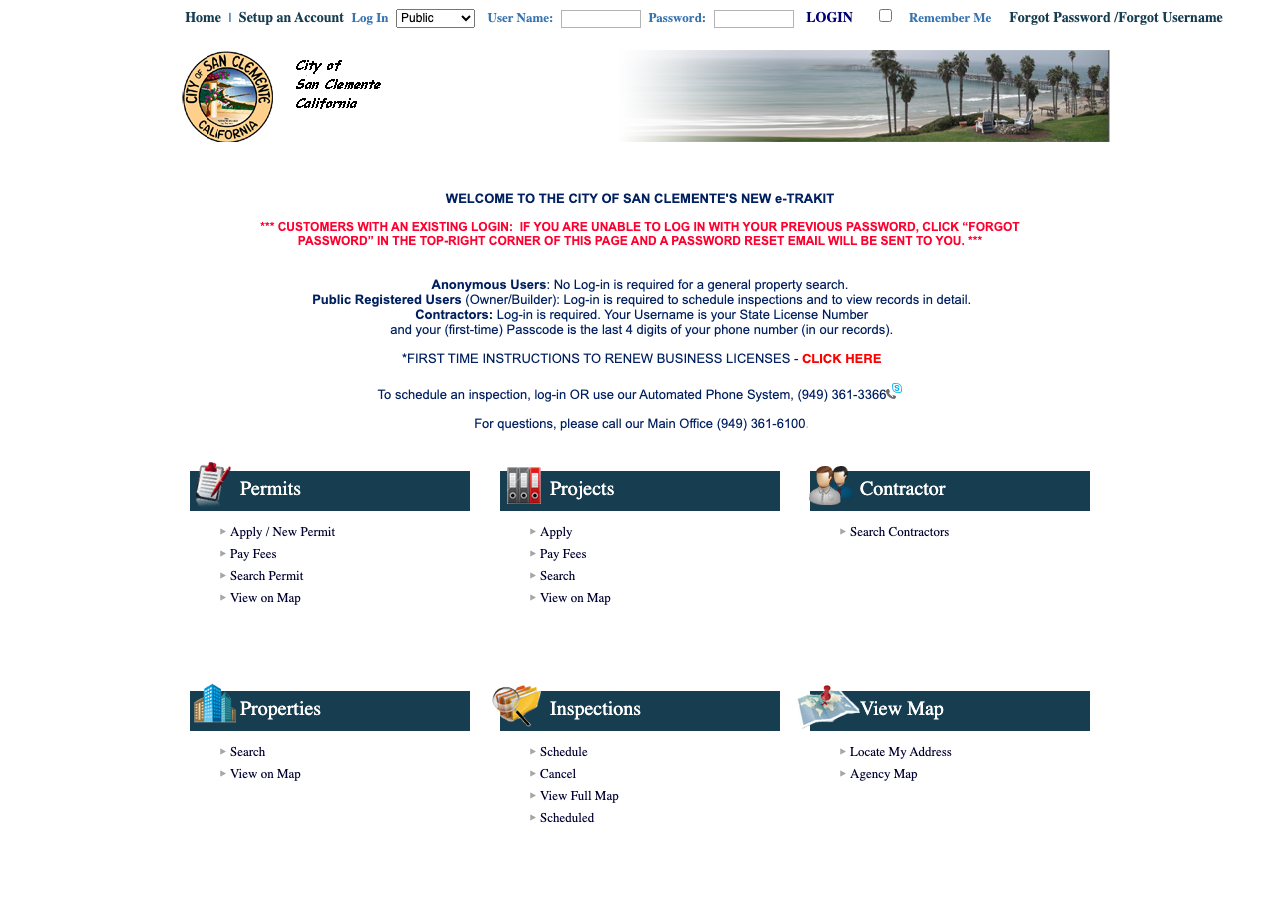
- Which permit portal does this authority use? eTRAKiT (https://cdweb.san-clemente.org/eTRAKiT/login.aspx), plus SolarAPP+ (https://solarapp.nrel.gov/) as an optional expedited front-end for eligible systems that then still issues the permit of record in eTRAKiT. 95% · portal landing page
- Can the whole application be completed online? No 75% · portal
- What does a residential solar permit cost? No flat solar fee; calculated from the general Building Permit Fee valuation table (Resolution 08-80): e.g. ~$345 permit fee for a $20,000 valuation job ($74.75 for the first $2,000 + $15/$1,000 to $25,000), plus Building Plan Check Fee = 65% of that permit fee (~$224), plus a $35 Electrical Permit issuance fee and 25% electrical plan-check. A typical residential PV job in the $15k-$30k range totals roughly $500-$900. 65% · fee schedule
- How is the fee calculated? Valuation 90% · fee schedule
- Is there a separate plan-check fee? Yes 92% · fee schedule
-
Plan review — and start the utility in parallel
Interconnection is a separate process from the permit and usually the longer pole. Where the utility does not depend on the permit being issued, running both at once is the single biggest saving available on a residential job.
- How long is an issued permit valid before it expires? Locally amended (Ordinance No. 1796, amending CBC/CRC Sec. 105.5/105.8): a permit becomes invalid if work is not commenced within 12 months of issuance, or if no inspection is requested within 180 days with no approved progress; one or more 180-day commencement extensions may be granted (total extensions capped at 18 months for an abandoned application). Separately, Sec. 105.8 requires all construction be completed within 12 months of permit issuance, extendable up to an additional 12 months by the Building Official. 92% · adopting ordinance
- Which utility handles interconnection here? San Diego Gas & Electric (SDG&E) 92% · AHJ document naming utility
- Where does the utility sit in the sequence? After permit 75% · utility DG program page
28 questions answered against City of San Clemente’s own published documents
Q1 Is this authority the AHJ for residential solar at this address? Core Jurisdiction & scope
Yes
Why the confidence is not higherCity's own Building-Safety-Permit-Services page states the Community Development Department's Building Division performs plan check, permitting and inspection; the solar-specific plan review checklist and Solar Permit process confirm residential PV is processed here.
department page checked 2026-08-30 https://www.sanclemente.gov/248/Building-Services
Q2 What does this authority permit itself, and what does it delegate? Core Jurisdiction & scope
Both
Why the confidence is not higherBuilding Division (Community Development Dept) issues and inspects both building and electrical permits in-house (city staff, not a contractor). Fire-code review/inspection is delegated to Orange County Fire Authority (OCFA) under contract, confirmed by name on OCFA's own Local Building/Planning Departments table and the city's own 'Fire Services - OCFA' page.
department page checked 2026-08-30 https://www.sanclemente.gov/248/Building-Services
Q3 Is a permit required for a residential rooftop PV system? Core Jurisdiction & scope
Yes
Why the confidence is not higherOrdinance No. 1796 (2025 code adoption) rewrote SCMC 15.08/CBC Sec.105.2's list of work exempt from permit (items 1-14); solar/PV does not appear on that exemption list. The Permits page and the dedicated 'Solar Voltaic Electrical Plan Review Comments - Residential' checklist both confirm a permit (routed either standard or via SolarAPP+) is required.
adopting ordinance checked 2026-08-30 https://www.sanclemente.gov/DocumentCenter/View/576
Q4 Is there a separate electrical permit, or is it combined? Core Jurisdiction & scope
Combined
Why the confidence is not higherThe Permits page treats solar as a single 'Solar Permit Application' submitted as one package (plans + calcs) and issued as one permit number in eTRAKiT, though the plan-review comments are organized as an 'Electrical Plan Review' track within that same permit. Not stated as two separate permit numbers.
department page checked 2026-08-30 https://www.sanclemente.gov/258/Permits
Q5 Who is allowed to pull the electrical permit? Core Who may apply
Either
Why the confidence is not higherPermits page: 'Homeowners and licensed contractors may apply' for building/solar permits; the electrical scope is pulled under the same permit. Owner-builder is allowed but the city 'discourages' it due to liability, which is noted as a caveat, not a prohibition.
department page checked 2026-08-30 https://www.sanclemente.gov/258/Permits
Q6 Must the contractor be registered with this authority before applying? Core Who may apply
No
Why the confidence is not higherNo pre-registration/vetting step for contractors is described anywhere on the Permits or Building-Services pages; applicants create an eTRAKiT portal account (a login, not a registration/licensing check) and provide license info at submittal. Inferred absence, not a document that affirmatively says 'no registration required.'
department page checked 2026-08-30 https://www.sanclemente.gov/258/Permits
Q7 Is a homeowner permitted to self-install and self-permit? Who may apply
Yes
Why the confidence is not higherPermits page confirms 'Owner Builder permits (available after verification form completion)' exist as a track, though the city 'discourages' it due to liability concerns — it is allowed, not disallowed.
department page checked 2026-08-30 https://www.sanclemente.gov/258/Permits
Q8 What documents make up a complete submittal? Core Submittal package
Solar Permit Application form; plans and structural/electrical calculations (PDF only); HOA Confirmation Form (BA-1) — checked as exempt for rooftop solar under the Solar Rights Act citation on the form itself; OCFA Fillable SFD form; Special Inspections form and Engineer's Structural Observation form if triggered by non-prescriptive framing/attachment.
Why the confidence is not higherCompiled from the Permits page submittal list and the Forms-Handouts-Checklists document library (BA-1 HOA form, Special Inspection forms, Structural Observation form).
published checklist checked 2026-08-30 https://www.sanclemente.gov/258/Permits
Q9 How many copies, and in what format? Submittal package
PDF only, submitted electronically to SolarPermits@San-Clemente.org (or via SolarAPP+ website for eligible projects). 'No links or Dropbox submissions accepted.' Standard (non-solar) building permits separately require 3 physical plan sets dropped at City Hall, but the solar-specific pathway is described as electronic/PDF-only.
Why the confidence is not higherDirect quote from the Permits page's solar section.
department page checked 2026-08-30 https://www.sanclemente.gov/258/Permits
Q10 Is a site plan required, and what must it show? Core Submittal package
Yes — the BI-5 'Typical Plot Plan' checklist requires: property boundaries/dimensions, bordering street names/widths, existing and proposed structures, distances to property lines, easements, and utility locations (electrical, gas, water, sewer). The solar checklist additionally requires an exterior elevation showing equipment and label locations/heights.
Why the confidence is not higherBI-5 Typical Plot Plan handout, cross-checked against solar plan-review checklist item 35 (exterior elevation with equipment/labels).
published checklist checked 2026-08-30 https://www.sanclemente.gov/DocumentCenter/View/613
Q11 Is a one-line / three-line diagram required? Core Drawings & calculations
Yes
Why the confidence is not higherThe 'Solar Voltaic Electrical Plan Review Comments - Residential' checklist repeatedly references single-line diagram content (conduit/conductor sizing, disconnect locations, panel schedule) as required plan content; the Permits page requires 'plans and calculations.'
published checklist checked 2026-08-30 https://www.sanclemente.gov/DocumentCenter/View/4495
Q12 Are string and conductor calculations required? Drawings & calculations
Yes
Why the confidence is not higherChecklist items 21-24 explicitly require conductor sizing/derating, and Voc/Isc string calculations with the formulas the plan checker will verify against ('System appears to be at 731 V' example calc shown in the template).
published checklist checked 2026-08-30 https://www.sanclemente.gov/DocumentCenter/View/4495
Q13 Is a structural PE stamp required, and at what threshold? Core Engineering & stamps
No blanket PE/architect stamp requirement for a standard roof-mount PV racking system installed per an ICC-ES report; a stamp by a CA-licensed architect or civil/structural engineer is required only for 'any portion of any structure that deviates from compliance with requirements found in the California Residential Code' (CRC Sec. R301.1.3.1), e.g., non-standard attachment, ground mount, or structural non-conformance.
Why the confidence is not higherBI-24 Minimum Residential Plan Submittal Requirements handout states the R301.1.3.1 stamp trigger; the solar-specific checklist (4495) does not add a PV-specific structural stamp threshold of its own.
published checklist checked 2026-08-30 https://www.sanclemente.gov/DocumentCenter/View/599
Q14 Is an electrical PE stamp required, and at what threshold? Engineering & stamps
No PV-specific electrical PE stamp threshold found; the solar plan-review checklist requires load calculations, busbar-derating justification (CEC 705.12(D)) and Voc/Isc calcs, but does not state these must be a PE's stamped work as opposed to the installer/designer's calculations.
Why the confidence is not higherAbsence checked in the full text of the 'Solar Voltaic Electrical Plan Review Comments' checklist, which lists calculation requirements but never invokes a PE stamp.
published checklist checked 2026-08-30 https://www.sanclemente.gov/DocumentCenter/View/4495
Q15 What does a residential solar permit cost? Core Fees
No flat solar fee; calculated from the general Building Permit Fee valuation table (Resolution 08-80): e.g. ~$345 permit fee for a $20,000 valuation job ($74.75 for the first $2,000 + $15/$1,000 to $25,000), plus Building Plan Check Fee = 65% of that permit fee (~$224), plus a $35 Electrical Permit issuance fee and 25% electrical plan-check. A typical residential PV job in the $15k-$30k range totals roughly $500-$900.
Why the confidence is not higherThe Permits page states fees are 'determined for each project individually based on size and complexity' rather than a flat solar rate; figure derived by applying the July 2026 fee schedule's valuation table myself, not quoted directly for a solar example.
fee schedule checked 2026-08-30 https://www.sanclemente.gov/DocumentCenter/View/627
Q16 How is the fee calculated? Core Fees
Valuation
Why the confidence is not higherThe July 2026 fee schedule (per City Council Resolution 08-80) prices Building Permit Fees on a sliding valuation ($/$ of construction cost) table with no separate per-kW or per-panel line for solar.
fee schedule checked 2026-08-30 https://www.sanclemente.gov/DocumentCenter/View/627
Q17 Is there a separate plan-check fee? Fees
Yes
Why the confidence is not higherFee schedule explicitly lists 'Building Plan Check Fee ... 65% of Building Permit Fee' and 'Electrical Plan Check Fee ... 25% of the Electrical Permit Fee' as line items separate from permit issuance.
fee schedule checked 2026-08-30 https://www.sanclemente.gov/DocumentCenter/View/627
Q18 What is the stated plan-review turnaround? Core Timeline & validity
Nothing published by this authority.
Where we lookedChecked the Permits page and the Building-Services (Building Division) department page in full (via rendered fetch); neither states a plan-review turnaround time in business days for solar or general building permits.
Q19 How long is an issued permit valid before it expires? Timeline & validity
Locally amended (Ordinance No. 1796, amending CBC/CRC Sec. 105.5/105.8): a permit becomes invalid if work is not commenced within 12 months of issuance, or if no inspection is requested within 180 days with no approved progress; one or more 180-day commencement extensions may be granted (total extensions capped at 18 months for an abandoned application). Separately, Sec. 105.8 requires all construction be completed within 12 months of permit issuance, extendable up to an additional 12 months by the Building Official.
Why the confidence is not higherOCR'd directly from Ordinance No. 1796 (pages 11-12), the city's own 2025-cycle code-adoption ordinance amending CBC/CRC administrative sections.
adopting ordinance checked 2026-08-30 https://www.sanclemente.gov/DocumentCenter/View/576
Q20 Which permit portal does this authority use? Core Portal & process
eTRAKiT (https://cdweb.san-clemente.org/eTRAKiT/login.aspx), plus SolarAPP+ (https://solarapp.nrel.gov/) as an optional expedited front-end for eligible systems that then still issues the permit of record in eTRAKiT.
Why the confidence is not higherStated directly on the Permits and Inspections pages.
portal landing page checked 2026-08-30 https://www.sanclemente.gov/258/Permits
Q21 Can the whole application be completed online? Core Portal & process
No
Why the confidence is not higherStandard building permits require a paper/physical step: after online submittal and an invoice for plan-check fees, the applicant must 'place the requested items and 3 sets of plans in the drop off shelf marked Building Drop Off' at City Hall. Solar-specific submittals are lighter (email PDF to SolarPermits@San-Clemente.org) and the SolarAPP+ path is close to fully online for eligible systems, but the city's own page does not describe a single fully self-service digital path for every residential solar permit.
portal checked 2026-08-30 https://www.sanclemente.gov/258/Permits
Q22 Which utility handles interconnection here? Core Utility interconnection
San Diego Gas & Electric (SDG&E)
Why the confidence is not higherThe city's own current (April 2026) Solar Voltaic Electrical Plan Review Comments checklist instructs applicants twice to 'Obtain SDGE approval for supply side taps' (items 7-8) — a city-side primary source naming the interconnecting utility. Corrected from the brief's prior SDG&E-only note by actively re-confirming: San Clemente sits in south Orange County, an area SDG&E (not SCE) serves; no community-choice aggregator (Orange County Power Authority) lists San Clemente as a member — OCPA's own site lists only Buena Park, Fullerton, Irvine, and (coming soon) Fountain Valley, all SCE-territory cities.
AHJ document naming utility checked 2026-08-30 https://www.sanclemente.gov/DocumentCenter/View/4495
Q23 Where does the utility sit in the sequence? Core Utility interconnection
After permit
Why the confidence is not higherSDG&E's own residential solar page states the sequence as: system 'installed, permitted and approved' by the city (including onsite inspection), and only then does 'SDG&E provide authorization to operate/interconnect' (Permission to Operate). The NEM/interconnection application itself can be filed in parallel with permitting, but energization is explicitly gated on the city's permit/inspection being complete.
utility DG program page checked 2026-08-30 https://www.sdge.com/residential/solar
Q24 Is a HOA or architectural approval required first? Overlays & special cases
No
Why the confidence is not higherThe city's own BA-1 HOA Confirmation Form — required with every building permit per SCMC 15.04.030 — includes a checkbox stating 'THIS IS A ROOFTOP SOLAR ENERGY SYSTEM ... AND IS EXEMPT FROM HOA REVIEW OR APPROVAL' (citing the Solar Rights Act). City Discretionary Design Review (architectural approval) is likewise not triggered for a typical single-family rooftop retrofit — it applies only to historically significant sites, projects within 300 ft of one, commercial/industrial work, 5+-unit new residential, or the Architectural Overlay District (Pier Bowl). Civil Code Sec.714/AB 130 (Stats. 2025 Ch.22, freezing more-restrictive residential amendments through 1 Jun 2031) reinforce that outcome.
AHJ form / ordinance checked 2026-08-30 https://www.sanclemente.gov/DocumentCenter/View/623
Q25 Is there a historic-district review? Overlays & special cases
No for a typical single-family rooftop PV retrofit; conditionally Yes only if the property is a historically-designated site, within 300 feet of one, or inside the A-D Architectural Design Overlay District (the 'Pier Bowl' area) — in which case Discretionary Design Review under the city's Design Guidelines and Zoning Ordinance Sec. 5.21 applies.
Why the confidence is not higherCity of San Clemente Design Guidelines document sets out exactly these four/five trigger categories for Discretionary Design Review; standard residential rooftop solar is not one of them.
design guidelines checked 2026-08-30 https://www.sanclemente.gov/DocumentCenter/View/1306
Q26 Is a wind or windstorm certification required? Overlays & special cases
No
Why the confidence is not higherNo separate windstorm/wind-resistance certification (of the Texas-TDI style) is required. The only wind-related item found is the standard CRC Table R301.2(1) jurisdictional design-criteria table (wind-borne debris zone, per R301.2.1.2), which the city fills in as informational design data within its adopted code amendments — not a stand-alone certificate process — and neither the solar checklist nor BI-24 impose one.
adopting ordinance checked 2026-08-30 https://www.sanclemente.gov/DocumentCenter/View/576
Q27 Is a Specific Use Permit or Council approval ever required? Overlays & special cases
Not required for a standard residential rooftop PV permit. A Specific/Conditional Use Permit or Planning Commission/Council action could be triggered only incidentally — e.g., a ground-mount array that cannot meet zoning setbacks, or a property inside the historic/Architectural Overlay District requiring Discretionary Design Review escalation — but no PV-specific SUP/Council-approval trigger is stated in any reviewed document.
Why the confidence is not higherInferred from the absence of any SUP/Council trigger in the solar checklist (4495), BI-24, and the Design Guidelines' list of Discretionary Design Review triggers; zoning Title 17 itself could not be reached (Municode Angular shell/403, see note).
design guidelines / inference checked 2026-08-30 https://www.sanclemente.gov/DocumentCenter/View/1306
Q28 Is there a system-size cap on residential generation? Overlays & special cases
Nothing published by this authority.
Where we lookedLooked for a residential-generation size cap in: the solar plan-review checklist (doc 4495, electrical-only, no cap stated), BI-24 general submittal checklist (no cap), and the city's Zoning Ordinance (Title 17) via the Planning-Services page link to library.municode.com — Municode served only an empty Angular shell to curl and a 403 to WebFetch (both the full page and the direct nodeId=TIT17ZO deep link), so Title 17's text could not be searched.
https://library.municode.com/ca/san_clemente/codes/code_of_ordinances?nodeId=TIT17ZO
Lines marked with a percentage were read off this authority’s own published documents. Unmarked guidance is general good practice, not this jurisdiction’s rule — always confirm against the authority before you submit.
Install 5 steps · 20 questions
-
Build to the code editions actually in force here
The NEC edition a jurisdiction enforces is often a cycle behind the newest one published, and local amendments sit on top of it. Rapid shutdown, conductor sizing and labelling all change between editions, so the edition in force is the first thing to establish, not the last.
- Which NEC edition is in force? 2023 97% · adopting ordinance
- Which building code edition is in force? 2025 California Building Code (based on 2024 IBC) and 2025 California Residential Code (based on 2024 IRC), both as locally amended, effective January 1, 2026. 97% · adopting ordinance
- Which fire code edition is in force? 2025 California Fire Code (based on 2024 IFC), amended by the State, the City, and Orange County Fire Authority (SCMC Title 8, Ch. 8.16). 95% · adopting ordinance
- Are there local amendments to any of the above? Yes 97% · adopting ordinance
- What is the installation judged against? The 2025 California Electrical Code (based on the 2023 NEC) and 2025 California Building/Residential Codes, both as amended by Ordinance No. 1796, plus the city's own 'Solar Voltaic Electrical Plan Review Comments - Residential' checklist which applies CEC Articles 690 and 705 (rapid shutdown, interconnection, disconnects, labeling) item-by-item during plan check. 90% · ordinance + checklist
-
Fire access, setbacks and pathways
Ridge setbacks and roof access pathways are fire-service requirements and they constrain the array layout. They are the most common cause of a redesign after the fire department comments on a plan set.
- What ridge setback and access pathways are required? No PV-specific ridge-setback or fire-access-pathway rule was located in the sections of Ordinance No. 1796 reviewed (its Fire Code amendments cover fuel modification, hazardous conditions/2808 waste-pile separation, and sprinkler requirements — not roof access setbacks), nor in OCFA's lettered-guideline index (A-01 through E-01, none titled PV/ESS/solar). This suggests the default 2025 CFC/2023 NEC Sec.705.10-style pathway and setback rules apply without a documented local or OCFA amendment, consistent with the pattern (no PV/ESS lettered OCFA guideline) reproduced elsewhere in this survey. 55% · ordinance review + guideline index
-
Rapid shutdown
Which rapid-shutdown rule applies follows directly from the NEC edition in force, and the initiation device has to be at a location the fire service can reach and identify. This is inspected, and it is labelled.
- Is rapid shutdown required, and to which NEC edition? Yes, rapid shutdown is required per CEC 690.12 (2023 NEC as adopted in the 2025 CEC) — but the city's own checklist template contains an internal date conflict: item 32 cites 'CEC 690.12' (current, matching the 2025 CEC/2023 NEC in force), while item 36 on the same document instructs applicants to 'Show all signage, labels, and directory required per 2019 CEC — Article 690, and 705,' an apparent leftover reference to the prior (2019) code cycle. Reporting both rather than resolving the conflict. 78% · published checklist
-
Labels and placards
The NEC sets a baseline for permanent markings at the service equipment and the disconnecting means. On top of that, an authority may specify its own wording, and the utility may specify more again. Where any of them writes its own text, a generic off-the-shelf label set will not pass — this is the detail most often fixed on a return visit.
- Which placards does this authority require at the service equipment? At minimum: (1) a main-service-panel placard reading 'WARNING: THIS EQUIPMENT FED BY MULTIPLE SOURCES...' per CEC 705.12; (2) AC-disconnect/rapid-shutdown labels at the disconnect and inside the panel adjacent to the PV breaker; (3) an ESS listing/labeling per UL 9540 where a battery is installed; (4) a directory/exterior-elevation diagram showing every label's location. 92% · published checklist
- Does the authority specify placard wording of its own? Yes 88% · published checklist
- Is a site plan / facility map placard required, and what must it show? Yes — item 35 of the solar checklist requires 'an exterior elevation indicating all equipment and their required labels,' identifying 'the specific location and height of each label on the exterior elevation' at the MSP, inverter, and disconnect. This functions as the facility/label-location diagram (paralleling NEC 705.10) rather than a physical on-site placard separate from the label set itself. 78% · published checklist
- Does the UTILITY specify placards beyond the AHJ's? Not clearly beyond the AHJ's. SDG&E's own contractor-facing documents found (Interconnection Handbook reference, NEM-ST application forms, a sample one-line diagram) do not add a distinct SDG&E placard spec. The one artifact found — SDG&E's sample one-line diagram PDF, still linked live from its current Solar Contractor Documents & Forms page but internally dated 2010 — actually calls the AC disconnect 'Recommended but not required,' which conflicts with the city's own 2026 checklist making that same disconnect mandatory. Flagging the discrepancy rather than resolving it; SDG&E's current position could not be independently confirmed beyond that outdated document. 45% · utility sample document (dated)
- Where must the labels be placed? At the main service panel (same height/location as the PV breaker, plus a duplicate label inside the panel next to that breaker); at the AC disconnect itself, which must be on the exterior of the building, readily accessible, and within 3 feet of the meter or the PV disconnect (or as required by the Fire Code Official); and the master label locations must additionally be documented on an exterior-elevation diagram in the plan set. 90% · published checklist
-
Disconnect, storage and listed equipment
Where the AC disconnect must sit relative to the meter is usually the utility's rule, not the building department's. Battery storage frequently carries its own permit, its own inspection and its own fire conditions.
- Where must the AC disconnect be, relative to the meter? Within 3 feet of the meter (or of the PV disconnect, or as otherwise required by the Fire Code Official); must be a visible-open, lockable, exterior-mounted AC disconnect. This is the city's own current (April 2026) requirement. Flagging a conflict: SDG&E's own sample one-line diagram, still linked from SDG&E's current site but dated 2010 internally, labels the AC disconnect 'Recommended but not required' by the utility — the AHJ rule is unambiguous and current; the utility-side document is old and inconsistent with it. 82% · published checklist
- Must equipment be on a specific approved list? Yes, narrowly — the checklist requires NRTL/UL listing for individual components (supply-side tap equipment listing, UL 1703 modules, UL 9540 for ESS) rather than a city-maintained 'approved products list.' No authority-specific approved-equipment list was found. 60% · published checklist
- Are batteries permitted, and under what conditions? Yes. Batteries/ESS are permitted subject to: CRC R328.4 compliance if located inside an inhabitable room, R328.8.1 impact protection if in a garage/carport, UL 9540 listing, and the unit must be at or above the property's Base Flood Elevation (BFE). Fire-code (OCFA) plan review is separately triggered above CFC Article 64 / 2007 IFC Sec.608 chemical-quantity thresholds. 88% · published checklist
- Is there a separate ESS permit or inspection? Yes, conditionally — the city itself does not issue a separate 'ESS permit' distinct from the solar/building permit, but OCFA runs a separate fire plan-review/inspection track (PR375, $963 plan review + $233 inspection) specifically for 'Battery Systems, stationary storage and cell sites' once chemical quantities exceed CFC Art.64/2007 IFC Sec.608 thresholds — most small home battery installs stay under that trigger. 72% · fire authority fee schedule
- Is there a local rule on service upgrades or busbar sizing? No city-specific busbar/service-upgrade rule beyond the state CEC 705.12(D) sum-of-breakers / 120%-rule, which the city's own checklist reproduces verbatim (items 10-13, 705.12(D)(2)(3)(a)-(c)) rather than tightening. The one local electrical amendment in Ordinance No. 1796 (new SCMC 15.12.020(B), Sec.300.5(L)) concerns mandatory undergrounding of new/relocated main-building utility services — unrelated to busbar sizing. 82% · adopting ordinance
20 questions answered against City of San Clemente’s own published documents
Q29 Which NEC edition is in force? Core Code editions in force
2023
Why the confidence is not higherOrdinance No. 1796 Sec.7 (SCMC 15.12.010): 'California Electrical Code, 2025 Edition based on the National Electrical Code (NEC), 2023 Edition ... with the modifications set forth below.' Effective Jan 1, 2026.
adopting ordinance checked 2026-08-30 https://www.sanclemente.gov/DocumentCenter/View/576
Q30 Which building code edition is in force? Core Code editions in force
2025 California Building Code (based on 2024 IBC) and 2025 California Residential Code (based on 2024 IRC), both as locally amended, effective January 1, 2026.
Why the confidence is not higherOrdinance No. 1796 / 'Effective January 1 2026 Adopted Building Codes for San Clemente' handout.
adopting ordinance checked 2026-08-30 https://www.sanclemente.gov/DocumentCenter/View/575
Q31 Which fire code edition is in force? Code editions in force
2025 California Fire Code (based on 2024 IFC), amended by the State, the City, and Orange County Fire Authority (SCMC Title 8, Ch. 8.16).
Why the confidence is not higher'Effective January 1 2026 Adopted Building Codes' handout and Ordinance No. 1796's recitals, which state OCFA's 2025 CFC amendments are incorporated.
adopting ordinance checked 2026-08-30 https://www.sanclemente.gov/DocumentCenter/View/575
Q32 Are there local amendments to any of the above? Core Code editions in force
Yes
Why the confidence is not higherOrdinance No. 1796 amends SCMC Chapters 15.08 (Building), 15.12 (Electrical), 15.13 (WUI, new), 15.16 (Mechanical), 15.20 (Plumbing), 15.22 (Residential), 15.23 (Existing Building) and Title 8 Ch.8.16 (Fire, amended by OCFA) with extensive local additions/deletions justified by climatic, topographic and geologic findings (Sections 1-2 of the ordinance).
adopting ordinance checked 2026-08-30 https://www.sanclemente.gov/DocumentCenter/View/576
Q33 What is the installation judged against? Core Electrical
The 2025 California Electrical Code (based on the 2023 NEC) and 2025 California Building/Residential Codes, both as amended by Ordinance No. 1796, plus the city's own 'Solar Voltaic Electrical Plan Review Comments - Residential' checklist which applies CEC Articles 690 and 705 (rapid shutdown, interconnection, disconnects, labeling) item-by-item during plan check.
Why the confidence is not higherCross-referenced adopting ordinance and the solar-specific plan-review checklist.
ordinance + checklist checked 2026-08-30 https://www.sanclemente.gov/DocumentCenter/View/4495
Q34 Is there a local rule on service upgrades or busbar sizing? Electrical
No city-specific busbar/service-upgrade rule beyond the state CEC 705.12(D) sum-of-breakers / 120%-rule, which the city's own checklist reproduces verbatim (items 10-13, 705.12(D)(2)(3)(a)-(c)) rather than tightening. The one local electrical amendment in Ordinance No. 1796 (new SCMC 15.12.020(B), Sec.300.5(L)) concerns mandatory undergrounding of new/relocated main-building utility services — unrelated to busbar sizing.
Why the confidence is not higherOrdinance No. 1796 Sec.7 (electrical chapter amendments) plus the solar checklist's citation of standard state CEC 705.12(D).
adopting ordinance checked 2026-08-30 https://www.sanclemente.gov/DocumentCenter/View/576
Q35 Is a specific mounting system or attachment spacing required? Structural & mounting
Nothing published by this authority.
Where we lookedLooked in the solar-specific 'Electrical Plan Review Comments' checklist (doc 4495 — electrical scope only, no mounting/attachment-spacing item) and the general BI-24 residential submittal checklist (framing/attachment section is generic, not PV-specific). Neither document states a required mounting system or attachment spacing for PV racking; standard practice would be the manufacturer's ICC-ES report reviewed under CRC R301.1.3.1, but no city-published spacing rule was found.
Q36 What ridge setback and access pathways are required? Core Fire pathways & setbacks
No PV-specific ridge-setback or fire-access-pathway rule was located in the sections of Ordinance No. 1796 reviewed (its Fire Code amendments cover fuel modification, hazardous conditions/2808 waste-pile separation, and sprinkler requirements — not roof access setbacks), nor in OCFA's lettered-guideline index (A-01 through E-01, none titled PV/ESS/solar). This suggests the default 2025 CFC/2023 NEC Sec.705.10-style pathway and setback rules apply without a documented local or OCFA amendment, consistent with the pattern (no PV/ESS lettered OCFA guideline) reproduced elsewhere in this survey.
Why the confidence is not higherReviewed ~50 of 96 OCR'd pages of Ordinance No. 1796 (fire-chapter sections found: hazardous conditions, fuel modification, Sec.2808 combustible-pile separation) and OCFA's Planning & Development Services guideline index.
ordinance review + guideline index checked 2026-08-30 https://ocfa.org/about-us/departments/community-risk-reduction/planning-development-services/
Q37 Is rapid shutdown required, and to which NEC edition? Core Rapid shutdown
Yes, rapid shutdown is required per CEC 690.12 (2023 NEC as adopted in the 2025 CEC) — but the city's own checklist template contains an internal date conflict: item 32 cites 'CEC 690.12' (current, matching the 2025 CEC/2023 NEC in force), while item 36 on the same document instructs applicants to 'Show all signage, labels, and directory required per 2019 CEC — Article 690, and 705,' an apparent leftover reference to the prior (2019) code cycle. Reporting both rather than resolving the conflict.
Why the confidence is not higherSolar Voltaic Electrical Plan Review Comments checklist, items 32 and 36 (same document, internally inconsistent code-year citation).
published checklist checked 2026-08-30 https://www.sanclemente.gov/DocumentCenter/View/4495
Q38 Which placards does this authority require at the service equipment? Core Labels Signage & labelling
At minimum: (1) a main-service-panel placard reading 'WARNING: THIS EQUIPMENT FED BY MULTIPLE SOURCES...' per CEC 705.12; (2) AC-disconnect/rapid-shutdown labels at the disconnect and inside the panel adjacent to the PV breaker; (3) an ESS listing/labeling per UL 9540 where a battery is installed; (4) a directory/exterior-elevation diagram showing every label's location.
Why the confidence is not higherSolar Voltaic Electrical Plan Review Comments checklist, items 14, 26-30, 35-36.
published checklist checked 2026-08-30 https://www.sanclemente.gov/DocumentCenter/View/4495
Q39 Does the authority specify placard wording of its own? Core Labels Signage & labelling
Yes
Why the confidence is not higherThe checklist prescribes verbatim required wording, e.g. item 27: 'SOLAR PV SYSTEM EQUIPPED WITH RAPID SHUTDOWN BREAKER INSIDE PANEL' and 'PHOTOVOLTAIC AC BREAKER - DO NOT RELOCATE THIS OVERCURRENT DEVICE,' and item 14's OCPD-derating warning label text.
published checklist checked 2026-08-30 https://www.sanclemente.gov/DocumentCenter/View/4495
Q40 Does it specify letter height, colour or material? Core Labels Signage & labelling
Nothing published by this authority.
Where we lookedChecked the full text of the solar plan-review checklist (doc 4495) for letter height, colour, or material specifications alongside its required wording — none given; it specifies exact label wording (items 14, 27-29) but never a size, colour, or material standard.
Q41 Is a site plan / facility map placard required, and what must it show? Core Labels Signage & labelling
Yes — item 35 of the solar checklist requires 'an exterior elevation indicating all equipment and their required labels,' identifying 'the specific location and height of each label on the exterior elevation' at the MSP, inverter, and disconnect. This functions as the facility/label-location diagram (paralleling NEC 705.10) rather than a physical on-site placard separate from the label set itself.
Why the confidence is not higherSolar Voltaic Electrical Plan Review Comments checklist, item 35.
published checklist checked 2026-08-30 https://www.sanclemente.gov/DocumentCenter/View/4495
Q42 Does the UTILITY specify placards beyond the AHJ's? Core Labels Signage & labelling
Not clearly beyond the AHJ's. SDG&E's own contractor-facing documents found (Interconnection Handbook reference, NEM-ST application forms, a sample one-line diagram) do not add a distinct SDG&E placard spec. The one artifact found — SDG&E's sample one-line diagram PDF, still linked live from its current Solar Contractor Documents & Forms page but internally dated 2010 — actually calls the AC disconnect 'Recommended but not required,' which conflicts with the city's own 2026 checklist making that same disconnect mandatory. Flagging the discrepancy rather than resolving it; SDG&E's current position could not be independently confirmed beyond that outdated document.
Why the confidence is not higherSDG&E sample one-line diagram PDF (Creation date 2010-03-19 per pdfinfo), linked from the current Solar Contractor Documents & Forms page, versus the city's April 2026 checklist.
utility sample document (dated) checked 2026-08-30 https://www.sdge.com/sites/default/files/Nem-OneLineElecDiag_0_0.pdf
Q43 Where must the labels be placed? Core Labels Signage & labelling
At the main service panel (same height/location as the PV breaker, plus a duplicate label inside the panel next to that breaker); at the AC disconnect itself, which must be on the exterior of the building, readily accessible, and within 3 feet of the meter or the PV disconnect (or as required by the Fire Code Official); and the master label locations must additionally be documented on an exterior-elevation diagram in the plan set.
Why the confidence is not higherSolar Voltaic Electrical Plan Review Comments checklist, items 25-29 and 35.
published checklist checked 2026-08-30 https://www.sanclemente.gov/DocumentCenter/View/4495
Q44 Must equipment be on a specific approved list? Equipment listing
Yes, narrowly — the checklist requires NRTL/UL listing for individual components (supply-side tap equipment listing, UL 1703 modules, UL 9540 for ESS) rather than a city-maintained 'approved products list.' No authority-specific approved-equipment list was found.
Why the confidence is not higherSolar Voltaic Electrical Plan Review Comments checklist, items 9, 24, 30.
published checklist checked 2026-08-30 https://www.sanclemente.gov/DocumentCenter/View/4495
Q45 Are batteries permitted, and under what conditions? Core Battery / ESS
Yes. Batteries/ESS are permitted subject to: CRC R328.4 compliance if located inside an inhabitable room, R328.8.1 impact protection if in a garage/carport, UL 9540 listing, and the unit must be at or above the property's Base Flood Elevation (BFE). Fire-code (OCFA) plan review is separately triggered above CFC Article 64 / 2007 IFC Sec.608 chemical-quantity thresholds.
Why the confidence is not higherSolar Voltaic Electrical Plan Review Comments checklist items 3-4, 30-31, cross-checked against OCFA's fee-schedule PR375 line item and its threshold description.
published checklist checked 2026-08-30 https://www.sanclemente.gov/DocumentCenter/View/4495
Q46 Is there a separate ESS permit or inspection? Battery / ESS
Yes, conditionally — the city itself does not issue a separate 'ESS permit' distinct from the solar/building permit, but OCFA runs a separate fire plan-review/inspection track (PR375, $963 plan review + $233 inspection) specifically for 'Battery Systems, stationary storage and cell sites' once chemical quantities exceed CFC Art.64/2007 IFC Sec.608 thresholds — most small home battery installs stay under that trigger.
Why the confidence is not higherOCFA Planning & Development Fee Schedule (PD-Fee-Schedule-2026.pdf), line PR375/PR375i; positive control 'sprinkler' (30+ hits) and fabricated control 'zzqqx' (0 hits) run against the same document to confirm the text search was working.
fire authority fee schedule checked 2026-08-30 https://storageocfaprod001.blob.core.windows.net/blobocfaprod01/2025/06/PD-Fee-Schedule-2026.pdf
Q47 Is a ground mount treated as a structure? Core Ground mount
Nothing published by this authority.
Where we lookedLooked for ground-mount structural classification in the solar plan-review checklist (doc 4495 — rooftop/electrical scope only, silent on ground mounts) and attempted to reach Zoning Ordinance Title 17 via the Planning-Services page's Municode link; library.municode.com served only an empty Angular shell to curl and a 403 to WebFetch on both the code-of-ordinances root and the direct nodeId=TIT17ZO link, so Title 17 could not be searched for a ground-mount/accessory-structure provision.
https://library.municode.com/ca/san_clemente/codes/code_of_ordinances?nodeId=TIT17ZO
Q48 Where must the AC disconnect be, relative to the meter? Core Utility equipment
Within 3 feet of the meter (or of the PV disconnect, or as otherwise required by the Fire Code Official); must be a visible-open, lockable, exterior-mounted AC disconnect. This is the city's own current (April 2026) requirement. Flagging a conflict: SDG&E's own sample one-line diagram, still linked from SDG&E's current site but dated 2010 internally, labels the AC disconnect 'Recommended but not required' by the utility — the AHJ rule is unambiguous and current; the utility-side document is old and inconsistent with it.
Why the confidence is not higherSolar Voltaic Electrical Plan Review Comments checklist item 29 (current), versus SDG&E sample one-line diagram (2010, still hosted live).
published checklist checked 2026-08-30 https://www.sanclemente.gov/DocumentCenter/View/4495
Lines marked with a percentage were read off this authority’s own published documents. Unmarked guidance is general good practice, not this jurisdiction’s rule — always confirm against the authority before you submit.
Inspection 5 steps · 14 questions
-
Book it
Booking is a portal, a phone call or an email depending on the authority, and the notice required is rarely zero. Book before the work is finished rather than after — the lead time, not the work, is usually what sets the date.
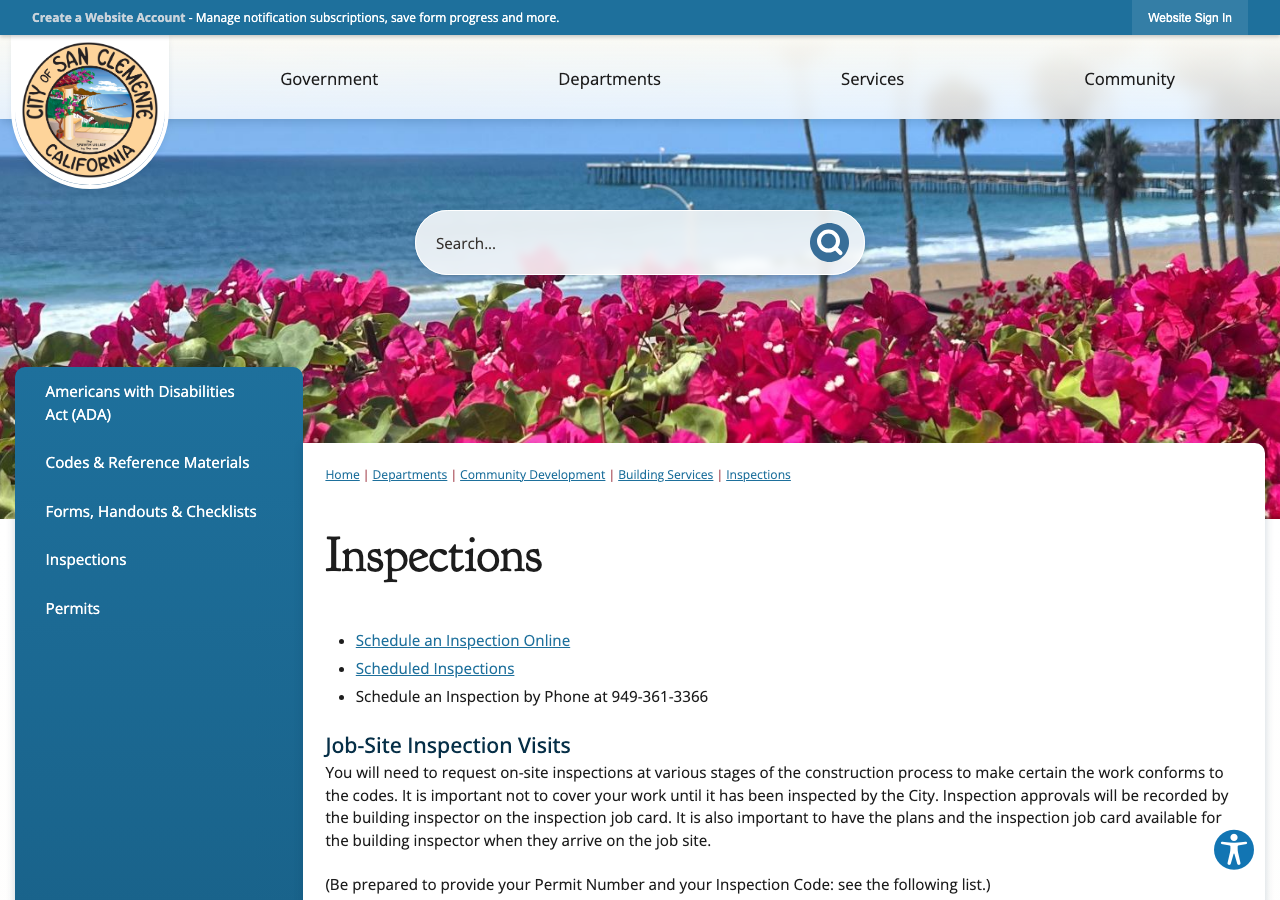
- How is an inspection booked? Portal (eTRAKiT, https://cdweb.san-clemente.org/etrakit/) or by phone at 949-361-3366. 90% · department page
- Are same-day or AM/PM windows offered? AM/PM windows only, not same-day guarantees: morning 8:30am-noon, afternoon 12:30-3:30pm. 85% · department page
-
Know who turns up
Some authorities inspect their own solar work; some delegate it, and a few do not inspect the PV equipment itself at all. Who is coming determines what they will look at.
- Does this AHJ perform its own final solar inspection? Yes 85% · department page
- If delegated, to whom? Orange County Fire Authority (OCFA), but only for the fire-code-triggered portion of a job (e.g., ESS above CFC Art.64/IFC 608 thresholds) — not for the routine building/electrical solar inspection, which the city performs itself. 80% · department page
-
Work the stages in order
A rough-in or mid-roof inspection, where one is required, has to happen before the work it covers is closed up. Missing a stage means opening something back up, and it is the most expensive kind of correction.
- Which inspections are required, and in what order? No PV-specific inspection code exists in the city's numbered inspection list; a residential rooftop PV job is closed out under code '333: Electrical Final' (and '999: Building Final' if structural/roof work was also permitted). No separate rough-in code for solar appears in the list. 75% · department page
- Is a rough-in or mid-roof inspection required? No 60% · department page (inference)
-
Have the paperwork on site
The approved plan set, the permit, and the equipment listings should be on site and reachable. Inspectors routinely verify that installed equipment matches what was approved, and that the labels are the ones the plan set promised.
- Is there a published inspection checklist? No 60% · document library (absence)
- What must be on site at inspection? Permit number and inspection code, the approved plan set, and the inspection job card. 88% · department page
- Does the inspector verify labels and listings? Yes (inferred) 65% · inference from plan-review checklist + department page
-
Sign-off, and permission to operate
Passing gives you a final or an equivalent sign-off. That is not the same as permission to operate: PTO comes from the utility, and who tells the utility the inspection passed varies. A system left switched off for weeks is usually waiting on this handover.
- What is issued on pass? Final 75% · department page (inference)
- Who notifies the utility for PTO? Installer 65% · utility program page (inference)
- Is there a re-inspection fee? $200.00 per hour (one-hour minimum) 90% · fee schedule
- How are corrections issued and cleared? Not explicitly documented as a formal 'correction notice' process; inferred from the Inspections page's emphasis on the physical 'inspection job card' (which an inspector presumably annotates on-site) and the portal's permit-status lookup — corrections are most likely communicated on the job card/verbally in the field and cleared by requesting a re-inspection through the same eTRAKiT portal or phone line used for the original booking. 45% · department page (inference)
14 questions answered against City of San Clemente’s own published documents
Q49 How is an inspection booked? Core Booking & scheduling
Portal (eTRAKiT, https://cdweb.san-clemente.org/etrakit/) or by phone at 949-361-3366.
Why the confidence is not higherInspections page states both channels directly; portal listed first/primary.
department page checked 2026-08-30 https://www.sanclemente.gov/259/Inspections
Q50 How much notice is required? Core Booking & scheduling
Nothing published by this authority.
Where we lookedRe-fetched the full Inspections page text directly (not just the summary) looking specifically for an advance-notice requirement in business days; none is stated anywhere on the page.
Q51 Are same-day or AM/PM windows offered? Booking & scheduling
AM/PM windows only, not same-day guarantees: morning 8:30am-noon, afternoon 12:30-3:30pm.
Why the confidence is not higherStated directly on the Inspections page.
department page checked 2026-08-30 https://www.sanclemente.gov/259/Inspections
Q52 Does this AHJ perform its own final solar inspection? Core Who inspects
Yes
Why the confidence is not higherCity (Community Development/Building Division) staff perform building and electrical final inspections directly per the Inspections page's own inspector list and code table (city phone/portal, not a third-party firm). Fire-related final sign-off for anything crossing an OCFA plan-review threshold (e.g., battery quantities) is delegated to OCFA.
department page checked 2026-08-30 https://www.sanclemente.gov/259/Inspections
Q53 If delegated, to whom? Core Who inspects
Orange County Fire Authority (OCFA), but only for the fire-code-triggered portion of a job (e.g., ESS above CFC Art.64/IFC 608 thresholds) — not for the routine building/electrical solar inspection, which the city performs itself.
Why the confidence is not higherOCFA's own Local Building/Planning Departments contact table lists San Clemente by name as a contract city, and the city's Fire-Services-OCFA page confirms the contract relationship.
department page checked 2026-08-30 https://ocfa.org/about-us/departments/community-risk-reduction/planning-development-services/
Q54 Which inspections are required, and in what order? Core Stages & sequence
No PV-specific inspection code exists in the city's numbered inspection list; a residential rooftop PV job is closed out under code '333: Electrical Final' (and '999: Building Final' if structural/roof work was also permitted). No separate rough-in code for solar appears in the list.
Why the confidence is not higherFull verbatim inspection-code list obtained from the Inspections page (101 through 999); no 'solar' or 'PV' code exists among them.
department page checked 2026-08-30 https://www.sanclemente.gov/259/Inspections
Q55 Is a rough-in or mid-roof inspection required? Stages & sequence
No
Why the confidence is not higherThe inspection code list has no rough-in/mid-roof code specific to PV; conduit/mounting for a typical exterior rooftop retrofit is generally covered entirely by the single '333: Electrical Final' inspection rather than a staged rough-in, based on the absence of any PV rough code in the published list.
department page (inference) checked 2026-08-30 https://www.sanclemente.gov/259/Inspections
Q56 Does the inspector verify labels and listings? Core What is checked
Yes (inferred)
Why the confidence is not higherThe plan-review checklist requires all required labels/listings to be shown on the approved plans (item 35); standard final-inspection practice for '333: Electrical Final' is to verify field conditions match approved plans, which would include label wording/placement and equipment listing. Not explicitly stated as an inspector checklist item on the Inspections page itself.
inference from plan-review checklist + department page checked 2026-08-30 https://www.sanclemente.gov/DocumentCenter/View/4495
Q57 Is there a published inspection checklist? Core What is checked
No
Why the confidence is not higherNo distinct 'inspection checklist' document (separate from the plan-review comment sheets) was found in the Forms-Handouts-Checklists library; the closest published document is the plan-review comment sheet used at submittal, not a field-inspection checklist.
document library (absence) checked 2026-08-30 https://www.sanclemente.gov/260/Forms-Handouts-Checklists
Q58 What must be on site at inspection? Core Documents on site
Permit number and inspection code, the approved plan set, and the inspection job card.
Why the confidence is not higherInspections page: 'Bring your permit number and inspection code to each site visit... have the plans and the inspection job card available for the building inspector.'
department page checked 2026-08-30 https://www.sanclemente.gov/259/Inspections
Q59 Is there a re-inspection fee? Corrections & re-inspection
$200.00 per hour (one-hour minimum)
Why the confidence is not higherCity-wide fee schedule (Resolution 08-80, updated 7/1/2026): 'Re-inspection fees assessed ... $200.00 per hour' — listed identically under Building, Mechanical, Plumbing and Electrical permit fee tables.
fee schedule checked 2026-08-30 https://www.sanclemente.gov/DocumentCenter/View/627
Q60 How are corrections issued and cleared? Corrections & re-inspection
Not explicitly documented as a formal 'correction notice' process; inferred from the Inspections page's emphasis on the physical 'inspection job card' (which an inspector presumably annotates on-site) and the portal's permit-status lookup — corrections are most likely communicated on the job card/verbally in the field and cleared by requesting a re-inspection through the same eTRAKiT portal or phone line used for the original booking.
Why the confidence is not higherInferred from Inspections page content; no dedicated 'how corrections are issued and cleared' section exists.
department page (inference) checked 2026-08-30 https://www.sanclemente.gov/259/Inspections
Q61 What is issued on pass? Core Final sign-off & PTO
Final
Why the confidence is not higherFor an existing single-family home, the closest equivalent to a certificate of occupancy is a passed final inspection ('333 Electrical Final' / '999 Building Final' on the permit record); the city's pages do not describe a separate CO or green-tag document issued specifically for a solar retrofit.
department page (inference) checked 2026-08-30 https://www.sanclemente.gov/259/Inspections
Q62 Who notifies the utility for PTO? Core Final sign-off & PTO
Installer
Why the confidence is not higherSDG&E's page frames PTO as something the customer/installer obtains once the system is 'installed, permitted and approved' — consistent with the standard CA NEM practice of the installer/contractor submitting the interconnection application and final documentation to SDG&E to trigger PTO, rather than the city or the utility initiating it unprompted.
utility program page (inference) checked 2026-08-30 https://www.sdge.com/residential/solar
Lines marked with a percentage were read off this authority’s own published documents. Unmarked guidance is general good practice, not this jurisdiction’s rule — always confirm against the authority before you submit.
Jurisdiction & key facts
The standing 62-question set, answered for City of San Clemente against this authority’s own published documents. Every answer carries the confidence it was recorded at and the document it came from. Where nothing is published we say so and show where we looked — a blank here is a finding, not a gap.
City of San Clemente is the authority having jurisdiction 92% confidence
- Holds
- Building and Electrical
- Delegated to
- Orange County Fire Authority (OCFA) holds fire-code plan review/inspection for the fire-triggered portion of a job (e.g., battery/ESS above CFC quantity thresholds); confirmed by name on OCFA's own Local Building/Planning Departments contact table and the city's own 'Fire Services - OCFA' page describing a service contract.
- Overridden by
- CA Civil Code Sec.714 (Solar Rights Act) — cited by the city's own BA-1 HOA Confirmation Form as exempting rooftop solar from HOA design review; AB 130 (Stats. 2025 Ch.22) freezes more-restrictive local residential code amendments from 1 Oct 2025 to 1 Jun 2031; Gov. Code Sec.65850.5 (ministerial/expedited solar permitting) underlies the city's voluntary SolarAPP+ pathway.
- Why not higher
- The city's own Building-Services and Permits pages (Community Development Dept, Building Division) confirm city staff — not a contractor — issue and inspect both building and electrical permits, and a dedicated 'Solar Voltaic Electrical Plan Review Comments - Residential' document (current, April 2026) shows the city actively plan-checks residential PV against 2025 CEC/CBC. OCFA is confirmed as the fire authority by name on both the city's own page and OCFA's own contract-city listing, not assumed from a database. Utility interconnection sits with SDG&E, confirmed from the city's own plan-review checklist instructing applicants to obtain SDGE approval for supply-side taps — corrected from any prior assumption of SCE, and checked against Orange County Power Authority's member list (Buena Park/Fullerton/Irvine/Fountain Valley — all SCE territory, not San Clemente) to rule out a CCA complication.
- Permit required
- Yes95%
- Permit cost
- No flat solar fee; calculated from the general Building Permit Fee valuation table (Resolution 08-80): e.g.65%
- Portal
- eTRAKiT (https://cdweb.san-clemente.org/eTRAKiT/login.aspx), plus SolarAPP+ (https://solarapp.nrel.gov/) as an optional expedited front-end for eligible systems that then still issues the…95%
- Electrical code
- 202397%
- Own placard wording
- Yes88%
- Booking an inspection
- Portal (eTRAKiT, https://cdweb.san-clemente.org/etrakit/) or by phone at 949-361-3366.90%
Labels & placards for this authority
City of San Clemente writes its own placard wording. A standard NEC label set will not satisfy it — the exact text, and in most cases the size, colour and font, are specified below.
Wording 88%
Yes
Size, colour & material None%
Where they go 90%
At the main service panel (same height/location as the PV breaker, plus a duplicate label inside the panel next to that breaker); at the AC disconnect itself, which must be on the exterior of the building, readily accessible, and within 3 feet of the meter or the PV disconnect (or as required by the Fire Code Official); and the master label locations must additionally be documented on an exterior-elevation diagram in the plan set.
What the utility wants on top 45%
Not clearly beyond the AHJ's. SDG&E's own contractor-facing documents found (Interconnection Handbook reference, NEM-ST application forms, a sample one-line diagram) do not add a distinct SDG&E placard spec. The one artifact found — SDG&E's sample one-line diagram PDF, still linked live from its current Solar Contractor Documents & Forms page but internally dated 2010 — actually calls the AC disconnect 'Recommended but not required,' which conflicts with the city's own 2026 checklist making that same disconnect mandatory. Flagging the discrepancy rather than resolving it; SDG&E's current position could not be independently confirmed beyond that outdated document.
Each figure above is sourced and dated in the full answer set below (questions 38–43). Where an authority’s own published sheet is older than the code it has adopted, the answer says so.
Their website


Average approval time — application to PTO
From the CPUC interconnection record. Bars show the average days taken each year; a year with no recorded projects is left blank rather than drawn as zero.