
City of San Mateo
San Mateo County
City of San Mateo is a city authority in the State of California, serving 105,661 residents. 3,665 residential solar installs are on record here. This page is the permit route for that jurisdiction: the fifteen steps from working out who has a say over an address through to permission to operate, the documents this authority publishes, and 62 answers taken from those documents and dated.
Permitting 5 steps · 28 questions
Whether a permit is needed — Yes Q3 Electrical and building permits — Combined Q4 Plan review — SolarAPP+/SB 379-eligible systems: real-time or near-real-time automated approval. Non-eligible (standard-track) systems: no specific business-day turnaround is… Q18 Where you file — Tyler EnerGov Citizen Self-Service (CSS) Portal (css.cityofsanmateo.org / cityofsanmateoca-energovweb.tylerhost.net); Q20
- Permit required
- Yes95% source
- What it costs
- $450.00 flat (single-family combination permit)95% source
- Plan review turnaround
- SolarAPP+/SB 379-eligible systems: real-time or near-real-time automated approval. Non-eligible (standard-track) systems: no specific business-day turnaround is published by the city.75% source
- Key document
- fee schedule cited by 5 open the document
-
Confirm who has a say over your address
A city address is usually permitted by the city, not the county — but not always, and some authorities keep building and hand electrical to someone else. Getting this wrong costs the whole submittal, because every requirement below belongs to whoever actually holds jurisdiction. Check the overlays in the same pass: an HOA, a historic district, a windstorm certification or a system-size cap can reshape the design, and all of them are cheaper to find now than after the array is laid out.
- Is this authority the AHJ for residential solar at this address? Yes 95% · municipal code
- What does this authority permit itself, and what does it delegate? Both 90% · fee schedule
- Is a permit required for a residential rooftop PV system? Yes 95% · municipal code
- Is there a separate electrical permit, or is it combined? Combined 88% · fee schedule
- Is a HOA or architectural approval required first? No 88% · municipal code
- Is there a historic-district review? Only for properties individually designated as historic resources or within a designated historic district (reviewed by the Historic Resources Commission under the city's Historic Preservation Ordinance); not a general requirement for ordinary residential solar permits, and Ch. 23.46 contains no solar-specific historic-review carve-out or trigger. 55% · city page
- Is a wind or windstorm certification required? No 68% · published checklist
- Is a Specific Use Permit or Council approval ever required? No for eligible small residential rooftop systems — review is limited to a Building Official completeness/code-compliance check, with appeal routed to the Planning Commission (not Council). 78% · municipal code
- Is there a system-size cap on residential generation? The streamlined/expedited 'small residential rooftop solar energy system' definition caps at 10 kW AC (or 30 kW thermal) on a single- or duplex-family dwelling not exceeding maximum legal building height; no found cap on residential system size overall under standard (non-expedited) review. 82% · municipal code
-
Check who is allowed to apply
Several authorities require the electrical permit to be pulled by a licensed electrician, or require the contractor to be registered with them BEFORE applying. Registration is not same-day. This is second on the list rather than fourth because it is the step most likely to stop the job before the drawings matter.
- Who is allowed to pull the electrical permit? Either 78% · city form
- Must the contractor be registered with this authority before applying? Yes 90% · department page
- Is a homeowner permitted to self-install and self-permit? Yes 82% · city form
-
Build the submittal package
Almost everywhere wants a site plan, a one-line or three-line electrical diagram, equipment cut sheets with listings, and a structural attachment detail. Build it against the published checklist rather than the last jurisdiction you worked in — the checklist is what the reviewer marks against.
- What documents make up a complete submittal? Per SMMC 23.46.050: (a) completed permit application; (b) completed PV02 eligibility checklist for expedited review; (c) completed standard electrical plan; (d) roof plan showing layout, panels, access pathways, fire classification and label locations; (e) completed structural criteria checklist (PV03/PV04); (f) processing fee payment. SB 379-eligible systems may instead submit through the automated SolarAPP+ portal. 95% · municipal code
- How many copies, and in what format? Electronic submittal via the Customer Self-Service (CSS)/EnerGov portal (PDF uploads); email or fax submittal is also required to be available per ordinance. No specific paper-copy count is published — the city's process is portal-first. 72% · department page
- Is a site plan required, and what must it show? Yes — a roof plan/site plan showing roof layout, PV panel/module locations, approximate roof access point, code-compliant access pathways, PV system fire classification, and locations of all required labels/markings. 92% · municipal code
- Is a one-line / three-line diagram required? Yes 80% · municipal code
- Are string and conductor calculations required? Yes for systems that don't meet the PV02 expedited-eligibility electrical criteria (string/MPPT counts, fusing, inverter counts) — those systems fall out of the expedited path and require full plan review including calculations. Systems that pass PV02 as-is need no additional calculations. 72% · published checklist
- Is a structural PE stamp required, and at what threshold? A CA-licensed Civil or Structural Engineer's stamp is required only if any item on the PV03/PV04 structural checklist (roof condition, slope/rafter data, array weight ≤4 psf PV, anchor spacing per Table 1, fastener embedment) is checked 'No.' If all items pass, no stamp is required. 92% · published checklist
- Is an electrical PE stamp required, and at what threshold? No electrical PE stamp requirement or threshold is published; SMMC 23.46.060(c) requires only that equipment meet CEC/IEEE/UL/NRTL and CPUC standards, with no PE-stamp trigger for standard residential PV. 62% · municipal code
-
Apply and pay
Most authorities now take the whole application through a portal, and several states cap or constrain what a residential solar permit may cost. Check whether plan check is billed separately before you quote the job.
- Which permit portal does this authority use? Tyler EnerGov Citizen Self-Service (CSS) Portal (css.cityofsanmateo.org / cityofsanmateoca-energovweb.tylerhost.net); SolarAPP+ (solarapp.nrel.gov) is used for automated eligible-system review before the CSS permit application. 92% · portal landing page
- Can the whole application be completed online? Yes 88% · department page
- What does a residential solar permit cost? $450.00 flat (single-family combination permit) 95% · fee schedule
- How is the fee calculated? Flat 90% · fee schedule
- Is there a separate plan-check fee? No 72% · fee schedule
-
Plan review — and start the utility in parallel
Interconnection is a separate process from the permit and usually the longer pole. Where the utility does not depend on the permit being issued, running both at once is the single biggest saving available on a residential job.
- What is the stated plan-review turnaround? SolarAPP+/SB 379-eligible systems: real-time or near-real-time automated approval. Non-eligible (standard-track) systems: no specific business-day turnaround is published by the city. 75% · municipal code
- How long is an issued permit valid before it expires? 12 months 80% · city form
- Which utility handles interconnection here? Pacific Gas & Electric (PG&E) 92% · city page
28 questions answered against City of San Mateo’s own published documents
Q1 Is this authority the AHJ for residential solar at this address? Core Jurisdiction & scope
Yes
Why the confidence is not higherSMMC Ch. 23.46 'Small Residential Rooftop Solar Energy Systems' assigns permitting duties to the City's own Building Department throughout (23.46.040, 23.46.070); city Building Division pages (SolarApp+, Building Permits) confirm active administration.
municipal code checked 2026-08-30 https://law.cityofsanmateo.org/us/ca/cities/san-mateo/code/23.46.040
Q2 What does this authority permit itself, and what does it delegate? Core Jurisdiction & scope
Both
Why the confidence is not higherCity Building Division issues combined building/electrical permits for solar (Master Fee Schedule item II.S: 'Each Combination Permit'). Fire-code enforcement is delegated to SMCFD, a separate joint-powers agency (SMMC 23.28.010), not retained by the city.
fee schedule checked 2026-08-30 https://www.cityofsanmateo.org/DocumentCenter/View/105420
Q3 Is a permit required for a residential rooftop PV system? Core Jurisdiction & scope
Yes
Why the confidence is not higherSMMC 23.46.030 Applicability: chapter governs 'the permitting of small residential rooftop solar systems'; only routine O&M or like-kind replacement is exempt, implying a permit is otherwise required.
municipal code checked 2026-08-30 https://law.cityofsanmateo.org/us/ca/cities/san-mateo/code/23.46.030
Q4 Is there a separate electrical permit, or is it combined? Core Jurisdiction & scope
Combined
Why the confidence is not higherMaster Fee Schedule FY26-27 lists the residential PV fee under 'IV. MISC. PLAN REVIEW, INSPECTIONS AND FEES — S. SOLAR ENERGY SYSTEMS — 1. Single Family Dwellings — Each Combination Permit — $450.00', i.e. one combination permit covers building+electrical.
fee schedule checked 2026-08-30 https://www.cityofsanmateo.org/DocumentCenter/View/105420
Q5 Who is allowed to pull the electrical permit? Core Who may apply
Either
Why the confidence is not higherCity's Owner-Builder Declaration Form (rev. 1/12/2024) lets a property owner pull permits themselves for work they perform personally or via employees, or via a licensed contractor; SolarApp+ page addresses licensed installers. No exclusive restriction to licensed electricians found.
city form checked 2026-08-30 https://www.cityofsanmateo.org/DocumentCenter/View/47752/Property-Owner-Builder-Verification-Form
Q6 Must the contractor be registered with this authority before applying? Core Who may apply
Yes
Why the confidence is not higherSolarApp+ page states plainly: 'Active San Mateo Business License is required. Contractor must also be added to SolarAPP+ program eligibility list.' A separate FAQ snippet confirms 'Contractors must be licensed and maintain the proper insurance and business license.'
department page checked 2026-08-30 https://www.cityofsanmateo.org/4770/solarapp-for-solar-installers
Q7 Is a homeowner permitted to self-install and self-permit? Who may apply
Yes
Why the confidence is not higherCity publishes an Owner-Builder Declaration Form under Business & Professions Code §7044 exemptions, allowing an owner to self-perform and self-permit construction work including, per its scope, on their residence (form is general to building permits, not solar-specific).
city form checked 2026-08-30 https://www.cityofsanmateo.org/DocumentCenter/View/47752/Property-Owner-Builder-Verification-Form
Q8 What documents make up a complete submittal? Core Submittal package
Per SMMC 23.46.050: (a) completed permit application; (b) completed PV02 eligibility checklist for expedited review; (c) completed standard electrical plan; (d) roof plan showing layout, panels, access pathways, fire classification and label locations; (e) completed structural criteria checklist (PV03/PV04); (f) processing fee payment. SB 379-eligible systems may instead submit through the automated SolarAPP+ portal.
Why the confidence is not higherDirectly enumerated in the ordinance text itself.
municipal code checked 2026-08-30 https://law.cityofsanmateo.org/us/ca/cities/san-mateo/code/23.46.050
Q9 How many copies, and in what format? Submittal package
Electronic submittal via the Customer Self-Service (CSS)/EnerGov portal (PDF uploads); email or fax submittal is also required to be available per ordinance. No specific paper-copy count is published — the city's process is portal-first.
Why the confidence is not higherSMMC 23.46.040(b) requires electronic (email/fax) submittal to be available; Online Permit Center page describes CSS portal upload of 'plans, documents, and other project-related materials.' Neither source states a specific number of copies for paper submittal, so a paper count could not be confirmed either way.
department page checked 2026-08-30 https://www.cityofsanmateo.org/4294/Online-Permit-Center
Q10 Is a site plan required, and what must it show? Core Submittal package
Yes — a roof plan/site plan showing roof layout, PV panel/module locations, approximate roof access point, code-compliant access pathways, PV system fire classification, and locations of all required labels/markings.
Why the confidence is not higherSMMC 23.46.050(d) lists these items verbatim as part of the required roof plan.
municipal code checked 2026-08-30 https://law.cityofsanmateo.org/us/ca/cities/san-mateo/code/23.46.050
Q11 Is a one-line / three-line diagram required? Core Drawings & calculations
Yes
Why the confidence is not higherSMMC 23.46.040(c)(1)/23.46.050(c) require a completed 'standard electrical plan' as part of a complete submittal; the PV03/PV04 structural packets are companion documents to this standard plan set that together function as the one-line diagram package.
municipal code checked 2026-08-30 https://law.cityofsanmateo.org/us/ca/cities/san-mateo/code/23.46.050
Q12 Are string and conductor calculations required? Drawings & calculations
Yes for systems that don't meet the PV02 expedited-eligibility electrical criteria (string/MPPT counts, fusing, inverter counts) — those systems fall out of the expedited path and require full plan review including calculations. Systems that pass PV02 as-is need no additional calculations.
Why the confidence is not higherPV02 Eligibility Checklist 'Electrical Requirements' section (string counts, MPPT limits, fusing, inverter counts) functions as a pass/fail gate; failing any item routes the project to standard plan review per PV02's own footnote 2.
published checklist checked 2026-08-30 https://www.cityofsanmateo.org/DocumentCenter/View/47395/PV02---Eligibility-for-Expedited-Permit-Plan-Submittal-Checklist-v-13
Q13 Is a structural PE stamp required, and at what threshold? Core Engineering & stamps
A CA-licensed Civil or Structural Engineer's stamp is required only if any item on the PV03/PV04 structural checklist (roof condition, slope/rafter data, array weight ≤4 psf PV, anchor spacing per Table 1, fastener embedment) is checked 'No.' If all items pass, no stamp is required.
Why the confidence is not higherStated explicitly in the checklist's 'Summary' block: 'One or more items are checked NO. Attach project-specific drawings and calculations stamped and signed by a California-licensed Civil or Structural Engineer.'
published checklist checked 2026-08-30 https://www.cityofsanmateo.org/DocumentCenter/View/47402/PV03---A61-Structural-Standard-Criteria-Plan-Submittal-Checklist-v-13
Q14 Is an electrical PE stamp required, and at what threshold? Engineering & stamps
No electrical PE stamp requirement or threshold is published; SMMC 23.46.060(c) requires only that equipment meet CEC/IEEE/UL/NRTL and CPUC standards, with no PE-stamp trigger for standard residential PV.
Why the confidence is not higherAbsence checked directly: read the full text of SMMC 23.46 (all 7 sections) and the PV02–PV04 checklists — none mentions an electrical engineer stamp or a kW/amp threshold for one, only the structural-engineer trigger in Q13.
municipal code checked 2026-08-30 https://law.cityofsanmateo.org/us/ca/cities/san-mateo/code/23.46.060
Q15 What does a residential solar permit cost? Core Fees
$450.00 flat (single-family combination permit)
Why the confidence is not higherFY2026-27 Adopted Comprehensive Fee Schedule (effective 7/1/2026), Community Development/Building Division, item IV.S.1: 'SOLAR ENERGY SYSTEMS (Fee set by State of California AB-132; sunsets 1/1/2034) — 1. Single Family Dwellings — Each Combination Permit — $450.00.' Document's own header dates it FY26-27, not inferred from the filename.
fee schedule checked 2026-08-30 https://www.cityofsanmateo.org/DocumentCenter/View/105420
Q16 How is the fee calculated? Core Fees
Flat
Why the confidence is not higherSingle-family fee is a flat $450 state-capped fee under AB-132; multi-family/commercial tiers move to per-kW above set thresholds, but residential (the scope of this survey) is flat.
fee schedule checked 2026-08-30 https://www.cityofsanmateo.org/DocumentCenter/View/105420
Q17 Is there a separate plan-check fee? Fees
No
Why the confidence is not higherThe $450 residential solar fee is listed as a single 'Combination Permit' line item under AB-132's state fee cap, distinct from the general Building Division formula elsewhere in the same schedule that separately breaks out plan review as '70% of Building Permit Fee' for SFR — solar is not shown split that way, implying plan check is bundled into the flat fee.
fee schedule checked 2026-08-30 https://www.cityofsanmateo.org/DocumentCenter/View/105420
Q18 What is the stated plan-review turnaround? Core Timeline & validity
SolarAPP+/SB 379-eligible systems: real-time or near-real-time automated approval. Non-eligible (standard-track) systems: no specific business-day turnaround is published by the city.
Why the confidence is not higherSMMC 23.46.070(d): 'Applications submitted through the automated permitting platform under SB 379 shall be processed automatically, with approvals issued in real time or near-real time.' No numeric day count for standard-track plan review was found on the Building Division pages checked (477, 3361, 3630).
municipal code checked 2026-08-30 https://law.cityofsanmateo.org/us/ca/cities/san-mateo/code/23.46.070
Q19 How long is an issued permit valid before it expires? Timeline & validity
12 months
Why the confidence is not higherCity's Owner-Builder Declaration form (rev. 1/12/2024) states: 'Permits issued shall become invalid unless the work...is commenced within 12 months after its issuance, or if...suspended or abandoned for a period of 12 months' citing H&SC §18938.5/.6 and CBC 105.5.1 (form cites the 2022 CBC cross-reference though the city is now on the 2025 cycle — the 12-month rule itself is unchanged across cycles).
city form checked 2026-08-30 https://www.cityofsanmateo.org/DocumentCenter/View/47752/Property-Owner-Builder-Verification-Form
Q20 Which permit portal does this authority use? Core Portal & process
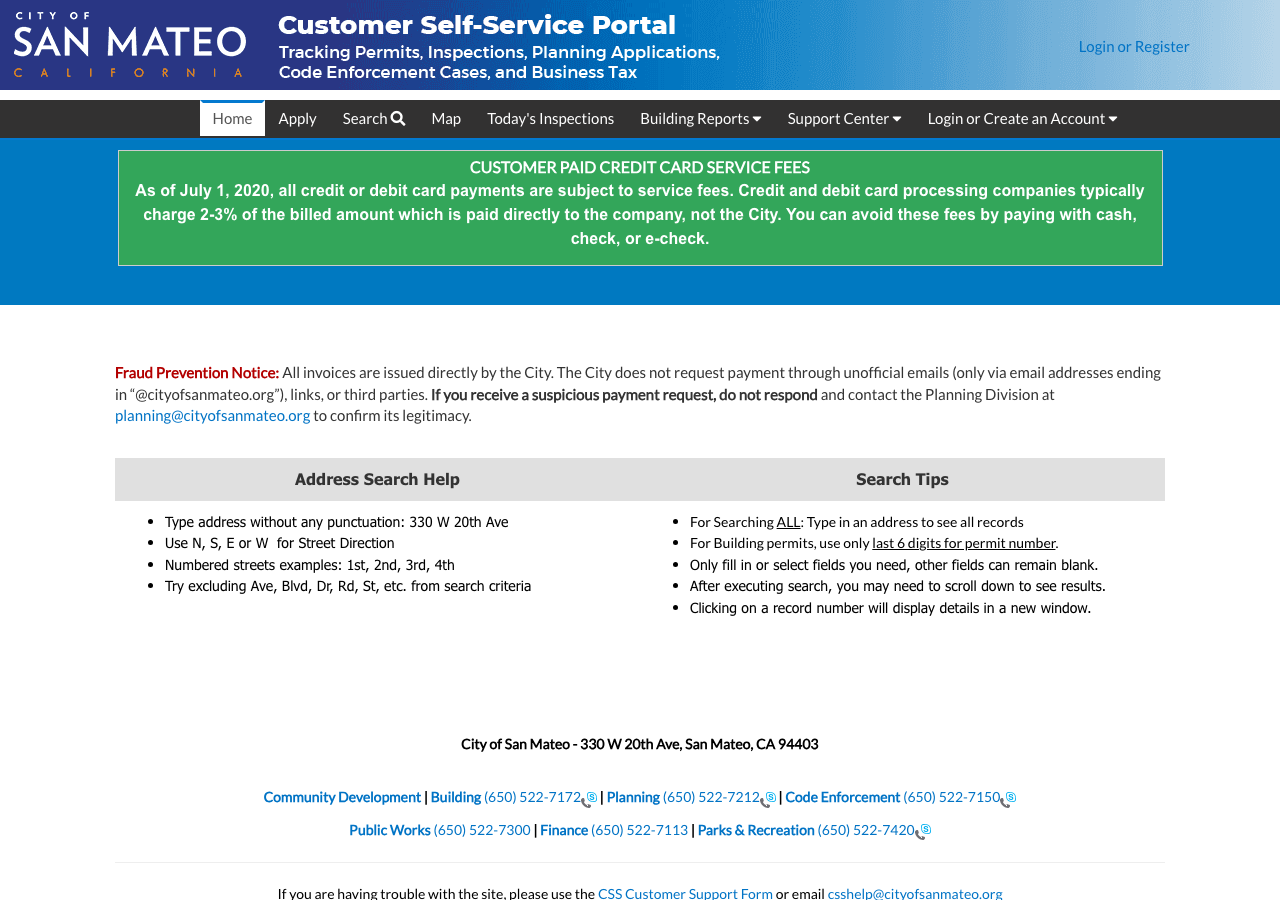
Tyler EnerGov Citizen Self-Service (CSS) Portal (css.cityofsanmateo.org / cityofsanmateoca-energovweb.tylerhost.net); SolarAPP+ (solarapp.nrel.gov) is used for automated eligible-system review before the CSS permit application.
Why the confidence is not higherBoth linked directly from the city's Online Permit Center and SolarApp+ pages.
portal landing page checked 2026-08-30 https://www.cityofsanmateo.org/4294/Online-Permit-Center
Q21 Can the whole application be completed online? Core Portal & process
Yes
Why the confidence is not higherOnline Permit Center describes end-to-end CSS workflow: register, submit application with plans, pay fees online, respond to review comments, receive the issued permit, all electronically; SolarApp+ page describes the same for solar specifically, ending with 'Apply for a City of San Mateo Solar Photovoltaic (SolarAPP) permit at our Online Permit Center. Pay for the Permit.'
department page checked 2026-08-30 https://www.cityofsanmateo.org/4770/solarapp-for-solar-installers
Q22 Which utility handles interconnection here? Core Utility interconnection
Pacific Gas & Electric (PG&E)
Why the confidence is not higherCity's own 'Electric, Gas, Water' services page states directly: 'Electric and Gas: Pacific Gas & Electric (PG&E).' Peninsula Clean Energy (San Mateo County's CCA) is the electricity generation/rate provider for many residents but does not own the wires or set interconnection rules — PG&E remains the interconnecting utility of record.
city page checked 2026-08-30 https://www.cityofsanmateo.org/3457/electric-gas-water
Q23 Where does the utility sit in the sequence? Core Utility interconnection
Nothing published by this authority.
Where we lookedSolarApp+ page (cityofsanmateo.org/4770), SMMC Ch. 23.46 full text, PG&E Greenbook doc 060559 — none states whether/where a PG&E interconnection application must sit relative to city permit issuance (before/after/parallel).
https://www.cityofsanmateo.org/4770/solarapp-for-solar-installers
Q24 Is a HOA or architectural approval required first? Overlays & special cases
No
Why the confidence is not higherSMMC 23.46.070(e): 'A City shall not condition approval of an application on the approval of an association, as defined in Section 4080 of the Civil Code.'
municipal code checked 2026-08-30 https://law.cityofsanmateo.org/us/ca/cities/san-mateo/code/23.46.070
Q25 Is there a historic-district review? Overlays & special cases
Only for properties individually designated as historic resources or within a designated historic district (reviewed by the Historic Resources Commission under the city's Historic Preservation Ordinance); not a general requirement for ordinary residential solar permits, and Ch. 23.46 contains no solar-specific historic-review carve-out or trigger.
Why the confidence is not higherCity's Historic Resources Commission page confirms the Commission reviews 'Historic property alterations and appeals' for designated resources/districts, but no document found ties this specifically to solar permitting, and Ch. 23.46 (the solar chapter) does not mention historic review at all.
city page checked 2026-08-30 https://www.cityofsanmateo.org/4967/Historic-Resources-Commission
Q26 Is a wind or windstorm certification required? Overlays & special cases
No
Why the confidence is not higherCalifornia uses ASCE 7 wind-uplift design built into the PV03/PV04 structural checklist (anchor fastener/embedment requirements) rather than a separate windstorm certification process (no TDI-style certificate found in any city document reviewed).
published checklist checked 2026-08-30 https://www.cityofsanmateo.org/DocumentCenter/View/47402/PV03---A61-Structural-Standard-Criteria-Plan-Submittal-Checklist-v-13
Q27 Is a Specific Use Permit or Council approval ever required? Overlays & special cases
No for eligible small residential rooftop systems — review is limited to a Building Official completeness/code-compliance check, with appeal routed to the Planning Commission (not Council).
Why the confidence is not higherSMMC 23.46.070(a) and (f): review is limited to 'the building official's review of whether the application is complete and meets local, state, and federal health and safety requirements,' and denials are appealable 'to the City's Planning Commission,' with no Council or Use Permit step mentioned.
municipal code checked 2026-08-30 https://law.cityofsanmateo.org/us/ca/cities/san-mateo/code/23.46.070
Q28 Is there a system-size cap on residential generation? Overlays & special cases
The streamlined/expedited 'small residential rooftop solar energy system' definition caps at 10 kW AC (or 30 kW thermal) on a single- or duplex-family dwelling not exceeding maximum legal building height; no found cap on residential system size overall under standard (non-expedited) review.
Why the confidence is not higherSMMC 23.46.020(g) definition sets the 10kW AC / 30kWth threshold that defines eligibility for the streamlined chapter; nothing in the reviewed code prohibits larger residential systems from being permitted through standard review.
municipal code checked 2026-08-30 https://law.cityofsanmateo.org/us/ca/cities/san-mateo/code/23.46.020
Lines marked with a percentage were read off this authority’s own published documents. Unmarked guidance is general good practice, not this jurisdiction’s rule — always confirm against the authority before you submit.
Install 5 steps · 20 questions
-
Build to the code editions actually in force here
The NEC edition a jurisdiction enforces is often a cycle behind the newest one published, and local amendments sit on top of it. Rapid shutdown, conductor sizing and labelling all change between editions, so the edition in force is the first thing to establish, not the last.
- Which NEC edition is in force? 2023 82% · municipal code
- Which building code edition is in force? 2025 California Building Code (Title 24, Part 2, Vols. 1-2 + Appendix G), effective January 1, 2026 95% · municipal code
- Which fire code edition is in force? The Fire Code adopted and amended by the San Mateo Consolidated Fire Department (a separate joint-powers agency), which the City adopts by reference (SMMC 23.28.010); presumed the 2025 California Fire Code (Title 24 Part 9) baseline effective statewide 1/1/2026, but SMCFD's own adoption ordinance/resolution with any local amendments was not locatable on smcfire.ca.gov this run. 58% · municipal code
- Are there local amendments to any of the above? Yes 85% · municipal code
- What is the installation judged against? The 2025 California Electrical Code (Title 24 Part 3), IEEE standards, UL/NRTL listing, and applicable CPUC safety/reliability rules 88% · municipal code
-
Fire access, setbacks and pathways
Ridge setbacks and roof access pathways are fire-service requirements and they constrain the array layout. They are the most common cause of a redesign after the fire department comments on a plan set.
- What ridge setback and access pathways are required? Clear code-compliant access pathways and a PV system fire classification are required and must be shown on the submitted roof plan; the specific ridge-setback/pathway dimensions come from the adopted (2025) California Fire Code §605.11, whose dimensional tables are ICC-copyrighted and could not be extracted from any freely accessible city or SMCFD document this run. 65% · published checklist
-
Rapid shutdown
Which rapid-shutdown rule applies follows directly from the NEC edition in force, and the initiation device has to be at a location the fire service can reach and identify. This is inspected, and it is labelled.
- Is rapid shutdown required, and to which NEC edition? Rapid shutdown is required under the adopted 2025 California Electrical Code (based on the 2023 NEC, NEC §690.12); no city document names 'rapid shutdown' explicitly, but PV02/PV03 require disconnecting-means locations and fire classification consistent with NEC 690.12 compliance. 62% · municipal code
-
Labels and placards
The NEC sets a baseline for permanent markings at the service equipment and the disconnecting means. On top of that, an authority may specify its own wording, and the utility may specify more again. Where any of them writes its own text, a generic off-the-shelf label set will not pass — this is the detail most often fixed on a return visit.
- Which placards does this authority require at the service equipment? At the AC disconnect: PG&E's utility-required 'UTILITY AC DISCONNECT SWITCH' placard, a device label, and a visible ON/OFF label. At the roof/array: PV system fire-classification marking and required CFC §605.11-style access-pathway/equipment labels per the city's PV02 checklist. 78% · utility DG manual
- Does the authority specify placard wording of its own? No 62% · municipal code
- Does it specify letter height, colour or material? The City itself does not specify letter height/color/material (absence confirmed after reading Ch. 23.46 and PV02–PV04 in full). The UTILITY (PG&E) does: labels must be permanent, engraved phenolic or comply with ANSI Z535.4, with lettering a minimum 3/8" high, all capitals. 85% · utility DG manual
- Is a site plan / facility map placard required, and what must it show? Yes — a roof plan/facility-map-style diagram is required showing roof layout, all PV panels/modules, clear access pathways, the PV system fire classification, and the locations of all required labels/markings and roof access points, plus (per PV02) the locations of electrical disconnecting means. 90% · municipal code
- Does the UTILITY specify placards beyond the AHJ's? Yes 92% · utility DG manual
- Where must the labels be placed? Utility-required labels: on the front of the AC disconnect switch itself, which must be located 10 feet or less, in line of sight, from PG&E's meter, at the same grade level as the meter, and never on a roof, on a floor above grade, or in an unapproved room. AHJ-required roof labels/markings: per the roof plan, at access pathways, equipment, and roof access points. 88% · utility DG manual
-
Disconnect, storage and listed equipment
Where the AC disconnect must sit relative to the meter is usually the utility's rule, not the building department's. Battery storage frequently carries its own permit, its own inspection and its own fire conditions.
- Where must the AC disconnect be, relative to the meter? 10 feet or less, in line of sight of PG&E's electric meter at the point of common coupling, easily seen from the meter panel, at the same grade level as the meter if installed outdoors; never on a floor/level above grade, on a roof, or inside a room that isn't an approved electric meter room. 92% · utility DG manual
- Must equipment be on a specific approved list? Yes 88% · municipal code
- Are batteries permitted, and under what conditions? Yes, with spacing/separation conditions — the City's own issued-permit records show routine residential battery installs (Enphase, Tesla Powerwall, LG Chem RESU) and the Fire Department's fee schedule prices ESS plan review/inspection separately, and at least one project needed sign-off for a 'REDUCED ESS SEPARATION.' 78% · issued-permit record
- Is there a separate ESS permit or inspection? Mixed: when installed together with new PV, both are covered by one combination/SolarApp permit (e.g. permit SA-2025-298715 covers 'PV Roof Mount...1 ess'); a standalone electrical permit is used when a battery is added independently of a new PV system (e.g. permit MEP-2025-298172, 'Energy Storage System'). The Fire Department separately prices ESS plan review/inspection at $980/system regardless of how the building permit is structured. 72% · issued-permit record
- Is a ground mount treated as a structure? Likely yes, as an accessory structure under Title 27 Zoning (Ch. 27.70, Accessory Buildings and Structures in Required Yards) — SMMC Ch. 23.46's streamlined solar process applies only to roof-mounted systems (23.46.020(g)(3)), so ground-mounted arrays fall outside that chapter and back into standard zoning/accessory-structure treatment; no solar-specific ground-mount carve-out was found. 55% · municipal code
- Is there a local rule on service upgrades or busbar sizing? No local amendment found — Ch. 23.12 (Electrical Code) consists of a single section (23.12.010, Adoption) with no added service-upgrade or busbar-sizing provisions; service upgrades/busbar sizing (e.g. the NEC 705.12 120% rule) are governed by the adopted CEC as-is, unamended locally. 68% · municipal code
- Is a specific mounting system or attachment spacing required? Yes — for flush-mounted residential arrays: modules parallel to roof plane with a 2–10 inch gap, no overhang past roof edges, ≤4 psf (PV)/5 psf (thermal) combined weight, array ≤ half of total roof-plane area, and anchor horizontal spacing per Table 1 (varies by roof slope and rafter spacing, e.g. 5'4" to 1'4" o.c.) with fastener/embedment criteria in Table 1 notes. 90% · published checklist
20 questions answered against City of San Mateo’s own published documents
Q29 Which NEC edition is in force? Core Code editions in force
2023
Why the confidence is not higherSMMC 23.12.010 adopts 'The 2025 California Electrical Code, California Code of Regulations, Title 24, Part 3' effective 1/1/2026 per the city's Adopted Building Codes page; the 2025 CEC cycle is based on the 2023 NEC as amended by the state — the local ordinance itself names the CEC edition/year rather than the underlying NFPA NEC edition by name.
municipal code checked 2026-08-30 https://law.cityofsanmateo.org/us/ca/cities/san-mateo/code/23.12.010
Q30 Which building code edition is in force? Core Code editions in force
2025 California Building Code (Title 24, Part 2, Vols. 1-2 + Appendix G), effective January 1, 2026
Why the confidence is not higherSMMC 23.08.010 adoption text, confirmed also by the city's Adopted Building Codes page ('current 2025 California Building Codes took effect on January 1, 2026').
municipal code checked 2026-08-30 https://law.cityofsanmateo.org/us/ca/cities/san-mateo/code/23.08.010
Q31 Which fire code edition is in force? Code editions in force
The Fire Code adopted and amended by the San Mateo Consolidated Fire Department (a separate joint-powers agency), which the City adopts by reference (SMMC 23.28.010); presumed the 2025 California Fire Code (Title 24 Part 9) baseline effective statewide 1/1/2026, but SMCFD's own adoption ordinance/resolution with any local amendments was not locatable on smcfire.ca.gov this run.
Why the confidence is not higherSMMC 23.28.010 text is explicit that the City adopts whatever fire code SMCFD adopts 'as amended from time to time' rather than naming an edition itself. Checked smcfire.ca.gov's fire-prevention-life-safety, the-fire-prevention-bureau, and documents-forms-policies pages for a published adoption ordinance/edition statement; none was found, so the exact SMCFD-adopted edition/amendments are an absence, not a confirmed fact.
municipal code checked 2026-08-30 https://law.cityofsanmateo.org/us/ca/cities/san-mateo/code/23.28.010
Q32 Are there local amendments to any of the above? Core Code editions in force
Yes
Why the confidence is not higherSMMC Ch. 23.08 (Building Code) carries local amendments (roofing §1505.1, concrete §1705.3, wall bracing Table 2308.10.1, pool enclosures, vehicular gates) and Ch. 23.07 (Residential Code) amends Table R602.10.3(3)/R602.10.4.5. By contrast, nearly all of Ch. 23.28's former local Fire Code amendments are now marked [Repealed], consistent with fire-code amendment authority sitting with SMCFD rather than the city.
municipal code checked 2026-08-30 https://law.cityofsanmateo.org/us/ca/cities/san-mateo/code/23.08
Q33 What is the installation judged against? Core Electrical
The 2025 California Electrical Code (Title 24 Part 3), IEEE standards, UL/NRTL listing, and applicable CPUC safety/reliability rules
Why the confidence is not higherSMMC 23.46.060(c): 'Solar energy systems for producing electricity shall meet all applicable safety and performance standards established by the California Electrical Code, the Institute of Electrical and Electronics Engineers, and accredited testing laboratories such as Underwriters Laboratories and, where applicable, rules of the Public Utilities Commission.'
municipal code checked 2026-08-30 https://law.cityofsanmateo.org/us/ca/cities/san-mateo/code/23.46.060
Q34 Is there a local rule on service upgrades or busbar sizing? Electrical
No local amendment found — Ch. 23.12 (Electrical Code) consists of a single section (23.12.010, Adoption) with no added service-upgrade or busbar-sizing provisions; service upgrades/busbar sizing (e.g. the NEC 705.12 120% rule) are governed by the adopted CEC as-is, unamended locally.
Why the confidence is not higherProved by reading the full Ch. 23.12 table of contents and its one section — no 23.12.020 or further sections exist locally (block-walked by chapter TOC, not by number gaps alone), confirming the absence rather than assuming it.
municipal code checked 2026-08-30 https://law.cityofsanmateo.org/us/ca/cities/san-mateo/code/23.12
Q35 Is a specific mounting system or attachment spacing required? Structural & mounting
Yes — for flush-mounted residential arrays: modules parallel to roof plane with a 2–10 inch gap, no overhang past roof edges, ≤4 psf (PV)/5 psf (thermal) combined weight, array ≤ half of total roof-plane area, and anchor horizontal spacing per Table 1 (varies by roof slope and rafter spacing, e.g. 5'4" to 1'4" o.c.) with fastener/embedment criteria in Table 1 notes.
Why the confidence is not higherPV03/PV04 'Structural Criteria for Residential Flush-Mounted Solar Arrays' checklist, published on the city's Checklists page.
published checklist checked 2026-08-30 https://www.cityofsanmateo.org/DocumentCenter/View/47402/PV03---A61-Structural-Standard-Criteria-Plan-Submittal-Checklist-v-13
Q36 What ridge setback and access pathways are required? Core Fire pathways & setbacks
Clear code-compliant access pathways and a PV system fire classification are required and must be shown on the submitted roof plan; the specific ridge-setback/pathway dimensions come from the adopted (2025) California Fire Code §605.11, whose dimensional tables are ICC-copyrighted and could not be extracted from any freely accessible city or SMCFD document this run.
Why the confidence is not higherPV02 Fire Safety Requirements section requires 'Clear access pathways' and 'Fire classification' as pass/fail eligibility items, and 23.46.050(d) requires the roof plan to show pathway locations — but the dimensional standard itself is CFC 605.11, referenced by adoption rather than reproduced locally, and is not retrievable outside the copyrighted ICC text.
published checklist checked 2026-08-30 https://www.cityofsanmateo.org/DocumentCenter/View/47395/PV02---Eligibility-for-Expedited-Permit-Plan-Submittal-Checklist-v-13
Q37 Is rapid shutdown required, and to which NEC edition? Core Rapid shutdown
Rapid shutdown is required under the adopted 2025 California Electrical Code (based on the 2023 NEC, NEC §690.12); no city document names 'rapid shutdown' explicitly, but PV02/PV03 require disconnecting-means locations and fire classification consistent with NEC 690.12 compliance.
Why the confidence is not higherInferred from the adopted electrical code edition (Q29) rather than an explicit local statement naming rapid shutdown; Ch. 23.46 and PV02–PV04 do not use the term 'rapid shutdown' directly.
municipal code checked 2026-08-30 https://law.cityofsanmateo.org/us/ca/cities/san-mateo/code/23.12.010
Q38 Which placards does this authority require at the service equipment? Core Labels Signage & labelling
At the AC disconnect: PG&E's utility-required 'UTILITY AC DISCONNECT SWITCH' placard, a device label, and a visible ON/OFF label. At the roof/array: PV system fire-classification marking and required CFC §605.11-style access-pathway/equipment labels per the city's PV02 checklist.
Why the confidence is not higherCombines PG&E Greenbook doc 060559 (utility-required labeling at the disconnect) with the city's PV02 checklist fire-safety item requiring 'all required markings and labels.'
utility DG manual checked 2026-08-30 https://www.pge.com/content/dam/pge/docs/about/doing-business-with-pge/060559.pdf
Q39 Does the authority specify placard wording of its own? Core Labels Signage & labelling
No
Why the confidence is not higherThe City does not publish its own custom placard wording in Ch. 23.46 or the PV02–PV04 checklists — it requires 'markings and labels' generically, deferring to the adopted state Fire/Electrical codes. PG&E, the utility, does specify its own exact wording ('UTILITY AC DISCONNECT SWITCH') — see Q42/Q38.
municipal code checked 2026-08-30 https://law.cityofsanmateo.org/us/ca/cities/san-mateo/code/23.46.050
Q40 Does it specify letter height, colour or material? Core Labels Signage & labelling
The City itself does not specify letter height/color/material (absence confirmed after reading Ch. 23.46 and PV02–PV04 in full). The UTILITY (PG&E) does: labels must be permanent, engraved phenolic or comply with ANSI Z535.4, with lettering a minimum 3/8" high, all capitals.
Why the confidence is not higherPG&E Greenbook doc 060559, 'Labeling' section, page 2, read directly via pdftotext.
utility DG manual checked 2026-08-30 https://www.pge.com/content/dam/pge/docs/about/doing-business-with-pge/060559.pdf
Q41 Is a site plan / facility map placard required, and what must it show? Core Labels Signage & labelling
Yes — a roof plan/facility-map-style diagram is required showing roof layout, all PV panels/modules, clear access pathways, the PV system fire classification, and the locations of all required labels/markings and roof access points, plus (per PV02) the locations of electrical disconnecting means.
Why the confidence is not higherSMMC 23.46.050(d) and PV02 checklist item D, read together.
municipal code checked 2026-08-30 https://law.cityofsanmateo.org/us/ca/cities/san-mateo/code/23.46.050
Q42 Does the UTILITY specify placards beyond the AHJ's? Core Labels Signage & labelling
Yes
Why the confidence is not higherPG&E Greenbook doc 060559 imposes its own disconnect-switch labeling regime (permanently attached 'UTILITY AC DISCONNECT SWITCH' signage, device label, ON/OFF label, NGOM labeling/mapping) that is independent of, and in addition to, whatever the AHJ requires.
utility DG manual checked 2026-08-30 https://www.pge.com/content/dam/pge/docs/about/doing-business-with-pge/060559.pdf
Q43 Where must the labels be placed? Core Labels Signage & labelling
Utility-required labels: on the front of the AC disconnect switch itself, which must be located 10 feet or less, in line of sight, from PG&E's meter, at the same grade level as the meter, and never on a roof, on a floor above grade, or in an unapproved room. AHJ-required roof labels/markings: per the roof plan, at access pathways, equipment, and roof access points.
Why the confidence is not higherPG&E Greenbook doc 060559 'Labeling' and 'Location' sections (utility); SMMC 23.46.050(d) for city-required roof marking locations.
utility DG manual checked 2026-08-30 https://www.pge.com/content/dam/pge/docs/about/doing-business-with-pge/060559.pdf
Q44 Must equipment be on a specific approved list? Equipment listing
Yes
Why the confidence is not higherSMMC 23.46.060(c) requires equipment to meet standards 'established by...accredited testing laboratories such as Underwriters Laboratories,' i.e. UL/NRTL listing is required.
municipal code checked 2026-08-30 https://law.cityofsanmateo.org/us/ca/cities/san-mateo/code/23.46.060
Q45 Are batteries permitted, and under what conditions? Core Battery / ESS
Yes, with spacing/separation conditions — the City's own issued-permit records show routine residential battery installs (Enphase, Tesla Powerwall, LG Chem RESU) and the Fire Department's fee schedule prices ESS plan review/inspection separately, and at least one project needed sign-off for a 'REDUCED ESS SEPARATION.'
Why the confidence is not higherMultiple entries in the city's monthly 'Permits Issued' document series (DocumentCenter/View/87543, 87546, 87547, 98123, 99444) describe residential battery permits and spacing conditions; the SMCFD fee schedule lists 'Energy Storage Systems (ESS) — per system — $980' confirming fire-code review of ESS placement/separation.
issued-permit record checked 2026-08-30 https://www.cityofsanmateo.org/documentcenter/view/98123
Q46 Is there a separate ESS permit or inspection? Battery / ESS
Mixed: when installed together with new PV, both are covered by one combination/SolarApp permit (e.g. permit SA-2025-298715 covers 'PV Roof Mount...1 ess'); a standalone electrical permit is used when a battery is added independently of a new PV system (e.g. permit MEP-2025-298172, 'Energy Storage System'). The Fire Department separately prices ESS plan review/inspection at $980/system regardless of how the building permit is structured.
Why the confidence is not higherCross-referenced two of the city's own 'Permits Issued' records (98123 combined PV+ESS; also a standalone ESS-only electrical permit record) against the FY2026 SMCFD fee schedule's separate ESS line item.
issued-permit record checked 2026-08-30 https://www.cityofsanmateo.org/documentcenter/view/98123
Q47 Is a ground mount treated as a structure? Core Ground mount
Likely yes, as an accessory structure under Title 27 Zoning (Ch. 27.70, Accessory Buildings and Structures in Required Yards) — SMMC Ch. 23.46's streamlined solar process applies only to roof-mounted systems (23.46.020(g)(3)), so ground-mounted arrays fall outside that chapter and back into standard zoning/accessory-structure treatment; no solar-specific ground-mount carve-out was found.
Why the confidence is not higherInference from two of the city's own documents: 23.46.020(g) restricts the streamlined definition to roof-mounted systems on a dwelling, and Ch. 27.70 is the only zoning chapter governing accessory structures in yards; neither document mentions ground-mount solar specifically.
municipal code checked 2026-08-30 https://law.cityofsanmateo.org/us/ca/cities/san-mateo/code/27.70
Q48 Where must the AC disconnect be, relative to the meter? Core Utility equipment
10 feet or less, in line of sight of PG&E's electric meter at the point of common coupling, easily seen from the meter panel, at the same grade level as the meter if installed outdoors; never on a floor/level above grade, on a roof, or inside a room that isn't an approved electric meter room.
Why the confidence is not higherPG&E Greenbook doc 060559, 'Location' section, read directly with pdftotext (utility-level requirement, not the AHJ's).
utility DG manual checked 2026-08-30 https://www.pge.com/content/dam/pge/docs/about/doing-business-with-pge/060559.pdf
Lines marked with a percentage were read off this authority’s own published documents. Unmarked guidance is general good practice, not this jurisdiction’s rule — always confirm against the authority before you submit.
Inspection 5 steps · 14 questions
-
Book it
Booking is a portal, a phone call or an email depending on the authority, and the notice required is rarely zero. Book before the work is finished rather than after — the lead time, not the work, is usually what sets the date.
- How is an inspection booked? Portal / Phone 85% · department page
- How much notice is required? For eligible small residential rooftop solar specifically: within 2 business days of request (per ordinance). General building-inspection practice (non-solar) is closer to next business day (24 hours from call, with a cutoff of 4:30pm for same-day scheduling). 80% · municipal code
- Are same-day or AM/PM windows offered? Yes — a two-hour inspection window is provided for eligible small residential rooftop solar inspections; general building inspections can request a morning window if scheduled before noon the prior day. 80% · municipal code
-
Know who turns up
Some authorities inspect their own solar work; some delegate it, and a few do not inspect the PV equipment itself at all. Who is coming determines what they will look at.
- Does this AHJ perform its own final solar inspection? Yes 82% · municipal code
- If delegated, to whom? San Mateo Consolidated Fire Department (SMCFD) — for the fire-code/life-safety component only 85% · fee schedule
-
Work the stages in order
A rough-in or mid-roof inspection, where one is required, has to happen before the work it covers is closed up. Missing a stage means opening something back up, and it is the most expensive kind of correction.
- Which inspections are required, and in what order? For eligible small residential rooftop solar, a single final inspection performed by the Building Division after permit issuance; there is no separate rough-in step for the eligible/expedited track. 85% · municipal code
- Is a rough-in or mid-roof inspection required? No 85% · municipal code
-
Have the paperwork on site
The approved plan set, the permit, and the equipment listings should be on site and reachable. Inspectors routinely verify that installed equipment matches what was approved, and that the labels are the ones the plan set promised.
- Is there a published inspection checklist? Yes 90% · department page
- What must be on site at inspection? Approved plans and permit documentation on site, and someone present who can provide the permit number, contractor name and phone number — these are what the city asks callers to have ready before requesting an inspection; a physical job-site posting requirement is standard under the adopted Building Code but not spelled out solar-specifically. 55% · department page
- Does the inspector verify labels and listings? Yes 72% · published checklist
-
Sign-off, and permission to operate
Passing gives you a final or an equivalent sign-off. That is not the same as permission to operate: PTO comes from the utility, and who tells the utility the inspection passed varies. A system left switched off for weeks is usually waiting on this handover.
- What is issued on pass? Final 62% · municipal code
- Is there a re-inspection fee? $282.78 per hour, minimum 1 hour 90% · fee schedule
- How are corrections issued and cleared? Corrections are issued as a written correction notice detailing all deficiencies and required additional information; applicants respond and resubmit through the CSS portal, where staff review comments and resubmittals iteratively until cleared. 82% · municipal code
14 questions answered against City of San Mateo’s own published documents
Q49 How is an inspection booked? Core Booking & scheduling
Portal / Phone
Why the confidence is not higherCity's Inspection Line (650-522-7172) is an IVR system to 'schedule building inspections, cancel/reschedule, confirm inspection time, retrieve results'; the CSS online portal is also used ('Request for inspection within your CSS account' — SolarApp+ page step 3).
department page checked 2026-08-30 https://www.cityofsanmateo.org/directory.aspx?DID=145
Q50 How much notice is required? Core Booking & scheduling
For eligible small residential rooftop solar specifically: within 2 business days of request (per ordinance). General building-inspection practice (non-solar) is closer to next business day (24 hours from call, with a cutoff of 4:30pm for same-day scheduling).
Why the confidence is not higherSMMC 23.46.070(c): 'An inspection will be scheduled within two business days of a request.' General FAQ text (search-indexed from cityofsanmateo.org/faq.aspx?qid=73) states the ~24-hour/next-business-day rule for building inspections generally — the two differ, and the solar-specific ordinance is treated as authoritative for solar.
municipal code checked 2026-08-30 https://law.cityofsanmateo.org/us/ca/cities/san-mateo/code/23.46.070
Q51 Are same-day or AM/PM windows offered? Booking & scheduling
Yes — a two-hour inspection window is provided for eligible small residential rooftop solar inspections; general building inspections can request a morning window if scheduled before noon the prior day.
Why the confidence is not higherSMMC 23.46.070(c): '...provide a two-hour inspection window.' General FAQ (qid=73, search-indexed) references AM-window scheduling for standard inspections.
municipal code checked 2026-08-30 https://law.cityofsanmateo.org/us/ca/cities/san-mateo/code/23.46.070
Q52 Does this AHJ perform its own final solar inspection? Core Who inspects
Yes
Why the confidence is not higherSMMC 23.46.070(c): 'only one inspection shall be required and performed by the Building Division' for eligible systems — the City's own Building Division performs the final electrical/building inspection. Fire-safety elements (access pathways, PV/ESS marking) are separately reviewed/inspected by the delegated San Mateo Consolidated Fire Department per its own fee schedule (Item 2.3, Photovoltaic Systems/ESS, $980/system each).
municipal code checked 2026-08-30 https://law.cityofsanmateo.org/us/ca/cities/san-mateo/code/23.46.070
Q53 If delegated, to whom? Core Who inspects
San Mateo Consolidated Fire Department (SMCFD) — for the fire-code/life-safety component only
Why the confidence is not higherSMMC 23.28.010 delegates fire-code adoption/enforcement to SMCFD; SMCFD's own fee schedule separately prices Photovoltaic Systems and ESS plan review & inspection at $980/system each, confirming it performs its own review/inspection distinct from the Building Division's final.
fee schedule checked 2026-08-30 https://www.smcfire.org/files/95fdc568e/SMCFD_Final+Fee+Schedule_12.16.25+final.pdf
Q54 Which inspections are required, and in what order? Core Stages & sequence
For eligible small residential rooftop solar, a single final inspection performed by the Building Division after permit issuance; there is no separate rough-in step for the eligible/expedited track.
Why the confidence is not higherSMMC 23.46.070(c): 'only one inspection shall be required and performed by the Building Division.'
municipal code checked 2026-08-30 https://law.cityofsanmateo.org/us/ca/cities/san-mateo/code/23.46.070
Q55 Is a rough-in or mid-roof inspection required? Stages & sequence
No
Why the confidence is not higherSMMC 23.46.070(c) explicitly limits eligible small residential rooftop solar to one inspection, performed by the Building Division — no rough-in or mid-roof inspection is required for that track.
municipal code checked 2026-08-30 https://law.cityofsanmateo.org/us/ca/cities/san-mateo/code/23.46.070
Q56 Does the inspector verify labels and listings? Core What is checked
Yes
Why the confidence is not higherPV02 checklist requires 'All required markings and labels are provided' as a fire-safety eligibility item, and SMMC 23.46.060(c) requires UL/NRTL-listed equipment; standard building-inspection practice verifies both label presence and listing marks at final, though no separate document states the inspector's field checklist verbatim.
published checklist checked 2026-08-30 https://www.cityofsanmateo.org/DocumentCenter/View/47395/PV02---Eligibility-for-Expedited-Permit-Plan-Submittal-Checklist-v-13
Q57 Is there a published inspection checklist? Core What is checked
Yes
Why the confidence is not higherPV02 (Eligibility), PV03/PV04 (Structural Standard Criteria) checklists are published on the city's Checklists, Guidelines & Forms page and function as pre-inspection/plan-review checklists for solar.
department page checked 2026-08-30 https://www.cityofsanmateo.org/3366/Checklists-Guidelines-Forms
Q58 What must be on site at inspection? Core Documents on site
Approved plans and permit documentation on site, and someone present who can provide the permit number, contractor name and phone number — these are what the city asks callers to have ready before requesting an inspection; a physical job-site posting requirement is standard under the adopted Building Code but not spelled out solar-specifically.
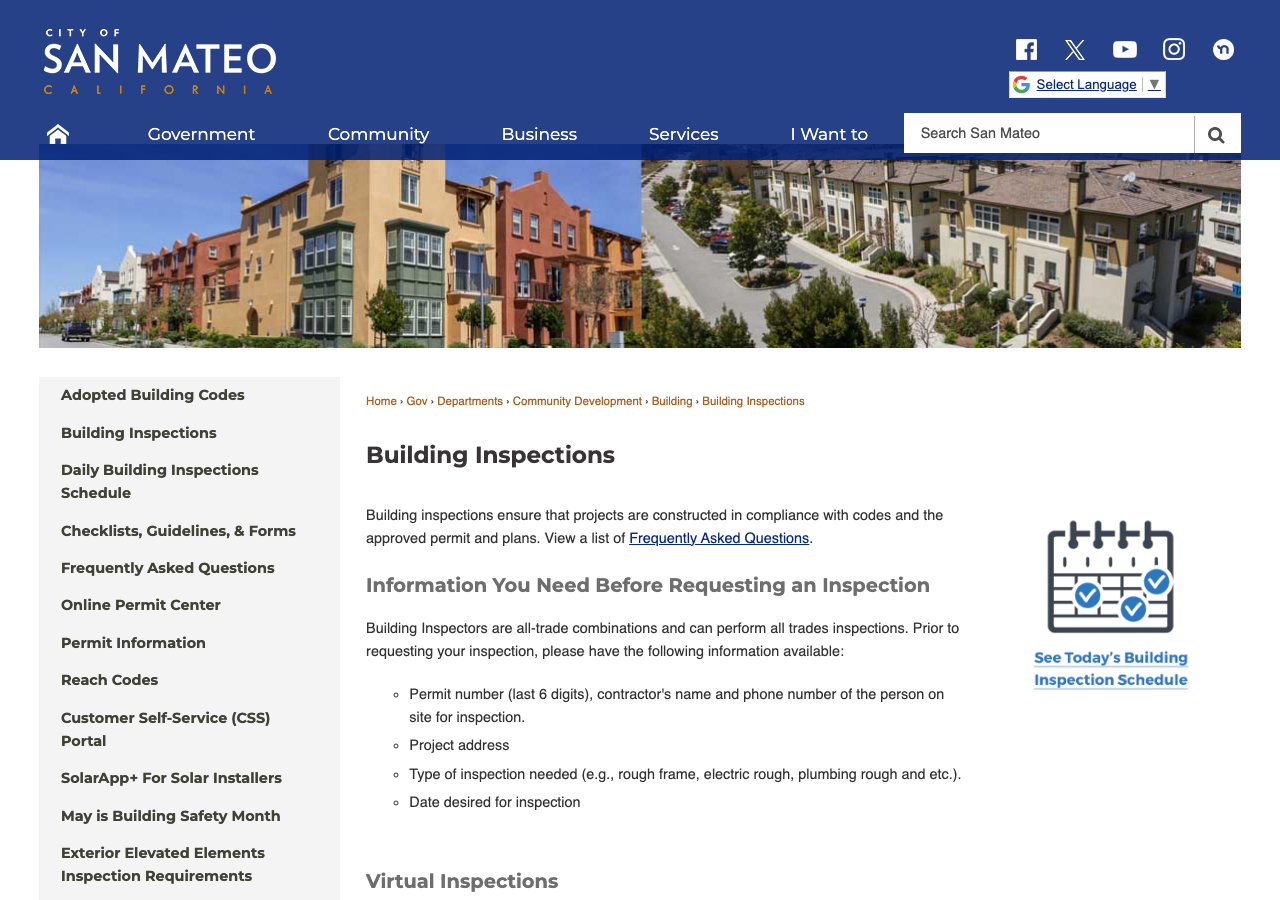
Why the confidence is not higherBuilding Inspections page ('Information You Need Before Requesting an Inspection') lists permit number, contractor's name/phone, project address, and inspection type as required to book — this is about booking information rather than an explicit 'must be on site' checklist for solar, hence the moderate confidence.
department page checked 2026-08-30 https://www.cityofsanmateo.org/478/Building-Inspections
Q59 Is there a re-inspection fee? Corrections & re-inspection
$282.78 per hour, minimum 1 hour
Why the confidence is not higherFY2026-27 Master Fee Schedule, Community Development/Building Division, Item IV.B: 'REINSPECTION FEE — Per Hr (Min. 1 Hour) — $282.78.'
fee schedule checked 2026-08-30 https://www.cityofsanmateo.org/DocumentCenter/View/105420
Q60 How are corrections issued and cleared? Corrections & re-inspection
Corrections are issued as a written correction notice detailing all deficiencies and required additional information; applicants respond and resubmit through the CSS portal, where staff review comments and resubmittals iteratively until cleared.
Why the confidence is not higherSMMC 23.46.070(b) describes the written correction-notice process; Online Permit Center page describes the CSS portal mechanism for 'receive comments, provide resubmittals, and other activities related to the review.'
municipal code checked 2026-08-30 https://law.cityofsanmateo.org/us/ca/cities/san-mateo/code/23.46.070
Q61 What is issued on pass? Core Final sign-off & PTO
Final
Why the confidence is not higherNo document uses a formal term for the pass outcome; SMMC 23.46.070(c) describes only 'one inspection...performed by the Building Division' with a pass/fail result (fail authorizes a subsequent inspection) — 'Final' is inferred from standard CA building-department terminology for a passed single-trade/combination inspection on an existing dwelling, not a document that names it explicitly.
municipal code checked 2026-08-30 https://law.cityofsanmateo.org/us/ca/cities/san-mateo/code/23.46.070
Q62 Who notifies the utility for PTO? Core Final sign-off & PTO
Nothing published by this authority.
Where we lookedSolarApp+ page, Online Permit Center page, PG&E Greenbook doc 060559, and a site search of cityofsanmateo.org for 'permission to operate' (1,334 results, none on point) — no city or utility document found this run states who submits the PTO/interconnection paperwork to PG&E after final inspection.
https://www.cityofsanmateo.org/Search/Results?searchPhrase=permission+to+operate
Lines marked with a percentage were read off this authority’s own published documents. Unmarked guidance is general good practice, not this jurisdiction’s rule — always confirm against the authority before you submit.
Jurisdiction & key facts
The standing 62-question set, answered for City of San Mateo against this authority’s own published documents. Every answer carries the confidence it was recorded at and the document it came from. Where nothing is published we say so and show where we looked — a blank here is a finding, not a gap.
City of San Mateo is the authority having jurisdiction 92% confidence
- Holds
- Building and Electrical (Community Development Dept, Building Division)
- Delegated to
- San Mateo Consolidated Fire Department (SMCFD) for fire-code plan review/enforcement only — SMCFD is a separate joint-powers fire authority serving Belmont, Foster City and San Mateo, not a city department
- Overridden by
- CA Solar Rights Act/AB 2188 (Gov. Code §65850.5) and SB 379 (Gov. Code §65850.52) cap local review scope and mandate automated permitting for qualifying systems; AB-132 caps residential solar/ESS permit fees statewide (sunsets 1/1/2034)
- Why not higher
- SMMC 23.46 (Small Residential Rooftop Solar Energy Systems) shows the City's own Building Division issues, reviews and inspects residential solar permits. SMMC 23.28.010 explicitly adopts 'the Fire Code adopted by the San Mateo Consolidated Fire Department, and as amended from time to time' rather than adopting a fire code itself — confirmed live: cityofsanmateo.org/3632/Fire-Safety-Permits 302-redirects to smcfire.org, which 302-redirects to smcfire.ca.gov, the independent SMCFD site ('Proudly Serving the Communities of Belmont, Foster City and San Mateo'). The brief's assumption that fire might be city-run was wrong; it is a joint agency, changing q31/q36/q45/q46/q52/q53.
https://law.cityofsanmateo.org/us/ca/cities/san-mateo/code/23.28.010
- Permit required
- Yes95%
- Permit cost
- $450.00 flat (single-family combination permit)95%
- Plan review
- SolarAPP+/SB 379-eligible systems: real-time or near-real-time automated approval. Non-eligible (standard-track) systems: no specific business-day turnaround is published by the city.75%
- Portal
- Tyler EnerGov Citizen Self-Service (CSS) Portal (css.cityofsanmateo.org / cityofsanmateoca-energovweb.tylerhost.net);92%
- Electrical code
- 202382%
- Own placard wording
- No62%
- Booking an inspection
- Portal / Phone85%
Labels & placards for this authority
Wording 62%
No
Size, colour & material 85%
The City itself does not specify letter height/color/material (absence confirmed after reading Ch. 23.46 and PV02–PV04 in full). The UTILITY (PG&E) does: labels must be permanent, engraved phenolic or comply with ANSI Z535.4, with lettering a minimum 3/8" high, all capitals.
Where they go 88%
Utility-required labels: on the front of the AC disconnect switch itself, which must be located 10 feet or less, in line of sight, from PG&E's meter, at the same grade level as the meter, and never on a roof, on a floor above grade, or in an unapproved room. AHJ-required roof labels/markings: per the roof plan, at access pathways, equipment, and roof access points.
What the utility wants on top 92%
Yes
Each figure above is sourced and dated in the full answer set below (questions 38–43). Where an authority’s own published sheet is older than the code it has adopted, the answer says so.
Their website

Average approval time — application to PTO
From the CPUC interconnection record. Bars show the average days taken each year; a year with no recorded projects is left blank rather than drawn as zero.