
City of Santa Cruz
Santa Cruz County
City of Santa Cruz is a city authority in the State of California, serving 62,956 residents. 5,530 residential solar installs are on record here. This page is the permit route for that jurisdiction: the fifteen steps from working out who has a say over an address through to permission to operate, the documents this authority publishes, and 62 answers taken from those documents and dated.
Permitting 5 steps · 28 questions
Whether a permit is needed — Yes Q3 Electrical and building permits — Combined - a residential rooftop PV system (and PV+ESS) is issued as a single 'Solar Permit'/'Photovoltaic Systems' permit that covers the electrical work Q4 Plan review — SolarApp+-eligible systems: instant/same-day automated review and issuance upon payment. Standard (non-eligible) Solar Permit route: turnaround not confirmed Q18 Where you file — Two portals: eTRAKiT (permitting.cityofsantacruz.com/ETRAKIT3) for general permit status/plan-review comments/inspection scheduling, Q20
- Permit required
- Yes95% source
- What it costs
- $351.00 flat for a residential system up to 15kW, plus $23.00 per kW above 15kW (both plus the city's standard 6% technology surcharge)80% source
- Plan review turnaround
- SolarApp+-eligible systems: instant/same-day automated review and issuance upon payment. Standard (non-eligible) Solar Permit route: turnaround not confirmed60% source
- Key document
- department page cited by 5 open the document
-
Confirm who has a say over your address
A city address is usually permitted by the city, not the county — but not always, and some authorities keep building and hand electrical to someone else. Getting this wrong costs the whole submittal, because every requirement below belongs to whoever actually holds jurisdiction. Check the overlays in the same pass: an HOA, a historic district, a windstorm certification or a system-size cap can reshape the design, and all of them are cheaper to find now than after the array is laid out.
- Is this authority the AHJ for residential solar at this address? Yes - City of Santa Cruz is the AHJ for residential solar within city limits 95% · adopting ordinance
- What does this authority permit itself, and what does it delegate? Both - Building & Safety (Planning and Community Development Dept.) holds both building and electrical for residential PV; nothing is delegated to the separate city Fire Department for rooftop PV review 88% · adopting ordinance
- Is a permit required for a residential rooftop PV system? Yes 95% · department page
- Is there a separate electrical permit, or is it combined? Combined - a residential rooftop PV system (and PV+ESS) is issued as a single 'Solar Permit'/'Photovoltaic Systems' permit that covers the electrical work 75% · fee schedule
- Is a HOA or architectural approval required first? No city-mandated architectural/design review specifically for residential rooftop PV; a private HOA approval letter is requested only 'if applicable' on general remodel submittals, and CA Civil Code Sec. 714/4600 (Solar Rights Act) limits what an HOA may restrict 62% · published checklist
- Is there a historic-district review? Yes, but only for a property that is a designated landmark, on the city's Historic Building Survey, or within the H-O Historic Overlay District - 'antennas, satellite dishes and solar collectors' are named as a design element the Historic Preservation Commission (or Zoning Administrator for minor projects) reviews under a Historic Alteration Permit 75% · zoning ordinance
- Is a wind or windstorm certification required? No 60% · adopting ordinance
- Is a Specific Use Permit or Council approval ever required? Not normally required for typical roof-mounted residential PV on an existing single-family home. Within the Coastal Zone Overlay District, most single-family roof/fixture improvements (which would include an attached PV array) are exempt from a discretionary Coastal Permit under SCMC 24.08.230.1(5) unless the parcel is on a beach/wetland, seaward of mean high tide, within 50 ft of a coastal bluff, or otherwise carved out by the exemption's exclusions - in those excluded cases a Coastal Permit (decided by the Zoning Administrator, not Council) would be required 68% · zoning ordinance
- Is there a system-size cap on residential generation? No system-size cap in the zoning/building code itself; the SolarApp+ FAST-TRACK program (not a citywide cap) technically limits eligible projects to a 400A main service, 225A service disconnect switches and 225A busbars, though SolarApp+ states there is no cap on total rated wattage 75% · department page
-
Check who is allowed to apply
Several authorities require the electrical permit to be pulled by a licensed electrician, or require the contractor to be registered with them BEFORE applying. Registration is not same-day. This is second on the list rather than fourth because it is the step most likely to stop the job before the drawings matter.
- Who is allowed to pull the electrical permit? Either - a state-licensed contractor, or the homeowner under a homeowner's permit 82% · adopting ordinance
- Must the contractor be registered with this authority before applying? No separate city contractor registration found beyond the state CSLB license 50% · adopting ordinance
- Is a homeowner permitted to self-install and self-permit? Yes - via the regular (non-SolarApp+) Solar Permit and Plan Check process 85% · department page
-
Build the submittal package
Almost everywhere wants a site plan, a one-line or three-line electrical diagram, equipment cut sheets with listings, and a structural attachment detail. Build it against the published checklist rather than the last jurisdiction you worked in — the checklist is what the reviewer marks against.
- What documents make up a complete submittal? For SolarApp+-eligible systems: SolarApp+ online design submittal plus a Solar PV Standard Plan/roof diagram (panel layout, pathways, disconnect locations) and structural documentation. For non-eligible/standard systems: a completed City Building Permit Application plus full plan set emailed to permits@santacruzca.gov. 62% · published checklist
- How many copies, and in what format? Submitted electronically (email or SolarApp+ upload); no physical copy count specified for solar 70% · department page
- Is a site plan required, and what must it show? Yes for the roof/site diagram - SolarApp+'s Solar PV Standard Plan must show panel/module layout, clear access pathways, and approximate locations of electrical disconnects and roof access points 68% · published checklist
- Is a one-line / three-line diagram required? Yes (inferred) - a 'Solar PV Standard Plan and supporting documentation' is required 55% · published checklist
- Are string and conductor calculations required? Yes (inferred) - string/MPPT and inverter configuration limits are checked 62% · published checklist
- Is a structural PE stamp required, and at what threshold? Not required where the project qualifies for the prescriptive Structural Technical Appendix of the CA Solar Permitting Guidebook; a stamped structural analysis (which may require a PE/SE) is required outside that prescriptive path 58% · published checklist
-
Apply and pay
Most authorities now take the whole application through a portal, and several states cap or constrain what a residential solar permit may cost. Check whether plan check is billed separately before you quote the job.
- Which permit portal does this authority use? Two portals: eTRAKiT (permitting.cityofsantacruz.com/ETRAKIT3) for general permit status/plan-review comments/inspection scheduling, and SolarApp+ (gosolarapp.org) specifically for eligible rooftop PV/ESS design submittal and instant issuance 92% · portal landing page
- Can the whole application be completed online? Partially - Yes for SolarApp+-eligible systems (fully online design submittal, payment and instant permit issuance); No for non-eligible systems, which submit via email to Building & Safety rather than a self-service online application 75% · portal
- What does a residential solar permit cost? $351.00 flat for a residential system up to 15kW, plus $23.00 per kW above 15kW (both plus the city's standard 6% technology surcharge) 80% · fee schedule
- How is the fee calculated? Tiered / Per kW 85% · fee schedule
- Is there a separate plan-check fee? No separate plan-check fee found - the 'Solar Permits' fee line appears to be a single, all-inclusive flat/tiered fee 68% · fee schedule
-
Plan review — and start the utility in parallel
Interconnection is a separate process from the permit and usually the longer pole. Where the utility does not depend on the permit being issued, running both at once is the single biggest saving available on a residential job.
- What is the stated plan-review turnaround? SolarApp+-eligible systems: instant/same-day automated review and issuance upon payment. Standard (non-eligible) Solar Permit route: turnaround not confirmed 60% · department page
- How long is an issued permit valid before it expires? No fixed statutory expiration day-count found, but a permit becomes subject to a 'Special Inspection to Final Lapsed Permit' fee if more than 180 days elapse between inspections, and is void if more than 1 year elapses between inspections 68% · fee schedule
- Which utility handles interconnection here? PG&E for delivery, metering, interconnection and Permission to Operate. Central Coast Community Energy (3CE) is the default community choice aggregator covering Santa Cruz County/city but is generation-procurement only; it has no interconnection, metering or PTO role - PG&E remains the delivery utility 85% · utility DG manual
- Where does the utility sit in the sequence? Parallel, with Permission to Operate gated on both - PG&E's interconnection/NEM application can be filed independently of the city permit process, but PTO is not granted until both the city final inspection and PG&E's own interconnection review are complete 58% · utility DG manual
28 questions answered against City of Santa Cruz’s own published documents
Q1 Is this authority the AHJ for residential solar at this address? Core Jurisdiction & scope
Yes - City of Santa Cruz is the AHJ for residential solar within city limits
Why the confidence is not higherSCMC 18.04.010/18.04.030 establish the Building Code of the City of Santa Cruz (2025 CBC/CRC/CEC etc.) and 18.04.080 creates a Building & Safety division under Planning and Community Development headed by the Chief Building Official; the city's own Building & Safety and SolarApp+ pages confirm the city issues residential PV permits directly.
adopting ordinance checked 2026-08-30 https://www.codepublishing.com/CA/SantaCruz/html/SantaCruz18/SantaCruz1804.html
Q2 What does this authority permit itself, and what does it delegate? Core Jurisdiction & scope
Both - Building & Safety (Planning and Community Development Dept.) holds both building and electrical for residential PV; nothing is delegated to the separate city Fire Department for rooftop PV review
Why the confidence is not higherSCMC 18.04.030/18.08.030 adopt the 2025 CBC/CRC/CEC under the Chief Building Official. The city's own Fire Code amendment, SCMC 19.05.250 (Alternate Power Sources), explicitly routes approval of 'all permanent installations of ... solar photovoltaic cells' to the BUILDING code official, not the fire code official, mirroring the pattern found in unincorporated Santa Cruz County. The Fire Prevention Fee Schedule (eff. 1/1/25) has no solar/PV/battery line item, and Fire's 'Building Permit Fire Review' fee tiers are scaled by overall building square footage, not a PV-specific charge.
adopting ordinance checked 2026-08-30 https://www.codepublishing.com/CA/SantaCruz/html/SantaCruz19/SantaCruz1905.html
Q3 Is a permit required for a residential rooftop PV system? Core Jurisdiction & scope
Yes
Why the confidence is not higherThe city's SolarApp+ page states plans and permits are required for residential rooftop PV/ESS, and SCMC 18.04.040 (amending CBC 105.1) requires a separate permit for building service equipment before it may be erected/installed; no solar exemption appears in the code's exemption lists.
department page checked 2026-08-30 https://www.santacruzca.gov/Government/City-Departments/Planning-and-Community-Development/Building-Safety/SolarApp
Q4 Is there a separate electrical permit, or is it combined? Core Jurisdiction & scope
Combined - a residential rooftop PV system (and PV+ESS) is issued as a single 'Solar Permit'/'Photovoltaic Systems' permit that covers the electrical work
Why the confidence is not higherThe Citywide Fee Schedule bills residential PV under one 'Solar Permits' line (PL-BLD142/143) rather than separate building+electrical lines, and SolarApp+ issues one City of Santa Cruz permit number per project. Could not confirm whether a PV-reinstall-during-reroof scenario (as documented for the County) requires a second, separate electrical permit in the city - not tested here.
fee schedule checked 2026-08-30 https://www.santacruzca.gov/files/assets/city/v/1/pl/documents/citywide-fee-schedule-effective-january-1-2025.pdf
Q5 Who is allowed to pull the electrical permit? Core Who may apply
Either - a state-licensed contractor, or the homeowner under a homeowner's permit
Why the confidence is not higherSCMC 18.08.070 allows permits to be issued to state-licensed contractors, or to an owner-occupant under a homeowner's permit who personally performs the work. The city's SolarApp+ page separately states SolarApp+ itself is 'Licensed Contractors Only' and that non-licensed/owner-builders must instead use the regular Solar Permit + Plan Check process.
adopting ordinance checked 2026-08-30 https://www.codepublishing.com/CA/SantaCruz/html/SantaCruz18/SantaCruz1808.html
Q6 Must the contractor be registered with this authority before applying? Core Who may apply
No separate city contractor registration found beyond the state CSLB license
Why the confidence is not higherSCMC 18.08.070 conditions issuance only on state licensure ('duly licensed by the State of California'); SolarApp+ registration (gosolarapp.org) and eTRAKiT registration are portal logins, not a city vetting/registration step. This is an absence inferred from silence in the ordinance and department pages, not a document that affirmatively says 'no registration required' - a dedicated contractor-registration page was not found.
adopting ordinance checked 2026-08-30 https://www.codepublishing.com/CA/SantaCruz/html/SantaCruz18/SantaCruz1808.html
Q7 Is a homeowner permitted to self-install and self-permit? Who may apply
Yes - via the regular (non-SolarApp+) Solar Permit and Plan Check process
Why the confidence is not higherThe city's SolarApp+ page states 'Non-licensed/owner-builders must apply for a regular Solar Permit with a regular Plan Check process,' i.e. self-install/self-permit is not blocked, just routed off the SolarApp+ fast lane; SCMC 18.08.070(b) separately authorizes an owner-occupant homeowner's permit for electrical work on a single-family dwelling.
department page checked 2026-08-30 https://www.santacruzca.gov/Government/City-Departments/Planning-and-Community-Development/Building-Safety/SolarApp
Q8 What documents make up a complete submittal? Core Submittal package
For SolarApp+-eligible systems: SolarApp+ online design submittal plus a Solar PV Standard Plan/roof diagram (panel layout, pathways, disconnect locations) and structural documentation. For non-eligible/standard systems: a completed City Building Permit Application plus full plan set emailed to permits@santacruzca.gov.
Why the confidence is not higherSolarApp+ page describes submitting via gosolarapp.org to receive an Approval Document and Inspection Checklist. The city's 'Checklist for Expedited Solar Permitting Eligibility' (PDF, created 2015 - a pre-SolarApp+, AB 2188-era document the city still hosts) itemizes a Solar PV Standard Plan, structural analysis per the CA Solar Permitting Guidebook, and a fire-safety roof/pathway diagram; that document predates SolarApp+ and conflicts with it in places (it excludes battery storage and caps systems at 10kW, while the current SolarApp+ program covers ESS and states no wattage cap), so it is used here only as secondary, dated corroboration.
published checklist checked 2026-08-30 https://www.santacruzca.gov/files/assets/city/v/1/pl/documents/building-amp-safety/expedited-solar-pv-requirements-checklist.pdf
Q9 How many copies, and in what format? Submittal package
Submitted electronically (email or SolarApp+ upload); no physical copy count specified for solar
Why the confidence is not higherBuilding & Safety's general submittal instructions direct applicants to email the application and full plan set to permits@santacruzca.gov, and the Residential Submittal Checklist (created 8/19/25) states 'Plans ... shall be submitted electronically.' No solar-specific copy count was found.
department page checked 2026-08-30 https://www.santacruzca.gov/Government/City-Departments/Planning-and-Community-Development/Building-Safety
Q10 Is a site plan required, and what must it show? Core Submittal package
Yes for the roof/site diagram - SolarApp+'s Solar PV Standard Plan must show panel/module layout, clear access pathways, and approximate locations of electrical disconnects and roof access points
Why the confidence is not higherThe city's 2015 Expedited Solar checklist (Fire Safety, item D) requires 'a diagram of the roof layout of all panels, modules, clear access pathways and approximate locations of electrical disconnecting means and roof access points.' This document is dated and pre-dates SolarApp+, so is used as corroboration rather than the primary current source; no separate, dated 'site plan' spec for solar was found on the current Building & Safety or SolarApp+ pages.
published checklist checked 2026-08-30 https://www.santacruzca.gov/files/assets/city/v/1/pl/documents/building-amp-safety/expedited-solar-pv-requirements-checklist.pdf
Q11 Is a one-line / three-line diagram required? Core Drawings & calculations
Yes (inferred) - a 'Solar PV Standard Plan and supporting documentation' is required
Why the confidence is not higherThe 2015 Expedited Solar checklist requires a completed 'Solar PV Standard Plan and supporting documentation' but does not use the phrase 'one-line diagram' explicitly; this is standard CA practice for PV plan sets but I could not confirm the term in a current Santa Cruz document.
published checklist checked 2026-08-30 https://www.santacruzca.gov/files/assets/city/v/1/pl/documents/building-amp-safety/expedited-solar-pv-requirements-checklist.pdf
Q12 Are string and conductor calculations required? Drawings & calculations
Yes (inferred) - string/MPPT and inverter configuration limits are checked
Why the confidence is not higherThe 2015 Expedited Solar checklist requires confirming 'no more than four photovoltaic module strings ... connected to each MPPT input' and inverter counts, implying string/conductor configuration is reviewed. Dated source (2015, pre-SolarApp+); used as corroboration only.
published checklist checked 2026-08-30 https://www.santacruzca.gov/files/assets/city/v/1/pl/documents/building-amp-safety/expedited-solar-pv-requirements-checklist.pdf
Q13 Is a structural PE stamp required, and at what threshold? Core Engineering & stamps
Not required where the project qualifies for the prescriptive Structural Technical Appendix of the CA Solar Permitting Guidebook; a stamped structural analysis (which may require a PE/SE) is required outside that prescriptive path
Why the confidence is not higherThe city's 2015 checklist requires 'a completed structural analysis and supporting documentation depicting applicable criteria from the Structural Technical Appendix of the California Solar Permitting Guidebook' - the statewide Guidebook's prescriptive appendix is designed to avoid a PE stamp for most residential roof-mounts; the Guidebook itself is currently unreachable at its lci.ca.gov address (known statewide redirect-loop issue), so this could not be independently re-verified against the current edition.
published checklist checked 2026-08-30 https://www.santacruzca.gov/files/assets/city/v/1/pl/documents/building-amp-safety/expedited-solar-pv-requirements-checklist.pdf
Q14 Is an electrical PE stamp required, and at what threshold? Engineering & stamps
Nothing published by this authority.
Where we lookedSearched the 2015 Expedited Solar PV checklist, the city's Building & Safety forms list, and SCMC Title 18 for an electrical PE-stamp threshold specific to residential PV; none of the retrieved documents state one.
https://www.codepublishing.com/CA/SantaCruz/html/SantaCruz18/SantaCruz1808.html
Q15 What does a residential solar permit cost? Core Fees
$351.00 flat for a residential system up to 15kW, plus $23.00 per kW above 15kW (both plus the city's standard 6% technology surcharge)
Why the confidence is not higherCitywide Fee Schedule (PCD | Building & Safety, 'Special and Miscellaneous Fees - Solar Permits'), fee lines PL-BLD142/143, effective 1/1/25, footer dated/updated 1/24/25. The city's own SolarApp+ page links to a newer 'fire-prevention-fee-schedule-2026.pdf' filename that could not be retrieved (blocked live, not archived in Wayback), so a later fee revision may exist that was not checked.
fee schedule checked 2026-08-30 https://www.santacruzca.gov/files/assets/city/v/1/pl/documents/citywide-fee-schedule-effective-january-1-2025.pdf
Q16 How is the fee calculated? Core Fees
Tiered / Per kW
Why the confidence is not higherCitywide Fee Schedule PL-BLD142-146: flat base fee up to a kW threshold (15kW residential, 50kW commercial) then a declining per-kW rate above it.
fee schedule checked 2026-08-30 https://www.santacruzca.gov/files/assets/city/v/1/pl/documents/citywide-fee-schedule-effective-january-1-2025.pdf
Q17 Is there a separate plan-check fee? Fees
No separate plan-check fee found - the 'Solar Permits' fee line appears to be a single, all-inclusive flat/tiered fee
Why the confidence is not higherThe Citywide Fee Schedule lists only one fee line item under 'Solar Permits' (PL-BLD142-146); no companion 'Solar Plan Check' line appears anywhere in the 46-page document (confirmed by full-text search with a working positive control 'electrical' and a fabricated control 'zzqqx', which returned zero hits).
fee schedule checked 2026-08-30 https://www.santacruzca.gov/files/assets/city/v/1/pl/documents/citywide-fee-schedule-effective-january-1-2025.pdf
Q18 What is the stated plan-review turnaround? Core Timeline & validity
SolarApp+-eligible systems: instant/same-day automated review and issuance upon payment. Standard (non-eligible) Solar Permit route: turnaround not confirmed
Why the confidence is not higherThe SolarApp+ page states the platform 'will instantly issue the permit after payment is complete.' The city's own 'Plan Review Target Dates & Review Timeframes' handout, which would state the standard-route turnaround, returned no Wayback capture and the live site is Akamai-blocked, so that figure could not be confirmed.
department page checked 2026-08-30 https://www.santacruzca.gov/Government/City-Departments/Planning-and-Community-Development/Building-Safety/SolarApp
Q19 How long is an issued permit valid before it expires? Timeline & validity
No fixed statutory expiration day-count found, but a permit becomes subject to a 'Special Inspection to Final Lapsed Permit' fee if more than 180 days elapse between inspections, and is void if more than 1 year elapses between inspections
Why the confidence is not higherCitywide Fee Schedule notes under PL-BLD148 ('Special Inspection to Final Lapsed Permit... over 180 days between inspections') and PL-BLD149 ('Expired Permits: For permits over 180 days but less than 1 year... if the permit has gone over 1 year between inspections it will be considered void').
fee schedule checked 2026-08-30 https://www.santacruzca.gov/files/assets/city/v/1/pl/documents/citywide-fee-schedule-effective-january-1-2025.pdf
Q20 Which permit portal does this authority use? Core Portal & process
Two portals: eTRAKiT (permitting.cityofsantacruz.com/ETRAKIT3) for general permit status/plan-review comments/inspection scheduling, and SolarApp+ (gosolarapp.org) specifically for eligible rooftop PV/ESS design submittal and instant issuance
Why the confidence is not higherBuilding & Safety 'Online Permit Services' section links its eTRAKiT portal; the SolarApp+ page separately directs solar applicants to gosolarapp.org.
portal landing page checked 2026-08-30 https://www.santacruzca.gov/Government/City-Departments/Planning-and-Community-Development/Building-Safety
Q21 Can the whole application be completed online? Core Portal & process
Partially - Yes for SolarApp+-eligible systems (fully online design submittal, payment and instant permit issuance); No for non-eligible systems, which submit via email to Building & Safety rather than a self-service online application
Why the confidence is not higherSolarApp+ page: 'Contractors submit a project to SolarAPP+ ... SolarApp+ will instantly issue the permit after payment is complete.' Non-eligible ('regular') solar permits follow the same email-based application process as other building permits per the Building & Safety page.
portal checked 2026-08-30 https://www.santacruzca.gov/Government/City-Departments/Planning-and-Community-Development/Building-Safety/SolarApp
Q22 Which utility handles interconnection here? Core Utility interconnection
PG&E for delivery, metering, interconnection and Permission to Operate. Central Coast Community Energy (3CE) is the default community choice aggregator covering Santa Cruz County/city but is generation-procurement only; it has no interconnection, metering or PTO role - PG&E remains the delivery utility
Why the confidence is not higherPG&E's own TD-7001M Greenbook (Ch. 6, Electric Generation Interconnection) governs interconnection and NEM for PG&E's territory, which includes the City of Santa Cruz. 3CE's own site states customers 'remain connected to PG&E's distribution network' and that 'payment of all electricity bills must be sent directly to PG&E' - confirming 3CE is generation-only.
utility DG manual checked 2026-08-30 https://www.pge.com/assets/pge/docs/account/service-requests/greenbook-manual-full.pdf
Q23 Where does the utility sit in the sequence? Core Utility interconnection
Parallel, with Permission to Operate gated on both - PG&E's interconnection/NEM application can be filed independently of the city permit process, but PTO is not granted until both the city final inspection and PG&E's own interconnection review are complete
Why the confidence is not higherInferred from PG&E's standard NEM/Rule 21 process described in the Greenbook (interconnection application, switchboard drawings reviewed by PG&E's metering department) running on a separate track from the city's building-permit/inspection process; no single Santa Cruz-specific document states the sequencing explicitly.
utility DG manual checked 2026-08-30 https://www.pge.com/assets/pge/docs/account/service-requests/greenbook-manual-full.pdf
Q24 Is a HOA or architectural approval required first? Overlays & special cases
No city-mandated architectural/design review specifically for residential rooftop PV; a private HOA approval letter is requested only 'if applicable' on general remodel submittals, and CA Civil Code Sec. 714/4600 (Solar Rights Act) limits what an HOA may restrict
Why the confidence is not higherThe Residential Additions and Remodels Submittal Checklist (general, not solar-specific; created 8/19/25) lists 'Home Owners Association approval letter (if applicable)' as a conditional item, not a citywide mandate; no HOA/architectural-review trigger specific to solar was found in Title 18 or 24.
published checklist checked 2026-08-30 https://www.santacruzca.gov/files/assets/city/v/1/pl/documents/building-amp-safety/residential-submittal-checklist.pdf
Q25 Is there a historic-district review? Overlays & special cases
Yes, but only for a property that is a designated landmark, on the city's Historic Building Survey, or within the H-O Historic Overlay District - 'antennas, satellite dishes and solar collectors' are named as a design element the Historic Preservation Commission (or Zoning Administrator for minor projects) reviews under a Historic Alteration Permit
Why the confidence is not higherSCMC 24.08.930 ('Findings Required' for a Historic Alteration Permit) lists item 8, 'antennas, satellite dishes and solar collectors,' among the elements subject to design-compatibility findings; 24.08.920 allows the Zoning Administrator to approve 'minor historic alteration projects' administratively without a public hearing.
zoning ordinance checked 2026-08-30 https://www.codepublishing.com/CA/SantaCruz/html/SantaCruz24/SantaCruz2408.html
Q26 Is a wind or windstorm certification required? Overlays & special cases
No
Why the confidence is not higherNo wind/windstorm certification requirement was found in Title 18 (Building/Electrical Code chapters) or the solar-specific checklists; this is a Gulf Coast/TDI-style requirement not typical of California AHJs, and none of the retrieved Santa Cruz documents mention one.
adopting ordinance checked 2026-08-30 https://www.codepublishing.com/CA/SantaCruz/html/SantaCruz18/SantaCruz1804.html
Q27 Is a Specific Use Permit or Council approval ever required? Overlays & special cases
Not normally required for typical roof-mounted residential PV on an existing single-family home. Within the Coastal Zone Overlay District, most single-family roof/fixture improvements (which would include an attached PV array) are exempt from a discretionary Coastal Permit under SCMC 24.08.230.1(5) unless the parcel is on a beach/wetland, seaward of mean high tide, within 50 ft of a coastal bluff, or otherwise carved out by the exemption's exclusions - in those excluded cases a Coastal Permit (decided by the Zoning Administrator, not Council) would be required
Why the confidence is not higherSCMC 24.08.230.1, Exemption 5 ('Improvements to Existing Single-Family Residences') exempts 'improvements to any fixtures or other structures directly attached to the residence' in the Coastal Zone Overlay District from coastal-permit processing, subject to listed exclusions (beach/wetland/bluff-edge/critical water supply/wells-septic). The exemption does not name solar panels by name (unlike unincorporated Santa Cruz County's parallel provision, SCCC 13.20.061, which explicitly names 'attached low-profile solar panels'), so applying it to PV specifically is an inference from the 'fixtures ... directly attached' language, not an explicit statement.
zoning ordinance checked 2026-08-30 https://www.codepublishing.com/CA/SantaCruz/html/SantaCruz24/SantaCruz2408.html
Q28 Is there a system-size cap on residential generation? Overlays & special cases
No system-size cap in the zoning/building code itself; the SolarApp+ FAST-TRACK program (not a citywide cap) technically limits eligible projects to a 400A main service, 225A service disconnect switches and 225A busbars, though SolarApp+ states there is no cap on total rated wattage
Why the confidence is not higherSolarApp+ page: 'While Solar APP+ does not specify a limit for the system's total rated wattage capacity, there are technical limits on the power rating of service panel equipment... Projects may be permitted to install up to 400A main service, 225A service disconnect switches and 225A busbars.' Systems outside these limits use the regular Plan Check route rather than being capped outright.
department page checked 2026-08-30 https://www.santacruzca.gov/Government/City-Departments/Planning-and-Community-Development/Building-Safety/SolarApp
Lines marked with a percentage were read off this authority’s own published documents. Unmarked guidance is general good practice, not this jurisdiction’s rule — always confirm against the authority before you submit.
Install 5 steps · 20 questions
-
Build to the code editions actually in force here
The NEC edition a jurisdiction enforces is often a cycle behind the newest one published, and local amendments sit on top of it. Rapid shutdown, conductor sizing and labelling all change between editions, so the edition in force is the first thing to establish, not the last.
- Which NEC edition is in force? 2023 (as the electrical basis of the 2025 California Electrical Code) 88% · adopting ordinance
- Which building code edition is in force? 2025 California Building Code and 2025 California Residential Code (Title 24, Parts 2 and 2.5), with local amendments 92% · adopting ordinance
- Which fire code edition is in force? 2025 California Fire Code, with local amendments 90% · adopting ordinance
- Are there local amendments to any of the above? Yes - extensive local amendments to the Building, Electrical and Fire Codes 92% · adopting ordinance
- What is the installation judged against? The installation is judged against the adopted 2025 CBC/CRC/CEC (2023 NEC) as locally amended by SCMC Title 18, plus the 2025 CFC as locally amended by SCMC Title 19 (including the Sec. 1201.4 alternate-power-source placard requirement) 85% · adopting ordinance
-
Fire access, setbacks and pathways
Ridge setbacks and roof access pathways are fire-service requirements and they constrain the array layout. They are the most common cause of a redesign after the fire department comments on a plan set.
- What ridge setback and access pathways are required? Governed by the base 2025 CRC/CFC rooftop-solar access, pathway and setback provisions as adopted without a local override; the city separately links a non-binding 2008 CAL FIRE-OSFM draft 'Solar Photovoltaic Installation Guideline' (3-ft pathways, hip/valley setbacks, smoke-ventilation spacing) that predates the current code cycle by 17 years 52% · fire code + amendments
-
Rapid shutdown
Which rapid-shutdown rule applies follows directly from the NEC edition in force, and the initiation device has to be at a location the fire service can reach and identify. This is inspected, and it is labelled.
- Is rapid shutdown required, and to which NEC edition? Yes - rapid shutdown is required under NEC 690.12 as incorporated by the 2025 CEC (2023 NEC base); no local amendment removes or modifies it 82% · adopting ordinance
-
Labels and placards
The NEC sets a baseline for permanent markings at the service equipment and the disconnecting means. On top of that, an authority may specify its own wording, and the utility may specify more again. Where any of them writes its own text, a generic off-the-shelf label set will not pass — this is the detail most often fixed on a return visit.
- Which placards does this authority require at the service equipment? A red 'Alternate Power Source' warning placard on each electrical panel subject to back-feed, plus PG&E's own engraved supply-side-connection placard where applicable, plus whatever the base 2025 CFC/2023 NEC require for PV disconnect and rapid-shutdown labeling 85% · adopting ordinance
- Does the authority specify placard wording of its own? Yes 92% · adopting ordinance
- Does it specify letter height, colour or material? Red background sign, minimum 3/4-inch tall contrasting lettering, permanently affixed on each electrical panel subject to back-feed 92% · adopting ordinance
- Is a site plan / facility map placard required, and what must it show? Not specified as a distinct citywide requirement beyond the base 2023 NEC 705.10 directory/placard rule that applies via the adopted 2025 CEC; the city's own dated (2015) expedited-solar checklist separately calls for a roof diagram showing panel layout, pathways and disconnect locations, but that is a submittal-package item, not a stated field placard spec 50% · adopting ordinance
- Does the UTILITY specify placards beyond the AHJ's? Yes - PG&E requires its own engraved placard/signage identifying a line/supply-side interconnection on the metering equipment, in addition to whatever the AHJ requires 85% · utility DG manual
- Where must the labels be placed? On each electrical panel subject to back-feed from the alternate power source (city fire-code sign); on the metering equipment for a line/supply-side tap (PG&E placard) 85% · adopting ordinance
-
Disconnect, storage and listed equipment
Where the AC disconnect must sit relative to the meter is usually the utility's rule, not the building department's. Battery storage frequently carries its own permit, its own inspection and its own fire conditions.
- Where must the AC disconnect be, relative to the meter? For a single-phase, self-contained/socket meter panel rated 320A or less, PG&E does not require an AC disconnect at all; for all other panel types an AC disconnect is required, generally installed after the meter (a fusible AC disconnect is required, plus an engraved supply-side-connection placard, for any line/supply-side tap ahead of the main breaker) 85% · utility DG manual
- Are batteries permitted, and under what conditions? Permitted, under the standard 2025 CFC (no Santa Cruz-specific ESS ordinance found); SolarApp+ states its program explicitly covers 'residential rooftop solar photovoltaic and energy storage systems' 62% · department page
- Is there a separate ESS permit or inspection? No separate ESS permit or fee line found - batteries appear to be permitted/inspected alongside the PV system under the same Solar Permit 60% · fee schedule
- Is there a local rule on service upgrades or busbar sizing? No blanket citywide ordinance found; the SolarApp+ fast-track program itself caps eligible projects at 400A main service and 225A service-disconnect/busbar rating (systems above that use the regular Plan Check route instead of being barred) 68% · department page
20 questions answered against City of Santa Cruz’s own published documents
Q29 Which NEC edition is in force? Core Code editions in force
2023 (as the electrical basis of the 2025 California Electrical Code)
Why the confidence is not higherSCMC 18.08.030 adopts 'CCR Title 24, Part 3, The 2025 California Electrical Code' with no local deletions (18.08.040: 'None'). California's 2025 CEC cycle is based on the 2023 NEC.
adopting ordinance checked 2026-08-30 https://www.codepublishing.com/CA/SantaCruz/html/SantaCruz18/SantaCruz1808.html
Q30 Which building code edition is in force? Core Code editions in force
2025 California Building Code and 2025 California Residential Code (Title 24, Parts 2 and 2.5), with local amendments
Why the confidence is not higherSCMC 18.04.030, most recently amended by Ord. 2025-21 (2025), adopts the 2025 CBC and 2025 CRC (plus 2025 CEnC, CEBC, CGBSC, CRSC) as the Building Code of the City of Santa Cruz. Note: the city's own public-facing Building & Safety webpage still displays a 'Building & Safety News' notice reading '2022 Codes in Effect ... effective January 1, 2023' as of a January 2026 site snapshot - that page text is stale and contradicted by the current, in-force ordinance text.
adopting ordinance checked 2026-08-30 https://www.codepublishing.com/CA/SantaCruz/html/SantaCruz18/SantaCruz1804.html
Q31 Which fire code edition is in force? Code editions in force
2025 California Fire Code, with local amendments
Why the confidence is not higherSCMC 19.05.010, most recently amended by Ord. 2025-25 (2025): 'adopting the 2025 Edition of the California Fire Code with local amendments ... repealing Ordinance No. 2022-14.' One internal cross-reference (SCMC 19.05.200, water supply) still cites '2022 California Fire Code Appendix B and BB' for a fire-flow calculation method, an apparent leftover from the prior cycle not yet updated to 2025 Appendix numbering.
adopting ordinance checked 2026-08-30 https://www.codepublishing.com/CA/SantaCruz/html/SantaCruz19/SantaCruz1905.html
Q32 Are there local amendments to any of the above? Core Code editions in force
Yes - extensive local amendments to the Building, Electrical and Fire Codes
Why the confidence is not higherSCMC 18.04.040 amends numerous CBC/CRC sections (e.g., Class 'B' roofing minimum, wall bracing tables, exemption thresholds); SCMC 19.05.020-19.05.310 amend/add dozens of Fire Code sections including the PV/alternate-power-source placard requirement at 19.05.250.
adopting ordinance checked 2026-08-30 https://www.codepublishing.com/CA/SantaCruz/html/SantaCruz18/SantaCruz1804.html
Q33 What is the installation judged against? Core Electrical
The installation is judged against the adopted 2025 CBC/CRC/CEC (2023 NEC) as locally amended by SCMC Title 18, plus the 2025 CFC as locally amended by SCMC Title 19 (including the Sec. 1201.4 alternate-power-source placard requirement)
Why the confidence is not higherComposite of SCMC 18.04.030, 18.08.030 and 19.05.010/19.05.250.
adopting ordinance checked 2026-08-30 https://www.codepublishing.com/CA/SantaCruz/html/SantaCruz18/SantaCruz1804.html
Q34 Is there a local rule on service upgrades or busbar sizing? Electrical
No blanket citywide ordinance found; the SolarApp+ fast-track program itself caps eligible projects at 400A main service and 225A service-disconnect/busbar rating (systems above that use the regular Plan Check route instead of being barred)
Why the confidence is not higherSolarApp+ page technical-limits language (see Q28); this is a program eligibility ceiling, not a universal busbar-sizing ordinance for all residential PV in the city.
department page checked 2026-08-30 https://www.santacruzca.gov/Government/City-Departments/Planning-and-Community-Development/Building-Safety/SolarApp
Q35 Is a specific mounting system or attachment spacing required? Structural & mounting
Nothing published by this authority.
Where we lookedLooked for the city's 'Roof Mounted, Suspended Equipment Anchorage' handout (linked from the Building & Safety Forms & Publications page) for a mounting-system/attachment-spacing spec. The live URL is Akamai-blocked and it has no Wayback Machine capture (checked via the CDX API, zero results), so its content could not be read.
Q36 What ridge setback and access pathways are required? Core Fire pathways & setbacks
Governed by the base 2025 CRC/CFC rooftop-solar access, pathway and setback provisions as adopted without a local override; the city separately links a non-binding 2008 CAL FIRE-OSFM draft 'Solar Photovoltaic Installation Guideline' (3-ft pathways, hip/valley setbacks, smoke-ventilation spacing) that predates the current code cycle by 17 years
Why the confidence is not higherSCMC 18.04.040/19.05.xxx contain no amendment to the CRC/CFC's rooftop-PV access/pathway sections, so the statewide 2025-cycle language controls by default; I could not verify the exact current section number (the sibling County of Santa Cruz file notes the CRC's PV pathway section renumbered from R324 to R329 in the 2025 cycle, unverified independently here). The city's Fire Prevention page links a document titled 'solar-pv-guideline.pdf' that is in fact CAL FIRE-OSFM's April 2008 statewide DRAFT guideline, explicitly non-binding ('does not have the force of law... Adoption of this guideline is optional') and written before the 2023 NEC/2025 CFC cycle - it should not be read as Santa Cruz's own enforceable standard, and confidence is held down accordingly.
fire code + amendments checked 2026-08-30 https://www.santacruzca.gov/files/assets/city/v/1/fd/documents/fire-prevention-life-safety/solar-pv-guideline.pdf
Q37 Is rapid shutdown required, and to which NEC edition? Core Rapid shutdown
Yes - rapid shutdown is required under NEC 690.12 as incorporated by the 2025 CEC (2023 NEC base); no local amendment removes or modifies it
Why the confidence is not higherSCMC 18.08.030 adopts the 2025 CEC without deletions (18.08.040: 'None'), and the 2025 CEC cycle carries forward 2023 NEC Article 690.12 rapid-shutdown requirements.
adopting ordinance checked 2026-08-30 https://www.codepublishing.com/CA/SantaCruz/html/SantaCruz18/SantaCruz1808.html
Q38 Which placards does this authority require at the service equipment? Core Labels Signage & labelling
A red 'Alternate Power Source' warning placard on each electrical panel subject to back-feed, plus PG&E's own engraved supply-side-connection placard where applicable, plus whatever the base 2025 CFC/2023 NEC require for PV disconnect and rapid-shutdown labeling
Why the confidence is not higherSCMC 19.05.250 (Sec. 1201.4, Alternate power sources) requires the warning sign described in Q39/Q40 on every panel subject to back-feed from 'electrical generators, wind generators, solar photovoltaic cells, or other power sources.' PG&E's TD-7001M Greenbook Sec. 6.3(a) separately requires 'an engraved placard (signage), indicating there is a line/supply side connection, installed on the metering equipment' whenever a fusible AC disconnect is used for a line-side/supply-side tap.
adopting ordinance checked 2026-08-30 https://www.codepublishing.com/CA/SantaCruz/html/SantaCruz19/SantaCruz1905.html
Q39 Does the authority specify placard wording of its own? Core Labels Signage & labelling
Yes
Why the confidence is not higherSCMC 19.05.250 specifies exact wording: 'WARNING - This premise is provided with an Alternate Power Source. Disconnection of commercial power may not disable the electrical power source.'
adopting ordinance checked 2026-08-30 https://www.codepublishing.com/CA/SantaCruz/html/SantaCruz19/SantaCruz1905.html
Q40 Does it specify letter height, colour or material? Core Labels Signage & labelling
Red background sign, minimum 3/4-inch tall contrasting lettering, permanently affixed on each electrical panel subject to back-feed
Why the confidence is not higherSCMC 19.05.250: 'Sign shall be red in color with a minimum of 3/4" tall contrasting lettering and shall be permanently affixed on each electrical panel subject to back-feed from alternate power sources.' (Note: this differs from unincorporated Santa Cruz County's parallel fire-code placard, which specifies 1/2-inch lettering - the city and county requirements are not identical.)
adopting ordinance checked 2026-08-30 https://www.codepublishing.com/CA/SantaCruz/html/SantaCruz19/SantaCruz1905.html
Q41 Is a site plan / facility map placard required, and what must it show? Core Labels Signage & labelling
Not specified as a distinct citywide requirement beyond the base 2023 NEC 705.10 directory/placard rule that applies via the adopted 2025 CEC; the city's own dated (2015) expedited-solar checklist separately calls for a roof diagram showing panel layout, pathways and disconnect locations, but that is a submittal-package item, not a stated field placard spec
Why the confidence is not higherSCMC 18.08.030 adopts the 2025 CEC (2023 NEC base) without amendment, which carries NEC 705.10's multiple-source directory/placard requirement by reference; no Santa Cruz-specific elaboration of what the directory must show was found.
adopting ordinance checked 2026-08-30 https://www.codepublishing.com/CA/SantaCruz/html/SantaCruz18/SantaCruz1808.html
Q42 Does the UTILITY specify placards beyond the AHJ's? Core Labels Signage & labelling
Yes - PG&E requires its own engraved placard/signage identifying a line/supply-side interconnection on the metering equipment, in addition to whatever the AHJ requires
Why the confidence is not higherPG&E TD-7001M Greenbook Sec. 6.3(a): '...Also required is an engraved placard (signage), indicating there is a line/supply side connection, installed on the metering equipment.' Detailed DG marking/labeling requirements are further deferred by the Greenbook to TD-2306M, 'Distribution Interconnection Handbook,' which the Greenbook itself says is only available 'See your PG&E Job Owner for access to this document' - i.e., gated, not publicly published.
utility DG manual checked 2026-08-30 https://www.pge.com/assets/pge/docs/account/service-requests/greenbook-manual-full.pdf
Q43 Where must the labels be placed? Core Labels Signage & labelling
On each electrical panel subject to back-feed from the alternate power source (city fire-code sign); on the metering equipment for a line/supply-side tap (PG&E placard)
Why the confidence is not higherCombines SCMC 19.05.250 ('permanently affixed on each electrical panel subject to back-feed') and PG&E Greenbook Sec. 6.3(a) ('installed on the metering equipment').
adopting ordinance checked 2026-08-30 https://www.codepublishing.com/CA/SantaCruz/html/SantaCruz19/SantaCruz1905.html
Q44 Must equipment be on a specific approved list? Equipment listing
Nothing published by this authority.
Where we lookedSearched SCMC Title 18 (Building/Electrical Code chapters), the Citywide Fee Schedule, and the SolarApp+/expedited-solar checklists for a Santa Cruz-specific approved-equipment list; none of the retrieved documents state one beyond the general NRTL/UL-listing requirement implicit in the adopted 2025 CEC.
https://www.codepublishing.com/CA/SantaCruz/html/SantaCruz18/SantaCruz1808.html
Q45 Are batteries permitted, and under what conditions? Core Battery / ESS
Permitted, under the standard 2025 CFC (no Santa Cruz-specific ESS ordinance found); SolarApp+ states its program explicitly covers 'residential rooftop solar photovoltaic and energy storage systems'
Why the confidence is not higherSolarApp+ page: 'The City of Santa Cruz has partnered with SolarAPP+ to streamline the permitting process for residential rooftop solar photovoltaic and ENERGY STORAGE SYSTEMS.' This contradicts the city's own dated (2015) expedited-solar checklist, which required 'without battery storage' as an eligibility condition for that older program - I read the 2015 document as superseded by the current SolarApp+ page and held confidence down accordingly. No ESS-specific chapter/section amendment to SCMC Title 19 (Fire Code) was found (searched with working positive control 'sprinkler' and fabricated control 'zzqqx').
department page checked 2026-08-30 https://www.santacruzca.gov/Government/City-Departments/Planning-and-Community-Development/Building-Safety/SolarApp
Q46 Is there a separate ESS permit or inspection? Battery / ESS
No separate ESS permit or fee line found - batteries appear to be permitted/inspected alongside the PV system under the same Solar Permit
Why the confidence is not higherThe Citywide Fee Schedule and the Fire Prevention Fee Schedule were both searched for 'battery,' 'energy storage,' and 'ESS' with zero hits (positive control 'fire'/'electrical' passed, fabricated control 'zzqqx' returned nothing), and no separate ESS line exists alongside the 'Solar Permits' fee (PL-BLD142-146).
fee schedule checked 2026-08-30 https://www.santacruzca.gov/files/assets/city/v/1/pl/documents/citywide-fee-schedule-effective-january-1-2025.pdf
Q47 Is a ground mount treated as a structure? Core Ground mount
Nothing published by this authority.
Where we lookedSearched SCMC Title 24 Chapters 24.08 (Land Use Permits, incl. Coastal Permit) and 24.10 (Land Use Districts, incl. district-by-district use tables) for 'photovoltaic,' 'solar array,' 'solar panel,' and 'ground mount'/'ground-mounted'; no hits beyond unrelated 'solar equipment (manufacturing)' use-table entries and general 'solar access' design-guideline language. Positive control 'electrical' and fabricated control 'zzqqx' both behaved as expected, so the search was working.
https://www.codepublishing.com/CA/SantaCruz/html/SantaCruz24/SantaCruz2410.html
Q48 Where must the AC disconnect be, relative to the meter? Core Utility equipment
For a single-phase, self-contained/socket meter panel rated 320A or less, PG&E does not require an AC disconnect at all; for all other panel types an AC disconnect is required, generally installed after the meter (a fusible AC disconnect is required, plus an engraved supply-side-connection placard, for any line/supply-side tap ahead of the main breaker)
Why the confidence is not higherPG&E TD-7001M Greenbook Table 6-3 ('Requirements for AC Disconnect Switches') and the accompanying text at Sec. 6.3(a)-(c).
utility DG manual checked 2026-08-30 https://www.pge.com/assets/pge/docs/account/service-requests/greenbook-manual-full.pdf
Lines marked with a percentage were read off this authority’s own published documents. Unmarked guidance is general good practice, not this jurisdiction’s rule — always confirm against the authority before you submit.
Inspection 5 steps · 14 questions
-
Book it
Booking is a portal, a phone call or an email depending on the authority, and the notice required is rarely zero. Book before the work is finished rather than after — the lead time, not the work, is usually what sets the date.
- How is an inspection booked? Phone 90% · department page
- How much notice is required? At least 1 business day for a next-business-day inspection (requests must be in before 2pm); requests made after 2pm are pushed to the SECOND business day rather than the next one 85% · department page
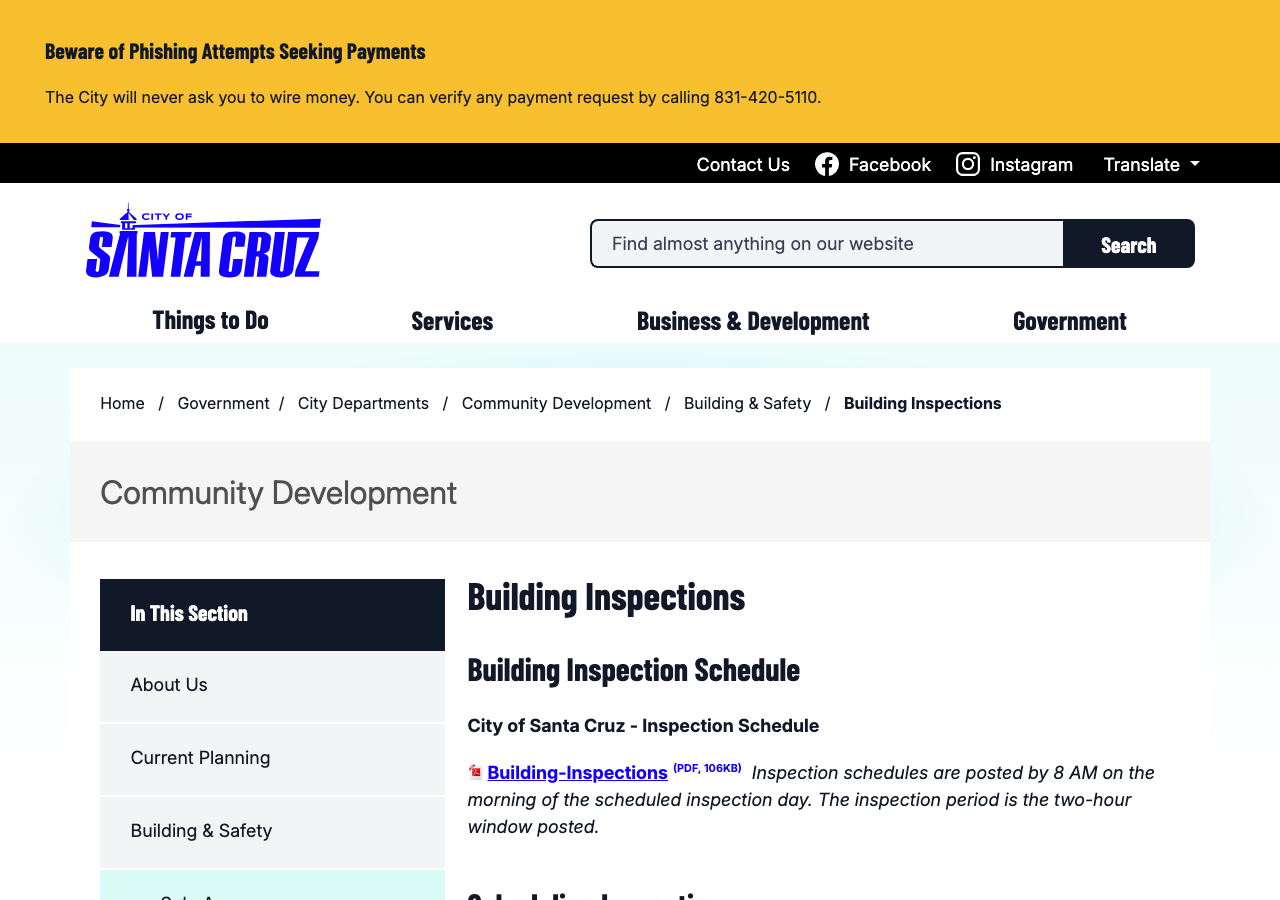
- Are same-day or AM/PM windows offered? No AM/PM half-day windows; inspections are posted to a specific 2-hour window by 8am on the day of the scheduled inspection 82% · department page
-
Know who turns up
Some authorities inspect their own solar work; some delegate it, and a few do not inspect the PV equipment itself at all. Who is coming determines what they will look at.
- Does this AHJ perform its own final solar inspection? Yes 88% · department page
- If delegated, to whom? N/A - not delegated; performed in-house by the Building & Safety Division 80% · department page
-
Work the stages in order
A rough-in or mid-roof inspection, where one is required, has to happen before the work it covers is closed up. Missing a stage means opening something back up, and it is the most expensive kind of correction.
- Which inspections are required, and in what order? For SolarApp+/standard rooftop PV, the documented sequence is a single scheduled field inspection against the SolarApp+ (or approved plan) Inspection Checklist, followed by permit close-out; no rough-in/mid-roof stage is described for typical residential PV 58% · department page
- Is a rough-in or mid-roof inspection required? No indication of a required rough-in/mid-roof inspection stage for standard residential rooftop PV 55% · department page
-
Have the paperwork on site
The approved plan set, the permit, and the equipment listings should be on site and reachable. Inspectors routinely verify that installed equipment matches what was approved, and that the labels are the ones the plan set promised.
- Is there a published inspection checklist? Yes 92% · department page
- What must be on site at inspection? The issued Permit card, the SolarApp+ Approval Document, the Inspection Checklist, and system specifications, all printed and on site 90% · department page
- Does the inspector verify labels and listings? Yes (inferred) 62% · department page
-
Sign-off, and permission to operate
Passing gives you a final or an equivalent sign-off. That is not the same as permission to operate: PTO comes from the utility, and who tells the utility the inspection passed varies. A system left switched off for weeks is usually waiting on this handover.
- What is issued on pass? Final (a passed final inspection closes out the permit); no separate 'green tag' or CO terminology was found for residential PV specifically 65% · department page
- Who notifies the utility for PTO? Installer (inferred) - the city's materials do not describe the city notifying PG&E; standard PG&E NEM practice has the installer/customer submit the Permission-to-Operate request once the system passes its city final 50% · utility DG manual
- Is there a re-inspection fee? $148.00 per hour, minimum 1 hour 82% · fee schedule
- How are corrections issued and cleared? Corrections are noted by the field inspector at the time of inspection; for SolarApp+ projects, any design correction/revision must be resubmitted and re-approved through the SolarApp+ platform itself before a new inspection can be scheduled 60% · department page
14 questions answered against City of Santa Cruz’s own published documents
Q49 How is an inspection booked? Core Booking & scheduling
Phone
Why the confidence is not higherBuilding Inspections page: 'All inspections must be scheduled by phone. Please contact the Building Division at (831) 420-5110 to schedule an inspection.' The same phone-only process is repeated on the SolarApp+ page.
department page checked 2026-08-30 https://www.santacruzca.gov/Government/City-Departments/Planning-and-Community-Development/Building-Safety/Building-Inspections
Q50 How much notice is required? Core Booking & scheduling
At least 1 business day for a next-business-day inspection (requests must be in before 2pm); requests made after 2pm are pushed to the SECOND business day rather than the next one
Why the confidence is not higherBuilding Inspections/SolarApp+ pages: 'Inspection requests made after 2 pm do not have the option for the next business day; rather they are scheduled for the second business day to allow us to schedule our routes.'
department page checked 2026-08-30 https://www.santacruzca.gov/Government/City-Departments/Planning-and-Community-Development/Building-Safety/Building-Inspections
Q51 Are same-day or AM/PM windows offered? Booking & scheduling
No AM/PM half-day windows; inspections are posted to a specific 2-hour window by 8am on the day of the scheduled inspection
Why the confidence is not higherBuilding Inspections page: 'Inspection schedules are posted by 8 AM on the morning of the scheduled inspection day. The inspection period is the two-hour window posted.'
department page checked 2026-08-30 https://www.santacruzca.gov/Government/City-Departments/Planning-and-Community-Development/Building-Safety/Building-Inspections
Q52 Does this AHJ perform its own final solar inspection? Core Who inspects
Yes
Why the confidence is not higherCity of Santa Cruz Building & Safety Division performs its own field inspections; the SolarApp+ page describes a 'Field solar representative' verifying the SolarApp+-generated Inspection Checklist and signing off prior to inspection, scheduled through the same (831) 420-5110 line as all other building inspections.
department page checked 2026-08-30 https://www.santacruzca.gov/Government/City-Departments/Planning-and-Community-Development/Building-Safety/SolarApp
Q53 If delegated, to whom? Core Who inspects
N/A - not delegated; performed in-house by the Building & Safety Division
Why the confidence is not higherSee Q52 sourcing; no delegation to the Fire Department, a fire district, or a third-party inspection agency was found for residential rooftop PV specifically.
department page checked 2026-08-30 https://www.santacruzca.gov/Government/City-Departments/Planning-and-Community-Development/Building-Safety/Building-Inspections
Q54 Which inspections are required, and in what order? Core Stages & sequence
For SolarApp+/standard rooftop PV, the documented sequence is a single scheduled field inspection against the SolarApp+ (or approved plan) Inspection Checklist, followed by permit close-out; no rough-in/mid-roof stage is described for typical residential PV
Why the confidence is not higherInferred from the SolarApp+ page's step-by-step process ('Step 4: Schedule an Inspection') describing only one inspection step, and the general Building Inspections page's statement that work is 'inspected and approved in succession' for multi-stage projects generally - no PV-specific multi-stage sequence was published.
department page checked 2026-08-30 https://www.santacruzca.gov/Government/City-Departments/Planning-and-Community-Development/Building-Safety/SolarApp
Q55 Is a rough-in or mid-roof inspection required? Stages & sequence
No indication of a required rough-in/mid-roof inspection stage for standard residential rooftop PV
Why the confidence is not higherThis is an absence inferred from silence: the SolarApp+ Inspection Checklist workflow and the general Building Inspections page describe scheduling a single inspection for solar; no document mentions a rough or mid-roof stage specific to PV.
department page checked 2026-08-30 https://www.santacruzca.gov/Government/City-Departments/Planning-and-Community-Development/Building-Safety/SolarApp
Q56 Does the inspector verify labels and listings? Core What is checked
Yes (inferred)
Why the confidence is not higherSolarApp+ page: 'Installation practices, workmanship, and adherence to the approved design are verified in the inspection process,' and the field inspector must 'verify the inspection checklist and sign the document confirming completion' - CA residential PV inspection checklists of this kind routinely include label/listing verification, though the word 'labels' is not used verbatim in the retrieved text.
department page checked 2026-08-30 https://www.santacruzca.gov/Government/City-Departments/Planning-and-Community-Development/Building-Safety/SolarApp
Q57 Is there a published inspection checklist? Core What is checked
Yes
Why the confidence is not higherSolarApp+ page links a sample: 'inspection checklist sample (PDF, 929KB)' and states the checklist 'will be generated ONLY when approved' for each project.
department page checked 2026-08-30 https://www.santacruzca.gov/Government/City-Departments/Planning-and-Community-Development/Building-Safety/SolarApp
Q58 What must be on site at inspection? Core Documents on site
The issued Permit card, the SolarApp+ Approval Document, the Inspection Checklist, and system specifications, all printed and on site
Why the confidence is not higherSolarApp+ page: 'The Permit, Solar App+ Approval Document, and Inspection Checklist and specifications must be printed for inspection and at the job site at all times for inspection purposes.' The general Building Inspections page adds: approved plans (if plan review was required), the city-issued permit card, and that the Green Job Site Card must be visible from the public right of way.
department page checked 2026-08-30 https://www.santacruzca.gov/Government/City-Departments/Planning-and-Community-Development/Building-Safety/SolarApp
Q59 Is there a re-inspection fee? Corrections & re-inspection
$148.00 per hour, minimum 1 hour
Why the confidence is not higherCitywide Fee Schedule PL-BLD21 ('Reinspection fees assessed under the provisions of Section 305.8 (UAC), Per hour with minimum 1 hour'), effective 1/1/25; the SolarApp+ page separately warns 'A reinspection fee will be applied if work is not ready or if the Permit and Approval documents are not printed and at the job site.'
fee schedule checked 2026-08-30 https://www.santacruzca.gov/files/assets/city/v/1/pl/documents/citywide-fee-schedule-effective-january-1-2025.pdf
Q60 How are corrections issued and cleared? Corrections & re-inspection
Corrections are noted by the field inspector at the time of inspection; for SolarApp+ projects, any design correction/revision must be resubmitted and re-approved through the SolarApp+ platform itself before a new inspection can be scheduled
Why the confidence is not higherSolarApp+ page: 'If revisions are not completed via Solar App+ prior to scheduling an inspection' a reinspection fee applies, implying corrections route back through the SolarApp+ system; for standard permits, the general resubmittal process (email permits@santacruzca.gov with 'REQUEST FOR RESUBMITTAL' in the subject line) applies.
department page checked 2026-08-30 https://www.santacruzca.gov/Government/City-Departments/Planning-and-Community-Development/Building-Safety
Q61 What is issued on pass? Core Final sign-off & PTO
Final (a passed final inspection closes out the permit); no separate 'green tag' or CO terminology was found for residential PV specifically
Why the confidence is not higherInferred from the general Building Inspections/SolarApp+ process description, which refers throughout to 'final inspection' and permit close-out rather than a distinct certificate or green-tag document.
department page checked 2026-08-30 https://www.santacruzca.gov/Government/City-Departments/Planning-and-Community-Development/Building-Safety/Building-Inspections
Q62 Who notifies the utility for PTO? Core Final sign-off & PTO
Installer (inferred) - the city's materials do not describe the city notifying PG&E; standard PG&E NEM practice has the installer/customer submit the Permission-to-Operate request once the system passes its city final
Why the confidence is not higherThis is inference from general CA NEM practice, not a Santa Cruz- or PG&E-document statement naming the responsible party; PG&E's Greenbook text extracted for this run does not contain the phrase 'Permission to Operate' or 'PTO,' so the step is evidently covered in the gated TD-2306M Distribution Interconnection Handbook rather than the public Greenbook.
utility DG manual checked 2026-08-30 https://www.pge.com/assets/pge/docs/account/service-requests/greenbook-manual-full.pdf
Lines marked with a percentage were read off this authority’s own published documents. Unmarked guidance is general good practice, not this jurisdiction’s rule — always confirm against the authority before you submit.
Jurisdiction & key facts
The standing 62-question set, answered for City of Santa Cruz against this authority’s own published documents. Every answer carries the confidence it was recorded at and the document it came from. Where nothing is published we say so and show where we looked — a blank here is a finding, not a gap.
City of Santa Cruz is the authority having jurisdiction 90% confidence
- Holds
- Building and Electrical (Planning and Community Development Dept., Building & Safety Division, under the Chief Building Official)
- Overridden by
- For coastal-zone parcels excluded from the city's Coastal Permit exemption (beach/wetland/blufftop/critical-water-supply sites), a Coastal Permit decided by the Zoning Administrator is layered on top of the building permit (SCMC 24.08.230.1(5)). For a landmark/Historic-Overlay property, a Historic Alteration Permit (SCMC 24.08.930, which names 'solar collectors' as a reviewed element) is layered on top. PG&E (interconnection/NEM/PTO) and, for line/supply-side taps, PG&E's own engraved-placard requirement, run on a parallel track the city does not administer. State law (2025 CBC/CRC/CEC per Health & Safety Code 18938(b); AB 130's Oct 2025-Jun 2031 freeze on more-restrictive local residential amendments) bounds what the city may add locally.
- Why not higher
- SCMC 18.04.010/18.04.030/18.04.080 establish the City of Santa Cruz Building Code and a Building & Safety Division under the Chief Building Official (part of Planning and Community Development, NOT a separate 'Building Department' name mismatch issue here - the brief-listed department name matches the code). Fire is a genuinely separate city department (Santa Cruz Fire Department, Chief Rob Oatey, 230 Walnut Ave) but its own Fire Code amendment (SCMC 19.05.250) routes PV/alternate-power-source APPROVAL to the building code official rather than retaining it for Fire, and Fire's own fee schedule carries no PV/solar/battery line - so, unlike some CA authorities where the fire department bills a separate residential PV plan-review fee, Santa Cruz's city fire department appears NOT to charge one. This is the same pattern found in unincorporated Santa Cruz County's file (approval also routed to the building official there), suggesting a countywide fire-code drafting convention rather than a city-specific idiosyncrasy. Central Coast Community Energy (3CE) is the local CCA but is confirmed generation-only (3CE's own site: customers 'remain connected to PG&E's distribution network,' bills go to PG&E) - PG&E alone handles interconnection, metering and PTO. IMPORTANT CAVEAT ON RETRIEVAL: the live santacruzca.gov site returned a persistent Akamai edge-WAF 403 (errors.edgesuite.net) to both curl and WebFetch across the whole domain during this run; every santacruzca.gov citation in this file was retrieved via Wayback Machine snapshots (dated Oct 2025-Feb 2026) after confirming the snapshot was not the literal Internet-Archive 'Temporarily Offline' placeholder, and PDFs were downloaded and read with pdftotext -layout, never summarized from a raw fetch. The Municipal Code chapters (Title 18, 19, 24) were retrieved directly and live via codepublishing.com, which was not blocked.
https://www.codepublishing.com/CA/SantaCruz/html/SantaCruz18/SantaCruz1804.html
- Permit required
- Yes95%
- Permit cost
- $351.00 flat for a residential system up to 15kW, plus $23.00 per kW above 15kW (both plus the city's standard 6% technology surcharge)80%
- Plan review
- SolarApp+-eligible systems: instant/same-day automated review and issuance upon payment. Standard (non-eligible) Solar Permit route: turnaround not confirmed60%
- Portal
- Two portals: eTRAKiT (permitting.cityofsantacruz.com/ETRAKIT3) for general permit status/plan-review comments/inspection scheduling,92%
- Electrical code
- 2023 (as the electrical basis of the 2025 California Electrical Code)88%
- Own placard wording
- Yes92%
- Booking an inspection
- Phone90%
Labels & placards for this authority
City of Santa Cruz writes its own placard wording. A standard NEC label set will not satisfy it — the exact text, and in most cases the size, colour and font, are specified below.
Wording 92%
Yes
Size, colour & material 92%
Red background sign, minimum 3/4-inch tall contrasting lettering, permanently affixed on each electrical panel subject to back-feed
Where they go 85%
On each electrical panel subject to back-feed from the alternate power source (city fire-code sign); on the metering equipment for a line/supply-side tap (PG&E placard)
What the utility wants on top 85%
Yes - PG&E requires its own engraved placard/signage identifying a line/supply-side interconnection on the metering equipment, in addition to whatever the AHJ requires
Each figure above is sourced and dated in the full answer set below (questions 38–43). Where an authority’s own published sheet is older than the code it has adopted, the answer says so.
Their website

Average approval time — application to PTO
From the CPUC interconnection record. Bars show the average days taken each year; a year with no recorded projects is left blank rather than drawn as zero.