
City of Santa Maria
Santa Barbara County
City of Santa Maria is a city authority in the State of California, serving 109,707 residents. 6,476 residential solar installs are on record here. This page is the permit route for that jurisdiction: the fifteen steps from working out who has a say over an address through to permission to operate, the documents this authority publishes, and 62 answers taken from those documents and dated.
Permitting 5 steps · 28 questions
Whether a permit is needed — Yes Q3 Electrical and building permits — Combined Q4 Plan review — No fixed number of days is published. The Community Development Dept FAQ states: 'Plan check times vary widely based on the size of the project, Q18 Where you file — eTRAKit (the City of Santa Maria's online permit-processing system, at cityofsantamaria.org/etrakit) Q20
- Permit required
- Yes92% source
- What it costs
- Itemized, not flat. Per the FY2025-26 User Fee Schedule (Council Resolution 2025-80): Building-side 'Photovoltaic System' fee $164.00 for 0–5 kWh, +$35.00 per additional kWh;85% source
- Plan review turnaround
- No fixed number of days is published. The Community Development Dept FAQ states: 'Plan check times vary widely based on the size of the project, complexity and quality of the plans submitted,80% source
- Key document
- authority's own page (permit type list) + fee schedule (itemized trade fees) cited by 4 open the document
-
Confirm who has a say over your address
A city address is usually permitted by the city, not the county — but not always, and some authorities keep building and hand electrical to someone else. Getting this wrong costs the whole submittal, because every requirement below belongs to whoever actually holds jurisdiction. Check the overlays in the same pass: an HOA, a historic district, a windstorm certification or a system-size cap can reshape the design, and all of them are cheaper to find now than after the array is laid out.
- Is this authority the AHJ for residential solar at this address? Yes 95% · authority's own department page
- What does this authority permit itself, and what does it delegate? Both 90% · authority's own department page
- Is a permit required for a residential rooftop PV system? Yes 92% · authority's own page + fee schedule
- Is there a separate electrical permit, or is it combined? Combined 72% · authority's own page (permit type list) + fee schedule (itemized trade fees)
- Is a HOA or architectural approval required first? No 58% · state law preemption (Civil Code §714); city code section itself not retrievable
- Is a wind or windstorm certification required? No 60% · absence in authority's own structural-review handout + no CA equivalent to TDI wind certification
- Is a Specific Use Permit or Council approval ever required? No, for by-right residential rooftop PV 55% · state law (Gov. Code §65850.5); city zoning chapter text itself not retrievable
-
Check who is allowed to apply
Several authorities require the electrical permit to be pulled by a licensed electrician, or require the contractor to be registered with them BEFORE applying. Registration is not same-day. This is second on the list rather than fourth because it is the step most likely to stop the job before the drawings matter.
- Who is allowed to pull the electrical permit? Either 48% · inference from state law + authority's application form
- Must the contractor be registered with this authority before applying? No 60% · authority's own application form (absence of a local registration field)
- Is a homeowner permitted to self-install and self-permit? Yes 50% · inference from CA statewide owner-builder practice; no city-specific statement found
-
Build the submittal package
Almost everywhere wants a site plan, a one-line or three-line electrical diagram, equipment cut sheets with listings, and a structural attachment detail. Build it against the published checklist rather than the last jurisdiction you worked in — the checklist is what the reviewer marks against.
- What documents make up a complete submittal? A completed Plan Check Application form (site info, description of work, contractor/designer info, documentation checkboxes for Structural Calcs / Energy Calcs / Truss Calcs / Specs / Soils Report), plus a Basic Site Plan (drawn to scale, showing structures, dimensions, north arrow, APN). A dedicated 'Residential Plan Submittal Checklist' is referenced by the Plan Review page but its current PDF (doc ID 22240) could not be retrieved (not archived, live site blocked) — see not_found for the itemized checklist. 70% · authority's own submittal forms
- Is a site plan required, and what must it show? Yes. The 'Basic Site Plan Requirements' handout requires: scale of 1"=20' or larger; location of curbs/sidewalks/driveways/structures/parking/landscaping; full dimensions of property boundaries, structures, and setbacks; north arrow, scale, address, and APN; unique site features (drainage, wells, easements, trees); a square-footage table; and applicant/owner/preparer contact info. 75% · authority's own handout
- Is a structural PE stamp required, and at what threshold? A CA Professional Engineer or Registered Architect stamp is required per the city's 'What Requires Signature of a CA Professional Engineer or CA Registered Architect' handout, citing B&P Code §§5537/6737, with exemptions for conventional wood-frame single-family dwellings ≤2 stories+basement (and their garages/accessory structures) unless the work deviates from conventional light-frame limitations in CBC Ch. 23 (Div. IV, §2320), or involves items like lateral force-resisting systems, equipment >400 lb per §1632.1, etc. 65% · authority's own handout (dated 2017, still linked in 2026)
-
Apply and pay
Most authorities now take the whole application through a portal, and several states cap or constrain what a residential solar permit may cost. Check whether plan check is billed separately before you quote the job.
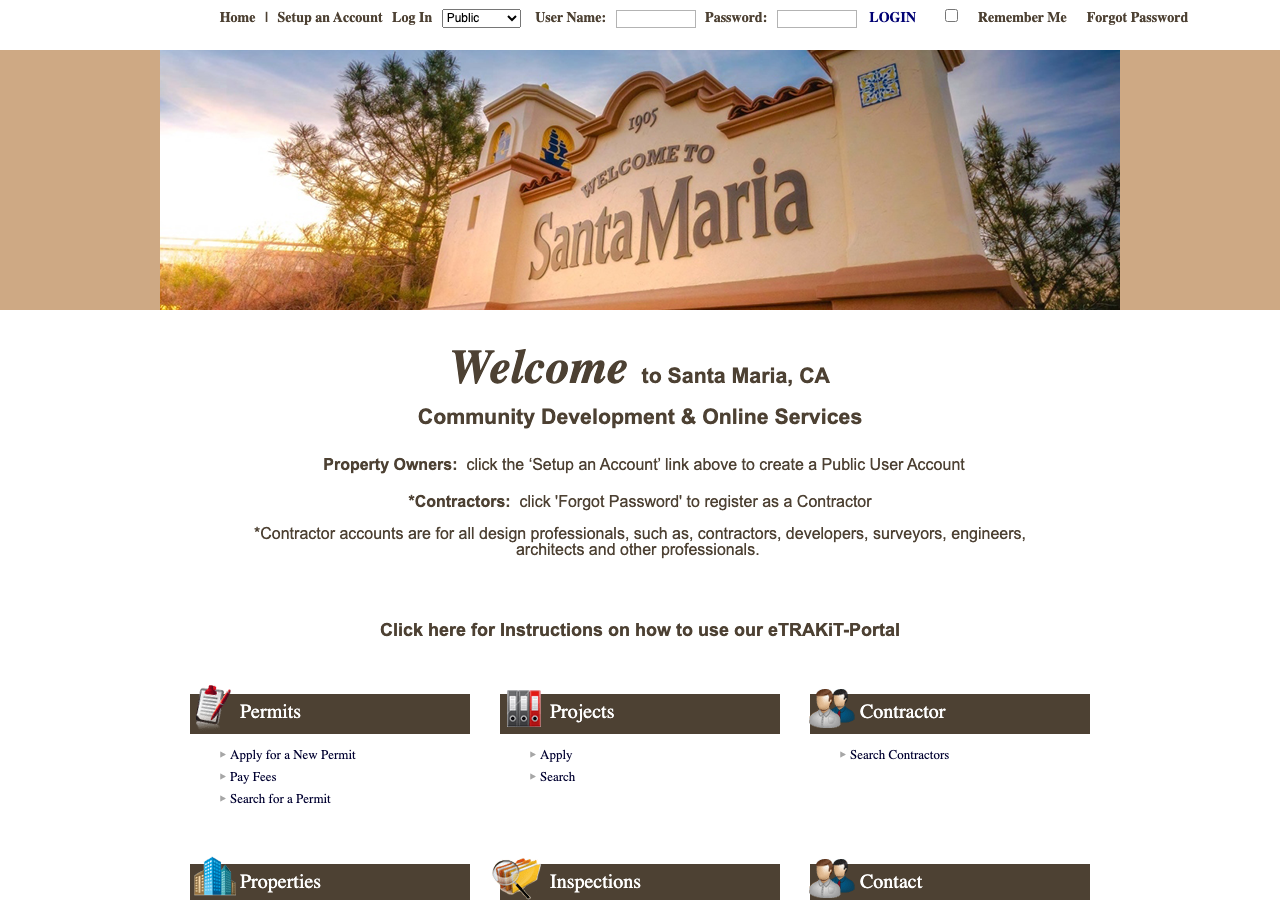
- Which permit portal does this authority use? eTRAKit (the City of Santa Maria's online permit-processing system, at cityofsantamaria.org/etrakit) 95% · authority's own department page
- Can the whole application be completed online? Yes 90% · authority's own department page (AB 2234 transparency disclosure)
- What does a residential solar permit cost? Itemized, not flat. Per the FY2025-26 User Fee Schedule (Council Resolution 2025-80): Building-side 'Photovoltaic System' fee $164.00 for 0–5 kWh, +$35.00 per additional kWh; Electrical-side 'Solar Photovoltaic Systems' fees — Ground Mounted Racks $59.00, Roof Mounted Racks 1–3 panels $26.00 / 4–10 panels $33.00 / over 10 panels $53.00, Inverter/batteries/components $39.00; plus a flat $39.00 Permit Issuance Fee and a 2.5% Community Development Technology Surcharge on all Building & Safety fees. A typical residential rooftop system (e.g. >10 panels, one inverter, ~6–8 kWh) would total roughly $270–$330 all-in. 85% · authority's own adopted fee schedule
- How is the fee calculated? Tiered 85% · authority's own adopted fee schedule
- Is there a separate plan-check fee? No distinct PV-specific plan-check line was found; the schedule's 'S-047 Building Plan Check/Inspection' entry says fees are per an appendix (the same Building Fees appendix used for the PV permit fee itself), and a general 'Stand Alone Electrical Plan Check' fee ($79) exists for electrical-only submittals not tied to a building permit — it is unclear whether this applies on top of the PV fee or only to unrelated stand-alone electrical work. 55% · authority's own adopted fee schedule
-
Plan review — and start the utility in parallel
Interconnection is a separate process from the permit and usually the longer pole. Where the utility does not depend on the permit being issued, running both at once is the single biggest saving available on a residential job.
- What is the stated plan-review turnaround? No fixed number of days is published. The Community Development Dept FAQ states: 'Plan check times vary widely based on the size of the project, complexity and quality of the plans submitted, and current permit volumes, ... call our office ... for current turnaround times.' 80% · authority's own department FAQ
- Which utility handles interconnection here? Pacific Gas & Electric (PG&E) 70% · CCA service-area list + absence of a municipal electric utility on the city's own site
28 questions answered against City of Santa Maria’s own published documents
Q1 Is this authority the AHJ for residential solar at this address? Core Jurisdiction & scope
Yes
Why the confidence is not higherCity of Santa Maria's own Community Development Department page states the Building Division 'regulates building and associated construction activities...pursuant to uniform construction codes' and issues building permits; confirmed as a live capture of the city's own site.
authority's own department page checked 2026-08-30 https://web.archive.org/web/20260814205741/https://www.cityofsantamaria.org/services/departments/community-development
Q2 What does this authority permit itself, and what does it delegate? Core Jurisdiction & scope
Both
Why the confidence is not higherCommunity Development page: 'The Building Division regulates building and associated construction activities...building plan review, building permit issuance, and inspection.' The same page's FAQ says 'anything that involves electrical, mechanical, plumbing or erecting of walls requires a building permit,' i.e. the Building Division issues both trades, not delegated to the county.
authority's own department page checked 2026-08-30 https://web.archive.org/web/20260814205741/https://www.cityofsantamaria.org/services/departments/community-development
Q3 Is a permit required for a residential rooftop PV system? Core Jurisdiction & scope
Yes
Why the confidence is not higherThe city's own AB 2234 post-entitlement page lists 'Photovoltaic System' as one of the required separate permit application types, and the FY2025-26 User Fee Schedule (Resolution 2025-80) carries dedicated 'Photovoltaic System' (Building) and 'Solar Photovoltaic Systems' (Electrical) fee line items, proving a permit is required and priced.
authority's own page + fee schedule checked 2026-08-30 https://web.archive.org/web/20260415215535/https://www.cityofsantamaria.org/services/departments/community-development/building-division-homepage/assembly-bill-2234-post-entitlements
Q4 Is there a separate electrical permit, or is it combined? Core Jurisdiction & scope
Combined
Why the confidence is not higherAB 2234 page lists 'Photovoltaic System' as a single distinct permit application type (alongside Building, Grading, etc.), not split into separate 'Building' and 'Electrical' PV applications. However, the fee schedule prices PV under two different fee tables (a Building-fee table by kWh, and an Electrical-fee table by rack/panel count and inverter/battery component) that are billed together within that one PV permit, so it functions as one combined permit with itemized trade fees rather than two permits.
authority's own page (permit type list) + fee schedule (itemized trade fees) checked 2026-08-30 https://web.archive.org/web/20260415215535/https://www.cityofsantamaria.org/services/departments/community-development/building-division-homepage/assembly-bill-2234-post-entitlements
Q5 Who is allowed to pull the electrical permit? Core Who may apply
Either
Why the confidence is not higherNo Santa Maria-specific document was found stating who may pull the PV electrical permit. This is inferred from general California contractor-licensing law (B&P Code §7028 requires a C-46 solar or C-10 electrical license for hire, but CA also allows owner-builders); the city's own Plan Check Application form asks for a 'Contractor Company Name / State License No.' but does not state licensed-contractor is mandatory.
inference from state law + authority's application form checked 2026-08-30 https://web.archive.org/web/20260114225408/https://www.cityofsantamaria.org/home/showpublisheddocument/6555/636758142428770000
Q6 Must the contractor be registered with this authority before applying? Core Who may apply
No
Why the confidence is not higherThe city's Plan Check Application asks only for the contractor's state license number/class, with no separate city contractor-registration field or process described on any Building Division page found; no local registration requirement was located.
authority's own application form (absence of a local registration field) checked 2026-08-30 https://web.archive.org/web/20260114225408/https://www.cityofsantamaria.org/home/showpublisheddocument/6555/636758142428770000
Q7 Is a homeowner permitted to self-install and self-permit? Who may apply
Yes
Why the confidence is not higherNo Santa Maria-specific prohibition on homeowner self-install/self-permit was found. California generally permits owner-builder permits statewide (Contractors State License Board owner-builder rules), and nothing on the city's Building Division pages excludes residential PV from that. Not confirmed by a city-specific statement, hence moderate confidence.
inference from CA statewide owner-builder practice; no city-specific statement found checked 2026-08-30 https://web.archive.org/web/20260512150700/https://www.cityofsantamaria.org/services/departments/community-development/building-division-homepage/building-plan-review
Q8 What documents make up a complete submittal? Core Submittal package
A completed Plan Check Application form (site info, description of work, contractor/designer info, documentation checkboxes for Structural Calcs / Energy Calcs / Truss Calcs / Specs / Soils Report), plus a Basic Site Plan (drawn to scale, showing structures, dimensions, north arrow, APN). A dedicated 'Residential Plan Submittal Checklist' is referenced by the Plan Review page but its current PDF (doc ID 22240) could not be retrieved (not archived, live site blocked) — see not_found for the itemized checklist.
Why the confidence is not higherBuilt from the city's own Plan Check Application PDF and 'Basic Site Plan Requirements' handout (both retrieved and text-extracted); these are general submittal documents, not solar-specific, so may not capture every PV-specific requirement.
authority's own submittal forms checked 2026-08-30 https://web.archive.org/web/20260114225408/https://www.cityofsantamaria.org/home/showpublisheddocument/6555/636758142428770000
Q9 How many copies, and in what format? Submittal package
Nothing published by this authority.
Where we lookedPlan Check Application PDF ('# OF PLAN SETS ___ # OF LNDSP SETS ___' left blank on the form, i.e. determined per project); Residential Plan Submittal Checklist PDF (doc ID 22240, linked from the Building Plan Review page) could not be retrieved — Wayback has no capture and the live site (cityofsantamaria.org) returns HTTP 403 to all fetch methods tried (Akamai block).
Q10 Is a site plan required, and what must it show? Core Submittal package
Yes. The 'Basic Site Plan Requirements' handout requires: scale of 1"=20' or larger; location of curbs/sidewalks/driveways/structures/parking/landscaping; full dimensions of property boundaries, structures, and setbacks; north arrow, scale, address, and APN; unique site features (drainage, wells, easements, trees); a square-footage table; and applicant/owner/preparer contact info.
Why the confidence is not higherThis is the city's general site-plan requirement (Community Development Dept handout), not a PV-specific one; no separate PV site-plan spec was located.
authority's own handout checked 2026-08-30 https://web.archive.org/web/20221208103828/https://www.cityofsantamaria.org/home/showpublisheddocument/8887/635543471949270000
Q11 Is a one-line / three-line diagram required? Core Drawings & calculations
Nothing published by this authority.
Where we lookedSearched the Plan Check Application, Basic Site Plan Requirements, AB 2234 post-entitlement page, and Building Plan Review page for a one-line/three-line diagram requirement; none of the retrievable city documents mention it. The likely source (Residential Plan Submittal Checklist, doc 22240) is unreachable — not archived, live site 403s.
Q12 Are string and conductor calculations required? Drawings & calculations
Nothing published by this authority.
Where we lookedSame documents checked as Q11 (Plan Check Application, Basic Site Plan Requirements, Building Plan Review page); none mention string/conductor calculations. The unreachable Residential Plan Submittal Checklist is the likely source.
Q13 Is a structural PE stamp required, and at what threshold? Core Engineering & stamps
A CA Professional Engineer or Registered Architect stamp is required per the city's 'What Requires Signature of a CA Professional Engineer or CA Registered Architect' handout, citing B&P Code §§5537/6737, with exemptions for conventional wood-frame single-family dwellings ≤2 stories+basement (and their garages/accessory structures) unless the work deviates from conventional light-frame limitations in CBC Ch. 23 (Div. IV, §2320), or involves items like lateral force-resisting systems, equipment >400 lb per §1632.1, etc.
Why the confidence is not higherThis is a general Building Division handout (not solar-specific) and its file-path date stamp reads 3-28-17; it was still the linked document on the May 2026 Plan Review page capture, but its currency for the 2025 code cycle is unverified.
authority's own handout (dated 2017, still linked in 2026) checked 2026-08-30 https://web.archive.org/web/20221129093558/https://www.cityofsantamaria.org/home/showpublisheddocument/22244/636334811774730000
Q14 Is an electrical PE stamp required, and at what threshold? Engineering & stamps
Nothing published by this authority.
Where we lookedChecked the PE/Architect-stamp handout, Plan Check Application, and Building Plan Review page for an electrical-specific PE stamp threshold; none give one distinct from the general architect/engineer stamp rule in Q13.
Q15 What does a residential solar permit cost? Core Fees
Itemized, not flat. Per the FY2025-26 User Fee Schedule (Council Resolution 2025-80): Building-side 'Photovoltaic System' fee $164.00 for 0–5 kWh, +$35.00 per additional kWh; Electrical-side 'Solar Photovoltaic Systems' fees — Ground Mounted Racks $59.00, Roof Mounted Racks 1–3 panels $26.00 / 4–10 panels $33.00 / over 10 panels $53.00, Inverter/batteries/components $39.00; plus a flat $39.00 Permit Issuance Fee and a 2.5% Community Development Technology Surcharge on all Building & Safety fees. A typical residential rooftop system (e.g. >10 panels, one inverter, ~6–8 kWh) would total roughly $270–$330 all-in.
Why the confidence is not higherDirectly extracted (pdftotext) from the city's own current fee-schedule PDF, adopted by Resolution 2025-80 (June 2025); the 'roughly $270-330' figure is my own arithmetic example from the listed line items, not a single published total.
authority's own adopted fee schedule checked 2026-08-30 https://web.archive.org/web/20260517082846/https://www.cityofsantamaria.org/home/showpublisheddocument/32700/638870720496970000
Q16 How is the fee calculated? Core Fees
Tiered
Why the confidence is not higherBuilding-side fee is tiered by kWh (0-5 kWh base + per-additional-kWh); electrical-side fee is tiered by mount type and panel/rack count, plus a flat component fee for inverter/batteries — a tiered, itemized structure rather than flat, per-panel-only, or pure-valuation.
authority's own adopted fee schedule checked 2026-08-30 https://web.archive.org/web/20260517082846/https://www.cityofsantamaria.org/home/showpublisheddocument/32700/638870720496970000
Q17 Is there a separate plan-check fee? Fees
No distinct PV-specific plan-check line was found; the schedule's 'S-047 Building Plan Check/Inspection' entry says fees are per an appendix (the same Building Fees appendix used for the PV permit fee itself), and a general 'Stand Alone Electrical Plan Check' fee ($79) exists for electrical-only submittals not tied to a building permit — it is unclear whether this applies on top of the PV fee or only to unrelated stand-alone electrical work.
Why the confidence is not higherFee-schedule structure is ambiguous on this specific point; no separate 'PV plan check' line exists, but a generic Building Plan Check appendix reference and a Stand-Alone Electrical Plan Check fee both exist in the same document.
authority's own adopted fee schedule checked 2026-08-30 https://web.archive.org/web/20260517082846/https://www.cityofsantamaria.org/home/showpublisheddocument/32700/638870720496970000
Q18 What is the stated plan-review turnaround? Core Timeline & validity
No fixed number of days is published. The Community Development Dept FAQ states: 'Plan check times vary widely based on the size of the project, complexity and quality of the plans submitted, and current permit volumes, ... call our office ... for current turnaround times.'
Why the confidence is not higherThis is a proven absence — the department's own FAQ explicitly declines to give a fixed turnaround and directs applicants to call, rather than the page simply omitting the topic.
authority's own department FAQ checked 2026-08-30 https://web.archive.org/web/20260814205741/https://www.cityofsantamaria.org/services/departments/community-development
Q19 How long is an issued permit valid before it expires? Timeline & validity
Nothing published by this authority.
Where we lookedLooked for a stated permit-validity/expiration period on the Building Permit Processing, Building Plan Review, and Building Inspections pages, and in the Plan Check Application and fee schedule; none state a specific expiration period (e.g. days without inspection). The governing text would be in the adopted CBC §105.5 as locally amended, which sits behind the blocked ecode360.com/SA5007 municipal code.
https://web.archive.org/web/20240521042232/https://ecode360.com/SA5007
Q20 Which permit portal does this authority use? Core Portal & process
eTRAKit (the City of Santa Maria's online permit-processing system, at cityofsantamaria.org/etrakit)
Why the confidence is not higherNamed directly on both the Building Inspections page ('use our Etrakit portal') and the AB 2234 post-entitlement transparency page ('eTRAKit-Portal, the City of Santa Maria's online permit processing system').
authority's own department page checked 2026-08-30 https://web.archive.org/web/20260415215535/https://www.cityofsantamaria.org/services/departments/community-development/building-division-homepage/assembly-bill-2234-post-entitlements
Q21 Can the whole application be completed online? Core Portal & process
Yes
Why the confidence is not higherThe city's AB 2234 page states plainly: 'Complete sets of plans, applicable reports and permit applications can be submitted via eTRAKit-Portal' and that the portal supports applying for building and planning permits, searching properties/permits, requesting/cancelling inspections, and paying fees — i.e. the full application can be completed online.
authority's own department page (AB 2234 transparency disclosure) checked 2026-08-30 https://web.archive.org/web/20260415215535/https://www.cityofsantamaria.org/services/departments/community-development/building-division-homepage/assembly-bill-2234-post-entitlements
Q22 Which utility handles interconnection here? Core Utility interconnection
Pacific Gas & Electric (PG&E)
Why the confidence is not higherNot confirmed by a PG&E territory map (none could be retrieved) or a single explicit city statement naming PG&E. Inferred from: (1) Central Coast Community Energy's (3CE) own community list includes Santa Maria alongside other known PG&E-territory North Santa Barbara County cities (Guadalupe, Solvang, Buellton), distinct from South-Coast SCE cities (Goleta, Carpinteria) also on 3CE's list; (2) the city's own site lists only water/sewer/trash under 'Utilities Department' — no municipal electric utility — consistent with an investor-owned utility (PG&E) serving the area. This is a geographic/indirect inference, not a direct-source confirmation, per the instruction not to use a ZIP-code tool.
CCA service-area list + absence of a municipal electric utility on the city's own site checked 2026-08-30 https://3cenergy.org/about-us/how-ccce-works/
Q23 Where does the utility sit in the sequence? Core Utility interconnection
Nothing published by this authority.
Where we lookedChecked the PG&E Greenbook (Section 6, Electric Generation Interconnection) and PG&E's solar/NEM landing pages for language on when the utility interconnection application must occur relative to city permit issuance; none of the retrieved PG&E pages state the sequencing explicitly.
https://www.pge.com/assets/pge/docs/account/service-requests/greenbook-manual-full.pdf
Q24 Is a HOA or architectural approval required first? Overlays & special cases
No
Why the confidence is not higherNo Santa Maria ordinance or HOA-review requirement for residential rooftop PV was found (municipal code itself is blocked). California's Solar Rights Act (Civil Code §714) preempts HOA/CC&R restrictions that significantly increase the cost or decrease the efficiency of a solar system, which as a matter of state law applies here regardless of the city's own silence on the topic.
state law preemption (Civil Code §714); city code section itself not retrievable checked 2026-08-30 https://web.archive.org/web/20240521042232/https://ecode360.com/SA5007
Q25 Is there a historic-district review? Overlays & special cases
Nothing published by this authority.
Where we lookedThe 2024-era eCode360 table of contents shows a 'CHAPTER 12-25A H HISTORIC OVERLAY DISTRICT' exists in Title 12 (Zoning), but the chapter text is unreachable (ecode360.com 403s every route tried, including with the ICC Referer header, and qcode.us now redirects into the same Cloudflare-gated ecode360 domain). Cannot confirm whether/how it applies to rooftop solar on a historic-overlay parcel.
https://web.archive.org/web/20240521042232/https://ecode360.com/SA5007
Q26 Is a wind or windstorm certification required? Overlays & special cases
No
Why the confidence is not higherNo Santa Maria document mentions a separate wind/windstorm certification (of the kind used by Texas TDI). California's adopted CBC handles wind loading through standard structural design/PE-stamp review (see Q13) rather than a distinct wind-certification instrument; nothing on the city's Building Division pages describes an additional wind certificate.
absence in authority's own structural-review handout + no CA equivalent to TDI wind certification checked 2026-08-30 https://web.archive.org/web/20221129093558/https://www.cityofsantamaria.org/home/showpublisheddocument/22244/636334811774730000
Q27 Is a Specific Use Permit or Council approval ever required? Overlays & special cases
No, for by-right residential rooftop PV
Why the confidence is not higherNo Santa Maria document requires Council/Specific-Use-Permit approval for standard residential rooftop solar; this is consistent with California Government Code §65850.5 (Solar Rights Act), which limits cities to ministerial (not discretionary/CUP) review of small residential rooftop solar systems.
state law (Gov. Code §65850.5); city zoning chapter text itself not retrievable checked 2026-08-30 https://web.archive.org/web/20240521042232/https://ecode360.com/SA5007
Q28 Is there a system-size cap on residential generation? Overlays & special cases
Nothing published by this authority.
Where we lookedLooked for a residential generation system-size cap in the Building Plan Review, AB 2234, and Community Development pages and in the fee schedule; none state a kW cap. The likely location (Title 12 Zoning or a specific PV ordinance) sits behind the blocked ecode360.com/SA5007 code.
https://web.archive.org/web/20240521042232/https://ecode360.com/SA5007
Lines marked with a percentage were read off this authority’s own published documents. Unmarked guidance is general good practice, not this jurisdiction’s rule — always confirm against the authority before you submit.
Install 5 steps · 20 questions
-
Build to the code editions actually in force here
The NEC edition a jurisdiction enforces is often a cycle behind the newest one published, and local amendments sit on top of it. Rapid shutdown, conductor sizing and labelling all change between editions, so the edition in force is the first thing to establish, not the last.
- Which NEC edition is in force? 2023 NEC (as codified into the 2025 California Electrical Code) 78% · authority's own page (verbatim quote), with a flagged apparent typo
- Which building code edition is in force? 2025 California Building Code (based on the 2024 International Building Code, 2024 IRC for the Residential Code) 90% · authority's own department page
- Which fire code edition is in force? 2025 California Fire Code (based on the 2024 International Fire Code) 90% · authority's own department page
- Are there local amendments to any of the above? Yes 85% · authority's own department page (amendment existence confirmed; text unreachable)
- What is the installation judged against? The installation is judged against the 2025 CBC/CRC/CEC/CMC/CPC/Energy Code/CFC/CEBC/Historical Building Code/CALGreen/Referenced Standards Code as adopted and locally amended by the Santa Maria City Council, per the Building Plan Review page. 80% · authority's own department page
-
Fire access, setbacks and pathways
Ridge setbacks and roof access pathways are fire-service requirements and they constrain the array layout. They are the most common cause of a redesign after the fire department comments on a plan set.
Nothing recorded for City of Santa Maria on this step yet — 1 question checked and found unpublished. The guidance above is general.
-
Rapid shutdown
Which rapid-shutdown rule applies follows directly from the NEC edition in force, and the initiation device has to be at a location the fire service can reach and identify. This is inspected, and it is labelled.
- Is rapid shutdown required, and to which NEC edition? Yes, rapid shutdown is required to NEC 690.12 60% · inference from adopted code edition; no direct city statement on rapid shutdown found
-
Labels and placards
The NEC sets a baseline for permanent markings at the service equipment and the disconnecting means. On top of that, an authority may specify its own wording, and the utility may specify more again. Where any of them writes its own text, a generic off-the-shelf label set will not pass — this is the detail most often fixed on a return visit.
- Which placards does this authority require at the service equipment? The UTILITY (PG&E) requires permanent signage at the meter panel identifying an alternative generation source is interconnected, plus signage/maps at the meter panel for the AC disconnect location if it is more than 10 feet away and out of line of sight (PG&E Greenbook §7.7, Table 7-7). The AHJ's own placard requirements (beyond the utility's) could not be confirmed — the likely source (adopted CFC/CBC local amendments) sits behind the blocked ecode360.com/SA5007. 75% · utility's own current interconnection manual
- Does it specify letter height, colour or material? No city-specific letter height or color spec was found. The utility (PG&E) Greenbook specifies acceptable labeling *materials/methods* for meter identification generally — an ID plate (UV-rated for outdoor use), non-removable stenciled paint, or (indoor only) manufactured decals; tape and hand-written labels are explicitly unacceptable for permanent installs — but this is general meter labeling guidance, not a solar-placard letter-height/color spec. 65% · utility's own current interconnection manual (general meter labeling table)
- Does the UTILITY specify placards beyond the AHJ's? Yes 92% · utility's own current interconnection manual
- Where must the labels be placed? Per PG&E's Greenbook: generation-source signage must be affixed to the electric meter panel; if the AC disconnect switch is more than 10 feet away from the meter panel and out of line of sight, additional signage/maps identifying its location are also required at the meter panel. A line/supply-side-tap installation additionally requires an engraved placard on the metering equipment noting the line-side connection. 88% · utility's own current interconnection manual
-
Disconnect, storage and listed equipment
Where the AC disconnect must sit relative to the meter is usually the utility's rule, not the building department's. Battery storage frequently carries its own permit, its own inspection and its own fire conditions.
- Where must the AC disconnect be, relative to the meter? The AC disconnect must be located per PG&E's Table 6-3: required for all self-contained/transformer-rated meter panels except single-phase, socket-based, ≤320A self-contained panels (which are exempt unless K-base). Where required, it sits ahead of the main breaker for line/supply-side taps (with an engraved line-side placard), or on a dedicated alternative-generation breaker; if more than 10 feet from the meter panel and out of line of sight, its location must also be signed/mapped at the meter panel. 90% · utility's own current interconnection manual
- Must equipment be on a specific approved list? No authority-specific 'approved equipment list' was found; standard NEC/UL-listing requirements (nationally recognized testing laboratory listing, per the Greenbook's own general reference to listed equipment) appear to be the operative standard rather than a Santa Maria-specific approved-manufacturer list. 55% · absence in authority's own retrievable documents; municipal code itself blocked
- Are batteries permitted, and under what conditions? Yes, batteries/ESS are permitted and are billed as part of a Solar Photovoltaic System electrical permit ('Inverter, batteries, components' — $39.00 fee line); specific safety conditions (CFC-based siting, spacing, egress rules) could not be confirmed. 62% · authority's own adopted fee schedule (existence of a billed fee line); conditions unconfirmed
- Is there a separate ESS permit or inspection? No separate ESS permit appears to exist 52% · inference from authority's own fee-schedule structure
20 questions answered against City of Santa Maria’s own published documents
Q29 Which NEC edition is in force? Core Code editions in force
2023 NEC (as codified into the 2025 California Electrical Code)
Why the confidence is not higherThe city's Building Plan Review page lists 'the 2025 California Electrical Code based on the 2024 NFPA 72 National Electrical Code' as in force. This appears to contain the city's own transcription error: NFPA 72 is the fire alarm code, not the NEC (NFPA 70); the 2025 CEC cycle is, statewide, based on the 2023 NEC (NFPA 70). Quoted the source exactly and flagged the discrepancy rather than silently correcting it.
authority's own page (verbatim quote), with a flagged apparent typo checked 2026-08-30 https://web.archive.org/web/20260512150700/https://www.cityofsantamaria.org/services/departments/community-development/building-division-homepage/building-plan-review
Q30 Which building code edition is in force? Core Code editions in force
2025 California Building Code (based on the 2024 International Building Code, 2024 IRC for the Residential Code)
Why the confidence is not higherBuilding Plan Review page lists '2025 California Building Code based on the International Building Code, 2024 Edition' and '2025 California Residential Code based on the 2024 International Residential Code' as in force, alongside the 2025 CMC, CPC, Energy Code, CEBC, Historical Building Code, CALGreen and Referenced Standards Code.
authority's own department page checked 2026-08-30 https://web.archive.org/web/20260512150700/https://www.cityofsantamaria.org/services/departments/community-development/building-division-homepage/building-plan-review
Q31 Which fire code edition is in force? Code editions in force
2025 California Fire Code (based on the 2024 International Fire Code)
Why the confidence is not higherSame Building Plan Review page lists '2025 California Fire Code based on the 2024 International Fire Code' among the codes in force.
authority's own department page checked 2026-08-30 https://web.archive.org/web/20260512150700/https://www.cityofsantamaria.org/services/departments/community-development/building-division-homepage/building-plan-review
Q32 Are there local amendments to any of the above? Core Code editions in force
Yes
Why the confidence is not higherThe same page states: 'City of Santa Maria Ordinance Adopting and Amending the State Building Codes' with a link captioned 'See City of Santa Maria Amendments to the Building Codes' (which routes to the blocked ecode360.com/SA5007) — confirming local amendments exist, even though their text could not be retrieved this run.
authority's own department page (amendment existence confirmed; text unreachable) checked 2026-08-30 https://web.archive.org/web/20260512150700/https://www.cityofsantamaria.org/services/departments/community-development/building-division-homepage/building-plan-review
Q33 What is the installation judged against? Core Electrical
The installation is judged against the 2025 CBC/CRC/CEC/CMC/CPC/Energy Code/CFC/CEBC/Historical Building Code/CALGreen/Referenced Standards Code as adopted and locally amended by the Santa Maria City Council, per the Building Plan Review page.
Why the confidence is not higherSame source as Q29-Q32; the specific local-amendment text itself (which could refine this) sits behind the blocked municipal code host.
authority's own department page checked 2026-08-30 https://web.archive.org/web/20260512150700/https://www.cityofsantamaria.org/services/departments/community-development/building-division-homepage/building-plan-review
Q34 Is there a local rule on service upgrades or busbar sizing? Electrical
Nothing published by this authority.
Where we lookedChecked the Building Plan Review, Building Permit Processing, and fee-schedule ELECTRICAL PERMIT FEES sections (which price service upgrades by amperage tier but do not state a busbar-sizing rule) for a local rule on service upgrades/busbar sizing; none was stated. The likely source (municipal code amendments) is behind the blocked ecode360.com/SA5007.
Q35 Is a specific mounting system or attachment spacing required? Structural & mounting
Nothing published by this authority.
Where we lookedNo mounting-system or attachment-spacing rule was found on any retrievable Building Division page or handout; the likely source (CRC/CBC local amendments) sits behind the blocked ecode360.com/SA5007 municipal code.
https://web.archive.org/web/20240521042232/https://ecode360.com/SA5007
Q36 What ridge setback and access pathways are required? Core Fire pathways & setbacks
Nothing published by this authority.
Where we lookedRidge setback / fire-pathway dimensions would be in the adopted CFC §605.11 as locally amended. ecode360.com 403s on every route tried (including with the ICC Referer header and via the qcode.us mirror, which now redirects into the same Cloudflare-gated domain); no Wayback capture of the Fire Code chapter text exists. This table is also independently ICC-copyrighted content per known prior-run findings.
https://web.archive.org/web/20240521042232/https://ecode360.com/SA5007
Q37 Is rapid shutdown required, and to which NEC edition? Core Rapid shutdown
Yes, rapid shutdown is required to NEC 690.12
Why the confidence is not higherInferred from code-adoption fact rather than a city statement naming rapid shutdown explicitly: the city's own Plan Review page states the 2025 California Electrical Code (based on the 2023 NEC per statewide code-cycle practice, notwithstanding the page's own 'NFPA 72' mislabel — see Q29) is in force, and NEC 690.12 rapid shutdown has been a standard NEC requirement since the 2014/2017 cycles. No Santa Maria-specific rapid-shutdown amendment was found or excluded.
inference from adopted code edition; no direct city statement on rapid shutdown found checked 2026-08-30 https://web.archive.org/web/20260512150700/https://www.cityofsantamaria.org/services/departments/community-development/building-division-homepage/building-plan-review
Q38 Which placards does this authority require at the service equipment? Core Labels Signage & labelling
The UTILITY (PG&E) requires permanent signage at the meter panel identifying an alternative generation source is interconnected, plus signage/maps at the meter panel for the AC disconnect location if it is more than 10 feet away and out of line of sight (PG&E Greenbook §7.7, Table 7-7). The AHJ's own placard requirements (beyond the utility's) could not be confirmed — the likely source (adopted CFC/CBC local amendments) sits behind the blocked ecode360.com/SA5007.
Why the confidence is not higherUtility-level requirement is directly quoted from PG&E's own current Greenbook (Rev. 2026-04, eff. 6/22/2026); the AHJ-specific placard requirement is unconfirmed due to the municipal-code block, so this answer is utility-sourced only.
utility's own current interconnection manual checked 2026-08-30 https://www.pge.com/assets/pge/docs/account/service-requests/greenbook-manual-full.pdf
Q39 Does the authority specify placard wording of its own? Core Labels Signage & labelling
Nothing published by this authority.
Where we lookedLooked in the retrievable Building Division pages and handouts for the AHJ specifying its own placard wording; none was found. The likely source (CFC/CBC local amendments) is behind the blocked ecode360.com/SA5007 municipal code.
https://web.archive.org/web/20240521042232/https://ecode360.com/SA5007
Q40 Does it specify letter height, colour or material? Core Labels Signage & labelling
No city-specific letter height or color spec was found. The utility (PG&E) Greenbook specifies acceptable labeling *materials/methods* for meter identification generally — an ID plate (UV-rated for outdoor use), non-removable stenciled paint, or (indoor only) manufactured decals; tape and hand-written labels are explicitly unacceptable for permanent installs — but this is general meter labeling guidance, not a solar-placard letter-height/color spec.
Why the confidence is not higherThis is the utility's general meter-ID labeling table (Greenbook Table 7-7), not a city or solar-specific letter-height/color rule; the AHJ's own placard-format requirement is unconfirmed due to the municipal-code block.
utility's own current interconnection manual (general meter labeling table) checked 2026-08-30 https://www.pge.com/assets/pge/docs/account/service-requests/greenbook-manual-full.pdf
Q41 Is a site plan / facility map placard required, and what must it show? Core Labels Signage & labelling
Nothing published by this authority.
Where we lookedLooked for a site-plan/facility-map placard requirement (NEC 705.10-style) in the retrievable Building Division pages, the Basic Site Plan Requirements handout, and the PG&E Greenbook; none address a facility map placard at the service equipment. The likely AHJ-specific source (CFC/CBC local amendments) is behind the blocked ecode360.com/SA5007 municipal code.
Q42 Does the UTILITY specify placards beyond the AHJ's? Core Labels Signage & labelling
Yes
Why the confidence is not higherPG&E's Greenbook (Table 7-7, §7.7) requires permanent alternative-generation-source signage at the meter panel and additional AC-disconnect-location signage/maps when the disconnect is more than 10 feet from the meter and out of line of sight — requirements that exist independently of, and in addition to, whatever the AHJ itself requires.
utility's own current interconnection manual checked 2026-08-30 https://www.pge.com/assets/pge/docs/account/service-requests/greenbook-manual-full.pdf
Q43 Where must the labels be placed? Core Labels Signage & labelling
Per PG&E's Greenbook: generation-source signage must be affixed to the electric meter panel; if the AC disconnect switch is more than 10 feet away from the meter panel and out of line of sight, additional signage/maps identifying its location are also required at the meter panel. A line/supply-side-tap installation additionally requires an engraved placard on the metering equipment noting the line-side connection.
Why the confidence is not higherDirectly quoted/extracted from the current PG&E Greenbook (§6.3, §7.7); this is the utility's requirement, and the AHJ's own placement rule (if any, beyond the utility's) is unconfirmed due to the municipal-code block.
utility's own current interconnection manual checked 2026-08-30 https://www.pge.com/assets/pge/docs/account/service-requests/greenbook-manual-full.pdf
Q44 Must equipment be on a specific approved list? Equipment listing
No authority-specific 'approved equipment list' was found; standard NEC/UL-listing requirements (nationally recognized testing laboratory listing, per the Greenbook's own general reference to listed equipment) appear to be the operative standard rather than a Santa Maria-specific approved-manufacturer list.
Why the confidence is not higherAbsence inferred from the retrievable Building Division and fee-schedule documents (none reference an approved-products list); the municipal code itself, where such a list would most likely appear if it existed, is blocked.
absence in authority's own retrievable documents; municipal code itself blocked checked 2026-08-30 https://web.archive.org/web/20260512150700/https://www.cityofsantamaria.org/services/departments/community-development/building-division-homepage/building-plan-review
Q45 Are batteries permitted, and under what conditions? Core Battery / ESS
Yes, batteries/ESS are permitted and are billed as part of a Solar Photovoltaic System electrical permit ('Inverter, batteries, components' — $39.00 fee line); specific safety conditions (CFC-based siting, spacing, egress rules) could not be confirmed.
Why the confidence is not higherFee-schedule evidence proves batteries are a recognized, permitted line item; the governing CFC/CRC energy-storage conditions themselves sit in the blocked ecode360.com/SA5007 municipal code and could not be verified.
authority's own adopted fee schedule (existence of a billed fee line); conditions unconfirmed checked 2026-08-30 https://web.archive.org/web/20260517082846/https://www.cityofsantamaria.org/home/showpublisheddocument/32700/638870720496970000
Q46 Is there a separate ESS permit or inspection? Battery / ESS
No separate ESS permit appears to exist
Why the confidence is not higherThe fee schedule bills 'Inverter, batteries, components' as one line item within the same 'Solar Photovoltaic Systems' electrical fee table used for the PV system itself, rather than as a distinct ESS permit type; this is an inference from fee-schedule structure, not an explicit statement.
inference from authority's own fee-schedule structure checked 2026-08-30 https://web.archive.org/web/20260517082846/https://www.cityofsantamaria.org/home/showpublisheddocument/32700/638870720496970000
Q47 Is a ground mount treated as a structure? Core Ground mount
Nothing published by this authority.
Where we lookedLooked for whether a ground-mounted PV rack is treated as a 'structure' (with attendant setback/permit consequences) in the retrievable Building Division pages and the fee schedule (which does price 'Ground Mounted Racks' as an electrical fee line, but that is a fee item, not a zoning/structure classification). The applicable zoning definition would be in Title 12 (Zoning) — Chapter 12-27 'Accessory Structures' or Chapter 12-2 'Definitions' — both behind the blocked ecode360.com/SA5007 municipal code.
https://web.archive.org/web/20240521042232/https://ecode360.com/SA5007
Q48 Where must the AC disconnect be, relative to the meter? Core Utility equipment
The AC disconnect must be located per PG&E's Table 6-3: required for all self-contained/transformer-rated meter panels except single-phase, socket-based, ≤320A self-contained panels (which are exempt unless K-base). Where required, it sits ahead of the main breaker for line/supply-side taps (with an engraved line-side placard), or on a dedicated alternative-generation breaker; if more than 10 feet from the meter panel and out of line of sight, its location must also be signed/mapped at the meter panel.
Why the confidence is not higherDirectly extracted from the current PG&E Greenbook, Section 6.3, Table 6-3 and accompanying notes.
utility's own current interconnection manual checked 2026-08-30 https://www.pge.com/assets/pge/docs/account/service-requests/greenbook-manual-full.pdf
Lines marked with a percentage were read off this authority’s own published documents. Unmarked guidance is general good practice, not this jurisdiction’s rule — always confirm against the authority before you submit.
Inspection 5 steps · 14 questions
-
Book it
Booking is a portal, a phone call or an email depending on the authority, and the notice required is rarely zero. Book before the work is finished rather than after — the lead time, not the work, is usually what sets the date.
- How is an inspection booked? Portal (eTRAKit) for standard building inspections; Phone for Business License inspections; Phone (Fire Prevention, ext. 2502) for fire inspections. 88% · authority's own department page
-
Know who turns up
Some authorities inspect their own solar work; some delegate it, and a few do not inspect the PV equipment itself at all. Who is coming determines what they will look at.
- Does this AHJ perform its own final solar inspection? Yes 85% · authority's own department page
- If delegated, to whom? Not delegated — performed in-house by the City of Santa Maria's own Building Division (general/electrical) and Fire Prevention division (fire-related items), per the city's Fire Department page which lists 'Prevention' as one of its own listed programs and Fire Admin staff directory (Fire Chief Bradley Dandridge et al.), not a county or JPA fire authority. 78% · authority's own department page
-
Work the stages in order
A rough-in or mid-roof inspection, where one is required, has to happen before the work it covers is closed up. Missing a stage means opening something back up, and it is the most expensive kind of correction.
Nothing recorded for City of Santa Maria on this step yet — 2 questions checked and found unpublished. The guidance above is general.
-
Have the paperwork on site
The approved plan set, the permit, and the equipment listings should be on site and reachable. Inspectors routinely verify that installed equipment matches what was approved, and that the labels are the ones the plan set promised.
- Is there a published inspection checklist? Not specific to solar. The city publishes a 'Special Inspection Manual and Forms' (dated 2022 in its page label, still current-linked on the May 2026 Building Plan Review page capture) but this covers deputized/structural special inspections generally, not a solar-specific inspection checklist. 55% · authority's own handout (general, not solar-specific; dated label)
- What must be on site at inspection? Per the Building Inspections page: completed work matching the approved plans; the approved City-stamped plans and inspection card on the job site; access for the inspector (including a ladder if needed); and the owner or contractor present for work on occupied buildings. 88% · authority's own department page
- Does the inspector verify labels and listings? Yes (inferred) 55% · inference from adopted code requirements; no direct city statement found
-
Sign-off, and permission to operate
Passing gives you a final or an equivalent sign-off. That is not the same as permission to operate: PTO comes from the utility, and who tells the utility the inspection passed varies. A system left switched off for weeks is usually waiting on this handover.
- What is issued on pass? Final inspection sign-off by the Building Division (no separate 'green tag' or Certificate of Occupancy language specific to PV was found in the retrievable pages). 50% · inference from authority's general inspection-approval language
- Who notifies the utility for PTO? Installer/customer 62% · utility's own current interconnection manual
- Is there a re-inspection fee? $99.00 (per the FY2025-26 fee schedule's 'Compliance Inspections/Reinspections' line, up from $95.40 the prior year) 85% · authority's own adopted fee schedule
- How are corrections issued and cleared? Corrections are communicated by the field inspector directly, by phone or on the job; per the Building Inspections page, inspectors aim to 'identify potential problems as early as possible' and 'consult with you by phone or on the job to resolve any problems.' No separate formal written-correction-notice process is described on the retrievable pages. 58% · authority's own department page
14 questions answered against City of Santa Maria’s own published documents
Q49 How is an inspection booked? Core Booking & scheduling
Portal (eTRAKit) for standard building inspections; Phone for Business License inspections; Phone (Fire Prevention, ext. 2502) for fire inspections.
Why the confidence is not higherDirectly stated on the city's own Building Inspections page: 'To schedule a building inspection use our Etrakit portal'; 'To schedule a Fire inspection, please contact Fire Prevention at (805) 925-0951 extension 2502'; and Business License inspections are scheduled by calling ext. 2241.
authority's own department page checked 2026-08-30 https://web.archive.org/web/20260413014435/https://www.cityofsantamaria.org/services/departments/community-development/building-division-homepage/building-inspections
Q50 How much notice is required? Core Booking & scheduling
Nothing published by this authority.
Where we lookedChecked the Building Inspections page and AB 2234 page for a stated minimum notice period (business days) to book an inspection; neither states one.
Q51 Are same-day or AM/PM windows offered? Booking & scheduling
Nothing published by this authority.
Where we lookedChecked the Building Inspections page and eTRAKit references for mention of same-day or AM/PM inspection windows; none found. The Guide to Using eTRAKit Portal PDF (doc 31879), which might address this, could not be retrieved — not archived, live site 403s.
Q52 Does this AHJ perform its own final solar inspection? Core Who inspects
Yes
Why the confidence is not higherThe city's own Building Inspections page describes its Building Division field inspectors performing construction inspections, and directs fire-related inspections to the city's own Fire Prevention division (same city, not a county or regional fire authority) — i.e. the AHJ performs its own final inspections in-house across both trades.
authority's own department page checked 2026-08-30 https://web.archive.org/web/20260413014435/https://www.cityofsantamaria.org/services/departments/community-development/building-division-homepage/building-inspections
Q53 If delegated, to whom? Core Who inspects
Not delegated — performed in-house by the City of Santa Maria's own Building Division (general/electrical) and Fire Prevention division (fire-related items), per the city's Fire Department page which lists 'Prevention' as one of its own listed programs and Fire Admin staff directory (Fire Chief Bradley Dandridge et al.), not a county or JPA fire authority.
Why the confidence is not higherConfirmed the fire department is a standalone city department (own chief, own staff directory, own station list) rather than a Santa Barbara County or regional fire authority, from the city's own Fire Department and Fire Administration pages.
authority's own department page checked 2026-08-30 https://web.archive.org/web/20260720071959/https://www.cityofsantamaria.org/services/departments/santa-maria-fire-dept
Q54 Which inspections are required, and in what order? Core Stages & sequence
Nothing published by this authority.
Where we lookedLooked for a stated PV-specific inspection sequence (e.g. rough vs. final) in the Building Inspections page, fee schedule (which shows generic 'Minimum Permit Fee' tiers for 0-3 inspections but not a solar-specific sequence), and AB 2234 page; none spell out an ordered sequence of inspections specific to residential PV.
Q55 Is a rough-in or mid-roof inspection required? Stages & sequence
Nothing published by this authority.
Where we lookedChecked the Building Inspections page and fee schedule for a stated rough-in/mid-roof inspection requirement for PV; neither addresses this specifically for solar.
Q56 Does the inspector verify labels and listings? Core What is checked
Yes (inferred)
Why the confidence is not higherNo explicit city statement that inspectors verify labels/listings was found; inferred from the fact the city has adopted the 2025 CEC/CBC (which require listed equipment and correct labeling as inspection criteria under standard code-enforcement practice), combined with PG&E's own signage requirements that inspectors would need equipment to bear.
inference from adopted code requirements; no direct city statement found checked 2026-08-30 https://web.archive.org/web/20260512150700/https://www.cityofsantamaria.org/services/departments/community-development/building-division-homepage/building-plan-review
Q57 Is there a published inspection checklist? Core What is checked
Not specific to solar. The city publishes a 'Special Inspection Manual and Forms' (dated 2022 in its page label, still current-linked on the May 2026 Building Plan Review page capture) but this covers deputized/structural special inspections generally, not a solar-specific inspection checklist.
Why the confidence is not higherThe existing document does not answer 'is there a published inspection checklist for solar' directly; flagging the tension that the linked manual is labeled '2022' while the same page states the 2025 code cycle is in force.
authority's own handout (general, not solar-specific; dated label) checked 2026-08-30 https://web.archive.org/web/20260512150700/https://www.cityofsantamaria.org/services/departments/community-development/building-division-homepage/building-plan-review
Q58 What must be on site at inspection? Core Documents on site
Per the Building Inspections page: completed work matching the approved plans; the approved City-stamped plans and inspection card on the job site; access for the inspector (including a ladder if needed); and the owner or contractor present for work on occupied buildings.
Why the confidence is not higherDirectly quoted from the city's own Building Inspections page requirements list.
authority's own department page checked 2026-08-30 https://web.archive.org/web/20260413014435/https://www.cityofsantamaria.org/services/departments/community-development/building-division-homepage/building-inspections
Q59 Is there a re-inspection fee? Corrections & re-inspection
$99.00 (per the FY2025-26 fee schedule's 'Compliance Inspections/Reinspections' line, up from $95.40 the prior year)
Why the confidence is not higherFound in the same current adopted fee schedule (Resolution 2025-80) used for Q15-17; this is a general Building Fees re-inspection line item, not stated as solar-specific, but no separate PV re-inspection fee exists.
authority's own adopted fee schedule checked 2026-08-30 https://web.archive.org/web/20260517082846/https://www.cityofsantamaria.org/home/showpublisheddocument/32700/638870720496970000
Q60 How are corrections issued and cleared? Corrections & re-inspection
Corrections are communicated by the field inspector directly, by phone or on the job; per the Building Inspections page, inspectors aim to 'identify potential problems as early as possible' and 'consult with you by phone or on the job to resolve any problems.' No separate formal written-correction-notice process is described on the retrievable pages.
Why the confidence is not higherThis is the department's general philosophy statement, not a step-by-step formal corrections process; a more detailed procedure may exist in the (unreachable) eTRAKit guide or municipal code.
authority's own department page checked 2026-08-30 https://web.archive.org/web/20260413014435/https://www.cityofsantamaria.org/services/departments/community-development/building-division-homepage/building-inspections
Q61 What is issued on pass? Core Final sign-off & PTO
Final inspection sign-off by the Building Division (no separate 'green tag' or Certificate of Occupancy language specific to PV was found in the retrievable pages).
Why the confidence is not higherNo Santa Maria document was found describing the exact form of the pass document (tag color, letter, etc.) for a residential PV final; answered as 'Final' based on general Building Division inspection-and-approval language on the Building Inspections page, which is the closest documented equivalent.
inference from authority's general inspection-approval language checked 2026-08-30 https://web.archive.org/web/20260413014435/https://www.cityofsantamaria.org/services/departments/community-development/building-division-homepage/building-inspections
Q62 Who notifies the utility for PTO? Core Final sign-off & PTO
Installer/customer
Why the confidence is not higherPG&E's Greenbook (§6.1) states 'Applicants may install customer-owned generation facilities through PG&E's Electric Generation Interconnection (EGI) program' and that switchboard drawings are 'submitted to the local PG&E Job Owner' by the applicant — i.e. the customer/installer, not the AHJ, initiates and carries the utility-side interconnection/PTO process. No Santa Maria document states the AHJ notifies the utility.
utility's own current interconnection manual checked 2026-08-30 https://www.pge.com/assets/pge/docs/account/service-requests/greenbook-manual-full.pdf
Lines marked with a percentage were read off this authority’s own published documents. Unmarked guidance is general good practice, not this jurisdiction’s rule — always confirm against the authority before you submit.
Jurisdiction & key facts
The standing 62-question set, answered for City of Santa Maria against this authority’s own published documents. Every answer carries the confidence it was recorded at and the document it came from. Where nothing is published we say so and show where we looked — a blank here is a finding, not a gap.
City of Santa Maria is the authority having jurisdiction 88% confidence
- Holds
- Building, electrical, mechanical and plumbing permitting and inspection (Community Development Dept, Building Division); fire-related plan review/inspection sits with the city's own Fire Prevention division under the Santa Maria Fire Department (also a city department, not a Santa Barbara County or regional fire authority)
- Overridden by
- California statewide codes (Title 24 CCR: 2025 CBC/CRC/CEC/CMC/CPC/CFC/CALGreen etc.) as adopted and locally amended by the Santa Maria City Council; state law also preempts specific local discretion (e.g. Gov. Code §65850.5 Solar Rights Act limiting discretionary review, Civil Code §714 limiting HOA restriction) — Santa Barbara County has no jurisdiction here since Santa Maria is an incorporated city and county building/electrical authority applies only in unincorporated county territory.
- Why not higher
- Confirmed directly from the city's own Community Development Department page (Building Division issues building/electrical/mechanical/plumbing permits) and Building Inspections page (in-house Fire Prevention division handles fire inspections, own staff directory/chief, not a county fire authority). No delegation to Santa Barbara County was found or implied anywhere on the city's site; PG&E (not the city) is the interconnection gatekeeper for utility-side approval, as documented separately in q22/42/43/48/62.
- Permit required
- Yes92%
- Permit cost
- Itemized, not flat. Per the FY2025-26 User Fee Schedule (Council Resolution 2025-80): Building-side 'Photovoltaic System' fee $164.00 for 0–5 kWh, +$35.00 per additional kWh;85%
- Plan review
- No fixed number of days is published. The Community Development Dept FAQ states: 'Plan check times vary widely based on the size of the project,80%
- Portal
- eTRAKit (the City of Santa Maria's online permit-processing system, at cityofsantamaria.org/etrakit)95%
- Electrical code
- 2023 NEC (as codified into the 2025 California Electrical Code)78%
- Booking an inspection
- Portal (eTRAKit) for standard building inspections; Phone for Business License inspections; Phone (Fire Prevention, ext. 2502) for fire inspections.88%
Labels & placards for this authority
Wording None%
Size, colour & material 65%
No city-specific letter height or color spec was found. The utility (PG&E) Greenbook specifies acceptable labeling *materials/methods* for meter identification generally — an ID plate (UV-rated for outdoor use), non-removable stenciled paint, or (indoor only) manufactured decals; tape and hand-written labels are explicitly unacceptable for permanent installs — but this is general meter labeling guidance, not a solar-placard letter-height/color spec.
Where they go 88%
Per PG&E's Greenbook: generation-source signage must be affixed to the electric meter panel; if the AC disconnect switch is more than 10 feet away from the meter panel and out of line of sight, additional signage/maps identifying its location are also required at the meter panel. A line/supply-side-tap installation additionally requires an engraved placard on the metering equipment noting the line-side connection.
What the utility wants on top 92%
Yes
Each figure above is sourced and dated in the full answer set below (questions 38–43). Where an authority’s own published sheet is older than the code it has adopted, the answer says so.
Their website
Average approval time — application to PTO
From the CPUC interconnection record. Bars show the average days taken each year; a year with no recorded projects is left blank rather than drawn as zero.