
City of Scotts Valley
Santa Cruz County
City of Scotts Valley is a city authority in the State of California, serving 12,224 residents. 1,132 residential solar installs are on record here. This page is the permit route for that jurisdiction: the fifteen steps from working out who has a say over an address through to permission to operate, the documents this authority publishes, and 62 answers taken from those documents and dated.
Permitting 5 steps · 28 questions
Whether a permit is needed — Yes Q3 Electrical and building permits — Combined Q4 Plan review — Instant / automated for the SolarAPP+-eligible portion of review; no separate business-day turnaround figure is published by the city for the subsequent Building… Q18 Where you file — OpenGov Permitting & Licensing portal, at scottsvalleyca.portal.opengov.com (the older scottsvalleyca.viewpointcloud.com URL 301-redirects to the same OpenGov… Q20
- Permit required
- Yes95% source
- What it costs
- $450 flat (residential, 1-15 kWh), plus $15 per kWh above 15 kWh. Residential solar-thermal: $450 flat (1-10 kWth), plus $15 per kWth above 10 kWth.92% source
- Plan review turnaround
- Instant / automated for the SolarAPP+-eligible portion of review; no separate business-day turnaround figure is published by the city for the subsequent Building Permit issuance step.78% source
- Key document
- inference from SolarAPP+ national requirements cited by 7 open the document
-
Confirm who has a say over your address
A city address is usually permitted by the city, not the county — but not always, and some authorities keep building and hand electrical to someone else. Getting this wrong costs the whole submittal, because every requirement below belongs to whoever actually holds jurisdiction. Check the overlays in the same pass: an HOA, a historic district, a windstorm certification or a system-size cap can reshape the design, and all of them are cheaper to find now than after the array is laid out.
- Is this authority the AHJ for residential solar at this address? Yes 95% · municipal code + department page
- What does this authority permit itself, and what does it delegate? Both 88% · municipal code
- Is a permit required for a residential rooftop PV system? Yes 95% · department handout
- Is there a separate electrical permit, or is it combined? Combined 78% · department handout + municipal code
-
Check who is allowed to apply
Several authorities require the electrical permit to be pulled by a licensed electrician, or require the contractor to be registered with them BEFORE applying. Registration is not same-day. This is second on the list rather than fourth because it is the step most likely to stop the job before the drawings matter.
- Who is allowed to pull the electrical permit? Either 60% · department handout
- Must the contractor be registered with this authority before applying? Yes 55% · municipal code
- Is a homeowner permitted to self-install and self-permit? Yes 78% · department handout
-
Build the submittal package
Almost everywhere wants a site plan, a one-line or three-line electrical diagram, equipment cut sheets with listings, and a structural attachment detail. Build it against the published checklist rather than the last jurisdiction you worked in — the checklist is what the reviewer marks against.
- What documents make up a complete submittal? No itemized, solar-specific submittal checklist (e.g., a named plan-set/site-plan/one-line list) is published by the city. The full Building Department document list (checked directly) contains no 'Solar Submittal Requirements' or similar PDF. The actual documented process is: (1) register and submit through SolarAPP+ for automated plan review; (2) if approved, apply for a Building Permit with the city via the OpenGov portal; (3) pay fees for the permit to issue electronically. 62% · department handout
- How many copies, and in what format? Electronic only, through the SolarAPP+ portal and then the city's OpenGov/ViewPointCloud portal (the two are the same platform -- viewpointcloud.com now 301-redirects to portal.opengov.com). No page or paper-copy count is specified because the whole submittal is electronic. 62% · department handout
- Is a site plan required, and what must it show? Likely yes, but not documented by the city itself for solar specifically -- SolarAPP+'s own national eligibility/review process requires a site plan as part of its automated checklist, and the city's general Building Division practice (per its non-solar generator-permit handout) is to require a site plan showing equipment location for any permit. 60% · department handout (non-solar) + inference
- Is a one-line / three-line diagram required? Yes 58% · department handout (non-solar) + inference
- Are string and conductor calculations required? Likely yes 52% · inference from SolarAPP+ national requirements
- Is an electrical PE stamp required, and at what threshold? No solar-specific PE-stamp threshold is published. The city's general (non-solar) electrical/mechanical/plumbing submittal document states: 'Load calculations must be prepared for all electric services greater than 200 amperes and must be prepared by a State of California licensed Electrical Engineer or State licensed as an Electrical Contractor provided said Electrical Contractor performs the installation' -- i.e. a licensed electrical contractor performing the work can self-certify in lieu of a separate PE stamp. 55% · department handout (non-solar)
-
Apply and pay
Most authorities now take the whole application through a portal, and several states cap or constrain what a residential solar permit may cost. Check whether plan check is billed separately before you quote the job.
- Which permit portal does this authority use? OpenGov Permitting & Licensing portal, at scottsvalleyca.portal.opengov.com (the older scottsvalleyca.viewpointcloud.com URL 301-redirects to the same OpenGov instance -- confirmed by HTTP header check -- so these are the same platform, not two competing portals). 92% · portal landing page
- Can the whole application be completed online? Yes 82% · department handout
- What does a residential solar permit cost? $450 flat (residential, 1-15 kWh), plus $15 per kWh above 15 kWh. Residential solar-thermal: $450 flat (1-10 kWth), plus $15 per kWth above 10 kWth. 92% · fee schedule
- How is the fee calculated? Tiered 90% · fee schedule
- Is there a separate plan-check fee? No 55% · fee schedule
-
Plan review — and start the utility in parallel
Interconnection is a separate process from the permit and usually the longer pole. Where the utility does not depend on the permit being issued, running both at once is the single biggest saving available on a residential job.
- What is the stated plan-review turnaround? Instant / automated for the SolarAPP+-eligible portion of review; no separate business-day turnaround figure is published by the city for the subsequent Building Permit issuance step. 78% · department handout
- Which utility handles interconnection here? PG&E (Pacific Gas & Electric Company) 88% · municipal code (franchise ordinance)
28 questions answered against City of Scotts Valley’s own published documents
Q1 Is this authority the AHJ for residential solar at this address? Core Jurisdiction & scope
Yes
Why the confidence is not higherSVMC 15.04.060 adopts the 2025 CBC/CRC/CEC/CMC/CPC by reference for the city, and the city's own Building Department issues residential Solar/PV permits directly via SolarAPP+ and its OpenGov portal.
municipal code + department page checked 2026-08-31 https://api.municode.com/CodesContent?productId=13736&nodeId=TIT15BUCO_CH15.04BURE
Q2 What does this authority permit itself, and what does it delegate? Core Jurisdiction & scope
Both
Why the confidence is not higherThe city's single 'Building Official' title (SVMC 15.04.050.B) covers building, electrical, mechanical and plumbing in-house. But the Fire Code is adopted and enforced entirely by the separate Scotts Valley Fire Protection District, not the city -- see jurisdiction block.
municipal code checked 2026-08-31 https://api.municode.com/CodesContent?productId=13736&nodeId=TIT15BUCO_CH15.04BURE
Q3 Is a permit required for a residential rooftop PV system? Core Jurisdiction & scope
Yes
Why the confidence is not higherThe city's own 'Solar Permits and Energy Storage Systems' handout describes applying for a Building Permit with the City of Scotts Valley after SolarAPP+ review, confirming a city permit is required.
department handout checked 2026-08-31 https://www.scottsvalley.gov/DocumentCenter/View/5409/Solar-Permits-and-Energy-Storage-Systems-10-2024
Q4 Is there a separate electrical permit, or is it combined? Core Jurisdiction & scope
Combined
Why the confidence is not higherThe handout describes a single 'Building Permit' issued by the city after SolarAPP+ automated review (no separate electrical permit number referenced), and SVMC 15.04.050.B places building, electrical, mechanical and plumbing authority under one 'Building Official' title, consistent with one combined permit.
department handout + municipal code checked 2026-08-31 https://www.scottsvalley.gov/DocumentCenter/View/5409/Solar-Permits-and-Energy-Storage-Systems-10-2024
Q5 Who is allowed to pull the electrical permit? Core Who may apply
Either
Why the confidence is not higherNo city document restricts the residential solar electrical permit to a licensed electrician only; the city's generic Owner-Builder handout and its Business License chapter apply broadly to 'any contractor' or an owner, with no solar-specific carve-out found.
department handout checked 2026-08-31 https://www.scottsvalley.gov/DocumentCenter/View/501/Owner-Builder-Information-Handout-PDF
Q6 Must the contractor be registered with this authority before applying? Core Who may apply
Yes
Why the confidence is not higherThe city links a separate 'Business Licenses' portal (hdlgov.com) from its homepage alongside Building Inspections, and SVMC Title 5 Ch. 5.04 imposes a business license tax on 'any business...whether or not carried on for profit' conducted in the city -- but no clause in 5.04 or the Building Department page explicitly conditions permit issuance on holding a city business license, so this is an inference from the general ordinance, not a stated permit precondition.
municipal code checked 2026-08-31 https://api.municode.com/CodesContent?productId=13736&nodeId=TIT5BUTALIRE_CH5.04BULI
Q7 Is a homeowner permitted to self-install and self-permit? Who may apply
Yes
Why the confidence is not higherThe city's own 'Considering Becoming an Owner-Builder?' handout (a CALBO template) is published on the Building Department's document list with no solar-specific exclusion, describing owner-as-worker self-permitting as an available (if riskier) path for any permit type.
department handout checked 2026-08-31 https://www.scottsvalley.gov/DocumentCenter/View/501/Owner-Builder-Information-Handout-PDF
Q8 What documents make up a complete submittal? Core Submittal package
No itemized, solar-specific submittal checklist (e.g., a named plan-set/site-plan/one-line list) is published by the city. The full Building Department document list (checked directly) contains no 'Solar Submittal Requirements' or similar PDF. The actual documented process is: (1) register and submit through SolarAPP+ for automated plan review; (2) if approved, apply for a Building Permit with the city via the OpenGov portal; (3) pay fees for the permit to issue electronically.
Why the confidence is not higherConfirmed by scanning every DocumentCenter link on the Building Department page (30+ PDFs enumerated) -- none is a solar/PV submittal checklist; the one solar-specific document is the process overview cited here, not an itemized document list.
department handout checked 2026-08-31 https://www.scottsvalley.gov/DocumentCenter/View/5409/Solar-Permits-and-Energy-Storage-Systems-10-2024
Q9 How many copies, and in what format? Submittal package
Electronic only, through the SolarAPP+ portal and then the city's OpenGov/ViewPointCloud portal (the two are the same platform -- viewpointcloud.com now 301-redirects to portal.opengov.com). No page or paper-copy count is specified because the whole submittal is electronic.
Why the confidence is not higherInferred from the handout's exclusively portal-based process steps; no explicit statement of file format (e.g., PDF only) or page count was found.
department handout checked 2026-08-31 https://www.scottsvalley.gov/DocumentCenter/View/5409/Solar-Permits-and-Energy-Storage-Systems-10-2024
Q10 Is a site plan required, and what must it show? Core Submittal package
Likely yes, but not documented by the city itself for solar specifically -- SolarAPP+'s own national eligibility/review process requires a site plan as part of its automated checklist, and the city's general Building Division practice (per its non-solar generator-permit handout) is to require a site plan showing equipment location for any permit.
Why the confidence is not higherNo Scotts-Valley-specific 'what the solar site plan must show' document was found; this is inferred from SolarAPP+'s national requirements and the city's general site-plan practice on a comparable (non-solar) handout.
department handout (non-solar) + inference checked 2026-08-31 https://www.scottsvalley.gov/DocumentCenter/View/2991/Mechanical-Electrical-and-Plumbing-Minimum-Submittal-Plans
Q11 Is a one-line / three-line diagram required? Core Drawings & calculations
Yes
Why the confidence is not higherNot stated in a Scotts-Valley-specific solar document, but SolarAPP+ nationally requires a one-line diagram as part of its automated review, and the city's own generic electrical-permit submittal document (for comparable systems) requires a 'single line drawing.'
department handout (non-solar) + inference checked 2026-08-31 https://www.scottsvalley.gov/DocumentCenter/View/2991/Mechanical-Electrical-and-Plumbing-Minimum-Submittal-Plans
Q12 Are string and conductor calculations required? Drawings & calculations
Likely yes
Why the confidence is not higherNo Scotts-Valley-specific solar document states this; inferred from SolarAPP+'s national conductor/string-sizing requirements, which the city's handout says the portal enforces automatically before a permit issues.
inference from SolarAPP+ national requirements checked 2026-08-31 https://www.scottsvalley.gov/DocumentCenter/View/5409/Solar-Permits-and-Energy-Storage-Systems-10-2024
Q13 Is a structural PE stamp required, and at what threshold? Core Engineering & stamps
Nothing published by this authority.
Where we lookedSolar Permits and Energy Storage Systems handout; full Building Department DocumentCenter link list (30+ PDFs, checked directly); no PV-specific structural handout (like Tracy's 'Special Conditions for PV Installations') exists for Scotts Valley, and no structural PE-stamp threshold is stated in any general Building Division document.
Q14 Is an electrical PE stamp required, and at what threshold? Engineering & stamps
No solar-specific PE-stamp threshold is published. The city's general (non-solar) electrical/mechanical/plumbing submittal document states: 'Load calculations must be prepared for all electric services greater than 200 amperes and must be prepared by a State of California licensed Electrical Engineer or State licensed as an Electrical Contractor provided said Electrical Contractor performs the installation' -- i.e. a licensed electrical contractor performing the work can self-certify in lieu of a separate PE stamp.
Why the confidence is not higherSourced from the city's general MEP submittal requirements document, which is not solar-specific; no PV-specific electrical engineering threshold document (like Tracy's 'Special Conditions for PV Installations') was found for Scotts Valley.
department handout (non-solar) checked 2026-08-31 https://www.scottsvalley.gov/DocumentCenter/View/2991/Mechanical-Electrical-and-Plumbing-Minimum-Submittal-Plans
Q15 What does a residential solar permit cost? Core Fees
$450 flat (residential, 1-15 kWh), plus $15 per kWh above 15 kWh. Residential solar-thermal: $450 flat (1-10 kWth), plus $15 per kWth above 10 kWth.
Why the confidence is not higherFY2026-27 approved Master Fee Schedule, Building Department Fees, 'Solar / PV Permit' line item, footnoted [2] 'Fee set by State GC 66015. Recommended fees cannot exceed maximum shown.' Positive control ('electrical', 5 hits) and fabricated control ('zzqqx', 0 hits) both passed on this document.
fee schedule checked 2026-08-31 https://www.scottsvalley.gov/DocumentCenter/View/6831/Master-Fee-Schedule-FY-2627-
Q16 How is the fee calculated? Core Fees
Tiered
Why the confidence is not higherFlat fee up to a 15 kWh breakpoint, then a per-kWh rate above it, per the Master Fee Schedule's Solar/PV Permit line.
fee schedule checked 2026-08-31 https://www.scottsvalley.gov/DocumentCenter/View/6831/Master-Fee-Schedule-FY-2627-
Q17 Is there a separate plan-check fee? Fees
No
Why the confidence is not higherThe fee schedule shows a single 'Solar / PV Permit' line (footnoted as a state-mandated-cap fee under Gov. Code §66015) with no separate 'Solar Plan Check' row alongside it, unlike most other permit types in the same schedule that do show a distinct plan-check line -- suggesting the flat/tiered fee bundles plan check and permit issuance for solar.
fee schedule checked 2026-08-31 https://www.scottsvalley.gov/DocumentCenter/View/6831/Master-Fee-Schedule-FY-2627-
Q18 What is the stated plan-review turnaround? Core Timeline & validity
Instant / automated for the SolarAPP+-eligible portion of review; no separate business-day turnaround figure is published by the city for the subsequent Building Permit issuance step.
Why the confidence is not higherThe city's own handout is titled around 'Steps for obtaining an instant Solar & Energy Storage System review' via SolarAPP+, and states that once fees are paid 'your permit will be immediately issued electronically.'
department handout checked 2026-08-31 https://www.scottsvalley.gov/DocumentCenter/View/5409/Solar-Permits-and-Energy-Storage-Systems-10-2024
Q19 How long is an issued permit valid before it expires? Timeline & validity
Nothing published by this authority.
Where we lookedSVMC 15.04 (Building Regulations) -- searched for a local amendment to CBC §105.5 (permit expiration); found no such amendment (only an unrelated impact-fee-refund provision using the word 'expir[e]'), so the base, unamended 2025 CBC §105.5 default would govern but its text was not independently retrieved from a Scotts Valley source.
https://api.municode.com/CodesContent?productId=13736&nodeId=TIT15BUCO_CH15.04BURE
Q20 Which permit portal does this authority use? Core Portal & process
OpenGov Permitting & Licensing portal, at scottsvalleyca.portal.opengov.com (the older scottsvalleyca.viewpointcloud.com URL 301-redirects to the same OpenGov instance -- confirmed by HTTP header check -- so these are the same platform, not two competing portals).
Why the confidence is not higherNamed on the Building Department page and in the SolarAPP+ handout; redirect confirmed directly via curl -I on both hostnames.
portal landing page checked 2026-08-31 https://www.scottsvalley.gov/208/Building-Department
Q21 Can the whole application be completed online? Core Portal & process
Yes
Why the confidence is not higherThe city's own handout describes an entirely online path: SolarAPP+ registration and automated review, then a Building Permit application submitted through the OpenGov portal, fees paid online, permit issued electronically, and inspection requested through the same portal -- no email or in-person step is described for a SolarAPP+-eligible system.
department handout checked 2026-08-31 https://www.scottsvalley.gov/DocumentCenter/View/5409/Solar-Permits-and-Energy-Storage-Systems-10-2024
Q22 Which utility handles interconnection here? Core Utility interconnection
PG&E (Pacific Gas & Electric Company)
Why the confidence is not higherThe city's own Municipal Code, Title 5, Chapter 5.36 'Pacific Gas and Electric Company Franchise' (Ord. 14/14A, 1966, still in force) grants PG&E the electric (and gas) distribution franchise within Scotts Valley -- confirming PG&E as the electric utility, though the ordinance itself predates modern DG interconnection rules.
municipal code (franchise ordinance) checked 2026-08-31 https://api.municode.com/CodesContent?productId=13736&nodeId=TIT5BUTALIRE_CH5.36PAGAELCOFR
Q23 Where does the utility sit in the sequence? Core Utility interconnection
Nothing published by this authority.
Where we lookedSolar Permits and Energy Storage Systems handout and Building Department page -- neither states where PG&E interconnection sits in the sequence relative to city permit issuance.
Q24 Is a HOA or architectural approval required first? Overlays & special cases
Nothing published by this authority.
Where we lookedFull Building Department document list and the Solar handout -- no HOA/architectural-approval requirement is mentioned for solar permitting.
Q25 Is there a historic-district review? Overlays & special cases
Nothing published by this authority.
Where we lookedFull Title 17 (Zoning) table of contents, walked via the Municode API -- there is no Historic Preservation or Historic District chapter anywhere in the code, and no historic-district review is mentioned in any solar-related document.
https://api.municode.com/codesToc/fullTree/latest?productId=13736
Q26 Is a wind or windstorm certification required? Overlays & special cases
Nothing published by this authority.
Where we lookedZoning Chapter 17.04 (Definitions) and 17.44 (General and Special Provisions), plus all Building Department solar documents -- no wind or windstorm certification requirement for solar was found; word-searched 'solar'/'photovoltaic' across both zoning chapters with zero genuine hits (a 'solarium' substring match was excluded as a false positive).
https://api.municode.com/CodesContent?productId=13736&nodeId=TIT17ZO_CH17.44GESPPR
Q27 Is a Specific Use Permit or Council approval ever required? Overlays & special cases
Nothing published by this authority.
Where we lookedZoning Chapter 17.44 (General and Special Provisions) and 17.50 (Administrative Procedures, Required Permits and Appeals) -- no Specific Use Permit or Council-approval trigger specific to residential rooftop solar was found.
https://api.municode.com/CodesContent?productId=13736&nodeId=TIT17ZO_CH17.44GESPPR
Q28 Is there a system-size cap on residential generation? Overlays & special cases
Nothing published by this authority.
Where we lookedFull Municipal Code TOC (Title 15 Buildings and Construction, Title 17 Zoning) walked via the Municode API -- there is no codified solar-specific chapter at all (unlike many CA cities' AB 2188-era chapters), so no residential system-size cap is codified. The $450/$15-per-kWh fee-schedule breakpoint is a fee tier, not a stated size cap.
https://api.municode.com/codesToc/fullTree/latest?productId=13736
Lines marked with a percentage were read off this authority’s own published documents. Unmarked guidance is general good practice, not this jurisdiction’s rule — always confirm against the authority before you submit.
Install 5 steps · 20 questions
-
Build to the code editions actually in force here
The NEC edition a jurisdiction enforces is often a cycle behind the newest one published, and local amendments sit on top of it. Rapid shutdown, conductor sizing and labelling all change between editions, so the edition in force is the first thing to establish, not the last.
- Which NEC edition is in force? 2023 (as adopted via the 2025 California Electrical Code) 85% · municipal code (adopting ordinance)
- Which building code edition is in force? 2025 California Building Code 96% · municipal code (adopting ordinance)
- Which fire code edition is in force? 2025 California Fire Code (adopted by the Scotts Valley Fire Protection District, not the city, via SVFPD Ordinance No. 2025-2 as amended by Ordinance No. 2025-3) 92% · district ordinance (scanned, OCR-extracted)
- Are there local amendments to any of the above? Yes 90% · district ordinance (OCR-extracted) + municipal code
- What is the installation judged against? The 2025 California Building/Residential/Electrical/Mechanical/Plumbing Codes as locally amended by SVMC Title 15 Ch. 15.04, plus the 2025 California Fire Code as adopted and amended by Scotts Valley Fire Protection District Ordinance No. 2025-2/2025-3, and (for SolarAPP+-eligible systems) SolarAPP+'s own automated national code-compliance engine. 88% · municipal code + district ordinance + department handout
-
Fire access, setbacks and pathways
Ridge setbacks and roof access pathways are fire-service requirements and they constrain the array layout. They are the most common cause of a redesign after the fire department comments on a plan set.
Nothing recorded for City of Scotts Valley on this step yet — 1 question checked and found unpublished. The guidance above is general.
-
Rapid shutdown
Which rapid-shutdown rule applies follows directly from the NEC edition in force, and the initiation device has to be at a location the fire service can reach and identify. This is inspected, and it is labelled.
- Is rapid shutdown required, and to which NEC edition? Required, per NEC 690.12 as incorporated into the 2025 California Electrical Code (based on the 2023 NEC). No Scotts-Valley-specific document restates the rapid-shutdown rule; compliance is enforced through SolarAPP+'s automated national review, which the city's own handout describes as issuing permits for 'code-compliant' PV systems. 68% · inference from adopted code edition + SolarAPP+
-
Labels and placards
The NEC sets a baseline for permanent markings at the service equipment and the disconnecting means. On top of that, an authority may specify its own wording, and the utility may specify more again. Where any of them writes its own text, a generic off-the-shelf label set will not pass — this is the detail most often fixed on a return visit.
- Which placards does this authority require at the service equipment? A 'WARNING - This premise is provided with an Alternate Power Source. Disconnection of commercial power may not disable the electrical power source' placard, permanently affixed on each electrical panel subject to back-feed from an alternate power source (which the ordinance defines to include 'electrical generators, wind generators, solar photovoltaic cells, or other power sources'). Power-disabling switches must also be clearly labeled. 90% · district ordinance (scanned, OCR-extracted)
- Does the authority specify placard wording of its own? Yes 88% · district ordinance (scanned, OCR-extracted)
- Does it specify letter height, colour or material? Sign shall be red in color, with a minimum of 3/4-inch tall contrasting lettering, and shall be permanently affixed. 88% · district ordinance (scanned, OCR-extracted)
- Where must the labels be placed? On each electrical panel subject to back-feed from an alternate power source (per SVFPD §25.509.1.2); power-disabling switches must also be clearly labeled. No separate city document specifies placement for any other required label (e.g., rapid-shutdown initiation device). 78% · district ordinance (scanned, OCR-extracted)
-
Disconnect, storage and listed equipment
Where the AC disconnect must sit relative to the meter is usually the utility's rule, not the building department's. Battery storage frequently carries its own permit, its own inspection and its own fire conditions.
- Are batteries permitted, and under what conditions? Permitted, under the 2025 California Fire Code as adopted by SVFPD. Residential (Group R-3/R-4) ESS installations are only required to comply with CFC §1207.11 (the dwelling-specific provision) rather than the full commercial §1207.1-1207.9 scope, per the exception stated in SVFPD's own Energy Storage System Review Guide -- but that guide is explicitly 'Extracts Only' and does not reprint §1207.11's own text, so the specific residential kWh/spacing thresholds could not be independently confirmed. A construction permit is required for stationary ESS (CFC §105.6.6/§1207.1.2), and SVFPD's Fire Code separately requires the §25.509.1.2 'Alternate Power Source' warning placard on any battery/alternate-power installation. 75% · district review-guide (extracted)
- Is there a separate ESS permit or inspection? Yes -- delegated to SVFPD, not the city. SVFPD's own 'Applications' page lists 'Energy Storage Systems' as a distinct permit type, submitted directly to Fire Marshal Collins, separate from the city Building Department's Solar/PV permit. 85% · department page
20 questions answered against City of Scotts Valley’s own published documents
Q29 Which NEC edition is in force? Core Code editions in force
2023 (as adopted via the 2025 California Electrical Code)
Why the confidence is not higherSVMC 15.04.060.D adopts 'CCR Title 24, Part 3, 2025 California Electrical Code' (Ord. No. 102.18, 11-5-2025); California's 2025 triennial code cycle is based on the 2023 NEC.
municipal code (adopting ordinance) checked 2026-08-31 https://api.municode.com/CodesContent?productId=13736&nodeId=TIT15BUCO_CH15.04BURE
Q30 Which building code edition is in force? Core Code editions in force
2025 California Building Code
Why the confidence is not higherSVMC 15.04.060.B: 'CCR Title 24, Part 2, 2025 California Building Code -- Volumes 1 and 2, including Appendices B, C, H, I and J' (Ord. No. 102.18, § 1, 11-5-2025); the Building Department page separately confirms 'As of January 1st, 2026 the 2025 California Building Codes are now in effect, replacing the 2022 codes.'
municipal code (adopting ordinance) checked 2026-08-31 https://api.municode.com/CodesContent?productId=13736&nodeId=TIT15BUCO_CH15.04BURE
Q31 Which fire code edition is in force? Code editions in force
2025 California Fire Code (adopted by the Scotts Valley Fire Protection District, not the city, via SVFPD Ordinance No. 2025-2 as amended by Ordinance No. 2025-3)
Why the confidence is not higherSVFPD's own 'Fire Code' page confirms adoption of 'the 2025 edition of the International Fire Code with California amendments' via Ord. 2025-2/2025-3; the ordinance text itself (extracted via OCR from the scanned county-ratification PDF) recites adoption of 'the 2025 California Fire Code.' Note the city's own municipal code contains no fire-code adoption chapter at all -- fire code is purely SVFPD's, confirmed by a full walk of the Title 15 TOC.
district ordinance (scanned, OCR-extracted) checked 2026-08-31 https://www.scottsvalleyfire.com/wp-content/uploads/2026/02/Scotts-Valley-FPD-Ordinance-2025-02-DOC-2025-1026-30.eeSign-1.pdf
Q32 Are there local amendments to any of the above? Core Code editions in force
Yes
Why the confidence is not higherSVFPD's Ordinance No. 2025-2 amends and adds numerous CFC sections (e.g., §25.101.1 title, §25.102.1 construction/design provisions, §25.509.1.2 'Alternate power sources' placard rule, §25.903.2 sprinkler requirements). The city's own Building Code (SVMC 15.04) also carries its own local amendments (definitions, permit exemptions, impact-fee provisions) layered onto the adopted 2025 CBC/CRC/CEC/CMC/CPC.
district ordinance (OCR-extracted) + municipal code checked 2026-08-31 https://www.scottsvalleyfire.com/wp-content/uploads/2026/02/Scotts-Valley-FPD-Ordinance-2025-02-DOC-2025-1026-30.eeSign-1.pdf
Q33 What is the installation judged against? Core Electrical
The 2025 California Building/Residential/Electrical/Mechanical/Plumbing Codes as locally amended by SVMC Title 15 Ch. 15.04, plus the 2025 California Fire Code as adopted and amended by Scotts Valley Fire Protection District Ordinance No. 2025-2/2025-3, and (for SolarAPP+-eligible systems) SolarAPP+'s own automated national code-compliance engine.
Why the confidence is not higherDirectly stated across the city's adoption ordinance, SVFPD's fire-code ordinance, and the city's SolarAPP+ handout.
municipal code + district ordinance + department handout checked 2026-08-31 https://api.municode.com/CodesContent?productId=13736&nodeId=TIT15BUCO_CH15.04BURE
Q34 Is there a local rule on service upgrades or busbar sizing? Electrical
Nothing published by this authority.
Where we lookedSVMC 15.04 and the city's general (non-solar) MEP submittal document -- neither states a local rule on service-upgrade sizing or the CEC 705.12(B) 120%-busbar rule specifically for solar; only a generic >200A load-calculation-preparer rule was found, which is not solar-specific.
Q35 Is a specific mounting system or attachment spacing required? Structural & mounting
Nothing published by this authority.
Where we lookedFull Building Department document list and the Solar handout -- no mounting-system or attachment-spacing specification (standoff height, lag-bolt size, etc.) is published by the city for PV, unlike Tracy's 'Solar Permitting Checklist.'
Q36 What ridge setback and access pathways are required? Core Fire pathways & setbacks
Nothing published by this authority.
Where we lookedSVFPD's full 27-page Fire Code ordinance (OCR-extracted, control-checked: 'fire' 268 hits, 'zzqqx' 0 hits) contains no rooftop PV pathway/ridge-setback amendment; the general Building Regulations chapter (15.04) is likewise silent. The base (unamended) 2025 CFC/CRC pathway rules would apply by default but were not independently retrieved from a Scotts Valley document.
Q37 Is rapid shutdown required, and to which NEC edition? Core Rapid shutdown
Required, per NEC 690.12 as incorporated into the 2025 California Electrical Code (based on the 2023 NEC). No Scotts-Valley-specific document restates the rapid-shutdown rule; compliance is enforced through SolarAPP+'s automated national review, which the city's own handout describes as issuing permits for 'code-compliant' PV systems.
Why the confidence is not higherInferred from the adopted 2025 CEC edition and SolarAPP+'s built-in national NEC compliance checks; no city document cites '690.12' by number.
inference from adopted code edition + SolarAPP+ checked 2026-08-31 https://www.scottsvalley.gov/DocumentCenter/View/5409/Solar-Permits-and-Energy-Storage-Systems-10-2024
Q38 Which placards does this authority require at the service equipment? Core Labels Signage & labelling
A 'WARNING - This premise is provided with an Alternate Power Source. Disconnection of commercial power may not disable the electrical power source' placard, permanently affixed on each electrical panel subject to back-feed from an alternate power source (which the ordinance defines to include 'electrical generators, wind generators, solar photovoltaic cells, or other power sources'). Power-disabling switches must also be clearly labeled.
Why the confidence is not higherSVFPD Fire Code §25.509.1.2 'Alternate power sources' (added by Ordinance No. 2025-2), extracted verbatim via OCR from the county-ratification PDF (no text layer in the source scan). Positive control ('fire', 268 hits) and fabricated control ('zzqqx', 0 hits) both passed on the full 27-page OCR'd document.
district ordinance (scanned, OCR-extracted) checked 2026-08-31 https://www.scottsvalleyfire.com/wp-content/uploads/2026/02/Scotts-Valley-FPD-Ordinance-2025-02-DOC-2025-1026-30.eeSign-1.pdf
Q39 Does the authority specify placard wording of its own? Core Labels Signage & labelling
Yes
Why the confidence is not higherSVFPD's §25.509.1.2 specifies the exact placard sentence verbatim ('WARNING - This premise is provided with an Alternate Power Source...'), which is the district's own custom wording, not a restatement of a national code label.
district ordinance (scanned, OCR-extracted) checked 2026-08-31 https://www.scottsvalleyfire.com/wp-content/uploads/2026/02/Scotts-Valley-FPD-Ordinance-2025-02-DOC-2025-1026-30.eeSign-1.pdf
Q40 Does it specify letter height, colour or material? Core Labels Signage & labelling
Sign shall be red in color, with a minimum of 3/4-inch tall contrasting lettering, and shall be permanently affixed.
Why the confidence is not higherSVFPD Fire Code §25.509.1.2, verbatim.
district ordinance (scanned, OCR-extracted) checked 2026-08-31 https://www.scottsvalleyfire.com/wp-content/uploads/2026/02/Scotts-Valley-FPD-Ordinance-2025-02-DOC-2025-1026-30.eeSign-1.pdf
Q41 Is a site plan / facility map placard required, and what must it show? Core Labels Signage & labelling
Nothing published by this authority.
Where we lookedSVFPD's Energy Storage System Review Guide and full Fire Code ordinance, plus the city's Building Regulations chapter -- no dedicated facility-map/site-plan placard requirement (NEC 705.10) is stated by either agency.
Q42 Does the UTILITY specify placards beyond the AHJ's? Core Labels Signage & labelling
Nothing published by this authority.
Where we lookedSolar handout and PG&E franchise ordinance -- neither addresses PG&E-specific placard requirements beyond the AHJ's; this would require PG&E's own Distribution Interconnection Handbook, not a city or district document.
https://api.municode.com/CodesContent?productId=13736&nodeId=TIT5BUTALIRE_CH5.36PAGAELCOFR
Q43 Where must the labels be placed? Core Labels Signage & labelling
On each electrical panel subject to back-feed from an alternate power source (per SVFPD §25.509.1.2); power-disabling switches must also be clearly labeled. No separate city document specifies placement for any other required label (e.g., rapid-shutdown initiation device).
Why the confidence is not higherSVFPD Fire Code §25.509.1.2, verbatim; no additional city-side labeling-location document was found.
district ordinance (scanned, OCR-extracted) checked 2026-08-31 https://www.scottsvalleyfire.com/wp-content/uploads/2026/02/Scotts-Valley-FPD-Ordinance-2025-02-DOC-2025-1026-30.eeSign-1.pdf
Q44 Must equipment be on a specific approved list? Equipment listing
Nothing published by this authority.
Where we lookedSolar handout and full Building Department document list -- no city-maintained 'approved equipment list' for PV components was found.
Q45 Are batteries permitted, and under what conditions? Core Battery / ESS
Permitted, under the 2025 California Fire Code as adopted by SVFPD. Residential (Group R-3/R-4) ESS installations are only required to comply with CFC §1207.11 (the dwelling-specific provision) rather than the full commercial §1207.1-1207.9 scope, per the exception stated in SVFPD's own Energy Storage System Review Guide -- but that guide is explicitly 'Extracts Only' and does not reprint §1207.11's own text, so the specific residential kWh/spacing thresholds could not be independently confirmed. A construction permit is required for stationary ESS (CFC §105.6.6/§1207.1.2), and SVFPD's Fire Code separately requires the §25.509.1.2 'Alternate Power Source' warning placard on any battery/alternate-power installation.
Why the confidence is not higherSVFPD's own 'Energy Storage System Review Guide Sheet, 2025 CFC/2023 NFPA 855' states the R-3/R-4 exception and permit requirement directly, but is marked 'Guidance Only -- Extracted language' and omits §1207.11's full text.
district review-guide (extracted) checked 2026-08-31 https://www.scottsvalleyfire.com/wp-content/uploads/2026/04/ESS-Application-Guide-2025-CFC-2023-NFPA-855-R1-SVFPD-Edit.pdf
Q46 Is there a separate ESS permit or inspection? Battery / ESS
Yes -- delegated to SVFPD, not the city. SVFPD's own 'Applications' page lists 'Energy Storage Systems' as a distinct permit type, submitted directly to Fire Marshal Collins, separate from the city Building Department's Solar/PV permit.
Why the confidence is not higherSVFPD Applications page names Energy Storage Systems as its own application category alongside Fire Alarm/Sprinkler/Hood-and-Duct permits.
department page checked 2026-08-31 https://www.scottsvalleyfire.com/plan-submittal/
Q47 Is a ground mount treated as a structure? Core Ground mount
Nothing published by this authority.
Where we lookedFull Zoning Title 17 TOC and the Solar handout -- no provision addressing whether a ground-mounted PV array is treated as a 'structure' for zoning/building purposes was found; the Solar handout's process describes only 'roof mounted' systems.
Q48 Where must the AC disconnect be, relative to the meter? Core Utility equipment
Nothing published by this authority.
Where we lookedSolar handout and PG&E franchise ordinance -- AC-disconnect placement relative to the utility meter is not addressed by any Scotts Valley document; this is typically governed by PG&E's own interconnection/DG manual.
Lines marked with a percentage were read off this authority’s own published documents. Unmarked guidance is general good practice, not this jurisdiction’s rule — always confirm against the authority before you submit.
Inspection 5 steps · 14 questions
-
Book it
Booking is a portal, a phone call or an email depending on the authority, and the notice required is rarely zero. Book before the work is finished rather than after — the lead time, not the work, is usually what sets the date.
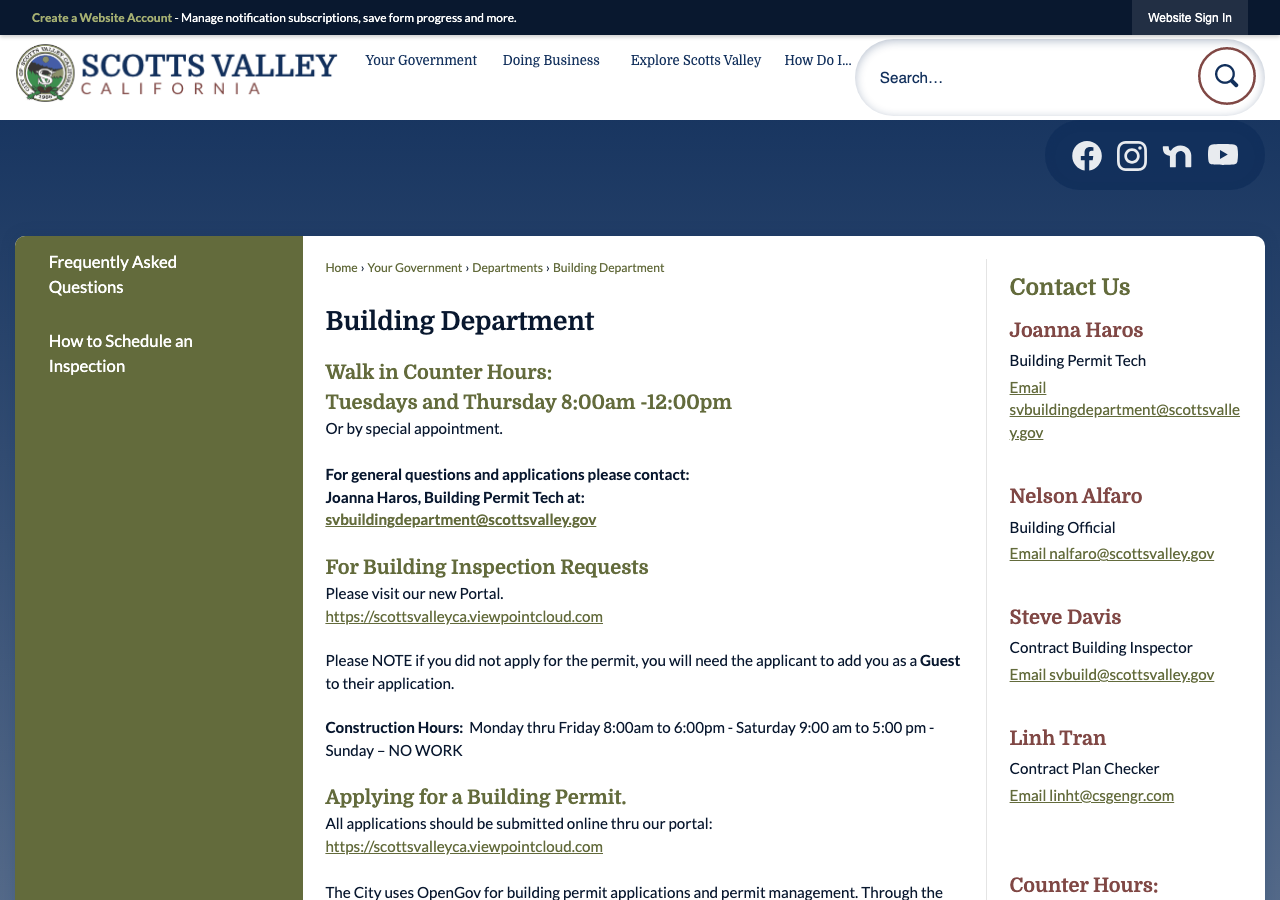
- How is an inspection booked? Portal 90% · department page
- How much notice is required? No fixed minimum lead time is published; the page states applicants 'should receive a CONFIRMATION in 24 to 48 hours' after requesting an inspection online. 62% · department page
-
Know who turns up
Some authorities inspect their own solar work; some delegate it, and a few do not inspect the PV equipment itself at all. Who is coming determines what they will look at.
- Does this AHJ perform its own final solar inspection? Delegated 80% · department page + district ordinance
- If delegated, to whom? Scotts Valley Fire Protection District (for ESS/battery and other fire-code-scoped permits only; building/electrical/mechanical/plumbing inspection stays with the city). 82% · department page
-
Work the stages in order
A rough-in or mid-roof inspection, where one is required, has to happen before the work it covers is closed up. Missing a stage means opening something back up, and it is the most expensive kind of correction.
Nothing recorded for City of Scotts Valley on this step yet — 2 questions checked and found unpublished. The guidance above is general.
-
Have the paperwork on site
The approved plan set, the permit, and the equipment listings should be on site and reachable. Inspectors routinely verify that installed equipment matches what was approved, and that the labels are the ones the plan set promised.
- Is there a published inspection checklist? Yes, for the SolarAPP+ portion -- the city's own handout describes SolarAPP+ generating a downloadable 'Inspection Checklist' that the applicant must provide to the Building Department after any revision. No separate city-authored solar inspection checklist document was found. 68% · department handout
-
Sign-off, and permission to operate
Passing gives you a final or an equivalent sign-off. That is not the same as permission to operate: PTO comes from the utility, and who tells the utility the inspection passed varies. A system left switched off for weeks is usually waiting on this handover.
- Is there a re-inspection fee? $228 per inspection (general Building Department 'Other misc. inspections & reinspections' line; no solar-specific reinspection fee exists separately). 68% · fee schedule
14 questions answered against City of Scotts Valley’s own published documents
Q49 How is an inspection booked? Core Booking & scheduling
Portal
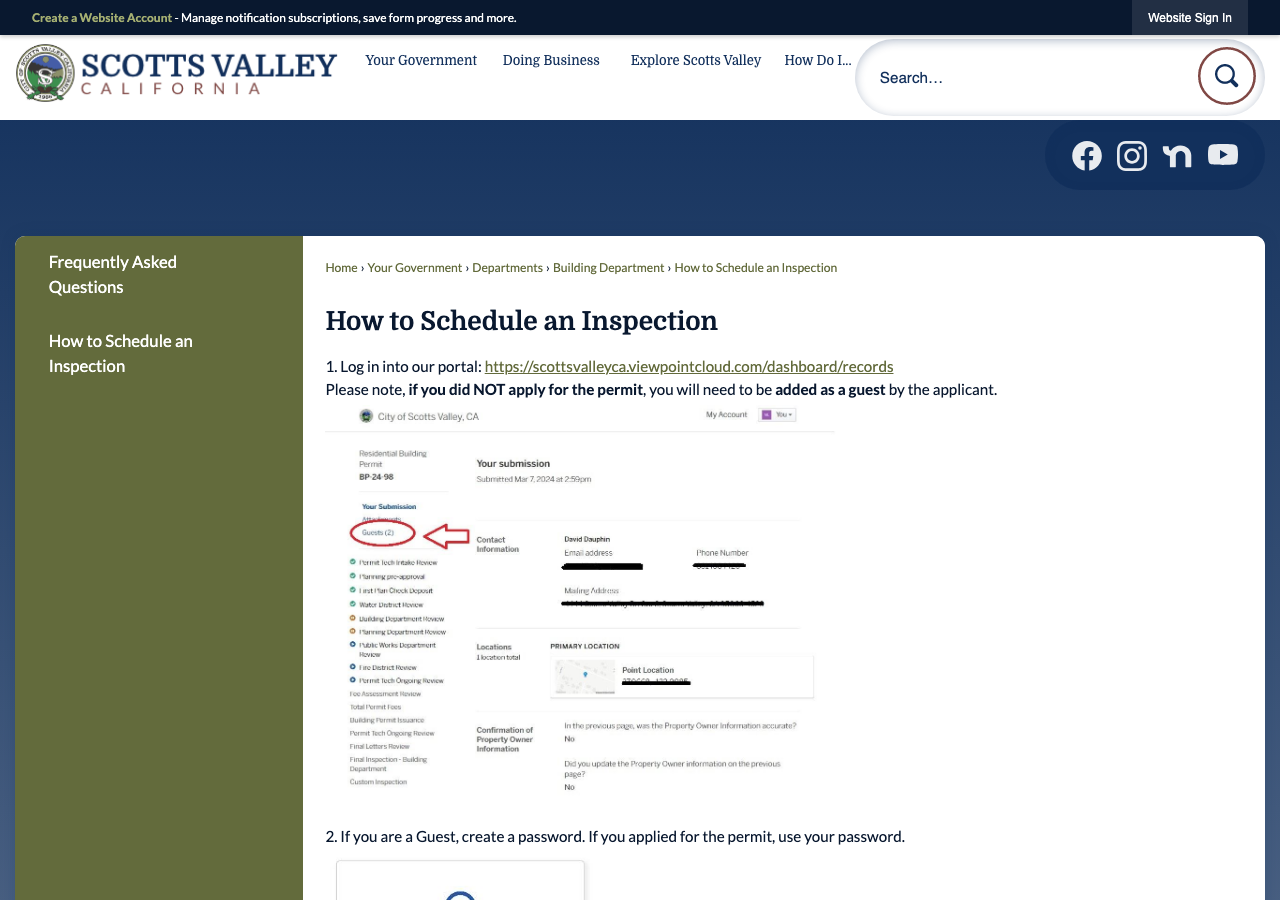
Why the confidence is not higherThe city's 'How to Schedule an Inspection' page instructs applicants to log into the OpenGov/ViewPointCloud portal, locate the desired inspection under their application, and click '+ New Appointment.'
department page checked 2026-08-31 https://www.scottsvalley.gov/671/How-to-Schedule-an-Inspection
Q50 How much notice is required? Core Booking & scheduling
No fixed minimum lead time is published; the page states applicants 'should receive a CONFIRMATION in 24 to 48 hours' after requesting an inspection online.
Why the confidence is not higherThis is a confirmation-turnaround figure, not an explicitly stated required-notice period, per the city's own inspection-scheduling page.
department page checked 2026-08-31 https://www.scottsvalley.gov/671/How-to-Schedule-an-Inspection
Q51 Are same-day or AM/PM windows offered? Booking & scheduling
Nothing published by this authority.
Where we looked'How to Schedule an Inspection' page -- does not state whether same-day or AM/PM inspection windows are offered; it only notes a general 24-48 hour confirmation window and an option to leave notes for the inspector.
https://www.scottsvalley.gov/671/How-to-Schedule-an-Inspection
Q52 Does this AHJ perform its own final solar inspection? Core Who inspects
Delegated
Why the confidence is not higherThe city's own Building Inspector performs Building/Electrical/Mechanical/Plumbing finals directly (in-house Building Official plus a 'Contract Building Inspector' on a city email), but SVFPD performs its own separate inspection for any Energy Storage System permit it issues, and SVFPD's Fire Code more generally makes it the AHJ for fire-code matters -- so a system with a battery component is inspected by two agencies.
department page + district ordinance checked 2026-08-31 https://www.scottsvalley.gov/671/How-to-Schedule-an-Inspection
Q53 If delegated, to whom? Core Who inspects
Scotts Valley Fire Protection District (for ESS/battery and other fire-code-scoped permits only; building/electrical/mechanical/plumbing inspection stays with the city).
Why the confidence is not higherSVFPD's own Applications page confirms it issues and presumably inspects its own Energy Storage System permits, separate from the city.
department page checked 2026-08-31 https://www.scottsvalleyfire.com/plan-submittal/
Q54 Which inspections are required, and in what order? Core Stages & sequence
Nothing published by this authority.
Where we looked'How to Schedule an Inspection' page and the Solar handout -- neither enumerates a required sequence of solar inspections (e.g., rough-in, final).
https://www.scottsvalley.gov/671/How-to-Schedule-an-Inspection
Q55 Is a rough-in or mid-roof inspection required? Stages & sequence
Nothing published by this authority.
Where we looked'How to Schedule an Inspection' page and the Solar handout -- no mid-roof or rough-in inspection stage is mentioned for solar; the handout describes only a single 'inspection' step after permit issuance.
Q56 Does the inspector verify labels and listings? Core What is checked
Nothing published by this authority.
Where we lookedFull Building Department document list and Solar handout -- no document explicitly states that the inspector verifies labels/listings at final; this is plausible standard practice but is not documented by the city.
Q57 Is there a published inspection checklist? Core What is checked
Yes, for the SolarAPP+ portion -- the city's own handout describes SolarAPP+ generating a downloadable 'Inspection Checklist' that the applicant must provide to the Building Department after any revision. No separate city-authored solar inspection checklist document was found.
Why the confidence is not higherSolarAPP+ handout, step 8: 'provide the new Inspection Checklist to the building department.'
department handout checked 2026-08-31 https://www.scottsvalley.gov/DocumentCenter/View/5409/Solar-Permits-and-Energy-Storage-Systems-10-2024
Q58 What must be on site at inspection? Core Documents on site
Nothing published by this authority.
Where we lookedSolar handout and 'How to Schedule an Inspection' page -- neither states what must be physically present on site (e.g., approved plans, inspection card, site access) for a solar inspection specifically.
https://www.scottsvalley.gov/671/How-to-Schedule-an-Inspection
Q59 Is there a re-inspection fee? Corrections & re-inspection
$228 per inspection (general Building Department 'Other misc. inspections & reinspections' line; no solar-specific reinspection fee exists separately).
Why the confidence is not higherFY2026-27 Master Fee Schedule, Building Department Fees, 'Other misc. inspections & reinspections -- per inspection -- $228.' This is the general reinspection fee, not a solar-specific line.
fee schedule checked 2026-08-31 https://www.scottsvalley.gov/DocumentCenter/View/6831/Master-Fee-Schedule-FY-2627-
Q60 How are corrections issued and cleared? Corrections & re-inspection
Nothing published by this authority.
Where we looked'How to Schedule an Inspection' page and full Building Department document list -- no document describes how correction notices are issued or cleared for solar (or generally).
https://www.scottsvalley.gov/671/How-to-Schedule-an-Inspection
Q61 What is issued on pass? Core Final sign-off & PTO
Nothing published by this authority.
Where we lookedFull Building Department document list and Solar handout -- no document states what is issued on a passed solar final inspection (e.g., green tag, letter, or simply a signed-off permit card).
Q62 Who notifies the utility for PTO? Core Final sign-off & PTO
Nothing published by this authority.
Where we lookedSolar handout, Building Department page, and PG&E franchise ordinance -- none states who (AHJ, installer, or PG&E itself) initiates Permission-to-Operate notification to the utility.
Lines marked with a percentage were read off this authority’s own published documents. Unmarked guidance is general good practice, not this jurisdiction’s rule — always confirm against the authority before you submit.
Jurisdiction & key facts
The standing 62-question set, answered for City of Scotts Valley against this authority’s own published documents. Every answer carries the confidence it was recorded at and the document it came from. Where nothing is published we say so and show where we looked — a blank here is a finding, not a gap.
City of Scotts Valley is the authority having jurisdiction 92% confidence
- Holds
- Building, Electrical, Mechanical and Plumbing permitting and inspection (in-house; SVMC 15.04.050.B vests 'building official,' 'plumbing official,' 'administrative authority' and 'chief electrical inspector' all in one 'chief building inspector' title). Fire-code adoption and enforcement is NOT a city function at all -- it belongs to the Scotts Valley Fire Protection District (SVFPD), a legally separate special district organized under Health & Safety Code Part 2.7 (Sec. 13800 et seq.), predating the city's own 1966 incorporation-era code and confirmed by SVMC 15.04.050.D's own definition: "'Fire chief' means the chief of the fire protection district wherein any proposed building site is located."
- Delegated to
- Scotts Valley Fire Protection District for all fire-code matters, including its own separate Energy Storage System (battery) construction permit and inspection (SVFPD 'Applications' page lists 'Energy Storage Systems' as a distinct permit type, submitted to Fire Marshal Collins). Building plan check is separately contracted to CSG Engineering (Linh Tran, 'Contract Plan Checker,' listed at a csgengr.com email on the city's own Building Department staff page), while the Building Official (Nelson Alfaro) and the 'Contract Building Inspector' (Steve Davis) both sit on city-domain emails.
- Overridden by
- CA Gov. Code §65850.5/§65850.52 (SolarAPP+ and fee-capped, streamlined residential solar permitting -- the city's own permitting handout runs entirely through SolarAPP+) and AB 130 (Stats. 2025, Ch. 22), which bars the city from adopting any new more-restrictive residential building-code amendment 10/1/2025-6/1/2031. Separately, Health & Safety Code §13869.7 lets SVFPD adopt fire-safety standards stricter than the State Fire Marshal's, subject to ratification by both the Santa Cruz County Board of Supervisors and the Scotts Valley City Council -- both of which happened for the current 2025 CFC adoption (County ratification 12/16/2025; City Council Resolution 2077, 12/17/2025).
- Why not higher
- SVMC 15.04.060 (Ord. No. 102.18, 11-5-2025) adopts the 2025 CBC/CRC/CEC/CMC/CPC/Energy/WUIC/Green Building codes by reference for the city, and the city's own Building Department page and 'Solar Permits and Energy Storage Systems' handout (Oct 2024) confirm the city issues the Solar/PV building permit itself via SolarAPP+ + the OpenGov portal. But the municipal code's own Title 15 contains NO fire-code adoption chapter at all (confirmed by walking the full TOC via the Municode API, ClientID 4267 / ProductID 13736) -- fire code is adopted entirely by SVFPD's own Ordinance No. 2025-2/2025-3, which required and received ratification from both the County Board of Supervisors and the City Council under Health & Safety Code §13869.7, proving SVFPD is a fully independent AHJ for fire matters, not a city department.
https://api.municode.com/CodesContent?productId=13736&nodeId=TIT15BUCO_CH15.04BURE
- Permit required
- Yes95%
- Permit cost
- $450 flat (residential, 1-15 kWh), plus $15 per kWh above 15 kWh. Residential solar-thermal: $450 flat (1-10 kWth), plus $15 per kWth above 10 kWth.92%
- Plan review
- Instant / automated for the SolarAPP+-eligible portion of review; no separate business-day turnaround figure is published by the city for the subsequent Building Permit issuance step.78%
- Portal
- OpenGov Permitting & Licensing portal, at scottsvalleyca.portal.opengov.com (the older scottsvalleyca.viewpointcloud.com URL 301-redirects to the same OpenGov instance -- confirmed by HTTP…92%
- Electrical code
- 2023 (as adopted via the 2025 California Electrical Code)85%
- Own placard wording
- Yes88%
- Booking an inspection
- Portal90%
Labels & placards for this authority
City of Scotts Valley writes its own placard wording. A standard NEC label set will not satisfy it — the exact text, and in most cases the size, colour and font, are specified below.
Wording 88%
Yes
Size, colour & material 88%
Sign shall be red in color, with a minimum of 3/4-inch tall contrasting lettering, and shall be permanently affixed.
Where they go 78%
On each electrical panel subject to back-feed from an alternate power source (per SVFPD §25.509.1.2); power-disabling switches must also be clearly labeled. No separate city document specifies placement for any other required label (e.g., rapid-shutdown initiation device).
What the utility wants on top None%
Each figure above is sourced and dated in the full answer set below (questions 38–43). Where an authority’s own published sheet is older than the code it has adopted, the answer says so.
Their website

Average approval time — application to PTO
From the CPUC interconnection record. Bars show the average days taken each year; a year with no recorded projects is left blank rather than drawn as zero.