
City of South San Francisco
San Mateo County
City of South San Francisco is a city authority in the State of California, serving 66,105 residents. 1,531 residential solar installs are on record here. This page is the permit route for that jurisdiction: the fifteen steps from working out who has a say over an address through to permission to operate, the documents this authority publishes, and 62 answers taken from those documents and dated.
Permitting 5 steps · 28 questions
Whether a permit is needed — Yes Q3 Electrical and building permits — Combined Q4 Plan review — Immediate/same-day for SolarAPP+-eligible systems (no city plan review); not published for the regular Building-Permit route. Q18 Where you file — eTRAKiT (CentralSquare Technologies), at permits.ssfca.gov (also reachable at legacy address permits.ssf.net, which redirects there) Q20
- Permit required
- Yes90% source
- What it costs
- $331 flat (Building Division fee 8.06, Photovoltaic – Residential)95% source
- Plan review turnaround
- Immediate/same-day for SolarAPP+-eligible systems (no city plan review); not published for the regular Building-Permit route.80% source
- Key document
- inference from absence + state law cited by 8 open the document
-
Confirm who has a say over your address
A city address is usually permitted by the city, not the county — but not always, and some authorities keep building and hand electrical to someone else. Getting this wrong costs the whole submittal, because every requirement below belongs to whoever actually holds jurisdiction. Check the overlays in the same pass: an HOA, a historic district, a windstorm certification or a system-size cap can reshape the design, and all of them are cheaper to find now than after the array is laid out.
- Is this authority the AHJ for residential solar at this address? Yes 95% · department page
- What does this authority permit itself, and what does it delegate? Both 85% · fee schedule
- Is a permit required for a residential rooftop PV system? Yes 90% · fee schedule
- Is there a separate electrical permit, or is it combined? Combined 70% · fee schedule
- Is a HOA or architectural approval required first? No — not required as a city permit condition 55% · inference from absence + state law
- Is a wind or windstorm certification required? No 60% · inference from absence
- Is a Specific Use Permit or Council approval ever required? No — ministerial building-permit process only; no Council/SUP step found for rooftop residential PV 65% · department handout + state law
-
Check who is allowed to apply
Several authorities require the electrical permit to be pulled by a licensed electrician, or require the contractor to be registered with them BEFORE applying. Registration is not same-day. This is second on the list rather than fourth because it is the step most likely to stop the job before the drawings matter.
- Who is allowed to pull the electrical permit? Either 85% · department handout
- Must the contractor be registered with this authority before applying? Yes 85% · department handout
- Is a homeowner permitted to self-install and self-permit? Yes 75% · department handout
-
Build the submittal package
Almost everywhere wants a site plan, a one-line or three-line electrical diagram, equipment cut sheets with listings, and a structural attachment detail. Build it against the published checklist rather than the last jurisdiction you worked in — the checklist is what the reviewer marks against.
- What documents make up a complete submittal? For SolarAPP+ route: SolarAPP+-approved plan set + confirmation/certificate, uploaded to the city portal with the plan-check application. For the non-SolarAPP+ (regular Building Permit) route: the generic Section A package on the city's Plan Submittal Requirements handout — title block, fully dimensioned plot plan, and (where applicable) an electrical single-line schematic with panel schedules/load calcs (Section B). 75% · published checklist
- How many copies, and in what format? Electronic only — the Plan Submittal Requirements handout states 'WE NOW ACCEPT ELECTRONIC SUBMITTALS WITH OPTION TO UPLOAD PLANS FOR RESIDENTIAL AND COMMERCIAL AT permits.ssf.net'; no physical copy count is specified. 75% · published checklist
- Is a site plan required, and what must it show? Yes — a fully dimensioned plot plan showing property lines, contour lines, streets, driveways, and locations of all buildings, easements and off-street parking (generic Section A requirement of the Plan Submittal Requirements handout; not solar-specific). 70% · published checklist
- Is a one-line / three-line diagram required? Yes 65% · published checklist
- Are string and conductor calculations required? Yes 55% · inference from program adoption
- Is a structural PE stamp required, and at what threshold? Generally no PE/architect structural stamp for a single-family residential PV retrofit — the city's generic submittal rule requires an architect/civil-engineer stamp only for 'buildings, other than accessory buildings and residential occupancies, less than 5 units, and 2 stories or less'; for single-family residences 'the person who drew the plans must sign all sheets.' A wet-stamped structural calc is only listed as a Section B item that 'may be required' case-by-case. 60% · published checklist
-
Apply and pay
Most authorities now take the whole application through a portal, and several states cap or constrain what a residential solar permit may cost. Check whether plan check is billed separately before you quote the job.
- Which permit portal does this authority use? eTRAKiT (CentralSquare Technologies), at permits.ssfca.gov (also reachable at legacy address permits.ssf.net, which redirects there) 95% · portal landing page
- Can the whole application be completed online? Yes, for SolarAPP+-eligible residential PV 85% · department handout
- What does a residential solar permit cost? $331 flat (Building Division fee 8.06, Photovoltaic – Residential) 95% · fee schedule
- How is the fee calculated? Flat 95% · fee schedule
- Is there a separate plan-check fee? No 65% · fee schedule
-
Plan review — and start the utility in parallel
Interconnection is a separate process from the permit and usually the longer pole. Where the utility does not depend on the permit being issued, running both at once is the single biggest saving available on a residential job.
- What is the stated plan-review turnaround? Immediate/same-day for SolarAPP+-eligible systems (no city plan review); not published for the regular Building-Permit route. 80% · department handout
- Which utility handles interconnection here? PG&E (Pacific Gas & Electric) 90% · utility service-requirements manual
- Where does the utility sit in the sequence? Parallel, but Permission to Operate (PTO) is gated on the city's final inspection 80% · utility contractor-resources page
28 questions answered against City of South San Francisco’s own published documents
Q1 Is this authority the AHJ for residential solar at this address? Core Jurisdiction & scope
Yes
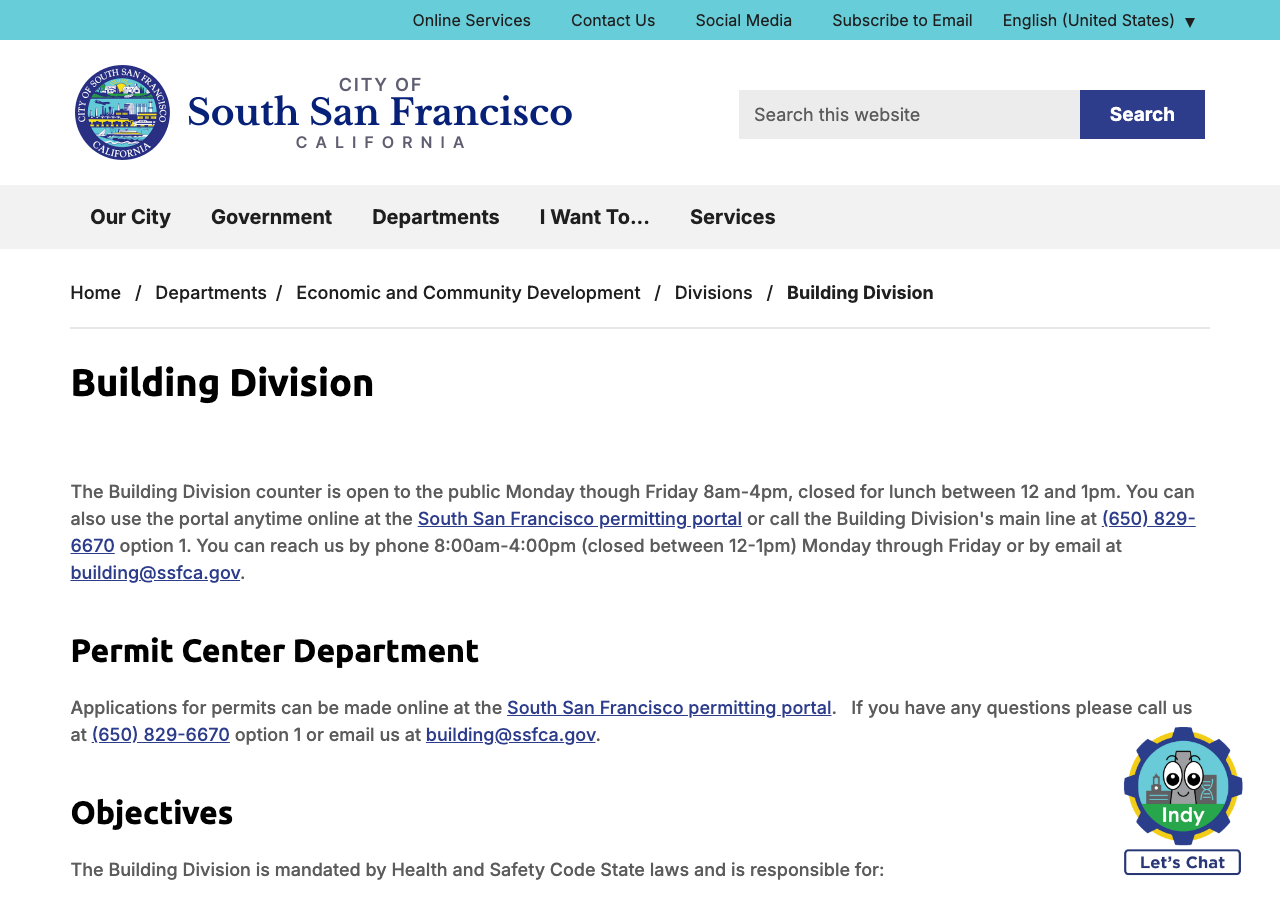
Why the confidence is not higherCity's own Building Division page and its 'Residential Photovoltaic Permits' handout (solar-a.pdf, PDF metadata CreationDate 21 Nov 2023) describe SSF issuing residential PV permits directly. www.ssfca.gov returns HTTP 403 to curl/WebFetch (Akamai WAF blocks non-browser clients); content verified via an Internet Archive Wayback Machine capture of the live page, digest confirmed, and dated from an internal revision stamp or the page's own capture timestamp, not the URL.
department page checked 2026-08-30 https://www.ssfca.gov/Departments/Economic-and-Community-Development/Divisions/Building-Division
Q2 What does this authority permit itself, and what does it delegate? Core Jurisdiction & scope
Both
Why the confidence is not higherBuilding Division issues a single combined building+electrical PV permit ($331 flat, Master Fee Schedule item 8.06). Fire Department runs its own Fire Permit Center but the Master Fee Schedule carries a residential PV line only under the Building Division (8.06/8.07); the Fire fee schedule's only PV line is '5.110.1 Photovoltaic – Commercial – Actual Cost', with no residential PV line under Fire, indicating Fire does not independently permit/charge for residential PV.
fee schedule checked 2026-08-30 https://www.ssfca.gov/files/assets/public/v/1/finance/documents/ssf-master-fee-schedule-fy-2025-26-vfinal1.pdf
Q3 Is a permit required for a residential rooftop PV system? Core Jurisdiction & scope
Yes
Why the confidence is not higherMaster Fee Schedule lists a dedicated residential Photovoltaic permit fee (8.06, $331 flat) and the Building Division's generic permit-required rule ('Any building or structure... requires a Building Permit') both confirm a permit is required.
fee schedule checked 2026-08-30 https://www.ssfca.gov/files/assets/public/v/1/finance/documents/ssf-master-fee-schedule-fy-2025-26-vfinal1.pdf
Q4 Is there a separate electrical permit, or is it combined? Core Jurisdiction & scope
Combined
Why the confidence is not higherFee 8.06 'Photovoltaic – Residential' is a single flat $331 fee under the Building Division with no separate electrical-permit line item for residential PV; inferred combined rather than stated in so many words.
fee schedule checked 2026-08-30 https://www.ssfca.gov/files/assets/public/v/1/finance/documents/ssf-master-fee-schedule-fy-2025-26-vfinal1.pdf
Q5 Who is allowed to pull the electrical permit? Core Who may apply
Either
Why the confidence is not higherThe city's Residential Photovoltaic Permits handout: 'Licensed contractors can now use SolarAPP+... (non-licensed/owner-builders must apply for a regular Building Permit with Plan Check)' — both a licensed contractor and a homeowner-as-owner-builder may pull the permit, via different routes.
department handout checked 2026-08-30 https://www.ssfca.gov/files/assets/public/v/1/economic-amp-community-development/documents/solar-a.pdf
Q6 Must the contractor be registered with this authority before applying? Core Who may apply
Yes
Why the confidence is not higherSame handout: 'An active City of South San Francisco Business License (You must have an active business license BEFORE submitting for a SolarAPP+ permit...)'.
department handout checked 2026-08-30 https://www.ssfca.gov/files/assets/public/v/1/economic-amp-community-development/documents/solar-a.pdf
Q7 Is a homeowner permitted to self-install and self-permit? Who may apply
Yes
Why the confidence is not higherHandout explicitly routes 'non-licensed/owner-builders' to 'a regular Building Permit with Plan Check' rather than excluding them, and the generic Residential Required Permits/Exempt-Work sheet confirms owner-builders may take out building permits generally.
department handout checked 2026-08-30 https://www.ssfca.gov/files/assets/public/v/1/economic-amp-community-development/documents/solar-a.pdf
Q8 What documents make up a complete submittal? Core Submittal package
For SolarAPP+ route: SolarAPP+-approved plan set + confirmation/certificate, uploaded to the city portal with the plan-check application. For the non-SolarAPP+ (regular Building Permit) route: the generic Section A package on the city's Plan Submittal Requirements handout — title block, fully dimensioned plot plan, and (where applicable) an electrical single-line schematic with panel schedules/load calcs (Section B).
Why the confidence is not higherTwo different submittal packages depending on route; combined from the solar-specific handout and the generic (non-solar-specific) Plan Submittal Requirements & Application handout (undated 'Revised 7/18' = Jul 2018, so applied generically, not confirmed solar-current).
published checklist checked 2026-08-30 https://www.ssfca.gov/files/assets/public/v/1/economic-amp-community-development/documents/plan-submittal-requirement_1.pdf
Q9 How many copies, and in what format? Submittal package
Electronic only — the Plan Submittal Requirements handout states 'WE NOW ACCEPT ELECTRONIC SUBMITTALS WITH OPTION TO UPLOAD PLANS FOR RESIDENTIAL AND COMMERCIAL AT permits.ssf.net'; no physical copy count is specified.
Why the confidence is not higherNo paper-copy count stated anywhere in the Building Division's own materials; taken as electronic-only given the explicit statement.
published checklist checked 2026-08-30 https://www.ssfca.gov/files/assets/public/v/1/economic-amp-community-development/documents/plan-submittal-requirement_1.pdf
Q10 Is a site plan required, and what must it show? Core Submittal package
Yes — a fully dimensioned plot plan showing property lines, contour lines, streets, driveways, and locations of all buildings, easements and off-street parking (generic Section A requirement of the Plan Submittal Requirements handout; not solar-specific).
Why the confidence is not higherSourced from the general (non-PV-specific) plan-submittal checklist since no solar-specific site-plan spec was found on the Building Division's own pages.
published checklist checked 2026-08-30 https://www.ssfca.gov/files/assets/public/v/1/economic-amp-community-development/documents/plan-submittal-requirement_1.pdf
Q11 Is a one-line / three-line diagram required? Core Drawings & calculations
Yes
Why the confidence is not higherSection B of the generic Plan Submittal Requirements handout lists 'ELECTRICAL PLAN: Single line schematic showing panels, conduit sizes, conductor sizes and grounding. Panel schedules and load calcs' as an item 'which may be required'; SolarAPP+ (the national platform SSF uses) also requires a one-line diagram as a matter of program design, not a city-specific rule.
published checklist checked 2026-08-30 https://www.ssfca.gov/files/assets/public/v/1/economic-amp-community-development/documents/plan-submittal-requirement_1.pdf
Q12 Are string and conductor calculations required? Drawings & calculations
Yes
Why the confidence is not higherNot stated by SSF itself; inferred from SolarAPP+'s national program requirements (which SSF has adopted as its primary residential PV route) rather than any SSF-specific document.
inference from program adoption checked 2026-08-30 https://www.ssfca.gov/files/assets/public/v/1/economic-amp-community-development/documents/solar-a.pdf
Q13 Is a structural PE stamp required, and at what threshold? Core Engineering & stamps
Generally no PE/architect structural stamp for a single-family residential PV retrofit — the city's generic submittal rule requires an architect/civil-engineer stamp only for 'buildings, other than accessory buildings and residential occupancies, less than 5 units, and 2 stories or less'; for single-family residences 'the person who drew the plans must sign all sheets.' A wet-stamped structural calc is only listed as a Section B item that 'may be required' case-by-case.
Why the confidence is not higherThis is a generic building-submittal rule, not solar-specific; no SSF document states a PV-specific structural-stamp threshold (e.g. by system weight or roof type).
published checklist checked 2026-08-30 https://www.ssfca.gov/files/assets/public/v/1/economic-amp-community-development/documents/plan-submittal-requirement_1.pdf
Q14 Is an electrical PE stamp required, and at what threshold? Engineering & stamps
Nothing published by this authority.
Where we lookedOrdinance/amendment text for an electrical PE-stamp threshold — checked the generic Plan Submittal Requirements handout (structural-only stamp rule) and the Building Codes page; SSF Municipal Code Ch.15 local amendments unreachable (eCode360 Cloudflare-managed challenge 403s even with the iccsafe.org Referer header).
Q15 What does a residential solar permit cost? Core Fees
$331 flat (Building Division fee 8.06, Photovoltaic – Residential)
Why the confidence is not higherFY2025-26 Master Fee Schedule, PDF metadata CreationDate/ModDate 7 Aug 2025 — current cycle. Does not include the separate Technology Fee (2% of permit fee), Climate Action Surcharge (0.026% of valuation) or $7 Building Permit Training Surcharge that also apply per-permit.
fee schedule checked 2026-08-30 https://www.ssfca.gov/files/assets/public/v/1/finance/documents/ssf-master-fee-schedule-fy-2025-26-vfinal1.pdf
Q16 How is the fee calculated? Core Fees
Flat
Why the confidence is not higherMaster Fee Schedule fee 8.06 is listed as 'Flat Fee' ($331), not valuation- or kW-based, for residential PV.
fee schedule checked 2026-08-30 https://www.ssfca.gov/files/assets/public/v/1/finance/documents/ssf-master-fee-schedule-fy-2025-26-vfinal1.pdf
Q17 Is there a separate plan-check fee? Fees
No
Why the confidence is not higherThe $331 residential PV fee sits as its own standalone flat line (8.06), separate from the valuation-based plan-check schedule used for other permits (8.19-8.43, where plan check = 65% of the building permit fee); no separate PV plan-check line exists, implying the flat fee is inclusive. Not stated explicitly.
fee schedule checked 2026-08-30 https://www.ssfca.gov/files/assets/public/v/1/finance/documents/ssf-master-fee-schedule-fy-2025-26-vfinal1.pdf
Q18 What is the stated plan-review turnaround? Core Timeline & validity
Immediate/same-day for SolarAPP+-eligible systems (no city plan review); not published for the regular Building-Permit route.
Why the confidence is not higherResidential Photovoltaic Permits handout: 'Projects qualifying for expedited permitting through SolarAPP+ will not require a city plan review... Once you've paid all applicable fees, your permit will be immediately issued electronically.' No turnaround figure found for non-SolarAPP+ submittals after checking the Building Division, Permit Center and Plan Submittal Requirements pages.
department handout checked 2026-08-30 https://www.ssfca.gov/files/assets/public/v/1/economic-amp-community-development/documents/solar-a.pdf
Q19 How long is an issued permit valid before it expires? Timeline & validity
Nothing published by this authority.
Where we lookedPermit-validity/expiration period — checked the Master Fee Schedule, Building Codes page, and Plan Submittal Requirements handout; none state a validity duration. The Building Permit Application PDF itself could not be retrieved (Wayback rate-limited repeated attempts).
Q20 Which permit portal does this authority use? Core Portal & process
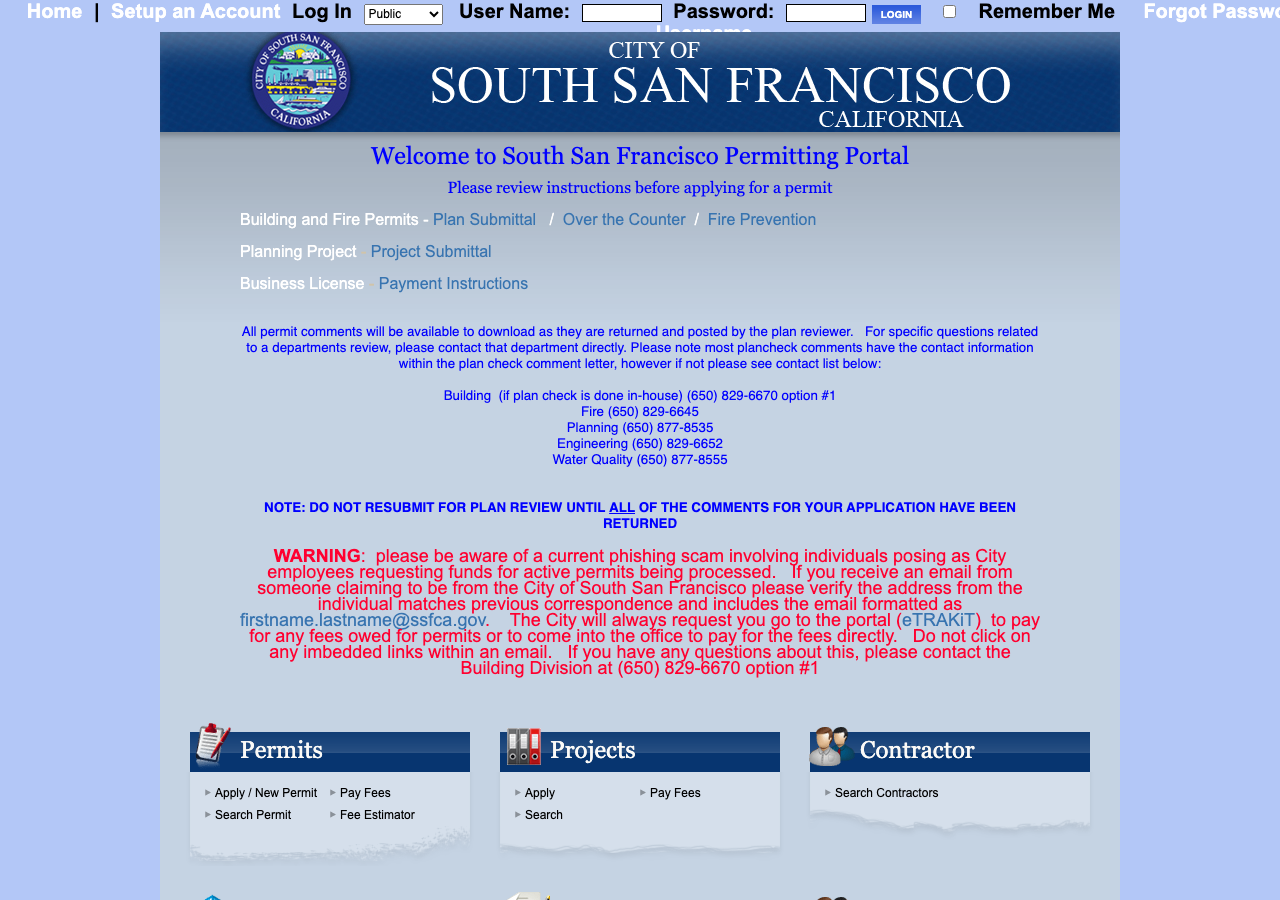
eTRAKiT (CentralSquare Technologies), at permits.ssfca.gov (also reachable at legacy address permits.ssf.net, which redirects there)
Why the confidence is not higherDirectly confirmed by fetching the portal: page <title> is 'eTRAKiT' and the footer reads 'Powered by CentralSquare Technologies'. Both the Building Division page and the solar handout link this same portal as the 'Online Permitting Center' / 'South San Francisco permitting portal'.
portal landing page checked 2026-08-30 https://permits.ssfca.gov/
Q21 Can the whole application be completed online? Core Portal & process
Yes, for SolarAPP+-eligible residential PV
Why the confidence is not higherHandout's 3-step process is entirely online: register/submit design via SolarAPP+, apply for the city permit through the Online Portal, upload approved plans, pay fees, and the permit issues electronically — no in-person step until inspection.
department handout checked 2026-08-30 https://www.ssfca.gov/files/assets/public/v/1/economic-amp-community-development/documents/solar-a.pdf
Q22 Which utility handles interconnection here? Core Utility interconnection
PG&E (Pacific Gas & Electric)
Why the confidence is not higherSSF sits in PG&E's electric distribution territory; PG&E's own TD-7001M 'Electric & Gas Service Requirements' (the Greenbook) covers this service area and PG&E's Electric Generation Interconnection (EGI)/Rule 21 process governs NEM interconnection here. Peninsula Clean Energy (now rebranded WestLight Energy, confirmed via westlightenergy.org) is the county's Community Choice Aggregator for power procurement only — 'WestLight Energy purchases clean electricity. PG&E delivers it to you' — and plays no role in interconnection, PTO, or wiring.
utility service-requirements manual checked 2026-08-30 https://www.pge.com/assets/pge/docs/account/service-requests/greenbook-manual-full.pdf
Q23 Where does the utility sit in the sequence? Core Utility interconnection
Parallel, but Permission to Operate (PTO) is gated on the city's final inspection
Why the confidence is not higherPG&E's own contractor-resources page: the interconnection application can be submitted independently of the building permit, but the contractor must 'include a copy of the final building permit/final inspection certificate that clearly indicates that final inspection... has been performed' before PTO is issued, and the customer must not energize the system before receiving PTO.
utility contractor-resources page checked 2026-08-30 https://www.pge.com/en/about/doing-business-with-pge/interconnections/contractor-resources.html
Q24 Is a HOA or architectural approval required first? Overlays & special cases
No — not required as a city permit condition
Why the confidence is not higherNo HOA/architectural-review item appears in either the solar handout or the generic Plan Submittal Requirements checklist. California Civil Code §714 (Solar Rights Act) separately bars an HOA from unreasonably restricting solar installations, which is consistent with the city not requiring proof of HOA sign-off, but no SSF document states this in terms.
inference from absence + state law checked 2026-08-30 https://www.ssfca.gov/files/assets/public/v/1/economic-amp-community-development/documents/solar-a.pdf
Q25 Is there a historic-district review? Overlays & special cases
Nothing published by this authority.
Where we lookedHistoric-district review requirement for rooftop PV — checked Building Division and Planning Division pages found via the site's own sitemap/nav; no historic-district or design-review trigger for solar-only work was found (Planning Division pages beyond the Design-Review-Application-Process and Zoning-Ordinance-Map listing were not individually opened).
https://www.ssfca.gov/Departments/Economic-and-Community-Development/Divisions/Planning-Division
Q26 Is a wind or windstorm certification required? Overlays & special cases
No
Why the confidence is not higherWind/windstorm certification (e.g. Texas TDI/TWIA) is a Gulf-Coast wind-pool program with no California analogue; checked the Building Codes page, the generic Plan Submittal Requirements handout, and the Master Fee Schedule — none reference a windstorm certification for residential structures.
inference from absence checked 2026-08-30 https://www.ssfca.gov/Departments/Economic-and-Community-Development/Divisions/Building-Division/Building-Codes
Q27 Is a Specific Use Permit or Council approval ever required? Overlays & special cases
No — ministerial building-permit process only; no Council/SUP step found for rooftop residential PV
Why the confidence is not higherCalifornia Gov. Code §65850.5 requires ministerial, non-discretionary approval of small residential solar systems, and SSF's own SolarAPP+ handout describes a purely administrative permit/inspection process with no Planning Commission or City Council step.
department handout + state law checked 2026-08-30 https://www.ssfca.gov/files/assets/public/v/1/economic-amp-community-development/documents/solar-a.pdf
Q28 Is there a system-size cap on residential generation? Overlays & special cases
Nothing published by this authority.
Where we lookedSystem-size cap on residential generation — checked the Master Fee Schedule, the Residential Photovoltaic Permits handout (which defers system-size-eligibility questions to SolarAPP+'s own national help article, not a city-set number), and the Building Codes page; no SSF-specific wattage/kW cap found.
Lines marked with a percentage were read off this authority’s own published documents. Unmarked guidance is general good practice, not this jurisdiction’s rule — always confirm against the authority before you submit.
Install 5 steps · 20 questions
-
Build to the code editions actually in force here
The NEC edition a jurisdiction enforces is often a cycle behind the newest one published, and local amendments sit on top of it. Rapid shutdown, conductor sizing and labelling all change between editions, so the edition in force is the first thing to establish, not the last.
- Which NEC edition is in force? 2023 90% · adopting ordinance / department page
- Which building code edition is in force? 2025 California Building Standards Code cycle: California Building Code (2024 IBC) / California Residential Code (2024 IRC) 85% · adopting ordinance / department page
- Which fire code edition is in force? California Fire Code (2024 International Fire Code) 85% · adopting ordinance / department page
- Are there local amendments to any of the above? Yes 80% · department page
- What is the installation judged against? The 2025 California Building Standards Code cycle (2024 IBC/IRC/IFC/UPC/UMC, 2023 NEC) as locally amended by SSF Municipal Code Chapter 15 80% · adopting ordinance / department page
-
Fire access, setbacks and pathways
Ridge setbacks and roof access pathways are fire-service requirements and they constrain the array layout. They are the most common cause of a redesign after the fire department comments on a plan set.
Nothing recorded for City of South San Francisco on this step yet — 1 question checked and found unpublished. The guidance above is general.
-
Rapid shutdown
Which rapid-shutdown rule applies follows directly from the NEC edition in force, and the initiation device has to be at a location the fire service can reach and identify. This is inspected, and it is labelled.
- Is rapid shutdown required, and to which NEC edition? Yes, rapid shutdown is required under NEC 690.12 as adopted via the 2023 NEC (California Electrical Code) 75% · inference from adopted NEC edition
-
Labels and placards
The NEC sets a baseline for permanent markings at the service equipment and the disconnecting means. On top of that, an authority may specify its own wording, and the utility may specify more again. Where any of them writes its own text, a generic off-the-shelf label set will not pass — this is the detail most often fixed on a return visit.
- Does the UTILITY specify placards beyond the AHJ's? Yes — PG&E requires an engraved placard where a fusible AC disconnect switch is installed for a line/supply-side (ahead-of-main-breaker) generator interconnection 90% · utility DG/service-requirements manual
- Where must the labels be placed? On the metering equipment (for the line/supply-side-tap placard specifically); more generally, PG&E's detailed DG placement/labeling rules live in TD-2306M, the Distribution Interconnection Handbook, which is gated to 'your PG&E Job Owner' and not publicly reachable. 75% · utility DG/service-requirements manual
-
Disconnect, storage and listed equipment
Where the AC disconnect must sit relative to the meter is usually the utility's rule, not the building department's. Battery storage frequently carries its own permit, its own inspection and its own fire conditions.
- Where must the AC disconnect be, relative to the meter? Within 10 feet of, and within line of sight of, the meter 85% · utility service-requirements manual
- Are batteries permitted, and under what conditions? Yes — the Master Fee Schedule carries a dedicated residential Energy Storage System permit fee (8.07, $331 flat), confirming batteries/ESS are a permitted, processed installation type; specific SSF conditions (e.g. location, capacity limits) could not be confirmed because the local Fire Code amendment text (Municipal Code Ch. 15 / eCode360) is Cloudflare-blocked. 70% · fee schedule
- Is there a separate ESS permit or inspection? Yes — Energy Storage System (Residential) has its own $331 flat fee line (8.07), distinct from the Photovoltaic (Residential) $331 line (8.06) 80% · fee schedule
20 questions answered against City of South San Francisco’s own published documents
Q29 Which NEC edition is in force? Core Code editions in force
2023
Why the confidence is not higherCity's Building Codes page (captured Feb 2026, after the statewide 1 Jan 2026 code-cycle changeover) lists 'California Electrical Code (2023 National Electrical Code)' among the current adopted codes. A Nov 2025 capture of the same page still showed the prior 2020 NEC/2022 cycle — the city updated the page in place between those two captures, confirming the changeover took effect as scheduled.
adopting ordinance / department page checked 2026-08-30 https://www.ssfca.gov/Departments/Economic-and-Community-Development/Divisions/Building-Division/Building-Codes
Q30 Which building code edition is in force? Core Code editions in force
2025 California Building Standards Code cycle: California Building Code (2024 IBC) / California Residential Code (2024 IRC)
Why the confidence is not higherSame Building Codes page, same Feb 2026 capture. Local amendments are referenced ('Chapter 15 of the SSF Municipal Code with Local Amendments') but the amendment text itself sits behind eCode360's Cloudflare managed challenge (403 even with the iccsafe.org Referer) and was not independently verified.
adopting ordinance / department page checked 2026-08-30 https://www.ssfca.gov/Departments/Economic-and-Community-Development/Divisions/Building-Division/Building-Codes
Q31 Which fire code edition is in force? Code editions in force
California Fire Code (2024 International Fire Code)
Why the confidence is not higherSame Building Codes page/capture as above.
adopting ordinance / department page checked 2026-08-30 https://www.ssfca.gov/Departments/Economic-and-Community-Development/Divisions/Building-Division/Building-Codes
Q32 Are there local amendments to any of the above? Core Code editions in force
Yes
Why the confidence is not higherThe Building Codes page states codes are '...adopted and amended by our City Council' and separately lists 'Local and State Amendments, Ordinances and Law' as part of the code set, and links 'Chapter 15 of the SSF Municipal Code with Local Amendments' — confirming local amendments exist, though their specific content could not be read (eCode360 Cloudflare-blocked).
department page checked 2026-08-30 https://www.ssfca.gov/Departments/Economic-and-Community-Development/Divisions/Building-Division/Building-Codes
Q33 What is the installation judged against? Core Electrical
The 2025 California Building Standards Code cycle (2024 IBC/IRC/IFC/UPC/UMC, 2023 NEC) as locally amended by SSF Municipal Code Chapter 15
Why the confidence is not higherSame Building Codes page. Local-amendment text unverified due to eCode360 access block (see q30/q32).
adopting ordinance / department page checked 2026-08-30 https://www.ssfca.gov/Departments/Economic-and-Community-Development/Divisions/Building-Division/Building-Codes
Q34 Is there a local rule on service upgrades or busbar sizing? Electrical
Nothing published by this authority.
Where we lookedLocal rule on service upgrades or busbar sizing — Master Fee Schedule prices a 'Service Upgrade' permit ($269) but states no technical busbar/backfeed rule; the substantive local amendment (if any) sits in SSF Municipal Code Ch.15/Electrical amendments on eCode360, which 403s even with the iccsafe.org Referer (Cloudflare managed challenge).
Q35 Is a specific mounting system or attachment spacing required? Structural & mounting
Nothing published by this authority.
Where we lookedSpecific mounting system/attachment spacing requirement — same eCode360 access block; no SSF-issued handout on PV mounting/attachment spacing was found among the Building Division's Helpful Handouts & Links.
Q36 What ridge setback and access pathways are required? Core Fire pathways & setbacks
Nothing published by this authority.
Where we lookedRidge setback and fire-access-pathway dimensions — same eCode360 access block for SSF Municipal Code Ch.15 Fire Code local amendments; the Fire Department's own Guidelines & Regulations and Fire Prevention pages were checked and contain no PV-specific setback/pathway language.
Q37 Is rapid shutdown required, and to which NEC edition? Core Rapid shutdown
Yes, rapid shutdown is required under NEC 690.12 as adopted via the 2023 NEC (California Electrical Code)
Why the confidence is not higherInferred from SSF's adoption of the 2023 NEC (q29); no SSF-specific amendment to or restatement of 690.12 was found (eCode360 access blocked), so this is the state-adopted baseline, not a confirmed local rule.
inference from adopted NEC edition checked 2026-08-30 https://www.ssfca.gov/Departments/Economic-and-Community-Development/Divisions/Building-Division/Building-Codes
Q38 Which placards does this authority require at the service equipment? Core Labels Signage & labelling
Nothing published by this authority.
Where we lookedWhich placards the AHJ (as distinct from PG&E) requires at the service equipment — checked Building Codes, Building Inspections, Fire Prevention Guidelines & Regulations, Fire Permit Center, and the solar handout; none state a city-specific placard beyond the state-adopted NEC/CFC baseline, and the Municipal Code Ch.15 amendment text is eCode360-blocked.
Q39 Does the authority specify placard wording of its own? Core Labels Signage & labelling
Nothing published by this authority.
Where we lookedWhether the authority specifies its own placard wording — same access block; no city-authored wording found in any Building Division or Fire Department page checked.
Q40 Does it specify letter height, colour or material? Core Labels Signage & labelling
Nothing published by this authority.
Where we lookedLetter height/colour/material specification for placards — same access block; not found in any Building Division/Fire Department page checked.
Q41 Is a site plan / facility map placard required, and what must it show? Core Labels Signage & labelling
Nothing published by this authority.
Where we lookedSite plan/facility-map placard requirement beyond NEC 705.10 — same access block; no SSF-specific facility-map placard spec found in the Building Division or Fire Department materials checked.
Q42 Does the UTILITY specify placards beyond the AHJ's? Core Labels Signage & labelling
Yes — PG&E requires an engraved placard where a fusible AC disconnect switch is installed for a line/supply-side (ahead-of-main-breaker) generator interconnection
Why the confidence is not higherPG&E Greenbook (TD-7001M, PDF metadata: publication date 22 Apr 2026, effective 22 Jun 2026, confirmed with pdfinfo): 'A fusible AC disconnect switch is required for generator interconnections ahead of the main breaker (line/supply side connection) and after the meter. Also required is an engraved placard (signage), indicating there is a line/supply side connection, installed on the metering equipment.' Table 6-3 shows most typical residential inverter-based systems (self-contained meter panel, ≤320A single-phase) do NOT need a separate AC disconnect at all, in which case this placard requirement does not apply.
utility DG/service-requirements manual checked 2026-08-30 https://www.pge.com/assets/pge/docs/account/service-requests/greenbook-manual-full.pdf
Q43 Where must the labels be placed? Core Labels Signage & labelling
On the metering equipment (for the line/supply-side-tap placard specifically); more generally, PG&E's detailed DG placement/labeling rules live in TD-2306M, the Distribution Interconnection Handbook, which is gated to 'your PG&E Job Owner' and not publicly reachable.
Why the confidence is not higherGreenbook §6.3 (see q42 citation) for the placard location; the Greenbook itself directs to TD-2306M for further DG-specific detail, and that handbook could not be retrieved (access-gated, not a public URL).
utility DG/service-requirements manual checked 2026-08-30 https://www.pge.com/assets/pge/docs/account/service-requests/greenbook-manual-full.pdf
Q44 Must equipment be on a specific approved list? Equipment listing
Nothing published by this authority.
Where we lookedWhether equipment must be on a specific approved list — checked the Building Codes page, the Master Fee Schedule, and the solar handout; none state an SSF-specific approved-equipment list beyond standard NRTL listing.
Q45 Are batteries permitted, and under what conditions? Core Battery / ESS
Yes — the Master Fee Schedule carries a dedicated residential Energy Storage System permit fee (8.07, $331 flat), confirming batteries/ESS are a permitted, processed installation type; specific SSF conditions (e.g. location, capacity limits) could not be confirmed because the local Fire Code amendment text (Municipal Code Ch. 15 / eCode360) is Cloudflare-blocked.
Why the confidence is not higherMaster Fee Schedule FY2025-26, fee 8.07.
fee schedule checked 2026-08-30 https://www.ssfca.gov/files/assets/public/v/1/finance/documents/ssf-master-fee-schedule-fy-2025-26-vfinal1.pdf
Q46 Is there a separate ESS permit or inspection? Battery / ESS
Yes — Energy Storage System (Residential) has its own $331 flat fee line (8.07), distinct from the Photovoltaic (Residential) $331 line (8.06)
Why the confidence is not higherMaster Fee Schedule FY2025-26; not confirmed whether a combined PV+ESS install pays both fees or one combined fee when submitted together.
fee schedule checked 2026-08-30 https://www.ssfca.gov/files/assets/public/v/1/finance/documents/ssf-master-fee-schedule-fy-2025-26-vfinal1.pdf
Q47 Is a ground mount treated as a structure? Core Ground mount
Nothing published by this authority.
Where we lookedWhether a ground-mount PV system is treated as a structure — checked the Building Codes page, the generic Plan Submittal Requirements handout, and the residential Required-Permits/Work-Exempt sheet; none address ground-mount PV specifically, and the Municipal Code Ch.15 text is eCode360-blocked.
Q48 Where must the AC disconnect be, relative to the meter? Core Utility equipment
Within 10 feet of, and within line of sight of, the meter
Why the confidence is not higherPG&E Greenbook §7.8, 'Main Service Disconnects': 'Applicants must place the main service disconnect switch adjacent to the meter(s), not more than 10 feet away and within line of sight,' repeated for the grounding/service-disconnect-enclosure rule in §7.36. This is PG&E's general service-disconnect rule (applies to the AC disconnect where one is required per Table 6-3), not a PV-specific clause.
utility service-requirements manual checked 2026-08-30 https://www.pge.com/assets/pge/docs/account/service-requests/greenbook-manual-full.pdf
Lines marked with a percentage were read off this authority’s own published documents. Unmarked guidance is general good practice, not this jurisdiction’s rule — always confirm against the authority before you submit.
Inspection 5 steps · 14 questions
-
Book it
Booking is a portal, a phone call or an email depending on the authority, and the notice required is rarely zero. Book before the work is finished rather than after — the lead time, not the work, is usually what sets the date.
- How is an inspection booked? Phone — 'Request an inspection by calling the Building Division main line at (650) 829-6670 option #1.' 90% · department handout
-
Know who turns up
Some authorities inspect their own solar work; some delegate it, and a few do not inspect the PV equipment itself at all. Who is coming determines what they will look at.
- Does this AHJ perform its own final solar inspection? Yes 90% · department page/staff directory
- If delegated, to whom? N/A — not delegated; performed in-house by Building Division staff inspectors 85% · department page/staff directory
-
Work the stages in order
A rough-in or mid-roof inspection, where one is required, has to happen before the work it covers is closed up. Missing a stage means opening something back up, and it is the most expensive kind of correction.
- Which inspections are required, and in what order? A single final inspection following permit issuance — the handout's process is (1) SolarAPP+ automated review, (2) city permit issuance, (3) schedule inspection by phone. No separate rough-in or interim inspection stage is described. 70% · department handout
- Is a rough-in or mid-roof inspection required? No 60% · inference from absence
-
Have the paperwork on site
The approved plan set, the permit, and the equipment listings should be on site and reachable. Inspectors routinely verify that installed equipment matches what was approved, and that the labels are the ones the plan set promised.
- What must be on site at inspection? The approved permit set/inspection record card and permit must be on site and readily accessible; the solar handout adds: 'have all approved paperwork, as well as permit and inspection card printed and present on site for your inspector.' 90% · department page
- Does the inspector verify labels and listings? Presumed yes as standard practice 50% · inference from general practice
-
Sign-off, and permission to operate
Passing gives you a final or an equivalent sign-off. That is not the same as permission to operate: PTO comes from the utility, and who tells the utility the inspection passed varies. A system left switched off for weeks is usually waiting on this handover.
- What is issued on pass? Final (inspection sign-off on the permit card) — no separate Certificate of Occupancy is referenced for a residential PV alteration 55% · inference from department page wording
- Who notifies the utility for PTO? Installer 80% · utility contractor-resources page
- Is there a re-inspection fee? $230/hour for re-inspections during normal business hours (fee 8.02); $309/hour for inspections/re-inspections outside normal hours (fee 8.01) 90% · fee schedule
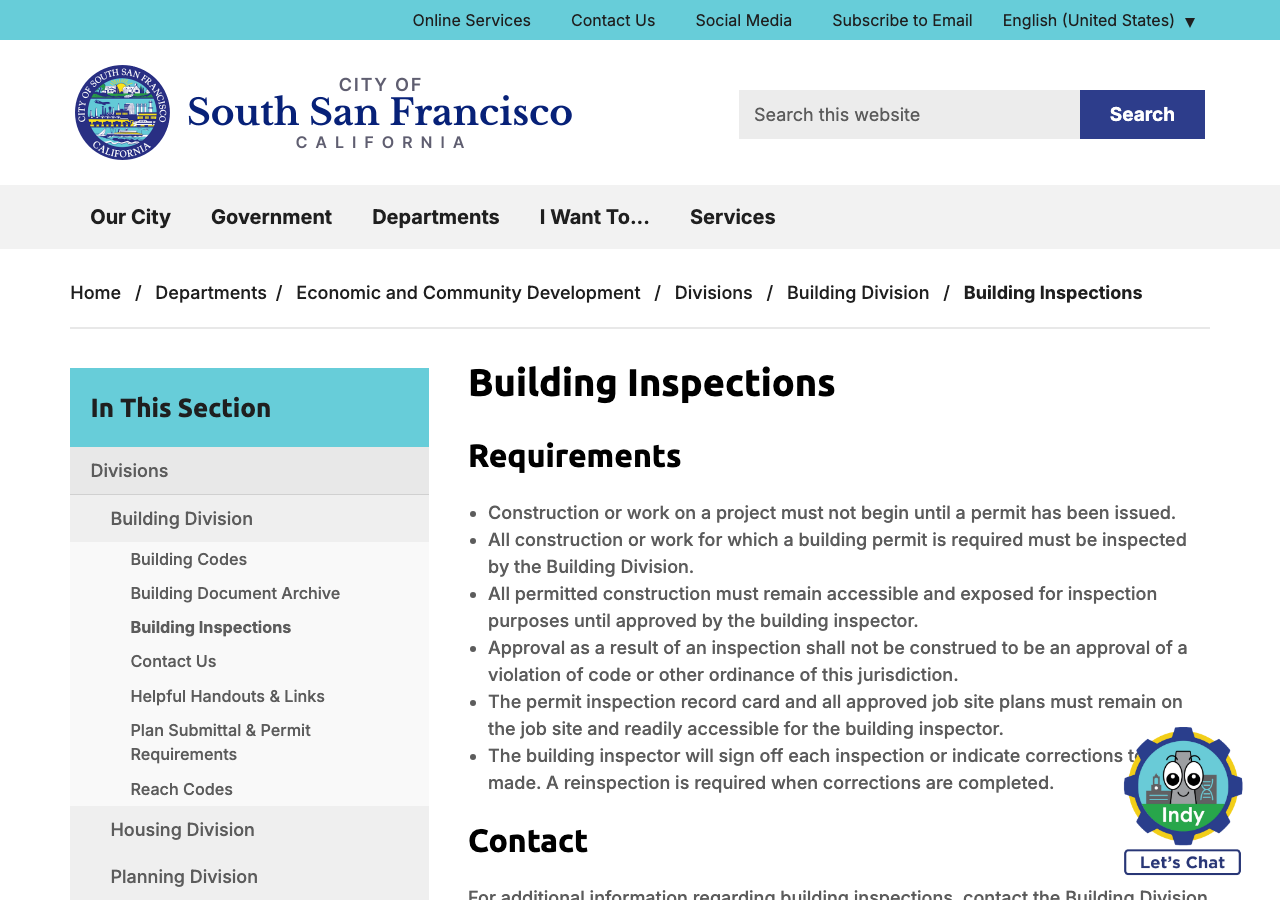
- How are corrections issued and cleared? The inspector signs off the inspection or notes corrections on the spot; a re-inspection is required once corrections are completed. 85% · department page
14 questions answered against City of South San Francisco’s own published documents
Q49 How is an inspection booked? Core Booking & scheduling
Phone — 'Request an inspection by calling the Building Division main line at (650) 829-6670 option #1.'
Why the confidence is not higherResidential Photovoltaic Permits handout, step 3 of the process.
department handout checked 2026-08-30 https://www.ssfca.gov/files/assets/public/v/1/economic-amp-community-development/documents/solar-a.pdf
Q50 How much notice is required? Core Booking & scheduling
Nothing published by this authority.
Where we lookedInspection-notice lead time — checked the Building-Inspections page and the solar handout ('call to request an inspection'); no stated number of business days' notice was found.
Q51 Are same-day or AM/PM windows offered? Booking & scheduling
Nothing published by this authority.
Where we lookedWhether same-day or AM/PM inspection windows are offered — same page checked; no scheduling-window detail is published.
Q52 Does this AHJ perform its own final solar inspection? Core Who inspects
Yes
Why the confidence is not higherThe Building Division's Contact Us page lists named, in-house staff Building Inspectors (e.g. Rich Pence, Cedric McNicol, Nick Alaimo, Sammy Joseph, Tony Ho), and the solar handout directs applicants to the Building Division itself to schedule inspection — no third party named.
department page/staff directory checked 2026-08-30 https://www.ssfca.gov/Departments/Economic-and-Community-Development/Divisions/Building-Division/Contact-Us
Q53 If delegated, to whom? Core Who inspects
N/A — not delegated; performed in-house by Building Division staff inspectors
Why the confidence is not higherSee q52 source.
department page/staff directory checked 2026-08-30 https://www.ssfca.gov/Departments/Economic-and-Community-Development/Divisions/Building-Division/Contact-Us
Q54 Which inspections are required, and in what order? Core Stages & sequence
A single final inspection following permit issuance — the handout's process is (1) SolarAPP+ automated review, (2) city permit issuance, (3) schedule inspection by phone. No separate rough-in or interim inspection stage is described.
Why the confidence is not higherResidential Photovoltaic Permits handout's 3-step 'How to get started' sequence.
department handout checked 2026-08-30 https://www.ssfca.gov/files/assets/public/v/1/economic-amp-community-development/documents/solar-a.pdf
Q55 Is a rough-in or mid-roof inspection required? Stages & sequence
No
Why the confidence is not higherThe city's own residential PV process (see q54) describes only a single final-inspection step; no mid-roof or rough-in inspection is mentioned anywhere in the Building Division's PV materials.
inference from absence checked 2026-08-30 https://www.ssfca.gov/files/assets/public/v/1/economic-amp-community-development/documents/solar-a.pdf
Q56 Does the inspector verify labels and listings? Core What is checked
Presumed yes as standard practice
Why the confidence is not higherNot explicitly stated in any SSF document found; California building inspectors routinely verify NRTL listing marks and required NEC/UL labels at a PV final, but no SSF-specific checklist confirms this in writing.
inference from general practice checked 2026-08-30 https://www.ssfca.gov/Departments/Economic-and-Community-Development/Divisions/Building-Division/Building-Inspections
Q57 Is there a published inspection checklist? Core What is checked
Nothing published by this authority.
Where we lookedPublished solar-specific inspection checklist — the solar handout links only to solar-app.org's own generic national help article ('Being prepared for Solarapp+ inspection'), not an SSF-authored checklist; no SSF-specific inspection checklist was found on the Building Division's Helpful Handouts & Links page.
Q58 What must be on site at inspection? Core Documents on site
The approved permit set/inspection record card and permit must be on site and readily accessible; the solar handout adds: 'have all approved paperwork, as well as permit and inspection card printed and present on site for your inspector.'
Why the confidence is not higherBuilding-Inspections page: 'The permit inspection record card and all approved job site plans must remain on the job site and readily accessible for the building inspector,' plus the solar handout's matching instruction.
department page checked 2026-08-30 https://www.ssfca.gov/Departments/Economic-and-Community-Development/Divisions/Building-Division/Building-Inspections
Q59 Is there a re-inspection fee? Corrections & re-inspection
$230/hour for re-inspections during normal business hours (fee 8.02); $309/hour for inspections/re-inspections outside normal hours (fee 8.01)
Why the confidence is not higherMaster Fee Schedule FY2025-26, Section 8 (Building Division).
fee schedule checked 2026-08-30 https://www.ssfca.gov/files/assets/public/v/1/finance/documents/ssf-master-fee-schedule-fy-2025-26-vfinal1.pdf
Q60 How are corrections issued and cleared? Corrections & re-inspection
The inspector signs off the inspection or notes corrections on the spot; a re-inspection is required once corrections are completed.
Why the confidence is not higherBuilding-Inspections page: 'The building inspector will sign off each inspection or indicate corrections to be made. A reinspection is required when corrections are completed.'
department page checked 2026-08-30 https://www.ssfca.gov/Departments/Economic-and-Community-Development/Divisions/Building-Division/Building-Inspections
Q61 What is issued on pass? Core Final sign-off & PTO
Final (inspection sign-off on the permit card) — no separate Certificate of Occupancy is referenced for a residential PV alteration
Why the confidence is not higherInferred from the Building-Inspections page's sign-off language and the solar handout's reference to an 'inspection card'; SSF does not use any of the exact terms CO/Green tag/Letter for this in its own materials.
inference from department page wording checked 2026-08-30 https://www.ssfca.gov/Departments/Economic-and-Community-Development/Divisions/Building-Division/Building-Inspections
Q62 Who notifies the utility for PTO? Core Final sign-off & PTO
Installer
Why the confidence is not higherPG&E's contractor-resources page places the burden on the contractor: they submit the interconnection application and must supply the final building-permit/inspection certificate before PG&E will issue PTO; the customer's role is authorization/signature only.
utility contractor-resources page checked 2026-08-30 https://www.pge.com/en/about/doing-business-with-pge/interconnections/contractor-resources.html
Lines marked with a percentage were read off this authority’s own published documents. Unmarked guidance is general good practice, not this jurisdiction’s rule — always confirm against the authority before you submit.
Jurisdiction & key facts
The standing 62-question set, answered for City of South San Francisco against this authority’s own published documents. Every answer carries the confidence it was recorded at and the document it came from. Where nothing is published we say so and show where we looked — a blank here is a finding, not a gap.
City of South San Francisco is the authority having jurisdiction 88% confidence
- Holds
- building and electrical (combined residential PV permit issued by the Economic & Community Development Department's Building Division)
- Overridden by
- CA Gov. Code §65850.52 (SB 379) requires ministerial/automated permitting where offered — SSF has implemented this via SolarAPP+; PG&E's Electric Rule 21 / Greenbook (TD-7001M) and the gated TD-2306M Distribution Interconnection Handbook govern interconnection and gate Permission to Operate independently of the city permit; AB 130 (Stats. 2025, Ch. 22) freezes any further more-restrictive local residential code amendments from 1 Oct 2025 to 1 Jun 2031.
- Why not higher
- Confirmed the brief's framing (Economic & Community Development / Building Division) is correct here — unlike the Alameda County brief error, SSF's own Building Division page and its 'Residential Photovoltaic Permits' handout both directly describe the Building Division issuing a single combined building+electrical permit for residential PV ($331 flat, Master Fee Schedule 8.06). SSF runs its own Fire Department (confirmed by name in the city directory at ssfca.gov/Departments/Fire-Department, not contracted to the county), with its own Fire Permit Center — but the Master Fee Schedule's only PV line item under Fire is '5.110.1 Photovoltaic – Commercial – Actual Cost'; there is no residential PV line under Fire, and none of the Fire Department's public pages (Fire Permit Center, Fire Prevention, Guidelines & Regulations) mention residential PV review or fees. So Fire does not independently gate or charge for a residential rooftop PV permit here — it is folded entirely into the Building Division process. Utility interconnection sits with PG&E, not the city; Peninsula Clean Energy (rebranded WestLight Energy, confirmed at westlightenergy.org) is the county CCA for power procurement only and has no interconnection role. Confidence is not higher because SSF Municipal Code Chapter 15's local amendments — which the city's own Building Codes page says exist — sit behind eCode360's Cloudflare-managed challenge and could not be read, so the exact scope of 'building and electrical' as locally amended is not fully verified.
- Permit required
- Yes90%
- Permit cost
- $331 flat (Building Division fee 8.06, Photovoltaic – Residential)95%
- Plan review
- Immediate/same-day for SolarAPP+-eligible systems (no city plan review); not published for the regular Building-Permit route.80%
- Portal
- eTRAKiT (CentralSquare Technologies), at permits.ssfca.gov (also reachable at legacy address permits.ssf.net, which redirects there)95%
- Electrical code
- 202390%
- Booking an inspection
- Phone — 'Request an inspection by calling the Building Division main line at (650) 829-6670 option #1.'90%
Labels & placards for this authority
Wording None%
Size, colour & material None%
Where they go 75%
On the metering equipment (for the line/supply-side-tap placard specifically); more generally, PG&E's detailed DG placement/labeling rules live in TD-2306M, the Distribution Interconnection Handbook, which is gated to 'your PG&E Job Owner' and not publicly reachable.
What the utility wants on top 90%
Yes — PG&E requires an engraved placard where a fusible AC disconnect switch is installed for a line/supply-side (ahead-of-main-breaker) generator interconnection
Each figure above is sourced and dated in the full answer set below (questions 38–43). Where an authority’s own published sheet is older than the code it has adopted, the answer says so.
Their website

Average approval time — application to PTO
From the CPUC interconnection record. Bars show the average days taken each year; a year with no recorded projects is left blank rather than drawn as zero.