
City of Turlock
Stanislaus County
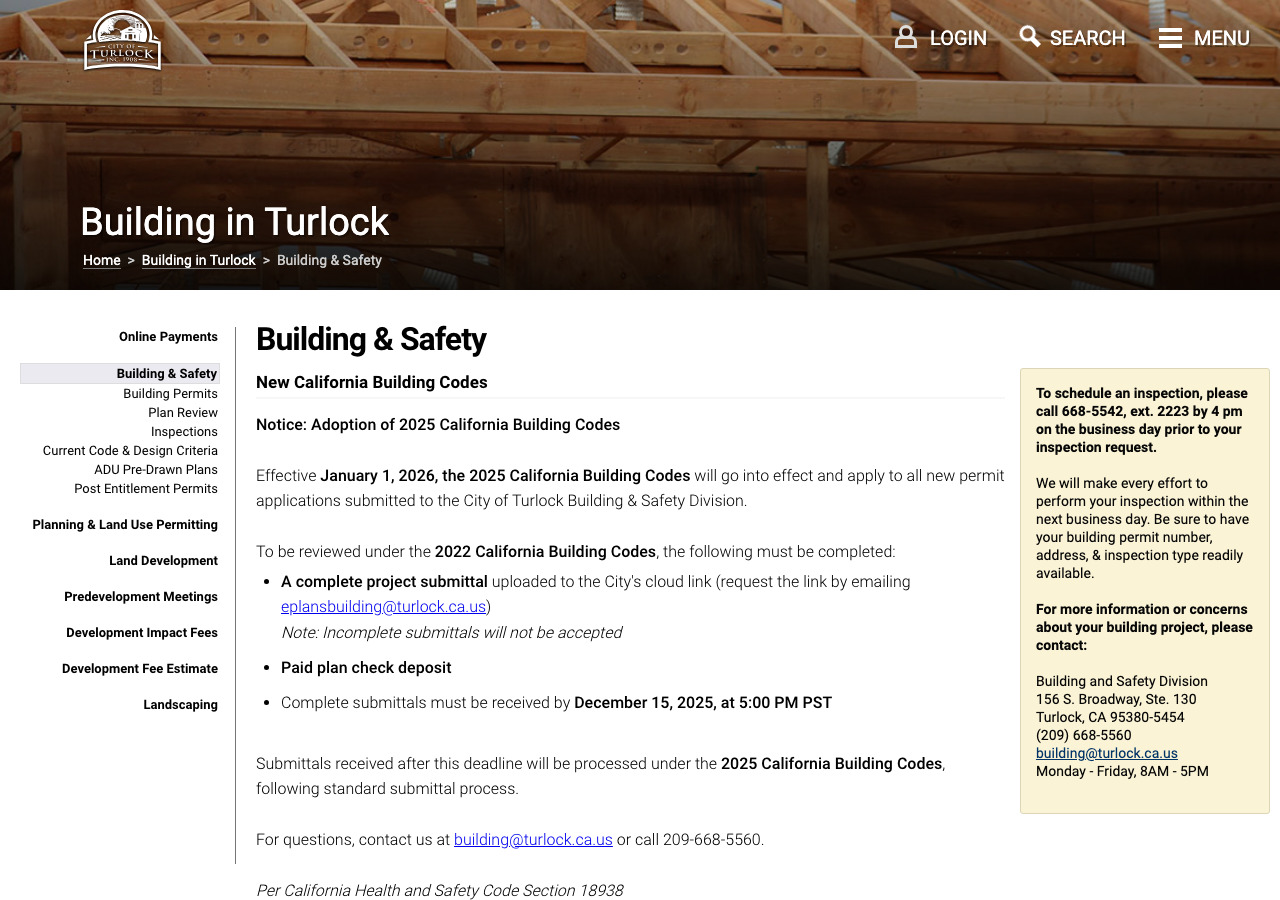
City of Turlock is a city authority in the State of California, serving 72,740 residents. This page is the permit route for that jurisdiction: the fifteen steps from working out who has a say over an address through to permission to operate, the documents this authority publishes, and 62 answers taken from those documents and dated.
Permitting 5 steps · 28 questions
Whether a permit is needed — Yes Q3 Electrical and building permits — Combined Q4 Plan review — 24 business hours (SolarAPP+ path): applicant receives the City permit number by email within 24 business hours of SolarAPP+ approval. Q18 Where you file — SolarAPP+ (solarapp.nrel.gov) for eligible licensed-contractor rooftop PV; the City's own electronic submittal portal (hosted at cloud.turlock.ca.us) plus a… Q20
- Permit required
- Yes95% source
- Plan review turnaround
- 24 business hours (SolarAPP+ path): applicant receives the City permit number by email within 24 business hours of SolarAPP+ approval.85% source
- Key document
- portal landing page cited by 7 open the document
-
Confirm who has a say over your address
A city address is usually permitted by the city, not the county — but not always, and some authorities keep building and hand electrical to someone else. Getting this wrong costs the whole submittal, because every requirement below belongs to whoever actually holds jurisdiction. Check the overlays in the same pass: an HOA, a historic district, a windstorm certification or a system-size cap can reshape the design, and all of them are cheaper to find now than after the array is laid out.
- Is this authority the AHJ for residential solar at this address? Yes 95% · department page
- What does this authority permit itself, and what does it delegate? Both 85% · department page
- Is a permit required for a residential rooftop PV system? Yes 95% · department page
- Is there a separate electrical permit, or is it combined? Combined 85% · permit application form
- Is a HOA or architectural approval required first? No 60% · published checklist
- Is there a historic-district review? No general historic-district review for solar; a review only applies if the specific parcel carries an individual 'Historic Site Contract' designation under Zoning Code Article 8, not as a blanket district overlay. 60% · department page / code table of contents
- Is a wind or windstorm certification required? No separate wind/windstorm certification is required; wind design values (Risk Category I: 90 mph through Risk Category IV: 105 mph) are published as standard structural design criteria applied through ordinary structural calculations, not as a distinct certification submittal. 55% · department page
- Is a Specific Use Permit or Council approval ever required? No — Turlock's small residential rooftop solar review (SolarAPP+ automated path or the regular Solar Permit/Plan Check path) is a ministerial building-permit process; no Planning Commission or City Council approval step is described for residential rooftop PV. 70% · department page
- Is there a system-size cap on residential generation? No city-published cap found. At the utility level, TID states 'System sizes are not limited to a customer's electric load under these rate schedules at this time,' while reserving the right to require an interconnection study or otherwise limit system size. 60% · utility FAQ page
-
Check who is allowed to apply
Several authorities require the electrical permit to be pulled by a licensed electrician, or require the contractor to be registered with them BEFORE applying. Registration is not same-day. This is second on the list rather than fourth because it is the step most likely to stop the job before the drawings matter.
- Who is allowed to pull the electrical permit? Either 90% · department page
- Must the contractor be registered with this authority before applying? No 60% · permit application form
- Is a homeowner permitted to self-install and self-permit? Yes 90% · department page
-
Build the submittal package
Almost everywhere wants a site plan, a one-line or three-line electrical diagram, equipment cut sheets with listings, and a structural attachment detail. Build it against the published checklist rather than the last jurisdiction you worked in — the checklist is what the reviewer marks against.
- What documents make up a complete submittal? Site plan (property lines, structures, electrical service/PV equipment/inverter/disconnect locations, designer & owner info); one-line diagram; inverter cut sheets/model number; PV module cut sheets; array info (module count, parallel circuits, operating V/I, Voc, Isc, Pmax); wiring & OCP sizing with conductor/EGC sizes; roof info (framing size/span/spacing, roofing type, array weight in psf); for ground mounts, support/footing details. 90% · published checklist
- How many copies, and in what format? For regular (non-SolarAPP+) permits: 4 sets of plans plus 2 complete sets of supporting calculations/documents for residential projects; significant residential projects must also be submitted electronically as separate, named PDFs (one per document type) via the City's electronic submittal portal. SolarAPP+-eligible jobs submit entirely electronically through the SolarAPP+/NREL portal instead. 80% · published handout
- Is a site plan required, and what must it show? Yes — must show all property lines, locations/dimensions of all structures on the property, the location of electrical service, PV equipment, inverters and AC/DC disconnects, and the designer's and property owner's name, address and phone number. 95% · published checklist
- Is a one-line / three-line diagram required? Yes 95% · published checklist
- Are string and conductor calculations required? Yes 90% · published checklist
- Is a structural PE stamp required, and at what threshold? Structural calculations (submittal does not itself specify 'PE stamp' wording) are required when: array weight exceeds 4 lbs/sq ft including mounting hardware; the roof is tile; panels are integrated into roof tiles; panels sit more than 12 inches off the roof; or the roof has a roofing overlay. For ground mounts, a structure unfamiliar to the AHJ or more than 6 feet above grade 'may require engineering calculations.' 85% · published checklist
-
Apply and pay
Most authorities now take the whole application through a portal, and several states cap or constrain what a residential solar permit may cost. Check whether plan check is billed separately before you quote the job.
- Which permit portal does this authority use? SolarAPP+ (solarapp.nrel.gov) for eligible licensed-contractor rooftop PV; the City's own electronic submittal portal (hosted at cloud.turlock.ca.us) plus a separate 'Online Permits' tool for reroof/HVAC/minor-electrical permits for everything else. 90% · portal landing page
- Can the whole application be completed online? Yes, for SolarAPP+-eligible projects — submission, code-compliance review, fee payment and permit issuance are all completed online. Non-eligible ('regular Solar Permit') projects submit electronically but still go through staff plan review and a deposit/payment step, not a single online transaction. 80% · department page
- Is there a separate plan-check fee? A plan-check deposit is required for most projects and is applied against the eventual permit fee; the Building Permits FAQ does not distinguish it as a fee wholly separate from the permit fee. 65% · department page
-
Plan review — and start the utility in parallel
Interconnection is a separate process from the permit and usually the longer pole. Where the utility does not depend on the permit being issued, running both at once is the single biggest saving available on a residential job.
- What is the stated plan-review turnaround? 24 business hours (SolarAPP+ path): applicant receives the City permit number by email within 24 business hours of SolarAPP+ approval. 85% · department page
- How long is an issued permit valid before it expires? Not clearly published for an issued permit. The Building Permit Application states the *application* itself 'EXPIRES one year from the date of initial application' if not acted on; the City's currently adopted 2025 California Building Code (no local amendment to this point identified) carries the standard 180-day expiration for issued permits with no commenced/continued work. 55% · permit application form
- Which utility handles interconnection here? Turlock Irrigation District (TID) — a municipally-owned irrigation/power district, not PG&E. 95% · utility's own page
- Where does the utility sit in the sequence? Parallel, with a dependency: the customer/contractor files a separate Application for Interconnection package directly with TID (Release of Information, wiring/meter diagram, spec sheets, CSI PV Calculator report) rather than through the City, but TID's own FAQ states 'TID will need a final inspection that is derived from a permit to install a net meter' — i.e. TID's own field inspection and net-meter installation follow completion of the City-permitted installation. 65% · utility DG program page
28 questions answered against City of Turlock’s own published documents
Q1 Is this authority the AHJ for residential solar at this address? Core Jurisdiction & scope
Yes
Why the confidence is not higherCity's own Residential Solar page and Building Permits page describe the City issuing residential solar/PV permits directly and performing inspections.
department page checked 2026-08-30 https://www.cityofturlock.org/buildinginturlock/buildingsafety/buildingpermits/residentialsolar.asp
Q2 What does this authority permit itself, and what does it delegate? Core Jurisdiction & scope
Both
Why the confidence is not higherThe City issues both building and electrical permits itself under one Building Permit (Solar Contractor and Electrical Contractor are both listed as line items on the single application). Plan review only (not permitting/inspection authority) is contracted to Bureau Veritas-North America and Interwest Consulting Group.
department page checked 2026-08-30 https://www.cityofturlock.org/buildinginturlock/buildingsafety/planreview.asp
Q3 Is a permit required for a residential rooftop PV system? Core Jurisdiction & scope
Yes
Why the confidence is not higherBuilding Permits page lists 'Residential Solar' explicitly among the construction types requiring a building permit.
department page checked 2026-08-30 https://www.cityofturlock.org/buildinginturlock/buildingsafety/buildingpermits/
Q4 Is there a separate electrical permit, or is it combined? Core Jurisdiction & scope
Combined
Why the confidence is not higherThe single Building Permit Application lists Electrical Contractor and Solar Contractor as line items under one permit number; SolarAPP+ issues one City permit number (e.g. BP# 25-1234) covering the whole system.
permit application form checked 2026-08-30 https://www.cityofturlock.org/_pdf/buildingpdf.asp?id=5
Q5 Who is allowed to pull the electrical permit? Core Who may apply
Either
Why the confidence is not higherSolarAPP+ automated path is 'Licensed Contractors Only'; the same page states non-licensed/owner-builders may instead apply for 'a regular Solar Permit with a regular Plan Check process' — so either a licensed contractor or an owner-builder can pull the permit, via different tracks.
department page checked 2026-08-30 https://www.cityofturlock.org/buildinginturlock/buildingsafety/buildingpermits/residentialsolar.asp
Q6 Must the contractor be registered with this authority before applying? Core Who may apply
No
Why the confidence is not higherThe Building Permit Application field for 'City of Turlock Business License No.' is marked '(If applicable)', implying it is not a mandatory prerequisite to submitting an application; no separate contractor pre-registration step is described elsewhere on the Building & Safety pages.
permit application form checked 2026-08-30 https://www.cityofturlock.org/_pdf/buildingpdf.asp?id=5
Q7 Is a homeowner permitted to self-install and self-permit? Who may apply
Yes
Why the confidence is not higherResidential Solar page states 'Non-licensed/owner-builders must apply for a regular Solar Permit with a regular Plan Check process' — an available path outside SolarAPP+.
department page checked 2026-08-30 https://www.cityofturlock.org/buildinginturlock/buildingsafety/buildingpermits/residentialsolar.asp
Q8 What documents make up a complete submittal? Core Submittal package
Site plan (property lines, structures, electrical service/PV equipment/inverter/disconnect locations, designer & owner info); one-line diagram; inverter cut sheets/model number; PV module cut sheets; array info (module count, parallel circuits, operating V/I, Voc, Isc, Pmax); wiring & OCP sizing with conductor/EGC sizes; roof info (framing size/span/spacing, roofing type, array weight in psf); for ground mounts, support/footing details.
Why the confidence is not higherDirectly enumerated on the City's Residential PV Submittal Requirements checklist, extracted with pdftotext -layout.
published checklist checked 2026-08-30 https://www.cityofturlock.org/_pdf/files/ResidenitalPVSubmittalChecklist2025.pdf
Q9 How many copies, and in what format? Submittal package
For regular (non-SolarAPP+) permits: 4 sets of plans plus 2 complete sets of supporting calculations/documents for residential projects; significant residential projects must also be submitted electronically as separate, named PDFs (one per document type) via the City's electronic submittal portal. SolarAPP+-eligible jobs submit entirely electronically through the SolarAPP+/NREL portal instead.
Why the confidence is not higherMinimum Plan Information handout states the 4-sets/2-sets rule for residential plan check; the Electronic Project Submittal Guidelines separately require PDF submittal for significant projects. These are general Building Division rules, not solar-specific restatements.
published handout checked 2026-08-30 https://www.cityofturlock.org/_pdf/files/minimumbuildingpermitinformation.pdf
Q10 Is a site plan required, and what must it show? Core Submittal package
Yes — must show all property lines, locations/dimensions of all structures on the property, the location of electrical service, PV equipment, inverters and AC/DC disconnects, and the designer's and property owner's name, address and phone number.
Why the confidence is not higherDirectly stated on the Residential PV Submittal Requirements checklist under 'SITE PLAN'.
published checklist checked 2026-08-30 https://www.cityofturlock.org/_pdf/files/ResidenitalPVSubmittalChecklist2025.pdf
Q11 Is a one-line / three-line diagram required? Core Drawings & calculations
Yes
Why the confidence is not higherChecklist requires a one-line diagram showing array configuration/wiring, combiner/junction box, conduit, equipment/system grounding, disconnect and inverter specs, AC/DC grounding electrode conductor size, and point-of-connection attachment method.
published checklist checked 2026-08-30 https://www.cityofturlock.org/_pdf/files/ResidenitalPVSubmittalChecklist2025.pdf
Q12 Are string and conductor calculations required? Drawings & calculations
Yes
Why the confidence is not higherChecklist requires wire type/size and equipment grounding conductor sizing (2022 CEC Table 250.122) for array DC wiring, source-circuit-to-inverter DC wiring with overcurrent protection, and inverter-to-grid-tie AC wiring with breaker size — i.e. string/conductor calculations.
published checklist checked 2026-08-30 https://www.cityofturlock.org/_pdf/files/ResidenitalPVSubmittalChecklist2025.pdf
Q13 Is a structural PE stamp required, and at what threshold? Core Engineering & stamps
Structural calculations (submittal does not itself specify 'PE stamp' wording) are required when: array weight exceeds 4 lbs/sq ft including mounting hardware; the roof is tile; panels are integrated into roof tiles; panels sit more than 12 inches off the roof; or the roof has a roofing overlay. For ground mounts, a structure unfamiliar to the AHJ or more than 6 feet above grade 'may require engineering calculations.'
Why the confidence is not higherResidential PV Submittal Requirements checklist, 'ROOF INFORMATION (ROOFTOP SYSTEMS)' and 'GROUND MOUNTED STRUCTURE' sections.
published checklist checked 2026-08-30 https://www.cityofturlock.org/_pdf/files/ResidenitalPVSubmittalChecklist2025.pdf
Q14 Is an electrical PE stamp required, and at what threshold? Engineering & stamps
Nothing published by this authority.
Where we lookedChecked the Residential PV Submittal Requirements checklist (which is otherwise very detailed on electrical submittal items) and the Minimum Plan Information handout — neither states an electrical PE-stamp threshold for residential PV. eCode360 chapter text (Ch. 8-7/8-9) could not be retrieved — see note on q32.
https://www.cityofturlock.org/_pdf/files/ResidenitalPVSubmittalChecklist2025.pdf
Q15 What does a residential solar permit cost? Core Fees
Nothing published by this authority.
Where we lookedChecked Permit Fees page, Building Permits page, Development Fee Estimate tool, and Fire Department Fee Schedule page — none publishes a residential solar permit dollar amount. The SolarAPP+ info sheet only says fees are 'assessed per the City of Turlock Master Fee Schedule,' but that schedule itself is not linked or discoverable from any of these pages.
https://www.cityofturlock.org/buildinginturlock/buildingsafety/buildingpermits/permitfees.asp
Q16 How is the fee calculated? Core Fees
Nothing published by this authority.
Where we lookedBuilding Permits page states fees for 'most projects' are based on use/square footage rather than valuation, but this is a general statement about building permits and is not stated to apply specifically to the solar permit fee calculation; no solar-specific fee-basis document was found.
https://www.cityofturlock.org/buildinginturlock/buildingsafety/buildingpermits/
Q17 Is there a separate plan-check fee? Fees
A plan-check deposit is required for most projects and is applied against the eventual permit fee; the Building Permits FAQ does not distinguish it as a fee wholly separate from the permit fee.
Why the confidence is not higherBuilding Permits page: 'Most projects will require a plan check deposit which will be applied to the cost of your building permit.' Amount is quoted case-by-case, not published as a table.
department page checked 2026-08-30 https://www.cityofturlock.org/buildinginturlock/buildingsafety/buildingpermits/
Q18 What is the stated plan-review turnaround? Core Timeline & validity
24 business hours (SolarAPP+ path): applicant receives the City permit number by email within 24 business hours of SolarAPP+ approval.
Why the confidence is not higherStated directly on the Residential Solar page and repeated in the SolarAPP+ Informational Guide PDF.
department page checked 2026-08-30 https://www.cityofturlock.org/buildinginturlock/buildingsafety/buildingpermits/residentialsolar.asp
Q19 How long is an issued permit valid before it expires? Timeline & validity
Not clearly published for an issued permit. The Building Permit Application states the *application* itself 'EXPIRES one year from the date of initial application' if not acted on; the City's currently adopted 2025 California Building Code (no local amendment to this point identified) carries the standard 180-day expiration for issued permits with no commenced/continued work.
Why the confidence is not higherBuilding Permit Application PDF states the 1-year application expiration; the 180-day figure is the unamended statewide CBC default, not a Turlock-specific document found on the city's site.
permit application form checked 2026-08-30 https://www.cityofturlock.org/_pdf/buildingpdf.asp?id=5
Q20 Which permit portal does this authority use? Core Portal & process
SolarAPP+ (solarapp.nrel.gov) for eligible licensed-contractor rooftop PV; the City's own electronic submittal portal (hosted at cloud.turlock.ca.us) plus a separate 'Online Permits' tool for reroof/HVAC/minor-electrical permits for everything else.
Why the confidence is not higherResidential Solar page names SolarAPP+; the Electronic Project Submittal Guide PDF links the city's own upload portal at cloud.turlock.ca.us; Online Permits page confirms the separate minor-permit portal.
portal landing page checked 2026-08-30 https://www.cityofturlock.org/buildinginturlock/buildingsafety/buildingpermits/residentialsolar.asp
Q21 Can the whole application be completed online? Core Portal & process
Yes, for SolarAPP+-eligible projects — submission, code-compliance review, fee payment and permit issuance are all completed online. Non-eligible ('regular Solar Permit') projects submit electronically but still go through staff plan review and a deposit/payment step, not a single online transaction.
Why the confidence is not higherResidential Solar page walks through the fully online SolarAPP+ steps (submit → pay → receive approval document/permit number); regular permits route through the Electronic Project Submittal Guide's deposit/review workflow.
department page checked 2026-08-30 https://www.cityofturlock.org/buildinginturlock/buildingsafety/buildingpermits/residentialsolar.asp
Q22 Which utility handles interconnection here? Core Utility interconnection
Turlock Irrigation District (TID) — a municipally-owned irrigation/power district, not PG&E.
Why the confidence is not higherConfirmed from TID's own Go Solar and Self-Generation Rate Schedule pages, which describe TID as the interconnecting/net-metering utility for Turlock customers; not taken from a ZIP-code lookup tool.
utility's own page checked 2026-08-30 https://www.tid.org/customer-service/go-solar/
Q23 Where does the utility sit in the sequence? Core Utility interconnection
Parallel, with a dependency: the customer/contractor files a separate Application for Interconnection package directly with TID (Release of Information, wiring/meter diagram, spec sheets, CSI PV Calculator report) rather than through the City, but TID's own FAQ states 'TID will need a final inspection that is derived from a permit to install a net meter' — i.e. TID's own field inspection and net-meter installation follow completion of the City-permitted installation.
Why the confidence is not higherTID Go Solar page (interconnection document list) and Solar FAQ ('Does a solar PV system have to meet local building codes?' answer).
utility DG program page checked 2026-08-30 https://www.tid.org/customer-service/go-solar/
Q24 Is a HOA or architectural approval required first? Overlays & special cases
No
Why the confidence is not higherThe City's Residential PV Submittal Requirements checklist and Building Permit Application do not list HOA or architectural-committee approval among submittal requirements; the City administers no such review itself.
published checklist checked 2026-08-30 https://www.cityofturlock.org/_pdf/files/ResidenitalPVSubmittalChecklist2025.pdf
Q25 Is there a historic-district review? Overlays & special cases
No general historic-district review for solar; a review only applies if the specific parcel carries an individual 'Historic Site Contract' designation under Zoning Code Article 8, not as a blanket district overlay.
Why the confidence is not higherZoning Regulations table of contents lists 'Article 8 - Historic Site Contract' as an individual-property mechanism under Chapter 9-5 Administration, and only a 'Downtown Overlay' appears under Chapter 9-4 Overlay Zoning Districts — no historic-district overlay is listed.
department page / code table of contents checked 2026-08-30 https://www.cityofturlock.org/buildinginturlock/planninglandusepermitting/zoningregulations/
Q26 Is a wind or windstorm certification required? Overlays & special cases
No separate wind/windstorm certification is required; wind design values (Risk Category I: 90 mph through Risk Category IV: 105 mph) are published as standard structural design criteria applied through ordinary structural calculations, not as a distinct certification submittal.
Why the confidence is not higherCurrent Code & Design Criteria page lists the wind load risk-category table; no separate wind-certification document or process is described anywhere on the Building & Safety pages.
department page checked 2026-08-30 https://www.cityofturlock.org/buildinginturlock/buildingsafety/currentcodedesigncriteria.asp
Q27 Is a Specific Use Permit or Council approval ever required? Overlays & special cases
No — Turlock's small residential rooftop solar review (SolarAPP+ automated path or the regular Solar Permit/Plan Check path) is a ministerial building-permit process; no Planning Commission or City Council approval step is described for residential rooftop PV.
Why the confidence is not higherResidential Solar page describes only Building & Safety-level review/permitting for both tracks; no CUP, SUP, or Council step appears anywhere in that process.
department page checked 2026-08-30 https://www.cityofturlock.org/buildinginturlock/buildingsafety/buildingpermits/residentialsolar.asp
Q28 Is there a system-size cap on residential generation? Overlays & special cases
No city-published cap found. At the utility level, TID states 'System sizes are not limited to a customer's electric load under these rate schedules at this time,' while reserving the right to require an interconnection study or otherwise limit system size.
Why the confidence is not higherTID Solar FAQ, 'Is there a limit on the size of system I can install under the Self-Generation rate schedules?' This is a utility-level answer, not a City zoning/building cap — no solar-specific chapter appears in the Zoning Regulations table of contents.
utility FAQ page checked 2026-08-30 https://www.tid.org/customer-service/go-solar/
Lines marked with a percentage were read off this authority’s own published documents. Unmarked guidance is general good practice, not this jurisdiction’s rule — always confirm against the authority before you submit.
Install 5 steps · 20 questions
-
Build to the code editions actually in force here
The NEC edition a jurisdiction enforces is often a cycle behind the newest one published, and local amendments sit on top of it. Rapid shutdown, conductor sizing and labelling all change between editions, so the edition in force is the first thing to establish, not the last.
- Which NEC edition is in force? 2023 NEC (in force via the 2025 California Electrical Code, effective January 1, 2026). 80% · adopting department page
- Which building code edition is in force? 2025 California Building Code (Volumes 1 & 2, Chapters 1–26, 31, §3109, Appendices H and I) and 2025 California Residential Code. 95% · adopting department page
- Which fire code edition is in force? 2025 California Fire Code. 95% · adopting department page
- Are there local amendments to any of the above? Yes — the City publishes local design-value amendments/overlays to the state code: Seismic Design Category D assumed citywide, Soil Site Class D assumed absent a geotechnical report, specific wind-load risk-category speeds (90–105 mph), zero ground snow load, 2-in/hr rain load, and residential soil-bearing defaults (1500 psf allowable foundation without a soils report). 75% · adopting department page
- What is the installation judged against? The currently adopted 2025 California Electrical Code (effective Jan 1, 2026) governs; however, the City's own Residential PV Submittal Checklist still references 2022 CEC table numbers (e.g. Table 250.122, 690.7, 690.8), so in practice submittals may still be checked against 2022 CEC citations pending an update to that handout. 75% · adopting department page + checklist
-
Fire access, setbacks and pathways
Ridge setbacks and roof access pathways are fire-service requirements and they constrain the array layout. They are the most common cause of a redesign after the fire department comments on a plan set.
- What ridge setback and access pathways are required? Ridge setback and pathway table (per CRC R324.6.1–R324.6.2.1): arrays covering ≤33% of the plan-view roof area need an 18-inch setback on both sides of the ridge; arrays >33% need 36 inches; with NFPA 13D sprinklers installed, the 18-inch setback applies up to 66% coverage and 36 inches above 66%. Pathways must be built over areas capable of supporting firefighters and kept clear of vent pipes, conduit, and mechanical equipment. 95% · published checklist / fire code + amendments
-
Rapid shutdown
Which rapid-shutdown rule applies follows directly from the NEC edition in force, and the initiation device has to be at a location the fire service can reach and identify. This is inspected, and it is labelled.
- Is rapid shutdown required, and to which NEC edition? Yes, rapid shutdown is required under the currently adopted 2025 California Electrical Code (based on the 2023 NEC, NEC 690.12), effective Jan 1, 2026. 70% · adopting department page
-
Labels and placards
The NEC sets a baseline for permanent markings at the service equipment and the disconnecting means. On top of that, an authority may specify its own wording, and the utility may specify more again. Where any of them writes its own text, a generic off-the-shelf label set will not pass — this is the detail most often fixed on a return visit.
- Which placards does this authority require at the service equipment? Per the utility's (TID's) installation guidelines, the following must be permanently labeled: the dedicated PV breaker in the main service panel (MSP), the AC disconnect switch, conduits for the solar circuit, the MSP itself, any line-side tap, and (if the optional TID generation meter is not visible from the MSP) a site-map placard on the MSP. 85% · utility DG manual
- Does the authority specify placard wording of its own? No — no independent City-authored placard wording was found; TID's placarding requirement cites compliance with NEC labeling rules (690.14(C)(2), 690.52) rather than prescribing its own custom text. 65% · utility DG manual
- Is a site plan / facility map placard required, and what must it show? Yes, but conditionally: a site-map placard on the main service panel is required only 'if the optional TID generation meter is to be located where not visible from MSP.' No universal facility-map placard requirement (independent of that condition) was found. 85% · utility DG manual
- Does the UTILITY specify placards beyond the AHJ's? Yes — TID's own Solar Installation Guidelines impose a placarding list (dedicated PV breaker, AC disconnect, solar-circuit conduits, MSP, line-side tap, and conditional site-map placard) in addition to whatever the AHJ requires, plus separate meter-height and meter-working-space construction standards. 90% · utility DG manual
- Where must the labels be placed? Per TID: dedicated PV breaker inside the MSP, AC disconnect switch itself, conduits carrying solar circuits, the MSP, any line-side tap, and (conditionally) a site-map placard on the MSP. Per the City's checklist, general PV equipment/inverter/disconnect locations must be shown on the site plan but no separate label-placement rule beyond TID's is published. 85% · utility DG manual
-
Disconnect, storage and listed equipment
Where the AC disconnect must sit relative to the meter is usually the utility's rule, not the building department's. Battery storage frequently carries its own permit, its own inspection and its own fire conditions.
- Where must the AC disconnect be, relative to the meter? The AC disconnect (if installed) must be located within 10 feet and in line of sight of the main service panel (MSP), on the same side of any obstruction (fence, gate, etc.) as the MSP. If the optional TID generation meter is used, an AC disconnect is additionally required between the MSP and the generation meter, and the generation meter socket can be no more than 60 feet from the inverter (or the array, for microinverters). 90% · utility DG manual
- Must equipment be on a specific approved list? Yes — equipment must be listed: the checklist requires the inverter be 'listed for utility interactivity' and PV modules be 'listed'; TID separately requires 'all connectors and equipment used in the installation must be UL approved.' 85% · published checklist
- Are batteries permitted, and under what conditions? Batteries are addressed at the utility level: TID's guidelines require the storage battery's kWh/kW size be specified on the single-line diagram, require the system be 'operable at time of TID inspection' with a contractor representative present to verify operation, and require it be demonstrated that the system cannot back-feed when TID power is interrupted. No City fire-code-specific residential battery/ESS provision (e.g. a size threshold or room-separation rule) was found on the City's own pages. 75% · utility DG manual + fire code (AHJ-level provision not found)
- Is a ground mount treated as a structure? Yes 80% · published checklist
- Is there a local rule on service upgrades or busbar sizing? Yes — center-fed service panels connected on the load side cannot use the 120% busbar-rating increase exception, because the solar breaker cannot be located on the opposite end of the busbar from the main breaker (CEC 705.12(D)(7)), and this is called out explicitly on the City's own checklist as a local point of emphasis. 85% · published checklist
- Is a specific mounting system or attachment spacing required? No universal city-wide spacing table beyond the manufacturer's rail installation instructions; the checklist requires 'attachment details of PV panels to the rails and rail installation instructions' and a method for sealing roof penetrations, but does not itself set a spacing figure. 70% · published checklist
20 questions answered against City of Turlock’s own published documents
Q29 Which NEC edition is in force? Core Code editions in force
2023 NEC (in force via the 2025 California Electrical Code, effective January 1, 2026).
Why the confidence is not higherCurrent Code & Design Criteria page lists '2025 California Electrical Code' as currently enacted; the 2025 CEC cycle is statewide based on the 2023 NEC. Note: the City's own Residential PV Submittal Checklist still cites '2022 CEC' table numbers in several places, suggesting that document has not yet been updated for the new cycle.
adopting department page checked 2026-08-30 https://www.cityofturlock.org/buildinginturlock/buildingsafety/currentcodedesigncriteria.asp
Q30 Which building code edition is in force? Core Code editions in force
2025 California Building Code (Volumes 1 & 2, Chapters 1–26, 31, §3109, Appendices H and I) and 2025 California Residential Code.
Why the confidence is not higherListed verbatim on the Current Code & Design Criteria page as 'Currently Enacted Building Codes.'
adopting department page checked 2026-08-30 https://www.cityofturlock.org/buildinginturlock/buildingsafety/currentcodedesigncriteria.asp
Q31 Which fire code edition is in force? Code editions in force
2025 California Fire Code.
Why the confidence is not higherListed verbatim on the Current Code & Design Criteria page.
adopting department page checked 2026-08-30 https://www.cityofturlock.org/buildinginturlock/buildingsafety/currentcodedesigncriteria.asp
Q32 Are there local amendments to any of the above? Core Code editions in force
Yes — the City publishes local design-value amendments/overlays to the state code: Seismic Design Category D assumed citywide, Soil Site Class D assumed absent a geotechnical report, specific wind-load risk-category speeds (90–105 mph), zero ground snow load, 2-in/hr rain load, and residential soil-bearing defaults (1500 psf allowable foundation without a soils report).
Why the confidence is not higherCurrent Code & Design Criteria page. Note: under AB 130 (Stats. 2025, ch. 22), California cities are barred from adopting new more-restrictive residential building standards from Oct 1 2025 to Jun 1 2031, so any further residential amendment activity by Turlock during this window would need to fall within AB 130's narrow exceptions.
adopting department page checked 2026-08-30 https://www.cityofturlock.org/buildinginturlock/buildingsafety/currentcodedesigncriteria.asp
Q33 What is the installation judged against? Core Electrical
The currently adopted 2025 California Electrical Code (effective Jan 1, 2026) governs; however, the City's own Residential PV Submittal Checklist still references 2022 CEC table numbers (e.g. Table 250.122, 690.7, 690.8), so in practice submittals may still be checked against 2022 CEC citations pending an update to that handout.
Why the confidence is not higherCurrent Code & Design Criteria page (2025 CEC) vs. Residential PV Submittal Requirements checklist (cites 2022 CEC).
adopting department page + checklist checked 2026-08-30 https://www.cityofturlock.org/buildinginturlock/buildingsafety/currentcodedesigncriteria.asp
Q34 Is there a local rule on service upgrades or busbar sizing? Electrical
Yes — center-fed service panels connected on the load side cannot use the 120% busbar-rating increase exception, because the solar breaker cannot be located on the opposite end of the busbar from the main breaker (CEC 705.12(D)(7)), and this is called out explicitly on the City's own checklist as a local point of emphasis.
Why the confidence is not higherStated as a boxed/highlighted note on the Residential PV Submittal Requirements checklist.
published checklist checked 2026-08-30 https://www.cityofturlock.org/_pdf/files/ResidenitalPVSubmittalChecklist2025.pdf
Q35 Is a specific mounting system or attachment spacing required? Structural & mounting
No universal city-wide spacing table beyond the manufacturer's rail installation instructions; the checklist requires 'attachment details of PV panels to the rails and rail installation instructions' and a method for sealing roof penetrations, but does not itself set a spacing figure.
Why the confidence is not higherResidential PV Submittal Requirements checklist, 'ROOF INFORMATION' section.
published checklist checked 2026-08-30 https://www.cityofturlock.org/_pdf/files/ResidenitalPVSubmittalChecklist2025.pdf
Q36 What ridge setback and access pathways are required? Core Fire pathways & setbacks
Ridge setback and pathway table (per CRC R324.6.1–R324.6.2.1): arrays covering ≤33% of the plan-view roof area need an 18-inch setback on both sides of the ridge; arrays >33% need 36 inches; with NFPA 13D sprinklers installed, the 18-inch setback applies up to 66% coverage and 36 inches above 66%. Pathways must be built over areas capable of supporting firefighters and kept clear of vent pipes, conduit, and mechanical equipment.
Why the confidence is not higherFull setback table and pathway rules reproduced verbatim on the Residential PV Submittal Requirements checklist.
published checklist / fire code + amendments checked 2026-08-30 https://www.cityofturlock.org/_pdf/files/ResidenitalPVSubmittalChecklist2025.pdf
Q37 Is rapid shutdown required, and to which NEC edition? Core Rapid shutdown
Yes, rapid shutdown is required under the currently adopted 2025 California Electrical Code (based on the 2023 NEC, NEC 690.12), effective Jan 1, 2026.
Why the confidence is not higherInferred from the Current Code & Design Criteria page's adoption of the 2025 CEC; the Residential PV Submittal Checklist itself does not use the words 'rapid shutdown' but requires disconnect/conduit/labeling details consistent with 690.12.
adopting department page checked 2026-08-30 https://www.cityofturlock.org/buildinginturlock/buildingsafety/currentcodedesigncriteria.asp
Q38 Which placards does this authority require at the service equipment? Core Labels Signage & labelling
Per the utility's (TID's) installation guidelines, the following must be permanently labeled: the dedicated PV breaker in the main service panel (MSP), the AC disconnect switch, conduits for the solar circuit, the MSP itself, any line-side tap, and (if the optional TID generation meter is not visible from the MSP) a site-map placard on the MSP.
Why the confidence is not higherTID Solar Installation Guidelines, Section 4 'Placarding', extracted directly from the PDF with pdftotext -layout. The City's own checklist does not separately restate a placard list; it defers to NEC 690.14(C)(2)/690.52 as cited by TID.
utility DG manual checked 2026-08-30 https://www.tid.org/wp-content/uploads/2025/04/TID-Solar-Guidelines-2025-Clean.pdf
Q39 Does the authority specify placard wording of its own? Core Labels Signage & labelling
No — no independent City-authored placard wording was found; TID's placarding requirement cites compliance with NEC labeling rules (690.14(C)(2), 690.52) rather than prescribing its own custom text.
Why the confidence is not higherTID Solar Installation Guidelines, Section 4; no Turlock-specific wording found on the City's checklist or Residential Solar page.
utility DG manual checked 2026-08-30 https://www.tid.org/wp-content/uploads/2025/04/TID-Solar-Guidelines-2025-Clean.pdf
Q40 Does it specify letter height, colour or material? Core Labels Signage & labelling
Nothing published by this authority.
Where we lookedTID's placarding section and the City's PV checklist both require labeling but neither specifies letter height, color, or material — they refer generically to 'permanent labeling per NEC rules.' Checked both documents directly (not summarized).
https://www.tid.org/wp-content/uploads/2025/04/TID-Solar-Guidelines-2025-Clean.pdf
Q41 Is a site plan / facility map placard required, and what must it show? Core Labels Signage & labelling
Yes, but conditionally: a site-map placard on the main service panel is required only 'if the optional TID generation meter is to be located where not visible from MSP.' No universal facility-map placard requirement (independent of that condition) was found.
Why the confidence is not higherTID Solar Installation Guidelines, Section 4(a)(iv).
utility DG manual checked 2026-08-30 https://www.tid.org/wp-content/uploads/2025/04/TID-Solar-Guidelines-2025-Clean.pdf
Q42 Does the UTILITY specify placards beyond the AHJ's? Core Labels Signage & labelling
Yes — TID's own Solar Installation Guidelines impose a placarding list (dedicated PV breaker, AC disconnect, solar-circuit conduits, MSP, line-side tap, and conditional site-map placard) in addition to whatever the AHJ requires, plus separate meter-height and meter-working-space construction standards.
Why the confidence is not higherTID Solar Installation Guidelines PDF, Sections 4 and 9, extracted directly.
utility DG manual checked 2026-08-30 https://www.tid.org/wp-content/uploads/2025/04/TID-Solar-Guidelines-2025-Clean.pdf
Q43 Where must the labels be placed? Core Labels Signage & labelling
Per TID: dedicated PV breaker inside the MSP, AC disconnect switch itself, conduits carrying solar circuits, the MSP, any line-side tap, and (conditionally) a site-map placard on the MSP. Per the City's checklist, general PV equipment/inverter/disconnect locations must be shown on the site plan but no separate label-placement rule beyond TID's is published.
Why the confidence is not higherTID Solar Installation Guidelines, Section 4.
utility DG manual checked 2026-08-30 https://www.tid.org/wp-content/uploads/2025/04/TID-Solar-Guidelines-2025-Clean.pdf
Q44 Must equipment be on a specific approved list? Equipment listing
Yes — equipment must be listed: the checklist requires the inverter be 'listed for utility interactivity' and PV modules be 'listed'; TID separately requires 'all connectors and equipment used in the installation must be UL approved.'
Why the confidence is not higherResidential PV Submittal Requirements checklist ('INVERTER INFORMATION', 'PV MODULE INFORMATION' sections) and TID Solar Installation Guidelines, Section 7(d).
published checklist checked 2026-08-30 https://www.cityofturlock.org/_pdf/files/ResidenitalPVSubmittalChecklist2025.pdf
Q45 Are batteries permitted, and under what conditions? Core Battery / ESS
Batteries are addressed at the utility level: TID's guidelines require the storage battery's kWh/kW size be specified on the single-line diagram, require the system be 'operable at time of TID inspection' with a contractor representative present to verify operation, and require it be demonstrated that the system cannot back-feed when TID power is interrupted. No City fire-code-specific residential battery/ESS provision (e.g. a size threshold or room-separation rule) was found on the City's own pages.
Why the confidence is not higherTID Solar Installation Guidelines, Section 6 'Battery Storage.'
utility DG manual + fire code (AHJ-level provision not found) checked 2026-08-30 https://www.tid.org/wp-content/uploads/2025/04/TID-Solar-Guidelines-2025-Clean.pdf
Q46 Is there a separate ESS permit or inspection? Battery / ESS
Nothing published by this authority.
Where we lookedChecked the Turlock Fire Department's Fire Permits page (lists Assembly, Auto Repair Garage, Day Care, Compressed Gases, Dispensing Flammable Liquids, Flammable/Combustible Liquids, Hazardous Materials, High-Piled Combustible Storage, Liquefied Petroleum Gases, and Fire Alarm permits) and its Fee Schedule page — neither lists a distinct residential ESS/battery-storage permit or inspection. eCode360 (fire code local amendments) could not be retrieved to check for a codified ESS permit — see note on q32.
https://www.cityofturlock.org/firedepartment/businessesdevelopers/firepermits.asp
Q47 Is a ground mount treated as a structure? Core Ground mount
Yes
Why the confidence is not higherThe checklist has a dedicated 'GROUND MOUNTED STRUCTURE' section requiring array weight (psf), support/footing/framing details, and possible engineering calculations for structures unfamiliar to the AHJ or more than 6 feet above grade — treating it as a structure requiring structural review, not merely equipment.
published checklist checked 2026-08-30 https://www.cityofturlock.org/_pdf/files/ResidenitalPVSubmittalChecklist2025.pdf
Q48 Where must the AC disconnect be, relative to the meter? Core Utility equipment
The AC disconnect (if installed) must be located within 10 feet and in line of sight of the main service panel (MSP), on the same side of any obstruction (fence, gate, etc.) as the MSP. If the optional TID generation meter is used, an AC disconnect is additionally required between the MSP and the generation meter, and the generation meter socket can be no more than 60 feet from the inverter (or the array, for microinverters).
Why the confidence is not higherTID Solar Installation Guidelines, Section 2 'Overall Design', extracted directly with pdftotext.
utility DG manual checked 2026-08-30 https://www.tid.org/wp-content/uploads/2025/04/TID-Solar-Guidelines-2025-Clean.pdf
Lines marked with a percentage were read off this authority’s own published documents. Unmarked guidance is general good practice, not this jurisdiction’s rule — always confirm against the authority before you submit.
Inspection 5 steps · 14 questions
-
Book it
Booking is a portal, a phone call or an email depending on the authority, and the notice required is rarely zero. Book before the work is finished rather than after — the lead time, not the work, is usually what sets the date.
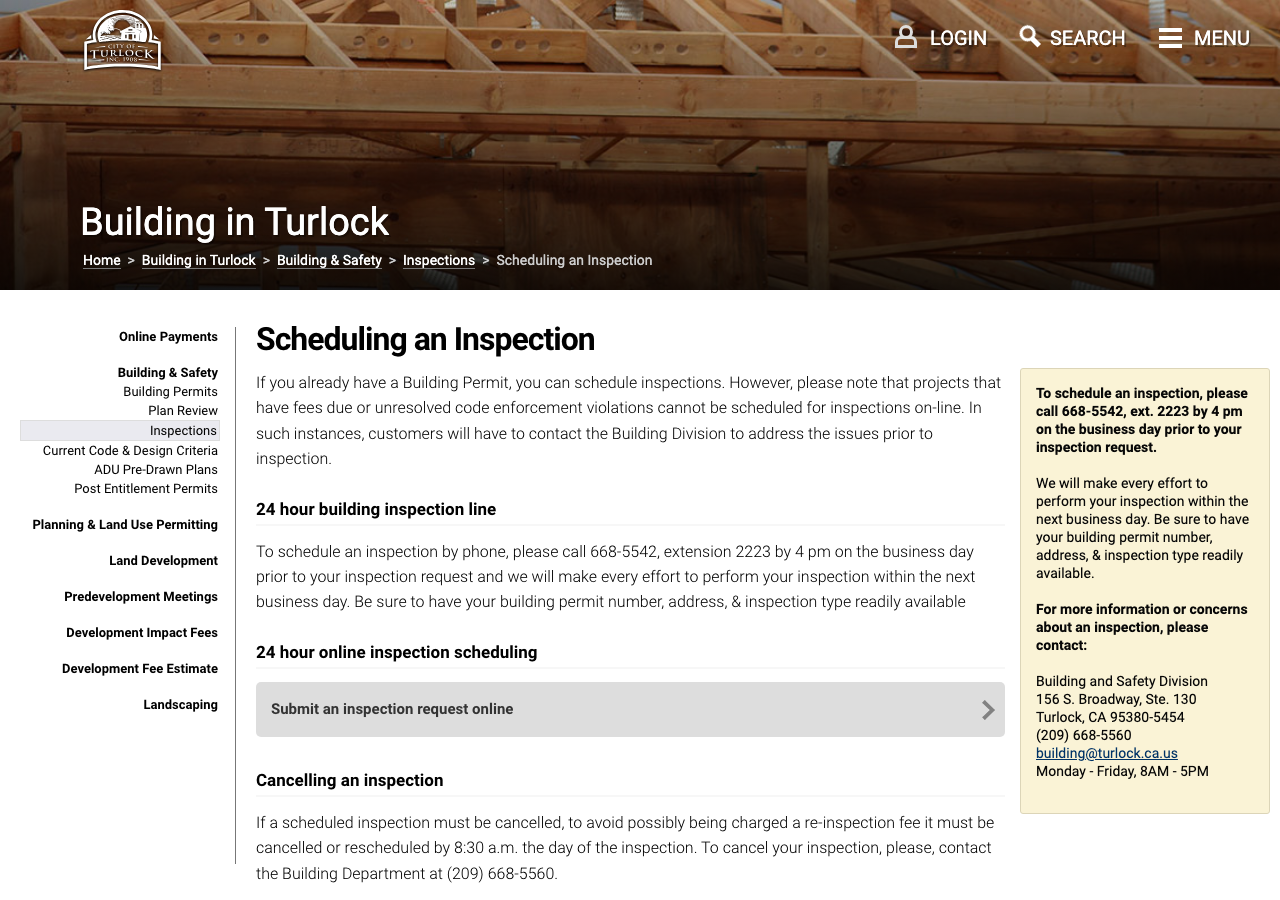
- How is an inspection booked? Phone 90% · department page
- How much notice is required? By 4:00 pm the business day before — requests made before 4:00 pm Mon–Fri are scheduled for the following workday; requests after 4:00 pm are scheduled for the 2nd day following the call. 90% · department page
- Are same-day or AM/PM windows offered? Not specified — the City schedules inspections for a given business day but does not publish AM/PM windows or same-day service for solar inspections. 60% · department page
-
Know who turns up
Some authorities inspect their own solar work; some delegate it, and a few do not inspect the PV equipment itself at all. Who is coming determines what they will look at.
- Does this AHJ perform its own final solar inspection? Yes 90% · published checklist / department page
- If delegated, to whom? N/A — inspection is not delegated to a third party. (Plan review, not inspection, is contracted to Bureau Veritas-North America and Interwest Consulting Group.) 80% · department page
-
Work the stages in order
A rough-in or mid-roof inspection, where one is required, has to happen before the work it covers is closed up. Missing a stage means opening something back up, and it is the most expensive kind of correction.
- Which inspections are required, and in what order? Sequence: (1) permit issuance (via SolarAPP+ or regular Solar Permit/Plan Check); (2) Turlock Fire Department inspection of the PV installation, required before the final building inspection can be scheduled; (3) City Building & Safety final inspection, verifying the SolarAPP+/City inspection checklist; (4) separately, TID's own field inspection before it will install a net meter/allow interconnection. 80% · published checklist
- Is a rough-in or mid-roof inspection required? No — no mid-roof or rough-in inspection stage is described for solar; the SolarAPP+ workflow generates a single Inspection Checklist tied to one inspection request. 60% · department page
-
Have the paperwork on site
The approved plan set, the permit, and the equipment listings should be on site and reachable. Inspectors routinely verify that installed equipment matches what was approved, and that the labels are the ones the plan set promised.
- Is there a published inspection checklist? Yes — SolarAPP+ generates a project-specific Inspection Checklist upon approval, referenced with a sample link on the Residential Solar page ('See inspection checklist sample'). 90% · department page
- What must be on site at inspection? The Permit, the SolarAPP+ Approval Document, and the Inspection Checklist and specifications — all printed and kept at the job site at all times for inspection purposes. 95% · department page
- Does the inspector verify labels and listings? Yes, inferentially — the submittal checklist and SolarAPP+ inspection checklist both center on listed/labeled equipment (listed inverters, listed modules, and TID's own required placards), which the field inspection verifies before signing off. 65% · published checklist / practice
-
Sign-off, and permission to operate
Passing gives you a final or an equivalent sign-off. That is not the same as permission to operate: PTO comes from the utility, and who tells the utility the inspection passed varies. A system left switched off for weeks is usually waiting on this handover.
- What is issued on pass? A signed final building inspection approval ('Final') — no Certificate of Occupancy is issued for a PV retrofit on an existing residence, since occupancy status of the dwelling itself does not change. 55% · department page
- Who notifies the utility for PTO? Installer — the customer/contractor submits a separate Application for Interconnection package directly to TID (not routed through the City); TID performs its own inspection before enabling net metering/PTO. 70% · utility DG manual
- How are corrections issued and cleared? Corrections are issued and cleared through SolarAPP+ revisions: any proposed change to approved plans must be resubmitted through SolarAPP+ (a plan-change fee is assessed) before work continues or an inspection is scheduled; for non-eligible revisions, the applicant contacts the Building Department directly. For regular (non-SolarAPP+) permits, plan-check comments are emailed with a link to view/download comments and a resubmittal form/link. 85% · department page
14 questions answered against City of Turlock’s own published documents
Q49 How is an inspection booked? Core Booking & scheduling
Phone
Why the confidence is not higherInspections are booked by calling the Building & Safety inspection line, (209) 668-5542 ext. 2223, and leaving permit number, address, inspection type, and requested date.
department page checked 2026-08-30 https://www.cityofturlock.org/buildinginturlock/buildingsafety/buildingpermits/residentialsolar.asp
Q50 How much notice is required? Core Booking & scheduling
By 4:00 pm the business day before — requests made before 4:00 pm Mon–Fri are scheduled for the following workday; requests after 4:00 pm are scheduled for the 2nd day following the call.
Why the confidence is not higherResidential Solar page and general Inspections page both give this cutoff.
department page checked 2026-08-30 https://www.cityofturlock.org/buildinginturlock/buildingsafety/buildingpermits/residentialsolar.asp
Q51 Are same-day or AM/PM windows offered? Booking & scheduling
Not specified — the City schedules inspections for a given business day but does not publish AM/PM windows or same-day service for solar inspections.
Why the confidence is not higherResidential Solar and Inspections pages describe only day-ahead scheduling by phone; no time-window language appears on either page.
department page checked 2026-08-30 https://www.cityofturlock.org/buildinginturlock/buildingsafety/inspections.asp
Q52 Does this AHJ perform its own final solar inspection? Core Who inspects
Yes
Why the confidence is not higherCity Building & Safety staff perform the final building inspection directly (call-in inspection line is staffed by City inspectors); the Turlock Fire Department additionally performs its own mandatory PV inspection before the final building inspection can be scheduled.
published checklist / department page checked 2026-08-30 https://www.cityofturlock.org/_pdf/files/ResidenitalPVSubmittalChecklist2025.pdf
Q53 If delegated, to whom? Core Who inspects
N/A — inspection is not delegated to a third party. (Plan review, not inspection, is contracted to Bureau Veritas-North America and Interwest Consulting Group.)
Why the confidence is not higherPlan Review page names the two plan-review contractors; the Residential Solar/Inspections pages describe inspections being performed and scheduled directly by City staff.
department page checked 2026-08-30 https://www.cityofturlock.org/buildinginturlock/buildingsafety/planreview.asp
Q54 Which inspections are required, and in what order? Core Stages & sequence
Sequence: (1) permit issuance (via SolarAPP+ or regular Solar Permit/Plan Check); (2) Turlock Fire Department inspection of the PV installation, required before the final building inspection can be scheduled; (3) City Building & Safety final inspection, verifying the SolarAPP+/City inspection checklist; (4) separately, TID's own field inspection before it will install a net meter/allow interconnection.
Why the confidence is not higherResidential PV Submittal Requirements checklist ('PRIOR TO SCHEDULING THE FINAL BUILDING INSPECTION, THE PV INSTALLATION SHALL BE INSPECTED AND APPROVED BY THE TURLOCK FIRE DEPARTMENT') plus TID Go Solar FAQ on its own final inspection.
published checklist checked 2026-08-30 https://www.cityofturlock.org/_pdf/files/ResidenitalPVSubmittalChecklist2025.pdf
Q55 Is a rough-in or mid-roof inspection required? Stages & sequence
No — no mid-roof or rough-in inspection stage is described for solar; the SolarAPP+ workflow generates a single Inspection Checklist tied to one inspection request.
Why the confidence is not higherResidential Solar page describes a single 'Schedule Your Inspection' step tied to one generated Inspection Checklist; no rough-in stage is mentioned.
department page checked 2026-08-30 https://www.cityofturlock.org/buildinginturlock/buildingsafety/buildingpermits/residentialsolar.asp
Q56 Does the inspector verify labels and listings? Core What is checked
Yes, inferentially — the submittal checklist and SolarAPP+ inspection checklist both center on listed/labeled equipment (listed inverters, listed modules, and TID's own required placards), which the field inspection verifies before signing off.
Why the confidence is not higherResidential PV Submittal Requirements checklist emphasizes listing labels throughout ('MODULES SHALL BE LISTED', etc.); the actual field Inspection Checklist content was not independently retrievable to directly confirm inspector checkboxes.
published checklist / practice checked 2026-08-30 https://www.cityofturlock.org/_pdf/files/ResidenitalPVSubmittalChecklist2025.pdf
Q57 Is there a published inspection checklist? Core What is checked
Yes — SolarAPP+ generates a project-specific Inspection Checklist upon approval, referenced with a sample link on the Residential Solar page ('See inspection checklist sample').
Why the confidence is not higherResidential Solar page and SolarAPP+ Informational Guide PDF both describe and link the generated Inspection Checklist.
department page checked 2026-08-30 https://www.cityofturlock.org/buildinginturlock/buildingsafety/buildingpermits/residentialsolar.asp
Q58 What must be on site at inspection? Core Documents on site
The Permit, the SolarAPP+ Approval Document, and the Inspection Checklist and specifications — all printed and kept at the job site at all times for inspection purposes.
Why the confidence is not higherStated directly on the Residential Solar page.
department page checked 2026-08-30 https://www.cityofturlock.org/buildinginturlock/buildingsafety/buildingpermits/residentialsolar.asp
Q59 Is there a re-inspection fee? Corrections & re-inspection
Nothing published by this authority.
Where we lookedResidential Solar page confirms a reinspection fee exists ('A reinspection fee will be applied if work is not ready...') but does not state the dollar amount; Permit Fees page and Development Fee Estimate tool do not publish a reinspection fee schedule either. (Note: TID separately charges $150 per trip for its own subsequent solar inspections, after one free TID inspection — but that is a utility fee, not the AHJ's.)
https://www.cityofturlock.org/buildinginturlock/buildingsafety/buildingpermits/permitfees.asp
Q60 How are corrections issued and cleared? Corrections & re-inspection
Corrections are issued and cleared through SolarAPP+ revisions: any proposed change to approved plans must be resubmitted through SolarAPP+ (a plan-change fee is assessed) before work continues or an inspection is scheduled; for non-eligible revisions, the applicant contacts the Building Department directly. For regular (non-SolarAPP+) permits, plan-check comments are emailed with a link to view/download comments and a resubmittal form/link.
Why the confidence is not higherResidential Solar page 'SolarAPP+ Revisions' section and the Electronic Project Submittal Guidelines 'Plan Review Comments & Resubmittals' section.
department page checked 2026-08-30 https://www.cityofturlock.org/buildinginturlock/buildingsafety/buildingpermits/residentialsolar.asp
Q61 What is issued on pass? Core Final sign-off & PTO
A signed final building inspection approval ('Final') — no Certificate of Occupancy is issued for a PV retrofit on an existing residence, since occupancy status of the dwelling itself does not change.
Why the confidence is not higherInferred from the general Inspections page's description of a 'Final Inspection... to make sure the structure is ready for occupancy or use' and the absence of any CO/green-tag terminology on the Residential Solar page specifically for PV.
department page checked 2026-08-30 https://www.cityofturlock.org/buildinginturlock/buildingsafety/inspections.asp
Q62 Who notifies the utility for PTO? Core Final sign-off & PTO
Installer — the customer/contractor submits a separate Application for Interconnection package directly to TID (not routed through the City); TID performs its own inspection before enabling net metering/PTO.
Why the confidence is not higherTID Go Solar page lists the interconnection application documents to be submitted directly to TID, and its FAQ states TID needs its own final inspection 'derived from a permit' before installing a net meter.
utility DG manual checked 2026-08-30 https://www.tid.org/customer-service/go-solar/
Lines marked with a percentage were read off this authority’s own published documents. Unmarked guidance is general good practice, not this jurisdiction’s rule — always confirm against the authority before you submit.
Jurisdiction & key facts
The standing 62-question set, answered for City of Turlock against this authority’s own published documents. Every answer carries the confidence it was recorded at and the document it came from. Where nothing is published we say so and show where we looked — a blank here is a finding, not a gap.
City of Turlock is the authority having jurisdiction 90% confidence
- Holds
- building and electrical (plus a mandatory Fire Department PV-specific inspection)
- Overridden by
- Turlock Irrigation District (TID) — the municipally-owned electric utility serving Turlock, not PG&E — requires its own separate Application for Interconnection, its own field inspection, and reserves the right to require an interconnection study before it will install a net meter or authorize PTO. The City's building/electrical permit and final inspection do not by themselves authorize grid interconnection.
- Why not higher
- City of Turlock's Development Services Department, Building & Safety Division, issues residential building/solar/electrical permits and performs its own final inspections (residentialsolar.asp; Building Permit Application PDF). The Residential PV Submittal Checklist additionally requires a mandatory Turlock Fire Department inspection before the final building inspection can be scheduled. Plan review (not inspection or issuance authority) is contracted out to Bureau Veritas-North America and Interwest Consulting Group per the Plan Review page. The interconnecting utility is confirmed as Turlock Irrigation District — a municipal irrigation/power district — directly from TID's own Go Solar and Self-Generation Rate pages, not from a ZIP-code utility lookup which could mis-assign PG&E.
https://www.cityofturlock.org/buildinginturlock/buildingsafety/buildingpermits/residentialsolar.asp
- Permit required
- Yes95%
- Plan review
- 24 business hours (SolarAPP+ path): applicant receives the City permit number by email within 24 business hours of SolarAPP+ approval.85%
- Portal
- SolarAPP+ (solarapp.nrel.gov) for eligible licensed-contractor rooftop PV; the City's own electronic submittal portal (hosted at cloud.turlock.ca.us) plus a separate 'Online Permits' tool…90%
- Electrical code
- 2023 NEC (in force via the 2025 California Electrical Code, effective January 1, 2026).80%
- Own placard wording
- No — no independent City-authored placard wording was found; TID's placarding requirement cites compliance with NEC labeling rules (690.14(C)(2),65%
- Booking an inspection
- Phone90%
Labels & placards for this authority
Wording 65%
No — no independent City-authored placard wording was found; TID's placarding requirement cites compliance with NEC labeling rules (690.14(C)(2), 690.52) rather than prescribing its own custom text.
Size, colour & material None%
Where they go 85%
Per TID: dedicated PV breaker inside the MSP, AC disconnect switch itself, conduits carrying solar circuits, the MSP, any line-side tap, and (conditionally) a site-map placard on the MSP. Per the City's checklist, general PV equipment/inverter/disconnect locations must be shown on the site plan but no separate label-placement rule beyond TID's is published.
What the utility wants on top 90%
Yes — TID's own Solar Installation Guidelines impose a placarding list (dedicated PV breaker, AC disconnect, solar-circuit conduits, MSP, line-side tap, and conditional site-map placard) in addition to whatever the AHJ requires, plus separate meter-height and meter-working-space construction standards.
Each figure above is sourced and dated in the full answer set below (questions 38–43). Where an authority’s own published sheet is older than the code it has adopted, the answer says so.
Their website

Average approval time — application to PTO
From the CPUC interconnection record. Bars show the average days taken each year; a year with no recorded projects is left blank rather than drawn as zero.