
City of Upland
San Bernardino County
City of Upland is a city authority in the State of California, serving 79,040 residents. 4,748 residential solar installs are on record here. This page is the permit route for that jurisdiction: the fifteen steps from working out who has a say over an address through to permission to operate, the documents this authority publishes, and 62 answers taken from those documents and dated.
Permitting 5 steps · 28 questions
Whether a permit is needed — Yes Q3 Electrical and building permits — Combined Q4 Where you file — Tyler EnerGov 'Citizen Self Service' (CSS) Portal for standard building/electrical permits, at cityofuplandca-energovweb.tylerhost.net/apps/selfservice; Q20
- Permit required
- Yes95% source
- What it costs
- $450 flat for a residential system ≤10 kVA (the great majority of residential installs); $770 for 10.1–50 kVA; $1,510 for >50 kVA88% source
- Key document
- department page (inference from adopted code) cited by 6 open the document
-
Confirm who has a say over your address
A city address is usually permitted by the city, not the county — but not always, and some authorities keep building and hand electrical to someone else. Getting this wrong costs the whole submittal, because every requirement below belongs to whoever actually holds jurisdiction. Check the overlays in the same pass: an HOA, a historic district, a windstorm certification or a system-size cap can reshape the design, and all of them are cheaper to find now than after the array is laid out.
- Is this authority the AHJ for residential solar at this address? Yes 95% · department page
- What does this authority permit itself, and what does it delegate? Both 90% · department page
- Is a permit required for a residential rooftop PV system? Yes 95% · published handout
- Is there a separate electrical permit, or is it combined? Combined 65% · fee schedule
- Is there a historic-district review? Conditional — Yes, but only for properties within one of the City's 9 locally-designated historic districts or on its local register of over 580 historic/cultural resources; not applicable to the great majority of residential parcels 62% · department page
- Is a wind or windstorm certification required? No — California does not use a separate wind/windstorm certification process (unlike TDI in Texas); wind loading (Upland: 110 mph, Exposure C) is a structural design parameter built into the adopted California Building Code, not a standalone certificate 70% · department page
- Is a Specific Use Permit or Council approval ever required? No 65% · inference from state law + department page
- Is there a system-size cap on residential generation? No hard cap stated; SolarAPP+ streamlined path is available for single-family/duplex PV systems (including battery storage) under 38.4 kW — larger or non-eligible systems route through standard CSS Portal plan review rather than being capped/prohibited 80% · department page
-
Check who is allowed to apply
Several authorities require the electrical permit to be pulled by a licensed electrician, or require the contractor to be registered with them BEFORE applying. Registration is not same-day. This is second on the list rather than fourth because it is the step most likely to stop the job before the drawings matter.
- Who is allowed to pull the electrical permit? Either 88% · published form
- Is a homeowner permitted to self-install and self-permit? Yes 90% · published handout
-
Build the submittal package
Almost everywhere wants a site plan, a one-line or three-line electrical diagram, equipment cut sheets with listings, and a structural attachment detail. Build it against the published checklist rather than the last jurisdiction you worked in — the checklist is what the reviewer marks against.
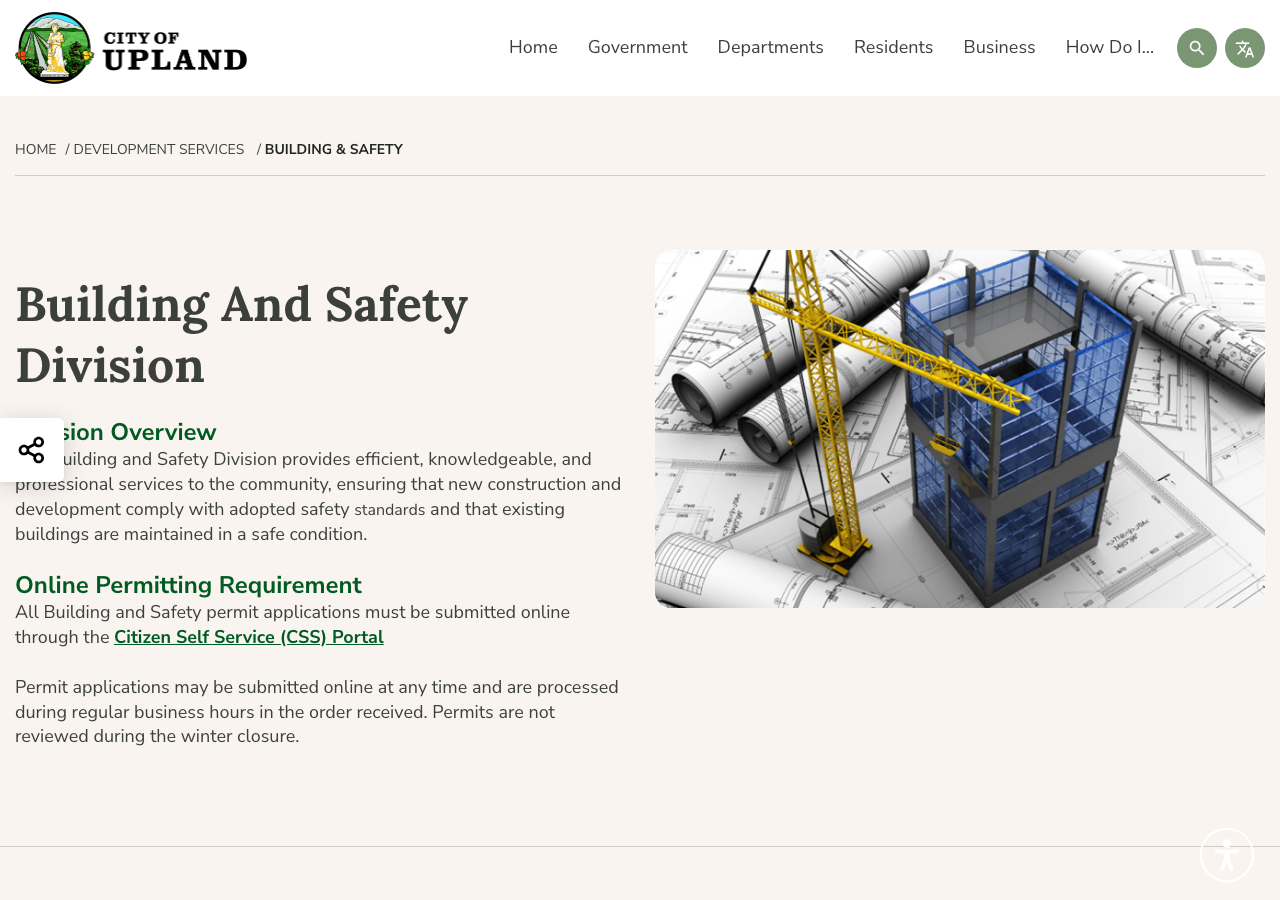
- How many copies, and in what format? Electronic/digital only, single set — the City states 'All Building and Safety permit applications must be submitted online through the Citizen Self Service (CSS) Portal,' with no physical-copy submittal option mentioned. 80% · department page
-
Apply and pay
Most authorities now take the whole application through a portal, and several states cap or constrain what a residential solar permit may cost. Check whether plan check is billed separately before you quote the job.
- Which permit portal does this authority use? Tyler EnerGov 'Citizen Self Service' (CSS) Portal for standard building/electrical permits, at cityofuplandca-energovweb.tylerhost.net/apps/selfservice; SolarAPP+ for eligible single-family/duplex PV (and PV+battery) systems under 38.4 kW 92% · department page
- Can the whole application be completed online? Yes 85% · department page
- What does a residential solar permit cost? $450 flat for a residential system ≤10 kVA (the great majority of residential installs); $770 for 10.1–50 kVA; $1,510 for >50 kVA 88% · fee schedule
- How is the fee calculated? Tiered 88% · fee schedule
- Is there a separate plan-check fee? Possibly — the schedule has a separate 'BUILDING PLAN CHECK FEES: Plan check fee $200.00' line item, but it is not stated whether this applies on top of the tiered PV permit fee or whether the PV fee is inclusive of plan check 55% · fee schedule
-
Plan review — and start the utility in parallel
Interconnection is a separate process from the permit and usually the longer pole. Where the utility does not depend on the permit being issued, running both at once is the single biggest saving available on a residential job.
- How long is an issued permit valid before it expires? 180 days from issuance before expiration if work has not commenced or is suspended/abandoned (standard CBC §105.5 default that Upland has adopted as part of the 2025 California Building Code; not independently restated in Upland-specific text) 55% · department page (inference from adopted code)
- Which utility handles interconnection here? Southern California Edison (SCE) — inference, not independently confirmed by name 45% · inference — utility source gated
28 questions answered against City of Upland’s own published documents
Q1 Is this authority the AHJ for residential solar at this address? Core Jurisdiction & scope
Yes
Why the confidence is not higherCity's own Building and Safety Division page states it issues building permits including a dedicated 'Solar Permit Streamlining' program; fee schedule lists PV permit fees under the City's own Master Fee Schedule.
department page checked 2026-08-30 https://www.uplandca.gov/development_services/building_safety/index.php
Q2 What does this authority permit itself, and what does it delegate? Core Jurisdiction & scope
Both
Why the confidence is not higherBuilding and electrical are both administered and inspected by the City's Building and Safety Division (460 N Euclid Ave); PV and Electrical Permit Issuance fee lines both appear on the City's own current fee schedule. Fire code enforcement is separately handled by San Bernardino County Fire Protection District (see jurisdiction.delegated_to) — not 'delegated' by Upland administratively, but a genuinely separate contracted agency.
department page checked 2026-08-30 https://www.uplandca.gov/development_services/building_safety/index.php
Q3 Is a permit required for a residential rooftop PV system? Core Jurisdiction & scope
Yes
Why the confidence is not higherCity's 'Do I need a Building Permit?' handout lists 'Solar Panels' explicitly among projects requiring a permit.
published handout checked 2026-08-30 https://www.uplandca.gov/Documents/Permits%20and%20Licenses/Building%20and%20Safety%20Forms/Do%20I%20need%20a%20Building%20Permit.pdf
Q4 Is there a separate electrical permit, or is it combined? Core Jurisdiction & scope
Combined
Why the confidence is not higherThe Master Fee Schedule lists a single tiered 'Photovoltaic System (PV)' permit fee line (by kVA size) separate from the generic 'Electrical Permit Issuance Fee' line used for standalone electrical work — implying PV permits are typically pulled as one combined permit covering the electrical scope. Not stated explicitly as a rule anywhere on the City's site, so this is inference from the fee schedule's structure rather than a direct statement.
fee schedule checked 2026-08-30 https://www.uplandca.gov/Documents/Permits%20and%20Licenses/Building%20and%20Safety%20Forms/2026%20Master%20Fee%20Schedule%20(01.13.26)%20-%20Building.pdf
Q5 Who is allowed to pull the electrical permit? Core Who may apply
Either
Why the confidence is not higherThe City's Construction Permit Application form has parallel declaration blocks: 2a for a California Licensed Contractor, 2b for an Owner-Builder — either may pull the permit.
published form checked 2026-08-30 https://www.uplandca.gov/Documents/Permits%20and%20Licenses/Building%20and%20Safety%20Forms/Construction%20Permit%20Application%20(NEW).pdf
Q6 Must the contractor be registered with this authority before applying? Core Who may apply
Nothing published by this authority.
Where we lookedConstruction Permit Application form (2a Contractor declaration asks for CSLB License Class/No. only) and the City's Business License page — found a business-license TAX obligation for anyone (including contractors) doing 1099 work in the city, but no statement that City registration is checked as a precondition before a building/electrical permit is issued.
https://www.uplandca.gov/finance/finance/business_licenses/business_licenses/index.php
Q7 Is a homeowner permitted to self-install and self-permit? Who may apply
Yes
Why the confidence is not higher'Do I need a Building Permit?' handout states 'a home owner (Owner/Builder) can obtain construction permits as well,' and the Construction Permit Application form has a full Owner-Builder declaration section (2b) citing Bus. & Prof. Code §7044.
published handout checked 2026-08-30 https://www.uplandca.gov/Documents/Permits%20and%20Licenses/Building%20and%20Safety%20Forms/Do%20I%20need%20a%20Building%20Permit.pdf
Q8 What documents make up a complete submittal? Core Submittal package
Nothing published by this authority.
Where we lookedBuilding and Safety Forms/Fees/Applications page (full document list reviewed) and the Solar Permit Streamlining page — found a general Residential Addition/Alteration submittal checklist and the SolarAPP+ pathway, but no Upland-specific solar submittal-package checklist.
Q9 How many copies, and in what format? Submittal package
Electronic/digital only, single set — the City states 'All Building and Safety permit applications must be submitted online through the Citizen Self Service (CSS) Portal,' with no physical-copy submittal option mentioned.
Why the confidence is not higherDirect statement on the Building and Safety Division's own current page; does not use the words 'how many copies' but online-only submission implies a single digital set with no paper copies accepted.
department page checked 2026-08-30 https://www.uplandca.gov/development_services/building_safety/index.php
Q10 Is a site plan required, and what must it show? Core Submittal package
Nothing published by this authority.
Where we lookedBuilding and Safety Forms/Fees/Applications page — only a general 'Site Plan-Sample.pdf' and general Submittal Checklist-Residential exist (for additions/alterations); no solar-specific site-plan requirement sheet was found.
Q11 Is a one-line / three-line diagram required? Core Drawings & calculations
Nothing published by this authority.
Where we lookedBuilding and Safety Forms/Fees/Applications page and Solar Permit Streamlining page — no Upland-specific solar submittal checklist naming required drawings (one-line/three-line diagram) was found; SolarAPP+'s own national standard requires one, but that is not an Upland-authored document.
https://www.uplandca.gov/development_services/building_safety/solar_permit_streamlining.php
Q12 Are string and conductor calculations required? Drawings & calculations
Nothing published by this authority.
Where we lookedSame Forms/Fees page and Solar Permit Streamlining page — no Upland-specific document naming string/conductor calculation requirements was found.
Q13 Is a structural PE stamp required, and at what threshold? Core Engineering & stamps
Nothing published by this authority.
Where we lookedSubmittal Checklist - Residential PDF (general remodel/addition checklist, not solar-specific) — found a general 'two or more story buildings require the stamp of a licensed professional' / non-conforming-structure rule, but no solar-specific structural PE stamp threshold.
Q14 Is an electrical PE stamp required, and at what threshold? Engineering & stamps
Nothing published by this authority.
Where we lookedSame Submittal Checklist - Residential PDF and Construction Permit Application form — no electrical PE stamp threshold specific to solar/PV was found.
Q15 What does a residential solar permit cost? Core Fees
$450 flat for a residential system ≤10 kVA (the great majority of residential installs); $770 for 10.1–50 kVA; $1,510 for >50 kVA
Why the confidence is not higherExtracted by OCR (pdftoppm + tesseract; the source PDF is a 27MB image-only 'Print to PDF' export with no text layer) from the City's own Master Fee Schedule, effective 13 Jan 2026 — the current in-force schedule. Table header reads 'Photovoltaic System (PV)' under the BUILDING section.
fee schedule checked 2026-08-30 https://www.uplandca.gov/Documents/Permits%20and%20Licenses/Building%20and%20Safety%20Forms/2026%20Master%20Fee%20Schedule%20(01.13.26)%20-%20Building.pdf
Q16 How is the fee calculated? Core Fees
Tiered
Why the confidence is not higherThree-tier structure by system size in kVA ($450 / $770 / $1,510), read directly off the current Master Fee Schedule via OCR.
fee schedule checked 2026-08-30 https://www.uplandca.gov/Documents/Permits%20and%20Licenses/Building%20and%20Safety%20Forms/2026%20Master%20Fee%20Schedule%20(01.13.26)%20-%20Building.pdf
Q17 Is there a separate plan-check fee? Fees
Possibly — the schedule has a separate 'BUILDING PLAN CHECK FEES: Plan check fee $200.00' line item, but it is not stated whether this applies on top of the tiered PV permit fee or whether the PV fee is inclusive of plan check
Why the confidence is not higherGenuine ambiguity in the source document itself — the $200 plan-check line sits in a general fees section applicable to multiple permit types and the PV tier fee is not labeled as inclusive or exclusive of it.
fee schedule checked 2026-08-30 https://www.uplandca.gov/Documents/Permits%20and%20Licenses/Building%20and%20Safety%20Forms/2026%20Master%20Fee%20Schedule%20(01.13.26)%20-%20Building.pdf
Q18 What is the stated plan-review turnaround? Core Timeline & validity
Nothing published by this authority.
Where we lookedBuilding and Safety Division page and Solar Permit Streamlining page — no stated plan-review turnaround time (in business days) was published on either.
https://www.uplandca.gov/development_services/building_safety/index.php
Q19 How long is an issued permit valid before it expires? Timeline & validity
180 days from issuance before expiration if work has not commenced or is suspended/abandoned (standard CBC §105.5 default that Upland has adopted as part of the 2025 California Building Code; not independently restated in Upland-specific text)
Why the confidence is not higherInferred from the base CBC §105.5 permit-expiration provision that Upland's Building & Safety page states it has adopted (2025 CBC); no Upland-specific page or handout was found stating a different local expiration period.
department page (inference from adopted code) checked 2026-08-30 https://www.uplandca.gov/development_services/building_safety/index.php
Q20 Which permit portal does this authority use? Core Portal & process
Tyler EnerGov 'Citizen Self Service' (CSS) Portal for standard building/electrical permits, at cityofuplandca-energovweb.tylerhost.net/apps/selfservice; SolarAPP+ for eligible single-family/duplex PV (and PV+battery) systems under 38.4 kW
Why the confidence is not higherBoth routes are named directly on the City's own 'Solar Permit Streamlining' and 'Building and Safety' pages.
department page checked 2026-08-30 https://www.uplandca.gov/development_services/building_safety/solar_permit_streamlining.php
Q21 Can the whole application be completed online? Core Portal & process
Yes
Why the confidence is not higher'All Building and Safety permit applications must be submitted online through the Citizen Self Service (CSS) Portal' — application submission is online-only. Note: inspection scheduling is a separate, phone-only process (voicemail line), not done through the portal — see q49.
department page checked 2026-08-30 https://www.uplandca.gov/development_services/building_safety/index.php
Q22 Which utility handles interconnection here? Core Utility interconnection
Southern California Edison (SCE) — inference, not independently confirmed by name
Why the confidence is not higherCould not find a city-name enumeration of Upland in any SCE-published material: SCE's own 'Index of Communities' document (linked from its Tariff Books page) is not a public web page but a SharePoint file gated behind Microsoft OAuth login (confirmed by following the link and receiving a login.microsoftonline.com redirect), and general SCE pages describe the territory only in aggregate ('180 incorporated cities and 15 counties') without naming Upland. Upland's own site (searched via its site search for 'Edison', emergency-preparedness page, and water/utilities page) does not name an electric utility either — Upland runs its own municipal water/sewer but not electric. This value rests on geography (Upland is surrounded by well-documented SCE cities — Rancho Cucamonga, Ontario, Claremont) and on Upland's absence from the California Energy Commission's published list of the state's ~40 publicly-owned electric utilities, neither of which is a city-name enumeration from SCE itself. Confidence capped accordingly per instructions.
inference — utility source gated checked 2026-08-30 https://www.sce.com/regulatory/regulatory-information/tariff-books/index-of-communities
Q23 Where does the utility sit in the sequence? Core Utility interconnection
Nothing published by this authority.
Where we lookedSCE's Rule 21 / interconnection materials — SCE's own 'Index of Communities' link (and by extension its interconnection/DG handbook materials) resolves to a SharePoint document gated behind Microsoft OAuth login (confirmed: following the link produced a login.microsoftonline.com redirect), so the utility's own stated sequence for its Rule 21 process relative to city permitting could not be read.
https://www.sce.com/regulatory/regulatory-information/tariff-books/index-of-communities
Q24 Is a HOA or architectural approval required first? Overlays & special cases
Nothing published by this authority.
Where we lookedZoning Clearance page and General Plan/Zoning Codes & Maps page — no municipal requirement for HOA or architectural-committee approval prior to permit issuance was found (HOA/CC&R approval is typically a private matter between homeowner and HOA in California, not a city permit precondition, but no Upland document was found stating this one way or the other for solar specifically).
https://www.uplandca.gov/development_services/planning/zoning_clearance.php
Q25 Is there a historic-district review? Overlays & special cases
Conditional — Yes, but only for properties within one of the City's 9 locally-designated historic districts or on its local register of over 580 historic/cultural resources; not applicable to the great majority of residential parcels
Why the confidence is not higherCity's Historic Preservation page (own current page) confirms a Historic Preservation Ordinance (adopted 1993), 9 designated historic districts, and a local register. It does not itself spell out a solar-specific review procedure for contributing properties, so the existence of a review requirement for exterior work in those districts is inferred from general historic-preservation-ordinance practice, not quoted procedural text.
department page checked 2026-08-30 https://www.uplandca.gov/development_services/planning/historic_preservation/index.php
Q26 Is a wind or windstorm certification required? Overlays & special cases
No — California does not use a separate wind/windstorm certification process (unlike TDI in Texas); wind loading (Upland: 110 mph, Exposure C) is a structural design parameter built into the adopted California Building Code, not a standalone certificate
Why the confidence is not higherUpland's own Building & Safety page publishes the applicable design wind load/exposure directly under 'Geographic & Code Information,' confirming it is handled as a CBC structural design input rather than a separate certification step; no CA-specific wind certification program exists to check against.
department page checked 2026-08-30 https://www.uplandca.gov/development_services/building_safety/index.php
Q27 Is a Specific Use Permit or Council approval ever required? Overlays & special cases
No
Why the confidence is not higherCA Gov. Code §65850.5 requires ministerial (non-discretionary) review for eligible small residential rooftop solar systems, which precludes a jurisdiction from requiring a CUP/SUP or Council approval for a standard system; no Upland document indicates it requires discretionary approval for residential PV.
inference from state law + department page checked 2026-08-30 https://www.uplandca.gov/development_services/building_safety/solar_permit_streamlining.php
Q28 Is there a system-size cap on residential generation? Overlays & special cases
No hard cap stated; SolarAPP+ streamlined path is available for single-family/duplex PV systems (including battery storage) under 38.4 kW — larger or non-eligible systems route through standard CSS Portal plan review rather than being capped/prohibited
Why the confidence is not higherStated directly on the City's 'Solar Permit Streamlining' page: 'Single-family and duplex PV systems under 38.4 kW qualify' for SolarAPP+, with battery storage includable and 'City permit approval is still required' either way.
department page checked 2026-08-30 https://www.uplandca.gov/development_services/building_safety/solar_permit_streamlining.php
Lines marked with a percentage were read off this authority’s own published documents. Unmarked guidance is general good practice, not this jurisdiction’s rule — always confirm against the authority before you submit.
Install 5 steps · 20 questions
-
Build to the code editions actually in force here
The NEC edition a jurisdiction enforces is often a cycle behind the newest one published, and local amendments sit on top of it. Rapid shutdown, conductor sizing and labelling all change between editions, so the edition in force is the first thing to establish, not the last.
- Which NEC edition is in force? 2023 NEC (via the 2025 California Electrical Code, part of the statewide 2025 Title 24 cycle) — inferred, not independently named by Upland 55% · department page (inference)
- Which building code edition is in force? 2025 California Building Code 92% · department page
- Which fire code edition is in force? 2022 California Fire Code (as amended by San Bernardino County FPD Ordinance No. FPD 23-01) — but flagged as likely stale: SBCoFPD's own current 'Community Safety' page (checked 30 Aug 2026) still labels its 'Important Links' as '2022 California Fire Code' even though the statewide 2025 Title 24 cycle (which would include the 2025 CFC) took effect 1 Jan 2026 elsewhere in the code family 65% · adopting ordinance
- Are there local amendments to any of the above? Yes 82% · adopting ordinance
- What is the installation judged against? The adopted 2025 California Building Code / (inferred 2025) California Electrical Code, and the 2022 California Fire Code as locally amended by SBCoFPD Ord. FPD 23-01 60% · inference from adopted codes
-
Fire access, setbacks and pathways
Ridge setbacks and roof access pathways are fire-service requirements and they constrain the array layout. They are the most common cause of a redesign after the fire department comments on a plan set.
Nothing recorded for City of Upland on this step yet — 1 question checked and found unpublished. The guidance above is general.
-
Rapid shutdown
Which rapid-shutdown rule applies follows directly from the NEC edition in force, and the initiation device has to be at a location the fire service can reach and identify. This is inspected, and it is labelled.
Nothing recorded for City of Upland on this step yet — 1 question checked and found unpublished. The guidance above is general.
-
Labels and placards
The NEC sets a baseline for permanent markings at the service equipment and the disconnecting means. On top of that, an authority may specify its own wording, and the utility may specify more again. Where any of them writes its own text, a generic off-the-shelf label set will not pass — this is the detail most often fixed on a return visit.
Nothing recorded for City of Upland on this step yet — 6 questions checked and found unpublished. The guidance above is general.
-
Disconnect, storage and listed equipment
Where the AC disconnect must sit relative to the meter is usually the utility's rule, not the building department's. Battery storage frequently carries its own permit, its own inspection and its own fire conditions.
- Are batteries permitted, and under what conditions? Yes, batteries/ESS are permitted for residential (R-3) use, regulated under CFC §1207 as referenced by the County's own local amendment; a separate County Fire operational permit is NOT required for R-3 occupancies (see q46) — the system goes through Upland's standard building/electrical permit process instead 82% · adopting ordinance
- Is there a separate ESS permit or inspection? No — R-3 (single-family residential) occupancies are explicitly exempted from San Bernardino County Fire's separate battery/ESS operational permit 90% · adopting ordinance
20 questions answered against City of Upland’s own published documents
Q29 Which NEC edition is in force? Core Code editions in force
2023 NEC (via the 2025 California Electrical Code, part of the statewide 2025 Title 24 cycle) — inferred, not independently named by Upland
Why the confidence is not higherUpland's Building & Safety page names only 'the 2025 CALIFORNIA BUILDING CODE' as adopted; it does not separately name the California Electrical Code. California's Title 24 code family is normally adopted as one package, so the Electrical Code (and thus NEC edition) is inferred to have moved to the 2025 cycle alongside the Building Code, but this was not independently confirmed in an Upland-specific document.
department page (inference) checked 2026-08-30 https://www.uplandca.gov/development_services/building_safety/index.php
Q30 Which building code edition is in force? Core Code editions in force
2025 California Building Code
Why the confidence is not higherStated plainly and currently on the Building & Safety Division's own page: 'The City of Upland has adopted the 2025 CALIFORNIA BUILDING CODE.' Confidence not higher only because the specific local adopting-ordinance section number and effective date were not independently retrieved (eCode360 blocked — see notes below).
department page checked 2026-08-30 https://www.uplandca.gov/development_services/building_safety/index.php
Q31 Which fire code edition is in force? Code editions in force
2022 California Fire Code (as amended by San Bernardino County FPD Ordinance No. FPD 23-01) — but flagged as likely stale: SBCoFPD's own current 'Community Safety' page (checked 30 Aug 2026) still labels its 'Important Links' as '2022 California Fire Code' even though the statewide 2025 Title 24 cycle (which would include the 2025 CFC) took effect 1 Jan 2026 elsewhere in the code family
Why the confidence is not higherOrdinance No. FPD 23-01 (dated March 2023, obtained as a 90-page image-only PDF and read via OCR) explicitly adopts 'the 2022 Edition of the California Fire Code... Part 9 of Title 24.' No newer superseding fire-code ordinance was found on SBCoFPD's Community Safety page as of the check date, and the page's own 'Important Links' section still names the 2022 CFC. Given the base CFC would automatically update statewide regardless of a lagging local-amendment ordinance, the true in-force base edition may already be the 2025 CFC with FPD 23-01's amendments carried forward pending a new ratifying ordinance — this is explicitly flagged as uncertain rather than asserted.
adopting ordinance checked 2026-08-30 https://sbcfire.org/wp-content/uploads/sites/46/2023/05/Ordinance-No.-FPD-23-01.pdf
Q32 Are there local amendments to any of the above? Core Code editions in force
Yes
Why the confidence is not higherSan Bernardino County FPD Ordinance No. FPD 23-01 amends Chapters 1, 2, 3, 4, 5, 9, 11 and 28 of the 2022 CFC (confirmed by direct OCR read of the ordinance text, which is applicable to Upland as a contracting jurisdiction). Whether Upland's own Title 15 (Building Code) carries local amendments on top of the base 2025 CBC could not be independently confirmed because eCode360 (ecode360.com/UP5026) returned HTTP 403 to every access method tried, including the iccsafe.org Referer bypass — Cloudflare bot-challenges the whole site, and Wayback Machine has only 10 total captured URLs for this code (home, index, index?letter=A, laws, and two law PDFs), none reaching Title 15 chapter text.
adopting ordinance checked 2026-08-30 https://sbcfire.org/wp-content/uploads/sites/46/2023/05/Ordinance-No.-FPD-23-01.pdf
Q33 What is the installation judged against? Core Electrical
The adopted 2025 California Building Code / (inferred 2025) California Electrical Code, and the 2022 California Fire Code as locally amended by SBCoFPD Ord. FPD 23-01
Why the confidence is not higherComposite answer built from q29–q32; no single Upland document states this as one sentence.
inference from adopted codes checked 2026-08-30 https://www.uplandca.gov/development_services/building_safety/index.php
Q34 Is there a local rule on service upgrades or busbar sizing? Electrical
Nothing published by this authority.
Where we lookedeCode360 (ecode360.com/UP5026), Title 15 — returned HTTP 403 on every access method tried (direct, iccsafe.org Referer bypass); Wayback Machine has only 10 total captured URLs for this code library, none reaching chapter-level electrical amendment text. No Upland-specific busbar/service-upgrade rule was found in the Building & Safety Forms/Fees documents either.
Q35 Is a specific mounting system or attachment spacing required? Structural & mounting
Nothing published by this authority.
Where we lookedSame eCode360 access attempt (403'd) plus the Submittal Checklist - Residential PDF — no Upland-specific mounting-system or attachment-spacing rule beyond the general 'engineering required if non-conforming' statement was found.
Q36 What ridge setback and access pathways are required? Core Fire pathways & setbacks
Nothing published by this authority.
Where we lookedSBCoFPD Ordinance No. FPD 23-01 was read in full via OCR and confirmed to add/amend only Chapters 1, 2, 3, 4, 5, 9, 11 and 28 of the 2022 CFC — it does not touch Chapter 6 (where CFC §605.11 rooftop-PV access/pathway/ridge-setback provisions live), meaning the base 2022 CFC applies unamended locally. However, the base CFC §605.11 text itself was not independently retrieved and quoted (only the local-amendment ordinance was obtained), so the specific pathway/setback dimensions cannot be stated with confidence.
https://sbcfire.org/wp-content/uploads/sites/46/2023/05/Ordinance-No.-FPD-23-01.pdf
Q37 Is rapid shutdown required, and to which NEC edition? Core Rapid shutdown
Nothing published by this authority.
Where we lookedUpland's Building & Safety page names only the 2025 California Building Code, not the California Electrical Code, and SBCoFPD Ordinance FPD 23-01 is a fire-code (not electrical-code) amendment — no Upland-specific document stating the NEC edition or confirming a local rapid-shutdown amendment was found.
https://www.uplandca.gov/development_services/building_safety/index.php
Q38 Which placards does this authority require at the service equipment? Core Labels Signage & labelling
Nothing published by this authority.
Where we lookedSBCoFire's Community Safety page fully enumerates its Fire Prevention Standards by letter/number (STND A-1 through W-4) — none is solar/PV-specific — and Upland's Building & Safety Forms/Fees page document list (fully reviewed) has no solar placard handout. This is a genuine enumerated absence, not an un-searched gap, but the base 2022 CFC §605.11.1 marking text itself was not independently retrieved to state what applies by default.
Q39 Does the authority specify placard wording of its own? Core Labels Signage & labelling
Nothing published by this authority.
Where we lookedSame Community Safety standards enumeration and Building & Safety Forms page — no Upland- or SBCoFPD-specific placard wording document found.
Q40 Does it specify letter height, colour or material? Core Labels Signage & labelling
Nothing published by this authority.
Where we lookedSame source — no Upland/SBCoFPD-specific letter height, colour or material spec found; base NEC/CFC marking requirements were not independently retrieved to quote as the default.
Q41 Is a site plan / facility map placard required, and what must it show? Core Labels Signage & labelling
Nothing published by this authority.
Where we lookedSame source — no Upland/SBCoFPD-specific site-plan/facility-map placard requirement document found.
Q42 Does the UTILITY specify placards beyond the AHJ's? Core Labels Signage & labelling
Nothing published by this authority.
Where we lookedSCE's Rule 21/DG Interconnection Handbook materials are gated behind a Microsoft OAuth SharePoint login (confirmed via the 'Index of Communities' link redirect), so the utility's own placard requirements beyond the AHJ's could not be read.
https://www.sce.com/regulatory/regulatory-information/tariff-books/index-of-communities
Q43 Where must the labels be placed? Core Labels Signage & labelling
Nothing published by this authority.
Where we lookedSame enumerated absence as q38-41 (SBCoFire standards list + Upland Forms page) — no Upland/SBCoFPD document specifying label placement beyond the (unretrieved) base code text was found.
Q44 Must equipment be on a specific approved list? Equipment listing
Nothing published by this authority.
Where we lookedBuilding & Safety Forms/Fees page and Solar Permit Streamlining page — no equipment-approved-list requirement document found.
Q45 Are batteries permitted, and under what conditions? Core Battery / ESS
Yes, batteries/ESS are permitted for residential (R-3) use, regulated under CFC §1207 as referenced by the County's own local amendment; a separate County Fire operational permit is NOT required for R-3 occupancies (see q46) — the system goes through Upland's standard building/electrical permit process instead
Why the confidence is not higherDirectly read (via OCR) from SBCoFPD Ordinance No. FPD 23-01, new §105.5.4A: 'An operational permit is required for a battery system or electrical energy storage system as regulated by section 1207 of the California Fire Code. Exception: This Section does not apply to systems in R-3 occupancies.'
adopting ordinance checked 2026-08-30 https://sbcfire.org/wp-content/uploads/sites/46/2023/05/Ordinance-No.-FPD-23-01.pdf
Q46 Is there a separate ESS permit or inspection? Battery / ESS
No — R-3 (single-family residential) occupancies are explicitly exempted from San Bernardino County Fire's separate battery/ESS operational permit
Why the confidence is not higherSame §105.5.4A text as q45: 'Exception: This Section does not apply to systems in R-3 occupancies.' Cross-checked against SBCoFPD's own current Fee Schedule (FY2026-27), whose 'Battery System' and 'Commercial Structure-Mounted Photovoltaic System' inspection fee lines are both labeled for commercial/non-R-3 use, with no residential line — consistent with the ordinance's R-3 exemption.
adopting ordinance checked 2026-08-30 https://sbcfire.org/wp-content/uploads/sites/46/2023/05/Ordinance-No.-FPD-23-01.pdf
Q47 Is a ground mount treated as a structure? Core Ground mount
Nothing published by this authority.
Where we lookedeCode360 (403'd, see q34/35) and General Plan/Zoning Codes & Maps page — no Upland-specific statement on whether a ground-mounted PV array is treated as a structure was found.
Q48 Where must the AC disconnect be, relative to the meter? Core Utility equipment
Nothing published by this authority.
Where we lookedSCE's Rule 21/DG Interconnection Handbook materials are gated behind Microsoft OAuth SharePoint login (same finding as q22/q23/q42) — AC-disconnect-to-meter placement is normally specified there, and it could not be read.
https://www.sce.com/regulatory/regulatory-information/tariff-books/index-of-communities
Lines marked with a percentage were read off this authority’s own published documents. Unmarked guidance is general good practice, not this jurisdiction’s rule — always confirm against the authority before you submit.
Inspection 5 steps · 14 questions
-
Book it
Booking is a portal, a phone call or an email depending on the authority, and the notice required is rarely zero. Book before the work is finished rather than after — the lead time, not the work, is usually what sets the date.
- How is an inspection booked? Phone 90% · department page
- How much notice is required? 1 business day (requests must be received by 4:00 p.m. on the business day prior to the requested inspection date) 90% · department page
- Are same-day or AM/PM windows offered? AM or PM request offered, but 'inspection times are not guaranteed and confirmations are not provided' 85% · department page
-
Know who turns up
Some authorities inspect their own solar work; some delegate it, and a few do not inspect the PV equipment itself at all. Who is coming determines what they will look at.
- Does this AHJ perform its own final solar inspection? Yes 80% · department page
- If delegated, to whom? N/A — not delegated; Upland's own Building and Safety Division performs the final inspection (see q52) 75% · department page
-
Work the stages in order
A rough-in or mid-roof inspection, where one is required, has to happen before the work it covers is closed up. Missing a stage means opening something back up, and it is the most expensive kind of correction.
Nothing recorded for City of Upland on this step yet — 2 questions checked and found unpublished. The guidance above is general.
-
Have the paperwork on site
The approved plan set, the permit, and the equipment listings should be on site and reachable. Inspectors routinely verify that installed equipment matches what was approved, and that the labels are the ones the plan set promised.
- What must be on site at inspection? Permit card and approved permit plans (both downloadable via the applicant's CSS Portal account) 90% · department page
-
Sign-off, and permission to operate
Passing gives you a final or an equivalent sign-off. That is not the same as permission to operate: PTO comes from the utility, and who tells the utility the inspection passed varies. A system left switched off for weeks is usually waiting on this handover.
- What is issued on pass? Final (inspection sign-off on the permit card / CSS Portal record) — a rooftop PV retrofit on an existing home would not typically generate a new Certificate of Occupancy 50% · department page (inference)
- Is there a re-inspection fee? $220 80% · fee schedule
14 questions answered against City of Upland’s own published documents
Q49 How is an inspection booked? Core Booking & scheduling
Phone
Why the confidence is not higher'Inspection Scheduling is currently being processed through the Inspection Voicemail Line Only' — City's own Inspections page, current.
department page checked 2026-08-30 https://www.uplandca.gov/development_services/building_safety/schedule_inspection.php
Q50 How much notice is required? Core Booking & scheduling
1 business day (requests must be received by 4:00 p.m. on the business day prior to the requested inspection date)
Why the confidence is not higherStated directly and currently on the City's Inspections page.
department page checked 2026-08-30 https://www.uplandca.gov/development_services/building_safety/schedule_inspection.php
Q51 Are same-day or AM/PM windows offered? Booking & scheduling
AM or PM request offered, but 'inspection times are not guaranteed and confirmations are not provided'
Why the confidence is not higherDirect quote from the City's Inspections page instructions on what to provide when calling the voicemail line.
department page checked 2026-08-30 https://www.uplandca.gov/development_services/building_safety/schedule_inspection.php
Q52 Does this AHJ perform its own final solar inspection? Core Who inspects
Yes
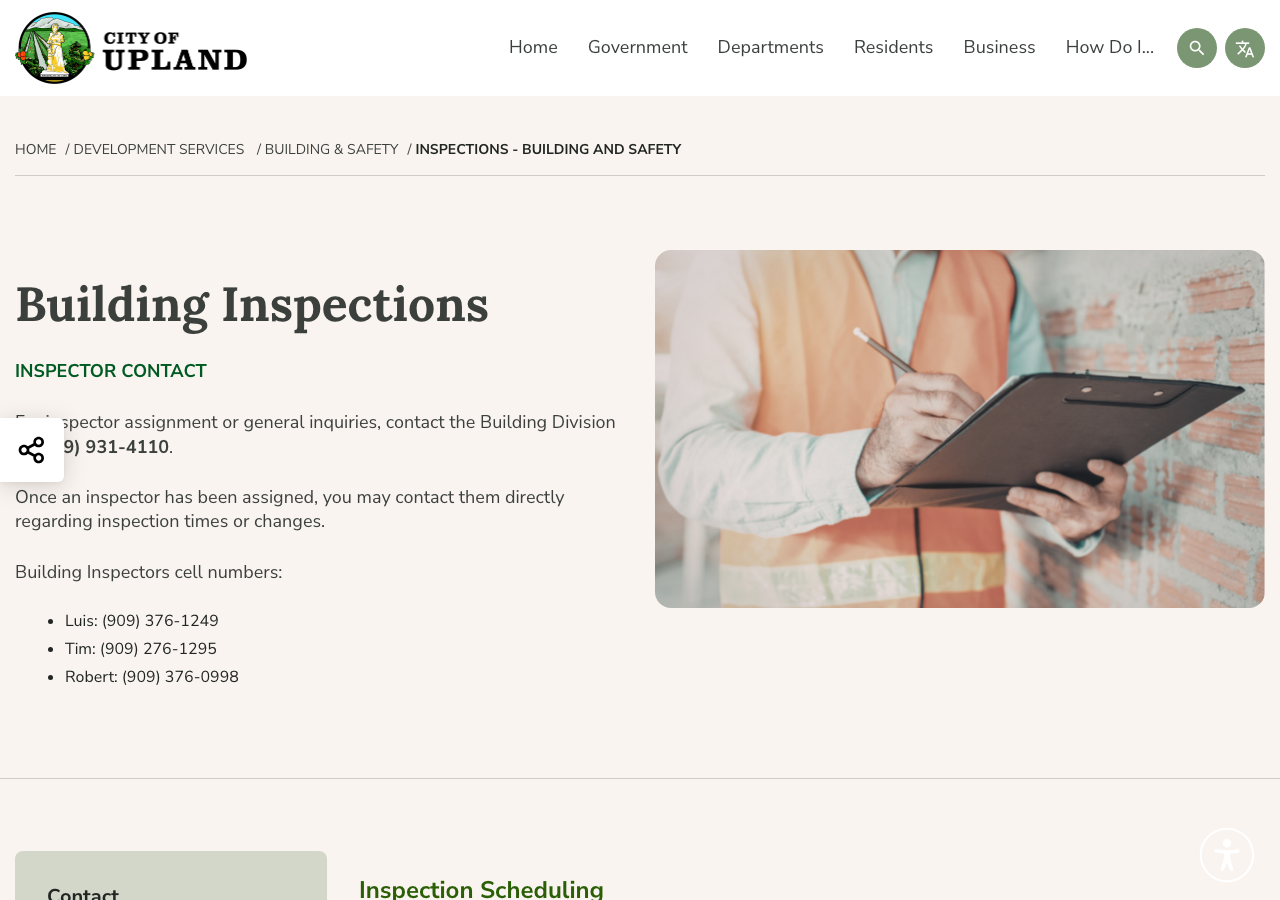
Why the confidence is not higherThe City's own Inspections page names its Building Division inspectors (Luis, Tim, Robert) with direct cell numbers for building-permit inspections; no indication that solar final inspections are routed to a different agency for standard R-3 systems (County Fire's own fee schedule has no residential PV/battery inspection line, consistent with fire not separately inspecting standard rooftop residential solar — see q45/46).
department page checked 2026-08-30 https://www.uplandca.gov/development_services/building_safety/schedule_inspection.php
Q53 If delegated, to whom? Core Who inspects
N/A — not delegated; Upland's own Building and Safety Division performs the final inspection (see q52)
Why the confidence is not higherConsistent with q52's evidence; no delegation to County Fire found for standard residential PV final sign-off.
department page checked 2026-08-30 https://www.uplandca.gov/development_services/building_safety/schedule_inspection.php
Q54 Which inspections are required, and in what order? Core Stages & sequence
Nothing published by this authority.
Where we lookedCity's Inspections page (schedule_inspection.php) — describes how to book an inspection but does not enumerate a solar-specific sequence of required inspections.
https://www.uplandca.gov/development_services/building_safety/schedule_inspection.php
Q55 Is a rough-in or mid-roof inspection required? Stages & sequence
Nothing published by this authority.
Where we lookedSame Inspections page — no statement on whether a rough-in/mid-roof inspection is required for PV specifically.
https://www.uplandca.gov/development_services/building_safety/schedule_inspection.php
Q56 Does the inspector verify labels and listings? Core What is checked
Nothing published by this authority.
Where we lookedSame Inspections page — does not state what the inspector checks (labels/listings) at a solar final.
https://www.uplandca.gov/development_services/building_safety/schedule_inspection.php
Q57 Is there a published inspection checklist? Core What is checked
Nothing published by this authority.
Where we lookedBuilding & Safety Forms/Fees/Applications page (full document list reviewed) — no published solar-specific inspection checklist was found among the listed PDFs.
Q58 What must be on site at inspection? Core Documents on site
Permit card and approved permit plans (both downloadable via the applicant's CSS Portal account)
Why the confidence is not higherDirect statement on the City's Inspections page: 'Have the following available at the job site: Permit card, Approved permit plans. Both documents are available for download through your CSS Portal account.'
department page checked 2026-08-30 https://www.uplandca.gov/development_services/building_safety/schedule_inspection.php
Q59 Is there a re-inspection fee? Corrections & re-inspection
$220
Why the confidence is not higher'Building Re-inspection Fee Each $220.00' — read via OCR from the City's current (13 Jan 2026) Master Fee Schedule. This is the general building re-inspection fee; no PV-specific re-inspection line was found, so it is applied by inference to solar re-inspections as well.
fee schedule checked 2026-08-30 https://www.uplandca.gov/Documents/Permits%20and%20Licenses/Building%20and%20Safety%20Forms/2026%20Master%20Fee%20Schedule%20(01.13.26)%20-%20Building.pdf
Q60 How are corrections issued and cleared? Corrections & re-inspection
Nothing published by this authority.
Where we lookedCity's Inspections page — describes booking and job-site prep but not how corrections are issued/cleared after a failed inspection.
https://www.uplandca.gov/development_services/building_safety/schedule_inspection.php
Q61 What is issued on pass? Core Final sign-off & PTO
Final (inspection sign-off on the permit card / CSS Portal record) — a rooftop PV retrofit on an existing home would not typically generate a new Certificate of Occupancy
Why the confidence is not higherInferred from general California residential-permit practice and the fact that the City's documents refer to 'Permit card' and 'Certificate of Inspection' as the closing artifacts for standard permits; no Upland document was found stating explicitly what is issued specifically on a passed solar final.
department page (inference) checked 2026-08-30 https://www.uplandca.gov/development_services/building_safety/certificate_of_inspection.php
Q62 Who notifies the utility for PTO? Core Final sign-off & PTO
Nothing published by this authority.
Where we lookedSCE's interconnection/PTO materials are gated behind Microsoft OAuth SharePoint login (same finding as q22/23/42/48), and Upland's Solar Permit Streamlining page is silent on who submits the PTO request to the utility.
https://www.sce.com/regulatory/regulatory-information/tariff-books/index-of-communities
Lines marked with a percentage were read off this authority’s own published documents. Unmarked guidance is general good practice, not this jurisdiction’s rule — always confirm against the authority before you submit.
Jurisdiction & key facts
The standing 62-question set, answered for City of Upland against this authority’s own published documents. Every answer carries the confidence it was recorded at and the document it came from. Where nothing is published we say so and show where we looked — a blank here is a finding, not a gap.
City of Upland is the authority having jurisdiction 92% confidence
- Holds
- Building and Electrical (both self-performed by the City's Building and Safety Division; single permit process, online-only via Tyler EnerGov Citizen Self Service or SolarAPP+)
- Delegated to
- San Bernardino County Fire Protection District (SBCoFPD) — fire code adoption, plan review and enforcement citywide, effective 22 Jul 2017 (confirmed on Upland's own Fire page and independently in SBCoFPD Ordinance No. FPD 23-01's applicability clause, which names political subdivisions that contract with the District under Health & Safety Code §13869.7). Upland has no fire department of its own.
- Overridden by
- CA Gov. Code §65850.5 (mandates ministerial, non-discretionary review for small residential rooftop solar, so Upland cannot require a CUP/SUP for a qualifying system); SBCoFPD's own local fire-code amendment (Ord. FPD 23-01, §105.5.4A) exempts R-3 (single-family residential) occupancies from the District's separate battery/ESS operational permit
- Why not higher
- Upland's Building & Safety Division page (own current site) names itself as the permitting authority for building/electrical and explicitly separately identifies 'San Bernardino County Fire' as the emergency-services department, with the Fire page stating fire protection has been provided by SBCoFPD since 22 Jul 2017. This was cross-checked against SBCoFPD's own Ordinance No. FPD 23-01 PDF (read via OCR), whose applicability section extends the County Fire Code to 'political subdivisions...that contract with the San Bernardino County Fire Protection District' pursuant to H&S Code §13869.7 — directly confirming Upland is covered, not just adjacent. This is a genuine annexed/contracted-fire city as flagged in the brief.
Check the code edition before you build
This authority's published code edition does not match what the state has adopted. That usually means the authority's ordinance has not been updated for the current cycle — but a local amendment can also be lawful. Confirm with the building department before you submit.
- Permit required
- Yes95%
- Permit cost
- $450 flat for a residential system ≤10 kVA (the great majority of residential installs); $770 for 10.1–50 kVA; $1,510 for >50 kVA88%
- Portal
- Tyler EnerGov 'Citizen Self Service' (CSS) Portal for standard building/electrical permits, at cityofuplandca-energovweb.tylerhost.net/apps/selfservice;92%
- Electrical code
- 2023 NEC (via the 2025 California Electrical Code, part of the statewide 2025 Title 24 cycle) — inferred, not independently named by Upland55%
- Booking an inspection
- Phone90%
Labels & placards for this authority
Wording None%
Size, colour & material None%
Where they go None%
What the utility wants on top None%
Each figure above is sourced and dated in the full answer set below (questions 38–43). Where an authority’s own published sheet is older than the code it has adopted, the answer says so.
Their website
Average approval time — application to PTO
From the CPUC interconnection record. Bars show the average days taken each year; a year with no recorded projects is left blank rather than drawn as zero.