
City of Walnut
Los Angeles County
City of Walnut is a city authority in the State of California, serving 28,430 residents. 2,731 residential solar installs are on record here. This page is the permit route for that jurisdiction: the fifteen steps from working out who has a say over an address through to permission to operate, the documents this authority publishes, and 62 answers taken from those documents and dated.
Permitting 5 steps · 28 questions
Whether a permit is needed — Yes Q3 Electrical and building permits — Separate Q4 Where you file — No dedicated online portal — paper application filed by mail or in person at Walnut City Hall Q20
- Permit required
- Yes95% source
- What it costs
- Residential: Plan Check $162.00, Permit $249.00 (base $194.20 + $54.80), Electrical $70.65 (+$57.60 if a meter/panel upgrade is needed), plus S.M.I.55% source
- Key document
- municipal code cited by 7 open the document
-
Confirm who has a say over your address
A city address is usually permitted by the city, not the county — but not always, and some authorities keep building and hand electrical to someone else. Getting this wrong costs the whole submittal, because every requirement below belongs to whoever actually holds jurisdiction. Check the overlays in the same pass: an HOA, a historic district, a windstorm certification or a system-size cap can reshape the design, and all of them are cheaper to find now than after the array is laid out.
- Is this authority the AHJ for residential solar at this address? Yes 95% · municipal code
- What does this authority permit itself, and what does it delegate? Both (in-house) 88% · municipal code
- Is a permit required for a residential rooftop PV system? Yes 95% · municipal code
- Is there a separate electrical permit, or is it combined? Separate 85% · fee schedule
- Is a HOA or architectural approval required first? No — and the City is barred from conditioning approval on one 95% · municipal code
- Is there a historic-district review? Only for City-designated historical landmarks/resources, via an ad-hoc committee — not a blanket district 65% · municipal code
- Is a Specific Use Permit or Council approval ever required? Yes, conditionally — a Use Permit may be required if the Building Official finds a 'specific, adverse impact' on public health/safety; appealable to the Planning Commission 90% · municipal code
- Is there a system-size cap on residential generation? 10 kW AC nameplate / 30 kW thermal, AND installed on a single- or duplex-family dwelling only (an eligibility gate for the expedited/ministerial path, not an absolute prohibition above it) 92% · municipal code
-
Check who is allowed to apply
Several authorities require the electrical permit to be pulled by a licensed electrician, or require the contractor to be registered with them BEFORE applying. Registration is not same-day. This is second on the list rather than fourth because it is the step most likely to stop the job before the drawings matter.
- Who is allowed to pull the electrical permit? Either (licensed contractor or owner-builder) 70% · permit application form
- Must the contractor be registered with this authority before applying? Yes (city business license, not a separate Building-Division registration) 65% · municipal code
- Is a homeowner permitted to self-install and self-permit? Yes 75% · permit application form
-
Build the submittal package
Almost everywhere wants a site plan, a one-line or three-line electrical diagram, equipment cut sheets with listings, and a structural attachment detail. Build it against the published checklist rather than the last jurisdiction you worked in — the checklist is what the reviewer marks against.
- What documents make up a complete submittal? A completed City building-permit application (paper 'carbon form'), the electrical-permit application, and the applicable fee — filed by mail or in person; WMC §2.36.040.D also directs the Building & Safety Division to adopt 'a standard plan and checklist' substantially conforming to the state Solar Permitting Guidebook, but no separate published checklist/standard-plan PDF could be located on the City's site (only the two generic permit-application forms and the fee schedule are linked from the solar page). 55% · department page (Wayback capture)
- How many copies, and in what format? Paper submittal only 70% · department page (Wayback capture)
-
Apply and pay
Most authorities now take the whole application through a portal, and several states cap or constrain what a residential solar permit may cost. Check whether plan check is billed separately before you quote the job.
- Which permit portal does this authority use? No dedicated online portal — paper application filed by mail or in person at Walnut City Hall 80% · municipal code
- Can the whole application be completed online? No 78% · municipal code
- What does a residential solar permit cost? Residential: Plan Check $162.00, Permit $249.00 (base $194.20 + $54.80), Electrical $70.65 (+$57.60 if a meter/panel upgrade is needed), plus S.M.I. (0.00013 x valuation) and Building Fund ($1/$25,000 valuation) fees 55% · fee schedule (dated; superseded basis)
- How is the fee calculated? Flat (base building + electrical fee) plus Valuation-based add-ons (S.M.I. and Building-Fund fee) — but the City's Ord. 25-07 (2025) re-based all building fees to '2x the county fee' and electrical fees to '1.5x the county fee,' so the operative calculation is now a County-fee multiplier, not the flat 2016 numbers themselves. 60% · municipal code + fee schedule
- Is there a separate plan-check fee? Yes 65% · fee schedule (dated)
-
Plan review — and start the utility in parallel
Interconnection is a separate process from the permit and usually the longer pole. Where the utility does not depend on the permit being issued, running both at once is the single biggest saving available on a residential job.
- Which utility handles interconnection here? Southern California Edison Co. 92% · city department page
28 questions answered against City of Walnut’s own published documents
Q1 Is this authority the AHJ for residential solar at this address? Core Jurisdiction & scope
Yes
Why the confidence is not higherWMC Ch. 2.36 (Solar Energy Systems and Inspections) makes the City's own Building Division the reviewing/issuing authority for small residential rooftop PV; the City's Building & Safety Division page confirms it processes solar permits in-house.
municipal code checked 2026-08-31 https://ecode360.com/44204853
Q2 What does this authority permit itself, and what does it delegate? Core Jurisdiction & scope
Both (in-house)
Why the confidence is not higherWMC Ch. 2.04/2.08 adopt the LA County Building Code and LA County Electrical Code by reference as the City's own codes, with 'Building Official' and 'Chief Electrical Inspector' both defined as City of Walnut officials (not a named outside firm). LACoFD separately retains ESS>3kWh, a BIPV subcategory, and disconnect placarding per its own guide regardless of city delegation. No outside plan-check/inspection firm (e.g. Willdan, Transtech) is named anywhere on the city's Building & Safety pages or in the code text, unlike neighboring La Puente/Temple City — treated as in-house at moderate-high confidence since a named individual behind the title could not be retrieved from the city's AJAX-driven staff directory in this run.
municipal code checked 2026-08-31 https://ecode360.com/44204496
Q3 Is a permit required for a residential rooftop PV system? Core Jurisdiction & scope
Yes
Why the confidence is not higherWMC §2.36.020 applies the permitting chapter to all small residential rooftop solar energy systems, and the Building Division issues a building permit under §2.36.050.A.
municipal code checked 2026-08-31 https://ecode360.com/44204853
Q4 Is there a separate electrical permit, or is it combined? Core Jurisdiction & scope
Separate
Why the confidence is not higherThe City publishes two distinct application forms — 'Building Permit' and 'Electrical Permit' — and the fee PDF lists a separate Building Permit line ($249) and a separate Electrical line ($70.65); WMC Ch. 2.04 (building) and Ch. 2.08 (electrical) are also separately adopted chapters with independent fee multipliers (2x vs 1.5x county fee).
fee schedule checked 2026-08-31 https://www.walnutca.gov/files/assets/walnut/v/1/cd/documents/building-amp-safety-division/new-folder/solar-system-fees.pdf
Q5 Who is allowed to pull the electrical permit? Core Who may apply
Either (licensed contractor or owner-builder)
Why the confidence is not higherThe City's generic Building Permit application (2016, image-only PDF, OCR'd) carries a standard California 'Owner-Builder Declaration' under B&P Code §7044/§7031.5 alongside a 'California Licensed Contractor's Declaration' — either a State-licensed contractor or the property owner as owner-builder may sign and pull the permit; WMC does not add a stricter local rule.
permit application form checked 2026-08-31 https://www.walnutca.gov/files/assets/walnut/v/1/cd/documents/building-amp-safety-division/new-folder/bldg-permit-application.pdf
Q6 Must the contractor be registered with this authority before applying? Core Who may apply
Yes (city business license, not a separate Building-Division registration)
Why the confidence is not higherWMC §4.08.130 requires every contractor 'conducting, carrying on or engaged in the business of general contractor or builder' within the City to pay an annual City business license tax (Class A/B-1: $75 + $2.50/employee) — a city-side registration/tax obligation distinct from state CSLB licensure. No separate pre-registration with the Building Division itself was found.
municipal code checked 2026-08-31 https://ecode360.com/WA5028
Q7 Is a homeowner permitted to self-install and self-permit? Who may apply
Yes
Why the confidence is not higherSame Owner-Builder Declaration on the City's building permit application allows a property owner to self-perform and sign as owner-builder under B&P Code §7044, subject to the standard state exemptions/limits (not intended for sale, etc.); WMC Ch. 2.36 does not restrict this for solar.
permit application form checked 2026-08-31 https://www.walnutca.gov/files/assets/walnut/v/1/cd/documents/building-amp-safety-division/new-folder/bldg-permit-application.pdf
Q8 What documents make up a complete submittal? Core Submittal package
A completed City building-permit application (paper 'carbon form'), the electrical-permit application, and the applicable fee — filed by mail or in person; WMC §2.36.040.D also directs the Building & Safety Division to adopt 'a standard plan and checklist' substantially conforming to the state Solar Permitting Guidebook, but no separate published checklist/standard-plan PDF could be located on the City's site (only the two generic permit-application forms and the fee schedule are linked from the solar page).
Why the confidence is not higherThe mandated standard-plan/checklist document required by §2.36.040.D was not found published; the City's own (Wayback-captured, since the live URL now 404s) solar page links only the generic Building/Electrical permit forms and the fee PDF, all dated 2016.
department page (Wayback capture) checked 2026-08-31 http://web.archive.org/web/20251030121900/https://www.walnutca.gov/For-Residents/Departments/Community-Development/Building-Safety-Division/Solar-Energy-Systems-And-Inspections
Q9 How many copies, and in what format? Submittal package
Paper submittal only
Why the confidence is not higherThe City's solar page describes the applications as 'actual carbon form to be filled out at City Hall,' and WMC §2.36.050.C states applications are processed 'through either mail and/or in person (over-the-counter)' with payment accepted only as 'cash, check, or money order' — no online portal or specified copy count.
department page (Wayback capture) checked 2026-08-31 http://web.archive.org/web/20251030121900/https://www.walnutca.gov/For-Residents/Departments/Community-Development/Building-Safety-Division/Solar-Energy-Systems-And-Inspections
Q10 Is a site plan required, and what must it show? Core Submittal package
Nothing published by this authority.
Where we lookedWMC Ch. 2.36 and the Building & Safety Division page/solar page (Wayback capture) — no site-plan content requirement specific to rooftop PV was stated beyond the generic 'complete application' language.
Q11 Is a one-line / three-line diagram required? Core Drawings & calculations
Nothing published by this authority.
Where we lookedWMC Ch. 2.36 and the two generic (image-only, no-text-layer) permit-application PDFs — no one-line/three-line diagram requirement stated in the codified solar chapter itself.
Q12 Are string and conductor calculations required? Drawings & calculations
Nothing published by this authority.
Where we lookedSame as Q11 — WMC Ch. 2.36 does not itemize drawing/calculation contents; presumably governed by the state Solar Permitting Guidebook standard checklist the City says it substantially conforms to (§2.36.040.E), which is not separately published on the City's site.
Q13 Is a structural PE stamp required, and at what threshold? Core Engineering & stamps
Nothing published by this authority.
Where we lookedWMC Ch. 2.04 (County Building Code amendments) — no PV-specific structural PE-stamp threshold found; only a generic expansive-soil/foundation amendment (§2.04.030.J) unrelated to solar.
Q14 Is an electrical PE stamp required, and at what threshold? Engineering & stamps
Nothing published by this authority.
Where we lookedWMC Ch. 2.08 (County Electrical Code amendments) — only an aluminum-wiring amendment (§2.08.030.B) was found; no PV-specific electrical PE-stamp threshold.
Q15 What does a residential solar permit cost? Core Fees
Residential: Plan Check $162.00, Permit $249.00 (base $194.20 + $54.80), Electrical $70.65 (+$57.60 if a meter/panel upgrade is needed), plus S.M.I. (0.00013 x valuation) and Building Fund ($1/$25,000 valuation) fees
Why the confidence is not higherFigures are from the City's own posted 'Solar System Fees' PDF, but pdfinfo shows it was created/modified in 2016 and never updated. WMC §2.04.060 (as amended by Ord. 25-07, 12/10/2025) now sets ALL building fees at 'twice the amount charged for the same services and permits by the County,' and §2.08.040 sets electrical fees at '1.5x' the County's — so the current dollar figure is legally indexed to LA County's current fee schedule, not this static 2016 sheet; the County-indexed current dollar amount could not be independently confirmed in this run.
fee schedule (dated; superseded basis) checked 2026-08-31 https://www.walnutca.gov/files/assets/walnut/v/1/cd/documents/building-amp-safety-division/new-folder/solar-system-fees.pdf
Q16 How is the fee calculated? Core Fees
Flat (base building + electrical fee) plus Valuation-based add-ons (S.M.I. and Building-Fund fee) — but the City's Ord. 25-07 (2025) re-based all building fees to '2x the county fee' and electrical fees to '1.5x the county fee,' so the operative calculation is now a County-fee multiplier, not the flat 2016 numbers themselves.
Why the confidence is not higherWMC §2.04.060 and §2.08.040 (fee-calculation amendments) read alongside the 2016 fee PDF's own line items (flat permit/plan-check lines plus a per-$25,000-valuation Building Fund fee).
municipal code + fee schedule checked 2026-08-31 https://ecode360.com/44204496
Q17 Is there a separate plan-check fee? Fees
Yes
Why the confidence is not higherThe City's own (2016) Solar System Fees PDF lists a separate 'Plan Check $162.00' line distinct from the 'Permit $249.00' line.
fee schedule (dated) checked 2026-08-31 https://www.walnutca.gov/files/assets/walnut/v/1/cd/documents/building-amp-safety-division/new-folder/solar-system-fees.pdf
Q18 What is the stated plan-review turnaround? Core Timeline & validity
Nothing published by this authority.
Where we lookedWMC Ch. 2.36 (§2.36.050.C: application 'will be processed in a timely manner') and the Building & Safety Division page — no numeric business-day turnaround is stated anywhere found.
Q19 How long is an issued permit valid before it expires? Timeline & validity
Nothing published by this authority.
Where we lookedWMC Ch. 2.04/2.36 — no locally-amended permit-expiration/validity period found; presumably falls to whatever expiration period is in the adopted LA County/California Building Code §105.5, which was not independently pulled in this run.
Q20 Which permit portal does this authority use? Core Portal & process
No dedicated online portal — paper application filed by mail or in person at Walnut City Hall
Why the confidence is not higherWMC §2.36.050.C: applications are processed 'through either mail and/or in person (over-the-counter)', payment accepted only as 'cash, check, or money order.' No SolarAPP+, Citizen Access, Accela, or other permit-portal link was found on the Community Development, Building & Safety, or (Wayback) solar pages.
municipal code checked 2026-08-31 https://ecode360.com/44204853
Q21 Can the whole application be completed online? Core Portal & process
No
Why the confidence is not higherWMC §2.36.040.B requires that 'electronic submittal... by email, internet, or facsimile' of documents be made available, and §2.36.050.C requires payment 'through either mail and/or in person' accepting only cash/check/money order — so even though document submittal may be electronic, the process cannot be completed fully online (no online payment or portal found). This is an internal tension in the City's own materials worth noting: the code promises electronic submittal while the live (2016-era) practice described on the solar page is a paper 'carbon form... at City Hall.'
municipal code checked 2026-08-31 https://ecode360.com/44204853
Q22 Which utility handles interconnection here? Core Utility interconnection
Southern California Edison Co.
Why the confidence is not higherThe City's own 'Utilities' page lists 'Electric: Southern California Edison Co.' with a phone number, directly confirming the brief's SCE hint from a city-side (not PowerToChoose) source.
city department page checked 2026-08-31 https://www.walnutca.gov/For-Residents/Community-Resources/Utilities
Q23 Where does the utility sit in the sequence? Core Utility interconnection
Nothing published by this authority.
Where we lookedSCE's own DG/interconnection pages soft-404 consistently (a known pattern per prior CA runs); WMC §2.36.050.D only states that City approval 'does not authorize' grid connection and that utility approval must be separately obtained by the applicant — it does not state whether that runs before, after, or parallel to the City permit.
https://www.sce.com/business/generating-your-own-power/interconnections
Q24 Is a HOA or architectural approval required first? Overlays & special cases
No — and the City is barred from conditioning approval on one
Why the confidence is not higherWMC §2.36.050.H, copying Civil Code §4600/§714 (Solar Rights Act) language verbatim: 'A city...shall not condition approval of an application on the approval of an association.' No HOA/architectural-review requirement is codified anywhere in Title 6 (no 'homeowners association' or 'architectural committee' hits found).
municipal code checked 2026-08-31 https://ecode360.com/44204853
Q25 Is there a historic-district review? Overlays & special cases
Only for City-designated historical landmarks/resources, via an ad-hoc committee — not a blanket district
Why the confidence is not higherWMC Ch. 6.104 (Historical Preservation) applies only 'to all designated historical resources within the City of Walnut' (§6.104.030) and routes permit applications affecting a *designated* landmark through a Historical Preservation ad-hoc advisory committee (§6.104.050.C). No PV-specific exemption or trigger is stated either way, and a typical residential PV retrofit would not reach this chapter unless the specific home is a designated resource.
municipal code checked 2026-08-31 https://ecode360.com/44203835
Q26 Is a wind or windstorm certification required? Overlays & special cases
Nothing published by this authority.
Where we lookedSearched WMC Title 2 (Buildings) for a windstorm/wind-certification requirement (as seen in TDI states); none found — California's building code administers wind loading through ASCE 7 in the adopted CBC rather than a separate windstorm certification, but no explicit statement either way was located for solar specifically.
Q27 Is a Specific Use Permit or Council approval ever required? Overlays & special cases
Yes, conditionally — a Use Permit may be required if the Building Official finds a 'specific, adverse impact' on public health/safety; appealable to the Planning Commission
Why the confidence is not higherWMC §2.36.050.A and .E: the Building Official 'may require an applicant to apply for a use permit' only on written findings of specific, adverse impact per the Solar Rights Act standard, and denials/use-permit decisions 'may be appealed to the Walnut Planning Commission.'
municipal code checked 2026-08-31 https://ecode360.com/44204853
Q28 Is there a system-size cap on residential generation? Overlays & special cases
10 kW AC nameplate / 30 kW thermal, AND installed on a single- or duplex-family dwelling only (an eligibility gate for the expedited/ministerial path, not an absolute prohibition above it)
Why the confidence is not higherWMC §2.36.030 'Small residential rooftop solar energy systems' definition — the AB 2188-era 10kW AC/30kW-thermal figure, scoped explicitly to single- or duplex-family dwellings (same scope-limited shape as West Hollywood/Los Gatos). Systems above this or on other building types are not barred but fall outside Ch. 2.36's expedited/ministerial process.
municipal code checked 2026-08-31 https://ecode360.com/44204853
Lines marked with a percentage were read off this authority’s own published documents. Unmarked guidance is general good practice, not this jurisdiction’s rule — always confirm against the authority before you submit.
Install 5 steps · 20 questions
-
Build to the code editions actually in force here
The NEC edition a jurisdiction enforces is often a cycle behind the newest one published, and local amendments sit on top of it. Rapid shutdown, conductor sizing and labelling all change between editions, so the edition in force is the first thing to establish, not the last.
- Which NEC edition is in force? 2023 NEC (inferred via the 2025 California Electrical Code) 70% · municipal code (adoption clause) + inference
- Which building code edition is in force? 2026 Edition of the LA County Building Code, based on the 2024 International Building Code (LA County Ordinance No. 25-5683, effective 1 Jan 2026) — i.e., the 2025 California Building Code cycle 90% · municipal code
- Which fire code edition is in force? 2023 Los Angeles County Fire Code (LACFC), based on the adopted sections of the 2022 California Fire Code plus unadopted 2021 International Fire Code sections (County Ordinance No. 23-0008) — lagging the 2025/2026 building-code cycle 90% · municipal code
- Are there local amendments to any of the above? Yes 95% · municipal code
- What is the installation judged against? The LA County Building Code, Electrical Code, and Fire Code as adopted by reference (WMC Chs. 2.04, 2.08, 3.16) plus the City's own local amendments in those same chapters, and — for the expedited small-residential path — WMC Ch. 2.36's own standards (UL/IEEE-listed equipment, CPUC safety/reliability rules, and conformance to CBC/CRC/CEC/CFC as adopted). 88% · municipal code
-
Fire access, setbacks and pathways
Ridge setbacks and roof access pathways are fire-service requirements and they constrain the array layout. They are the most common cause of a redesign after the fire department comments on a plan set.
Nothing recorded for City of Walnut on this step yet — 1 question checked and found unpublished. The guidance above is general.
-
Rapid shutdown
Which rapid-shutdown rule applies follows directly from the NEC edition in force, and the initiation device has to be at a location the fire service can reach and identify. This is inspected, and it is labelled.
- Is rapid shutdown required, and to which NEC edition? Yes, required — via whichever NEC edition is incorporated by the current wholesale adoption (inferred 2023 NEC / Art. 690.12) 65% · municipal code + inference
-
Labels and placards
The NEC sets a baseline for permanent markings at the service equipment and the disconnecting means. On top of that, an authority may specify its own wording, and the utility may specify more again. Where any of them writes its own text, a generic off-the-shelf label set will not pass — this is the detail most often fixed on a return visit.
- Which placards does this authority require at the service equipment? LACoFD's 'F.D. – ELECTRICAL / BLDG DISCONNECT / #X of Y' placard at the service/disconnect equipment (retained LACoFD scope, applies regardless of city delegation of conventional PV review) 85% · fire-agency guide
- Does the authority specify placard wording of its own? Yes 90% · fire-agency guide
- Does it specify letter height, colour or material? Exterior placard: min 2in x 3.5in, weather-resistant plastic, engraved, red letters on yellow background, Arial all-caps, min font size 24 (28 bold for 'F.D.' and '#X of Y'). Panel-interior placard: min 7/16in x 3/4in, same colors, Arial all-caps bold min size 24. Attached with permanent epoxy. 90% · fire-agency guide
- Is a site plan / facility map placard required, and what must it show? A site plan is required for ESS installations specifically (LACoFD guide, min scale 3/32in=1ft) documenting equipment/clearances; no distinct general 'facility map placard' for standard rooftop PV was found on the City's own materials. 55% · fire-agency guide
- Where must the labels be placed? At the electrical service equipment / building disconnect(s), exterior and panel-interior, per LACoFD's placard spec 75% · fire-agency guide
-
Disconnect, storage and listed equipment
Where the AC disconnect must sit relative to the meter is usually the utility's rule, not the building department's. Battery storage frequently carries its own permit, its own inspection and its own fire conditions.
- Must equipment be on a specific approved list? Yes 85% · municipal code
- Are batteries permitted, and under what conditions? Permitted, but reviewed/inspected directly by LACoFD (not delegated to the City) with defined clearances: min 5 ft from lot lines/public ways/other buildings/combustibles/hazmat, min 10 ft from vegetation, min 3 ft from doors/windows/operable openings/HVAC inlets into habitable space 88% · fire-agency guide
- Is there a separate ESS permit or inspection? Yes — LACoFD performs its own separate ESS plan review/field inspection regardless of city building-permit delegation 85% · fire-agency guide + fee schedule
- Is a ground mount treated as a structure? By inference, yes — no PV-specific carve-out found 55% · municipal code (definitions) + inference
20 questions answered against City of Walnut’s own published documents
Q29 Which NEC edition is in force? Core Code editions in force
2023 NEC (inferred via the 2025 California Electrical Code)
Why the confidence is not higherWMC §2.08.010 adopts 'the 2026 Edition of the Los Angeles County Electrical Code (Ordinance No. 25-5683), effective January 1, 2026' by reference, but the WMC text itself never states the underlying NEC edition number. Statewide, the 2025 CEC (effective 1 Jan 2026 as part of the 2025 Title 24 cycle) is based on the 2023 NEC — this is inferred from that statewide cycle alignment, not read directly off the county ordinance text.
municipal code (adoption clause) + inference checked 2026-08-31 https://ecode360.com/44204609
Q30 Which building code edition is in force? Core Code editions in force
2026 Edition of the LA County Building Code, based on the 2024 International Building Code (LA County Ordinance No. 25-5683, effective 1 Jan 2026) — i.e., the 2025 California Building Code cycle
Why the confidence is not higherWMC §2.04.020: 'the Los Angeles County Code, Los Angeles County Ordinance No. 25-5683, adopted November 25, 2025, as contained in the 2026 Edition of the Los Angeles County Building Code based on the 2024 International Building Code... effective January 1, 2026.'
municipal code checked 2026-08-31 https://ecode360.com/44204496
Q31 Which fire code edition is in force? Code editions in force
2023 Los Angeles County Fire Code (LACFC), based on the adopted sections of the 2022 California Fire Code plus unadopted 2021 International Fire Code sections (County Ordinance No. 23-0008) — lagging the 2025/2026 building-code cycle
Why the confidence is not higherWMC §3.16.010: adopts 'Fire Code, County of Los Angeles, 2023,' 'based on both the adopted sections of the 2022 California Fire Code and unadopted sections of the California Fire Code found in the 2021 International Fire Code.' Confirmed by reading the Ordinance Disposition Table to the end (Title OL): the last fire-code-touching ordinance is 23-03 (adding Ch. 2.42 and amending §§3.16.010-030); building/electrical/mechanical/plumbing/residential were separately updated to the 2026 cycle by Ord. 25-07 (12/10/2025), fire was not — a genuine, confirmed code-cycle lag.
municipal code checked 2026-08-31 https://ecode360.com/44204998
Q32 Are there local amendments to any of the above? Core Code editions in force
Yes
Why the confidence is not higherBoth the Building Code (WMC §2.04.030, A-K: fee collection, definitions, grading Appendix J, rodent control, recreational-court permits, garage-floor/carport amendments, fire-retardant roofing, pool-barrier amendments, expansive-soil foundations, premises identification) and the Electrical Code (§2.08.030: aluminum-wiring amendment) and the Fire Code (§3.16.030: fireworks, vegetation clearance) all carry local amendments layered on the adopted County codes.
municipal code checked 2026-08-31 https://ecode360.com/44204496
Q33 What is the installation judged against? Core Electrical
The LA County Building Code, Electrical Code, and Fire Code as adopted by reference (WMC Chs. 2.04, 2.08, 3.16) plus the City's own local amendments in those same chapters, and — for the expedited small-residential path — WMC Ch. 2.36's own standards (UL/IEEE-listed equipment, CPUC safety/reliability rules, and conformance to CBC/CRC/CEC/CFC as adopted).
Why the confidence is not higherWMC §2.36.020.C and Chs. 2.04/2.08/3.16 adoption clauses.
municipal code checked 2026-08-31 https://ecode360.com/44204853
Q34 Is there a local rule on service upgrades or busbar sizing? Electrical
Nothing published by this authority.
Where we lookedWMC Ch. 2.08 electrical-code amendments (§2.08.030) — only the aluminum-wiring/copper-minimum-for-#6-and-smaller rule was found; no PV-specific service-upgrade or busbar-sizing amendment.
Q35 Is a specific mounting system or attachment spacing required? Structural & mounting
Nothing published by this authority.
Where we lookedWMC Ch. 2.36 and Ch. 2.04 (building code amendments) — no local mounting-system or attachment-spacing rule found beyond what the adopted CBC/CRC itself specifies.
Q36 What ridge setback and access pathways are required? Core Fire pathways & setbacks
Nothing published by this authority.
Where we lookedWMC Chs. 2.04/2.36 and the LACoFD ESS/PV/Disconnects Guide (which by its own terms addresses ESS clearances, not the standard rooftop-PV ridge-setback/pathway spec used for the expedited small-residential path) — no Walnut-specific ridge-setback or access-pathway rule was found; the City says only that it substantially conforms to the state Solar Permitting Guidebook's standard plan, which is not itself published on the City's site.
Q37 Is rapid shutdown required, and to which NEC edition? Core Rapid shutdown
Yes, required — via whichever NEC edition is incorporated by the current wholesale adoption (inferred 2023 NEC / Art. 690.12)
Why the confidence is not higherWMC Ch. 2.08 adopts the current LA County Electrical Code (2026 Edition, eff. 1/1/2026) wholesale rather than reciting individual NEC sections, so rapid-shutdown (NEC 690.12, present in every NEC cycle since 2014) applies automatically as part of that adoption. Neither the WMC text nor the City's 2016-era solar materials cite '690.12' or 'rapid shutdown' by name (checked with a positive control for 'electrical' — present — and a fabricated control 'zzqqx' — absent — confirming the search itself worked), so confidence reflects inference from the adoption chain rather than an explicit local citation.
municipal code + inference checked 2026-08-31 https://ecode360.com/44204609
Q38 Which placards does this authority require at the service equipment? Core Labels Signage & labelling
LACoFD's 'F.D. – ELECTRICAL / BLDG DISCONNECT / #X of Y' placard at the service/disconnect equipment (retained LACoFD scope, applies regardless of city delegation of conventional PV review)
Why the confidence is not higherLACoFD Guide for ESS, PV & Disconnects, Rev. 3 (2023-09-01), Appendix B — independently re-downloaded and extracted with pdftotext in this run (not inherited from a prior run).
fire-agency guide checked 2026-08-31 https://fire.lacounty.gov/wp-content/uploads/2023/09/LACoFD-Guide-for-ESS-PV-and-Disconnects-Rev-3-2023-09-01-w-Appendices-SECURED.pdf
Q39 Does the authority specify placard wording of its own? Core Labels Signage & labelling
Yes
Why the confidence is not higherSame LACoFD Appendix B: exact verbatim wording 'F.D. – ELECTRICAL / BLDG DISCONNECT / #X of Y' is specified for the exterior placard, with a separate panel-interior placard format.
fire-agency guide checked 2026-08-31 https://fire.lacounty.gov/wp-content/uploads/2023/09/LACoFD-Guide-for-ESS-PV-and-Disconnects-Rev-3-2023-09-01-w-Appendices-SECURED.pdf
Q40 Does it specify letter height, colour or material? Core Labels Signage & labelling
Exterior placard: min 2in x 3.5in, weather-resistant plastic, engraved, red letters on yellow background, Arial all-caps, min font size 24 (28 bold for 'F.D.' and '#X of Y'). Panel-interior placard: min 7/16in x 3/4in, same colors, Arial all-caps bold min size 24. Attached with permanent epoxy.
Why the confidence is not higherLACoFD Guide for ESS, PV & Disconnects, Appendix B, Sections B.1-B.4 (independently extracted this run).
fire-agency guide checked 2026-08-31 https://fire.lacounty.gov/wp-content/uploads/2023/09/LACoFD-Guide-for-ESS-PV-and-Disconnects-Rev-3-2023-09-01-w-Appendices-SECURED.pdf
Q41 Is a site plan / facility map placard required, and what must it show? Core Labels Signage & labelling
A site plan is required for ESS installations specifically (LACoFD guide, min scale 3/32in=1ft) documenting equipment/clearances; no distinct general 'facility map placard' for standard rooftop PV was found on the City's own materials.
Why the confidence is not higherLACoFD Guide for ESS, PV & Disconnects — Site Plans requirement (ESS-scoped) plus its citation of CEC §§705.10/705.20. The City's own solar materials do not separately describe a facility-map placard for conventional PV.
fire-agency guide checked 2026-08-31 https://fire.lacounty.gov/wp-content/uploads/2023/09/LACoFD-Guide-for-ESS-PV-and-Disconnects-Rev-3-2023-09-01-w-Appendices-SECURED.pdf
Q42 Does the UTILITY specify placards beyond the AHJ's? Core Labels Signage & labelling
Nothing published by this authority.
Where we lookedSCE's own DG/interconnection and net-metering pages — checked, and consistent with the known pattern from prior CA runs, SCE's own placard/labeling pages did not return usable content (soft-404 pattern). Not substituted with another utility's document.
Q43 Where must the labels be placed? Core Labels Signage & labelling
At the electrical service equipment / building disconnect(s), exterior and panel-interior, per LACoFD's placard spec
Why the confidence is not higherLACoFD Guide Appendix B — 'PLACARD FOR WALLS AND/OR EXTERIOR OF ELECTRICAL PANELS/ENCLOSURES' (Figure 1) and a panel-interior placard (Figure 2) 'TO IDENTIFY SPECIFIC SWITCHES/BREAKERS WITHIN THE SAME PANEL.'
fire-agency guide checked 2026-08-31 https://fire.lacounty.gov/wp-content/uploads/2023/09/LACoFD-Guide-for-ESS-PV-and-Disconnects-Rev-3-2023-09-01-w-Appendices-SECURED.pdf
Q44 Must equipment be on a specific approved list? Equipment listing
Yes
Why the confidence is not higherWMC §2.36.020.C: solar energy systems 'shall meet all applicable safety and performance standards established by the California Electrical Code, the Institute of Electrical and Electronics Engineers, and accredited testing laboratories such as Underwriters Laboratories.'
municipal code checked 2026-08-31 https://ecode360.com/44204853
Q45 Are batteries permitted, and under what conditions? Core Battery / ESS
Permitted, but reviewed/inspected directly by LACoFD (not delegated to the City) with defined clearances: min 5 ft from lot lines/public ways/other buildings/combustibles/hazmat, min 10 ft from vegetation, min 3 ft from doors/windows/operable openings/HVAC inlets into habitable space
Why the confidence is not higherLACoFD Guide for ESS, PV & Disconnects §III (2023 LACFC §1207.11.3.1) — independently re-extracted this run. LACoFD's own Background section (II.A) states its historical delegation of conventional rooftop-PV fire review to city Building & Safety 'does not extend to' ESS/BESS installations.
fire-agency guide checked 2026-08-31 https://fire.lacounty.gov/wp-content/uploads/2023/09/LACoFD-Guide-for-ESS-PV-and-Disconnects-Rev-3-2023-09-01-w-Appendices-SECURED.pdf
Q46 Is there a separate ESS permit or inspection? Battery / ESS
Yes — LACoFD performs its own separate ESS plan review/field inspection regardless of city building-permit delegation
Why the confidence is not higherLACoFD Guide §II.B: ESS 'submitted for plan-review by, and/or...installed and then inspected by either a city or county Building and Safety' are 'also required to have LACoFD approval,' consisting of both plan submittal/approval and field inspection. LACoFD's own current fee schedule (Appendix QQ, eff. 2024-01-11) lists a distinct 'Energy storage system, Group R-3 and R-4' field-inspection fee of $195.00, confirmed independently in this run.
fire-agency guide + fee schedule checked 2026-08-31 https://fire.lacounty.gov/wp-content/uploads/2025/10/2023-LACFC-Appendix-QQ-Certified-Ord-Eff.-2024-01-11-Secured.pdf
Q47 Is a ground mount treated as a structure? Core Ground mount
By inference, yes — no PV-specific carve-out found
Why the confidence is not higherTitle 6's general zoning definition of 'Structure' is broad: 'Anything constructed or built...which requires location on the ground or is attached to something having a location on the ground,' excepting only patios, paved areas, walks, pools, and tennis courts. No PV-specific ground-mount exemption or ordinance was found (the only 'ground mounted' hits in Title 6 concern antennas, not solar); Walnut's shape matches Pacifica's broad-definition-captures-by-inference pattern rather than a named solar ground-mount chapter.
municipal code (definitions) + inference checked 2026-08-31 https://ecode360.com/WA5028
Q48 Where must the AC disconnect be, relative to the meter? Core Utility equipment
Nothing published by this authority.
Where we lookedSCE's own DG interconnection requirements/handbook pages — per the known pattern in prior CA runs, SCE's own AC-disconnect-location pages returned no usable content in this run. Not substituted with another utility's spec.
https://www.sce.com/business/generating-your-own-power/interconnections
Lines marked with a percentage were read off this authority’s own published documents. Unmarked guidance is general good practice, not this jurisdiction’s rule — always confirm against the authority before you submit.
Inspection 5 steps · 14 questions
-
Book it
Booking is a portal, a phone call or an email depending on the authority, and the notice required is rarely zero. Book before the work is finished rather than after — the lead time, not the work, is usually what sets the date.
- How is an inspection booked? Phone (voicemail) 90% · department page
-
Know who turns up
Some authorities inspect their own solar work; some delegate it, and a few do not inspect the PV equipment itself at all. Who is coming determines what they will look at.
- Does this AHJ perform its own final solar inspection? Yes (self-performs), with a possible fire referral 90% · municipal code
- If delegated, to whom? Los Angeles County Fire Department (Consolidated Fire Protection District) — only when the Building Official refers a job for fire inspection, or automatically for ESS/BIPV (LACoFD's own retained scope) 88% · department page + municipal code
-
Work the stages in order
A rough-in or mid-roof inspection, where one is required, has to happen before the work it covers is closed up. Missing a stage means opening something back up, and it is the most expensive kind of correction.
- Which inspections are required, and in what order? A single consolidated building-division inspection for expedited-eligible small residential PV (no separate rough-in/final split), with a possible separate fire inspection if referred 85% · municipal code
- Is a rough-in or mid-roof inspection required? No 78% · municipal code
-
Have the paperwork on site
The approved plan set, the permit, and the equipment listings should be on site and reachable. Inspectors routinely verify that installed equipment matches what was approved, and that the labels are the ones the plan set promised.
- Is there a published inspection checklist? No 65% · department page (absence, Wayback-checked)
-
Sign-off, and permission to operate
Passing gives you a final or an equivalent sign-off. That is not the same as permission to operate: PTO comes from the utility, and who tells the utility the inspection passed varies. A system left switched off for weeks is usually waiting on this handover.
- What is issued on pass? Final (building-division sign-off) — no CO, green-tag, or letter terminology found specific to residential PV 50% · municipal code (inference)
- Who notifies the utility for PTO? Installer/applicant 88% · municipal code
- Is there a re-inspection fee? $97.10 (City, per the 2016 fee schedule, described as 'Excess Inspect / Expired') for standard building inspections; LACoFD separately charges $98.00 for 'additional inspections after initial inspection and one reinspection' on fire-referred/ESS jobs 60% · fee schedule (dated) + fire fee schedule
- How are corrections issued and cleared? A written correction notice detailing all deficiencies is sent to the applicant for resubmission (for incomplete applications); a failed field inspection authorizes a subsequent inspection 70% · municipal code
14 questions answered against City of Walnut’s own published documents
Q49 How is an inspection booked? Core Booking & scheduling
Phone (voicemail)
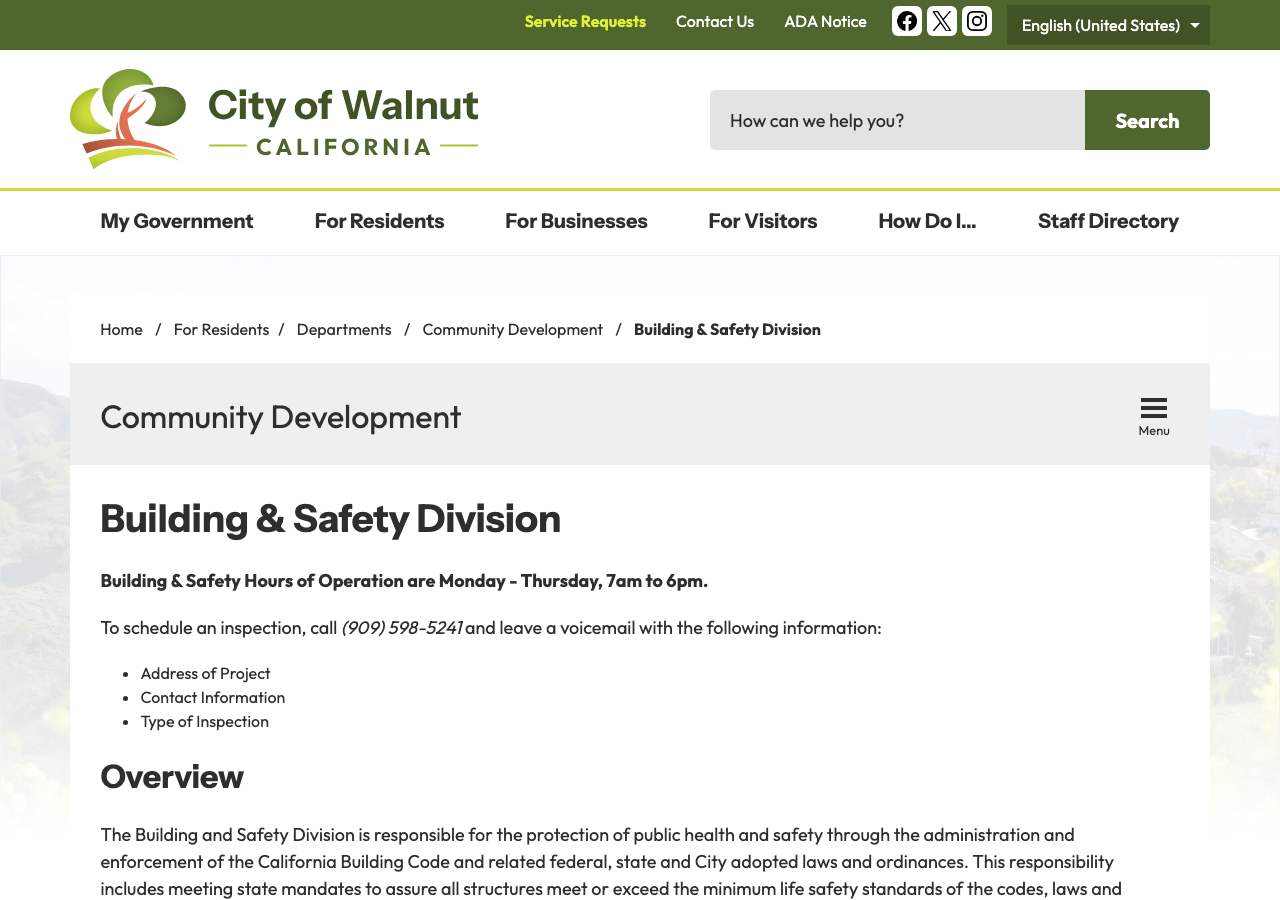
Why the confidence is not higherBuilding & Safety Division page: 'To schedule an inspection, call (909) 598-5241 and leave a voicemail with the following information: Address of Project, Contact Information, Type of Inspection.'
department page checked 2026-08-31 https://www.walnutca.gov/For-Residents/Departments/Community-Development/Building-Safety-Division
Q50 How much notice is required? Core Booking & scheduling
Nothing published by this authority.
Where we lookedBuilding & Safety Division page — gives the phone/voicemail booking method but states no minimum advance-notice period.
https://www.walnutca.gov/For-Residents/Departments/Community-Development/Building-Safety-Division
Q51 Are same-day or AM/PM windows offered? Booking & scheduling
Nothing published by this authority.
Where we lookedBuilding & Safety Division page — no mention of same-day service or AM/PM inspection windows.
https://www.walnutca.gov/For-Residents/Departments/Community-Development/Building-Safety-Division
Q52 Does this AHJ perform its own final solar inspection? Core Who inspects
Yes (self-performs), with a possible fire referral
Why the confidence is not higherWMC §2.36.050.J: 'only one inspection shall be required and performed by the building division for small residential rooftop solar energy systems eligible for expedited review. A separate fire inspection may be performed if a building official deems it necessary...referred to appropriate local fire department.' LACoFD separately and independently inspects ESS/BIPV regardless of this delegation (see Q45/46).
municipal code checked 2026-08-31 https://ecode360.com/44204853
Q53 If delegated, to whom? Core Who inspects
Los Angeles County Fire Department (Consolidated Fire Protection District) — only when the Building Official refers a job for fire inspection, or automatically for ESS/BIPV (LACoFD's own retained scope)
Why the confidence is not higherWMC §3.16.040 names 'the Los Angeles County Fire Department, and the Consolidated Fire Protection District' as responsible for fire-hazard enforcement citywide; §2.36.050.J allows the building official to refer PV jobs to 'the local fire department.' The City's own Fire Department page confirms LACoFD (Division 8, Assistant Chief's office at 1061 S. Grand Ave., Diamond Bar) serves Walnut via Stations 61 and 146.
department page + municipal code checked 2026-08-31 https://www.walnutca.gov/For-Residents/Public-Safety/Fire-Department
Q54 Which inspections are required, and in what order? Core Stages & sequence
A single consolidated building-division inspection for expedited-eligible small residential PV (no separate rough-in/final split), with a possible separate fire inspection if referred
Why the confidence is not higherWMC §2.36.050.J-K: 'only one inspection shall be required...' and 'should include consolidated inspections.'
municipal code checked 2026-08-31 https://ecode360.com/44204853
Q55 Is a rough-in or mid-roof inspection required? Stages & sequence
No
Why the confidence is not higherSame §2.36.050.J language — 'only one inspection shall be required' for expedited-eligible systems, implying no separate rough-in/mid-roof inspection for the small-residential path.
municipal code checked 2026-08-31 https://ecode360.com/44204853
Q56 Does the inspector verify labels and listings? Core What is checked
Nothing published by this authority.
Where we lookedBuilding & Safety Division page and WMC Ch. 2.36 — neither states inspection-practice detail on whether labels/listings are specifically verified in the field (beyond the general UL/IEEE listing requirement in §2.36.020.C).
https://www.walnutca.gov/For-Residents/Departments/Community-Development/Building-Safety-Division
Q57 Is there a published inspection checklist? Core What is checked
No
Why the confidence is not higherThe City's current Building & Safety Division page and the Wayback-captured solar page link only a fee schedule and two generic (image-only) permit-application forms — no distinct published inspection checklist was found for solar specifically, unlike some neighboring cities' dedicated solar checklists.
department page (absence, Wayback-checked) checked 2026-08-31 http://web.archive.org/web/20251030121900/https://www.walnutca.gov/For-Residents/Departments/Community-Development/Building-Safety-Division/Solar-Energy-Systems-And-Inspections
Q58 What must be on site at inspection? Core Documents on site
Nothing published by this authority.
Where we lookedBuilding & Safety Division page and WMC Ch. 2.36 — no statement of what must be physically present on site at time of inspection (e.g., approved plans, permit card) was found beyond generic practice.
https://www.walnutca.gov/For-Residents/Departments/Community-Development/Building-Safety-Division
Q59 Is there a re-inspection fee? Corrections & re-inspection
$97.10 (City, per the 2016 fee schedule, described as 'Excess Inspect / Expired') for standard building inspections; LACoFD separately charges $98.00 for 'additional inspections after initial inspection and one reinspection' on fire-referred/ESS jobs
Why the confidence is not higherCity figure from the City's own (2016-dated) Solar System Fees PDF, subject to the same 2x-county-fee multiplier caveat as Q15/16. LACoFD figure independently re-extracted this run from Appendix QQ (Table QQ104.4(6), eff. 2024-01-11).
fee schedule (dated) + fire fee schedule checked 2026-08-31 https://www.walnutca.gov/files/assets/walnut/v/1/cd/documents/building-amp-safety-division/new-folder/solar-system-fees.pdf
Q60 How are corrections issued and cleared? Corrections & re-inspection
A written correction notice detailing all deficiencies is sent to the applicant for resubmission (for incomplete applications); a failed field inspection authorizes a subsequent inspection
Why the confidence is not higherWMC §2.36.050.I ('a written correction notice detailing all deficiencies...shall be sent to the applicant for resubmission') and §2.36.050.L ('If a small residential rooftop solar energy system fails inspection, a subsequent inspection is authorized but need not conform to the requirements of this chapter'). Note §2.36.050.I is phrased around application-completeness correction rather than exclusively field-inspection corrections.
municipal code checked 2026-08-31 https://ecode360.com/44204853
Q61 What is issued on pass? Core Final sign-off & PTO
Final (building-division sign-off) — no CO, green-tag, or letter terminology found specific to residential PV
Why the confidence is not higherNeither WMC Ch. 2.36 nor the Building & Safety Division page uses a specific term like 'green tag' or 'Certificate of Occupancy' for solar; 'Final' is inferred from the standard adopted-CBC final-inspection process (Ch. 2.04) rather than a Walnut-specific citation.
municipal code (inference) checked 2026-08-31 https://ecode360.com/44204496
Q62 Who notifies the utility for PTO? Core Final sign-off & PTO
Installer/applicant
Why the confidence is not higherWMC §2.36.050.D: 'An approval of the application does not authorize an applicant to connect the small residential rooftop energy system to the local utility provider's electricity grid. The applicant is responsible for obtaining such approval or permission from the local utility provider.'
municipal code checked 2026-08-31 https://ecode360.com/44204853
Lines marked with a percentage were read off this authority’s own published documents. Unmarked guidance is general good practice, not this jurisdiction’s rule — always confirm against the authority before you submit.
Jurisdiction & key facts
The standing 62-question set, answered for City of Walnut against this authority’s own published documents. Every answer carries the confidence it was recorded at and the document it came from. Where nothing is published we say so and show where we looked — a blank here is a finding, not a gap.
City of Walnut is the authority having jurisdiction 88% confidence
- Holds
- Building and Electrical, in-house — City of Walnut Building & Safety Division (Building Official / Chief Electrical Inspector titles both defined as City of Walnut officials under WMC §2.08.020, no outside firm named). LA County Fire Department (Consolidated Fire Protection District) is the City's designated fire authority under WMC §3.16.040, and independently retains ESS>3kWh, a defined BIPV subcategory, and ALL electrical-disconnect/rapid-shutdown placarding on every PV job per its own current guide, regardless of the City's building-permit delegation.
- Overridden by
- LACoFD's ESS, PV & Disconnects Requirements Guide (Rev. 3, 2023-09-01) governs the retained fire scope described above; Gov. Code §65850.52 (SB 379) underlies the City's WMC Ch. 2.36 expedited small-residential (10kW AC/30kW thermal, single/duplex only) permitting path.
- Why not higher
- Walnut is confirmed as an LACoFD contract city three independent ways in this run: (1) the City's own Fire Department page names LACoFD Division 8 (Assistant Chief's office, 1061 S. Grand Ave., Diamond Bar) and Stations 61/146 as serving Walnut; (2) WMC §3.16.040 explicitly names 'the Los Angeles County Fire Department, and the Consolidated Fire Protection District' as the enforcing agency in the City's own code (the strongest, codified-definitional-hook form of evidence per playbook guidance); (3) fire.lacounty.gov's own 'Contracting' page (title: vendor-procurement RFP/IFB content per the govbot playbook's caution) nonetheless embeds a genuine Division/office-roster widget listing 'Diamond Bar Industry La Puente Pomona Walnut' under Division 8, and the SAME widget recurs on fire.lacounty.gov's actual About page (about-us-2) listing 'Diamond Bar* La Verne (Co) Pomona* Walnut*' under the Diamond Bar community-services office (asterisk denoting contract-city status) — cross-checked with a fabricated-URL control (fire.lacounty.gov/contract-cities/ returns a genuine 404) to confirm the roster widget isn't itself a false positive. Building and Electrical are in-house per WMC's own definitions (no outside firm named anywhere on the City's Building & Safety pages, unlike La Puente/Temple City's Willdan/Transtech arrangements), though I could not retrieve a named Building Official from the City's AJAX-driven staff directory in this run, so that specific piece is inference rather than a directly-read name.
https://www.walnutca.gov/For-Residents/Public-Safety/Fire-Department
Check the code edition before you build
This authority's published code edition does not match what the state has adopted. That usually means the authority's ordinance has not been updated for the current cycle — but a local amendment can also be lawful. Confirm with the building department before you submit.
- Permit required
- Yes95%
- Permit cost
- Residential: Plan Check $162.00, Permit $249.00 (base $194.20 + $54.80), Electrical $70.65 (+$57.60 if a meter/panel upgrade is needed), plus S.M.I.55%
- Portal
- No dedicated online portal — paper application filed by mail or in person at Walnut City Hall80%
- Electrical code
- 2023 NEC (inferred via the 2025 California Electrical Code)70%
- Own placard wording
- Yes90%
- Booking an inspection
- Phone (voicemail)90%
Labels & placards for this authority
City of Walnut writes its own placard wording. A standard NEC label set will not satisfy it — the exact text, and in most cases the size, colour and font, are specified below.
Wording 90%
Yes
Size, colour & material 90%
Exterior placard: min 2in x 3.5in, weather-resistant plastic, engraved, red letters on yellow background, Arial all-caps, min font size 24 (28 bold for 'F.D.' and '#X of Y'). Panel-interior placard: min 7/16in x 3/4in, same colors, Arial all-caps bold min size 24. Attached with permanent epoxy.
Where they go 75%
At the electrical service equipment / building disconnect(s), exterior and panel-interior, per LACoFD's placard spec
What the utility wants on top None%
Each figure above is sourced and dated in the full answer set below (questions 38–43). Where an authority’s own published sheet is older than the code it has adopted, the answer says so.
Their website

Average approval time — application to PTO
From the CPUC interconnection record. Bars show the average days taken each year; a year with no recorded projects is left blank rather than drawn as zero.