
City of Wasco
Kern County
City of Wasco is a city authority in the State of California, serving 27,047 residents. 1,975 residential solar installs are on record here. This page is the permit route for that jurisdiction: the fifteen steps from working out who has a say over an address through to permission to operate, the documents this authority publishes, and 62 answers taken from those documents and dated.
Permitting 5 steps · 28 questions
Whether a permit is needed — Yes Q3 Electrical and building permits — Combined Q4 Plan review — Same day for over-the-counter applications; 1 to 3 days for electronic applications, for systems meeting the expedited checklist. Q18 Where you file — MyGov (public.mygov.us/wasco_ca), fed by the SolarAPP+ front end at gosolarapp.org for PV and ESS permits. Q20
- Permit required
- Yes95% source
- What it costs
- $322 flat for systems ≤15 kW; $322 base + $15 per kW for the portion above 15 kW (residential). Commercial has a separate, higher tiered schedule.95% source
- Plan review turnaround
- Same day for over-the-counter applications; 1 to 3 days for electronic applications, for systems meeting the expedited checklist.90% source
- Key document
- authority's own page cited by 4 open the document
-
Confirm who has a say over your address
A city address is usually permitted by the city, not the county — but not always, and some authorities keep building and hand electrical to someone else. Getting this wrong costs the whole submittal, because every requirement below belongs to whoever actually holds jurisdiction. Check the overlays in the same pass: an HOA, a historic district, a windstorm certification or a system-size cap can reshape the design, and all of them are cheaper to find now than after the array is laid out.
- Is this authority the AHJ for residential solar at this address? Yes 95% · authority's own page
- What does this authority permit itself, and what does it delegate? Both 85% · authority's own page
- Is a permit required for a residential rooftop PV system? Yes 95% · municipal code
- Is there a separate electrical permit, or is it combined? Combined 85% · fee schedule
- Is a HOA or architectural approval required first? No 90% · municipal code
- Is there a historic-district review? Conditional — a Historic Downtown (H-D) combining district exists (WMC 17.24.040) but is scoped to the downtown commercial core, not general residential zones; no PV-specific carve-out or trigger was found within it. 65% · municipal code
- Is a wind or windstorm certification required? No 80% · municipal code (search)
- Is a Specific Use Permit or Council approval ever required? No — not for standard residential rooftop or code-conforming ground-mount installations (a permitted, by-right use under WMC Ch. 15.36/17.30.100). Utility-scale 'Solar energy field' and 'Solar energy electrical array' uses are separately classified as Permitted (P), not conditional, in the city's Industrial zoning-use tables (WMC 17.22.050/17.22.070) — but that is a distinct, non-residential use classification. 70% · municipal code
- Is there a system-size cap on residential generation? Codified cap: 10 kW AC / 30 kW thermal, scoped to systems on a 'single or duplex family dwelling' (WMC 15.36.020(B)(1)). The city's live SolarAPP+ Eligibility Checklist (Sept 2025) does not restate a kW ceiling; instead it gates the ministerial path by service size (≤400A service, ≤225A busbar, ≤200A service disconnect) and system weight (≤4.0 psf) — a cap-vs-gate split like several other CA cities. 85% · municipal code
-
Check who is allowed to apply
Several authorities require the electrical permit to be pulled by a licensed electrician, or require the contractor to be registered with them BEFORE applying. Registration is not same-day. This is second on the list rather than fourth because it is the step most likely to stop the job before the drawings matter.
- Who is allowed to pull the electrical permit? Either 75% · eligibility checklist
- Is a homeowner permitted to self-install and self-permit? Yes 75% · department form
-
Build the submittal package
Almost everywhere wants a site plan, a one-line or three-line electrical diagram, equipment cut sheets with listings, and a structural attachment detail. Build it against the published checklist rather than the last jurisdiction you worked in — the checklist is what the reviewer marks against.
- What documents make up a complete submittal? For SolarAPP+ PV: (1) SolarAPP+ Approval Checklist, (2) Solar Equipment Spec Sheets, (3) One-Line Diagram (Electrical). For ESS-only (SolarAPP+ Storage Only): (1) SolarAPP+ Approval Checklist, (2) Equipment Spec Sheets. 95% · authority's own page
- How many copies, and in what format? Electronic/digital only via MyGov upload (no paper-copy count specified) for the SolarAPP+ path; the general submittal-requirements page separately allows in-person submittal 'at the planning and building department counter' as an alternative under WMC 15.36.050(A). 80% · municipal code
- Is a one-line / three-line diagram required? Yes 95% · authority's own page
- Is a structural PE stamp required, and at what threshold? No fixed PE-stamp/kW threshold stated by the city. SolarAPP+'s Eligibility Checklist gates the ministerial (no-plan-review) path structurally at a system+hardware weight of ≤4.0 psf and other prescriptive criteria; systems failing eligibility (e.g., exceeding weight, non-conforming roof, etc.) route to full plan check where the Building Official may require engineering on a case-by-case basis, but no numeric PE-stamp trigger is published. 55% · eligibility checklist
-
Apply and pay
Most authorities now take the whole application through a portal, and several states cap or constrain what a residential solar permit may cost. Check whether plan check is billed separately before you quote the job.
- Which permit portal does this authority use? MyGov (public.mygov.us/wasco_ca), fed by the SolarAPP+ front end at gosolarapp.org for PV and ESS permits. 95% · authority's own page
- Can the whole application be completed online? Yes 95% · authority's own page
- What does a residential solar permit cost? $322 flat for systems ≤15 kW; $322 base + $15 per kW for the portion above 15 kW (residential). Commercial has a separate, higher tiered schedule. 95% · fee schedule
- How is the fee calculated? Tiered 95% · fee schedule
- Is there a separate plan-check fee? No 85% · fee schedule
-
Plan review — and start the utility in parallel
Interconnection is a separate process from the permit and usually the longer pole. Where the utility does not depend on the permit being issued, running both at once is the single biggest saving available on a residential job.
- What is the stated plan-review turnaround? Same day for over-the-counter applications; 1 to 3 days for electronic applications, for systems meeting the expedited checklist. 90% · municipal code
- How long is an issued permit valid before it expires? 1 year from date of issuance; void if work is suspended/abandoned for 180 days. 80% · department FAQ
- Which utility handles interconnection here? PG&E (Pacific Gas & Electric) 90% · city council agenda / warrant register
- Where does the utility sit in the sequence? After permit 70% · utility tariff
28 questions answered against City of Wasco’s own published documents
Q1 Is this authority the AHJ for residential solar at this address? Core Jurisdiction & scope
Yes
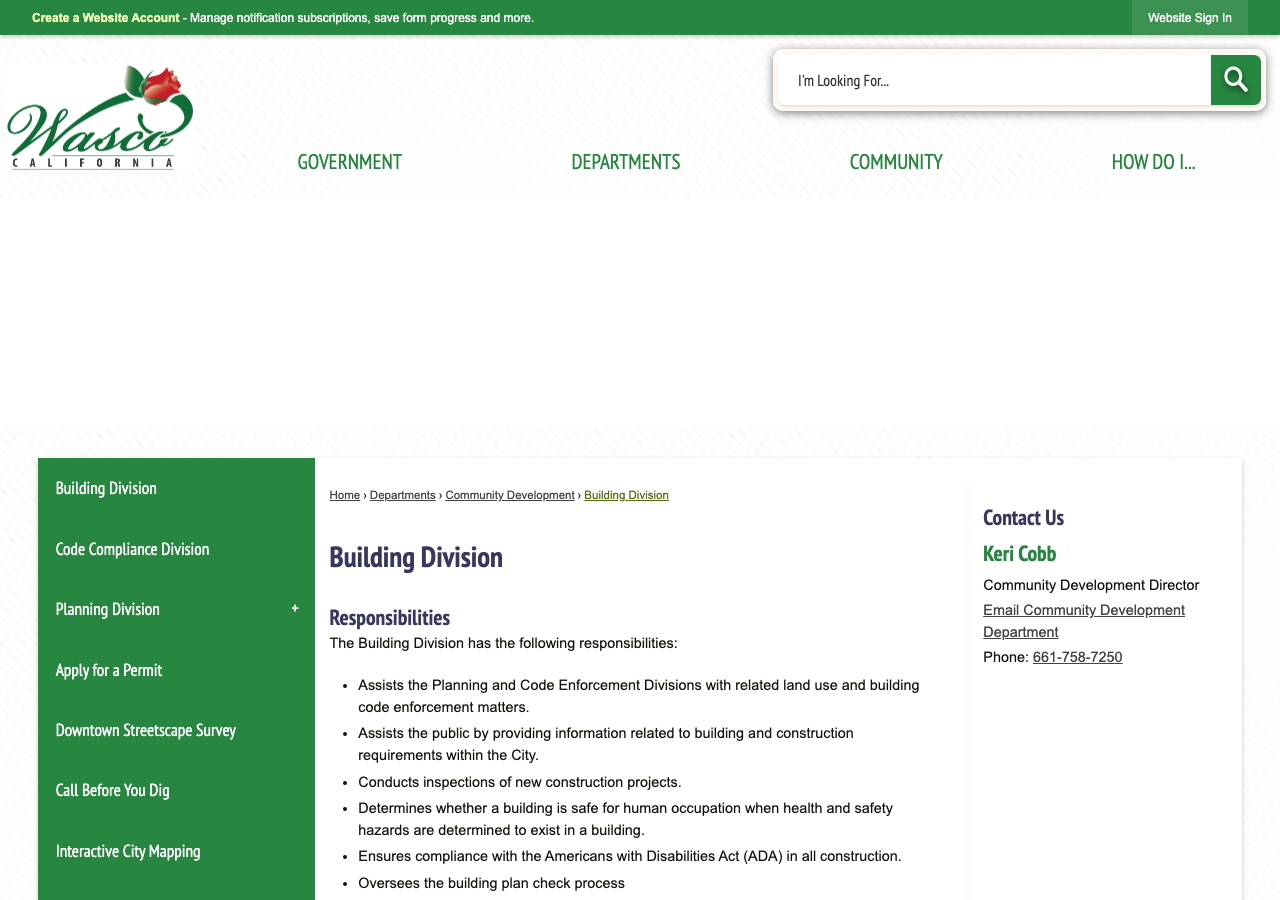
Why the confidence is not higherCity of Wasco's own Building Division and Community Development pages, plus codified WMC Ch. 15.36 (Expedited Permit Process for Small Residential Rooftop Solar Energy Systems), show the city issues and inspects residential PV permits directly.
authority's own page checked 2026-08-31 https://www.cityofwasco.org/204/Building-Division
Q2 What does this authority permit itself, and what does it delegate? Core Jurisdiction & scope
Both
Why the confidence is not higherCity of Wasco Building Division (under Community Development, Director Keri Cobb) self-performs building and electrical plan review/permitting/inspection in-house; no delegation to a contract plan-check firm found. Fire-code health/safety standards are cross-referenced to Kern County Fire Department by name in WMC 15.36.040(A), but KCFD's own fee schedule and standards show no distinct residential PV/ESS fee or review — its Solar (Roof/Ground Mounted) and Stationary ESS standards are explicitly scoped 'Commercial' only, so fire's practical role in a residential PV job is nominal/undocumented.
authority's own page checked 2026-08-31 https://www.cityofwasco.org/204/Building-Division
Q3 Is a permit required for a residential rooftop PV system? Core Jurisdiction & scope
Yes
Why the confidence is not higherWMC 15.36.030 Applicability: 'This chapter applies to the permitting of all small residential rooftop solar energy systems in the city.'
municipal code checked 2026-08-31 https://wasco.municipal.codes/Code/15.36.030
Q4 Is there a separate electrical permit, or is it combined? Core Jurisdiction & scope
Combined
Why the confidence is not higherMaster Fee Schedule FY2025-26 lists a single 'Residential Solar Photovoltaic System – Solar Permit' fee line under Building Fees Section A, whose header states fees shown 'include all applicable permit issuance, inspection, and plan review fees' — i.e. one combined permit, not a separate stand-alone electrical permit.
fee schedule checked 2026-08-31 https://www.cityofwasco.org/DocumentCenter/View/3090/Master-Fee-Schedule-FY-2025-26-PDF
Q5 Who is allowed to pull the electrical permit? Core Who may apply
Either
Why the confidence is not higherSolarAPP+ eligibility checklist (city-linked) requires the project be 'Installed by contractor with all licenses required by jurisdiction' for the ministerial/automated path. Separately, WMC/Ordinance 2025-732 §15.04.045 (CEC amendment, new §110.1.1) allows 'A homeowner may do electrical work on his residence excluding installation of electrical service panels' for the standard owner-builder path. So licensed-contractor is required for SolarAPP+; homeowner self-install (excluding panel work) is allowed under the general/full-review path.
eligibility checklist checked 2026-08-31 https://drive.google.com/file/d/1c76c2KvYvypMJlsHrJtPLVYsIbb2XfN0/view?usp=sharing
Q6 Must the contractor be registered with this authority before applying? Core Who may apply
Nothing published by this authority.
Where we lookedBuilding Division page, SolarAPP+/MyGov application pages, and a municipal-code search for 'business license contractor' (165 hits, none specific to a solar/building-permit contractor-registration requirement) — no city-specific contractor pre-registration requirement found distinct from standard CSLB licensure.
Q7 Is a homeowner permitted to self-install and self-permit? Who may apply
Yes
Why the confidence is not higherCity's standard Construction Permit Declarations form includes an Owner-Builder's Declaration (Business & Professions Code §7044) allowing a property owner to self-perform work and self-permit generically. However, the SolarAPP+ ministerial pathway specifically requires a licensed contractor per its Eligibility Checklist, so owner-builder self-install routes through the standard/full-review permit path, not SolarAPP+.
department form checked 2026-08-31 https://www.cityofwasco.org/DocumentCenter/View/3302/Construction-Permit-Declaration--Updated-PDF
Q8 What documents make up a complete submittal? Core Submittal package
For SolarAPP+ PV: (1) SolarAPP+ Approval Checklist, (2) Solar Equipment Spec Sheets, (3) One-Line Diagram (Electrical). For ESS-only (SolarAPP+ Storage Only): (1) SolarAPP+ Approval Checklist, (2) Equipment Spec Sheets.
Why the confidence is not higherCity's own SolarAPP+ instruction pages list the exact required-document set and require each to be uploaded separately with the matching 'Type' selected in MyGov.
authority's own page checked 2026-08-31 https://www.cityofwasco.org/392/Solar-App-For-Solar-Installers
Q9 How many copies, and in what format? Submittal package
Electronic/digital only via MyGov upload (no paper-copy count specified) for the SolarAPP+ path; the general submittal-requirements page separately allows in-person submittal 'at the planning and building department counter' as an alternative under WMC 15.36.050(A).
Why the confidence is not higherSolarAPP+ pages describe upload of PDFs to MyGov; WMC 15.36.050 confirms electronic submittal or in-person counter submittal as the two channels.
municipal code checked 2026-08-31 https://wasco.municipal.codes/Code/15.36.050
Q10 Is a site plan required, and what must it show? Core Submittal package
Nothing published by this authority.
Where we lookedSolarAPP+ required-document list (3 items for PV, 2 for ESS) and WMC Ch. 15.36 — neither itemizes a separate site-plan document or specifies what it must show for a rooftop system; WMC 17.30.100 addresses ground-mount siting but not a site-plan content checklist.
Q11 Is a one-line / three-line diagram required? Core Drawings & calculations
Yes
Why the confidence is not higher'One-Line Diagram (Electrical)' is explicitly required as one of the 3 documents for a SolarAPP+ PV permit.
authority's own page checked 2026-08-31 https://www.cityofwasco.org/392/Solar-App-For-Solar-Installers
Q12 Are string and conductor calculations required? Drawings & calculations
Nothing published by this authority.
Where we lookedSolarAPP+ required-document list — string/conductor calculations are not listed as a separate submittal item; the SolarAPP+ engine appears to check electrical parameters (max string voltage, wire ratings, etc.) internally per its Eligibility Checklist rather than requiring a separate calc packet from the applicant.
https://drive.google.com/file/d/1c76c2KvYvypMJlsHrJtPLVYsIbb2XfN0/view?usp=sharing
Q13 Is a structural PE stamp required, and at what threshold? Core Engineering & stamps
No fixed PE-stamp/kW threshold stated by the city. SolarAPP+'s Eligibility Checklist gates the ministerial (no-plan-review) path structurally at a system+hardware weight of ≤4.0 psf and other prescriptive criteria; systems failing eligibility (e.g., exceeding weight, non-conforming roof, etc.) route to full plan check where the Building Official may require engineering on a case-by-case basis, but no numeric PE-stamp trigger is published.
Why the confidence is not higherInferred from the SolarAPP+ Eligibility Checklist's structural criteria; no separate city document states a PE-stamp threshold.
eligibility checklist checked 2026-08-31 https://drive.google.com/file/d/1c76c2KvYvypMJlsHrJtPLVYsIbb2XfN0/view?usp=sharing
Q14 Is an electrical PE stamp required, and at what threshold? Engineering & stamps
Nothing published by this authority.
Where we lookedSolarAPP+ Eligibility Checklist and WMC Ch. 15.36 — no electrical PE-stamp threshold specified.
https://drive.google.com/file/d/1c76c2KvYvypMJlsHrJtPLVYsIbb2XfN0/view?usp=sharing
Q15 What does a residential solar permit cost? Core Fees
$322 flat for systems ≤15 kW; $322 base + $15 per kW for the portion above 15 kW (residential). Commercial has a separate, higher tiered schedule.
Why the confidence is not higherCity of Wasco Master Fee Schedule, effective 1 Jul 2025, Building Fees §A.3 'Residential Solar Photovoltaic System – Solar Permit.'
fee schedule checked 2026-08-31 https://www.cityofwasco.org/DocumentCenter/View/3090/Master-Fee-Schedule-FY-2025-26-PDF
Q16 How is the fee calculated? Core Fees
Tiered
Why the confidence is not higherSame fee-schedule line: flat base fee to 15kW, then a per-kW add-on above 15kW.
fee schedule checked 2026-08-31 https://www.cityofwasco.org/DocumentCenter/View/3090/Master-Fee-Schedule-FY-2025-26-PDF
Q17 Is there a separate plan-check fee? Fees
No
Why the confidence is not higherFee schedule §A header states fees shown for the commonly-requested permit types listed (which include the Residential Solar PV line) 'include all applicable permit issuance, inspection, and plan review fees' — no separate plan-check fee is charged on top for solar permits. (A separate 65%-of-permit-fee plan-check fee exists only under §G, which applies to the general valuation-based Section B/C/D/E permit types, not the dedicated solar line.)
fee schedule checked 2026-08-31 https://www.cityofwasco.org/DocumentCenter/View/3090/Master-Fee-Schedule-FY-2025-26-PDF
Q18 What is the stated plan-review turnaround? Core Timeline & validity
Same day for over-the-counter applications; 1 to 3 days for electronic applications, for systems meeting the expedited checklist.
Why the confidence is not higherWMC 15.36.060(A): 'shall issue a nondiscretionary building permit the same day for over-the-counter applications or within one to three days for electronic applications.'
municipal code checked 2026-08-31 https://wasco.municipal.codes/Code/15.36.060
Q19 How long is an issued permit valid before it expires? Timeline & validity
1 year from date of issuance; void if work is suspended/abandoned for 180 days.
Why the confidence is not higherCity's 'Building Code Adoption – 2025 Cycle' FAQ states permits expire if work is not commenced within 1 year, or if suspended/abandoned for 180 days, echoing standard CBC §105.5.
department FAQ checked 2026-08-31 https://www.cityofwasco.org/DocumentCenter/View/3307/Building-Code-Adoption---2025-Cycle-PDF
Q20 Which permit portal does this authority use? Core Portal & process
MyGov (public.mygov.us/wasco_ca), fed by the SolarAPP+ front end at gosolarapp.org for PV and ESS permits.
Why the confidence is not higherCity's own SolarAPP+ instruction pages name both platforms and the exact URLs, and all links resolve to Wasco's own MyGov tenant (not another city's).
authority's own page checked 2026-08-31 https://www.cityofwasco.org/392/Solar-App-For-Solar-Installers
Q21 Can the whole application be completed online? Core Portal & process
Yes
Why the confidence is not higherSolarAPP+/MyGov process is entirely online: application, document upload, and automatic permit issuance; a printed copy of the permit is then required at the jobsite for inspection.
authority's own page checked 2026-08-31 https://www.cityofwasco.org/392/Solar-App-For-Solar-Installers
Q22 Which utility handles interconnection here? Core Utility interconnection
PG&E (Pacific Gas & Electric)
Why the confidence is not higherCity's own Utility Billing page shows the city bills only water/sewer/refuse, not electricity (i.e. no municipal electric utility); a City Council agenda packet warrant/check register (Aug 2026) shows the City itself paying 'PG&E COMPANY' for city-facility electric service and for new streetlight installation, confirming PG&E as the serving electric utility in Wasco.
city council agenda / warrant register checked 2026-08-31 https://www.cityofwasco.org/AgendaCenter/City-Council-2/?#08042026-583
Q23 Where does the utility sit in the sequence? Core Utility interconnection
After permit
Why the confidence is not higherPG&E Electric Rule 21 §F.2.b requires, as a condition of Permission-to-Operate (PTO) processing, 'evidence of Applicant's final electric inspection clearance from the Governmental Authority having jurisdiction' — i.e. PTO is finalized only after the AHJ's final building/electrical inspection, though the interconnection application itself can be filed in parallel with permitting.
utility tariff checked 2026-08-31 https://www.pge.com/tariffs/assets/pdf/tariffbook/ELEC_RULES_21.pdf
Q24 Is a HOA or architectural approval required first? Overlays & special cases
No
Why the confidence is not higherWMC 17.30.100(B)(1): 'The city shall not require approval for any solar energy system based on the approval of the system by an association' (i.e. the city will not condition its own approval on HOA sign-off).
municipal code checked 2026-08-31 https://wasco.municipal.codes/Code/17.30.100
Q25 Is there a historic-district review? Overlays & special cases
Conditional — a Historic Downtown (H-D) combining district exists (WMC 17.24.040) but is scoped to the downtown commercial core, not general residential zones; no PV-specific carve-out or trigger was found within it.
Why the confidence is not higherWMC 17.24.040 purpose/applicability language scopes the H-D district to 'the downtown and the historic structures, sites' — a commercial-core overlay, not applied citywide to residential parcels.
municipal code checked 2026-08-31 https://wasco.municipal.codes/Code/17.24.040
Q26 Is a wind or windstorm certification required? Overlays & special cases
No
Why the confidence is not higherNo solar-specific windstorm-certification requirement found. Wasco's general climatic finding (WMC/Ord. 2025-732 §15.04.050(A)(1)) notes the city is in a '70 mph wind zone' used to justify unrelated structural amendments; a municipal-code search for 'wind speed' (102 hits, positive control passed) surfaced only the general sign-code wind-pressure section (15.16.090) and this generic finding — nothing solar-specific, unlike Banning's dedicated solar wind handout.
municipal code (search) checked 2026-08-31 https://wasco.municipal.codes/search?q=wind+speed
Q27 Is a Specific Use Permit or Council approval ever required? Overlays & special cases
No — not for standard residential rooftop or code-conforming ground-mount installations (a permitted, by-right use under WMC Ch. 15.36/17.30.100). Utility-scale 'Solar energy field' and 'Solar energy electrical array' uses are separately classified as Permitted (P), not conditional, in the city's Industrial zoning-use tables (WMC 17.22.050/17.22.070) — but that is a distinct, non-residential use classification.
Why the confidence is not higherWMC 17.22.050 and 17.22.070 use tables list 'Solar energy field' / 'Solar energy electrical array' as 'P' (permitted) in industrial districts, not 'C' (conditional); no CUP/Council-approval trigger found for residential PV in Ch. 15.36 or 17.30.100.
municipal code checked 2026-08-31 https://wasco.municipal.codes/Code/17.22.050
Q28 Is there a system-size cap on residential generation? Overlays & special cases
Codified cap: 10 kW AC / 30 kW thermal, scoped to systems on a 'single or duplex family dwelling' (WMC 15.36.020(B)(1)). The city's live SolarAPP+ Eligibility Checklist (Sept 2025) does not restate a kW ceiling; instead it gates the ministerial path by service size (≤400A service, ≤225A busbar, ≤200A service disconnect) and system weight (≤4.0 psf) — a cap-vs-gate split like several other CA cities.
Why the confidence is not higherWMC 15.36.020 codified definition vs. the current SolarAPP+ Eligibility Checklist (dated 16 Sep 2025) linked from the city's own SolarAPP+ page.
municipal code checked 2026-08-31 https://wasco.municipal.codes/Code/15.36.020
Lines marked with a percentage were read off this authority’s own published documents. Unmarked guidance is general good practice, not this jurisdiction’s rule — always confirm against the authority before you submit.
Install 5 steps · 20 questions
-
Build to the code editions actually in force here
The NEC edition a jurisdiction enforces is often a cycle behind the newest one published, and local amendments sit on top of it. Rapid shutdown, conductor sizing and labelling all change between editions, so the edition in force is the first thing to establish, not the last.
- Which NEC edition is in force? 2023 95% · department FAQ / adopting ordinance
- Which building code edition is in force? 2025 California Building Code (based on the 2024 IBC) and 2025 California Residential Code (based on the 2024 IRC), adopted by Ordinance No. 2025-732, effective 1 Jan 2026. 95% · adopting ordinance
- Which fire code edition is in force? 2025 California Fire Code (based on the 2024 IFC), adopted by reference in Ordinance 2025-732 §15.04.030(J), enforced by Kern County Fire Department. KCFD's own current 'ESS Application Guide' extraction is already labeled '2025 CFC/2023 NFPA 855,' confirming the cycle is live in practice. 90% · adopting ordinance / department guide
- Are there local amendments to any of the above? Yes 90% · adopting ordinance
- What is the installation judged against? The 2025 CBC/CRC/CEC/CFC as locally amended by Ordinance 2025-732, plus WMC Ch. 15.36's own requirement that solar/PV systems meet CEC, IEEE, UL, and (where applicable) CPUC safety/performance standards. 90% · municipal code
-
Fire access, setbacks and pathways
Ridge setbacks and roof access pathways are fire-service requirements and they constrain the array layout. They are the most common cause of a redesign after the fire department comments on a plan set.
- What ridge setback and access pathways are required? Kern County Fire Department Standard No. 1204-1 ('Solar Panels – Roof Mounted', 10 Jun 2021, per 2022 CFC) gives detailed pathway/setback figures (6 ft perimeter clearance, reducible to 4 ft; 4 ft interior pathways every 150 ft; 8 ft clearance around smoke/heat vents, etc.) — but this standard is explicitly titled and scoped to 'Commercial Roof Installations.' No equivalent residential-specific KCFD standard or city ordinance was found; residential rooftop PV pathway/setback requirements therefore appear to default to the base 2025 CFC §1204 provisions without a local residential amendment. 70% · fire department standard
-
Rapid shutdown
Which rapid-shutdown rule applies follows directly from the NEC edition in force, and the initiation device has to be at a location the fire service can reach and identify. This is inspected, and it is labelled.
- Is rapid shutdown required, and to which NEC edition? Yes, rapid shutdown is required under the currently adopted 2023 NEC (via the 2025 CEC), Article 690.12. This is inherited automatically from the state-mandated code adoption (Ordinance 2025-732) — Wasco's own municipal code does not separately amend or restate §690.12, and a code-wide search for '690.12' returns zero hits (fabricated-control-style negative), confirming no local override. The city's own SolarAPP+ Eligibility Checklist independently cross-references '690.12(B)(2)(3)' when excluding a particular rapid-shutdown method, confirming the 2023 NEC baseline is in active use. 85% · municipal code (search) / eligibility checklist
-
Labels and placards
The NEC sets a baseline for permanent markings at the service equipment and the disconnecting means. On top of that, an authority may specify its own wording, and the utility may specify more again. Where any of them writes its own text, a generic off-the-shelf label set will not pass — this is the detail most often fixed on a return visit.
- Which placards does this authority require at the service equipment? No dedicated local placard ordinance found; a search of the municipal code for 'placard' (5 hits, all in the general Sign Code/business-licensing definitions, none solar-related) confirms this is not locally amended. Labeling at the service equipment therefore defaults to base 2025 CEC (690.56/705.10 series) and, for rapid-shutdown labels specifically, base 2025 CFC §1204.5 (per KCFD's Commercial roof-mount standard, which cites CFC 1204.5.1/.5.1.1/.5.3 — though that standard itself is scoped commercial-only). 75% · fire department standard / municipal code (search)
- Does the authority specify placard wording of its own? No 80% · municipal code (search)
- Does it specify letter height, colour or material? No local specification of letter height, colour, or material found for residential PV placards (beyond KCFD's commercial-only roof-mount standard, which does not give letter-height/colour specs either — only pathway dimensions). 75% · fire department standard / municipal code (search)
- Does the UTILITY specify placards beyond the AHJ's? PG&E's Electric Rule 21 requires (independent of any AHJ placard) that the interconnection's manually-operated visible disconnect 'include markings or signage that clearly indicates open and closed positions' (Rule 21 §H.1.d(ii)), and that its location be clearly marked on the submitted single-line diagram or, if not adjacent to the point of common coupling, that permanent signage be installed identifying the device's location. 70% · utility tariff
-
Disconnect, storage and listed equipment
Where the AC disconnect must sit relative to the meter is usually the utility's rule, not the building department's. Battery storage frequently carries its own permit, its own inspection and its own fire conditions.
- Must equipment be on a specific approved list? Yes 90% · eligibility checklist
- Are batteries permitted, and under what conditions? Yes, lithium-ion batteries only, subject to conditions: system must be under 400 lbs with its center of mass under 4 ft from the floor in high seismic areas (Seismic Design Category D/E/F); ESS must not be installed within the habitable space of a dwelling unit; batteries must be CEC-listed. Base 2025 CFC §1207.1 exempts Group R-3/R-4 occupancies from full Chapter 12 ESS requirements except §1207.11. 85% · eligibility checklist / fire department guide
- Is there a separate ESS permit or inspection? Yes 95% · authority's own page
- Is a ground mount treated as a structure? Yes (inferred) 85% · municipal code / eligibility checklist
- Is there a local rule on service upgrades or busbar sizing? No local amendment found on service-upgrade or busbar sizing (contrast with Palm Springs' 225A rule). SolarAPP+'s own eligibility gate (≤400A service / ≤225A busbar / ≤200A disconnect) is a program-eligibility limit, not a codified local building-code rule. 80% · adopting ordinance
20 questions answered against City of Wasco’s own published documents
Q29 Which NEC edition is in force? Core Code editions in force
2023
Why the confidence is not higher2025 California Electrical Code (Part 3 of the 2025 CBSC) is 'based on the 2023 National Electrical Code (NEC)' per the city's 'Building Code Adoption – 2025 Cycle' FAQ; adopted by Ordinance 2025-732 §15.04.030(D), effective 1 Jan 2026 (now in force).
department FAQ / adopting ordinance checked 2026-08-31 https://www.cityofwasco.org/DocumentCenter/View/3307/Building-Code-Adoption---2025-Cycle-PDF
Q30 Which building code edition is in force? Core Code editions in force
2025 California Building Code (based on the 2024 IBC) and 2025 California Residential Code (based on the 2024 IRC), adopted by Ordinance No. 2025-732, effective 1 Jan 2026.
Why the confidence is not higherOrdinance 2025-732 §15.04.030(A)-(C).
adopting ordinance checked 2026-08-31 https://www.cityofwasco.org/DocumentCenter/View/3308/City-of-Wasco-Municipal-Code-Ordinance-No-2025---732-PDF
Q31 Which fire code edition is in force? Code editions in force
2025 California Fire Code (based on the 2024 IFC), adopted by reference in Ordinance 2025-732 §15.04.030(J), enforced by Kern County Fire Department. KCFD's own current 'ESS Application Guide' extraction is already labeled '2025 CFC/2023 NFPA 855,' confirming the cycle is live in practice.
Why the confidence is not higherOrdinance 2025-732 and KCFD ESS Application Guide (pdfinfo CreationDate 16 Apr 2026).
adopting ordinance / department guide checked 2026-08-31 https://kerncountyfire.org/wp-content/uploads/ESS-Application-Guide-2025-CFC-2023-NFPA-855.pdf
Q32 Are there local amendments to any of the above? Core Code editions in force
Yes
Why the confidence is not higherOrdinance 2025-732 contains local CBC/CRC/CEC amendments (e.g. §110.1.1 restricting who may do electrical/panel work, §250.50 and §250.104(B) grounding/bonding amendments, several Group-occupancy sprinkler amendments referencing 'the Kern County Fire Code'), none of them PV-specific.
adopting ordinance checked 2026-08-31 https://www.cityofwasco.org/DocumentCenter/View/3308/City-of-Wasco-Municipal-Code-Ordinance-No-2025---732-PDF
Q33 What is the installation judged against? Core Electrical
The 2025 CBC/CRC/CEC/CFC as locally amended by Ordinance 2025-732, plus WMC Ch. 15.36's own requirement that solar/PV systems meet CEC, IEEE, UL, and (where applicable) CPUC safety/performance standards.
Why the confidence is not higherWMC 15.36.040 and Ordinance 2025-732.
municipal code checked 2026-08-31 https://wasco.municipal.codes/Code/15.36.040
Q34 Is there a local rule on service upgrades or busbar sizing? Electrical
No local amendment found on service-upgrade or busbar sizing (contrast with Palm Springs' 225A rule). SolarAPP+'s own eligibility gate (≤400A service / ≤225A busbar / ≤200A disconnect) is a program-eligibility limit, not a codified local building-code rule.
Why the confidence is not higherOrdinance 2025-732 §15.04.045 (California Electric Code amendments) covers only electrical-work licensure, grounding electrodes, and metal-piping bonding — no busbar/service-upgrade provision; municipal-code search confirms no such local rule.
adopting ordinance checked 2026-08-31 https://www.cityofwasco.org/DocumentCenter/View/3308/City-of-Wasco-Municipal-Code-Ordinance-No-2025---732-PDF
Q35 Is a specific mounting system or attachment spacing required? Structural & mounting
Nothing published by this authority.
Where we lookedWMC Ch. 15.36, WMC 17.30.100, and the SolarAPP+ Eligibility Checklist — none specify a numeric attachment-spacing standard; the eligibility checklist only limits the project to a single racking-system model, which is a program-eligibility constraint, not a spacing spec.
Q36 What ridge setback and access pathways are required? Core Fire pathways & setbacks
Kern County Fire Department Standard No. 1204-1 ('Solar Panels – Roof Mounted', 10 Jun 2021, per 2022 CFC) gives detailed pathway/setback figures (6 ft perimeter clearance, reducible to 4 ft; 4 ft interior pathways every 150 ft; 8 ft clearance around smoke/heat vents, etc.) — but this standard is explicitly titled and scoped to 'Commercial Roof Installations.' No equivalent residential-specific KCFD standard or city ordinance was found; residential rooftop PV pathway/setback requirements therefore appear to default to the base 2025 CFC §1204 provisions without a local residential amendment.
Why the confidence is not higherKCFD Standard 1204-1 is titled 'Solar Panels (Roof Mounted)' with a 'Commercial Roof Installations' subheading and no residential section; no separate KCFD or Wasco residential standard was found.
fire department standard checked 2026-08-31 https://kerncountyfire.org/wp-content/uploads/SolarPanelsRoofMounted.pdf
Q37 Is rapid shutdown required, and to which NEC edition? Core Rapid shutdown
Yes, rapid shutdown is required under the currently adopted 2023 NEC (via the 2025 CEC), Article 690.12. This is inherited automatically from the state-mandated code adoption (Ordinance 2025-732) — Wasco's own municipal code does not separately amend or restate §690.12, and a code-wide search for '690.12' returns zero hits (fabricated-control-style negative), confirming no local override. The city's own SolarAPP+ Eligibility Checklist independently cross-references '690.12(B)(2)(3)' when excluding a particular rapid-shutdown method, confirming the 2023 NEC baseline is in active use.
Why the confidence is not higherMunicipal-code search for '690.12' (0 hits) plus the FAQ's confirmation of 2023 NEC adoption plus the Eligibility Checklist's own citation.
municipal code (search) / eligibility checklist checked 2026-08-31 https://drive.google.com/file/d/1c76c2KvYvypMJlsHrJtPLVYsIbb2XfN0/view?usp=sharing
Q38 Which placards does this authority require at the service equipment? Core Labels Signage & labelling
No dedicated local placard ordinance found; a search of the municipal code for 'placard' (5 hits, all in the general Sign Code/business-licensing definitions, none solar-related) confirms this is not locally amended. Labeling at the service equipment therefore defaults to base 2025 CEC (690.56/705.10 series) and, for rapid-shutdown labels specifically, base 2025 CFC §1204.5 (per KCFD's Commercial roof-mount standard, which cites CFC 1204.5.1/.5.1.1/.5.3 — though that standard itself is scoped commercial-only).
Why the confidence is not higherMunicipal-code search for 'placard' plus KCFD Standard 1204-1.
fire department standard / municipal code (search) checked 2026-08-31 https://kerncountyfire.org/wp-content/uploads/SolarPanelsRoofMounted.pdf
Q39 Does the authority specify placard wording of its own? Core Labels Signage & labelling
No
Why the confidence is not higherControl-proven: a municipal-code search for 'placard' surfaces only the general sign code and business-licensing chapters — no solar/PV-specific wording is codified.
municipal code (search) checked 2026-08-31 https://wasco.municipal.codes/search?q=placard
Q40 Does it specify letter height, colour or material? Core Labels Signage & labelling
No local specification of letter height, colour, or material found for residential PV placards (beyond KCFD's commercial-only roof-mount standard, which does not give letter-height/colour specs either — only pathway dimensions).
Why the confidence is not higherSame code search plus review of KCFD Standard 1204-1 in full.
fire department standard / municipal code (search) checked 2026-08-31 https://kerncountyfire.org/wp-content/uploads/SolarPanelsRoofMounted.pdf
Q41 Is a site plan / facility map placard required, and what must it show? Core Labels Signage & labelling
Nothing published by this authority.
Where we lookedWMC Ch. 15.36, KCFD Roof/Ground-Mounted standards, and the city's SolarAPP+ pages — none describe a site-plan/facility-map placard requirement (705.10-style) distinct from the general one-line-diagram submittal.
Q42 Does the UTILITY specify placards beyond the AHJ's? Core Labels Signage & labelling
PG&E's Electric Rule 21 requires (independent of any AHJ placard) that the interconnection's manually-operated visible disconnect 'include markings or signage that clearly indicates open and closed positions' (Rule 21 §H.1.d(ii)), and that its location be clearly marked on the submitted single-line diagram or, if not adjacent to the point of common coupling, that permanent signage be installed identifying the device's location.
Why the confidence is not higherPG&E Electric Rule 21, Section H (Generating Facility Design and Operating Requirements), current tariff sheet effective 29 Aug 2025.
utility tariff checked 2026-08-31 https://www.pge.com/tariffs/assets/pdf/tariffbook/ELEC_RULES_21.pdf
Q43 Where must the labels be placed? Core Labels Signage & labelling
Nothing published by this authority.
Where we lookedPG&E's own DG/interconnection material accessible in this run (Rule 21 tariff) specifies disconnect accessibility/marking requirements but not a precise placement dimension relative to the meter; PG&E's detailed meter-proximity spec is understood to live in a gated Greenbook document (e.g. TD-2306M) not reachable without a PG&E job-owner login.
https://www.pge.com/tariffs/assets/pdf/tariffbook/ELEC_RULES_21.pdf
Q44 Must equipment be on a specific approved list? Equipment listing
Yes
Why the confidence is not higherSolarAPP+ Eligibility Checklist: 'Modules and inverters must be listed in the California Energy Commission's database of approved equipment' and 'Energy storage systems and batteries must be listed in the California Energy Commission's database of approved equipment.'
eligibility checklist checked 2026-08-31 https://drive.google.com/file/d/1c76c2KvYvypMJlsHrJtPLVYsIbb2XfN0/view?usp=sharing
Q45 Are batteries permitted, and under what conditions? Core Battery / ESS
Yes, lithium-ion batteries only, subject to conditions: system must be under 400 lbs with its center of mass under 4 ft from the floor in high seismic areas (Seismic Design Category D/E/F); ESS must not be installed within the habitable space of a dwelling unit; batteries must be CEC-listed. Base 2025 CFC §1207.1 exempts Group R-3/R-4 occupancies from full Chapter 12 ESS requirements except §1207.11.
Why the confidence is not higherSolarAPP+ Eligibility Checklist (Structural and Fire sections) and KCFD's own 'ESS Application Guide' (2025 CFC/2023 NFPA 855 extraction) quoting the R-3/R-4 exception at CFC §1207.1.
eligibility checklist / fire department guide checked 2026-08-31 https://drive.google.com/file/d/1c76c2KvYvypMJlsHrJtPLVYsIbb2XfN0/view?usp=sharing
Q46 Is there a separate ESS permit or inspection? Battery / ESS
Yes
Why the confidence is not higherCity runs a distinct 'ESS Battery ONLY Permit' workflow under the Residential category in MyGov/SolarAPP+, separate from the combined 'Solar or Solar and Storage' PV workflow, requiring its own 2-document submittal.
authority's own page checked 2026-08-31 https://www.cityofwasco.org/441/Solar-App-For-Energy-Storage-System-ESS-
Q47 Is a ground mount treated as a structure? Core Ground mount
Yes (inferred)
Why the confidence is not higherWMC 17.30.100(B)(2) requires ground-mounted systems to 'conform to the setback requirements for the main structure' — i.e. treated like a structure for setback purposes. Separately, the SolarAPP+ ministerial pathway explicitly excludes ground mounts ('No ground mounted systems' is a disqualifying criterion), so any ground mount must go through full plan review rather than the automated path.
municipal code / eligibility checklist checked 2026-08-31 https://wasco.municipal.codes/Code/17.30.100
Q48 Where must the AC disconnect be, relative to the meter? Core Utility equipment
Nothing published by this authority.
Where we lookedWMC Ch. 15.36, SolarAPP+ pages, and PG&E Rule 21 (reachable portions) — none give a specific AC-disconnect-to-meter placement dimension; PG&E's detailed spec is believed to be in a gated Greenbook document not reachable in this run.
https://www.pge.com/tariffs/assets/pdf/tariffbook/ELEC_RULES_21.pdf
Lines marked with a percentage were read off this authority’s own published documents. Unmarked guidance is general good practice, not this jurisdiction’s rule — always confirm against the authority before you submit.
Inspection 5 steps · 14 questions
-
Book it
Booking is a portal, a phone call or an email depending on the authority, and the notice required is rarely zero. Book before the work is finished rather than after — the lead time, not the work, is usually what sets the date.
- How is an inspection booked? Phone 95% · department page/handout
- How much notice is required? For morning inspections: request no later than the afternoon of the day before. For afternoon inspections: request no later than 11:30 a.m. the same day. (Note: a separate, older MyGov instructional PDF states morning inspections must be called in 'before 7:30am' the same morning — the two current city documents conflict; the 14 May 2026-updated Inspection Policy is treated as authoritative here.) 70% · department page/handout
- Are same-day or AM/PM windows offered? Yes — Morning window 8:00am–11:30am; Afternoon window 1:00pm–3:30pm; roof-related inspections are scheduled mornings only. 95% · department page/handout
-
Know who turns up
Some authorities inspect their own solar work; some delegate it, and a few do not inspect the PV equipment itself at all. Who is coming determines what they will look at.
- Does this AHJ perform its own final solar inspection? Yes 90% · municipal code
- If delegated, to whom? Not delegated for the final building/electrical inspection (performed in-house by the Building Official). Kern County Fire Department has a nominal cross-referenced health/safety role under WMC 15.36.040(A), but no confirmed separate residential PV/ESS fire inspection or fee was found at KCFD — its published Solar/ESS standards and fee schedule are explicitly commercial-scoped, so if KCFD performs any residential-PV fire review it is undocumented. 65% · municipal code / fire department fee schedule
-
Work the stages in order
A rough-in or mid-roof inspection, where one is required, has to happen before the work it covers is closed up. Missing a stage means opening something back up, and it is the most expensive kind of correction.
- Which inspections are required, and in what order? For SolarAPP+/expedited-eligible systems: a single final inspection (WMC 15.36.060(G)) — no separate rough-in stage. For systems routed to full plan check (ineligible for SolarAPP+, e.g. ground mounts), the sequence is not detailed in any city document found in this run. 65% · municipal code
- Is a rough-in or mid-roof inspection required? No 80% · municipal code
-
Have the paperwork on site
The approved plan set, the permit, and the equipment listings should be on site and reachable. Inspectors routinely verify that installed equipment matches what was approved, and that the labels are the ones the plan set promised.
- Is there a published inspection checklist? Yes 90% · department page/handout
- What must be on site at inspection? Approved set of plans and the inspection card must be on-site and available to inspectors for all inspections; a printed copy of the permit (from MyGov) must also be available at the jobsite; a properly strapped/secured ladder must be provided for roof inspections; day-of-inspection timestamped photos (per the solar checklist) are required for solar jobs. 90% · department page/handout
- Does the inspector verify labels and listings? Yes 90% · department page/handout
-
Sign-off, and permission to operate
Passing gives you a final or an equivalent sign-off. That is not the same as permission to operate: PTO comes from the utility, and who tells the utility the inspection passed varies. A system left switched off for weeks is usually waiting on this handover.
- Who notifies the utility for PTO? Installer (applicant) 65% · utility tariff
- Is there a re-inspection fee? $80, applying from the third inspection onward (i.e. after the second re-inspection); a $80 missed-inspection fee also applies. 95% · fee schedule
- How are corrections issued and cleared? Corrections are issued as a written notice through MyGov (applicant is notified by email); the project shows a 'Correction Items' tab. For expedited/SolarAPP+-eligible applications, WMC 15.36.060(F) separately requires 'a written correction notice detailing all deficiencies ... shall be sent to the applicant for resubmission.' 85% · department handout / municipal code
14 questions answered against City of Wasco’s own published documents
Q49 How is an inspection booked? Core Booking & scheduling
Phone
Why the confidence is not higherCity's 'Information and Inspection Policy' explicitly states inspections are scheduled by calling (661) 758-7250, and the 'How to Apply for a Permit' guide separately confirms: 'Inspections cannot be scheduled through the MyGov system or the City Website.'
department page/handout checked 2026-08-31 https://www.cityofwasco.org/DocumentCenter/View/2936/Information-and-Inspection-Policy-PDF
Q50 How much notice is required? Core Booking & scheduling
For morning inspections: request no later than the afternoon of the day before. For afternoon inspections: request no later than 11:30 a.m. the same day. (Note: a separate, older MyGov instructional PDF states morning inspections must be called in 'before 7:30am' the same morning — the two current city documents conflict; the 14 May 2026-updated Inspection Policy is treated as authoritative here.)
Why the confidence is not higherBuilding Department Information and Inspection Policy (revision-stamped 5/14/2026) vs. MyGov Permitting Software User Instructions PDF — both currently linked from the city's own pages.
department page/handout checked 2026-08-31 https://www.cityofwasco.org/DocumentCenter/View/2936/Information-and-Inspection-Policy-PDF
Q51 Are same-day or AM/PM windows offered? Booking & scheduling
Yes — Morning window 8:00am–11:30am; Afternoon window 1:00pm–3:30pm; roof-related inspections are scheduled mornings only.
Why the confidence is not higherBuilding Department Information and Inspection Policy.
department page/handout checked 2026-08-31 https://www.cityofwasco.org/DocumentCenter/View/2936/Information-and-Inspection-Policy-PDF
Q52 Does this AHJ perform its own final solar inspection? Core Who inspects
Yes
Why the confidence is not higherWMC 15.36.060(G): 'Only one inspection shall be required and performed by the building official for small residential rooftop solar energy systems eligible for expedited review.' The Building Division (in-house Community Development staff) schedules and performs it directly.
municipal code checked 2026-08-31 https://wasco.municipal.codes/Code/15.36.060
Q53 If delegated, to whom? Core Who inspects
Not delegated for the final building/electrical inspection (performed in-house by the Building Official). Kern County Fire Department has a nominal cross-referenced health/safety role under WMC 15.36.040(A), but no confirmed separate residential PV/ESS fire inspection or fee was found at KCFD — its published Solar/ESS standards and fee schedule are explicitly commercial-scoped, so if KCFD performs any residential-PV fire review it is undocumented.
Why the confidence is not higherWMC 15.36.040 and 15.36.060 vs. KCFD's fee schedule and Solar/ESS standards (all commercial-scoped).
municipal code / fire department fee schedule checked 2026-08-31 https://kerncountyfire.org/wp-content/uploads/FeeSchedule-KCFD_2020_Updated_Webpage.pdf
Q54 Which inspections are required, and in what order? Core Stages & sequence
For SolarAPP+/expedited-eligible systems: a single final inspection (WMC 15.36.060(G)) — no separate rough-in stage. For systems routed to full plan check (ineligible for SolarAPP+, e.g. ground mounts), the sequence is not detailed in any city document found in this run.
Why the confidence is not higherWMC 15.36.060(G); no equivalent sequence document found for the full-review track.
municipal code checked 2026-08-31 https://wasco.municipal.codes/Code/15.36.060
Q55 Is a rough-in or mid-roof inspection required? Stages & sequence
No
Why the confidence is not higherWMC 15.36.060(G) limits expedited-eligible systems to a single required inspection; a second inspection is only authorized if the first fails.
municipal code checked 2026-08-31 https://wasco.municipal.codes/Code/15.36.060
Q56 Does the inspector verify labels and listings? Core What is checked
Yes
Why the confidence is not higherThe city's solar-specific 'day of inspection' photo protocol (Information and Inspection Policy) requires photos of the Module Serial #, optimizers/micro-inverters, racking system/flashing, and equipment bonding — i.e. the inspector verifies installed equipment/labels against the approved plan.
department page/handout checked 2026-08-31 https://www.cityofwasco.org/DocumentCenter/View/2936/Information-and-Inspection-Policy-PDF
Q57 Is there a published inspection checklist? Core What is checked
Yes
Why the confidence is not higherThe Information and Inspection Policy PDF publishes a itemized solar photo-inspection checklist (J-boxes, module serial numbers, optimizers/micro-inverters, racking/flashing, bonding, fire access, array photos) to be texted to the inspector.
department page/handout checked 2026-08-31 https://www.cityofwasco.org/DocumentCenter/View/2936/Information-and-Inspection-Policy-PDF
Q58 What must be on site at inspection? Core Documents on site
Approved set of plans and the inspection card must be on-site and available to inspectors for all inspections; a printed copy of the permit (from MyGov) must also be available at the jobsite; a properly strapped/secured ladder must be provided for roof inspections; day-of-inspection timestamped photos (per the solar checklist) are required for solar jobs.
Why the confidence is not higherInformation and Inspection Policy plus SolarAPP+ instruction pages.
department page/handout checked 2026-08-31 https://www.cityofwasco.org/DocumentCenter/View/2936/Information-and-Inspection-Policy-PDF
Q59 Is there a re-inspection fee? Corrections & re-inspection
$80, applying from the third inspection onward (i.e. after the second re-inspection); a $80 missed-inspection fee also applies.
Why the confidence is not higherMaster Fee Schedule FY2025-26, Building Fees, 'Re-inspection Fee (3rd Time or More)' and 'Missed Inspection Fee.'
fee schedule checked 2026-08-31 https://www.cityofwasco.org/DocumentCenter/View/3090/Master-Fee-Schedule-FY-2025-26-PDF
Q60 How are corrections issued and cleared? Corrections & re-inspection
Corrections are issued as a written notice through MyGov (applicant is notified by email); the project shows a 'Correction Items' tab. For expedited/SolarAPP+-eligible applications, WMC 15.36.060(F) separately requires 'a written correction notice detailing all deficiencies ... shall be sent to the applicant for resubmission.'
Why the confidence is not higherMyGov Permitting Software User Instructions and WMC 15.36.060(F).
department handout / municipal code checked 2026-08-31 https://www.cityofwasco.org/DocumentCenter/View/2975/How-To-Apply-For-A-Permit---English---PDF
Q61 What is issued on pass? Core Final sign-off & PTO
Nothing published by this authority.
Where we lookedInformation and Inspection Policy, SolarAPP+ pages, and WMC Ch. 15.36 — none of the reviewed documents name the specific artifact issued on a passed final (no 'Certificate of Occupancy', 'green tag', or 'Final' terminology found); the process only describes the inspection being 'approved.'
https://www.cityofwasco.org/DocumentCenter/View/2936/Information-and-Inspection-Policy-PDF
Q62 Who notifies the utility for PTO? Core Final sign-off & PTO
Installer (applicant)
Why the confidence is not higherPG&E Electric Rule 21's NEM interconnection process places the burden on the 'Applicant' to submit the completed interconnection request, agreement, and evidence of the AHJ's final inspection clearance to PG&E in order to obtain Permission to Operate; no Wasco document addresses this step directly, so this is inferred from the utility's own tariff process.
utility tariff checked 2026-08-31 https://www.pge.com/tariffs/assets/pdf/tariffbook/ELEC_RULES_21.pdf
Lines marked with a percentage were read off this authority’s own published documents. Unmarked guidance is general good practice, not this jurisdiction’s rule — always confirm against the authority before you submit.
Jurisdiction & key facts
The standing 62-question set, answered for City of Wasco against this authority’s own published documents. Every answer carries the confidence it was recorded at and the document it came from. Where nothing is published we say so and show where we looked — a blank here is a finding, not a gap.
City of Wasco is the authority having jurisdiction 90% confidence
- Holds
- Building and Electrical (self-performed, in-house, by the Community Development Department's Building Division)
- Delegated to
- Kern County Fire Department (fire-code health/safety cross-reference only, per WMC 15.36.040(A); KCFD staffs Station 31 under contract per the city's own Fire page; KCFD's own published fee schedule/standards show no distinct residential PV/ESS fee or review, so its practical residential role is largely nominal/undocumented)
- Overridden by
- California Solar Rights Act / Gov. Code solar-permitting statutes and AB 130's residential-amendment freeze apply statewide as with every CA city; no authority-specific override beyond that was found
- Why not higher
- City's own Building Division, Planning Division, and SolarAPP+/MyGov pages (all on cityofwasco.org and Wasco's own MyGov tenant, not a copied template from another jurisdiction) show the city self-performs building and electrical permitting/inspection for residential PV, and codified WMC Ch. 15.36 confirms the Building Official issues and inspects these permits directly. The city's own Fire page confirms Kern County Fire Department staffs the local fire station (Station 31) under contract.
- Permit required
- Yes95%
- Permit cost
- $322 flat for systems ≤15 kW; $322 base + $15 per kW for the portion above 15 kW (residential). Commercial has a separate, higher tiered schedule.95%
- Plan review
- Same day for over-the-counter applications; 1 to 3 days for electronic applications, for systems meeting the expedited checklist.90%
- Portal
- MyGov (public.mygov.us/wasco_ca), fed by the SolarAPP+ front end at gosolarapp.org for PV and ESS permits.95%
- Electrical code
- 202395%
- Own placard wording
- No80%
- Booking an inspection
- Phone95%
Labels & placards for this authority
Wording 80%
No
Size, colour & material 75%
No local specification of letter height, colour, or material found for residential PV placards (beyond KCFD's commercial-only roof-mount standard, which does not give letter-height/colour specs either — only pathway dimensions).
Where they go None%
What the utility wants on top 70%
PG&E's Electric Rule 21 requires (independent of any AHJ placard) that the interconnection's manually-operated visible disconnect 'include markings or signage that clearly indicates open and closed positions' (Rule 21 §H.1.d(ii)), and that its location be clearly marked on the submitted single-line diagram or, if not adjacent to the point of common coupling, that permanent signage be installed identifying the device's location.
Each figure above is sourced and dated in the full answer set below (questions 38–43). Where an authority’s own published sheet is older than the code it has adopted, the answer says so.
Their website
Average approval time — application to PTO
From the CPUC interconnection record. Bars show the average days taken each year; a year with no recorded projects is left blank rather than drawn as zero.