
City of Watsonville
Santa Cruz County
City of Watsonville is a city authority in the State of California, serving 52,590 residents. 2,817 residential solar installs are on record here. This page is the permit route for that jurisdiction: the fifteen steps from working out who has a say over an address through to permission to operate, the documents this authority publishes, and 62 answers taken from those documents and dated.
Permitting 5 steps · 28 questions
Whether a permit is needed — Yes Q3 Electrical and building permits — Combined Q4 Plan review — Immediate/same-day electronic issuance for SolarAPP+-eligible applications once the automated compliance check passes and fees are paid via Stripe; Q18 Where you file — SolarAPP+ (solarapp.nrel.gov) for residential rooftop solar under WMC 8-17; for other building permits the City has no self-service e-permitting portal identified… Q20
- Permit required
- Yes95% source
- What it costs
- $336 flat (FY26-27); was $238 flat in FY25-2690% source
- Plan review turnaround
- Immediate/same-day electronic issuance for SolarAPP+-eligible applications once the automated compliance check passes and fees are paid via Stripe;70% source
- Key document
- fee schedule cited by 4 open the document
-
Confirm who has a say over your address
A city address is usually permitted by the city, not the county — but not always, and some authorities keep building and hand electrical to someone else. Getting this wrong costs the whole submittal, because every requirement below belongs to whoever actually holds jurisdiction. Check the overlays in the same pass: an HOA, a historic district, a windstorm certification or a system-size cap can reshape the design, and all of them are cheaper to find now than after the array is laid out.
- Is this authority the AHJ for residential solar at this address? Yes 95% · ordinance
- What does this authority permit itself, and what does it delegate? Both 90% · department page
- Is a permit required for a residential rooftop PV system? Yes 95% · fee schedule
- Is there a separate electrical permit, or is it combined? Combined 78% · permit application form
- Is a HOA or architectural approval required first? No -- not required by the City itself. Where a private HOA exists, Civil Code Section 714 (Solar Rights Act) limits but does not eliminate its review, and the City's own ministerial ordinance expressly cross-references it. 70% · ordinance
- Is there a historic-district review? Yes, but only for individually City-Council-designated historic structures/sites, not a blanket historic district -- WMC 8-21 requires Planning Commission review and approval of 'permit applications for the construction, alteration, and demolition of structures' on any designated site. Unlike the City of Santa Cruz's code, Watsonville's ordinance does not separately name 'solar collectors' as a reviewed design element. 70% · ordinance
- Is a wind or windstorm certification required? No -- California does not use a third-party windstorm certification regime (unlike, e.g., Texas TDI). Wind design is addressed through the adopted 2025 CBC/CRC structural provisions (City's published Design Criteria state 92 mph wind speed, Exposure C, Seismic Design Category D for Watsonville). 65% · department page
- Is a Specific Use Permit or Council approval ever required? Generally No for a compliant rooftop PV system under the ministerial WMC 8-17 ordinance (state law, GC 65850.5, requires non-discretionary/administrative approval). FLAG: a Coastal Development Permit (and potentially Planning Commission/Council-level review) can be triggered for the subset of Watsonville properties that fall within the mapped California Coastal Zone -- confirmed by the City's own 2005 Local Coastal Program/Land Use Plan document and by a live example (Pajaro Valley High School, on the city's west side near Harkins Slough Road, is on record needing a City-issued CDP because 'the school site rests within the California Coastal Zone'). This is location-specific within the city, not citywide, and was not resolved to a parcel-level boundary in this run. 60% · city document (site search)
- Is there a system-size cap on residential generation? No universal cap on residential generation size. The ministerial/expedited streamlined-review pathway under WMC 8-17 is limited by definition to systems 'no larger than ten (10) kilowatts alternating current nameplate rating or thirty (30) kilowatts thermal' on a single- or duplex-family dwelling -- but larger systems remain permittable via the standard (non-streamlined-timeline) building-permit process; this is an eligibility threshold for expedited handling, not a hard ceiling on system size. 85% · ordinance
-
Check who is allowed to apply
Several authorities require the electrical permit to be pulled by a licensed electrician, or require the contractor to be registered with them BEFORE applying. Registration is not same-day. This is second on the list rather than fourth because it is the step most likely to stop the job before the drawings matter.
- Who is allowed to pull the electrical permit? Either 50% · permit application form
- Must the contractor be registered with this authority before applying? Yes 65% · department page
- Is a homeowner permitted to self-install and self-permit? Yes 55% · department page
-
Build the submittal package
Almost everywhere wants a site plan, a one-line or three-line electrical diagram, equipment cut sheets with listings, and a structural attachment detail. Build it against the published checklist rather than the last jurisdiction you worked in — the checklist is what the reviewer marks against.
- What documents make up a complete submittal? For SolarAPP+ (the City's live process): an online SolarAPP+ submittal that auto-generates an Approval Document and Inspection Checklist once contractor and design inputs pass compliance review, plus City permit fee payment via Stripe. For the standard/manual track, the City's combined 'Building/Fire Permit and Plan Check Application' (form 1120) plus a roof-layout/access-pathway diagram and supporting documentation per the (2016-dated) 'Eligibility Checklist for Expedited Solar Photovoltaic Permitting' -- flagged stale, see note. 70% · department page + PDF
- How many copies, and in what format? Digital only: applicants are asked to provide a digital copy of project plans on a USB/thumb drive for submittals with a plan set; no specific copy count is published. 55% · department page
- Is a site plan required, and what must it show? Yes -- a roof-layout diagram showing all panels/modules, clear access pathways, and the approximate locations of electrical disconnecting means and roof access points is required per the City's solar eligibility checklist (fire safety requirements section D). 70% · checklist PDF
- Is a one-line / three-line diagram required? Yes 65% · checklist PDF
- Are string and conductor calculations required? Yes 60% · checklist PDF
-
Apply and pay
Most authorities now take the whole application through a portal, and several states cap or constrain what a residential solar permit may cost. Check whether plan check is billed separately before you quote the job.
- Which permit portal does this authority use? SolarAPP+ (solarapp.nrel.gov) for residential rooftop solar under WMC 8-17; for other building permits the City has no self-service e-permitting portal identified -- 'Digital Plan Review' is a manual, contact-by-phone/email process, and the plan set is delivered on a USB thumb drive. 75% · department page/PDF
- Can the whole application be completed online? Yes, for SolarAPP+-eligible residential rooftop PV -- the entire application, automated compliance review, fee payment (Stripe) and permit issuance happen online. No for the general/manual building-permit track (plans must be dropped off physically or via thumb drive; 'Digital Plan Review' is inquiry-only by phone/email). 75% · department page
- What does a residential solar permit cost? $336 flat (FY26-27); was $238 flat in FY25-26 90% · fee schedule
- How is the fee calculated? Flat 85% · fee schedule
- Is there a separate plan-check fee? Likely no separate plan-check fee for SolarAPP+-processed permits (the automated compliance check substitutes for manual plan review, and the fee schedule's Solar Panel Fee sits under Electrical Inspection Fees rather than under Building Permit Fees, which is the section carrying the general 'Plan Check -- All Occupancies (67% of Building Payment)' surcharge). A generic 'Plan Check Over the Counter/Change/Recheck/Deferred' fee ($136 flat, item #127) could apply if a solar project is instead routed through manual plan review. 55% · fee schedule
-
Plan review — and start the utility in parallel
Interconnection is a separate process from the permit and usually the longer pole. Where the utility does not depend on the permit being issued, running both at once is the single biggest saving available on a residential job.
- What is the stated plan-review turnaround? Immediate/same-day electronic issuance for SolarAPP+-eligible applications once the automated compliance check passes and fees are paid via Stripe; no separate published turnaround time exists for solar permits routed through standard/manual plan review. 70% · department page/PDF
- How long is an issued permit valid before it expires? 180 days (standard CBC/CRC administrative expiration), by inference 60% · ordinance (inference)
- Which utility handles interconnection here? PG&E (Pacific Gas and Electric Company) 88% · utility press release, hosted by city
- Where does the utility sit in the sequence? Parallel for submission, but After permit for final Permission to Operate (PTO) -- PG&E's current Rule 21 tariff requires 'evidence of Applicant's final electric inspection clearance from the Governmental Authority having jurisdiction' before granting PTO, and the City's own ordinance (WMC 8-17.03(f)) states building-permit approval 'does not authorize an applicant to connect ... to the local utility provider's electricity grid. The applicant is responsible for obtaining such approval ... from the local utility provider.' 85% · utility tariff (Rule 21)
28 questions answered against City of Watsonville’s own published documents
Q1 Is this authority the AHJ for residential solar at this address? Core Jurisdiction & scope
Yes
Why the confidence is not higherWMC Title 8 vests building/electrical/fire code administration in the City (Community Development Dept., Building Division) and Chapter 8-17 is the City's own ministerial rooftop-solar ordinance under GC 65850.5, adopted Ord. 1483-25 eff. 1/1/2026.
ordinance https://www.codepublishing.com/CA/Watsonville/html/Watsonville08/Watsonville0817.html
Q2 What does this authority permit itself, and what does it delegate? Core Jurisdiction & scope
Both
Why the confidence is not higherCommunity Development Department's Building Division issues both building and electrical permits from one combined 'Building/Fire Permit and Plan Check Application' (DocumentCenter/View/1120). Fire is a separate city department, but its own new-construction inspection role is explicitly delegated back to Community Development: the Fire Dept's 'Building & Construction Information' page states 'For new or remodel construction permit inspections, contact the Community Development Department,' and WMC 8-11.02 (CFC amendment 509.1.2) routes approval of PV/alternate power sources to 'the building code official,' not Fire.
department page https://www.watsonville.gov/506/Building-Construction-Information
Q3 Is a permit required for a residential rooftop PV system? Core Jurisdiction & scope
Yes
Why the confidence is not higherFee schedule carries a dedicated 'Solar Panel Fee' line (#158, $336 flat, FY26-27) under Electrical Inspection Fees, and WMC 8-17.03 requires a permit application and Building-Official approval for small residential rooftop solar systems.
fee schedule https://www.watsonville.gov/DocumentCenter/View/28679/2026-27-Fee-Schedule
Q4 Is there a separate electrical permit, or is it combined? Core Jurisdiction & scope
Combined
Why the confidence is not higherThe City uses one 'Building/Fire Permit and Plan Check Application' form covering building, electrical, mechanical and plumbing scopes on a single sheet, and the fee schedule bills solar as a single flat 'Solar Panel Fee' line rather than separate building+electrical permit fees.
permit application form https://www.watsonville.gov/DocumentCenter/View/1120/BuildingFire-Application
Q5 Who is allowed to pull the electrical permit? Core Who may apply
Either
Why the confidence is not higherThe combined Building/Fire application lets a Property Owner, Contractor, Architect, Designer or Engineer apply, with a license/registration number field but no field restricting solar/electrical work to a specific contractor classification; SolarAPP+ (the City's expedited-review tool) additionally requires the applicant to register as a licensed 'Installer' with contractor-license numbers on file. No Watsonville-specific ordinance text was found naming which license class may pull the electrical portion.
permit application form https://www.watsonville.gov/DocumentCenter/View/1120/BuildingFire-Application
Q6 Must the contractor be registered with this authority before applying? Core Who may apply
Yes
Why the confidence is not higherThe City's Licensed Contractors page requires 'prospective contractors wishing to conduct business within the City of Watsonville' to file a Business License Application before working, in addition to holding a CSLB license -- a City business-license registration step, though it is the same general requirement applied to all contractor trades, not solar-specific.
department page https://www.watsonville.gov/1572/Licensed-Contractors
Q7 Is a homeowner permitted to self-install and self-permit? Who may apply
Yes
Why the confidence is not higherThe Permit Applications & Forms page publishes both an 'Owner Builder Disclosure Form' (English and Spanish), which is the standard California owner-builder self-permit acknowledgment, implying homeowner self-permitting is allowed under the same general permit process as any other applicant; no solar-specific bar on owner-builder was found.
department page https://www.watsonville.gov/400/Permit-Applications-Forms
Q8 What documents make up a complete submittal? Core Submittal package
For SolarAPP+ (the City's live process): an online SolarAPP+ submittal that auto-generates an Approval Document and Inspection Checklist once contractor and design inputs pass compliance review, plus City permit fee payment via Stripe. For the standard/manual track, the City's combined 'Building/Fire Permit and Plan Check Application' (form 1120) plus a roof-layout/access-pathway diagram and supporting documentation per the (2016-dated) 'Eligibility Checklist for Expedited Solar Photovoltaic Permitting' -- flagged stale, see note.
Why the confidence is not higherSolarAPP+ How-To (city doc, created 27 Jul 2023, no ceiling on system size other than platform equipment limits) is the current live process per the Permit Applications & Forms page. The separate 2016-dated 'Eligibility Checklist for Expedited Solar Photovoltaic Permitting' PDF (P:\BUILDING\GAIL\... internal path, no revision since 2016) caps eligibility at 10kW AC and excludes battery storage -- it predates both the SolarAPP+ rollout and the Jan-2026 WMC 8-17 ordinance and may no longer reflect current practice; it is still linked live from the same page so its document checklist (roof diagram, structural criteria, one-line diagram) is retained here as the underlying paperwork description, not as the current eligibility ceiling.
department page + PDF https://www.watsonville.gov/DocumentCenter/View/22083/SolarAPP---How-to
Q9 How many copies, and in what format? Submittal package
Digital only: applicants are asked to provide a digital copy of project plans on a USB/thumb drive for submittals with a plan set; no specific copy count is published.
Why the confidence is not higher'For application submittals that include a set of plans, please provide a digital copy of your project plans on a thumb drive' -- Permit Applications & Forms page. No number-of-copies requirement stated.
department page https://www.watsonville.gov/400/Permit-Applications-Forms
Q10 Is a site plan required, and what must it show? Core Submittal package
Yes -- a roof-layout diagram showing all panels/modules, clear access pathways, and the approximate locations of electrical disconnecting means and roof access points is required per the City's solar eligibility checklist (fire safety requirements section D).
Why the confidence is not higher2016-dated 'Eligibility Checklist for Expedited Solar Photovoltaic Permitting,' Fire Safety Requirements item D. Flagged as a stale document (2016) for its 10kW/no-battery eligibility ceiling, but the site-plan/diagram content requirement itself is a generic documentation item unlikely to have changed.
checklist PDF https://www.watsonville.gov/DocumentCenter/View/1122/Eligibility-for-Expedited-Plan-Check-for-Solar-Installations-PDF
Q11 Is a one-line / three-line diagram required? Core Drawings & calculations
Yes
Why the confidence is not higherThe 2016 eligibility checklist's Electrical Requirements section (MPPT/string counts, fusing, combiner limits) presupposes a one-line/three-line electrical diagram is submitted for review even though the checklist itself doesn't use that phrase; SolarAPP+'s own online submittal requires equivalent electrical design inputs to run its automated compliance check.
checklist PDF https://www.watsonville.gov/DocumentCenter/View/1122/Eligibility-for-Expedited-Plan-Check-for-Solar-Installations-PDF
Q12 Are string and conductor calculations required? Drawings & calculations
Yes
Why the confidence is not higherEligibility checklist's Electrical Requirements section directly specifies string/MPPT/fuse/combiner limits (no more than 4 strings per MPPT with source-circuit fusing in the inverter, etc.), which requires string and conductor calculations to demonstrate compliance.
checklist PDF https://www.watsonville.gov/DocumentCenter/View/1122/Eligibility-for-Expedited-Plan-Check-for-Solar-Installations-PDF
Q13 Is a structural PE stamp required, and at what threshold? Core Engineering & stamps
Nothing published by this authority.
Where we lookedWMC Chapters 8-1 (Administrative Provisions), 8-3 (CBC 2025 adopted by reference, no local amendments text republished at codepublishing.com), and the 2016/2023 solar handouts -- none states a numeric structural PE-stamp valuation or system-size threshold; the ordinance instead asks the applicant to self-verify structural adequacy 'using standard engineering evaluation techniques' for expedited-eligible systems (WMC 8-17.03(c)(1)), implying no PE stamp is required at that tier, but no explicit threshold for when one IS required was published.
https://www.codepublishing.com/CA/Watsonville/html/Watsonville08/Watsonville0817.html
Q14 Is an electrical PE stamp required, and at what threshold? Engineering & stamps
Nothing published by this authority.
Where we lookedSame chapters checked as Q13 plus WMC 8-5 (CEC 2025, adopted by reference with no additional amendments text). No electrical PE-stamp threshold specific to solar was published; the ordinance asks the applicant to self-verify the existing electrical system 'using standard electrical inspection techniques' at the applicant's own cost (WMC 8-17.03(c)(2)) for expedited-eligible systems.
https://www.codepublishing.com/CA/Watsonville/html/Watsonville08/Watsonville0805.html
Q15 What does a residential solar permit cost? Core Fees
$336 flat (FY26-27); was $238 flat in FY25-26
Why the confidence is not higher2026-27 Fee Schedule (effective 1 Jul 2026, PDF created 16 Jun 2026 / modified 17 Jul 2026), line #158 'Solar Panel Fee,' under Electrical Inspection Fees, FY26/27 = $336.00 Flat Fee. SolarAPP+ adds its own separate NREL processing fee and a $25 revision fee (after the first three free revisions), paid together via Stripe per the City's SolarAPP+ How-To document.
fee schedule https://www.watsonville.gov/DocumentCenter/View/28679/2026-27-Fee-Schedule
Q16 How is the fee calculated? Core Fees
Flat
Why the confidence is not higherFee schedule line #158 'Solar Panel Fee' is listed as 'Flat Fee,' not tied to system valuation, per-kW, or per-panel.
fee schedule https://www.watsonville.gov/DocumentCenter/View/28679/2026-27-Fee-Schedule
Q17 Is there a separate plan-check fee? Fees
Likely no separate plan-check fee for SolarAPP+-processed permits (the automated compliance check substitutes for manual plan review, and the fee schedule's Solar Panel Fee sits under Electrical Inspection Fees rather than under Building Permit Fees, which is the section carrying the general 'Plan Check -- All Occupancies (67% of Building Payment)' surcharge). A generic 'Plan Check Over the Counter/Change/Recheck/Deferred' fee ($136 flat, item #127) could apply if a solar project is instead routed through manual plan review.
Why the confidence is not higherFee schedule items #89 (Plan Check -- All Occupancies, 67% of Building Payment) sits in the valuation-based Building Permit Fees section (items 73-141); the Solar Panel Fee (#158) sits in the separate, flat-fee Electrical Inspection Fees section (#142-158), which has no accompanying plan-check line of its own.
fee schedule https://www.watsonville.gov/DocumentCenter/View/28679/2026-27-Fee-Schedule
Q18 What is the stated plan-review turnaround? Core Timeline & validity
Immediate/same-day electronic issuance for SolarAPP+-eligible applications once the automated compliance check passes and fees are paid via Stripe; no separate published turnaround time exists for solar permits routed through standard/manual plan review.
Why the confidence is not higherCity's SolarAPP+ How-To document: 'Once you've paid all applicable fees your permit will be immediately issued electronically.' No manual-track turnaround was published on the Building Division or Permit Applications pages.
department page/PDF https://www.watsonville.gov/DocumentCenter/View/22083/SolarAPP---How-to
Q19 How long is an issued permit valid before it expires? Timeline & validity
180 days (standard CBC/CRC administrative expiration), by inference
Why the confidence is not higherWMC 8-1 (Administrative Provisions) states a permit isn't valid until fees are paid but does not itself restate a numeric expiration period, meaning the state-standard California Building/Residential Code Section 105.5 (180 days without progress or a call for inspection) governs by reference since Chapter 8-3/8-4 adopt the 2025 CBC/CRC without a local amendment on point. The FY26-27 fee schedule's item #140 'One-Time Renewal or Extension Fee' ($320 flat) corroborates that a fixed expiration/renewal cycle exists.
ordinance (inference) https://www.codepublishing.com/CA/Watsonville/html/Watsonville08/Watsonville0801.html
Q20 Which permit portal does this authority use? Core Portal & process
SolarAPP+ (solarapp.nrel.gov) for residential rooftop solar under WMC 8-17; for other building permits the City has no self-service e-permitting portal identified -- 'Digital Plan Review' is a manual, contact-by-phone/email process, and the plan set is delivered on a USB thumb drive.
Why the confidence is not higherCity's own SolarAPP+ How-To PDF (2023) directs installers to register and submit at solarapp.nrel.gov; the separate 'Digital Plan Review' page (id 155) says only 'Please contact the Building Division ... to inquire about the City's digital plan review process,' with no portal link, confirming no general e-permitting portal exists outside the SolarAPP+ solar-specific pathway. Note: cityofwatsonvilleca.tylerportico.com, linked in the site footer, is labelled 'Online Bill Pay' (utility billing), not a permit portal -- checked and ruled out.
department page/PDF https://www.watsonville.gov/DocumentCenter/View/22083/SolarAPP---How-to
Q21 Can the whole application be completed online? Core Portal & process
Yes, for SolarAPP+-eligible residential rooftop PV -- the entire application, automated compliance review, fee payment (Stripe) and permit issuance happen online. No for the general/manual building-permit track (plans must be dropped off physically or via thumb drive; 'Digital Plan Review' is inquiry-only by phone/email).
Why the confidence is not higherSolarAPP+ How-To PDF describes a fully online register->submit->pay->issue flow; Permit Applications & Forms page requires a physical/thumb-drive plan submittal for other permits, and the Digital Plan Review page has no online submission link, only a phone/email contact.
department page https://www.watsonville.gov/155/Digital-Plan-Review
Q22 Which utility handles interconnection here? Core Utility interconnection
PG&E (Pacific Gas and Electric Company)
Why the confidence is not higherPG&E's own press release, dated 29 May 2026 and hosted on the City's DocumentCenter, states PG&E 'has begun the first phase of a critical capacity project in Watsonville, Freedom and surrounding communities' upgrading the local electric distribution system -- direct, dated, city-hosted confirmation PG&E is the electric distribution/interconnecting utility here (not from PowerToChoose). The City's own Utilities/Utility-Billing page bills only Water, Sewer and Solid Waste -- confirming no municipal electric utility exists.
utility press release, hosted by city https://www.watsonville.gov/DocumentCenter/View/28422
Q23 Where does the utility sit in the sequence? Core Utility interconnection
Parallel for submission, but After permit for final Permission to Operate (PTO) -- PG&E's current Rule 21 tariff requires 'evidence of Applicant's final electric inspection clearance from the Governmental Authority having jurisdiction' before granting PTO, and the City's own ordinance (WMC 8-17.03(f)) states building-permit approval 'does not authorize an applicant to connect ... to the local utility provider's electricity grid. The applicant is responsible for obtaining such approval ... from the local utility provider.'
Why the confidence is not higherPG&E Electric Rule No. 21, Sheet 45 (Cal. P.U.C. Sheet No. 59481-E, effective 29 Aug 2025 per the Advice Letter stamp), Section D.13.b; and WMC 8-17.03(f).
utility tariff (Rule 21) https://www.pge.com/tariffs/assets/pdf/tariffbook/ELEC_RULES_21.pdf
Q24 Is a HOA or architectural approval required first? Overlays & special cases
No -- not required by the City itself. Where a private HOA exists, Civil Code Section 714 (Solar Rights Act) limits but does not eliminate its review, and the City's own ministerial ordinance expressly cross-references it.
Why the confidence is not higherWMC 8-17.02 defines a qualifying system by reference to 'paragraph (iii) of subdivision (c) of Section 714 of the Civil Code' -- the Solar Rights Act's HOA-restriction provision -- rather than imposing its own separate HOA-approval step.
ordinance https://www.codepublishing.com/CA/Watsonville/html/Watsonville08/Watsonville0817.html
Q25 Is there a historic-district review? Overlays & special cases
Yes, but only for individually City-Council-designated historic structures/sites, not a blanket historic district -- WMC 8-21 requires Planning Commission review and approval of 'permit applications for the construction, alteration, and demolition of structures' on any designated site. Unlike the City of Santa Cruz's code, Watsonville's ordinance does not separately name 'solar collectors' as a reviewed design element.
Why the confidence is not higherWMC Chapter 8-21 (Preservation of Historical, Architectural, and Aesthetic Structures), Sections 8-21.01, 8-21.09-8-21.12; full-text checked for the word 'solar' -- no hits.
ordinance https://www.codepublishing.com/CA/Watsonville/html/Watsonville08/Watsonville0821.html
Q26 Is a wind or windstorm certification required? Overlays & special cases
No -- California does not use a third-party windstorm certification regime (unlike, e.g., Texas TDI). Wind design is addressed through the adopted 2025 CBC/CRC structural provisions (City's published Design Criteria state 92 mph wind speed, Exposure C, Seismic Design Category D for Watsonville).
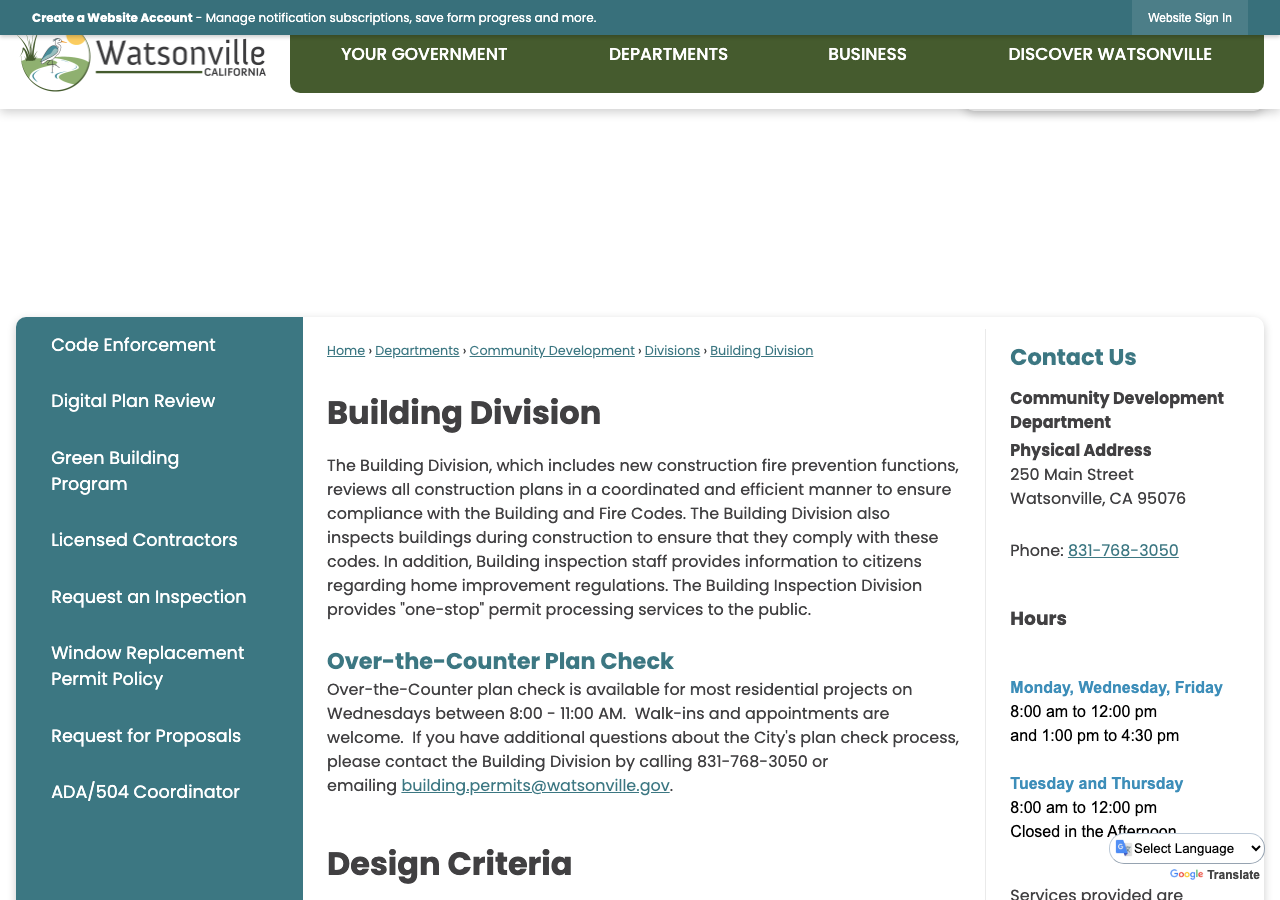
Why the confidence is not higherCity of Watsonville Building Division page, 'Design Criteria' section (Wind Speed & Exposure: 92 mph, Surface Roughness Category C, Wind Exposure C; CRC Section 301.2.2.1). No windstorm-certificate requirement of any kind found.
department page https://www.watsonville.gov/150/Building-Division
Q27 Is a Specific Use Permit or Council approval ever required? Overlays & special cases
Generally No for a compliant rooftop PV system under the ministerial WMC 8-17 ordinance (state law, GC 65850.5, requires non-discretionary/administrative approval). FLAG: a Coastal Development Permit (and potentially Planning Commission/Council-level review) can be triggered for the subset of Watsonville properties that fall within the mapped California Coastal Zone -- confirmed by the City's own 2005 Local Coastal Program/Land Use Plan document and by a live example (Pajaro Valley High School, on the city's west side near Harkins Slough Road, is on record needing a City-issued CDP because 'the school site rests within the California Coastal Zone'). This is location-specific within the city, not citywide, and was not resolved to a parcel-level boundary in this run.
Why the confidence is not higherCity site-search hit: '15. District Letter requesting aeronautics review (2000)' -- 'The school site rests within the California Coastal Zone and so to obtain a Coastal Development Permit from the City of Watsonville, developmental standards must be met.' Also: 'Local Coastal Program - Land Use Plan (2005)' document exists on the City's DocumentCenter, confirming Watsonville administers its own coastal-zone LCP for at least part of its incorporated area.
city document (site search) https://www.watsonville.gov/documentcenter/view/11100
Q28 Is there a system-size cap on residential generation? Overlays & special cases
No universal cap on residential generation size. The ministerial/expedited streamlined-review pathway under WMC 8-17 is limited by definition to systems 'no larger than ten (10) kilowatts alternating current nameplate rating or thirty (30) kilowatts thermal' on a single- or duplex-family dwelling -- but larger systems remain permittable via the standard (non-streamlined-timeline) building-permit process; this is an eligibility threshold for expedited handling, not a hard ceiling on system size.
Why the confidence is not higherWMC 8-17.02(1) definition of 'small residential rooftop solar energy system,' tracking the State definition in Government Code Section 65850.5.
ordinance https://www.codepublishing.com/CA/Watsonville/html/Watsonville08/Watsonville0817.html
Lines marked with a percentage were read off this authority’s own published documents. Unmarked guidance is general good practice, not this jurisdiction’s rule — always confirm against the authority before you submit.
Install 5 steps · 20 questions
-
Build to the code editions actually in force here
The NEC edition a jurisdiction enforces is often a cycle behind the newest one published, and local amendments sit on top of it. Rapid shutdown, conductor sizing and labelling all change between editions, so the edition in force is the first thing to establish, not the last.
- Which NEC edition is in force? 2023 NEC (adopted as amended within the 2025 California Electrical Code, Part 3) 80% · adopting ordinance
- Which building code edition is in force? 2025 California Building Code, Volumes 1 and 2 (and 2025 California Residential Code, Part 2.5, for one- and two-family dwellings) 95% · adopting ordinance
- Which fire code edition is in force? 2025 California Fire Code, Part 9 95% · adopting ordinance
- Are there local amendments to any of the above? Yes 90% · ordinance
- What is the installation judged against? The installation is judged against the 2025 CBC/CRC/CEC/CFC as locally amended by Ord. 1483-25 (eff. 1/1/2026), plus WMC Chapter 8-17's own eligibility/process requirements for the streamlined pathway, and California Government Code Section 65850.5. 85% · ordinance
-
Fire access, setbacks and pathways
Ridge setbacks and roof access pathways are fire-service requirements and they constrain the array layout. They are the most common cause of a redesign after the fire department comments on a plan set.
- What ridge setback and access pathways are required? Governed by the unamended 2025 California Fire Code's rooftop-solar access-pathway/setback section (no local amendment to it was found in WMC 8-11.02's list of amended/added/deleted CFC sections, which covers only fire-flow, hydrants, sprinklers, alternate power sources, wildfire-risk-area rules, and appendices). 55% · ordinance (local amendments, checked for absence)
-
Rapid shutdown
Which rapid-shutdown rule applies follows directly from the NEC edition in force, and the initiation device has to be at a location the fire service can reach and identify. This is inspected, and it is labelled.
- Is rapid shutdown required, and to which NEC edition? Yes -- rapid shutdown is required to the 2023 NEC (via the 2025 CEC, Part 3) since no Watsonville-specific amendment to the CEC's rapid-shutdown provisions (NEC Article 690.12) was found; WMC Chapter 8-5 adopts the CEC 'by reference' only, with no additional locally amended sections listed. 70% · adopting ordinance (checked for absence of local amendment)
-
Labels and placards
The NEC sets a baseline for permanent markings at the service equipment and the disconnecting means. On top of that, an authority may specify its own wording, and the utility may specify more again. Where any of them writes its own text, a generic off-the-shelf label set will not pass — this is the detail most often fixed on a return visit.
- Which placards does this authority require at the service equipment? A red 'Alternate Power Source' warning placard at each electrical panel subject to back-feed from solar/PV or other alternate power sources, required by the City's own Fire Code amendment. 95% · ordinance
- Does the authority specify placard wording of its own? Yes 95% · ordinance
- Does it specify letter height, colour or material? Red sign color, minimum 1/2-inch tall contrasting lettering; material not specified. 90% · ordinance
- Does the UTILITY specify placards beyond the AHJ's? Yes -- PG&E's current interconnection tariff (Rule 21) requires a 'Visible Disconnect' near the Point of Interconnection with markings/signage that 'clearly indicates open and closed positions,' when required by PG&E's operating practices. PG&E's more detailed distribution-generation interconnection handbook (TD-2306M) is gated ('See your PG&E Job Owner for access') and was not reachable in this run. 60% · utility tariff (Rule 21)
- Where must the labels be placed? Permanently affixed on each electrical panel subject to back-feed from the alternate power source (i.e., at the main/subpanel(s) fed by the PV system), per the City's own fire-code amendment. 90% · ordinance
-
Disconnect, storage and listed equipment
Where the AC disconnect must sit relative to the meter is usually the utility's rule, not the building department's. Battery storage frequently carries its own permit, its own inspection and its own fire conditions.
- Where must the AC disconnect be, relative to the meter? Not fixed by the City; governed by the adopted 2025 CEC's general disconnect-accessibility rules (readily accessible, outdoor, lockable) and by PG&E's Rule 21 visible-disconnect requirement near the Point of Interconnection when PG&E's operating practices call for one. PG&E's jurisdiction-specific distribution-generation manual (TD-2306M), which would normally pin down an exact distance from the meter, is gated to registered PG&E job owners and was not reachable in this run. 55% · utility tariff (Rule 21)
- Must equipment be on a specific approved list? Yes, by inference from the adopted 2025 CEC's general listing requirement (CEC 110.3(B)) for all electrical equipment, applied to PV modules, inverters, and disconnects; no Watsonville-specific 'approved equipment list' was found. 60% · adopting ordinance (inference)
- Are batteries permitted, and under what conditions? Permitted, but the applicable conditions are split across two ambiguous sources: (1) general 2025 CRC/CFC battery/ESS listing (UL 9540) and installation provisions apply by reference (no local amendment found), and (2) the Fire Department's FY26-27 fee schedule lists a generic 'Battery System' item ($395.00, Per Hour/Annual) inside a long, alphabetized CFC Chapter 1 operational-permit list (Aerosol Products, Aircraft Refueling, Asbestos Removal, Battery System, Candles...) that does not distinguish residential from commercial/industrial application -- flagged, not resolved. 55% · fee schedule
- Is there a separate ESS permit or inspection? Likely yes for the underlying building/electrical permit for the ESS itself (covered by the same combined Building/Fire application used for solar), and possibly also the separate Fire 'Battery System' operational permit noted in Q45 -- but the residential applicability of that second, Fire-side permit was not confirmed. 50% · permit application form
- Is there a local rule on service upgrades or busbar sizing? No Watsonville-specific local amendment to service/busbar sizing was found in the Municipal Code; the operative limits currently governing the City's live process are SolarAPP+ platform equipment limits (adopted by the City by using the tool): up to 400A main service, 225A service disconnect switches, and 225A busbars. The older 2016 checklist separately capped the eligible service at a single-phase 120/240V panel with a 225A-or-less busbar for that specific expedited pathway. 65% · department page/PDF
20 questions answered against City of Watsonville’s own published documents
Q29 Which NEC edition is in force? Core Code editions in force
2023 NEC (adopted as amended within the 2025 California Electrical Code, Part 3)
Why the confidence is not higherWMC 8-5.01 adopts 'The California Electrical Code, Part 3, 2025 Edition,' effective 1 Jan 2026 (Ord. 1483-25). California's 2025 Building Standards Code cycle is based on the 2023 NFPA 70 (NEC) with state amendments, per the standard triennial state adoption pattern; no chapter republishing the base NEC text was found at codepublishing.com (proprietary ICC/NFPA text is adopted by reference only), so the 2023-NEC lineage is inference from the known CA code-cycle mapping rather than a directly quoted section.
adopting ordinance https://www.codepublishing.com/CA/Watsonville/html/Watsonville08/Watsonville0805.html
Q30 Which building code edition is in force? Core Code editions in force
2025 California Building Code, Volumes 1 and 2 (and 2025 California Residential Code, Part 2.5, for one- and two-family dwellings)
Why the confidence is not higherWMC 8-3.01 and 8-4.01, both adopted by Ord. 1483-25, effective 1 January 2026.
adopting ordinance https://www.codepublishing.com/CA/Watsonville/html/Watsonville08/Watsonville0803.html
Q31 Which fire code edition is in force? Code editions in force
2025 California Fire Code, Part 9
Why the confidence is not higherWMC 8-11.01, adopted by Ord. 1483-25, effective 1 January 2026.
adopting ordinance https://www.codepublishing.com/CA/Watsonville/html/Watsonville08/Watsonville0811.html
Q32 Are there local amendments to any of the above? Core Code editions in force
Yes
Why the confidence is not higherWMC 8-11.02 amends/adds several CFC sections locally, including a new Section 509.1.2 'Alternate power sources' governing solar/PV signage, amended fire-flow and hydrant-painting sections (507.5.7), rewritten sprinkler-requirement sections (903.2 series), and ADU fire-access provisions -- all adopted alongside the base 2025 CFC by the same Ord. 1483-25.
ordinance https://www.codepublishing.com/CA/Watsonville/html/Watsonville08/Watsonville0811.html
Q33 What is the installation judged against? Core Electrical
The installation is judged against the 2025 CBC/CRC/CEC/CFC as locally amended by Ord. 1483-25 (eff. 1/1/2026), plus WMC Chapter 8-17's own eligibility/process requirements for the streamlined pathway, and California Government Code Section 65850.5.
Why the confidence is not higherWMC Chapters 8-1, 8-3, 8-4, 8-5, 8-11, and 8-17, all adopted/amended by the single Ordinance 1483-25.
ordinance https://www.codepublishing.com/CA/Watsonville/html/Watsonville08/Watsonville0817.html
Q34 Is there a local rule on service upgrades or busbar sizing? Electrical
No Watsonville-specific local amendment to service/busbar sizing was found in the Municipal Code; the operative limits currently governing the City's live process are SolarAPP+ platform equipment limits (adopted by the City by using the tool): up to 400A main service, 225A service disconnect switches, and 225A busbars. The older 2016 checklist separately capped the eligible service at a single-phase 120/240V panel with a 225A-or-less busbar for that specific expedited pathway.
Why the confidence is not higherCity's SolarAPP+ How-To PDF (2023) FAQ 'Is there a limit on system size SolarAPP+ can review?'; 2016 Eligibility Checklist, Electrical Requirements item C.
department page/PDF https://www.watsonville.gov/DocumentCenter/View/22083/SolarAPP---How-to
Q35 Is a specific mounting system or attachment spacing required? Structural & mounting
Nothing published by this authority.
Where we lookedWMC Chapters 8-1, 8-3, 8-4 (adopted-by-reference chapters with no locally republished amendment text at codepublishing.com), the 2016 solar eligibility checklist, and the SolarAPP+ How-To PDF -- none specifies a mounting-system brand, attachment type, or spacing requirement beyond the applicant's own structural self-certification duty in WMC 8-17.03(c)(1).
https://www.codepublishing.com/CA/Watsonville/html/Watsonville08/Watsonville0803.html
Q36 What ridge setback and access pathways are required? Core Fire pathways & setbacks
Governed by the unamended 2025 California Fire Code's rooftop-solar access-pathway/setback section (no local amendment to it was found in WMC 8-11.02's list of amended/added/deleted CFC sections, which covers only fire-flow, hydrants, sprinklers, alternate power sources, wildfire-risk-area rules, and appendices).
Why the confidence is not higherWMC 8-11.02 (full local CFC amendment list read in full) contains no section on rooftop PV access pathways or ridge setbacks, meaning the base, un-republished 2025 CFC text controls; that base ICC/CA text itself was not directly retrievable (proprietary code, adopted by reference only), so this is an absence-of-amendment inference, not a direct quote of the pathway requirement.
ordinance (local amendments, checked for absence) https://www.codepublishing.com/CA/Watsonville/html/Watsonville08/Watsonville0811.html
Q37 Is rapid shutdown required, and to which NEC edition? Core Rapid shutdown
Yes -- rapid shutdown is required to the 2023 NEC (via the 2025 CEC, Part 3) since no Watsonville-specific amendment to the CEC's rapid-shutdown provisions (NEC Article 690.12) was found; WMC Chapter 8-5 adopts the CEC 'by reference' only, with no additional locally amended sections listed.
Why the confidence is not higherWMC 8-5.01 (single section, 'Adopted by reference,' no companion amendments section, unlike Chapters 8-3/8-11 which do carry amendment sections).
adopting ordinance (checked for absence of local amendment) https://www.codepublishing.com/CA/Watsonville/html/Watsonville08/Watsonville0805.html
Q38 Which placards does this authority require at the service equipment? Core Labels Signage & labelling
A red 'Alternate Power Source' warning placard at each electrical panel subject to back-feed from solar/PV or other alternate power sources, required by the City's own Fire Code amendment.
Why the confidence is not higherWMC 8-11.02, new CFC Section 509.1.2 ('Alternate power sources'): 'a sign reading: "WARNING—This premise is provided with an Alternate Power Source. Disconnection of commercial power may not disable the electrical power source" shall be permanently affixed ... on each electrical panel subject to back-feed from alternate power sources. Any and all power disabling switches shall be clearly labeled.'
ordinance https://www.codepublishing.com/CA/Watsonville/html/Watsonville08/Watsonville0811.html
Q39 Does the authority specify placard wording of its own? Core Labels Signage & labelling
Yes
Why the confidence is not higherSame WMC 509.1.2 amendment quotes the exact required wording verbatim: 'WARNING—This premise is provided with an Alternate Power Source. Disconnection of commercial power may not disable the electrical power source.'
ordinance https://www.codepublishing.com/CA/Watsonville/html/Watsonville08/Watsonville0811.html
Q40 Does it specify letter height, colour or material? Core Labels Signage & labelling
Red sign color, minimum 1/2-inch tall contrasting lettering; material not specified.
Why the confidence is not higherWMC 509.1.2: 'Sign shall be red in color with a minimum of ½" tall contrasting lettering and shall be permanently affixed on each electrical panel.' No material (metal/vinyl/engraved) is specified.
ordinance https://www.codepublishing.com/CA/Watsonville/html/Watsonville08/Watsonville0811.html
Q41 Is a site plan / facility map placard required, and what must it show? Core Labels Signage & labelling
Nothing published by this authority.
Where we lookedWMC Chapter 8-17 (ministerial ordinance text, full text read), the 2016 eligibility checklist, and the SolarAPP+ How-To PDF -- none separately describes a site-plan/facility-map placard beyond the roof-layout diagram required as part of the submittal package (which shows panel locations, access pathways and disconnect locations, itself a design document rather than a posted field placard).
https://www.codepublishing.com/CA/Watsonville/html/Watsonville08/Watsonville0817.html
Q42 Does the UTILITY specify placards beyond the AHJ's? Core Labels Signage & labelling
Yes -- PG&E's current interconnection tariff (Rule 21) requires a 'Visible Disconnect' near the Point of Interconnection with markings/signage that 'clearly indicates open and closed positions,' when required by PG&E's operating practices. PG&E's more detailed distribution-generation interconnection handbook (TD-2306M) is gated ('See your PG&E Job Owner for access') and was not reachable in this run.
Why the confidence is not higherPG&E Electric Rule No. 21 ('GENERATING FACILITY INTERCONNECTIONS'), Section D -- 'Visible Disconnect Required' (also repeated for Smart Inverter interconnections). Cal. P.U.C. Sheet No. 59481-E family, Advice 7692-E, effective 29 Aug 2025.
utility tariff (Rule 21) https://www.pge.com/tariffs/assets/pdf/tariffbook/ELEC_RULES_21.pdf
Q43 Where must the labels be placed? Core Labels Signage & labelling
Permanently affixed on each electrical panel subject to back-feed from the alternate power source (i.e., at the main/subpanel(s) fed by the PV system), per the City's own fire-code amendment.
Why the confidence is not higherWMC 8-11.02, CFC Section 509.1.2.
ordinance https://www.codepublishing.com/CA/Watsonville/html/Watsonville08/Watsonville0811.html
Q44 Must equipment be on a specific approved list? Equipment listing
Yes, by inference from the adopted 2025 CEC's general listing requirement (CEC 110.3(B)) for all electrical equipment, applied to PV modules, inverters, and disconnects; no Watsonville-specific 'approved equipment list' was found.
Why the confidence is not higherWMC 8-5.01 adopts the 2025 CEC in full; no separate City-maintained equipment list was found on the Building Division, Permit Applications, or SolarAPP+ pages.
adopting ordinance (inference) https://www.codepublishing.com/CA/Watsonville/html/Watsonville08/Watsonville0805.html
Q45 Are batteries permitted, and under what conditions? Core Battery / ESS
Permitted, but the applicable conditions are split across two ambiguous sources: (1) general 2025 CRC/CFC battery/ESS listing (UL 9540) and installation provisions apply by reference (no local amendment found), and (2) the Fire Department's FY26-27 fee schedule lists a generic 'Battery System' item ($395.00, Per Hour/Annual) inside a long, alphabetized CFC Chapter 1 operational-permit list (Aerosol Products, Aircraft Refueling, Asbestos Removal, Battery System, Candles...) that does not distinguish residential from commercial/industrial application -- flagged, not resolved.
Why the confidence is not higherFY26-27 Fee Schedule, Fire Department 'Inspection Fees' section, item #26 'Battery System,' $194.00 (FY25/26) -> $395.00 (FY26/27), Per Hour/Annual. No text in this fee schedule or in WMC 8-11 clarifies whether a single residential rooftop-PV-paired home battery triggers this operational permit.
fee schedule https://www.watsonville.gov/DocumentCenter/View/28679/2026-27-Fee-Schedule
Q46 Is there a separate ESS permit or inspection? Battery / ESS
Likely yes for the underlying building/electrical permit for the ESS itself (covered by the same combined Building/Fire application used for solar), and possibly also the separate Fire 'Battery System' operational permit noted in Q45 -- but the residential applicability of that second, Fire-side permit was not confirmed.
Why the confidence is not higherSame sources as Q45; no ESS-specific ordinance or checklist distinct from the generic Building/Fire Permit and Plan Check Application (id 1120) was found.
permit application form https://www.watsonville.gov/DocumentCenter/View/1120/BuildingFire-Application
Q47 Is a ground mount treated as a structure? Core Ground mount
Nothing published by this authority.
Where we lookedWMC Title 14 (Zoning): Chapter 14-16 District Regulations (full text checked, 2 'solar' hits found -- both irrelevant, one about industrial-use fuel type, one about Planned Development design-team composition, confirming the search itself works and is not silently failing), Chapter 14-18 Definitions, and Chapter 14-40 General Provisions/Exceptions/Modifications -- none defines or classifies a ground-mounted solar array as an accessory structure, height exception, or setback trigger.
https://www.codepublishing.com/CA/Watsonville/html/Watsonville14/Watsonville1416.html
Q48 Where must the AC disconnect be, relative to the meter? Core Utility equipment
Not fixed by the City; governed by the adopted 2025 CEC's general disconnect-accessibility rules (readily accessible, outdoor, lockable) and by PG&E's Rule 21 visible-disconnect requirement near the Point of Interconnection when PG&E's operating practices call for one. PG&E's jurisdiction-specific distribution-generation manual (TD-2306M), which would normally pin down an exact distance from the meter, is gated to registered PG&E job owners and was not reachable in this run.
Why the confidence is not higherPG&E Electric Rule No. 21, Section D ('Visible Disconnect Required'); WMC 8-5 adopts the 2025 CEC without a local amendment specifying disconnect placement.
utility tariff (Rule 21) https://www.pge.com/tariffs/assets/pdf/tariffbook/ELEC_RULES_21.pdf
Lines marked with a percentage were read off this authority’s own published documents. Unmarked guidance is general good practice, not this jurisdiction’s rule — always confirm against the authority before you submit.
Inspection 5 steps · 14 questions
-
Book it
Booking is a portal, a phone call or an email depending on the authority, and the notice required is rarely zero. Book before the work is finished rather than after — the lead time, not the work, is usually what sets the date.
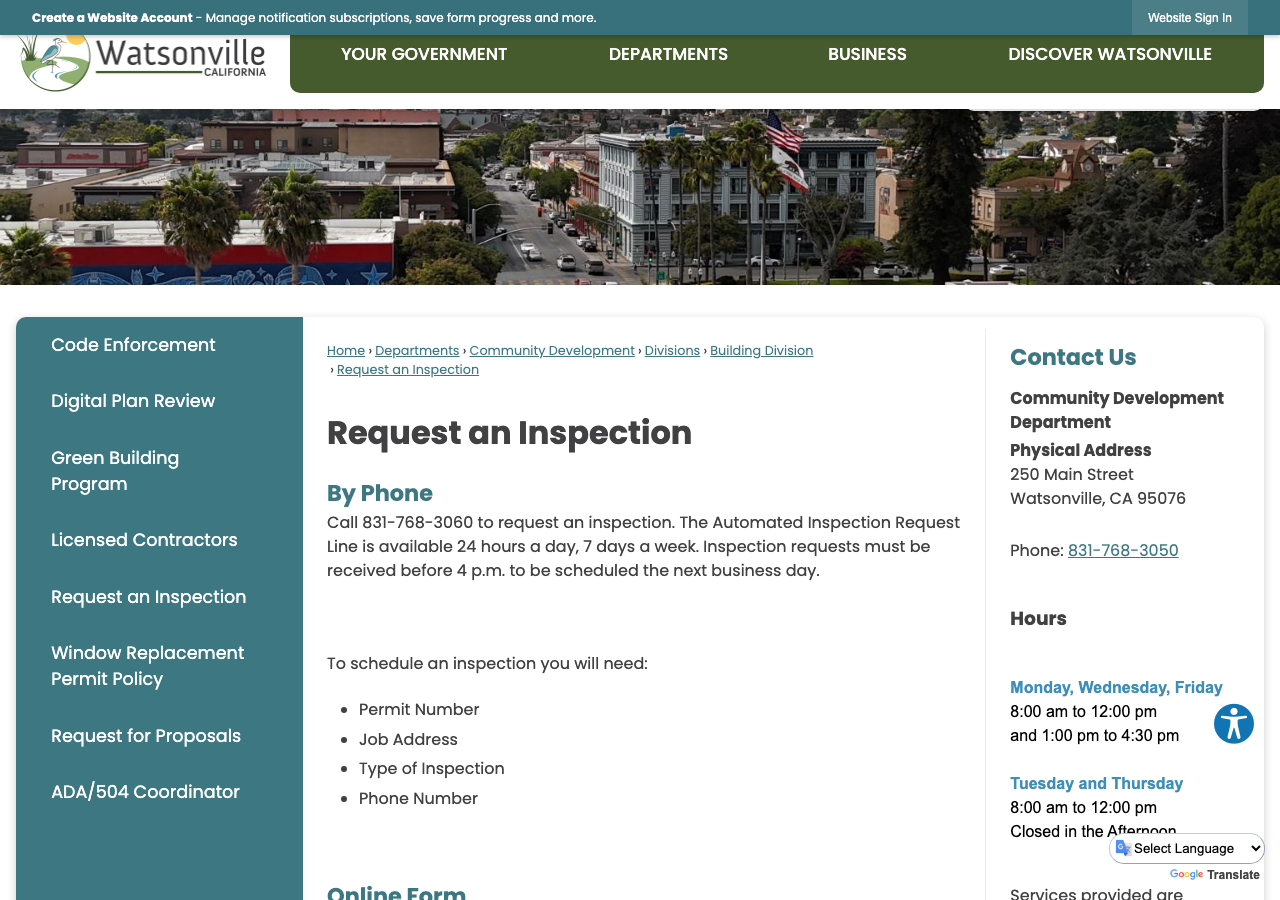
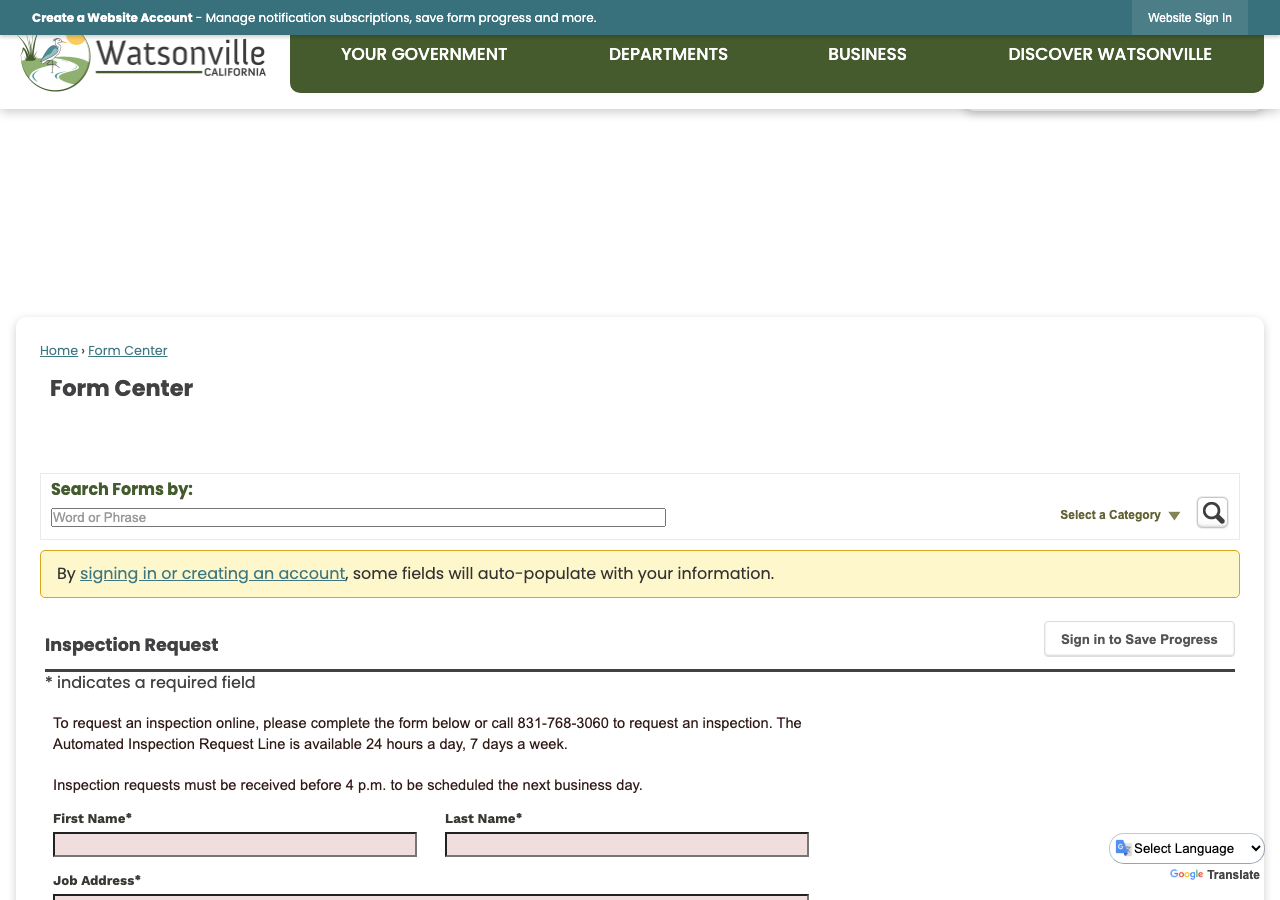
- How is an inspection booked? Phone (24/7 automated inspection request line) or an Online Form 90% · department page
- How much notice is required? Requests received before 4:00 p.m. are scheduled for the next business day (i.e., roughly one business day's notice). 90% · department page
-
Know who turns up
Some authorities inspect their own solar work; some delegate it, and a few do not inspect the PV equipment itself at all. Who is coming determines what they will look at.
- Does this AHJ perform its own final solar inspection? Yes -- the Building Division (Community Development Department) performs building/electrical/solar inspections; Fire performs its own separate annual/complaint-driven business inspections but explicitly delegates new-construction and remodel permit inspections back to Community Development. 85% · department page
- If delegated, to whom? Not delegated outside the City -- performed by the City's own Community Development Department / Building Division, with a consolidated Building Official + Fire Chief inspection for expedited-eligible systems per the ministerial ordinance. 85% · ordinance
-
Work the stages in order
A rough-in or mid-roof inspection, where one is required, has to happen before the work it covers is closed up. Missing a stage means opening something back up, and it is the most expensive kind of correction.
- Which inspections are required, and in what order? For expedited/SolarAPP+-eligible systems: a single consolidated final inspection (which may combine Building Official and Fire Chief sign-off). For standard-track/larger systems, the sequence was not separately published (typically rough electrical then final, per general CA building practice, but not confirmed for Watsonville specifically). 70% · ordinance
- Is a rough-in or mid-roof inspection required? No, for expedited/SolarAPP+-eligible systems -- WMC 8-17.03(d) requires only one inspection. Not confirmed either way for standard-track/larger systems. 65% · ordinance
-
Have the paperwork on site
The approved plan set, the permit, and the equipment listings should be on site and reachable. Inspectors routinely verify that installed equipment matches what was approved, and that the labels are the ones the plan set promised.
- Is there a published inspection checklist? Yes, for SolarAPP+-processed permits -- the platform automatically generates a project-specific Inspection Checklist provided to the City alongside the Approval Document. 75% · department page/PDF
- What must be on site at inspection? The issued permit/Approval Document and its SolarAPP+-generated Inspection Checklist; for the standard track, the approved plan set and permit card. No separately published generic 'what to have on site' list beyond these was found. 55% · department page/PDF (inference)
- Does the inspector verify labels and listings? Yes, by inference -- SolarAPP+ generates a project-specific Inspection Checklist tied to the code-compliance inputs (including listed-equipment data) supplied at application, which the City's inspector works from at the field inspection. 60% · department page/PDF
-
Sign-off, and permission to operate
Passing gives you a final or an equivalent sign-off. That is not the same as permission to operate: PTO comes from the utility, and who tells the utility the inspection passed varies. A system left switched off for weeks is usually waiting on this handover.
- What is issued on pass? Final (a passed final inspection/approved permit card); a Certificate of Occupancy is not typical for a PV retrofit on an existing single-family/duplex dwelling. 55% · ordinance (inference)
- Who notifies the utility for PTO? Installer -- the installer/applicant submits the interconnection (NEM) request to PG&E, which requires 'evidence of Applicant's final electric inspection clearance from the Governmental Authority having jurisdiction' before PG&E issues Permission to Operate; the City's own ordinance likewise places the utility-approval step on the applicant, not the City. 85% · utility tariff (Rule 21) + ordinance
- Is there a re-inspection fee? $254.00 per hour (FY26-27; was $180.00/hr FY25-26) -- 'Building Reinspection fee' 80% · fee schedule
- How are corrections issued and cleared? A written correction notice is issued by the Building Official detailing all deficiencies and any additional information required; the permit is not deemed complete/eligible for expedited issuance until corrections are resolved. 85% · ordinance
14 questions answered against City of Watsonville’s own published documents
Q49 How is an inspection booked? Core Booking & scheduling
Phone (24/7 automated inspection request line) or an Online Form
Why the confidence is not higher'Request an Inspection' page: 'Call 831-768-3060 ... The Automated Inspection Request Line is available 24 hours a day, 7 days a week' and 'Submit the Request an Inspection Form to complete an online inspection request.'
department page https://www.watsonville.gov/153/Request-an-Inspection
Q50 How much notice is required? Core Booking & scheduling
Requests received before 4:00 p.m. are scheduled for the next business day (i.e., roughly one business day's notice).
Why the confidence is not higher'Request an Inspection' page: 'Inspection requests must be received before 4 p.m. to be scheduled the next business day.'
department page https://www.watsonville.gov/153/Request-an-Inspection
Q51 Are same-day or AM/PM windows offered? Booking & scheduling
Nothing published by this authority.
Where we looked'Request an Inspection' page (id 153) and Building Division page (id 150) -- neither mentions AM/PM windows or same-day scheduling; only 'next business day' after a 4 p.m. cutoff is published.
Q52 Does this AHJ perform its own final solar inspection? Core Who inspects
Yes -- the Building Division (Community Development Department) performs building/electrical/solar inspections; Fire performs its own separate annual/complaint-driven business inspections but explicitly delegates new-construction and remodel permit inspections back to Community Development.
Why the confidence is not higher'For new or remodel construction permit inspections, contact the Community Development Department' -- Fire Inspections page and Building & Construction Information page (both Fire Dept pages).
department page https://www.watsonville.gov/505/Fire-Inspections
Q53 If delegated, to whom? Core Who inspects
Not delegated outside the City -- performed by the City's own Community Development Department / Building Division, with a consolidated Building Official + Fire Chief inspection for expedited-eligible systems per the ministerial ordinance.
Why the confidence is not higherWMC 8-17.03(d): 'only one (1) inspection shall be required ... and may include a consolidated inspection by the Building Official and Fire Chief.'
ordinance https://www.codepublishing.com/CA/Watsonville/html/Watsonville08/Watsonville0817.html
Q54 Which inspections are required, and in what order? Core Stages & sequence
For expedited/SolarAPP+-eligible systems: a single consolidated final inspection (which may combine Building Official and Fire Chief sign-off). For standard-track/larger systems, the sequence was not separately published (typically rough electrical then final, per general CA building practice, but not confirmed for Watsonville specifically).
Why the confidence is not higherWMC 8-17.03(d).
ordinance https://www.codepublishing.com/CA/Watsonville/html/Watsonville08/Watsonville0817.html
Q55 Is a rough-in or mid-roof inspection required? Stages & sequence
No, for expedited/SolarAPP+-eligible systems -- WMC 8-17.03(d) requires only one inspection. Not confirmed either way for standard-track/larger systems.
Why the confidence is not higherWMC 8-17.03(d): 'only one (1) inspection shall be required.'
ordinance https://www.codepublishing.com/CA/Watsonville/html/Watsonville08/Watsonville0817.html
Q56 Does the inspector verify labels and listings? Core What is checked
Yes, by inference -- SolarAPP+ generates a project-specific Inspection Checklist tied to the code-compliance inputs (including listed-equipment data) supplied at application, which the City's inspector works from at the field inspection.
Why the confidence is not higherCity's SolarAPP+ How-To PDF: 'the compliance check ... will reissue your updated permit and alert the City of Watsonville with a revised Approval Document and Inspection Checklist.'
department page/PDF https://www.watsonville.gov/DocumentCenter/View/22083/SolarAPP---How-to
Q57 Is there a published inspection checklist? Core What is checked
Yes, for SolarAPP+-processed permits -- the platform automatically generates a project-specific Inspection Checklist provided to the City alongside the Approval Document.
Why the confidence is not higherCity's SolarAPP+ How-To PDF, 'How do I make changes to approved plans?' answer.
department page/PDF https://www.watsonville.gov/DocumentCenter/View/22083/SolarAPP---How-to
Q58 What must be on site at inspection? Core Documents on site
The issued permit/Approval Document and its SolarAPP+-generated Inspection Checklist; for the standard track, the approved plan set and permit card. No separately published generic 'what to have on site' list beyond these was found.
Why the confidence is not higherInferred from City's SolarAPP+ How-To PDF describing the Approval Document + Inspection Checklist pairing; no standalone 'documents required at inspection' page was found for the manual track.
department page/PDF (inference) https://www.watsonville.gov/DocumentCenter/View/22083/SolarAPP---How-to
Q59 Is there a re-inspection fee? Corrections & re-inspection
$254.00 per hour (FY26-27; was $180.00/hr FY25-26) -- 'Building Reinspection fee'
Why the confidence is not higher2026-27 Fee Schedule, item #91 'Building Reinspection fee,' Per Hour, listed under Building Permit Fees. (A separate, higher 'Reinspection Fee' of $354.00/hr, item #211, sits in the Fire Department's own fee section for its unrelated operational-permit inspections -- Weed Abatement, Carnivals, etc. -- and does not appear to be the applicable one for a solar building/electrical reinspection.)
fee schedule https://www.watsonville.gov/DocumentCenter/View/28679/2026-27-Fee-Schedule
Q60 How are corrections issued and cleared? Corrections & re-inspection
A written correction notice is issued by the Building Official detailing all deficiencies and any additional information required; the permit is not deemed complete/eligible for expedited issuance until corrections are resolved.
Why the confidence is not higherWMC 8-17.03(e): 'Upon receipt of an incomplete application, the Building Official shall issue a written correction notice detailing all deficiencies in the application and any additional information required to be eligible for expedited permit issuance.'
ordinance https://www.codepublishing.com/CA/Watsonville/html/Watsonville08/Watsonville0817.html
Q61 What is issued on pass? Core Final sign-off & PTO
Final (a passed final inspection/approved permit card); a Certificate of Occupancy is not typical for a PV retrofit on an existing single-family/duplex dwelling.
Why the confidence is not higherInferred from general CA residential-alteration permitting practice combined with WMC 8-17.03(d)'s single consolidated 'inspection' language (no CO/green-tag terminology used in the ordinance itself).
ordinance (inference) https://www.codepublishing.com/CA/Watsonville/html/Watsonville08/Watsonville0817.html
Q62 Who notifies the utility for PTO? Core Final sign-off & PTO
Installer -- the installer/applicant submits the interconnection (NEM) request to PG&E, which requires 'evidence of Applicant's final electric inspection clearance from the Governmental Authority having jurisdiction' before PG&E issues Permission to Operate; the City's own ordinance likewise places the utility-approval step on the applicant, not the City.
Why the confidence is not higherPG&E Electric Rule No. 21, Section D.13.b (NEM Permission to Operate processing); WMC 8-17.03(f): 'The applicant is responsible for obtaining such approval or permission from the local utility provider.'
utility tariff (Rule 21) + ordinance https://www.pge.com/tariffs/assets/pdf/tariffbook/ELEC_RULES_21.pdf
Lines marked with a percentage were read off this authority’s own published documents. Unmarked guidance is general good practice, not this jurisdiction’s rule — always confirm against the authority before you submit.
Jurisdiction & key facts
The standing 62-question set, answered for City of Watsonville against this authority’s own published documents. Every answer carries the confidence it was recorded at and the document it came from. Where nothing is published we say so and show where we looked — a blank here is a finding, not a gap.
City of Watsonville is the authority having jurisdiction 88% confidence
- Holds
- Building and Electrical (Community Development Department, Building Division). Fire is a separate city department (Watsonville Fire Department, est. 1861, Fire Chief Corey Shaefer) but its own Fire Code amendment (WMC 8-11.02, CFC Sec. 509.1.2) routes approval of solar/alternate-power-source installations to 'the building code official,' and Fire's own webpages explicitly delegate new-construction/remodel permit inspections back to Community Development ('For new or remodel construction permit inspections, contact the Community Development Department').
- Overridden by
- For the subset of parcels within the mapped California Coastal Zone (confirmed to include at least part of the city's west side, e.g. the Pajaro Valley High School site near Harkins Slough Road, per the City's own 2005 Local Coastal Program/Land Use Plan and a documented City-issued Coastal Development Permit history there), a Coastal Development Permit is layered on top of the building/electrical permit -- not resolved to a citywide parcel boundary in this run. PG&E (interconnection, NEM, Permission to Operate) runs on a parallel track the City does not administer; its Rule 21 tariff requires the City's own final-inspection clearance before PTO is granted, and its detailed distribution-generation manual (TD-2306M) is gated to registered PG&E job owners. Central Coast Community Energy (3CE) is confirmed (via the City's own Climate Action and Adaptation Plan / CEQA documents, which set a measure to increase '3CE' participation) as the default generation provider/CCA for city accounts, but PG&E alone owns the wires and controls interconnection/PTO -- 3CE plays no role in the permitting or inspection chain. State law (2025 CBC/CRC/CEC/CFC per the standard CA Building Standards Code cycle; Government Code Sec. 65850.5's ministerial-review mandate, which WMC Chapter 8-17 implements almost verbatim) bounds what the City may add locally; AB 130's Oct-2025-to-Jun-2031 freeze on more-restrictive local residential code amendments would apply to any future attempt to tighten WMC Title 8 beyond the current 2025 cycle.
- Why not higher
- WMC Title 8 (Building Regulations) establishes the Building Division under a Building Official within the Community Development Department (WMC 8-1, 8-3 through 8-11), and WMC Chapter 8-17 (added by Ord. 1483-25, eff. 1 Jan 2026) is the City's own ministerial small-residential-rooftop-solar ordinance implementing Government Code Sec. 65850.5. The City's Building Division page (250 Main Street) states 'Services provided are Planning, Engineering, Fire, and Building submittals and inspections' -- i.e. Fire submittals/inspections for new construction are handled through Community Development, not through the separate Fire Department's own webpages (which are for annual/business-license fire inspections). This was checked by name against the City's own department directory and the sitemap, not inferred from a code numbering pattern.
https://www.codepublishing.com/CA/Watsonville/html/Watsonville08/Watsonville0817.html
- Permit required
- Yes95%
- Permit cost
- $336 flat (FY26-27); was $238 flat in FY25-2690%
- Plan review
- Immediate/same-day electronic issuance for SolarAPP+-eligible applications once the automated compliance check passes and fees are paid via Stripe;70%
- Portal
- SolarAPP+ (solarapp.nrel.gov) for residential rooftop solar under WMC 8-17; for other building permits the City has no self-service e-permitting portal identified -- 'Digital Plan Review'…75%
- Electrical code
- 2023 NEC (adopted as amended within the 2025 California Electrical Code, Part 3)80%
- Own placard wording
- Yes95%
- Booking an inspection
- Phone (24/7 automated inspection request line) or an Online Form90%
Labels & placards for this authority
City of Watsonville writes its own placard wording. A standard NEC label set will not satisfy it — the exact text, and in most cases the size, colour and font, are specified below.
Wording 95%
Yes
Size, colour & material 90%
Red sign color, minimum 1/2-inch tall contrasting lettering; material not specified.
Where they go 90%
Permanently affixed on each electrical panel subject to back-feed from the alternate power source (i.e., at the main/subpanel(s) fed by the PV system), per the City's own fire-code amendment.
What the utility wants on top 60%
Yes -- PG&E's current interconnection tariff (Rule 21) requires a 'Visible Disconnect' near the Point of Interconnection with markings/signage that 'clearly indicates open and closed positions,' when required by PG&E's operating practices. PG&E's more detailed distribution-generation interconnection handbook (TD-2306M) is gated ('See your PG&E Job Owner for access') and was not reachable in this run.
Each figure above is sourced and dated in the full answer set below (questions 38–43). Where an authority’s own published sheet is older than the code it has adopted, the answer says so.
Their website
Average approval time — application to PTO
From the CPUC interconnection record. Bars show the average days taken each year; a year with no recorded projects is left blank rather than drawn as zero.