
Plumas County
State of California
Plumas County is a county authority in the State of California, covering 33 regions, serving 19,790 residents. 438 residential solar installs are on record here. This page is the permit route for that jurisdiction: the fifteen steps from working out who has a say over an address through to permission to operate, the documents this authority publishes, and 62 answers taken from those documents and dated.
Permitting 5 steps · 28 questions
Whether a permit is needed — Yes. Q3 Electrical and building permits — Combined — Plumas County processes residential PV as a single permit (billed as an 'Electrical' fee line with a plan-review component covering the structural/roof… Q4 Plan review — ~2-4 weeks average for a complete submittal (not solar-specific — this is the Building Department's general stated turnaround, dependent on workload). Q18 Where you file — No dedicated online permit-application portal was found. Applications are paper forms (downloaded PDFs) submitted at the Quincy counter or an after-hours drop box… Q20
- Permit required
- Yes.96% source
- What it costs
- $239.50 residential (Electrical permit $166.00 + ½-hour plan review $73.50). Commercial PV is $371.50.88% source
- Plan review turnaround
- ~2-4 weeks average for a complete submittal (not solar-specific — this is the Building Department's general stated turnaround, dependent on workload).78% source
- Key document
- department handout + codified ordinance cited by 13 open the document
-
Confirm who has a say over your address
A city address is usually permitted by the city, not the county — but not always, and some authorities keep building and hand electrical to someone else. Getting this wrong costs the whole submittal, because every requirement below belongs to whoever actually holds jurisdiction. Check the overlays in the same pass: an HOA, a historic district, a windstorm certification or a system-size cap can reshape the design, and all of them are cheaper to find now than after the array is laid out.
- Is this authority the AHJ for residential solar at this address? Yes, but only for UNINCORPORATED Plumas County. The one incorporated city, City of Portola, is a separate AHJ with its own in-house Building Department. 92% · codified ordinance + city department page
- What does this authority permit itself, and what does it delegate? Both — Plumas County's own Building Department (in-house; all staff on @countyofplumas.com, no contract-firm domain found) issues and inspects both building and electrical permits for unincorporated-area residential solar. Fire-code (CFC) adoption and R-3/WUI enforcement is ALSO assigned by ordinance to the Building Official (§8-1.09) — not to a separate county fire office (there is none). Actual fire suppression/dispatch response, however, is provided by whichever of 20 separate local fire protection districts/departments covers the parcel (no county fire department exists at all). 88% · department staff directory
- Is a permit required for a residential rooftop PV system? Yes. 96% · department handout
- Is there a separate electrical permit, or is it combined? Combined — Plumas County processes residential PV as a single permit (billed as an 'Electrical' fee line with a plan-review component covering the structural/roof review too), applied for on the county's Miscellaneous Building Permit Application, which lists electrical, structural repair, mechanical etc. as one form. No separate 'building permit' fee line exists alongside the PV electrical fee line. 76% · fee schedule / application form
- Is a HOA or architectural approval required first? Not a county-imposed requirement — the county's own PV documents mention only Planning/Zoning items (accessory-structure standards, setbacks, height, reflectivity) for freestanding units, with no HOA/architectural-review step in the county's own permitting process. (This does not mean an individual subdivision's private CC&Rs cannot impose one — that is outside the county's control and the Solar Rights Act, Civil Code §714, would apply.) 68% · department handout
- Is there a historic-district review? No historic-district review found — a full walk of the Title 9 (Planning and Zoning) chapter list found no historic-preservation or historic-district chapter at all (Chapters 1 General Plan, 2 Zoning, 3 Subdivisions, 4 Development Standards, 5 Mine/Reclamation, 6 Open Ranges, 7 Development Agreements, 8 Street Addresses, 9/9.5 Fire Safe/FHSZ, 10 Impact Fees, 11 Easements). 80% · codified ordinance (TOC)
- Is a wind or windstorm certification required? No separate windstorm certification is required beyond standard code wind-load design. The county's own PV Requirements document addresses wind loading only via the standard CRC §R324.4.1.2 component-and-cladding reference to Table R301.2(2)/(3) (adjusted for height and exposure) — there is no Banning/Barstow-style special-wind-region or minimum-mph certification called out. 85% · department handout (read in full)
- Is a Specific Use Permit or Council approval ever required? Not required for a standard rooftop retrofit. A large or nonconforming ground-mounted system that cannot meet the applicable zoning district's accessory-structure standards could require a Special Use Permit or Variance under the county's general zoning process (Title 9, Ch. 2, Arts. 6 and 8), but no solar-specific SUP/Council-approval trigger is codified. 62% · codified ordinance (inference)
- Is there a system-size cap on residential generation? No codified system-size cap (no AB 2188-era 10 kW AC / 30 kW thermal figure, or any other number, was found). 84% · codified ordinance (control-checked absence)
-
Check who is allowed to apply
Several authorities require the electrical permit to be pulled by a licensed electrician, or require the contractor to be registered with them BEFORE applying. Registration is not same-day. This is second on the list rather than fourth because it is the step most likely to stop the job before the drawings matter.
- Who is allowed to pull the electrical permit? Licensed electrician, as a practical matter. 85% · department handout
- Must the contractor be registered with this authority before applying? No separate county contractor-registration requirement found — the county verifies the state CSLB license number and workers' compensation coverage (per §8-9.01 and the PV Requirements form fields) but does not require prior registration with the county itself. 74% · codified ordinance
- Is a homeowner permitted to self-install and self-permit? No, as a practical matter — the county's own handout states the CEC 'Qualified Personnel' requirement 'will not allow most homeowners to install these systems.' A homeowner could still pull an owner-builder permit under Bus. & Prof. Code §7044 (referenced in County Code §8-9.05) and hire a licensed electrician to perform the actual PV work, but self-INSTALLATION is effectively barred by the county's own document. 78% · department handout + codified ordinance
-
Build the submittal package
Almost everywhere wants a site plan, a one-line or three-line electrical diagram, equipment cut sheets with listings, and a structural attachment detail. Build it against the published checklist rather than the last jurisdiction you worked in — the checklist is what the reviewer marks against.
- What documents make up a complete submittal? Per the county's own Solar Submittal Checklist: completed permit application (owner/contractor/agent signatures), workers'-comp forms, contractor license verification, project description; two sets of plans comprising a site plan (major-component locations), a roof layout plan (module layout, 3'-0" perimeter setback, roofing type), an electrical single-line diagram (array configuration, calculations, conductor types/sizes, overcurrent protection, inverter, disconnects, required signage, AC connection point, and battery/battery-box details if applicable); structural calculations (existing roof + added PV load, roof AND ground snow load verification, module attachment, rack snow/wind loads, and a foundation plan/calcs for ground- or pole-mount); and equipment specification sheets (modules, inverters, MPPTs, combiner box(es), disconnects, mounting-rack snow-load rating, and rack fire-rating listing). 96% · published checklist
- How many copies, and in what format? Two complete sets of plans. 92% · department handout
- Is a site plan required, and what must it show? Yes. Must show the location of all buildings on the property and the location of the PV unit on the property (PV Requirements #1), and separately the location of all major solar components (checklist). 95% · department handout
- Is a one-line / three-line diagram required? Yes — a one-line diagram of the service-entrance system AND a three-line diagram showing individual conductor types/sizes, conduit sizes and connection points, plus a roof plan showing new/existing equipment and available fault current at the AC disconnect. 97% · department handout
- Are string and conductor calculations required? Yes — the checklist requires 'electrical calculations' and conductor types/sizes on the single-line diagram, and the Requirements handout requires a load-calculation worksheet whenever the main breaker is being de-rated. 90% · published checklist
- Is a structural PE stamp required, and at what threshold? A California-licensed structural Engineer's stamp/signature is required essentially always for the roof-mount structural evaluation — there is no stated kW or weight threshold below which it is waived. The Requirements doc: 'Existing roof construction must be evaluated for local geographic and climatic design criteria as well as imbalanced load... by an Engineer licensed in the State of California for structural elements. Any structural plan sheets must be stamped and signed by the Engineer.' It also flags a hard structural ceiling: max additional roof loading of 5 psf + a 50-lb point load for truss-framed roofs before engineering is required to show the framing can carry it. 90% · department handout
-
Apply and pay
Most authorities now take the whole application through a portal, and several states cap or constrain what a residential solar permit may cost. Check whether plan check is billed separately before you quote the job.
- Which permit portal does this authority use? No dedicated online permit-application portal was found. Applications are paper forms (downloaded PDFs) submitted at the Quincy counter or an after-hours drop box in Quincy or Chester. GovPayNet is used only for fee payment, and a separate 24/7 phone line + a public Google Calendar are used only for inspection scheduling — neither is an application portal. 76% · department page (reviewed in full)
- Can the whole application be completed online? No — see Q20; there is no online application system, only paper submittal. 76% · department page (reviewed in full)
- What does a residential solar permit cost? $239.50 residential (Electrical permit $166.00 + ½-hour plan review $73.50). Commercial PV is $371.50. A separate 'Service Upgrade for PV System' line is $166.00 residential / $298.00 commercial, and a 'Stationary Battery System Residential' line is also $239.50. 88% · fee schedule / department handout
- How is the fee calculated? Flat — a flat electrical-permit fee plus a flat half-hour plan-review fee; not valuation-based, not per-kW, per-panel, or tiered. 86% · fee schedule
- Is there a separate plan-check fee? Yes — the plan-review component ($73.50 for a half hour) is itemized separately from the $166.00 electrical-permit fee, even though both are billed together as one $239.50 total. 88% · fee schedule
-
Plan review — and start the utility in parallel
Interconnection is a separate process from the permit and usually the longer pole. Where the utility does not depend on the permit being issued, running both at once is the single biggest saving available on a residential job.
- What is the stated plan-review turnaround? ~2-4 weeks average for a complete submittal (not solar-specific — this is the Building Department's general stated turnaround, dependent on workload). 78% · department FAQ
- How long is an issued permit valid before it expires? 24 months after issuance; becomes invalid earlier if work is not commenced within 180 days or is suspended/abandoned for 180 days. One or more 180-day extensions may be granted by the Building Official for good cause. 92% · codified ordinance
- Which utility handles interconnection here? PG&E, for the majority of unincorporated Plumas County (confirmed from the Building Department's own page). However, Plumas-Sierra Rural Electric Cooperative (PSREC) — headquartered in the City of Portola per its own site — very likely serves the City of Portola and the eastern Plumas County/Sierra Valley area instead of PG&E; this could not be confirmed from a Portola-city or Plumas-County document (only from PSREC's own site), so it is reported as a probable utility split rather than a confirmed one. 70% · department page + utility's own site
- Where does the utility sit in the sequence? After permit / gated on the AHJ's final inspection — Plumas County independently bars any utility (by name, in county code) from permanently connecting electrical power before the county's own final inspection has been made and approved by the Building Official or a designated inspector (§8-9.05). This mirrors PG&E's own Rule 21 §D.13.b, which processes Permission to Operate only upon 'evidence of Applicant's final electric inspection clearance from the Governmental Authority having jurisdiction.' 85% · codified ordinance + utility tariff
28 questions answered against Plumas County’s own published documents
Q1 Is this authority the AHJ for residential solar at this address? Core Jurisdiction & scope
Yes, but only for UNINCORPORATED Plumas County. The one incorporated city, City of Portola, is a separate AHJ with its own in-house Building Department.
Why the confidence is not higherPlumas County Code §8-1.01 (Municode) has the county's Building Official administer the adopted CBSC; the City of Portola's own site names its own Building Department staff (Todd Roberts, Dave Mann, both @cityofportola.com) issuing permits independently. No explicit 'applies only to unincorporated territory' sentence was found in Title 8/9 (unlike Colusa County's GCC §5-3), so this rests on California's default rule that county ordinances govern unincorporated territory plus Portola's confirmed independent department, not an express carve-out clause.
codified ordinance + city department page checked 2026-08-31 https://library.municode.com/ca/plumas_county/codes/code_of_ordinances?nodeId=TIT8BURE_CH1BUCO
Q2 What does this authority permit itself, and what does it delegate? Core Jurisdiction & scope
Both — Plumas County's own Building Department (in-house; all staff on @countyofplumas.com, no contract-firm domain found) issues and inspects both building and electrical permits for unincorporated-area residential solar. Fire-code (CFC) adoption and R-3/WUI enforcement is ALSO assigned by ordinance to the Building Official (§8-1.09) — not to a separate county fire office (there is none). Actual fire suppression/dispatch response, however, is provided by whichever of 20 separate local fire protection districts/departments covers the parcel (no county fire department exists at all).
Why the confidence is not higherStaff Directory shows Michael Coelho, 'Director of Building Services', plus in-house Building Inspectors/Plans Examiner/Permit Techs, all on @countyofplumas.com — no vendor or staffing-firm domain (Willdan/4LEAF/CSG/etc.) found in the six tells checked (staff directory, portal domain, booking-calendar host [pcbd.inspection.calendar@gmail.com is department-branded, not a firm], solar process pages, email local-part, pdfinfo Author on the two solar PDFs [Becky Osborn / Hicks, Randal — both plausible county staff, not a contractor]). §8-1.09 (Municode) codifies CFC/WUI enforcement authority in the Building Official. Did not locate a Building fee-schedule staffing appendix or the adopted budget's Contractual Services line for Building, so two of the nine delegation tells were not completed — held below 95 for that reason.
department staff directory checked 2026-08-31 https://www.plumascounty.us/611/Staff-Directory
Q3 Is a permit required for a residential rooftop PV system? Core Jurisdiction & scope
Yes.
Why the confidence is not higherThe Building Department's own 'Photovoltaic and Stationary Storage Battery System Requirements' document lists a Permit Application Requirements section and a Permit Fees section specifically for residential PV; the Solar Submittal Checklist likewise assumes a permit application is filed.
department handout checked 2026-08-31 https://www.plumascounty.us/DocumentCenter/View/28992/2019-Plumas-County-Photovoltaic-System-Requirements
Q4 Is there a separate electrical permit, or is it combined? Core Jurisdiction & scope
Combined — Plumas County processes residential PV as a single permit (billed as an 'Electrical' fee line with a plan-review component covering the structural/roof review too), applied for on the county's Miscellaneous Building Permit Application, which lists electrical, structural repair, mechanical etc. as one form. No separate 'building permit' fee line exists alongside the PV electrical fee line.
Why the confidence is not higherInferred from the fee schedule structure in the PV Requirements handout ('Photovoltaic Systems Residential: Elect. $166.00, plus ½ Hr. plan review of $73.50 = $239.50' is the only PV fee line — there is no separate structural/building fee line) and from the Miscellaneous Building Permit Application covering electrical/structural/mechanical work in one form. Not stated in so many words by the county, hence not scored higher.
fee schedule / application form checked 2026-08-31 https://www.plumascounty.us/DocumentCenter/View/28992/2019-Plumas-County-Photovoltaic-System-Requirements
Q5 Who is allowed to pull the electrical permit? Core Who may apply
Licensed electrician, as a practical matter.
Why the confidence is not higherThe county's own PV Requirements document quotes the 2019 CEC's 'Qualified Personnel' definition verbatim and states outright: 'This requirement will not allow most homeowners to install these systems.' The submittal package also requires the 'Contractor's Name and License Number' as a required Permit Application field.
department handout checked 2026-08-31 https://www.plumascounty.us/DocumentCenter/View/28992/2019-Plumas-County-Photovoltaic-System-Requirements
Q6 Must the contractor be registered with this authority before applying? Core Who may apply
No separate county contractor-registration requirement found — the county verifies the state CSLB license number and workers' compensation coverage (per §8-9.01 and the PV Requirements form fields) but does not require prior registration with the county itself.
Why the confidence is not higherRead §8-9.01 (Construction Permits — Applications) in full: it requires proof of workers'-comp coverage and a Dept. of Industrial Relations license statement, not a separate county contractor registry. No county 'register your license here first' page was found.
codified ordinance checked 2026-08-31 https://library.municode.com/ca/plumas_county/codes/code_of_ordinances?nodeId=TIT8BURE_CH9COPE
Q7 Is a homeowner permitted to self-install and self-permit? Who may apply
No, as a practical matter — the county's own handout states the CEC 'Qualified Personnel' requirement 'will not allow most homeowners to install these systems.' A homeowner could still pull an owner-builder permit under Bus. & Prof. Code §7044 (referenced in County Code §8-9.05) and hire a licensed electrician to perform the actual PV work, but self-INSTALLATION is effectively barred by the county's own document.
Why the confidence is not higherDirect quote from the PV Requirements handout combined with the owner-builder reference in Plumas County Code §8-9.05, which contemplates owner-builders generally but not solar-specific self-install.
department handout + codified ordinance checked 2026-08-31 https://www.plumascounty.us/DocumentCenter/View/28992/2019-Plumas-County-Photovoltaic-System-Requirements
Q8 What documents make up a complete submittal? Core Submittal package
Per the county's own Solar Submittal Checklist: completed permit application (owner/contractor/agent signatures), workers'-comp forms, contractor license verification, project description; two sets of plans comprising a site plan (major-component locations), a roof layout plan (module layout, 3'-0" perimeter setback, roofing type), an electrical single-line diagram (array configuration, calculations, conductor types/sizes, overcurrent protection, inverter, disconnects, required signage, AC connection point, and battery/battery-box details if applicable); structural calculations (existing roof + added PV load, roof AND ground snow load verification, module attachment, rack snow/wind loads, and a foundation plan/calcs for ground- or pole-mount); and equipment specification sheets (modules, inverters, MPPTs, combiner box(es), disconnects, mounting-rack snow-load rating, and rack fire-rating listing).
Why the confidence is not higherRead directly and in full from the department's own 2-page Solar Submittal Checklist (ModDate 17 Jun 2024) plus the companion 4-page Photovoltaic and Stationary Storage Battery System Requirements (ModDate 3 May 2023).
published checklist checked 2026-08-31 https://www.plumascounty.us/DocumentCenter/View/20983
Q9 How many copies, and in what format? Submittal package
Two complete sets of plans.
Why the confidence is not higherPV Requirements handout: 'Two complete sets of plans for the system that you are proposing to install are required.' Format not further specified (paper submittal via counter/drop box — no online upload portal was found; see Q20).
department handout checked 2026-08-31 https://www.plumascounty.us/DocumentCenter/View/28992/2019-Plumas-County-Photovoltaic-System-Requirements
Q10 Is a site plan required, and what must it show? Core Submittal package
Yes. Must show the location of all buildings on the property and the location of the PV unit on the property (PV Requirements #1), and separately the location of all major solar components (checklist).
Why the confidence is not higherQuoted directly from both the PV Requirements handout and the Solar Submittal Checklist.
department handout checked 2026-08-31 https://www.plumascounty.us/DocumentCenter/View/28992/2019-Plumas-County-Photovoltaic-System-Requirements
Q11 Is a one-line / three-line diagram required? Core Drawings & calculations
Yes — a one-line diagram of the service-entrance system AND a three-line diagram showing individual conductor types/sizes, conduit sizes and connection points, plus a roof plan showing new/existing equipment and available fault current at the AC disconnect.
Why the confidence is not higherQuoted directly, item 6 of the PV Requirements handout's plan-content list.
department handout checked 2026-08-31 https://www.plumascounty.us/DocumentCenter/View/28992/2019-Plumas-County-Photovoltaic-System-Requirements
Q12 Are string and conductor calculations required? Drawings & calculations
Yes — the checklist requires 'electrical calculations' and conductor types/sizes on the single-line diagram, and the Requirements handout requires a load-calculation worksheet whenever the main breaker is being de-rated.
Why the confidence is not higherSolar Submittal Checklist ('Electrical calculations', 'type and sizes of conductors') and PV Requirements item 7.
published checklist checked 2026-08-31 https://www.plumascounty.us/DocumentCenter/View/20983
Q13 Is a structural PE stamp required, and at what threshold? Core Engineering & stamps
A California-licensed structural Engineer's stamp/signature is required essentially always for the roof-mount structural evaluation — there is no stated kW or weight threshold below which it is waived. The Requirements doc: 'Existing roof construction must be evaluated for local geographic and climatic design criteria as well as imbalanced load... by an Engineer licensed in the State of California for structural elements. Any structural plan sheets must be stamped and signed by the Engineer.' It also flags a hard structural ceiling: max additional roof loading of 5 psf + a 50-lb point load for truss-framed roofs before engineering is required to show the framing can carry it.
Why the confidence is not higherQuoted directly, items 9-10 of the PV Requirements handout.
department handout checked 2026-08-31 https://www.plumascounty.us/DocumentCenter/View/28992/2019-Plumas-County-Photovoltaic-System-Requirements
Q14 Is an electrical PE stamp required, and at what threshold? Engineering & stamps
Nothing published by this authority.
Where we lookedchecked the PV Requirements handout and Solar Submittal Checklist in full for a separate electrical PE-stamp threshold; both address only the CEC 'Qualified Personnel'/licensed-electrician requirement, not a PE-stamp threshold for the electrical design itself
Q15 What does a residential solar permit cost? Core Fees
$239.50 residential (Electrical permit $166.00 + ½-hour plan review $73.50). Commercial PV is $371.50. A separate 'Service Upgrade for PV System' line is $166.00 residential / $298.00 commercial, and a 'Stationary Battery System Residential' line is also $239.50.
Why the confidence is not higherQuoted directly from the department's own PV Requirements handout (ModDate 3 May 2023, confirmed via pdfinfo — filename/URL do not carry a date). Could not locate a separate, more-current comprehensive Building Division fee schedule to cross-check against; the Planning Department's own fee schedule (doc 52390) is a different, zoning-fee document and was not used.
fee schedule / department handout checked 2026-08-31 https://www.plumascounty.us/DocumentCenter/View/28992/2019-Plumas-County-Photovoltaic-System-Requirements
Q16 How is the fee calculated? Core Fees
Flat — a flat electrical-permit fee plus a flat half-hour plan-review fee; not valuation-based, not per-kW, per-panel, or tiered.
Why the confidence is not higherSame fee lines as Q15 — single flat dollar figures regardless of system size.
fee schedule checked 2026-08-31 https://www.plumascounty.us/DocumentCenter/View/28992/2019-Plumas-County-Photovoltaic-System-Requirements
Q17 Is there a separate plan-check fee? Fees
Yes — the plan-review component ($73.50 for a half hour) is itemized separately from the $166.00 electrical-permit fee, even though both are billed together as one $239.50 total.
Why the confidence is not higherPV Requirements handout fee line: 'Elect. $166.00, plus ½ Hr. plan review of $73.50 = $239.50.'
fee schedule checked 2026-08-31 https://www.plumascounty.us/DocumentCenter/View/28992/2019-Plumas-County-Photovoltaic-System-Requirements
Q18 What is the stated plan-review turnaround? Core Timeline & validity
~2-4 weeks average for a complete submittal (not solar-specific — this is the Building Department's general stated turnaround, dependent on workload).
Why the confidence is not higherBuilding Department FAQ on its own department page: 'A complete submittal (all required documents, engineering, signatures, and planning/zoning requirements) will take an average of 2-4 weeks.' Not broken out by permit type, so this is the general figure, not a solar-specific SLA.
department FAQ checked 2026-08-31 https://www.plumascounty.us/77/Building-Department
Q19 How long is an issued permit valid before it expires? Timeline & validity
24 months after issuance; becomes invalid earlier if work is not commenced within 180 days or is suspended/abandoned for 180 days. One or more 180-day extensions may be granted by the Building Official for good cause.
Why the confidence is not higherPlumas County Code §8-1.03, 'Permit expiration' (Municode, codified through Ord. 2025-1159).
codified ordinance checked 2026-08-31 https://library.municode.com/ca/plumas_county/codes/code_of_ordinances?nodeId=TIT8BURE_CH1BUCO
Q20 Which permit portal does this authority use? Core Portal & process
No dedicated online permit-application portal was found. Applications are paper forms (downloaded PDFs) submitted at the Quincy counter or an after-hours drop box in Quincy or Chester. GovPayNet is used only for fee payment, and a separate 24/7 phone line + a public Google Calendar are used only for inspection scheduling — neither is an application portal.
Why the confidence is not higherReviewed the Building Department's own page (Quick Links, FAQs, 'Permit Applications/Other Submitals' page) in full; no eTRAKiT/Accela/SmartGov/OpenGov-style portal link was found anywhere on it, only downloadable PDF forms and the drop-box/GovPayNet/inspection-calendar items.
department page (reviewed in full) checked 2026-08-31 https://www.plumascounty.us/77/Building-Department
Q21 Can the whole application be completed online? Core Portal & process
No — see Q20; there is no online application system, only paper submittal.
Why the confidence is not higherSame review as Q20.
department page (reviewed in full) checked 2026-08-31 https://www.plumascounty.us/77/Building-Department
Q22 Which utility handles interconnection here? Core Utility interconnection
PG&E, for the majority of unincorporated Plumas County (confirmed from the Building Department's own page). However, Plumas-Sierra Rural Electric Cooperative (PSREC) — headquartered in the City of Portola per its own site — very likely serves the City of Portola and the eastern Plumas County/Sierra Valley area instead of PG&E; this could not be confirmed from a Portola-city or Plumas-County document (only from PSREC's own site), so it is reported as a probable utility split rather than a confirmed one.
Why the confidence is not higherThe county's Building Department page has a standing 'Wildfire Recovery Rebuilds & PG&E' section naming a PG&E Sr. Outreach Specialist by name and stating 'Plumas County will require the PG&E service application number prior to issuing a building permit' — solid county-side confirmation of PG&E for that (rebuild) context. Separately, PSREC's own homepage places its main office in Portola and references a 2026 annual meeting in Vinton (Sierra Valley), and the City of Portola's own 'Partnered Services' page does not name any electric utility at all (only Fire, Animal Control, Law Enforcement, Finance, Legal). Per playbook guidance, PowerToChoose was not used; both sources here are first-party but the PSREC-serves-Portola half rests on PSREC's own site only, hence reduced confidence.
department page + utility's own site checked 2026-08-31 https://www.plumascounty.us/77/Building-Department
Q23 Where does the utility sit in the sequence? Core Utility interconnection
After permit / gated on the AHJ's final inspection — Plumas County independently bars any utility (by name, in county code) from permanently connecting electrical power before the county's own final inspection has been made and approved by the Building Official or a designated inspector (§8-9.05). This mirrors PG&E's own Rule 21 §D.13.b, which processes Permission to Operate only upon 'evidence of Applicant's final electric inspection clearance from the Governmental Authority having jurisdiction.'
Why the confidence is not higher§8-9.05, 'Electrical power service...Inspections' (Municode) plus PG&E's own current Electric Rule 21 tariff sheet.
codified ordinance + utility tariff checked 2026-08-31 https://library.municode.com/ca/plumas_county/codes/code_of_ordinances?nodeId=TIT8BURE_CH9COPE
Q24 Is a HOA or architectural approval required first? Overlays & special cases
Not a county-imposed requirement — the county's own PV documents mention only Planning/Zoning items (accessory-structure standards, setbacks, height, reflectivity) for freestanding units, with no HOA/architectural-review step in the county's own permitting process. (This does not mean an individual subdivision's private CC&Rs cannot impose one — that is outside the county's control and the Solar Rights Act, Civil Code §714, would apply.)
Why the confidence is not higherPV Requirements handout, 'Planning Department Requirements' section, read in full — no HOA/ARC step listed.
department handout checked 2026-08-31 https://www.plumascounty.us/DocumentCenter/View/28992/2019-Plumas-County-Photovoltaic-System-Requirements
Q25 Is there a historic-district review? Overlays & special cases
No historic-district review found — a full walk of the Title 9 (Planning and Zoning) chapter list found no historic-preservation or historic-district chapter at all (Chapters 1 General Plan, 2 Zoning, 3 Subdivisions, 4 Development Standards, 5 Mine/Reclamation, 6 Open Ranges, 7 Development Agreements, 8 Street Addresses, 9/9.5 Fire Safe/FHSZ, 10 Impact Fees, 11 Easements).
Why the confidence is not higherFull TOC walk of Title 9 via the Municode API (codesToc/fullTree), cross-checked by chapter name.
codified ordinance (TOC) checked 2026-08-31 https://library.municode.com/ca/plumas_county/codes/code_of_ordinances?nodeId=TIT9PLZO
Q26 Is a wind or windstorm certification required? Overlays & special cases
No separate windstorm certification is required beyond standard code wind-load design. The county's own PV Requirements document addresses wind loading only via the standard CRC §R324.4.1.2 component-and-cladding reference to Table R301.2(2)/(3) (adjusted for height and exposure) — there is no Banning/Barstow-style special-wind-region or minimum-mph certification called out.
Why the confidence is not higherFull 4-page PV Requirements document read; the only wind-load content is the quoted CRC R324.4.1.2 text.
department handout (read in full) checked 2026-08-31 https://www.plumascounty.us/DocumentCenter/View/28992/2019-Plumas-County-Photovoltaic-System-Requirements
Q27 Is a Specific Use Permit or Council approval ever required? Overlays & special cases
Not required for a standard rooftop retrofit. A large or nonconforming ground-mounted system that cannot meet the applicable zoning district's accessory-structure standards could require a Special Use Permit or Variance under the county's general zoning process (Title 9, Ch. 2, Arts. 6 and 8), but no solar-specific SUP/Council-approval trigger is codified.
Why the confidence is not higherInferred from the general Special Use Permit (Art. 6) and Variance (Art. 8) provisions of the Zoning chapter TOC, plus the PV Requirements handout's statement that freestanding units 'must meet accessory structure provisions for their particular zoning district.' No solar-specific SUP clause was found.
codified ordinance (inference) checked 2026-08-31 https://library.municode.com/ca/plumas_county/codes/code_of_ordinances?nodeId=TIT9PLZO_CH2ZO
Q28 Is there a system-size cap on residential generation? Overlays & special cases
No codified system-size cap (no AB 2188-era 10 kW AC / 30 kW thermal figure, or any other number, was found).
Why the confidence is not higherTitle 8 (Building Regulations) has no dedicated small-residential-rooftop-solar chapter at all — full-text review of every Title 8 chapter (Ch.1 Building Code, Ch.9 Construction Permits, Ch.14 Fire Safe) returned zero 'solar'/'photovoltaic' hits (control: 'fire'/'electrical' hit repeatedly in the same files, proving the extraction worked; fabricated term 'zzqqx' returned zero everywhere). The Zoning chapter's ~300-term Definitions article (Art. 2) likewise defines 'Hydroelectric generation,' 'Limited electric generation' and 'Wind turbine' but has no 'Solar' entry at all. The county's own PV Requirements/Checklist documents also state no kW ceiling.
codified ordinance (control-checked absence) checked 2026-08-31 https://library.municode.com/ca/plumas_county/codes/code_of_ordinances?nodeId=TIT8BURE_CH1BUCO
Lines marked with a percentage were read off this authority’s own published documents. Unmarked guidance is general good practice, not this jurisdiction’s rule — always confirm against the authority before you submit.
Install 5 steps · 20 questions
-
Build to the code editions actually in force here
The NEC edition a jurisdiction enforces is often a cycle behind the newest one published, and local amendments sit on top of it. Rapid shutdown, conductor sizing and labelling all change between editions, so the edition in force is the first thing to establish, not the last.
- Which NEC edition is in force? 2023 NEC, via the 2025 CEC (Part 3 of Title 24), effective 1 Jan 2026 — automatically in force under the county's own 'evergreen' adoption clause, Plumas County Code §8-1.01, which adopts 'the current California Building Standards Code... For purposes of this section, "current" means the 2007 edition and any subsequent triennial edition,' updating 'by operation of law' whenever the state cycle changes. NOTE: the Building Department's own PV Requirements handout (last revised 3 May 2023) still directly instructs applicants to 'Specify the applicable codes: 2019 CRC, and 2019 CEC' — a real, sourced two-cycle lag between the codified evergreen standard and the department's own operational solar handout. 84% · codified ordinance + department handout (conflict noted)
- Which building code edition is in force? Current CBC (2025 edition, i.e. Part 2 of Title 24, effective 1 Jan 2026), via the same §8-1.01 evergreen adoption clause described in Q29. 86% · codified ordinance
- Which fire code edition is in force? Current CFC (2025 edition, i.e. Part 9 of Title 24, effective 1 Jan 2026) — adopted via the same §8-1.01 omnibus clause (which lists 'Part 9 [including Appendix Chapter 4 and Appendix H]' among the adopted parts), NOT via a separate Fire Prevention chapter (Title 4, Ch. 2, is a pre-CFC set of firebreak/fireworks/fuel-storage ordinances from the 1970s-90s with no CFC adoption language of its own). Enforcement of the CFC/WUI provisions for R-3 occupancies is separately assigned by ordinance to the county's own Building Official, per §8-1.09 — not to a fire agency. 86% · codified ordinance
- Are there local amendments to any of the above? Yes. Local amendments found in Title 8, Ch. 1: §8-1.02 (no-fee permits for small accessory/agricultural buildings), §8-1.04 (anti-glare roof-covering amendment to CBC §1506.1 — bars mirror-like/reflective roofing), §8-1.07 (added ice-dam roof flashing requirement, CBC §1507), §8-1.08 (added frost-depth footing requirement, CBC §1805 — 12in into undisturbed soil, 18in total minimum depth), §8-1.09 (CFC/WUI enforcement assigned to the Building Official), and in Ch. 9: §8-9.05 (local pre-final-inspection energization bar) and §8-9.06.1 (CBC §1807.2.1 slab damp-proofing amendment). 95% · codified ordinance
- What is the installation judged against? The adopted (evergreen) CBC/CRC/CEC/CFC parts of Title 24 CCR as locally amended (Q32), plus the Building Department's own PV Requirements and Solar Submittal Checklist as the operational plan-check standard. 88% · codified ordinance + department handout
-
Fire access, setbacks and pathways
Ridge setbacks and roof access pathways are fire-service requirements and they constrain the array layout. They are the most common cause of a redesign after the fire department comments on a plan set.
- What ridge setback and access pathways are required? Standard (unamended) 2019 CRC §R324.6 roof access/pathway/ridge-setback rules, quoted verbatim in the county's own PV Requirements handout: minimum two 36in-wide pathways from lowest roof edge to ridge (one on the street/driveway side); an 18in clear setback at the ridge on both sides where the array covers ≤33% of plan-view roof area, 36in where it covers more (or 66%/18in and >66%/36in with an NFPA 13D/P2904 residential sprinkler system installed); a 36in pathway to any emergency escape/rescue opening; exceptions for detached non-habitable structures and for roofs ≤2:12 slope. 93% · department handout (quoting adopted CRC)
-
Rapid shutdown
Which rapid-shutdown rule applies follows directly from the NEC edition in force, and the initiation device has to be at a location the fire service can reach and identify. This is inspected, and it is labelled.
- Is rapid shutdown required, and to which NEC edition? Yes, rapid shutdown is required. The county's own PV Requirements handout cites 'CEC 690.56(c)(1)' as the rapid-shutdown authority — this citation is itself in error (690.56(C) is the NEC/CEC placarding section for interconnected systems; rapid shutdown is properly codified at NEC/CEC §690.12). Recorded as written, not corrected. Which EDITION of the NEC governs is the evergreen-clause figure from Q29 (currently 2023 NEC via the 2025 CEC), though the same handout separately tells applicants to cite the superseded 2019 CEC. 80% · department handout (citation error noted)
-
Labels and placards
The NEC sets a baseline for permanent markings at the service equipment and the disconnecting means. On top of that, an authority may specify its own wording, and the utility may specify more again. Where any of them writes its own text, a generic off-the-shelf label set will not pass — this is the detail most often fixed on a return visit.
- Which placards does this authority require at the service equipment? No county-specific placard list — the handout requires only that the system be 'posted with all applicable warnings, signage and plaques per CEC Articles 690 and 705' (a generic cross-reference), plus 'REQUIRED SIGNAGE' as a line item on the submitted single-line diagram in the checklist, without itemizing which placards. 80% · department handout
- Does the authority specify placard wording of its own? No — the county does not specify its own placard wording; it only cross-references CEC Articles 690 and 705 generically. 86% · department handout (control-checked absence)
- Does it specify letter height, colour or material? No — no letter height, colour or material is specified by the county anywhere in its PV documents. 86% · department handout (control-checked absence)
- Does the UTILITY specify placards beyond the AHJ's? PG&E's own Rule 21 requires a visible, lockable AC/interconnection disconnect with open/closed position markings (§H.1.d), shown on the single-line diagram, beyond anything the county itself specifies. For the eastern-county area that may instead be served by Plumas-Sierra Rural Electric Cooperative (see Q22), PSREC's own interconnection/placard rules were not reached within this run. 70% · utility tariff
- Where must the labels be placed? At the AC disconnect(s)/lock-offs at breakers, and at the service panel — the PV Requirements handout requires the disconnecting means to be 'within sight of any photovoltaic equipment' (CEC 422.30; CEC 690 Part 3), and PG&E's Rule 21 separately requires its own visible disconnect to be reachable 24/7. 78% · department handout + utility tariff
-
Disconnect, storage and listed equipment
Where the AC disconnect must sit relative to the meter is usually the utility's rule, not the building department's. Battery storage frequently carries its own permit, its own inspection and its own fire conditions.
- Must equipment be on a specific approved list? Yes — panels/modules must be listed and labeled per UL 1703, inverters per UL 1741 (utility-interactive listing for grid-tied systems), per CRC §R324.3.1 as quoted in the county's own handout; the checklist separately requires cut sheets/listings for modules, inverters, MPPTs, combiner boxes, disconnects, and a fire-rating listing for the mounting rack. 95% · department handout
- Are batteries permitted, and under what conditions? Yes. Stationary storage battery systems must be installed per manufacturer's instructions/listing and comply with CRC §R327 and CFC Chapter 12. The county additionally requires listing/labeling to UL 9540A-2018, installed per NFPA 855, OR housed in a standalone structure of ignition-resistant construction (CRC §R337) or non-combustible construction. 95% · department handout
- Is there a separate ESS permit or inspection? Priced as a distinct permit line ('Stationary Battery System Residential,' Elect. $166 + ½hr plan review $73.50 = $239.50, separate from the PV line) though it can be submitted alongside a PV permit. Whether it triggers a distinct SITE inspection visit (versus being rolled into the same PV final) is not stated by the county. 70% · fee schedule (partial)
- Is a ground mount treated as a structure? Yes — the Planning Department requires that 'all freestanding units must meet accessory structure provisions for their particular zoning district,' and CEC 690.33(b) guarding-against-contact applies to all freestanding units. Ground-mounted systems are separately required (CRC §R324.7) to be designed per CRC §R301, with the fire-separation distance from structures 'determined by the local jurisdiction' — Plumas County has not codified its own figure for that distance (see not_found). 88% · department handout
- Is there a local rule on service upgrades or busbar sizing? No local busbar-sizing or service-upgrade amendment found (no Palm-Springs-style 225A minimum-busbar or attic-ambient-derating rule). Title 8 has no dedicated Electrical Code local-amendment chapter at all; the only PV-adjacent service item is a flat 'Service Upgrade for PV System' fee line ($166 residential / $298 commercial), which is a fee, not a technical sizing rule. 82% · codified ordinance (control-checked absence)
20 questions answered against Plumas County’s own published documents
Q29 Which NEC edition is in force? Core Code editions in force
2023 NEC, via the 2025 CEC (Part 3 of Title 24), effective 1 Jan 2026 — automatically in force under the county's own 'evergreen' adoption clause, Plumas County Code §8-1.01, which adopts 'the current California Building Standards Code... For purposes of this section, "current" means the 2007 edition and any subsequent triennial edition,' updating 'by operation of law' whenever the state cycle changes. NOTE: the Building Department's own PV Requirements handout (last revised 3 May 2023) still directly instructs applicants to 'Specify the applicable codes: 2019 CRC, and 2019 CEC' — a real, sourced two-cycle lag between the codified evergreen standard and the department's own operational solar handout.
Why the confidence is not higher§8-1.01 read in full (Municode); the 2023-NEC-via-2025-CEC fact is the general California adoption timeline (2025 Title 24, effective 1 Jan 2026), applied here through the county's rolling adoption clause rather than a Plumas-specific re-adoption ordinance — there is no Plumas ordinance naming '2023 NEC' by number, only the rolling reference plus the stale 2019 figure in the handout.
codified ordinance + department handout (conflict noted) checked 2026-08-31 https://library.municode.com/ca/plumas_county/codes/code_of_ordinances?nodeId=TIT8BURE_CH1BUCO
Q30 Which building code edition is in force? Core Code editions in force
Current CBC (2025 edition, i.e. Part 2 of Title 24, effective 1 Jan 2026), via the same §8-1.01 evergreen adoption clause described in Q29.
Why the confidence is not higherPlumas County Code §8-1.01 (Municode).
codified ordinance checked 2026-08-31 https://library.municode.com/ca/plumas_county/codes/code_of_ordinances?nodeId=TIT8BURE_CH1BUCO
Q31 Which fire code edition is in force? Code editions in force
Current CFC (2025 edition, i.e. Part 9 of Title 24, effective 1 Jan 2026) — adopted via the same §8-1.01 omnibus clause (which lists 'Part 9 [including Appendix Chapter 4 and Appendix H]' among the adopted parts), NOT via a separate Fire Prevention chapter (Title 4, Ch. 2, is a pre-CFC set of firebreak/fireworks/fuel-storage ordinances from the 1970s-90s with no CFC adoption language of its own). Enforcement of the CFC/WUI provisions for R-3 occupancies is separately assigned by ordinance to the county's own Building Official, per §8-1.09 — not to a fire agency.
Why the confidence is not higher§8-1.01 and §8-1.09 (Municode), and a full read of Title 4 Ch. 2 (Fire Prevention) confirming it contains no CFC-adoption language.
codified ordinance checked 2026-08-31 https://library.municode.com/ca/plumas_county/codes/code_of_ordinances?nodeId=TIT8BURE_CH1BUCO
Q32 Are there local amendments to any of the above? Core Code editions in force
Yes. Local amendments found in Title 8, Ch. 1: §8-1.02 (no-fee permits for small accessory/agricultural buildings), §8-1.04 (anti-glare roof-covering amendment to CBC §1506.1 — bars mirror-like/reflective roofing), §8-1.07 (added ice-dam roof flashing requirement, CBC §1507), §8-1.08 (added frost-depth footing requirement, CBC §1805 — 12in into undisturbed soil, 18in total minimum depth), §8-1.09 (CFC/WUI enforcement assigned to the Building Official), and in Ch. 9: §8-9.05 (local pre-final-inspection energization bar) and §8-9.06.1 (CBC §1807.2.1 slab damp-proofing amendment).
Why the confidence is not higherFull text of Plumas County Code Title 8, Chapters 1 and 9, read directly via the Municode API (10 and 9 documents respectively).
codified ordinance checked 2026-08-31 https://library.municode.com/ca/plumas_county/codes/code_of_ordinances?nodeId=TIT8BURE_CH1BUCO
Q33 What is the installation judged against? Core Electrical
The adopted (evergreen) CBC/CRC/CEC/CFC parts of Title 24 CCR as locally amended (Q32), plus the Building Department's own PV Requirements and Solar Submittal Checklist as the operational plan-check standard.
Why the confidence is not higherSynthesis of §8-1.01 and the two department solar documents.
codified ordinance + department handout checked 2026-08-31 https://www.plumascounty.us/DocumentCenter/View/28992/2019-Plumas-County-Photovoltaic-System-Requirements
Q34 Is there a local rule on service upgrades or busbar sizing? Electrical
No local busbar-sizing or service-upgrade amendment found (no Palm-Springs-style 225A minimum-busbar or attic-ambient-derating rule). Title 8 has no dedicated Electrical Code local-amendment chapter at all; the only PV-adjacent service item is a flat 'Service Upgrade for PV System' fee line ($166 residential / $298 commercial), which is a fee, not a technical sizing rule.
Why the confidence is not higherFull read of Title 8, Ch. 1 (the chapter that carries every other local CBC amendment) found no electrical-service amendment; confirmed against the Title 8 TOC, which has no separate Electrical Code chapter.
codified ordinance (control-checked absence) checked 2026-08-31 https://library.municode.com/ca/plumas_county/codes/code_of_ordinances?nodeId=TIT8BURE_CH1BUCO
Q35 Is a specific mounting system or attachment spacing required? Structural & mounting
Nothing published by this authority.
Where we lookedchecked the PV Requirements handout and Solar Submittal Checklist for a specific mounting-system or attachment-spacing standard (e.g., a fixed O.C. figure like Banning's 48in); both require only that the applicant 'specify the anchoring method' and provide an engineer-stamped structural calculation and manufacturer's mounting-rack listing/snow-load rating — no county-specified spacing number
Q36 What ridge setback and access pathways are required? Core Fire pathways & setbacks
Standard (unamended) 2019 CRC §R324.6 roof access/pathway/ridge-setback rules, quoted verbatim in the county's own PV Requirements handout: minimum two 36in-wide pathways from lowest roof edge to ridge (one on the street/driveway side); an 18in clear setback at the ridge on both sides where the array covers ≤33% of plan-view roof area, 36in where it covers more (or 66%/18in and >66%/36in with an NFPA 13D/P2904 residential sprinkler system installed); a 36in pathway to any emergency escape/rescue opening; exceptions for detached non-habitable structures and for roofs ≤2:12 slope.
Why the confidence is not higherQuoted verbatim from the PV Requirements handout, which reproduces CRC §R324.6-R324.6.2.2 in full; no local amendment to these figures was found.
department handout (quoting adopted CRC) checked 2026-08-31 https://www.plumascounty.us/DocumentCenter/View/28992/2019-Plumas-County-Photovoltaic-System-Requirements
Q37 Is rapid shutdown required, and to which NEC edition? Core Rapid shutdown
Yes, rapid shutdown is required. The county's own PV Requirements handout cites 'CEC 690.56(c)(1)' as the rapid-shutdown authority — this citation is itself in error (690.56(C) is the NEC/CEC placarding section for interconnected systems; rapid shutdown is properly codified at NEC/CEC §690.12). Recorded as written, not corrected. Which EDITION of the NEC governs is the evergreen-clause figure from Q29 (currently 2023 NEC via the 2025 CEC), though the same handout separately tells applicants to cite the superseded 2019 CEC.
Why the confidence is not higherDirect quote/citation from the PV Requirements handout item 5: 'Rapid shutdown is required CEC 690.56(c)(1).' Confidence reduced because the cited section number is wrong for rapid shutdown.
department handout (citation error noted) checked 2026-08-31 https://www.plumascounty.us/DocumentCenter/View/28992/2019-Plumas-County-Photovoltaic-System-Requirements
Q38 Which placards does this authority require at the service equipment? Core Labels Signage & labelling
No county-specific placard list — the handout requires only that the system be 'posted with all applicable warnings, signage and plaques per CEC Articles 690 and 705' (a generic cross-reference), plus 'REQUIRED SIGNAGE' as a line item on the submitted single-line diagram in the checklist, without itemizing which placards.
Why the confidence is not higherPV Requirements item 3 and Solar Submittal Checklist, both read in full.
department handout checked 2026-08-31 https://www.plumascounty.us/DocumentCenter/View/28992/2019-Plumas-County-Photovoltaic-System-Requirements
Q39 Does the authority specify placard wording of its own? Core Labels Signage & labelling
No — the county does not specify its own placard wording; it only cross-references CEC Articles 690 and 705 generically.
Why the confidence is not higherFull 4-page PV Requirements document and 2-page checklist read; no wording is given anywhere in either.
department handout (control-checked absence) checked 2026-08-31 https://www.plumascounty.us/DocumentCenter/View/28992/2019-Plumas-County-Photovoltaic-System-Requirements
Q40 Does it specify letter height, colour or material? Core Labels Signage & labelling
No — no letter height, colour or material is specified by the county anywhere in its PV documents.
Why the confidence is not higherSame full-document read as Q39.
department handout (control-checked absence) checked 2026-08-31 https://www.plumascounty.us/DocumentCenter/View/28992/2019-Plumas-County-Photovoltaic-System-Requirements
Q41 Is a site plan / facility map placard required, and what must it show? Core Labels Signage & labelling
Nothing published by this authority.
Where we lookedchecked the PV Requirements handout and Solar Submittal Checklist for a dedicated 705.10-style site plan/facility-map placard requirement beyond the general 'site plan showing locations of major solar components' submittal item; no such placard requirement was found
Q42 Does the UTILITY specify placards beyond the AHJ's? Core Labels Signage & labelling
PG&E's own Rule 21 requires a visible, lockable AC/interconnection disconnect with open/closed position markings (§H.1.d), shown on the single-line diagram, beyond anything the county itself specifies. For the eastern-county area that may instead be served by Plumas-Sierra Rural Electric Cooperative (see Q22), PSREC's own interconnection/placard rules were not reached within this run.
Why the confidence is not higherPG&E's current Electric Rule 21 tariff sheet, downloaded and grepped directly (playbook-established citation, re-used here rather than re-derived).
utility tariff checked 2026-08-31 https://www.pge.com/tariffs/assets/pdf/tariffbook/ELEC_RULES_21.pdf
Q43 Where must the labels be placed? Core Labels Signage & labelling
At the AC disconnect(s)/lock-offs at breakers, and at the service panel — the PV Requirements handout requires the disconnecting means to be 'within sight of any photovoltaic equipment' (CEC 422.30; CEC 690 Part 3), and PG&E's Rule 21 separately requires its own visible disconnect to be reachable 24/7.
Why the confidence is not higherPV Requirements item 5, plus PG&E Rule 21 §H.1.d.
department handout + utility tariff checked 2026-08-31 https://www.plumascounty.us/DocumentCenter/View/28992/2019-Plumas-County-Photovoltaic-System-Requirements
Q44 Must equipment be on a specific approved list? Equipment listing
Yes — panels/modules must be listed and labeled per UL 1703, inverters per UL 1741 (utility-interactive listing for grid-tied systems), per CRC §R324.3.1 as quoted in the county's own handout; the checklist separately requires cut sheets/listings for modules, inverters, MPPTs, combiner boxes, disconnects, and a fire-rating listing for the mounting rack.
Why the confidence is not higherQuoted directly from the PV Requirements handout (CRC §R324.3.1) and the Solar Submittal Checklist.
department handout checked 2026-08-31 https://www.plumascounty.us/DocumentCenter/View/28992/2019-Plumas-County-Photovoltaic-System-Requirements
Q45 Are batteries permitted, and under what conditions? Core Battery / ESS
Yes. Stationary storage battery systems must be installed per manufacturer's instructions/listing and comply with CRC §R327 and CFC Chapter 12. The county additionally requires listing/labeling to UL 9540A-2018, installed per NFPA 855, OR housed in a standalone structure of ignition-resistant construction (CRC §R337) or non-combustible construction.
Why the confidence is not higherQuoted directly from the 'Stationary Storage Battery Systems' section of the PV Requirements handout.
department handout checked 2026-08-31 https://www.plumascounty.us/DocumentCenter/View/28992/2019-Plumas-County-Photovoltaic-System-Requirements
Q46 Is there a separate ESS permit or inspection? Battery / ESS
Priced as a distinct permit line ('Stationary Battery System Residential,' Elect. $166 + ½hr plan review $73.50 = $239.50, separate from the PV line) though it can be submitted alongside a PV permit. Whether it triggers a distinct SITE inspection visit (versus being rolled into the same PV final) is not stated by the county.
Why the confidence is not higherFee-schedule line-item structure in the PV Requirements handout.
fee schedule (partial) checked 2026-08-31 https://www.plumascounty.us/DocumentCenter/View/28992/2019-Plumas-County-Photovoltaic-System-Requirements
Q47 Is a ground mount treated as a structure? Core Ground mount
Yes — the Planning Department requires that 'all freestanding units must meet accessory structure provisions for their particular zoning district,' and CEC 690.33(b) guarding-against-contact applies to all freestanding units. Ground-mounted systems are separately required (CRC §R324.7) to be designed per CRC §R301, with the fire-separation distance from structures 'determined by the local jurisdiction' — Plumas County has not codified its own figure for that distance (see not_found).
Why the confidence is not higherPV Requirements handout, 'Planning Department Requirements' and CRC §R324.7 quotation.
department handout checked 2026-08-31 https://www.plumascounty.us/DocumentCenter/View/28992/2019-Plumas-County-Photovoltaic-System-Requirements
Q48 Where must the AC disconnect be, relative to the meter? Core Utility equipment
Nothing published by this authority.
Where we lookedchecked the PV Requirements/checklist documents and PG&E's Rule 21 tariff for a specific AC-disconnect-to-meter distance/location spec (PG&E's meter-proximity spec lives in its gated Greenbook TD-2306M, not the public Rule 21 tariff); none is published by the county itself
https://www.pge.com/tariffs/assets/pdf/tariffbook/ELEC_RULES_21.pdf
Lines marked with a percentage were read off this authority’s own published documents. Unmarked guidance is general good practice, not this jurisdiction’s rule — always confirm against the authority before you submit.
Inspection 5 steps · 14 questions
-
Book it
Booking is a portal, a phone call or an email depending on the authority, and the notice required is rarely zero. Book before the work is finished rather than after — the lead time, not the work, is usually what sets the date.
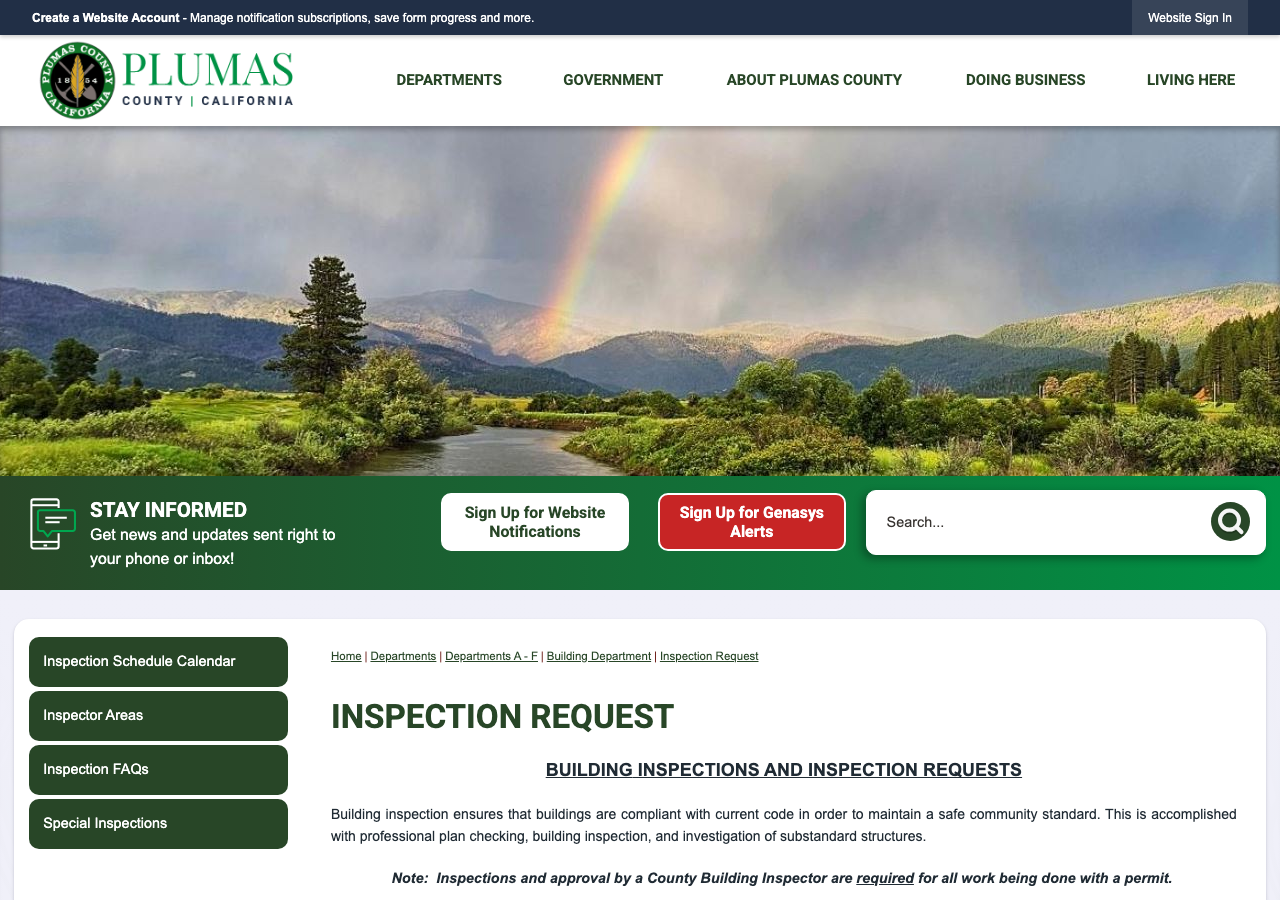
- How is an inspection booked? Phone — a dedicated 24/7 Inspection Request Phone Line, (530) 283-6001. 95% · department page
- How much notice is required? Effectively 1 business day — requests must be received 'no later than 3 PM of the working day before the requested inspection.' Weekend requests roll to the following Tuesday; requests left on a county holiday roll to the second day after the holiday. 93% · department page
- Are same-day or AM/PM windows offered? No AM/PM window system — the daily Inspection Schedule Calendar 'is not finalized until 8:30 a.m. on the day of the inspection,' is described as an estimate only, and applicants are told to 'allow one hour before and after estimated inspection time.' 85% · department page
-
Know who turns up
Some authorities inspect their own solar work; some delegate it, and a few do not inspect the PV equipment itself at all. Who is coming determines what they will look at.
- Does this AHJ perform its own final solar inspection? Yes — self-performed by the county's own Building Inspectors (Bill Osborn, Chase Ramirez per the current staff directory); no delegation to a firm or another agency was found for the final building/electrical inspection. 88% · department staff directory
- If delegated, to whom? Not applicable — inspection is self-performed by the County Building Department; it is not delegated. 85% · department staff directory
-
Work the stages in order
A rough-in or mid-roof inspection, where one is required, has to happen before the work it covers is closed up. Missing a stage means opening something back up, and it is the most expensive kind of correction.
Nothing recorded for Plumas County on this step yet — 2 questions checked and found unpublished. The guidance above is general.
-
Have the paperwork on site
The approved plan set, the permit, and the equipment listings should be on site and reachable. Inspectors routinely verify that installed equipment matches what was approved, and that the labels are the ones the plan set promised.
- What must be on site at inspection? Approved, stamped plans on site — the Inspection Request page's general guidance requires that actual conditions match the approved plans, implying the approved plan set (and presumably the permit card) must be available for the inspector to compare against; not stated as an explicit itemized list for PV. 62% · department page (inference)
- Does the inspector verify labels and listings? Very likely yes, by inference — the checklist requires equipment cut sheets/listings and 'REQUIRED SIGNAGE' as approved plan-check items, and the Inspection Request page's general 'Tips for Successful Inspections' states 'Work must match what is shown on the approved plans,' which would include listed equipment and signage as drawn. Not stated as an explicit inspector checklist item for PV specifically. 65% · department page (inference)
-
Sign-off, and permission to operate
Passing gives you a final or an equivalent sign-off. That is not the same as permission to operate: PTO comes from the utility, and who tells the utility the inspection passed varies. A system left switched off for weeks is usually waiting on this handover.
- What is issued on pass? Final inspection approval/sign-off by the Building Official or designated Inspector — County Code §8-9.05 frames the gating event as 'the final inspection has been made and the approval signed by the Building Official or the Official's designated Building Inspector'; no separate Certificate of Occupancy, 'green tag' or letter terminology was found for a standard residential PV retrofit. 66% · codified ordinance (inference)
- How are corrections issued and cleared? If actual site conditions differ from the approved plans, or the work cannot be followed against the approved plans, the applicant must have the design professional revise and RESUBMIT the plans to the county for approval BEFORE calling for an inspection — i.e., corrections are cleared by a plan resubmittal, not an on-site correction notice process. 68% · department page
14 questions answered against Plumas County’s own published documents
Q49 How is an inspection booked? Core Booking & scheduling
Phone — a dedicated 24/7 Inspection Request Phone Line, (530) 283-6001.
Why the confidence is not higherBuilding Department's own 'Building Inspections and Inspection Requests' page.
department page checked 2026-08-31 https://www.plumascounty.us/3300/Inspection-Request
Q50 How much notice is required? Core Booking & scheduling
Effectively 1 business day — requests must be received 'no later than 3 PM of the working day before the requested inspection.' Weekend requests roll to the following Tuesday; requests left on a county holiday roll to the second day after the holiday.
Why the confidence is not higherQuoted directly from the Inspection Request page.
department page checked 2026-08-31 https://www.plumascounty.us/3300/Inspection-Request
Q51 Are same-day or AM/PM windows offered? Booking & scheduling
No AM/PM window system — the daily Inspection Schedule Calendar 'is not finalized until 8:30 a.m. on the day of the inspection,' is described as an estimate only, and applicants are told to 'allow one hour before and after estimated inspection time.'
Why the confidence is not higherQuoted directly from the Inspection Request page.
department page checked 2026-08-31 https://www.plumascounty.us/3300/Inspection-Request
Q52 Does this AHJ perform its own final solar inspection? Core Who inspects
Yes — self-performed by the county's own Building Inspectors (Bill Osborn, Chase Ramirez per the current staff directory); no delegation to a firm or another agency was found for the final building/electrical inspection.
Why the confidence is not higherStaff Directory (in-house inspector titles/emails) plus the Inspection Request page's description of 'a County Building Inspector.'
department staff directory checked 2026-08-31 https://www.plumascounty.us/611/Staff-Directory
Q53 If delegated, to whom? Core Who inspects
Not applicable — inspection is self-performed by the County Building Department; it is not delegated.
Why the confidence is not higherSame evidence as Q52.
department staff directory checked 2026-08-31 https://www.plumascounty.us/611/Staff-Directory
Q54 Which inspections are required, and in what order? Core Stages & sequence
Nothing published by this authority.
Where we lookedchecked the PV Requirements handout, Solar Submittal Checklist and the Inspection Request page for a published, ordered list of solar-specific inspection stages (e.g., rough electrical, mid-roof, final); none names a specific sequence for PV beyond the general final-inspection/energization language in §8-9.05
Q55 Is a rough-in or mid-roof inspection required? Stages & sequence
Nothing published by this authority.
Where we lookedchecked the same three sources as Q54 for a stated rough-in or mid-roof inspection requirement specific to PV; none was found
Q56 Does the inspector verify labels and listings? Core What is checked
Very likely yes, by inference — the checklist requires equipment cut sheets/listings and 'REQUIRED SIGNAGE' as approved plan-check items, and the Inspection Request page's general 'Tips for Successful Inspections' states 'Work must match what is shown on the approved plans,' which would include listed equipment and signage as drawn. Not stated as an explicit inspector checklist item for PV specifically.
Why the confidence is not higherSolar Submittal Checklist (equipment listings, required signage as submittal items) + Inspection Request page general inspection-conduct language.
department page (inference) checked 2026-08-31 https://www.plumascounty.us/3300/Inspection-Request
Q57 Is there a published inspection checklist? Core What is checked
Nothing published by this authority.
Where we lookedchecked for a dedicated ON-SITE PV inspection checklist (distinct from the pre-submittal Solar Submittal Checklist, which is a plan-check document, not an inspector's field checklist); none was found published
Q58 What must be on site at inspection? Core Documents on site
Approved, stamped plans on site — the Inspection Request page's general guidance requires that actual conditions match the approved plans, implying the approved plan set (and presumably the permit card) must be available for the inspector to compare against; not stated as an explicit itemized list for PV.
Why the confidence is not higherInspection Request page, 'Tips for Successful Inspections.'
department page (inference) checked 2026-08-31 https://www.plumascounty.us/3300/Inspection-Request
Q59 Is there a re-inspection fee? Corrections & re-inspection
Nothing published by this authority.
Where we lookedchecked the PV Requirements fee schedule and the Inspection Request page for a re-inspection dollar figure; the Inspection Request page only warns generically that being unprepared 'can result in reinspection fees and project delays' without stating an amount
Q60 How are corrections issued and cleared? Corrections & re-inspection
If actual site conditions differ from the approved plans, or the work cannot be followed against the approved plans, the applicant must have the design professional revise and RESUBMIT the plans to the county for approval BEFORE calling for an inspection — i.e., corrections are cleared by a plan resubmittal, not an on-site correction notice process.
Why the confidence is not higherInspection Request page, 'Tips for Successful Inspections.'
department page checked 2026-08-31 https://www.plumascounty.us/3300/Inspection-Request
Q61 What is issued on pass? Core Final sign-off & PTO
Final inspection approval/sign-off by the Building Official or designated Inspector — County Code §8-9.05 frames the gating event as 'the final inspection has been made and the approval signed by the Building Official or the Official's designated Building Inspector'; no separate Certificate of Occupancy, 'green tag' or letter terminology was found for a standard residential PV retrofit.
Why the confidence is not higher§8-9.05 (Municode).
codified ordinance (inference) checked 2026-08-31 https://library.municode.com/ca/plumas_county/codes/code_of_ordinances?nodeId=TIT8BURE_CH9COPE
Q62 Who notifies the utility for PTO? Core Final sign-off & PTO
Nothing published by this authority.
Where we lookedchecked the Building Department's own page and the PV Requirements handout for a statement of who (installer vs. AHJ vs. utility) notifies PG&E/PSREC for Permission to Operate after a passed final inspection; the only utility-sequencing language found (PG&E service-application number required before permit issuance) concerns wildfire-rebuild new electrical service, not the general post-install PTO notification step
Lines marked with a percentage were read off this authority’s own published documents. Unmarked guidance is general good practice, not this jurisdiction’s rule — always confirm against the authority before you submit.
Jurisdiction & key facts
The standing 62-question set, answered for Plumas County against this authority’s own published documents. Every answer carries the confidence it was recorded at and the document it came from. Where nothing is published we say so and show where we looked — a blank here is a finding, not a gap.
Plumas County is the authority having jurisdiction 90% confidence
- Holds
- Both (Building and Electrical), via the County's own in-house Building Department. Fire-code (CFC/WUI) enforcement authority for R-3 occupancies is ALSO assigned by ordinance to the Building Official (§8-1.09) rather than to a separate fire agency; there is no county fire department at all. Actual fire-suppression response is provided per-parcel by whichever of 20 separate local fire protection districts/departments covers the address (confirmed by the county's own 'Plumas County Fire Protection Agencies' roster and its 'Not within a Fire Protection District' FAQ, which states 'Residential Fire protection is provided by one of 20 local Fire Departments in Plumas County' and 'There are no CALFIRE fire stations in Plumas County').
- Overridden by
- Within Plumas County, the City of Portola (the county's only incorporated city) is a separate AHJ: it self-performs BUILDING in-house (Todd Roberts, Director of Public Works; Dave Mann, Building Inspector — both @cityofportola.com), but its FIRE service is contracted out — per the city's own current 'Partnered Services' page, fire has been provided by the Beckwourth Peak Fire Protection District since 1 July 2024 (a newer arrangement than the county's own July-2020 fire-agency roster, which still shows 'Portola City FD (Under Contract with Eastern Plumas Rural FPD)' and 'Beckwourth FPD' as two separate entities — apparently since consolidated). PG&E's Rule 21 gates Permission to Operate on 'evidence of Applicant's final electric inspection clearance from the Governmental Authority having jurisdiction' (§D.13.b); Plumas County Code §8-9.05 independently and locally bars any utility from permanently connecting power before the county's own final inspection.
- Why not higher
- County-side: Plumas County Code §8-1.01/§8-1.09 (Municode, codified through Ord. 2025-1159, 10 Jun 2025) plus the Building Department's own Staff Directory (all-in-house, @countyofplumas.com) and its two solar-specific handouts. City-side: City of Portola's own Building Department and Partnered Services pages, cross-checked against the county's own 2020 fire-agency list to catch the 2024 fire-district consolidation. No explicit unincorporated-territory-only sentence (unlike Colusa County's GCC §5-3) was found in Title 8 or Title 9, so this rests on California's default rule plus Portola's independently confirmed department rather than an express carve-out — held at 90 rather than 95+ for that reason.
https://library.municode.com/ca/plumas_county/codes/code_of_ordinances?nodeId=TIT8BURE_CH1BUCO
- Permit required
- Yes.96%
- Permit cost
- $239.50 residential (Electrical permit $166.00 + ½-hour plan review $73.50). Commercial PV is $371.50.88%
- Plan review
- ~2-4 weeks average for a complete submittal (not solar-specific — this is the Building Department's general stated turnaround, dependent on workload).78%
- Portal
- No dedicated online permit-application portal was found. Applications are paper forms (downloaded PDFs) submitted at the Quincy counter or an after-hours drop box in Quincy or Chester.76%
- Electrical code
- 2023 NEC, via the 2025 CEC (Part 3 of Title 24), effective 1 Jan 2026 — automatically in force under the county's own 'evergreen' adoption clause, Plumas County Code §8-1.01,84%
- Own placard wording
- No — the county does not specify its own placard wording; it only cross-references CEC Articles 690 and 705 generically.86%
- Booking an inspection
- Phone — a dedicated 24/7 Inspection Request Phone Line, (530) 283-6001.95%
Labels & placards for this authority
Wording 86%
No — the county does not specify its own placard wording; it only cross-references CEC Articles 690 and 705 generically.
Size, colour & material 86%
No — no letter height, colour or material is specified by the county anywhere in its PV documents.
Where they go 78%
At the AC disconnect(s)/lock-offs at breakers, and at the service panel — the PV Requirements handout requires the disconnecting means to be 'within sight of any photovoltaic equipment' (CEC 422.30; CEC 690 Part 3), and PG&E's Rule 21 separately requires its own visible disconnect to be reachable 24/7.
What the utility wants on top 70%
PG&E's own Rule 21 requires a visible, lockable AC/interconnection disconnect with open/closed position markings (§H.1.d), shown on the single-line diagram, beyond anything the county itself specifies. For the eastern-county area that may instead be served by Plumas-Sierra Rural Electric Cooperative (see Q22), PSREC's own interconnection/placard rules were not reached within this run.
Each figure above is sourced and dated in the full answer set below (questions 38–43). Where an authority’s own published sheet is older than the code it has adopted, the answer says so.
Their website
Average approval time — application to PTO
From the CPUC interconnection record. Bars show the average days taken each year; a year with no recorded projects is left blank rather than drawn as zero.