
San Bernardino County
State of California
San Bernardino County is the 6th largest jurisdiction in California — 2,181,654 residents across 28 regions, with 14,306 residential solar installs on record. This page is the permit route for that jurisdiction: the fifteen steps from working out who has a say over an address through to permission to operate, the documents this authority publishes, and 60 answers taken from those documents and dated.
Permitting 5 steps · 26 questions
Whether a permit is needed — Yes. A permit is required for both roof-mount and ground-mount residential solar. Q3 Electrical and building permits — Combined — a residential PV installation is permitted under a single 'Solar Energy Systems' permit with its own plan review and permit fee. Q4 Where you file — EZ Online Permitting ('EZOP') at https://ezop.sbcounty.gov/citizenaccess — Accela-based. Q20
- Permit required
- Yes. A permit is required for both roof-mount and ground-mount residential solar.95% source
- What it costs
- $441 total for a single-family residential roof-mount PV system of 15 kW or less — $215.00 plan review + $226.00 permit fee. The $57.00 intake processing fee is expressly WAIVED for residential PV.95% source
- Key document
- portal page cited by 4 open the document
-
Confirm who has a say over your address
A city address is usually permitted by the city, not the county — but not always, and some authorities keep building and hand electrical to someone else. Getting this wrong costs the whole submittal, because every requirement below belongs to whoever actually holds jurisdiction. Check the overlays in the same pass: an HOA, a historic district, a windstorm certification or a system-size cap can reshape the design, and all of them are cheaper to find now than after the array is laid out.
- Is this authority the AHJ for residential solar at this address? Yes — San Bernardino County Land Use Services, Building & Safety Division is the AHJ for residential solar at addresses in the unincorporated county. 92% · department page
- What does this authority permit itself, and what does it delegate? Both — Building & Safety permits building AND electrical (its fee schedule carries Building, Electrical, Plumbing and Mechanical permit fees). Fire review is a separate County Fire Department step. 85% · fee schedule
- Is a permit required for a residential rooftop PV system? Yes. A permit is required for both roof-mount and ground-mount residential solar. 95% · department handout
- Is there a separate electrical permit, or is it combined? Combined — a residential PV installation is permitted under a single 'Solar Energy Systems' permit with its own plan review and permit fee. The separate 'Electrical Permit Fees' schedule applies to 'a permit to do electrical construction only'. 75% · fee schedule
-
Check who is allowed to apply
Several authorities require the electrical permit to be pulled by a licensed electrician, or require the contractor to be registered with them BEFORE applying. Registration is not same-day. This is second on the list rather than fourth because it is the step most likely to stop the job before the drawings matter.
- Who is allowed to pull the electrical permit? Either — the EZOP solar page allows 'an owner or contractor of a property' to permit. BUT the SolarAPP+ automated route is restricted: 'Qualified Licensed Contractors Only (C-10 and C-46)'. 80% · portal page
- Is a homeowner permitted to self-install and self-permit? Yes — an owner may apply. The County's solar permit page states the permit applies to 'an owner or contractor of a property to construct rooftop or ground mounted solar.' 70% · portal page
-
Build the submittal package
Almost everywhere wants a site plan, a one-line or three-line electrical diagram, equipment cut sheets with listings, and a structural attachment detail. Build it against the published checklist rather than the last jurisdiction you worked in — the checklist is what the reviewer marks against.
- What documents make up a complete submittal? SolarAPP+ route: 'SolarAPP+ Approval Document' and 'SolarAPP+ Specification Sheet' uploaded at submittal into EZOP, plus 'Smoke and Carbon Certification' before final inspection. Standard route: 'plans and any necessary supporting documentation for review and approval by the County'. Expedited ≤10 kW route: the 'Checklist for Expedited Solar PV 10KW or less is required prior to issuance of the permit', uploaded as an attachment into the EZOP account. 85% · portal page
-
Apply and pay
Most authorities now take the whole application through a portal, and several states cap or constrain what a residential solar permit may cost. Check whether plan check is billed separately before you quote the job.
- Which permit portal does this authority use? EZ Online Permitting ('EZOP') at https://ezop.sbcounty.gov/citizenaccess — Accela-based. Automated plan review for eligible residential PV runs through NREL SolarAPP+ (https://solarapp.nrel.gov/). Inspections are booked through the separate EZ Inspect app / https://ezinspect.sbcounty.gov/. 95% · portal page
- Can the whole application be completed online? Yes — end to end. Design is submitted to SolarAPP+ for automated review, the approval documents are uploaded to EZOP, and inspection is booked in the EZ Inspect app, where residential PV may even be closed out by self-inspection photos without a site visit. 85% · portal page
- What does a residential solar permit cost? $441 total for a single-family residential roof-mount PV system of 15 kW or less — $215.00 plan review + $226.00 permit fee. The $57.00 intake processing fee is expressly WAIVED for residential PV. Above 15 kW roof mount: $225 plan review + $15.00 per additional kW above 15 kW, plus $225 permit fee. Ground mount SFR: $225 plan review (≤15 kW; above 15 kW add $15/kW) + $225 permit fee. 95% · fee ordinance
- How is the fee calculated? Flat, then tiered per kW. Flat for the first 15 kW; above 15 kW a per-kW adder of $15.00 for each additional kilowatt applies to the plan review fee (the permit fee stays flat at $225). 95% · fee ordinance
- Is there a separate plan-check fee? Yes — plan review is a separate, separately-timed fee. Footnote [29]: 'The review fee shall be paid at the time of submitting plans and specifications for review and the permit fee shall be paid at the time of permit issuance.' 95% · fee schedule
-
Plan review — and start the utility in parallel
Interconnection is a separate process from the permit and usually the longer pole. Where the utility does not depend on the permit being issued, running both at once is the single biggest saving available on a residential job.
- Which utility handles interconnection here? Split. Southern California Edison (SCE) is the interconnecting utility for the great majority of the unincorporated county. Bear Valley Electric Service (BVES, a division of Golden State Water Company) serves the Big Bear Lake area of the San Bernardino Mountains. Community Choice Aggregators present in the county (e.g. Apple Valley Choice Energy) are retail suppliers only — they do NOT handle interconnection; the wires utility does. 75% · state energy commission utility list
26 questions answered against San Bernardino County’s own published documents
Q1 Is this authority the AHJ for residential solar at this address? Core Jurisdiction & scope
Yes — San Bernardino County Land Use Services, Building & Safety Division is the AHJ for residential solar at addresses in the unincorporated county.
Why the confidence is not higherThe County's own Building & Safety permits page lists 'Solar installations (roof and ground mount)' among permits it issues, and the EZOP solar page states review is by the County. Not 100 because it is address-dependent — an address inside any incorporated city falls to that city instead.
department page https://lus.sbcounty.gov/building-safety-home/permits/
Q2 What does this authority permit itself, and what does it delegate? Core Jurisdiction & scope
Both — Building & Safety permits building AND electrical (its fee schedule carries Building, Electrical, Plumbing and Mechanical permit fees). Fire review is a separate County Fire Department step.
Why the confidence is not higherThe Building & Safety Division Fee Schedule contains 'Electrical Permit Fees – Residential' and 'Electrical Permit Fees – Plan Review' line items, so electrical is retained by the County, not delegated. Not higher because no single page states the building/electrical/fire split for solar explicitly.
fee schedule https://lus.sbcounty.gov/wp-content/uploads/sites/48/BNS-Master-Fee-Schedule-25-26.pdf
Q3 Is a permit required for a residential rooftop PV system? Core Jurisdiction & scope
Yes. A permit is required for both roof-mount and ground-mount residential solar.
Why the confidence is not higherTwo County documents say it plainly. The Residential Development Guidance lists 'Roof and Ground Mount Solar Installation' under 'Below is a list of items requiring a permit', and the EZOP solar page says a permit is required 'for property owners or contractors before constructing rooftop or ground mounted solar'.
department handout https://lus.sbcounty.gov/wp-content/uploads/sites/48/BandS/Handouts/Residential-Development-Guidance-REV-2823.pdf
Q4 Is there a separate electrical permit, or is it combined? Core Jurisdiction & scope
Combined — a residential PV installation is permitted under a single 'Solar Energy Systems' permit with its own plan review and permit fee. The separate 'Electrical Permit Fees' schedule applies to 'a permit to do electrical construction only'.
Why the confidence is not higherInferred from the structure of the County's own fee schedule: solar has a dedicated fee section (16.0204(j)) and the electrical fee section is explicitly scoped to electrical-only permits. No County page states 'combined' in words, so this is a two-document inference rather than a direct statement.
fee schedule https://lus.sbcounty.gov/wp-content/uploads/sites/48/BNS-Master-Fee-Schedule-25-26.pdf
Q5 Who is allowed to pull the electrical permit? Core Who may apply
Either — the EZOP solar page allows 'an owner or contractor of a property' to permit. BUT the SolarAPP+ automated route is restricted: 'Qualified Licensed Contractors Only (C-10 and C-46)'.
Why the confidence is not higherBoth statements are the County's own wording, but they come from two different pages describing two different routes, and neither addresses who may pull the ELECTRICAL portion specifically. The C-10/C-46 restriction is a hard, quotable limit on the automated route only.
portal page https://wp.sbcounty.gov/ezop/permits/solar-with-solarapp/
Q6 Must the contractor be registered with this authority before applying? Core Who may apply
Nothing published by this authority.
Where we lookedBuilding & Safety permits page, EZOP solar-residential and SolarAPP+ pages, and the full Building & Safety Division Fee Schedule. The fee schedule has a 'certified fabricator' registration ($272 application / $91 renewal) but that governs off-site fabrication, not solar contractors. No prior-registration requirement for contractors was found; the SolarAPP+ page states only a licence-class restriction (C-10 and C-46).
https://lus.sbcounty.gov/wp-content/uploads/sites/48/BNS-Master-Fee-Schedule-25-26.pdf
Q7 Is a homeowner permitted to self-install and self-permit? Who may apply
Yes — an owner may apply. The County's solar permit page states the permit applies to 'an owner or contractor of a property to construct rooftop or ground mounted solar.'
Why the confidence is not higherThe page plainly allows an owner to permit, but it does not separately address owner self-INSTALLATION, and the SolarAPP+ route excludes non-contractors. Scored as a reliable inference from the authority's own wording rather than a direct answer to the question asked.
portal page https://wp.sbcounty.gov/ezop/permits/solar-residential/
Q8 What documents make up a complete submittal? Core Submittal package
SolarAPP+ route: 'SolarAPP+ Approval Document' and 'SolarAPP+ Specification Sheet' uploaded at submittal into EZOP, plus 'Smoke and Carbon Certification' before final inspection. Standard route: 'plans and any necessary supporting documentation for review and approval by the County'. Expedited ≤10 kW route: the 'Checklist for Expedited Solar PV 10KW or less is required prior to issuance of the permit', uploaded as an attachment into the EZOP account.
Why the confidence is not higherAll three are the County's own current wording from its own portal pages. Less than certain because the standard route's description is generic ('any necessary supporting documentation') rather than an itemised checklist, and the expedited checklist form itself is no longer downloadable (see not_found q10).
portal page https://wp.sbcounty.gov/ezop/permits/solar-with-solarapp/
Q9 How many copies, and in what format? Submittal package
Nothing published by this authority.
Where we lookedEZOP solar-residential page, SolarAPP+ page, and the complete Building & Safety guidance-and-technical-handouts index (45 PDFs enumerated). Submission is electronic via EZOP, so no copy count is published.
https://lus.sbcounty.gov/building-safety-home/guidance-and-technical-handouts/
Q10 Is a site plan required, and what must it show? Core Submittal package
Nothing published by this authority.
Where we lookedThe complete Building & Safety guidance-and-technical-handouts index — it contains NO solar submittal handout or site-plan checklist (the only solar item is IB-0017 on ground-mount guarding). The legacy 'Expedited_Solar_Plan_Checklist.docx' at www.sbcounty.gov/Uploads/LUS/BandS/Solar_Permitting/ now returns the County's generic WordPress page instead of the document (soft 404 — HTTP 200 serving HTML, verified by file type). The legacy solar permitting page at cms.sbcounty.gov/lus/BuildingSafety/SolarPermitting.aspx no longer resolves at all. So the County's expedited solar checklist is referenced by the EZOP conditions page but is no longer downloadable from any County URL I could find.
https://wp.sbcounty.gov/ezop/conditions/expedited-solar-pv-10kw/
Q11 Is a one-line / three-line diagram required? Core Drawings & calculations
Nothing published by this authority.
Where we lookedSame as q10 — no published County solar plan-check checklist survives, so no one-line/three-line diagram requirement is stated. The PV self-inspection checklist repeatedly references 'the approved plans' but does not enumerate required drawings.
https://lus.sbcounty.gov/building-safety-home/guidance-and-technical-handouts/
Q12 Are string and conductor calculations required? Drawings & calculations
Nothing published by this authority.
Where we lookedBuilding & Safety handouts index and the PV self-inspection checklist. No string or conductor calculation requirement published.
https://lus.sbcounty.gov/building-safety-home/guidance-and-technical-handouts/
Q13 Is a structural PE stamp required, and at what threshold? Core Engineering & stamps
Nothing published by this authority.
Where we lookedBuilding & Safety handouts index (all 45 PDFs), IB-0001 through IB-0019 information bulletins, and the EZOP solar pages. No structural PE stamp threshold for residential PV is published by the County. Note: a secondary source claimed wet-stamped engineer/architect approval is required, but I could not corroborate that against any County document and am not recording it.
https://lus.sbcounty.gov/building-safety-home/guidance-and-technical-handouts/
Q14 Is an electrical PE stamp required, and at what threshold? Engineering & stamps
Nothing published by this authority.
Where we lookedSame sources as q13. No electrical PE stamp threshold published.
https://lus.sbcounty.gov/building-safety-home/guidance-and-technical-handouts/
Q15 What does a residential solar permit cost? Core Fees
$441 total for a single-family residential roof-mount PV system of 15 kW or less — $215.00 plan review + $226.00 permit fee. The $57.00 intake processing fee is expressly WAIVED for residential PV. Above 15 kW roof mount: $225 plan review + $15.00 per additional kW above 15 kW, plus $225 permit fee. Ground mount SFR: $225 plan review (≤15 kW; above 15 kW add $15/kW) + $225 permit fee.
Why the confidence is not higherTwo independent County documents agree: the Building & Safety Division Fee Schedule (July 2025) and the amended County Fee Ordinance Section 16.0204(j), which carries a column headed 'Effective: July 1, 2026' showing $215.00 / $226.00 — i.e. this is the schedule in force today, 28 Aug 2026. The ordinance also shows the next step-ups ($221/$229 from 1 July 2027). Docked slightly because the $441 is my addition of two separately-listed fees, not a figure the County prints as a single total.
fee ordinance https://lus.sbcounty.gov/wp-content/uploads/sites/48/FY-2026-BNS-Fee-Schedule.pdf
Q16 How is the fee calculated? Core Fees
Flat, then tiered per kW. Flat for the first 15 kW; above 15 kW a per-kW adder of $15.00 for each additional kilowatt applies to the plan review fee (the permit fee stays flat at $225).
Why the confidence is not higherThe County fee ordinance prints the calculation verbatim: '$225.00 plus $15.00 per each additional kilowatt above 15KW'. It is not valuation-based and not per-panel. Confident, but note the per-kW adder attaches to plan review only, which the schedule shows but does not explain.
fee ordinance https://lus.sbcounty.gov/wp-content/uploads/sites/48/FY-2026-BNS-Fee-Schedule.pdf
Q17 Is there a separate plan-check fee? Fees
Yes — plan review is a separate, separately-timed fee. Footnote [29]: 'The review fee shall be paid at the time of submitting plans and specifications for review and the permit fee shall be paid at the time of permit issuance.'
Why the confidence is not higherQuoted directly from the County's own fee schedule footnote governing the Solar Energy Systems section.
fee schedule https://lus.sbcounty.gov/wp-content/uploads/sites/48/BNS-Master-Fee-Schedule-25-26.pdf
Q18 What is the stated plan-review turnaround? Core Timeline & validity
Nothing published by this authority.
Where we lookedEZOP solar-residential page, SolarAPP+ page, Building & Safety permits page and the Residential Development Guidance handout. The County publishes NO business-day plan-review turnaround for solar. The relevant fact instead: the SolarAPP+ route replaces human plan review with automated instant review, and the expedited ≤10 kW route requires only the eligibility checklist prior to permit issuance — but neither is expressed as a number of days.
Q19 How long is an issued permit valid before it expires? Timeline & validity
Nothing published by this authority.
Where we lookedResidential Development Guidance handout, Building & Safety permits page and the Building & Safety Division Fee Schedule. No permit validity/expiration period published for solar. (IB-0012 gives expiry rules for code-transition plan applications only, not for issued permits.)
Q20 Which permit portal does this authority use? Core Portal & process
EZ Online Permitting ('EZOP') at https://ezop.sbcounty.gov/citizenaccess — Accela-based. Automated plan review for eligible residential PV runs through NREL SolarAPP+ (https://solarapp.nrel.gov/). Inspections are booked through the separate EZ Inspect app / https://ezinspect.sbcounty.gov/.
Why the confidence is not higherAll three named on the County's own portal pages, with links. Three distinct systems, which is itself worth knowing — the permit portal and the inspection portal are not the same product.
portal page https://wp.sbcounty.gov/ezop/permits/solar-with-solarapp/
Q21 Can the whole application be completed online? Core Portal & process
Yes — end to end. Design is submitted to SolarAPP+ for automated review, the approval documents are uploaded to EZOP, and inspection is booked in the EZ Inspect app, where residential PV may even be closed out by self-inspection photos without a site visit.
Why the confidence is not higherEach leg is stated on a County page, but the County does not publish a single statement that the whole application can be completed online, so this is assembled from three of its own pages. A processing fee is charged by SolarAPP+/NREL separately from County fees, which the page notes but does not quantify.
portal page https://wp.sbcounty.gov/ezop/permits/solar-with-solarapp/
Q22 Which utility handles interconnection here? Core Utility interconnection
Split. Southern California Edison (SCE) is the interconnecting utility for the great majority of the unincorporated county. Bear Valley Electric Service (BVES, a division of Golden State Water Company) serves the Big Bear Lake area of the San Bernardino Mountains. Community Choice Aggregators present in the county (e.g. Apple Valley Choice Energy) are retail suppliers only — they do NOT handle interconnection; the wires utility does.
Why the confidence is not higherThe territory split is well established in CEC/CPUC sources, but I could not find a County-side page or a utility territory map naming the boundary, so the exact dividing line for a given unincorporated address is not proven here. Flagging the CCA point deliberately: this is the same failure mode as trusting a ZIP-level lookup, and Apple Valley Choice Energy would be the wrong answer for interconnection. This answer belongs at utility level, not authority level — the County does not gate interconnection.
state energy commission utility list https://www.energy.ca.gov/almanac/electricity_data/utilities.html
Q23 Where does the utility sit in the sequence? Core Utility interconnection
Nothing published by this authority.
Where we lookedEZOP solar-residential page, SolarAPP+ page and the Building & Safety permits page. The County does not sequence the utility interconnection against its own permit anywhere in its published material — it lists Planning, Grading, Geology, Geotechnical and Fire as possible additional steps but never mentions the utility. This question belongs at utility level (SCE Rule 21 / BVES), not at authority level.
Q24 Is a HOA or architectural approval required first? Overlays & special cases
Nothing published by this authority.
Where we lookedEZOP solar-residential page and Building & Safety handouts. No HOA or architectural approval prerequisite published by the County. (California's Solar Rights Act constrains HOA restrictions statewide, but that is state law, not a County requirement.)
Q27 Is a Specific Use Permit or Council approval ever required? Overlays & special cases
Nothing published by this authority.
Where we lookedEZOP solar-residential page, which lists 'Planning Review' as a possible additional requirement but does not say when a Specific Use Permit or Board approval is triggered. Development Code 84.29.040 'Solar Energy Development Standards' would answer this and was unreachable — see the code-access note below.
Q28 Is there a system-size cap on residential generation? Overlays & special cases
Nothing published by this authority.
Where we lookedBuilding & Safety Division Fee Schedule and County Fee Ordinance 16.0204(j) — these tier fees above 15 kW but impose no cap; the SolarAPP+ page states no kW ceiling. Development Code 84.29.040 was unreachable. No residential generation size cap found, but I cannot prove its absence without the Development Code text.
https://lus.sbcounty.gov/wp-content/uploads/sites/48/FY-2026-BNS-Fee-Schedule.pdf
Lines marked with a percentage were read off this authority’s own published documents. Unmarked guidance is general good practice, not this jurisdiction’s rule — always confirm against the authority before you submit.
Install 5 steps · 20 questions
-
Build to the code editions actually in force here
The NEC edition a jurisdiction enforces is often a cycle behind the newest one published, and local amendments sit on top of it. Rapid shutdown, conductor sizing and labelling all change between editions, so the edition in force is the first thing to establish, not the last.
- Which NEC edition is in force? 2023 NEC — in force as the 2025 California Electrical Code (Title 24 Part 3), effective 1 January 2026. 88% · information bulletin
- Which building code edition is in force? 2025 California Building Standards Code (Title 24), effective 1 January 2026 — including the 2025 CBC and 2025 CRC. Applications submitted before 1 Jan 2026 could use the 2022 code but had to obtain the permit before 1 July 2026 or expire, so as of 28 Aug 2026 the 2025 code governs all live work. 95% · information bulletin
- Which fire code edition is in force? 2025 California Fire Code (Title 24 Part 9), as part of the 2025 California Building Standards Code adopted effective 1 January 2026. 80% · information bulletin
- Are there local amendments to any of the above? Yes. The County publishes at least one local requirement specific to solar: IB-0017, 'Protection for Residential Ground Mount Solar Panel Systems', which defines local guarding requirements under CEC 110.27 and 690.31(A). 85% · information bulletin
- What is the installation judged against? The 2025 California Electrical Code (2023 NEC basis), checked against the approved plans, plus County IB-0017 for ground mounts. The County's PV self-inspection checklist cites CEC 110.3, 110.3(B), 250.50, 250.58, 690.4(B), 690.12(C), 690.13(A)(B)(E)(F), 690.31(G)(3) and (G)(4), 690.47, 690.51/690.52 and 705.12(B). 85% · inspection checklist
-
Fire access, setbacks and pathways
Ridge setbacks and roof access pathways are fire-service requirements and they constrain the array layout. They are the most common cause of a redesign after the fire department comments on a plan set.
- What ridge setback and access pathways are required? Per the 2025 CRC R324.6 / CFC Chapter 12 as adopted: not fewer than two 36-inch-wide pathways on separate roof planes from lowest roof edge to ridge, at least one on the street or driveway side; ridge setback 18 inches both sides where the array covers 33% or less of plan-view roof area, 36 inches both sides where it exceeds 33%. The County itself checks only 'Firefighter access according to approved plan.' 70% · inspection checklist + state code
-
Rapid shutdown
Which rapid-shutdown rule applies follows directly from the NEC edition in force, and the initiation device has to be at a location the fire service can reach and identify. This is inspected, and it is labelled.
- Is rapid shutdown required, and to which NEC edition? Yes — rapid shutdown is required, to the CEC 690.12 in force (2025 CEC / 2023 NEC basis). The County checks: 'Rapid shutdown initiation device labeled on the plans. Device must be either: service disconnecting means, PV system disconnecting means, or readily accessible switch that plainly indicates whether it is in the "off" or "on" position (CEC 690.12(C))'. Rapid shutdown equipment is also named among equipment that must be installed, listed and labeled per the approved plan. 88% · inspection checklist
-
Labels and placards
The NEC sets a baseline for permanent markings at the service equipment and the disconnecting means. On top of that, an authority may specify its own wording, and the utility may specify more again. Where any of them writes its own text, a generic off-the-shelf label set will not pass — this is the detail most often fixed on a return visit.
- Which placards does this authority require at the service equipment? Four placard/marking families are checked by the County: (1) 'WARNING: PHOTOVOLTAIC POWER SOURCE' markings on all interior and exterior DC conduit, enclosures, raceways, cable assemblies, junction boxes, combiner boxes and disconnects on buildings (CFC 605.11.1.1, 605.11.1.2 and CEC 690.31(G)(3)); (2) the PV system disconnecting means labelled 'PV SYSTEM DISCONNECT' and readily accessible (CEC 690.13(A) & (B)); (3) the rapid shutdown initiation device labelled, per CEC 690.12(C); (4) modules and equipment 'properly marked and labeled' / 'installed, listed and labeled according to the approved plan' (CEC 110.3, 690.4(B), 690.51 or 690.52). A DC PV disconnecting means must additionally 'be marked for use in PV systems or be suitable for backfeed operation'. 90% · inspection checklist
- Does the authority specify placard wording of its own? No — the County does not author placard wording of its own. It restates the code's wording ('WARNING: PHOTOVOLTAIC POWER SOURCE', 'PV SYSTEM DISCONNECT') and cites CEC/CFC as the source. 80% · inspection checklist
- Does it specify letter height, colour or material? Yes, for the DC warning markings: '3/8-inch (9.5 mm) minimum-sized white letters on a red background. The signs are made of reflective weather resistant material.' 90% · inspection checklist
- Where must the labels be placed? Conduit/raceway/cable markings: 'every 10 feet, within one foot of all turns or bends and within one foot above and below all penetrations of roof/ceiling assemblies, walls and barriers' (CEC 690.31(G)(4), CFC 605.11.1.4). Warning markings go on all interior and exterior DC conduit, enclosures, raceways, cable assemblies, junction boxes, combiner boxes and disconnects on buildings. The 'PV SYSTEM DISCONNECT' label goes on the PV system disconnecting means, which must be readily accessible. 90% · inspection checklist
-
Disconnect, storage and listed equipment
Where the AC disconnect must sit relative to the meter is usually the utility's rule, not the building department's. Battery storage frequently carries its own permit, its own inspection and its own fire conditions.
- Must equipment be on a specific approved list? No specific County approved-equipment list. Equipment must be listed and labelled per CEC 110.3 and must match the approved plan: 'Equipment installed, listed and labeled according to the approved plan (e.g., PV modules, dc/dc converters, combiners, inverters, rapid shutdown equipment).' Module 'manufacturer, make, model, and number of modules match the approved plans.' 75% · inspection checklist
- Is a ground mount treated as a structure? Yes, effectively — a ground mount requires its own building permit, is fee-scheduled separately from roof mount, is excluded from both streamlined routes (the expedited ≤10 kW route and SolarAPP+, whose checklist is titled 'Roof Mount'), and carries a County-specific guarding requirement under IB-0017. Setbacks are governed by the land use zoning district. 65% · information bulletin + fee schedule
- Is there a local rule on service upgrades or busbar sizing? No local busbar rule beyond code, but the County enforces CEC 705.12(B) explicitly and checks it as a line item: 'Inverter output circuit breaker is located at opposite end of bus from utility supply at load center and/or service panelboard. If panel is center-fed, inverter output circuit breaker can be at either end of busbar... (not required if the sum of the inverter and utility supply circuit breakers is less than or equal to the panelboard bus rating).' 75% · inspection checklist
- Is a specific mounting system or attachment spacing required? Roof mount: no local attachment-spacing rule — 'Modules are attached to the mounting structure according to the manufacturer's instructions and the approved plans.' Ground mount: LOCAL requirement under IB-0017 — live PV circuit conductors must be guarded, by (A) a substantial partition or unclimbable fencing around the array perimeter, which may attach to the PV mounting poles and may be wood, chain link or heavy-duty mesh (minimum 14 gauge); (B) commercially durable scrim enclosing the direct underside of the array; or (C) installing PV circuit conductors in Type MC cable or in a raceway. Other methods may be submitted for Building Official approval. 85% · information bulletin
20 questions answered against San Bernardino County’s own published documents
Q29 Which NEC edition is in force? Core Code editions in force
2023 NEC — in force as the 2025 California Electrical Code (Title 24 Part 3), effective 1 January 2026.
Why the confidence is not higherThe County's own IB-0012 adopts the 2025 California Building Standards Code effective 1 Jan 2026, and the CEC is Part 3 of that code; the 2025 CEC is a fully integrated code based on the 2023 NEC with California amendments. Two-source inference (County bulletin + state code basis) rather than a County document naming 'NEC 2023', hence 88 not 95. Caution: several County solar handouts still cite 2019 CEC section numbers — see q32/q35.
information bulletin https://lus.sbcounty.gov/wp-content/uploads/sites/48/IB-0012-2025-Code-Adoption.pdf
Q30 Which building code edition is in force? Core Code editions in force
2025 California Building Standards Code (Title 24), effective 1 January 2026 — including the 2025 CBC and 2025 CRC. Applications submitted before 1 Jan 2026 could use the 2022 code but had to obtain the permit before 1 July 2026 or expire, so as of 28 Aug 2026 the 2025 code governs all live work.
Why the confidence is not higherIB-0012 is the County Building Official's own signed bulletin (Maged Soliman, PE, CBO), updated 1 January 2026, and states the effective dates and the transition cut-off verbatim.
information bulletin https://lus.sbcounty.gov/wp-content/uploads/sites/48/IB-0012-2025-Code-Adoption.pdf
Q31 Which fire code edition is in force? Code editions in force
2025 California Fire Code (Title 24 Part 9), as part of the 2025 California Building Standards Code adopted effective 1 January 2026.
Why the confidence is not higherIB-0012 adopts the whole California Building Standards Code, of which the CFC is Part 9, so the edition follows. Marked down because IB-0012 does not name the Fire Code, and fire code adoption in this county also runs through the separate San Bernardino County Fire Protection District, whose own adopting ordinance I did not reach. Also note the County's PV self-inspection checklist still cites 'CFC 605.11' — 2016-cycle numbering, superseded by CFC Chapter 12 (1205) — so its citations are stale even though the underlying requirement stands.
information bulletin https://lus.sbcounty.gov/wp-content/uploads/sites/48/IB-0012-2025-Code-Adoption.pdf
Q32 Are there local amendments to any of the above? Core Code editions in force
Yes. The County publishes at least one local requirement specific to solar: IB-0017, 'Protection for Residential Ground Mount Solar Panel Systems', which defines local guarding requirements under CEC 110.27 and 690.31(A).
Why the confidence is not higherIB-0017 says in its own words that it 'define[s] the local requirements' — a plain statement of a local amendment. Held below 95 because the bulletin is dated April 2021 and references the 2019 CEC, two code cycles behind the 2025 CEC now in force, so its currency is uncertain even though it is still published on the live handouts page.
information bulletin https://lus.sbcounty.gov/wp-content/uploads/sites/48/BandS/Handouts/IB-0017-Protection-for-Ground-Mounted-Solar-Panel-Systems-4-8-2021.pdf
Q33 What is the installation judged against? Core Electrical
The 2025 California Electrical Code (2023 NEC basis), checked against the approved plans, plus County IB-0017 for ground mounts. The County's PV self-inspection checklist cites CEC 110.3, 110.3(B), 250.50, 250.58, 690.4(B), 690.12(C), 690.13(A)(B)(E)(F), 690.31(G)(3) and (G)(4), 690.47, 690.51/690.52 and 705.12(B).
Why the confidence is not higherThis is the County's own published inspection checklist, so it is exactly what the installation is judged against in practice. Docked because some cited section numbers (e.g. 705.12(B), CFC 605.11) belong to earlier code cycles, so the checklist has not been renumbered to the 2025 CEC.
inspection checklist https://lus.sbcounty.gov/wp-content/uploads/sites/48/TEST/SELF-INSP-Residential-10Kw-Max-Photovoltaic-System.pdf
Q34 Is there a local rule on service upgrades or busbar sizing? Electrical
No local busbar rule beyond code, but the County enforces CEC 705.12(B) explicitly and checks it as a line item: 'Inverter output circuit breaker is located at opposite end of bus from utility supply at load center and/or service panelboard. If panel is center-fed, inverter output circuit breaker can be at either end of busbar... (not required if the sum of the inverter and utility supply circuit breakers is less than or equal to the panelboard bus rating).'
Why the confidence is not higherQuoted verbatim from the County's own checklist, so the enforcement is certain; scored at 75 because 'no LOCAL rule' is a partial absence — I found no local amendment on service upgrades, but the County's Development Code text was unreachable (see not_found).
inspection checklist https://lus.sbcounty.gov/wp-content/uploads/sites/48/TEST/SELF-INSP-Residential-10Kw-Max-Photovoltaic-System.pdf
Q35 Is a specific mounting system or attachment spacing required? Structural & mounting
Roof mount: no local attachment-spacing rule — 'Modules are attached to the mounting structure according to the manufacturer's instructions and the approved plans.' Ground mount: LOCAL requirement under IB-0017 — live PV circuit conductors must be guarded, by (A) a substantial partition or unclimbable fencing around the array perimeter, which may attach to the PV mounting poles and may be wood, chain link or heavy-duty mesh (minimum 14 gauge); (B) commercially durable scrim enclosing the direct underside of the array; or (C) installing PV circuit conductors in Type MC cable or in a raceway. Other methods may be submitted for Building Official approval.
Why the confidence is not higherIB-0017 is the County's own signed bulletin and states these as its local requirements, with the alternatives quoted. Docked because the bulletin is dated 8 April 2021 against the 2019 CEC and has not been reissued for the 2025 code cycle.
information bulletin https://lus.sbcounty.gov/wp-content/uploads/sites/48/BandS/Handouts/IB-0017-Protection-for-Ground-Mounted-Solar-Panel-Systems-4-8-2021.pdf
Q36 What ridge setback and access pathways are required? Core Fire pathways & setbacks
Per the 2025 CRC R324.6 / CFC Chapter 12 as adopted: not fewer than two 36-inch-wide pathways on separate roof planes from lowest roof edge to ridge, at least one on the street or driveway side; ridge setback 18 inches both sides where the array covers 33% or less of plan-view roof area, 36 inches both sides where it exceeds 33%. The County itself checks only 'Firefighter access according to approved plan.'
Why the confidence is not higherThe numbers are state code, in force here by the County's adoption of the 2025 CBSC, but the County publishes no setback figures of its own — its checklist defers entirely to the approved plan. So the specific dimensions come from the state code, not from a San Bernardino County document, and County Fire may impose more via its separate review.
inspection checklist + state code https://lus.sbcounty.gov/wp-content/uploads/sites/48/TEST/SELF-INSP-Residential-10Kw-Max-Photovoltaic-System.pdf
Q37 Is rapid shutdown required, and to which NEC edition? Core Rapid shutdown
Yes — rapid shutdown is required, to the CEC 690.12 in force (2025 CEC / 2023 NEC basis). The County checks: 'Rapid shutdown initiation device labeled on the plans. Device must be either: service disconnecting means, PV system disconnecting means, or readily accessible switch that plainly indicates whether it is in the "off" or "on" position (CEC 690.12(C))'. Rapid shutdown equipment is also named among equipment that must be installed, listed and labeled per the approved plan.
Why the confidence is not higherQuoted verbatim from the County's own PV inspection checklist, so both the requirement and the labelling duty are certain. Docked because the checklist's edition alignment is uncertain — it cites 690.12(C) without naming a code year, and other citations in the same document are from earlier cycles.
inspection checklist https://lus.sbcounty.gov/wp-content/uploads/sites/48/TEST/SELF-INSP-Residential-10Kw-Max-Photovoltaic-System.pdf
Q38 Which placards does this authority require at the service equipment? Core Labels Signage & labelling
Four placard/marking families are checked by the County: (1) 'WARNING: PHOTOVOLTAIC POWER SOURCE' markings on all interior and exterior DC conduit, enclosures, raceways, cable assemblies, junction boxes, combiner boxes and disconnects on buildings (CFC 605.11.1.1, 605.11.1.2 and CEC 690.31(G)(3)); (2) the PV system disconnecting means labelled 'PV SYSTEM DISCONNECT' and readily accessible (CEC 690.13(A) & (B)); (3) the rapid shutdown initiation device labelled, per CEC 690.12(C); (4) modules and equipment 'properly marked and labeled' / 'installed, listed and labeled according to the approved plan' (CEC 110.3, 690.4(B), 690.51 or 690.52). A DC PV disconnecting means must additionally 'be marked for use in PV systems or be suitable for backfeed operation'.
Why the confidence is not higherEvery item is quoted directly from the County's own published PV inspection checklist — the document its inspectors work from — so this is what actually gets looked for on site. Not 95 because the checklist's code citations are from an earlier cycle (CFC 605.11 is 2016-cycle numbering), so the section references, though not the substance, are out of date.
inspection checklist https://lus.sbcounty.gov/wp-content/uploads/sites/48/TEST/SELF-INSP-Residential-10Kw-Max-Photovoltaic-System.pdf
Q39 Does the authority specify placard wording of its own? Core Labels Signage & labelling
No — the County does not author placard wording of its own. It restates the code's wording ('WARNING: PHOTOVOLTAIC POWER SOURCE', 'PV SYSTEM DISCONNECT') and cites CEC/CFC as the source.
Why the confidence is not higherProved by reading the only County document that specifies placards, end to end including its final page. The checklist's last heading is 'Required Warning Labels', which raised the possibility of a County-specific label list — but that page is a generic system diagram (roof-top panels / DC junction box / DC isolator / string inverter / AC circuit breaker / consumer junction box / net metering), not a label schedule. I OCR'd and viewed it to confirm. Not 95 because a County-specific placard could still exist in the Development Code or County Fire documents I could not reach.
inspection checklist https://lus.sbcounty.gov/wp-content/uploads/sites/48/TEST/SELF-INSP-Residential-10Kw-Max-Photovoltaic-System.pdf
Q40 Does it specify letter height, colour or material? Core Labels Signage & labelling
Yes, for the DC warning markings: '3/8-inch (9.5 mm) minimum-sized white letters on a red background. The signs are made of reflective weather resistant material.'
Why the confidence is not higherQuoted verbatim from the County's own PV inspection checklist. This is the single most actionable placard spec the County publishes — letter height, colour, contrast and material are all stated. Docked to 90 because it is the code's spec restated (CFC 605.11.1.1/.1.2, CEC 690.31(G)(3)) under stale section numbers, and no letter-height spec is given for the 'PV SYSTEM DISCONNECT' or rapid-shutdown labels.
inspection checklist https://lus.sbcounty.gov/wp-content/uploads/sites/48/TEST/SELF-INSP-Residential-10Kw-Max-Photovoltaic-System.pdf
Q41 Is a site plan / facility map placard required, and what must it show? Core Labels Signage & labelling
Nothing published by this authority.
Where we lookedThe County's PV self-inspection checklist read in full, including OCR of its final page. The checklist has a heading 'Required Warning Labels' but the page beneath it is a generic system diagram, not a placard schedule. No CEC 705.10 site plan / facility map placard requirement appears anywhere in County material — neither in the checklist nor in the handouts index.
Q42 Does the UTILITY specify placards beyond the AHJ's? Core Labels Signage & labelling
Nothing published by this authority.
Where we lookedSearched for the SCE interconnection/DG placard specification. SCE Rule 21 requires the AC disconnect location to be shown on single-line drawings and site plans, and requires photographs of the Rule 21 AC disconnect showing visible contact separation in the open position — but I did not reach an SCE-published placard specification document, and nothing at all for Bear Valley Electric Service. Recording nothing rather than inferring: this needs SCE's own DG interconnection handbook, which I could not open in this run.
Q43 Where must the labels be placed? Core Labels Signage & labelling
Conduit/raceway/cable markings: 'every 10 feet, within one foot of all turns or bends and within one foot above and below all penetrations of roof/ceiling assemblies, walls and barriers' (CEC 690.31(G)(4), CFC 605.11.1.4). Warning markings go on all interior and exterior DC conduit, enclosures, raceways, cable assemblies, junction boxes, combiner boxes and disconnects on buildings. The 'PV SYSTEM DISCONNECT' label goes on the PV system disconnecting means, which must be readily accessible.
Why the confidence is not higherQuoted verbatim from the County's own inspection checklist. Same single caveat as q38/q40 — the code section numbering is from an earlier cycle.
inspection checklist https://lus.sbcounty.gov/wp-content/uploads/sites/48/TEST/SELF-INSP-Residential-10Kw-Max-Photovoltaic-System.pdf
Q44 Must equipment be on a specific approved list? Equipment listing
No specific County approved-equipment list. Equipment must be listed and labelled per CEC 110.3 and must match the approved plan: 'Equipment installed, listed and labeled according to the approved plan (e.g., PV modules, dc/dc converters, combiners, inverters, rapid shutdown equipment).' Module 'manufacturer, make, model, and number of modules match the approved plans.'
Why the confidence is not higherThe listing/labelling duty is quoted from the County's own checklist and is certain; the 'no County-specific approved list' half is an absence proved only against the Building & Safety handouts index and the solar portal pages, not against County Fire's documents.
inspection checklist https://lus.sbcounty.gov/wp-content/uploads/sites/48/TEST/SELF-INSP-Residential-10Kw-Max-Photovoltaic-System.pdf
Q45 Are batteries permitted, and under what conditions? Core Battery / ESS
Nothing published by this authority.
Where we lookedEZOP solar-residential page, SolarAPP+ page (silent on battery/ESS entirely), Building & Safety Division Fee Schedule (Solar Energy Systems section has PV roof, PV ground, solar water heating and commercial lines — NO ESS or battery line item), and the complete handouts/information-bulletin index. The County's Building & Safety material does not address residential battery storage. ESS conditions would most likely sit with the San Bernardino County Fire Protection District, whose documents I did not reach.
https://lus.sbcounty.gov/wp-content/uploads/sites/48/BNS-Master-Fee-Schedule-25-26.pdf
Q46 Is there a separate ESS permit or inspection? Battery / ESS
Nothing published by this authority.
Where we lookedSame as q45 — no separate ESS permit or inspection line exists in the County fee schedule, and no ESS inspection appears in the EZ Inspect eligible list ('Water Heater, Reroof, and Solar are eligible for a self-inspection'). Absence of a fee line is suggestive but not proof, so recording nothing.
https://lus.sbcounty.gov/wp-content/uploads/sites/48/BNS-Master-Fee-Schedule-25-26.pdf
Q47 Is a ground mount treated as a structure? Core Ground mount
Yes, effectively — a ground mount requires its own building permit, is fee-scheduled separately from roof mount, is excluded from both streamlined routes (the expedited ≤10 kW route and SolarAPP+, whose checklist is titled 'Roof Mount'), and carries a County-specific guarding requirement under IB-0017. Setbacks are governed by the land use zoning district.
Why the confidence is not higherFour County sources point the same way — the permit list, a distinct 'ground mounted system' fee line, the roof-mount-only scope of the streamlined routes, and IB-0017. But I could not read Development Code 84.29.040 'Solar Energy Development Standards', which is where the word 'structure' would actually be defined, so the legal characterisation is inference rather than quotation.
information bulletin + fee schedule https://lus.sbcounty.gov/wp-content/uploads/sites/48/BandS/Handouts/IB-0017-Protection-for-Ground-Mounted-Solar-Panel-Systems-4-8-2021.pdf
Q48 Where must the AC disconnect be, relative to the meter? Core Utility equipment
Nothing published by this authority.
Where we lookedThe County's PV self-inspection checklist, which covers disconnect RATING and MARKING (CEC 110.3, 690.13) but says nothing about physical position relative to the meter. This is a utility requirement (SCE Rule 21 / BVES), not a County one — see q42.
Lines marked with a percentage were read off this authority’s own published documents. Unmarked guidance is general good practice, not this jurisdiction’s rule — always confirm against the authority before you submit.
Inspection 5 steps · 14 questions
-
Book it
Booking is a portal, a phone call or an email depending on the authority, and the notice required is rarely zero. Book before the work is finished rather than after — the lead time, not the work, is usually what sets the date.
- How is an inspection booked? Portal / app / phone. Three routes: the free EZ Inspect mobile app ('The fastest and easiest way'), entered by permit number; EZOP online at https://ezop.sbcounty.gov/CitizenAccess/; or phone (909) 387-8311, or (760) 995-8140 for desert areas. EZ Inspect help desk: (800) 637-6653 or (909) 501-0873. 92% · department page
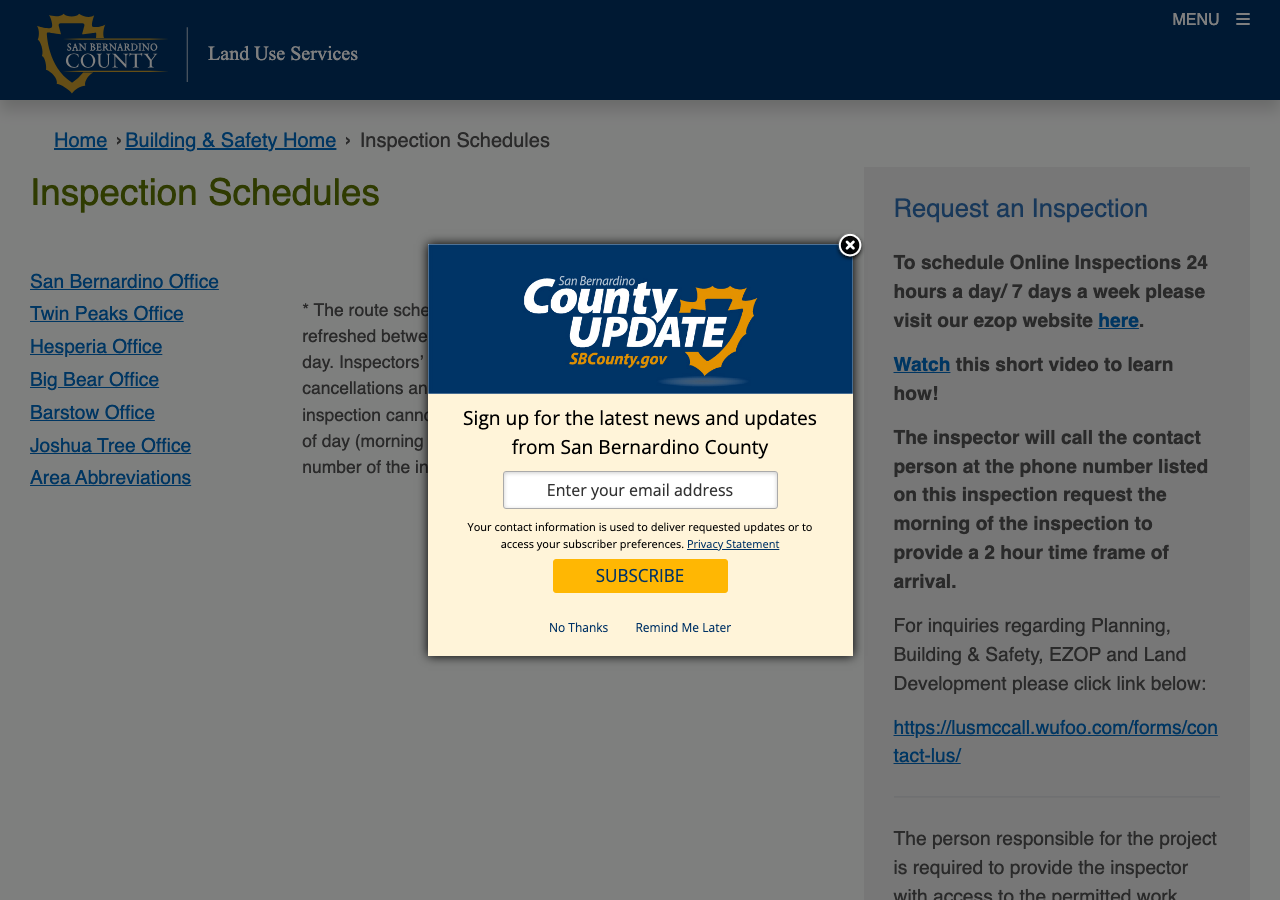
- How much notice is required? Not a fixed notice period — availability is set by community. The County publishes an Inspection Days table by community and region: valley, Big Bear and Twin Peaks communities are 'Everyday'; Barstow/Daggett/Hinkley/Fort Irwin and similar are 'Monday/Wednesday/Friday'; Angelus Oaks, Barton Flats, Forest Falls and Green Valley Lake are 'Tuesday/Thursday'; remote desert and Colorado River communities (Amboy, Baker, Cadiz, Goff's, Havasu Lake, Havasu Landing, Ivanpah) are 'Thursday' only; Boron is 'Tuesday'. 85% · department handout
- Are same-day or AM/PM windows offered? Two-hour windows, not AM/PM halves: the County provides 'a two (2) hour window for on-site inspections', and 'On the day of your inspection, your inspector will contact you by phone to set up an inspection time.' For self-inspections there is a same-day cut-off: 'Please submit all photos prior to 3:00 p.m. on the day of inspection. Photos submitted after 3:00 p.m. will be completed the next business day.' 88% · department page
-
Know who turns up
Some authorities inspect their own solar work; some delegate it, and a few do not inspect the PV equipment itself at all. Who is coming determines what they will look at.
- Does this AHJ perform its own final solar inspection? Yes — the County performs its own inspections, and offers three modes: On-Site, Virtual, and Self Inspection. 'All building-related inspections (Building, Electrical, Mechanical, Plumbing, Energy, and Certificate of Occupancy) are eligible on-site inspections.' 90% · department page
- If delegated, to whom? Not delegated — San Bernardino County Building & Safety retains the final solar inspection. However, for residential PV it may be discharged by contractor-submitted photographs under the Self-Inspection Program, reviewed by County staff, rather than by a site visit. 85% · department page
-
Work the stages in order
A rough-in or mid-roof inspection, where one is required, has to happen before the work it covers is closed up. Missing a stage means opening something back up, and it is the most expensive kind of correction.
- Which inspections are required, and in what order? For the ≤10 kW roof-mount residential PV route, a single final PV inspection, discharged against the County's 'Residential 10Kw Maximum Photovoltaic System – Roof Mount Self-Inspection Program' checklist. The general County rule is that 'an inspection will be required prior to covering up or concealing any completed work.' 65% · inspection checklist
-
Have the paperwork on site
The approved plan set, the permit, and the equipment listings should be on site and reachable. Inspectors routinely verify that installed equipment matches what was approved, and that the labels are the ones the plan set promised.
- Is there a published inspection checklist? Yes — 'Residential 10Kw Maximum Photovoltaic System – Roof Mount / Self-Inspection Program', a 2-page itemised checklist plus a system diagram, published on the County's EZ Inspect site. It opens: 'Contractor shall provide photos demonstrating compliance with the following items.' 92% · inspection checklist
- What must be on site at inspection? For the SolarAPP+ route, 'Smoke and Carbon Certification' is required before final inspection. For self-inspection, the required photographs per the PV guidance document: 'See the respective self-inspection guidance document for the photos which must be submitted with the inspection. Failure to follow the guidelines could result in a delay.' The approved plans are the reference throughout — multiple checklist items are judged 'according to the approved plan'. 70% · portal page
- Does the inspector verify labels and listings? Yes, explicitly and in detail. The County's PV inspection checklist requires photographic proof that modules 'are properly marked and labeled', that equipment is 'installed, listed and labeled according to the approved plan', that DC conduit and enclosure markings say 'WARNING: PHOTOVOLTAIC POWER SOURCE' with the specified letter size, colour and material, that the marking interval is met, that the PV system disconnecting means is labelled 'PV SYSTEM DISCONNECT', and that the rapid shutdown initiation device is labelled. 92% · inspection checklist
-
Sign-off, and permission to operate
Passing gives you a final or an equivalent sign-off. That is not the same as permission to operate: PTO comes from the utility, and who tells the utility the inspection passed varies. A system left switched off for weeks is usually waiting on this handover.
- How are corrections issued and cleared? Results are emailed: 'After the inspection is over, pass/fail status and any comments from the inspector's report will sent to the provided email.' Reports also appear in the EZ Inspect app if the inspection was booked there. Corrections are therefore issued as inspector comments on a failed result. 85% · department page
14 questions answered against San Bernardino County’s own published documents
Q49 How is an inspection booked? Core Booking & scheduling
Portal / app / phone. Three routes: the free EZ Inspect mobile app ('The fastest and easiest way'), entered by permit number; EZOP online at https://ezop.sbcounty.gov/CitizenAccess/; or phone (909) 387-8311, or (760) 995-8140 for desert areas. EZ Inspect help desk: (800) 637-6653 or (909) 501-0873.
Why the confidence is not higherAll three routes and all numbers are stated on the County's own inspection-request page and repeated in the Residential Development Guidance handout. Two County sources agree.
department page https://ezinspect.sbcounty.gov/inspection-requests/
Q50 How much notice is required? Core Booking & scheduling
Not a fixed notice period — availability is set by community. The County publishes an Inspection Days table by community and region: valley, Big Bear and Twin Peaks communities are 'Everyday'; Barstow/Daggett/Hinkley/Fort Irwin and similar are 'Monday/Wednesday/Friday'; Angelus Oaks, Barton Flats, Forest Falls and Green Valley Lake are 'Tuesday/Thursday'; remote desert and Colorado River communities (Amboy, Baker, Cadiz, Goff's, Havasu Lake, Havasu Landing, Ivanpah) are 'Thursday' only; Boron is 'Tuesday'.
Why the confidence is not higherTaken directly from the County's own Inspection Days handout, which is the document its inspection-request page points to for 'when inspections are available in your area'. Scored at 85 rather than higher because the handout is undated, and it answers 'which days' rather than the 'how much notice' the question asks — the County publishes no advance-notice or cut-off time for on-site booking. This matters commercially: a job in Amboy or Havasu Lake has one inspection day a week.
department handout https://lus.sbcounty.gov/wp-content/uploads/sites/48/BandS/Handouts/Inspection-Days.pdf
Q51 Are same-day or AM/PM windows offered? Booking & scheduling
Two-hour windows, not AM/PM halves: the County provides 'a two (2) hour window for on-site inspections', and 'On the day of your inspection, your inspector will contact you by phone to set up an inspection time.' For self-inspections there is a same-day cut-off: 'Please submit all photos prior to 3:00 p.m. on the day of inspection. Photos submitted after 3:00 p.m. will be completed the next business day.'
Why the confidence is not higherAll quoted from the County's own on-site and self-inspection pages. Docked because no cut-off time is published for BOOKING a next-day on-site inspection — only the 3:00 p.m. photo-submission deadline is stated, and that applies to the self-inspection route.
department page https://ezinspect.sbcounty.gov/on-site-inspections/
Q52 Does this AHJ perform its own final solar inspection? Core Who inspects
Yes — the County performs its own inspections, and offers three modes: On-Site, Virtual, and Self Inspection. 'All building-related inspections (Building, Electrical, Mechanical, Plumbing, Energy, and Certificate of Occupancy) are eligible on-site inspections.'
Why the confidence is not higherStated plainly across the County's own EZ Inspect pages. Not 95 only because the SolarAPP+ page lists the three modes as options without saying who chooses between them for a given solar permit.
department page https://ezinspect.sbcounty.gov/on-site-inspections/
Q53 If delegated, to whom? Core Who inspects
Not delegated — San Bernardino County Building & Safety retains the final solar inspection. However, for residential PV it may be discharged by contractor-submitted photographs under the Self-Inspection Program, reviewed by County staff, rather than by a site visit.
Why the confidence is not higherFollows directly from the County's own self-inspection page naming Solar as eligible and from the County-branded PV self-inspection checklist. Marked down because the page does not explicitly state who is authorised to take and submit the photos — it refers to a 'contractor inspection app', which implies the installing contractor.
department page https://ezinspect.sbcounty.gov/self-inspections/
Q54 Which inspections are required, and in what order? Core Stages & sequence
For the ≤10 kW roof-mount residential PV route, a single final PV inspection, discharged against the County's 'Residential 10Kw Maximum Photovoltaic System – Roof Mount Self-Inspection Program' checklist. The general County rule is that 'an inspection will be required prior to covering up or concealing any completed work.'
Why the confidence is not higherThe County publishes one PV inspection checklist and no staged sequence for solar, and its self-inspection route implies a single close-out event. But the County nowhere states 'the required inspections for solar are X then Y', so the single-stage conclusion is inference from the shape of the published documents rather than a stated sequence. Systems above 10 kW are not covered by that checklist at all.
inspection checklist https://lus.sbcounty.gov/wp-content/uploads/sites/48/TEST/SELF-INSP-Residential-10Kw-Max-Photovoltaic-System.pdf
Q55 Is a rough-in or mid-roof inspection required? Stages & sequence
Nothing published by this authority.
Where we lookedPV self-inspection checklist and the EZ Inspect on-site/virtual/self pages. No rough-in or mid-roof inspection is specified for solar. The only general rule is 'an inspection will be required prior to covering up or concealing any completed work'.
Q56 Does the inspector verify labels and listings? Core What is checked
Yes, explicitly and in detail. The County's PV inspection checklist requires photographic proof that modules 'are properly marked and labeled', that equipment is 'installed, listed and labeled according to the approved plan', that DC conduit and enclosure markings say 'WARNING: PHOTOVOLTAIC POWER SOURCE' with the specified letter size, colour and material, that the marking interval is met, that the PV system disconnecting means is labelled 'PV SYSTEM DISCONNECT', and that the rapid shutdown initiation device is labelled.
Why the confidence is not higherThis is the strongest evidence in the whole set: labels and listings are not merely verified, they are a photographed deliverable of the inspection. Taken verbatim from the County's own checklist. Not higher only because the checklist is scoped to systems of 10 kW or less, roof mount.
inspection checklist https://lus.sbcounty.gov/wp-content/uploads/sites/48/TEST/SELF-INSP-Residential-10Kw-Max-Photovoltaic-System.pdf
Q57 Is there a published inspection checklist? Core What is checked
Yes — 'Residential 10Kw Maximum Photovoltaic System – Roof Mount / Self-Inspection Program', a 2-page itemised checklist plus a system diagram, published on the County's EZ Inspect site. It opens: 'Contractor shall provide photos demonstrating compliance with the following items.'
Why the confidence is not higherThe document is live on the County's own inspection site and is solar-specific. Docked because it is undated and sits under a '/TEST/' path segment in its URL, and its code citations are from an earlier cycle — so it is current in the sense of being published, but its maintenance is uncertain.
inspection checklist https://lus.sbcounty.gov/wp-content/uploads/sites/48/TEST/SELF-INSP-Residential-10Kw-Max-Photovoltaic-System.pdf
Q58 What must be on site at inspection? Core Documents on site
For the SolarAPP+ route, 'Smoke and Carbon Certification' is required before final inspection. For self-inspection, the required photographs per the PV guidance document: 'See the respective self-inspection guidance document for the photos which must be submitted with the inspection. Failure to follow the guidelines could result in a delay.' The approved plans are the reference throughout — multiple checklist items are judged 'according to the approved plan'.
Why the confidence is not higherEach element is the County's own wording, but the County publishes no consolidated 'what must be on site at inspection' list — no statement about the permit card or a physical plan set being posted. Assembled from two pages rather than answered directly.
portal page https://wp.sbcounty.gov/ezop/permits/solar-with-solarapp/
Q59 Is there a re-inspection fee? Corrections & re-inspection
Nothing published by this authority.
Where we lookedThe Building & Safety Division Fee Schedule in full. A re-inspection fee is referenced repeatedly in footnotes ('Additional inspections will be charged a re-inspection fee', footnotes [1],[3],[6],[8],[11],[27]) but NO dollar amount for it appears in the schedule. The Miscellaneous section prices a 'Miscellaneous inspection' at $227.00 flat, but footnote [18] scopes that to 'an inspection that is not covered under any other permit in Section 16.0204' — so it is not the re-inspection fee and I am not recording it as one. Note also that the solar footnote [29] does not state how many inspections the solar permit fee includes, unlike the electrical/plumbing/mechanical footnotes which each say two.
https://lus.sbcounty.gov/wp-content/uploads/sites/48/BNS-Master-Fee-Schedule-25-26.pdf
Q60 How are corrections issued and cleared? Corrections & re-inspection
Results are emailed: 'After the inspection is over, pass/fail status and any comments from the inspector's report will sent to the provided email.' Reports also appear in the EZ Inspect app if the inspection was booked there. Corrections are therefore issued as inspector comments on a failed result.
Why the confidence is not higherQuoted verbatim from the County's on-site and self-inspection pages (the same sentence, typo included, appears on both). Docked because the County does not publish how a correction is formally cleared — whether a re-inspection must be booked as a new request, and on what timescale.
department page https://ezinspect.sbcounty.gov/on-site-inspections/
Q61 What is issued on pass? Core Final sign-off & PTO
Nothing published by this authority.
Where we lookedEZ Inspect on-site, virtual and self-inspection pages and the Residential Development Guidance handout. The County publishes only that a 'pass/fail status' is emailed — it does not name what instrument is issued on pass (final, green tag, CO or letter) for a solar permit. 'Certificate of Occupancy' appears only in the list of inspection types eligible for on-site inspection.
Q62 Who notifies the utility for PTO? Core Final sign-off & PTO
Nothing published by this authority.
Where we lookedEZOP solar-residential page, SolarAPP+ page and EZ Inspect pages — the County never mentions PTO or notifying the utility anywhere in its solar material. This sits with SCE/BVES; see q42.
Lines marked with a percentage were read off this authority’s own published documents. Unmarked guidance is general good practice, not this jurisdiction’s rule — always confirm against the authority before you submit.
Jurisdiction & key facts
The standing 60-question set, answered for San Bernardino County against this authority’s own published documents. Every answer carries the confidence it was recorded at and the document it came from. Where nothing is published we say so and show where we looked — a blank here is a finding, not a gap.
San Bernardino County is the authority having jurisdiction 90% confidence
- Holds
- Building, electrical, plumbing and mechanical permitting, plan review and inspection for the unincorporated area of San Bernardino County. Building & Safety issues the solar energy system permit itself.
- Delegated to
- Fire review/inspection sits with the San Bernardino County Fire Protection District — the County's own solar permit page lists 'Fire Department review/inspections' as a separate possible requirement alongside Planning Review, Grading Permit, Geology Investigation and Geotechnical Report. Automated plan review for eligible residential PV is delegated to NREL SolarAPP+.
- Overridden by
- California state law. IB-0012 states 'In compliance with State law, the County of San Bernardino is required to adopt and enforce the latest published edition of the California Building Standards Code' — the County cannot set its own base code editions, only local amendments. The Solar Rights Act / AB 2188 (Gov. Code 65850.5) expedited-permitting duty also applies statewide.
- Why not higher
- The County's own Building & Safety and EZ Online Permitting pages plainly show it issues and inspects solar permits in the unincorporated area, and IB-0012 states the state-code preemption in the County's own words. Held back from higher because the boundary with the County Fire District is described only as 'Fire Department review/inspections' may be required, without a document saying which parts of a residential PV job Fire reviews. NOTE FOR THE CALLER: San Bernardino County contains 24+ incorporated cities that are each their own AHJ. In particular the CITY of San Bernardino (sanbernardino.gov) uses the Symbium portal and an SB 379 38.4 kW threshold — that is a DIFFERENT authority and none of it applies here. Everything below is sbcounty.gov.
- Permit required
- Yes. A permit is required for both roof-mount and ground-mount residential solar.95%
- Permit cost
- $441 total for a single-family residential roof-mount PV system of 15 kW or less — $215.00 plan review + $226.00 permit fee.95%
- Portal
- EZ Online Permitting ('EZOP') at https://ezop.sbcounty.gov/citizenaccess — Accela-based. Automated plan review for eligible residential PV runs through NREL SolarAPP+…95%
- Electrical code
- 2023 NEC — in force as the 2025 California Electrical Code (Title 24 Part 3), effective 1 January 2026.88%
- Own placard wording
- No — the County does not author placard wording of its own. It restates the code's wording ('WARNING: PHOTOVOLTAIC POWER SOURCE', 'PV SYSTEM DISCONNECT') and cites CEC/CFC as the source.80%
- Booking an inspection
- Portal / app / phone. Three routes: the free EZ Inspect mobile app ('The fastest and easiest way'), entered by permit number; EZOP online at https://ezop.sbcounty.gov/CitizenAccess/;92%
Labels & placards for this authority
Wording 80%
No — the County does not author placard wording of its own. It restates the code's wording ('WARNING: PHOTOVOLTAIC POWER SOURCE', 'PV SYSTEM DISCONNECT') and cites CEC/CFC as the source.
Size, colour & material 90%
Yes, for the DC warning markings: '3/8-inch (9.5 mm) minimum-sized white letters on a red background. The signs are made of reflective weather resistant material.'
Where they go 90%
Conduit/raceway/cable markings: 'every 10 feet, within one foot of all turns or bends and within one foot above and below all penetrations of roof/ceiling assemblies, walls and barriers' (CEC 690.31(G)(4), CFC 605.11.1.4). Warning markings go on all interior and exterior DC conduit, enclosures, raceways, cable assemblies, junction boxes, combiner boxes and disconnects on buildings. The 'PV SYSTEM DISCONNECT' label goes on the PV system disconnecting means, which must be readily accessible.
What the utility wants on top None%
Each figure above is sourced and dated in the full answer set below (questions 38–43). Where an authority’s own published sheet is older than the code it has adopted, the answer says so.
Their website
Average approval time — application to PTO
From the CPUC interconnection record. Bars show the average days taken each year; a year with no recorded projects is left blank rather than drawn as zero.