
Tehama County
State of California
Tehama County is a county authority in the State of California, covering 15 regions, serving 65,829 residents. 1,510 residential solar installs are on record here. This page is the permit route for that jurisdiction: the fifteen steps from working out who has a say over an address through to permission to operate, the documents this authority publishes, and 62 answers taken from those documents and dated.
Permitting 5 steps · 28 questions
Whether a permit is needed — Yes — a permit is required for residential rooftop PV in unincorporated Tehama County. Q3 Electrical and building permits — Combined for a roof-mount retrofit — the Fee Ordinance's electrical Table E (Code 566, Q4 Where you file — ViewPointCloud (tehamacountyca.viewpointcloud.com). Q20
- Permit required
- Yes — a permit is required for residential rooftop PV in unincorporated Tehama County.95% source
- What it costs
- $400.95 flat, County Electrical Permit Code 566 'Solar Photovoltaic System,' charged per inverter (this figure bundles 30 minutes of plan check plus support/travel/inspection time,70% source
- Key document
- ordinance cited by 7 open the document
-
Confirm who has a say over your address
A city address is usually permitted by the city, not the county — but not always, and some authorities keep building and hand electrical to someone else. Getting this wrong costs the whole submittal, because every requirement below belongs to whoever actually holds jurisdiction. Check the overlays in the same pass: an HOA, a historic district, a windstorm certification or a system-size cap can reshape the design, and all of them are cheaper to find now than after the array is laid out.
- Is this authority the AHJ for residential solar at this address? Yes, but only for UNINCORPORATED Tehama County. The incorporated cities of Red Bluff and Corning, and the town of Tehama, are separate AHJs that issue their own building/electrical permits and are outside Tehama County Building & Safety's jurisdiction. 92% · department page
- What does this authority permit itself, and what does it delegate? Both — Tehama County Building & Safety issues both building and electrical permits in-house for unincorporated county parcels. No plan-review or inspection contractor is named anywhere in the department's own materials (fee ordinance lists in-house hourly rates for 'Building Official,' 'Building Inspector,' and 'Plan Check' staff, and the Building Official is named as a county employee, Patrick Ewald). 82% · fee schedule
- Is a permit required for a residential rooftop PV system? Yes — a permit is required for residential rooftop PV in unincorporated Tehama County. 95% · ordinance
- Is there a separate electrical permit, or is it combined? Combined for a roof-mount retrofit — the Fee Ordinance's electrical Table E (Code 566, 'Solar Photovoltaic System') is used as a stand-alone electrical permit for PV added to an existing home; only ground-mount arrays (treated as a structure) would additionally draw a building-permit/structural component. There is no evidence of two separately numbered permits for a typical roof-mount retrofit. 62% · fee schedule
- Is a HOA or architectural approval required first? No county requirement — nothing in the streamlined solar ordinance (Ch. 15.60) or the general submittal checklist calls for HOA/architectural approval as a condition of the county permit; any HOA review would be a private CC&R matter outside the county's process. 65% · ordinance
- Is there a historic-district review? No, in general — historic-district/individual-landmark review under Ch. 15.32 (Historical Building Code) applies only to buildings independently 'qualified' as historic structures (e.g., listed on a national/state/local register); a typical residential parcel is not subject to it. 68% · ordinance
- Is a wind or windstorm certification required? No dedicated wind/windstorm certification document is required. Wind loading is addressed through the county's standard structural design value (90 mph design wind speed, Exposure C) published on the Codes & Ordinances page, applied through ordinary structural calculations rather than a separate certification. 72% · department page
- Is a Specific Use Permit or Council approval ever required? Yes, conditionally — Ch. 15.60.040(g): if the Building Official finds substantial evidence the proposed system could have a 'specific, adverse impact' on public health/safety and the Planning Director concurs, the applicant must obtain a discretionary Use Permit from the Planning Commission (appealable within 10 calendar days). 92% · ordinance
- Is there a system-size cap on residential generation? A soft cap exists only for eligibility for the STREAMLINED/expedited process: systems must be ≤10 kW AC nameplate (or ≤30 kW thermal) to qualify. Larger residential systems are not prohibited outright — they simply fall outside Ch. 15.60's expedited track and go through standard discretionary/ministerial review instead. 88% · ordinance
-
Check who is allowed to apply
Several authorities require the electrical permit to be pulled by a licensed electrician, or require the contractor to be registered with them BEFORE applying. Registration is not same-day. This is second on the list rather than fourth because it is the step most likely to stop the job before the drawings matter.
- Who is allowed to pull the electrical permit? Either — a state-licensed C-46 (Solar) or C-10 (Electrical) contractor may pull the permit, or the homeowner may self-permit as an owner-builder. 70% · permit application form
- Must the contractor be registered with this authority before applying? No — the application asks only for the contractor's California (CSLB) state license number and class; there is no separate Tehama County contractor registration field or process. 75% · permit application form
- Is a homeowner permitted to self-install and self-permit? Yes — the county publishes an 'Owner-Builder-Take-Note' disclosure form as part of its standard forms package, confirming homeowner self-install/self-permit is accepted (subject to the owner-builder acknowledgement). 78% · department forms page
-
Build the submittal package
Almost everywhere wants a site plan, a one-line or three-line electrical diagram, equipment cut sheets with listings, and a structural attachment detail. Build it against the published checklist rather than the last jurisdiction you worked in — the checklist is what the reviewer marks against.
- What documents make up a complete submittal? No dedicated, stand-alone PV submittal checklist is published. The county's only public checklist is the general 'Building Permit Application' cover sheet, which for new-home construction lists: Approved Plot Plan, complete set of building plans, energy calculations, truss calculations, SFR-modified soils test, structural calculations (if applicable), 'Solar Plans and Manual J Report,' and a flood elevation certificate (if applicable). Ch. 15.60.040(b) obligates the Building Official to publish a solar-specific checklist conforming to the CA Solar Permitting Guidebook, but no such document appears on the county's Forms & Publications page. 55% · department forms page
- How many copies, and in what format? Not stated as a copy count — submittal is via the ViewPointCloud e-permitting portal (electronic/PDF upload), which the county directs all applicants to use ('Apply for a Permit Online'). No physical-copy requirement is published. 55% · department page
- Is a site plan required, and what must it show? Yes — an 'Approved Plot Plan' is a required checklist item on the Building Permit Application; the application itself does not spell out exactly what the plot plan must depict beyond that label. 60% · permit application form
- Is a one-line / three-line diagram required? Yes, by inheritance — Ch. 15.60.030(c)(2) requires small residential rooftop PV to conform to the California Electrical Code and 'all applicable safety and performance standards' referenced by the CA Solar Permitting Guidebook, which mandates a one-line diagram as a checklist item; the county has not published its own copy of that checklist to confirm the wording locally. 60% · ordinance
- Is a structural PE stamp required, and at what threshold? Not specified for solar particularly. The general checklist lists 'Structural Calculations (if applicable)' with no stated valuation, span, or roof-load threshold; the Building Official determines applicability case by case. 50% · permit application form
- Is an electrical PE stamp required, and at what threshold? Not specified — no electrical PE-stamp threshold is published anywhere in the ordinance or forms reviewed; the streamlined solar ordinance (Ch. 15.60) requires conformance to the CEC/UL/IEEE standards but does not require a licensed electrical engineer's stamp for eligible (≤10kW AC) systems. 50% · ordinance
-
Apply and pay
Most authorities now take the whole application through a portal, and several states cap or constrain what a residential solar permit may cost. Check whether plan check is billed separately before you quote the job.
- Which permit portal does this authority use? ViewPointCloud (tehamacountyca.viewpointcloud.com). 92% · department page
- Can the whole application be completed online? Yes, functionally — the county's only application route publicized is the ViewPointCloud portal ('Apply for a Permit Online'), and the same portal is used to log in and schedule inspections. The department page does not explicitly confirm online fee payment, so this is inferred from ViewPointCloud's standard e-permitting functionality rather than confirmed line-by-line. 65% · department page
- What does a residential solar permit cost? $400.95 flat, County Electrical Permit Code 566 'Solar Photovoltaic System,' charged per inverter (this figure bundles 30 minutes of plan check plus support/travel/inspection time, and covers up to two site visits). A ground-mounted array additionally draws a $223.00 Tehama County Fire Dept (TCFD) plan-review fee. No separate building-valuation fee applies to a roof-mount retrofit. 70% · fee schedule
- How is the fee calculated? Flat, per inverter (Code 566 is a fixed dollar amount per inverter, not a percentage-of-valuation, per-kW, or per-panel charge). 78% · fee schedule
- Is there a separate plan-check fee? No — plan check is bundled into the $400.95 electrical permit fee itself (the fee formula explicitly includes '30 minutes x $143.10/Hr. (plan check rate)'); there is no separate stand-alone plan-check line item for solar. 78% · fee schedule
-
Plan review — and start the utility in parallel
Interconnection is a separate process from the permit and usually the longer pole. Where the utility does not depend on the permit being issued, running both at once is the single biggest saving available on a residential job.
- How long is an issued permit valid before it expires? 180 days (permit applications/issued permits expire after 180 days of inactivity). 82% · department page
- Which utility handles interconnection here? PG&E (Pacific Gas & Electric). No community-choice aggregator serving Tehama County was found — the county's own Building & Safety staff memo assumes PG&E as the default electric utility and discusses only PG&E vs. off-grid scenarios. 80% · county staff memo
- Where does the utility sit in the sequence? After permit / final inspection — PG&E's own Greenbook states local/state ordinances require the applicant to obtain permits AND final inspections before PG&E establishes electric service, and PG&E has the right under Electric Rule 11/16 to refuse connection until the AHJ clears the work. 85% · utility service manual
28 questions answered against Tehama County’s own published documents
Q1 Is this authority the AHJ for residential solar at this address? Core Jurisdiction & scope
Yes, but only for UNINCORPORATED Tehama County. The incorporated cities of Red Bluff and Corning, and the town of Tehama, are separate AHJs that issue their own building/electrical permits and are outside Tehama County Building & Safety's jurisdiction.
Why the confidence is not higherCounty Building & Safety department page names its scope; county's own 'Cities, Towns & Communities' page and Municode both confirm 3 incorporated cities within the county exist as separate jurisdictions.
department page checked 2026-08-30 https://www.tehama.gov/government/departments/building-and-safety/
Q2 What does this authority permit itself, and what does it delegate? Core Jurisdiction & scope
Both — Tehama County Building & Safety issues both building and electrical permits in-house for unincorporated county parcels. No plan-review or inspection contractor is named anywhere in the department's own materials (fee ordinance lists in-house hourly rates for 'Building Official,' 'Building Inspector,' and 'Plan Check' staff, and the Building Official is named as a county employee, Patrick Ewald).
Why the confidence is not higherInferred from Ord. 1918 fee schedule (in-house hourly rates, no consultant line item) and the Building Permit Application header naming a county Building Official; no outside firm is named anywhere the way Camarillo names Charles Abbott Associates.
fee schedule checked 2026-08-30 https://www.tehama.gov/wp-content/uploads/2024/12/ord1918-Fee-Ordinance.pdf
Q3 Is a permit required for a residential rooftop PV system? Core Jurisdiction & scope
Yes — a permit is required for residential rooftop PV in unincorporated Tehama County.
Why the confidence is not higherTehama County Code Ch. 15.60 'Streamlined Permit Process for Small Residential Rooftop Solar Energy Systems' establishes an expedited PERMIT-issuance process under GC 65850.5 — a permit is presupposed throughout.
ordinance checked 2026-08-30 https://tehamacounty.legistar.com/View.ashx?M=F&ID=15003879&GUID=C5732D70-975B-43D7-9E52-8272B52F5A24
Q4 Is there a separate electrical permit, or is it combined? Core Jurisdiction & scope
Combined for a roof-mount retrofit — the Fee Ordinance's electrical Table E (Code 566, 'Solar Photovoltaic System') is used as a stand-alone electrical permit for PV added to an existing home; only ground-mount arrays (treated as a structure) would additionally draw a building-permit/structural component. There is no evidence of two separately numbered permits for a typical roof-mount retrofit.
Why the confidence is not higherInferred: Ord. 1918 Table B (building fees, valuation-based) is captioned 'FOR NEW CONSTRUCTION, FACTORY BUILT HOMES, AND RESIDENTIAL REMODEL/CONVERSION WITH PLANS' while Table E (electrical) is used independently for stand-alone electrical work including Code 566 solar; TCFD's fee sheet separately buckets 'Ground Mount Solar' under a structural plan-review line, implying only ground-mount pulls a second (fire/structural) track.
fee schedule checked 2026-08-30 https://www.tehama.gov/wp-content/uploads/2024/12/ord1918-Fee-Ordinance.pdf
Q5 Who is allowed to pull the electrical permit? Core Who may apply
Either — a state-licensed C-46 (Solar) or C-10 (Electrical) contractor may pull the permit, or the homeowner may self-permit as an owner-builder.
Why the confidence is not higherBuilding Permit Application has a 'STATE LIC #/CLASS' field for a contractor (no county-specific license required beyond the CSLB number), and the Forms & Publications page separately publishes an 'Owner-Builder-Take-Note Form Fillable,' confirming owner-builder is an accepted path.
permit application form checked 2026-08-30 https://www.tehama.gov/wp-content/uploads/2025/04/Building-Permit-Application-2024-Fill-in.pdf
Q6 Must the contractor be registered with this authority before applying? Core Who may apply
No — the application asks only for the contractor's California (CSLB) state license number and class; there is no separate Tehama County contractor registration field or process.
Why the confidence is not higherBuilding Permit Application form fields are 'STATE LIC #' and 'CLASS' only; no county registration number field exists on the form.
permit application form checked 2026-08-30 https://www.tehama.gov/wp-content/uploads/2025/04/Building-Permit-Application-2024-Fill-in.pdf
Q7 Is a homeowner permitted to self-install and self-permit? Who may apply
Yes — the county publishes an 'Owner-Builder-Take-Note' disclosure form as part of its standard forms package, confirming homeowner self-install/self-permit is accepted (subject to the owner-builder acknowledgement).
Why the confidence is not higherForms & Publications page lists 'Owner-Builder-Take-Note Form Fillable' among standard building forms.
department forms page checked 2026-08-30 https://www.tehama.gov/government/departments/building-and-safety/building-forms/
Q8 What documents make up a complete submittal? Core Submittal package
No dedicated, stand-alone PV submittal checklist is published. The county's only public checklist is the general 'Building Permit Application' cover sheet, which for new-home construction lists: Approved Plot Plan, complete set of building plans, energy calculations, truss calculations, SFR-modified soils test, structural calculations (if applicable), 'Solar Plans and Manual J Report,' and a flood elevation certificate (if applicable). Ch. 15.60.040(b) obligates the Building Official to publish a solar-specific checklist conforming to the CA Solar Permitting Guidebook, but no such document appears on the county's Forms & Publications page.
Why the confidence is not higherRead the full Forms & Publications listing (Applications / ADA / Manufactured Homes / Roofing / Other / Energy Compliance categories) — no item titled 'solar' or 'PV' checklist exists; only the generic new-home checklist mentions 'Solar Plans' in passing.
department forms page checked 2026-08-30 https://www.tehama.gov/government/departments/building-and-safety/building-forms/
Q9 How many copies, and in what format? Submittal package
Not stated as a copy count — submittal is via the ViewPointCloud e-permitting portal (electronic/PDF upload), which the county directs all applicants to use ('Apply for a Permit Online'). No physical-copy requirement is published.
Why the confidence is not higherPermit Information page directs all applicants to the online portal; no paper-copy count is mentioned anywhere in the Forms, Permit Information, or Application pages reviewed.
department page checked 2026-08-30 https://www.tehama.gov/government/departments/building-and-safety/permit-information/
Q10 Is a site plan required, and what must it show? Core Submittal package
Yes — an 'Approved Plot Plan' is a required checklist item on the Building Permit Application; the application itself does not spell out exactly what the plot plan must depict beyond that label.
Why the confidence is not higherBuilding Permit Application checklist explicitly lists 'APPROVED PLOT PLAN' as a required attachment; no separate plot-plan content specification was found.
permit application form checked 2026-08-30 https://www.tehama.gov/wp-content/uploads/2025/04/Building-Permit-Application-2024-Fill-in.pdf
Q11 Is a one-line / three-line diagram required? Core Drawings & calculations
Yes, by inheritance — Ch. 15.60.030(c)(2) requires small residential rooftop PV to conform to the California Electrical Code and 'all applicable safety and performance standards' referenced by the CA Solar Permitting Guidebook, which mandates a one-line diagram as a checklist item; the county has not published its own copy of that checklist to confirm the wording locally.
Why the confidence is not higherCh. 15.60.030(c)(2) ties compliance to the CEC and to standards the state Solar Permitting Guidebook incorporates (one-line diagram is a Guidebook staple), but no local document was found spelling this out directly.
ordinance checked 2026-08-30 https://tehamacounty.legistar.com/View.ashx?M=F&ID=15003879&GUID=C5732D70-975B-43D7-9E52-8272B52F5A24
Q12 Are string and conductor calculations required? Drawings & calculations
Nothing published by this authority.
Where we lookedSearched Ch. 15.60 (Streamlined Solar) and Ch. 15.20 (Electrical Code) in full text of Ord. No. 2150, and the Building Permit Application/Forms & Publications page — no explicit statement requiring string or conductor calculations for residential PV.
Q13 Is a structural PE stamp required, and at what threshold? Core Engineering & stamps
Not specified for solar particularly. The general checklist lists 'Structural Calculations (if applicable)' with no stated valuation, span, or roof-load threshold; the Building Official determines applicability case by case.
Why the confidence is not higherBuilding Permit Application checklist item 'STRUCTURAL CALCULATIONS (IF APPLICABLE)' carries no numeric threshold; no separate solar-specific structural policy was found.
permit application form checked 2026-08-30 https://www.tehama.gov/wp-content/uploads/2025/04/Building-Permit-Application-2024-Fill-in.pdf
Q14 Is an electrical PE stamp required, and at what threshold? Engineering & stamps
Not specified — no electrical PE-stamp threshold is published anywhere in the ordinance or forms reviewed; the streamlined solar ordinance (Ch. 15.60) requires conformance to the CEC/UL/IEEE standards but does not require a licensed electrical engineer's stamp for eligible (≤10kW AC) systems.
Why the confidence is not higherCh. 15.60.030(c)(2) references code/testing-lab conformance, not a PE stamp; no other document imposes one.
ordinance checked 2026-08-30 https://tehamacounty.legistar.com/View.ashx?M=F&ID=15003879&GUID=C5732D70-975B-43D7-9E52-8272B52F5A24
Q15 What does a residential solar permit cost? Core Fees
$400.95 flat, County Electrical Permit Code 566 'Solar Photovoltaic System,' charged per inverter (this figure bundles 30 minutes of plan check plus support/travel/inspection time, and covers up to two site visits). A ground-mounted array additionally draws a $223.00 Tehama County Fire Dept (TCFD) plan-review fee. No separate building-valuation fee applies to a roof-mount retrofit.
Why the confidence is not higherOrd. No. 1918 fee schedule (Attachment A, Table E, Code 566) shows the $400.95 figure and its build-up formula; TCFD's current (dated 17 Jul 2026 per pdfinfo) fee sheet lists 'Plan Review, non-sprinkler, no alarm (New Shop, Garage, Ground Mount Solar, etc) $223.00.' The Ord. 1918 PDF's own creation date is 2010 even though it remains the only fee ordinance the county currently links, so escalation since 2010 cannot be independently confirmed from the document alone.
fee schedule checked 2026-08-30 https://www.tehama.gov/wp-content/uploads/2024/12/ord1918-Fee-Ordinance.pdf
Q16 How is the fee calculated? Core Fees
Flat, per inverter (Code 566 is a fixed dollar amount per inverter, not a percentage-of-valuation, per-kW, or per-panel charge).
Why the confidence is not higherOrd. No. 1918, Table E, Code 566 fee build-up is a fixed formula independent of system size (kW) or panel count.
fee schedule checked 2026-08-30 https://www.tehama.gov/wp-content/uploads/2024/12/ord1918-Fee-Ordinance.pdf
Q17 Is there a separate plan-check fee? Fees
No — plan check is bundled into the $400.95 electrical permit fee itself (the fee formula explicitly includes '30 minutes x $143.10/Hr. (plan check rate)'); there is no separate stand-alone plan-check line item for solar.
Why the confidence is not higherOrd. No. 1918, Table E, Code 566 formula arithmetic: (140.12 min x $141.05/hr) + (30 min x $143.10/hr) = $400.95, i.e. plan check is already priced in.
fee schedule checked 2026-08-30 https://www.tehama.gov/wp-content/uploads/2024/12/ord1918-Fee-Ordinance.pdf
Q18 What is the stated plan-review turnaround? Core Timeline & validity
Nothing published by this authority.
Where we lookedSearched Ch. 15.60.040 (the streamlined-review section) and the Permit Information / Building & Safety department pages — the ordinance requires an 'expedited' administrative review but states no specific business-day turnaround figure.
Q19 How long is an issued permit valid before it expires? Timeline & validity
180 days (permit applications/issued permits expire after 180 days of inactivity).
Why the confidence is not higherPermit Information page: 'REMINDER: All permit applications expire after 180 days.' This tracks the standard CBC 105.3.2/105.5 180-day default.
department page checked 2026-08-30 https://www.tehama.gov/government/departments/building-and-safety/permit-information/
Q20 Which permit portal does this authority use? Core Portal & process
ViewPointCloud (tehamacountyca.viewpointcloud.com).
Why the confidence is not higherPermit Information page: 'To apply for a permit online please go to: https://tehamacountyca.viewpointcloud.com — Apply Now.'
department page checked 2026-08-30 https://www.tehama.gov/government/departments/building-and-safety/permit-information/
Q21 Can the whole application be completed online? Core Portal & process
Yes, functionally — the county's only application route publicized is the ViewPointCloud portal ('Apply for a Permit Online'), and the same portal is used to log in and schedule inspections. The department page does not explicitly confirm online fee payment, so this is inferred from ViewPointCloud's standard e-permitting functionality rather than confirmed line-by-line.
Why the confidence is not higherPermit Information and Inspection Requests pages both route exclusively through the ViewPointCloud portal; no parallel paper-only path is advertised.
department page checked 2026-08-30 https://www.tehama.gov/government/departments/building-and-safety/permit-information/
Q22 Which utility handles interconnection here? Core Utility interconnection
PG&E (Pacific Gas & Electric). No community-choice aggregator serving Tehama County was found — the county's own Building & Safety staff memo assumes PG&E as the default electric utility and discusses only PG&E vs. off-grid scenarios.
Why the confidence is not higherCounty staff memo 'Off Grid vs PGE' (Bldg & Safety, dated 1 May 2026 per pdfinfo) frames the only two states as PG&E-served or off-grid — no CCA is mentioned; no CCA opt-out notice exists on tehama.gov.
county staff memo checked 2026-08-30 https://www.tehama.gov/wp-content/uploads/2026/05/Off-Grid-vs-PGE-staff-memo.pdf
Q23 Where does the utility sit in the sequence? Core Utility interconnection
After permit / final inspection — PG&E's own Greenbook states local/state ordinances require the applicant to obtain permits AND final inspections before PG&E establishes electric service, and PG&E has the right under Electric Rule 11/16 to refuse connection until the AHJ clears the work.
Why the confidence is not higherPG&E Greenbook (TD-7001M, rev. 2026-04), Section 1.11, item 11: 'Local and state ordinances require applicants to obtain the appropriate permits and final inspections before PG&E establishes services...' and item 12 on PG&E's right to withhold connection.
utility service manual checked 2026-08-30 https://www.pge.com/assets/pge/docs/account/service-requests/greenbook-manual-full.pdf
Q24 Is a HOA or architectural approval required first? Overlays & special cases
No county requirement — nothing in the streamlined solar ordinance (Ch. 15.60) or the general submittal checklist calls for HOA/architectural approval as a condition of the county permit; any HOA review would be a private CC&R matter outside the county's process.
Why the confidence is not higherCh. 15.60 (submittal/review requirements) and the Building Permit Application checklist contain no HOA/architectural-approval line item.
ordinance checked 2026-08-30 https://tehamacounty.legistar.com/View.ashx?M=F&ID=15003879&GUID=C5732D70-975B-43D7-9E52-8272B52F5A24
Q25 Is there a historic-district review? Overlays & special cases
No, in general — historic-district/individual-landmark review under Ch. 15.32 (Historical Building Code) applies only to buildings independently 'qualified' as historic structures (e.g., listed on a national/state/local register); a typical residential parcel is not subject to it.
Why the confidence is not higherCh. 15.32 and the Historic Structure definition in Ord. No. 2150 (Title 15) apply narrowly to designated historic structures, not to residential parcels generally.
ordinance checked 2026-08-30 https://tehamacounty.legistar.com/View.ashx?M=F&ID=15003879&GUID=C5732D70-975B-43D7-9E52-8272B52F5A24
Q26 Is a wind or windstorm certification required? Overlays & special cases
No dedicated wind/windstorm certification document is required. Wind loading is addressed through the county's standard structural design value (90 mph design wind speed, Exposure C) published on the Codes & Ordinances page, applied through ordinary structural calculations rather than a separate certification.
Why the confidence is not higherCodes & Ordinances page 'Local conditions & requirements' table lists 'Wind Speed: 90 MPH' and 'Exposure: C' as design inputs, with no separate wind-certification document referenced anywhere.
department page checked 2026-08-30 https://www.tehama.gov/government/departments/building-and-safety/codes-and-ordinances/
Q27 Is a Specific Use Permit or Council approval ever required? Overlays & special cases
Yes, conditionally — Ch. 15.60.040(g): if the Building Official finds substantial evidence the proposed system could have a 'specific, adverse impact' on public health/safety and the Planning Director concurs, the applicant must obtain a discretionary Use Permit from the Planning Commission (appealable within 10 calendar days).
Why the confidence is not higherCh. 15.60.040(g) of Ord. No. 2150 (Title 15, Streamlined Solar chapter) sets out this exact referral/use-permit mechanism.
ordinance checked 2026-08-30 https://tehamacounty.legistar.com/View.ashx?M=F&ID=15003879&GUID=C5732D70-975B-43D7-9E52-8272B52F5A24
Q28 Is there a system-size cap on residential generation? Overlays & special cases
A soft cap exists only for eligibility for the STREAMLINED/expedited process: systems must be ≤10 kW AC nameplate (or ≤30 kW thermal) to qualify. Larger residential systems are not prohibited outright — they simply fall outside Ch. 15.60's expedited track and go through standard discretionary/ministerial review instead.
Why the confidence is not higherCh. 15.60.030(c)(1) defines 'small residential rooftop solar energy system' with the 10kW AC / 30kW thermal ceiling as the threshold for streamlined eligibility.
ordinance checked 2026-08-30 https://tehamacounty.legistar.com/View.ashx?M=F&ID=15003879&GUID=C5732D70-975B-43D7-9E52-8272B52F5A24
Lines marked with a percentage were read off this authority’s own published documents. Unmarked guidance is general good practice, not this jurisdiction’s rule — always confirm against the authority before you submit.
Install 5 steps · 20 questions
-
Build to the code editions actually in force here
The NEC edition a jurisdiction enforces is often a cycle behind the newest one published, and local amendments sit on top of it. Rapid shutdown, conductor sizing and labelling all change between editions, so the edition in force is the first thing to establish, not the last.
- Which NEC edition is in force? As adopted, Tehama County Code §15.20.030 (Ord. No. 2150, the county's Nov 2025 'Code Cycle 2025' readoption) still reads: '...incorporating the National Electrical Code, 2022 current edition...' — the same wording carried over unchanged from the prior 2022-cycle ordinance (Ord. No. 2127). By contrast, the SAME readoption ordinance visibly updated the Building Code chapter to 'International Building Code, 2024 Edition' and the Fire Code chapter to 'International Fire Code, 2018 2024 Edition' (redlined). The Electrical Code section shows no equivalent redline to a newer NEC year, which is either a genuine drafting gap in the 2025 readoption or boilerplate that does not track true NFPA edition numbers (there is no NFPA 'NEC 2022' edition; NEC editions run 2020/2023). This is reported as-is, at reduced confidence, because the primary text is internally inconsistent. 45% · ordinance
- Which building code edition is in force? 2025 California Building Code (Title 24, Part 2), incorporating the International Building Code, 2024 Edition — adopted via Ord. No. 2150 (Tehama County Code §15.04.030), the county's 'Code Cycle 2025' readoption. 85% · ordinance
- Which fire code edition is in force? 2025 California Fire Code (Title 24, Part 9), incorporating the International Fire Code, 2024 Edition — adopted via Ord. No. 2150 (Tehama County Code §15.34.030), redlined from the prior 2018 IFC edition. 85% · ordinance
- Are there local amendments to any of the above? Yes — local amendments exist, e.g., California Residential Code Appendix AX/CI (swimming pool safety) amendment at §15.06.040; Uniform Sign Code appendix substitution at §15.24 area; and locally-set structural design values (90 mph wind, Seismic Zone D, Exposure C, specific trench depths) published separately on the Codes & Ordinances page. 85% · ordinance
- What is the installation judged against? The installation is judged against the California Electrical Code (Title 24, Part 3)/NEC as adopted by Tehama County Code Ch. 15.20, the California Building/Residential Code (Ch. 15.04/15.06), and — for eligible small systems — the additional Ch. 15.60.030(c)(2) conformance standard: CEC, IEEE, UL-listing, and applicable CPUC safety/reliability rules. 85% · ordinance
-
Fire access, setbacks and pathways
Ridge setbacks and roof access pathways are fire-service requirements and they constrain the array layout. They are the most common cause of a redesign after the fire department comments on a plan set.
- What ridge setback and access pathways are required? No local amendment to the state-standard fire-code roof access pathway/ridge setback was found (Ch. 15.34 is a bare CFC/IFC adoption with no PV-pathway amendment) — so the 2025 CFC/CRC default pathway rules apply. Separately, TCFD's 'Residential Development Requirements' handout imposes its own, different requirement: photovoltaic systems must maintain at least 10 feet of defensible space (vegetation clearance), on top of the general 100-foot structure defensible-space zone. 65% · fire district handout
-
Rapid shutdown
Which rapid-shutdown rule applies follows directly from the NEC edition in force, and the initiation device has to be at a location the fire service can reach and identify. This is inspected, and it is labelled.
- Is rapid shutdown required, and to which NEC edition? Rapid shutdown per NEC 690.12 is required by inheritance since the county adopts the CEC/NEC wholesale (Ch. 15.20.030) with no local exemption — but which NEC edition's 690.12 language applies is uncertain given the internal inconsistency found at Q29 (electrical chapter text still cites '2022 current edition' while building/fire chapters were bumped to 2024-edition model codes in the same 2025 readoption). 45% · ordinance
-
Labels and placards
The NEC sets a baseline for permanent markings at the service equipment and the disconnecting means. On top of that, an authority may specify its own wording, and the utility may specify more again. Where any of them writes its own text, a generic off-the-shelf label set will not pass — this is the detail most often fixed on a return visit.
- Which placards does this authority require at the service equipment? No county-specific placard beyond the state code is separately published; the operative placard requirement comes from PG&E's Greenbook, which requires permanent signage at the meter panel identifying the interconnected DG source (see Q42/43). 65% · ordinance
- Does the authority specify placard wording of its own? No — the county ordinance itself does not specify placard wording; it defers to the CEC and (for the utility side) to PG&E's Greenbook, which does specify wording ('an alternative source of generation is interconnected' / line-side connection warning). 65% · ordinance
- Does it specify letter height, colour or material? The county specifies letter height/material only for site-ADDRESS signage (min. 4-inch letters, 1/2-inch stroke, reflectorized — TCFD Residential Development Requirements), not for PV service-equipment placards specifically; no county document sets letter height/colour/material for the PV placard itself. 60% · fire district handout
- Is a site plan / facility map placard required, and what must it show? Not separately elaborated locally — NEC 705.10 (facility placard/directory requirement, adopted via CEC/NEC per Ch. 15.20) applies by default, but no county document restates or adds to what it must show. 55% · ordinance
- Does the UTILITY specify placards beyond the AHJ's? Yes — PG&E's Greenbook requires permanent signage on the meter panel stating that an alternative generation source (solar/wind/battery) is interconnected, plus additional signage/maps at the meter panel if the AC disconnect is more than 10 feet away and out of line of sight; a fusible line-side disconnect additionally requires an engraved placard warning of the line/supply-side connection. 90% · utility service manual
- Where must the labels be placed? At the electric meter panel — DG interconnection signage is affixed to the meter panel itself; if the AC disconnect switch is located more than 10 feet from, or out of line of sight of, the meter panel, PG&E additionally requires signage/maps at the meter panel pointing to the disconnect's location. 88% · utility service manual
-
Disconnect, storage and listed equipment
Where the AC disconnect must sit relative to the meter is usually the utility's rule, not the building department's. Battery storage frequently carries its own permit, its own inspection and its own fire conditions.
- Where must the AC disconnect be, relative to the meter? For the most common residential case (inverter-based, self-contained meter panel, ≤320A, single-phase), PG&E does NOT require an AC disconnect switch at all; if one is installed anyway it must be PG&E-approved. For all other panel types (transformer-rated, multi-phase, non-inverter-based, or >320A), an AC disconnect IS required, installed after the meter and ahead of/adjacent to the main breaker; if the disconnect sits more than 10 feet from, or out of line of sight of, the meter, PG&E requires directional signage/maps at the meter panel. 88% · utility service manual
- Must equipment be on a specific approved list? Yes, by inheritance — Ch. 15.60.030(c)(2) requires eligible small residential PV systems to meet 'applicable safety and performance standards established by ... accredited testing laboratories such as Underwriters Laboratories,' i.e., UL-listed equipment. 85% · ordinance
- Are batteries permitted, and under what conditions? Permitted under the wholesale-adopted 2025 California Fire Code (IFC 2024 base) Chapter 12 (Energy Storage Systems) — no county-specific amendment or additional battery condition was found in the Ch. 15.34 text, and TCFD's current fee schedule has no dedicated ESS line item (unlike some Bay Area districts). 55% · fire district fee schedule
- Is there a separate ESS permit or inspection? No distinct, separately-numbered ESS permit or fee line was found; battery storage appears to be reviewed within the ordinary building/electrical/fire process rather than a dedicated ESS track. 55% · fire district fee schedule
- Is a ground mount treated as a structure? Yes — a ground-mounted array is treated as a structure requiring its own plan review; TCFD's own fee schedule buckets 'Ground Mount Solar' with new accessory structures ('New Shop, Garage, Ground Mount Solar, etc.') under its structural plan-review fee, distinct from an ordinary electrical-only permit. 75% · fire district fee schedule
20 questions answered against Tehama County’s own published documents
Q29 Which NEC edition is in force? Core Code editions in force
As adopted, Tehama County Code §15.20.030 (Ord. No. 2150, the county's Nov 2025 'Code Cycle 2025' readoption) still reads: '...incorporating the National Electrical Code, 2022 current edition...' — the same wording carried over unchanged from the prior 2022-cycle ordinance (Ord. No. 2127). By contrast, the SAME readoption ordinance visibly updated the Building Code chapter to 'International Building Code, 2024 Edition' and the Fire Code chapter to 'International Fire Code, 2018 2024 Edition' (redlined). The Electrical Code section shows no equivalent redline to a newer NEC year, which is either a genuine drafting gap in the 2025 readoption or boilerplate that does not track true NFPA edition numbers (there is no NFPA 'NEC 2022' edition; NEC editions run 2020/2023). This is reported as-is, at reduced confidence, because the primary text is internally inconsistent.
Why the confidence is not higherDirect text of Ord. No. 2150 (2025 Title 15 readoption): Ch.15.04 (Building) and Ch.15.34 (Fire) show clear redline year-bumps to 2024-edition model codes; Ch.15.20 (Electrical) and Ch.15.22 (Mechanical) show no corresponding bump and still read '2022 current edition' for the incorporated NEC/UMC — an unresolved internal contradiction in the county's own current ordinance.
ordinance checked 2026-08-30 https://tehamacounty.legistar.com/View.ashx?M=F&ID=15003879&GUID=C5732D70-975B-43D7-9E52-8272B52F5A24
Q30 Which building code edition is in force? Core Code editions in force
2025 California Building Code (Title 24, Part 2), incorporating the International Building Code, 2024 Edition — adopted via Ord. No. 2150 (Tehama County Code §15.04.030), the county's 'Code Cycle 2025' readoption.
Why the confidence is not higherOrd. No. 2150 §15.04.030 text: '...incorporating the International Building Code, 2024 Edition...' — this is the redlined figure in the 2025 Title 15 readoption ordinance.
ordinance checked 2026-08-30 https://tehamacounty.legistar.com/View.ashx?M=F&ID=15003879&GUID=C5732D70-975B-43D7-9E52-8272B52F5A24
Q31 Which fire code edition is in force? Code editions in force
2025 California Fire Code (Title 24, Part 9), incorporating the International Fire Code, 2024 Edition — adopted via Ord. No. 2150 (Tehama County Code §15.34.030), redlined from the prior 2018 IFC edition.
Why the confidence is not higherOrd. No. 2150 §15.34.030 text shows '2018 2024 Edition' redline for the incorporated IFC.
ordinance checked 2026-08-30 https://tehamacounty.legistar.com/View.ashx?M=F&ID=15003879&GUID=C5732D70-975B-43D7-9E52-8272B52F5A24
Q32 Are there local amendments to any of the above? Core Code editions in force
Yes — local amendments exist, e.g., California Residential Code Appendix AX/CI (swimming pool safety) amendment at §15.06.040; Uniform Sign Code appendix substitution at §15.24 area; and locally-set structural design values (90 mph wind, Seismic Zone D, Exposure C, specific trench depths) published separately on the Codes & Ordinances page.
Why the confidence is not higherOrd. No. 2150 §15.06.040 (pool code amendment text) and the Codes & Ordinances page's 'Local conditions & requirements' table (wind/seismic/trench-depth figures) are both county-specific additions layered on the state model codes.
ordinance checked 2026-08-30 https://tehamacounty.legistar.com/View.ashx?M=F&ID=15003879&GUID=C5732D70-975B-43D7-9E52-8272B52F5A24
Q33 What is the installation judged against? Core Electrical
The installation is judged against the California Electrical Code (Title 24, Part 3)/NEC as adopted by Tehama County Code Ch. 15.20, the California Building/Residential Code (Ch. 15.04/15.06), and — for eligible small systems — the additional Ch. 15.60.030(c)(2) conformance standard: CEC, IEEE, UL-listing, and applicable CPUC safety/reliability rules.
Why the confidence is not higherCh. 15.60.030(c)(2) explicitly layers CEC + IEEE + UL + CPUC conformance on top of the base electrical-code adoption in Ch. 15.20.
ordinance checked 2026-08-30 https://tehamacounty.legistar.com/View.ashx?M=F&ID=15003879&GUID=C5732D70-975B-43D7-9E52-8272B52F5A24
Q34 Is there a local rule on service upgrades or busbar sizing? Electrical
Nothing published by this authority.
Where we lookedSearched the full text of Ch. 15.20 (Electrical Code, Ord. No. 2150) for any local amendment on service upgrades, main-panel busbar sizing, or the 120%-rule for interconnection — none found; the chapter is a bare adoption of the state code with no PV-specific amendment.
Q35 Is a specific mounting system or attachment spacing required? Structural & mounting
Nothing published by this authority.
Where we lookedSearched Ord. No. 2150 (Building/Electrical/Fire chapters) and the full Forms & Publications listing — no PV racking/attachment-spacing standard was found; the only mounting-related documents on file are for manufactured-home tie-downs/skirting, which are unrelated to rooftop PV racking.
https://www.tehama.gov/government/departments/building-and-safety/building-forms/
Q36 What ridge setback and access pathways are required? Core Fire pathways & setbacks
No local amendment to the state-standard fire-code roof access pathway/ridge setback was found (Ch. 15.34 is a bare CFC/IFC adoption with no PV-pathway amendment) — so the 2025 CFC/CRC default pathway rules apply. Separately, TCFD's 'Residential Development Requirements' handout imposes its own, different requirement: photovoltaic systems must maintain at least 10 feet of defensible space (vegetation clearance), on top of the general 100-foot structure defensible-space zone.
Why the confidence is not higherOrd. No. 2150 Ch. 15.34 text contains no PV pathway/setback amendment; TCFD's Residential Development Requirements (dated 29 Dec 2025 per pdfinfo) states: 'Photovoltaic systems shall have at least 10 feet of Defensible Space.'
fire district handout checked 2026-08-30 https://www.tehamacountyfire.org/wp-content/uploads/2025/12/Residental-Development-Requirements-tehama-county-fire.pdf
Q37 Is rapid shutdown required, and to which NEC edition? Core Rapid shutdown
Rapid shutdown per NEC 690.12 is required by inheritance since the county adopts the CEC/NEC wholesale (Ch. 15.20.030) with no local exemption — but which NEC edition's 690.12 language applies is uncertain given the internal inconsistency found at Q29 (electrical chapter text still cites '2022 current edition' while building/fire chapters were bumped to 2024-edition model codes in the same 2025 readoption).
Why the confidence is not higherSame source/contradiction as Q29 — Ord. No. 2150 §15.20.030.
ordinance checked 2026-08-30 https://tehamacounty.legistar.com/View.ashx?M=F&ID=15003879&GUID=C5732D70-975B-43D7-9E52-8272B52F5A24
Q38 Which placards does this authority require at the service equipment? Core Labels Signage & labelling
No county-specific placard beyond the state code is separately published; the operative placard requirement comes from PG&E's Greenbook, which requires permanent signage at the meter panel identifying the interconnected DG source (see Q42/43).
Why the confidence is not higherNo placard specification appears in Ch. 15.60 or Ch. 15.20 of Ord. No. 2150; the only concrete placard language found is in the PG&E Greenbook.
ordinance checked 2026-08-30 https://tehamacounty.legistar.com/View.ashx?M=F&ID=15003879&GUID=C5732D70-975B-43D7-9E52-8272B52F5A24
Q39 Does the authority specify placard wording of its own? Core Labels Signage & labelling
No — the county ordinance itself does not specify placard wording; it defers to the CEC and (for the utility side) to PG&E's Greenbook, which does specify wording ('an alternative source of generation is interconnected' / line-side connection warning).
Why the confidence is not higherCh. 15.60/15.20 contain no wording template; PG&E Greenbook §7.7 and §6.3(a) specify the substantive wording for their own required placards.
ordinance checked 2026-08-30 https://tehamacounty.legistar.com/View.ashx?M=F&ID=15003879&GUID=C5732D70-975B-43D7-9E52-8272B52F5A24
Q40 Does it specify letter height, colour or material? Core Labels Signage & labelling
The county specifies letter height/material only for site-ADDRESS signage (min. 4-inch letters, 1/2-inch stroke, reflectorized — TCFD Residential Development Requirements), not for PV service-equipment placards specifically; no county document sets letter height/colour/material for the PV placard itself.
Why the confidence is not higherTCFD Residential Development Requirements, 'Signing and Building Numbering' section, gives the 4-inch/½-inch/reflectorized address-sign spec; no equivalent spec exists for solar equipment labels in any document found.
fire district handout checked 2026-08-30 https://www.tehamacountyfire.org/wp-content/uploads/2025/12/Residental-Development-Requirements-tehama-county-fire.pdf
Q41 Is a site plan / facility map placard required, and what must it show? Core Labels Signage & labelling
Not separately elaborated locally — NEC 705.10 (facility placard/directory requirement, adopted via CEC/NEC per Ch. 15.20) applies by default, but no county document restates or adds to what it must show.
Why the confidence is not higherCh. 15.20.030 adopts the CEC/NEC wholesale with no local elaboration on the 705.10 facility placard content.
ordinance checked 2026-08-30 https://tehamacounty.legistar.com/View.ashx?M=F&ID=15003879&GUID=C5732D70-975B-43D7-9E52-8272B52F5A24
Q42 Does the UTILITY specify placards beyond the AHJ's? Core Labels Signage & labelling
Yes — PG&E's Greenbook requires permanent signage on the meter panel stating that an alternative generation source (solar/wind/battery) is interconnected, plus additional signage/maps at the meter panel if the AC disconnect is more than 10 feet away and out of line of sight; a fusible line-side disconnect additionally requires an engraved placard warning of the line/supply-side connection.
Why the confidence is not higherPG&E Greenbook (TD-7001M-07, rev. 2026-04), Table 7-7 'Labeling Options and Requirements,' and §6.3(a) on the engraved line-side-connection placard.
utility service manual checked 2026-08-30 https://www.pge.com/assets/pge/docs/account/service-requests/greenbook-manual-full.pdf
Q43 Where must the labels be placed? Core Labels Signage & labelling
At the electric meter panel — DG interconnection signage is affixed to the meter panel itself; if the AC disconnect switch is located more than 10 feet from, or out of line of sight of, the meter panel, PG&E additionally requires signage/maps at the meter panel pointing to the disconnect's location.
Why the confidence is not higherPG&E Greenbook, Table 7-7 (§7.7).
utility service manual checked 2026-08-30 https://www.pge.com/assets/pge/docs/account/service-requests/greenbook-manual-full.pdf
Q44 Must equipment be on a specific approved list? Equipment listing
Yes, by inheritance — Ch. 15.60.030(c)(2) requires eligible small residential PV systems to meet 'applicable safety and performance standards established by ... accredited testing laboratories such as Underwriters Laboratories,' i.e., UL-listed equipment.
Why the confidence is not higherCh. 15.60.030(c)(2), Ord. No. 2150.
ordinance checked 2026-08-30 https://tehamacounty.legistar.com/View.ashx?M=F&ID=15003879&GUID=C5732D70-975B-43D7-9E52-8272B52F5A24
Q45 Are batteries permitted, and under what conditions? Core Battery / ESS
Permitted under the wholesale-adopted 2025 California Fire Code (IFC 2024 base) Chapter 12 (Energy Storage Systems) — no county-specific amendment or additional battery condition was found in the Ch. 15.34 text, and TCFD's current fee schedule has no dedicated ESS line item (unlike some Bay Area districts).
Why the confidence is not higherCh. 15.34 (Ord. No. 2150) is a bare CFC/IFC adoption with no ESS amendment; TCFD Fee Structure (eff. 1-1-2023, PDF dated 17 Jul 2026) lists no battery/ESS-specific fee line beyond an unrelated fire-alarm-battery test charge.
fire district fee schedule checked 2026-08-30 https://www.tehamacountyfire.org/wp-content/uploads/2023/05/TCFD-Fee-Structure-1-1-2023.pdf
Q46 Is there a separate ESS permit or inspection? Battery / ESS
No distinct, separately-numbered ESS permit or fee line was found; battery storage appears to be reviewed within the ordinary building/electrical/fire process rather than a dedicated ESS track.
Why the confidence is not higherTCFD Fee Structure has no ESS line item, and Ch. 15.34/15.20 of Ord. No. 2150 contain no ESS-specific permit provision.
fire district fee schedule checked 2026-08-30 https://www.tehamacountyfire.org/wp-content/uploads/2023/05/TCFD-Fee-Structure-1-1-2023.pdf
Q47 Is a ground mount treated as a structure? Core Ground mount
Yes — a ground-mounted array is treated as a structure requiring its own plan review; TCFD's own fee schedule buckets 'Ground Mount Solar' with new accessory structures ('New Shop, Garage, Ground Mount Solar, etc.') under its structural plan-review fee, distinct from an ordinary electrical-only permit.
Why the confidence is not higherTCFD Fee Structure (eff. 1-1-2023): 'Plan Review, non-sprinkler, no alarm (New Shop, Garage, Ground Mount Solar, etc) $223.00.'
fire district fee schedule checked 2026-08-30 https://www.tehamacountyfire.org/wp-content/uploads/2023/05/TCFD-Fee-Structure-1-1-2023.pdf
Q48 Where must the AC disconnect be, relative to the meter? Core Utility equipment
For the most common residential case (inverter-based, self-contained meter panel, ≤320A, single-phase), PG&E does NOT require an AC disconnect switch at all; if one is installed anyway it must be PG&E-approved. For all other panel types (transformer-rated, multi-phase, non-inverter-based, or >320A), an AC disconnect IS required, installed after the meter and ahead of/adjacent to the main breaker; if the disconnect sits more than 10 feet from, or out of line of sight of, the meter, PG&E requires directional signage/maps at the meter panel.
Why the confidence is not higherPG&E Greenbook Table 6-3 'Requirements for AC Disconnect Switches' and §6.3(a); Table 7-7 for the >10 ft signage rule.
utility service manual checked 2026-08-30 https://www.pge.com/assets/pge/docs/account/service-requests/greenbook-manual-full.pdf
Lines marked with a percentage were read off this authority’s own published documents. Unmarked guidance is general good practice, not this jurisdiction’s rule — always confirm against the authority before you submit.
Inspection 5 steps · 14 questions
-
Book it
Booking is a portal, a phone call or an email depending on the authority, and the notice required is rarely zero. Book before the work is finished rather than after — the lead time, not the work, is usually what sets the date.
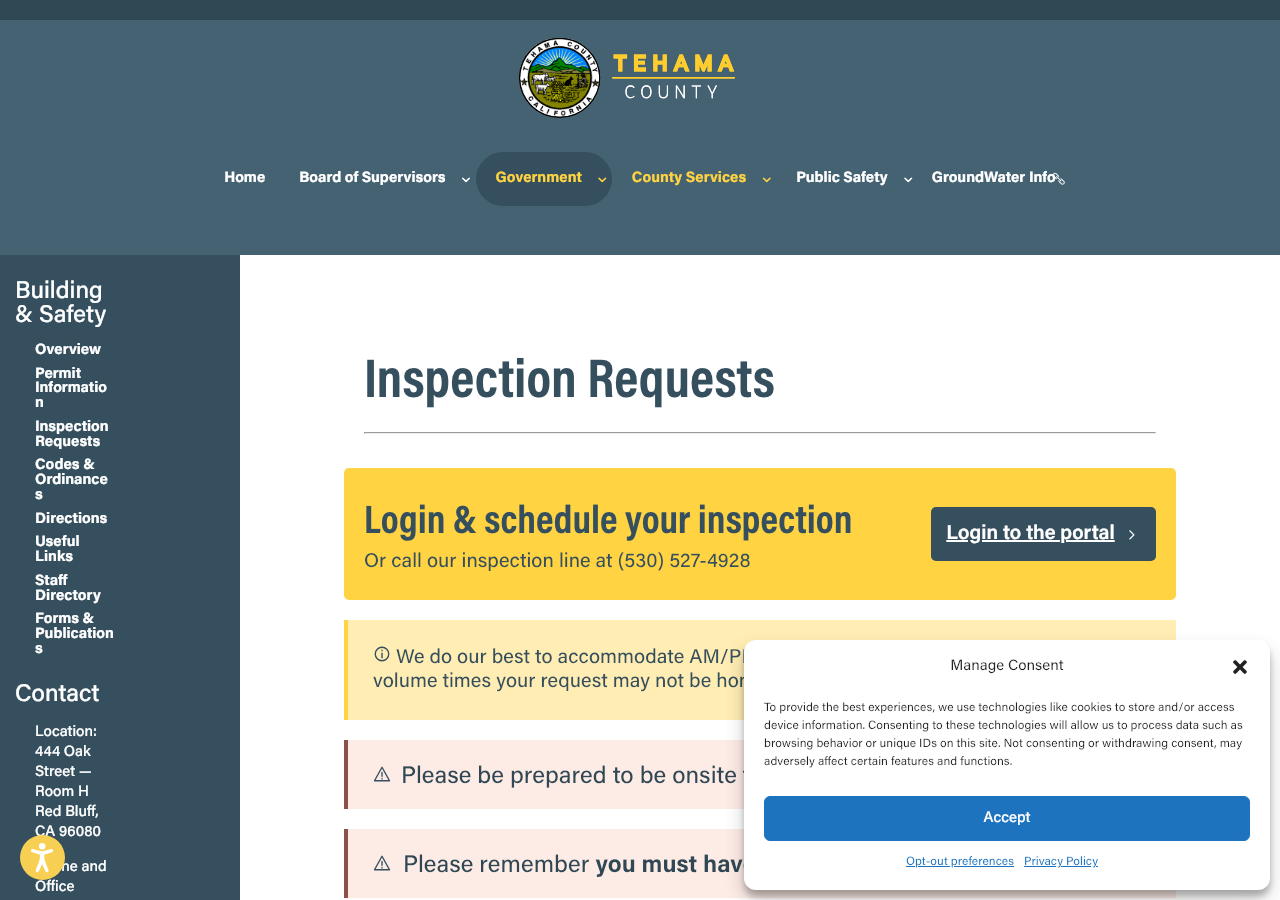
- How is an inspection booked? Portal (login to the ViewPointCloud portal and schedule) or Phone (dedicated inspection line, (530) 527-4928, available 24 hours for requests, separate from the main office line). 90% · department page
- How much notice is required? One business day — inspections must be requested online by 4:00 p.m., or by phone by 4:30 p.m., to be scheduled for the next business day. 90% · department page
- Are same-day or AM/PM windows offered? AM/PM windows are requested-but-not-guaranteed ('We do our best to accommodate AM/PM inspection requests, but during high-volume times your request may not be honored'); no same-day inspections are offered (next-business-day only), and applicants must be on-site by 8:00 a.m. 85% · department page
-
Know who turns up
Some authorities inspect their own solar work; some delegate it, and a few do not inspect the PV equipment itself at all. Who is coming determines what they will look at.
- Does this AHJ perform its own final solar inspection? Yes for building/electrical — Tehama County Building & Safety performs its own final building/electrical inspections in-house; where required, a separate fire final inspection is performed by Tehama County Fire (delegated to CAL FIRE, see Q53). 80% · department page
- If delegated, to whom? Not delegated for building/electrical (performed in-house by county Building & Safety inspectors). The FIRE final inspection is effectively delegated to Tehama County Fire Department, which itself operates under a cooperative agreement with CAL FIRE (Tehama-Glenn Unit) dating to 1927 — CAL FIRE/TCFD staff, not the Building Department, conduct that piece. 80% · fire department page
-
Work the stages in order
A rough-in or mid-roof inspection, where one is required, has to happen before the work it covers is closed up. Missing a stage means opening something back up, and it is the most expensive kind of correction.
- Which inspections are required, and in what order? Per Ch. 15.60.040(e), an eligible small residential rooftop PV system draws only ONE timely inspection by Building & Safety staff, 'excepting a separate fire inspection if necessary.' Where a fire final is required, TCFD's own handout is explicit about order: 'MUST SCHEDULE & PASS FIRE DEPT. FINAL INSPECTION, PRIOR TO BUILDING DEPT. FINAL.' 85% · fire district handout
- Is a rough-in or mid-roof inspection required? No, generally — for systems eligible under the Ch. 15.60 streamlined process, only a single final inspection is required (plus a fire final if referred); a rough-in/mid-roof inspection is not called for expedited small systems. Larger, non-expedited systems would fall back to the county's standard multi-stage electrical-inspection process, which is not separately documented for solar. 62% · ordinance
-
Have the paperwork on site
The approved plan set, the permit, and the equipment listings should be on site and reachable. Inspectors routinely verify that installed equipment matches what was approved, and that the labels are the ones the plan set promised.
- What must be on site at inspection? A complete set of county-approved plans, the pink permit card, supporting calculations, and the yellow inspection card must all be on site between 8:00 a.m. and 5:00 p.m. the day of the scheduled inspection; an orange 'Job Site' card must also be posted, visible from the nearest maintained road (no more than 25 ft from the road). 90% · department policy document
- Does the inspector verify labels and listings? Presumed yes as a matter of ordinary code-enforcement practice under the adopted CEC (listing/labeling verification is a routine field-inspection duty), but no county document states this explicitly for solar. 50% · ordinance
-
Sign-off, and permission to operate
Passing gives you a final or an equivalent sign-off. That is not the same as permission to operate: PTO comes from the utility, and who tells the utility the inspection passed varies. A system left switched off for weeks is usually waiting on this handover.
- What is issued on pass? Final (a signed-off final inspection / yellow inspection card cleared); no distinct 'green tag' or 'Certificate of Occupancy' terminology was found for a solar-only permit. 60% · department policy document
- Who notifies the utility for PTO? The installer/applicant — PG&E's own process requires the applicant to obtain the AHJ's permit and final inspection clearance and provide it to PG&E before PG&E will connect service/grant Permission to Operate; Ch. 15.60.040(f) also states county approval 'does not authorize an applicant to connect ... to the local utility provider's electricity grid. The applicant is responsible for obtaining such approval or permission from the local utility provider.' 65% · ordinance
- Is there a re-inspection fee? $166.15 (re-inspection fee, assessed if a scheduled inspection is not cancelled by 7:30 a.m. the day of, or a correction notice's items are not corrected before a re-inspection is requested). 90% · department policy document
- How are corrections issued and cleared? A written correction notice is left at the job site detailing all deficiencies; the permit holder must correct every listed item and then call in for a re-inspection before proceeding further with the project, having the correction notice available on-site for the inspector to review. 88% · department policy document
14 questions answered against Tehama County’s own published documents
Q49 How is an inspection booked? Core Booking & scheduling
Portal (login to the ViewPointCloud portal and schedule) or Phone (dedicated inspection line, (530) 527-4928, available 24 hours for requests, separate from the main office line).
Why the confidence is not higherInspection Requests page: 'Login & schedule your inspection — Or call our inspection line at (530) 527-4928 — Login to the portal.'
department page checked 2026-08-30 https://www.tehama.gov/government/departments/building-and-safety/inspection-requests/
Q50 How much notice is required? Core Booking & scheduling
One business day — inspections must be requested online by 4:00 p.m., or by phone by 4:30 p.m., to be scheduled for the next business day.
Why the confidence is not higherInspection Requests page: 'You must schedule your inspection online before 4:00 p.m. — or by phone before 4:30 p.m. — to have your inspection the next business day.'
department page checked 2026-08-30 https://www.tehama.gov/government/departments/building-and-safety/inspection-requests/
Q51 Are same-day or AM/PM windows offered? Booking & scheduling
AM/PM windows are requested-but-not-guaranteed ('We do our best to accommodate AM/PM inspection requests, but during high-volume times your request may not be honored'); no same-day inspections are offered (next-business-day only), and applicants must be on-site by 8:00 a.m.
Why the confidence is not higherInspection Requests page, exact quoted language above plus 'Please be prepared to be onsite for your inspection by 8:00 a.m.'
department page checked 2026-08-30 https://www.tehama.gov/government/departments/building-and-safety/inspection-requests/
Q52 Does this AHJ perform its own final solar inspection? Core Who inspects
Yes for building/electrical — Tehama County Building & Safety performs its own final building/electrical inspections in-house; where required, a separate fire final inspection is performed by Tehama County Fire (delegated to CAL FIRE, see Q53).
Why the confidence is not higherInspection Requests / Building & Safety pages describe the county's own inspection line and process; TCFD Residential Development Requirements confirms a distinct fire-department final is required in addition.
department page checked 2026-08-30 https://www.tehama.gov/government/departments/building-and-safety/inspection-requests/
Q53 If delegated, to whom? Core Who inspects
Not delegated for building/electrical (performed in-house by county Building & Safety inspectors). The FIRE final inspection is effectively delegated to Tehama County Fire Department, which itself operates under a cooperative agreement with CAL FIRE (Tehama-Glenn Unit) dating to 1927 — CAL FIRE/TCFD staff, not the Building Department, conduct that piece.
Why the confidence is not higherTehama County Fire Department homepage: 'The TCFD has had a cooperative agreement with CAL FIRE since 1927 to manage and provide all-risk fire and emergency medical services to the unincorporated areas of Tehama County.'
fire department page checked 2026-08-30 https://www.tehamacountyfire.org/
Q54 Which inspections are required, and in what order? Core Stages & sequence
Per Ch. 15.60.040(e), an eligible small residential rooftop PV system draws only ONE timely inspection by Building & Safety staff, 'excepting a separate fire inspection if necessary.' Where a fire final is required, TCFD's own handout is explicit about order: 'MUST SCHEDULE & PASS FIRE DEPT. FINAL INSPECTION, PRIOR TO BUILDING DEPT. FINAL.'
Why the confidence is not higherCh. 15.60.040(e) of Ord. No. 2150; TCFD 'Residential Development Requirements' handout (dated 29 Dec 2025).
fire district handout checked 2026-08-30 https://www.tehamacountyfire.org/wp-content/uploads/2025/12/Residental-Development-Requirements-tehama-county-fire.pdf
Q55 Is a rough-in or mid-roof inspection required? Stages & sequence
No, generally — for systems eligible under the Ch. 15.60 streamlined process, only a single final inspection is required (plus a fire final if referred); a rough-in/mid-roof inspection is not called for expedited small systems. Larger, non-expedited systems would fall back to the county's standard multi-stage electrical-inspection process, which is not separately documented for solar.
Why the confidence is not higherCh. 15.60.040(e) ('Only one, timely, inspection shall be required and performed by staff for small residential rooftop solar energy systems eligible for expedited review...').
ordinance checked 2026-08-30 https://tehamacounty.legistar.com/View.ashx?M=F&ID=15003879&GUID=C5732D70-975B-43D7-9E52-8272B52F5A24
Q56 Does the inspector verify labels and listings? Core What is checked
Presumed yes as a matter of ordinary code-enforcement practice under the adopted CEC (listing/labeling verification is a routine field-inspection duty), but no county document states this explicitly for solar.
Why the confidence is not higherNo document was found stating this directly; inferred from the county's wholesale CEC adoption (Ch. 15.20.030) and general inspection practice.
ordinance checked 2026-08-30 https://tehamacounty.legistar.com/View.ashx?M=F&ID=15003879&GUID=C5732D70-975B-43D7-9E52-8272B52F5A24
Q57 Is there a published inspection checklist? Core What is checked
Nothing published by this authority.
Where we lookedChecked the full Forms & Publications page (every item listed, categorized Applications/ADA/Manufactured Homes/Roofing/Other/Energy Compliance) and the Inspection Requests page — the only inspection-related publication is the generic, procedural 'Inspection Policy' (site-access/job-card rules), not an itemized PV/solar inspection checklist.
https://www.tehama.gov/government/departments/building-and-safety/building-forms/
Q58 What must be on site at inspection? Core Documents on site
A complete set of county-approved plans, the pink permit card, supporting calculations, and the yellow inspection card must all be on site between 8:00 a.m. and 5:00 p.m. the day of the scheduled inspection; an orange 'Job Site' card must also be posted, visible from the nearest maintained road (no more than 25 ft from the road).
Why the confidence is not higherInspection Policy PDF (Tehama County Building & Safety), items 1–2, verbatim.
department policy document checked 2026-08-30 https://www.tehama.gov/wp-content/uploads/2026/02/Inspection-Policy.pdf
Q59 Is there a re-inspection fee? Corrections & re-inspection
$166.15 (re-inspection fee, assessed if a scheduled inspection is not cancelled by 7:30 a.m. the day of, or a correction notice's items are not corrected before a re-inspection is requested).
Why the confidence is not higherInspection Policy PDF: 'Failure to comply with any item above shall require the permit holder to pay a re-inspection of $166.15.' Matches Ord. No. 1918 Table A Code 112 'Reinspection Fee (except overtime) $166.15.'
department policy document checked 2026-08-30 https://www.tehama.gov/wp-content/uploads/2026/02/Inspection-Policy.pdf
Q60 How are corrections issued and cleared? Corrections & re-inspection
A written correction notice is left at the job site detailing all deficiencies; the permit holder must correct every listed item and then call in for a re-inspection before proceeding further with the project, having the correction notice available on-site for the inspector to review.
Why the confidence is not higherInspection Policy PDF, item 4.
department policy document checked 2026-08-30 https://www.tehama.gov/wp-content/uploads/2026/02/Inspection-Policy.pdf
Q61 What is issued on pass? Core Final sign-off & PTO
Final (a signed-off final inspection / yellow inspection card cleared); no distinct 'green tag' or 'Certificate of Occupancy' terminology was found for a solar-only permit.
Why the confidence is not higherInferred from the Inspection Policy's yellow-inspection-card system and Ch. 15.60.040(f) ('staff shall administratively approve the application and issue all required permits or authorizations') — no document names the specific paper issued at final.
department policy document checked 2026-08-30 https://www.tehama.gov/wp-content/uploads/2026/02/Inspection-Policy.pdf
Q62 Who notifies the utility for PTO? Core Final sign-off & PTO
The installer/applicant — PG&E's own process requires the applicant to obtain the AHJ's permit and final inspection clearance and provide it to PG&E before PG&E will connect service/grant Permission to Operate; Ch. 15.60.040(f) also states county approval 'does not authorize an applicant to connect ... to the local utility provider's electricity grid. The applicant is responsible for obtaining such approval or permission from the local utility provider.'
Why the confidence is not higherCh. 15.60.040(f), Ord. No. 2150, combined with PG&E Greenbook §1.11 (permits/final inspections required before PG&E establishes service).
ordinance checked 2026-08-30 https://tehamacounty.legistar.com/View.ashx?M=F&ID=15003879&GUID=C5732D70-975B-43D7-9E52-8272B52F5A24
Lines marked with a percentage were read off this authority’s own published documents. Unmarked guidance is general good practice, not this jurisdiction’s rule — always confirm against the authority before you submit.
Jurisdiction & key facts
The standing 62-question set, answered for Tehama County against this authority’s own published documents. Every answer carries the confidence it was recorded at and the document it came from. Where nothing is published we say so and show where we looked — a blank here is a finding, not a gap.
Tehama County is the authority having jurisdiction 88% confidence
- Holds
- Building AND Electrical, but ONLY for unincorporated Tehama County. The incorporated cities of Red Bluff and Corning, and the town of Tehama, are separate AHJs with their own building departments and permits — Tehama County Building & Safety has no jurisdiction inside those city limits. Within unincorporated territory, fire plan review/inspection is carried out by Tehama County Fire Department under a 1927 cooperative agreement with CAL FIRE (Tehama-Glenn Unit), not by the Building Department itself.
- Overridden by
- Fire sign-off gates the building final: TCFD's own handout states the applicant 'MUST SCHEDULE & PASS FIRE DEPT. FINAL INSPECTION, PRIOR TO BUILDING DEPT. FINAL.' Separately, PG&E (the interconnecting utility) will not energize/connect service until the AHJ's permit and final inspection are complete (PG&E Greenbook §1.11, Electric Rule 11/16) — utility PTO is sequenced strictly after AHJ sign-off.
- Why not higher
- County Building & Safety department page defines its own scope (building + electrical) and lists the county's incorporated cities as having their own departments; TCFD's Residential Development Requirements handout and PG&E's Greenbook both independently confirm the sequencing described above.
https://www.tehama.gov/government/departments/building-and-safety/
Check the code edition before you build
This authority's published code edition does not match what the state has adopted. That usually means the authority's ordinance has not been updated for the current cycle — but a local amendment can also be lawful. Confirm with the building department before you submit.
- Permit required
- Yes — a permit is required for residential rooftop PV in unincorporated Tehama County.95%
- Permit cost
- $400.95 flat, County Electrical Permit Code 566 'Solar Photovoltaic System,' charged per inverter (this figure bundles 30 minutes of plan check plus support/travel/inspection time,70%
- Portal
- ViewPointCloud (tehamacountyca.viewpointcloud.com).92%
- Electrical code
- As adopted, Tehama County Code §15.20.030 (Ord. No. 2150, the county's Nov 2025 'Code Cycle 2025' readoption) still reads: '...incorporating the National Electrical Code,45%
- Own placard wording
- No — the county ordinance itself does not specify placard wording; it defers to the CEC and (for the utility side) to PG&E's Greenbook,65%
- Booking an inspection
- Portal (login to the ViewPointCloud portal and schedule) or Phone (dedicated inspection line, (530) 527-4928, available 24 hours for requests, separate from the main office line).90%
Labels & placards for this authority
Wording 65%
No — the county ordinance itself does not specify placard wording; it defers to the CEC and (for the utility side) to PG&E's Greenbook, which does specify wording ('an alternative source of generation is interconnected' / line-side connection warning).
Size, colour & material 60%
The county specifies letter height/material only for site-ADDRESS signage (min. 4-inch letters, 1/2-inch stroke, reflectorized — TCFD Residential Development Requirements), not for PV service-equipment placards specifically; no county document sets letter height/colour/material for the PV placard itself.
Where they go 88%
At the electric meter panel — DG interconnection signage is affixed to the meter panel itself; if the AC disconnect switch is located more than 10 feet from, or out of line of sight of, the meter panel, PG&E additionally requires signage/maps at the meter panel pointing to the disconnect's location.
What the utility wants on top 90%
Yes — PG&E's Greenbook requires permanent signage on the meter panel stating that an alternative generation source (solar/wind/battery) is interconnected, plus additional signage/maps at the meter panel if the AC disconnect is more than 10 feet away and out of line of sight; a fusible line-side disconnect additionally requires an engraved placard warning of the line/supply-side connection.
Each figure above is sourced and dated in the full answer set below (questions 38–43). Where an authority’s own published sheet is older than the code it has adopted, the answer says so.
Their website
Average approval time — application to PTO
From the CPUC interconnection record. Bars show the average days taken each year; a year with no recorded projects is left blank rather than drawn as zero.