
Town of Apple Valley
San Bernardino County
Town of Apple Valley is a city authority in the State of California, serving 75,791 residents. 8,737 residential solar installs are on record here. This page is the permit route for that jurisdiction: the fifteen steps from working out who has a say over an address through to permission to operate, the documents this authority publishes, and 62 answers taken from those documents and dated.
Permitting 5 steps · 28 questions
Whether a permit is needed — Yes Q3 Electrical and building permits — Combined -- the fee schedule's Solar Energy (Photovoltaic) section prices a single 'Permit and Plan Review for a Single Family Residence' line ($432.48) rather than… Q4 Where you file — A branded 'Permit Center' portal at applevalley.cts.city, built on the '84works' permitting platform (login-gated; Q20
- Permit required
- Yes95% source
- What it costs
- $432.48 flat (Photovoltaic Systems for Single Family Residential Permit and Plan Review)85% source
- Key document
- fee schedule cited by 5 open the document
-
Confirm who has a say over your address
A city address is usually permitted by the city, not the county — but not always, and some authorities keep building and hand electrical to someone else. Getting this wrong costs the whole submittal, because every requirement below belongs to whoever actually holds jurisdiction. Check the overlays in the same pass: an HOA, a historic district, a windstorm certification or a system-size cap can reshape the design, and all of them are cheaper to find now than after the array is laid out.
- Is this authority the AHJ for residential solar at this address? Yes 90% · department page
- What does this authority permit itself, and what does it delegate? Both (Building and Electrical) -- retained by the Town's Building & Safety / Permit Center. Fire-code enforcement (including the annual Battery Energy Storage System operational permit) is delegated to the independent Apple Valley Fire Protection District, a separate special district, not a Town department. 82% · department page
- Is a permit required for a residential rooftop PV system? Yes 95% · fee schedule
- Is there a separate electrical permit, or is it combined? Combined -- the fee schedule's Solar Energy (Photovoltaic) section prices a single 'Permit and Plan Review for a Single Family Residence' line ($432.48) rather than listing a separate electrical permit fee for the PV system; the schedule's stand-alone Electrical Permit Fees section appears to govern non-solar electrical work. 55% · fee schedule
- Is a HOA or architectural approval required first? No -- not required as part of the Town's own permitting process. Under California Civil Code §714 (Solar Rights Act), an HOA/CC&R may not effectively prohibit installation of a solar energy system on a homeowner's property and may only impose reasonable, cost-neutral restrictions; no evidence was found that the Town's own permit process makes HOA sign-off a submittal prerequisite. 60% · state statute
- Is there a historic-district review? No 55% · site search (self-controlled)
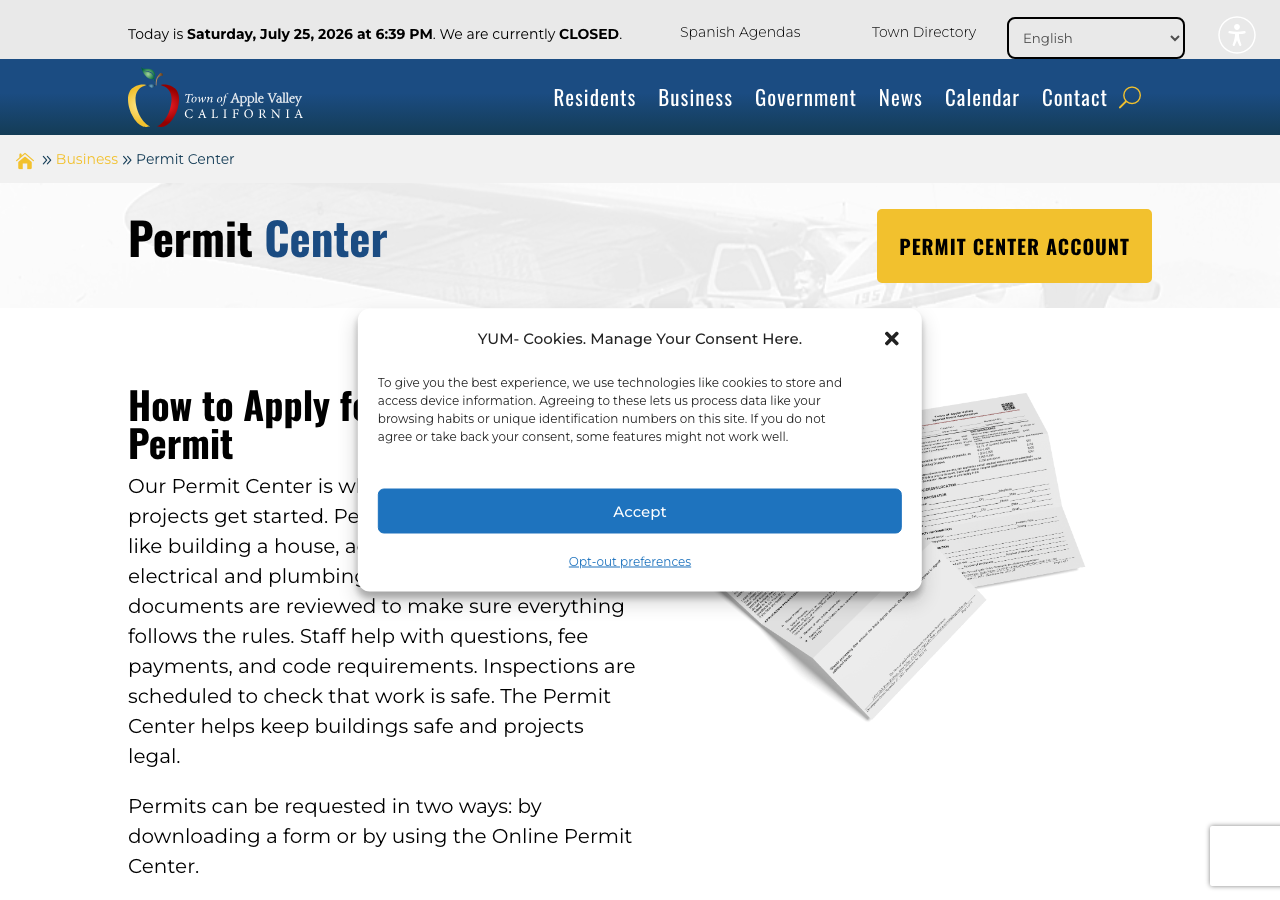
- Is a wind or windstorm certification required? No 50% · site search (self-controlled)
-
Check who is allowed to apply
Several authorities require the electrical permit to be pulled by a licensed electrician, or require the contractor to be registered with them BEFORE applying. Registration is not same-day. This is second on the list rather than fourth because it is the step most likely to stop the job before the drawings matter.
- Who is allowed to pull the electrical permit? Either -- a C-10 electrical or C-46 solar licensed contractor typically pulls the permit, but the Town's own site indexes an 'Owner-Builder Packet' among its permit-center documents, indicating the Town accepts owner-builder (homeowner) self-permitting consistent with the statewide CSLB owner-builder exemption. 50% · department page (title only; linked document unreachable)
- Is a homeowner permitted to self-install and self-permit? Yes 50% · department page (title only; linked document unreachable)
-
Build the submittal package
Almost everywhere wants a site plan, a one-line or three-line electrical diagram, equipment cut sheets with listings, and a structural attachment detail. Build it against the published checklist rather than the last jurisdiction you worked in — the checklist is what the reviewer marks against.
Nothing recorded for Town of Apple Valley on this step yet — 7 questions checked and found unpublished. The guidance above is general.
-
Apply and pay
Most authorities now take the whole application through a portal, and several states cap or constrain what a residential solar permit may cost. Check whether plan check is billed separately before you quote the job.
- Which permit portal does this authority use? A branded 'Permit Center' portal at applevalley.cts.city, built on the '84works' permitting platform (login-gated; site config confirms appName 'Permit Center', commonHooksetName '84works'). 75% · portal landing page
- What does a residential solar permit cost? $432.48 flat (Photovoltaic Systems for Single Family Residential Permit and Plan Review) 85% · fee schedule
- How is the fee calculated? Flat 80% · fee schedule
- Is there a separate plan-check fee? No -- the $432.48 residential PV fee is labelled 'Permit and Plan Review' as a single combined figure, not itemized separately. Note a general 'Permit Issuance Fee' of $121.29 may apply on top of any Electrical/Mechanical/Plumbing/Solar permit per the schedule's Miscellaneous Permit Fees section. 65% · fee schedule
-
Plan review — and start the utility in parallel
Interconnection is a separate process from the permit and usually the longer pole. Where the utility does not depend on the permit being issued, running both at once is the single biggest saving available on a residential job.
- Which utility handles interconnection here? Southern California Edison (SCE) 95% · utility/CCA FAQ (authority-adjacent, town-sponsored entity)
28 questions answered against Town of Apple Valley’s own published documents
Q1 Is this authority the AHJ for residential solar at this address? Core Jurisdiction & scope
Yes
Why the confidence is not higherTown's Permit Center page lists Building Permit and Electrical Permit as permit types issued directly by the Town, and the Town's own fee schedule prices a residential Solar/PV permit; the Town, not San Bernardino County, is the AHJ for residential rooftop PV at addresses within Town limits.
department page checked 2026-08-30 https://applevalley.org/business/permit-center/
Q2 What does this authority permit itself, and what does it delegate? Core Jurisdiction & scope
Both (Building and Electrical) -- retained by the Town's Building & Safety / Permit Center. Fire-code enforcement (including the annual Battery Energy Storage System operational permit) is delegated to the independent Apple Valley Fire Protection District, a separate special district, not a Town department.
Why the confidence is not higherPermit Center page names Building Permit and Electrical Permit as Town-issued permit types; applevalley.org/public-safety/ links to the separately governed avfpd.org rather than a Town fire department page.
department page checked 2026-08-30 https://applevalley.org/business/permit-center/
Q3 Is a permit required for a residential rooftop PV system? Core Jurisdiction & scope
Yes
Why the confidence is not higherThe Town's Municipal Fee Schedule (adopted 26 Sep 2023) contains a section titled 'ACTIVE SOLAR & PHOTOVOLTAIC ENERGY PERMIT FEES' stating 'Any person filing an application for a permit to do solar energy work shall pay a fee according to the following schedule, at the time of filing,' with a specific line for 'Photovoltaic Systems for Single Family Residential Permit and Plan Review.'
fee schedule checked 2026-08-30 https://applevalley.org/wp-content/uploads/2025/07/Muni-Fees-Report-for-Posting.pdf
Q4 Is there a separate electrical permit, or is it combined? Core Jurisdiction & scope
Combined -- the fee schedule's Solar Energy (Photovoltaic) section prices a single 'Permit and Plan Review for a Single Family Residence' line ($432.48) rather than listing a separate electrical permit fee for the PV system; the schedule's stand-alone Electrical Permit Fees section appears to govern non-solar electrical work.
Why the confidence is not higherInferred from the fee schedule's structure -- the solar section bundles 'permit and plan review' into one fee -- but no Town document explicitly states whether a separate electrical permit application/inspection record is still opened alongside it.
fee schedule checked 2026-08-30 https://applevalley.org/wp-content/uploads/2025/07/Muni-Fees-Report-for-Posting.pdf
Q5 Who is allowed to pull the electrical permit? Core Who may apply
Either -- a C-10 electrical or C-46 solar licensed contractor typically pulls the permit, but the Town's own site indexes an 'Owner-Builder Packet' among its permit-center documents, indicating the Town accepts owner-builder (homeowner) self-permitting consistent with the statewide CSLB owner-builder exemption.
Why the confidence is not higherThe underlying Owner-Builder Packet PDF link on the Town's site is broken (returns only an unrelated town-events PDF), so only the document's title/existence -- not its content or scope -- could be confirmed; no Town-specific statement was found restricting who may pull the electrical permit for solar work specifically.
department page (title only; linked document unreachable) checked 2026-08-30 https://applevalley.org/old-document/owner-builder-packet/
Q6 Must the contractor be registered with this authority before applying? Core Who may apply
Nothing published by this authority.
Where we lookedPermit Center page, Business License page (applevalley.org/business/business-license/) -- neither states a pre-registration requirement for contractors before pulling a permit; wp-json site search for 'contractor+license' returns only the general Business License page with no permit-linkage statement.
Q7 Is a homeowner permitted to self-install and self-permit? Who may apply
Yes
Why the confidence is not higherTown's Permit Center document index lists an 'Owner-Builder Packet,' implying the Town processes owner-builder (homeowner self-permit) applications consistent with the statewide CSLB owner-builder exemption; however the actual PDF is a broken link on the Town's rebuilt site, so scope/conditions could not be confirmed.
department page (title only; linked document unreachable) checked 2026-08-30 https://applevalley.org/old-document/owner-builder-packet/
Q8 What documents make up a complete submittal? Core Submittal package
Nothing published by this authority.
Where we lookedPermit Center page (generic category list only, no actual checklist); 'Design Criteria Checklist' (x2) and 'Owner-Builder Packet' stub pages on applevalley.org -- all confirmed broken (the linked PDF resolves to an unrelated town-events flyer, not the named document); Municipal Fee Schedule preface has no submittal list.
https://applevalley.org/old-document/design-criteria-checklist-2/
Q9 How many copies, and in what format? Submittal package
Nothing published by this authority.
Where we lookedPermit Center page and portal login page (applevalley.cts.city) -- no public statement on number of copies/format found; portal is behind a login wall.
Q10 Is a site plan required, and what must it show? Core Submittal package
Nothing published by this authority.
Where we lookedSite-search control run: 'checklist' (4 real hits, e.g. Design Criteria Checklist, EV Charging Station checklist) and 'zzqqx' (0 hits) both behave correctly, confirming the search itself works; 'site plan' specifics for PV were not separately locatable and the linked checklist PDFs are broken stub pages.
https://applevalley.org/wp-json/wp/v2/search?search=checklist
Q11 Is a one-line / three-line diagram required? Core Drawings & calculations
Nothing published by this authority.
Where we lookedSite search for 'one-line' returns 0 results (positive control 'electrical' returns 3 real hits, fabricated control 'zzqqx' returns 0 -- search is functioning); no Town document states a one-line/three-line diagram requirement.
https://applevalley.org/wp-json/wp/v2/search?search=one-line
Q12 Are string and conductor calculations required? Drawings & calculations
Nothing published by this authority.
Where we lookedSame controlled site-search pass as Q11; no page or document addresses string/conductor calculations.
https://applevalley.org/wp-json/wp/v2/search?search=one-line
Q13 Is a structural PE stamp required, and at what threshold? Core Engineering & stamps
Nothing published by this authority.
Where we lookedMunicipal Fee Schedule (no PE-stamp threshold stated) and site search for 'engineer'/'structural' terms not indexed to any relevant permit-requirements page; municode (Title 15) unreachable.
https://applevalley.org/wp-content/uploads/2025/07/Muni-Fees-Report-for-Posting.pdf
Q14 Is an electrical PE stamp required, and at what threshold? Engineering & stamps
Nothing published by this authority.
Where we lookedSame as Q13 -- no electrical PE-stamp threshold found in the fee schedule or any reachable Town page.
https://applevalley.org/wp-content/uploads/2025/07/Muni-Fees-Report-for-Posting.pdf
Q15 What does a residential solar permit cost? Core Fees
$432.48 flat (Photovoltaic Systems for Single Family Residential Permit and Plan Review)
Why the confidence is not higherDirectly stated in the Town's Municipal Fee Schedule PDF, Solar Energy (Photovoltaic) Permit Fees section, item 2(B). The document is dated/adopted 26 Sep 2023 (FY2023-24) and is still the only fee schedule linked from the Town's site as of the check date -- no newer schedule was found via the site's own search (fee-schedule search returns only this document), so it is treated as currently in force but the 2023 adoption date caps confidence.
fee schedule checked 2026-08-30 https://applevalley.org/wp-content/uploads/2025/07/Muni-Fees-Report-for-Posting.pdf
Q16 How is the fee calculated? Core Fees
Flat
Why the confidence is not higherThe solar/PV permit-and-plan-review fee for a single-family residence is stated as a flat dollar figure ($432.48), distinct from the schedule's valuation-based and per-square-foot methods used for general building/electrical work.
fee schedule checked 2026-08-30 https://applevalley.org/wp-content/uploads/2025/07/Muni-Fees-Report-for-Posting.pdf
Q17 Is there a separate plan-check fee? Fees
No -- the $432.48 residential PV fee is labelled 'Permit and Plan Review' as a single combined figure, not itemized separately. Note a general 'Permit Issuance Fee' of $121.29 may apply on top of any Electrical/Mechanical/Plumbing/Solar permit per the schedule's Miscellaneous Permit Fees section.
Why the confidence is not higherFee schedule states the PV permit-and-plan-review fee as one number, but a separate Miscellaneous section says a $121.29 'Permit Issuance Fee' applies 'in addition to the fees prescribed in the Electric, Mechanical, Plumbing and Solar energy schedules for each permit on a single application form,' creating some ambiguity about total out-of-pocket cost.
fee schedule checked 2026-08-30 https://applevalley.org/wp-content/uploads/2025/07/Muni-Fees-Report-for-Posting.pdf
Q18 What is the stated plan-review turnaround? Core Timeline & validity
Nothing published by this authority.
Where we lookedPermit Center page (no turnaround time stated); portal (applevalley.cts.city) is login-gated so any published SLA behind it could not be checked.
Q19 How long is an issued permit valid before it expires? Timeline & validity
Nothing published by this authority.
Where we lookedMunicipal Fee Schedule and Permit Center page -- neither states a permit-validity/expiration period for solar or general building permits; municode (where a Title 15 expiration clause would ordinarily sit) is an empty Angular shell to curl and to the 8 Oct 2025 Wayback capture.
https://library.municode.com/ca/apple_valley/codes/code_of_ordinances
Q20 Which permit portal does this authority use? Core Portal & process
A branded 'Permit Center' portal at applevalley.cts.city, built on the '84works' permitting platform (login-gated; site config confirms appName 'Permit Center', commonHooksetName '84works').
Why the confidence is not higherThe Town's Permit Center page links a button labelled 'Permit Center Account' to https://applevalley.cts.city/#/login; fetching the portal's own /site JSON schema confirms the platform identity ('84works') though it is otherwise behind a login wall.
portal landing page checked 2026-08-30 https://applevalley.org/business/permit-center/
Q21 Can the whole application be completed online? Core Portal & process
Nothing published by this authority.
Where we lookedPermit Center page states permits 'can be requested in two ways: by downloading a form or by using the Online Permit Center' but the portal (applevalley.cts.city) requires a login to proceed further, so whether a full solar application (documents, fee payment, plan upload) can be completed end-to-end online could not be confirmed.
Q22 Which utility handles interconnection here? Core Utility interconnection
Southern California Edison (SCE)
Why the confidence is not higherApple Valley Choice Energy (AVCE), the Town's own Community Choice Aggregator, states in its own FAQ: 'SCE continues to deliver the electricity, and provide billing, customer service, power line maintenance and repair. AVCE only replaces the electric generation services.' This directly confirms SCE, not AVCE, is the interconnecting/wires utility, despite AVCE being the default generation provider -- avoiding the PowerToChoose trap of naming the CCA as the utility.
utility/CCA FAQ (authority-adjacent, town-sponsored entity) checked 2026-08-30 https://avchoiceenergy.com/faqs/
Q23 Where does the utility sit in the sequence? Core Utility interconnection
Nothing published by this authority.
Where we lookedSCE Net Energy Metering page and AVCE FAQ -- both describe the NEM/interconnection application process generally but neither states explicitly whether SCE interconnection approval must precede, follow, or run parallel to the Town's building/electrical permit issuance for a residential system.
Q24 Is a HOA or architectural approval required first? Overlays & special cases
No -- not required as part of the Town's own permitting process. Under California Civil Code §714 (Solar Rights Act), an HOA/CC&R may not effectively prohibit installation of a solar energy system on a homeowner's property and may only impose reasonable, cost-neutral restrictions; no evidence was found that the Town's own permit process makes HOA sign-off a submittal prerequisite.
Why the confidence is not higherState-law inference (Civil Code §714) plus absence of any HOA-approval step on the Town's Permit Center/fee-schedule materials; not a Town-specific written policy statement.
state statute checked 2026-08-30 https://leginfo.legislature.ca.gov/faces/codes_displaySection.xhtml?lawCode=CIV§ionNum=714.
Q25 Is there a historic-district review? Overlays & special cases
No
Why the confidence is not higherSite search for 'historic' on applevalley.org returns only CEQA archaeological-resources survey documents (Appendix D items) and general Town-history content, with no historic-district zoning overlay or design-review board found; Apple Valley incorporated in 1988, making a designated historic district unlikely. Not a definitive negative statement from a Town ordinance, since municode access was blocked (see jurisdiction note).
site search (self-controlled) checked 2026-08-30 https://applevalley.org/wp-json/wp/v2/search?search=historic
Q26 Is a wind or windstorm certification required? Overlays & special cases
No
Why the confidence is not higherCalifornia does not operate a windstorm-certification program comparable to the Texas Department of Insurance's WPI-8 process; wind loading is addressed through standard CBC structural design rather than a separate certificate. No Town document was found requiring one, and site search for 'wind' returns no CBC/structural content, only unrelated pages (pet adoption, banner program, etc.).
site search (self-controlled) checked 2026-08-30 https://applevalley.org/wp-json/wp/v2/search?search=wind
Q27 Is a Specific Use Permit or Council approval ever required? Overlays & special cases
Nothing published by this authority.
Where we lookedSite search for 'specific plan' returns only land-use Specific Plan documents (Jess Ranch, North Apple Valley, Apple Valley Village) unrelated to rooftop PV; no Council-approval trigger for residential solar found; municode (where a CUP/SUP threshold would sit) unreachable.
https://applevalley.org/wp-json/wp/v2/search?search=specific+plan
Q28 Is there a system-size cap on residential generation? Overlays & special cases
Nothing published by this authority.
Where we lookedMunicipal Fee Schedule and Permit Center page -- no system-size cap stated; municode (zoning code, where such a cap would typically sit) returns an empty Angular shell to curl and is empty in the closest Wayback capture.
https://library.municode.com/ca/apple_valley/codes/code_of_ordinances
Lines marked with a percentage were read off this authority’s own published documents. Unmarked guidance is general good practice, not this jurisdiction’s rule — always confirm against the authority before you submit.
Install 5 steps · 20 questions
-
Build to the code editions actually in force here
The NEC edition a jurisdiction enforces is often a cycle behind the newest one published, and local amendments sit on top of it. Rapid shutdown, conductor sizing and labelling all change between editions, so the edition in force is the first thing to establish, not the last.
- Which NEC edition is in force? 2023 (inferred: California Electrical Code, Title 24 Part 3, 2025 edition incorporates the 2023 NEC, effective statewide 1 Jan 2026) 45% · inference from a neighbouring AHJ's adopting ordinance
- Which building code edition is in force? 2025 California Building Code (Title 24, Part 2), inferred effective 1 Jan 2026 45% · inference from a neighbouring AHJ's adopting ordinance
- Which fire code edition is in force? 2025 California Fire Code (Title 24, Part 9), with select 2024 International Fire Code appendix chapters (4, B, BB, D, E, F, I, K, N, O) incorporated by reference 95% · adopting ordinance
- Are there local amendments to any of the above? Yes (at the fire-code level) -- AVFPD Ordinance 67 makes numerous local amendments to the 2025 CFC: fire apparatus access road width/grade/surface (§503.2.x, §503.7.x), electric-gate emergency-access hardware (§503.6.1), and premises-identification/address-numbering standards (§505.1, including illuminated-number and setback-triggered secondary numbering rules). None of the amendments found are specific to rooftop PV pathways/setbacks. 75% · adopting ordinance
- What is the installation judged against? The 2025 California Fire Code as locally amended by AVFPD Ordinance 67 (fire-safety aspects); building/electrical aspects inferred to be judged against the 2025 CBC/CEC per the statewide Title 24 cycle, though the Town's own Title 15 text could not be retrieved. 55% · adopting ordinance
-
Fire access, setbacks and pathways
Ridge setbacks and roof access pathways are fire-service requirements and they constrain the array layout. They are the most common cause of a redesign after the fire department comments on a plan set.
Nothing recorded for Town of Apple Valley on this step yet — 1 question checked and found unpublished. The guidance above is general.
-
Rapid shutdown
Which rapid-shutdown rule applies follows directly from the NEC edition in force, and the initiation device has to be at a location the fire service can reach and identify. This is inspected, and it is labelled.
Nothing recorded for Town of Apple Valley on this step yet — 1 question checked and found unpublished. The guidance above is general.
-
Labels and placards
The NEC sets a baseline for permanent markings at the service equipment and the disconnecting means. On top of that, an authority may specify its own wording, and the utility may specify more again. Where any of them writes its own text, a generic off-the-shelf label set will not pass — this is the detail most often fixed on a return visit.
Nothing recorded for Town of Apple Valley on this step yet — 6 questions checked and found unpublished. The guidance above is general.
-
Disconnect, storage and listed equipment
Where the AC disconnect must sit relative to the meter is usually the utility's rule, not the building department's. Battery storage frequently carries its own permit, its own inspection and its own fire conditions.
- Are batteries permitted, and under what conditions? Batteries/ESS are permitted subject to the 2025 California Fire Code as enforced by AVFPD; AVFPD's own fee schedule lists 'Battery System' and 'Battery Energy Storage System' as distinct annual California Fire Code operational-permit line items ($227/year each). 65% · fee schedule (fire district)
- Is there a separate ESS permit or inspection? Yes -- AVFPD charges a separate annual California Fire Code operational permit for 'Battery Energy Storage System' ($227/year), distinct from and in addition to the Town's building/electrical permit for the PV/ESS installation itself. 70% · fee schedule (fire district)
20 questions answered against Town of Apple Valley’s own published documents
Q29 Which NEC edition is in force? Core Code editions in force
2023 (inferred: California Electrical Code, Title 24 Part 3, 2025 edition incorporates the 2023 NEC, effective statewide 1 Jan 2026)
Why the confidence is not higherCould not confirm from a Town-specific adopting ordinance -- municode is an empty Angular shell (confirmed via curl and via the closest Wayback capture, 8 Oct 2025) and the Town's own document links are broken. Inferred from (a) the statewide Title-24 three-year cycle and (b) the fact that the co-located Apple Valley Fire Protection District's own Ordinance No. 67, adopted after public hearings 6 Oct and 17 Nov 2025, formally adopts the '2025 Edition' of the parallel Title 24 Part 9 (Fire Code) -- Title 24 parts are ordinarily triggered on the same statewide effective date. This is inference, not a direct Town citation.
inference from a neighbouring AHJ's adopting ordinance checked 2026-08-30 https://avfpd.org/wp-content/uploads/2025/12/ORDINANCE-67-Fire-Code-Amendments.pdf
Q30 Which building code edition is in force? Core Code editions in force
2025 California Building Code (Title 24, Part 2), inferred effective 1 Jan 2026
Why the confidence is not higherSame basis and same limitation as Q29 -- no Town-specific Title 15 adopting ordinance could be retrieved (municode blocked; Town document links broken); inferred from the statewide Title 24 cycle and AVFPD's parallel 2025 Fire Code adoption.
inference from a neighbouring AHJ's adopting ordinance checked 2026-08-30 https://avfpd.org/wp-content/uploads/2025/12/ORDINANCE-67-Fire-Code-Amendments.pdf
Q31 Which fire code edition is in force? Code editions in force
2025 California Fire Code (Title 24, Part 9), with select 2024 International Fire Code appendix chapters (4, B, BB, D, E, F, I, K, N, O) incorporated by reference
Why the confidence is not higherDirectly stated in Apple Valley Fire Protection District Ordinance No. 67, Section 1: 'a certain document ... being marked and designated as the California Fire Code, 2025 Edition, with errata, together with those portions of the 2024 International Fire Code ... are hereby adopted and declared to be the Fire Code of the Apple Valley Fire Protection District.' Adopted following public hearings 6 Oct and 17 Nov 2025. Note this ordinance is a scanned PDF with no text layer -- extracted via pdftoppm + tesseract OCR, not pdftotext.
adopting ordinance checked 2026-08-30 https://avfpd.org/wp-content/uploads/2025/12/ORDINANCE-67-Fire-Code-Amendments.pdf
Q32 Are there local amendments to any of the above? Core Code editions in force
Yes (at the fire-code level) -- AVFPD Ordinance 67 makes numerous local amendments to the 2025 CFC: fire apparatus access road width/grade/surface (§503.2.x, §503.7.x), electric-gate emergency-access hardware (§503.6.1), and premises-identification/address-numbering standards (§505.1, including illuminated-number and setback-triggered secondary numbering rules). None of the amendments found are specific to rooftop PV pathways/setbacks.
Why the confidence is not higherRead directly from Ordinance 67's amendment sections (OCR'd from a scanned PDF); could not independently confirm whether the Town separately amends the CBC/CEC since Title 15 text was unreachable (municode blocked).
adopting ordinance checked 2026-08-30 https://avfpd.org/wp-content/uploads/2025/12/ORDINANCE-67-Fire-Code-Amendments.pdf
Q33 What is the installation judged against? Core Electrical
The 2025 California Fire Code as locally amended by AVFPD Ordinance 67 (fire-safety aspects); building/electrical aspects inferred to be judged against the 2025 CBC/CEC per the statewide Title 24 cycle, though the Town's own Title 15 text could not be retrieved.
Why the confidence is not higherFire-code portion is a direct primary-source citation; building/electrical portion is inference (see Q29/Q30 limitations).
adopting ordinance checked 2026-08-30 https://avfpd.org/wp-content/uploads/2025/12/ORDINANCE-67-Fire-Code-Amendments.pdf
Q34 Is there a local rule on service upgrades or busbar sizing? Electrical
Nothing published by this authority.
Where we lookedAVFPD Ordinance 67 (OCR'd in full) does not address service upgrades/busbar sizing (that is an electrical/building-code, not fire-code, topic); Town Title 15/CEC amendments unreachable via municode.
https://avfpd.org/wp-content/uploads/2025/12/ORDINANCE-67-Fire-Code-Amendments.pdf
Q35 Is a specific mounting system or attachment spacing required? Structural & mounting
Nothing published by this authority.
Where we lookedSite search and fee schedule -- no mounting-system or attachment-spacing requirement found; municode unreachable.
Q36 What ridge setback and access pathways are required? Core Fire pathways & setbacks
Nothing published by this authority.
Where we lookedAVFPD Ordinance 67 (OCR'd in full, searched for 'setback', 'rooftop', 'access pathway') contains only general fire-apparatus-road and premises-identification amendments, no PV-specific ridge-setback/pathway amendment -- meaning the base (unamended) 2025 CFC/NFPA 1 rooftop-PV-access provisions would apply by default, but no Town or AVFPD document republishes that base-code text for confirmation.
https://avfpd.org/wp-content/uploads/2025/12/ORDINANCE-67-Fire-Code-Amendments.pdf
Q37 Is rapid shutdown required, and to which NEC edition? Core Rapid shutdown
Nothing published by this authority.
Where we lookedSite search for 'rapid+shutdown' returns 0 results (against working positive controls 'electrical'=3, 'fee'=28); no Town or AVFPD document states a rapid-shutdown requirement or ties it to a specific NEC/CEC edition.
https://applevalley.org/wp-json/wp/v2/search?search=rapid+shutdown
Q38 Which placards does this authority require at the service equipment? Core Labels Signage & labelling
Nothing published by this authority.
Where we lookedSite search for 'placard' returns 0 results (positive control 'sign' returns 10 hits, all unrelated Sign-Permit/Sign-Program applications, not solar placards; fabricated control 'zzqqx' returns 0) -- confirms a genuine absence of published placard requirements on the Town's own site. SCE's Interconnection Handbook (on.sce.com/InterconnectionHandbook), which would likely address utility-required placards, redirects through a SharePoint Microsoft-OAuth login wall and could not be reached.
Q39 Does the authority specify placard wording of its own? Core Labels Signage & labelling
Nothing published by this authority.
Where we lookedSame controlled search as Q38 -- no placard-wording requirement published.
Q40 Does it specify letter height, colour or material? Core Labels Signage & labelling
Nothing published by this authority.
Where we lookedSame controlled search as Q38 -- no letter-height/colour/material spec published.
Q41 Is a site plan / facility map placard required, and what must it show? Core Labels Signage & labelling
Nothing published by this authority.
Where we lookedSame controlled search as Q38, plus 'setback' (0 hits) -- no facility-map/site-plan placard spec found.
Q42 Does the UTILITY specify placards beyond the AHJ's? Core Labels Signage & labelling
Nothing published by this authority.
Where we lookedSCE's Interconnection Handbook shortlink (on.sce.com/InterconnectionHandbook) redirects to login.microsoftonline.com (Edison Intl. SharePoint OAuth) -- confirmed via curl redirect chain; the general SCE solar/NEM pages (sce.com/business/smart-energy-solar, .../meter-socket-adapter-program) do not state utility-specific placard requirements beyond the AHJ's.
Q43 Where must the labels be placed? Core Labels Signage & labelling
Nothing published by this authority.
Where we lookedSame as Q42 -- SCE's gated Interconnection Handbook is the likely source for exact label-placement rules; general SCE pages reviewed do not state it.
Q44 Must equipment be on a specific approved list? Equipment listing
Nothing published by this authority.
Where we lookedFee schedule and Permit Center page -- no equipment-listing/approved-list requirement stated (beyond the general expectation of UL/NRTL-listed equipment implicit in code compliance).
Q45 Are batteries permitted, and under what conditions? Core Battery / ESS
Batteries/ESS are permitted subject to the 2025 California Fire Code as enforced by AVFPD; AVFPD's own fee schedule lists 'Battery System' and 'Battery Energy Storage System' as distinct annual California Fire Code operational-permit line items ($227/year each).
Why the confidence is not higherDirectly evidenced by AVFPD Ordinance 68 Exhibit A (Schedule of Fees), item A.4-5, which lists both as CFC operational permits at $227/year. Could not confirm from any Town or AVFPD document whether small residential-scale home-battery systems fall under a size/kWh exemption threshold (as some CFC-adopting jurisdictions carve out) -- OCR'd text of Ordinance 67's amendments did not surface such a threshold.
fee schedule (fire district) checked 2026-08-30 https://avfpd.org/wp-content/uploads/2025/12/ORDINANCE-68-Fees-for-Service.pdf
Q46 Is there a separate ESS permit or inspection? Battery / ESS
Yes -- AVFPD charges a separate annual California Fire Code operational permit for 'Battery Energy Storage System' ($227/year), distinct from and in addition to the Town's building/electrical permit for the PV/ESS installation itself.
Why the confidence is not higherSame primary source as Q45 (Ordinance 68 Exhibit A); this mirrors the pattern flagged in the brief for Napa and San Ramon Valley FPD -- an independent fire district pricing PV/ESS-adjacent review as its own billable line separate from the building AHJ.
fee schedule (fire district) checked 2026-08-30 https://avfpd.org/wp-content/uploads/2025/12/ORDINANCE-68-Fees-for-Service.pdf
Q47 Is a ground mount treated as a structure? Core Ground mount
Nothing published by this authority.
Where we lookedSite search for 'ground+mount' returns 2 irrelevant hits (Youth Scholarship Program, Parks and Recreation) against working positive/fabricated controls elsewhere in this run; municode (zoning/accessory-structure definitions) unreachable.
https://applevalley.org/wp-json/wp/v2/search?search=ground+mount
Q48 Where must the AC disconnect be, relative to the meter? Core Utility equipment
Nothing published by this authority.
Where we lookedSCE's Meter Socket Adapter Program page describes MSA placement generically but does not state a general AC-disconnect-to-meter distance/location rule; the authoritative source (SCE Electric Service Requirements manual / Interconnection Handbook, gated behind on.sce.com/InterconnectionHandbook -> SharePoint OAuth) could not be reached.
Lines marked with a percentage were read off this authority’s own published documents. Unmarked guidance is general good practice, not this jurisdiction’s rule — always confirm against the authority before you submit.
Inspection 5 steps · 14 questions
-
Book it
Booking is a portal, a phone call or an email depending on the authority, and the notice required is rarely zero. Book before the work is finished rather than after — the lead time, not the work, is usually what sets the date.
Nothing recorded for Town of Apple Valley on this step yet — 3 questions checked and found unpublished. The guidance above is general.
-
Know who turns up
Some authorities inspect their own solar work; some delegate it, and a few do not inspect the PV equipment itself at all. Who is coming determines what they will look at.
- Does this AHJ perform its own final solar inspection? Delegated (partially) -- the Town's Building & Safety Division performs its own final building/electrical inspections for residential PV; the independent Apple Valley Fire Protection District separately administers and (by implication of its annual operational-permit fee) inspects Battery Energy Storage Systems under its own program. 60% · department page + fee schedule (fire district)
- If delegated, to whom? Apple Valley Fire Protection District (for the Battery Energy Storage System operational permit/inspection only; building/electrical inspection is retained by the Town itself, not delegated) 55% · department page (fire district)
-
Work the stages in order
A rough-in or mid-roof inspection, where one is required, has to happen before the work it covers is closed up. Missing a stage means opening something back up, and it is the most expensive kind of correction.
Nothing recorded for Town of Apple Valley on this step yet — 2 questions checked and found unpublished. The guidance above is general.
-
Have the paperwork on site
The approved plan set, the permit, and the equipment listings should be on site and reachable. Inspectors routinely verify that installed equipment matches what was approved, and that the labels are the ones the plan set promised.
Nothing recorded for Town of Apple Valley on this step yet — 3 questions checked and found unpublished. The guidance above is general.
-
Sign-off, and permission to operate
Passing gives you a final or an equivalent sign-off. That is not the same as permission to operate: PTO comes from the utility, and who tells the utility the inspection passed varies. A system left switched off for weeks is usually waiting on this handover.
- Who notifies the utility for PTO? Installer 55% · utility page
- Is there a re-inspection fee? $121.29 per inspection 80% · fee schedule
14 questions answered against Town of Apple Valley’s own published documents
Q49 How is an inspection booked? Core Booking & scheduling
Nothing published by this authority.
Where we lookedPermit Center page and portal (applevalley.cts.city, login-gated) -- no public statement on how inspections are booked beyond the general 'Receive Inspections and Approvals' category heading.
Q50 How much notice is required? Core Booking & scheduling
Nothing published by this authority.
Where we lookedSame as Q49 -- no notice period stated.
Q51 Are same-day or AM/PM windows offered? Booking & scheduling
Nothing published by this authority.
Where we lookedSame as Q49 -- no AM/PM or same-day window information published.
Q52 Does this AHJ perform its own final solar inspection? Core Who inspects
Delegated (partially) -- the Town's Building & Safety Division performs its own final building/electrical inspections for residential PV; the independent Apple Valley Fire Protection District separately administers and (by implication of its annual operational-permit fee) inspects Battery Energy Storage Systems under its own program.
Why the confidence is not higherInferred by combining the Town's Permit Center listing (Building/Electrical inspections performed by the Town) with AVFPD's own annual BESS operational-permit fee, which by nature of a CFC operational permit implies an associated inspection; no single Town or AVFPD document states this split explicitly for a residential PV+battery job end to end.
department page + fee schedule (fire district) checked 2026-08-30 https://applevalley.org/business/permit-center/
Q53 If delegated, to whom? Core Who inspects
Apple Valley Fire Protection District (for the Battery Energy Storage System operational permit/inspection only; building/electrical inspection is retained by the Town itself, not delegated)
Why the confidence is not higherSame inference basis as Q52.
department page (fire district) checked 2026-08-30 https://avfpd.org/office-of-the-fire-marshal/
Q54 Which inspections are required, and in what order? Core Stages & sequence
Nothing published by this authority.
Where we lookedPermit Center page lists generic categories (Foundation, Framing, Final, Reinspection) with no solar-specific inspection sequence; municode/adopted code unreachable.
Q55 Is a rough-in or mid-roof inspection required? Stages & sequence
Nothing published by this authority.
Where we lookedSame as Q54 -- no statement on a rough-in/mid-roof inspection for PV.
Q56 Does the inspector verify labels and listings? Core What is checked
Nothing published by this authority.
Where we lookedNo Town or AVFPD document states inspector practice regarding verifying labels/listings at final.
Q57 Is there a published inspection checklist? Core What is checked
Nothing published by this authority.
Where we lookedConfirmed via the site's own broken-link pattern: every checklist-titled page found (Design Criteria Checklist x2, EV Charging Station checklist, Owner-Builder Packet) resolves to a stub with no attached PDF other than an unrelated town-events flyer -- no working published inspection checklist exists at the URLs where the Town's own site indexes one.
https://applevalley.org/old-document/design-criteria-checklist-2/
Q58 What must be on site at inspection? Core Documents on site
Nothing published by this authority.
Where we lookedPermit Center page -- no on-site-documents requirement stated.
Q59 Is there a re-inspection fee? Corrections & re-inspection
$121.29 per inspection
Why the confidence is not higherTown's Municipal Fee Schedule, Miscellaneous/Additional Inspection and Plan Review Charges section: 'Re-inspection Fee Per Inspection ... $121.29.' This is the general Building & Safety re-inspection fee (applies to all trades on a permit, including solar), not a solar-specific line item, and the schedule is dated 2023-24.
fee schedule checked 2026-08-30 https://applevalley.org/wp-content/uploads/2025/07/Muni-Fees-Report-for-Posting.pdf
Q60 How are corrections issued and cleared? Corrections & re-inspection
Nothing published by this authority.
Where we lookedPermit Center page -- no correction/re-inspection process description beyond the fee-schedule dollar amount already captured at Q59.
Q61 What is issued on pass? Core Final sign-off & PTO
Nothing published by this authority.
Where we lookedFee schedule and Permit Center page do not name the specific document/term (CO / Final / Green tag / Letter) issued on a passed final for residential PV.
Q62 Who notifies the utility for PTO? Core Final sign-off & PTO
Installer
Why the confidence is not higherSCE's own Net Energy Metering page states 'Most contractors will apply on your behalf' regarding interconnection/NEM enrollment submissions, and SCE's standard Rule 21 process has the installer/contractor submit the certificate of completion after final inspection to trigger Permission to Operate. No Apple Valley-specific document was found stating who notifies SCE for this Town's permits specifically, so this is drawn from SCE's general customer-facing process rather than a Town or AVCE document.
utility page checked 2026-08-30 https://www.sce.com/clean-energy-efficiency/solar-generating-your-own-power/billing-incentives/net-energy-metering
Lines marked with a percentage were read off this authority’s own published documents. Unmarked guidance is general good practice, not this jurisdiction’s rule — always confirm against the authority before you submit.
Jurisdiction & key facts
The standing 62-question set, answered for Town of Apple Valley against this authority’s own published documents. Every answer carries the confidence it was recorded at and the document it came from. Where nothing is published we say so and show where we looked — a blank here is a finding, not a gap.
Town of Apple Valley is the authority having jurisdiction 85% confidence
- Holds
- Building and Electrical (Town Building & Safety / Permit Center issues Building, Electrical, Plumbing and Mechanical permits, including a dedicated Solar Energy/Photovoltaic permit line in its fee schedule)
- Overridden by
- Fire-code enforcement is held by the independent Apple Valley Fire Protection District (AVFPD), not the Town -- AVFPD is a separate special district (own Board of Directors, own ordinances 63-72, own fee schedule) that adopted the 2025 California Fire Code by its own Ordinance No. 67 (public hearings 6 Oct and 17 Nov 2025) and charges its own annual operational permit for 'Battery System' and 'Battery Energy Storage System' ($227/yr each, Ordinance 68 Exhibit A). AVFPD's 'Fire Letter' requirement (Ordinance 68, $122) is explicitly scoped to 'R-3 Only, in County Area' -- i.e. unincorporated San Bernardino County parcels in AVFPD's district, NOT properties inside Town limits -- so a residential PV permit pulled from the Town does not additionally require that specific AVFPD fire-letter step. Utility interconnection sits with Southern California Edison (SCE), which continues to own/maintain the wires and deliver power even though Apple Valley Choice Energy (AVCE), the Town-sponsored Community Choice Aggregator, supplies default generation and administers the town's own NEM billing-credit program.
- Why not higher
- Town's own Permit Center page (applevalley.org/business/permit-center/) lists Building Permit and Electrical Permit as permit types the Town itself issues, and the Town's FY2023-24 Municipal Fee Schedule (adopted 26 Sep 2023, still the only fee schedule linked on the site as of 30 Aug 2026) contains a dedicated 'ACTIVE SOLAR & PHOTOVOLTAIC ENERGY PERMIT FEES' section, confirming the Town -- not the county -- issues residential PV permits. Separately, applevalley.org/public-safety/ links out to avfpd.org, confirming the Town is served by the independent Apple Valley Fire Protection District rather than a Town fire department or San Bernardino County Fire, matching the brief's High-Desert-independent-fire-district hint. Confidence held at 85 rather than higher because the Town's own site is a recently rebuilt WordPress site in which almost every technical document (checklists, owner-builder packet, design criteria checklists) is a broken/unattached stub link (confirmed by fetching several directly), and library.municode.com/ca/apple_valley/ (the Town's municipal code host) returns an empty Angular shell to both curl and WebFetch, and is still empty in the closest Wayback capture (8 Oct 2025) -- so the Town's own adopting ordinance for Title 15 (Buildings and Construction) could not be independently read.
- Permit required
- Yes95%
- Permit cost
- $432.48 flat (Photovoltaic Systems for Single Family Residential Permit and Plan Review)85%
- Portal
- A branded 'Permit Center' portal at applevalley.cts.city, built on the '84works' permitting platform (login-gated; site config confirms appName 'Permit Center', commonHooksetName '84works').75%
- Electrical code
- 2023 (inferred: California Electrical Code, Title 24 Part 3, 2025 edition incorporates the 2023 NEC, effective statewide 1 Jan 2026)45%
Labels & placards for this authority
Wording None%
Size, colour & material None%
Where they go None%
What the utility wants on top None%
Each figure above is sourced and dated in the full answer set below (questions 38–43). Where an authority’s own published sheet is older than the code it has adopted, the answer says so.
Their website

Average approval time — application to PTO
From the CPUC interconnection record. Bars show the average days taken each year; a year with no recorded projects is left blank rather than drawn as zero.