
Town of Danville
Contra Costa County
Town of Danville is a city authority in the State of California, serving 43,582 residents. 5,828 residential solar installs are on record here. This page is the permit route for that jurisdiction: the fifteen steps from working out who has a say over an address through to permission to operate, the documents this authority publishes, and 62 answers taken from those documents and dated.
Permitting 5 steps · 28 questions
Whether a permit is needed — Yes Q3 Electrical and building permits — Combined Q4 Plan review — Same day for over-the-counter applications, or 1-3 business days for electronic applications, Q18 Where you file — Tyler Technologies EnerGov 'SelfService' portal, reached at danville.ca.gov/CSS (redirects to danvilleca-energovpub.tylerhost.net/Apps/SelfService). Q20
- Permit required
- Yes95% source
- What it costs
- $201.50 flat + $7.44 per kWp of system rating (Fee = A + B*v, A=$201.50, B=$7.44/kWp), for both residential and non-residential photovoltaic systems.95% source
- Plan review turnaround
- Same day for over-the-counter applications, or 1-3 business days for electronic applications, for 'small residential rooftop solar energy systems' (<=10 kW AC / 30 kW thermal) that meet the approved…90% source
- Key document
- published checklist cited by 8 open the document
-
Confirm who has a say over your address
A city address is usually permitted by the city, not the county — but not always, and some authorities keep building and hand electrical to someone else. Getting this wrong costs the whole submittal, because every requirement below belongs to whoever actually holds jurisdiction. Check the overlays in the same pass: an HOA, a historic district, a windstorm certification or a system-size cap can reshape the design, and all of them are cheaper to find now than after the array is laid out.
- Is this authority the AHJ for residential solar at this address? Yes 95% · authority's own page
- What does this authority permit itself, and what does it delegate? Both (Building and Electrical, single combined Building Permit with an electrical sub-permit); fire-code review/inspection of PV and ESS is split out to San Ramon Valley Fire Protection District, an independent special district, which charges its own PV/ESS fee; Contra Costa Central Sanitary District must stamp plans before submittal for any ground-mounted system. 90% · fee schedule
- Is a permit required for a residential rooftop PV system? Yes 95% · published checklist
- Is there a separate electrical permit, or is it combined? Combined 85% · fee schedule
- Is a HOA or architectural approval required first? No. 90% · adopting ordinance
- Is there a historic-district review? No blanket historic-district review for residential rooftop solar. Danville's Heritage Resource program is voluntary and covers only 21 individually Town-designated sites (identified by a brass plaque); if the specific parcel is one of those, the Heritage Resource Commission has a review role, but this is not a general overlay affecting ordinary residential lots. 65% · authority's own page
- Is a wind or windstorm certification required? No. 60% · authority's own document
- Is a Specific Use Permit or Council approval ever required? Yes — a Use Permit can be required (and denied) if the Chief Building Official makes written findings, based on substantial evidence, that the solar system would have a 'specific, adverse impact' on public health/safety; such decisions are appealable to the Planning Commission. 90% · adopting ordinance
- Is there a system-size cap on residential generation? No absolute cap on residential system size, but two size thresholds matter: (1) MC 10-12.1(f) defines 'small residential rooftop solar energy system' — eligible for the ministerial same-day/1-3-day review — as <=10 kW AC nameplate or <=30 kW thermal, installed on a single or duplex dwelling, not exceeding the town's max legal building height; (2) the national SolarAPP+ program the town uses for automated review separately caps eligible systems at <=38.4 kW AC. Larger residential systems remain permittable but go through standard (non-expedited) plan review. 85% · adopting ordinance
-
Check who is allowed to apply
Several authorities require the electrical permit to be pulled by a licensed electrician, or require the contractor to be registered with them BEFORE applying. Registration is not same-day. This is second on the list rather than fourth because it is the step most likely to stop the job before the drawings matter.
- Who is allowed to pull the electrical permit? Licensed contractor for the standard/expedited SolarAPP+ path (national SolarAPP+ program excludes owner-installed systems); a homeowner may pull the permit as owner-builder via the town's standard (non-SolarAPP+) process using the Addendum for Owner/Builders form. 65% · program eligibility page
- Must the contractor be registered with this authority before applying? No town-specific contractor pre-registration requirement found. 60% · authority's own page
- Is a homeowner permitted to self-install and self-permit? Yes for the standard (non-SolarAPP+) permit path via the town's Owner/Builder Addendum; No for the SolarAPP+ automated path, which the program itself excludes owner-installed systems from. 65% · authority's own page
-
Build the submittal package
Almost everywhere wants a site plan, a one-line or three-line electrical diagram, equipment cut sheets with listings, and a structural attachment detail. Build it against the published checklist rather than the last jurisdiction you worked in — the checklist is what the reviewer marks against.
- What documents make up a complete submittal? Per the town's 'Photovoltaic Systems Submittal Requirements' (ID 782, rev 12/15/2025): drawings (plot plan, electrical plans, structural plans stamped/signed, and for ground-mount 2 sets stamped by Contra Costa Central Sanitary District) plus supporting documents (manufacturer spec sheets/installation instructions for modules, inverters, disconnects, transformers, batteries, generators, mounting systems; structural calculations if weight >5 psf or ground-mounted). 95% · published checklist
- How many copies, and in what format? Drawings: 2 sets, 11x17 in. minimum up to 24x36 in. maximum, for in-person submittal (sheet-size rule applies to electronic submittals too). Supporting documents: 2 sets, 8.5x11 in. minimum. 95% · published checklist
- Is a site plan required, and what must it show? Yes. Plot plan must show: lot dimensions (metes and bounds), footprint of all existing/proposed buildings with dimensions to property lines and between buildings, north arrow and scale, visible utility to curb, easements, and the location/species/variety/trunk size and canopy/dripline of all trees. 95% · published checklist
- Is a one-line / three-line diagram required? Yes. 90% · published checklist
- Are string and conductor calculations required? Yes, as data shown on the required electrical line diagram (modules per string, conductor/conduit type and size, breaker sizes) rather than as a separate stand-alone calculation packet; structural calculations are separately required (signed/stamped) when system weight exceeds 5 psf or the system is ground-mounted. 70% · published checklist
- Is a structural PE stamp required, and at what threshold? Yes, always required (stamped and signed structural plans are listed as a base drawing requirement for every PV submittal), and stamped structural CALCULATIONS are specifically required once total system weight exceeds 5 lb/sq ft, or whenever the system is ground-mounted. 90% · published checklist
- Is an electrical PE stamp required, and at what threshold? Not specified — the submittal checklist requires stamped/signed structural plans and (conditionally) structural calculations, but does not name an electrical PE stamp or a threshold that would trigger one; electrical drawings are only required to be prepared to code (CEC Article 690), not stamped by a PE. 60% · published checklist
-
Apply and pay
Most authorities now take the whole application through a portal, and several states cap or constrain what a residential solar permit may cost. Check whether plan check is billed separately before you quote the job.
- Which permit portal does this authority use? Tyler Technologies EnerGov 'SelfService' portal, reached at danville.ca.gov/CSS (redirects to danvilleca-energovpub.tylerhost.net/Apps/SelfService). 95% · portal landing page
- Can the whole application be completed online? Yes, for most residential projects including solar (submit design via SolarAPP+ for eligible systems, or upload plans directly; pay fees; sign and upload the building permit; schedule inspections) all through the online portal. 85% · portal
- What does a residential solar permit cost? $201.50 flat + $7.44 per kWp of system rating (Fee = A + B*v, A=$201.50, B=$7.44/kWp), for both residential and non-residential photovoltaic systems. 95% · fee schedule
- How is the fee calculated? Tiered/Per kW (flat base component plus a per-kWp variable component). 95% · fee schedule
- Is there a separate plan-check fee? No separate plan-check line identified for solar; the Photovoltaic established fee (A+Bv) appears to be a single all-in figure, distinct from the percentage-of-building-permit 'Plan Review' fees that apply to standard (non-solar) building permits in the same schedule. 65% · fee schedule
-
Plan review — and start the utility in parallel
Interconnection is a separate process from the permit and usually the longer pole. Where the utility does not depend on the permit being issued, running both at once is the single biggest saving available on a residential job.
- What is the stated plan-review turnaround? Same day for over-the-counter applications, or 1-3 business days for electronic applications, for 'small residential rooftop solar energy systems' (<=10 kW AC / 30 kW thermal) that meet the approved checklist/standard plans; not separately stated for larger or non-qualifying residential systems, which follow standard plan review. 90% · adopting ordinance
- How long is an issued permit valid before it expires? Not stated in a Danville-specific ordinance; the Town has adopted the 2025 California Building/Administrative Code 'in its entirety' with no amendment found to the permit-expiration section, so the state model-code default (permit becomes invalid if work is not commenced or is abandoned for 180 days) applies by adoption. 55% · adopting ordinance
- Which utility handles interconnection here? Pacific Gas & Electric (PG&E). 90% · authority's own page + utility tariff
- Where does the utility sit in the sequence? Parallel, with Permission to Operate (PTO) gated on the AHJ's final inspection clearance: the interconnection application can be filed while the building permit is in process, but PG&E's Distribution Provider approval for interconnection normally requires 'evidence of Applicant's final electric inspection clearance from the Governmental Authority having jurisdiction' before PTO issues. 80% · utility DG manual/tariff
28 questions answered against Town of Danville’s own published documents
Q1 Is this authority the AHJ for residential solar at this address? Core Jurisdiction & scope
Yes
Why the confidence is not higherTown's own Permit Directory lists 'Residential Solar/PV System' with its own Apply link and submittal-requirements PDF; codified MC Ch. 10-12 (Small Residential Rooftop Solar Systems) explicitly assigns the Building Division to review and permit residential PV.
authority's own page checked 2026-08-30 https://www.danville.ca.gov/155/Permit-Center
Q2 What does this authority permit itself, and what does it delegate? Core Jurisdiction & scope
Both (Building and Electrical, single combined Building Permit with an electrical sub-permit); fire-code review/inspection of PV and ESS is split out to San Ramon Valley Fire Protection District, an independent special district, which charges its own PV/ESS fee; Contra Costa Central Sanitary District must stamp plans before submittal for any ground-mounted system.
Why the confidence is not higherFee schedule prices 'Electrical Sub-Permit' as 20% of the building permit fee (combined, not separate permit); MC 10-12.5(h) contemplates a 'separate fire inspection' by the local fire authority when no delegation agreement exists; SRVFPD Resolution 2026-07 has its own line items 105.6.20 (Solar PV) and 105.6.5 (Energy Storage Systems); Outside Agency Checklist requires CCCSD stamp pre-submittal for ground-mount/generator projects.
fee schedule checked 2026-08-30 https://www.danville.ca.gov/DocumentCenter/View/836/Master-Fee-Schedule-PDF
Q3 Is a permit required for a residential rooftop PV system? Core Jurisdiction & scope
Yes
Why the confidence is not higherPermit Directory lists Residential Solar/PV System as a permitted project type with its own submittal-requirements PDF (ID 782, rev 12/15/2025) requiring a Building Permit Application.
published checklist checked 2026-08-30 https://www.danville.ca.gov/DocumentCenter/View/782/Photovoltaic-Systems-PDF
Q4 Is there a separate electrical permit, or is it combined? Core Jurisdiction & scope
Combined
Why the confidence is not higherMaster Fee Schedule 2026/27 prices 'Electrical Sub-Permit' as 20% of the building permit fee under one Building Permit Application; there is no separate stand-alone electrical permit application for PV in the Permit Directory.
fee schedule checked 2026-08-30 https://www.danville.ca.gov/DocumentCenter/View/836/Master-Fee-Schedule-PDF
Q5 Who is allowed to pull the electrical permit? Core Who may apply
Licensed contractor for the standard/expedited SolarAPP+ path (national SolarAPP+ program excludes owner-installed systems); a homeowner may pull the permit as owner-builder via the town's standard (non-SolarAPP+) process using the Addendum for Owner/Builders form.
Why the confidence is not higherSolarAPP+'s own current eligibility article (linked from Danville's SolarApp+ page) lists 'Systems installed by Homeowners' as out of SolarAPP+ scope; the town's Permit Center forms list includes a generic 'Addendum for Owner/Builders (PDF)' used for owner-builder permits town-wide, which is the standard CA owner-builder route outside SolarAPP+.
program eligibility page checked 2026-08-30 https://help.solar-app.org/article/43-what-types-of-systems-are-not-eligible-for-solarapp-review
Q6 Must the contractor be registered with this authority before applying? Core Who may apply
No town-specific contractor pre-registration requirement found.
Why the confidence is not higherChecked the Permit Center and Building Division pages in full (both list forms, fees, and process steps) — neither mentions a requirement to register or pre-qualify a contractor with the Town before applying; standard CSLB license verification at issuance is implied but not spelled out.
authority's own page checked 2026-08-30 https://www.danville.ca.gov/155/Permit-Center
Q7 Is a homeowner permitted to self-install and self-permit? Who may apply
Yes for the standard (non-SolarAPP+) permit path via the town's Owner/Builder Addendum; No for the SolarAPP+ automated path, which the program itself excludes owner-installed systems from.
Why the confidence is not higherTown's Permit Center 'Addendum for Owner/Builders (PDF)' is a generic owner-builder form available for building permits town-wide; SolarAPP+'s own current eligibility page (linked by the town) lists homeowner-installed systems as out of scope for automated review.
authority's own page checked 2026-08-30 https://www.danville.ca.gov/155/Permit-Center
Q8 What documents make up a complete submittal? Core Submittal package
Per the town's 'Photovoltaic Systems Submittal Requirements' (ID 782, rev 12/15/2025): drawings (plot plan, electrical plans, structural plans stamped/signed, and for ground-mount 2 sets stamped by Contra Costa Central Sanitary District) plus supporting documents (manufacturer spec sheets/installation instructions for modules, inverters, disconnects, transformers, batteries, generators, mounting systems; structural calculations if weight >5 psf or ground-mounted).
Why the confidence is not higherDirect quote from the Town's own current Photovoltaic Systems Submittal Requirements handout, extracted with pdftotext -layout and confirmed with pdfinfo (CreationDate 15 Dec 2025).
published checklist checked 2026-08-30 https://www.danville.ca.gov/DocumentCenter/View/782/Photovoltaic-Systems-PDF
Q9 How many copies, and in what format? Submittal package
Drawings: 2 sets, 11x17 in. minimum up to 24x36 in. maximum, for in-person submittal (sheet-size rule applies to electronic submittals too). Supporting documents: 2 sets, 8.5x11 in. minimum.
Why the confidence is not higherDirect quote from the Photovoltaic Systems Submittal Requirements handout, section 1.A/1.B.
published checklist checked 2026-08-30 https://www.danville.ca.gov/DocumentCenter/View/782/Photovoltaic-Systems-PDF
Q10 Is a site plan required, and what must it show? Core Submittal package
Yes. Plot plan must show: lot dimensions (metes and bounds), footprint of all existing/proposed buildings with dimensions to property lines and between buildings, north arrow and scale, visible utility to curb, easements, and the location/species/variety/trunk size and canopy/dripline of all trees.
Why the confidence is not higherDirect quote, Photovoltaic Systems Submittal Requirements, section 2.A.
published checklist checked 2026-08-30 https://www.danville.ca.gov/DocumentCenter/View/782/Photovoltaic-Systems-PDF
Q11 Is a one-line / three-line diagram required? Core Drawings & calculations
Yes.
Why the confidence is not higherSubmittal handout requires an 'Electrical line diagram' identifying all existing/new devices and components (service panel, subpanels, junction boxes, inverters, optimizers, batteries), total kVA rating, amperage ratings, modules per string, conductor/conduit type and size, and breaker sizes.
published checklist checked 2026-08-30 https://www.danville.ca.gov/DocumentCenter/View/782/Photovoltaic-Systems-PDF
Q12 Are string and conductor calculations required? Drawings & calculations
Yes, as data shown on the required electrical line diagram (modules per string, conductor/conduit type and size, breaker sizes) rather than as a separate stand-alone calculation packet; structural calculations are separately required (signed/stamped) when system weight exceeds 5 psf or the system is ground-mounted.
Why the confidence is not higherPhotovoltaic Systems Submittal Requirements, section 2.B, does not require a distinct 'string calculation' document but does require this data on the one-line diagram.
published checklist checked 2026-08-30 https://www.danville.ca.gov/DocumentCenter/View/782/Photovoltaic-Systems-PDF
Q13 Is a structural PE stamp required, and at what threshold? Core Engineering & stamps
Yes, always required (stamped and signed structural plans are listed as a base drawing requirement for every PV submittal), and stamped structural CALCULATIONS are specifically required once total system weight exceeds 5 lb/sq ft, or whenever the system is ground-mounted.
Why the confidence is not higherDirect quote, Photovoltaic Systems Submittal Requirements, sections 1.A and 1.B.
published checklist checked 2026-08-30 https://www.danville.ca.gov/DocumentCenter/View/782/Photovoltaic-Systems-PDF
Q14 Is an electrical PE stamp required, and at what threshold? Engineering & stamps
Not specified — the submittal checklist requires stamped/signed structural plans and (conditionally) structural calculations, but does not name an electrical PE stamp or a threshold that would trigger one; electrical drawings are only required to be prepared to code (CEC Article 690), not stamped by a PE.
Why the confidence is not higherChecked the Photovoltaic Systems Submittal Requirements PDF in full (sections 1 and 2); it addresses stamped/signed structural plans and calculations explicitly but is silent on any electrical PE stamp requirement.
published checklist checked 2026-08-30 https://www.danville.ca.gov/DocumentCenter/View/782/Photovoltaic-Systems-PDF
Q15 What does a residential solar permit cost? Core Fees
$201.50 flat + $7.44 per kWp of system rating (Fee = A + B*v, A=$201.50, B=$7.44/kWp), for both residential and non-residential photovoltaic systems.
Why the confidence is not higherMaster Fee Schedule 2026/27 (Resolution period reflected in document dated internally 26 May 2026), Development Services - Building, Established Fees table, 'Photovoltaic (Residential and Non-Residential)' line.
fee schedule checked 2026-08-30 https://www.danville.ca.gov/DocumentCenter/View/836/Master-Fee-Schedule-PDF
Q16 How is the fee calculated? Core Fees
Tiered/Per kW (flat base component plus a per-kWp variable component).
Why the confidence is not higherFee = A + B*v formula in the current Master Fee Schedule, where v = system rating in kWp.
fee schedule checked 2026-08-30 https://www.danville.ca.gov/DocumentCenter/View/836/Master-Fee-Schedule-PDF
Q17 Is there a separate plan-check fee? Fees
No separate plan-check line identified for solar; the Photovoltaic established fee (A+Bv) appears to be a single all-in figure, distinct from the percentage-of-building-permit 'Plan Review' fees that apply to standard (non-solar) building permits in the same schedule.
Why the confidence is not higherThe Photovoltaic line sits in the 'Established Fees' table, not the 'Plan Review' percentage table; no solar-specific plan-check line appears elsewhere in the 21-page fee schedule (checked in full).
fee schedule checked 2026-08-30 https://www.danville.ca.gov/DocumentCenter/View/836/Master-Fee-Schedule-PDF
Q18 What is the stated plan-review turnaround? Core Timeline & validity
Same day for over-the-counter applications, or 1-3 business days for electronic applications, for 'small residential rooftop solar energy systems' (<=10 kW AC / 30 kW thermal) that meet the approved checklist/standard plans; not separately stated for larger or non-qualifying residential systems, which follow standard plan review.
Why the confidence is not higherDirect quote, Danville Municipal Code 10-12.5(a) Permit Review and Inspection Requirements.
adopting ordinance checked 2026-08-30 https://codelibrary.amlegal.com/codes/danvilleca/latest/danville_ca/0-0-0-17290
Q19 How long is an issued permit valid before it expires? Timeline & validity
Not stated in a Danville-specific ordinance; the Town has adopted the 2025 California Building/Administrative Code 'in its entirety' with no amendment found to the permit-expiration section, so the state model-code default (permit becomes invalid if work is not commenced or is abandoned for 180 days) applies by adoption.
Why the confidence is not higherMC 10-1.1 and 10-13.1 both state the CBC/CAC are 'adopted in its entirety'; no separate Danville expiration ordinance was found in Chapter X.
adopting ordinance checked 2026-08-30 https://codelibrary.amlegal.com/codes/danvilleca/latest/danville_ca/0-0-0-12915
Q20 Which permit portal does this authority use? Core Portal & process
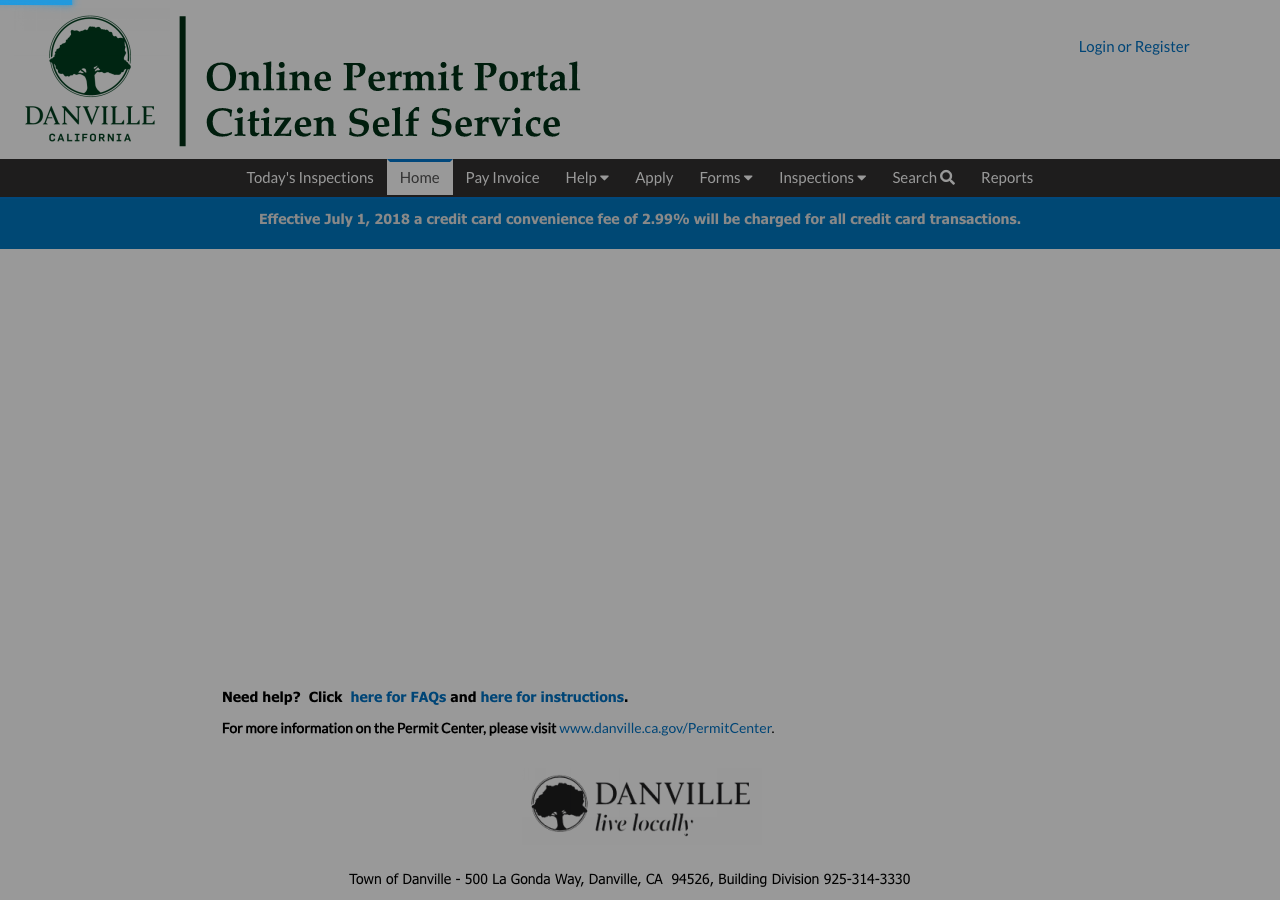
Tyler Technologies EnerGov 'SelfService' portal, reached at danville.ca.gov/CSS (redirects to danvilleca-energovpub.tylerhost.net/Apps/SelfService).
Why the confidence is not higherConfirmed by HTTP 302 redirect from https://www.danville.ca.gov/CSS to the EnerGov SelfService URL, and by the direct SolarApp+ 'Apply' link on the Permit Center page pointing to the same tylerhost.net EnerGov instance.
portal landing page checked 2026-08-30 https://danvilleca-energovpub.tylerhost.net/Apps/SelfService#/home
Q21 Can the whole application be completed online? Core Portal & process
Yes, for most residential projects including solar (submit design via SolarAPP+ for eligible systems, or upload plans directly; pay fees; sign and upload the building permit; schedule inspections) all through the online portal.
Why the confidence is not higherPermit Center page: 'Most residential projects... are currently accepted through our online portal'; SolarApp+ Submittals page walks through registering, submitting, paying, and signing entirely online.
portal checked 2026-08-30 https://www.danville.ca.gov/1042/SolarApp-Submittals
Q22 Which utility handles interconnection here? Core Utility interconnection
Pacific Gas & Electric (PG&E).
Why the confidence is not higherTown's own Permit Center Quick Links list 'Pacific Gas & Electric (PG&E)' as the utility resource; confirmed as the interconnecting distribution utility by PG&E's own Rule 21/Greenbook tariff documents which govern NEM interconnection town-wide in its territory. Danville is not served by a municipal electric utility (no Utility Billing/municipal electric page exists on danville.ca.gov).
authority's own page + utility tariff checked 2026-08-30 https://www.danville.ca.gov/155/Permit-Center
Q23 Where does the utility sit in the sequence? Core Utility interconnection
Parallel, with Permission to Operate (PTO) gated on the AHJ's final inspection clearance: the interconnection application can be filed while the building permit is in process, but PG&E's Distribution Provider approval for interconnection normally requires 'evidence of Applicant's final electric inspection clearance from the Governmental Authority having jurisdiction' before PTO issues.
Why the confidence is not higherDirect quote, PG&E Electric Rule 21 tariff (Advice 7692-E, filed via pge.com/tariffs), Section D.13.b, current as of the retrieved PDF.
utility DG manual/tariff checked 2026-08-30 https://www.pge.com/tariffs/assets/pdf/tariffbook/ELEC_RULES_21.pdf
Q24 Is a HOA or architectural approval required first? Overlays & special cases
No.
Why the confidence is not higherDanville Municipal Code 10-12.5(f): 'A permit subject to this Chapter shall not require approval of the application by an association, as defined in Section 4080 of the Civil Code' — codifying the Solar Rights Act (Civil Code 714/4600) HOA preemption for solar.
adopting ordinance checked 2026-08-30 https://codelibrary.amlegal.com/codes/danvilleca/latest/danville_ca/0-0-0-17290
Q25 Is there a historic-district review? Overlays & special cases
No blanket historic-district review for residential rooftop solar. Danville's Heritage Resource program is voluntary and covers only 21 individually Town-designated sites (identified by a brass plaque); if the specific parcel is one of those, the Heritage Resource Commission has a review role, but this is not a general overlay affecting ordinary residential lots.
Why the confidence is not higherTown's Heritage Resources page states the program is 'voluntary' and lists only 21 designated resources plus properties 'not yet designated' or 'potential'; the codified small-residential-solar ordinance (MC 10-12) does not reference historic review at all.
authority's own page checked 2026-08-30 https://www.danville.ca.gov/159/Heritage-Resources
Q26 Is a wind or windstorm certification required? Overlays & special cases
No.
Why the confidence is not higherCalifornia adopts wind design through CBC Section 1609/ASCE 7-16 structural engineering (Wind Exposure C per Danville's own Current Building Codes & Design Criteria handout), not a separate windstorm-inspection certification program (unlike, e.g., Texas TDI); no such certification is referenced anywhere in the town's solar submittal or code chapters.
authority's own document checked 2026-08-30 https://www.danville.ca.gov/DocumentCenter/View/858
Q27 Is a Specific Use Permit or Council approval ever required? Overlays & special cases
Yes — a Use Permit can be required (and denied) if the Chief Building Official makes written findings, based on substantial evidence, that the solar system would have a 'specific, adverse impact' on public health/safety; such decisions are appealable to the Planning Commission.
Why the confidence is not higherDirect quote, Danville Municipal Code 10-12.5(a) and (c).
adopting ordinance checked 2026-08-30 https://codelibrary.amlegal.com/codes/danvilleca/latest/danville_ca/0-0-0-17290
Q28 Is there a system-size cap on residential generation? Overlays & special cases
No absolute cap on residential system size, but two size thresholds matter: (1) MC 10-12.1(f) defines 'small residential rooftop solar energy system' — eligible for the ministerial same-day/1-3-day review — as <=10 kW AC nameplate or <=30 kW thermal, installed on a single or duplex dwelling, not exceeding the town's max legal building height; (2) the national SolarAPP+ program the town uses for automated review separately caps eligible systems at <=38.4 kW AC. Larger residential systems remain permittable but go through standard (non-expedited) plan review.
Why the confidence is not higherDirect quote, Danville Municipal Code 10-12.1(f); SolarAPP+ eligibility page linked by the Town states the 38.4 kW AC program-wide ceiling.
adopting ordinance checked 2026-08-30 https://codelibrary.amlegal.com/codes/danvilleca/latest/danville_ca/0-0-0-17259
Lines marked with a percentage were read off this authority’s own published documents. Unmarked guidance is general good practice, not this jurisdiction’s rule — always confirm against the authority before you submit.
Install 5 steps · 20 questions
-
Build to the code editions actually in force here
The NEC edition a jurisdiction enforces is often a cycle behind the newest one published, and local amendments sit on top of it. Rapid shutdown, conductor sizing and labelling all change between editions, so the edition in force is the first thing to establish, not the last.
- Which NEC edition is in force? 2023 NEC, as incorporated into the 2025 California Electrical Code (Part 3, Title 24 CCR), effective 1 Jan 2026. 90% · adopting ordinance
- Which building code edition is in force? 2025 California Building Code and 2025 California Residential Code, effective 1 Jan 2026. 95% · authority's own document
- Which fire code edition is in force? 2025 California Fire Code, effective 1 Jan 2026, adopted by the Town for its own Chapter X purposes; San Ramon Valley Fire Protection District (the actual fire AHJ) adopts fire-code amendments separately through its own Board. 85% · adopting ordinance
- Are there local amendments to any of the above? No amendments to the text of the adopted model codes themselves — the Building (10-1.1), Electrical (10-3.1) and Fire (10-6.1) code sections each say the respective 2025 code is 'adopted in its entirety.' Danville does, however, layer separate freestanding local ordinances alongside the codes: Ch. 10-12 (Small Residential Rooftop Solar Systems), 10-8 (Very High Fire Hazard Severity Zone), 10-9 (Post-Disaster Placards), 10-11 (Gas Shut-Off Devices), and 10-17 (EV Charging Stations). 80% · adopting ordinance
- What is the installation judged against? The 2025 CEC (based on 2023 NEC) Article 690, plus the 2025 CBC/CRC structural provisions and 2025 CFC roof-access/pathway provisions; Danville's own submittal checklist explicitly states 'Installation of the PV system shall be in conformance with CEC Article 690.' 90% · published checklist
-
Fire access, setbacks and pathways
Ridge setbacks and roof access pathways are fire-service requirements and they constrain the array layout. They are the most common cause of a redesign after the fire department comments on a plan set.
- What ridge setback and access pathways are required? For sloped roofs (>2:12): hip-roof layouts need a 3-ft-wide clear access pathway from eave to ridge on each panelled slope; single-ridge roofs need two 3-ft pathways per slope; panels must stay >=18 in. from hips/valleys where panels are on both sides (may abut if only one side is panelled and hip/valley lengths are equal); panels may be no higher than 3 ft below the ridge (for smoke ventilation); ground-mounted arrays require a 10-ft clear, brush-free area. 95% · published checklist + fire code
-
Rapid shutdown
Which rapid-shutdown rule applies follows directly from the NEC edition in force, and the initiation device has to be at a location the fire service can reach and identify. This is inspected, and it is labelled.
- Is rapid shutdown required, and to which NEC edition? Yes — required under the 2025 California Electrical Code (based on 2023 NEC) Article 690.12, which the town's own submittal checklist incorporates by reference ('conformance with CEC Article 690'), even though the checklist text itself does not use the words 'rapid shutdown.' 70% · NEC edition in force
-
Labels and placards
The NEC sets a baseline for permanent markings at the service equipment and the disconnecting means. On top of that, an authority may specify its own wording, and the utility may specify more again. Where any of them writes its own text, a generic off-the-shelf label set will not pass — this is the detail most often fixed on a return visit.
- Which placards does this authority require at the service equipment? Identification and warning signage 'in conformance with CEC Article 690' at the service equipment (per the town's own checklist); additionally PG&E requires an engraved placard on the metering equipment whenever a line/supply-side (load-side-bypass) fusible AC disconnect is installed. 85% · ordinance + utility spec
- Does the authority specify placard wording of its own? No — the Town does not prescribe its own placard wording; it defers generically to 'CEC Article 690' compliance. PG&E prescribes wording only for the specific line/supply-side-tap placard ('indicating there is a line/supply side connection'). 75% · ordinance
- Does it specify letter height, colour or material? Not specified by the Town in any document reviewed, and not specified for letter height/color/material in PG&E's Greenbook either (only 'engraved placard' is specified for the line-side-tap case, with no dimensions). 60% · utility DG manual
- Is a site plan / facility map placard required, and what must it show? No distinct 'facility map' placard beyond the required roof plan sheet itself: the submittal package's Roof Plan must show panel layout, fire department access pathway, total roof/panel area and coverage percentage, and device/service locations — effectively serving as the site/facility map, but it is a design-drawing requirement, not a separate placard mounted at the service equipment. 60% · published checklist
- Does the UTILITY specify placards beyond the AHJ's? Yes. PG&E requires an AC disconnect per Table 6-3 of its Greenbook for all meter panels except small (<=320A, single-phase) self-contained socket panels, and specifically requires an engraved placard on the metering equipment indicating a line/supply-side connection whenever a fusible AC disconnect is installed ahead of the main breaker. 90% · utility DG manual
- Where must the labels be placed? The PG&E line/supply-side-connection placard must be 'installed on the metering equipment.' The town's own checklist does not add a separate location requirement beyond generic CEC Article 690 compliance (which places rapid-shutdown and disconnect labels at/near the service disconnecting means and PV disconnect per code). 65% · utility DG manual
-
Disconnect, storage and listed equipment
Where the AC disconnect must sit relative to the meter is usually the utility's rule, not the building department's. Battery storage frequently carries its own permit, its own inspection and its own fire conditions.
- Where must the AC disconnect be, relative to the meter? PG&E does not require a separate AC disconnect switch at all for a typical residential self-contained, socket-based meter panel <=320A single-phase (Table 6-3) — the NEC/CEC-required 'readily accessible' disconnecting means near the service equipment still applies as a building-code matter even when PG&E doesn't independently require a utility-grade disconnect. Where an AC disconnect IS required (larger/transformer-rated panels, or any line/supply-side tap), it must sit ahead of the main breaker and after the meter, with an engraved placard on the metering equipment for line-side-tap installations. 80% · utility DG manual
- Must equipment be on a specific approved list? Yes. 90% · published checklist
- Are batteries permitted, and under what conditions? Yes, under detailed conditions: a floor plan of the structure housing the battery bank, battery type/size/dimensions/ventilation/physical-damage protection, anchoring method, a battery wiring diagram, inclusion in the electrical single-line diagram, and labeling of each battery to match its assigned breaker. 90% · fire code + amendments
- Is there a separate ESS permit or inspection? Not as a separate Town building permit (ESS is submitted within the same PV/solar Building Permit application per the submittal checklist), but San Ramon Valley Fire Protection District charges its own separate Energy Storage Systems construction-permit plan-review/inspection fee ($743, item 105.6.5) distinct from its Solar Photovoltaic Power Systems fee ($957, item 105.6.20). 80% · fee schedule
- Is a ground mount treated as a structure? Yes. 90% · published checklist
- Is there a local rule on service upgrades or busbar sizing? No local rule found. Danville's Electrical Code chapter (MC 10-3) has exactly one section — 10-3.1 Adoption — adopting the 2025 CEC in its entirety, with no supplemental section addressing service upgrades or busbar sizing. 75% · adopting ordinance
- Is a specific mounting system or attachment spacing required? No fixed spacing number is prescribed, but a specific attachment/mounting submittal is required: a torque schedule (in/lbs or ft/lbs) for all connections (inverter mounting hardware, disconnects, breakers, module clips, lug/panel hardware, racking system), UL listing of the mounting/racking system, and a racking/railing layout showing spans and attachment-point locations on the roof plan. 85% · published checklist
20 questions answered against Town of Danville’s own published documents
Q29 Which NEC edition is in force? Core Code editions in force
2023 NEC, as incorporated into the 2025 California Electrical Code (Part 3, Title 24 CCR), effective 1 Jan 2026.
Why the confidence is not higherMC 10-3.1 adopts 'The California Electrical Code, Part 3 of Title 24... 2025 Edition... in its entirety' (Ord. 2025-05); the 2025 CEC amendment cycle is based on the 2023 NEC (there is no '2025 NEC').
adopting ordinance checked 2026-08-30 https://codelibrary.amlegal.com/codes/danvilleca/latest/danville_ca/0-0-0-15223
Q30 Which building code edition is in force? Core Code editions in force
2025 California Building Code and 2025 California Residential Code, effective 1 Jan 2026.
Why the confidence is not higherTown's Current Building Codes & Design Criteria handout (rev 12/19/2025) lists 2025 CBC, 2025 CRC among 'Current Building Codes,' effective date 1/1/2026; MC 10-1.1 adopts the 2025 CBC 'in its entirety.'
authority's own document checked 2026-08-30 https://www.danville.ca.gov/DocumentCenter/View/858
Q31 Which fire code edition is in force? Code editions in force
2025 California Fire Code, effective 1 Jan 2026, adopted by the Town for its own Chapter X purposes; San Ramon Valley Fire Protection District (the actual fire AHJ) adopts fire-code amendments separately through its own Board.
Why the confidence is not higherMC 10-6.1: 'The California Fire Code, Part 9 of Title 24... 2025 Edition... is adopted in its entirety' (Ord. 2025-05); SRVFPD's Ordinances & Resolutions page (linked from firedepartment.org/our-district/community-risk-reduction/ordinances-resolutions) is the district's own separate adopting body and was not itself pulled for this run.
adopting ordinance checked 2026-08-30 https://codelibrary.amlegal.com/codes/danvilleca/latest/danville_ca/0-0-0-15246
Q32 Are there local amendments to any of the above? Core Code editions in force
No amendments to the text of the adopted model codes themselves — the Building (10-1.1), Electrical (10-3.1) and Fire (10-6.1) code sections each say the respective 2025 code is 'adopted in its entirety.' Danville does, however, layer separate freestanding local ordinances alongside the codes: Ch. 10-12 (Small Residential Rooftop Solar Systems), 10-8 (Very High Fire Hazard Severity Zone), 10-9 (Post-Disaster Placards), 10-11 (Gas Shut-Off Devices), and 10-17 (EV Charging Stations).
Why the confidence is not higherChecked the full table of contents of Chapter X (Building and Housing) via the code's own section-toc API; each of 10-1.1, 10-3.1 and 10-6.1 has exactly one child section (Adoption) with 'in its entirety' language, and no separate 'amendments' subsection exists under Building, Electrical, or Fire.
adopting ordinance checked 2026-08-30 https://codelibrary.amlegal.com/codes/danvilleca/latest/danville_ca/0-0-0-12915
Q33 What is the installation judged against? Core Electrical
The 2025 CEC (based on 2023 NEC) Article 690, plus the 2025 CBC/CRC structural provisions and 2025 CFC roof-access/pathway provisions; Danville's own submittal checklist explicitly states 'Installation of the PV system shall be in conformance with CEC Article 690.'
Why the confidence is not higherDirect quote, Photovoltaic Systems Submittal Requirements, section 2.B.
published checklist checked 2026-08-30 https://www.danville.ca.gov/DocumentCenter/View/782/Photovoltaic-Systems-PDF
Q34 Is there a local rule on service upgrades or busbar sizing? Electrical
No local rule found. Danville's Electrical Code chapter (MC 10-3) has exactly one section — 10-3.1 Adoption — adopting the 2025 CEC in its entirety, with no supplemental section addressing service upgrades or busbar sizing.
Why the confidence is not higherConfirmed by pulling the full section-toc for MC Chapter 10-3 (only one child node, 'Adoption') and reading that section's text in full.
adopting ordinance checked 2026-08-30 https://codelibrary.amlegal.com/codes/danvilleca/latest/danville_ca/0-0-0-15223
Q35 Is a specific mounting system or attachment spacing required? Structural & mounting
No fixed spacing number is prescribed, but a specific attachment/mounting submittal is required: a torque schedule (in/lbs or ft/lbs) for all connections (inverter mounting hardware, disconnects, breakers, module clips, lug/panel hardware, racking system), UL listing of the mounting/racking system, and a racking/railing layout showing spans and attachment-point locations on the roof plan.
Why the confidence is not higherDirect quote, Photovoltaic Systems Submittal Requirements, sections 2.B and 1.D.
published checklist checked 2026-08-30 https://www.danville.ca.gov/DocumentCenter/View/782/Photovoltaic-Systems-PDF
Q36 What ridge setback and access pathways are required? Core Fire pathways & setbacks
For sloped roofs (>2:12): hip-roof layouts need a 3-ft-wide clear access pathway from eave to ridge on each panelled slope; single-ridge roofs need two 3-ft pathways per slope; panels must stay >=18 in. from hips/valleys where panels are on both sides (may abut if only one side is panelled and hip/valley lengths are equal); panels may be no higher than 3 ft below the ridge (for smoke ventilation); ground-mounted arrays require a 10-ft clear, brush-free area.
Why the confidence is not higherDirect quote, Photovoltaic Systems Submittal Requirements, roof-top clearance section (matches 2025 CFC/CRC fire-pathway provisions).
published checklist + fire code checked 2026-08-30 https://www.danville.ca.gov/DocumentCenter/View/782/Photovoltaic-Systems-PDF
Q37 Is rapid shutdown required, and to which NEC edition? Core Rapid shutdown
Yes — required under the 2025 California Electrical Code (based on 2023 NEC) Article 690.12, which the town's own submittal checklist incorporates by reference ('conformance with CEC Article 690'), even though the checklist text itself does not use the words 'rapid shutdown.'
Why the confidence is not higherChecked the Photovoltaic Systems Submittal Requirements PDF specifically for 'rapid shutdown' and '690.12' — neither string appears (positive control 'electrical' hits 7 times, fabricated control 'zzqqx' hits 0 times, so the search itself is sound); the requirement is a state-code mandate that applies regardless of the local checklist's silence on the specific term.
NEC edition in force checked 2026-08-30 https://www.danville.ca.gov/DocumentCenter/View/782/Photovoltaic-Systems-PDF
Q38 Which placards does this authority require at the service equipment? Core Labels Signage & labelling
Identification and warning signage 'in conformance with CEC Article 690' at the service equipment (per the town's own checklist); additionally PG&E requires an engraved placard on the metering equipment whenever a line/supply-side (load-side-bypass) fusible AC disconnect is installed.
Why the confidence is not higherPhotovoltaic Systems Submittal Requirements, section 2.B ('Provide identification and warning signage in conformance with CEC Article 690'); PG&E Greenbook (TD-7001M-06, pub. 22 Apr 2026) Table 6-3 note (a).
ordinance + utility spec checked 2026-08-30 https://www.danville.ca.gov/DocumentCenter/View/782/Photovoltaic-Systems-PDF
Q39 Does the authority specify placard wording of its own? Core Labels Signage & labelling
No — the Town does not prescribe its own placard wording; it defers generically to 'CEC Article 690' compliance. PG&E prescribes wording only for the specific line/supply-side-tap placard ('indicating there is a line/supply side connection').
Why the confidence is not higherChecked both the Photovoltaic Systems Submittal Requirements PDF and the codified MC Ch. 10-12 solar ordinance in full — neither contains custom placard text; PG&E's Greenbook specifies the substance but not verbatim wording for its own line/supply-side placard.
ordinance checked 2026-08-30 https://www.danville.ca.gov/DocumentCenter/View/782/Photovoltaic-Systems-PDF
Q40 Does it specify letter height, colour or material? Core Labels Signage & labelling
Not specified by the Town in any document reviewed, and not specified for letter height/color/material in PG&E's Greenbook either (only 'engraved placard' is specified for the line-side-tap case, with no dimensions).
Why the confidence is not higherSearched the Photovoltaic Systems Submittal Requirements PDF and the full-text-extracted PG&E Greenbook (TD-7001M-06) for 'letter height'/inch-height placard language; no match in either (search validated by many unrelated '1/2 inch' hits confirming the text layer is searchable).
utility DG manual checked 2026-08-30 https://www.pge.com/assets/pge/docs/account/service-requests/greenbook-manual-full.pdf
Q41 Is a site plan / facility map placard required, and what must it show? Core Labels Signage & labelling
No distinct 'facility map' placard beyond the required roof plan sheet itself: the submittal package's Roof Plan must show panel layout, fire department access pathway, total roof/panel area and coverage percentage, and device/service locations — effectively serving as the site/facility map, but it is a design-drawing requirement, not a separate placard mounted at the service equipment.
Why the confidence is not higherChecked the Photovoltaic Systems Submittal Requirements PDF in full; the Roof Plan requirement (section 2.B) is the closest analog to a 705.10-style facility map, and no separate mounted facility-map placard requirement was found.
published checklist checked 2026-08-30 https://www.danville.ca.gov/DocumentCenter/View/782/Photovoltaic-Systems-PDF
Q42 Does the UTILITY specify placards beyond the AHJ's? Core Labels Signage & labelling
Yes. PG&E requires an AC disconnect per Table 6-3 of its Greenbook for all meter panels except small (<=320A, single-phase) self-contained socket panels, and specifically requires an engraved placard on the metering equipment indicating a line/supply-side connection whenever a fusible AC disconnect is installed ahead of the main breaker.
Why the confidence is not higherDirect quote, PG&E Greenbook TD-7001M-06 (Electric Generation Interconnection), Publication Date 22 Apr 2026, Effective Date 22 Jun 2026, Section 6.3/Table 6-3.
utility DG manual checked 2026-08-30 https://www.pge.com/assets/pge/docs/account/service-requests/greenbook-manual-full.pdf
Q43 Where must the labels be placed? Core Labels Signage & labelling
The PG&E line/supply-side-connection placard must be 'installed on the metering equipment.' The town's own checklist does not add a separate location requirement beyond generic CEC Article 690 compliance (which places rapid-shutdown and disconnect labels at/near the service disconnecting means and PV disconnect per code).
Why the confidence is not higherPG&E Greenbook TD-7001M-06 Section 6.3(a); Photovoltaic Systems Submittal Requirements section 2.B for the generic CEC 690 reference.
utility DG manual checked 2026-08-30 https://www.pge.com/assets/pge/docs/account/service-requests/greenbook-manual-full.pdf
Q44 Must equipment be on a specific approved list? Equipment listing
Yes.
Why the confidence is not higherPhotovoltaic Systems Submittal Requirements requires 'Provide UL listing' and 'device listing for the method of bonding PV modules' for all major components (modules, inverters, batteries, railing).
published checklist checked 2026-08-30 https://www.danville.ca.gov/DocumentCenter/View/782/Photovoltaic-Systems-PDF
Q45 Are batteries permitted, and under what conditions? Core Battery / ESS
Yes, under detailed conditions: a floor plan of the structure housing the battery bank, battery type/size/dimensions/ventilation/physical-damage protection, anchoring method, a battery wiring diagram, inclusion in the electrical single-line diagram, and labeling of each battery to match its assigned breaker.
Why the confidence is not higherDirect quote, Photovoltaic Systems Submittal Requirements, section 2.B ('Batteries or Energy Storage Systems').
fire code + amendments checked 2026-08-30 https://www.danville.ca.gov/DocumentCenter/View/782/Photovoltaic-Systems-PDF
Q46 Is there a separate ESS permit or inspection? Battery / ESS
Not as a separate Town building permit (ESS is submitted within the same PV/solar Building Permit application per the submittal checklist), but San Ramon Valley Fire Protection District charges its own separate Energy Storage Systems construction-permit plan-review/inspection fee ($743, item 105.6.5) distinct from its Solar Photovoltaic Power Systems fee ($957, item 105.6.20).
Why the confidence is not higherPhotovoltaic Systems Submittal Requirements folds ESS into the same PV submittal package; SRVFPD Resolution No. 2026-07 (Fees and Charges) Table 1, items 105.6.5 and 105.6.20, priced and listed separately.
fee schedule checked 2026-08-30 http://www.firedepartment.org/home/showpublisheddocument/5797/639203071553370000
Q47 Is a ground mount treated as a structure? Core Ground mount
Yes.
Why the confidence is not higherGround-mounted PV specifically triggers: (1) structural plans/calculations drawn to scale showing foundation system, framing, and fasteners, treated like any other structure; and (2) a mandatory pre-submittal stamp from Contra Costa Central Sanitary District, called out only for ground-mounted arrays/generators.
published checklist checked 2026-08-30 https://www.danville.ca.gov/DocumentCenter/View/782/Photovoltaic-Systems-PDF
Q48 Where must the AC disconnect be, relative to the meter? Core Utility equipment
PG&E does not require a separate AC disconnect switch at all for a typical residential self-contained, socket-based meter panel <=320A single-phase (Table 6-3) — the NEC/CEC-required 'readily accessible' disconnecting means near the service equipment still applies as a building-code matter even when PG&E doesn't independently require a utility-grade disconnect. Where an AC disconnect IS required (larger/transformer-rated panels, or any line/supply-side tap), it must sit ahead of the main breaker and after the meter, with an engraved placard on the metering equipment for line-side-tap installations.
Why the confidence is not higherPG&E Greenbook TD-7001M-06, Table 6-3 and accompanying notes (a)-(d).
utility DG manual checked 2026-08-30 https://www.pge.com/assets/pge/docs/account/service-requests/greenbook-manual-full.pdf
Lines marked with a percentage were read off this authority’s own published documents. Unmarked guidance is general good practice, not this jurisdiction’s rule — always confirm against the authority before you submit.
Inspection 5 steps · 14 questions
-
Book it
Booking is a portal, a phone call or an email depending on the authority, and the notice required is rarely zero. Book before the work is finished rather than after — the lead time, not the work, is usually what sets the date.
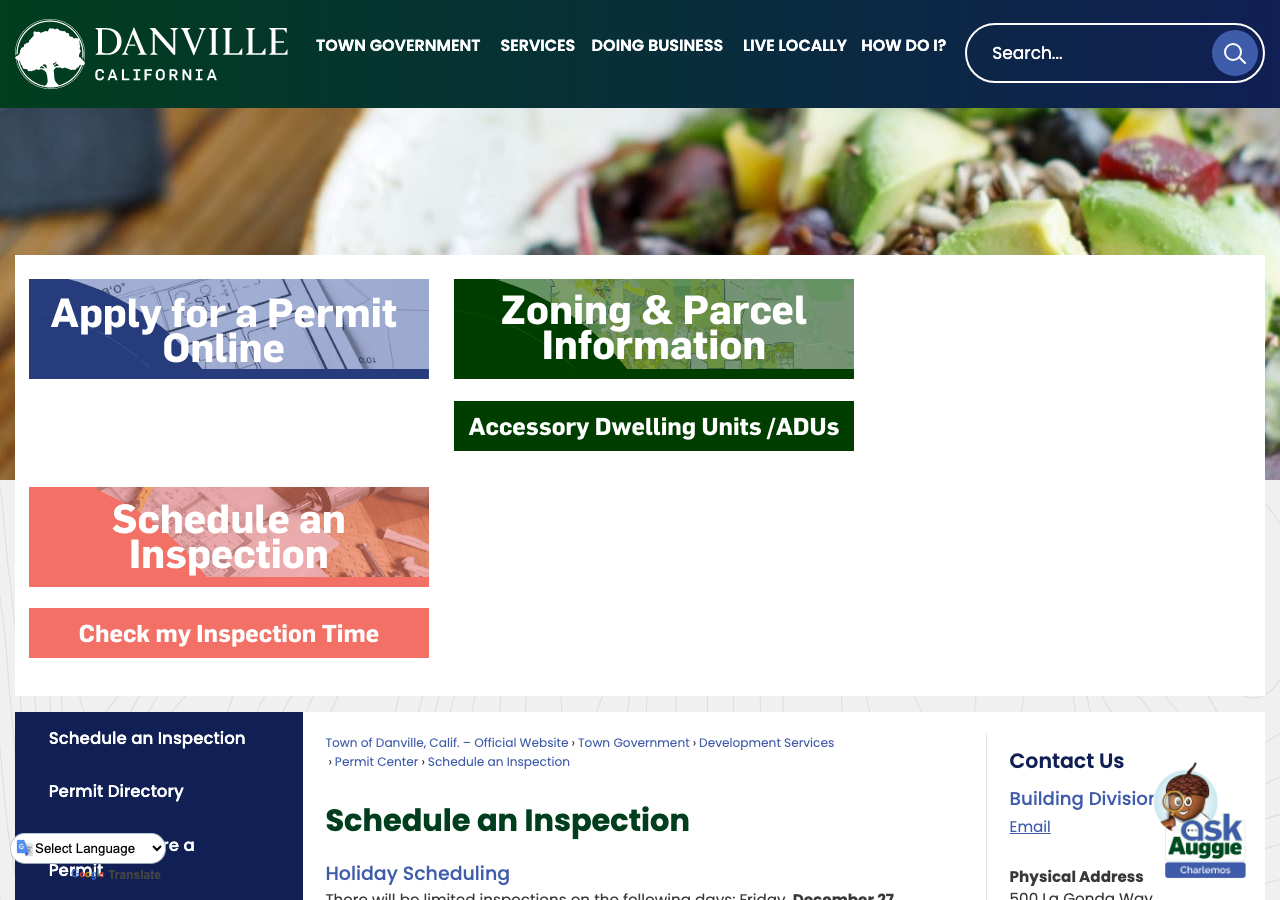
- How is an inspection booked? Portal (Tyler EnerGov 'CSS' Citizen Self Service, request an inspection online) or Phone (IVR system at 925-314-3333); San Ramon Valley Fire Protection District final inspections are booked directly with the District at 925-838-6600 rather than through the Town's system. 90% · department page
- How much notice is required? Request by 3:00 p.m. the business day before for a next-business-day inspection (effectively 1 business day's notice); inspections can be scheduled up to 5 days in advance. 90% · department page
- Are same-day or AM/PM windows offered? AM/PM preference can be selected when scheduling by phone; a specific 2-hour inspection window is assigned and posted online after 5:00 p.m. the evening before the scheduled date. 90% · department page
-
Know who turns up
Some authorities inspect their own solar work; some delegate it, and a few do not inspect the PV equipment itself at all. Who is coming determines what they will look at.
- Does this AHJ perform its own final solar inspection? Delegated (split): the Building Division performs the building/electrical final itself, and for small qualifying residential systems MC 10-12.5(h) limits the Town to a single consolidated inspection — but 'a separate fire inspection may be performed' by the fire authority if no delegation agreement exists, and the Town's own Inspection Codes list gives San Ramon Valley Fire Protection District's direct phone number as the contact for a Fire final rather than folding it into the Town's own inspection codes. 75% · department page + ordinance
- If delegated, to whom? San Ramon Valley Fire Protection District (independent special fire district), for the fire-code portion of PV/ESS review and inspection. 85% · fee schedule
-
Work the stages in order
A rough-in or mid-roof inspection, where one is required, has to happen before the work it covers is closed up. Missing a stage means opening something back up, and it is the most expensive kind of correction.
- Which inspections are required, and in what order? For small qualifying residential rooftop solar (<=10 kW AC/30 kW thermal): a single consolidated Building Division final inspection (no separate rough-in required by the ordinance). For larger residential, ground-mount, or battery systems, the Town's general Electrical inspection codes apply (e.g., 401 Service, 402 Subpanel, 404 Rough Electric, 405 UFER Ground) ahead of a 905 Building Final, with a possible separate Fire final booked directly with SRVFPD. 70% · ordinance + department page
- Is a rough-in or mid-roof inspection required? No, for systems that qualify as 'small residential rooftop solar' under MC 10-12 — the ordinance limits the Town to a single required inspection. Not separately addressed for non-qualifying (larger, ground-mount, or non-expedited) systems beyond the Town's generic Electrical inspection codes. 65% · ordinance
-
Have the paperwork on site
The approved plan set, the permit, and the equipment listings should be on site and reachable. Inspectors routinely verify that installed equipment matches what was approved, and that the labels are the ones the plan set promised.
- Is there a published inspection checklist? No dedicated solar-specific field-inspection checklist is published; the Town publishes only a generic town-wide 'Inspection Codes' list (by trade/category, e.g., Electrical 401-406, Building, Plumbing, Mechanical) rather than a PV-specific checklist of items checked. 70% · department page
- What must be on site at inspection? Not explicitly itemized in any Town document found; the inspection-scheduling process references an 'inspection card' (with a PIN number in its top-right corner) that the inspector confirms against the permit and site address, implying the permit/inspection card and approved plans should be available on site. 50% · department page
- Does the inspector verify labels and listings? Likely yes, inferred rather than directly documented: the approved plan set (which the field inspection is checked against) must include UL listings, device listings, and CEC Article 690 identification/warning signage per the submittal checklist, but no separate field-inspection checklist itemizing 'verify labels and listings' as a discrete step was found. 55% · published checklist / practice
-
Sign-off, and permission to operate
Passing gives you a final or an equivalent sign-off. That is not the same as permission to operate: PTO comes from the utility, and who tells the utility the inspection passed varies. A system left switched off for weeks is usually waiting on this handover.
- What is issued on pass? A signed-off Building Final on the permit/inspection card. A Certificate of Occupancy is not typically issued for a PV addition to an existing single-family residence (COs apply to new construction/occupancy changes under the CBC as adopted). 55% · department page / inference
- Who notifies the utility for PTO? The installer, acting as Applicant, submits the interconnection request to PG&E including evidence of the AHJ's final electric-inspection clearance; PG&E (Distribution Provider) then processes Permission to Operate. 75% · utility DG manual/tariff
- Is there a re-inspection fee? $122 minimum (Reinspection/Administration Fee). 90% · fee schedule
- How are corrections issued and cleared? A written correction notice or letter detailing all deficiencies and any additional required information/documentation is sent to the applicant for resubmission; if a small qualifying residential system fails inspection, a subsequent (re-)inspection is authorized but need not conform to the ordinance's expedited timelines. 85% · ordinance
14 questions answered against Town of Danville’s own published documents
Q49 How is an inspection booked? Core Booking & scheduling
Portal (Tyler EnerGov 'CSS' Citizen Self Service, request an inspection online) or Phone (IVR system at 925-314-3333); San Ramon Valley Fire Protection District final inspections are booked directly with the District at 925-838-6600 rather than through the Town's system.
Why the confidence is not higherTown's Schedule an Inspection page details both the online-portal and phone-IVR booking methods, and its own 'Inspection Codes' table lists a Fire final with SRVFPD's direct phone number rather than a Town inspection code.
department page checked 2026-08-30 https://www.danville.ca.gov/815/Schedule-an-Inspection
Q50 How much notice is required? Core Booking & scheduling
Request by 3:00 p.m. the business day before for a next-business-day inspection (effectively 1 business day's notice); inspections can be scheduled up to 5 days in advance.
Why the confidence is not higherDirect quote, Town's Schedule an Inspection page.
department page checked 2026-08-30 https://www.danville.ca.gov/815/Schedule-an-Inspection
Q51 Are same-day or AM/PM windows offered? Booking & scheduling
AM/PM preference can be selected when scheduling by phone; a specific 2-hour inspection window is assigned and posted online after 5:00 p.m. the evening before the scheduled date.
Why the confidence is not higherDirect quote, Town's Schedule an Inspection page.
department page checked 2026-08-30 https://www.danville.ca.gov/815/Schedule-an-Inspection
Q52 Does this AHJ perform its own final solar inspection? Core Who inspects
Delegated (split): the Building Division performs the building/electrical final itself, and for small qualifying residential systems MC 10-12.5(h) limits the Town to a single consolidated inspection — but 'a separate fire inspection may be performed' by the fire authority if no delegation agreement exists, and the Town's own Inspection Codes list gives San Ramon Valley Fire Protection District's direct phone number as the contact for a Fire final rather than folding it into the Town's own inspection codes.
Why the confidence is not higherDanville Municipal Code 10-12.5(h); Town's Schedule an Inspection page 'Final' inspection-codes table listing '* Fire 925-838-6600' alongside Town-numbered codes for Engineering, Planning, and Building Final.
department page + ordinance checked 2026-08-30 https://codelibrary.amlegal.com/codes/danvilleca/latest/danville_ca/0-0-0-17290
Q53 If delegated, to whom? Core Who inspects
San Ramon Valley Fire Protection District (independent special fire district), for the fire-code portion of PV/ESS review and inspection.
Why the confidence is not higherSRVFPD's own current fee schedule (Resolution 2026-07) prices dedicated Solar Photovoltaic Power Systems (105.6.20, $957) and Energy Storage Systems (105.6.5, $743) plan-review/inspection fees; Danville's Outside Agency Checklist and Permit Center quick links both name 'San Ramon Valley Fire District/Protection District' as the fire authority of record for Danville addresses.
fee schedule checked 2026-08-30 http://www.firedepartment.org/home/showpublisheddocument/5797/639203071553370000
Q54 Which inspections are required, and in what order? Core Stages & sequence
For small qualifying residential rooftop solar (<=10 kW AC/30 kW thermal): a single consolidated Building Division final inspection (no separate rough-in required by the ordinance). For larger residential, ground-mount, or battery systems, the Town's general Electrical inspection codes apply (e.g., 401 Service, 402 Subpanel, 404 Rough Electric, 405 UFER Ground) ahead of a 905 Building Final, with a possible separate Fire final booked directly with SRVFPD.
Why the confidence is not higherMC 10-12.5(h)-(i); Town's Schedule an Inspection page 'Inspection Codes' table (Electrical and Final categories).
ordinance + department page checked 2026-08-30 https://codelibrary.amlegal.com/codes/danvilleca/latest/danville_ca/0-0-0-17290
Q55 Is a rough-in or mid-roof inspection required? Stages & sequence
No, for systems that qualify as 'small residential rooftop solar' under MC 10-12 — the ordinance limits the Town to a single required inspection. Not separately addressed for non-qualifying (larger, ground-mount, or non-expedited) systems beyond the Town's generic Electrical inspection codes.
Why the confidence is not higherDanville Municipal Code 10-12.5(h): 'Only one inspection shall be required and performed by the Building Division for small residential rooftop solar energy systems eligible for expedited review.'
ordinance checked 2026-08-30 https://codelibrary.amlegal.com/codes/danvilleca/latest/danville_ca/0-0-0-17290
Q56 Does the inspector verify labels and listings? Core What is checked
Likely yes, inferred rather than directly documented: the approved plan set (which the field inspection is checked against) must include UL listings, device listings, and CEC Article 690 identification/warning signage per the submittal checklist, but no separate field-inspection checklist itemizing 'verify labels and listings' as a discrete step was found.
Why the confidence is not higherInferred from the Photovoltaic Systems Submittal Requirements' listing/labeling requirements combined with standard California building-inspection practice of inspecting against approved plans; no Town document states the inspector's checklist verbatim.
published checklist / practice checked 2026-08-30 https://www.danville.ca.gov/DocumentCenter/View/782/Photovoltaic-Systems-PDF
Q57 Is there a published inspection checklist? Core What is checked
No dedicated solar-specific field-inspection checklist is published; the Town publishes only a generic town-wide 'Inspection Codes' list (by trade/category, e.g., Electrical 401-406, Building, Plumbing, Mechanical) rather than a PV-specific checklist of items checked.
Why the confidence is not higherChecked the Town's Schedule an Inspection page in full; it contains an Inspection Codes table but no PV-specific checklist document is linked from it or from the SolarApp+/Permit Center pages.
department page checked 2026-08-30 https://www.danville.ca.gov/815/Schedule-an-Inspection
Q58 What must be on site at inspection? Core Documents on site
Not explicitly itemized in any Town document found; the inspection-scheduling process references an 'inspection card' (with a PIN number in its top-right corner) that the inspector confirms against the permit and site address, implying the permit/inspection card and approved plans should be available on site.
Why the confidence is not higherInferred from the Town's Schedule an Inspection page's phone-IVR instructions, which reference the inspection card's PIN; no separate 'what must be on site' document was found.
department page checked 2026-08-30 https://www.danville.ca.gov/815/Schedule-an-Inspection
Q59 Is there a re-inspection fee? Corrections & re-inspection
$122 minimum (Reinspection/Administration Fee).
Why the confidence is not higherMaster Fee Schedule 2026/27, 'Additional Fees That May Apply' table.
fee schedule checked 2026-08-30 https://www.danville.ca.gov/DocumentCenter/View/836/Master-Fee-Schedule-PDF
Q60 How are corrections issued and cleared? Corrections & re-inspection
A written correction notice or letter detailing all deficiencies and any additional required information/documentation is sent to the applicant for resubmission; if a small qualifying residential system fails inspection, a subsequent (re-)inspection is authorized but need not conform to the ordinance's expedited timelines.
Why the confidence is not higherDirect quote, Danville Municipal Code 10-12.5(g) and (j).
ordinance checked 2026-08-30 https://codelibrary.amlegal.com/codes/danvilleca/latest/danville_ca/0-0-0-17290
Q61 What is issued on pass? Core Final sign-off & PTO
A signed-off Building Final on the permit/inspection card. A Certificate of Occupancy is not typically issued for a PV addition to an existing single-family residence (COs apply to new construction/occupancy changes under the CBC as adopted).
Why the confidence is not higherInferred from the Town's general permit/inspection process (905 'Building Final' inspection code) and standard CBC practice for additions to existing SFRs; no Danville document explicitly states 'no CO is issued for solar.'
department page / inference checked 2026-08-30 https://www.danville.ca.gov/815/Schedule-an-Inspection
Q62 Who notifies the utility for PTO? Core Final sign-off & PTO
The installer, acting as Applicant, submits the interconnection request to PG&E including evidence of the AHJ's final electric-inspection clearance; PG&E (Distribution Provider) then processes Permission to Operate.
Why the confidence is not higherPG&E Electric Rule 21 tariff, Section D.13.b: interconnection approval requires 'evidence of Applicant's final electric inspection clearance from the Governmental Authority having jurisdiction' — 'Applicant' in NEM practice is normally the installer acting on the customer's behalf.
utility DG manual/tariff checked 2026-08-30 https://www.pge.com/tariffs/assets/pdf/tariffbook/ELEC_RULES_21.pdf
Lines marked with a percentage were read off this authority’s own published documents. Unmarked guidance is general good practice, not this jurisdiction’s rule — always confirm against the authority before you submit.
Jurisdiction & key facts
The standing 62-question set, answered for Town of Danville against this authority’s own published documents. Every answer carries the confidence it was recorded at and the document it came from. Where nothing is published we say so and show where we looked — a blank here is a finding, not a gap.
Town of Danville is the authority having jurisdiction 90% confidence
- Holds
- Both (Building and Electrical, combined under one Building Permit) for solar PV; fire-code review/inspection is split to San Ramon Valley Fire Protection District (an independent special district) which charges its own PV/ESS fees; Contra Costa Central Sanitary District must stamp plans pre-submittal for ground-mounted systems; Planning Division/Heritage Resource Commission only engage if a Use Permit is triggered or the parcel is a designated Heritage Resource.
- Delegated to
- San Ramon Valley Fire Protection District (fire-code plan review and, per MC 10-12.5(h), a separate fire final inspection when no inter-agency inspection agreement exists); Contra Costa Central Sanitary District (pre-submittal plan stamp, ground-mount only)
- Overridden by
- State law overrides local discretion in specific ways: Danville's own MC Ch. 10-12 (Ord. 2015-03) codifies Gov. Code Sec. 65850.5/65850.55 ministerial/expedited-review mandates and Civil Code Sec. 714/4600 (Solar Rights Act) HOA preemption; the 2025 CBC/CRC/CEC/CFC (Title 24) are adopted 'in their entirety' per Ord. 2025-05, leaving the Town no room to weaken the substantive technical requirements.
- Why not higher
- Town's Building Division page (danville.ca.gov/516) states it performs 'permitting, plan review, inspection, and code enforcement'; the Permit Directory lists 'Residential Solar/PV System' with its own EnerGov Apply link and a dedicated, currently-dated (12/15/2025) submittal-requirements PDF; the codified Municipal Code Chapter 10-12 explicitly gives the Building Division permit-issuance and (for qualifying systems) sole-inspection authority while carving out a fire-authority exception; the Outside Agency Checklist (rev 6/1/2026) separately lists San Ramon Valley Fire District and Central Contra Costa Sanitary District as agencies with their own jurisdiction over parts of the project; SRVFPD's own current fee resolution (2026-07) independently prices PV and ESS plan review/inspection, confirming this is a genuine split rather than a rubber-stamp delegation.
- Permit required
- Yes95%
- Permit cost
- $201.50 flat + $7.44 per kWp of system rating (Fee = A + B*v, A=$201.50, B=$7.44/kWp), for both residential and non-residential photovoltaic systems.95%
- Plan review
- Same day for over-the-counter applications, or 1-3 business days for electronic applications, for 'small residential rooftop solar energy systems' (<=10 kW AC / 30 kW thermal) that meet the…90%
- Portal
- Tyler Technologies EnerGov 'SelfService' portal, reached at danville.ca.gov/CSS (redirects to danvilleca-energovpub.tylerhost.net/Apps/SelfService).95%
- Electrical code
- 2023 NEC, as incorporated into the 2025 California Electrical Code (Part 3, Title 24 CCR), effective 1 Jan 2026.90%
- Own placard wording
- No — the Town does not prescribe its own placard wording; it defers generically to 'CEC Article 690' compliance.75%
- Booking an inspection
- Portal (Tyler EnerGov 'CSS' Citizen Self Service, request an inspection online) or Phone (IVR system at 925-314-3333);90%
Labels & placards for this authority
Wording 75%
No — the Town does not prescribe its own placard wording; it defers generically to 'CEC Article 690' compliance. PG&E prescribes wording only for the specific line/supply-side-tap placard ('indicating there is a line/supply side connection').
Size, colour & material 60%
Not specified by the Town in any document reviewed, and not specified for letter height/color/material in PG&E's Greenbook either (only 'engraved placard' is specified for the line-side-tap case, with no dimensions).
Where they go 65%
The PG&E line/supply-side-connection placard must be 'installed on the metering equipment.' The town's own checklist does not add a separate location requirement beyond generic CEC Article 690 compliance (which places rapid-shutdown and disconnect labels at/near the service disconnecting means and PV disconnect per code).
What the utility wants on top 90%
Yes. PG&E requires an AC disconnect per Table 6-3 of its Greenbook for all meter panels except small (<=320A, single-phase) self-contained socket panels, and specifically requires an engraved placard on the metering equipment indicating a line/supply-side connection whenever a fusible AC disconnect is installed ahead of the main breaker.
Each figure above is sourced and dated in the full answer set below (questions 38–43). Where an authority’s own published sheet is older than the code it has adopted, the answer says so.
Their website
Average approval time — application to PTO
From the CPUC interconnection record. Bars show the average days taken each year; a year with no recorded projects is left blank rather than drawn as zero.