
Trinity County
State of California
Trinity County is a county authority in the State of California, covering 14 regions, serving 16,112 residents. 50 residential solar installs are on record here. This page is the permit route for that jurisdiction: the fifteen steps from working out who has a say over an address through to permission to operate, the documents this authority publishes, and 62 answers taken from those documents and dated.
Permitting 5 steps · 28 questions
Whether a permit is needed — Yes. A building permit is required for a residential rooftop PV system. Q3 Electrical and building permits — Combined into a single application, but priced as separate trades. The county's Building Permit Application form is one document with checkboxes for 'Dwelling /… Q4 Plan review — Up to 6 weeks (approximately 30 business days) upon a complete submittal. Q18 Where you file — None found. Trinity County does not appear to operate an online permitting portal (no Accela/EnerGov/eTRAKiT/SolarAPP+/OpenGov instance found anywhere on the… Q20
- Permit required
- Yes. A building permit is required for a residential rooftop PV system.95% source
- What it costs
- For the ELECTRICAL trade: a 'Solar system' permit is billed at 'valuation per CBC' (i.e., computed off the ICC/CBC building-valuation table, not a flat or per-kW figure),72% source
- Plan review turnaround
- Up to 6 weeks (approximately 30 business days) upon a complete submittal.82% source
- Key document
- department application form (stale citation noted) cited by 13 open the document
-
Confirm who has a say over your address
A city address is usually permitted by the city, not the county — but not always, and some authorities keep building and hand electrical to someone else. Getting this wrong costs the whole submittal, because every requirement below belongs to whoever actually holds jurisdiction. Check the overlays in the same pass: an HOA, a historic district, a windstorm certification or a system-size cap can reshape the design, and all of them are cheaper to find now than after the array is laid out.
- Is this authority the AHJ for residential solar at this address? Yes. Trinity County is the AHJ for residential solar countywide because Trinity County has NO incorporated cities at all -- every named community (Weaverville, Hayfork, Lewiston, Junction City, Douglas City, Trinity Center, Hyampom, Big Bar, Salyer, Burnt Ranch, Denny, Wildwood, South Fork, etc.) is an unincorporated 'Planning Area' of the county's own General Plan, not a municipality with its own building department. 95% · county planning document
- What does this authority permit itself, and what does it delegate? Both -- Building AND Electrical, self-performed in-house by the Community Development Department's Building Division (named Chief Building Official Cody Smith, plan checker; Miles Tralle, Building Inspector I). Fire/life-safety review for the county's own 'Fire Safe' wildfire-defensible-space standards (Trinity County Ordinance 1162 / TCC Ch. 8.30, implementing state PRC 4290) is performed by CAL FIRE's Trinity Unit (a CDF Battalion Chief signs the 'CAL FIRE Acknowledgement Form'), but the Building Department retains final authority: the form states conditions 'are required to be completed prior to the final building inspection by the Trinity County Building Department.' No separate County Fire Code (CFC) adoption chapter was found (see Q31). 88% · department application form
- Is a permit required for a residential rooftop PV system? Yes. A building permit is required for a residential rooftop PV system. 95% · codified ordinance
- Is there a separate electrical permit, or is it combined? Combined into a single application, but priced as separate trades. The county's Building Permit Application form is one document with checkboxes for 'Dwelling / Remodel / Addition / LDRD / Electrical / Mechanical / Accessory Structure / Demolition' -- there is no dedicated 'Solar' box, so a rooftop PV job is filed as 'Electrical' (or 'Accessory Structure' for a ground mount) on the same form used for everything else. The county's own fee ordinance nonetheless prices 'Building Permit,' 'Electrical,' 'Mechanical' and 'Plumbing' as separate permit-processing-fee categories, each with its own $45/$58 base fee, and lists a 'Solar system' line under BOTH the Electrical schedule (valuation-based) and the Plumbing schedule ($45/$45flat for solar water heating) -- so one submittal can generate more than one trade-fee line. 72% · department application form + fee schedule
- Is a HOA or architectural approval required first? No HOA/architectural-approval requirement was found in any Trinity County document, and no general design-review or architectural-review chapter exists anywhere in the zoning title (control-checked: 0 hits for 'design review' or 'architectural review' establishing a discretionary review BODY, against 133 hits for the positive control 'setback' and 0 for the fabricated control 'zzqqx' across the full 63-chapter Title 17 text). 78% · codified ordinance (control-checked absence)
- Is there a historic-district review? No general historic-district design-review process (no Certificate-of-Appropriateness-style ordinance) was found in the zoning title. The only historic references found are narrow: TCC 17.27.060 precludes siting a MOBILE/manufactured home within any National-Register historic district, and the floodplain-variance chapter (17.29B.270) allows a variance for repair/restoration of a National-Register or State-Inventory historic structure. Neither creates a discretionary review gate for a rooftop PV retrofit. 68% · codified ordinance (control-checked)
- Is a wind or windstorm certification required? No windstorm/wind-speed certification requirement was found anywhere in the county's own documents (control-checked absence: zero 'wind' hits beyond 'window/door' in the full Building Permit Application packet, and no Building-Division handout addresses wind exposure or design wind speed). 75% · department checklist (control-checked absence)
- Is a Specific Use Permit or Council approval ever required? Not specifically codified for solar. The general Use Permit / Conditional Use Permit mechanism (present in every zoning district chapter) could be triggered by a freestanding/ground-mount array that exceeds the general accessory-structure height (25 ft in R/A/H/RR districts per TCC 17.30.050(E)) or that does not fit the district's listed accessory uses, and the county's Fire Safe Ordinance (Ch. 8.30) has its own separate exception/appeal process for wildfire-standard deviations. No dedicated 'Council approval for solar' trigger was found. 55% · codified ordinance (inference)
- Is there a system-size cap on residential generation? No. There is NO codified system-size cap or eligibility-gate ordinance for residential solar anywhere in Trinity County Code -- a clean, control-checked absence (1 stray 'photovoltaic' hit across the entire 118-section Title 15 and 63-chapter Title 17 corpus, and it is an unrelated cannabis-cultivation renewable-energy clause, not a residential PV rule; 'solar' appears exactly once, in an unrelated Limited-Density-Rural-Dwelling heating-fuel clause; positive control 'electrical' hit 42/133 times in Titles 15/17 respectively, fabricated control 'zzqqx' zero). This is a real gap, not a search failure: the SAME Title 15 contains a fully built-out 'EXPEDITED ELECTRIC VEHICLE CHARGING STATION PERMITTING' chapter (TCC 15.26, Ord. 1364, adopted 21 Mar 2023) implementing Gov. Code Section 65850.7 -- proving the county knows how to adopt this style of streamlined ordinance -- with no equivalent chapter ever adopted under Gov. Code Section 65850.5/.52/.55 for solar. 90% · codified ordinance (control-checked absence + contrast)
-
Check who is allowed to apply
Several authorities require the electrical permit to be pulled by a licensed electrician, or require the contractor to be registered with them BEFORE applying. Registration is not same-day. This is second on the list rather than fourth because it is the step most likely to stop the job before the drawings matter.
- Who is allowed to pull the electrical permit? Either -- a state-licensed contractor (license class and number entered on the application) or a homeowner acting as an owner-builder. 85% · department application form
- Must the contractor be registered with this authority before applying? No county-specific contractor registration requirement beyond the standard state CSLB license number entered on the application was found. The county's 'Contractors List' (linked from the Building Division page) is a plain courtesy directory of local contractors' names and phone numbers with no registration language, and Title 5 of the county code (Business Taxes, Licenses and Regulations) has no general contractor/business-license chapter -- only bingo, cardrooms and similarly specific licenses. 70% · department handout
- Is a homeowner permitted to self-install and self-permit? Yes. A homeowner may self-install and self-permit as an owner-builder. 92% · department application form
-
Build the submittal package
Almost everywhere wants a site plan, a one-line or three-line electrical diagram, equipment cut sheets with listings, and a structural attachment detail. Build it against the published checklist rather than the last jurisdiction you worked in — the checklist is what the reviewer marks against.
- What documents make up a complete submittal? A complete Building Permit application; three complete sets of building plans (signed by the drafter or, if engineered, wet-stamped by a CA-licensed engineer, indicating the applicable snow load and CBC code year); three copies of a plot plan plus one copy of a location map; a Plan Review Fee deposit; for solar/wood-stove/water-heating systems specifically -- type of system, pumps, tank sizes, heat exchangers, solar panels, blowers, pipe unit, and the manufacturer's name plus technical/installation data; two sets of Title 24 energy calculations (Trinity County is in Climate Zone 16) on conditioned structures; engineering data (two sets, wet-stamped) if manufactured/job-built trusses are used or the site has special conditions; and a signed CAL FIRE Acknowledgement Form before final. 85% · department checklist
- How many copies, and in what format? Paper only: three complete sets of building plans, three copies of the plot plan, and one copy of the location map (8.5x11 if the plot plan is larger). No online upload option or portal was found -- see Q20/Q21. 85% · department checklist
- Is a site plan required, and what must it show? Yes. The site plan must show a north arrow, the proposed structure's square footage, all four setbacks (front/sides/rear), the building type/use and square footage of every EXISTING structure on the parcel (for lot-coverage calculation), the parcel in its entirety, and the name of the main access road. 90% · department checklist
- Is a one-line / three-line diagram required? Very likely yes by inference -- no Trinity County document uses the literal phrase 'one-line' or 'three-line diagram' (a control-checked absence across the whole 13-page application packet), but the packet's 'FLOOR PLAN' item requires 'plumbing fixtures, electrical and lighting outlets' to be shown and the standard electrical plan-check process presupposes a wiring diagram of that detail for a PV interconnection. 55% · department checklist (inference)
- Is a structural PE stamp required, and at what threshold? No fixed kW, weight or dollar threshold is stated. The application packet requires two wet-stamped sets of engineering 'if manufactured or job built trusses are to be used' or if the site presents 'special problems such as: steep slope; unstable or filled ground; or is in a flood plain,' or an unusual structure shape -- a general, not solar-specific, engineering trigger. A structural PE stamp for a PV mounting system would most likely be required whenever the racking falls outside a manufacturer's prescriptive listing or the roof snow load exceeds 50 psf (which independently triggers a 'lateral design' requirement per the packet). 55% · department checklist (inference)
-
Apply and pay
Most authorities now take the whole application through a portal, and several states cap or constrain what a residential solar permit may cost. Check whether plan check is billed separately before you quote the job.
- Which permit portal does this authority use? None found. Trinity County does not appear to operate an online permitting portal (no Accela/EnerGov/eTRAKiT/SolarAPP+/OpenGov instance found anywhere on the county's site). Submittal is in person or by mail/fax to the Community Development Department, Building Division, 61 Airport Road, Weaverville; inspections are booked by phone. The county's only public-facing 'portal' (CivicClerk, at trinitycoca.portal.civicclerk.com) is for Board/Planning Commission agendas and minutes, not permitting. 78% · department page (control-checked absence)
- Can the whole application be completed online? No. There is no online application system; see Q20. 76% · department page (control-checked absence)
- What does a residential solar permit cost? For the ELECTRICAL trade: a 'Solar system' permit is billed at 'valuation per CBC' (i.e., computed off the ICC/CBC building-valuation table, not a flat or per-kW figure), on top of a $58 electrical permit-processing fee (2023 ordinance's 'fully weighted' column; original was $45). Separately, under the PLUMBING trade, a 'Solar system' line (solar water heating) is a flat $45 (fully weighted; $35 original). A Plan Review Fee deposit is also charged (see Q17). NOTE: the county's own linked 'fee schedule' PDF is itself an unsigned ordinance TEMPLATE -- 'Ordinance No. XXXX,' date and Board vote all left blank -- so treat these dollar amounts as the best available but formally unexecuted copy of the current schedule; other county fee pages (Assessor, Clerk-Recorder) separately reference fees 'updated February 1, 2026 in accordance with the adopted Trinity County Fee Schedule,' suggesting a newer consolidated adoption exists that could not be located for Building specifically. 72% · fee schedule (irregular: unsigned draft)
- How is the fee calculated? Valuation-based (per CBC) for the Electrical 'Solar system' permit fee; a flat fee ($45) for the Plumbing 'Solar system' (solar water heating) line. Not per-kW and not per-panel anywhere in the county's fee documents. 78% · fee schedule
- Is there a separate plan-check fee? Yes. A separate Plan Review Fee deposit is required with every building-plan submittal, described as covering plan review and zoning review combined; the applicant must call or email the office to have the amount calculated case-by-case (it is not a single published line item). 85% · department application form
-
Plan review — and start the utility in parallel
Interconnection is a separate process from the permit and usually the longer pole. Where the utility does not depend on the permit being issued, running both at once is the single biggest saving available on a residential job.
- What is the stated plan-review turnaround? Up to 6 weeks (approximately 30 business days) upon a complete submittal. 82% · department application form
- How long is an issued permit valid before it expires? 180 days: if construction is not started within 180 days of permit issuance, or work is stopped for any 180-day period, the permit 'shall be deemed revoked' absent contact/extension. NOTE (drafting lag): the application packet cites this rule to the superseded 'UNIFORM BUILDING CODE -- SECTION 303(D)' even though the county's own codified adoption ordinance (TCC 15.04.080) names the current California Building Code, not the UBC -- recorded as written, a stale statutory citation inside a current, actively-used form. 70% · department application form (stale citation noted)
- Which utility handles interconnection here? Trinity Public Utilities District (Trinity PUD) -- NOT Pacific Gas & Electric as commonly assumed. Trinity PUD's own site states plainly that, with 7,230 meters, it 'serves most of the customers in Trinity County' with 100%-renewable hydroelectric power, having purchased PG&E's former Shasta-Division distribution system covering most of the county in a 1993 $12,000,000 settlement (and having earlier condemned PG&E's Hayfork facilities in 1987). PG&E may still serve some remaining outlying parts of the county that were not part of that acquisition, but no specific PG&E-served community within Trinity County could be identified from a county- or utility-side document in this run -- confirm per address before relying on Rule 21. 85% · utility's own document
- Where does the utility sit in the sequence? After permit / gated on the AHJ's approval. Trinity PUD's own 'Upgrade Service' page states outright: 'One important step is that prior to Trinity PUD installing the electric power the Trinity County Building Department has to inspect and approve your electrical panel.' 90% · utility's own document
28 questions answered against Trinity County’s own published documents
Q1 Is this authority the AHJ for residential solar at this address? Core Jurisdiction & scope
Yes. Trinity County is the AHJ for residential solar countywide because Trinity County has NO incorporated cities at all -- every named community (Weaverville, Hayfork, Lewiston, Junction City, Douglas City, Trinity Center, Hyampom, Big Bar, Salyer, Burnt Ranch, Denny, Wildwood, South Fork, etc.) is an unincorporated 'Planning Area' of the county's own General Plan, not a municipality with its own building department.
Why the confidence is not higherThe county's own General Plan & Community Plans page lists every named community in the county as a 'Planning Area' of the county General Plan (e.g. Weaverville Planning Area, Hayfork Planning Area, Lewiston-Douglas City Planning Area), and the 2014 Safety Element treats fire/emergency service across these same named places as a single countywide unincorporated-area problem -- there is no other municipal AHJ anywhere in the county to carve out, the same clean shape found at Mariposa County.
county planning document checked 2026-08-31 https://www.trinitycounty.org/276/General-Plan-Community-Plans
Q2 What does this authority permit itself, and what does it delegate? Core Jurisdiction & scope
Both -- Building AND Electrical, self-performed in-house by the Community Development Department's Building Division (named Chief Building Official Cody Smith, plan checker; Miles Tralle, Building Inspector I). Fire/life-safety review for the county's own 'Fire Safe' wildfire-defensible-space standards (Trinity County Ordinance 1162 / TCC Ch. 8.30, implementing state PRC 4290) is performed by CAL FIRE's Trinity Unit (a CDF Battalion Chief signs the 'CAL FIRE Acknowledgement Form'), but the Building Department retains final authority: the form states conditions 'are required to be completed prior to the final building inspection by the Trinity County Building Department.' No separate County Fire Code (CFC) adoption chapter was found (see Q31).
Why the confidence is not higherNamed officials and the county-letterhead 'CALFIRE Acknowledgement Form' both appear inside the county's own Building Permit Application packet; no delegation firm (Willdan/4LEAF/CSG/etc.) appears anywhere -- staff directory, application signature blocks, portal domain (none exists) and fee schedule staffing all point in-house.
department application form checked 2026-08-31 https://www.trinitycounty.org/DocumentCenter/View/309/Building-Permit-Application--PDF
Q3 Is a permit required for a residential rooftop PV system? Core Jurisdiction & scope
Yes. A building permit is required for a residential rooftop PV system.
Why the confidence is not higherTrinity County Code 15.04.140 makes it 'unlawful...to install or alter any...electrical wiring or fixtures' without a permit, and the Building Permit Application's own item 7 states outright: 'SOLAR, WOOD STOVE, & WATER HEATING SYSTEMS -- All solar, wood stove and water heating systems require a building permit,' listing 'solar panels' by name among the required plan details.
codified ordinance checked 2026-08-31 https://library.municode.com/ca/trinity_county/codes/code_of_ordinances?nodeId=TIT15BUCO_CH15.04BUCO_15.04.140BUWIPEUN
Q4 Is there a separate electrical permit, or is it combined? Core Jurisdiction & scope
Combined into a single application, but priced as separate trades. The county's Building Permit Application form is one document with checkboxes for 'Dwelling / Remodel / Addition / LDRD / Electrical / Mechanical / Accessory Structure / Demolition' -- there is no dedicated 'Solar' box, so a rooftop PV job is filed as 'Electrical' (or 'Accessory Structure' for a ground mount) on the same form used for everything else. The county's own fee ordinance nonetheless prices 'Building Permit,' 'Electrical,' 'Mechanical' and 'Plumbing' as separate permit-processing-fee categories, each with its own $45/$58 base fee, and lists a 'Solar system' line under BOTH the Electrical schedule (valuation-based) and the Plumbing schedule ($45/$45flat for solar water heating) -- so one submittal can generate more than one trade-fee line.
Why the confidence is not higherBuilding Permit Application (13-page packet) permit-type checkbox layout, cross-checked against the 2023 fee ordinance's separate Electrical/Plumbing/Building fee tables, both read directly.
department application form + fee schedule checked 2026-08-31 https://www.trinitycounty.org/DocumentCenter/View/309/Building-Permit-Application--PDF
Q5 Who is allowed to pull the electrical permit? Core Who may apply
Either -- a state-licensed contractor (license class and number entered on the application) or a homeowner acting as an owner-builder.
Why the confidence is not higherThe Building Permit Application's main form has a 'Contractor State License No.___ Class___' field alongside a full 'Property Owner's Package: Disclosures & Forms for Owner-Builders Applying for Construction Permits' -- both routes are built into the same document with no restriction to a specific electrical/solar license class stated.
department application form checked 2026-08-31 https://www.trinitycounty.org/DocumentCenter/View/309/Building-Permit-Application--PDF
Q6 Must the contractor be registered with this authority before applying? Core Who may apply
No county-specific contractor registration requirement beyond the standard state CSLB license number entered on the application was found. The county's 'Contractors List' (linked from the Building Division page) is a plain courtesy directory of local contractors' names and phone numbers with no registration language, and Title 5 of the county code (Business Taxes, Licenses and Regulations) has no general contractor/business-license chapter -- only bingo, cardrooms and similarly specific licenses.
Why the confidence is not higherContractors List PDF read in full (a bare name/phone/license# directory, no registration process); Title 5 chapter list reviewed via the Municode TOC for a general business-license requirement -- none found.
department handout checked 2026-08-31 https://www.trinitycounty.org/DocumentCenter/View/303/Contractors-List-PDF
Q7 Is a homeowner permitted to self-install and self-permit? Who may apply
Yes. A homeowner may self-install and self-permit as an owner-builder.
Why the confidence is not higherThe Building Permit Application packet includes a full California-standard 'Owner-Builder Acknowledgment and Verification of Information' form the property owner must read, initial and sign before an owner-builder permit issues.
department application form checked 2026-08-31 https://www.trinitycounty.org/DocumentCenter/View/309/Building-Permit-Application--PDF
Q8 What documents make up a complete submittal? Core Submittal package
A complete Building Permit application; three complete sets of building plans (signed by the drafter or, if engineered, wet-stamped by a CA-licensed engineer, indicating the applicable snow load and CBC code year); three copies of a plot plan plus one copy of a location map; a Plan Review Fee deposit; for solar/wood-stove/water-heating systems specifically -- type of system, pumps, tank sizes, heat exchangers, solar panels, blowers, pipe unit, and the manufacturer's name plus technical/installation data; two sets of Title 24 energy calculations (Trinity County is in Climate Zone 16) on conditioned structures; engineering data (two sets, wet-stamped) if manufactured/job-built trusses are used or the site has special conditions; and a signed CAL FIRE Acknowledgement Form before final.
Why the confidence is not higherBuilding Permit Application / Planning Review Checklist packet (13 pages), 'REQUIREMENTS FOR A BUILDING PERMIT' section, read in full via pdftotext -layout.
department checklist checked 2026-08-31 https://www.trinitycounty.org/DocumentCenter/View/309/Building-Permit-Application--PDF
Q9 How many copies, and in what format? Submittal package
Paper only: three complete sets of building plans, three copies of the plot plan, and one copy of the location map (8.5x11 if the plot plan is larger). No online upload option or portal was found -- see Q20/Q21.
Why the confidence is not higherBuilding Permit Application packet item 1 and 2(a), read directly; countywide site search found no permitting portal.
department checklist checked 2026-08-31 https://www.trinitycounty.org/DocumentCenter/View/309/Building-Permit-Application--PDF
Q10 Is a site plan required, and what must it show? Core Submittal package
Yes. The site plan must show a north arrow, the proposed structure's square footage, all four setbacks (front/sides/rear), the building type/use and square footage of every EXISTING structure on the parcel (for lot-coverage calculation), the parcel in its entirety, and the name of the main access road.
Why the confidence is not higherBuilding Permit Planning Review Checklist, read in full.
department checklist checked 2026-08-31 https://www.trinitycounty.org/DocumentCenter/View/309/Building-Permit-Application--PDF
Q11 Is a one-line / three-line diagram required? Core Drawings & calculations
Very likely yes by inference -- no Trinity County document uses the literal phrase 'one-line' or 'three-line diagram' (a control-checked absence across the whole 13-page application packet), but the packet's 'FLOOR PLAN' item requires 'plumbing fixtures, electrical and lighting outlets' to be shown and the standard electrical plan-check process presupposes a wiring diagram of that detail for a PV interconnection.
Why the confidence is not higherFull-text read of the Building Permit Application packet -- zero hits for 'one-line' or 'riser diagram'; no dedicated solar plan-check checklist exists to check separately (unlike Mariposa's E-Inspection form).
department checklist (inference) checked 2026-08-31 https://www.trinitycounty.org/DocumentCenter/View/309/Building-Permit-Application--PDF
Q12 Are string and conductor calculations required? Drawings & calculations
Nothing published by this authority.
Where we lookedchecked the full Building Permit Application/checklist packet and the separate 'Energy Calculations for Title 24' handout for a string/conductor-sizing calculation requirement specific to PV; the packet's engineering items address trusses and site conditions generally, not solar string/conductor sizing
https://www.trinitycounty.org/DocumentCenter/View/306/Energy-Calculations-for-Title-24--PDF
Q13 Is a structural PE stamp required, and at what threshold? Core Engineering & stamps
No fixed kW, weight or dollar threshold is stated. The application packet requires two wet-stamped sets of engineering 'if manufactured or job built trusses are to be used' or if the site presents 'special problems such as: steep slope; unstable or filled ground; or is in a flood plain,' or an unusual structure shape -- a general, not solar-specific, engineering trigger. A structural PE stamp for a PV mounting system would most likely be required whenever the racking falls outside a manufacturer's prescriptive listing or the roof snow load exceeds 50 psf (which independently triggers a 'lateral design' requirement per the packet).
Why the confidence is not higherBuilding Permit Application packet, engineering item and 'If your roof snow load exceeds 50 PSF, lateral design may be required' note, both read directly; no PV-specific numeric threshold is stated anywhere in the county's documents.
department checklist (inference) checked 2026-08-31 https://www.trinitycounty.org/DocumentCenter/View/309/Building-Permit-Application--PDF
Q14 Is an electrical PE stamp required, and at what threshold? Engineering & stamps
Nothing published by this authority.
Where we lookedchecked the Building Permit Application packet and the codified Building Code chapter (TCC 15.04) for an electrical (as opposed to structural) PE-stamp threshold specifically; neither states one
https://library.municode.com/ca/trinity_county/codes/code_of_ordinances?nodeId=TIT15BUCO_CH15.04BUCO
Q15 What does a residential solar permit cost? Core Fees
For the ELECTRICAL trade: a 'Solar system' permit is billed at 'valuation per CBC' (i.e., computed off the ICC/CBC building-valuation table, not a flat or per-kW figure), on top of a $58 electrical permit-processing fee (2023 ordinance's 'fully weighted' column; original was $45). Separately, under the PLUMBING trade, a 'Solar system' line (solar water heating) is a flat $45 (fully weighted; $35 original). A Plan Review Fee deposit is also charged (see Q17). NOTE: the county's own linked 'fee schedule' PDF is itself an unsigned ordinance TEMPLATE -- 'Ordinance No. XXXX,' date and Board vote all left blank -- so treat these dollar amounts as the best available but formally unexecuted copy of the current schedule; other county fee pages (Assessor, Clerk-Recorder) separately reference fees 'updated February 1, 2026 in accordance with the adopted Trinity County Fee Schedule,' suggesting a newer consolidated adoption exists that could not be located for Building specifically.
Why the confidence is not higher2023 Ordinance Adopted Fees PDF (pdfinfo CreationDate 2 Mar 2023), read via pdftotext -layout -- the 'Electrical' and 'Plumbing' sub-tables both carry a 'Solar system' line; the document's own final page shows blank signature/date/ordinance-number fields.
fee schedule (irregular: unsigned draft) checked 2026-08-31 https://www.trinitycounty.org/DocumentCenter/View/311/2023-Ordinance-Adopted-Fees-PDF
Q16 How is the fee calculated? Core Fees
Valuation-based (per CBC) for the Electrical 'Solar system' permit fee; a flat fee ($45) for the Plumbing 'Solar system' (solar water heating) line. Not per-kW and not per-panel anywhere in the county's fee documents.
Why the confidence is not higherSame 2023 fee ordinance, cross-checked against the document's own internal structure (most Electrical unit-fee lines are flat dollar figures; 'Solar system,' 'Swimming pool' and 'Other electrical' are the only three marked 'valuation per CBC').
fee schedule checked 2026-08-31 https://www.trinitycounty.org/DocumentCenter/View/311/2023-Ordinance-Adopted-Fees-PDF
Q17 Is there a separate plan-check fee? Fees
Yes. A separate Plan Review Fee deposit is required with every building-plan submittal, described as covering plan review and zoning review combined; the applicant must call or email the office to have the amount calculated case-by-case (it is not a single published line item).
Why the confidence is not higherBuilding Permit Application, item 2: 'PLAN REVIEW FEE -- A Plan Review Fee must be submitted with all building plans. This deposit is your plan review and zoning fee combined... Plans will not be accepted without the plan review fee.'
department application form checked 2026-08-31 https://www.trinitycounty.org/DocumentCenter/View/309/Building-Permit-Application--PDF
Q18 What is the stated plan-review turnaround? Core Timeline & validity
Up to 6 weeks (approximately 30 business days) upon a complete submittal.
Why the confidence is not higherBuilding Permit Application cover sheet, stated in bold: 'THE PLAN APPROVAL PROCESS CAN TAKE UP TO 6 WEEKS UPON COMPLETE SUBMITTAL.' This is a general building-permit turnaround, not solar-specific -- no expedited/streamlined solar review process exists (see Q28).
department application form checked 2026-08-31 https://www.trinitycounty.org/DocumentCenter/View/309/Building-Permit-Application--PDF
Q19 How long is an issued permit valid before it expires? Timeline & validity
180 days: if construction is not started within 180 days of permit issuance, or work is stopped for any 180-day period, the permit 'shall be deemed revoked' absent contact/extension. NOTE (drafting lag): the application packet cites this rule to the superseded 'UNIFORM BUILDING CODE -- SECTION 303(D)' even though the county's own codified adoption ordinance (TCC 15.04.080) names the current California Building Code, not the UBC -- recorded as written, a stale statutory citation inside a current, actively-used form.
Why the confidence is not higherBuilding Permit Application, 'REQUIRED INSPECTIONS' item 9, quoted directly; cross-checked against TCC 15.04.080, which adopts the CBC (Title 24 Part 2), never the UBC, by any name.
department application form (stale citation noted) checked 2026-08-31 https://www.trinitycounty.org/DocumentCenter/View/309/Building-Permit-Application--PDF
Q20 Which permit portal does this authority use? Core Portal & process
None found. Trinity County does not appear to operate an online permitting portal (no Accela/EnerGov/eTRAKiT/SolarAPP+/OpenGov instance found anywhere on the county's site). Submittal is in person or by mail/fax to the Community Development Department, Building Division, 61 Airport Road, Weaverville; inspections are booked by phone. The county's only public-facing 'portal' (CivicClerk, at trinitycoca.portal.civicclerk.com) is for Board/Planning Commission agendas and minutes, not permitting.
Why the confidence is not higherFull site-map crawl (439 URLs) of trinitycounty.org found no portal link under Building/Planning/Community Development; the Building Division page and the Building Permit Application both describe a paper submittal and a phone-call inspection-request process with no digital alternative mentioned.
department page (control-checked absence) checked 2026-08-31 https://www.trinitycounty.org/201/Building-Division
Q21 Can the whole application be completed online? Core Portal & process
No. There is no online application system; see Q20.
Why the confidence is not higherSame basis as Q20.
department page (control-checked absence) checked 2026-08-31 https://www.trinitycounty.org/201/Building-Division
Q22 Which utility handles interconnection here? Core Utility interconnection
Trinity Public Utilities District (Trinity PUD) -- NOT Pacific Gas & Electric as commonly assumed. Trinity PUD's own site states plainly that, with 7,230 meters, it 'serves most of the customers in Trinity County' with 100%-renewable hydroelectric power, having purchased PG&E's former Shasta-Division distribution system covering most of the county in a 1993 $12,000,000 settlement (and having earlier condemned PG&E's Hayfork facilities in 1987). PG&E may still serve some remaining outlying parts of the county that were not part of that acquisition, but no specific PG&E-served community within Trinity County could be identified from a county- or utility-side document in this run -- confirm per address before relying on Rule 21.
Why the confidence is not higherTrinity PUD's own 'District History' page (trinitypud.com/about/history), read in full and dated by its own narrative through 2010+ construction milestones; the page is the utility's own current, first-party account, not a third-party lookup tool (PowerToChoose was not used).
utility's own document checked 2026-08-31 https://www.trinitypud.com/about/history
Q23 Where does the utility sit in the sequence? Core Utility interconnection
After permit / gated on the AHJ's approval. Trinity PUD's own 'Upgrade Service' page states outright: 'One important step is that prior to Trinity PUD installing the electric power the Trinity County Building Department has to inspect and approve your electrical panel.'
Why the confidence is not higherTrinity PUD Upgrade Service page, read in full and quoted directly -- a first-party, current utility statement naming the county Building Department specifically.
utility's own document checked 2026-08-31 https://www.trinitypud.com/construction/upgrade-service
Q24 Is a HOA or architectural approval required first? Overlays & special cases
No HOA/architectural-approval requirement was found in any Trinity County document, and no general design-review or architectural-review chapter exists anywhere in the zoning title (control-checked: 0 hits for 'design review' or 'architectural review' establishing a discretionary review BODY, against 133 hits for the positive control 'setback' and 0 for the fabricated control 'zzqqx' across the full 63-chapter Title 17 text).
Why the confidence is not higherFull-text extraction of all 63 chapters of Title 17 (Zoning) via the Municode CodesContent API, control-checked as above.
codified ordinance (control-checked absence) checked 2026-08-31 https://library.municode.com/ca/trinity_county/codes/code_of_ordinances?nodeId=TIT17ZO
Q25 Is there a historic-district review? Overlays & special cases
No general historic-district design-review process (no Certificate-of-Appropriateness-style ordinance) was found in the zoning title. The only historic references found are narrow: TCC 17.27.060 precludes siting a MOBILE/manufactured home within any National-Register historic district, and the floodplain-variance chapter (17.29B.270) allows a variance for repair/restoration of a National-Register or State-Inventory historic structure. Neither creates a discretionary review gate for a rooftop PV retrofit.
Why the confidence is not higherSame Title 17 full-text extraction, all 'historic' hits read in context.
codified ordinance (control-checked) checked 2026-08-31 https://library.municode.com/ca/trinity_county/codes/code_of_ordinances?nodeId=TIT17ZO_CH17.27...
Q26 Is a wind or windstorm certification required? Overlays & special cases
No windstorm/wind-speed certification requirement was found anywhere in the county's own documents (control-checked absence: zero 'wind' hits beyond 'window/door' in the full Building Permit Application packet, and no Building-Division handout addresses wind exposure or design wind speed).
Why the confidence is not higherFull-text search of the Building Permit Application packet and the Building Division page's linked handouts for 'wind'; no windstorm-specific document or clause found.
department checklist (control-checked absence) checked 2026-08-31 https://www.trinitycounty.org/DocumentCenter/View/309/Building-Permit-Application--PDF
Q27 Is a Specific Use Permit or Council approval ever required? Overlays & special cases
Not specifically codified for solar. The general Use Permit / Conditional Use Permit mechanism (present in every zoning district chapter) could be triggered by a freestanding/ground-mount array that exceeds the general accessory-structure height (25 ft in R/A/H/RR districts per TCC 17.30.050(E)) or that does not fit the district's listed accessory uses, and the county's Fire Safe Ordinance (Ch. 8.30) has its own separate exception/appeal process for wildfire-standard deviations. No dedicated 'Council approval for solar' trigger was found.
Why the confidence is not higherTCC 17.30.050 (height exceptions) and Ch. 8.30 (exceptions/appeals) read directly; no solar-specific CUP trigger found in Title 15 or 17.
codified ordinance (inference) checked 2026-08-31 https://library.municode.com/ca/trinity_county/codes/code_of_ordinances?nodeId=TIT17ZO_CH17.30GERE_17.30.050HE
Q28 Is there a system-size cap on residential generation? Overlays & special cases
No. There is NO codified system-size cap or eligibility-gate ordinance for residential solar anywhere in Trinity County Code -- a clean, control-checked absence (1 stray 'photovoltaic' hit across the entire 118-section Title 15 and 63-chapter Title 17 corpus, and it is an unrelated cannabis-cultivation renewable-energy clause, not a residential PV rule; 'solar' appears exactly once, in an unrelated Limited-Density-Rural-Dwelling heating-fuel clause; positive control 'electrical' hit 42/133 times in Titles 15/17 respectively, fabricated control 'zzqqx' zero). This is a real gap, not a search failure: the SAME Title 15 contains a fully built-out 'EXPEDITED ELECTRIC VEHICLE CHARGING STATION PERMITTING' chapter (TCC 15.26, Ord. 1364, adopted 21 Mar 2023) implementing Gov. Code Section 65850.7 -- proving the county knows how to adopt this style of streamlined ordinance -- with no equivalent chapter ever adopted under Gov. Code Section 65850.5/.52/.55 for solar.
Why the confidence is not higherFull-text control-checked search of Title 15 (118 sections) and Title 17 (63 chapters) via the Municode CodesContent API; TCC 15.26 read in full for the EV-charging contrast.
codified ordinance (control-checked absence + contrast) checked 2026-08-31 https://library.municode.com/ca/trinity_county/codes/code_of_ordinances?nodeId=TIT15BUCO_CH15.26EXELVECHSTPE
Lines marked with a percentage were read off this authority’s own published documents. Unmarked guidance is general good practice, not this jurisdiction’s rule — always confirm against the authority before you submit.
Install 5 steps · 20 questions
-
Build to the code editions actually in force here
The NEC edition a jurisdiction enforces is often a cycle behind the newest one published, and local amendments sit on top of it. Rapid shutdown, conductor sizing and labelling all change between editions, so the edition in force is the first thing to establish, not the last.
- Which NEC edition is in force? 2023 NEC, via the 2025 California Electrical Code (Title 24, Part 3), automatically in force under Trinity County's own EVERGREEN adoption clause: TCC 15.04.080(B) adopts 'the California Electrical Code, 2001 Edition...and all subsequent editions thereof...by this reference' -- meaning the current state code cycle applies without the county needing to pass a new ordinance each cycle. 82% · codified ordinance
- Which building code edition is in force? 2025 California Building Code (Title 24, Parts 1 & 2), via the same evergreen clause: TCC 15.04.080(A)/(F) adopts 'the California Building Code, 2001 Edition...and all subsequent editions thereof.' 82% · codified ordinance
- Are there local amendments to any of the above? Yes. Local amendments found in Title 15 include: 15.04.090 (special snow-load venting rule), 15.04.131 (mobile home installation), Ch. 15.08 (Sign Ordinance), Ch. 15.16 (local Floodplain Management ordinance), Ch. 15.25 (Limited Density Rural Dwellings, which independently cross-references CBC Chapter 7A, CRC R302, PRC 4290/4291 and the county's own Fire Safe Ordinance for fire safety -- TCC 15.25.040(X)), and Ch. 8.30 (the 1991 Fire Safe Ordinance itself, a wholesale local wildfire/access/water-supply/signage code). 88% · codified ordinance
- What is the installation judged against? The current (evergreen-adopted) CBC/CEC/CMC/CPC/Energy Code/Building Standards Administrative Code as locally amended by Title 15 (snow venting, mobile homes, signs, floodplain, LDRD), plus the county's own Fire Safe Ordinance (Ch. 8.30, TCC, implementing PRC 4290) for site access, water supply and defensible space, plus -- for the Limited-Density-Rural-Dwelling alternative-standards path specifically -- an explicit cross-reference to CBC Chapter 7A and CRC R302 (TCC 15.25.040(X)). 80% · codified ordinance (synthesis)
-
Fire access, setbacks and pathways
Ridge setbacks and roof access pathways are fire-service requirements and they constrain the array layout. They are the most common cause of a redesign after the fire department comments on a plan set.
Nothing recorded for Trinity County on this step yet — 1 question checked and found unpublished. The guidance above is general.
-
Rapid shutdown
Which rapid-shutdown rule applies follows directly from the NEC edition in force, and the initiation device has to be at a location the fire service can reach and identify. This is inspected, and it is labelled.
- Is rapid shutdown required, and to which NEC edition? Required by default under the evergreen-adopted 2023 NEC Section 690.12 (via TCC 15.04.080(B) and the 2025 CEC) -- Trinity County has no document of its own, positive or negative, addressing rapid shutdown; unlike Mariposa County (whose detailed E-Inspection self-certification form conspicuously omits 690.12 while citing everything around it), Trinity County simply has no solar-specific inspection or self-certification document at all to check for the citation. 65% · codified ordinance (inference)
-
Labels and placards
The NEC sets a baseline for permanent markings at the service equipment and the disconnecting means. On top of that, an authority may specify its own wording, and the utility may specify more again. Where any of them writes its own text, a generic off-the-shelf label set will not pass — this is the detail most often fixed on a return visit.
- Does the authority specify placard wording of its own? No. No Trinity County document specifies its own placard wording for solar equipment. 70% · department documents (control-checked absence)
- Does it specify letter height, colour or material? No. No letter height, colour or material is specified by the county anywhere. 70% · department documents (control-checked absence)
-
Disconnect, storage and listed equipment
Where the AC disconnect must sit relative to the meter is usually the utility's rule, not the building department's. Battery storage frequently carries its own permit, its own inspection and its own fire conditions.
- Is there a separate ESS permit or inspection? No. There is no separate ESS permit or inspection, and no ESS/battery/storage fee line exists anywhere in the Building section of the county's fee ordinance -- a control-checked absence (0 hits for 'battery'/'storage'/'ESS' in the Building fee section, against dozens of 'electrical' hits in the same section and a 0-hit fabricated 'zzqqx' control). 75% · fee schedule (control-checked absence)
- Is a ground mount treated as a structure? Effectively yes, by inference. The Building Permit Application's own permit-type checkboxes list 'Accessory Structure' as a distinct category from 'Dwelling'/'Electrical,' so a freestanding/ground-mount PV array would most likely be filed and reviewed as an accessory structure, subject to the applicable zoning district's general accessory-building height cap (25 ft in R/A/H/RR districts, TCC 17.30.050(E)) and yard-setback rules (e.g. 20 ft front / 6 ft side / 20 ft rear in the Rural Residential district, TCC 17.15.080-.100) -- there is no PV-specific ground-mount ordinance or exemption anywhere in Title 17 (control-checked: 0 solar/photovoltaic hits relevant to ground mounts across all 63 zoning chapters). 68% · codified ordinance (inference)
20 questions answered against Trinity County’s own published documents
Q29 Which NEC edition is in force? Core Code editions in force
2023 NEC, via the 2025 California Electrical Code (Title 24, Part 3), automatically in force under Trinity County's own EVERGREEN adoption clause: TCC 15.04.080(B) adopts 'the California Electrical Code, 2001 Edition...and all subsequent editions thereof...by this reference' -- meaning the current state code cycle applies without the county needing to pass a new ordinance each cycle.
Why the confidence is not higherTCC 15.04.080(B), quoted directly; the evergreen mechanism means the specific 'current' edition is not separately re-stated anywhere in the county's own text, so this is a textually-clear but one-step-removed inference from the adoption clause plus the statewide 2025 CEC effective date.
codified ordinance checked 2026-08-31 https://library.municode.com/ca/trinity_county/codes/code_of_ordinances?nodeId=TIT15BUCO_CH15.04BUCO_15.04.080ADMOCO
Q30 Which building code edition is in force? Core Code editions in force
2025 California Building Code (Title 24, Parts 1 & 2), via the same evergreen clause: TCC 15.04.080(A)/(F) adopts 'the California Building Code, 2001 Edition...and all subsequent editions thereof.'
Why the confidence is not higherTCC 15.04.080(A) and (F), quoted directly.
codified ordinance checked 2026-08-31 https://library.municode.com/ca/trinity_county/codes/code_of_ordinances?nodeId=TIT15BUCO_CH15.04BUCO_15.04.080ADMOCO
Q31 Which fire code edition is in force? Code editions in force
Nothing published by this authority.
Where we lookedsearched the full 118-section Title 15 (Buildings and Construction) and the full Title 8 (Health and Safety, including Ch. 8.30 Fire Safe Ordinance) for an 'Adoption of the California Fire Code' clause comparable to TCC 15.04.080's building/electrical/mechanical/plumbing/energy list; none exists. Ch. 8.30 (Fire Safe Ordinance, Ord. 1162, 1991) adopts only the state PRC 4290 defensible-space/access/water-supply/signage standards for State Responsibility Area development -- it is not a California Fire Code adoption. No separate CFC chapter, and no CAL FIRE Trinity Unit page naming a specific CFC edition, was found
https://library.municode.com/ca/trinity_county/codes/code_of_ordinances?nodeId=TIT8HESA_CH8.30FISAOR
Q32 Are there local amendments to any of the above? Core Code editions in force
Yes. Local amendments found in Title 15 include: 15.04.090 (special snow-load venting rule), 15.04.131 (mobile home installation), Ch. 15.08 (Sign Ordinance), Ch. 15.16 (local Floodplain Management ordinance), Ch. 15.25 (Limited Density Rural Dwellings, which independently cross-references CBC Chapter 7A, CRC R302, PRC 4290/4291 and the county's own Fire Safe Ordinance for fire safety -- TCC 15.25.040(X)), and Ch. 8.30 (the 1991 Fire Safe Ordinance itself, a wholesale local wildfire/access/water-supply/signage code).
Why the confidence is not higherFull read of Title 15 chapter list and content, and TCC 15.25.040 and Ch. 8.30 directly.
codified ordinance checked 2026-08-31 https://library.municode.com/ca/trinity_county/codes/code_of_ordinances?nodeId=TIT15BUCO_CH15.25LIDERUDW_15.25.040RE
Q33 What is the installation judged against? Core Electrical
The current (evergreen-adopted) CBC/CEC/CMC/CPC/Energy Code/Building Standards Administrative Code as locally amended by Title 15 (snow venting, mobile homes, signs, floodplain, LDRD), plus the county's own Fire Safe Ordinance (Ch. 8.30, TCC, implementing PRC 4290) for site access, water supply and defensible space, plus -- for the Limited-Density-Rural-Dwelling alternative-standards path specifically -- an explicit cross-reference to CBC Chapter 7A and CRC R302 (TCC 15.25.040(X)).
Why the confidence is not higherSynthesis of TCC 15.04.080, 15.25.040(X) and Ch. 8.30, each read directly.
codified ordinance (synthesis) checked 2026-08-31 https://library.municode.com/ca/trinity_county/codes/code_of_ordinances?nodeId=TIT15BUCO_CH15.04BUCO_15.04.080ADMOCO
Q34 Is there a local rule on service upgrades or busbar sizing? Electrical
Nothing published by this authority.
Where we lookedcontrol-checked full-text search of Title 15's adoption/amendment chapters and the 2023 fee ordinance for 'busbar', '225', '200 amp' sizing language; none found (fee schedule prices 'Main service up to 200A' / '200A to 399A' / '400A or more' identically at $77 each -- a fee line, not a technical rule)
https://www.trinitycounty.org/DocumentCenter/View/311/2023-Ordinance-Adopted-Fees-PDF
Q35 Is a specific mounting system or attachment spacing required? Structural & mounting
Nothing published by this authority.
Where we lookedchecked the Building Permit Application packet and Title 15 for a specific mounting-system or attachment-spacing standard for PV racking; none found -- the only structural language is the general 'lateral design may be required' snow-load trigger and the trusses/special-site engineering clause
https://www.trinitycounty.org/DocumentCenter/View/309/Building-Permit-Application--PDF
Q36 What ridge setback and access pathways are required? Core Fire pathways & setbacks
Nothing published by this authority.
Where we lookedchecked Ch. 8.30 (Fire Safe Ordinance) in full and the Building Permit Application's CAL FIRE Acknowledgement Form; the Fire Safe Ordinance governs PARCEL-level access roads, driveways, turnarounds and water supply, not roof-level solar ridge setback or pathway clearance; no CFC-style roof-access-pathway rule exists anywhere because no CFC has been separately adopted (see Q31)
https://library.municode.com/ca/trinity_county/codes/code_of_ordinances?nodeId=TIT8HESA_CH8.30FISAOR
Q37 Is rapid shutdown required, and to which NEC edition? Core Rapid shutdown
Required by default under the evergreen-adopted 2023 NEC Section 690.12 (via TCC 15.04.080(B) and the 2025 CEC) -- Trinity County has no document of its own, positive or negative, addressing rapid shutdown; unlike Mariposa County (whose detailed E-Inspection self-certification form conspicuously omits 690.12 while citing everything around it), Trinity County simply has no solar-specific inspection or self-certification document at all to check for the citation.
Why the confidence is not higherTCC 15.04.080(B) evergreen NEC adoption, plus a full search of every Trinity County document gathered in this run for '690.12' or 'rapid shutdown' -- zero hits anywhere, because no solar-specific document of any kind exists to contain the citation.
codified ordinance (inference) checked 2026-08-31 https://library.municode.com/ca/trinity_county/codes/code_of_ordinances?nodeId=TIT15BUCO_CH15.04BUCO_15.04.080ADMOCO
Q38 Which placards does this authority require at the service equipment? Core Labels Signage & labelling
Nothing published by this authority.
Where we lookedchecked the Building Permit Application, the 2023 fee ordinance, the Fire Safe Ordinance (Ch. 8.30), and Trinity PUD's Rate Schedule 17, Application for Service and Upgrade Service page for any placard/warning-label requirement at the service equipment; none of these documents specifies one
https://www.trinitycounty.org/DocumentCenter/View/309/Building-Permit-Application--PDF
Q39 Does the authority specify placard wording of its own? Core Labels Signage & labelling
No. No Trinity County document specifies its own placard wording for solar equipment.
Why the confidence is not higherFull read of every solar-adjacent county document gathered in this run (Building Permit Application, 2023 fee ordinance, Ch. 8.30) -- none specifies wording.
department documents (control-checked absence) checked 2026-08-31 https://www.trinitycounty.org/DocumentCenter/View/309/Building-Permit-Application--PDF
Q40 Does it specify letter height, colour or material? Core Labels Signage & labelling
No. No letter height, colour or material is specified by the county anywhere.
Why the confidence is not higherSame basis as Q39.
department documents (control-checked absence) checked 2026-08-31 https://www.trinitycounty.org/DocumentCenter/View/309/Building-Permit-Application--PDF
Q41 Is a site plan / facility map placard required, and what must it show? Core Labels Signage & labelling
Nothing published by this authority.
Where we lookedchecked the Building Permit Application's site-plan requirements and the county's general 'Development Services Site Plan Requirements'-style items for a dedicated 705.10-style facility-map placard requirement distinct from the ordinary plan-check site plan; none found
https://www.trinitycounty.org/DocumentCenter/View/309/Building-Permit-Application--PDF
Q42 Does the UTILITY specify placards beyond the AHJ's? Core Labels Signage & labelling
Nothing published by this authority.
Where we lookedchecked Trinity PUD's Rate Schedule No. 17 (Renewable Electric Generating Facility Net Metering), its Application for Service form, and its Upgrade Service page in full for a utility-specified placard beyond the AHJ's; none specifies one (the rate schedule addresses metering, credits and eligibility only)
https://www.trinitypud.com/pdf/rates/17-renewable-electric-and-solar.pdf
Q43 Where must the labels be placed? Core Labels Signage & labelling
Nothing published by this authority.
Where we lookedchecked the same Trinity PUD documents and the county's own materials for a required label-placement location; none specifies one beyond the generic requirement that the system connect to 'the District's electrical distribution system' with District meters in place
https://www.trinitypud.com/pdf/rates/17-renewable-electric-and-solar.pdf
Q44 Must equipment be on a specific approved list? Equipment listing
Nothing published by this authority.
Where we lookedchecked the Building Permit Application and the 2023 fee ordinance for an explicit UL/equipment-listing requirement stated by the county itself (as opposed to the default state CEC 690.4 listing requirement that would apply regardless); no Trinity-specific document restates it
https://www.trinitycounty.org/DocumentCenter/View/309/Building-Permit-Application--PDF
Q45 Are batteries permitted, and under what conditions? Core Battery / ESS
Nothing published by this authority.
Where we lookedchecked every Trinity County document gathered in this run (Building Permit Application, 2023 fee ordinance, Ch. 8.30 Fire Safe Ordinance, Ch. 15.25 LDRD) for any battery/ESS-specific condition; batteries are not addressed anywhere -- no permission-with-conditions language, no prohibition, no fire-code battery section (because no CFC has been separately adopted, Q31)
https://www.trinitycounty.org/DocumentCenter/View/311/2023-Ordinance-Adopted-Fees-PDF
Q46 Is there a separate ESS permit or inspection? Battery / ESS
No. There is no separate ESS permit or inspection, and no ESS/battery/storage fee line exists anywhere in the Building section of the county's fee ordinance -- a control-checked absence (0 hits for 'battery'/'storage'/'ESS' in the Building fee section, against dozens of 'electrical' hits in the same section and a 0-hit fabricated 'zzqqx' control).
Why the confidence is not higherFull-text, control-checked search of the Building section (fee-ordinance lines 145-330) of the 2023 fee schedule.
fee schedule (control-checked absence) checked 2026-08-31 https://www.trinitycounty.org/DocumentCenter/View/311/2023-Ordinance-Adopted-Fees-PDF
Q47 Is a ground mount treated as a structure? Core Ground mount
Effectively yes, by inference. The Building Permit Application's own permit-type checkboxes list 'Accessory Structure' as a distinct category from 'Dwelling'/'Electrical,' so a freestanding/ground-mount PV array would most likely be filed and reviewed as an accessory structure, subject to the applicable zoning district's general accessory-building height cap (25 ft in R/A/H/RR districts, TCC 17.30.050(E)) and yard-setback rules (e.g. 20 ft front / 6 ft side / 20 ft rear in the Rural Residential district, TCC 17.15.080-.100) -- there is no PV-specific ground-mount ordinance or exemption anywhere in Title 17 (control-checked: 0 solar/photovoltaic hits relevant to ground mounts across all 63 zoning chapters).
Why the confidence is not higherBuilding Permit Application permit-type checkboxes, plus TCC 17.30.050(E) and TCC 17.15.080-.100, all read directly; Title 17 control-checked as in Q24/Q28.
codified ordinance (inference) checked 2026-08-31 https://library.municode.com/ca/trinity_county/codes/code_of_ordinances?nodeId=TIT17ZO_CH17.15RURERRDI
Q48 Where must the AC disconnect be, relative to the meter? Core Utility equipment
Nothing published by this authority.
Where we lookedchecked Trinity PUD's Rate Schedule No. 17, Application for Service, and Upgrade Service page for a specific AC-disconnect-to-meter distance or location spec; none found -- the rate schedule requires only that the system be 'connected to the District's electrical distribution system' with District-owned meters
https://www.trinitypud.com/pdf/rates/17-renewable-electric-and-solar.pdf
Lines marked with a percentage were read off this authority’s own published documents. Unmarked guidance is general good practice, not this jurisdiction’s rule — always confirm against the authority before you submit.
Inspection 5 steps · 14 questions
-
Book it
Booking is a portal, a phone call or an email depending on the authority, and the notice required is rarely zero. Book before the work is finished rather than after — the lead time, not the work, is usually what sets the date.
- How is an inspection booked? Phone. Call (530) 623-4890 and leave a message with the building permit number, requested date, type of inspection, name, and address. 90% · department page
- How much notice is required? At least 24 hours generally (per the standard 'REQUIRED INSPECTIONS' notice in the Building Permit Application). For same-day scheduling on the fixed day assigned to a given geographic area, the message must be left before 8:00 am (per the Building Division page) or requests must be 'called in prior to 7:30 AM on the day of inspection' (per the application packet) -- the two county documents give slightly different same-day cutoff times, reported as written rather than resolved. 80% · department page + application form
- Are same-day or AM/PM windows offered? No AM/PM window system. Instead, most areas of the county are inspected on a fixed WEEKLY DAY-OF-WEEK-BY-GEOGRAPHIC-AREA schedule (e.g. Monday: Local/Trinity Center/Coffee Creek/Lewiston/Poker Bar/Deerlick Springs/Hayfork/Hyampom/Wildwood; Tuesday: Local/Douglas City; Wednesday: Local/Junction City/Del Loma/Hawkins Bar/Burnt Ranch/Salyer/Denny/Big Bar; Thursday: repeats Monday's areas; Friday: Ruth/Zenia/Mad River/Van Duzen/Kettenpom/Hettenshaw). A same-day inspection can be added to that day's route if requested before 8 am / 7:30 am. 80% · department page
-
Know who turns up
Some authorities inspect their own solar work; some delegate it, and a few do not inspect the PV equipment itself at all. Who is coming determines what they will look at.
- Does this AHJ perform its own final solar inspection? Yes, self-performed in-house. The county's own Building Permit Application names an in-house Chief Building Official/Plan Checker (Cody Smith) and Building Inspector I (Miles Tralle), both on county letterhead/phone; the Building Division page names the same office with a generic county email; no delegation-firm name, contract, or portal was found anywhere across every tell checked (staff titles, email domains, no permitting portal exists to check a vendor/firm subdomain on, and the fee ordinance carries no staffing appendix). 88% · department application form + department page
- If delegated, to whom? N/A for Building/Electrical -- not delegated (see Q52). For the WILDFIRE/DEFENSIBLE-SPACE component specifically, review is performed by CAL FIRE's Trinity Unit (a named Battalion Chief signs the county's CAL FIRE Acknowledgement Form), but final sign-off authority is retained by the Trinity County Building Department, which must approve the CAL FIRE conditions before finaling the permit. 80% · department application form
-
Work the stages in order
A rough-in or mid-roof inspection, where one is required, has to happen before the work it covers is closed up. Missing a stage means opening something back up, and it is the most expensive kind of correction.
- Which inspections are required, and in what order? For a new dwelling (the county's documents are written for new construction, not solar-only retrofits): Foundation -> Underfloor Plumbing -> Roof Sheathing (nailing) -> 4-Way Inspection (Framing, Rough Electrical, Rough Plumbing, Mechanical) -> Insulation -> Lath/Wallboard -> Final Inspection -> Certificate of Occupancy. For a stand-alone solar addition to an already-occupied home, the county's documents do not separately state a shortened sequence; a single electrical/final inspection is the most likely practical outcome but this is not stated explicitly (see Q61). 70% · department application form
- Is a rough-in or mid-roof inspection required? Yes, for new-dwelling construction (Roof Sheathing nailing inspection, and the '4-Way' inspection which includes Rough Electrical, are both distinct pre-final stages). Not stated separately for a solar-only retrofit to an existing dwelling. 60% · department application form
-
Have the paperwork on site
The approved plan set, the permit, and the equipment listings should be on site and reachable. Inspectors routinely verify that installed equipment matches what was approved, and that the labels are the ones the plan set promised.
- Is there a published inspection checklist? No dedicated solar inspection checklist is published. The closest document is the general 'REQUIRED INSPECTIONS' list in the Building Permit Application packet, which is written for new-dwelling construction generally (foundation through final/CofO), not a solar-specific checklist of the kind Mariposa County (E-Inspection form) or Manteca/Manhattan Beach publish. 75% · department checklist (control-checked absence of a solar-specific version)
- What must be on site at inspection? Approved plans must be on the job (the inspector 'may not be able to do the inspection' without them), the yellow permit card posted at the entrance to the property, the brown/orange card posted at the work site, and a ladder provided if needed for the inspection type (roof, attic, etc.). 85% · department application form
-
Sign-off, and permission to operate
Passing gives you a final or an equivalent sign-off. That is not the same as permission to operate: PTO comes from the utility, and who tells the utility the inspection passed varies. A system left switched off for weeks is usually waiting on this handover.
- What is issued on pass? For new construction: a Final Inspection, followed by a Certificate of Occupancy ('issued after final inspection when the dwelling complies with the provisions of all applicable codes and ordinances and is ready for permanent occupancy...required prior to obtaining permanent utility connections'). It is not stated whether a fresh Certificate of Occupancy, a bare 'final' card, or a letter is issued for a rooftop PV addition to an ALREADY-occupied existing dwelling -- the county's only documented sign-off process is written for new-dwelling construction. 55% · department application form (inference)
- Who notifies the utility for PTO? Not explicitly stated by either the county or Trinity PUD. The process is customer/installer-initiated: Trinity PUD's own Upgrade Service page describes the customer contacting the Building Department first, then Trinity PUD, signing a Contract, and only then does 'Trinity PUD installing the electric power' occur after 'the Trinity County Building Department has to inspect and approve your electrical panel' -- implying the CUSTOMER/INSTALLER drives the sequence rather than the county affirmatively notifying the utility, but no document uses the word 'notify' or names a specific party responsible for that step. 55% · utility's own document (inference)
- Is there a re-inspection fee? No dedicated Building-Division re-inspection fee line was found in the 2023 fee ordinance's Building section; a failed/return inspection would most likely be billed under the Building Permit sub-table's general 'all inspections at actual cost per hourly rate' line ($129/hour, fully-weighted column; $100/hour original). (Note: the SAME fee document has a distinct, explicit 'Re-inspection fee' of $342/$164 -- but that line sits under the ENVIRONMENTAL HEALTH section of the schedule, not Building, and does not apply to a solar/building permit.) 68% · fee schedule
14 questions answered against Trinity County’s own published documents
Q49 How is an inspection booked? Core Booking & scheduling
Phone. Call (530) 623-4890 and leave a message with the building permit number, requested date, type of inspection, name, and address.
Why the confidence is not higherBuilding Division page, quoted directly.
department page checked 2026-08-31 https://www.trinitycounty.org/201/Building-Division
Q50 How much notice is required? Core Booking & scheduling
At least 24 hours generally (per the standard 'REQUIRED INSPECTIONS' notice in the Building Permit Application). For same-day scheduling on the fixed day assigned to a given geographic area, the message must be left before 8:00 am (per the Building Division page) or requests must be 'called in prior to 7:30 AM on the day of inspection' (per the application packet) -- the two county documents give slightly different same-day cutoff times, reported as written rather than resolved.
Why the confidence is not higherBuilding Division page ('must be left before 8 am') and Building Permit Application ('called in prior to 7:30 AM'), both read directly.
department page + application form checked 2026-08-31 https://www.trinitycounty.org/201/Building-Division
Q51 Are same-day or AM/PM windows offered? Booking & scheduling
No AM/PM window system. Instead, most areas of the county are inspected on a fixed WEEKLY DAY-OF-WEEK-BY-GEOGRAPHIC-AREA schedule (e.g. Monday: Local/Trinity Center/Coffee Creek/Lewiston/Poker Bar/Deerlick Springs/Hayfork/Hyampom/Wildwood; Tuesday: Local/Douglas City; Wednesday: Local/Junction City/Del Loma/Hawkins Bar/Burnt Ranch/Salyer/Denny/Big Bar; Thursday: repeats Monday's areas; Friday: Ruth/Zenia/Mad River/Van Duzen/Kettenpom/Hettenshaw). A same-day inspection can be added to that day's route if requested before 8 am / 7:30 am.
Why the confidence is not higherBuilding Division page's Inspection Area Schedule, quoted directly.
department page checked 2026-08-31 https://www.trinitycounty.org/201/Building-Division
Q52 Does this AHJ perform its own final solar inspection? Core Who inspects
Yes, self-performed in-house. The county's own Building Permit Application names an in-house Chief Building Official/Plan Checker (Cody Smith) and Building Inspector I (Miles Tralle), both on county letterhead/phone; the Building Division page names the same office with a generic county email; no delegation-firm name, contract, or portal was found anywhere across every tell checked (staff titles, email domains, no permitting portal exists to check a vendor/firm subdomain on, and the fee ordinance carries no staffing appendix).
Why the confidence is not higherBuilding Permit Application inspection-schedule footer and the Building Division page's contact block, both read directly.
department application form + department page checked 2026-08-31 https://www.trinitycounty.org/DocumentCenter/View/309/Building-Permit-Application--PDF
Q53 If delegated, to whom? Core Who inspects
N/A for Building/Electrical -- not delegated (see Q52). For the WILDFIRE/DEFENSIBLE-SPACE component specifically, review is performed by CAL FIRE's Trinity Unit (a named Battalion Chief signs the county's CAL FIRE Acknowledgement Form), but final sign-off authority is retained by the Trinity County Building Department, which must approve the CAL FIRE conditions before finaling the permit.
Why the confidence is not higherSame evidence as Q2/Q52.
department application form checked 2026-08-31 https://www.trinitycounty.org/DocumentCenter/View/309/Building-Permit-Application--PDF
Q54 Which inspections are required, and in what order? Core Stages & sequence
For a new dwelling (the county's documents are written for new construction, not solar-only retrofits): Foundation -> Underfloor Plumbing -> Roof Sheathing (nailing) -> 4-Way Inspection (Framing, Rough Electrical, Rough Plumbing, Mechanical) -> Insulation -> Lath/Wallboard -> Final Inspection -> Certificate of Occupancy. For a stand-alone solar addition to an already-occupied home, the county's documents do not separately state a shortened sequence; a single electrical/final inspection is the most likely practical outcome but this is not stated explicitly (see Q61).
Why the confidence is not higherBuilding Permit Application 'BUILDING INSPECTIONS' numbered list 1-8, quoted directly; the retrofit-specific gap is the same ambiguity found in Mariposa County's equivalent new-construction-oriented handout.
department application form checked 2026-08-31 https://www.trinitycounty.org/DocumentCenter/View/309/Building-Permit-Application--PDF
Q55 Is a rough-in or mid-roof inspection required? Stages & sequence
Yes, for new-dwelling construction (Roof Sheathing nailing inspection, and the '4-Way' inspection which includes Rough Electrical, are both distinct pre-final stages). Not stated separately for a solar-only retrofit to an existing dwelling.
Why the confidence is not higherSame numbered inspection list as Q54.
department application form checked 2026-08-31 https://www.trinitycounty.org/DocumentCenter/View/309/Building-Permit-Application--PDF
Q56 Does the inspector verify labels and listings? Core What is checked
Nothing published by this authority.
Where we lookedchecked the Building Permit Application's inspection instructions for an explicit statement that the inspector verifies labels/listings on equipment; the packet requires 'Approved Plans...on the job' and general code compliance but does not specifically mention verifying labels or equipment listings
https://www.trinitycounty.org/DocumentCenter/View/309/Building-Permit-Application--PDF
Q57 Is there a published inspection checklist? Core What is checked
No dedicated solar inspection checklist is published. The closest document is the general 'REQUIRED INSPECTIONS' list in the Building Permit Application packet, which is written for new-dwelling construction generally (foundation through final/CofO), not a solar-specific checklist of the kind Mariposa County (E-Inspection form) or Manteca/Manhattan Beach publish.
Why the confidence is not higherFull site review found no dedicated solar/PV checklist PDF anywhere on trinitycounty.org; the general inspection list was the only comparable document found.
department checklist (control-checked absence of a solar-specific version) checked 2026-08-31 https://www.trinitycounty.org/DocumentCenter/View/309/Building-Permit-Application--PDF
Q58 What must be on site at inspection? Core Documents on site
Approved plans must be on the job (the inspector 'may not be able to do the inspection' without them), the yellow permit card posted at the entrance to the property, the brown/orange card posted at the work site, and a ladder provided if needed for the inspection type (roof, attic, etc.).
Why the confidence is not higherBuilding Permit Application's 'IT IS THE PROPERTY OWNERS RESPONSIBILITY' inspection instructions, quoted directly.
department application form checked 2026-08-31 https://www.trinitycounty.org/DocumentCenter/View/309/Building-Permit-Application--PDF
Q59 Is there a re-inspection fee? Corrections & re-inspection
No dedicated Building-Division re-inspection fee line was found in the 2023 fee ordinance's Building section; a failed/return inspection would most likely be billed under the Building Permit sub-table's general 'all inspections at actual cost per hourly rate' line ($129/hour, fully-weighted column; $100/hour original). (Note: the SAME fee document has a distinct, explicit 'Re-inspection fee' of $342/$164 -- but that line sits under the ENVIRONMENTAL HEALTH section of the schedule, not Building, and does not apply to a solar/building permit.)
Why the confidence is not higher2023 fee ordinance, Building section ('all inspections at actual cost per hourly rate,' line under 'Building Permit' / 'enforcement') and Environmental Health section ('Re-inspection fee'), both read directly and their section headers confirmed.
fee schedule checked 2026-08-31 https://www.trinitycounty.org/DocumentCenter/View/311/2023-Ordinance-Adopted-Fees-PDF
Q60 How are corrections issued and cleared? Corrections & re-inspection
Nothing published by this authority.
Where we lookedchecked the Building Permit Application and the codified Title 15 chapters for a stated corrections-notice/clearance process (e.g. a written correction notice with a defined resubmission path); no such process is described in any Trinity County document reviewed -- only a general statement that 'Failure to submit a complete Building Permit application will result in additional fees billed to the applicant upon resubmission and rereview'
https://www.trinitycounty.org/DocumentCenter/View/309/Building-Permit-Application--PDF
Q61 What is issued on pass? Core Final sign-off & PTO
For new construction: a Final Inspection, followed by a Certificate of Occupancy ('issued after final inspection when the dwelling complies with the provisions of all applicable codes and ordinances and is ready for permanent occupancy...required prior to obtaining permanent utility connections'). It is not stated whether a fresh Certificate of Occupancy, a bare 'final' card, or a letter is issued for a rooftop PV addition to an ALREADY-occupied existing dwelling -- the county's only documented sign-off process is written for new-dwelling construction.
Why the confidence is not higherBuilding Permit Application 'BUILDING INSPECTIONS' items 7-8, quoted directly; the packet is explicitly new-construction-oriented (it discusses foundation, framing, insulation, drywall stages throughout) with no retrofit-specific sign-off language, the same gap documented at Mariposa County.
department application form (inference) checked 2026-08-31 https://www.trinitycounty.org/DocumentCenter/View/309/Building-Permit-Application--PDF
Q62 Who notifies the utility for PTO? Core Final sign-off & PTO
Not explicitly stated by either the county or Trinity PUD. The process is customer/installer-initiated: Trinity PUD's own Upgrade Service page describes the customer contacting the Building Department first, then Trinity PUD, signing a Contract, and only then does 'Trinity PUD installing the electric power' occur after 'the Trinity County Building Department has to inspect and approve your electrical panel' -- implying the CUSTOMER/INSTALLER drives the sequence rather than the county affirmatively notifying the utility, but no document uses the word 'notify' or names a specific party responsible for that step.
Why the confidence is not higherTrinity PUD Upgrade Service page, read in full; no Trinity County document addresses utility notification for PTO at all.
utility's own document (inference) checked 2026-08-31 https://www.trinitypud.com/construction/upgrade-service
Lines marked with a percentage were read off this authority’s own published documents. Unmarked guidance is general good practice, not this jurisdiction’s rule — always confirm against the authority before you submit.
Jurisdiction & key facts
The standing 62-question set, answered for Trinity County against this authority’s own published documents. Every answer carries the confidence it was recorded at and the document it came from. Where nothing is published we say so and show where we looked — a blank here is a finding, not a gap.
Trinity County is the authority having jurisdiction 92% confidence
- Holds
- Both Building AND Electrical, self-performed in-house by the Community Development Department's Building Division. No County Fire Code (CFC) has been separately adopted (see Q31) -- wildfire/defensible-space standards (TCC Ch. 8.30, implementing state PRC 4290) are reviewed by CAL FIRE's Trinity Unit but finaled by the Building Department. Structural fire SUPPRESSION is fragmented across 14 named volunteer fire departments/companies (Coffee Creek, Douglas City, Down River, Hawkins Bar, Hayfork, Hyampom, Junction City, Kettenpom-Zenia, Lewiston, Post Mountain, Salyer, Southern Trinity, Trinity Center, Weaverville per the county's 2014 Safety Element) plus CAL FIRE (private land wildland fire) and USFS (federal land wildland fire) -- none of these hold building/electrical permitting authority.
- Overridden by
- Trinity Public Utilities District (Trinity PUD) -- a non-CPUC public utility district -- gates energization on the county's own electrical-panel approval (its own page: 'prior to Trinity PUD installing the electric power the Trinity County Building Department has to inspect and approve your electrical panel'), and applies its own Rate Schedule No. 17 net-metering tariff (with a Grid Benefit Charge rising from $30/month to $40/month) INSTEAD of PG&E's Rule 21, because Trinity PUD -- not PG&E -- serves most of the county. This corrects the brief: the utility field said PG&E, but Trinity PUD's own 'District History' page states it serves 'most of the customers in Trinity County' with 100% hydroelectric power, having purchased PG&E's former Shasta-Division distribution system for most of the county in a 1993 settlement. PG&E may still serve some remaining outlying areas, unconfirmed which.
- Why not higher
- Trinity County has NO incorporated cities -- confirmed from the county's own General Plan & Community Plans page, which lists every named place in the county (including Weaverville, the county seat) as a 'Planning Area' of the county's own General Plan rather than a separate municipality, the same clean shape documented at Mariposa County. There is therefore no other municipal AHJ anywhere in the county for building/electrical to carve out. The utility correction (Trinity PUD, not PG&E) is a second, independent finding proved from the utility's own current site, not from PowerToChoose.
https://www.trinitycounty.org/276/General-Plan-Community-Plans
- Permit required
- Yes. A building permit is required for a residential rooftop PV system.95%
- Permit cost
- For the ELECTRICAL trade: a 'Solar system' permit is billed at 'valuation per CBC' (i.e., computed off the ICC/CBC building-valuation table, not a flat or per-kW figure),72%
- Plan review
- Up to 6 weeks (approximately 30 business days) upon a complete submittal.82%
- Portal
- None found. Trinity County does not appear to operate an online permitting portal (no Accela/EnerGov/eTRAKiT/SolarAPP+/OpenGov instance found anywhere on the county's site).78%
- Electrical code
- 2023 NEC, via the 2025 California Electrical Code (Title 24, Part 3), automatically in force under Trinity County's own EVERGREEN adoption clause: TCC 15.04.080(B) adopts 'the California…82%
- Own placard wording
- No. No Trinity County document specifies its own placard wording for solar equipment.70%
- Booking an inspection
- Phone. Call (530) 623-4890 and leave a message with the building permit number, requested date, type of inspection, name, and address.90%
Labels & placards for this authority
Wording 70%
No. No Trinity County document specifies its own placard wording for solar equipment.
Size, colour & material 70%
No. No letter height, colour or material is specified by the county anywhere.
Where they go None%
What the utility wants on top None%
Each figure above is sourced and dated in the full answer set below (questions 38–43). Where an authority’s own published sheet is older than the code it has adopted, the answer says so.
Their website
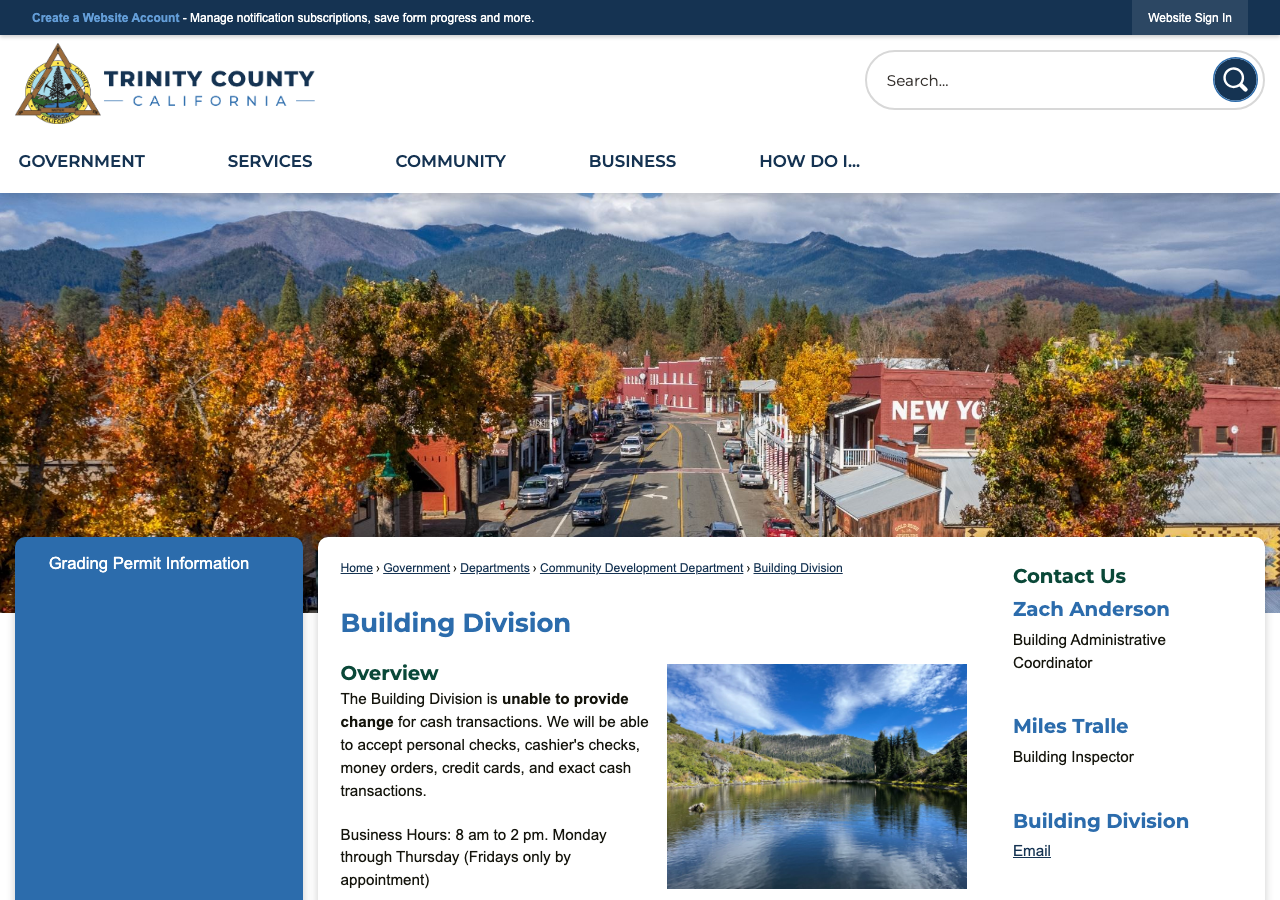
Average approval time — application to PTO
From the CPUC interconnection record. Bars show the average days taken each year; a year with no recorded projects is left blank rather than drawn as zero.